

Location and site plan of Çatalhöyük.

Introduction
Micromorphology (Courty et al. 1989) is becoming increasingly used as a means of investigating site formation processes and cultural activities by studying deposits in their precise depositional context, allowing us to look at how the material was deposited, as well as the properties of the material itself (Matthews et al. 1997).Certain properties are however not visible under the microscope. The research presented here aims to use a number of micro-analytical techniques to enhance and clarify the information from micromorphology, through the integration of high resolution phytolith, infra-red (FT-IR), and organic residue analyses by Gas Chromatography Mass Spectrometry (GC-MS).
Çatalhöyük: background and sampling rationale
Çatalhöyük, a Neolithic site in central Anatolia, is one of the most important early archaeological sites in the world. The deposits at the site, radiocarbon-dated to c. 7400–6200 BC span from the early Neolithic to the late Chalcolithic. The site covers more than 12 hectares and it is estimated that as many as 10 000 people may have lived there. First excavated by James Mellaart between 1961 and 1965, the site achieved international recognition, due to the size and density of the settlement and the wealth of the wall paintings and other artwork uncovered within the buildings. Excavations were renewed in the early 1990s under the direction of Ian Hodder. The site comprises two mounds – the early Neolithic east mound and the later Chalcolithic west mound.
Samples analysed span a large part of the site’s occupation, to allow a spatial and temporal comparison between deposits. Micromorphology is used to infer how the deposits were formed, whilst phytolith, residue and mineralogical analyses are used to analyse specific components that are difficult to identify through thin section analysis alone.
Large midden in the South Area.

The objectives are to use these integrated analyses to study the formation processes of middens at Çatalhöyük (Figure 1) and to investigate the daily lives of the people who produced these deposits. Middens are an important area of study at the site as they contain traces of diverse activities not seen in the ‘clean’ building deposits; furthermore, they are very extensive (Figure 2).
Results
Micromorphological analysis of the slides (Figure 3) shows a wide range of deposit types, with some interesting repetition of sequences which may relate to cyclical or seasonal activities. Deposit types have been classified on the basis of inclusion characteristics, which are seen to be a good indicator of activity types (Figure 4). Major inclusion types are plant material (charred grasses, woods, seeds, phytoliths and calcitic plant ash), dung (a variety of types can be identified including dung ash), aggregates (burnt and unburnt plasters, mud bricks and other aggregates) bone (burnt and unburnt with huge variations in size and preservation). Other inclusion types are mineral material (quartz, calcite, gypsum) and amorphous organic material.
There are variations in deposit preservation, largely related to the position of the midden in the mound, with samples closer to the mound surface showing frequent evidence of bioturbation from animals, root activity, and salt crystallisation. Differences can be seen between secondary and tertiary deposition, with the former showing a greater degree of orientation of some inclusions, whilst the latter shows a typical unorientated and random distribution, with an embedded related distribution. Micromorphological analysis has shown a large variation in the type, size and frequency of the different inclusion types.
Process of section to slide.

Midden components in thin section.

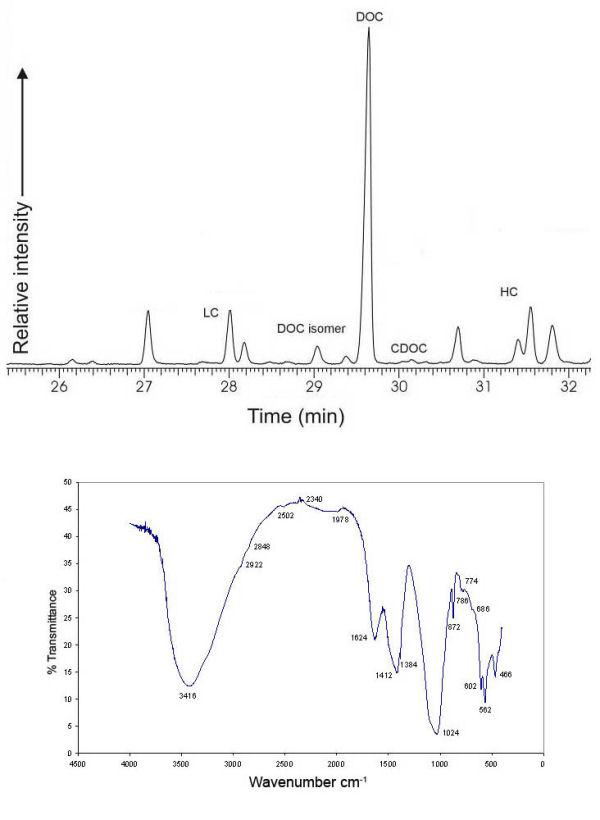
Several samples have been targeted for residue analysis by GC-MS. These samples include coprolites and mineralised hackberry remains. This enables identification of faecal material to species, which has important implications for interpretation of deposits containing this material (Bull et al. 1999). The majority of samples show the presence of a suite of faecal biomarkers, including those of human origin. Samples have been analysed for both sterols and bile acids. Sterols such as coprostanol indicate a faecal origin to the sample, whilst the type of bile acids present narrow this down to individual species, the presence of deoxycholic acid (DOC) indicating a human origin (Figure 5).
Sub samples have been analysed using FT-IR to investigate the mineralogy of microlayers and components to help characterise deposits. An example of the type of spectra obtained can be seen in Figure 5, showing a mix of calcite, quartz and phosphate minerals. Components such as coprolites have been analysed, and are found to contain high concentrations of phosphate in this and previous studies with FT-IR (Allen et al. 2002).
Above: GC trace showing human bile acids. Below: FT-IR spectrum of sample containing phosphate.

Examples of phytoliths extracted from middens.

Each thin microlayer of the micromorphology block has been sampled for phytoliths (Figure 6). Phytoliths are silicified plant cells, composed of amorphous silica (Reference PipernoPiperno 2006). The samples are processed to remove the deposit matrix, and the plant silica mounted for quantification and identification under a light microscope. These data are used in conjunction with thin section observations to help identify phytoliths, which are often difficult to see in thin section.
Phytoliths are an abundant and well preserved deposit at Çatalhöyük, but often it is difficult to fully identify types in thin section. High resolution sampling of individual layers and processing these for phytoliths allows a comparison to be made between phytolith assemblages and the depositional context of the layer from which they were extracted. Identification is through comparison with reference and published material.
By integrating these micro-analytical techniques it has been possible to infer cyclical patterns in deposits and activity types in the middens at Çatalhöyük. The significance of these patterns and their relation to other areas of research at the site are currently being investigated and will further enhance our understanding of the daily lives of the people who produced these deposits.
Acknowledgements
Thank you to the following: ÇatalhöyükResearch Project for supporting this research, NERC LSMSF for 2 grants for residue analysis, CCLRC for a Facility Development Project Grant to carry out work at the Daresbury Laboratory, Dr Bull (Bristol) for help with residue analysis, and Dr Rosen (UCL) and Dr Jenkins (Reading) for help with phytolith analysis.
This research was presented as a poster at the Sixth World Archaeological Congress, Dublin, 30 June - 4 July 2008.