






1 Introduction
Given a finite group G, let
$\mathcal N(G)$
 be the set of ordered pairs
$(g_1,g_2)\in G^2$
be the set of ordered pairs
$(g_1,g_2)\in G^2$
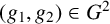 with the property that
$\langle g_1, g_2\rangle $
with the property that
$\langle g_1, g_2\rangle $
 is a nilpotent subgroup of G. Then,

expresses the probability that two randomly chosen elements of G generate a nilpotent subgroup. Guralnick and Wilson [Reference Guralnick and Wilson3] proved that if
$\nu (G)> \nu (\operatorname {\mathrm {Sym}}(3)) = \tfrac 12$
 , then G is nilpotent. However, the following question, raised in [Reference Jafarian Amiri, Madadiand and Rostami4], remains open: does
${\nu (G)> {1}/{12}}$
, then G is nilpotent. However, the following question, raised in [Reference Jafarian Amiri, Madadiand and Rostami4], remains open: does
${\nu (G)> {1}/{12}}$
 imply that G is solvable? In this note, we provide an affirmative answer.
Theorem 1.1. Let G be a finite group. If
$\nu (G)> {1}/{12},$
 then G is solvable.
Since
$\nu (\mathrm {Alt}(5))= {1}/{12},$
 the previous result is sharp.
2 Proof of Theorem 1.1
Let us start this section with a couple of definitions.
Definition 2.1. Let G be a finite group, N a normal subgroup of G and
$g_1, g_2\in G.$
 We define

Definition 2.2. Let S be a finite nonabelian simple group. We identify S with the subgroup of its inner automorphisms and we define

Proposition 2.3. Assume that a finite group G contains a unique minimal normal subgroup, say N, and that N is nonabelian. Then,

where S is a composition factor of
$N.$

Proof. Assume that
$N=S^u,$
 with
$u\in \mathbb N$
with
$u\in \mathbb N$
 . We may identify G with a subgroup of the wreath product
$\operatorname {\mathrm {Aut}} S\wr \operatorname {\mathrm {Sym}}(u).$
. We may identify G with a subgroup of the wreath product
$\operatorname {\mathrm {Aut}} S\wr \operatorname {\mathrm {Sym}}(u).$
 In this identification, any element of G can be written in the form
$(\alpha _1,\ldots ,\alpha _u)\rho ,$
In this identification, any element of G can be written in the form
$(\alpha _1,\ldots ,\alpha _u)\rho ,$
 with
$\alpha _1,\ldots ,\alpha _u \in \operatorname {\mathrm {Aut}} S$
with
$\alpha _1,\ldots ,\alpha _u \in \operatorname {\mathrm {Aut}} S$
 and
$\rho \in \operatorname {\mathrm {Sym}}(u)$
and
$\rho \in \operatorname {\mathrm {Sym}}(u)$
 . Moreover, we identify S with the inner automorphism group
$\operatorname {\mathrm {Inn}}(S)$
. Moreover, we identify S with the inner automorphism group
$\operatorname {\mathrm {Inn}}(S)$
 and, therefore, we can write
$N=\{(s_1,\ldots ,s_u)\mid s_1,\ldots ,s_u \in S\}.$
and, therefore, we can write
$N=\{(s_1,\ldots ,s_u)\mid s_1,\ldots ,s_u \in S\}.$

Now, consider
$g_1,g_2\in G$
 given by

Write

as products of disjoint cyclic permutations, and assume that 1 belongs to the supports of
$\sigma _1$
 and
$\tau _1.$
and
$\tau _1.$
 Suppose

Let

The map
$\phi \colon X\to \operatorname {\mathrm {Aut}} S$
 sending
$(\alpha _1,\ldots ,\alpha _u)\rho $
sending
$(\alpha _1,\ldots ,\alpha _u)\rho $
 to
$\alpha _1$
to
$\alpha _1$
 is a group homomorphism. Now, let
$n_1=(s_1,\ldots ,s_u), n_2=(t_1,\ldots ,t_u) \in N$
is a group homomorphism. Now, let
$n_1=(s_1,\ldots ,s_u), n_2=(t_1,\ldots ,t_u) \in N$
 . Then,
$(n_1g_1)^e, (n_2g_2)^f \in X$
. Then,
$(n_1g_1)^e, (n_2g_2)^f \in X$
 and
and

Let

If
$(s_1,t_1)\notin \mathcal N_{\gamma _1,\gamma _2}(\operatorname {\mathrm {Aut}} S,S),$
 then
then

is not nilpotent. In particular,
$\langle n_1g_1, n_2g_2\rangle $
 is not nilpotent. Thus, given
$s_i, t_j$
is not nilpotent. Thus, given
$s_i, t_j$
 for
$i\neq 1$
for
$i\neq 1$
 and
$j\neq 1$
and
$j\neq 1$
 , there are at least

choices for
$s_1$
 and
$t_1$
and
$t_1$
 such that
$\langle n_1g_1, n_2g_2\rangle $
such that
$\langle n_1g_1, n_2g_2\rangle $
 is not nilpotent. It follows that there are at least
$|S|^{2u}(1-\tilde \nu (S))$
is not nilpotent. It follows that there are at least
$|S|^{2u}(1-\tilde \nu (S))$
 pairs
$(n_1,n_2)\in N^2$
pairs
$(n_1,n_2)\in N^2$
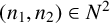 such that
$\langle n_1g_1,n_2g_2\rangle $
such that
$\langle n_1g_1,n_2g_2\rangle $
 is not nilpotent. This is equivalent to saying that
$\nu _{g_1,g_2}(G,N)\leq \tilde \nu (S)$
is not nilpotent. This is equivalent to saying that
$\nu _{g_1,g_2}(G,N)\leq \tilde \nu (S)$
 for every
$(g_1,g_2) \in G^2.$
for every
$(g_1,g_2) \in G^2.$
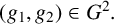 Hence
Hence

and, consequently,
$\nu (G)\leq \tilde \nu (S).$

Proposition 2.4. If S is a finite nonabelian simple group, then
$\tilde \nu (S)\leq \tilde \nu (\mathrm {Alt}(5))= {1}/{12}$
 , with equality only if
$S=\mathrm {Alt}(5).$
, with equality only if
$S=\mathrm {Alt}(5).$

Proof. Given
$a_1,a_2 \in \operatorname {\mathrm {Aut}} S$
 , let
$\mathcal P_{a_1,a_2}(S)=\{(s_1,s_2)\in S^2\mid S\leq \langle s_1a_1,s_2a_2\rangle \}$
, let
$\mathcal P_{a_1,a_2}(S)=\{(s_1,s_2)\in S^2\mid S\leq \langle s_1a_1,s_2a_2\rangle \}$
 . We define

Clearly, if
$(s_1,s_2) \in \mathcal P_{a_1,a_2}(S),$
 then
$\langle s_1a_1, s_2a_2\rangle $
then
$\langle s_1a_1, s_2a_2\rangle $
 is not nilpotent and, therefore,
$(s_1,s_2) \notin \mathcal N_{a_1,a_2}(\operatorname {\mathrm {Aut}} S,S).$
is not nilpotent and, therefore,
$(s_1,s_2) \notin \mathcal N_{a_1,a_2}(\operatorname {\mathrm {Aut}} S,S).$
 Thus,
Thus,

for every
$a_1, a_2\in \operatorname {\mathrm {Aut}} S$
 and, therefore,

Results of Dixon [Reference Dixon1], Kantor and Lubotzky [Reference Kantor and Lubotzky5], and Liebeck and Shalev [Reference Liebeck and Shalev6] establish that
$\tilde \pi (S) \to 1$
 as
$|S| \to \infty .$
as
$|S| \to \infty .$
 Explicit lower bounds for
$\tilde \pi (S)$
Explicit lower bounds for
$\tilde \pi (S)$
 are given in [Reference Menezes, Quick and Roney-Dougal7], where, in particular, all nonabelian simple groups S with
$\tilde \pi (S)\leq 9/10$
are given in [Reference Menezes, Quick and Roney-Dougal7], where, in particular, all nonabelian simple groups S with
$\tilde \pi (S)\leq 9/10$
 are listed. Since
$1-9/10=1/10>1/12$
are listed. Since
$1-9/10=1/10>1/12$
 , this is not enough for our purposes, but more detailed information can be found in [Reference Menezes8]. In particular, combining [Reference Menezes8, Table 5.1, Theorem 6.01 and Lemma 7.1.1], it turns out that if S is not an alternating group, then either
$\tilde {\pi }(S)> {11}/{12}$
, this is not enough for our purposes, but more detailed information can be found in [Reference Menezes8]. In particular, combining [Reference Menezes8, Table 5.1, Theorem 6.01 and Lemma 7.1.1], it turns out that if S is not an alternating group, then either
$\tilde {\pi }(S)> {11}/{12}$
 (and, consequently,
$\tilde {\nu }(S) < {1}/{12})$
(and, consequently,
$\tilde {\nu }(S) < {1}/{12})$
 or S belongs to the family
$\mathcal S$
or S belongs to the family
$\mathcal S$
 of the following groups:

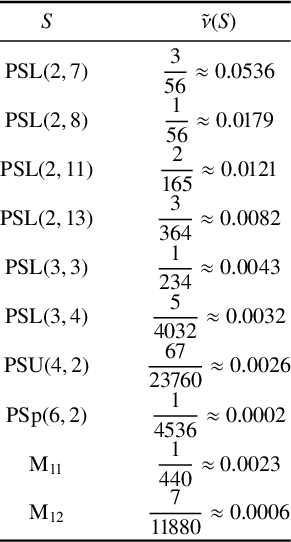
The GAP Library of Tables of Marks [9] contains the tables of marks of all almost simple groups whose socle belongs to
$\mathcal S$
 and, using them, the exact value of
$\tilde {\nu }(S)$
and, using them, the exact value of
$\tilde {\nu }(S)$
 , reported in Table 1, can be easily obtained (see Section 3 for more details).
$\tilde \nu (S)$
 for
$S\in \mathcal S$
for
$S\in \mathcal S$
 .
.

Table 1 Long description
The table has two columns. The left column is labeled bold S and lists group names: P S L open parenthesis 2 comma 7 close parenthesis, P S L open parenthesis 2 comma 8 close parenthesis, P S L open parenthesis 2 comma 11 close parenthesis, P S L open parenthesis 2 comma 13 close parenthesis, P S L open parenthesis 3 comma 3 close parenthesis, P S L open parenthesis 3 comma 4 close parenthesis, P S U open parenthesis 4 comma 2 close parenthesis, P S p open parenthesis 6 comma 2 close parenthesis, M sub 11, and M sub 12. The right column is labeled nu tilde of bold S and lists the corresponding values: 3 all over 56 is approximately 0.0536, 1 all over 56 is approximately 0.0179, 2 all over 165 is approximately 0.0121, 3 all over 364 is approximately 0.0082, 1 all over 234 is approximately 0.0043, 5 all over 4032 is approximately 0.0032, 67 all over 23760 is approximately 0.0026, 1 all over 4536 is approximately 0.0002, 1 all over 440 is approximately 0.0023, and 7 all over 11880 is approximately 0.0006. Each value is aligned with its group name in the same row.
Now, assume that
$S=\mathrm {Alt}(n)$
 . Using GAP and, in particular, the library of tables of marks, it can be checked that

Now, suppose
$n\geq 10$
 and, for
$1\leq i\leq n,$
and, for
$1\leq i\leq n,$
 let
let

Consider
$a_1,a_2\in \operatorname {\mathrm {Sym}}(n)$
 and let
$Y_{a_1,a_2}=\langle a_1,a_2,\mathrm {Alt}(n)\rangle .$
and let
$Y_{a_1,a_2}=\langle a_1,a_2,\mathrm {Alt}(n)\rangle .$
 Moreover, let

and, for
$1\leq i\leq n$
 , let
, let

Notice that
$\Omega _0, \Omega _1,\ldots ,\Omega _n$
 are disjoint subsets of
$(\mathrm {Alt}(n))^2$
are disjoint subsets of
$(\mathrm {Alt}(n))^2$
 and
and

It follows that

For
$1\leq i\leq n,$
 there exist
$s_1, s_2\in \mathrm {Alt}(n)$
there exist
$s_1, s_2\in \mathrm {Alt}(n)$
 such that
$\langle s_1a_1, s_2a_2\rangle \leq X_i$
such that
$\langle s_1a_1, s_2a_2\rangle \leq X_i$
 and
and

Moreover,

Hence,

It follows from [Reference Menezes, Quick and Roney-Dougal7] that if
$m\geq 9$
 , then
$\tilde \pi (\mathrm {Alt}(m))\geq \tilde \pi (\mathrm {Alt}(9))= {15403}/{18144}$
, then
$\tilde \pi (\mathrm {Alt}(m))\geq \tilde \pi (\mathrm {Alt}(9))= {15403}/{18144}$
 and, therefore, for
$n\geq 10,$
and, therefore, for
$n\geq 10,$


Proof of Theorem 1.1
Assume that G is a nonsolvable finite group. Then, G admits a nonabelian chief factor
$X/Y$
 . In particular,
$G/C_G(X/Y)$
. In particular,
$G/C_G(X/Y)$
 has a unique minimal normal subgroup and this minimal normal subgroup is isomorphic to
$X/Y.$
has a unique minimal normal subgroup and this minimal normal subgroup is isomorphic to
$X/Y.$
 It can be easily proved that
$\nu (G)\leq \nu (G/N)$
It can be easily proved that
$\nu (G)\leq \nu (G/N)$
 for every normal subgroup N of G (see, for example, [Reference Jafarian Amiri, Madadiand and Rostami4, Lemma 2.1]). This implies that
$\nu (G)\leq \nu (G/C_G(X/Y)).$
for every normal subgroup N of G (see, for example, [Reference Jafarian Amiri, Madadiand and Rostami4, Lemma 2.1]). This implies that
$\nu (G)\leq \nu (G/C_G(X/Y)).$
 Moreover, by Proposition 2.3,
$\nu (G/C_G(X/Y))\leq \tilde \nu (S),$
Moreover, by Proposition 2.3,
$\nu (G/C_G(X/Y))\leq \tilde \nu (S),$
 where S is a composition factor of
$X/Y.$
where S is a composition factor of
$X/Y.$
 Since, by Proposition 2.4,
$\tilde \nu (S)\leq 1/12$
Since, by Proposition 2.4,
$\tilde \nu (S)\leq 1/12$
 , we conclude

3 Details on the computation of
$\tilde {\nu }(S)$


To compute the exact value of
$\tilde {\nu }(S)$
 , with
$S \in \mathcal {S}$
, with
$S \in \mathcal {S}$
 , the following observation is useful.
Lemma 3.1. Let N be a normal subgroup of a finite group G and let
$\Omega $
 be the set of pairs
$(g_1, g_2) \in G^2$
be the set of pairs
$(g_1, g_2) \in G^2$
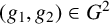 such that
$\langle g_1, g_2 \rangle N = G$
such that
$\langle g_1, g_2 \rangle N = G$
 . Then, the value of
$\nu _{g_1, g_2}(G, N)$
. Then, the value of
$\nu _{g_1, g_2}(G, N)$
 is the same for every choice of
$(g_1, g_2) \in \Omega $
is the same for every choice of
$(g_1, g_2) \in \Omega $
 .
.
Proof. Denote by
$\mathcal H$
 the set of 2-generated subgroups H of G that are nilpotent and such that
$G=HN$
the set of 2-generated subgroups H of G that are nilpotent and such that
$G=HN$
 . Assume that
$(g_1,g_2)\in \Omega $
. Assume that
$(g_1,g_2)\in \Omega $
 and, for every
$H\in \mathcal H$
and, for every
$H\in \mathcal H$
 , let
$\Delta (g_1,g_2,H)$
, let
$\Delta (g_1,g_2,H)$
 be the set of
$(n_1,n_2)$
be the set of
$(n_1,n_2)$
 such that
$H=\langle n_1g_1,n_2g_2\rangle .$
such that
$H=\langle n_1g_1,n_2g_2\rangle .$
 Then,
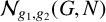
$\mathcal N_{g_1,g_2}(G,N)$
Then,
$\mathcal N_{g_1,g_2}(G,N)$
 is the disjoint union of the subsets
$\Delta (g_1,g_2,H)$
is the disjoint union of the subsets
$\Delta (g_1,g_2,H)$
 , with H ranging over
$\mathcal H.$
, with H ranging over
$\mathcal H.$

Fix
$H\in \mathcal H$
 . Since
$HN=G,$
. Since
$HN=G,$
 there exist
$n_1,n_2\in N$
there exist
$n_1,n_2\in N$
 such that
$g_1=n_1h_1$
such that
$g_1=n_1h_1$
 and
$g_2=n_2h_2$
and
$g_2=n_2h_2$
 , and therefore,
$(n_1^{-1},n_2^{-1})\in \Delta (g_1,g_2,H)$
, and therefore,
$(n_1^{-1},n_2^{-1})\in \Delta (g_1,g_2,H)$
 . Moreover,

It follows from the main result in [Reference Gaschütz2] that
$|\Delta (g_1,g_2,H)|/|N\cap H|^2$
 does not depend on the choice of
$(g_1,g_2)$
does not depend on the choice of
$(g_1,g_2)$
 and coincides with the conditional probability that two randomly chosen elements of H generate H given that they generate H modulo
$H\cap N.$
and coincides with the conditional probability that two randomly chosen elements of H generate H given that they generate H modulo
$H\cap N.$
 Consequently, the cardinality of the sets
$\Delta (g_1,g_2,H)$
Consequently, the cardinality of the sets
$\Delta (g_1,g_2,H)$
 , and hence also that of their disjoint union, does not depend on the choice of
$(g_1, g_2)$
, and hence also that of their disjoint union, does not depend on the choice of
$(g_1, g_2)$
 .
.
Given
$S \in \mathcal {S}$
 , for every almost simple group G with
$\mathrm {soc}(G) = S$
, for every almost simple group G with
$\mathrm {soc}(G) = S$
 , we use the table of marks of G to determine the nilpotent 2-generated subgroups of G that supplement
$\mathrm {soc}(G)$
, we use the table of marks of G to determine the nilpotent 2-generated subgroups of G that supplement
$\mathrm {soc}(G)$
 and, for each such subgroup, we compute the number of ordered pairs that generate it. Let
$\tau (G, S)$
and, for each such subgroup, we compute the number of ordered pairs that generate it. Let
$\tau (G, S)$
 be the sum of the numbers thus obtained, divided by
$|S|^2$
be the sum of the numbers thus obtained, divided by
$|S|^2$
 and by the number of pairs that generate
$G/S$
and by the number of pairs that generate
$G/S$
 . The resulting number coincides with
$\nu _{g_1, g_2}(G, S)$
. The resulting number coincides with
$\nu _{g_1, g_2}(G, S)$
 , where
$\langle g_1, g_2 \rangle S = G$
, where
$\langle g_1, g_2 \rangle S = G$
 . Finally,
$\tilde {\nu }(S)$
. Finally,
$\tilde {\nu }(S)$
 is the maximum of the values
$\tau (G, S)$
is the maximum of the values
$\tau (G, S)$
 as G ranges over the almost simple groups with socle S.
The case which requires more attention is when
$S=\text {PSL}(3,4)$
 . In this case,
${\mathrm {Out}\,S\cong C_2\times \operatorname {\mathrm {Sym}}(3)}$
. In this case,
${\mathrm {Out}\,S\cong C_2\times \operatorname {\mathrm {Sym}}(3)}$
 and there are 6 different subgroups
$S\leq G\leq \operatorname {\mathrm {Aut}} S$
and there are 6 different subgroups
$S\leq G\leq \operatorname {\mathrm {Aut}} S$
 such that
$G/S$
such that
$G/S$
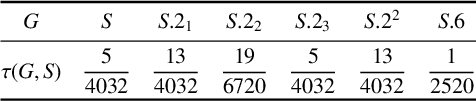
 is nilpotent. The values of
$\tau (G,S)$
is nilpotent. The values of
$\tau (G,S)$
 are as in Table 2.
$\tau (G,S)$
 when
$\operatorname {\mathrm {soc}}(G)=\text {PSL}(3,4)$
when
$\operatorname {\mathrm {soc}}(G)=\text {PSL}(3,4)$
 .
.

Table 2 Long description
The table header lists columns as bold G, S, S dot 2 sub 1, S dot 2 sub 2, S dot 2 sub 3, S dot 2 squared, and S dot 6. The first row under bold G is tau of G comma S. The tau values for each subgroup, from left to right, are as follows: S is 5 all over 4032, S dot 2 sub 1 is 13 all over 4032, S dot 2 sub 2 is 19 all over 6720, S dot 2 sub 3 is 5 all over 4032, S dot 2 squared is 13 all over 4032, and S dot 6 is 1 all over 2520. The table applies when the socle of G equals P S L open parenthesis 3 comma 4 close parenthesis.
In particular,
$\tilde \nu (\text {PSL}(3,4))={13}/{4032}.$





 Open access

