

The plain of Kazerun and Tall-e Jidun
Kazerun county and city are located to the west of Fars province, with Mamasani and Behbehan to the north, Shiraz to the east and north-east, Firuzabad to the south-east and parts of Borazjan and Bushehr counties to the west and south-west (Figure 1). The terrain is mountainous: Kazerun is surrounded by high mountains running north-west to south-east, as is the case for other regions in the province of Fars (Reference MozafarianMozafarian 1995: 65).
The mound at Jidun (Tall-e Jidun) is one of the most important mounds in Kazerun. It lies 1km from the causeway linking Kazerun to Naserabad, 500m from the village of Naserabad. Its coordinates are: E 51° 39' 56" and N 29° 35' 28"; altitude is 100m above sea level. The mound is 280m long, 270m wide and 15m high (Figure 2). The surface of the mound is ploughed annually and used to grow wheat. The causeway towards Naserabad crosses the northern part of the mound, and pottery was revealed as a result of this damage.
Location of Kazerun and Tall-e Jidun.

Tall-e Jidun seen from the north.

Contour map of Tall-e Jidun showing grid.

Systematic survey and material recovered
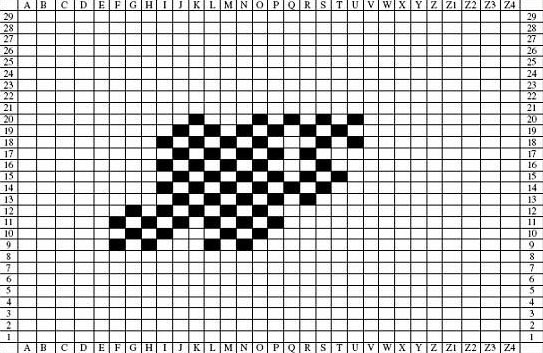
First a contour map of the mound was prepared at a scale of 1/1000. The surface of the mound was divided into squares measuring 10×10m and subjected to random sampling. The western side of the grid was conventionally assigned numbers (with number 1 southernmost) and the southern side was assigned letters (with letter A the westernmost) (Figure 3).
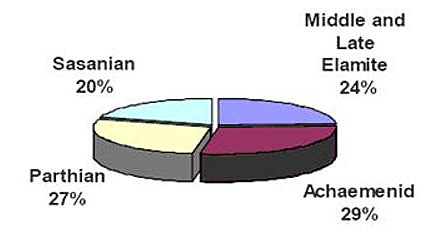
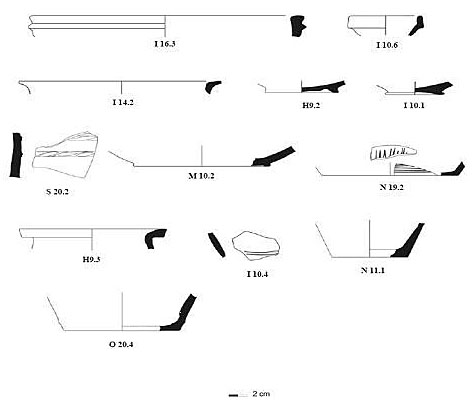
Out of a total of 255 pottery fragments collected, 56 sherds (24 per cent) were identified as belonging to the Elamite period, 65 (29 per cent) to the Achaemenid period, 63 (27 percent) to the Parthian period and 47 (20 per cent) to the Sasanian period (Figure 4). Diagnostic sherds are described in Table 1. Overall, finds occurred in greater densities in the northern part of the mound (Figure 5).
Proportions of ceramic per period at Tall-e Jidun.

The squares sampled at Tall-e Jidun.

The Elamite period
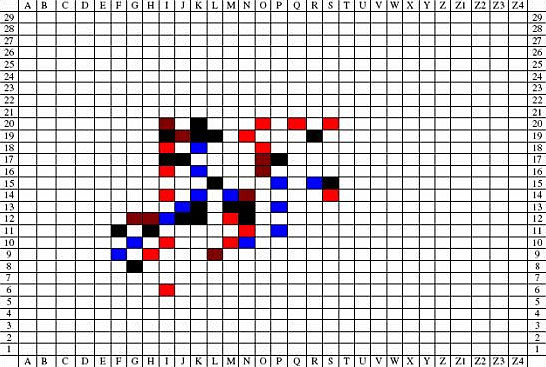
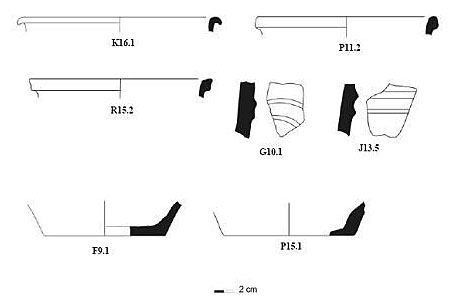
The distribution of the Elamite pottery shows that it is concentrated in the central and southern part of the mound (red on Figure 6). The greatest number of sherds of this period came from square O18 (seven sherds). The Middle Elamite pottery (Figure 7) is comparable to that recovered at Susa (Reference GascheGasche 1973: Plate 4.17) and Malyan (Reference NickersonNickerson 1983: Figure 48b). Four pottery sherds of the Late Elamite period are similar to examples found at Tall-e Nurabad (Potts & Roustaei 2006: Figure 3.130 TNP.2336), Susa (Reference GascheGasche 1973: Plate 4.17) and Choghazanbil (Reference GhirshmanGhirshman 1966-70: Plate XGV.1058).
Middle and Late Elamite (red), Achaemenid (blue), Parthain (black) and Sasanian (brown) pottery distribution at Tall-e Jidun.

Pottery of the Middle and Late Elamite period.

Achaemenid pottery.

The Achaemenid period
The pottery attributed to the Achaemenid period is prevalent in the central and southern part of the mound (blue on Figure 6). The largest number of sherds of this period came from square G10 (eight sherds). The Achaemenid pottery (Figure 8) is comparable to that of Pasargad (Reference StronachStronach 1978: Plate 117.20 & 119.24), Persepolis (Reference SchmidtSchmidt 1957: Plate 73.7), Tepe Suruvan (Atarashi & Horiuchi 1963: Plate XVII.1), Tall-e Nurabad (Potts & Roustaei 2006: Figure 3.134.TNP.214) and Dasht-e Nurabad.
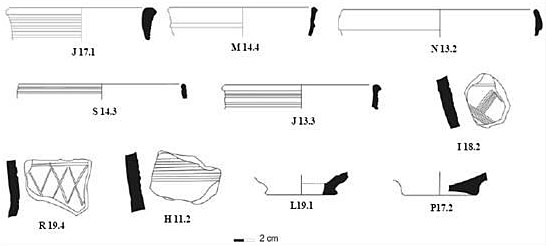
Parthian pottery.

The Parthian period
Parthian pottery was mainly found in the northern, western and central parts of the mound (black on Figure 6). Most of the sherds from this period came from square N13 (eight sherds). Pottery finds of this period (Figure 9) are comparable to those from Ghale Yazdgerd (Keall & Keall 1981: Figure 19.22), Ghale Zahak (Reference KleissKleiss 1973: Abb. 22.8 & 14) and Bisotun (Reference KleissKleiss 1970: Abb. 25.17).
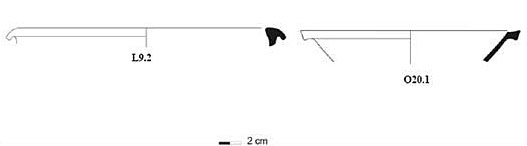
Sasanian pottery.

The Sasanian period
There are few pottery finds attributed to the Sasanian period, loosely distributed in the northern and central parts of the mound (black on Figure 6). Pottery from this period (Figure10) is comparable to examples from Dasht-e Nurabad (Potts & Roustaei 2006: Figure 6.28.MSP.533) and Ghasre Abu Nasr (Reference WhitcombWhitcomb 1985: Figure 57.U).
Conclusion
From the ceramic recovered in the systematic surface survey, it appears that occupation over a number of periods occurred in the central and northern parts of the mound. A comparison of Tall-e Jidun with other sites in the provinces of Fars and Khuzestan and in the northwest would suggest that the site was occupied continuously from the Middle Elamite period (second millennium BC) to the Sasanian period. The distribution of the pottery would further suggest that the greatest extent of occupation was in the Achaemenid period.