




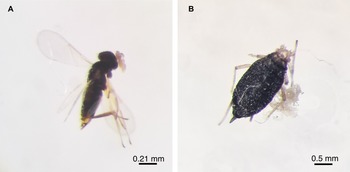
Rice root aphids, Rhopalosiphum rufiabdominale (Sasaki, 1899) (Hemiptera: Aphididae), and cannabis aphids, Phorodon cannabis Passerini, 1860 (Hemiptera: Aphididae), are pests of commercial cannabis plants, Cannabis sativa Linnaeus (Cannabaceae) (Cranshaw et al. Reference Cranshaw, Halbert, Favret, Britt and Miller2018; Lagos-Kutz et al. Reference Lagos-Kutz, Potter, DiFonzo, Russell and Hartman2018; Cranshaw and Wainwright-Evans Reference Cranshaw and Wainwright-Evans2020). Rice root aphids feed on cannabis roots (Cranshaw and Wainwright-Evans Reference Cranshaw and Wainwright-Evans2020) and foliage (M.O., unpublished data), whereas cannabis aphids feed only on cannabis foliage (Cranshaw et al. Reference Cranshaw, Halbert, Favret, Britt and Miller2018; Lemay and Scott-Dupree Reference Lemay and Scott-Dupree2022). Hymenopteran parasitoids, such as Aphidius spp. Esenbeck, 1818 (Hymenoptera: Braconidae) (Cameron et al. Reference Cameron, Hill, Teulon, Stufkens, Connolly and Walker2013; Paynter and Teulon Reference Paynter and Teulon2019) and Aphelinus spp. (Haldeman, 1851) (Hymenoptera: Aphelinidae) (Mueller et al. Reference Mueller, Blommers and Mols1992; Bergh and Stallings Reference Bergh and Stallings2016), are widely used as biological control agents of aphids (Boivin et al. Reference Boivin, Hance and Brodeur2012; McCormick et al. Reference McCormick, Unsicker and Gershenzon2012). Aphidius colemani Viereck, 1912, Aphidius ervi Haliday, 1834, Aphidius matricariae Haliday, 1834 (all Hymenoptera: Braconidae), and Aphelinus abdominalis (Dalman, 1820) (Hymenoptera: Aphelinidae) are all biological control agents of cannabis aphids, but A. ervi and A. matricariae are deemed most suitable for biocontrol of this pest (Lemay and Scott-Dupree Reference Lemay and Scott-Dupree2022). Aphidius matricariae, A. colemani, and A. abdominalis may also attack the alate morph of the rice root aphid (Lemay and Scott-Dupree Reference Lemay and Scott-Dupree2022), but their effectiveness is yet to be investigated. To study potential control tactics for rice root aphids and cannabis aphids in commercial cannabis production, rice root aphids were reared on potted rye plants, Secale cereale Linnaeus (Poaceae), and cannabis aphids were reared on potted cannabis plants in an access-controlled greenhouse at Simon Fraser University (Burnaby, British Columbia, Canada). In December 2023, hymenopteran parasitoids found their way into the rice root aphid colony and decimated it. Using taxonomic keys (Takada Reference Takada2002; Chen and Li Reference Chen and Li2016), we assigned the parasitoids to the genus Aphelinus and consulted taxonomic experts John Huber and Owen Lonsdale at the National Identification Service, Canadian National Collection of Insects, Arachnids, and Nematodes (Ottawa, Ontario, Canada) for species-level identification. Based on knowledge of where and how the specimens were obtained, and by using a European key and matching our submitted specimens with those identified by Aphelinidae expert Mohammad Hayat, of Aligarh Muslim University (Aligarh, India), the parasitoid was determined to be Aphelinus varipes (Förster, 1841) (Hymenoptera: Aphelinidae) (Fig. 1A).
Photos of A, the hymenopteran parasitoid Aphelinus varipes and B, a mummified (parasitised) cannabis aphid, Phorodon cannabis.

We undertook a study to determine and quantify the ability of A. varipes collected from our greenhouse to parasitise rice root aphids and cannabis aphids. Rice root aphids were reared on potted rye plants in BugDorms (600 × 600 × 600 mm; 2120F Insect Rearing Tent; MegaView Science Co., Taichung City, Taiwan) in a greenhouse at 24 ± 8 °C and 47% relative humidity and under a 14:10–hour light:dark photoperiod produced by metal halide lamps (Philips, Markham, Ontario, Canada). Cannabis aphids were reared on potted cannabis plants in BugDorms at 20 ± 5 °C and 50% relative humidity and under a 18:6-hour light:dark photoperiod produced by a halide lamp and daylight and grow-light fluorescent tubes (F32T8/TL 965, Philips; F32T8/PL, Standard Products Inc., Saint-Laurent, Quebec, Canada). Third- or fourth-instar aphid nymphs were used in experiments, as described below. Aphelinus varipes was reared in a separate building in BugDorms fitted with rice root aphid–infested rye plants and maintained at 20 ± 5 °C and under a 14:10–hour light:dark photoperiod that was produced by fluorescent grow lights. All parasitoids used in the experiments had prior access to aphid hosts, typically engaging in host feeding (Röhne Reference Röhne2002).
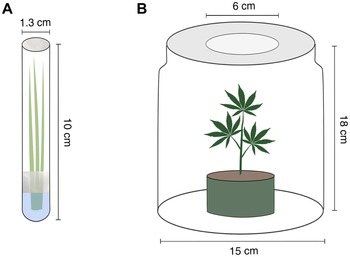
We tested whether percentage parasitism by female A. varipes differed by host group size, as Ismail et al. (Reference Ismail, Zanolli, Muratori and Hance2021) had reported for pea aphids, Acyrthosiphon pisum (Harris, 1776) (Hemiptera: Aphididae). Three one-week-old rye seedlings (∼75 mm tall) were bundled at their base with a cotton strip (20 × 50 mm) and inserted into a glass test tube (13 × 100 mm; Pyrex®, Corelle Brands Ltd., Rosemont, Illinois, United States of America) filled with 2 mL of water (Fig. 2A). The cotton strip prevented the drowning of aphids later added to the test tubes, which were plugged with cotton (MedPro®; Thermo Fisher Scientific Company, Waltham, Massachusetts, United States of America) to prevent insect escape. Groups of 1, 2, 5, or 10 third- to fourth-instar rice root aphid nymphs and one female A. varipes were introduced into each tube containing the rye seedlings. Tubes containing insects were held at room temperature (20 ± 6 °C) and 40 ± 10% relative humidity, with a 14:10–hour light:dark photoperiod produced by fluorescent lights. All female parasitoids had been collected from our parasitoid-rearing colony and had been observed copulating when confined with a male. After seven days, mummified (parasitised) and nonparasitised aphids (including offspring) were counted. Aphelinus varipes could not be found in two replicates, which therefore were excluded from the experiment. To confirm that aphids were mummified and not just discoloured, aphids deemed mummified in each replicate were brushed into 1.5-mL centrifuge tubes loosely closed with a cotton ball to allow air exchange. The tubes were kept in the dark in an incubator (Precision™; Thermo Fisher Scientific) at 24 ± 2 °C with water pans to maintain 50% relative humidity. Aphids that were confirmed mummified, and all emerged parasitoids, were recorded after 21 days.
Graphical illustrations of the experimental design for testing parasitism of A, rice root aphids, and B, cannabis aphids by the hymenopteran parasitoid Aphelinus varipes. For each experimental replicate, 1, 2, 5, or 10 rice root aphids were introduced into a glass tube fitted with trimmed rye seedlings, 10 cannabis aphids were introduced into a glass jar fitted with a potted rye plant, and a single female parasitoid was added to each aphid group. Parasitised aphids (mummies) were counted first at day 7, and mummification was verified at day 21.

We also investigated whether female A. varipes parasitise cannabis aphids. In each of 10–12 replicates, a potted cannabis plant (“Mac” cultivar; pot size: 100 mm diameter × 73 mm height) was inserted into a glass jar (150 mm diameter × 180 mm height; Fig. 2B), and 10 third- to fourth-instar cannabis aphid nymphs and one female A. varipes were released from 1.5-mL centrifuge tubes, which were placed on the soil surface. The jars were sealed with metal lids, each of which had a 60-mm central hole covered with parafilm (10 × 10 cm, Amcor, Neenah, Wisconsin, United States of America). After 24 hours, the parafilm was replaced with mesh cloth (150 × 150 mm) to allow air ventilation and to prevent mould formation. Jars were illuminated under a 18:6–hour light:dark photoperiod with fluorescent lights. The 18-hour photophase was four hours longer than that used for parasitoid rearing but was required as a stipulation in the research permit from the Canadian government to ensure that cannabis plants remained in the vegetative stage. After seven days, the mummified aphids and nonparasitised aphids (including offspring) were counted in each replicate. Mummified cannabis aphids (Fig. 1B) were processed as described above for mummified rice root aphids.
For rice root aphids and cannabis aphids, percentage parasitism for each replicate tube was calculated by dividing the number of mummified aphids on day 21 by the initial number of live aphids on day 1 (1, 2, 5, or 10 rice root aphids; 10 cannabis aphids; n = 10 each) and multiplying the quotient by 100. Mean percentage parasitism (± standard error) for all replicates was then calculated for each group size.
We found that A. varipes parasitised and completed development on both rice root aphid and cannabis aphid hosts. The parasitism rate for cannabis aphids was only 3%. This relatively low percentage of parasitism may have been due, in part, to defensive characteristics (e.g., trichomes, terpenes) of the cannabis plants (Bar and Shtein Reference Bar and Shtein2019). Although the percentage of rice root aphid parasitism was low at lower host densities, it increased with increasing numbers of aphids in tubes, peaking at 21% for the 10 aphid/tube treatment (Table 1). If F1 aphids from unparasitised parents hatched and were parasitised during the experiment, we would have slightly overestimated parasitism rates of our starting experimental cohort. However, this potential overestimation is not critically important because our primary objective was to determine whether A. varipes parasitises rice root aphids, cannabis aphids, or both, not to determine parasitism efficiency at different host densities. Higher rates of parasitism in larger groups of aphids (Table 1) may be attributed to elevated emission of herbivore-induced plant volatiles (Ismail et al. Reference Ismail, Zanolli, Muratori and Hance2021), which may have alerted the parasitoids about the presence of multiple potential hosts. However, the plant-volatile release induced by 10 aphids likely would have been insufficient to attract parasitoids. Powell et al. (Reference Powell, Pennacchio, Poppy and Tremblay1998) found that 40 pea aphids, A. pisum, feeding on bean plants for 72 hours, were required to elicit upwind flight of A. ervi.
Mean percent (%) parasitism of rice root aphids and cannabis aphids exposed to a single female parasitoid Aphelinus varipes

As a generalist endoparasitoid (Hopper et al. Reference Hopper, De Farias, Woolley, Heraty and Britch2005), A. varipes has been well studied for biological control. This parasitoid can develop in various aphid hosts, including green peach aphids, Myzus persicae (Sulzer, 1776) (Acheampong et al. Reference Acheampong, Gillespie and Quiring2012; Ali et al. Reference Ali, Naseem, Zhang, Pan, Zhang and Liu2022); cotton aphids, Aphis gossypii Glover, 1877 (Röhne Reference Röhne2002); soybean aphids, Aphis glycines Matsumura, 1917 (Yashima and Murai Reference Yashima and Murai2013); small bramble aphids, Aphis ruborum (Börner and Schilder, 1932) (Riddick et al. Reference Riddick, Miller, Owen, Bauchan, Schmidt and Gariepy2019); and bird cherry-oat aphids, Rhopalosiphum padi (Linnaeus, 1758) (Christiansen-Weniger Reference Christiansen-Weniger1994; Prinsloo Reference Prinsloo2000). Our results demonstrate that A. varipes can parasitise rice root aphids and cannabis aphids and may be the first report of A. varipes parasitising a Phorodon species. Aphelinus varipes should be investigated further for its biocontrol potential against rice root aphids and cannabis aphids.
Acknowledgements
The authors thank the following individuals for their assistance and support with the study: Henry Murillo for supplying a start-up colony of rice root aphids; John Huber and Owen Lonsdale for parasitoid identification; Regine Gries for processing permits; Audrey Lau, Colin Fairburn, Zoya Haq, Katerina Sarneva, and Khash Shojaeizadeh for assistance with plant and aphid colony maintenance; Paul Abram for guidance with parasitoid identification; members of the Gries Lab for their help; Sharon Oliver for comments; Chris Cutler for comments and editorial revisions; and two anonymous reviewers for meticulous reviews and constructive comments. The research was financially supported by an NSERC–Industrial Research Chair to GG, with BASF Canada Inc. and Scotts Canada Ltd. as the industrial sponsors.


 Open access

