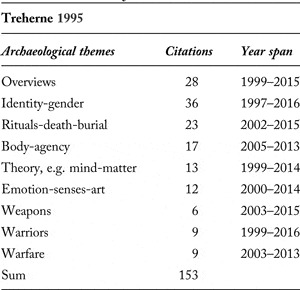


Introductory Remarks Catherine J. Frieman
Over the (slightly more than) two decades that the European Journal of Archaeology (formerly the Journal of European Archaeology) has been in print, we have published a number of excellent and high profile articles. Among these, Paul Treherne's seminal meditation on Bronze Age male identity and warriorhood stands out as both the highest cited and the most regularly downloaded paper in our archive. Speaking informally with friends and colleagues who work on Bronze Age topics as diverse as ceramics, metalwork, landscape phenomenology, and settlement structure, I found that this paper holds a special place in their hearts. Certainly, it is a staple of seminar reading lists and, in my experience at least, is prone to provoke heated discussions among students on topics as far ranging as gender identity in the past and present, theoretically informed methods for material culture studies, and the validity of using Classical texts for understanding prehistoric worlds. Moreover, in its themes of violence, embodiment, materiality, and the fluidity or ephemeral nature of gendered identities, it remains a crucial foundational text for major debates raging in European prehistoric archaeology in the present day.
Thus, it seemed pertinent that, as part of the commemoration of our 20th volume, we should return to our most loved paper to ask why and how it has aged so well, in what ways the debates we are currently having build on its themes, and where new data or interpretations have since enhanced (or challenged) Treherne's compelling narrative. The following short articles were solicited as responses to and reflections on Treherne's original article. Authors were asked simply to build on Treherne's work and to reflect on how it had impacted their own research and their wider field. These reflections range from reviews of the ongoing significance of Treherne's ideas to our understanding of gendered identities in the Bronze Age (Brück, Rebay-Salisbury, Bergerbrant), to the political impact of prehistoric research into gender identity and masculinity (Montón Subiás, Sofaer), and to the identification and social position of war, warfare, warrior's bodies, and depictions of warriorhood in prehistoric societies (Knüsel, Vandkilde, Giles). We are also pleased to include a short response by Paul Treherne, now chair of history at St Stephen's International School in Rome, to these reviews and to the ongoing significance of his postgraduate research for European prehistoric archaeology.
Gender and Personhood in the European Bronze Age Joanna Brück
Paul Treherne's article in the Journal of European Archaeology for Reference Treherne1995 is one of the most influential pieces of work on the Bronze Age written in the past few decades. It effectively critiqued previous work on prestige goods—arguing, for example, that we need to account for the particular character of the grave goods that accompany high status burials—but it also sustained and crystallized existing models of a Bronze Age warrior elite.
The image of the Bronze Age warrior is extraordinarily enduring; but it is, in my opinion, highly problematic, for it dominates our narratives of the period to the virtual exclusion of alternative interpretative frameworks, and it runs the risk of missing much of the depth, texture, and complexity of Bronze Age life. The following comments are based on many years of work on the British Bronze Age, but are relevant, I believe, for other areas of Europe too. It is true, of course, that burials accompanied by swords and other weaponry are a feature of many regions, but there are other sorts of grave groups that provide equally interesting, and often rather different, insights into Bronze Age society. In particular, there is a danger that, by focusing on warrior burials and accoutrements, we may inadvertently construct an androcentric vision of the period: in common with Treherne, recent work on the role of warriors and warfare in the Bronze Age (e.g. Kristiansen & Larsson, Reference Kristiansen and Larsson2005; Harding, Reference Harding2007) assumes that positions of social, political, and economic power were held solely by men, and that women were (like fine weaponry) the objects of elite exchange rather than social agents in their own right. There is, of course, copious evidence to counter such assumptions. ‘Wealthy’ female burials are found in many regions: the cremation burial of an adult female from the Early Bronze Age cemetery at Barrow Hills, Oxfordshire, was accompanied by a bronze awl, knife-dagger, and necklace of amber, faience, and jet/shale (Barclay & Halpin, Reference Barclay and Halpin1999: 162–65), while the adult female from the famous barrow of Borum Eshøj on Jutland was buried with a dagger, a fibula, an elaborately-decorated belt disc, a neck-ring, two arm rings, two spiral finger rings, and two small bronze tutuli, among other things (Glob, Reference Glob1973: 43–45). Our tendency to sideline this evidence, or to interpret it as an indication that women acted as ‘vehicles for the display of their husband's resources’ (Shennan, Reference Shennan1975: 286), is primarily a reflection of the position of women in our own recent past and can be critiqued on theoretical grounds: post-Enlightenment understandings of the self construct men as active subjects and women as passive objects, but this is part of an ideology that served particular purposes in the eighteenth and nineteenth centuries, facilitating the colonial endeavour, for example, by feminizing and commodifying landscape.
Treherne argues that Bronze Age mortuary practices worked to construct an image of bodily perfection for the individual—the warrior's beauty, as he puts it. Yet, this emphasis on the individual, and the assumption that the integrity of the body was a key concern during this period, are problematic, for they impose onto the past a model of the self that is particular to the contemporary western world. Body image is a matter of enormous concern in Euro-American society today, and the ideological primacy of the individual means that the body and the self are viewed as coterminous, one mapping neatly onto the other, and both having well-defined and impermeable boundaries. There is much to suggest, however, that Bronze Age concepts of the person were very different. Mortuary practices in Britain often involve the deliberate fragmentation of the body. This is true even for those funerary traditions most commonly invoked as evidence for an increasing concern with the ‘individual’, for example Beaker burials of the Chalcolithic and Early Bronze Age. The grave of the ‘Boscombe bowmen’, for example, contained the incomplete remains of several adults and children (McKinley, Reference McKinley and Fitzpatrick2011: 28–31): the articulated adult male (burial 25004) was missing his left hand and forearm, while the two bundles of disarticulated bone found just above and below this burial comprise selected skeletal elements from five other individuals, predominantly skull and longbone fragments from the left side of the body. Cremation burials are characteristic of the Later Bronze Age in the same region, and the majority of these comprise only a portion of the remains of the deceased. The three heaviest of the twenty-one urned adult cremation burials found at Coneygre Farm in Nottinghamshire weighed 1475 g, 915 g, and 735 g respectively, but the remaining eighteen burials weighed less than 600 g, and fourteen of these were under 400 g (Allen et al., Reference Allen, Harman and Wheeler1987: table 1). The evidence for the deliberate destruction of grave goods (Brück, Reference Brück2004, Reference Brück2006) and the circulation of heirlooms (themselves often incomplete or composite objects: Sheridan & Davis, Reference Sheridan and Davis2002; Woodward, Reference Woodward2002) indicates that objects were subject to practices of fragmentation and curation, and we can suggest that human bodies may have been treated in similar ways: the resulting elements were exchanged over space and time to mark, mediate, and transform inter-personal relationships. Such practices hint at relational or dividual concepts of the self very different from modern Western ideologies of the individual (see Strathern, Reference Strathern1988; Busby, Reference Busby1997).
An interest in ancestral ‘relics’ perhaps explains the evidence for the reopening of burials and for the reordering of the bones encountered when graves were reused. The Early Bronze Age shaft grave at South Dumpton Down in Kent contained a sequence of burials (Perkins, Reference Perkinsnd); each time a body was placed in the grave, the skull of the previous interment was removed. Evidence for the reopening of graves on the Continent has often been interpreted as ‘grave robbing’, but could equally have acted as a means of acquiring the bodily remains or objects associated with known and important deceased members of the community. The Middle Bronze Age cremation graves at Pitten, in Austria, were provided with special ‘doorway’ structures that allowed mourners to access the grave: it has been suggested that their purpose was to allow food offerings to be given to the deceased over a protracted period of time (Sørensen & Rebay-Salisbury, Reference Sørensen and Rebay-Salisbury2005: 166–67), but they may also have allowed grave goods or quantities of cremated bone to be removed. Certainly, cremation burials in Continental Europe sometimes contain only portions of the bodies of the deceased: the urn from grave 11 in area 1 of the Late Bronze Age cemetery at Niederkaina in eastern Saxony, for example, contained just 427 g of burnt bone belonging to an adult (Coblenz & Nebelsick, Reference Coblenz and Nebelsick1997: 40). Because my own research specialism is the British Bronze Age, I do not have a clear sense of how prevalent such practices were on the Continent, although this is certainly a question that would be worth exploring. In Britain, the deliberate deposition of fragments of human bone in domestic contexts (for example, in pits or postholes at the entrance to settlements: Brück, Reference Brück1995) provides some insight into the ‘afterlives’ of such relics. Usually, such finds comprise single fragments of skull or longbone, although the complete mummified ‘body’ of an adult male buried under the floor of roundhouse 1370 at Cladh Hallan in Scotland was composed of the skull and cervical vertebrae from one individual, the mandible of a second, and the postcranial bones of a third (Parker Pearson et al., Reference Parker Pearson, Chamberlain and Craig2005), all several centuries old on burial, suggesting a protracted and complex phase of post-mortem manipulation. Together, what such practices indicate is that the identity of the deceased was not considered fixed on burial but could in fact be reworked as and when fragments of bodies and associated objects were removed, exchanged, inherited, and (re)combined in a variety of mortuary and non-mortuary contexts. Treherne's argument that there was a finality to the moment of burial resulting in the creation of a fixed image of the deceased can therefore be called into question: instead, memory was created through practices that involved the reworking and recontextualization of fragments of the dead.
In addition, it is of course problematic to assume that grave goods were owned by the deceased and reference intrinsic personal attributes (Brück, Reference Brück2004). Grave goods may not have functioned as objects of display, but may instead have described aspects of the relationship between the living and the dead, or ideas about death and the afterlife. Although it is often assumed that cremation burials accompanied by razors must be male, in fact such items may be the product of ritual practices enacted as part of the funerary rite. Toilet articles such as razors, tweezers, and awls may have been used to mark the bodies of the mourners, for example by shaving the hair (Woodward, Reference Woodward2000: 115). This would have helped to distinguish different phases of the mortuary rite, particularly periods of separation or liminality. Objects such as wagons reference connectivity, travel, and transformation, while drinking cups are as much about commensality and the consumption of substances that facilitated communication with the otherworld, as personal status. Across much of western Europe, swords are found not in burials but were instead deposited in rivers (e.g. Fontijn, Reference Fontijn2002), sometimes complete and still usable, and sometimes deliberately decommissioned—bent and broken in ways that cannot simply be explained as a product of combat damage. Often, large numbers of swords and other bladed weapons are found at particular locations, for example fording places or the confluences of rivers. Such finds hint at the fluidity of personal identity for they suggest that the role of the warrior may have related only to a particular phase in the lifecourse, or may have been a temporary and highly ritualized form of identity that was taken up in particular political contexts and subsequently relinquished (Fontijn, Reference Fontijn and Parker Pearson2005). The deposition of quantities of metalwork in rivers and their separation from the bodies of particular individuals hints at collective or community identities tied to place, with the character of the objects (weapons made of metal) referencing the dangerous and transformative properties of social and political boundaries. Yet, the relative paucity of defended settlements in these regions suggests that other concerns occupied those same ‘warriors’ for much of their daily lives.
There is, therefore, much to suggest that Bronze Age models of the self were very different from those common in our own cultural context. If we call anachronistic ideas about the individual, subjectivity, and the body into question, we must surely also revisit our assumptions about gendered identity: both women and men were actively involved in the construction of Bronze Age lifeworlds—lifeworlds that involved fluid and contextually-specific concepts of identity and power, and where inter-personal violence was just one element of a complex range of social relationships.
Comments on Paul Treherne's ‘The Warrior's Beauty’: The Masculine Body and Self-Identity in Bronze Age Europe Katharina Rebay-Salisbury
Twenty-one years after its publication in 1995, Paul Treherne's ‘The Warrior's Beauty’ remains an influential article for scholars interested in the archaeology of the body, gender, and identity in later European prehistory. The archaeology of the body and identity has since developed and grown, becoming a popular field of study in many different regional archaeologies (e.g. Meskell, Reference Meskell1999; Hamilakis et al., Reference Hamilakis, Pluciennik and Tarlow2002; Joyce, Reference Joyce2005; Robb & Harris, Reference Robb and Harris2013). This article, originally conceived as an MPhil dissertation at the University of Cambridge, investigates how the identity of the European Bronze Age warrior emerged from practices and beliefs centring on the human body and its aesthetics.
Treherne presents warrior identities as a pan-European phenomenon and an important part of Europe's long-term social fabric. First formulated in the Bronze Age, a specific way of making identity continues into the Iron Age and beyond well into the Middle Ages. The warrior lives a particular lifestyle, which includes war/warfare, alcohol, riding/driving, and bodily ornamentation (Treherne, Reference Treherne1995: 108, hereafter only page numbers cited); in death, these themes are further developed and become archaeologically visible in burial practices and grave goods. The ‘warrior package’ thus contains several elements, which include personal weaponry, drinking equipment, bodily ornamentation, grooming tools, and horse harness and/or wheeled vehicles (p. 105).
Among the archaeological evidence, Treherne scrutinizes toilet articles such as combs, tweezers, razors, mirrors, and tattooing awls in particular. Male self-identity, according to Treherne, is linked to a specific kind of masculine beauty and achieved through bodily regimes. Treherne's study is unique in that it aims to integrate the concepts of beauty and aesthetics into the large body of literature on Bronze Age war, warfare, and violence. To the modern reader, the catchy and intriguing title of Treherne's article provokes an association of dissonance: beauty is a concept that tends to be associated with femininity rather than masculinity today. The notion of the beauty of the warrior seems at odds with that of beauty. Bodily beauty and physical attractiveness, however, are important for both sexes, although what is considered beautiful is different for men and women; it underlies evolutionary principles of sexual selection and connotes health, symmetry, and sexual dimorphism (Grammer et al., Reference Grammer, Fink, Møller and Thornhill2003).
Further, Treherne's is one of the few articles that explicitly thematize masculinity, not only theoretically (as Knapp, Reference Knapp1998 has done admirably), but using archaeological evidence constructively to paint a vivid picture of what a particular kind of male identity might have been like. As such, he fulfils the call for understanding the warrior identity as one of ‘divergent, multiple masculinities’ (p. 91).
The development of a warrior ideology is tied into two large-scale social shifts in later European prehistory. The first concerns a shift from an ideology of place and community in Late Neolithic/Copper Age societies to an ideology of individual and personal display, which characterizes Bronze Age societies (p. 107). This shift took place at different times in different places, notably in a first wave during the fourth and third millennium BC (associated, for example, with Bell Beakers). Burial in communal, megalithic tombs gives way to funerary rites that include the interment of a single body in an individual grave, with personal grave goods including prestige goods acquired through long-term exchange networks. Social categorization, including gender and status, was achieved and played out in elaborate funerary rituals, but they were fleeting events: as the body was only visible for a very short time, it had to be represented in a very formalized and stereotyped way to communicate the message of identity unambiguously, ‘fixing an image of the deceased’ in the memory of the participants in the funeral (p. 113).
A second wave of ideological change began in the mid-second millennium bc (associated with the central European Middle Bronze Age) and intensified towards the Iron Age: a ‘differentiated warrior ideology’ developed from a ‘generalised male ethos’ (p. 108). Traditionally, this has been interpreted in terms of increasing social hierarchies and the rise of chiefdoms. Importantly, the warrior identity now includes membership in a specialized group, attached to a patron in paramount position. Warriors engage in a system of relationships of hospitality and reciprocity, which includes exchange, the consumption of alcohol, a shared belief system, shared daily life, and ritualized warfare (p. 109), accompanied by cultural emotions such as honour (see Péristiany, Reference Péristiany1966).
Archaeological evidence of this change include the sword—the first object designed solely for combat—among other weaponry and sets of drinking vessels which go beyond meeting an individual's needs, ornaments that ‘accentuate every part of the body and its movement’ (p. 110, a theme further developed by Sørensen, Reference Sørensen1997, Reference Sørensen, Rebay-Salisbury, Sørensen and Hughes2010), and an emphasis on textiles as well as ‘toilet articles’.
Toilet articles are artefacts specifically designed for bodily grooming and decorating, such as combs, tweezers, razors, mirrors, and tattooing awls. Shaving, combing, plucking hair, manicuring nails, scarification, and tattooing are argued to be part of the daily routine of taking care of the body. Like weapons, toilet articles show signs of wear and tear, which suggests they were used to achieve ‘beauty in life’. Bog bodies with exquisitely manicured hands, which requires attention over extended periods of time, attest to daily self-care. Further evidence comes from Bronze Age anthropomorphic representations with carefully shaved and groomed hair. The aesthetics of the warrior were achieved through reflexive, personal action; they were important in life and death, ‘mutually constituting one another and together the individual's self-identity’ (p. 125). Toilet articles might have also played a role in specific rituals for particular occasions, e.g. before entering battle or during funerary activities; the fact that they were placed around the body in the grave points to their use in the preparation of the corpse or in ritual mourning.
At this point, I have always wondered why Treherne did not develop this argument one small step further: namely, to see toilet items as means of identity transformation. By employing bodily rituals such as shaving, cutting, and grooming hair, the transition between different kinds of male identity—perhaps that of the warrior and that of a more civil nature—could have been marked and achieved. Multiple masculinities may have had different appearances. The warrior identity would then appear less fixed, although perhaps bound to a certain age and status group or group membership, and more fluid, situational, and temporal. The warrior identity could have been taken up on particular occasions by different people, at times perhaps even by women.
Interestingly, the discussion of beauty is centred on hair and nails, and there is little discussion of other bodily constituents of beauty. For the warrior especially, attractive body proportions with a lean body mass and well trained and defined muscles would have certainly been the ideal, and could only be achieved through regular training. Bronze and Iron Age body cuirasses (e.g. from Kleinklein, Austria: Egg & Kramer, Reference Egg and Kramer2013) with hints of muscle lines are indicators of such beauty standards.
Treherne's article develops theoretical thoughts on transformations of ideology and the emergence of elites. He reacts against the prevailing interpretation of the focus on the human body in the grave as a medium of ideological expression, with the grave as the arena of power negotiation and the ‘ideology of prestige display’ employed in legitimization through mystification. The mantra of funerary archaeologists at the time—that the ‘dead do not bury themselves’ (see Parker Pearson, Reference Parker Pearson1999: 84)—had begun to disregard and overshadow the lives of the buried people. Drawing on materialist formulations of ideology, tension between ideology as illusion and social reality had emerged. Treherne, however, insists that people lived their ideology as real (p. 116). Grave goods chosen for display and conspicuous consumption as well as ostentatious funerary rituals are expressions of social practices and beliefs people actually subscribed to. To explain why specific objects are selected for social legitimization and aggrandizement, their specific socio-historic context has to be taken into account.
Formulating his own philosophical position on the body against the work of Althusser, Merleau-Ponty, Bourdieu, Giddens, and others, Treherne stresses the ‘fundamental materiality of the body and self’ (p. 119). The body is more than a social construct, a product of discourse or the symbolic; the self is practically mediated and lived through the body. Self-identity emerges through sensory exploration with the body as the medium of experience; self-care and beauty maintenance, therefore, play an important part in identity construction.
To explain why beauty was important to the Bronze Age warrior, Treherne draws on sources and scholarship on the heroes of Greek Antiquity (e.g. Vernant & Zeitlin, Reference Vernant and Zeitlin1991; Shanks, Reference Shanks1999). In particular the (lack of) beliefs in a life after death meant that the self could only transcend death in the minds of the living (p. 123). Fixing the image of the deceased in the mortuary sphere was therefore paramount, because only memory preserved the deceased in the social discourse (p. 124). The emphasis on beauty counteracted the notions of mutilation, dismemberment, and decay associated with the corpse; elaborate funerary practices helped to cope with the emotion of existential anxiety and counteracted forgetting.
These notions are not necessarily apparent from the archaeological evidence alone and they raise questions about the applicability of the concept of the ‘warrior's beauty’. Treherne's focus on a detailed interpretation of the warrior identity led him to neglect temporal and regional differences; and the extent of the phenomenon remains vaguely defined. Treherne traces roots in the emerging urban societies of the Near East and Anatolia (p. 108), from which elements were selectively adapted; a part of the ideological transformation towards an emphasis on the individual seems anchored in northern and western Europe (although other forms of personhood than the individual may have prevailed; see Fowler, Reference Fowler2004) and does not fit central and eastern Europe in my opinion, where single graves have a much longer pedigree. Cemeteries with individual graves and personal grave goods were already common forms of body disposal during the LBK (Linearbandkeramik, c. 5500–4900). Subsequently, the deposition of ‘multiple and fragmented bodies’ in cairns, passage graves, and other megalithic structures became popular from Scandinavia to Iberia (Hofmann & Whittle, Reference Hofmann, Whittle and Jones2008: 296), but remained a northern and western European phenomenon.
The ‘differentiated warrior ideology’, in contrast, has perhaps most archaeological support in central Europe, where social difference became expressed through burial practices and grave goods since the early second millennium BC at the latest (examples include the ‘princely graves’ from Leubingen and Helmsdorf, Germany; Meller, Reference Meller, Meller and Schefzik2015: 245). Treherne, however, seeks interpretative analogies in much later Greece. And although the warrior identity is discussed as a historically situated product of time and place (Joyce, Reference Joyce2005: 150), one wonders if the combination of groups of males engaging in violence, intoxication, and beautification is not indeed a cross-cultural phenomenon. Specific to the European Bronze Age are then merely the burial practices and the specific kind of prestige good economy tied into metal circulation.
It further remains unclear how broadly the concept of the ‘warrior's beauty’ applies within a given society. Does the ethos of the warrior form part of the general social ideology, adopted by every male of a certain age group, or how selective was membership in the warrior society? Treherne laid out how elite warriors had a lifestyle that involved risk and violence, but also of luxury and excess, apparent in valuable weaponry and bodily grooming, and with it a worldly existence of honour, glory, and beauty to be remembered so as to transcend death. However, what about the common fighter? The family father defending his farmstead, the youth gang raiding the neighbouring village, the mercenaries, and those forced to fight for others’ causes?
It seems that the Bronze Age elite warrior was similarly removed from those fighters as the officer in command is remote from the common soldier today, who, through discipline, control, and subordination, emerges as a non-individual (p. 128). The unknown, anonymous soldier encompasses all nuances ranging from the operator of a killing drone to the injured and traumatized homecoming hero. Perhaps it is time to shed light on the diversity of fighters in later European prehistory, too.
The nature of warfare and violence and its associated archaeological evidence in the form of weaponry, defensive architecture, and trauma on human remains has not lost its appeal since the publication of Treherne's article (e.g. Osgood & Monks, Reference Osgood, Monks and Toms2000; Parker Pearson & Thorpe, Reference Parker Pearson and Thorpe2005; Otto et al., Reference Otto, Thrane and Vandkilde2006; Peter-Röcher, Reference Peter-Röcher2007; Uckelmann & Mödlinger, Reference Uckelmann and Mödlinger2011). Krieg, the current exhibition at the Landesmuseum für Vorgeschichte in Halle (Saale), traces the origins of war in the Neolithic (Meller & Schefzik, Reference Meller and Schefzik2015). Anthony Harding perhaps best described the chronological and regional variations in the evidence for fighting. He found the characterization of Bronze Age warriors as a war-band engaging in inter-group raiding more to the point (Harding, Reference Harding2007: 169), although he too maintained the existence of an encompassing ideology of honour, prestige, and violence. Kristian Kristiansen and Thomas Larsson (Reference Kristiansen and Larsson2005), as well as Richard Harrison (Reference Harrison2004), stressed the religious and ritual role of the warrior. A persuasive interpretation of Bronze Age religion on the basis of the iconography on razors has been put forward by Flemming Kaul (Reference Kaul1998). The idea that the warrior's self-identity was connected to the maintenance of bodily ideas, however, was nowhere else formulated as concisely as in Treherne's article—it seems to have stood the test of time.
Warrior's Beauty: Revisited from a Nordic Perspective Sophie Bergerbrant
Paul Treherne's article ‘The Warrior's Beauty’ was published in the Journal of European Archaeology twenty-one years ago (Reference Treherne1995); it remains the most downloaded article in the history of the European Journal of Archaeology.
The article was a reworked version of his MPhil dissertation submitted to the University of Cambridge. In it he argued for the need to revitalize and revise the concept of the ‘warrior aristocracy’ (Kriegeradel in German). The article thus redefined the warrior ideal, both in life and in death. Treherne emphasized tangible, personal consumables that were essential for identifying this developing status group, and these centred around four important themes: weaponry, drinking equipment, bodily ornamentation (toilet articles), and horse harnesses and/or wheeled vehicles. He pointed out that not all attributes were present in all cases of warrior graves, and that a distinct form of masculinity, which was present both in life and in death, was central to the warrior ideological complex. He argued that a warrior ideal and lifestyle was born in or around the Bronze Age and that it endured for an extended period in history.
Treherne's contribution was an important catalyst for reviving the topic of the warrior class and ideal in history. Many studies have followed since (Vandkilde, Reference Vandkilde, Otto, Thrane and Vandkilde2006a: 57), and Treherne's article can be seen as having had a significant role in this revival. Indeed, it has been one of the inspirations and starting points for numerous studies about prehistoric masculinity. It has also been referred to in many subsequent Scandinavian studies (e.g. my own PhD: Bergerbrant, Reference Bergerbrant2007), and in studies about warrior graves (e.g. Sarauw, Reference Sarauw2007) and warrior identity (e.g. Skogstrand, Reference Skogstrand2014). However, the article's emphasis on the longevity of the warrior ideals has, in many ways, led the notion that ‘warrior identity’ was a monolithic cultural norm through many periods and regions, effacing subtle variations and culturally specific views of warriors. For example, Skogstrand (Reference Skogstrand2014: 251–56) has shown that warriors disappear from the archaeological record on Funen in the Early Pre-Roman Iron Age; and, when they reappear, in the Late Pre-Roman Iron Age, the warrior role has profoundly changed from the Late Bronze Age form described by Treherne. Despite this, Treherne's contribution provided a key to opening up new angles for the study of masculinity, although explorations of gender and masculinity are unlikely to have been the conscious or primary aims of the author as it is largely grounded in a different body of theory from most gender and masculinity studies. It also has quite a narrow focus, with the warrior class being treated as the only male identity worth defining, while today we are more likely to acknowledge the permutations and variations of masculinity (e.g. Skogstrand, Reference Skogstrand2014). Indeed, a close study of the male costumes recovered from the anaerobically preserved Danish oak log coffin burials has shown that there are at least two, and probably more, variations in male gendered attire, only one of which could be related to warriors (Bergerbrant, Reference Bergerbrant2007: 50–54; Bergerbrant et al., Reference Bergerbrant, Bender Jørgensen and Fossøy2013).
As the title indicates, Treherne's article focuses on appearance and the beauty of the warrior, the softer and aristocratic side of warriorhood: the flashy weapons, the horse riding/chariots, the drinking, and the grooming. These are the positive sides that create bonds between males. Although it also claims to touch upon the darker sides of warriorhood, it really only mentions the actual hardship of a warrior lifestyle, i.e. war, and even that gets only a brief mention. Lately, remains of large-scale warfare have been excavated in northern Europe, such as at Tollense for the Bronze Age (Jantzen et al., Reference Jantzen, Orschiedt, Piek and Terberger2015) and Alken Enge for the Iron Age (Holst, Reference Holst2014), both showing the more brutal and unsavoury side of warfare. The Tollense publication, for example, demonstrates that many of individuals who died in the battle and ended up in the river were non-locals, and the evidence for their diet indicates that they had been eating millet (Jantzen et al., Reference Jantzen, Orschiedt, Piek and Terberger2015), a plant that did not normally form part of the local diet. The site indicates that warriors travelled long distances, and many died as a result of warfare, as demonstrated by the examples of arrowheads found embedded in skulls (Jantzen et al., Reference Jantzen, Orschiedt, Piek and Terberger2015). Of course, one could always discuss whether these individuals were part of the warrior aristocracy or whether they were ‘mere’ foot soldiers. The first publication about Tollense focuses on the actual remains of warfare found at the site, and, not surprisingly, there is no reference to Treherne's article in the book (Jantzen et al., Reference Jantzen, Orschiedt, Piek and Terberger2015).
The main focus in Treherne's article is the theoretical perspective it puts forward, with the archaeological material being included mainly as an illustration of the idea. The author emphasizes the importance not of a beautiful death as much as that of a beautiful treatment after death and in burial and hints that the presence of beauty in the burial might have been a way to cope with the anxiety that may have arisen after a warrior's death. Drawing on the evidence that swords have been reshaped and toilet-equipment used, he suggested that ‘beauty’ was a fundamental part of the warrior lifestyle, too. Even though the body of the warrior is interpreted as an important part of the self-identity of the warrior aristocracy, the body of the warriors, the skeletal remains, are not brought into the argumentation. Bodies are often an important archaeological source for obtaining information and knowledge about prehistoric warfare. In The Routledge Handbook of the Bioarchaeology of Human Conflict (Knüsel & Smith, Reference Knüsel and Smith2013a) there are no references to Treherne's article either, whereas in The Oxford Handbook of The European Bronze Age (Fokkens & Harding, Reference Fokkens and Harding2013) a number of articles refer to it. The physical sides of warfare and warriorhood need to meet the identity and status side put forward by Treherne. The challenge for the future is to combine these different aspects of warriors in prehistory, and to tell a more complete story as there are always two sides to a coin (see Knüsel, this section).
Over the last ten years there has been a growing interest in the archaeology of the body in research (e.g. Sofaer, Reference Sofaer2006; Borić & Robb, Reference Borić and Robb2008). Many of these studies have shown the importance of connecting the physical body with archaeological interpretations of identity, in line with some of Treherne's arguments. Not only have there been theoretical developments concerning the archaeology of the body, there has also been great progress in scientific analyses that can help us gain information about the body. New developments in isotopic analyses and aDNA have given us new and unique possibilities for investigating the diet, mobility, and genetic heritage of deceased individuals, warriors or not, at a much more detailed level than ever before. So far, the most in-depth studies of this kind have been conducted on female graves (e.g. the new analysis of the Egtved girl by Frei et al., Reference Frie, Mannering, Kristiansen, Allentoft, Wilson, Skals, Tridico, Nosch, Willerlev, Clarke and Frei2015), but future work on warriors’ graves would clearly expand our understanding of warriorhood in the Bronze Age. An increase in the number of experimental warfare studies has also taken place over the last decade. All these recent developments need to be viewed together for an up-to-date reassessment on the Bronze Age warrior. We might not need to revitalize the archaeology of warfare and warriors, as Treherne's article did twenty-one years ago, but all this new research demands another serious theoretical and methodological discussion to bring together and reassess the different dimensions of warriorhood, both the beauty and the beast.
It is easy to find flaws in an article written two decades ago. The intention here is not to belittle Treherne's article in any way. It was, and remains, a sound and influential text, and it has been an important article for many fields of archaeology. As has been noted above, this article was significant for changing perspectives and redirecting research on warfare and warriors. However, twenty-one years later its contribution and role has changed from being a new and innovative article to being ‘a classic’; a starting point for many fields of research. It set a new baseline upon which we continue to build. The problem is, are we not becoming lazy if we simply go on accepting this article's interpretation as the norm?
The time has come for another young scholar to write a new thought-provoking article with a fresh interpretation on warfare and warriors in order for research to move another step forward, an article that embraces the multitude of ideas and data available through new theoretical and methodological developments within the archaeology of the body, or body-centred archaeology, without forgetting the many important contributions highlighted by Treherne. We should never forget that the beauty of the warrior ideal is always followed by the threat and unpleasantness of warfare. I hope there is someone out there who might be up to the task of again writing an article that challenges our perceptions so profoundly that it shifts and changes the course of many fields of archaeology.
An Iberian Perspective on ‘The Warrior's Beauty’ Sandra Montón Subías
Twenty-one years ago, in his now classic article under discussion here, Paul Treherne brought to the fore the analysis of subjectivity in understanding what happened in the prehistory of Europe. After reviewing the evidence for warriors and warfare, he rejected as ‘deficient’ the ideology-as-a-resource mainstream interpretive models for the Neolithic/Bronze Age transition, and re-evaluated this shift in terms of changes in the construction of the male self. In so doing, he pioneered studies of masculinity, of embodiment and symmetrical analysis in archaeology. In addition, his work remains a fine example of the role that prehistory can play in the construction of world history.
Contrary to the quite common conviction that interest in warfare and warriors is mainly a product of the 1990s, I regard the subject as deeply ingrained in the fabric of archaeology. Indeed, the emergence of militant male warrior elites has been considered inherent to processes of growing social complexity since the beginning of our discipline (see Siret & Siret, Reference Siret and Siret1890 as an early example from Iberia). Although frequently theoretically underdeveloped, concepts such as warriors, conflict, instability, warfare, and militarism have been widely used in the archaeological literature of all time. Poorly developed theorizing is, in my view, not so much related to a lack of interest or a conscious wish to pacify the past (as stated, for instance, by Keeley, Reference Keeley1996), but to the very idiosyncrasy of archaeological schools of thought and background assumptions that have taken the phenomenon for granted (see Aranda Jiménez et al., Reference Aranda Jiménez, Montón Subías and Jiménez-Brobeil2009 as an example, again from Iberia).
Within culture history, for instance, the theme was ubiquitous in the form of studies of weaponry (especially typologies), which were and are widely used as fossil types to define and characterize cultures, and to construct temporalities and chronological sequences across the whole of Europe. From the 1970s onwards, growing attention (from heterogeneous perspectives too) to the evolution of social complexity during the transition from the Neolithic to the Bronze Age also correlated the increase in social hierarchy with the rise and consolidation of a male body of warriors. Treherne drew on the same material evidence handled by these previous studies (new specialized weaponry, horse harness, wheeled vehicles, ornaments, and grooming tools) and accepted them as proof of new war-like practices and body language. However, he rejected the modernist dualistic thinking that took these shifts to merely represent a change ‘from an ideology of place and community to one of the individual and personal display’ (Treherne, Reference Treherne1995: 107, hereafter cited by page number only). To him, the Neolithic/Bronze Age transition was, first and foremost, an ontological process.
‘The Warrior's Beauty’ connected the emergence of individualization and personal display in the archaeological record with a new style of life and changes in what it was to be a person (p. 122) and, more specifically, in male self-identity (p. 106). Warrior paraphernalia did not, thus, allude to a restricted elite mobilizing ideology as an external resource for its own benefit—as if persons and ideology belonged to different plans of action, as ideology could embrace structured thoughts detached from people's actions—but to new men's embodied understandings of themselves, their identity, and their way of being in their surrounding world.
Having set out the outline of Treherne's argument, I would like to point out how valuable I find the identification of general trends in prehistory that may be related to concerns of our current times, without doubt a clear merit of Treherne's overview. Maybe because I teach an MPhil course on world history and most of my departmental colleagues are historians of the written sources, I have for some time insisted on how important prehistory is in the construction (and teaching) of world history. Perceived sometimes as a remote (and even exotic) domain, it is also often thought to be unrelated to problems of the present day. However, prehistory saw the birth of many different processes that have moulded the world to its actual shape. The fact that present social and gender inequality, existing identities and ways of being a person, and cultural values and attitudes have been formed by complex long-standing processes beginning in prehistory, and that these can only be well understood and modified in light of their historical backgrounds, has been insufficiently explored.
I find it worrisome, however, that long-term reviews are usually constructed to enhance social change(s) at the cost of social continuity(ies). Because I find Treherne's contribution to fit this tendency, I will now focus in greater detail on his main subject: the emergence of individuality in widespread areas of Europe. My intention here is to discuss the article on its own terms and not so much to point out missing topics that fall outside Treherne's purpose.
Fundamental to the author's argument is the relationship between material culture, the body, and the new type of subjectivity incarnated in the male warrior. According to Treherne, previous works had not really grasped the reasons why objects designated as ‘prestige items’ (an expression that he considers reductionist) are those and not others. Mainly considered as signs of elevated status, their intricate and vital relationship with the manipulation of the warrior's body had remained unattended. Pioneering symmetrical archaeology, Treherne claims that these goods are not only expressing but also constructing a new ‘notion of self and personhood, grounded in changing attitudes to and practices in, on, and through the body’ (p. 125). However, to me, the importance of the body is more announced by Treherne than it is explained. Even when, inspired by works about the Homeric warrior, he assumes the centrality of the body in societies with no body/mind dichotomies, the reader may remain mystified by why the body is so paramount in constructing individualization and differentiation. At this point, I would like to draw attention to a series of works that have contextualized the importance of the body for personhood construction in the framework of oral societies (especially Hernando, Reference Hernando2002, Reference Hernando2012; Moragón, Reference Moragón2013).
Drawing also on the absence of the body/mind dichotomies and on studies promoted (among others) by Norbert Elias, Walter J. Ong, and David R. Olson, such works have explained that, in prehistoric oral societies, there must have been no disconnect between what persons were and their bodies, no fracture between what persons thought they were and what they actually were. Persons became selves through their embodied actions. Under such circumstances, the body was precisely the main mechanism (instead of abstract thinking and reflection) to construct and manifest identity (through its management, movements, actions, and associated material culture). In this sense, the importance of the body in self-hood construction was nothing new to Bronze Age Europe. However, while community belonging was previously performed, Bronze Age warriors set themselves apart and emphasized difference. The difference was thus between being a part of and being apart from, but always through the body.
However, and here I refer again to the change versus continuity issue mentioned before, it is not possible to be apart from something without at the same time being a part of it, as Almudena Hernando has shown in her works. While most scholarship has read Bronze Age warrior's gear, she argues, in terms of individuality and difference, it has at the same time ignored its meaning regarding relational bonding. While warriors were setting themselves apart, they were simultaneously bonding with new peers (warrior fraternities), and thus maintaining, although in a new fashion, relational identity (Hernando, Reference Hernando2012: 137–41). Treherne thus ignores relational mechanisms that remained in the construction of the new subjectivity. In this sense, we could say that Treherne's is a masculinist study on masculinity. In focusing only on individuality and social change, he is stressing values that define hegemonic masculinity in the present and dominate the mainstream writing of (pre)history (see on this issue Hernando, Reference Hernando2012 and Montón Subías & Lozano, Reference Montón Subías and Lozano2012).
In mentioning these flaws (in my view) I would not like to diminish the article's merits. I regard it as a fundamental piece in archaeology's literature, not surprisingly ‘the most downloaded paper in the entire EJA archive’, as Catherine Frieman mentioned when she invited me to contribute here. Paul Treherne is among the first scholars explicitly reflecting on the construction of the male self in prehistory. In the 1990s, when gender studies in archaeology were mainly perceived as women's affair, it was very important to reflect on the fact that men also had gender. In addition, Treherne's article made very clear that, during prehistory, there were different ways of being a person and, importantly, that individuality had a (pre)historic starting point. That is beyond any doubt, and as such needs to be acknowledged.
I want to insist, however, on how important it is to complement overviews such as Treherne's with studies of social dynamics, values, and principles that have been marginalized from the mainstream of scholarly discourse and thus left outside history. To continue with examples from Iberia, different works—from a feminist or feminist sensitive standpoint—have already attempted to redress imbalances created by this neglect, focusing on the role of stability, continuity, recurrence, relationality, and interdependence (see, also for the Bronze Age, Colomer et al., Reference Colomer, González Marcén and Montón Subías1998 and Aranda Jiménez, Reference Aranda Jiménez, Berrocal, Sanjuán and Gilman2013 as two examples). Only by considering the interplay between change and permanence can social complexity and diversity in the past be comprehended, changes be understood in their full dimension, and an inclusive World (pre)History be constructed. It is not only a question of fairness or representation; it is a question of improving archaeological and historical knowledge.
The Warrior's Seduction Joanna Sofaer
In his novel The Narrow Road to the Deep North, Richard Flanagan describes the attitude to virtue of his central character, war hero Dorrigo Evans:
‘Dorrigo Evans hated virtue, hated virtue being admired, hated people who pretended he had virtue or pretended to virtue themselves. And the more he was accused of virtue as he grew older, the more he hated it. He did not believe in virtue. Virtue was vanity dressed up and waiting for applause.’ (Flanagan, Reference Flanagan2013: 53)
Virtue, then, is not a matter of self-identity, which, as Dorrigo Evans's story unfolds, is full of complexity and doubt borne of self-knowledge and introspection. Instead, virtue in relation to self does not really exist, or at most is shallow and showy. It emerges primarily from the desire of people to attribute qualities to others as if to give themselves hope in a world where honour and heroism seem in short supply.
As I write, the news is full of refugees fleeing conflict, stories of soldiers suffering from post-traumatic stress disorder, and terrorist atrocities. Perhaps it is precisely because of the lack of virtue in the modern world that the romantic vision of a warrior golden age offered by Treherne is so appealing. Yet it is both striking and disturbing that the combination of heroic traits identified by Treherne—a focus on hair and grooming as a marker of identity and lifestyle, the search for glory, eternal remembrance, and heroic death—are hallmarks of a range of modern military and terrorist groups, albeit in different ways. One thinks of the ‘buzz-cut’ in the US military, the immaculately groomed and uniformed soldiers of the North Korean regime, and the propaganda promulgated by the self-styled warriors of Daesh. In each of these cases, the individual male body is linked to the body politic (Brod & Kaufman, Reference Brod, Kaufman, Brod and Kaufman1994: 8). There seems very little of beauty here.
I do not doubt the importance of social categories in the Bronze Age, that ‘the warrior’ may have been one such category, or that the body, its display, and adornment played a significant role in the mediation of Bronze Age social relations. However, ‘The Warrior's Beauty’ proffers a highly sanitized and hegemonic view of Bronze Age masculinity that does little justice to the complexity of human identity (see Cornwall & Lindisfarne, Reference Cornwall and Lindisfarne1994). Asserting that there was a ‘coherent warrior lifestyle’ does not mean that all eligible men conformed to it. The evidence for how regularly masculine ideals were enacted and sustained, or how individuals entered the warrior ‘class’ is thin—to what extent was it ‘action-based’ or inherited? Similarly, the extent to which warrior values can be exclusively equated with social status, or whether status might be expressed or achieved in a variety of other ways, is unclear. One might also ask to whom the performance of beauty was directed and whether it took place in public or in private. In an age before mirrors, did men groom themselves or was this done for them? In the case of the latter, was identity, therefore, a co-creation? How might modifications to the body aim to meet the expectations of others rather than of self? Furthermore, the Homeric epic poems (a key strand in Treherne's argument) post-date the Bronze Age (Finkelberg, Reference Finkelberg1998). Thus, they cannot be understood to represent a Bronze Age reality, but are likely to represent an amalgam (Snodgrass, Reference Snodgrass1974) or ‘unhistorical composite’ relevant to the values of the intended audience (Osborne, Reference Osborne1996: 153). Yet these unresolved questions, tensions, and deficiencies often seem to be willingly overlooked, such is the draw of Treherne's narrative.
‘The Warrior's Beauty’ remains one of the few unambiguous discussions of masculine identity in the prehistory literature and here, too, lies some of its allure. It is useful to recognize that the article was written in the early days of gender archaeology. The potential of mortuary contexts for gendered analyses in terms of the relationship between the physical body and grave goods had recently been highlighted in a range of publications (e.g. Bertelsen et al., Reference Bertelsen, Lillehammer and Næss1987; Gero & Conkey, Reference Gero and Conkey1991; see also Sofaer & Sørensen, Reference Sofaer, Sørensen, Tarlow and Nilsson-Stutz2013). While these and many other subsequent works aimed to rectify the ‘invisibility’ of women and other social groups, on the whole men have remained visible but ‘unmarked’ (Alberti, Reference Alberti and Nelson2006: 401). Treherne's article, therefore, offers a form of analysis that remains largely unavailable elsewhere. It may also provide a potential point of self-identification for modern men, something noticeable in responses to ‘The Warrior's Beauty’ in my own teaching practice: a delight (and relief) that the study of social identity and gender has a place for men and is not just about women! However, whether the enduring popularity of the article is due to the particular nature of the insights it provides into the Bronze Age and the nature of masculinity, or whether it results from disciplinary failure to develop a range of recognizable narratives about men (and thus a lack of alternative points of contact with the past for young men in particular), is unclear. In claiming that the origins of feudalism lie with the Bronze Age warrior, Treherne positions the Bronze Age in a particular way with regard to the construction of modernity and creates a seductive legacy for modern masculine identity. However, this apparent legacy deserves scrutiny since the elision of two distant and entirely different periods is awkward. There is, therefore, potential for a vibrant, more contextually-specific discussion that enriches archaeology by recognizing dynamics, complexity, and nuances in the interwoven histories of women and men.
Though presented through the lens of theoretical debates surrounding various Marxist and post-processualist understandings of the expression of ideology that took root in the 1980s and 1990s, much of the article reads as if it could have been written more recently. Re-reading ‘The Warrior's Beauty’ twenty-one years after its publication, it is striking how current some of the terminology is. Terms such as ‘embodiment’, ‘performance’, ‘subjectivity’, and ‘personhood’, along with an explicit focus on the physicality of the body as a source for the construction and mediation of identity, resonate with contemporary concerns regarding the nature of past human experience. The article, therefore, retains disciplinary relevance, although it is notable that, in contrast to the extended discussion of ideology in the first part of the publication, the theoretical vocabulary that may be of most interest today is comparatively under-referenced and used relatively loosely. A lack of explicit ‘positioning’ in terms of the shades of meaning that accompany some of these theoretical strands may be an additional reason for the article's continuing appeal. In other words, it is easier to agree with generalities rather than specifics. A number of highly relevant volumes arguing both for and against Treherne's position in relation to the body had already been published prior to 1995, but are not cited by him (e.g. Butler, Reference Butler1990, Reference Butler1993; Featherstone, Reference Featherstone1991; Shilling, Reference Shilling1993; Cornwall & Lindisfarne, Reference Cornwall and Lindisfarne1994; Moore, Reference Moore1994). It is, therefore, interesting to consider whether the impact and continued relevance of the publication reflects its original aims and intentions. Rather than continuing to use the article in order to understand masculine identity, it may be profitable to return to, and critically engage with, Treherne's broader initial goals and arguments regarding the lived experience of ideology. Today, when it seems that ideology is everywhere, a critical re-reading of Treherne's text has particular poignancy in reflecting upon the potential role of ideology in the development of human experiences. It challenges us to consider how the expression of individual and group action is tied to beliefs about the world and one's place within it.
Though Treherne's article retains its popularity twenty-one years after its original publication, this is not necessarily due to its complete veracity or the bullet-proof nature of its arguments and evidence base. Instead, it appeals to the all too human desire for his narrative in our own turbulent world. It speaks to the pressing need for particular kinds of histories and thereby highlights both missed opportunities and constructive disciplinary developments. It will doubtless continue to be widely read as new generations of archaeologists find inspiration in its pages.
The Ongoing Significance of Paul Treherne's Classic 1995 Article ‘The Warrior's Beauty: The Masculine Body and Self-Identity in Bronze-Age Europe’ ( Journal of European Archaeology, 3(1), 105–44.) in Recognition of the 20th Volume of the European Journal of Archaeology Christopher J. Knüsel
This review comes in the midst of what has been described as a ‘crisis of masculinity’ in societies across the world, a social phenomenon that is characterized by a male attainment deficit, increased incarceration and recidivism, poor employment prospects, and low self-esteem. In 2001 The Economist noted that ‘throughout the world, developed and developing, antisocial behaviour is essentially male. Violence, sexual abuse of children, illicit drug use, alcohol misuse, gambling, all are overwhelmingly male activities’. The article goes on to observe that ‘Men […] have been robbed of their traditional roles as providers, protectors and even procreators’. Nearly fifteen years later, in 2015, The Economist characterized this trend in rich countries as ‘no job, no family and no prospects’.
This description of contemporary masculinity is completely at odds with the image Paul Treherne paints of masculinity some 4000 years ago in ‘The Warrior's Beauty’. Treherne characterizes these Bronze Age warriors as epitomized by a concern with physical appearance, as implied by items described as ‘toilet kits’ found in their graves, consisting of combs, razors, and tweezers, which probably groomed them in life and at death. He describes these warriors as ‘beautiful’, adorned in shiny gold and bronze metalwork displayed on woollen garments, with elaborate, well-groomed, and probably distinctive hairstyles and perhaps facial hair or lack thereof. They may have employed make-up, perhaps using the peculiar wooden ‘spatulas’ sometimes found in burials, contemporary examples of which were found with Gristhorpe Man (Melton et al., Reference Melton, Montgomery and Knüsel2013 and see below) and another with the Amesbury Archer (Fitzpatrick, Reference Fitzpatrick2011: 75). These Bronze Age men engaged in feats of conviviality—drinking bouts and feasts—and in the skilled use of the first specialized arms requiring both physical co-ordination and more assiduous training. They had personal character and their appearance expressed a developed self-identity based on a weapon-bearing warrior lifestyle. Perhaps, like their later medieval counterparts, they evinced prowess; not only physical skill, but bearing and poise in conduct (see Knüsel Reference Knüsel, Baadsgaard, Boutin and Buikstra2011, Reference Knüsel, Whelehan and Bolin2015) that won glory, renown, and remembrance that formed the goals of life and contributed to a good death (Bloch and Parry, Reference Bloch, Parry, Bloch and Parry1982: 15; Binski, Reference Binski1996) as represented by an elaborate single burial beneath a mound visible for all to see. These men seem to have exuded confidence, self-esteem, and self-assurance within their societies, as reflected and represented in the treatment of their bodies in death. Treherne draws splendidly on the notion that ‘the body and its treatment becomes [sic] an artefact of and canvas for symbolic and social expression’ (Knüsel et al., Reference Knüsel, Batt, Cook, Montgomery, Müldner, Ogden, Palmer, Stern, Todd and Wilson2010: 306).
Although Treherne's article is admirable for highlighting the accoutrements, material culture, and aspects of the social context of these Bronze Age warriors, it inspired my interest, in part, because of the areas in which it is least developed. Despite repeated mentions and discussion of the body from a metaphysical point of view based on funerary remains, few remains of bodies enter into the piece and when they do they involve apparent manipulations of the remains of the deceased with presumed symbolic value that has more recently been ascribed to other processes in many instances. In effect, this leaves the use of ‘male’ and ‘masculine’ in his treatment in the same realm as the use of the word ‘prestige’ that is critiqued so thoroughly in it. The physicality of these warrior males is left untouched—their height, weight, physique, their maladies and wounds, the extent of their masculinity as defined by masculine physical traits—and even if all the individuals accompanied by such objects were indeed males, all of these attributes can be determined from the analysis of the skeletal remains of the deceased. Were these men physically distinctive? Where did they come from, and to whom were they related? Did these physical attributes also have an influence on the appearance and status of the warrior as much as their dress and accoutrements? Some of these questions have been answered in the twenty-one years since the article was published, but many have not, and geographic and temporal coverage is uneven. These corporeal attributes could act as a complement to, and contribute much, if not more, to the ‘substantive content and implications for subjectivity’ (Treherne, Reference Treherne1995: 117, hereafter cited by page number only), to address ‘the relationship between the body and subjectivity’ (italics in the original) implicit in the objects found with the dead. This means that the template provided by Treherne could be judged against individual Bronze Age warrior graves, and it could inspire similar approaches in later periods, as indeed it did in the medieval examples referred to above.
Deeper consideration of the physical remains of the dead would also contribute to better understand the placement of objects on the body with respect to skeletal remains; this would do much to unravel the ideological underpinnings of these objects, revealing in the process a grammar of symbolic intent present in the patterning of material with respect to the remains of the body.
The corporeal attributes of these well-appointed male burials can also provide a means to study the social effects of ideologies that permeate all forms of human practice and whether or not their manifestations were indeed a conspiratorial practice of a ‘small group of cynical men’ (p. 115) to obtain a pre-eminent social status that conferred membership to ‘the warrior fraternity’ (p. 114). As noted by Treherne, the societies of the Late Neolithic and Bronze Age were not egalitarian (if not before, see below), and it may well be that the activities and behaviours linked to the appearance of these individuals was indeed a conspiracy to legitimate social inequality. And this may have been enforced through threat and fear of retribution—from within social groups and from the outside—that led to the hegemony of groups of people, at least in some places and times. The means to explore these relationships come in two forms: measures of well-being and physical injuries, including weapon-related trauma. Again, both relate to the physical remains of the deceased.
One of the occupants of these Bronze Age single burials, the nearly complete skeleton known as Gristhorpe Man, was buried in an oak log coffin on the coast overlooking the North Sea, near Scarborough in Yorkshire (Melton, et al., Reference Melton, Montgomery, Knüsel, Batt, Needham, Parker Pearson, Sheridan, Heron, Horsley, Schmidt, Evans, Carter, Edwards, Hargreaves, Janaway, Lynnerup, O'Connor, Ogden, Taylor, Wastling and Wilson2010, Reference Melton, Montgomery and Knüsel2013). He was buried with a whalebone-embellished dagger, among other artefacts. Gristhorpe Man and other single inhumations form a distinctive group of ‘tall men’ from the Early Bronze Age in Britain that suggests preferential access to good nutrition and growth environments commensurate with social advantage from birth, stature being a good measure of population and individual health and well-being (see discussion in McKinley, Reference McKinley and Fitzpatrick2011; Knüsel et al., Reference Knüsel, Wastling, Ogden, Lynnerup, Melton, Montgomery and Knüsel2013). These men may have belonged to an inherited social elite for a period of time, though one that was not apparently sustainably inter-generational over the longer term. Gristhorpe Man was of robust build with an enviable body mass, producing a high normal body mass index by today's standards. His was of athletic build. His strongly developed right dominant arm (i.e. humerus) testifies to its use in strenuous physical activities that are likely to have included technological and subsistence-linked activities such as manufacture and maintenance of objects, as in woodworking and metalworking, and pursuits requiring physical effort, including long-distance walking and sport, as well as weapon use. Dietary isotopes suggest that he had benefited from a rich, high-protein diet, which also predisposed him to renal stones. During life he had developed an intracranial tumour, the placement of which may have affected movement of the right side of his body, including his well-developed right upper limb, and his ability to speak and comprehend speech. His remains also show evidence of a chronic infection of the maxillary dentition from dental caries, as well as other carious lesions. These are indications of the physical consequences of a socially pre-eminent lifestyle that included the consumption of cariogenic foods.
Gristhorpe Man had sustained four ante-mortem (i.e. all healed) traumatic injuries, two to his ribs, another to his neck, and yet another to his chin. These attest to an active lifestyle that exposed him to injury. The Amesbury Archer (named after the arrowheads among the grave goods accompanying this Early Bronze Age male burial in Wiltshire) also had sustained a crippling knee injury in his young adult years (McKinley, Reference McKinley and Fitzpatrick2011). A worldwide review of traumatic lesions related to inter-personal conflict found that such injuries occurred overwhelmingly in males from the Bronze Age to the modern period (Knüsel & Smith, Reference Knüsel, Smith, Knüsel and Smith2013b). These sumptuously adorned men and their followers were not only able to deliver injurious blows, but also exposed themselves repeatedly to injury as well.
The Neolithic forms a turning point in the level of violence (Schulting, Reference Schulting, Gowland and Knüsel2006; Schulting & Fibiger, Reference Schulting and Fibiger2012; Smith, Reference Smith, Knüsel and Smith2014) Although there is noticeably more evidence of injuries resulting from interpersonal violence in the Neolithic than in preceding periods, there appears to be a more equal distribution of traumatic injuries between the sexes (Schulting & Wysocki, Reference Schulting and Wysocki2005; Fibiger et al., Reference Fibiger, Ahlström, Bennike and Schulting2013; Knüsel & Smith, Reference Knüsel, Smith, Knüsel and Smith2013b), attesting to the differing circumstance in which these wounds were received. Neolithic warfare appears to have been more about surprise and hit-and-run tactics, as may be indicated by a lack of static, defensible fortified places. Support for this statement comes in at least two additional forms of physical evidence, in addition to skeletal trauma: mass graves and bilateral limb asymmetry. The Early Neolithic mass grave at Talheim, which Schulting (Reference Schulting and Ralph2013: 22) describes as ‘paradigm-shifting’, was the first to provide evidence that apparent ‘tools’ (adzes) were responsible for cranial trauma that resulted in the deaths of multiple men, women, and children (Wahl & König, Reference Wahl and König1987). It was not only in the Early Neolithic that such violence is documented (Meyer et al., Reference Meyer, Lohr, Kürbis, Dresely, Haak, Adler, Gronenborn and Alt2014, Reference Meyer, Lohr, Gronenborn and Alt2015), other notable examples being known from the Late Neolithic (Meyer et al., Reference Meyer, Brandt, Haak, Ganslmeier, Meller and Alt2009). Already in the Early Neolithic, males buried with adzes seem to have employed their right upper limbs in activities that predisposed them to thrower's elbow (Villotte & Knüsel, Reference Villotte and Knüsel2014), a disorder linked to single-handed tool-use that probably included weapons.
Schulting (Reference Schulting and Ralph2013: 25) notes that ‘we do not see a specialized warrior identity in the Mesolithic or Neolithic and that every able-bodied male would be expected to perform this role alongside his other roles: as hunter, farmer, herder, fisher, weaver, potter, etc.’. If discernible warrior graves are apparently absent, it appears that their activities seem to have been present. Warriors, then, probably emerged before they became archaeologically visible in the Bronze Age (see Jeunesse, Reference Jeunesse1996), when a more highly organized entourage of (male) warriors and more highly orchestrated warfare that is familiar to historians of the ancient world came into being.
When combined with the type of material associations described by Treherne, these studies have the capacity to break the symbolic/utilitarian interpretive equifinality implicit in apparently socially-identifying objects. In short, a great corpus, made up of theory, historical precedent, and material cultural correlates, lacks a synthetic biological component, and we are thus left with the conundrum of whether elaborately interred individuals constitute an orchestrated symbolic, but in essence unreal or even misleading, representation, or a true reflection of the emergence of a socially differentiated group that contributes leaders, i.e. active social agents, wielding unequal power to influence social change. This question finds its correlate in the work of Härke (Reference Härke1990, Reference Härke and Carver1992) on early medieval weapon burials, which are described by Steuer (Reference Steuer and Randsborg1989) as also representing a ‘warrior lifestyle’ in the early medieval period. As suggested in Treherne's essay, the key to unpicking this knot of ambiguity—to break the equifinality implicit in the term ‘weapon burial’—lies in the physical attributes of individuals buried in elaborate graves.
The emergence of warriors in the Bronze Age may go far to explain some of the population movements/mass migrations that are thought to have taken place on a grand scale in the period (Haak et al., Reference Haak, Lazaridis, Patterson, Rohland, Mallick, Llamas, Brandt, Nordenfelt, Harney, Stewardson, Fu, Mittnik, Bánffy, Economou, Francken, Friederich, Garrido Pena, Hallgren, Khartanovich, Khokhlov, Kunst, Kuznetsov, Meller, Mochalov, Moiseyev, Nicklisch, Pichler, Risch, Rojo Guerra, Roth, Szécsényi-Nagy, Wahl, Meyer, Krause, Brown, Anthony, Cooper, Alt and Reich2015), but such an explanation may also be employed on a local or regional scale to account for the origin of warrior-leaders. This would also help resolve the question of whether individual cases represent true warriors—who had actually fought—and distinguish them from others who were non-combatants buried in ways which mimicked the warrior's beauty, in a manner that is similar to the transformation from warrior to courtier-aristocrat of the Later Middle Ages (see p. 130). This diachronic perspective, hinted at in the conclusion of Treherne's piece, speaks for what appears to be a recurrent and enduring phenomenon of a certain type of masculinity. It seems clear that by the advent of the European Bronze Age, if not before, the martial component of masculinity had emerged, and it continues to be present in a less personally active but increasingly powerful and deadly form in leadership today.
The ‘Beautiful Warrior’ Twenty-one Years After: Bronze Age Warfare and Warriors Helle Vandkilde
The seminal article by Paul Treherne in the 1995 volume of this journal seems to have given rise to a mostly independent thread unrelated to the current surge in warfare research. The role of warfare and warrior aesthetics is briefly discussed against this background.
Warriors would seem topical to questions of prehistoric warfare, which until c. 1996 was a marginal subject area in archaeology. Since then, war has gained considerable momentum as a research theme and today the archaeology of warfare is firmly placed in the suite of archaeologies addressed. The brilliant ‘Warrior's Beauty’ paper by Paul Treherne, published in Reference Treherne1995 in the European Journal of Archaeology (then the Journal of European Archaeology) can, given its many citations, be categorized as a high-impact article; it is a frequently accessed article on the journal's website. Against this background, it is pertinent to ask if the study has had a role in driving the current interest in war and, hence, has influenced the new knowledge now emerging. Are the visual appearance and bodily movements of the ancient warrior, sensu Treherne, at all present in the archaeology of warfare now blooming?
In the twentieth century, the warrior was considered a heroic stereotype at the head of an ancient society that was deemed essentially peaceful. But, after the ‘discovery’ of the war-like reality of societies in the late 1990s, warriors have paradoxically fallen out of the Bronze Age research limelight, although warrior elites sometimes figure in interpretations (Vandkilde, Reference Vandkilde, Gardner, Lake and Sommer2016). It is, therefore, timely to assess the value of Treherne's contribution.
An impactful essay ahead of its time
Treherne's essay contains a number of observations and theory-driven hypotheses, which have the potential to throw light on the main strands of change in Neolithic and Bronze Age Europe and increase our understanding of the role of the warrior in these societies. In addition, it is a manifesto replete with theoretical insights: classic, mainstream, and scholarly. The position taken is not easily slotted in to any theoretical school or paradigm; the article works equally well as a grand history on an Eurasian scale, and, by contrast, as an examination of the male body and equipment as both unique and reiterated materiality in life and death. This epistemological stance embedded in Classical history may explain the immediate success of Treherne's article, not least in the mid-1990s when much energy was invested in aligning with processual, post-processual, or post-structural persuasions.
Characteristically, the essay works with dualities rather than dichotomies. In fact, the inseparability of ideology and reality on the one hand, and of the body, identity, and personhood on the other, may have been an eye-opener for many archaeologists struggling to make sense of specific archaeological remains, in particular burials: it became clearer that people's beliefs were lived through their social interactions and affiliations, and that concepts such as ‘false consciousness’ tends to victimize, especially, those people ‘without history’ and thence to simplify complex prehistoric realities. People live out their ideologies and form their identities through their bodies in an entanglement where power is an inherent element. In providing a simultaneously sophisticated and straightforward framework for thinking theoretically about archaeological things, data, culture, and change, Treherne was well ahead of his time. First, the essay can be read as a critique of archaeology rooted in philosophy, while at the same time promoting body, gender, identity, agency, the senses, and even history as an interleaved package central to the interpretive agenda. Second, the essay can be taken to be an innovative framework for better understanding the numerous weapons recovered in burials and hoards from around 3000 bc onwards, and here Classical studies and early written sources support the argument well. The immediate impression is nevertheless that this second aspect has not been invigorated to any significant extent by the general academic turn set out by Treherne's essay.
Internet data may confirm this broad canvas. Even if the number of citations is likely to be an underestimate, the statistics in Table 1 show that Treherne's article has contributed more significantly to other subject areas (eighty-four per cent) than to warfare, weapons, and warriorhood (sixteen per cent). Its main impact is on questions of identity and gender, body and agency, emotion, art, and the senses, in addition to general theory and overviews. Its low impact (very few, if any, references) on the otherwise thriving genre of war studies is illustrated when leafing through a number of anthologies: e.g. those of Carman & Harding (Reference Carman and Harding1999); Osgood et al. (Reference Osgood, Monks and Toms2000); Otto et al. (Reference Otto, Thrane and Vandkilde2006); Ralph (Reference Ralph2013). Given this essay's heading and principal message, it is surprising that warrior studies show up in such a low proportion in the statistics, but this may relate to warriors being rather marginal to the current rise in warfare studies. In fact, a handful of major warrior studies do recognize Treherne Reference Treherne1995 as central to the analysis of ancient warriors: Harrison (Reference Harrison2004); Vandkilde (Reference Vandkilde, Otto, Thrane and Vandkilde2006b); Harding (Reference Harding2007); Knöpke (Reference Knöpke2009); Schulting (Reference Schulting and Ralph2013). One could argue that it was Keeley's book (War Before Civilization, Reference Keeley1996) and the wars and genocide of the 1990s that heralded research in prehistoric warfare. Meanwhile Treherne's essay became one of the guiding threads in a parallel thrust to populate prehistory with able-bodied real people, but this comprised few analyses of warriors until recently. Treherne's article thus seems to have instigated an independent thread of research mostly disconnected from the surge of warfare studies from 1996 to the present.
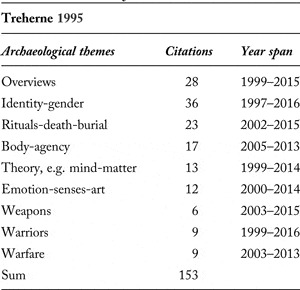
While Treherne's article demonstrates a good knowledge of the archaeology outside the English-speaking world, the works quoting Treherne come predominantly from the latter. German archaeology has recently discovered war as a research area; this Kriegsarchäologie seems to largely be an independent development apparently little influenced by the global rise in war studies since 1996, as the few cross-references reveal (e.g. Meller & Schefzik, Reference Meller and Schefzik2015). It may be that the interest in war now manifest in German archaeology is a logical continuation, or offshoot, of the strong Kriegergräber tradition, which was also a major source of inspiration for Treherne (p. 105). More broadly, weaponry is still an important research focus in Germany (as well as elsewhere), albeit the interest has shifted slightly more towards investigations of damage and wear on deadly weapons, such as swords and spears, as well as research on traumata (e.g. Peter-Röcher, Reference Peter-Röcher2007; Horn, Reference Horn2013). Furthermore, recent discoveries have been influential too, notably the Corded Ware multiple burial at Eulau in central Germany (Meyer et al., Reference Meyer, Brandt, Haak, Ganslmeier, Meller and Alt2009) and two early Urnfield sites, the battlefield of Tollense (Jantzen et al., Reference Jantzen, Brinker, Orschiedt, Heinemeier, Piek, Hauenstein, Krüger, Lidke, Lübke, Lampe, Lorenz, Schult and Terberger2011) and the Neckarsulm warrior cemetery (Knöpke, Reference Knöpke2009; Wahl & Price, Reference Wahl and Price2013) in north-eastern and southern Germany, respectively.
In sum, the growing field of the archaeology of warfare follows several research directions which have so far been little concerned with the beautifully-bodied warrior, despite his implicit capacity for violence. It may well be that the warrior needs to be instated as an instrumental agent in the sometimes war-like reality of prehistoric society.
The Bronze Age warrior: epic hero or militant professional?
Treherne used as a springboard, firstly, the ostentatious panoplies of weapons deposited in the so-called Kriegergräber and, secondly, Homer's warrior tales and their reinterpretations in Classical studies traditionally favouring masculine bodily aesthetics. The association of both these categories with grooming tools, dress and accessories, drinking equipment, and wheeled vehicles may be a convincing argument that they represent the shared characteristics of warrior elites—centred on both the living and the dead masculine body: common life/death style and norms, beliefs, appearance, as well as inbred social superiority and habits of cultural consumption. This ideology is accordingly lived through individualizing and communal action in the group of warriors among which courtly conduct is pre-eminent, not least during the funerals of companions. It is, indeed, the Weberian notion of the status group which permeates the analysis and which is similar to van Wees’ status warriors in the setting of Homer's epics (Reference van Wees1992), or for that matter Kristiansen's warrior aristocracies in the Bronze Age (Reference Kristiansen1984, Reference Kristiansen, Carman and Harding1999). Treherne does not use the word ‘hero’, which is nevertheless implicit throughout his article, in which, furthermore, the concept of warrior elites is not criticized and becomes a static component of Bronze Age society.
Today we know that prehistoric warfare cannot be reduced to rituals such as Treherne erroneously contends (pp. 109), extending the paradigmatic absence of war and violence prevalent in much earlier archaeological interpretation, which also venerated the gallant warrior as the head of society. Homeric warfare is, to put it simply, about prowess and honour, and about fame and glory on an epic scale; but bloody raids and piracy represent the reverse of the gleaming coin. Van Wees (Reference van Wees1992) shows that Homer's epics narrate a social world in which rivalry thrived, and where power and leadership were constantly under pressure rather than making an undisputed, stable warrior hierarchy. Ugly violence and brutal assaults, such as plundering cities for revenue and taking captives for slavery, are present as subtexts to the dominant narrative of heroic conduct, which also tends to evaporate when the fallen heroes are left unburied and mutilated on the battlefield, in danger of losing their social status.
These are important nuances to consider in regard to Bronze Age archaeology too; the interface between heroic and violent realities is becoming clearer, but still needs further study. Van Wees’ findings can be said to parallel the duality present in the archaeological sources for the Bronze Age:
There can, first of all, be no doubt that a heroic logic is embedded within much Bronze Age materiality in the same way as it is at the core of Homeric society, reflected in particular in the Iliad. This implies that heroization formed part of the social reality in both these connected worlds and later gave rise to the varied and probably quite widespread practice of hero cults (Whitley, Reference Whitley and Spencer1995; Vandkilde, Reference Vandkilde, Bergerbrant and Sabatini2013a), echoed in Hesiod's men of bronze and his notion of an age of heroes. Against this background, it becomes problematic merely to dismiss the hypothesis of warrior aristocracies, even though this institution needs to be nuanced in Bronze Age settings. Treherne is not overmuch concerned with bodily techniques as physical action, sensu Mauss (Reference Mauss1936), and is more in line with Vernant's (Reference Vernant and Zeitlin1991a) aesthetic body perspective. Aesthetics on its own is, however, inadequate: through a more complete body perspective, Warnier (Reference Warnier2011) contends that warfare always involves the fighter's subjectivity and that warriors are the professional agents specifically trained in the techniques of warfare. The movements of both body and weapons have to be synchronized to effectively overcome the innate fear, as mentality is clearly important for survival.
Secondly, new data strongly suggest that prehistoric warfare was quite widespread and often deadly: there is now substantial skeletal evidence for war-related violence (e.g. Schulting, Reference Schulting and Ralph2013). Kriegergräber have so far not revealed skeletal trauma—probably not because it did not exist, but because the skeletons are generally badly preserved and often cremated. The social status of the warrior as sword carrier or as charioteer is effectively commemorated in the burial rites (e.g. Clausing, Reference Clausing, Clausing and Egg1999; Winghart, Reference Winghart, Clausing and Egg1999), and there is nothing to suggest that this did not have a bearing on conflict and war. A violent reality at the transition to the Urnfield period emerges clearly from two recently excavated sites. Around 1250 bc in the Tollense river valley, numerous plundered corpses of warriors with projectiles often still embedded in their bodies were left on the battlefield by the victors (Jantzen et al., Reference Jantzen, Brinker, Orschiedt, Heinemeier, Piek, Hauenstein, Krüger, Lidke, Lübke, Lampe, Lorenz, Schult and Terberger2011). This is paralleled at the cemetery of Neckarsulm, dated to the early Urnfield period (Ha A1) (Knöpke, Reference Knöpke2009). Both sites contain almost exclusively young male warriors, many of them foreigners and probably mounted (Wahl & Price, Reference Wahl and Price2013; Brinker et al., Reference Brinker, Schramm, Flohr, Orschiedt, Meller and Schezik2015). This matches well the quantification of weapon burials calculated by Clausing (Reference Clausing, Clausing and Egg1999: 392) with peaks at the beginning and end of this long period. Earlier evidence, such as the Corded Ware burials at Gjerrild and Eulau, and the Wassenar and Over-Vindinge burials dated to the transition to the Middle Bronze Age, clearly show that war-related violence occurred, if not throughout the period then definitely at the thresholds of change (see Otto et al., Reference Otto, Thrane and Vandkilde2006; Peter-Röcher, Reference Peter-Röcher2007; Vandkilde, Reference Vandkilde and Ralph2013b). These datasets concur with the outcome of use-wear studies of Bronze Age weaponry (e.g. Kristiansen, Reference Kristiansen2002; Mörtz, Reference Mörtz2010; Horn, Reference Horn2013). In addition, weapons such as swords, spears, shields, and armour became more deadly, effective, and standardized over time, culminating in the Urnfield period. While bows and arrows are infrequent in burials and other deposits they are prominently attested across the periods in the data for skeletal trauma. This reveals that archery was instrumental in war, while it did not officially form part of the concept of heroic valour and of special codes of life/death style conducted in the companies of warrior peers.
Warriorhood can thus be defined as a social identity springing from militant bodily-material interaction, but also from heroic tales of men, war, and glory. Therefore, Treherne's warrior obsessed with his bodily appearance ought to be taken seriously when we add the violence that is also integral to the warrior's being and doing. Such an entwined reality for a Bronze Age warrior is in full agreement with the outcomes of the few warrior-focused studies mentioned in the introduction. If the identity of the warrior is disconnected from the activity of warfare, there is a risk that the many data obtained, notably for weaponry and trauma, will not further our knowledge of how war and its agents influenced history and vice versa. Quantitative variations over time in trauma and weaponry already hint that warriors and their actions were placed centrally in the historical web of causes and effects with major thresholds at around 3000 bc, 1600 bc, and 1200 bc.
The Beauty of the Chalk Warrior: A Reflection on Treherne's Contribution to Prehistoric Martial Culture Melanie Giles
Introduction
In 1995, archaeologists from the University of Sheffield were excavating a Late Iron Age-early Roman farmstead—a so-called ‘ladder’ or ‘droveway’ enclosure—on the High Wolds of East Yorkshire (Giles, Reference Giles, Haselgrove and Moore2007). Among the objects in the box of finds that has made its way into my care, is a small, broken tablet of hard chalk with an almost translucent or bony quality. It is roughly triangular and, even though it lacks a head, it is clearly carved to represent a human torso: a new, rare example of the ‘chalk figures’ first drawn by Mortimer (Reference Mortimer1905: fig. 492) and published as a corpus by Stead (Reference Stead1988). The fragment is damaged by both plough and mattock, yet some original incised lines survive underneath the unwashed rime of loam: the double stripe of a belt, the flare of a sword's hilt running up the backbone, and the sleeve-edges of both arms (Figure 1f). The right sleeve reaches behind over the shoulder blade; the left hangs down, truncated abruptly where the front has sheared off in antiquity (Figure 2). This diminutive armed figure is poised, frozen in the act of reaching for its sword—appealing to be understood in the context of the last century of Iron Age life in Britain, and its difficult and undoubtedly bloody entry into the Roman world.
Chalk figures from East Yorkshire: (a) Withernsea; (b) Garton Slack; (c) Fimber, Blealand's Nook; (d) Malton; (e) Garton Slack; (f) Wharram Grange Crossroads (after Stead, Reference Stead1988 with additions, drawn by M. Giles).

The Wharram Grange Crossroads figurine fragment: dorsal face (Photo: M. Giles).

1995 also saw the publication of Paul Treherne's article on ‘The Warrior's Beauty’, and an increasingly battered photocopy of this publication has accompanied me into the field ever since. Useful evening reading matter on an East Yorkshire Wolds dig where Iron Age square burials cluster along streams fed by violent springs. An example of taut scholarship that drew theory into skilful marriage with Bronze Age material culture. An article glowing with bronze feasting equipment, weaponry, and horse-gear, against which echo the worlds of Homeric poetry and the bloody sheen of figures such as Achilles and Hector. Yet at its heart lay overlooked and intimate objects of male bodily care: ‘accessories’ normally relegated to the domestic realm. The small piece of research presented here owes a debt of inspiration to this publication and its author. In the sections that follow, I want first to highlight its key strengths and then show how my own work continues to tack back-and-forth to this seminal article.
‘The Warrior's Beauty’
Treherne's critique of the Bronze Age ‘warrior aristocracy’ model draws on embodiment and practice theory of the late 1980s–1990s (particularly the theories inspired by Mauss, Bourdieu, and Giddens), and the work of John Barrett (Reference Barrett1994), Julian Thomas (Reference Thomas, Garwood, Jennings, Skeates and Toms1991), and Marie Louise Stig Sørensen (Reference Sørensen, Walde and Willows1991) on ‘technologies of the body’, ‘lifestyle’, and ‘biographical’ approaches in archaeology. Like them, he takes the materiality of the body and its life-cycle as a fundamental frame of human experience, meaning, and thus analysis. Yet his article stands out from these studies through an explicit interest in the character of the warrior. Treherne does not problematize this term (see Giles, Reference Gilesforthcoming), nor spend time discussing the scale and character of violence in later prehistoric Europe, citing instead the ‘heroic combat’ of Classical Mediterranean literature as analogous evidence. He contrasts this kind of ‘sovereign warrior’ with the hoplite phalanxes of Late Bronze Age Spartans or serried ranks of Roman legionaries, for example. At the end of the article, brief allusions to medieval sacred masculinity, knightly valour, and later court aristocracy provide alternative models of male renown, which foreshadow the work of Taylor (e.g. Reference Taylor2013) or Gilchrist (e.g. Reference Gilchrist, Sayer and Williams2009). It is, however, clear, as the article progresses, that Treherne is arguing that these warriors were not inevitable socio-evolutionary products of complex societies: they were the outcome of deliberate choices to elevate and perpetuate a particular character, and celebrate the ideals they embodied.
Such bodies took very particular historical and cultural forms, which required work: habitualized regimes of bodily training, care, and adornment, alongside a suite of cultural customs which valorized the body as ‘a locus of individuality’ (Treherne, Reference Treherne1995: 107). Musculature, posture, hair, equipment, and dress. The work of training, practising, and honing one's skills. The work of crafting, sharpening, and repairing arms. The symbolically charged arenas of hunting and dancing through which warriors practised their arts. The drinking and eating through which warriors distinguished themselves from others, celebrated their courage, and bound themselves to their comrades. And, not least, the work of fighting: being wounded, dying with honour, being remembered. This not only gave rise to a specific male ‘life style’ as he puts it, embodied in both ‘social practices and cultural representations’, but also a ‘death style … a socio-culturally prescribed way of expiring’ (p. 106).
Throughout his article, Treherne deploys objects normally dismissed as part of male vanity (‘horn, bone, and bronze combs, bronze tweezers, razors, mirrors and (‘tattooing’) awls’; p. 110) and suggests they could be essential parts of the kit and care of the warrior. He reminds us that personhood was ‘not limited to the boundaries of the epidermis’ (p. 126), but could also be constituted through body art, hair styling, clothing, even the use of incense or oils, alongside actual arms, as part of costumes that ‘visually and acoustically accentuated the body’ (p. 127). Qualities of youth, physical power, sexual potency, and courage are illustrated through the ‘blaze’ of light said to surround heroes such as Achilles: a sheen that Treherne discusses in relation to the fleshy-material amalgam of shields, breastplates, blades, hair, muscles, sweat, used in such synergy with the warrior's body that they became not just trappings but extensions of the self. Treherne draws archaeologists away from the field of violence itself into the most intimate rituals of self-care that protected and strengthened these figures, as well as the rites that dealt with their injuries; prepared and buried their corpses in a fitting send-off, and—their direct corollary—despoiled, stripped, and defamed the bodies of enemies. And finally, he points to the after-work of commemoration: the graveside performances and monuments (warrior ‘stelae’ or tumuli, figurines or motifs) as corollaries of Greek epic poetry, which fixed them in both the land and the memory of their brothers-in-arms and descendants. Seminal to all of these ideas was the heavily referenced work of Vernant (Reference Vernant, Vernant and Zeitlin1991b).
Performing beauty, performing violence: the Iron Age warrior
Treherne's model of embodiment has received critical attention from Bronze Age scholars (e.g. Brück, Reference Brück2004) on relational identity or Fowler (Reference Fowler2013) on personhood. Yet his notion that later prehistory marks the emergence of a form of ‘masculine beauty peculiar to the warrior’ (p. 106) was a compelling one. Methodologically, he made scholars look at the whole life-cycle of this persona through its associated material culture: not just weaponry, but objects of body care, statuary, figurines, and even burial as a kind of valorizing, material epigraph, ‘fixing a certain image in death’ (p. 121).
In my own field, James's (Reference James, Haselgrove and Pope2007) ‘call to arms’ (regarding the pacification of the Iron Age) has been complemented by seminal studies on weaponry (Stead, Reference Stead2006) and violence (Redfern, Reference Redfern2009; Armit, Reference Armit2012; Kelly, Reference Kelly and Ralph2013; Aldhouse-Green, Reference Aldhouse-Green2015); it created a richer understanding of the character of Iron Age conflict and a more critical approach to the ‘Celtic warrior’ (Creighton, Reference Creighton2000; Hunter, Reference Hunter, Haselgrove and Wigg-Wolf2005; Giles, Reference Gilesforthcoming). In my own work, I have combined osteological and material culture evidence to suggest that codes of honourable conduct governed communities like the Arras culture of Iron Age East Yorkshire: agreed, staggered stages of conflict before blood was shed, which were highly performative (Giles, Reference Giles2012, Reference Giles2015). It is into such arenas of swaggering bravado and bellicose posturing that we need to resituate decorated weapons and chariotry—not just as intimidating for an enemy, but apotropaically effective for the warrior (Giles, Reference Giles, Garrow, Gosden and Hill2008). I have also revisited Vernant's idea that ‘dying well’—achieving a ‘beautiful death’—was not merely a way of dealing with grief and enhancing status (p. 123), but a vital means of grappling with the existential ‘angst’ that gripped young men committed to a brief but glorious life (p. 122): achieving post-mortem honour particularly in the case of untimely, mysterious, or ignominious deaths (Giles, Reference Giles2015). But what about the notion of ‘beauty’ specific to such warriors? Let us return to the chalk figures.
The chalk figures
They emerge on the Yorkshire Wolds and surrounding Vales in the context of a radically changing world: the first century bc–first century ad (pre-dating the conquest of northern Britain but continuing to be made, used, and deposited into the later Roman period; Stead, Reference Stead1988: 22–23). The final phase of this region's square barrow cemetery rite witnessed a higher proportion of weapon burials than before (Stead, Reference Stead1991), suggesting a renewed focus on arms, reflected in later weapons caches such as South Cave (Evans et al., Reference Evans, George, Anderson, Cameron, Didsbury, Doherty, Goodman, Marshall, Northover and O'Connorforthcoming). In an era when Roman conquest and military occupation became a lived reality, it is not perhaps surprising that armed masculinity was culturally re-vitalized. Whether dealing with resistance and its suppression, collaboration, or recruitment as an auxiliary, the right to bear arms and the skill to wield them must have defined the aspirations of many young men in this region.
Between forty and fifty figurines are known: twenty-four complete/near-complete examples, including Wharram (Stead, Reference Stead1988: table 1). They are carved in a variety of different kinds of chalk: some heavily modified, others nodules and plaques apparently selected for their torso form. Both substance and appearance may have been key, not just for the ease of creating such figures from an everyday material, but for its white, hard shine—analogous to bone while exuding the sheen of sweat which may have enhanced its perceived animacy (see Conneller, Reference Conneller2011). Details are finely incised (e.g. Malton, Figure 1d) or cut-back and excised to create three-dimensional effects (e.g. Withernsea, Figure 1a). The figures create a strong sense of an idealized body: composed, largely expressionless—simple eyes and a nose, rarely a mouth, and only then a flat line. Perhaps this conjured the grim determination or fortitude expected of a man poised for violence, enduring pain, or steeled for death (see Armit, Reference Armit2012). Rarely are they explicitly gendered: Withernsea has a stylized phallus and scrotum, as well as a moustache and beard (or hood) and Fimber may also have a pointed beard (Stead, Reference Stead1988). Heads are often missing, perhaps a point of structural weakness but Stead (Reference Stead1988: 25) also suggests that some may have been deliberately ‘decapitated’. Arms are depicted (but not legs or feet): frequently shown in a dual posture of left-handed welcome or hospitality (spread open across the stomach) and right-handed ‘readiness’, reaching for or hovering above the sword—an apotropaic gesture (Giles, Reference Giles, Haselgrove and Moore2007) rather than a realistic depiction of unsheathing a blade (Stead, Reference Stead1988: 19).
Fourteen of the near-complete figures are depicted with swords (Stead, Reference Stead1988: 19), twelve running vertically or diagonally along the back and two at the right-hand side (Anthoons, Reference Anthoons2012). Stead links this to the mid-scabbard suspension loops found with his Group E (e.g. Mid–Late Iron Age East Yorkshire: Kirkburn K5, Wetwang Slack chariot burials 1 and 3) and Group F (first century ad ‘Brigantian’ swords from north-west Britain) swords (Stead, Reference Stead2006). These weapons are often composites of bronze or wooden scabbards, shielding iron blades. La Tène-inspired Celtic art often draws the eye down the bronze scabbard to elaborate chapes. Hilts and pommels frequently combine organic materials (wood, horn, and, in the case of South Cave sword 1, whalebone tooth and elephant ivory; O'Connor, Reference O'Connor, Choyke and O'Connor2013) with exquisite glasswork, excised iron grips, or raised bronze plates and studs. Rare scabbard fittings (rings, miniature terrets, and strap unions) would have fixed hide ties to belts. Importantly, it is these lost, ‘ancillary’ organics and the details of woven cloth that form the major decorative focus on the figures. Hems, hoods, collars, bands, and wrappings (sometimes covering the scabbard) are drawn as grids or alternating horizontal/vertical stripes and herringbone patterns. These might represent highly localized weaving traditions that demarcated aspects of neighbourhood, lineage, age, or gender (Giles, Reference Giles2012: 127). On several figures (Figure 1e) repeated, incised gashes, slashes, and scored lines overlie such clothing: symbolic wounding or killing of an ‘enemy’ figure perhaps, or representations of injuries endured—scars borne by a ‘hero’.
Discussion
This reflection on Treherne's seminal work began with a new example of an Iron Age chalk figure. The brief example given here furthers Treherne's argument that the ‘beauty’ of such warriors resided in the melding of skilled body, kit, and experience: flesh marked by combat, but cared for; well-dressed hair and clothing; strappings, fittings, and sheathed blades. Yet beauty also resided in posture and gesture … poised, prepared, ready … exuding not the moment of violence, but potential for bloodshed. They thus form an important, indigenous contrast to the Classical world's representation of northern tribes—the noble, dying victim (e.g. the ‘Dying Gaul’), or the defeated and trampled Barbarian (e.g. Reitertyp tombstones, such as that of Insus found in Lancaster). The chalk figures were meant to stand outside of time, unmoved (quite literally, given the flat base and basal peg-hole on many examples; Stead, Reference Stead1988: 22). What was their purpose? The idiosyncratic nature of their crafting, the multiple fragments found at sites like Garton Slack, and their deposition among household debris (as with the Wharram Grange Crossroads example) suggest these were not part of an elite art, but were made expediently, locally, and frequently. Household deity, toy, game-piece, warrior-god, mythic ancestor (Stead, Reference Stead1988: 25)? Feared and symbolically dispatched enemy? Venerated mnemonic of an honoured relative? Intimate surrogate, even, for a body lost in conflict, defiled and defamed? We may never know. Yet they tell us of a concept of the armed figure which (in Treherne's words) did not simply relate to appearance, but to living beautifully and dying well.
Aging well … Dying Beautifully Paul Treherne
In the autumn of 2004, I was invited to view a discovery brought to light in a gorge below the little medieval town of Sovana, in southern Tuscany. Workmen clearing the vegetation around a large mass of volcanic tufo (tuff) found the block of stone engraved on its underside. When I arrived, local archaeologists had burrowed underneath the boulder, propping it up with timber supports. Lying on my back, I shut my eyes, as they instructed, and pulled myself into the narrow space beneath the rock. I shall never forget the sight when I opened my eyes again. I found myself face to face with a life-sized demon, a Scylla or Triton, carved more than two thousand years ago from the warm-hued stone.
The Tomba dei demoni alati, as it is now known, was discovered by chance in a well-known necropolis where I, like countless others, had walked many times before. The winged demon once formed the pediment of a tomb, which had become detached centuries earlier from the high cliff face where the tomb itself was located. This accounted for the figure's incredible state of preservation—his flowing hair, nude torso, and curling fishtails all fresh and crisp as if carved yesterday. Further excavation revealed a high arched niche, in which a painted effigy of the deceased lay. The false-door was flanked by at least one lion and two other standing figures that were largely intact from the neck down.
At the time, I was part of a collaborative project restoring the nearby Siren tomb at Sovana, first publicized by Samuel Ainsley and George Dennis in 1843. I was sent to Grosseto to inspect a carved head that had been found half a century later amid the rubble around the tomb of the Siren. The head had once belonged to one of two statues that flanked the central niche of the tomb's façade, in exactly the same fashion as the more recent and better-preserved Tomba dei demoni alati. After years in which it had been kept in the vaults of the Archaeological Museum, a plaster cast of the head was being made for restoration on site.
Intriguingly, the curator showed me something one could not observe from the fragmentary torso on site, yet confirmed by the figures from the newly discovered tomb. In each statue, one hand drew back a tress of hair, while the other reached across with a blade to cut it. There was something more that intrigued me. Whereas the owner of the recent tomb was male, as advertised by a crude phallus etched in the rock face, the winged demons cutting their own hair were all female.
The experience cast my thoughts back to the article I wrote in this journal in 1995: ‘The warrior's beauty: the masculine body and self-identity in Bronze Age Europe.’ The paper grew out of an undergraduate degree in anthropology and Classics and was adapted from a dissertation for an M.Phil degree in archaeology at Cambridge University, written in a few brief months over the summer of 1994.
The Tomba dei demoni alati at Sovana invoked many of the same themes that had informed my research. The monstrous Scylla, heaving the deck of a ruined ship over his shoulders, reminded me of the threat of annihilation that death (at sea) evokes, devoid of any notion of a redemptive afterlife. The figures cutting their long hair recalled the contrast between beauty and bodily mutilation in death, like the siren whose song promised not the splendour of eternal renown, but a place among the bleached bones and rotting corpses in her coils.
Archaeologists have dated the Sovana tombs to the third century bc, long after the Iliad and Odyssey were committed to writing and enshrined as part of a common literary tradition across wide areas of the Mediterranean. Explicit Homeric scenes begin to appear in Etruscan funerary art from at least the seventh century bc, in some cases showing divergence from Greek versions of the tales.
In my original article, I made much more sweeping claims about the relevance of Homeric poetry to our understanding of masculinity and self-identity in later European prehistory, while deliberately avoiding questions as to how such a body of myth or epic tradition might have been transmitted, or adopted and reinterpreted in new environments. The purpose was not to pin-point Homeric epic in time and space, much less to suggest, as an earlier generation of archaeologists mistakenly did, that Bronze Age Europe was somehow the Heroic Age of which ‘the bard’ had sung. Homer, if he ever existed, composed his epics in the specific circumstances of eighth-century Greece, at a time when society was undergoing rapid social change.
The poems themselves are layered with the accumulation of centuries of oral transmission, arguably reaching back to the Bronze Age. This is why archaeologists have tended to approach them like monuments to be excavated for material traces of the past. Instead, as Ian Morris explains, ‘material culture and poetic culture were two ways in which people in eighth-century Greece constructed the social world within which they moved. Both were important arenas in which people fashioned images of what they wanted the world to be, and challenged competing constructions which they did not like’ (Morris, Reference Morris, Morris and Powell1997: 539).
In this light, the development of epic poetry itself only becomes intelligible when viewed, alongside funerary rites, as an historically contextualized response to fundamental questions of being: ‘the same strategy for dealing with death both inspires the treatment of the corpse and presides over the development of oral epic’ (Vernant, Reference Vernant, Vernant and Zeitlin1991b: 82).
The epic biography of a warrior often began with his funerary dirge but, more than this, heroic poetry and the ‘warrior grave’ functioned through homologous significatory structures. Both comprised historically unique modes of narrative representation, relying on formulaic tools—static epithets, stock phrases or imagery, and highly standardized or repetitive scenes, episodes, and sequences—involving the living and dead body.
The exhibition of the individual in the earth and epic song were both performative spectacles, mythopœic acts that summed up an existence led in pursuit of an aesthetic ideal. Beyond simply idealising the lifestyle of the warrior, these representational media shared a common function: the enshrinement of personal reputation and status in collective memory through linking the individual to an exalted heroic ‘past’ which stands outside time and space. Through imprinting particular images or associations in the minds of the audience, they were the sole opportunity for the individual to integrate and transcend death. By dying beautifully in the eyes of the living, the heroic warrior inscribed his singular being on the collective memory of the group, even the soil itself, thereby achieving a measure of immortality.
Seen in this light, the introduction of writing was only another strategy for rendering memory durable, a set of signs like the earthen mounds placed at conspicuous locations in the landscape. Paradoxically, however, the very technology that salvaged oral poetry for posterity altered its nature irrevocably, fossilizing it into a literary corpus open to scrutiny as abstract text. Self-conscious attempts to invoke an heroic past, like the Tomba dei demoni alati at Sovana, would henceforth take place in a world of literary ‘quotes’. The funeral of Misenus in the Aeneid is deliberately styled after that of Hector in the Iliad, as is the Tiber-side tumulus of the emperor Augustus, to whom Virgil dedicated his epic poem. Late Antique challenges to these monumental expressions of the heroic ideal would also be disseminated via the written word—the myriad ‘technologies of self’, as Foucault liked to call them, of which Christianity was the most far reaching.
On the fringes of Europe, where, over the Early Middle Ages, Christian literacy made inroads into what were still, essentially, prehistoric societies, surviving epic poetry and material culture reveal a great deal about changing notions of the body, masculinity, and personhood. Read side by side, rather than as passive reflections of one another, the Sutton Hoo ship burial and funeral passages in Beowulf offer a rich and complex picture of the colliding worldviews and different ‘psychic fabrics’, as Seamus Heaney put it, that are woven into the Anglo-Saxon poem—a piece of narrative that speaks more than ever to us, living as we do, ‘[i]n an age when “the instability of the human subject” is constantly argued for if not presumed’ (Heaney, Reference Heaney2001: xvii).
One of the challenges for those studying the past is the way in which we inevitably look at the body or masculinity, as we do with everything else, through the lens of modern values, preoccupations, and concerns. I shall never forget one evening in a pub in Cambridge shortly after my article was published when a fellow student enthused that I had discovered ‘queens in the Bronze Age’.
It is gratifying to know that the article continues to inspire debate.