


Introduction
Estimates of population size from adequate surveys are a crucial tool for understanding the population dynamics and setting conservation status and priorities for species (IUCN 2001, Mace et al. Reference Mace, Collar, Gaston, Hilton-Taylor and Akçakaya2008). The lack of reliable estimates of the total population is one of the main problems when any population modelling is carried out (Oro et al. Reference Oro, Aguilar, Igual and Louzao2004) and it remains a major constraint in assessing the conservation status of most natural populations (Rayner et al. Reference Rayner, Clout, Stamp, Imber, Brunton and Hauber2007, Mace et al. Reference Mace, Collar, Gaston, Hilton-Taylor and Akçakaya2008). Estimating population size may therefore be a challenging but relevant issue in the case of species with low detection rates (Rayner et al. Reference Rayner, Clout, Stamp, Imber, Brunton and Hauber2007, Barbraud et al. Reference Barbraud, Delord, Marteau and Weimerskirch2009).
The Balearic Shearwater Puffinus mauretanicus Lowe 1921 (Procellariidae) is at present considered one of most threatened seabirds in the world (Oro et al. Reference Oro, Aguilar, Igual and Louzao2004, BirdLife International 2014). This species, endemic to the Balearic Islands, is listed as ‘Critically Endangered’ on the IUCN Red List (Baillie et al. Reference Baillie, Hilton-Taylor and Stuart2004, BirdLife International 2014) due to the estimation of a mean extinction time of just over 40 years, based on previous population viability analysis (Oro et al. Reference Oro, Aguilar, Igual and Louzao2004), which in turn is driven by a small population size and low adult survival rates. Thus, the Balearic Shearwater is considered a priority species both at global and European scales (BirdLife International 2004, 2014), for which a specific action plan has been thoroughly revised and updated recently (Arcos Reference Arcos2011a).
The current conservation status of this species is based on available demographic parameters including breeding population estimates, which are particularly difficult to assess accurately. For many rare and endangered seabird species, the mere estimation of the number of individuals in a colony can represent technical and practical challenges (Rayner et al. Reference Rayner, Clout, Stamp, Imber, Brunton and Hauber2007, Lewison et al. Reference Lewison, Oro, Godley, Underhill, Bearhop, Wilson, Ainley, Arcos, Boersma, Borboroglu, Boulinier, Frederiksen, Genovart, González-Solís, Green, Grémillet, Hamer, Hilton, Hyrenbach, Martínez-Abraín, Montevecchi, Phillips, Ryan, Sagar, Sydeman, Wanless, Watanuki, Weimerskirch and Yorio2012). Balearic Shearwaters breed in caves, burrows and crevices on islets and coastal cliffs (Rodríguez and McMinn Reference Rodríguez and McMinn2002, Ruiz and Martí Reference Ruiz and Martí2004). The inaccessibility of some colony locations, together with the nocturnal habits when attending the nests have meant that breeding censuses have had to rely on indirect methods such as counts of rafts or vocalisations (Gilbert et al. Reference Gilbert, Gibbons and Evans1998, Ruiz and Martí Reference Ruiz and Martí2004), which are subject to strong biases and inaccuracies. Based on these methods, breeding censuses were carried out in 1999 and 2001, giving an estimate of c.2,000 breeding pairs, and total population size, including both breeders and non-breeders, was thought to be under 10,000 birds (Ruiz and Martí Reference Ruiz and Martí2004). These breeding population figures were included in the population viability analysis carried out by Oro et al. (Reference Oro, Aguilar, Igual and Louzao2004) for the estimation of extinction time mentioned above. However, preliminary attempts in the last few years to obtain estimates of the global population of the Balearic Shearwater based on censuses outside breeding colonies have highlighted the possibility that the current breeding population might be severely underestimated (Programa Migres 2009, Arcos Reference Arcos, Valeiras, Muñoz, Bermejo, M.Arcos and Paterson2011b). Moreover, recent counts (2007–2009) in the breeding grounds have updated the figure to c.3,200 breeding pairs (Arcos Reference Arcos2011a). Based on this evidence, a precautionary estimate of 9,000–13,000 mature individuals has been recently proposed, which is roughly equivalent to 13,000–20,000 individuals in total (BirdLife International 2014).
A major part of the population of Balearic Shearwaters leaves the Mediterranean each year after breeding, during late spring and early summer, passing through the Strait of Gibraltar, with flow concentrated particularly close to the tip of the northern coast of the Strait (Mateos-Rodríguez and Arroyo Reference Mateos-Rodríguez and Arroyo2011), making the migration of this species clearly visible from the coast if a suitable observatory is chosen.
Taking advantage of this migration bottleneck, in this paper we test the hypothesis that the current global population of Balearic Shearwater is larger than presently thought. We analysed data from four land-based censuses of Balearic Shearwater’s post-breeding migration through the Strait of Gibraltar in 2007–2010. Based on count data, we estimated the numbers of birds passing during time periods in which counts were not undertaken. From the addition of both counted and estimated birds, we inferred the size of the Balearic Shearwater population migrating through the Strait of Gibraltar each year.
Material and methods
Study area
Systematic counts of Balearic Shearwaters were carried out from Tarifa Island (36°00’2.96’’N, 05°36’36.51’’W), the southernmost point of the north coast of the Strait of Gibraltar (Figure 1). The Strait of Gibraltar represents a clear example of a bottleneck for pelagic seabirds, with migrants being constrained from both sides into a narrow front of only 14.4 km at the nearest point between the European and African coasts. It is the only connection between the Atlantic Ocean and the Mediterranean Sea (Figure 1), and consequently it concentrates the majority of seabird populations, including Balearic Shearwaters, moving in or out the Mediterranean throughout the annual cycle (Hashmi Reference Hashmi, Yesou and Sultana2000). Moreover, previous studies have demonstrated that migrating seabirds passing across the northern sector of the Strait tend to concentrate nearer the coast than randomly expected (Mateos-Rodríguez et al. Reference Mateos-Rodríguez, Arroyo, Rodríguez, Cuenca and De La Cruz2010, Mateos-Rodríguez and Arroyo Reference Mateos-Rodríguez and Arroyo2011), making them particularly detectable from vantage points such as Tarifa Island (Figure 1). We undertook counts from a vantage point near the south tip of the island, located on a flat platform at c.5 m above sea level.
Study area with details of the African and Spanish coastline, showing the characteristic narrow funnel-shape of the Strait of Gibraltar. Tarifa Island, the point used to survey seabirds from coast in the Strait of Gibraltar, is located into the circle. Inset: map showing the position of the Strait of Gibraltar between Europe and Africa, and between the Atlantic Ocean and the Mediterranean Sea. The square between Spain and Africa shows the study area enlarged in the main figure.

Coastal counts
Daily censuses were conducted from mid-May to mid-July from 2007 to 2010, weather and visibility conditions permitting. Specific dates of starting and finishing varied slightly from year to year (Table 1). The counts were concentrated between 06h00 and 11h00 UTC (06h00 to 10h00 in 2007), as previous observations had shown that most seabird movements in the Strait took place during the first half of the day (Tellería Reference Tellería1981; authors’ unpubl. data). Nevertheless, we tried to cover most of the hours during daylight on as many days as possible to account for the remaining hours of the day and to confirm the expected pattern (Table 2).
Count Periods, number of days and number of Balearic Shearwaters counted each year for each flight direction, total bird estimates for each year and for each flight direction with their standard deviation (SD) and the final net population, including the approximate 95% confidence intervals (1.96*SD) for each year. Flight directions (west or east) indicate the direction toward which the bird was moving. Nc, number of hours of counts; Ng, number of hours with gaps in counts; Nt, total number of hours (Nc + Ng). In 2007, counts were not undertaken in five days between 23 May and 1 June, and in 8 July.

Number of hours of counts for each time period per year.
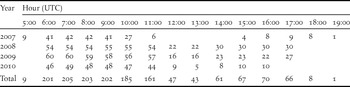
Each count was carried out by two experienced seabird ornithologists, occasionally assisted by trained volunteers. The main observer carried out continuous counts equipped with a telescope (magnification x 20), slowly scanning the area in front of Tarifa Island, in order to record the movements of Balearic and other small shearwaters moving out to the Atlantic or in to the Mediterranean. The range covered by these observations was estimated to be from 100 m to 3,000 m (91% of the whole seabird flow observations; see Mateos-Rodríguez et al. Reference Mateos-Rodríguez, Arroyo, Rodríguez, Cuenca and De La Cruz2010 for details).
Simultaneously, a second observer with binoculars (10 x 42) surveyed seabird flocks flying out of the field of view of the telescope either because they were flying too close or too high to be recorded by the main observer. For each sighting, observers recorded the species, number of birds and flight direction. Periods of one hour of continuous counts were used as the unit for analysis. We also recorded hourly wind direction (cardinal direction) and speed (Beaufort scale), at c.10 m above sea level with an on-site measuring station located in the tip of Tarifa Island.
Data analysis
Gaps in counts occurred either in those periods when censuses were interrupted or on a few days when counts were not undertaken (see legend of Table 1). In order to estimate the numbers of birds passing during those gaps, we first modeled the actual counts using Generalised Additive Models (GAM; Hastie and Tibshirani Reference Hastie and Tibshirani1990). The unit for statistical analysis was 1-hour sequences and the corresponding count was taken as the response variable. We assumed that the daily passage occurred during daylight from sunrise to sunset, since there is no evidence of nocturnal migratory movements by the species (see below). Thus, the total hours of observation varied from day to day depending on the solar timetable and among years. We performed the analyses with the package ‘gam’ in R 2.11.1 (R Development Core Team 2010). The explanatory variables considered were wind direction and speed, and time variables (hour, day and year). We adopted a forward stepwise procedure, whereby new variables were added to the model one at a time, both as main effects and as interactions with variables already in the model and we retained the model with the lowest Akaike Information Criterion (AIC; Akaike Reference Akaike, Petrov and Csake1973). Furthermore, as a final check, we used a backward step on the final model, dropping each variable in turn from the model to see if this resulted in a lower AIC. We entered categorical variables such as wind direction as factors and numerical variables such as day as smooth terms (thin plate regression splines). We modeled our data using the negative binomial distribution and estimating a dispersion parameter, which was incorporated into the model selection procedures. We used the log-link function. Once a final model was chosen, we used it to predict the average number of birds in each time gap. Then we estimated migration passage as the sum of the predicted numbers over all time gaps plus the number of directly counted birds within the study period.
We obtained standard deviation (SD) using a parametric bootstrap. Here, we created 10,000 new datasets by simulating new model parameters from a multivariate normal distribution with mean and variance-covariance equal to the fitted values and using these new parameters to predict data points at the observed covariate values (Wood Reference Wood2006). We analysed these simulated datasets in the same way as the original and estimated the SD of migratory flow from its empirical SD among the bootstrap samples.
Balearic Shearwaters in the Strait of Gibraltar show a preferential direction according to migratory behavior; nevertheless, birds flying in opposite direction were sometimes observed. To reduce the probability of double counting, surveys were carried out during post-breeding migration (mid-May to mid-July), when reverse movements are minimal (Programa Migres 2009). Additionally, we calculated separately the total counts of birds flying in the main and opposite directions. Subsequently, we obtained the net passage by subtraction of those quantities. More details of the analytical procedure and its applicability are referred to in Mateos-Rodríguez et al. (Reference Mateos-Rodríguez, Thomas and Arroyo2012).
Results
We carried out a total of 1,529 hours of counts between 2007 and 2010 (Table 1). Census coverage varied from 37.5% (2007) to 67.3% (2008) of daylight hours, thus influencing the raw number of shearwaters observed. Counts of birds flying west ranged from 12,835 in 2010 (324 h) to 17,874 in 2009 (477 h). Simultaneously, a markedly lower number of Balearic Shearwaters were registered flying east, from 585 in 2007 to 267 in 2008 (Table 1).
The final models accounted for a substantial proportion of the deviance (39.8% and 37.7% for birds flying west and east, respectively). Date is the most influential variable affecting counts in both models, accounting for about 72% of the increase in the amount of variation explained. The peaks of migration of birds flying west occurred between the last week of May and the first 10 days of June, being more notable in 2007 and 2010 but with greater spread in 2008 and 2009 (Figure 2). The second factor entering the model was the time of the day (hour) accounting for about 20% of the increase in the amount of variation explained. The migration rates were rather uniform, though they were relatively high in the early morning (up to 08h00), decreasing up to 13h00 and increasing slightly thereafter (Figure 3). The rest of the deviance explained by the models is due to the adjustment of wind speed and year, with a markedly lower relative influence.
Post-breeding phenology of Balearic Shearwaters across the Strait of Gibraltar during the years of the study. Migration rates (no. birds/hour) are represented on the Y axis, considering just observations before 12h00 UTC (point, mean value; error line, standard deviation). Julian dates (135 = 15 May) are represented on the X axis. Vertical dashed lines (in grey) indicate 1 June (left) and 1 July (right).

Diurnal (circadian) rhythm of migration of Balearic Shearwaters in the Strait of Gibraltar. Down plot (left axis): Migration rates (no. birds/hour) are represented (bar, mean value; error line, standard deviation). Upper plot (right axis): Fitted smooth term (solid line) for the time of the day (hour) in the final model, plotted on the scale of the link function (i.e. the log scale). Dashed lines represent approximate 95% confidence intervals (+/- 2 times the standard error). In the right axis s(hour) denotes the smooth function of variable hour.

There was a total of 1,263 hours of daylight distributed over all the years, days, and hours in which counts of Balearic Shearwaters were not conducted. After summing up the counted plus the estimated birds (as provided by the model), the net passage of Balearic Shearwaters ranged between 23,780 in 2008 and 26,535 in 2009 (see Table 1 for details). The standard deviations (considered as the addition of both standard deviation of birds flying west and east) were relatively low regarding final estimations, being lower than 7% on average in all the cases (Table 1).
Discussion
Balearic Shearwater population estimates
The figures obtained in the Strait of Gibraltar reflect a population of Balearic Shearwaters notably larger than thought to date. A minimum threshold of 24,000 to 26,500 individuals is proposed for Balearic Shearwaters leaving the Mediterranean by the Strait of Gibraltar. This estimation could even be considered conservative, since the potential biases suggest slight underestimation. Moreover, a proportion of the population is believed to remain within the Mediterranean (Del Hoyo et al. Reference Del Hoyo, Elliott and Sargatal1992, Paterson Reference Paterson1997), mainly adult birds (Ruiz and Martí Reference Ruiz and Martí2004), although recent findings based on remote tracking suggest that almost all the adults migrate to the Atlantic (Guilford et al. Reference Guilford, Wynn, McMinn, Rodríguez, Fayet, Maurice, Jones and Meier2012). We also point out that some birds are already observed in the Atlantic during the breeding period, usually in low numbers (e.g. Galicia; Mouriño et al. Reference Mouriño, Arcos, Salvadores, Sandoval and Vidal2003), thus supporting the idea that our estimate is conservative. Additionally, birds may also migrate later than the study period, but taking into account the phenology of the species in the study area, it may not be in significant numbers.
The use of GAM provides a reliable and statistically consistent method to convert migration passage rates for incomplete counts into migration volume (Mateos-Rodríguez et al. Reference Mateos-Rodríguez, Thomas and Arroyo2012). It is worth emphasising that the precision of our estimates appears to be high, as shown by the low values of the standard deviation (between 3% and 7%; Table 1). This might be expected given the levels of sampling effort and the use of models that explain a reasonably high proportion of the variability in counts. Furthermore, standard deviations were considerably lower in those years in which the sampling effort was higher, but the net estimations were markedly similar and consistent through the years.
In this study, the date (reflecting the phenology of the species in the area) was revealed as the factor with highest influence on the results of the counts. This is in agreement with general knowledge about the timing and control of migration, since for both extrinsic and intrinsic reasons, migration is normally confined to particular parts of the annual cycle (Newton Reference Newton2008). The remaining factors modulate the results of the counts. The inclusion of factors into estimates by modelling implies a substantial improvement with regard to other methods (see Stratoudakis Reference Stratoudakis1999).
An important question arises from these figures: how can the discrepancies between estimates on the breeding grounds and those of migrating birds reported here be explained? Several alternatives and non-exclusive hypotheses are proposed.
The first and most plausible hypothesis suggests that the estimates of breeding population are severely underestimated. This makes sense, since estimations are currently based on indirect methods as counts of rafts near breeding sites and/or those based on rate of vocalisations (see Ruiz and Martí Reference Ruiz and Martí2004), which hardly ever fit the actual number of breeding pairs. In fact, breeding population estimates have been recently reassessed upwards from about 2,000 to more than 3,000 pairs after a more thorough survey of known breeding sites plus the finding of new sites (Arcos Reference Arcos2011a). The existence of new, undetected breeding colonies is another possibility, although Balearic Shearwaters have been monitored intensely at breeding sites in the Balearic Islands during recent decades (Ruiz and Martí Reference Ruiz and Martí2004, Rodriguez and McMinn Reference Rodríguez and McMinn2002). No evidence of new colonies away from the Balearic Islands exists to date, but this possibility should not be definitely discarded, since many potentially suitable nesting sites could exist in some under-surveyed areas in the Western Mediterranean, particularly the North African coast. Alternatively, the proportion of non-breeding individuals (including juveniles, sub-adults and mature adults birds on sabbatical) might be unusually large in this species even for a Procellariiform and consequently the numbers of non-breeding Balearic Shearwaters would be underestimated (Oro et al. Reference Oro, Aguilar, Igual and Louzao2004, Arcos Reference Arcos2011a). However, there does not appear to be a plausible way of explaining such a huge non-breeding population out of the currently assumed breeding figures and considering reasonable values for demographic parameters (Arcos Reference Arcos, Valeiras, Muñoz, Bermejo, M.Arcos and Paterson2011b).
Assessing potential sources of bias
Bird censuses have always been associated with some level of error (Bibby et al. Reference Bibby, Burgess, Hill and Mustoe2000), but they may be reduced if properly trained ornithologists are in charge of the counts.
In our study, a team of experienced ornithologists undertook the surveys and the methodological procedures were settled (see Programa Migres Reference Programa2009, Arroyo et al. Reference Arroyo, Cuenca, Barrios, de la Cruz, Ramírez, Onrubia, González, Román, Valeiras, Muñoz, Bermejo, Arcos and Paterson2011). Thus we can be confident that counts were carried out under the best possible conditions and that no substantial errors are related to observer skills. The reliability of land-based counts for quantifying seabirds at sea is constrained by the distance at which birds can be detected. Even if the passage of migratory seabirds in the Strait of Gibraltar is confined to a corridor of just 14.4 km at its narrowest point, it is obviously unrealistic to believe that this distance can be covered even from the most suitable vantage point on the coast and an undetermined number of migrating seabirds, including Balearic Shearwaters, cross the Strait beyond our range of detection. Additionally, it might be thought that reverse movements of individuals occur further away from observer (i.e. along the Moroccan coast), resulting in repeated counts that could inflate the results. However, Balearic Shearwaters tend to follow the Spanish Mediterranean coast during migration (Hashmi Reference Hashmi, Yesou and Sultana2000, Paterson Reference Paterson1997) and migrating Balearic Shearwaters passing along the northern part of the Strait have been proven to concentrate near the coast, with the great majority of birds flying within the nearest 3,000 m band (mean 1,192 ± 603 m; n = 675 flocks; for details see Mateos-Rodríguez et al. Reference Mateos-Rodríguez, Arroyo, Rodríguez, Cuenca and De La Cruz2010 and Mateos-Rodríguez and Arroyo Reference Mateos-Rodríguez and Arroyo2011). Moreover, ship transects across the Strait of Gibraltar have confirmed that movements of Balearic Shearwaters are very rare along both the central and the southern part of the Strait (see appendix in Mateos-Rodríguez and Arroyo Reference Mateos-Rodríguez and Arroyo2011). Thus, the number of Balearic Shearwaters undetected by observers should be negligible, and in such a case this bias would indicate a slight underestimation. In addition, reverse migration of seabirds migrating through the Strait of Gibraltar is likely to be minimal except for Balearic Shearwaters in autumn, when remarkable movements of birds flying into the Atlantic occurred on some days (Mateos-Rodríguez et al. Reference Mateos-Rodríguez, Thomas and Arroyo2012). In this sense, recent tracking studies recorded rapid and direct migration through the Strait of Gibraltar in autumn for Balearic Shearwaters (Guilford et al. Reference Guilford, Wynn, McMinn, Rodríguez, Fayet, Maurice, Jones and Meier2012), suggesting that the occurrence of reverse migration for this species is not so generalised. In any case, carrying out the survey for this species during mid-May to mid-July, when reverse movements appear to be minimal, reduces the probability of double counts (Mateos-Rodríguez et al. Reference Mateos-Rodríguez, Thomas and Arroyo2012). Finally, there is no evidence of the existence of nocturnal migratory movements of the species, suggesting a predominance of diurnal migration, as found in the related Cory’s Shearwater Calonectris borealis (Dias et al. Reference Dias, Granadeiro and Catry2012). In any case, the existence of any nocturnal migratory movements would lead to even higher figures.
Implications for conservation
The results shown in our study confirm that the global population of the Balearic Shearwater is considerably larger than previously thought, as the simple counts already exceed the current estimates. This is relevant from a conservation point of view, since the status of this species as ‘Critically Endangered’ depends on the prediction time of extinction, which in turn depends on the population size, population structure and trend. Our results multiply by 2.5 the long assumed estimates of 10,000 Balearic Shearwaters (Ruiz and Martí Reference Ruiz and Martí2004). These estimates were based on figures of c.2,000 breeding pairs, that were used in the population viability analysis (PVA) to estimate mean extinction time of Balearic Shearwater (Oro et al. Reference Oro, Aguilar, Igual and Louzao2004). In fact, these authors already highlighted the lack of a reliable estimate of population size for the total world population of Balearic Shearwater as one of the main problems for population modelling. Recent updates refer to actual figures of c.3,200 breeding pairs, from which almost 15,000 birds could be expected (Arcos Reference Arcos2011a). Our results corroborate (or even surpass) the recent findings that the global population of Balearic Shearwaters is higher than thought to date. This fact reinforces the urgent need to reassess the PVA using new population estimates for the species, and then, if necessary, reconsider its conservation status. In this work we provide a reasonable threshold for the population, which can be used in a future status assessment. However, we must be cautious when considering this reassessment and further research is required to clarify the reasons for the discrepancies between breeding and non-breeding population estimates to correctly assess its conservation status. Our results do not provide specific information on the migratory population structure of the species, and therefore it is not possible to properly relate the figures presented here to those of breeding birds, which is necessary to run a PVA from the new information. Additionally, population trends have not been recently assessed, but the existing evidence still suggests that some colonies are disappearing or decreasing (review in Arcos Reference Arcos2011a). In this sense, it is worth noting that the population trend and adult survival estimated by Oro et al. (Reference Oro, Aguilar, Igual and Louzao2004) came from colonies without predators, and consequently reflect the result of threats at sea. Threats at sea are of special concern for this species, particularly mortality resulting from by-catch (Arcos et al. Reference Arcos, Louzao and Oro2008, Laneri et al. Reference Laneri, Louzao, Martínez-Abraín, Arcos, Belda, Guallart, Sánchez, Giménez, Maestre and Oro2010, Arcos Reference Arcos2011a, Louzao et al. Reference Louzao, Arcos, Laneri, Martínez-Abraín, Belda, Guallart, Sánchez, Giménez, Maestre, Oro, Valeiras, Muñoz, Bermejo, Arcos and Paterson2011), but also the depletion of food due to over-exploitation of small pelagic fish stocks, the variation of fishery discards at a global scale or the development of off-shore wind farms (Louzao et al. Reference Louzao, Igual, McMinn, Aguilar, Triay and Oro2006, Arcos et al. Reference Arcos, Louzao and Oro2008, Navarro et al. Reference Navarro, Louzao, Igual, Oro, Delgado, Arcos, Genovart, Hobson and Forero2009, Arcos Reference Arcos2011a). If these conditions persist, population viability is expected to remain very low, even assuming that the population of Balearic Shearwater is larger than presently thought. Under this scenario, conservation strategies for the species must be maintained or even increased, both at breeding sites and at sea. Nonetheless, the new figures may open a new ray of hope for the future of the species.
For those species where breeding numbers are difficult to estimate, as is the case for many Procellariiformes (Gilbert et al. Reference Gilbert, Gibbons and Evans1998, Heaney et al. Reference Heaney, Ratcliffe, Brown, Robinson and Lock2002), we show that coast-based counts from strategically located vantage points in areas of concentration can become an essential tool for obtaining population estimates. Such methods might also become useful to infer long-term population trends that may aid in the development of effective conservation strategies for this Critically Endangered species.
In this sense, we provide a novel approach to estimating abundance that is consistent and statistically robust, and which under the particular conditions of migratory bottlenecks, can be generalised for estimating abundance of other migratory taxa.
Acknowledgements
We thank the staff of Foundation Migres and particularly C. Torralvo, B. Pérez, J. Elorriaga, M. González, J. Ramírez and the group of volunteers for their help with the fieldwork. B. Martin, E. Casado, A. M. Paterson and two anonymous referees provided valuable comments that improved the manuscript. A. M. Paterson also improved the English in the final version. This study was funded by the Consejería de Medio Ambiente (Junta de Andalucía) in the context of the Migres Program.



