





Introduction
Existing studies have noted that faith can play a dual role, facilitating or hindering activism. Faith provides a framework for interpreting and engaging with the world, which may serve as a source of empowerment and mobilisation for activism while also functioning as an instrument for reinforcing conservative views by sustaining a conceptual binary between religious and secular matters, including politics (Hancock, Reference Hancock2023; Hodge, Reference Hodge2012; Reinhardt & Duncan, Reference Reinhardt and Duncan2025). In both respects, faith can shape the reason for and the ways in which people relate to activism (Hodge, Reference Hodge2012; Wright, Reference Wright2010). This article explores how faith shapes the perceptions and experiences of activists working against gender-based violence. Gender-based violence is defined as “violence that is directed against a woman because she is a woman or that affects women disproportionately, including acts that inflict physical, mental or sexual harm or suffering, threats of such acts, coercion and other deprivations of liberty” (UN Women Australia, 2024). Some studies note the potential mismatch between the value of women’s rights and religious practices that uphold gender norms (Haustein & Tomalin, Reference Haustein and Tomalin2019), whereas others highlight that religious teaching on justice can liberate and mobilise victim survivors to act on (Flood & Pease, Reference Flood and Pease2009; George, Reference George2015). These papers highlight the need for further studies to examine how religious beliefs, resources and practices influence activism against gender-based violence.
This article discusses the global movement advocating justice for women forced into Japanese military sexual slavery, often widely called “comfort women.” “Comfort women” has been a widely used euphemism for wartime sex slaves who were drafted by the Imperial Japanese army before and during the Second World War. Korea, as a colony of Japan from 1910 to 1945, was one of the countries with the highest number of “comfort women,” estimated to be approximately 200,000 in total from China, the Philippines, Taiwan, Indonesia, Malaysia, Vietnam, Burma and the Netherlands. Victim survivors’ voices have been silenced by the interplay of international political dynamics after the war, the social stigma attached to sexual violence victims and colonial practices (Carranza Ko, Reference Carranza Ko2023; Hicks, Reference Hicks1995; Noh, Reference Noh2024). Since South Korean survivor Kim Hak-soon’s first testimony in 1991, Japanese military sexual slavery has been recognised by the international community as a “war crime” (UN OHCHR, 2014) and a “human rights violation” (UN OHCHR, 2022). Activities around the issue have grown into a global movement not only to address unresolved issues related to official apologies and reparations but also to end wars and gender-based violence. I frame this movement as memory activism, which links the past, present and future through citizen-led “strategic commemoration of the past” aimed at transforming and advancing society (Gutman & Wüstenberg, Reference Gutman and Wüstenberg2022).
In this movement, Korean faith groups played a role in South Korea. In particular, Korea Church Women United (KCWU) was critical in promoting the movement along with feminist activists and students (Lee, Reference Lee2021). In 1990, its campaign and press conference led to the establishment of the Korean Council for the Women Drafted for Military Sexual Slavery by Japan, which is now the Korean Council for Justice and Remembrance for the Issues of Military Sexual Slavery by Japan (“the Korean Council” throughout this article). Several religious groups, including Catholic, Jesuit, Christian, Buddhist and Won Buddhist, have also supported the movement, and they formed the Korea-Japan Reconciliation and Peace Platform alongside civil society organisations in 2020 (Women and War, 2024). The significance of this movement lies in building multireligious and transnational networks from feminist theological perspectives (Cho, Reference Cho2014).
This article explores how faith has shaped “comfort women” activism in transnational contexts. In this global movement, Australia has played a unique role with the legacy of late survivor-activist, Jan Ruff-O’Herne (1923–2019), a Dutch Australian who was forced into the “comfort women” system in Indonesia during the Japanese occupation of the Dutch East Indies, and the strong network of South Korean migrant activists. In 2016, in Sydney, the Statue of Peace—a symbolic sculpture to memorialise the victims, “comfort women” and to protest against gender-based violences at war—was installed in a uniting church whose pastor supported the movement in partnership with Korean migrants. My article on Korean migrants’ transnational activism (Noh, Reference Noh2021) suggests that faith serves as motivation for some activists to engage in this movement. However, the role of faith in activism in relation to individuals’ perceptions and experiences of gender-based violence remains underresearched, particularly in the context of transnational activism.
To help fill this gap, this research examines how faith is perceived as supporting or undermining “comfort women” activism among two groups: Australian and Korean victim survivors and Korean migrant activists in Australia. This study uses the term “faith” to encompass both institutionalised religions and collective and individual spiritual practices. Its focus on the relationship between faith and activism against gender-based violence importantly allows me to explore how this religious and spiritual engagement intersects with the transnational contexts of Korea and Australia and with a broader global human rights movement surrounding “comfort women.” Korean migrants’ activism, particularly in Australia, has rarely been discussed in scholarly articles. This present research expands the understanding of Korean migrants’ transnational activism, with a focus on the influences of their faith.
Locating faith and “comfort women” activism in the literature
Faith and activism
The relationship between faith and activism is often described as either enhancing or constraining each other (Hancock, Reference Hancock2023; Hodge, Reference Hodge2012; Reinhardt & Duncan, Reference Reinhardt and Duncan2025). Faith can construct social identity, offering a distinctive worldview (Truong & Ghafournia, Reference Truong and Ghafournia2024; Ysseldyk et al., Reference Ysseldyk, Matheson and Anisman2010). Hodge (Reference Hodge2012) describes how faith can promote social justice by providing individuals with a lens to understand and interpret injustice and motivating them to act upon it. For example, the identified influences of religious teaching and practices include the contribution of Buddhism—in particular “engaged Buddhism”—to the concept of human security and activism around peace and environmental protection (Laliberté, Reference Laliberté2024; Truong, Reference Truong, Haar and Busuttil2005) and progressive Christian ethics in human trafficking activism (Campbell & Zimmerman, Reference Campbell and Zimmerman2014). Spirituality, beyond institutionalised religions, has been discussed by some feminist scholars, including Judith Butler and bell hooks, with a focus on its liberational and relational impacts on activism (Kim, Reference Kim2014).
Religion and spirituality have been suggested as sources of transnational empathy, affection, hope and justice (Morin & Guelke, Reference Morin and Guelke2007; Wright, Reference Wright2010). Scholars have also identified how religious practices can cultivate emotional behaviours such as compassion and care that stimulate and support activism. Compassion and care ethics, which is based on interrelatedness from a Buddhist perspective, highlights alleviating others’ suffering (Truong, Reference Truong2006), and the Muslim sense of piety and religious obligation serves as a source of activism (McGinty, Reference McGinty2012). Spirituality also provides emotional sources for political activism such as hope and compassion (Wright, Reference Wright2010). In addition, many faith traditions have incorporated social justice, prompting individual practitioners and faith-based organisations to engage in activism, as seen in movements rooted in Buddhism, Christianity, Hinduism, Islam and Judaism (Hodge, Reference Hodge2012; Laliberté, Reference Laliberté2024). Catholic communities have taken a role in promoting social justice grounded in Catholic Social Teachings, particularly concerning peace and life (Park, Reference Park2010), and more progressively, in movements inspired by Liberation theology (Woodworth, Reference Woodworth2023). However, tensions between faith-guided compassion and accountability are noted in evangelical activism (Elisha, 2018). Another study demonstrates that faith-based activism differs significantly across countries even within the same denomination (Laliberté, Reference Laliberté2024).
Faith and gender-based violence
Faith has a complex- and context-specific relationship with gender-based violence. Religious teachings and practices can shape social and gender norms, which can contribute to or work against gender-based violence (Truong & Ghafournia, Reference Truong and Ghafournia2024). For victim survivors, faith can serve not only as a resource and refuge but also as a barrier to seeking help (Tran et al., Reference Tran, Forbes-Mewett, Tran, Hach and Tarzia2025). In general, all major faiths do not tolerate violence and encourage assisting those in need. However, how they approach and address gender-based violence is often questioned because of their role in perpetuating violence against women or women’s acceptance of suffering and reinforcing patriarchal views (Flood & Pease, Reference Flood and Pease2009; Truong & Ghafournia, Reference Truong and Ghafournia2024). For example, Catholic Christianity has been identified as playing a complex role in seeking to alleviate gender-based violence while simultaneously entrenching a binary view of gender relations (Hermkens et al., Reference Hermkens, Kenneth and McKenna2022). A study in Australia revealed that most religious groups, including Christian, Muslim and Jewish groups, tend to present a conservative view of gender norms, whereas some play a role in progressive social change (Van Krieken et al., Reference Van Krieken, Habibis, Smith, Hutchins, Martin and Maton2010). In response to gender-based violence, a study suggests the potential role of Buddhism-informed healing and empowerment for victim survivors, while acknowledging the limited attention such issues receive within Buddhist communities (Kanukollu & Epstein-Ngo, Reference Kanukollu, Epstein-Ngo and Johnson2015).
Several studies have noted the role of faith practices in diffusing norms of gender equality or justice in the context of gender-based violence. Religious teaching on justice and compassion was observed to empower and mobilise communities for social change (Flood & Pease, Reference Flood and Pease2009; George, Reference George2015). An empirical study also reports that an overwhelming majority of people from diverse religions (Buddhist, Sikh, Muslim, Christian, Jewish, Hindu and mixed-faith) perceive their religion as valuing gender equality (Page & Yip, Reference Page and Yip2017). Three faith communities—Muslim, Jewish and Catholic—identified their faith as informing the concept of justice in relation to gender-based violence (Aghtaie et al., Reference Aghtaie, Mulvihill, Abrahams and Hester2020).
In Korea, 51% of the population is identified as irreligious, while Christianity—Protestantism and Catholicism combined—account for 31%, followed by Buddhism at 17%. Korean Christian communities have worked toward gender equality particularly since the introduction of feminist theology in the 1970s (Cho, Reference Cho2014). However, a study from Korea indicates that young women view gender norms and cultures within Catholic, Protestant and Buddhist institutions as failing to keep pace with broader societal change (Park & Oh, Reference Park and Oh2023). Similarly, another study notes that Korean churches lag behind in preventing and responding to gender-related violence, despite their Christian ethics, which highlight the protection of the vulnerable (Kim, Reference Kim2022).
Faith and Japanese military sexual slavery
Conservative Korean churches have been identified as pivotal for shaping modern Korean masculinity (Choi, Reference Choi2012; Schattle & Lee, Reference Schattle and Lee2019). However, Japanese military sexual slavery issues have been unearthed through the active role of Korean Christian women since the 1980s and led to the establishment of the Korean Council (Oh, Reference Oh2020). Christian victim survivors, including Kim Hak-soon and Gil Won-ok, also played key roles in promoting the movement both nationally and internationally (Chung, Reference Chung2019). In the international context, in 1993, the Justice and Peace Committee of the Seoul Catholic Archdiocese sent a letter to the Japanese Embassy in Korea and the Japanese Catholic Reform Commission regarding an apology to “comfort women” (Catholic Times, 2012). Moreover, many faith leaders and laypeople from Catholicism, Buddhism and Won Buddhism have supported the movement through public statements, financial contributions, religious practices and participation in the Wednesday demonstrations organised by the Council (Lee, Reference Lee2022; Min, Reference Min2016; Bishop’s Conference of Korea, 2016; Chung, Reference Chung2022).
Some scholars have interpreted this issue of sexual slavery as a violation of Imago Dei, the image of God (Yang, Reference Yang2016). Some recent studies have also examined this issue from the perspective of theological frameworks of shame, reconciliation and hospitality (Bong, Reference Bong2023; Yu, Reference Yu2022). These existing studies point to the need for further studies that explore how religious beliefs and practices can influence the perception of gender-based violence and related activism. This research seeks to analyse how Korean and Australian activists interpret or advance religious teaching and practice in the context of this movement.
Methods
Philosophical orientation and positionality
This study is philosophically grounded in social constructionism and constructivism, which underscore the social and cultural influences on meaning-making processes and the uniqueness of individual interpretations of shared phenomena, respectively (Crotty, Reference Crotty1998). This orientation directed my inquiry into how religious or social contexts shape perceptions and practices related to gender-based violence, as well as how activities within the same faith or community may diverge in their interpretation of these issues. I acknowledge that my own experiences as a Korean migrant in Australia, a Christian—particularly one with experience in faith-informed political activism as a member of a Catholic Youth movement with the Catholic Priests’ Association for Justice—and a fellow activist could shape both the research questions and the way I relate to the interview participants. My shared understanding of the contexts of this movement and the Christian faith helped me engage with written records and interview participants, while my limited understanding of other faiths led me to seek detailed explanations and interpretations of the link with activism.
Data collection
This research collected two types of data: public narratives of “comfort women” survivor-activists from Korea and Australia and interviews with Korean migrant activists living in Australia. First, I reviewed publicly available documentation. This includes the memoir, Fifty Years in Silence, written by a Dutch-Australian survivor and committed Catholic Jan Ruff O’Herne (1923–2019), and archived testimonies and public statements made by Kim Bok-Dong (1926–2019) and Gil Won-ok (1928–2025), two representative survivor-activists from Korea. Although the collected documents include no reference to their faith, Kim Bok-Dong was a devoted Buddhist, and Gil Won-ok was a Christian who served as a deacon in her church.
I subsequently conducted 10 online semi-structured interviews with migrant activists to explore the role of faith in their activism. The reasons for exploring the perceptions of migrant activists are threefold: first, activism within migrant communities has been less researched than that of mainstream society; second, migrant activists can provide valuable insights into how transnational contexts shape their experiences of faith and activism, given the transnational nature of the issue and the movement; and third, my engagement in this issue as an activist since 2015 has enabled access to communities of Korean migrant activists. In Australia, Korean activists (approximately 50–80, with approximately 15 core members) are first- or second-generation immigrants. The interview participants were invited from three activist groups: four from Sydney, four from Melbourne and two from Brisbane. Three participants were identified from my earlier research and my involvement in these communities’ activities. Additional participants were recruited through group announcements and recommendations from previous interviewees. The participants received the information sheet supplementary material, which outlined the purpose and process of this project and provided written consent.
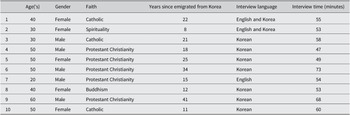
The interviewees were evenly split by gender. In terms of religion, five participants identified one’s religion as Protestant Christianity, three as Catholic, one as Buddhism and one as Spirituality. Further details on each participant can be found in Table 1.
Characteristics of the participating activists

Table 1. Long description
Error
As a Korean native proficient in English, I conducted seven interviews in Korean, two in a mix of English and Korean and one in English, on the basis of each participant’s preferences. With experience in professional translation between Korean and English, I transcribed and translated all the interviews by myself to ensure confidentiality. The transcripts were checked with the interview participants to increase their accuracy and credibility.
Data analysis
Qualitative data collected from documents and interviews were analysed with the aid of NVivo. The thematic analysis processes focused on how victim survivors made sense of their faith in the context of gender-based violence and how activists—including those victim survivors who actively participated in the movement—related their faith to their experience engaging in the Japanese military sexual slavery campaign. Across different sets of data—archival documents about and by victim survivors and interviews with migrant activists—I assigned codes such as “identity,” “motivation,” “meaning of faith” and “meaning of activism.” The identified codes and patterns were developed into major themes in relation to the role of faith in (1) recognising the suffering of “comfort women,” (2) shaping understandings of gender-based violence and (3) assisting or undermining their activism. Public narratives of survivor-activists were presented with their names and sources, whereas quotes and findings from interviews were deidentified.
Results
Engaging with the suffering of “comfort women” through faith
Korean victim survivors’ oral testimonies generally focus on confirming facts and building collective memories of the sufferings they endured. While faith is largely absent from their narratives, Kim Bok-Dong attributed her survival to Buddha and her mother’s daily prayers for more than eight years while she was at comfort stations across China, Hong Kong, Malaysia and Singapore in one interview (BBS, 2019). A memoir written by a Dutch-Australian survivor, Jan Ruff O’Herne, explicitly reveals that her Catholic faith assisted in surviving suffering. The following shows that her faith was a source of hope and strength:
I was poor and stripped of everything, and yet I was rich because of it. It meant a total dependence on God for everything. We were in God’s hands. I was aware of an inner strength that came from God and which would determine that I was going to survive all this hardship and suffering, no matter what! (Jan Ruff-O’Herne, Reference Ruff-O’Herne2008, p. 61–62)
The religious practices of reading the Bible and praying together provided her and other victims with a “healing effect” in their suffering (Jan Ruff-O’Herne, Reference Ruff-O’Herne2008, p. 88). Their faith also deepened their understanding of Jesus’s passion, allowing them to connect it with their own suffering:
The humiliation was as much as I could stand. For the first time in my life I fully understood what Jesus must have suffered when he was stripped of his garment before crucifixion. Each time, after the doctor’s visit, I went to my room and prayed the Tenth Station of the Cross – Jesus is stripped of his garments. (Jan Ruff-O’Herne, Reference Ruff-O’Herne2008, p. 96)
However, right after the war, Jan Ruff O’Herne was rejected by a Catholic priest when she expressed her desire to become a nun:
I was shattered and sadly disappointed by what I had been told. It gave me a terrible inferiority complex. Was I not good enough now to embrace the religious life? Had I suddenly changed? Was I soiled and dirty? (Jan Ruff-O’Herne, Reference Ruff-O’Herne2008, p. 127)
Although her devoted faith was betrayed by the priest, who judged her for what had happened to her, she remained strong in her faith, recalling that “Christ, too, had been scorned, rejected and misunderstood” (Jan Ruff-O’Herne, Reference Ruff-O’Herne2008, p. 127). After publicly disclosing, 50 years later, that she had been a “comfort woman” and actively engaging in this movement as human rights activist, she could reconcile her relationship with the Church as well:
The parish was welcoming me back with open arms. Father was offering the mass for me…I had feared the consequence of breaking the silence for so long…I had arrived home to peace, and love and acceptance. (Jan Ruff-O’Herne, Reference Ruff-O’Herne2008, p. 151–152)
This change in the Catholic Church’s response was notably mentioned by two interview participants (Participants 1 and 2), who emphasised its significant impact on Jan’s journey as a survivor-activist, through which she healed herself and sought the healing of others as deeply aligned with her faith:
I actually felt quite relieved that Jan didn’t receive mistreatment from her place of faith for the second time. Once is enough. (Participant 1)
The faith of survivor-activists also influenced some Korean migrant activists who shared their religion, deepening their sense of connection and enabling them to understand survivors’ lives with empathy through a religious perspective:
I do think the Catholic faith has had an instrumental role in at first establishing our friendship, but throughout the years consolidating the depths of our friendship…. To me, Jan was a true survivor. She has overcome rage and to be honest, understandable hatred towards the perpetrators because she was able to tap into that faith, in my opinion, and she sought strength to be able to forgive and love herself again. (Participant 1)
I guess that Kim Bok-dong could focus on the future, neither the past nor the present…In Buddhism, we believe that every human being can be a Buddha after the ultimate realisation. She may have used her hatred and suffering to reach the highest spiritual state. (Participant 8)
The activism of victim survivors was perceived as a process of restoring a fractured self and achieving self-fulfilment, guided by their faith. In addition to shared faith, most interview participants could have a sense of relatedness to victim survivors through intersectional identities, such as migrants (6 participants), Koreans (5 participants) and women (3 participants). For example, one participant described victim survivors as “migrants dispatched to unfamiliar land against their will”, similar to the interview participants themselves (Participant 10).
For some interview participants, particularly those with Christian faith, their own faith served as a motivation to engage in this movement:
If I say I believe in God and if I say I believe in the love of God, my faith should reveal the love through my act by loving others. (Participant 9)
I want to live with a purpose as a Christian. To me, living well in line with that purpose means spreading God’s love in the world… We are indebted to victim-survivors’ bitter lives and are responsible for acting on their behalf. I am proud to be part of this movement as a Christian. (Participant 6)
In addition to the command of love, another Christian participant explained that his anger led him to join this movement:
We have been commanded by our scriptures to take care of those who were hurt, to take care of the minorities and love one another, especially those who have been wronged. So I guess that being the basis of my faith and then seeing this group of women, victims who were never cared for but only abused even by their own government just made me very upset. Made me very sad that…not only are we not following the commands of God to love one another, we are actively going against the governments that silenced them…So yes, my faith has influenced me because we need to be more loving and then need to be more just. (Participant 7)
Urging the Japanese and Korean governments to take responsibility for their past and ongoing attempts to silence victims and activists is a shared goal of this movement. Notably, the participant’s anger toward the government was invoked by his concept of justice, which aligns with his faith.
Understanding rights and justice through faith
Some Korean survivors, including Kim Bok-dong and Gil Won-ok, and a Dutch-Australian survivor, Jan Ruff O’Herne, were devoted to the fight for justice. Their fight was not confined to resolving the Japanese military sexual slavery issue, and they all emphasised solidarity with citizens and other victims of sexual violence in conflict around the world:
I would like to tell the Japanese government and embassy that they can move themselves if they don’t want to see the Statue of Peace. The statue is erected with funds raised by the civilians who supported us during difficult times, so even the Korean government does not have authority over it…I may have lost my trust in the government, but I still trust the people. (Kim Bok-dong, https://womenandwar.net/kr/testimonies)
I started coming out to the street in 2002. I started talking about everything that happened to me. I travel to different countries because we cannot let anyone else be victimised like us… How do I travel to all kinds of places, in scorching sun and awful cold? I want to make a world without war, a peaceful world. That is why I travel with my sick body everywhere. (Gil Won-ok, https://womenandwar.net/kr/testimonies/)
For fifty years, the “Comfort Women” maintained silence; they lived with terrible shame, of feeling soiled and dirty… I hope that by speaking out, I have been able to make a contribution to world peace and reconciliation, and that human rights violation against women will never happen again. (Jan Ruff-O’Herne, United States congressional hearing 2007, https://comfortwomenaction.org/2024/01/07/statement-of-jan-ruff-oherne-at-the-2007-congressional-hearing-for-the-house-resolution-121/)
Public narratives rarely show how faith influenced their activities as peace and human rights activists. The following is an exception that demonstrates how Jan’s vision of peace was free from hatred and fear, aligning with her Catholic faith:
Today I am laying a wreath at your memorial in Tokyo, with the Japanese people, standing at my side. This wreath is a sign of peace and forgiveness. A sign of hope for the future of the world, the future of our children. I hope that after fifty years, we have learned the lesson that we are putting the war behind us and that we can work together, towards a world of peace. A world without hatred and fear, without war and violence, but rather a world of peace and understanding, friendship and love and freedom…Several elderly ex-soldiers and other peace-seeking men came forward to read out their prepared speeches and prayers. Some of these men were Christians and I was very touched by one man who gave a moving talk in broken English. He ended by praying that beautiful psalm, Psalm 51, with the words, “My sin is always before me”. Holding out my hands to the ex-soldiers, I concluded the wreath laying ceremony by praying the peace prayer of St Francis of Assisi…The week in Japan was, for me, a continuous healing process. (Jan Ruff-O’Herne, Reference Ruff-O’Herne2008, p. 150)
These survivor-activists’ contributions to peace and human rights were recognised through several international and national awards, including those from faith communities—Jan Ruff-O’Herne served as an ambassador for the Year of Grace in 2012 (The Southern Cross, 2019) and Gil Won-ok received the inaugural Ewha Christian Women’s Peace Award in 2017 (Daily Good News, 2017).
However, most interview participants did not perceive religious institutions as playing a significant role in this movement, although they acknowledged “Christian women’s critical role in initiating this movement in Korea” (Participant 1) and “Australian church’s support for the Statue of Peace” (Participant 3). The installation of the Statues of Peace has been a critical element of this memory activism, and activist groups in Sydney and Melbourne faced difficulties in finding a safe location to protect the statues from potential damage. They shared how the Statue of Peace in Sydney has been placed in the Uniting Church, a Christian denomination in Australia, as follows:
The Uniting Church in Ashfield has had some connections with the Korean Church since the 1970s. However, the decision to place the Statue there was driven primarily by Rev. Bill Crews’ personal commitment as a human rights champion. He first reached out to us, suggesting the Church as a safe location for the Statue, free from attack or damage. (Participant 9)
However, some suggest that this could be possible, as the Uniting Church has demonstrated its strong focus on social responsibility and activism for social justice (Participants 1, 4 and 6). The Uniting Church, as an Australian denomination, was contrasted with Korean churches, where practitioners either condemn political activism or praise it as a good deed driven by altruism:
Korean Christians here are very conservative. Pastors and general church members blame me for wearing a badge (symbolising support for a specific social movement), considering it an act of adultery. Any political engagement is criticised as communist. (Participant 6)
If I can put it this way, I think there was an overall sense that being involved in the so-called comfort women issue for a young woman that I was back then was seen as virtuous…The reaction I received from other Christians when I said I was doing this was that it was something good and that was good enough. An uncomplicated sense of this is a good thing. (Participant 1)
Most participants perceived Korean churches in Australia as conservative, “with hierarchal and male-centred structure” (Participant 10) “reflecting Korean society which does not challenge the power and wealth” (Participant 6). Although they could gain a sense of belonging (Participant 4) and endure the hardships faced by migrants (Participant 5) in Korean churches, they felt that their engagement in activism was not well received by fellow churchgoers (Participants 6 and 9).
Despite the negligible official role of institutional religions and the lack of understanding from migrant faith communities, some activists found religious leaders’ informal support meaningful in highlighting the legitimacy of this movement:
Pope Fracis encouraged me to keep up with the fight. I felt very thankful and was deeply touched and very impressed. (Kim Bok-dong, after a private audience with Pope Francis during this stay in Korea, 2014, https://www.catholicsun.org/2014/08/19/former-sex-slave-says-she-still-feels-impact-of-meeting-with-pope/)
I could see nuns whenever I went to the Wednesday Demonstration (the weekly protest that began in 1992) in Korea. Even when Buddhist monks held demonstrations, nuns were at the forefront. I was impressed by them, similar to the Catholic Priests’ Association for Justice, who have consistently stood by the vulnerable. (Participant 3)
For most participants, this sexual slavery issue is about human dignity, a concern shared by all religions. At the same time, some participants acknowledged that caring for victim survivors does not necessarily require faith, although it is the essence of faith:
The issue is about showing no respect for human life. Belittling the value of life is a big issue for Christians…If I were not a church goer, I would still be involved in this out of a sense of justice. My faith is an additional force, I think…I don’t think we need “faith” to do this. It is so natural to be concerned about others as part of life…In my view, the essence of faith is helping others, particularly those who are vulnerable, and having righteous anger and taking action. (Participant 4)
As noted above, most participants recognised the experiences of victims as an issue of justice, highlighting their structural vulnerability as women in a colonised country. Among them, five participants (Participants 1, 7, 8, 9 and 10) explicitly framed this military sexual slavery issue as a woman’s rights issue. A few participants, especially Christians, reported that their faith is deeply associated with human rights and that social justice stems from their faith.
Human rights involve loving human beings. This is why it can align well with Christian faith. (Participant 9)
Christians should bear social responsibility. We need to speak out when we see injustice. That is the role of the prophet. (Participant 6)
One Christian participant maintained that human rights values are deeply rooted in the Bible, suggesting that the failure to uphold them should be explained by human nature:
I genuinely believe that most of our human rights values are derived from the scriptures. It’s just that a lot of the Christians, because we are selfish people, we pervert the words of God and purposely deny the importance of the emphasis of societal love within the scriptures. (Participant 7)
In contrast, one participant disagreed with the claim that Christian belief serves as a grounding for social justice, feeling conflicted between being a Catholic practitioner and an advocate for women’s rights:
It is never easy to be a Catholic practitioner while also being a feminist and an advocate for women’s happiness, freedom, and power throughout my life. (Participant 1)
This participant particularly noted the tensions between practicing feminism and Catholic faith in Korean churches, choosing to attend services where she finds compatibility with her values.
Despite diverging opinions regarding the alignment of faith and human rights, Participants 1 and 7 commonly suggested that their commitment to universal values, such as human rights and justice, was shaped by their upbringing and first-hand experiences in other campaigns in Australia. The participants, including these two participants, commonly highlighted the universal nature of gender-based violence at war, as one participant stated:
I think there is a misconception that this is a Korean issue. The way I see it is there is a correlation. I think it’s like a Venn diagram with every issue we see during wartime. Many terrible sexual crimes have occurred. The intersection here is that men coerce women for their own purposes, for their own will, without respecting uh, the consent of the women. And then I just realised, this is definitely not just a Korean issue. This happened worldwide. Guess what? It’s still occurring worldwide. Wherever there is, wherever there are men with guns, there is rape. (Participant 7)
Framing the “comfort women” issue as a “worldwide issue” calling for “global solidarity” was attributed to their transnational positionality as migrants (Participants 2, 9 and 10), distinguishing it from the nationalistic viewpoints that have sustained this movement in Korea albeit amid increasing efforts to move beyond them (Participants 1 and 3).
Sustaining activism through faith
As mentioned as one of the motivations for this movement, faith was described as an influential factor in motivating and sustaining broader activism.
Faith has led me to take responsibility for society. I try to be more tolerant. I try to be righteous on the basis of God’s words. (Participant 6)
My mother was very concerned about my active participation when I first engaged in a social movement. I reassured my mother at that time, “You bore and raised me as a Christian. I have nothing to be ashamed of in from of God”. I think I am living in line with the will of God. I am confident and proud of myself in front of God. (Participant 9)
For the older generation, such as Participant 9’s mother, who witnessed political persecution in Korea, engagement in activism entailed significant risks. However, a shared Christian belief could be used to reassure family members about their involvement in the movement.
For some participants, activism preceded their faith. For example, Participant 10 chose her faith, influenced by her engagement in activism.
In my case, I did not think activism through my faith. I decided to become a Catholic, which aligned quite well with my thoughts and activism. (Participant 10)
The above reflects public perceptions about the Catholic Church, which has a history of supporting the democracy movement in Korea. As a result, this participant strongly believed in the alignment between her perceptions of faith and activism—both means becoming “a better person”.
For me, faith and activism are not different at all. There is no end, but I cannot give up any. (Participant 10)
Similarly, a participant with a spiritual faith stated that joining this movement gave her a sense of purpose:
As a spiritual person, it is important for me to embody my highest values. One of my greatest values is justice. This movement serves as a purpose in my life… That way I can find a true meaning of my life. I can demonstrate my highest value—a true being self. (Participant 2)
However, some participants also noted the differences—faith can be more constant than activism, which continually changes its agenda.
Issues keep changing, but faith does not. I can decide what to work on as decided by my faith (Participant 10).
Furthermore, some participants regarded their faith—Buddhism and spirituality—did not encourage activism.
I respect those who act on their faith. I don’t know any other activists who practice Buddhism. But I do not think Buddhist teachings emphasise social or political matters…Even in faith communities, I have not experienced any Buddhist groups urging us to take collective action as a faith community. (Participant 8)
In spiritualism, individual belief is what matters most. I cannot force others to be interested in social justice issues…In many cases, activism involves anger in the fight…I would like to rather focus on healing rather than horrible things that occurred in the past. (Participant 2)
For them, “constantly training the mind in daily life” and “pursuing personal path of seeking own values” are the essence of their faith. While these principles can align with engagement in activism, Participants 2 and 8 perceived that they may at times contradict the nature of activism centred on collective actions for common causes.
The participants commonly suggested faith as a source of resilience. As the “comfort women” campaign has lasted for a long time without achieving its demands, resilience has remained one of the key virtues for those committed to this movement:
It is such a long journey. Human rights or justice is my highest value that I want to live by. Actually, the activities give me energy back. (Participant 2)
I think faith helps me to not be so dismayed. No matter how terrible things go, no, I can rely on God. There’s I can fall back into the arms of God. Therefore, it helps me to deal with loss more easily. When you lose the fight, people may be hurt, upset and hurt. Me too. But I could go. That is OK. (Participant 7)
This suggests that faith can assist activists in being resilient and persistent despite the hardships they encounter in activism.
Discussion
Faith is influential in shaping activists’ motivations, commitment and resilience in activism, yet it has received limited scholarly attention to date. This research examined whether and how faith influences both the enabling and constraining aspects of activism against Japanese military sexual slavery. Findings from public narratives of survivor-activists from Korea and Australia and interviews with Korean migrant activists in Australia suggest that their faith, although not central, supported recognising the suffering surrounding gender-based violence, strengthening commitments to social injustice and engaging in activism perseveringly. Despite the lack of public records on the faith of victim survivors, some studies have identified the role of faith in helping them step forward as witnesses and activists (Chung, Reference Chung2019). Without direct experience of gender-based violence, migrant activists could relate to the suffering of victim survivors, partly by attributing their motivation and enduring commitment to religious teachings. While the focus and influence of activists varied across different religious and spiritual teaching and practices, the shared values of human dignity were reported as key in shaping their understanding of gender-based violence and their sense of purpose in contributing to related activism. All participants framed Japanese military sexual slavery as a grave threat to human dignity and a violation of women’s rights (Yu, Reference Yu2022). Valuing dignity and rights is not necessarily informed by faith; however, interview participants with faith tended to relate these values to their faiths or perceive them as strengthened by faith to some extent.
Faith appears to be influential as an ethical and emotional foundation for individual activists. The relationship between faith and universal values such as human rights, justice and peace can be found in the common emphasis on human dignity, goodness and compassion (Moyn, Reference Moyn2017; Salama & Wiener, Reference Salama and Wiener2023). Emotional reflexivity, which involves the contemplation and management of emotions, is suggested to be critical for sustained activism (Brown & Pickerill, Reference Brown and Pickerill2009). Faith can underpin commitment and resilience when facing challenges, as well as compassion and accountability for distant others (Elisha, Reference Elisha2008). Given the temporal and spatial distance of “comfort women” issues for immigrants in Australia—particularly for 1.5-generation participants educated outside Korea—faith has played a role, although not a primary role, in Korean immigrants’ engagement in the movement. In particular, the Christian faith was presented as having strong ground for enhancing activism, with particular attention given to vulnerability, social responsibility and justice. This is in line with existing studies that suggest compatibility between Christian faith and civic virtues that encourage participation in activities for good causes (Tse & Chan, Reference Tse and Chan2023). Christian teaching is understood to emphasise a particular concern for the vulnerable and a commitment to social justice (Woodworth, Reference Woodworth2023). Bong (Reference Bong2023) suggests extending Catholic-informed “hospitality” to “comfort women” and recognising their lives as embodying life and hope. Spirituality and Buddhism highlight harmony and inner peace, valuing individuals’ meaning and life purpose (Kwan & Wai-Yin, Reference Kwan and Wai-Yin2023). These aspects may seem incompatible with activism; however, the findings of this study indicate an alignment with activist practices that can be energising and transformative. Spirituality has informed feminist understandings of interdependence and relationality (Kim, Reference Kim2014), which underpin and enhance solidaristic actions (Eckenwiler, Reference Eckenwiler2018). Buddhist teachings highlight liberating individuals from suffering and worldly limitations and suggest that transformed individuals can bring positive changes to society (Cho, Reference Cho2014; Hodge, Reference Hodge2012), as demonstrated in some forms of Buddhism-inspired activism for social justice causes (Laliberté, Reference Laliberté2024).
This study also identified tensions between activist and feminist identities, as well as frictions between institutionalised religions and individual practices. The identity misfit reported by a Catholic practitioner is related to conflicts between the Church’s pursuit of social justice and its teachings on gender and gender-based violence (Hermkens et al., Reference Hermkens, Kenneth and McKenna2022). Although a justice orientation has been key to both Protestant and Catholic feminist activists in Korea since the 1980s (Cho, Reference Cho2014), most activists have found that their faith communities lag behind the needed changes and instead focus on individual practices by reinterpreting and reconciling their religious teachings, which is consistent with existing studies (Ecklund, Reference Ecklund2003; Reinhardt & Duncan, Reference Reinhardt and Duncan2025). Most interview participants did not perceive the role of institutionalised religions as significant in “comfort women” activism in Australia. The interview participants affiliated with Korean migrant faith communities felt misunderstood or unaccepted by fellow members. This can be explained by the tendency toward conservatism found in diaspora Christian communities (Cho, Reference Cho2004), as demonstrated in this study, where migrant faith communities undermined the “comfort women” movement, perceiving it either as a leftist political matter or as a form of charity toward the vulnerable.
This research highlights another important context for participating activists—their transnational positionality. Migrants have contributed to human rights and peace movements in both their countries of origin and their host countries through their transnational identities and networks (Cohen & Fischer, Reference Cohen and Fischer2018). Migrants’ engagement in the social and political issues of their home countries—conceptualised as “political transmigrants” (Guarnizo et al., Reference Guarnizo, Portes and Haller2003)—is increasing because of the maintained link with their country of origin and the favourable context of their host country (Dhesi, Reference Dhesi2017; Quinsaat, Reference Quinsaat2019). This study contributes to a deeper understanding of migrants’ activism, involving transnational contexts for interpreting and practicing their faith. Faith is suggested to play an important role in migrants’ lives and political activism (Kotin et al., Reference Kotin, Dyrness and Irazábal2011). A study in the context of the USA also indicated that Korean migrant faith communities serve as important sites for sustaining transnational identities and connections to the home country (Jin, Reference Jin2017). However, the findings of this research suggest that Korean migrant faith communities rather distance themselves from political activism, creating friction for individual activists of faith. Given that the relationship between faith and activism has not been discussed much, particularly among non-Western populations (Hancock, Reference Hancock2023), this research serves as a significant addition to scholarship on the role of faith in migrant activism. Further research is needed to investigate how the influence of migrants’ religious beliefs and practices on their activism is mediated by the diverse and intersecting variables of national, sociopolitical and cultural contexts.
Conclusion
This study explored the influence of faith on the understanding of gender-based violence and how it shapes or supports related activism, as perceived and experienced by those engaged in “comfort women” activism. Faith appeared to serve as an ethical and emotional foundation, to some extent, for activism, strengthening activists’ connections—with the suffering endured by Japanese military sexual slaves; with the values of human dignity, human rights and social justice; and with activism through enhanced commitment and resilience. This study also noted the unique challenges faced by activists who experience a misalignment between their faith and activism, particularly in how they challenge gender norms or mobilise collective action. This study expanded our understanding of the relationship between faith and activism within the transnational context of migrants.
Supplementary material
The supplementary material for this article can be found at http://doi.org/10.1017/S0957876526000422.
Acknowledgements
I appreciate the thoughtful feedback offered by Prof. Susan Broomhall, Director, Gender and Women’s History Research Centre at Australian Catholic University on earlier drafts. I am grateful to the three reviewers for their constructive comments.
Funding statement
This research has been supported by the 2023 Korean Studies Grant Program of the Academy of Korean Studies (grant number AKS-2023-R-067).
Competing interests
The author declares that she has no conflict of interest to report.
Ethical standard
This study was approved by the Australian Catholic University Human Ethics Committee (2023-3059H). This material is the authors’ own original work, which is not currently being considered for publication elsewhere.
Use of AI tool
During the preparation of this manuscript, the author used Chat GPT and Rubriq for grammar checking and editing purposes.


 Open access

