


1. Introduction
For a long period, creative work was understood mainly as a human-centered activity, grounded in individual insight and experiential knowledge (Reference Perry-Smith and MannucciPerry-Smith & Mannucci, 2017). With the rapid progress of generative AI, this assumption is being challenged. AI systems can now create texts, images, code, design alternatives at a scale and speed that were previously unattainable. More and more studies are beginning to investigate human–AI co-creation (HAIC) (Rai & Sarker, 2019; Reference Song, Zhu and LuoSong, Zhu, & Luo, 2024; Reference Wu, Ji, Yu, Zeng, Wu and ShidujamanWu et al., 2021). HAIC here refers to humans and AI working together synergistically to accomplish creative tasks (Reference Song, Zhu and LuoSong, Zhu, & Luo, 2024; Reference Wu, Ji, Yu, Zeng, Wu and ShidujamanWu et al., 2021). In the process of HAIC, both humans and AI leverage their unique strengths, engaging in dynamic interaction to achieve tasks. HAIC is already visible in practice, such as prompt-based creation, model-assisted design, agent-supported planning (Reference Sarica and LuoSarica & Luo, 2024; Reference Ren, Ma and LuoRen, Ma, & Luo, 2025; Reference Zhu and LuoZhu & Luo, 2023). The purpose of this article is to clarify the necessary elements in HAIC. Hence, we propose a conceptual model of HAIC that distinguishes five core elements: Human, AI, Instruction, Interaction, and Artifact. By defining these elements and their relationships, we contribute a theoretical lens consistent with design-oriented research. We treat the co-creation process itself as a design object, providing developers and researchers with a specific checklist to diagnose why a collaboration fails.
2. Theoretical background
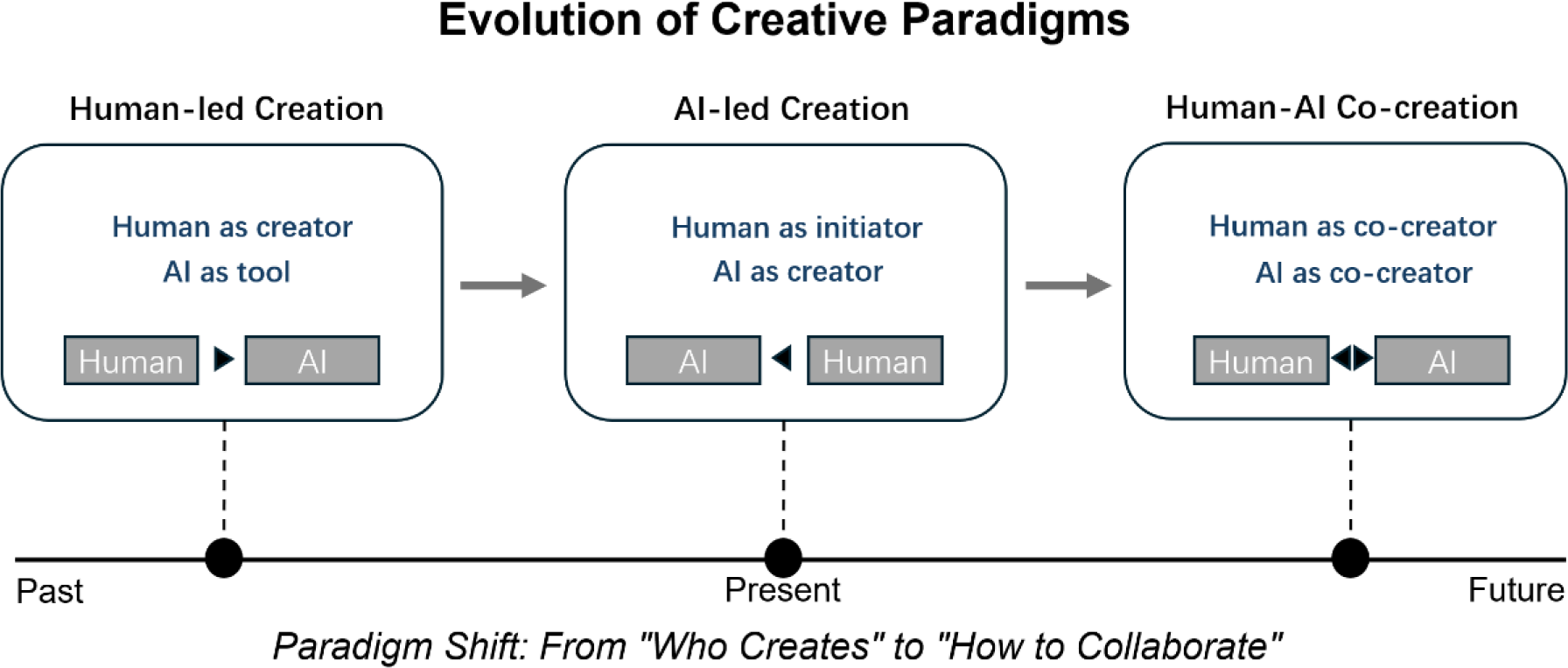
Creativity, traditionally defined as the creating artifacts that are novel, valuable, and surprising (Reference Sternberg and LubartSternberg & Lubart, 1999), has historically been viewed as an exclusively human faculty. However, the deep impact of AI into the design domain has destabilized this anthropocentric view, forcing a re-examination of the locus of creativity. From a historical perspective, the role of AI in creative tasks has undergone three transformations, which are caused by changes in the division of labor between human and machine (as shown in Figure 1).
In the early phase, AI served usually as a tool. The creative process was entirely human-driven, with AI acting merely as executors to improve efficiency or precision within fixed boundaries. While this ensured that design outputs were deeply grounded in human intent, the process was inherently bound by human cognitive limitations (Reference Jansson and SmithJansson & Smith, 1991; Reference Hatchuel, Le Masson and WeilHatchuel, Le Masson, & Weil, 2011). Humans, while excellent at assigning meaning, are often slow to explore complex combinatorial spaces (Reference BodenBoden, 2009), limiting the scope of innovation to familiar solutions.
With the rise of Generative AI, AI could create vast amounts of content with a few human prompts. However, this autonomy introduces a critical barrier to design practice. Without human intervention, AI-generated outputs face significant legal and ethical challenges, particularly regarding copyright infringement and intellectual property ownership (Reference Ren, Ma and LuoRen et al., 2025). Since generative models derive outputs from vast datasets of existing works, purely AI-generated artifacts often exist in a legal gray area, lacking the clear “human authorship” required for copyright protection in many jurisdictions. Furthermore, the opacity of the generation process raises unresolved questions about accountability: if an AI design infringes on a patent or causes harm, the absence of a human agent makes liability difficult to assign.
Consequently, the AI-led creation, despite its generative power, is insufficient for professional design practice. The inability to secure legal ownership or guarantee ethical accountability necessitates a transition to HAIC. Rather than treating AI as a mere evaluator or executor, this paradigm of HAIC positions AI as a co-creator, co-generator, co-explorer, co-evaluator, and even co-explainer (Reference YuYu, 2025). Through dynamic interaction, human and AI collaborate to accomplish creative tasks. In this paradigm, the goal of HACI is not to replace human creativity by AI but to expand the boundary of creativity by human-machine collaboration—achieving breakthrough innovation neither human nor machine could achieve alone.
Evolution of creative paradigms

3. Proposed framework
3.1. Requirements to define a theoretical model and relevance of design theory
In the context of design science research, a design theory is not simply an observation of “what happens,” but a prescriptive framework that needs to answer two questions: “What is the design object?” and “How is this design constructed, instantiated, and evaluated?” (Reference Hevner, March, Park and RamHevner et al., 2004). Therefore, we posit that a valid conceptual model for HAIC must satisfy three critical theoretical requirements:
(1) The design object of the model must be defined. In information system design science, the design object is usually a type of IT artifact (Reference Hevner, March, Park and RamHevner et al., 2004); here, our design object is the process of HAIC. We are not designing a piece of code or an interface, but a collaborative method of human-machine that can be repeatedly executed. By treating the “co-creation process” itself as object can we discuss subsequent improvements, comparisons, and evaluations.
(2) The elements and relationship of the model must be explained. The reason why a theoretical model can guide design is because it clearly states: if this type of design activity is to work normally, which elements and relationship need are required. In HAIC, the relationship between various elements is that humans, AI, and artifacts all require instructions to achieve internalization. So we propose five elements in concept model of HAIC: human, AI, instruction, interaction, and artifact, based on the consideration of the “minimum feasible collaborative unit”: without people, there is no purpose, without instructions, there is no alignment; without interaction, there is no intermediate correction; and without products, there is no evaluation basis. That is to say, these elements form a necessary set, which together constitute the operational process of the conceptual model of HAIC; By reducing any option to optional, the model degenerates from a designable framework to an accidental usage scenario.
(3) A theoretical model must also be evaluable and communicated. Design theory does not encourage remaining only on conceptual diagrams; it requires models to be implemented in construction and evaluation: Can we use it to design a specific system or product? Can we use it to check which element is missing in an existing method? The five elements of proposed HAIC model are precisely for operationalization: developers can use it as a checklist for human-machine co-creation system design (e.g., Does the interface have explicit interactions?), and researchers can also use it as an analytical framework to explain why the same model behaves differently in different organizations (e.g., What unclear instructions cause interaction failure?).
A good design outcome should be “purposeful, innovative, formalizable, searchable and communicated”; HAIC corresponds to these points: it formalizes the human-machine collaboration process into a describable cycle, and clearly communicates it to developers, researchers, and managers through five elements.
3.2. Modelling human-AI co-creation as concept model
We argue that HAIC should be rendered as a purposeful design process. From in-depth observation, abstraction, and systematic consolidation of collaboration patterns, we formulate the HAIC model as a conceptual representation of this process. This model conceptualizes the HAIC as the process in which humans and AI collaborate efficiently and interactively under instructions to jointly create novel and valuable artifacts. As, shown in Figure 2, the concept model of HACI has five core elements: Human, Artificial Intelligence, Artifact, Instruction, and Interaction. These elements are key to achieving efficient and high-quality co-creation. Next, we will elaborate on the five core elements, clarifying their roles, indispensability, and unique contributions in co-creation process.
The framework of HAIC Model

3.2.1. Human
The goal of HAIC is to collaboratively generate useful and novel artifact in a controllable, iterative, and evaluable process, rather than allowing the AI unilaterally to output plausible but are disconnected from real-specific context. Under this objective, the reason why human is considered as an element is that only humans can define what is ‘useful’, what is ‘novel’, and what exactly needs to be generated in the current real-specific context. In other words, HAIC aims not to produce abstract content, but to collaboratively create content tailored to specific object, tasks, and contexts, this this direction can only be injected by people. In achieving this goal, humans play two crucial roles: specification and evaluation. Specification refers to humans transforming a vague need into an instruction that AI can understand and execute, such as refining “write a description of iPhone” into “write a description of iPhone for non-technical readers, emphasizing application value, and under 200 words.” Evaluation refers to humans judging whether AI outputs align with the intent, identifying deviations, and determining whether further iteration is warranted. These two actions transform HAIC from “the model outputting content once” into a “collaborative process that continuously approaches human intent.”
When human-machine collaboration is truly in operation, humans are not merely abstractly “present,” but rather play a role through two entry points: On one hand, humans write, select, and modify instructions—that is, transforming their intentions, standards, tone, and requirements into commands that AI can execute—clearly stating “what I want.” On the other hand, humans use interaction to see what the AI has generated, whether it has understood, whether it needs to be restarted, and whether partial modifications are needed—clearly stating “how well it was generated.” Humans therefore repeatedly switching between these two entry points constitute the human control chain of HAIC.
3.2.2. AI
The goal of HAIC is also to enable co-creation to work effectively, efficiently, and diversely, which means transforming the work that originally required a lot of manual designing, searching, writing, checking, comparing and expanding into a generation process that can be executed quickly and repeatedly, while keeping human intent intact. Under this goal, AI’s role is not simply “helping to write a paragraph,” but rather acting as a “generation and transformation engine” for the collaborative process: given great instructions from humans, AI can produce multiple versions, perspectives, and contents in a very short time, laying out all the parts that previously required slow thinking, research, and organization from humans at once, giving humans choices, adjustable results, and comparable evidence.
Many real-world collaborative scenarios—such as migrating a description to several styles, writing versions for different audiences based on the same set of facts, generating several alternative solutions based on a single idea, and quickly organizing unstructured data into structured data—are essentially high-frequency, repetitive, batch tasks that require memorizing large amounts of context. If these tasks were entirely done by humans, the cost would be extremely high, and rapid iteration would be impossible. Therefore, AI is key to transforming HAIC from simply “collaborating” to “collaborating efficiently.”
3.2.3. Artifact
The goal of HAIC is not simply to “make conversations between humans and AI,” but rather to “ensure that this collaboration produces tangible and evaluable results.” Without artifacts, HAIC is merely an interactive process; with artifacts, HAIC becomes a creative process. The term “artifact” here should not be understood as just the final solution/product to be delivered, but also includes various intermediate results generated throughout the process, such as ideas, solutions, and even concepts and knowledge generated by human-computer interaction (Reference Kaptelinin and NardiKaptelinin & Nardi, 2009).
The reason for considering artifacts as an important element of HAIC is that for co-creation to be controllable and evaluable, there must be an externally medium to accommodate the respective tasks performed by humans and AI. If humans provide instructions to AI within interaction, but the result only remains at the level of “the model was called once,” the collaborative process and output is invisible, and it’s impossible to say, “what went well in this round, what went wrong, or how to adjust in the next round.” The existence of an artifact transforms the abstract “I want the model to generate something” into the concrete “This is the content it has generated.” Only when artifacts are created can people use their contextual knowledge, quality standards, and style preferences to judge whether something is right, sufficient, or whether it needs further refinement. In other words, the artifact is the ontology that transforms the process into an object; without artifact, the human, instruction, AI, and interaction in Human-Computer Interaction cannot be verified.
3.2.4. Instruction
The HAIC process is not simply about “humans saying a sentence and AI responding with a sentence,” but rather about enabling AI to stably, repeatedly, and predictably execute human intentions. Therefore, there needs an intermediary responsible for “turning what human think or say into what AI can do”, which is instruction. The “instruction” here is not a temporary prompt in the narrow sense, but refers to a complete set of methods that formalize, structure, and proceduralize human intentions, it can be a carefully designed prompt, a set of step-by-step task specifications, a fixed generation template, or even the process of translating a certain design/innovation method into machine-executable commands. Without great instructions, human-machine interaction even becomes disjointed—like ” a chicken talking to a duck “—and fails to produce valuable artifact. Therefore, instruction should be considered as a significant element key for HAIC.
3.2.5. Interaction
Humans decide “what to do,” instructions decide “how to do it,” AI decide “to what extent it can be done,” and artifacts decide “what has been achieved so far,” then interaction determines “whether all of these can be seen, whether these can be corrected in time, and whether these can proceed at an appropriate pace.” To achieve this, there must be a dedicated channel responsible for “transporting information, sending results back, and relaying feedback,” and this channel is called interaction.
In actual operation, interaction typically could manifest in familiar forms: a dialogue website, a selectable and editable interface, and even a canvas where modules can be dragged and dropped. Regardless of the form, it all boils down to the same thing: conveying instructions from one side to another. Therefore, in HAIC, interaction is not just a simple interface, but a link that truly connects the human, AI, artifact, and instruction into a collaborative system.
4. Case study: HAIC model in practice
4.1. Implementation background
ScholarMate is the largest professional research social networking platform in China and has long undertaken the development and operation of research management information systems of many universities and scientific research institutions in Chinese Mainland and Hong Kong. In 2025, this company launches the research management information systems for the Macau region. Compared with existing regions, Macau has several localized differences in scientific research project filing, statistical reporting, and other aspects, which makes it impossible their previously developed systems to be directly migrated and used. They need to design a system prototype with a similar structure but different rules in a relatively short period of time. At the start of the project, the company adopted the existing development approach: with front-end and back-end divided by two teams; The expression of requirements mainly relies on PPT documents created by product personnel, which display the expected interface and process in the form of static screenshots; Every adjustment to the interface, fields, and process requires the design side to update the PPT and then deliver it to the R&D side for front-end restoration. This model was acceptable in projects with a 6-12 month cycle in the past, but in the Macau project, due to the high frequency of requirement changes and the need to quickly align with multiple business personnel, the original approach showed obvious problems of high iteration costs and long feedback cycles.
4.2. Problem identification
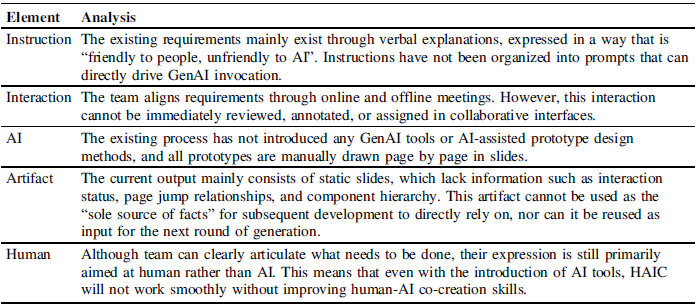
When this company launched the development of a research information management system for Macau, one of its overall goals was to “introduce GenAI into the existing development process to shorten the prototype development cycle.” However, when we entered the project, the actual work we observed was still their long-established pattern: Product manager designed static page prototypes in the form of PowerPoint, explained the meaning of the pages to the development team through meetings, and then the developers recreated each page based on the PowerPoint, repeating the above process when encountering business changes. Based on the concept model of HAIC, we examined the existing development process of ScholarMate and constructed a targeted problem matrix (as shown in Table 1) to identify which elements already exist, which elements exist but lack form, and which elements have not yet been made explicit.Overall, the diagnosis can be summarized as: Human and the final Artifact existed, but Instruction was not structured, Interaction was not high-frequency, AI was not embedded in the prototyping stage, and the Artifact was not functionalized to support regeneration.
Problem Identification

4.3. Solution and effect
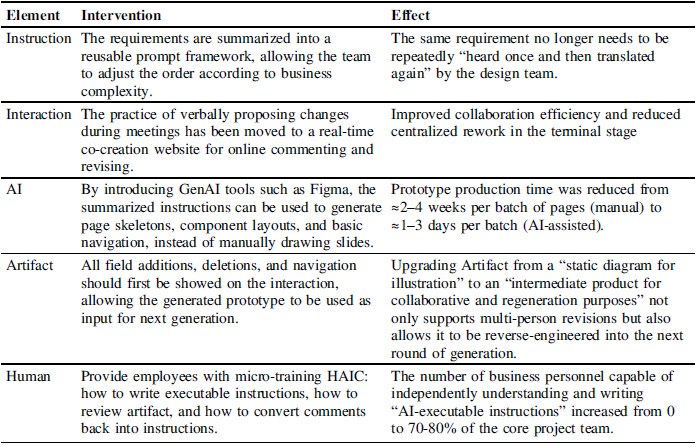
Based on the above HAIC-based diagnosis, we did not replace the company’s business architecture or team division. Instead, we supplemented the process along the elements in HAIC model so that the entire co-creation loop could be made explicit and executable. The interventions and observed effects are summarized in Table 2. After implementing the above methods, when the company develops new or similar systems, the cycle in the prototyping and front-end determinism phase is reduced from approximately 6–12 months (depending on the frequency of changes) to approximately 3 months to create a complete, clickable, and collaboratively accessible high-fidelity prototype. The amount of rework in the subsequent front-end implementation phase also decreases significantly. However, it is important to note that this efficiency improvement does not stem from the introduction of a single tool, but rather from the simultaneous activation of the five elements of HAIC.
Interventions and effects

5. Discussion
This paper addresses a specific problem: many individuals or organizations are already using AI for creative work, but most practices remain at the level of one-time model calls and partial replacement of human intervention, failing to guarantee that collaboration is controllable, repeatable, and measurable. Our proposed HAIC model attempts to demonstrate that achieving high-quality human-machine co-creation requires making the elements of the co-creation activity explicit and explaining the relationships between them. Many companies feel that “we’re using ChatGPT, but efficiency hasn’t improved,” not because the model is weak, but because they haven’t analyzed the various elements of human-machine co-creation and their relationships, and haven’t adopted appropriate methods for the specific task. Overall, in order for HAIC to become a designable, reusable, and assessable process, it is necessary to clarify elements, which can be used to diagnose where the existing process is weak, how to make up for it, and what kind of improvement should be seen after making up for it, just like our case.
6. Conclusion and future work
This paper proposed a conceptual framework for HAIC that identifies five interdependent elements—Human, AI, Instruction, Interaction, and Artifact—and argues that together they constitute the minimum feasible unit for controllable, repeatable, and evaluable co-creation. We clarified what such a design theory must do to be meaningful: it has to define its design object, identify its necessary elements and their relationships, and be implementable and evaluable in practice. The case of Scholarmate illustrated that, when the five elements were systematically activated, an organization could move from a 6–12 month prototype development cycle to roughly 3 months. However, we also need to acknowledge that the current model is too macro and does not involve specific ways to improve a certain element. For example, we encountered training on how to enhance people’s familiarity with AI in the transformation of ScholarMate, and the success of the model is also related to how to use it.
Future research can extend this work in at least three directions. First, comparative studies across domains can test whether the five-element structure remains stable or needs domain-specific refinements. Second, quantitative evaluations can be designed to isolate the effects of individual elements on co-creation performance. Third, longitudinal studies can examine how human co-creation literacy develops over time and how that, in turn, changes the optimal design of the instruction and interaction layers.
Acknowledgement
This work is supported by the National Natural Science Foundation of China (725B2035).


 Open access

