


1. Introduction
In order to develop products that are valuable to users and provide them with meaningful and effective support in their everyday tasks, it is necessary to identify their needs and desires, which result not least from their situation in life and their actions and are intended to support them [Paetzold & Wartzack, Reference Okhuysen, Bechky, Paetzold and Wartzack2012]. In the past, this was mainly done in a deficit-oriented way: a person’s lack of ability was described in terms of corresponding functions, for which technical solutions for fulfilling the function were then derived [Birken et al. Reference Birken, Hoffmeister and Schweiger2016]. Consequently, these solutions were not always accepted. On the one hand, they often have a stigmatising effect [Walter et al. Reference Walter, Paetzold and Nitsch2015], as they reveal personal limitations. On the other hand, people develop routines to deal with and compensate for their own deficits [Paetzold, Reference Paetzold2018]. If technical solutions or products do not fit into these routines, they are often not accepted and used [Pelizäus, Reference Pelizäus-Hoffmeister2018]. The starting point for engineering research is the consideration that people interpret a product differently in their role as developers than in their role as users. Users of technical systems explore the functionality and evaluate it in their own everyday context. This interpretation process is not purely rational; experiences, life situations and actions play an important role in the evaluation of the products. Sarodnik and Braun describe this effect as mutual ignorance [Sarodnik & Brau Reference Sarodnick and Brau2006 ]. In order to develop products that meet both objectives and needs, a basic understanding of how products are interpreted by users and developers is therefore needed first. Figure 1 is intended to help with this.
Mutual understanding of the product between user and designer [based on Walter et al. Reference Walter, Paetzold and Nitsch2015]

Users tend to interpret the product in terms of causality. They are not aware of the intention behind the product development, but see it as an isolated object and interpret it in their individual context of use based on their experience. In general, the task to be performed is not the only thing in the foreground. Rather, users develop routines, i.e. processes for accomplishing tasks, into which supporting systems must be integrated [Pelizäus, Reference Pelizäus-Hoffmeister2018]. If they decide that a product supports them in their ability to act, they will use it.
Developers work according to the principle of finality. This means that they anticipate an effect that should support users in a specific situation in order to help them cope. Accordingly, a system behaviour is derived, which is broken down into the necessary sub-functions. Solutions can then be sought for these, which in turn are integrated into an overall system and lead to the product. [Bender & Gericke, Reference Bender and Gericke2021]
From these explanations, it is clear that the difference between user and designer primarily lies in the expertise:
-
The expertise of designers lies in the use of technical-physical facts and laws to solve problems. They are familiar with new technologies and can explain their functionality and use in order to fulfil defined functions and use them to accomplish tasks. However, developers usually have only limited knowledge of the constraints of use, the context of use and the routines into which the product is integrated. These must be anticipated.
-
The expertise of users lies in the fact that they know their everyday situation and cope with it by means of routines. They know the constraints for action situations that need to be taken into account and associate a specific intention for product use with them. However, users usually have only limited knowledge of what technologies are available and to what extent these can support them in completing a task. Therefore, it is usually only possible to a limited extent to evaluate which boundary and framework conditions are important for the development in order to provide adequate technical systems for action support.
A communication process is needed to bring together these different areas of expertise. Developers need information about the context of use and the associated routines in order to develop products with adequate system behaviour. Users need information about how and why technologies can support them in their everyday lives. This need for communication and the exchange of information is well known. A wide range of information exchange mechanisms are used here. Examples include user participation methods such as co-creation workshops [Sanders & Steppers, Reference Sanders and Stappers2008] or design thinking methods [Liedka, Reference Liedtka2018]. These are often based on social science methods such as surveys or observations to gather information. From a development methodology point of view, prototypes are often used to support this communication [Camburn etal., Reference Camburn, Viswanathan, Linsey, Anderson, Jensen, Crawford and Wood2017]. In the literature, there is a very intensive discussion about which properties and characteristics prototypes must have in order to support communication processes [e.g. in Menold et al. Reference Menold, Jablokow and Simpson2017, Christie et al. Reference Christie, Daniel, Richard, Devin, Kyle, Kristin and Richard2012]. However, this is done without specifying the underlying communication process in more detail.
The aim of this paper is to identify factors influencing the communication process between user and designer that help to explain the mutual exchange of information. The idea is to identify aspects that should be considered when creating prototypes in order to support the information transformation process. This leads to the guiding research question: Which aspects and influencing factors must contain a communication model in order to describe the mutual exchange of information between designer and user as comprehensively as possible and, based on this, to be able to provide targeted support through prototypes?
2. Conceptual framework and methodical approach
Technical systems should support people in their ability to perform and act independently. They help to overcome given performance limits. Conventional methods for determining requirements [e.g. source] in engineering focus on capturing the expected system behaviour, which is then broken down into sub-functions and used as the basis for the development process. This function-oriented view of users and their needs has often been deficit-oriented in the past [Birken et al., Reference Birken, Hoffmeister and Schweiger2016 ]. As a result, products are perceived as stigmatising when used and are not accepted.
In order to develop successful products, development projects require an appropriately adapted starting point: an integrating perspective that encompasses the users, the product and the context of use. Everyday behaviour [Voss, Reference Voß1995] serves as a conceptual anchor for the systematic analysis of the action and life situation. Since the use of technical systems does not only depend on functionality, but also on their interpretation in the context of action, an analysis of the motives for product use is required. The affordance approach [Leonardi, Reference Leonardi2011] provides a framework for this. This can be used to derive implications for the interplay between human agency and technological agency in order to explain the benefits of technologies in the context of action. However, it remains unclear how the developer can use this interplay to understand the life and action situation. Methods of agile working show the use of prototypes [Böhmer eta al., Reference Böhmer, Hostettler, Richter, Lindemann, Conradt and Knoll2017] to generate the information necessary for the development of the life and action situation, and to also introduce user to the possibilities of technologies.
The results and findings presented in the paper are the result of a broad literature study on communication mechanisms based on prototypes. The research was conducted in the fields that have communication and communication processes as an object of study in research. Coordination theory [Okhuysen & Bechky, Reference Okhuysen, Bechky, Paetzold and Wartzack2009] serves as the basis for explaining mechanisms of communication in the development environment as well as to bring in different perspectives in communication processes. The aim was to understand the communication mechanisms and to interpret them in the context of product development in general and the exchange of information between developers and users in particular. Interesting and relevant approaches were found in the social sciences and in psychology. The communication models used here were analysed. The aim was to derive starting points for adapting these communication mechanisms to the special requirements of the development process.
In addition, an in-depth examination of methods and explanatory approaches to the use of prototypes in product development was carried out. In the literature research conducted for this purpose, the main focus was on publications that deal with the selection and design of prototypes and that derive and substantiate the factors influencing the design from the purpose of the prototype.
3. The state of the art
3.1. Decoder/encoder models as a basis for communication models
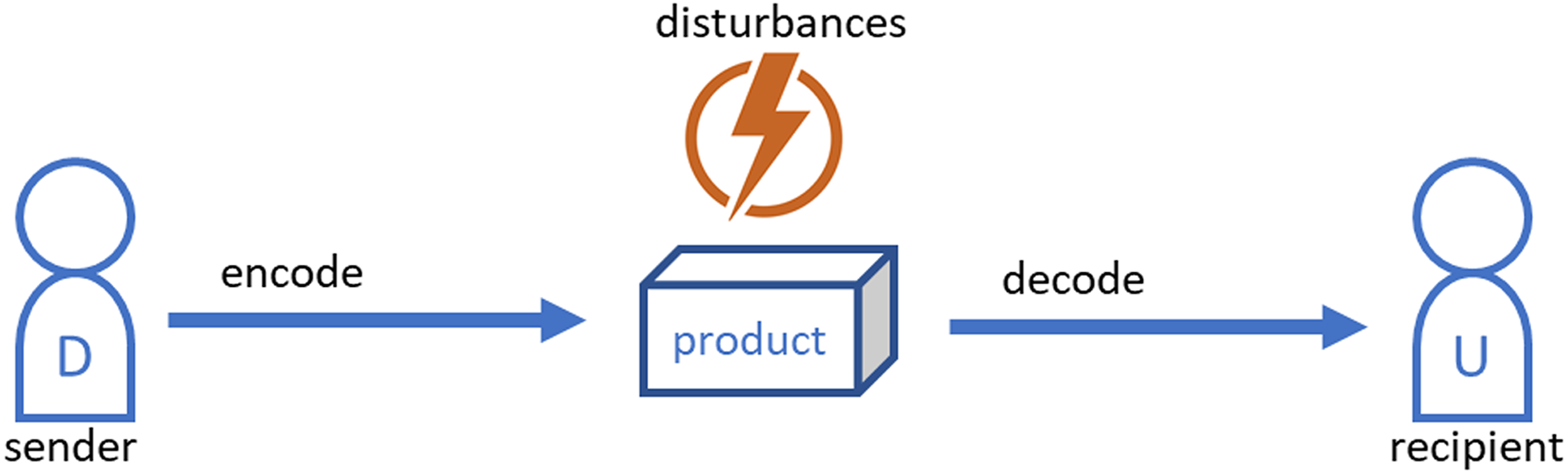
The following considerations regarding communication between designer and user are based on so-called decoder/encoder models. These, along with intention-oriented models and dialogue models, form a category of psychological communication models [Röhner et al. 2012]. The focus of decoder/encoder models is on explaining how messages are encoded, transmitted and decoded between sender and receiver, which messages can be transmitted and which disturbance variables may need to be taken into account.
The communication model according to Shannon/Weaver [Dotzler et al. 2012], which can be assigned to the decoder/encoder models, serves as the basis for modelling the communication processes between designer and user. The basic assumption behind the communication model is that the information to be passed on is encrypted (encoded) and forwarded to the recipient via communication channels and decoded by the recipient. In this process, disturbances or problems can lead to a distortion of the content to be transmitted (Figure 2).
Shannon/Weaver’s simple communication model [Dotzler et al. 2012]

As shown above, communication is not a single-directional process. Rather, both stakeholders act as both senders and receivers. To describe the information transformation process between designers and users and to combine the different perspectives on a product, it is therefore necessary to analyse the communication between the two in greater detail in order to find starting points for how this can be supported in the interest of the effective development of products.
3.2. Methods of user integration, user participation and UX
Methods of user integration are available for recording and evaluating user experiences, product requirements and the usage situation. In this regard, the term user integration is initially used as a collective term that encompasses various methodological approaches. These methods were examined under the premise of analysing how the exchange of information between users and designers is structured and what boundary conditions and influencing factors this is subject to. In order to better understand the user perspective and to integrate the user into the development in a targeted manner, methods for user experience research, user participation and participatory design (co-creation) have been established [Reinicke, Reference Reinicke2004.].
The interdisciplinary field of user experience research not only examines usability, but also the emotional and psychological effects on the user during the product use process [Hassenzahl, Reference Hassenzahl2008]. Usability is measured. In addition to aspects of effectiveness (i.e. the contribution to achieving the goal in the action situation) and efficiency (as an evaluation of the cost-benefit behaviour), satisfaction with product use, which describes the positive attitude towards the product, is also included in this measurement [DIN EN ISO, 2020]. Only when the usability of the product for task fulfilment has been evaluated is the product used on a permanent basis [van Gorp & Adams, Reference Van Gorp and Adams2012]. Since the concrete behaviour during product use is analysed, it is difficult to derive statements for current development processes. Information can only be obtained for follow-up developments. Furthermore, classifications into the action situation are not included in the metrics for user-friendliness. These metrics are based on a detached observation of the action situation, which concentrates exclusively on the product as the object of observation.
Methods of user participation serve to integrate the user perspective into the development process. User participation (also discussed under the name of user integration) is an interdisciplinary concept that combines approaches from economics, human sciences and engineering to better understand user behaviour [Fronemann & Peissner, Reference Fronemann and Matthias2014]. Depending on the tasks to be taken over by the user and the information expected by said user, he or she is integrated into different phases of product development [Fichter, Reference Fichter2005]. A wide range of methods are available for this purpose, particularly, social science methods such as focus groups, interviews and observations. These methods, in turn, use product artefacts such as sketches, models, concepts and real prototypes as a basis for communication. The role of the user within these methods varies, with the user acting either as a problem solver, idea provider or evaluator of solutions [Paetzold, Reference Paetzold2021]. This also varies the intensity with which the user is involved; in the associated development processes, he can be involved either passively or actively [Fichtner, Reference Fichter2005]. Accordingly, the communication between the designers and the users is based on different intentions.
In this sense, [Hannah et al. Reference Hannah, Michaelraj and Summers2008] distinguish here according to
-
Declarative communication for information and documentation;
-
Interrogative communication to request suggestions or test things out, and
-
Imperative communication, which is intended to be compelling, brings about decisions and demands instructions.
Depending on the objective of the communication, corresponding characteristics of prototypes can be derived to support the communication. If a product is to be evaluated, high-fidelity prototypes are preferred, which should reproduce the functionality as realistically as possible. Only in this way can the user’s benefit be insured in the given situation. If the user is more of a problem solver, low-fidelity prototypes seem more appropriate, as they avoid solution fixation and allow room for further or redesign of the product or functionalities.
In summary, communication between designers and users is attributed particular importance in the context of user integration, but this is rather development-driven and defined by the information needs of the development team. Figure 3a illustrates the communication channels in the context of user integration.
Communication model for the methods of user integration (a) and participative design (b)

Methods of participatory design describe approaches for the targeted and proactive integration of ideas and experiences from the context of use into the development process [Boer, Reference Boer2011]. These include, for example, design thinking [Bjögvinsson et al. Reference Bjögvinsson, Ehn and Hillgren2012] and co-design approaches [Sanders, Reference Sanders2002]. In these approaches, the user plays an active role, not only in the development of solution ideas, but also in the clarification of the action situation and the associated needs for coping with it. The designer takes on a moderating role in the processes or becomes a co-worker and supporter [Sanders & Stappers, Reference Sanders and Stappers2008]. In addition, he plays an explanatory role with regard to the use of methods and tools. As a consequence, prototypes are created as a joint result of the collaboration between user and designer to find a solution that reflects both their horizons of experience. The associated communication process is outlined in Figure 2b.
The focus of further considerations is on the analysis of the exchange of information within the framework of the methods of user integration, but also partially considers that of participatory design.
4. Development of the communication model to describe the information flows between designer and user
4.1. The communication model to describe mutual information flows
Based on the analysis of the information flows in the application of methods of user integration and participatory design, basic assumptions and factors influencing the communication between designer and user, and the associated information transformation process, are now to be described in more detail. The starting point for the argumentation is the assumption that the designer, through communication processes, discusses his product ideas and their realisation with the user and shows him the technological possibilities for task management. This is done, on the one hand, to validate the designer’s ideas. On the other hand, the user is not only given the opportunity to better understand his own usage situation and thus the tasks to be mastered in everyday life, in which the products are intended to be helpful.
Assuming that information from users is collected during development in order to do justice to the iterative character of the product concretisation and to ensure validation during development, the finished product is not available as a communication medium. Rather, product artefacts, which are each generated in the various phases of development, serve as prototypes [Camburn et al. Reference Camburn, Viswanathan, Linsey, Anderson, Jensen, Crawford and Wood2017]. Such product artefacts may be, for example, drawings, physical models, digital models, concept visualisations, partial models of overall systems, domain-specific models, etc. In the literature, the term prototype is used in this context. Houde & Hill (Reference Houde and Hill1997) define prototypes in this sense very generally as any representation of a design idea, regardless of the media used to create it.
The mechanisms for exchanging information described in the previous chapter can now be described from the specific perspectives of the user or the designer using this communication model. The designer provides the user with a product artefact in which a defined functionality or system behaviour is implemented. By agreeing to use this, the user, as the recipient, decodes the designer’s message. Disturbance variables or fuzziness in the decoding result from how the user interprets the product or the prototype that is supposed to embody this product. Based on this, the user decides whether it fits into his or her routines and can therefore be integrated into his or her everyday life. The user evaluates the benefit of a technical solution in an object-based way using on the prototype. The designer, on the other hand, must evaluate the information based on behaviour. He records it, usually using methods from the social sciences, and then has to draw conclusions about the context of use. To do this, the designer must evaluate the user’s information in a behaviour-based way.
Communication model for describing the mutual information flows between user and designer

In order to explain the nested information exchange processes, system-theory approaches are used [Ropohl, Reference Ropohl2012]. Accordingly, the two information transformation processes are to be understood as two nested control loops. The product/product functionality thus becomes the controlled system, which is influenced by disturbance variables and thus manipulates the controlled variable, i.e. the information to be transmitted. To enable a holistic interpretation in the exchange of information, it is essential to analyse both control loops from the specific perspectives. However, the following considerations initially focus on the more object-based control loop shown in orange in Figure 4. Disturbance variables result from differences in the interpretation of both the prototype and the situation.
On the one hand, this is necessary to first build a basic understanding of the communication processes. Here, the prototype plays a special role as a tool for transporting information. This raises the question of what needs to be taken into account in the design of the prototypes in order to support information as holistically as possible. On the other hand, in order to develop the lower control loop, social science and psychological expertise is also required to interpret the behaviour-based phenomena. To substantiate this second control loop, not only psychological and social science methods are required to describe the flow of information. They also require modelling methods to describe and capture action routines and usage constraints.
4.2. Interpretation of the interpretation of the information flows and derivation of implications for disturbance variables
When interpreting prototypes, it is important to consider some aspects of the conclusions drawn for the information flows and their description via control loops. In addition to the approach to a product by designers and users shown in Figure 1, it is also particularly important to note that development processes, especially in the early phases, are characterised by a high degree of uncertainty and incomplete information. Assumptions are usually made that need to be checked and, if necessary, corrected in the course of development. Solutions are successively refined in an iterative process and substantiated by the selection and design of solution principles. When combining the partial solutions into an overall system, trade-offs also need to be identified in order to balance out conflicting objectives.
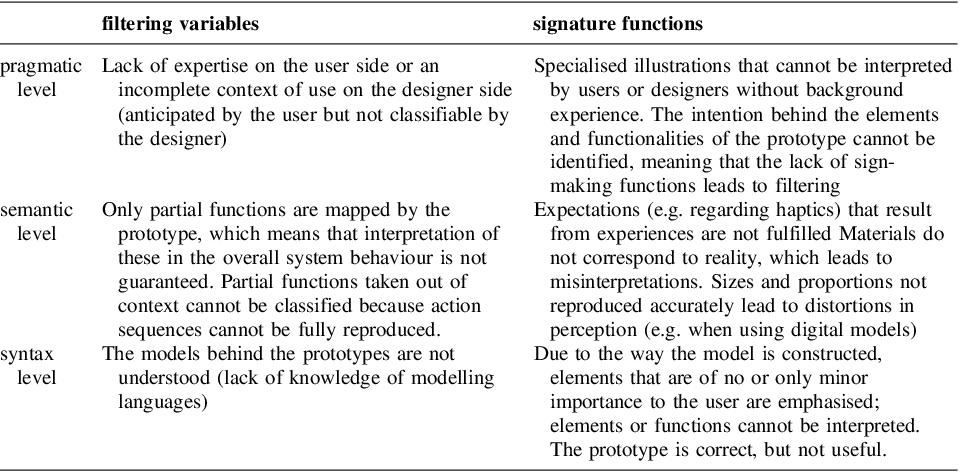
Product artefacts that arise during development and are able to be used as prototypes are therefore often only partial models of an overall system, with a low level of detail or more or less subject to uncertainties. They arise from the development work and are therefore easy for the designers to interpret. For the user, with his or her divergent background experience, this usually is much more difficult. This results in disturbances that must be taken into account in the use and interpretation of prototypes in the communication process. There are two types of disturbance that influence the interpretation or interpretability of prototypes [Nicklas & Paetzold, Reference Nicklas, Atzberger, Briede-Westermeyer and Paetzold2020]:
-
Filtering variables are present when the prototype used cannot be interpreted by the user in his context of use or is interpreted differently than the sender intended. Different experiences lead to deviations in interpretation, and in the decoding process, information is then lost or misunderstood. For example, a CAD model may be interpreted differently by the user than a physical model of a product because the spatial impression and true sizes are lost.
-
The term ‘signature function’ refers to the features of the prototype that show the user how and for what purpose the product is to be used [Heufler, Reference Heufler2004]. We speak of missing signature functions when certain elements are expected in the prototype, and certain functions are associated with them. In this case, it may not be possible to deduce the intended function.
Consequently, in the communication between designer and user, both are both recipients and transmitters of information. However, the coding/decoding differs due to the different pragmatics under which the product functionalities are considered for task [Walter et al. Reference Walter, Paetzold and Nitsch2015]. This makes a distinction in the coding processes necessary. In each case, other factors determine the coding. Consequently, it seems obvious to formulate the exchange of information and thus the transformation of information from both perspectives and to link both interpretations [Nicklas et al. Reference Nicklas and Paetzold2020].
4.3. Specification of the disturbance variables
Finally, the question arises as to how these disturbing influences and filtering variable are to be grasped and interpreted, since requirements for the design of prototypes can be derived from this. The aim must be to anticipate such disturbing influences in the design of prototypes in order to ensure that information is passed on to the user as clearly as possible. To this end, it seems helpful to find sources for the two classes of disturbing variables (indication function, filtering variables).
Criteria and descriptive approaches from semiotics are used to analyse the communication between designer and user in more detail and, above all, to be able to define and describe the disturbance variables more clearly. Semiotics provides models to analyse communication and the associated complex relationships between signs, their meaning and interpretation [Stachowiak, Reference Stachowiak1973]. To do this, a distinction is made between pragmatics, semantics and syntax in the meaning of the interpretation of signs [McNally, Reference McNally2013]. These categories have already been used to describe the different perspectives of users and designers on the product (see Figure 1):
-
Pragmatics describes the purpose and function of signs in general. This describes the meaning and use of constructs for communication, in this case of prototypes in specific situations. In this context, this means that prototypes should illustrate the functions of the system to be developed and make them clear to the user. Since these are ultimately only models and therefore do not fully represent reality, it is important to consider which criteria lead to differences in perception between designers and users.
-
Semantics explains the meaning of signs in language constructs and thus substantiates the elements in them. Such language constructs are ultimately the result of negotiations. They arise in a process in which it is agreed which elements represent which content. In the context of using prototypes for communication, this means that, on the one hand, elements must be present on the prototype that allow the user to recognise the technical functionalities. On the other hand, conclusions can be drawn about the usage situation from observing how the user accesses the functionality.
-
Syntax defines the rules by which language constructs are mapped. It thus describes the formal means available for designing prototypes in terms of their form and structure.
Possible causes for both categories of interference at the levels of pragmatics, semantics and syntax are summarised in Table 1.
Description of disturbances at pragmatic, semantic and syntax level

5. Discussion of the results
The communication model derived and presented here is intended to help establish a deeper understanding of the communication processes and the associated information transformation and information flows between designer and user. By tracing the extended communication model back to a decoder/encoder model according to Shannon/Weaver, the significance of prototypes as information carriers can be explained. Prototypes thus become language elements through which information is transported. However, it is important to note that these are only a part of the language and are supplemented by other elements, such as direct exchange. Different terms for the same thing for example are also aspects that need to be considered in communication. It can also be deduced that the type of design and the description language used (digital or real models as reduced overall systems or partial models) influence the interpretation and thus also the information content that is transported.
The disturbances that occur here are characterised by the relationships between the elements of the prototype and the user (pragmatics), the relationship between elements of the prototype and its meaning (semantics) and the relationships between the elements in the prototype itself (syntax). It therefore seems obvious to use these categories to explain disruptions in the interpretation of prototypes from the various perspectives. This makes it possible to explain what needs to be taken into account in the design of prototypes in order to keep the information content as high as possible. Ultimately, however, this provides only limited information on how this specifically affects the design of prototypes in concrete terms, and what specifically needs to be taken into account in the design. In the literature on prototyping, there are a number of works that deal with the design of prototypes for the adequate communication of information [e.g. Camburn et al., 2002; Menold et al., Reference Menold, Jablokow and Simpson2017]. The next step is to align and specify these approaches for the context addressed by this paper.
In order to address the question of how the identification of disruptive variables will affect the design of the prototype, further research needs to address three aspects: On the one hand, the communication model needs to be expanded or supplemented. It seems particularly interesting to integrate elements from other communication models. The dialogue model according to Watzlawick [Watzlawick et al. Reference Watzlawick, Bavelas and Jackson2011] takes a pragmatic approach, but sees communication as a social construct whose goal is to construct a shared reality [Röhner et al. Reference Röhner, Schütz and Schütz2016]. This allows processes of negotiation and mutual learning to be taken into account. Consequently, it then seems sensible to consider prototypes as boundary objects [Carlile, Reference Carlile2002] that serve to develop a common and mutual understanding. Approaches to this can be found in participatory design. Considering that pragmatics and semantics are understood as the result of negotiations, it seems crucial to bring together both perspectives, that of the designer and that of the user, in order to model and investigate the complex situation of the product use in daily routines.
Intentional models of communication [Grice, Reference Grice1975] mainly address the semantic level: communication is seen as a collaborative act, the aim of which is to promote a common understanding between designers and users, even if their communication goals are different. These approaches offer potential for the actual design of prototypes, since they describe categories that must be taken into account in information design in order to make them transparent. Approaches from the media-richness theory [Trevino et al. Reference Trevino, Lengel and Daft1987], which need to be substantiated in the context of prototype design, are helpful here.
In addition, a deeper understanding of the prototype itself is required. Prototypes are well established in product development to communicate with various stakeholders in the development process, whereby the communication can have different objectives [e.g. Camburn et al. 2018]. The various approaches to describing, using and designing prototypes must be analysed and a context-specific ontology derived from this to support communication between developers and users.
The limitations of the extended communication model presented here lie in the fact that the disturbance variables can still only be specified or quantified to a very limited extent. The considerations presented therefore serve above all to develop experiments to characterise the disturbance variables more precisely and to weight their significance for the interpretation. In addition to the classification of prototype features [e.g. Menold et al., Reference Menold, Jablokow and Simpson2017] and the consideration of the degree of maturity in development, factors from model theory [Stachowiak, Reference Stachowiak1973] or media-richness theory [e.g. Kahai & Cooper, Reference Kahai and Cooper2003] must also be taken into account. Last but not least, a key aspect of future research will be to design experiments to validate not only the extended communication model, but also to identify and verify the influences on the concrete design of the prototypes.
6. Conclusion
If communication between designer and user is only initiated on the basis of the finished product, changes to the product in terms of better user-friendliness are no longer possible or only possible with considerable effort. In the worst case, this can lead to high economic damage for the company. Accordingly, it makes sense to initiate communication between designer and user in the early phases of development. In summary, the considerations presented here for understanding information transformation processes on the basis of the semiotic categories of pragmatics, semantics and syntax are helpful in principle for identifying disturbances and, through their classification, for assigning potential approaches to the actual design of prototypes. This should provide the potential to reduce the disruptive influences in this communication.




 Open access

