


In the United States, many urban governments incorporate institutions to facilitate resident participation. These institutions include zoning board meetings where members of the public are allowed to speak, the formal recognition of neighborhood associations in the citywide planning process (and provision of funds to those associations), and the creation of additional bureaucracies to obtain resident input on proposed projects. Participatory institutions allow residents to express preferences to local politicians. At the same time, they enable opponents to delay or block projects.Footnote 1
Local opponents, labeled “Not In My Back Yard” (NIMBY) voters, obstruct projects out of concern for local costs while failing to account for wider social benefits.Footnote 2 In housing policy specifically, scholars point to resident participation as a major source of supply restrictions and resulting high prices, severely impacting economic opportunity and aggregate economic growth (Einstein et al. Reference Einstein, Glick and Palmer2020; Chetty et al. Reference Chetty, Hendren, Kline and Saez2014; Hsieh and Moretti Reference Hsieh and Moretti2015). Moreover, with unequal participation across neighborhoods, locally costly projects are placed according to the “path of least resistance,” harming disadvantaged communities (Schelly and Stretesky Reference Schelly and Stretesky2009). Polluting facilities and hazardous waste sites are often located in predominantly low-income and non-White communities (Taylor Reference Taylor2014, 33–46; Collins et al. Reference Collins, Munoz and JaJa2016). Additionally, longitudinal data provides evidence that polluting facilities are located in neighborhoods already disadvantaged by race and class (Schelly and Stretesky Reference Schelly and Stretesky2009; Mohai and Saha Reference Mohai and Saha2015).
In response to these problems, many reformers have advocated reducing opportunities for local resident participation, including through state government preemption of local control over land use regulation (Infranca Reference Infranca2019). While some scholars support curtailing participatory institutions, seen as empowering entrenched incumbents, others fear that doing so would eliminate one of the few tools for disadvantaged communities to protect themselves from harmful developments (Imbroscio Reference Imbroscio2021; Einstein Reference Einstein2021; Schragger Reference Schragger2021; Schleicher Reference Schleicher2021). While substantial biases (such as age, gender, and homeownership) exist in who participates in local government, there is also evidence that participatory opportunities can empower the poor (Einstein et al. Reference Einstein, Palmer and Glick2019; Hertting Reference Hertting2024). For these reasons, it is vital to better understand the relationship between participatory institutions and urban inequality.
This paper presents a formal model of a politician’s choice to establish participatory institutions across two urban neighborhoods with unequal political power. We argue that there is a non-monotonic relationship between participation and inequality: urban politicians establish participatory institutions when inequality is intermediate. When inequality is high, politicians locate projects in disadvantaged neighborhoods without the inefficiencies associated with participation. When inequality is low, politicians allow each neighborhood to approve or block projects on their own in exchange for compensation, resulting in more equitable location outcomes.Footnote 3 Hence, participatory institutions are associated with political inequality due to the circumstances in which they are established, not their intrinsic features.
The model helps explain the broad trajectory of US local government in the latter part of the 20th century. In many cases, local participatory institutions were established in the wake of the Great Society. Great Society programs such as Model Cities promoted community participation in urban planning. At the same time, civil rights activists, as well as non-profits such as the Ford Foundation, supported the political mobilization of previously marginalized ethnic groups. As a result, the 1960s and 1970s saw the development of more inclusive political coalitions in urban government. We use three examples (Atlanta, GA; New York, NY; and Portland, OR) to show that, upon entering government, these coalitions established neighborhood-level channels for community participation. In terms of our model, these new institutional structures reflect both the accomplishments and limits of the Great Society in reducing urban inequality.
This argument holds implications for ongoing debates over US land use regulation. Costs of housing and infrastructure development in the US have dramatically increased in recent decades, and recent scholarship connects these cost increases to participatory institutions in land use regulation (Brooks and Liscow Reference Brooks and Liscow2023; Glaeser and Gyourko Reference Glaeser and Gyourko2018). By investigating why these institutions were initially established within the US political context, we can better understand the benefits and drawbacks of maintaining them. To the extent that participatory institutions support the still-incomplete incorporation of marginalized groups into urban politics, the model provides a note of caution against moves to curtail participation in land use policymaking. The model also points toward a promising but overlooked alternative for increasing socially beneficial development by deepening urban democracy.
Our argument
To better understand the relationship between participation and inequality, we investigate the sources of differences in institutional procedures governing land use policies. In the model, the politician chooses among alternative regulatory regimes for determining the project location. The “unilateral” development regime reflects the mid-twentieth century status quo with limited opportunities for public participation in land use regulation. We then explore a politician’s calculation to establish institutions for members of the public to express their preferences to the politician (a “participatory” regime) or for local neighborhood institutions to directly approve or veto proposed projects in those neighborhoods (a “decentralized” regime). By investigating the strategic choice over alternative land use institutions, we can evaluate the extent to which participation exacerbates or ameliorates political inequality.
Significantly, our focus is on decision-making at the local level of US government. While state and national policies contain important procedural requirements that apply to lower levels of government, there is substantial variation in local land use regulations across the US, including wide differences in opportunities for participation (Gyourko et al. Reference Gyourko, Hartley and Krimmel2021; Hsieh and Moretti Reference Hsieh and Moretti2015). Even within the same metropolitan area, land use regulatory processes across cities vary greatly (O’Neill et al. Reference O’Neill, Gualco-Nelson and Biber2019).Footnote 4 This institutional variation affects the extent of participation available to citizens and subsequent development decisions (Glaeser and Gyourko Reference Glaeser and Gyourko2018).
An additional element of the US context is the role of local politicians in land use regulation. Oftentimes, local politicians in the US directly approve the location of individual projects (Comacho Reference Comacho2013).Footnote 5 This “project” could represent any place-based policy, but we are especially concerned with land use development such as housing or energy infrastructure. Crucially, the project benefits the city as a whole but imposes local costs on the residents of the district in which it is located.Footnote 6 This captures the spatial features of development costs and establishes a tension between residents of different parts of the city over who bears the local costs of development. To analyze the strategic calculation to establish participatory institutions, we start from a politician who chooses both the institutional structure of land use policymaking and where to locate a project.
The politician is unequally concerned about the welfare of each district, which reflects the distribution of power among groups in urban politics. This inequality across districts could be an inherent feature of politician preferences, or it could be induced by greater electoral clout or other sources of influence on the part of different districts. A range of studies show racial and class biases both in terms of participation among citizens and responsiveness by politicians (Go Reference Go2014; Levine Reference Levine2017; Weitzer Reference Weitzer1999; Wichowsky et al. Reference Wichowsky, Shah and Heideman2022). While politicians likely care about social groups rather than districts themselves, urban segregation implies that concern for class or racial groups often corresponds to concern for districts. Yet no matter the value placed on each district’s welfare, we assume that politicians are uncertain about the magnitude of costs that local residents experience from a project.
Participatory institutions. Participatory institutions allow the politician to learn about residents’ costs of the proposed project.Footnote 7 In the case of California housing policy, for example, opportunities for public input include comments at public meetings, project appeals, design review, historic designation petitions, the community planning process, and lobbying the city council against granting variances (Monkkonen and Livesley-O’Neill Reference Monkkonen and Livesley-O’Neill2017). Such participatory approval processes inevitably build in myriad opportunities for obstruction by project opponents (Einstein et al. Reference Einstein, Glick and Palmer2017), which is itself a source of information. Project opponents always have an incentive to say a project is as bad as possible; participatory institutions allow committed opponents to demonstrate the depth of their opposition, thereby communicating information to politicians. Given uncertainty over the local costs of projects, participatory institutions enable the politician to make a more informed decision, despite the inefficiencies that result.
The calculation for politicians to establish participatory institutions depends on an interaction between uncertainty and bias, i.e., the degree to which they are more concerned with one district than the other. Insofar as politicians are uncertain about the local costs of projects, they allow residents to impose delays and thereby signal to decision-makers. Yet if politician bias toward one district is extreme, then they always locate the project in the disadvantaged district. In effect, inequality obviates the need for additional information: under conditions of high inequality, the politician locates the project in the disadvantaged district regardless of the local costs and thus has no need for participatory institutions.
Decentralization. Rather than deciding on the location of the project directly, our model allows the politician to transfer decision-making to each district. With decentralization, each district decides on its own to allow the project or not, given offers of compensation by the developer. Since residents of each district know their own costs of the project, there is no need to signal information to politicians – with the associated inefficiencies.Footnote 8 Because both districts have a veto over local projects, unequal concern by the politician does not translate into unequal policy outcomes. Making the extreme assumption that decentralization eliminates all transaction costs, we show that even under these very favorable conditions, inequality across districts leads the politician to reject decentralization. When sufficiently biased toward one district, the politician prefers to maintain centralized control in order to benefit the favored district, despite the inefficiency of participatory institutions.
While mainly presented as a conceptual baseline to illuminate the effect of inequality, the decentralized regime can also be understood in terms of the historical demand for “community control.” In the 1960s, activists associated with the Black Power movement argued for decentralizing control of local public goods to segregated urban neighborhoods (Altshuler Reference Altshuler1970). Political interest in community control diminished in the 1970s as these efforts proved unsuccessful. Yet neighborhood planning institutions (discussed in the historical case studies below) could hypothetically operate similarly to the community control idea if empowered to directly decide on project approval, rather than merely advise a municipal government. By providing the option of decentralization, our model illuminates why local politicians preferred participatory institutions over the community control alternative.
Summary of our argument. Politicians set up participatory institutions to learn about local costs of projects while maintaining ultimate policy control to protect the advantaged district. Importantly, politicians set up participatory institutions because they do not share preferences with the people participating. Participatory institutions are useful to the politician when they are moderately aligned so that the politician can use the information (somewhat) contrarily to the ends of those participating. Therefore, the problem of nimbyism that results from participatory institutions is a product of urban inequality. Nimbyism becomes a problem when inequality has decreased but remains present.
A model of participatory institutions
In this section, we model the institutional design and project location choice of a politician who has generically unequal concern over two districts. The politician chooses a land use regulatory regime, which may include participatory institutions, to determine where to locate a project. These projects impose local costs upon district residents while providing aggregate social benefits.
We conceive of participatory institutions as allowing local residents to impose costs on a proposed project. As a venue for opposition, participatory institutions have two inextricable effects. First, opposition signals information about the local costs of projects to politicians. Second, participatory institutions create inefficiencies. Obstruction by project opponents increases regulatory expenses, which is similar to opponents imposing a cost to influence a politician in other models (e.g., Glaeser et al. Reference Glaeser, Gyourko and Saks2005a; Einstein et al. Reference Einstein, Glick and Palmer2017). The signaling mechanism provides a benefit alongside this cost, explaining why the politician establishes these institutions in the first place.
Two features determine the outcome of the game. First, the politician is uncertain about the magnitude of local costs in either district and has the option to establish participatory institutions to obtain information, but this empowers opponents to impose costly delay. Second, the politician is biased in favor of one district over the other and seeks to protect the advantaged district from local project costs. This interaction between uncertainty and inequality determines the resulting structure of the land use regulatory regime.
Formal setup
We present a game of incomplete information with two districts, $A$
and
$A$
and $B$
, and three alternative institutional regimes for determining in which district a project is located.
$B$
, and three alternative institutional regimes for determining in which district a project is located.
Players and utilities
A developer $D$
wants to construct a project in one of the districts. A politician
$D$
wants to construct a project in one of the districts. A politician $P$
, who determines the project approval process, has concern over the externality experienced by local residents in each district but is uncertain about their magnitudes, represented by
$P$
, who determines the project approval process, has concern over the externality experienced by local residents in each district but is uncertain about their magnitudes, represented by ${\beta _I}$
(with
${\beta _I}$
(with $I \in \left\{ {A,B} \right\}$
). Each district also contains an opponent
$I \in \left\{ {A,B} \right\}$
). Each district also contains an opponent ${O_I}$
, so
${O_I}$
, so $P$
can learn about local costs by creating participatory institutions to allow opposition. However, imposing delay is costly not only for
$P$
can learn about local costs by creating participatory institutions to allow opposition. However, imposing delay is costly not only for ${O_I}$
but also for
${O_I}$
but also for $P$
given that a project is pursued.
$P$
given that a project is pursued.
The politician $P$
chooses among three possible development regimes: unilateral (denoted with a superscript
$P$
chooses among three possible development regimes: unilateral (denoted with a superscript $\mathbb U$
), participatory (denoted with a superscript
$\mathbb U$
), participatory (denoted with a superscript $\mathbb P$
), and decentralized (denoted with a superscript
$\mathbb P$
), and decentralized (denoted with a superscript $\mathbb D$
). In the unilateral regime,
$\mathbb D$
). In the unilateral regime, $P$
sets a development fee
$P$
sets a development fee ${\phi _I}$
in each district. In the participatory regime,
${\phi _I}$
in each district. In the participatory regime, $P$
observes levels of opposition and then sets the development fee. And in the decentralized regime, each district
$P$
observes levels of opposition and then sets the development fee. And in the decentralized regime, each district $I$
contains a median voter
$I$
contains a median voter ${V_I}$
, who is uncertain about
${V_I}$
, who is uncertain about ${V_J}$
’s externality and who chooses
${V_J}$
’s externality and who chooses ${\phi _I}$
. Following the procedure of each development regime,
${\phi _I}$
. Following the procedure of each development regime, $D$
decides whether and where to build.
$D$
decides whether and where to build.
Utilities for each player are as follows:
 $${U_P}\left( {{\phi _A},{\phi _B}} \right) = {\pi _A}{\rm{\;}}\left( {{\psi _A}{\rm{\;}}\left( { - {\beta _A}{\rm{\;}}b} \right) + \left( {1 - {t_A}} \right){\rm{\;}}{\phi _A}} \right) + {\pi _B}{\rm{\;}}\left( {{\psi _B}{\rm{\;}}\left( { - {\beta _B}{\rm{\;}}b} \right) + \left( {1 - {t_B}} \right){\rm{\;}}{\phi _B}} \right),$$
 $${U_{{O_I}}}\left( {{t_I}} \right) = {\pi _I}\;\left( { - \gamma \;{\beta _I}\;b} \right) - {\kappa \over 2}\;{t_I}^2,$$
 $${U_{{V_I}}}\left( {{\phi _I}} \right) = {\pi _I}{\rm{\;}}\left( { - {\beta _I}{\rm{\;}}b + {\phi _I}} \right),$$
 $${U_D}\left( {{\pi _A},{\pi _B}} \right) = {\pi _A}{\rm{\;}}\left( {b - {\phi _A}} \right) + {\pi _B}{\rm{\;}}\left( {b - {\phi _B}} \right),$$
where ${\pi _I}$
indicates that the project is built in district
${\pi _I}$
indicates that the project is built in district $I$
,
$I$
, ${\psi _I}$
is
${\psi _I}$
is $P$
’s level of concern for
$P$
’s level of concern for $I$
,
$I$
, ${\beta _I}$
is
${\beta _I}$
is $I$
’s externality coefficient,
$I$
’s externality coefficient, $b$
is the magnitude of the project,
$b$
is the magnitude of the project, ${t_I}$
is transaction costs imposed by
${t_I}$
is transaction costs imposed by ${O_I}$
, and
${O_I}$
, and ${\phi _I}$
is the fee in district
${\phi _I}$
is the fee in district $I$
. The parameter
$I$
. The parameter $\gamma $
is
$\gamma $
is ${O_I}$
’s level of concern about the project. Next,
${O_I}$
’s level of concern about the project. Next, $\kappa $
is each
$\kappa $
is each ${O_I}$
’s level of opposition costs.
${O_I}$
’s level of opposition costs. $D$
may select at most one
$D$
may select at most one ${\pi _I} = 1$
.
${\pi _I} = 1$
.
Order of moves
The order of moves in the game is as follows:
-
1. The type ${\beta _I}$
of each opponent
${O_I}$
is drawn independently and revealed only to
${O_I}$
, with each
${\beta _I}\sim U\left[ {0,\bar \beta } \right]$
.
${\beta _I}$
of each opponent
${O_I}$
is drawn independently and revealed only to
${O_I}$
, with each
${\beta _I}\sim U\left[ {0,\bar \beta } \right]$
. -
2. The politician
$P$
decides whether to delegate decision-making to the districts. -
3. If
$P$
delegated, each
${V_I}$
simultaneously chooses
${\phi _I}$
. -
4. If
$P$
did not delegate:-
(a)
$P$
chooses the level of opposition costs
$\kappa \in \left\{ {\tilde \kappa, \infty } \right\}$
, with
$0 \lt \tilde \kappa \lt \infty $
. -
(b) Each
${O_I}$
selects transaction costs
${t_I}$
to impose contingent on a project being built in district
$I$
. -
(c)
$P$
observes each
${t_I}$
and sets each district-specific application fee
${\phi _I}$
.
-
-
5. The developer
$D$
decides whether and where to pay the fee and build the project. -
6. The game ends and payoffs are realized.


We say that $P$
chooses the unilateral regime when not delegating along with setting
$P$
chooses the unilateral regime when not delegating along with setting $\kappa = \infty $
(because participation is infinitely costly), the participatory regime when not delegating along with setting
$\kappa = \infty $
(because participation is infinitely costly), the participatory regime when not delegating along with setting $\kappa = \tilde \kappa $
, and the decentralized regime when delegating.
$\kappa = \tilde \kappa $
, and the decentralized regime when delegating.
Assumptions
Our first assumption is without loss of generality:
Assumption 1
Concern for district $A$
(
$A$
( ${\psi _A}$
) is weakly less than that for district
${\psi _A}$
) is weakly less than that for district $B$
(
$B$
( ${\psi _B}$
).
${\psi _B}$
).
This assumption captures inequality across neighborhoods. For the politician $P$
to care unequally about the welfare of either neighborhood is a reduced form way of representing inequalities of political power or resources in urban politics. Next, we assume that externalities are small enough so that no matter what
$P$
to care unequally about the welfare of either neighborhood is a reduced form way of representing inequalities of political power or resources in urban politics. Next, we assume that externalities are small enough so that no matter what $P$
learns, the project is always placed somewhere rather than nowhere. This corresponds to the following assumption:
$P$
learns, the project is always placed somewhere rather than nowhere. This corresponds to the following assumption:
Assumption 2
The maximum possible externality ( $\bar \beta $
) is strictly less than
$\bar \beta $
) is strictly less than ${{\tilde \kappa \;{\psi _B}} \over {{\psi _A}\;\left( {\gamma \;b + \tilde \kappa \;{\psi _B}} \right)}}$
.
${{\tilde \kappa \;{\psi _B}} \over {{\psi _A}\;\left( {\gamma \;b + \tilde \kappa \;{\psi _B}} \right)}}$
.
Thus, while opposition may inform in which district the project should go, it does not entirely preclude projects. While local opposition obviously prevents many projects from being constructed, this assumption has two advantages. First, it allows us to focus on those projects that go forward but are misallocated across districts. Second, it eases the analysis of a signaling game in which the private types of two different players are drawn randomly.Footnote 9
Equilibrium
As this is a sequential game of imperfect information, the natural equilibrium concept is perfect Bayesian equilibrium (PBE). We focus on pure-strategy equilibria that survive the D1 refinement. A pure strategy for $P$
is a function
$P$
is a function ${{\mathbb S}_P}:{\mathbb R}_ + ^2 \to \left\{ {0,1} \right\} \times \left\{ {\tilde \kappa, \infty } \right\} \times {\mathbb R}_ + ^2$
that maps each district’s choice of transaction costs to a delegation decision, a level of opposition costs to impose, and the application fees in each district given no delegation. Given the order of moves, the delegation decision and level of opposition costs are constant in each district’s choice of transaction costs. A pure strategy for each
${{\mathbb S}_P}:{\mathbb R}_ + ^2 \to \left\{ {0,1} \right\} \times \left\{ {\tilde \kappa, \infty } \right\} \times {\mathbb R}_ + ^2$
that maps each district’s choice of transaction costs to a delegation decision, a level of opposition costs to impose, and the application fees in each district given no delegation. Given the order of moves, the delegation decision and level of opposition costs are constant in each district’s choice of transaction costs. A pure strategy for each ${O_I}$
is a function
${O_I}$
is a function ${{\mathbb S}_{{O_I}}}:\left\{ {\tilde \kappa, \infty } \right\} \times \left[ {0,\bar \beta } \right] \to {{\mathbb R}_ + }$
that maps
${{\mathbb S}_{{O_I}}}:\left\{ {\tilde \kappa, \infty } \right\} \times \left[ {0,\bar \beta } \right] \to {{\mathbb R}_ + }$
that maps $P$
’s choice of opposition costs and
$P$
’s choice of opposition costs and $I$
’s externality level to a choice of transaction costs. A pure strategy for each
$I$
’s externality level to a choice of transaction costs. A pure strategy for each ${V_I}$
is a function
${V_I}$
is a function ${{\mathbb S}_{{V_I}}}:\left[ {0,\bar \beta } \right] \to {{\mathbb R}_ + }$
that maps
${{\mathbb S}_{{V_I}}}:\left[ {0,\bar \beta } \right] \to {{\mathbb R}_ + }$
that maps $I$
’s externality level to an application fee given delegation. A pure strategy for
$I$
’s externality level to an application fee given delegation. A pure strategy for $D$
is a function
$D$
is a function ${{\mathbb S}_D}:{\mathbb R}_ + ^2 \to \left\{ {\emptyset, A,B} \right\}$
that maps application fees in each district to a choice of which district (if any) in which to pay the fee and build the project.
${{\mathbb S}_D}:{\mathbb R}_ + ^2 \to \left\{ {\emptyset, A,B} \right\}$
that maps application fees in each district to a choice of which district (if any) in which to pay the fee and build the project. $P$
’s beliefs about
$P$
’s beliefs about $\left( {{\beta _A},{\beta _B}} \right)$
are denoted by the function
$\left( {{\beta _A},{\beta _B}} \right)$
are denoted by the function $\mu \left( {{t_A},{t_B}} \right)$
. A PBE is a strategy profile and system of beliefs such that players’ strategies are sequentially rational and beliefs are consistent with Bayes’s rule on the path of play.
$\mu \left( {{t_A},{t_B}} \right)$
. A PBE is a strategy profile and system of beliefs such that players’ strategies are sequentially rational and beliefs are consistent with Bayes’s rule on the path of play.
Summary
To summarize, for $I \in \left\{ {A,B} \right\}$
, the exogenous parameters are
$I \in \left\{ {A,B} \right\}$
, the exogenous parameters are ${\psi _I}$
,
${\psi _I}$
, $b$
,
$b$
, $\gamma $
,
$\gamma $
, $\tilde \kappa $
, and
$\tilde \kappa $
, and $\bar \beta $
. The parameter
$\bar \beta $
. The parameter ${\beta _I}$
is a random variable drawn from a uniform distribution with support
${\beta _I}$
is a random variable drawn from a uniform distribution with support $[ {0,\bar \beta } ]$
. The endogenous choices are
$[ {0,\bar \beta } ]$
. The endogenous choices are ${\phi _I}$
,
${\phi _I}$
, ${\pi _I}$
,
${\pi _I}$
, ${t_I}$
, and
${t_I}$
, and $\kappa $
. The equilibrium concept is PBE. We focus on pure-strategy equilibria that survive the D1 refinement.
$\kappa $
. The equilibrium concept is PBE. We focus on pure-strategy equilibria that survive the D1 refinement.
Discussion
The policymaking environment
The starting point for our approach to land use regulation is an assumption that residents experience local costs from new development, but they weigh these against potential economic benefits. This reflects an extensive empirical literature on the costs that residents perceive from new housing (Hankinson Reference Hankinson2018; Marble and Nall Reference Marble and Nall2021; Monkkonen and Livesley-O’Neill Reference Monkkonen and Livesley-O’Neill2017; Trounstine Reference Trounstine2023), as well as resident responsiveness to economic benefits when present (Gerber and Phillips Reference Gerber and Phillips2003, Reference Gerber and Phillips2004; Alster Reference Alster2023). These economic benefits might arise as a result of bargaining between residents and developers in the form of community benefits agreements (Been Reference Been2010; King and Rich Reference King and Ashlin Rich2022).
Our formal framework, which builds upon Foster and Warren (Reference Foster and Warren2022), reflects these possibilities. Players $P$
or
$P$
or ${V_I}$
set a fee
${V_I}$
set a fee $\phi $
that captures the compensation for residents that developers must provide.Footnote
10
Notably,
$\phi $
that captures the compensation for residents that developers must provide.Footnote
10
Notably, $t$
operates as a source of inefficiency that reduces potential bargains between
$t$
operates as a source of inefficiency that reduces potential bargains between $D$
and
$D$
and $P$
, so it does not matter which player is assumed to pay
$P$
, so it does not matter which player is assumed to pay $t$
directly.Footnote
11
Each project has some value
$t$
directly.Footnote
11
Each project has some value $b$
(assumed to be positive) representing the net social value of the project. While there are social benefits to the project, there are also local costs, represented by
$b$
(assumed to be positive) representing the net social value of the project. While there are social benefits to the project, there are also local costs, represented by ${\beta _I}$
.
${\beta _I}$
.
Unlike the previous model, however, which focuses on voter attitudes toward development in light of obstruction by project opponents, the current paper asks why politicians (or voters) establish such institutions to facilitate obstruction in the first place. For this to be plausible, participatory institutions must provide a benefit over the cost to the institutional designer. In keeping with this, empirical evidence indicates that politicians obtain useful information from public participation. For instance, Einstein et al. (Reference Einstein, Glick and Palmer2020, 121) observe that “resident comments can change board members’ minds.” Correspondingly, information gathering is useful to politicians in our model due to uncertainty over the local cost of projects ${\beta _I}$
. Starting from this uncertainty allows us to investigate when and why politicians decide to establish participatory institutions.
${\beta _I}$
. Starting from this uncertainty allows us to investigate when and why politicians decide to establish participatory institutions.
The opponent ${O_I}$
represents the local residents most opposed to a proposed project. As a committed opponent,
${O_I}$
represents the local residents most opposed to a proposed project. As a committed opponent, ${O_I}$
experiences no benefits from the project. Empirically, individuals who attend neighborhood meetings tend to be unrepresentative (Einstein et al. Reference Einstein, Palmer and Glick2019), and even a handful of opponents can substantially delay a project and increase regulatory expenses (Einstein et al. Reference Einstein, Glick and Palmer2017). Even though
${O_I}$
experiences no benefits from the project. Empirically, individuals who attend neighborhood meetings tend to be unrepresentative (Einstein et al. Reference Einstein, Palmer and Glick2019), and even a handful of opponents can substantially delay a project and increase regulatory expenses (Einstein et al. Reference Einstein, Glick and Palmer2017). Even though ${O_I}$
’s preferences need not reproduce those of other local residents,
${O_I}$
’s preferences need not reproduce those of other local residents, ${O_I}$
is assumed to have preferences at least connected to those of district
${O_I}$
is assumed to have preferences at least connected to those of district $I$
residents more broadly. Simply put, the worse a project is for typical district
$I$
residents more broadly. Simply put, the worse a project is for typical district $I$
residents, the worse it is for
$I$
residents, the worse it is for ${O_I}$
, even while
${O_I}$
, even while ${O_I}$
represents those residents who are most opposed. This link is controlled by the parameter
${O_I}$
represents those residents who are most opposed. This link is controlled by the parameter $\gamma $
, with the above interpretation implying that
$\gamma $
, with the above interpretation implying that $\gamma \gt 1$
(though this need not be assumed in the model analysis).
$\gamma \gt 1$
(though this need not be assumed in the model analysis).
The politician $P$
’s choice of protest costs is discrete. If
$P$
’s choice of protest costs is discrete. If $P$
chooses the unilateral regime, opposition is infinitely costly (i.e., prohibited), while if
$P$
chooses the unilateral regime, opposition is infinitely costly (i.e., prohibited), while if $P$
chooses the participatory regime, there is a positive but finite level of protest costs. Were
$P$
chooses the participatory regime, there is a positive but finite level of protest costs. Were $P$
allowed to choose any strictly positive and finite value of
$P$
allowed to choose any strictly positive and finite value of $\kappa $
, then
$\kappa $
, then $P$
would have no best strategy. That is because in equilibrium, all information is revealed for any such value of
$P$
would have no best strategy. That is because in equilibrium, all information is revealed for any such value of $\kappa $
, while the costs imposed on
$\kappa $
, while the costs imposed on $P$
by each
$P$
by each ${O_i}$
are decreasing in
${O_i}$
are decreasing in $\kappa $
. Of course, in reality,
$\kappa $
. Of course, in reality, $P$
may find it harder and harder to distinguish different levels of opposition costs (and thus types) the closer that they get, as occurs the larger that
$P$
may find it harder and harder to distinguish different levels of opposition costs (and thus types) the closer that they get, as occurs the larger that $\kappa $
becomes. Explicitly introducing such noise would complicate characterization of the equilibrium, but our assumption about
$\kappa $
becomes. Explicitly introducing such noise would complicate characterization of the equilibrium, but our assumption about $P$
’s choice set can be seen as representing the possibility that opposition needs to be sufficiently strong to communicate information.
$P$
’s choice set can be seen as representing the possibility that opposition needs to be sufficiently strong to communicate information.
The signaling mechanism
Conditional on the establishment of participatory institutions, the model bears closest formal resemblance to an all-pay reverse auction. Similarly, Cotton (Reference Cotton2016) studies an environment in which two lobbies exert costly effort to persuade a politician to review their policy proposals. The politician then selects a proposal for which to investigate the level of quality. Cotton shows that this “contest for attention” fully reveals the quality of both proposals even if the politician reviews only one of them. As in that model, the purpose of the all-pay auction is not necessarily to maximize revenue but rather to elicit information. Our participatory institutions, which allow residents to send a costly signal of their preferences to politicians, thus resemble informational models of protest in authoritarian regimes (e.g., Lorentzen Reference Lorentzen2013).
However, our model differs from these earlier works in several key respects. First, $P$
is conceived of as a biased social welfare maximizer, such that
$P$
is conceived of as a biased social welfare maximizer, such that $P$
does not necessarily purchase the object from the lowest bidder. Although this appears directly in
$P$
does not necessarily purchase the object from the lowest bidder. Although this appears directly in $P$
’s utility function, it corresponds to the effects of racial, economic, or other forms of inequality. With greater resources, particular kinds of residents are able to exert greater electoral pressure on politicians, thus inducing the preferences that we represent in reduced form. We interpret the relative values of
$P$
’s utility function, it corresponds to the effects of racial, economic, or other forms of inequality. With greater resources, particular kinds of residents are able to exert greater electoral pressure on politicians, thus inducing the preferences that we represent in reduced form. We interpret the relative values of ${\psi _A}$
and
${\psi _A}$
and ${\psi _B}$
to correspond to social inequalities that determine relative neighborhood power.Footnote
12
${\psi _B}$
to correspond to social inequalities that determine relative neighborhood power.Footnote
12
Second, residents’ effort is costly not only to themselves but also to the politician contingent on building the project. Consistent with a typical signaling model, imposing delay is costly on the player imposing it, which may allow for separation of different types and thus learning by the politician. But a key aspect of this sort of institution is that signaling takes the form of imposing delays and thus costs on other actors. Though the literature has other such examples (e.g., Patty Reference Patty2016), in our model there is a direct utility effect of the signal (i.e., unrelated to beliefs) contingent on which action the receiver selects. This corresponds to the particular environment that we study, in which institutions allow residents to impose costs and delays conditional on moving forward with a potential public project.
Third, we allow the politician to choose between establishing such institutions and pursuing other alternatives. The fact that signals are costly to receive creates a distinctive tradeoff for $P$
in the model. The politician
$P$
in the model. The politician $P$
must weigh the benefit of eliciting information from residents against the costs of complicating the project approval process. Depending on
$P$
must weigh the benefit of eliciting information from residents against the costs of complicating the project approval process. Depending on $P$
’s relative concern for different districts – corresponding to districts’ relative ability to pressure the politician – the politician may choose instead to make decisions unilaterally or to delegate decision-making to the districts. In analyzing the receiver’s calculation of whether to establish such institutions, we contribute to research on the relationship between a politician’s goals and tradeoffs inherent in alternative information-gathering institutions (e.g., Gailmard and Patty Reference Gailmard and Patty2013).
$P$
’s relative concern for different districts – corresponding to districts’ relative ability to pressure the politician – the politician may choose instead to make decisions unilaterally or to delegate decision-making to the districts. In analyzing the receiver’s calculation of whether to establish such institutions, we contribute to research on the relationship between a politician’s goals and tradeoffs inherent in alternative information-gathering institutions (e.g., Gailmard and Patty Reference Gailmard and Patty2013).
Analysis
The politician $P$
chooses the regime yielding the highest expected utility. There are three options, each with advantages and disadvantages for
$P$
chooses the regime yielding the highest expected utility. There are three options, each with advantages and disadvantages for $P$
. Unilateralism allows
$P$
. Unilateralism allows $P$
to choose fees without incurring any transaction costs, but
$P$
to choose fees without incurring any transaction costs, but $P$
cannot act on local information. Participatory institutions allow
$P$
cannot act on local information. Participatory institutions allow $P$
to use local information to choose fees, but
$P$
to use local information to choose fees, but $P$
bears the transaction costs. Finally, decentralization allows local information to be incorporated into the choice of fees without the inefficiency of transaction costs, but
$P$
bears the transaction costs. Finally, decentralization allows local information to be incorporated into the choice of fees without the inefficiency of transaction costs, but $P$
is no longer in control.
$P$
is no longer in control.
This section analyzes the strategic interactions of players within each land use regime, and given $P$
’s expected utility in each regime, demonstrates the conditions under which
$P$
’s expected utility in each regime, demonstrates the conditions under which $P$
establishes participatory institutions.
$P$
establishes participatory institutions.
The unilateral development regime
Here, $P$
relies solely on their prior but avoids transaction costs. Expected utility from placing the project in district
$P$
relies solely on their prior but avoids transaction costs. Expected utility from placing the project in district $I$
rather than
$I$
rather than $J$
is
$J$
is
 $${\mathbb E}U_P^{\mathbb U}\left( {{\pi _I} = 1,{\pi _J} = 0} \right) = b - {1 \over {\overline \beta }}\mathop \int \nolimits_0^{\overline \beta } {\psi _I}\left( { - {\beta _I}b} \right){\rm{\;\;}}d{\beta _I} = b\left( {1 - {{{\psi _I}} \over 2}\overline \beta } \right).$$
Notice that $P$
’s expected utility is weighted by district concern. It follows that
$P$
’s expected utility is weighted by district concern. It follows that $P$
prefers to put the project in
$P$
prefers to put the project in $A$
rather than
$A$
rather than $B$
whenever
$B$
whenever ${\psi _A} \le {\psi _B}$
, which we have already assumed. This implies that
${\psi _A} \le {\psi _B}$
, which we have already assumed. This implies that
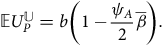 $${\mathbb E}U_P^{\mathbb U} = b\left( {1 - {{{\psi _A}} \over 2}\overline \beta } \right).$$
The participatory development regime
Now we analyze the effect of participatory institutions. We search for an equilibrium in which players use linear strategies with one exception. Specifically, for ${O_B}$
as the advantaged opponent, we find a threshold above which there is no benefit to revealing
${O_B}$
as the advantaged opponent, we find a threshold above which there is no benefit to revealing ${O_B}$
’s type to be any higher. Then we conjecture that
${O_B}$
’s type to be any higher. Then we conjecture that ${O_A}$
sets
${O_A}$
sets ${t_A} = {\omega _A}{\rm{\;}}{\beta _A}$
and
${t_A} = {\omega _A}{\rm{\;}}{\beta _A}$
and ${O_B}$
sets
${O_B}$
sets ${t_B} = {\omega _B} \, {\rm{min}}\{ {{\beta _B},{{\mathord{\buildrel{\lower3pt\hbox{$\scriptscriptstyle\smile$}}\over \beta } }_B}} \}$
, where
${t_B} = {\omega _B} \, {\rm{min}}\{ {{\beta _B},{{\mathord{\buildrel{\lower3pt\hbox{$\scriptscriptstyle\smile$}}\over \beta } }_B}} \}$
, where ${\omega _I}$
is some coefficient and
${\omega _I}$
is some coefficient and ${{{\mathord{\buildrel{\lower3pt\hbox{$\scriptscriptstyle\smile$}}\over \beta } }_B}}$
is the type of
${{{\mathord{\buildrel{\lower3pt\hbox{$\scriptscriptstyle\smile$}}\over \beta } }_B}}$
is the type of ${O_B}$
such that if
${O_B}$
such that if $P$
were to learn that
$P$
were to learn that ${\beta _A} = \overline \beta $
and
${\beta _A} = \overline \beta $
and ${{\beta _B} = {{\mathord{\buildrel{\lower3pt\hbox{$\scriptscriptstyle\smile$}}\over \beta } }_B}}$
,
${{\beta _B} = {{\mathord{\buildrel{\lower3pt\hbox{$\scriptscriptstyle\smile$}}\over \beta } }_B}}$
, $P$
would be indifferent between allowing the project in
$P$
would be indifferent between allowing the project in $A$
and
$A$
and $B$
. In other words, we conjecture a semiseparating equilibrium in which the only instance of pooling is types of
$B$
. In other words, we conjecture a semiseparating equilibrium in which the only instance of pooling is types of ${O_B}$
so large such that
${O_B}$
so large such that $P$
would never want to place the project in
$P$
would never want to place the project in $B$
. In such an equilibrium,
$B$
. In such an equilibrium, $P$
behaves in the same way as if full separation had occurred, and so for ease of exposition we speak of
$P$
behaves in the same way as if full separation had occurred, and so for ease of exposition we speak of $P$
making decisions as if
$P$
making decisions as if $P$
always acquired full knowledge of
$P$
always acquired full knowledge of ${\beta _A}$
and
${\beta _A}$
and ${\beta _B}$
.
${\beta _B}$
.
$P$
’s optimal behavior
 $P$
observes each district’s level of opposition and decides the district in which it prefers the project to go. Recall that
$P$
observes each district’s level of opposition and decides the district in which it prefers the project to go. Recall that $P$
determines the stringency of land use regulation in each district (i.e.,
$P$
determines the stringency of land use regulation in each district (i.e., $P$
selects
$P$
selects ${\phi _A}$
and
${\phi _A}$
and ${\phi _B}$
). Then if
${\phi _B}$
). Then if $P$
prefers the project to go in
$P$
prefers the project to go in $A$
, for example,
$A$
, for example, $P$
sets
$P$
sets ${\phi _A} = b$
and
${\phi _A} = b$
and ${\phi _B} \gt b$
(we assume that when indifferent,
${\phi _B} \gt b$
(we assume that when indifferent, $D$
builds the project).
$D$
builds the project).
Upon observing the levels of opposition, $P$
learns
$P$
learns ${\beta _A}$
and
${\beta _A}$
and ${\beta _B}$
. Given
${\beta _B}$
. Given $P$
’s utility,
$P$
’s utility, $P$
then prefers to place the project in
$P$
then prefers to place the project in $A$
when
$A$
when
 $${\psi _A}{\rm{\;}}\left( { - {\beta _A}{\rm{\;}}b} \right) + \left( {1 - {\omega _A}{\rm{\;}}{\beta _A}} \right){\rm{\;}}b \ge {\psi _B}{\rm{\;}}\left( { - {\beta _{\rm{B}}}{\rm{\;}}b} \right) + \left( {1 - {\omega _B}{\rm{\;}}{\beta _B}} \right){\rm{\;}}b \Leftrightarrow $$
 $${\beta _A}{\rm{\;}}\left( {{\psi _A} + {\omega _A}} \right) \le {\beta _B}{\rm{\;}}\left( {{\psi _B} + {\omega _B}} \right).$$
Notice then that two different factors determine the district in which $P$
prefers the project to go. The first is which district faces a lower externality, accounting for
$P$
prefers the project to go. The first is which district faces a lower externality, accounting for $P$
’s weights determining its relative concern for each district. The presence of participatory institutions allows
$P$
’s weights determining its relative concern for each district. The presence of participatory institutions allows $P$
to learn the type of each
$P$
to learn the type of each ${O_I}$
and therefore which district the project “should” go in. However, the fact itself that
${O_I}$
and therefore which district the project “should” go in. However, the fact itself that $P$
cares more about one district may lead
$P$
cares more about one district may lead $P$
to place the project in the other district, even if it faces a higher externality. Second,
$P$
to place the project in the other district, even if it faces a higher externality. Second, $P$
’s decision is additionally contingent on each opponent’s level of opposition, which not only informs
$P$
’s decision is additionally contingent on each opponent’s level of opposition, which not only informs $P$
but is also directly payoff-relevant.
$P$
but is also directly payoff-relevant.
Optimal opposition choices
As conjectured, we find a semiseparating equilibrium in which the intensity of each player’s opposition is a linear function of its type (up to a maximum value). The following lemma summarizes the equilibrium coefficients on the externality experienced that determine the amount that ${O_A}$
and
${O_A}$
and ${O_B}$
oppose:
${O_B}$
oppose:
Lemma 1
Optimal choices of ${\omega _A}$
and
${\omega _A}$
and ${\omega _B}$
, respectively, are
${\omega _B}$
, respectively, are
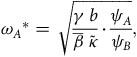 $${\omega _A}^{\rm{*}} = \sqrt {{{\gamma \;b} \over {\overline \beta \;\tilde \kappa }} \cdot {{{\psi _A}} \over {{\psi _B}}}}, $$
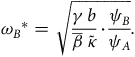 $${\omega _B}^{\rm{*}} = \sqrt {{{\gamma \;b} \over {\overline \beta \;\tilde \kappa }} \cdot {{{\psi _B}} \over {{\psi _A}}}} .$$
Proof. All proofs are in Appendix A unless otherwise noted.□
We see that for each ${O_I}$
, the level of opposition conditional on
${O_I}$
, the level of opposition conditional on ${\beta _I}$
is increasing in
${\beta _I}$
is increasing in $\gamma $
,
$\gamma $
, $b$
, and
$b$
, and ${\psi _I}$
, and decreasing in
${\psi _I}$
, and decreasing in ${\psi _J}$
,
${\psi _J}$
, $\overline \beta $
, and
$\overline \beta $
, and $\tilde \kappa $
. And when opponents’ concern
$\tilde \kappa $
. And when opponents’ concern $\gamma $
or project magnitude
$\gamma $
or project magnitude $b$
equals zero, obviously
$b$
equals zero, obviously ${\omega _A}^{\rm{*}} = {\omega _B}^{\rm{*}} = 0$
.
${\omega _A}^{\rm{*}} = {\omega _B}^{\rm{*}} = 0$
.
P’s location decision
Now that we know the equilibrium strategies of ${O_A}$
and
${O_A}$
and ${O_B}$
, we can give the (subgame) equilibrium condition under which the project goes in
${O_B}$
, we can give the (subgame) equilibrium condition under which the project goes in $A$
. Recalling from Inequality 1 that we require
$A$
. Recalling from Inequality 1 that we require ${\beta _A}{\rm{\;}}\left( {{\psi _A} + {\omega _A}} \right) \le {\beta _B}{\rm{\;}}\left( {{\psi _B} + {\omega _B}} \right)$
, we see now that this implies
${\beta _A}{\rm{\;}}\left( {{\psi _A} + {\omega _A}} \right) \le {\beta _B}{\rm{\;}}\left( {{\psi _B} + {\omega _B}} \right)$
, we see now that this implies
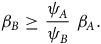 $${\beta _B} \ge {{{\psi _A}} \over {{\psi _B}}}\;{\beta _A}.$$
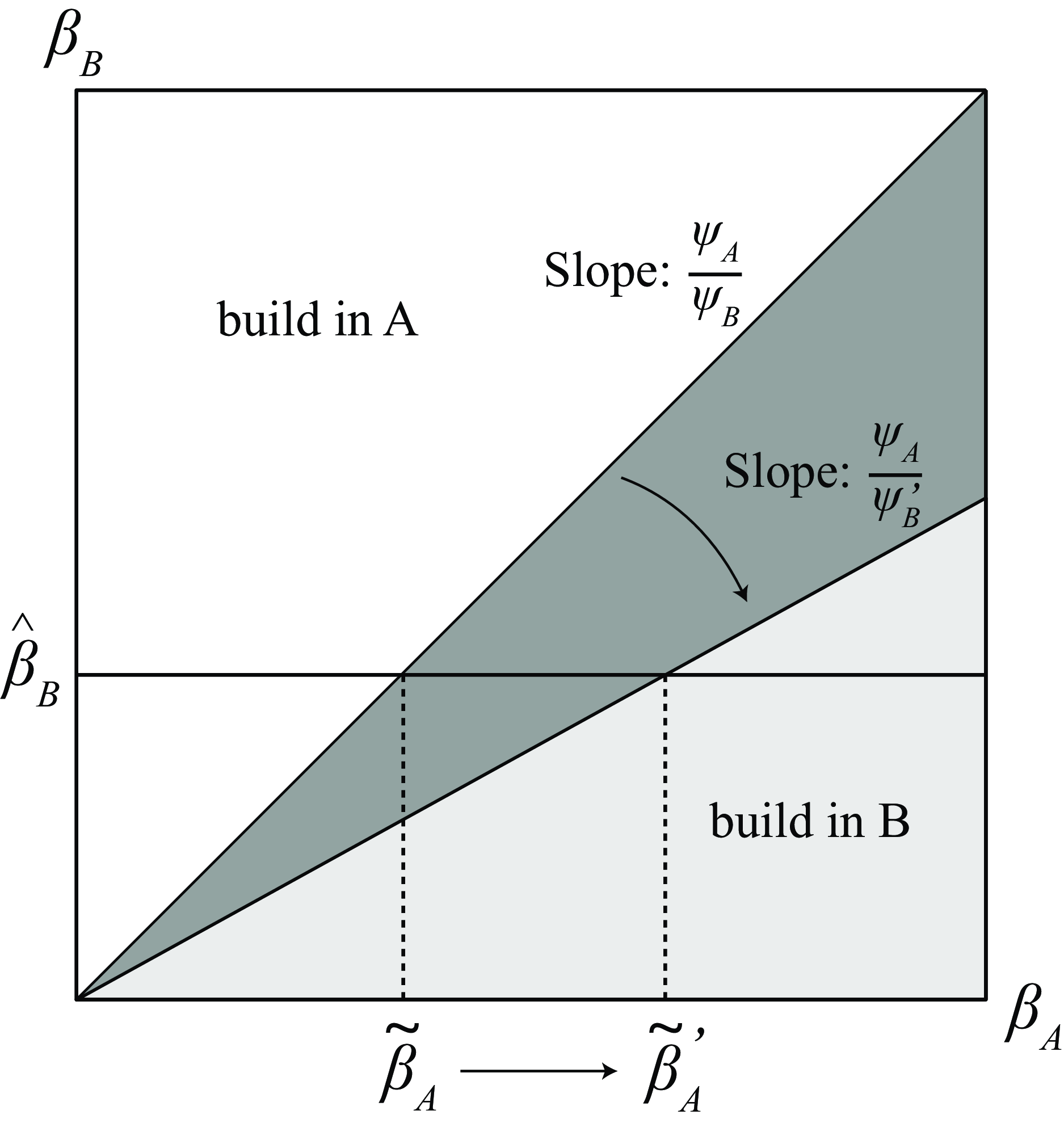
In $\left( {{\beta _A},{\beta _B}} \right)$
-space, the equation corresponding to Inequality 2 represents a ray emanating from
$\left( {{\beta _A},{\beta _B}} \right)$
-space, the equation corresponding to Inequality 2 represents a ray emanating from $\left( {0,0} \right)$
that separates the region in which the project goes in
$\left( {0,0} \right)$
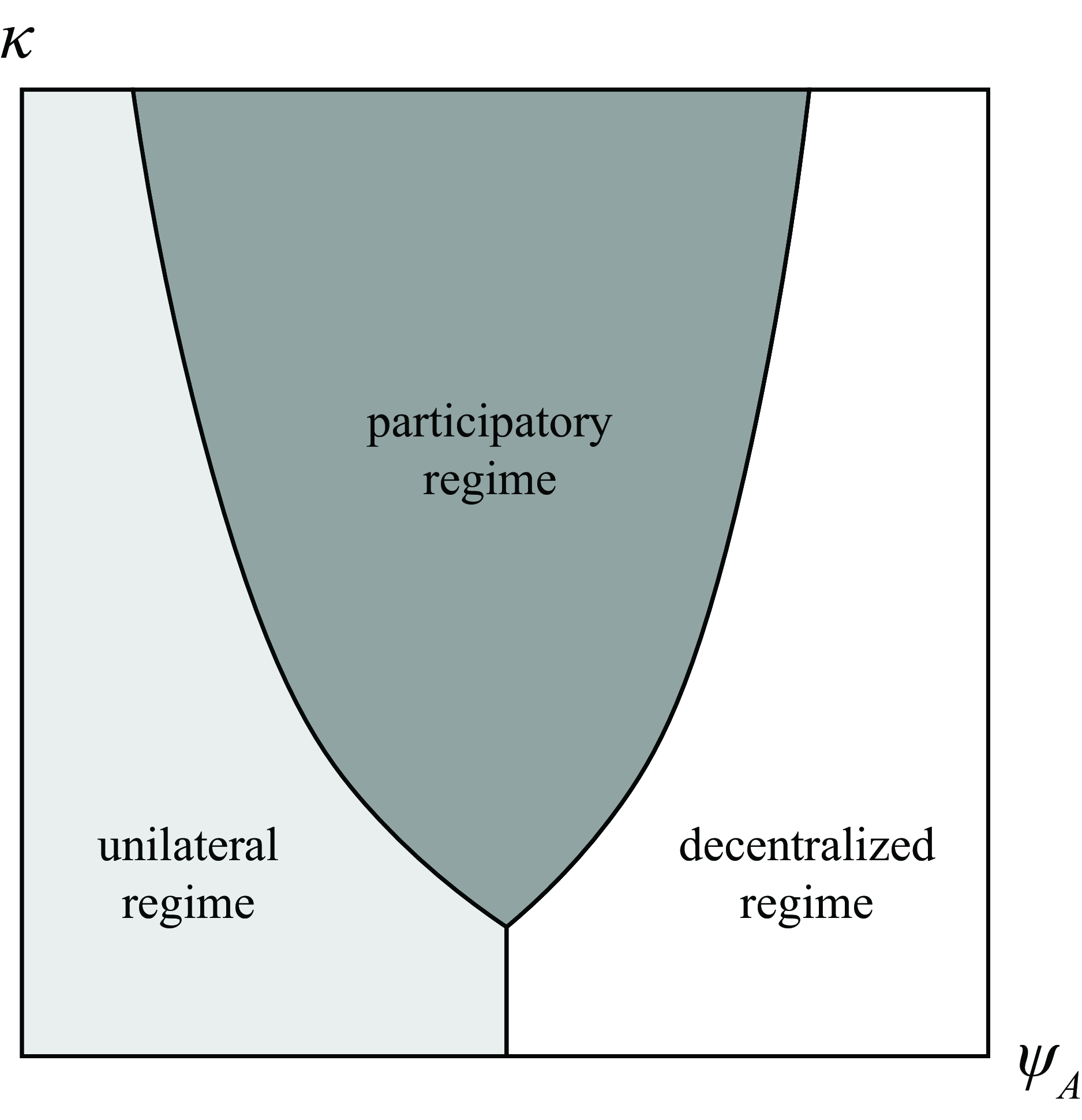
that separates the region in which the project goes in $A$
(top left) from that in which it goes in
$A$
(top left) from that in which it goes in $B$
(bottom right). Figure 1 illustrates
$B$
(bottom right). Figure 1 illustrates $P$
’s alternative project location decisions for different values of
$P$
’s alternative project location decisions for different values of ${\beta _A}$
and
${\beta _A}$
and ${\beta _B}$
.
${\beta _B}$
.
In the white region, where $P$
builds in
$P$
builds in $A$
, and the light-gray region, where
$A$
, and the light-gray region, where $P$
builds in
$P$
builds in $B$
,
$B$
, $P$
’s choice is socially optimal. But in the dark-gray region,
$P$
’s choice is socially optimal. But in the dark-gray region, $P$
builds in
$P$
builds in $A$
despite it being socially optimal to build in
$A$
despite it being socially optimal to build in $B$
. For a given realization of the externality
$B$
. For a given realization of the externality ${\beta _B}$
(denoted by
${\beta _B}$
(denoted by ${\hat \beta _B}$
and shown by horizontal line), an increase in
${\hat \beta _B}$
and shown by horizontal line), an increase in $P$
’s concern for
$P$
’s concern for $B$
, corresponding to
$B$
, corresponding to ${\psi _B}$
increasing to
${\psi _B}$
increasing to ${\psi _B}{\rm{'}} \gt {\psi _B}$
, shrinks the region in which
${\psi _B}{\rm{'}} \gt {\psi _B}$
, shrinks the region in which $P$
locates the project in district
$P$
locates the project in district $B$
.
$B$
.
The fact that Inequality 2 depends upon ${\psi _A}$
and
${\psi _A}$
and ${\psi _B}$
represents the benefit of participatory institutions for
${\psi _B}$
represents the benefit of participatory institutions for $P$
. When
$P$
. When $P$
is equally concerned about each district (
$P$
is equally concerned about each district ( ${\psi _A} = {\psi _B}$
), then Inequality 2 reduces to
${\psi _A} = {\psi _B}$
), then Inequality 2 reduces to ${\beta _B} \ge {\beta _A}$
, and
${\beta _B} \ge {\beta _A}$
, and $P$
places the project in the lower-externality district. However, when
$P$
places the project in the lower-externality district. However, when ${\psi _B} \gt {\psi _A}$
, there are times when
${\psi _B} \gt {\psi _A}$
, there are times when ${\beta _A} \gt {\beta _B}$
but the project goes in
${\beta _A} \gt {\beta _B}$
but the project goes in $A$
regardless. In this case, the disadvantaged district
$A$
regardless. In this case, the disadvantaged district $A$
bears the negative externalities of the project despite the fact that those externalities would be smaller if the project were located in
$A$
bears the negative externalities of the project despite the fact that those externalities would be smaller if the project were located in $B$
. But
$B$
. But $P$
nonetheless chooses to locate the project in
$P$
nonetheless chooses to locate the project in $A$
in order to protect the residents of the advantaged district
$A$
in order to protect the residents of the advantaged district $B$
.
$B$
.
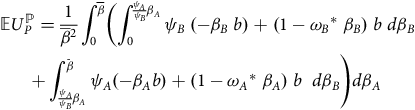
Using the above, we construct $P$
’s expected utility from establishing participatory institutions. This is
$P$
’s expected utility from establishing participatory institutions. This is
 $$\begin{gathered}\mathbb{E}U_P^\mathbb{P} = \frac{1}{{{{\bar \beta }^2}}}\int_0^{\bar \beta } {\left( {\int_0^{\frac{{\psi A}}{{{\psi _B}}}{\beta _A}} {{\psi _B}} \;\left( { - {\beta _B}\;b} \right) + \left( {1 - {\omega _B}^{\text{*}}\;{\beta _B}} \right)\;b\;d{\beta _B}} \right.} \; \\\left. { + \int_{\frac{{{\psi _A}}}{{{\psi _B}}}{\beta _A}}^{\bar \beta } {{\psi _A}\left( { - {\beta _A}b} \right) + \left( {1 - {\omega _A}^{\text{*}}\;{\beta _A}} \right)\;b\;\;d{\beta _B}} } \right)d{\beta _A} \\
\end{gathered}$$
$$\begin{gathered}\mathbb{E}U_P^\mathbb{P} = \frac{1}{{{{\bar \beta }^2}}}\int_0^{\bar \beta } {\left( {\int_0^{\frac{{\psi A}}{{{\psi _B}}}{\beta _A}} {{\psi _B}} \;\left( { - {\beta _B}\;b} \right) + \left( {1 - {\omega _B}^{\text{*}}\;{\beta _B}} \right)\;b\;d{\beta _B}} \right.} \; \\\left. { + \int_{\frac{{{\psi _A}}}{{{\psi _B}}}{\beta _A}}^{\bar \beta } {{\psi _A}\left( { - {\beta _A}b} \right) + \left( {1 - {\omega _A}^{\text{*}}\;{\beta _A}} \right)\;b\;\;d{\beta _B}} } \right)d{\beta _A} \\
\end{gathered}$$
 $$\!= {b \over {6{\psi _B}^2}}\left( \!{{\psi _A}\sqrt {{{\overline \beta \;\gamma \;b\;{\psi _A}\;{\psi _B}} \over {\tilde \kappa }}} + \!{\psi _B}\left( {\overline \beta \;{\psi _A}\left( {{\psi _A} - 3{\psi _B}} \right) + \!6{\psi _B} - 3\sqrt {{{\overline \beta \;\gamma \;b\;{\psi _A}\;{\psi _B}} \over {\tilde \kappa }}} } \right)} \right).$$
The decentralized development regime
In contrast to the unilateral and participatory regimes, in this case $P$
cedes control over the project location decision to the voters of each district.
$P$
cedes control over the project location decision to the voters of each district.
D’s problem
As before, the developer $D$
chooses to build the project in the district charging the lowest fee, given that any district charges less than the entire value of the project.
$D$
chooses to build the project in the district charging the lowest fee, given that any district charges less than the entire value of the project.
The voters’ problem
When delegation occurs, each voter must choose a fee. This setup is effectively a sealed first-price reverse auction with independent private costs in which the good for sale is the right to develop in a district and the price is the fee.Footnote
13
In search of a symmetric equilibrium, let us analyze ${V_I}$
’s problem.
${V_I}$
’s problem. ${V_I}$
’s cost is
${V_I}$
’s cost is ${\beta _I} \, b$
, and it believes that
${\beta _I} \, b$
, and it believes that ${V_J}$
’s cost is uniformly distributed over
${V_J}$
’s cost is uniformly distributed over $[ {0,\overline \beta {\rm{\;}}b} ]$
. Suppose that
$[ {0,\overline \beta {\rm{\;}}b} ]$
. Suppose that ${V_I}$
believes that
${V_I}$
believes that ${V_J}$
uses an affine strategy, i.e.
${V_J}$
uses an affine strategy, i.e. ${\phi _J}\left( {{\beta _J}{\rm{\;}}b} \right) = \alpha + \eta {\rm{\;}}{\beta _J}{\rm{\;}}b$
, with
${\phi _J}\left( {{\beta _J}{\rm{\;}}b} \right) = \alpha + \eta {\rm{\;}}{\beta _J}{\rm{\;}}b$
, with $\alpha $
and
$\alpha $
and $\eta $
not a function of
$\eta $
not a function of ${\beta _J}$
. Then
${\beta _J}$
. Then ${V_I}$
’s expected payoff from choosing some
${V_I}$
’s expected payoff from choosing some ${\phi _I}$
is
${\phi _I}$
is
 $${\mathbb E}U_{{V_I}}^{\mathbb D}\left( {{\phi _I}} \right) = \left( {1 - {{{\phi _I} - \alpha } \over {\overline \beta {\rm{\;}}\eta {\rm{\;}}b}}} \right)\left( {{\phi _I} - {\beta _I}{\rm{\;}}b} \right).$$
Then the first-order condition implies
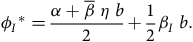 $${\phi _I}^{\rm{*}} = {{\alpha + \overline \beta \;\eta \;b} \over 2} + {1 \over 2}{\beta _I}\;b.$$
with the second-order condition satisfied. Looking back to the components of an affine strategy, we would therefore have $\alpha = {{\alpha + \overline \beta \;\eta \;b} \over 2}$
and
$\alpha = {{\alpha + \overline \beta \;\eta \;b} \over 2}$
and $\eta = {1 \over 2}$
. Solving simultaneously gives
$\eta = {1 \over 2}$
. Solving simultaneously gives $\alpha = {{\overline \beta \;b} \over 2}$
and
$\alpha = {{\overline \beta \;b} \over 2}$
and $\eta = {1 \over 2}$
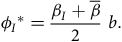
. That is, a consistent strategy for all
$\eta = {1 \over 2}$
. That is, a consistent strategy for all ${V_I}$
is indeed affine, with
${V_I}$
is indeed affine, with
 $${\phi _I}^{\rm{*}} = {{{\beta _I} + \overline \beta } \over 2}\;b.$$
We see then that $D$
always builds the project, it always goes in the place with the lower externality, and in expectation each voter is able to capture some of the surplus, as is
$D$
always builds the project, it always goes in the place with the lower externality, and in expectation each voter is able to capture some of the surplus, as is $D$
. Importantly, this contrasts with the participatory regime. That regime exhibits an asymmetry (and thus kinks in many of the expressions) due to the politician favoring one of the districts. But the asymmetry vanishes under the decentralized development regime, because the politician is eliminated and the districts deal directly with the developer, who only cares about how much money is spent on compensation.
$D$
. Importantly, this contrasts with the participatory regime. That regime exhibits an asymmetry (and thus kinks in many of the expressions) due to the politician favoring one of the districts. But the asymmetry vanishes under the decentralized development regime, because the politician is eliminated and the districts deal directly with the developer, who only cares about how much money is spent on compensation.
P’s expected utility
We assume that $P$
has utility over the project’s social value even though
$P$
has utility over the project’s social value even though $P$
no longer directly collects the fee.
$P$
no longer directly collects the fee. $P$
’s expected utility from decentralization is therefore as follows:
$P$
’s expected utility from decentralization is therefore as follows:
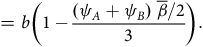
 $${\mathbb E}U_P^{\mathbb D} = {1 \over {{{\overline \beta }^2}}}\mathop \int \nolimits_0^{\overline \beta } \left( {\mathop \int \nolimits_0^{{\beta _A}} {\psi _B}{\rm{\;}}\left( { - {\beta _B}{\rm{\;}}b} \right) + b{\rm{\;\;}}d{\beta _B} + \mathop \int \nolimits_{{\beta _A}}^{\overline \beta } {\psi _A}{\rm{\;}}\left( { - {\beta _A}{\rm{\;}}b} \right) + b{\rm{\;\;}}d{\beta _B}} \right)d{\beta _{\rm{A}}}$$
 $$ = b\left( {1 - {{\left( {{\psi _A} + {\psi _B}} \right)\;\overline \beta /2} \over 3}} \right).$$
P’s choice of development regime
We now compare $P$
’s expected utility in each regime to determine
$P$
’s expected utility in each regime to determine $P$
’s choice. We find that
$P$
’s choice. We find that ${\mathbb E}U_P^{\mathbb P} \gt {\mathbb E}U_P^{\mathbb U}$
is equivalent to
${\mathbb E}U_P^{\mathbb P} \gt {\mathbb E}U_P^{\mathbb U}$
is equivalent to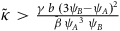 $\tilde \kappa \gt {{\gamma \;b\;{{(3{\psi _B} - {\psi _A})}^2}} \over {\bar \beta \;{\psi _A}^3\;{\psi _B}}}$
, and
$\tilde \kappa \gt {{\gamma \;b\;{{(3{\psi _B} - {\psi _A})}^2}} \over {\bar \beta \;{\psi _A}^3\;{\psi _B}}}$
, and ${\mathbb E}U_P^{\mathbb P} \gt {\mathbb E}U_P^{\mathbb D}$
occurs when
${\mathbb E}U_P^{\mathbb P} \gt {\mathbb E}U_P^{\mathbb D}$
occurs when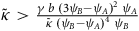 $\tilde \kappa \gt {{\gamma \;b\;{{(3{\psi _B} - {\psi _A})}^2}\;{\psi _A}} \over {\tilde \kappa \;{{({\psi _B} - {\psi _A})}^4}\;{\psi _B}}}$
. Both these conditions must hold for
$\tilde \kappa \gt {{\gamma \;b\;{{(3{\psi _B} - {\psi _A})}^2}\;{\psi _A}} \over {\tilde \kappa \;{{({\psi _B} - {\psi _A})}^4}\;{\psi _B}}}$
. Both these conditions must hold for $P$
to choose the participatory regime. Otherwise,
$P$
to choose the participatory regime. Otherwise, $P$
compares the utility of the unilateral and decentralized regimes, and
$P$
compares the utility of the unilateral and decentralized regimes, and ${\mathbb E}U_P^{\mathbb U} \gt {\mathbb E}U_P^{\mathbb D}$
is equivalent to
${\mathbb E}U_P^{\mathbb U} \gt {\mathbb E}U_P^{\mathbb D}$
is equivalent to ${{{\psi }}_A} \lt {{\psi _B}\over{2}}$
.
${{{\psi }}_A} \lt {{\psi _B}\over{2}}$
.
Remembering that ${{\mathord{\buildrel{\lower3pt\hbox{$\scriptscriptstyle\smile$}}\over \beta } }_B}$
is the type of opponent
${{\mathord{\buildrel{\lower3pt\hbox{$\scriptscriptstyle\smile$}}\over \beta } }_B}$
is the type of opponent $B$
that would make
$B$
that would make $P$
indifferent if opponent
$P$
indifferent if opponent $A$
were the highest possible type and denoting
$A$
were the highest possible type and denoting ${{\mathord{\buildrel{\lower3pt\hbox{$\scriptscriptstyle\smile$}}\over \beta } }_B}^{\rm{*}}$
as its equilibrium value (presented in the proof to Lemma 1), we summarize the equilibrium outcome with the following result:
${{\mathord{\buildrel{\lower3pt\hbox{$\scriptscriptstyle\smile$}}\over \beta } }_B}^{\rm{*}}$
as its equilibrium value (presented in the proof to Lemma 1), we summarize the equilibrium outcome with the following result:
Proposition 1 (Equilibrium)
If ${\psi _A} \lt {{\psi_{B}}\over{2}}$
,
${\psi _A} \lt {{\psi_{B}}\over{2}}$
, $P$
creates participatory institutions when
$P$
creates participatory institutions when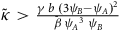 $\tilde \kappa \gt {{\gamma \;b\;{{(3{\psi _B} - {\psi _A})}^2}} \over {\bar \beta \;{\psi _A}^3\;{\psi _B}}}$
; otherwise,
$\tilde \kappa \gt {{\gamma \;b\;{{(3{\psi _B} - {\psi _A})}^2}} \over {\bar \beta \;{\psi _A}^3\;{\psi _B}}}$
; otherwise, $P$
chooses the unilateral regime and sets
$P$
chooses the unilateral regime and sets ${\phi _A} = b$
and
${\phi _A} = b$
and ${\phi _B} \gt b$
and
${\phi _B} \gt b$
and $D$
builds in
$D$
builds in $A$
.
$A$
.
If ${\psi _A} \ge {{\psi_{B}}\over{2}}$
,
${\psi _A} \ge {{\psi_{B}}\over{2}}$
, $P$
creates participatory institutions when
$P$
creates participatory institutions when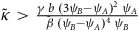 $\tilde \kappa \gt {{\gamma \;b\;{{(3{\psi _B} - {\psi _A})}^2}\;{\psi _A}} \over {\bar \beta \;{{({\psi _B} - {\psi _A})}^4}\;{\psi _B}}}$
; otherwise,
$\tilde \kappa \gt {{\gamma \;b\;{{(3{\psi _B} - {\psi _A})}^2}\;{\psi _A}} \over {\bar \beta \;{{({\psi _B} - {\psi _A})}^4}\;{\psi _B}}}$
; otherwise, $P$
chooses the decentralized regime and
$P$
chooses the decentralized regime and ${V_I}$
sets
${V_I}$
sets ${\phi_I}^{*} = {{{\beta _I} + \overline \beta } \over 2}b$
and
${\phi_I}^{*} = {{{\beta _I} + \overline \beta } \over 2}b$
and $D$
builds in the location with the lowest externality.
$D$
builds in the location with the lowest externality.
If $P$
creates participatory institutions, then
$P$
creates participatory institutions, then
-
${O_A}$
sets
${t_A} = {\omega _A}^{\rm{*}}{\rm{\;}}{\beta _A}$
.
-
${O_B}$
sets
${t_B} = {\omega _B}^{\rm{*}} \cdot {{min}}\left\{ {{\beta _B},{{\mathord{\buildrel{\lower3pt\hbox{$\scriptscriptstyle\smile$}}\over \beta } }_B}^{*}} \right\}$
.
-
$P$
sets
${\phi _A} = b$
and
${\phi _B} \gt b$
when
${\beta _B} \ge {{{\psi _A}} \over {{\psi _B}}}\;{\beta _A}$
and sets
${\phi _A} \gt b$
and
${\phi _B} = b$
otherwise.
-
$D$
builds in the location with the lowest fee.





Proof. In text.□
A necessary condition for $P$
to establish participatory institutions is for opponents’ costs of obstruction (represented by
$P$
to establish participatory institutions is for opponents’ costs of obstruction (represented by $\kappa $
) to be sufficiently large. This reduces the inefficiency associated with participation, making it more attractive for the politician. Beyond this factor, whether the politician prefers unilateral control or decentralization depends on their relative concern for either district.
$\kappa $
) to be sufficiently large. This reduces the inefficiency associated with participation, making it more attractive for the politician. Beyond this factor, whether the politician prefers unilateral control or decentralization depends on their relative concern for either district.
We can now look at a comparative static result pertaining to $P$
’s willingness to create participatory institutions. What happens when inequality increases? (That is, concern for
$P$
’s willingness to create participatory institutions. What happens when inequality increases? (That is, concern for $B$
increases while concern for
$B$
increases while concern for $A$
decreases by an equal amount, which holds constant
$A$
decreases by an equal amount, which holds constant $P$
’s relative concern for receiving fee payments.) We reach the following result:
$P$
’s relative concern for receiving fee payments.) We reach the following result:
Proposition 2 (Institutional choice)
When ${\psi _A}$
is small,
${\psi _A}$
is small, $P$
selects the unilateral regime; when
$P$
selects the unilateral regime; when ${\psi _A}$
is intermediate,
${\psi _A}$
is intermediate, $P$
selects the participatory regime; and when
$P$
selects the participatory regime; and when ${\psi _A}$
is large,
${\psi _A}$
is large, $P$
selects the decentralized regime. The size of the range of
$P$
selects the decentralized regime. The size of the range of ${\psi _A}$
considered intermediate is increasing in
${\psi _A}$
considered intermediate is increasing in $\kappa $
.
$\kappa $
.
This result shows that participatory institutions are created in a middle zone of inequality. On one hand, when inequality is very high, $P$
anticipates that they will almost always want the project to go in
$P$
anticipates that they will almost always want the project to go in $A$
, in which case the downside of incurring transaction costs no longer exceeds the benefit of gaining information about each district, and
$A$
, in which case the downside of incurring transaction costs no longer exceeds the benefit of gaining information about each district, and $P$
simply sends the project to
$P$
simply sends the project to $A$
at all times. On the other hand, when inequality is very low,
$A$
at all times. On the other hand, when inequality is very low, $P$
’s utility approaches that of the social optimum, which decentralization produces without the transaction costs of participatory institutions. Participatory institutions are best for
$P$
’s utility approaches that of the social optimum, which decentralization produces without the transaction costs of participatory institutions. Participatory institutions are best for $P$
when concern for
$P$
when concern for $A$
relative to
$A$
relative to $B$
is intermediate, because
$B$
is intermediate, because $P$
has enough concern for
$P$
has enough concern for $A$
not to want the project to go there when their externality is very high, but not so much that
$A$
not to want the project to go there when their externality is very high, but not so much that $P$
would not sometimes want to override the social optimum. The smaller that the project benefit
$P$
would not sometimes want to override the social optimum. The smaller that the project benefit $b$
is and the higher that opposition cost
$b$
is and the higher that opposition cost $\kappa $
is, the greater range of
$\kappa $
is, the greater range of ${\psi _A}$
can be considered intermediate and compatible with
${\psi _A}$
can be considered intermediate and compatible with $P$
selecting participatory institutions. This result is illustrated in Figure 2 (see the proof for a formal definition of small, intermediate, and large).
$P$
selecting participatory institutions. This result is illustrated in Figure 2 (see the proof for a formal definition of small, intermediate, and large).
An illustration of Proposition 2. On the left, where district $A$
is most disadvantaged,
$A$
is most disadvantaged, $P$
chooses the unilateral development regime. In the middle (as long as
$P$
chooses the unilateral development regime. In the middle (as long as $\kappa $
is not too small, with the corresponding inefficiency from opposition being too large),
$\kappa $
is not too small, with the corresponding inefficiency from opposition being too large), $P$
chooses the participatory development regime. On the right, where
$P$
chooses the participatory development regime. On the right, where $P$
’s preferences are most egalitarian,
$P$
’s preferences are most egalitarian, $P$
chooses the decentralized development regime. In this example, we fix
$P$
chooses the decentralized development regime. In this example, we fix ${\psi _B} = 1$
and
${\psi _B} = 1$
and $b = 1/200$
.
$b = 1/200$
.
To make this argument concrete, consider an example of different neighborhoods in San Francisco: the Mission, a historically working-class neighborhood where much recent development has been located, and west San Francisco, where development is effectively banned (Shaw Reference Shaw2018). By the logic of our model, the reason why the city of San Francisco does not allow each neighborhood to veto or approve projects on their own – even if this would be the social-welfare maximizing policy – is because by maintaining centralized control, the city can make it so that more projects go in the Mission rather than west San Francisco. Since these projects (we assume) benefit the city as a whole, the advantaged neighborhoods yield the benefits without paying the cost.Footnote 14 In effect, this is a transfer from poor neighborhoods to affluent neighborhoods.Footnote 15
Given this analysis, we conclude that the policy failures of local governments are rooted in a political problem in which different groups within a city have unequal power in government. While nimbyism is possible because of participatory institutions, the politician only establishes participatory institutions because the politician does not share preferences with those participating (though this is still associated with increased equality relative to unilateralism). Even when an alternative with zero transaction costs is available, a politician with biased preferences accepts the inefficiency of participatory institutions in order to maintain ultimate control over the allocation of projects and thereby benefit the advantaged district.Footnote 16
Historical development
The model analysis show how different degrees of concern on the part of a politician for different districts affects institutional selection. We interpret the concern of the politician to reflect the power of different social groups located in different parts of the city. The model shows that as groups become more equal, the politician restructures institutions to eliminate unilateral control and provide participatory channels for public input. In terms of Figure 2, this corresponds to a rightward shift from the left region to the middle region as ${\psi _A}$
(concern for the disadvantaged district) increases.
${\psi _A}$
(concern for the disadvantaged district) increases.
In the current section, we identify historical changes in local politics during the 1960s and 1970s that transformed political relationships among social groups in many US cities. These changes in local politics corresponded to politicians restructuring local institutions to facilitate public participation in land use policymaking. We first describe how historic changes associated with the Great Society altered the balance of power among groups in urban politics. Using brief case studies, we then show how the resulting group incorporation led to the establishment of participatory institutions. This corresponds to the intermediate region of our model, reflecting both increased equality across neighborhoods and persistent inequality.
The effect of the great society on community power
Political changes in the 1960s transformed the distribution of power among groups in urban politics. In terms of the model, we interpret these changes in power to increase ${\psi _A}$
, representing government responsiveness to the disadvantaged district. The increase in
${\psi _A}$
, representing government responsiveness to the disadvantaged district. The increase in ${\psi _A}$
, while
${\psi _A}$
, while ${\psi _B}$
stays constant, translates to increasing equality in urban politics.
${\psi _B}$
stays constant, translates to increasing equality in urban politics.
The increasing influence of disadvantaged groups occurred through multiple channels. First, the civil rights movement provided a training ground for activists (North and South), and the Voting Rights Act directly increased the power of Black electorates in Southern politics. Second, the Ford Foundation and other non-profits supported ethnic-based organizations by providing resources for political engagement among activists from minority groups (Ferguson Reference Ferguson2007). Third, Great Society programs in President Lyndon Johnson’s War on Poverty fostered participation among groups previously excluded from urban politics.
In fact, a range of evidence shows that the Great Society, especially the Community Action and Model Cities programs, had an expansive impact on urban politics. These programs promoted “maximum feasible participation,” a nebulous mandate that nevertheless appears to have affected program implementation. A recent review of historical literature on the Model Cities program concludes that Model Cities provided “representatives of the disadvantaged direct and meaningful access to the process of power and changed racial politics by establishing a new tier of leadership” (Weber and Wallace Reference Weber and Wallace2012, 174). Using city case studies, Greenstone and Peterson (Reference Greenstone and Peterson1976) argue that Great Society programs transformed political coalitions and conflicts in major cities by providing resources to low-income and minority groups, fostering alliances among activists with similar interests across neighborhoods, and directly helping activists from disadvantaged communities build skills, knowledge, and experience engaging with city governments.
These political changes substantially transformed the landscape of groups in many cities. In both the North and South, Black neighborhoods were increasingly influential in urban politics, in part due to Model Cities and other War on Poverty programs (Germany Reference Germany2007; Greenstone and Peterson Reference Greenstone and Peterson1976; Self Reference Self2003). In some cities, reform politicians allied with activists from low-income or minority communities to successfully challenge political machines (Agee Reference Agee2014). In others, particularly Southern cities, biracial coalitions achieved power (Germany Reference Germany2007). Alternatively, existing political leadership responded to the transformed political landscape by adjusting their political positions (Greenstone and Peterson Reference Greenstone and Peterson1976).
Many historians, as well as observers at the time – not least opponents fearing a “social revolution” (Self Reference Self2003, 245) – have perceived Great Society programs and other changes of the 1960s to enhance participation and overall responsiveness of urban governments to a wider variety of groups. But there were important limitations. Hamilton (Reference Hamilton1979) characterizes the result of these efforts among some Black communities as a “patron-recipient relationship” with demobilizing effects. Johnson (Reference Johnson2007) acknowledges the impact of the new generation of minority leadership but argues that, overall, organizing along ethnic lines submerged broadly redistributive economic demands and curtailed gains to impoverished communities.
Together, the increasing while still limited influence of disadvantaged groups in urban politics can be understood to correspond to the intermediate region of inequality in the model (see Figure 2). In this region, the politician establishes participatory institutions in order to be moderately responsive to disadvantaged groups, while maintaining the ability to disproportionately benefit more advantaged groups. In the next section, we provide examples of new political coalitions achieving power in urban governments and then expanding mechanisms for public participation in land use policymaking.
Case studies
This section uses brief case studies of cities from different regions of the country to illustrate how the changing power of groups in urban politics produced a dramatic institutional restructuring. In each case, local politicians responded to the transformed power of groups across neighborhoods by expanding opportunities for participation in land use policymaking. We focus on neighborhood-level institutions as an important mechanism to facilitate public participation in urban politics.
Neighborhood organizations exemplify the participatory procedures of the model in multiple ways. By providing a neighborhood-specific forum to debate project proposals, public opposition communicates information to politicians about the local costs of project proposals. This reflects the informational benefit that participation provides the politician in the model. Simultaneously, by establishing an additional step in the land use planning process, these institutions could be used as a venue for opponents to raise objections and delay potential projects. This corresponds to the cost that participatory institutions in the model enable opponents to impose on the politician. Thus, the establishment of neighborhood institutions constitutes a move from the unilateral to participatory development regime of the model.
Atlanta
After desegregation and the Voting Rights Act, Maynard Jackson was elected mayor in 1973 with strong Black support, while Atlanta’s business elite were divided. Jackson pledged greater inclusivity, using a metaphor of a feast in which no groups are excluded. Jackson also strongly supported neighborhood groups, many of which had recently mobilized around highway construction and other issues (Stone Reference Stone1989). At the same time, Jackson sought positive relations with the downtown business elite and pursued business development with “enthusiastic support” (Reed Reference Reed1999, 168).Yet this represented a substantial shift from earlier years in which elite-led redevelopment displaced as much as one-fifth of Atlanta’s population, corresponding to the unilateral development regime (Stone Reference Stone1989). In terms of the model, neighborhoods are increasingly equal, though still unequal, within the politician’s utility.
As Jackson took office in 1974, the city council established twenty-four Neighborhood Planning Units (NPUs) with the goal of facilitating neighborhood-level public participation in land use planning. Jackson supported the NPUs with administrative staff who assisted neighborhood residents in developing neighborhood-specific plans. These neighborhood proposals would then contribute to Atlanta’s comprehensive land use plan (Hutcheson Jr. Reference Hutcheson1984). Hence, the NPUs provide a forum for neighborhood residents to voice their concerns to city officials and potentially delay development proposals. As the model shows, politicians prefer participatory procedures along these lines when they want to protect disadvantaged groups from the worst projects, but still override local preferences in some cases on behalf of more powerful neighborhoods.
New York
In New York City, official neighborhood institutions were first established in 1963 as advisory bodies by Mayor Robert Wagner Jr. to counterbalance the power of the Democratic political machine (Angotti Reference Angotti1997). Nonetheless, as in the unilateral regime of the model, opportunities for neighborhood-level public involvement in planning remained limited. John Lindsay’s election in 1965 “represented a historic turning point,” with Lindsay’s “strong record on civil rights” and outreach to Black and Puerto Rican voters meaning that he relied on a wider coalition of voters than did Wagner (Viteritti Reference Viteritti and Viteritti2014, 15–16). Lindsay likewise supported the neighborhood-focused community groups that formed in the context of the War on Poverty.Footnote 17 Thus, Lindsay represents a politician in the model with more equal preferences across neighborhoods than prior politicians.
As mayor, Lindsay attempted to expand the power of neighborhood participatory institutions in his unsuccessful effort to create “little city halls” (Marcuse Reference Marcuse1987). Although Lindsay faced opposition from the city council (Viteritti Reference Viteritti and Viteritti2014), a formal role for these institutions in land use planning was established in New York’s 1975 charter revision. The votes of neighborhood planning institutions remained advisory – the city council still approved or rejected the community plans (Angotti Reference Angotti2008). Nonetheless, as in the model, increased concern by politicians for previously marginalized groups led them to establish participatory institutions, expanding opportunities for these groups to influence the planning process.
Portland
In the mid-twentieth century, Portland’s land use policy reflected the unilateral regime of the model. For instance, in the early 1960s, the Portland Development Commission displaced over 300 families (mainly Italian and Jewish immigrants) from the low-income South Auditorium neighborhood, ignoring protests by local residents (Wollner et al. Reference Wollner, Provo and Schablitsky2001). Starting in the mid-1960s, the Model Cities program provided funding for low-income, predominately African-American neighborhoods to organize. Other neighborhoods, such as in wealthier Southeast Portland, organized to demand funding for themselves. In 1970, Neil Goldschmitt was elected to the city council and established a reputation as a “neighborhood guy” (MacGillivray Reference MacGillivray2016). With support from neighborhood activists, Goldschmitt was elected mayor in 1972. We interpret Goldschmitt’s election to represent increasing equality within the politician’s utility across neighborhoods.
In 1974, Goldschmitt’s administration established the Office of Neighborhood Associations, which provided a budget and administrative support for neighborhood associations (Wollner et al. Reference Wollner, Provo and Schablitsky2001). Now formally established within the city government, neighborhood associations enabled local residents to collaborate with city staff on neighborhood land use planning, and at the same time, to lobby the city government on issues of neighborhood concern (De Morris and Leistner Reference De Morris and Leistner2009). Hence, greater political equality across neighborhoods led to reforms creating formal mechanisms for citizen participation, but these neighborhood-level institutions still lacked the power to approve or veto projects.
Inequality and nimbyism in urban politics
Institutional reforms in Atlanta, New York, Portland, and other cities created formal mechanisms for public participation in land use policymaking in the 1970s and thereafter. As documented by scholars in law, economics, and political science, this new institutional context laid the foundation for rising housing prices and other inefficiencies in land use policy (see Schleicher Reference Schleicher2013; Glaeser et al. Reference Glaeser, Gyourko and Saks2005b; Einstein et al. Reference Einstein, Glick and Palmer2020). While housing markets differ greatly across regions of the US, participatory institutions provide a source of “frictions” in supply response that is necessary for changes in housing demand to affect prices (Gyourko et al. Reference Gyourko, Mayer and Sinai2013). Hence, these institutional changes provide an essential component for a full explanation of the housing market in recent decades.
At the same time, the model complicates the relationship between inequality and inefficiencies in land use regulation. Prior analyses of inefficiencies in land use identify nimbyism and hence participatory institutions as the key problem. However, as the model shows, participatory institutions are set up when politicians have unequal concern for different districts, even if inequality is reduced from where it was under unilateral decision-making. Yet in terms of historical origins, participatory institutions emerged from an unquestionably positive development: the incorporation of previously excluded groups into urban politics. Rather than rolling back participatory reforms, the model indicates the possibility of further enhancing equality across neighborhoods while simultaneously reducing inefficiencies in land use policymaking by empowering neighborhood-level institutions.Footnote 18
The key feature of the decentralized development regime is that each neighborhood chooses for itself whether to accept or reject projects. Without this, the only way for local residents to signal their preferences is through obstruction, exerting costly effort to delay project approval. As our model shows, this is simultaneously inefficient and perpetuates inequality by forcing locally costly projects into disadvantaged neighborhoods. If districts instead negotiate directly with developers over compensation for the local costs of development, marginalized neighborhoods can reject bad projects viewed as net harms and achieve compensation for good projects otherwise. Because local residents know their own costs from development, procedures to communicate information to politicians are no longer necessary, reducing inefficiencies of effort, delay, and misallocation.
Widespread opposition to development proposals is a commonly observed feature of participatory institution in the US today. Yet this opposition likely arises because local residents are offered insufficient compensation for the local costs of new development. In theory, reducing the transaction costs of the project approval process increases the compensation that developers can provide local residents and thereby increases public support (Foster and Warren Reference Foster and Warren2022). This theoretical possibility is supported by empirical evidence in which developers negotiate with local interest groups or elected representatives of local residents in order to offer public goods or other forms of compensation in exchange for support for the development proposal (Gerber and Phillips Reference Gerber and Phillips2003, Reference Gerber and Phillips2004; Alster Reference Alster2023). With more mutually beneficial bargains between developers and local residents, a larger number of projects are approved. To this end, we recommend establishing formal mechanisms for neighborhoods to negotiate with developers and then approve or veto project proposals.
To be more specific, we can return to the case studies. In Atlanta, Portland, and New York, reforms following the Great Society established neighborhood-level institutions to facilitate public participation in land use regulation. Yet in no case were neighborhood residents actually granted the power to approve projects. Such a procedure, in which neighborhood residents approve or veto project proposals in their own neighborhood, could look like the process by which labor union members approve a contract. In this case, elected neighborhood representatives would negotiate with project developers over compensation for local residents, with voters then ratifying or rejecting the agreement through a referendum.Footnote 19 Significantly, deepening neighborhood-level democracy in this way is consistent with simplifying the land use regulatory process overall.
Conclusion
Land use decisions pertaining to housing or environmental policy exhibit near-catastrophic levels of governance failures, and prior scholars direct attention to participatory institutions. We argue that the institutional landscape results from inequalities across groups in local politics. When inequality is high, local politicians locate undesirable projects in disadvantaged neighborhoods, without concern for local costs. Participatory institutions enable local residents to communicate how costly a project is to politicians, but they simultaneously allow project opponents to obstruct the approval process. Participatory institutions are established in an intermediate region of inequality, in which politicians care enough about the local costs in disadvantaged neighborhoods, but still want to protect advantaged neighborhoods. When inequality is minimal, politicians empower residents to approve or veto projects in their own neighborhood.
This theoretical argument illuminates an important facet of the developmental trajectory of American local government in the late 20th century. In light of the theoretical relationship between urban inequality and participatory institutions that our formal model elucidates, the incorporation of previously excluded groups into urban politics can incentivize urban politicians to establish participatory institutions. The historical evidence that we present supports this argument. In various ways, Great Society programs durably altered the distribution of power in urban politics. Urban politicians then established participatory institutions in response to the resulting political activism by neighborhood groups. Reforms to reduce the power of neighborhood organizations risk undoing some of the progress in urban inclusion achieved by the Great Society.
Supplementary material
For supplementary material accompanying this paper visit https://doi.org/10.1017/S0143814X25100810.
Data availability statement
This research does not employ statistical methods; no replication materials are available.
Acknowledgment
We gratefully acknowledge helpful comments from Katherine Levine Einstein, Niall Hughes, David Imbroscio, Alexander Sahn, Ken Shotts, Jessica Trounstine, Robert Van Houweling, and two anonymous reviewers.


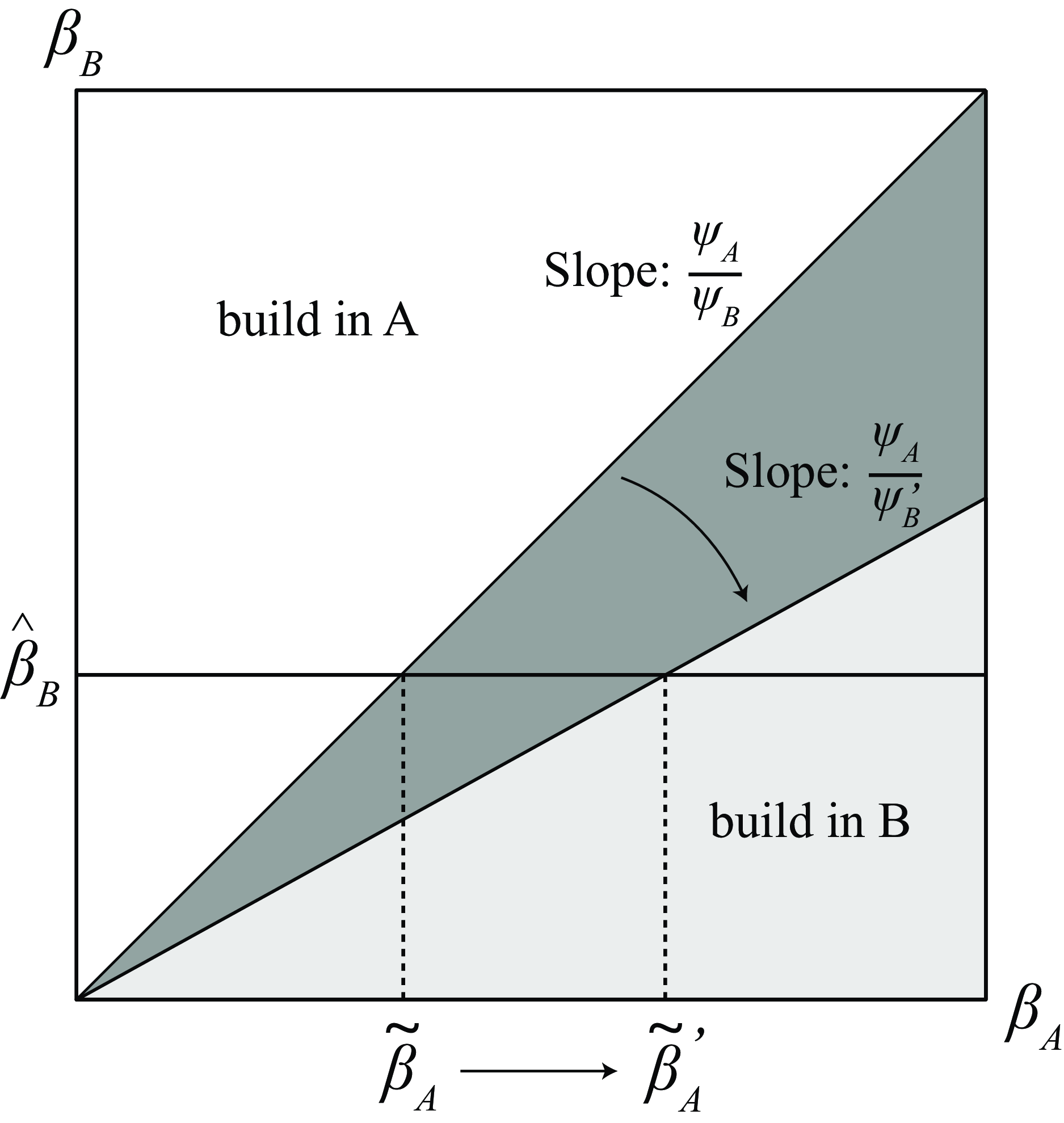


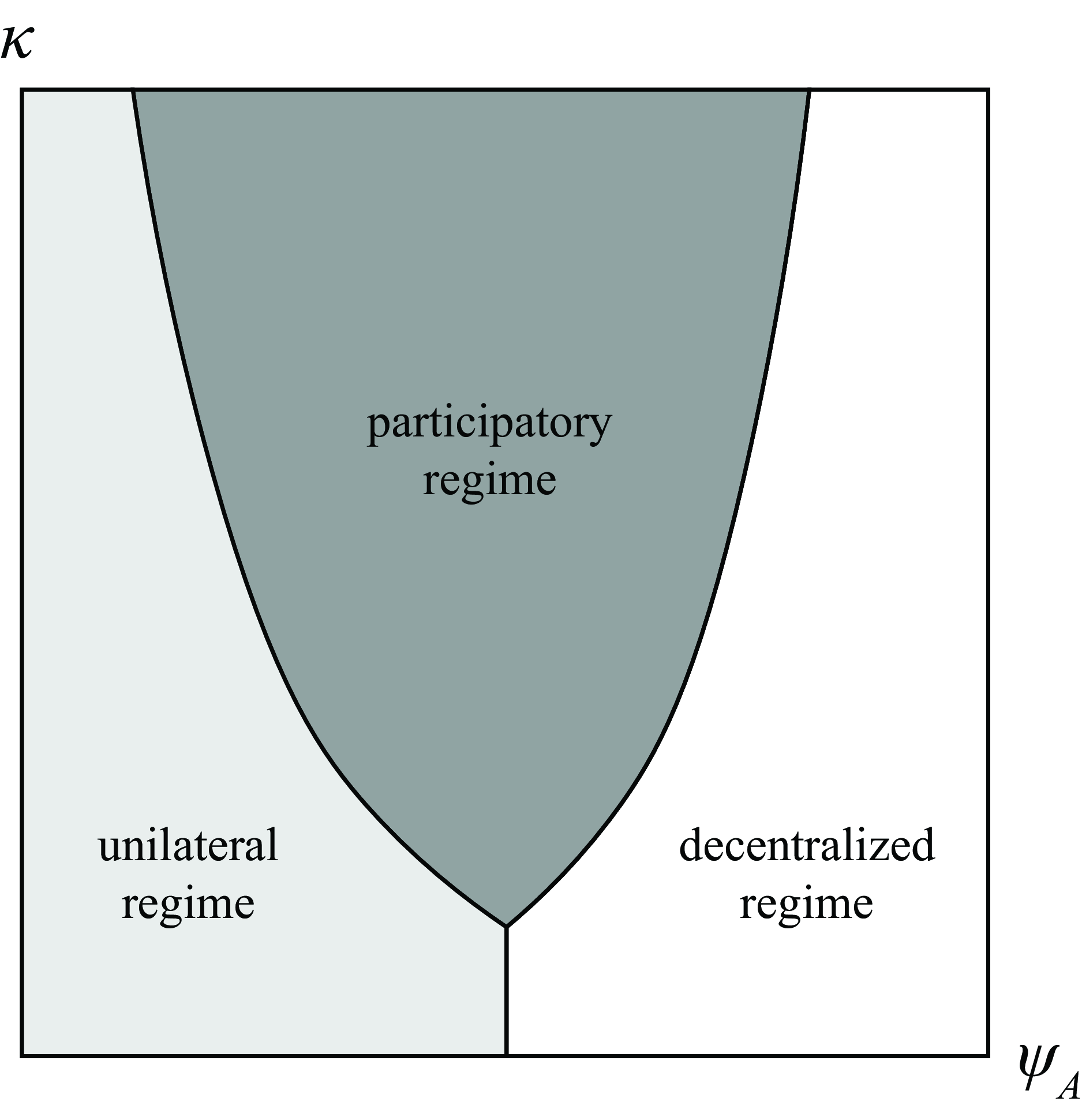


 Open access

