


Monitoring of hours spent on call by senior house officers (SHOs) is compulsory to comply with the Working Time Directive (WTD Expert Group, 2004), but this does not yield detailed information of what junior doctors are called to do during on-call hours (Department of Health, 2005). The workload of trainees on call has been studied in acute trusts (Reference Baldwin, Newton and BuckleyBaldwin et al, 1997; Reference Paice, West and CooperPaice et al,1997; Reference Hurley and Patterson-BrownHurley & Patterson-Brown, 1999; Reference Brown, De Cossart and WiltshireBrown et al, 2002; Department of Health, 2005), but the nature of the work is very different in medicine, paediatrics and surgery compared with psychiatry (Reference Callaghan, Gabra and BrownCallaghan et al, 2005). The major differences are the greater time necessary for assessment and admission, and the less frequent use of emergency investigations.
Callaghan et al (Reference Callaghan, Gabra and Brown2005) showed that SHOs in psychiatry appreciated their time on call as a learning experience, with nearly two-thirds having confidence in their decision-making. In that study SHOs made retrospective estimates of the on-call work that was directly related to training: admissions, assessments, risk assessments, level of senior support, developing management plans and team-working. Herzberg & Paice (Reference Herzberg and Paice2002) described a perceived improvement in psychiatry training after interviewing SHOs from London training schemes.
In Learning Objectives for SHOs (Royal College of Psychiatrists, 2002) there is no reference to the learning objectives for the on-call period apart from the general expectation that by the end of basic training psychiatrists should be able to assess patients in a variety of settings. The Basic Specialist Training Handbook (Royal College of Psychiatrists, 2003) states that each trainee should do 55 nights on call during their basic training, but not what should be achieved during these nights on call.
We gathered detailed prospective data about first on-call activity to help to resolve such issues as resident v. non-resident SHOs, tasks that could wait or be taken over by other professionals (Modernising Agency, 2006), the impact of an overnight crisis service, the screening of calls by senior nursing staff, and ensuring that there is relevant experience for training as well as service provision while on call (Postgraduate Medical Education and Training Board, 2005).
Form used to gather data from on-call senior house officers.

Method
Three surveys of the activity of SHOs on call were conducted in October 2002, April 2003 and October 2004. The area covered by the on-call service was West Berkshire with a population of 460 000. The period surveyed was from 17.00 h to 09.00 h on weekdays and throughout the weekends for 2 weeks. For the first survey the in-patient unit was at an out-of-town site, Fair Mile Hospital, with 190 beds; for the second and third surveys the in-patient unit was at Prospect Park Hospital with 163 beds.
Work for the first on call can largely be predicted and categorised into: (a) assessments; (b) admissions; and (c) prescribing medication for in-patients, managing their increasing agitation, or assessing for section 5(2) of the Mental Health Act 1983. Consequently these categories were incorporated into the form that we developed (Fig. 1). Physical calls were those that related to physical symptoms that were independent of psychiatric illness. Self-harm was considered to be psychiatric in nature. Assessment was defined as when the SHO was the first psychiatrist to see the patient and was involved in making a decision about admission. Admission was defined as when the decision to admit the patient had already been made, and the first on call was involved in booking the patient.
If the problem was resolved with advice, the ‘call’ column was ticked, if the SHO had to attend the ‘att’ column was ticked. For each call the time the task started and stopped was recorded, and the ward was noted using a single-letter code. Once doctors were familiar with the form it took less than 10 s to complete. The recording of 20 calls on the forms would generate less than 4 min work. At the beginning and end of each on-call session the SHO was contacted to ensure that the forms were completed.
Results
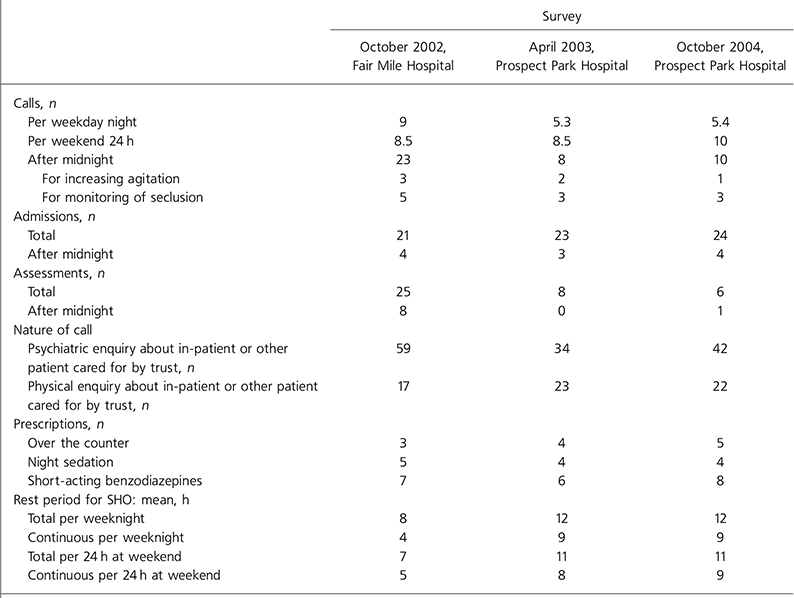
The total numbers of calls to the first on-call psychiatrists during the three survey periods are shown in Table 1. The reduction in the bed number when the in-patient service changed sites made no difference to the number of calls about in-patients or the number of admissions. The number of calls for admissions was similar in all the surveys (mean 1.25 per weeknight, range 0-4, and 2.5 per 24 h at weekends, range 0-6). Admissions and assessments accounted for a quarter of calls but three-quarters of the time spent on tasks.
Results of three surveys of experiences of first on-call doctors
| Survey | |||
|---|---|---|---|
| October 2002, Fair Mile Hospital | April 2003, Prospect Park Hospital | October 2004, Prospect Park Hospital | |
| Calls, n | |||
| Per weekday night | 9 | 5.3 | 5.4 |
| Per weekend 24 h | 8.5 | 8.5 | 10 |
| After midnight | 23 | 8 | 10 |
| For increasing agitation | 3 | 2 | 1 |
| For monitoring of seclusion | 5 | 3 | 3 |
| Admissions, n | |||
| Total | 21 | 23 | 24 |
| After midnight | 4 | 3 | 4 |
| Assessments, n | |||
| Total | 25 | 8 | 6 |
| After midnight | 8 | 0 | 1 |
| Nature of call | |||
| Psychiatric enquiry about in-patient or other | 59 | 34 | 42 |
| patient cared for by trust, n | |||
| Physical enquiry about in-patient or other patient | 17 | 23 | 22 |
| cared for by trust, n | |||
| Prescriptions, n | |||
| Over the counter | 3 | 4 | 5 |
| Night sedation | 5 | 4 | 4 |
| Short-acting benzodiazepines | 7 | 6 | 8 |
| Rest period for SHO: mean, h | |||
| Total per weeknight | 8 | 12 | 12 |
| Continuous per weeknight | 4 | 9 | 9 |
| Total per 24 h at weekend | 7 | 11 | 11 |
| Continuous per 24 h at weekend | 5 | 8 | 9 |
Distribution of work throughout the on-call period
There was marked variation between periods on call. There were 2-24 calls per weekday night and 3-35 for Saturday or Sunday. There was no predictability and no suggestion of ‘busy nights’ from the data.
Increasing agitation of in-patients and the monitoring of seclusion combined with assessments made up at least 85% of calls post-midnight in all the surveys. In all the surveys, 60% of calls about physical problems on weekday evenings occurred within 1 h of the start of the on-call period, suggesting that the on-call psychiatrist was being consulted about physical problems when they were not in a position to ask the patient’s own team to assess these.
Resident v. non-resident
In each 2-week period there was in general only one situation where the doctor was said to need to get there as a matter of urgency - this was difficult to estimate accurately, but was probably within around 20 min. These situations usually involved transfer of a patient to a general hospital for treatment or investigation, which could be done without the junior doctor being present. The immediate attendance of the SHO for situations such as a cardiac arrest was not required in any of the periods surveyed. There was no evidence that a resident doctor increased patient safety. Both junior and senior medical staff agreed that the first on-call psychiatrist could operate safely as a non-resident. Switching to a non-resident on-call psychiatrist reduced the number of working hours, since resident doctors are considered to be working even when resting, in accordance with the SiMAP ruling and the Jaeger European Court of Justice Judgments (WTD Expert Group, 2004).
Influence of an overnight crisis service
An overnight crisis service operating in the accident and emergency (A&E) department of the local general hospital was started in February 2003. This all-night service, which is staffed by experienced nurses and social workers, provides advice or a mental health assessment at the request of the A&E department, on-call general practitioners, carers and service users. The aim of the initiative was to improve the quality and increase the rapidity of the liaison between psychiatric services and the A&E department (Royal College of Psychiatrists, 2004). The service has had a marked impact on the on-call workload of SHOs, reducing the number of assessments performed by on-call SHOs in 2 weeks from 25 (30% of which were after midnight) to between 6 and 8. The proportion of nights when there were no assessments increased from 25% to 70%. Hence it was possible for an SHO in training to go for a number of months without having to perform an out-of-hours assessment. This concern that SHOs in psychiatry are not gaining experience of assessments while on call because they are being performed by nurse-led services has been raised in other trusts (Reference WhiteWhite, 2005). In West Berkshire, SHOs are encouraged to be present at the more challenging assessments so that they gain adequate experience (Reference Gibson and CampbellGibson & Campbell, 2000; Reference Callaghan, Gabra and BrownCallaghan et al, 2005) in assessing patients for admission, managing crises and planning the alternatives to admission. This, however, relies on the motivation and initiative of individual SHOs.
Before the introduction of the overnight crisis service there were 23 calls after midnight in the 2-week period. More than a third of these were for assessments. With the overnight crisis service in operation there were between 8 and 10 calls post-midnight, of which between 0 and 1 were for assessments.
Screening of calls by a senior nurse
In March 2003 screening of calls by a senior nurse was introduced. This had a marked impact on the number of calls concerning psychiatric problems of in-patients and those in the community (1.2 per night on weekday nights v. 4 per weekday night), but no difference to the number of calls made to a doctor about physical problems. Interestingly there was no reduction in the number of calls about psychiatric in-patient problems over the weekend (9 calls per weekend after the introduction of senior nurse screening v. 8.5 per weekend before).
Miscellaneous advice over the phone was sought from doctors in 23 calls before nurse screening and between 8 and 11 after screening. Frequently it is not obvious why a doctor would be better able to help with such advice than their nursing colleagues, the police, social services and other allied professionals. Our experience was that a senior nurse was capable of providing supportive advice to ward staff on issues that are not obviously medical. This has been effective in reducing the number of calls in other mental health trusts (Reference WhiteWhite, 2005). Using a nurse as the point of contact for referrals and determining the need to contact a doctor is one solution suggested by the Department of Health (WTD Expert Group, 2004) and the Academy of Medical Royal Colleges (2004) to ensure that doctors working out of hours comply with the Working Time Directive.
Medication prescription during the on-call period
Between 3 and 5 calls in each of the 2-week periods surveyed were for over-the-counter medication. Although this has been frequently complained about, it contributed only a minor part of the workload.
In all three surveys three-fifths of the prescriptions were for short-acting benzodiazepines and two-fifths were for night sedation. Although steps have been taken to improve training on the use of sedative medication and to encourage teams to plan therapeutic strategies during the day, there has been no change to the number of times the first on call is asked to prescribe these drugs. Three factors contribute to this. First, training has not been repeated to cover the turnover of junior doctors. Second, the training has not involved the night nursing staff who request the medication. Third, more clinical time is being spent in the community and teams have less time to plan and implement strategies for in-patients to avoid the unplanned prescription of sedatives during the on-call period.
Seclusion and agitation
Calls for assessment of patients in seclusion facilities and for sedation of agitated patients form a large proportion of the calls after midnight (Table 1). Since we conducted the survey, nurse prescribers have been allowed to prescribe an extended range of sedating drugs (Department of Health, 2006). Mental health nurses already play a central role in the provision of medication and have considerable knowledge and experience in this area. There is evidence that nurse prescribing for acute and disturbing symptoms that require rapidly responsive treatment leads to greater service user satisfaction (National Prescribing Centre et al, 2005).
It is more challenging for clinical teams to find alternatives to seclusion so that junior doctors do not need to be called throughout the night to monitor a secluded patient.
Discussion
Meeting the requirements of the working time directive requires adjustment of working patterns and attitudes of more than just the first on-call doctors. The organisation of the whole multidisciplinary team during on-call periods and the regular working day must change so that first on-call psychiatrists meet the restricted working hours of the European Working Time Directive. These changes should be based on evidence that they will be useful and their effects on the on-call workload should be monitored. The use of this form together with monitoring of hours has helped to inform the evolution of different services and to monitor their effect on first on-call activity. Such monitoring is essential to assess the impact of changes in service delivery on the quantity and type of learning experience while on call (Reference CalmanCalman, 2000; Reference Bulstrode and HuntBulstrode & Hunt, 2005). Unfortunately this form does not measure the quality of training while on call (Reference Callaghan, Gabra and BrownCallaghan et al, 2005). We would recommend the use of a locally designed form similar to the one we have employed so that other trusts can determine what happens during first on call at night and this expensive resource is used effectively, and junior doctors can gain the necessary experience.


 Open access


eLetters
No eLetters have been published for this article.