

The find and its context
The tell of Poduri-Dealul Ghindaru is located in the county of Bacau, in eastern Romania (45°28'953" N, 26°30'029" E; Figure 1). The site stands at 429m asl on a 30m-high terrace on the right bank of the Tazlau Sarat river and has a known extent of c. 1.2ha. Excavators studying the stratification over some 27 campaigns have identified levels belonging to both the Precucuteni and Cucuteni Chalcolithic cultures and to the Bronze Age (Monah et al. 2003).
Map showing the location of the tell of Poduri-Dealul Ghindaru in eastern Romania.

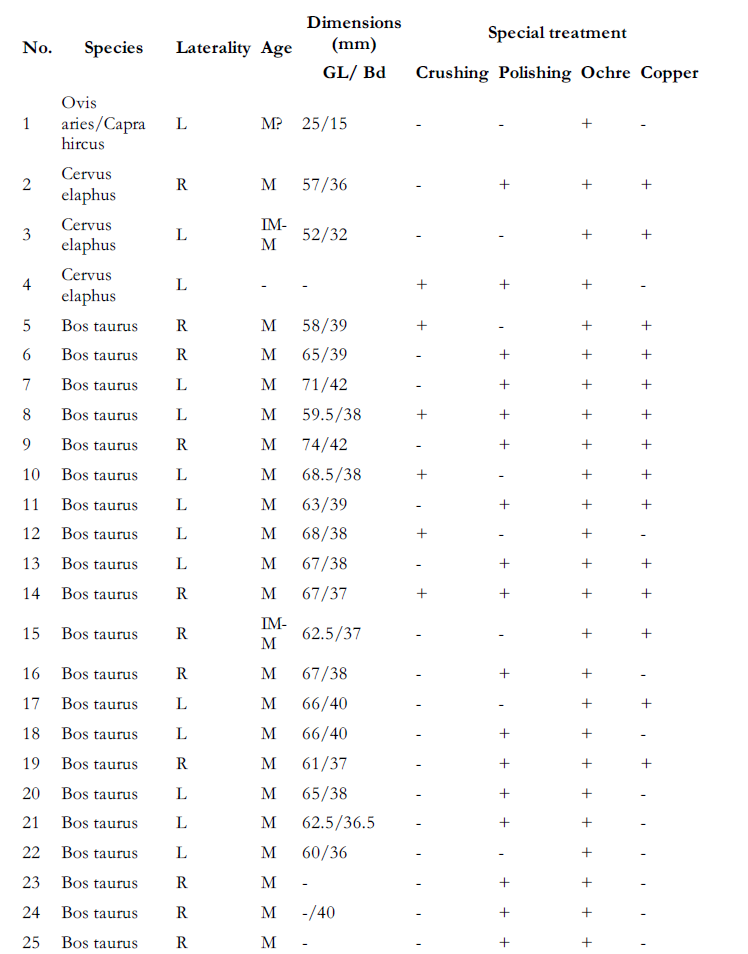
During the 2005 campaign, an unusual deposit of 25 astragali (animal ankle bones) was discovered in the Cucuteni A1 level, dated to 4662-4465 cal BC (Mantu 1998: 246). The deposit was clustered in clay layers on the south-east side of a house foundation built on tree trunks (Figure 2). The cluster lay in the form of an approximate rectangle, with one outlier (Figure 3). Twenty-one of the astragali were from cattle (Bos taurus), three from red deer (Cervus elaphus) and one from a sheep or goat (Ovis aries/Capra hircus). Almost all were from mature animals; 11 were from the right foot and 14 from the left (Table 1). Cattle (Bos taurus), identified as the main species in the group, had a special status in the local economy at Poduri; in the Cucuteni A level the remains of cattle dominate the assemblage (c. 58%).
Foundations of the building where the astragal deposit was discovered.

The astragali deposit in situ.


The bones were calcined, probably in the fire that destroyed the dwelling. The shapes of some astragali had been altered by crushing. Fifteen of the cattle astragali and two of red deer have traces of polishing (blunting) on the anterior surface (Figure 4). There were also traces of red ochre, and a greenish coloration suggesting some pieces had been in contact with copper.
Anterior surface of three of the cattle astragals found in the Cucuteni A 1 level.

Interpretation
Numerous astragali from different animals have been discovered in the deposits of Chalcolithic settlements in south-east Europe (Gilmour 1997; Dandoy 2006). Nevertheless, the group in question is rare for its concentration and its location within the footings of a dwelling. Astragali were widely used in divination and in games, where they were thrown as dice (e.g. Gilmour 1997; Koeper & Whitney-Desautels 1999). These associations may explain the traces of ochre, wear and polishing on some examples. It would be understandable if such objects found an ultimate destination in a ritual deposit designed to bring good fortune to a new dwelling, and that is our proposed interpretation for this group. On the other hand, a further eight bovine astragali, again polished on the anterior surface, were found in refuse deposits at the same site and an alternative interpretation is that the bones were used in the processing of animal hides (Cavaleriu & Bejenaru 2009).
Acknowledgements
This study was supported by the Romanian Research Program PN II Idei_2116/2008.