





Introduction
In 2020, the Organisation for Economic Co-operation and Development (OECD) declared that a ‘deliberative wave’ had been building across the globe, as ‘representative deliberative processes’ were increasingly adopted by governments and embedded into public decision-making (OECD 2020). Deliberative democracy scholars long anticipated such a turn in democratic theory and praxis (Bohman Reference Bohman1998), and frequently framed it through the rise and diffusion of mini-publics, i.e. participatory institutions ‘small enough to facilitate genuine deliberation and representative enough to ensure genuine democracy’ (Goodin and Dryzek Reference Goodin and Dryzek2006: 220).
The buzz triggered by citizens’ assemblies in academia and practice brought to the fore an important challenge: how can democratic systems connect deliberation to mass participation? Even when ‘representative deliberative processes’ aim to mirror society through stratified random selection, they typically involve only a small number of citizens, and practical sampling problems frequently hinder the attainment of the representativeness they aspire to (Peixoto and Spada Reference Peixoto and Spada2023). More importantly, critics have warned that deliberation risks becoming institutionally insulated from ‘macro democracy’, thereby weakening the capacity of citizens at large to contest, appropriate, and shape the reasons that justify collective decisions (Chambers Reference Chambers2009; Lafont Reference Lafont2020).
This concern has been sharpened in recent debates about democratic legitimacy and self-government. Lafont’s participatory conception of deliberative democracy insists that the justification of collective decisions cannot rely on institutional ‘shortcuts’ that ask the many to defer to the few; instead, deliberative institutions must be assessed in terms of whether they expand democratic control for citizens more generally (Lafont Reference Lafont2020). In a related vein, Lafont and Urbinati diagnose a broader ‘lottocratic mentality’ that risks normalizing the view that the many should be governed – directly or indirectly – by the few selected by lot, rather than strengthening mass-democratic agency (Lafont and Urbinati Reference Lafont and Urbinati2024).
At the same time, there is no shortage of efforts to address the scale problem within deliberative theory and practice. Experiments seek to extend deliberation beyond bounded forums through multi-level architectures, large numbers of linked local processes, and digital infrastructures. More recently, AI-supported tools have been discussed as instruments to lower participation costs, process large volumes of input, support moderation, or facilitate synthesis (Fishkin et al. Reference Fishkin, Bolotnyy, Lerner, Siu and Bradburn2025). Yet these efforts raise further issues while not tackling the problem that lies at their origin.
This article takes a different route. It focuses on institutional design features that enable participation at large scale without relinquishing the normative and empirical advantages of deliberation, and it does so by drawing on democratic innovations that evolved largely outside the OECD-centered deliberative canon. In Latin America, a region with a long and strong tradition of experimentation with democratic innovations (Selee and Peruzzotti Reference Selee and Peruzzotti2009; Cameron et al. Reference Cameron, Hershberg and Sharpe2012; Pogrebinschi Reference Pogrebinschi2023), no more than 10 mini-publics grounded on random selection and informed facilitated deliberation have been reported until the end of 2020 (Pogrebinschi Reference Pogrebinschi2023: 46). Nonetheless, according to the LATINNO dataset, at least 1602 other participatory institutions, processes, and mechanisms relying on deliberation evolved in 18 countries between 1990 and 2020 (Pogrebinschi Reference Pogrebinschi2021). These innovations engaged millions of citizens, mobilized thousands of civil society organizations (CSOs), and impacted hundreds of public policies (Pogrebinschi Reference Pogrebinschi2023: 2, 37).
Against this background, this article advances a specific claim: democratic innovations can reconcile deliberation with broad participation at scale by combining three design features – open participation, sequential deliberation, and institutionalized collaboration. Taken together, these features enable large numbers of citizens and CSOs to enter deliberative processes while sustaining core deliberative properties such as iterative justification and preference refinement, and while strengthening the prospects that policymaking institutions will take up the resulting outputs.
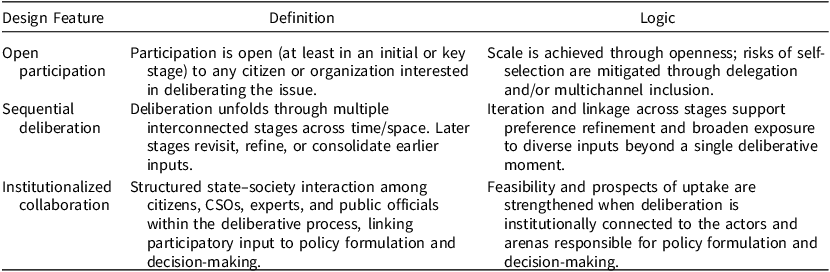
The analytical framework developed in this article focuses on the following features. First, open participation refers to institutional arrangements that allow participation by any interested individual or organization at least at some stage of the process. Open entry expands inclusion through access, but it also raises familiar risks associated with self-selection, including unequal voice and domination by recurrent or highly organized participants. Second, sequential deliberation refers to designs in which deliberation unfolds across multiple stages and deliberative sites over time, such that outcomes are discussed repeatedly by different groups in different moments; later stages provide opportunities to revisit earlier inputs and revise proposals in ways that facilitate preference refinement. Third, institutionalized collaboration captures structured state–society interaction among citizens, CSOs, experts, and public officials, enabling a genuine form of collaborative deliberation rather than merely an informed and facilitated one. Such interaction among state and society actors can generate collective intelligence that enhances both the quality and feasibility of proposals, thereby improving the likelihood of concrete policy outcomes.
To ground and illustrate this conceptual framework, the article draws on the LATINNO dataset on democratic innovations in Latin America (Pogrebinschi Reference Pogrebinschi2021) and examines two recurrent types of democratic innovations – multilevel policymaking and participatory planning – as designs in which the three features are institutionalized through distinct logics and with different trade-offs. Multilevel policymaking is characterized by an open participatory process that involves at least two levels of deliberation on policies, scaling deliberation through successive or parallel participatory stages and culminating in an output that captures diverse inputs. Participatory planning engages citizens and CSOs in participatory and deliberative processes aimed at shaping long-term policies or plans, gathering input from a wide range of actors while building the consensus required to pursue the agenda set by a new plan.
The remainder of the article proceeds as follows. The next section introduces the data and analytical framework, defining the three design features and clarifying the design attributes through which each can be identified across cases. The subsequent sections use multilevel policymaking and participatory planning to show how open participation is governed, how deliberative sequencing is organized (cumulatively or through multimodal integration), and how collaboration is incorporated in ways that can enable – or constrain – democratic agency and policy uptake. The conclusion returns to the broader problem of connecting deliberation to mass participation, arguing that the framework developed here expands the menu of viable institutional designs for inclusive and legitimate policymaking at scale.
Data and analytical framework
The empirical basis for this article is the LATINNO dataset on democratic innovations in Latin America (Pogrebinschi Reference Pogrebinschi2021), which systematically maps 3744 participatory institutions, processes, and mechanisms implemented at national and subnational levels across 18 countries between 1990 and 2020. Each case in the dataset corresponds to a distinct institutional design, rather than to each individual instance in which that design is implemented. Within this broader universe, the dataset identifies 1602 democratic innovations whose primary mode of citizen participation is deliberation. Building on LATINNO, recent research highlights the scale and policy relevance of democratic innovations in the region: across three decades, they have engaged millions of citizens, mobilized thousands of CSOs, and contributed to public policy outputs and outcomes at multiple levels of government (Pogrebinschi Reference Pogrebinschi2023).
The analytical framework proposed in this article draws on LATINNO for two complementary purposes. First, it uses the dataset’s typology, as developed by Pogrebinschi (Reference Pogrebinschi2023), to identify and characterize two types of democratic innovations that are particularly suited to the core challenge addressed in this article, i.e. how to enable participation at large scale without relinquishing core deliberative properties: multilevel policymaking and participatory planning. Second, the article uses LATINNO to offer a baseline descriptive assessment of outcomes associated with these types of democratic innovations, reporting whether cases yielded decisions, whether decisions were binding, and – where policy enactment was the expected outcome – whether policies were enacted.
In the LATINNO dataset, democratic innovations take the form of institutions, processes, or mechanisms (Pogrebinschi Reference Pogrebinschi2021). Processes are understood as structurally bounded participatory arrangements that connect at least two participatory instances across space and/or time through a shared goal. They follow procedures involving interrelated steps that participants are expected to observe, but unlike institutions, they do not constitute regularized practices (Pogrebinschi, Reference Pogrebinschi2023: 26–27). As processes, democratic innovations reflect varied institutional designs for citizen participation and often operate as systems in which several parts are interconnected to form a whole (Mansbridge et al. Reference Mansbridge, Bohman, Chambers, Christiano, Fung, Parkinson, Thompson, Warren, Parkinson and Mansbridge2012; Parkinson Reference Parkinson, Parkinson and Mansbridge2012; Hendriks Reference Hendriks2016). Because they link multiple participatory moments and sites to policymaking, processes are especially apt for capturing hybrid and multi-stage designs in which participation is distributed across actors and arenas.
Following the LATINNO dataset’s typology, multilevel policymaking is defined as an open participatory process involving at least two levels of deliberation on policies, taking place sequentially or simultaneously, and scaling deliberation through successive or parallel participatory stages such that the final output captures inputs accumulated across the process (Pogrebinschi Reference Pogrebinschi2023). LATINNO records 128 multilevel policymaking designs across Latin America between 1990 and 2020. Participatory planning, in turn, is defined as participatory and deliberative processes aimed at shaping long-term policies or plans (e.g. strategic plans, national plans, development plans), in which planning is the central objective and deliberation is the means through which competing visions of the future and implementation alternatives are weighed (Pogrebinschi Reference Pogrebinschi2023). LATINNO records 366 participatory planning designs across the region between 1990 and 2020.
This article advances a specific claim: democratic innovations can enable participation at large scale while sustaining core deliberative properties when they combine three design features – open participation, sequential deliberation, and institutionalized collaboration. The two types of democratic innovations examined here, multilevel policymaking and participatory planning, provide empirically dense bases for specifying these features and for illustrating how their configuration varies across policy issues, territorial scope, and political-institutional context.
Open participation is conceptualized as a design feature in which participation is, at least at some stage, open to any citizen or organization interested in deliberating the issue at stake. Openness expands access, but it also raises a classic concern: self-selection can privilege organized actors and recurrent ‘professional participants’. However, both democratic innovations discussed in this article incorporate design choices that can mitigate domination risks without closing participation. In multilevel policymaking, the move from open local participation to later stages populated by delegates selected across many localities can prevent the same group from controlling the process while ensuring geographic diversity – particularly relevant when outputs target national policy. In participatory planning, representativeness can be pursued through multichannel and hybrid participation, combining smaller deliberative commissions (often involving CSOs and experts) with broader citizen engagement via workshops, consultations, and digital channels.
Sequential deliberation is conceptualized as deliberation unfolding through interconnected stages in which outputs are revisited, refined, and consolidated over time and/or across spaces. The point is not merely the presence of more than one meeting, but the existence of a structured sequence in which deliberative moments are designed to relate to one another. In multilevel policymaking, sequencing often implies a cumulative structure: deliberations held in earlier stages build into each other, culminating in a single output that reflects accumulated inputs. In participatory planning, sequencing is typically less cumulative and more integrative: the final plan tends to be an amalgam of inputs gathered across different moments and modalities that do not necessarily build linearly into one another. This is consistent with a systemic understanding of how multiple deliberative sites can form a cohesive whole (Mansbridge et al. Reference Mansbridge, Bohman, Chambers, Christiano, Fung, Parkinson, Thompson, Warren, Parkinson and Mansbridge2012; Parkinson Reference Parkinson, Parkinson and Mansbridge2012).
Institutionalized collaboration is conceptualized as a design feature in which deliberation is organized through structured state–society interaction among citizens, CSOs, experts, and public officials – often with direct interaction between those who will be affected by a policy and those responsible for drafting and implementing it. Rather than reducing participation to consultation, institutionalized collaboration links deliberation to joint problem-solving and to the translation of inputs into policy-relevant outputs. It captures how open participation and sequential deliberation can incorporate practical knowledge (from affected citizens and long-engaged activists) and professional knowledge (from experts and administrators), generating collective intelligence while increasing the feasibility of outputs and thus the prospects of uptake by policymaking institutions.
Together, these three design features provide an analytical framework for examining how democratic innovations seek to reconcile large-scale participation with deliberation, while also bringing into view the trade-offs built into different design choices. Open participation enables scale through broad access, yet it raises self-selection and inequality risks that designs must actively avoid. Sequential deliberation can transform openness into iterated contestation and revision across stages, but it may also introduce filtering as inputs travel, or dilution when heterogeneous contributions are integrated. Institutionalized collaboration can strengthen the feasibility and prospects of policy uptake by linking deliberation to structured state–society interaction, yet it may generate closure when commitment is weak or when the process is controlled by a narrow set of actors. Table 1 summarizes the three features and the core design logic associated with each.
Design features enabling large-scale participation and deliberation

The empirical sections that follow use multilevel policymaking and participatory planning as two types of democratic innovations through which the three-feature framework is traced and specified. The aim is to develop a structured analytical account of how open participation, sequential deliberation, and institutionalised collaboration are designed and how their combination shapes the prospects – and limits – of deliberation at scale.
The analysis proceeds in three steps. First, for each of the two types of democratic innovations, I identify the entry points through which participation is opened and the institutional devices through which openness is governed. Here, the central analytical question is how designs manage the tensions associated with self-selection, including unequal voice and the risk that recurrent organized actors dominate. Empirically, this implies attention to who is entitled to participate at different stages (citizens, CSOs, stakeholders, public officials), how access is distributed across time and space, and which channels (face-to-face, digital, mixed) structure participation.
Second, I trace the architecture of sequential deliberation. The key issue is not simply whether processes have multiple meetings, but whether they institutionalize linkages across deliberative moments such that inputs can travel, be revisited, and be revised. The empirical analysis therefore distinguishes between cumulative sequencing (where outputs reflect results that build from stage to stage, often across territorial levels) and integrative sequencing (where outputs aggregate inputs across heterogeneous spaces and modalities that do not necessarily build linearly). This distinction enables me to show how different sequencing logics can preserve deliberative properties – such as preference refinement and iterative justification – while also entailing distinct risks, including filtering, dilution, or loss of traceability of influence.
Third, I examine how the two types of democratic innovations configure institutionalized collaboration, understood as structured state–society interaction among citizens, CSOs, experts, and public officials. The analytical focus is on the institutional conditions under which such interaction becomes an enabling resource for deliberation and policy uptake. Empirically, this entails tracing (i) whether and how state actors participate across stages, (ii) where in the policy cycle deliberation is positioned (agenda-setting, formulating, implementation, or monitoring), and (iii) which bodies or procedures translate participatory inputs into policy-relevant outputs. Across both types of democratic innovations, the argument is that institutionalized collaboration can generate collective intelligence and enhance feasibility, but it can also degenerate into consultative dynamics – particularly when governmental control is high or when participation is primarily driven by external requirements (e.g., a donor-mandated process).
Throughout the next two empirical sections, I treat the three features as interdependent. Open participation, by itself, does not secure deliberative quality; sequential deliberation and institutionalized collaboration are the mechanisms through which openness can be structured into repeated contestation, revision, and policy-oriented co-production. Conversely, sequencing and collaboration do not guarantee democratic empowerment; they can also intensify filtering, enable closure, or drift toward consultation. The empirical examples, therefore, include instances where participation was contested or where outcomes fell short, not as exceptions but as scope conditions that help specify when large-scale deliberative participation is more likely to realize its democratic promise.
Multilevel policymaking
Multilevel policymaking is a type of democratic innovation characterized by an open participatory process that involves at least two levels of deliberation on policies, which may take place sequentially or simultaneously. What distinguishes this innovation is its multilevel character: deliberation is scaled through successive or parallel participatory stages, resulting in a final output that captures diverse inputs collected throughout the process (Pogrebinschi Reference Pogrebinschi2023: 45–46). Across Latin America, 18 countries embraced some form of multilevel policymaking between 1990 and 2020. According to the LATINNO dataset, 128 such processes can be identified across the region, with variation in design and naming.
Multilevel policymaking is particularly instructive for the framework proposed in this article because it offers a clear institutional response to the problem of scale. Rather than concentrating deliberation in one place at one time, or relying on any single selection rule to secure representativeness, multilevel policymaking distributes participation and deliberation across multiple stages and sites, linking them through procedures of delegation, aggregation, and revision. In doing so, it tends to combine – often in a tightly coupled way – the three design features emphasized in this article: open participation, sequential deliberation, and institutionalized collaboration.
Multilevel policymaking processes are typically open to participation and bring together citizens, CSOs, and government representatives in agenda-setting (identification of problems and priorities) and/or policy formulation. The presence of participants from state and civil society, and often also from the private sector, aims to enable structured state–society interaction in which deliberation benefits from a wide range of perspectives: across interconnected rounds of discussion, stakeholders with different – and sometimes conflicting – preferences are given repeated opportunities to converge into agreements. Given that participation is often open at least in the initial stage, multilevel policymaking frequently involves large numbers of participants from extensive geographic areas.
The two most typical designs of multilevel policymaking in Latin America are national policy conferences and national dialogues. While both share the basic multilevel logic, they differ in how they structure sequencing (more vertical versus more horizontal sequencing) and in where they are typically positioned in the policy cycle (policy formulation versus agenda-setting).
National policy conferences: vertical sequencing
A typical design of multilevel policymaking involves sequential deliberation through a country’s administrative hierarchy. Some processes encompass three stages, scaling up from the local to the regional and finally to the national level. Others follow a two-stage model, advancing deliberation from the local to the regional level or from the regional to the national level. In both scenarios, the institutional aim is to incorporate inputs from participants at all levels that may be affected by a policy. This multilevel design is especially consequential in countries with significant regional diversity, where municipalities and regions differ in social, economic, cultural, and political contexts. By structuring deliberation through linked stages, national policy conferences facilitate the inclusion of participants with different backgrounds and a broader spectrum of local and regional demands in policies that will be applied uniformly across an entire region or country.
Open participation is typically strongest at the initial stage. In the best-known example of this design – Brazil’s National Public Policy Conferences – participation was entirely open at the local level throughout the country; delegates were elected to participate in the second stage (state-level conferences), and the process moved to the national level, where delegates from the previous stages convened to deliberate proposals previously discussed and consolidated. This design addresses a key tension that open participation raises: while broad entry maximizes inclusion, it also creates risks of domination by recurrent organized actors. Here, the move from open participation to elected delegation functions as a governance device, reducing the likelihood that one same group controls the process and ensuring geographic diversity of participants, a particularly relevant condition when the policy under formulation will be implemented nationally.
The sequential deliberation of national policy conferences is cumulative: outcomes reflect deliberations held in previous stages that build into each other. This cumulative character is analytically important because it clarifies how deliberative properties can be sustained at scale. Rather than treating early-stage inputs as consultative ‘noise’, the design positions those inputs as building blocks that reappear in later stages, allowing participants – through successive rounds – to revise, contest, and refine proposals. In this sense, national policy conferences distribute deliberation in ways that enable iterative justification and preference refinement without requiring that deliberation be concentrated in a single bounded forum.
Finally, national policy conferences illustrate institutionalized collaboration as an enabler of large-scale deliberation. The Brazilian national conferences brought together ordinary citizens, CSOs, elected representatives, and public administrators, enabling interaction among participants with different stakes and forms of knowledge. Because participation is largely self-selected at least in early stages, such processes can incorporate experiential and professional knowledge that may be crucial for generating collective intelligence. Empirically, this combination is a collaborative resource that can improve the feasibility of proposals and support policy uptake – especially in policy domains where implementation requires coordination across administrative layers.
Brazil’s National Public Policy Conferences also provide evidence that multilevel designs can be associated with substantive policy impact. Official data from the country’s federal government indicates that approximately seven million people participated in 82 national policy conferences held between 2003 and 2011 (Pogrebinschi Reference Pogrebinschi2013). Moreover, recommendations yielded by these democratic innovations were turned into national legislation in breakthrough areas such as food and nutritional security and in policy domains that expanded representation by addressing minority groups, such as women, for the first time (Pogrebinschi and Samuels Reference Pogrebinschi and Samuels2014). The National Policy Conferences’ multilevel deliberative design has also been linked to redistributive policy outcomes (Pogrebinschi and Ryan Reference Pogrebinschi and Ryan2018).
At the same time, multilevel policymaking does not guarantee success. Ecuador’s Plurinational and Intercultural Conference on Food Sovereignty (COPISA), created in 2010, sought to organize a broad deliberative process between CSOs and government in order to draft nine laws supplementing Ecuador’s 2009 Food Sovereignty Law. Between 2010 and 2012, COPISA held facilitated deliberative panels on each mandated bill; workshops were open to public participation and organized around roundtables and plenaries. At least 15,000 participants and 5000 organizations joined the deliberation and collective construction of the nine bills (Peña Reference Peña2013). Yet the participatory character of these processes has been contested due to COPISA’s lack of regularity and interaction with civil society (Fiorini Reference Fiorini2015), and not all laws drafted by COPISA were enacted.
This contrast is analytically instructive for the framework proposed in this article. It suggests that the three features – openness, sequencing, and collaboration – operate as necessary but insufficient conditions for connecting deliberation to the mass public. In particular, the COPISA experience points to the importance of institutional continuity and sustained civil society interaction as conditions under which institutionalized collaboration is more likely to support policy uptake: where interaction is irregular or weak, collaboration risks becoming episodic, and outcomes become more vulnerable to political filtering and legislative inaction, even when participation is extensive.
National dialogues: horizontal sequencing
A second typical multilevel design involves sequenced deliberation across multiple spaces. Even when the process has national scope, it does not necessarily scale up from local to national levels. Instead, deliberation is organized across different participatory stages occurring simultaneously in distinct spaces and/or unfolding at different moments. In some cases, different deliberative formats are combined, enabling several rounds of deliberation by different groups. The crucial aspect is that these deliberative spaces and moments are interconnected and mutually reinforcing. Here, multilevelness derives less from administrative hierarchy and more from the sequencing and cumulative integration of deliberative rounds across sites, yielding a shared outcome.
National dialogues are typically agenda-setting processes rather than primarily policy-formulation exercises. Bolivia was among the first countries to implement this participatory and deliberative format, holding three national dialogues between 1997 and 2004. Bolivia’s dialogues – facilitated by the national government in collaboration with UNDP – brought citizens together with diverse stakeholders from political, social, and economic spheres to address national challenges and define long-term policy agendas.
The Bolivian experience also makes visible an important institutional driver of participatory scaling: international development funding requirements. The dialogues aimed at developing nationwide poverty-reduction strategies using UNDP funding: to access financial aid, the government was required to involve civil society in the formulation, implementation, and monitoring of policies. In this context, deliberation served a dual function: it was expected to increase ownership, enhance accountability, and improve the effectiveness of anti-poverty policies.
The second national dialogue in 2000 involved more than 2000 individuals representing 300 municipalities, using formats such as roundtables, conferences, and workshops to formulate a national poverty-reduction strategy. Participation influenced the final output, some organizations strengthened their capacities during the process, and consensus resulted in mechanisms of social control intended to increase monitoring of poverty-reduction policies during implementation (PNUD 2001; Molenaers and Robrecht Reference Molenaers and Robrecht2003). The third dialogue (‘Productive Bolivia’) took place in 2004 and (Molenaers and Robrecht Reference Molenaers and Robrecht2003) expanded scope to engage rural and Indigenous organizations as well as producers and trade unions, with more than 40,000 organizations reportedly participating across 53 pre-dialogues, 314 municipal roundtables, and nine departmental roundtables.Footnote 1
National dialogues have been implemented in various countries in the region for diverse purposes and across distinct policy areas. For example, Uruguay held the National Dialogue for Employment in 2011, Ecuador the National Dialogue on Climate Change in 2013, and the Dominican Republic a National Dialogue on HIV and Human Rights in 2013, illustrating the ability of multilevel designs to engage citizens and organized actors in addressing social challenges. Indeed, LATINNO indicates that more than half of all multilevel policymaking cases in Latin America until 2020 were dedicated to deliberating social policy. This makes sense, given that social policies often require broad consensus to be introduced by governments and enacted by legislatures, and multilevel processes that bring citizens and CSOs into multiple rounds of deliberation with public officials across regions – while institutionalizing structured state–society interaction – can furnish a robust foundation for forging such agreements and strengthening the prospects of uptake.
Design implications
Taken together, national policy conferences and national dialogues illustrate how multilevel policymaking combines the three design features in practice. First, participation is open – at least initially – and thus capable of mobilizing large numbers of citizens and organizations. Second, deliberation is sequential and cumulative: it unfolds through interconnected stages, vertically or horizontally linked, culminating in outputs that reflect accumulated inputs. Third, institutionalized collaboration is built into the process insofar as designs organize structured state–society interaction among participants with different stakes in the same issues, linking deliberation to the actors and arenas in charge of policy formulation and decision-making.
These design properties also clarify why multilevel policymaking can approximate – through a different route – some of the representational aspirations commonly pursued through randomly selected mini-publics. Deliberation with large numbers of participants across diverse regions can foster a form of representativeness generated by population reach and territorial diversity, rather than by sampling.
A further illustration is provided by Uruguay’s multistage participatory processes for youth policy. The deliberation leading to the first Youth Action Plan (2011–15) unfolded in three stages: initial roundtables and workshops in which young people articulated concerns and priorities; a subsequent stage in which participants worked with the governmental institutions and ministries responsible for youth policy to develop diagnoses and proposals; and a final stage to discuss and validate the agreed proposals, reportedly engaging 2300 young people from more than 130 localities.Footnote 2 The second Youth Action Plan (2015–25) followed a similarly sequenced structure, moving from initial dialogues that identified priority issues, to territorial dialogues conducted nationwide, and culminating in a national youth conference that brought together participants from earlier stages.Footnote 3 Within the framework advanced here, these processes show how open entry can be structured through sequencing and policy-cycle positioning so that large-scale participation is coupled to sustained state–society interaction in the production of policy-relevant outputs.
Yet the same properties also foreground limitations and trade-offs. Where sequencing fails to ensure sustained deliberation, or where government commitment to regularity and civil society participation is weak, institutionalized collaboration may not consolidate into policy uptake – as the COPISA experience illustrates. Likewise, where processes are strongly driven by external funding requirements, participation may be extensive while democratic empowerment remains contested.
Finally, multilevel policymaking also shows how digital tools can be embedded within a sequential design without displacing deliberation. The Peruvian ‘2036 National Education Project’, a six-month national process implemented in 2019, began with an open digital survey in which more than 220,000 citizens participated. According to the Peruvian government, the input was processed by artificial intelligence software and then fed into subsequent deliberative workshops and expert tables that shaped the drafting process, which reportedly engaged over 250,000 voices from teachers, students, parents, specialists, CSOs, government officials, and national and regional authorities.Footnote 4 From the perspective of the framework developed in this article, this example underscores the role of sequential deliberation: digital input collection and processing function as an entry point into a broader multi-stage deliberative process, rather than as a substitute for deliberation.
In the next section, I turn to participatory planning. Unlike multilevel policymaking, participatory planning is not defined by vertical scaling across territorial levels. Its distinctive contribution to deliberation at scale lies instead in hybridization across participatory means and deliberative spaces, and in the integrative (rather than cumulative) logic through which diverse inputs become a plan.
Participatory planning
Participatory planning is a type of democratic innovation that engages citizens and CSOs in deliberative processes aimed at shaping long-term policies or plans for a country, region, or city. It is primarily oriented toward formulating new policies and setting future strategies and actions. Given the long-term scope and broad substantive reach of the policies to be drafted, participatory planning seeks to gather input from a wide range of social and political actors while building the consensus necessary to pursue the agenda defined by the new plan. Planning is the central objective of participation, and deliberation is the means through which competing visions of the future and alternative implementation pathways are weighed.
In Latin America, participatory planning encompasses strategic plans, national plans, annual plans, five-year plans, and development plans. Across these forms, the shared institutional ambition is to enable extensive participation in long-term policymaking through deliberative practices. According to LATINNO, 366 distinct participatory planning cases occurred across 18 countries between 1990 and 2020.
Participatory planning is particularly valuable for the framework advanced in this article because it combines the three design features – open participation, sequential deliberation, and institutionalized collaboration – through a logic that differs from multilevel policymaking. Participatory planning is likewise structured as a process and involves multiple spaces and moments of deliberation that relate to one another, but it is not defined by vertical scaling across territorial levels. Its ‘sequencing’ is therefore not primarily cumulative. Instead, the policy outcome tends to integrate diverse inputs gathered across distinct segments of the process that do not necessarily build into each other through a single linear chain.
Open participation in participatory planning is typically pursued through multichannel inclusion. Participation is often open to anyone with an interest in the process, but openness is rarely organized through a single entry point. Instead, participatory planning tends to combine diverse means of participation with multiple deliberative spaces, enabling broad participation in one or more stages – through face-to-face deliberations that gather inputs for policy formulation and/or through digital platforms built to facilitate wide public discussion. This multichannel design does more than expand participation numerically; it also functions as a governance device for openness, seeking to mitigate domination by recurrent or highly organized participants by diversifying who participates, where participation takes place, and with which role (for example, smaller commissions involving CSOs and experts at one stage and broader citizen deliberation at another).
The sequential aspect of deliberation in participatory planning is not primarily characterized by cumulative sequencing across stages. Rather, it is defined by the interconnection of practices across space and time oriented toward a shared objective. Sequencing here is defined by the way practices across space and time are oriented toward a shared objective and linked through the allocation of tasks among different spaces and actors (Parkinson Reference Parkinson, Parkinson and Mansbridge2012), forming a system in which multiple parts cohere as a whole (Mansbridge et al. Reference Mansbridge, Bohman, Chambers, Christiano, Fung, Parkinson, Thompson, Warren, Parkinson and Mansbridge2012). Participatory planning therefore often operates through hybrid designs, combining diverse participatory means with multiple deliberative spaces – sometimes in parallel, sometimes in succession. This distinction matters for the article’s broader argument about deliberation at scale. In multilevel policymaking, sequential deliberation is often cumulative, with later rounds explicitly built from earlier stages. In participatory planning, by contrast, sequencing more often functions through integration: heterogeneous inputs are made to speak to each other through a planning process that absorbs, reconciles, and translates them into a plan. The deliberative properties at stake are not only iteration (in the sense of revisiting issues), but also cross-exposure – bringing different kinds of participants into contact with different kinds of reasons across time, spaces, and modalities.
Institutionalized collaboration is a further defining feature of participatory planning, insofar as planning processes organize structured state–society interaction among citizens, CSOs, experts, and public officials in agenda-setting and policy formulation. The long-term character of planning – drafting a policy, devising an action plan, or setting a program to which a government is expected to commit – tends to bring together a wide variety of actors and foster dialogue among stakeholders that do not usually communicate (ordinary citizens and experts, CSOs and policymakers, private enterprises and grassroots movements). The point is not expert-driven deliberation, but policy-oriented interaction that can support joint problem-solving, improve feasibility, and thus strengthen the prospects of uptake. At the same time, the same feature renders participatory planning vulnerable to closure or consultative drift when interaction is not sustained or when governmental control over translation and drafting dominates.
Three configurations of participatory planning
Three examples clarify how these design features are configured in practice and how their combination can both enable policy-oriented deliberation and expose vulnerabilities in uptake.
Chile’s long-term Energy Policy planning process (‘Energy 2050’) exemplifies how participatory planning combines participation and deliberation across various spaces and moments to develop a comprehensive strategy. Initiated in 2014 and spanning 18 months, it engaged over 4000 citizens, CSOs, academics, and experts in interaction with government. It articulated three participation dimensions – political (energy stakeholders), technical (experts and sector representatives), and social (citizens and CSOs) – which were reflected in a set of deliberative spaces: a political advisory committee (27 key stakeholders), technical thematic working groups, regional citizen workshops, and a digital platform intended to broaden participation (Ministry of Energy of Chile 2015). The process unfolded in stages designed to integrate these dimensions; deliberations produced a substantial roadmap and culminated in the presentation of the plan to the President in December 2015. Yet the depth and reach of participation and deliberation remained contested: despite the multichannel design, turnout in some deliberative forums and online discussions was relatively low, and the process has been characterized both as inclusive and as consultative with limited citizen engagement (Hernández and Minoletti Reference Hernández and Minoletti2019).
In El Salvador, the 2002 Santa Tecla’s Participatory Strategic Planning illustrates how participatory planning can extend beyond agenda-setting and policy formulation into implementation monitoring and evaluation. The process enabled citizens in the city of Santa Tecla to propose short-, medium-, and long-term projects for a decade-long plan (2002–2012). It involved 650 citizens and civil society representatives in a total of 44 roundtables tasked with discussing with public authorities the directions, priorities, projects, and actions to be developed during the following decade. The planning process incorporated several participatory bodies and mechanisms, including a citizens’ assembly, local development committee, sectoral boards, zonal committees, and participatory budgeting. Once the strategic plan was enacted, an advisory citizen assembly was formed to overwatch implementation and updating of the plan. This monitoring body was composed of representatives elected in the distinct neighborhoods of the city together with public authorities (Alfaro Estrada Reference Alfaro Estrada2004). Until 2010, 378 proposed projects had been implemented, 63 per cent of which reportedly followed the original proposals from the 2002 participatory process (Galdámez Reference Galdámez2010).
Costa Rica provides a contrasting variant of participatory planning in which deliberative input is oriented toward legal reform and thus becomes legislatively mediated. A process to formulate a new water law began in 2002 with a national deliberative forum (200 representatives from diverse sectors), followed by a technical water group composed of government and CSO representatives that facilitated drafting; it also included dialogue workshops across all six regions (327 participants from civil society, the private sector, and government). In 2004, a subsequent participatory process developed an environmental agenda for water based on three regional forums (approximately 400 participants), identifying key challenges and proposing solutions. Yet the translation of these outputs depended on legislative uptake: a popular initiative supported by roughly 170,000 signatures introduced a bill in 2010, and more recent reform efforts have continued through new proposals to modernize water governance, but without a definitive replacement of the 1942 Water Law.Footnote 5 For the framework advanced here, the case is instructive because it shows how participatory planning can generate policy-relevant drafting through institutionalized collaboration and sequenced deliberation, while remaining exposed to veto points and political filtering when the principal uptake channel is legislative enactment rather than an administrative pathway internal to the participatory process itself.
Participatory planning in Latin America is primarily government-driven, but it has also seen significant involvement from international organizations. LATINNO data indicate that nearly one-third of participatory planning cases between 1990 and 2020 were supported by international development organizations. Because development aid often targets long-term goals and extends over years, it is frequently accompanied by planning requirements; to ensure transparency and accountability, organizations such as the World Bank and USAID have required that planning involves citizens and CSOs and fosters dialogue between them and governments. The democratic quality of participation under such conditions is, however, debated. Dagnino (Reference Dagnino, Moksnes and Melin2010), for instance, argues that citizens can become mere suppliers of information without having a genuine voice in decision-making.
Based on data from the LATINNO dataset, while 72 per cent of cases of participatory planning in Latin America yielded some form of decision, only 13 per cent yielded a binding decision. Nevertheless, for all participatory planning processes in which the expected outcome was a policy, the latter has been enacted in exactly 50 per cent of cases. That policies resulted from participatory planning processes half of the time is a considerable achievement. However, the question of whether the content of a policy truly reflects the inputs received from citizens and CSOs throughout the process may remain open in some cases.
Taken together, participatory planning cases illustrate a distinct route to deliberation at scale: not cumulative vertical scaling, but multichannel openness, sequencing through interconnected practices, and policy-oriented institutionalized collaboration. It also clarifies where the framework’s tensions concentrate: the risk that hybrid designs become consultative; the difficulty of sustaining broad engagement across multiple stages (especially online); and the dependence of uptake on political and institutional pathways that can remain outside the control of participatory design.
Two routes to large-scale deliberation
Multilevel policymaking and participatory planning specify two institutionally distinct routes through which democratic innovations can enable participation at large scale while sustaining deliberative properties. Rather than approximating a single institutional model, both types combine three design features – open participation, sequential deliberation, and institutionalized collaboration – in different configurations. Because the empirical analysis draws on a region with an extensive record of large-scale democratic innovations, the comparison is particularly useful for specifying how the same design features can be institutionalized through different logics and with different implications. Table 2 summarizes how these three design features are typically manifested in multilevel policymaking and participatory planning.
Design features of multilevel policymaking and participatory planning: typical manifestations
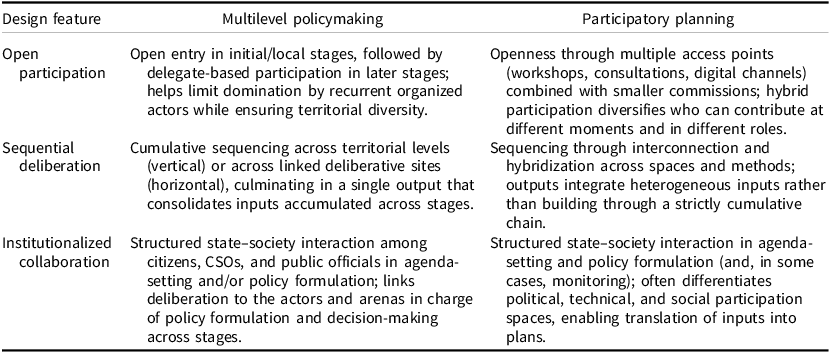
Open participation is the key mechanism for scale in both types: participation is open to citizens and CSOs at least at one stage, enabling broad entry and expansive inclusion. Openness, however, brings a familiar dilemma. Because participation is self-selected, it can privilege actors with greater organizational capacity, time, and resources, generating unequal voice and recurrent participation by the same groups. The two types address this dilemma through distinct design logics. Multilevel policymaking typically couples open entry with delegation across territorial stages. Participation may be open at the local stage, while later stages are populated by delegates drawn from diverse municipalities and regions, which can limit domination by recurrent participants and generate territorial diversity in the participant pool. Participatory planning more often governs openness through multichannel inclusion. Hybrid designs distribute participation across spaces, moments, and roles – combining deliberative commissions (frequently involving CSOs and experts), workshops and consultations, and, in some cases, digital channels – thereby multiplying access points rather than relying on a single entry gate. These strategies are not normatively equivalent. Delegation can increase diversity and improve transmission across levels, yet it can also intensify filtering as proposals travel upward. Multichannel inclusion can broaden access and diversify forms of participation input, yet it can weaken the traceability of influence across modalities and stages.
Both types also rely on sequential deliberation to preserve deliberative properties under conditions of scale. In each, outcomes are discussed across multiple sites and moments, creating opportunities for inputs to be revisited, contested, and revised rather than merely collected. Yet the logic of sequencing differs. In multilevel policymaking, sequential deliberation is predominantly cumulative: participants at earlier stages build into later stages, culminating in an output that reflects accumulated inputs. This sequencing institutionalizes iteration and can produce a comparatively legible chain of transmission and revision, as later-stage participants confront claims articulated elsewhere and can revise or consolidate them in light of broader contestation. In participatory planning, sequential deliberation more often functions through integration rather than accumulation. Plans tend to emerge as an amalgam of inputs gathered across heterogeneous spaces, modalities, and moments that do not necessarily build linearly into one another. The key deliberative mechanism is therefore not only iteration (revisiting issues) but integration: assembling, reconciling, and translating diverse inputs into a policy document that orients future action. This sequencing logic aligns with systemic approaches insofar as it depends on interconnected sites performing complementary tasks and linking them through planning procedures. The comparison highlights that deliberation at scale can be sustained through different sequencing logics. Cumulative sequencing tends to strengthen transmission and opportunities for revision but may sharpen filtering; integrative sequencing tends to broaden input diversity and cross-exposure but may weaken transparency about which inputs shaped which components of the final output.
Institutionalized collaboration is the feature that most directly connects deliberation to decision-relevant actors and arenas. In both types, it is realized through structured state–society interaction among citizens, CSOs, experts, and public officials, often in processes positioned in agenda-setting and/or policy formulation. The underlying ambition is to anchor translation: proposals are assessed not only in terms of quality but also in terms of feasibility and the institutional pathways through which they can be taken up. This feature is therefore central to participation-at-scale, since large-scale deliberation can generate extensive input while still failing to shape policy in the absence of institutionally anchored translation channels. At the same time, institutionalized collaboration is exposed to risks of closure and consultative drift. When governmental control is strong or when interaction is irregular, collaboration can become episodic or primarily legitimating. Across both types, institutionalized collaboration does not in itself secure democratic empowerment: effects depend on how interaction is structured, whether it is sustained across stages, and whether public authorities remain committed to translating outputs into decisions.
Across both types, the analysis indicates that the three design features operate as an interdependent package. Openness enables scale, but it requires sequencing and institutionalized collaboration to be translated into iterative revision and policy-relevant outputs. Conversely, sequencing and institutionalized collaboration can also amplify filtering, produce forms of closure, or weaken the traceability of influence as inputs travel across stages and arenas. The comparison therefore specifies how different configurations of openness, sequencing, and institutionalized collaboration shape both the capacities and the vulnerabilities of democratic innovations when deliberation is organized at large scale.
Conclusion
The deliberative wave identified by the OECD has brought back to the fore a longstanding challenge: how democratic systems can connect deliberation to the mass public (OECD 2020). Recent debates in deliberative theory emphasize that deliberation should remain linked to broad-based citizen agency and public contestation, rather than becoming institutionally insulated from macro-democratic politics (Chambers Reference Chambers2009; Lafont Reference Lafont2020; Lafont and Urbinati Reference Lafont and Urbinati2024). Against this background, this article has argued that scaling deliberation need not be approached primarily through the expansion, multiplication, or digitalization of mini-publics. Instead, it has proposed an analytical framework centered on three design features – open participation, sequential deliberation, and institutionalized collaboration – that enable large numbers of citizens and CSOs to enter deliberative processes while sustaining iterative revision and strengthening prospects of translation into policy outputs.
This article makes a twofold contribution. Analytically, the framework provides concepts for comparing how democratic innovations institutionalize open entry, deliberative linkage, and structured state–society interaction, while making visible the trade-offs that accompany attempts to scale deliberation. Empirically, the article has shown how these features are realized through two recurrent types of democratic innovations – multilevel policymaking and participatory planning – drawn from Latin America. The regional focus matters because Latin America combines an extensive record of large-scale participatory experimentation with comparatively limited diffusion of randomly selected mini-publics (Pogrebinschi Reference Pogrebinschi2023). This makes it a particularly revealing setting for examining designs that seek to connect deliberation to broad participation, rather than relying on sampling-based representativeness. Future research can assess how these design features travel beyond Latin America and how they interact with different institutional and political contexts.
The comparison across the two types of democratic innovations clarifies that deliberation at scale is not a single institutional accomplishment but a design problem with distinct solutions. Designs that combine open participation with structured sequencing and institutionalized collaboration can preserve iterative revision while keeping deliberation connected to policy-relevant actors and arenas. At the same time, the Latin-American cases also underscore that uptake remains the critical vulnerability: where translation channels are weak or discontinuous, large-scale deliberation can generate extensive input without shaping policy decisions.
These findings carry implications for institutional design debates that have tended to treat scale as a dilemma to be resolved either by restricting participation (to protect deliberative quality) or by replacing deliberation with aggregated input (to protect inclusion). The evidence assembled here points to a different proposition: large-scale deliberative participation becomes plausible when openness is governed, when sequencing produces structured opportunities for contestation and revision, and when collaboration is anchored in institutional pathways that connect participatory outputs to decision-making. Digital and AI-supported tools are most plausibly complementary to deliberation when they are embedded in multi-stage processes – for example, as devices for outreach, input collection, and synthesis that are subsequently subjected to deliberative contestation and revision. The central question, then, is not whether participation can be expanded, but whether expanded participation is institutionally linked to deliberation in ways compatible with democratic self-government (Lafont Reference Lafont2020; Lafont and Urbinati Reference Lafont and Urbinati2024). In that sense, the three-feature framework developed here helps identify design configurations that can connect deliberation to the mass public without relinquishing democratic control.
Data availability statement
The data underlying this article are available in: Pogrebinschi, Thamy. (2021). LATINNO Dataset on Democratic Innovations in Latin America. Version 1.0.0. Berlin: WZB – Berlin Social Science Center. https://doi.org/10.7802/2278
Acknowledgements
I thank the editor and anonymous reviewers for their constructive comments. I also acknowledge the use of generative AI tools to support language editing and improve clarity in English as a non-native language.
Funding statement
This research received no specific grant from any funding agency in the public, commercial, or not-for-profit sectors. The open access publication was funded by the WZB Berlin Social Science Center.
Competing interests
The author declares none.

 Open access

