


1. Introduction
Digital transformation and Industry 4.0 are forcing companies to rethink business models and organisational structures (Reference Bilgeri, Wortmann and FleischBilgeri et al., 2017). Product management (PM) is at the forefront of this change, acting as the bridge between market demands and the company’s offerings (Reference AumayrAumayr, 2023). Modern product managers must juggle heterogeneous information sources and increased product complexity. Leveraging product-related data across the lifecycle (e.g., usage logs, market trends, social media feedback) offers promising potential. Analysing such data can reveal insights that drive optimization of PM decisions (Reference Fichtler, Grigoryan, Koldewey and DumitrescuFichtler et al., 2023; Reference Gnanasambandam, Harryson, Srivastava and WuGnanasambandam et al., 2017). The concept of data-driven product management (DDPM) is becoming increasingly important in this context. This refers to the systematic integration of data analysis into PM tasks to generate usable knowledge for decision-making from different data sets (Reference Grigoryan, Fichtler, Schreiner, Rabe, Panzner, Kühn, Dumitrescu and KoldeweyGrigoryan et al., 2023).
While the potential of DDPM is well recognised (Reference Fichtler, Grigoryan, Kirchberg, Koldewey and DumitrescuFichtler et al., 2024a), its implementation often falls short in practice (Reference Grigoryan, Fichtler, Schreiner, Rabe, Panzner, Kühn, Dumitrescu and KoldeweyGrigoryan et al., 2023). The main obstacle lies not in the lack of data but in fragmented data silos and poor visibility of existing datasets, which keep many product decisions dependent on intuition and experience (Reference Kayser, Mueller and KronsbeinKayser et al., 2019; Reference McAfee and BrynjolfssonMcAfee & Brynjolfsson, 2012). Only about 10% of companies consider themselves well-prepared with respect to data and systems. At the same time, roughly one-third admit they are little or not at all prepared for the increasing complexity brought by digitalisation (Reference Bahrenburg, Munk and FischerBahrenburg et al., 2019). Consequently, PM today is not yet able to systematically base decisions on objective data (Reference Grigoryan, Fichtler, Schreiner, Rabe, Panzner, Kühn, Dumitrescu and KoldeweyGrigoryan et al., 2023). Digital transformation literature emphasizes that success is not just about new technology, but also about organisational change. Companies often introduce new roles (e.g., Chief Digital Officer) to steer digital initiatives and create new data-focused units or teams (Reference Bilgeri, Wortmann and FleischBilgeri et al., 2017). Nevertheless, research by McKinsey and BCG shows that only ∼30 % of digital transformation initiatives meet their objectives. A key differentiator of successful initiatives is clear accountability and ownership of responsibilities across the organisation (Reference Deakin, O’Beirne and LaBergeDeakin et al., 2019; Reference Forth, Reichert, Laubier and ChakrabortyForth et al., 2020). This brings organisational design to the top of the agenda: Who is responsible for what?
In organisational contexts, a role can be understood as a set of expectations and responsibilities associated with a specific position within a social system (Reference BiddleBiddle, 1986). Beyond this formal perspective, roles also act as relational mechanisms that facilitate coordination across occupational and functional boundaries by defining mutual expectations and accountabilities (Reference BechkyBechky, 2006).
DDPM represents a multifaceted organisational capability that extends well beyond the traditional boundaries of PM. Its successful implementation requires alignment across strategic, organisational, human, and technological dimensions – ranging from data infrastructure and analytics competence to leadership and change management (Reference Fichtler, Petzke, Grigoryan, Koldewey and DumitrescuFichtler et al., 2026). Despite this complexity, existing research has so far addressed only partial aspects of the topic and often adopts a limited or misleading focus. Studies within PM research, for example, have concentrated primarily on the role of the product manager. (Reference Grigoryan, Martin, Lamarz, Fichtler, Hohn, Asmar, Kühn and DumitrescuGrigoryan et al., 2025) identified 139 distinct PM tasks and clustered them into categories, highlighting the diversity of this individual role. However, such works neglect the broader set of organisational roles necessary for DDPM to function end-to-end. Particularly, research is needed to identify those roles responsible for data collection, distribution, and analysis (Reference Fichtler, Kirchberg, Grigoryan, Koldewey and DumitrescuFichtler et al., 2024b). Likewise, literature on organisational roles in digital transformation remains largely conceptual and fails to specify concrete role or task profiles (Reference Zoppelletto, Orlandi, Zardini, Rossignoli and KrausZoppelletto et al., 2023). Consequently, a structured and comprehensive overview of the roles and activities required for the operational implementation of DDPM is still missing, representing the gap that this paper seeks to address. To close this research gap, this study addresses the central research question:
“Which roles are required to implement DDPM holistically?”
The objective is to derive and specify the organisational roles that collectively enable DDPM, including their associated tasks, competencies, and interfaces. Methodologically, the research combines a systematic literature review with empirical insights from industry workshops, ensuring both theoretical grounding and practical validity. The resulting set of role profiles serves as a structured foundation for organizing and governing DDPM within companies. It reconceptualizes DDPM not as an extension of the product manager’s responsibilities but as an organisational system that distributes work across roles and integrates technical, analytical, and managerial perspectives. Practically, it offers decision-makers a concrete support for organisational design by clarifying which roles and interactions are necessary to plan and operationalize DDPM initiatives effectively.
The paper is structured as follows: Hereinafter, the research methodology is presented, followed by the results regarding the roles for DDPM and their documentation. The results are subsequently discussed in detail. The paper closes with a brief conclusion.
2. Research design
The research process is structured according to the Design Science Research Methodology (DSRM) proposed by (Reference Peffers, Tuunanen, Rothenberger and ChatterjeePeffers et al., 2007). This approach provides a systematic framework for developing and evaluating artefacts and is particularly appropriate for addressing practice-oriented research problems. The study follows the initial five stages of the DSRM to develop a role set for DDPM. At the same time, the publication of this paper represents the final, sixth phase – communication (see Figure 1).
Research design adapted from Reference Peffers, Tuunanen, Rothenberger and ChatterjeePeffers et al. (2007)

The problem background, as outlined in the introduction, establishes the foundation. It highlights the increasing organisational complexity resulting from the transition toward DDPM and the lack of clarity regarding the roles and responsibilities required to orchestrate this transformation effectively. This context concludes the first phase of the DSRM. Building upon this problem, the objectives are threefold (Phase 2): (1) to establish a comprehensive overview of roles required for implementing DDPM, (2) to develop exemplary and structured descriptions of these roles, and (3) to guide planning transformation measures by assigning organisational responsibilities through these roles.
The design and development phase (Phase 3) was executed in multiple steps. First, a systematic literature review following (Reference Webster and WatsonWebster & Watson, 2002) was conducted to identify papers with relevant information about DDPM. For that, Scopus, IEEE, AIS eLibrary, EBSCOhost, and ACM were selected as databases. Through iterative improvement, the following search string was formed and applied in the selected databases: (“product manage*” OR “product planning” OR “product strateg*”) AND (“digital*” OR ”“data*” OR “analytics*“ OR “AI”) AND (“decision*” OR “support” OR “feedback*” OR “information” OR “knowledge” OR “insights” OR “learning” OR “innovation” OR “improvement” OR “recommendation*” OR “evaluation” OR “optimization“). As roles are typically described implicitly rather than explicitly labelled, they were identified inductively during coding instead of being used as search terms. The search yielded 1,451 articles, which were screened based on title and abstract. A total of 310 papers with an assumed focus on DDPM remained. After reading these papers and conducting a backward and forward search, 145 papers were identified as containing information about DDPM; the remaining papers were excluded. The researchers thoroughly reviewed the full texts to identify passages that addressed roles or tasks within DDPM. Building on the extracted information about roles and tasks, the dataset was organized into overarching thematic blocks, which provided the theoretical foundation for an initial collection of roles. Subsequently, this preliminary set was refined and validated through a focus group workshop involving practitioners from the manufacturing industry (see Table 1). Preliminary roles and their core activities were prepared as posters and used as discussion artefacts to guide a structured, collaborative review and refinement of the role set. Feedback was visually documented on the posters. The discussion focused on assessing completeness, relevance, and potential overlaps between roles, resulting in the final set of 12 roles (added/adapted roles/tasks are marked in the results section). In addition, specific requirements for the documentation and presentation of the roles were gathered. Based on these insights, structured role cards were developed, capturing essential information such as tasks, competencies, responsibilities, and interfaces between roles.
Companies in the research setting (focus group & workshop series)

To demonstrate the applicability of the developed artefacts (Phase 4), a series of workshops with five industrial companies was conducted (see Table 1). Within these workshops, participants first developed a shared target state for DDPM and derived concrete transformation measures to achieve this state. The role profiles were then systematically used to map these measures to responsibilities and organisational actors. This structured mapping supported the allocation of ownership, revealed responsibility gaps and overlaps, and helped identify the organisational units that needed to be involved in the implementation (more information can be found in chapter 3.2).
The evaluation phase (Phase 5) assessed the developed artefacts against the previously defined objectives. The workshops served as an evaluation setting, allowing for feedback from practitioners on the comprehensiveness, usability, and applicability of the role profiles. The evaluation confirmed that the artefacts effectively support organisations in identifying relevant roles, clarifying responsibilities, and structuring their transformation activities toward DDPM without the need for further changes.
3. Results
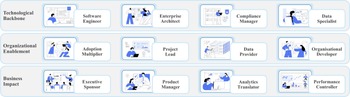
The results provide a comprehensive overview of the roles that are essential for implementing and operating DDPM. A total of twelve different roles were identified (see Figure 2), which reflect the diverse technical, organisational, and strategic tasks that are required. Each role represents a specific set of responsibilities and functions within the organisational structure. Together, they illustrate the multidimensional nature of DDPM. The following subsections describe the identified roles within the layers, as well as their interfaces, and the developed role cards for their documentation. Due to space limitations, not all sources analysed are listed. We have specifically selected those sources that cover all key aspects addressed in the manuscript, so that each role is supported by appropriate literature.
Overview of the 12 roles for orchestrating DDPM

3.1. Description of the 12 roles for orchestrating DDPM
The Technological Backbone Roles provide the technical and data-related foundation for DDPM. It ensures reliable system architectures, data integration, governance, and stable operations to make analytics feasible and scalable.
The Software Engineer (SE) is responsible for the technical implementation, development, and operation of applications and services that enable DDPM (Reference Hallstedt, Isaksson and Öhrwall RönnbäckHallstedt et al., 2020). The role covers coding, testing, deploying, and continuously improving software solutions tailored to PM needs (Reference Gundelweiler and ReitererGundelweiler & Reiterer, 2008). In addition, it ensures system stability, troubleshooting, and user support to maintain reliable operations (added according to focus group). In collaboration with stakeholders and external IT providers, the Software Engineer implements technical requirements and maintains reliable system operations required for continuous DDPM activities (Reference Gundelweiler and ReitererGundelweiler & Reiterer, 2008).
Interfaces: EA, CM, DS, AM, PL, PM, PC, AT
The Enterprise Architect (EA) designs architectures to optimize the interaction between systems relevant for DDPM. This role ensures scalability, security, and efficiency. It acts strategically and plans long-term technology decisions (Reference Dremel, Herterich, Wulf, Waizmann and BrennerDremel et al., 2017; Reference Gemino and ReichGemino & Reich, 2023). Responsibilities include describing technical data flows between systems (Reference Azeroual, Nikiforova and ShaAzeroual et al., 2023), developing technical standards for cross-system data processing, setting up technical support systems for data integration, ensuring synergies between IT architectures of different projects, and strategically improving IT infrastructure integration (Reference Gemino and ReichGemino & Reich, 2023; Reference Groggert, Wenking, Schmitt and FriedliGroggert et al., 2017).
Interfaces: SE, CM, DS, PL, DP, ES
The Compliance Manager (CM) governs the product data lifecycle in DDPM, covering data capture, storage, and archiving (Reference Harkonen, Mustonen, Koskinen and HannilaHarkonen et al., 2020). The role defines and enforces standards and rules for data maintenance, documentation, and storage, and ensures consistency with legal, regulatory, and internal governance requirements (Reference Abramovici, Gebus, Göbel and SavarinoAbramovici et al., 2017). Responsibilities include reviewing compliance, assessing risks, implementing organization-wide policies, and coordinating adherence to data protection and governance frameworks across systems and stakeholders (Reference Azeroual, Nikiforova and ShaAzeroual et al., 2023).
Interfaces: SE, EA, DS, PL, DP
The Data Specialist (DS) prepares and maintains data for analytical use in DDPM. Responsibilities include developing and operating ETL processes, transforming heterogeneous and unstructured data into structured formats, and establishing data pipelines for efficient processing (Reference Abramovici, Gebus, Göbel and SavarinoAbramovici et al., 2017). The role defines and monitors data quality standards, validates datasets, selects and applies appropriate analytical methods, and evaluates the quality of analysis results (Reference Azeroual, Nikiforova and ShaAzeroual et al., 2023; Reference Groggert, Wenking, Schmitt and FriedliGroggert et al., 2017). Additionally, the Data Specialist monitors analytical models and supports their maintenance and re-training to ensure reliable, decision-ready data assets (Reference Dremel, Herterich, Wulf, Waizmann and BrennerDremel et al., 2017; Reference Olsson and BoschOlsson & Bosch, 2025)
Interfaces: SE, EA, CM, PL, DP, PM, AT
The Organizational Enablement Roles embed data-driven practices into everyday PM work. It aligns processes, roles, skills, and stakeholders to ensure that DDPM is adopted and consistently used.
The Adoption Multiplier (AM) (adapted according to focus group) promotes the acceptance and sustained use of DDPM approaches within the organization. The role communicates successful use cases and best practices, supports teams in applying data-based solutions, and initiates change activities to embed DDPM in everyday work (Reference Meyer, Fichtler, Koldewey and DumitrescuMeyer et al., 2022a). Acting as a power user and internal ambassador, the Adoption Multiplier facilitates knowledge sharing, organizes workshops and peer-learning formats, and guides colleagues in interpreting and using analytical results effectively (Reference Groggert, Wenking, Schmitt and FriedliGroggert et al., 2017).
Interfaces: SE, PL, OD, ES, PM, PC, AT
The Project Lead (PL) (adapted according to focus group) plans and coordinates DDPM initiatives across functions and stakeholders (Reference Gundelweiler and ReitererGundelweiler & Reiterer, 2008). Responsibilities include managing budgets, monitoring costs and resources, and ensuring schedule adherence to provide transparency for decision-making (Reference Gemino and ReichGemino & Reich, 2023; Reference Wilberg, Schäfer, Kandlbinder, Hollauer, Omer and LindemannWilberg et al., 2017). The role aligns requirements and results across departments, facilitates information flows, and coordinates collaboration and communication between technical, analytical, and business teams to synchronize activities and dependencies for coherent execution of DDPM-related projects (Reference Dremel, Herterich, Wulf, Waizmann and BrennerDremel et al., 2017)
Interfaces: SE, EA, CM, DS, AM, DP, OD, ES, PM, PC, AT
The Data Provider (DP) (added according to focus group) owns the domain system and manages the operational source systems that provide data for DDPM. This role ensures that data provision requirements are met. This refers, for example, to the content, timeliness, frequency, and format of the data to be delivered, as well as compliance with company-wide standards for storage and structuring. Tasks include maintaining data accuracy within the source system, ensuring availability for downstream analysis, and providing appropriate data for specific pipelines (Reference Azeroual, Nikiforova and ShaAzeroual et al., 2023).
Interfaces: SE, EA, CM, DS, PL, PM
The Organisational Developer (OD) shapes structures and ways of working within the PM function to embed DDPM (Reference Gemino and ReichGemino & Reich, 2023). Responsibilities include defining target operating models, specifying roles and responsibilities, designing end-to-end workflows, and integrating data-driven activities into PM routines (Reference Olsson and BoschOlsson & Bosch, 2024). The role analyses existing practices, assesses skill availability and capability gaps, and develops role definitions, process designs, and competency frameworks to align responsibilities and qualifications with DDPM requirements (Reference Meyer, Wiederkehr, Panzner, Koldewey and DumitrescuMeyer et al., 2022c).
Interfaces: AM, PM, ES, PL, PC
The Business Impact Layer represents the value-creating core of DDPM. It translates product challenges into analytical questions, interprets insights, and drives data-informed decisions that improve product performance and business outcomes.
The Executive Sponsor (ES) (adapted according to focus group) secures management commitment and organizational support for implementing DDPM. Responsibilities include advocating DDPM at the leadership level, communicating the need for change, and obtaining necessary resources such as budget and personnel (Reference Dremel, Herterich, Wulf, Waizmann and BrennerDremel et al., 2017). The role promotes alignment with strategic priorities and provides direction for implementation efforts (Reference Meyer, Wiederkehr, Panzner, Koldewey and DumitrescuMeyer et al., 2022c). Additionally, the role appoints qualified team members, monitors overall progress and adherence to objectives, and intervenes at a steering level to address risks or deviations affecting DDPM initiatives (Reference Gemino and ReichGemino & Reich, 2023; Reference Meyer, Fichtler, Koldewey and DumitrescuMeyer et al., 2022a).
Interfaces: EA, AM, PL, PM, PC
The Product Manager (PM) formulates product-related objectives, identifies information deficits, and defines problem statements that require analytical support within DDPM. The role specifies requirements for the preparation and presentation of analysis results, ensuring they are decision-ready and aligned with product needs (Reference Groggert, Wenking, Schmitt and FriedliGroggert et al., 2017; Reference Meyer, Fichtler, Koldewey and DumitrescuMeyer et al., 2022a). Based on these insights, the Product Manager implements data-driven decisions, prioritizes measures according to business objectives and risks, and integrates analytical outcomes into the working processes in close collaboration with analytical and technical roles (Reference Meyer, Fichtler, Koldewey and DumitrescuMeyer et al., 2022a).
Interfaces: SE, AM, PM, OD, PC, AT
The Performance Controller (PC) assesses the current performance of PM processes and defines target systems with measurable KPIs to evaluate DDPM initiatives (Reference Hallstedt, Isaksson and Öhrwall RönnbäckHallstedt et al., 2020). The role structures pilot projects to generate tangible benefits and early successes, enabling confidence-building and organizational acceptance (Reference Dremel, Herterich, Wulf, Waizmann and BrennerDremel et al., 2017). It prepares performance evidence and success cases to support strategic argumentation and scaling decisions (Reference Olsson, Bosch, Hyrynsalmi, Münch, Smolander and MelegatiOlsson & Bosch, 2024). Progress is continuously monitored to identify improvement needs and guide further actions (Reference Dremel, Herterich, Wulf, Waizmann and BrennerDremel et al., 2017).
Interfaces: SE, OD, ES, PM
The Analytics Translator (AT) acts as the interface between PM and analytics (Reference Meyer, Fichtler, Koldewey and DumitrescuMeyer et al., 2022b). The role translates product-related problem statements and management questions into analytical requirements and communicates these to data and technical teams (Reference Harkonen, Mustonen, Koskinen and HannilaHarkonen et al., 2020). It structures and presents analysis results in clear, audience-specific formats such as dashboards or interactive reports to support decision-making (Reference Harkonen, Mustonen, Koskinen and HannilaHarkonen et al., 2020; Reference Meyer, Fichtler, Koldewey and DumitrescuMeyer et al., 2022a). Responsibilities include visualizing results in an understandable manner, refining presentation formats collaboratively, and configuring user-specific views aligned with decision-makers’ needs (Reference Abramovici, Gebus, Göbel and SavarinoAbramovici et al., 2017).
Interfaces: SE, DS, AM, PM
3.2. Documentation and use of the roles
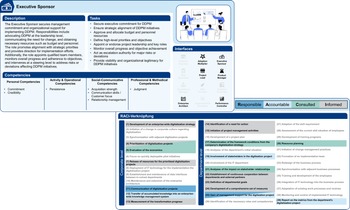
Documentation of the roles: To facilitate the practical application of the identified roles, individual role profiles were developed for each role and documented on role cards (see Figure 3). These cards serve as a structured and easily accessible instrument for organisations to understand, compare, and assign responsibilities within the implementation of DDPM. The content and structure of the role cards were derived from feedback gathered during the focus group workshop, ensuring a high degree of relevance and usability for practitioners. Each role card follows a standardized template that provides a concise yet comprehensive overview of the respective role within the organisational context. This approach is conceptually aligned with recent work in Systems Engineering, where roles are modelled as coherent bundles of tasks, competences, interfaces, and responsibilities (Reference Grote, Koldewey, Schwarz, Dumitrescu and AlbersGrote et al., 2025), thereby supporting a systematic and comparable documentation of organisational roles.
Front (top) and back (bottom) of the role card

The front side of each role card (see Figure 3, top) contains a brief description of the role complemented by a list of core tasks typically associated with the role. These tasks reflect the specific contributions of the role to DDPM. To further enhance the practical value, the profiles include an overview of competencies required for effective role execution. These competencies were mapped using the established KODE Competence Atlas (Reference Heyse and ErpenbeckHeyse & Erpenbeck, 2007), which provides a scientifically grounded framework for categorizing individual skills and behavioural competencies. This ensures that the profiles not only define responsibilities but also highlight the personal and professional capabilities that are essential for fulfilling them. In addition, the role cards specify interfaces with other roles within the role set. This element emphasizes the interdependencies between roles and helps organisations identify necessary collaboration patterns and coordination mechanisms within cross-functional teams. On the reverse side (see Figure 3, bottom), the role card includes a mapping of each role to the activities within a departmental digital transformation process, as outlined in the reference process model developed by Reference Fichtler, Petzke, Grigoryan, Dumitrescu and KoldeweyFichtler et al. (2025). This mapping is based on the RACI method (Responsible, Accountable, Consulted, Informed), indicating the specific level of involvement of each role in different transformation activities (Project Management Institute, 2021). This structured integration of role descriptions, competency requirements, and process-related responsibilities provides organisations with a comprehensive orientation tool for planning and implementing transformation measures. By linking roles to transformation activities, the role cards enable a targeted allocation of responsibilities and promote a more systematic orchestration of tasks across functional boundaries.
Use of the roles: The role cards act as an active structuring tool in organisational transformation processes. They are used in moderated workshops to implement a DDPM. The process begins with the joint development of an organisation-specific target vision for the DDPM. Prioritised transformation measures are then derived from this. These measures are then systematically compared with the role set. This is particularly aimed at decision-makers and designers of organisational transformations, including product managers, executives, and representatives of data- and technology-related functions. Using role cards, existing responsibility structures are questioned and developed further through collaboration. The role cards serve as an analytical framework for allocating responsibilities, identifying role dependencies, and clarifying organisational accountability structures. This structured process highlights both responsibility overlaps and functional gaps in the existing organisational design. Integrating the role profiles into the reference process for the digital transformation of departments creates an additional steering effect. As each role is assigned to specific transformation activities, this link clarifies responsibilities, as well as the procedural sequencing and prioritisation of measures. The role cards, therefore, help to align organisational responsibility structures and transformation logic coherently, and support the consistent implementation of a DDPM.
4. Discussion
The results highlight that DDPM represents a socio-technical system of coordinated roles, not an isolated managerial function. The orchestration of DDPM requires clearly defined interfaces between analytical, technical, and strategic roles, ensuring that data-based insights are not only generated but effectively translated into product decisions. The derived twelve roles collectively illustrate how responsibilities must be distributed along the DDPM value chain – from data acquisition and processing to decision-making and implementation. Importantly, these roles do not necessarily imply the creation of new positions or full-time functions. Depending on company size and context, existing positions can take on one or multiple DDPM roles, allowing responsibilities to be combined and adapted within the current organisational structure. This flexibility is particularly relevant for small and medium-sized enterprises, where resource constraints often require multifunctional role allocations.
The identified roles reflect the multi-dimensional nature of DDPM as an organizational transformation at the intersection of PM and data analytics. The roles capture activity clusters that collectively enable the systematic integration of data into product-related decision processes. Given this hybrid character, overlaps with established analytics roles (Reference Gunklach, Nadj, Michalczyk, Jacob, Gröger and MädcheGunklach et al., 2025) are structurally plausible. However, the distinctive contribution lies in the contextual specification of these activities for the PM domain. The differentiation into Technological Backbone, Organizational Enablement, and Business Impact structures responsibilities along the DDPM value chain. Technological roles ensure the integration, quality, and availability of product-related data. Organizational roles embed analytical routines into PM processes, structures, and competencies. The Business Impact roles operationalize the linkage between product-related information deficits and accountable decision-making, thereby formalizing how analytical outputs become embedded in PM. The DDPM-specific character is particularly evident in the coordinated alignment of roles within the Business Impact layer. The Product Manager formulates decision-relevant problem statements, the Analytics Translator converts them into analytical requirements and decision-ready outputs, and the Value Controller establishes measurable performance logics, thereby creating an explicit end-to-end linkage between challenges and impact assessment. Additionally, roles such as the Adoption Multiplier formalize socio-organizational mechanisms that support the diffusion and stabilization of data-driven practices within the PM function.
A central insight is that role clarity functions as an organisational enabler for DDPM. Many of the barriers identified in practice – fragmented ownership of data, conflicting priorities between IT and business, or missing analytical accountability – can be traced back to unclear role boundaries (Reference Fichtler, Petzke, Grigoryan, Koldewey and DumitrescuFichtler et al., 2026). The developed role profiles directly address this by specifying what each role contributes to data-driven value creation and how collaboration occurs across departmental borders. This perspective frames DDPM as an integrated coordination architecture that links technological capabilities with decision-making and organizational accountability.
From a research perspective, this paper contributes to the theoretical understanding of digital transformation and PM by framing DDPM as an organisational capability rather than an individual function. In doing so, it extends existing PM literature, which traditionally centres on the product manager, by conceptualising DDPM as a system of interdependent roles that collectively enable data-informed decision-making. Building on Reference BiddleBiddle’s (1986) view of roles as bundles of expectations and behaviours that structure interaction within social systems, the findings demonstrate how clearly defined role expectations translate abstract organisational objectives into coordinated collective action. This interpretation positions the developed DDPM role architecture as a tangible operationalisation of role theory in a digital context, showing how responsibilities, competencies, and interfaces can be formalised to support effective coordination. Furthermore, the results resonate with Reference BechkyBechky’s (2006) notion of role-based coordination across occupational boundaries, as the identified roles act as boundary objects that connect analytical, technical, and managerial domains. This highlights that organisational effectiveness in DDPM emerges from the negotiated alignment of expectations and accountabilities rather than from hierarchical control or isolated expertise. In parallel, the findings also reflect Reference OrlikowskiOrlikowski’s (2000) practice-based perspective on technology, illustrating that digital tools and data analytics do not merely support predefined tasks but continuously reshape roles and routines through their enactment in practice. Taken together, this conceptualisation advances the discourse on socio-technical systems, role theory, and organisational design by showing that effective data utilisation in digital transformation depends on the intentional design and continuous adaptation of interconnected roles, rather than on the competencies of individual actors alone.
From a practical perspective, the study provides companies with a structured overview of the roles required for DDPM. This overview supports organisational design decisions by making visible how responsibilities, competencies, and interfaces should be distributed across PM and technological functions. The role profiles act as a design blueprint for defining accountability, reducing ambiguity, and aligning cross-functional collaboration. They enable organisations to identify role gaps, clarify expectations, and improve coordination between departments. In doing so, the results offer a concrete design artefact that helps practitioners shape organisational structures capable of supporting adaptive and data-informed decision-making.
The findings are derived from qualitative research, emphasizing depth and practical insight rather than statistical generalizability. Consequently, both the systematic literature review and the empirical validation are subject to typical qualitative limitations such as selection and interpretation bias. The systematic literature review may reflect database and keyword dependencies. At the same time, the empirical results – based on a limited number of industrial cases and participants – are shaped by the perspectives of participants and researchers embedded in the DDPM ecosystem. This shared context may have reinforced positive interpretations of the developed roles. Moreover, the evaluation captures perceived applicability and completeness rather than measurable performance outcomes. These factors limit the generalizability of the results and call for quantitative and longitudinal studies to examine the actual organisational impact of the proposed role architecture.
Future research should focus on developing and validating a standardized method for applying the role profiles in organisational design processes – linking them to measurable indicators such as decision quality, time-to-decision, and innovation performance. Quantitative studies could test the relationships between role clarity, competence fit, and transformation success across industries. To further increase the informative value of the role profiles, it would be useful to conduct studies on the characteristics of the relationships between the role profiles and the associated competence profiles for a successful implementation of DDPM.
5. Conclusion
This paper positions DDPM as an organisational design challenge that requires clearly defined roles, competencies, and responsibilities across departmental boundaries. By integrating theoretical insights from literature with empirical validation in industrial settings, the study delivers a structured set of twelve roles that make DDPM operationally tangible. The developed role profiles help companies assign responsibilities, bridge disciplinary gaps, and systematically plan their transformation activities. Overall, the findings provide both scholars and practitioners with a foundation for understanding and designing the organisational mechanisms that enable data-driven decision-making – offering a pathway toward more adaptive, evidence-based PM in the digital age.
Acknowledgement
This work is a result of the project “product.intelligence” funded by the Ministry of Economic Affairs, Industry, Climate Protection, and Energy of the State of North Rhine-Westphalia (MWIKE NRW).



 Open access

