


Impact statement
Hydroinformatics technology integrates various computational modeling approaches used to estimate the impacts of proposed infrastructure designs and operating policies that address water quantity and quality issues and that meet economic, environmental, and social water management goals. This technology provides ways of visualizing and communicating this information to the public, to stakeholders, and to decision-makers.
Introduction
Three decades ago, Professor Michael B. Abbott (Reference Abbott1991) used the term ‘hydroinformatics’ to describe the integration of two technologies: computational hydraulics and computer-based data management and visualization. His concern was the need for more effective communication among those like him who were modeling and designing hydraulic systems and those who would be impacted by such systems. He recognized that decisions regarding hydraulic structures were being made by those unfamiliar with computational hydraulic modeling and how the results of such modeling could help them make more informed decisions. He believed there needed to be a better way of communication and building trust between modelers of hydraulic structures and all those involved with, and concerned about, the possible impacts of decisions regarding such structures. To ‘Mike,’ that better way of communication was through the development of a new technology. He called it hydroinformatics – the modeling and management of flows of both water and information.
‘Hydro’ is the English spelling of the Greek word for water. ‘Informatics’ refers to information-systems, or science, or engineering, or technology, or theory. In practice, these two-word disciplines are all dependent on computers. Advances in computer technology have enabled advances in hydroinformatics. This review attempts to briefly outline these advances since Abbott coined the term.
Michael Abbott viewed hydroinformatics as a technology for making knowledge gained from computational hydraulic, hydrologic, and water resource systems modeling available and understandable to society. He considered hydroinformatics as an interface between water science, technology, and society: ‘a new ‘metaknowledge’ of communicating knowledge, in this case, resulting from computational models of hydraulic and hydrologic processes. It provides a symbiosis, and even a constructive interaction, between communication technology and water science and technologies with the objective of satisfying social needs (Abbott, Reference Abbott1991, Reference Abbott and O’Kane1992, Reference Abbott and Mueller1996; Grigg, Reference Grigg2016; Jonoski, Reference Jonoski2022b).
History of development
Computational hydraulics became a discipline in the early 1970s when computers and data processing technologies began to be used for hydrological and hydraulic modeling and analyses. This technology, like all computer-based technologies, has advanced over time (Minns et al., Reference Minns, Verwey, Warren and Jonoski2022). As computer technology advanced, it became possible to develop more sophisticated and detailed models that could simulate the spatially and temporally varying processes that determine water quantity and quality. It led to the development of new software tools for modeling, data analysis and visualization. These features were often incorporated into computer graphics-based interactive data-driven decision support programs designed to facilitate stakeholder learning, communication, and participation.
Hydroinformatics provided a general label for the new modeling approaches researchers were introducing for modeling hydraulic and hydrologic processes. The first hydroinformatics conference, held in Delft in 1994, offered early examples of applications of neural networks and evolutionary and adaptive computing methods in contrast to physical-based models. Some of these methods are currently viewed as part of artificial intelligence. (Goldberg, Reference Goldberg1989; Abbott, Reference Abbott1993, Reference Abbott1994, Reference Abbott1999; Hsu et al., Reference Hsu, Gupta and Sorooshian1995; Savić, Reference Savić2018).
The establishment of the Journal of Hydroinformatics helped hydroinformatics become an accepted and viable component of computational hydraulics and water resources engineering. Since this journal’s first issue in 1999, hydroinformatics has continued to evolve and expand. It has become an important field of research in the hydrological sciences and in the practice of water resources management. The journal together with multiple meetings of hydroinformatic specialty groups in professional societies have facilitated communication among those developing and applying hydroinformatics methods and have contributed to advances in our understanding of hydrological–social systems.
In the early years, hydroinformatics focused primarily on developing software tools for data management, modeling, and display. Interest in data-driven modeling techniques grew and were applied to runoff prediction and downscaling of climate data among a growing range of other applications. New ideas were explored such as machine learning algorithms, support vector machines, fuzzy logic, and chaos theory. Neural networks were supplementing, if not replacing, conventional complex numerical hydrodynamic models used, for example, to simulate flood inundations and to assess flood plain vulnerabilities. Nature-based metaheuristic methods became particularly popular and successful because of their ability to deal with issues of scale and complexity (Abbott and Jonoski, Reference Abbott, Jonoski, Babovic and Larsen1998; Thein and Abbott, Reference Thein, Abbott, Babovic and Larsen1998; Abbott et al., Reference Abbott, Babovic and Cunge2001, Reference Abbott, Tumwesigye and Vojinovic2006; Abbott, Reference Abbott, Liong, Phoon and Babovic2004, Reference Abbott, Abrahart, See and Solomatine2009; Vojinovic and Abbott, Reference Vojinovic and Abbott2017).
Today, more than three decades later, the scope of hydroinformatics has broadened to address challenges involving not only the physical, chemical, and biological aspects but also the cultural, economic, political, sociological, and legal aspects of designing and managing water. Hydroinformatics acknowledges the inherently social nature of water management problems and of decision-making processes and strives to understand those social processes impacting water management and use (Tian et al., Reference Tian, Wei, Haeffner and Kreibich2024).
Hydroinformatics draws on and integrates hydraulics, hydrology, environmental engineering and many other informatics disciplines. It has been applied to all parts of the water cycle from the atmosphere to the oceans, including the interventions in that cycle as humans attempt to modify it to address water management needs such as urban drainage, flood control, and water supply and quality issues. It provides support for decision-making at all levels of governance and policy making, and on all aspects of infrastructure design, management, and operations.
Taking advantage of improvements in computer technology, hydroinformatics has expanded to include the use of geographic information systems (GIS), remote sensing, artificial intelligence, machine learning, big data analytics and faster hyper-heuristic analyses, visualization improvements, and interactive virtual reality environments. Hydroinformatics has a growing worldwide community of researchers and practitioners. Postgraduate programs in hydroinformatics are being offered by leading academic institutions. Solomatine et al. (Reference Solomatine, Price, Jonoski, Popescu, Bhattacharya, Segura, Perez, van Andel and Bertini2022) provide a description of the hydroinformatics graduate program and curriculum at IHE-Delft, the birthplace of hydroinformatics. The Journal of Hydroinformatics provides a specific, but not the only, outlet for hydroinformatics research. In addition, the research community gathers to exchange ideas at biennial hydroinformatics conferences (Babovic and Minns, Reference Babovic, Minns and Jonoski2022).
Early developers of hydroinformatics
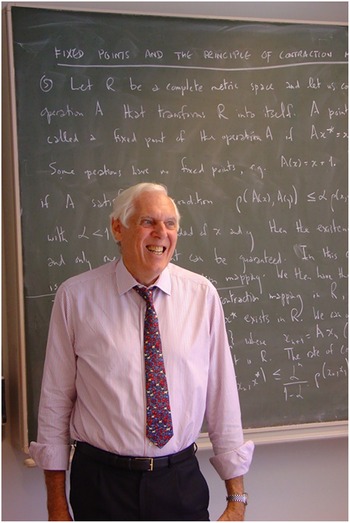
Hydroinformatics is a technology that has benefitted from the contributions in a wide range of disciplines, including computer science, environmental fluid mechanics and water engineering, hydrology, geography, and the environmental sciences. Notable early contributors to hydroinformatics include the group of faculty and students collaborating with Professor Michael B. Abbott at the International Institute for Infrastructural, Hydraulic and Environmental Engineering (now called the IHE Delft Institute for Water Education) in Delft, The Netherlands (Figure 1). These include Professors Arthur Mynett, Michael J. Hall, Roland K. Price, and Dimitri P. Solomintine together with their students. These students included Anthony W. Minns who was among the first to demonstrate the utility of artificial neural networks for predicting runoff and for addressing other water issues. Vladan Babovic is well known for his pioneering work in the development and application of genetic programming models in hydraulics, rainfall-runoff modeling, flood forecasting, and water resources management. His work has helped to demonstrate the potential of genetic programming as a tool for hydraulic and hydrological modeling and has contributed to the development of more advanced versions of that technology (Babovic and Minns, Reference Babovic and Minns1994; Minns and Hall, Reference Minns and Hall1996; Babovic and Abbott, Reference Babovic and Abbott1997; Jonoski and Abbott, Reference Jonoski, Abbott, Babovic and Larsen1998; Dibike et al., Reference Dibike, Minns and Abbott1999; Babovic, Reference Babovic2000; Dibike et al., Reference Dibike, Velickov, Solomatine and Abbott2001; Babovic and Keijzer, Reference Babovic and Keijzer2002; Solomatine and Dulal, Reference Solomatine and Dulal2003; Price and Solomatine, Reference Price and Solomatine2009; Solomatine et al., Reference Solomatine, Price, Jonoski, Popescu, Bhattacharya, Segura, Perez, van Andel and Bertini2022).
Professor Michael B. Abbott teaching one of his classes at IHE-Delft, NL.

Other early developers of hydroinformatics include Dragan A. Savić who contributed to data assimilation, model calibration, and software tools for water resources management including the “smart water grid” concept that uses advanced sensor technologies and data analytics to improve the design and management of water networks. Graeme C. Dandy and Agnus R. Simpson developed evolutionary optimization techniques for the design and management of water distribution systems. They also contributed to the enhancement of decision support systems for water resources management, which incorporate optimization algorithms, hydrological models, and other tools to help water managers make more informed decisions. Jean A. Cunge developed the one-dimensional Saint-Venant equations for unsteady open-channel flow and contributed to the development of several hydrodynamic models, such as MIKE 11 and SOBEK. The software FEFLOW (Finite Element subsurface FLOW system) for simulating and visualizing in 3 dimensions groundwater flow, mass, and heat transfer in subsurface porous and fractured media was developed by Hans-Jörg G. Diersch, initially in the Institute of Mechanics of the (East) German Academy of Sciences and later with Stefan Kaden at WASY, the Institute for Water Resources Planning and Systems Research. In 2007 WASY became part of the Danish Hydraulics Institute (DHI) Group where FEFLOW along with other MIKE models (MIKE Powered by DHI) are being maintained and distributed. Other institutions offering various models for water management with graphics-based interactive interfaces include Deltares (Deltares Open Software – Welcome – oss.deltares.nl), the US EPA (Learn About Models at EPA | US EPA) that maintains EPANET, a tool for understanding the movement and fate of drinking water constituents within distribution systems, the US Army Corps of Engineers Hydrologic Engineering Center that develops, maintains, and distributes a wide variety of what are known as HEC models (hec models – Bing video), and the US Geological Survey that develops and distributes various versions of their groundwater model MODFLOW for simulating and predicting groundwater conditions and groundwater/surface-water interactions (MODFLOW and Related Programs | U.S. Geological Survey (usgs.gov)). Vijay P. Singh pioneered the application of entropy theory, copulas, and wavelets to hydrology and water resources. Zoran Vojinovic developed integrated urban water management models and tools. Kurt Fedra, at the International Institute for Applied Systems Analysis (IIASA) and later at his own firm, is an early developer of decision support systems for large environmental and socio-technical systems, interactive simulation, visualization, GIS and AI applications, knowledge engineering, advanced simulation techniques and interactive graphics. (Simpson et al., Reference Simpson, Dandy and Murphy1994; Maier and Dandy, Reference Maier and Dandy1996; Savić and Walters, Reference Savić and Walters1997; Cunge and Erlich, Reference Cunge and Erlich1999; Diersch, Reference Diersch2014; Refsgaard et al., Reference Refsgaard, Erlich, Bathurst and Jonoski2022).
These are among the individuals and institutions that have contributed to the early, and in some cases continuing, development of hydroinformatics. For more detail on the history of hydroinformatics and on the original ideas of Abbott and his collaborators at IHE-Delft, I encourage readers to refer to Jonoski (Reference Jonoski2022a). This edited book is devoted to the field of hydroinformatics as envisaged and developed by its founder, Mike Abbott. The authors are among this discipline’s prominent developers and educators. Other insightful reviews include those of Makropoulos and Savić (Reference Makropoulos and Savić2019), Gourbesville and Caignaert (Reference Gourbesville and Caignaert2022), and those found in the various Handbooks of Hydroinformatics cited in this paper.
The hydroinformatics technology continues to evolve and expand, thanks to researchers and practitioners around the world who are engaged in developing and applying computational approaches and visualization methods that will subsequently become among the tools of hydroinformatics. Hydroinformatics is a technology that adopts and applies any advancements in computer technology and modeling methods that can better meet its changing and increasing needs.
Tools of hydroinformatics
Today hydroinformatics encompasses a wide range of tools and approaches for managing and analyzing water systems and related data. Key tools of hydroinformatics include:
-
a) Geographic Information Systems (GIS) for analyzing and visualizing geospatial data such as river networks, watershed boundaries, and land use patterns.
-
b) Remote sensing from satellite and aerial imagery for detecting changes in water levels, areas of drought or flooding, and changes in land use over large areas over time.
-
c) Optimization and simulation modeling software for identifying and evaluating alternative plans and management policies and for estimating their possible physical, environmental, and social impacts. They can help in the prediction of water flows, water qualities, and other aspects of water systems over time and space and how they will respond to changes in weather patterns, land use, management decisions, and other factors.
-
d) Data management software for storing, managing, visualizing, and analyzing water-related data.
-
e) Digital smart games for informing and educating players on how hydrologic or hydraulic systems function under different scenario inputs.
-
f) Artificial intelligence tools including machine learning methods for analyzing large and complex systems or environmental data sets, and digital twins combining GIS and virtual reality for providing an interactive digital replica, a simulation model, of a system.
Overall, hydroinformatics is a highly interdisciplinary field that benefits from a wide range of tools and technologies from multiple disciplines, including computer science, hydrology, geography, and environmental science. A sampling of these tools and methods and examples of their use are described in more detail in the paragraphs that follow.
-
i) Systems analysis optimization, simulation methods
Optimization and simulation modeling are two basic and important tools of hydroinformatics technology. Optimization models are used to find the values of decision variables that satisfy one or more specified objectives or goals and that meet specified sets of constraints that define the system boundaries, the interactions among system components, and any system performance requirements. They are useful in reducing the number of alternatives worthy of more detailed simulation modeling and analysis. Simulation models addressing ‘what if’ questions are useful for estimating the values of system performance criteria over time and space. Performance criteria can include different statistical measures of physical, environmental, economic and/or social impacts.
Overall, optimization and simulation modeling are tools that can help better inform those having to make decisions. They do not replace decision-makers; rather they can inform them. By using these methods to evaluate different management strategies and infrastructure designs and operating policies, stakeholders and decision-makers may learn how to make more effective use of available resources, reduce physical, economic, and environmental risks including those associated with climate change and extreme events, and identify and promote more sustainable water management policies. (Singh, Reference Singh2014; McDonnell, Reference McDonnell2021).
-
ii) Smart games
Smart games promote learning. They are designed to be engaging and fun, while also providing educational content and promoting skill development. In the context of hydroinformatics, smart games have been used to help educate and engage users in performing ‘what-if’ scenarios and understanding the resulting consequences. For example, smart games can be developed to teach users about the water cycle, watershed modeling, and river basin management, say within a particular region. These games can involve the use of interactive simulations, puzzles, and quizzes to help users better understand complex hydrological systems.
Smart games can also promote collaboration and community engagement in water resources management. These games can involve multiple players and encourage them to work together to solve hydrological challenges or achieve common goals. This can help to build trust among participants and a shared responsibility for water resources management (Castelletti et al., Reference Castelletti, Cominola, Facchini, Giuliani, Fraternali, Herrera, Melenhorst, Micheel, Novak, Pasini, Rizzoli, Rottondi, Tsakalides, Panousopoulou, Tsagkatakis and Montestruque2018)
-
iii) Nature-based evolutionary methods.
Nature-based Evolutionary Algorithms (EA) are biology-inspired methods for finding preferred solutions to optimization problems. The use of optimization algorithms inspired by natural ecological processes has allowed significant increases in our ability to model complex systems. Evolutionary based approaches involve an iterative succession of solutions each influenced by the performance of the previous set of solutions as the search continues to find the best values of all unknown decision variables or parameters of a model. Genetic algorithms, genetic programming and differential evolution are examples of evolutionary methods (Karkalos et al., Reference Karkalos, Markopoulos and Davim2019; Maier et al., Reference Maier, Razavi, Kapelan, Matott, Kasprzyk and Tolson2018; van Thienen et al., Reference van Thienen, Keedwell, Farmani and Vertommen2021).
Genetic algorithms are one of the earliest metaheuristic methods for seeking values of parameters or decision variables. Genetic programming involves the search for the best functional relationships, that is, the structure of the model itself. The algorithms are heuristic and thus easily modified to suit the user’s needs. Genetic Algorithms, developed initially by De Jong (Reference De Jong1975) and Holland (Reference Abbott and Vojinovic1975, Reference Abbott and Vojinovic1992), are among the most popular ones. They are the basis of newer methods such as artificial ant and bee colony algorithms, sheep flock heredity algorithm, shuffled frog-leaping algorithm, bacteria foraging optimization algorithm, and swarm intelligence-based approaches just to mention a few (Suribabu and Neelakantan, Reference Suribabu and Neelakantan2006; Maier et al., Reference Maier, Kapelan, Kasprzyk, Kollat, Matott, Cunha, Dandy, Gibbs, Keedwell, Marchi, Ostfeld, Savić, Solomatine, Vrugt, Zecchin, Minsker, Barbour, Kuczera, Pasha, Castelletti, Giuliani and Reed2014, Reference Maier, Razavi, Kapelan, Matott, Kasprzyk and Tolson2018). Nature-based optimization methods such as these are arguably among the more effective methods for finding good solutions to large highly complex problems that are otherwise difficult to model using mathematical programming (constrained optimization) methods (Goldberg, Reference Goldberg1989).
-
iv) Visualization
Visualization techniques can aid in understanding hydrological data in various forms, including maps, graphs, and dynamic 5D (x, y, z, time, and color) displays. These technologies enable users to visualize and interact with complex hydrological data and models in ways that are intuitive and informative. Computer graphics technology can be used to create realistic visualizations of hydrological features, such as rivers, lakes, and watersheds. Virtual reality can help create immersive experiences that allow users to explore and interact with hydrological models and data. Developments in visualization techniques are making it possible to fully immerse a user in a virtual environment by simulating the same kinds of physical and psychological reactions they would experience in the real world. By presenting model results in a visual and interactive way, these technologies can help to make hydrological information more accessible and understandable to policymakers, stakeholders, and the general public. Such technology can also help one evaluate the impacts of different management strategies on hydrological systems, or simulate the effects of extreme weather events, such as floods or droughts.
Visualization methods play a significant role in the development of digital twins. Often using GIS data, digital twins are virtual representations of landscapes and their physical objects, processes, relationships, and behaviors. Digital twins can represent natural and built environments. They can help us observe and monitor changes in those environments in response to various alternative design and management decisions (Campbell and Wachal, Reference Campbell and Wachal2021; Wu et al., Reference Wu, Lu and Wu2023).
Overall, visualization, computer graphics, and virtual reality can significantly enhance the effectiveness and accessibility of hydroinformatics tools and methods, and support more informed water resources management practices and decision-making. (Imberger, Reference Imberger2023).
-
v) Artificial intelligence techniques
Artificial intelligence includes methods that get machines to mimic human intelligence and to perform tasks as humans would. Voice assistants like Siri and Alexa are examples of AI technology, as are customer service chatbots that pop up to help you navigate websites (Savić, Reference Savić2018; Findikakis and Savić, Reference Findikakis and Savić2021; Russell and Norvig, Reference Russell and Norvig2022; Chang et al., Reference Chang, Chang and Chen2023).
Machine learning is a type of artificial intelligence. Through machine learning, practitioners develop models that can “learn” from data patterns without human direction. The huge volume and complexity of data (unmanageable by humans without computational aids) that is now being generated has increased the potential usefulness of machine learning.
Machine learning typically involves the development and use of artificial neural networks. A neural network is a layered architecture of nodes and links. The values of weights assigned to each link (neuron) are based on data, called training data. Its ability to predict future outcomes given new data is based on these training data. Artificial neural networks work as mapping functions between the input and the output values. Deep learning refers to neural networks of three or more internal network layers of nodes and links.
Advanced Machine Learning Techniques include Nonparametric Density Estimation, and Regression, Bayesian estimation; Stochastic Learning Algorithms, Cloud and Cluster Computing, Data Fusion Techniques, Empirical Orthogonal Functions and Teleconnection, Internet of Things, Kernel-Based Modeling, Large Eddy Simulation, Pattern Recognition, Uncertainty-Based Resiliency Evaluation and Volume-Based Inverse Modeling. All these tools make it easier to understand and use the information contained in large datasets, such as airborne imagery and hydro-meteorological datasets that are collected worldwide.
Machine learning algorithms are used in a wide variety of applications where it is difficult or impossible to develop conventional physically based models and solution algorithms to perform the needed tasks. A subset of machine learning is data mining that focuses on exploratory data analysis through unsupervised learning.
GeoAI combines methods in spatial data science and machine learning to extract knowledge from spatial data (Janowicz et al., Reference Janowicz, Gao, McKenzie, Hu and Bhaduri2019). It is an active area of research that has applications in other fields including disaster management and basin (including urban) planning (Ballesteros et al., Reference Ballesteros, Sanchez-Torres and Branch2021). The rapidly increasing availability and quality of satellite and drone imagery, together with their decreasing costs and ease of use, are making these technologies increasingly useful in practice.
Autonomous agents are programs, powered by AI, that when given an objective, can create tasks for themselves, complete tasks, create new tasks, reprioritize their task list, complete the new top task, and repeat this loop of actions until their objective is reached. The programming techniques needed to power autonomous agents are new and have been used to develop open-source programs such as AutoGPT, BabyAGI, and Microsoft’s Jarvis. More information on AI and its impact on hydroinformatics is contained in papers by Al-Saati and Kabir (Reference Al-Saati and Kabir2019), Babovic et al. (Reference Babovic, Han and Chen2021), Mounce et al. (Reference Mounce, Sheperd, Boxall, Horoshenkov and Boyle2021), Babovic and Minns (Reference Babovic, Minns and Jonoski2022), Russell and Norvig (Reference Russell and Norvig2022), and Babovic (Reference Babovic2023).
-
vi) The methods of social hydrology
Over the past decade there has been a concerted effort to develop modeling approaches that go beyond helping to facilitate society’s understanding of the results of computational hydrologic, hydraulic, and water systems modeling through the use of communication technologies, but to understand and predict the behavior of those so impacted by water management decisions, and in turn the impact of their behavior on our water systems. Among the quantitative modeling methods used by social-hydrologists is systems dynamics modeling for accounting for various feedbacks among water system and social components, and agent-based modeling (ABM) for simulating the actions and interactions of autonomous social agents (both individual and collective entities such as organizations or groups) to better understand and predict the possible behavior of various social components of coupled human-water systems. The interdisciplinary perspective that the use of hydroinformatics tools provides can help social hydrologists address the issues of interest to them. An excellent overview of these efforts, as well as the objectives and approaches taken by those working in this new area of research, is contained in the book edited by Tian, et al. (Reference Tian, Wei, Haeffner and Kreibich2024).
Applications
Hydroinformatics methods have contributed to the study and analysis of a wide range of water resources management, planning, and operation issues. These issues have involved:
-
1. Forecasting flows, velocities, and managing extremes: Hydroinformatics technology can be used to develop weather forecasting and early warning systems that use real-time data from monitoring stations and hydrological models to predict flow velocities, elevations, and mitigate potential floods and droughts and severe wind and fire storms (Thorkilsen and Dynesen, Reference Thorkilsen and Dynesen2001; Wilkinson et al., Reference Wilkinson, Quinn and Caspar2013; Langhammer, Reference Langhammer2023).
-
2. Water supply distribution and wastewater collection: Hydroinformatics technology can be used in the planning and analysis of water distribution and sewer collection systems, including treatment processes, pipeline networks, and pumping stations, and the location of water flow, quality, and pressure sensors to ensure that water of sufficient quantity and quality is delivered efficiently and effectively.
With robust and high-resolution data coming from smart meters, water network management systems now exist that can perform self-discovery of problems and provide recommendations to operators on the best mitigation strategies and respective outcomes. This can enhance resiliency in the face of unforeseen threats, decrease capital costs on infrastructure upgrades, and help protect the environment. Examples can be found in Marsalek et al. (Reference Marsalek, Zeman and Ward2017), Fried and van Loosdrecht (Reference Fried and van Loosdrecht2018), Kapelan et al. (Reference Kapelan, Weisbond and Babovic2020), Alzamora et al. (Reference Alzamora, Conejos, Castro-Gama and Vertommen2021), Mounce et al. (Reference Mounce, Sheperd, Boxall, Horoshenkov and Boyle2021)van Thienen et al. (Reference van Thienen, Keedwell, Farmani and Vertommen2021) and in Spotlight on hydroinformatics: The force shaping the future of water | Xylem US. Makropoulos and Savić (Reference Makropoulos and Savić2019) provide a review of hydroinformatics applications addressing a range of urban water management problems and issues.
-
3. Irrigation management: Hydroinformatics technology can be used to identify and evaluate alternative management policies for irrigation systems, including crop selection, irrigation scheduling, and water use efficiency, to improve crop yields, reduce costs, and water use (Zhu et al., Reference Zhu, Ringler and Rosegrant2019; Gumiere et al., Reference Gumiere, Camporese, Botto, Lafond, Paniconi and Gallichand2020; Casadei et al., Reference Casadei, Peppoloni, Ventura, Teodorescu, Dunea and Petrescu2021).
-
4. Environmental monitoring: Hydroinformatics techniques are used to monitor and analyze the spatial and temporal distribution of various water quality constituents and other environmental factors, such as nutrient levels, sediment concentrations and transport, and various species and water levels in aquatic ecosystems, to help identify and mitigate any adverse environmental impacts. Earth Observation sensor developments, lately facilitated by crowdsourcing, social media, and citizen science, which gather information about our planet, make hydroinformatics tools increasingly relevant for understanding changes and for processing data and management (Demir and Freni, Reference Demir and Freni2022; Rodríguez-López et al., Reference Rodríguez-López, Usta, Alvarez, Duran-Llacer, Lami, Martínez-Retureta and Urrutia2023).
A major problem faced by water utilities is the monitoring of underground pipe systems. Swarms of micro-robots can work in buried pipe networks automatically and cooperatively. Manually operated video cameras and acoustic loggers can be replaced with such autonomous robots to facilitate the inspection of pipe systems and the collection of data to assess pipe conditions and maintenance needs (Suribabu and Neelakantan, Reference Suribabu and Neelakantan2006; Mounce et al., Reference Mounce, Sheperd, Boxall, Horoshenkov and Boyle2021).
-
5. Groundwater management: Groundwater resource management and the effective management of aquifer recharge schemes in areas where groundwater is used, is needed to ensure the long-term (sustainable) use of available water. Numerous articles have been published showing the way hydroinformatics approaches have been, and are being, applied to the management of groundwater. Relatively recent ones include those authored by Gaur et al. (Reference Gaur, Raju, Kumar and Bajpai2021), Parasyris et al. (Reference Parasyris, Spanoudaki, Varouchakis and Kampanis2021), Rao et al. (Reference Rao, Subrahmanyam and Raju2021), Kumar et al. (Reference Kumar, Dwivedi, Ojha, Kumar, Pant, Mishra, Patidar, Singh, Sarkar, Janardhanan, Kumar and Mainuddin2022), Pranjal et al. (Reference Pranjal, Chatterjee, Kumar, Dwivedi, Jally and Kumar2023), and Zamani et al. (Reference Zamani, Eslamian and Koupai2023).
-
6. Watershed land and water management: Hydroinformatics technology can be used to aid in integrated watershed management planning that incorporates the complex interactions among land uses, hydrology, and water quality, and protects surface and ground water resources over large geographic areas (Hewett et al. Reference Hewett, Quinn, Heathwaite, Doyle, Burke, Whitehead and Lerner2008, Reference Hewett, Doyle and Quinn2010, Reference Hewett, Quinn and Wilkinson2016; Brodaric, et al., Reference Brodaric, Booth, Boisvert and Lucido2016; Rangan, Reference Rangan2016; Casadei et al., Reference Casadei, Peppoloni, Ventura, Teodorescu, Dunea and Petrescu2021; Hewett et al., Reference Hewett, Simpson, Wainwright and Hudson2018; Makropoulos and Savić, Reference Makropoulos and Savić2019; Yustiani, et al., Reference Yustiani, Hasbiah, Matsumoto and Rachman2019; Herath et al., Reference Herath, Chadalawada and Babovic2020; Cyr-Gagnon and Rodriguez, Reference Cyr-Gagnon and Rodriguez2021; Chen et al., Reference Chen, Lin, Feng and Chen2022; Kourakos et al., Reference Kourakos, Brunetti, Bigelow, Wallander and Dahlke2023; López-Chacón et al., Reference López-Chacón, Salazar and Bladé2023; Park and You, Reference Park and You2023; Rachidi et al., Reference Rachidi, El Mazoudi, El Alami, Jadoud and Er-Raki2023).
-
7. Reservoir operation and river and lake flow and elevation regulation: Examples of the application of hydroinformatics methods to this aspect of river basin or watershed management are found in Oliveira and Loucks (Reference Oliveira and Loucks1997), Furber et al. (Reference Furber, Medema, Adamowski, Clamen and Vijay2016) and Ortiz-Riomalo et al. (Reference Ortiz-Riomalo, Koessler, Miranda-Montagut and Cardenas2023).
-
8. Coastal zone management: Hydroinformatics technology can be used to model and analyze the impacts of climate change and sea-level rise on coastal ecosystems, as well as to develop strategies for coastal protection and adaptation and real-time forecasts for infrastructure development (Thorkilsen and Dynesen, Reference Thorkilsen and Dynesen2001; Pinho et al., Reference Pinho, Vieira and Antunes do Carmo2004).
-
9. Impact assessments: Hydroinformatics methods have been used to assess hydrologic, economic, and social impacts of management plans and policies. They can help identify potential risks and vulnerabilities, including those associated with climate change (Abbott and Jonoski, Reference Abbott and Jonoski2001; Abbott and Vojinovic, Reference Abbott and Vojinovic2010a, Reference Abbott and Vojinovic2010b, Reference Abbott and Vojinovic2014).
-
10. Knowledge and data management: Hydroinformatics methods can be used to facilitate participation and connections among modelers, stakeholders and decision-makers(Abbott, Reference Abbott and Mueller1996; Díez and McIntosh, Reference Díez and McIntosh2009; Lu and Piasecki, Reference Lu and Piasecki2012; Abdullaev, and Rakhmatullaev, Reference Abdullaev and Rakhmatullaev2014; Gourbesville et al., Reference Gourbesville, Cunge and Caignaert2014; Walker et al., Reference Walker, Loucks and Carr2015; Chen and Han, Reference Chen and Han2016; Furber et al., Reference Furber, Medema, Adamowski, Clamen and Vijay2016; Ward et al., Reference Ward, Borden, Kabo-bah, Fatawu and Mwinkom2019; Ortiz-Riomalo et al., Reference Ortiz-Riomalo, Koessler, Miranda-Montagut and Cardenas2023).
Overall, hydroinformatics technology has been used in a wide range of applications pertaining to water and its management. Its use has improved our understanding of the performance of alternative water systems, enhanced our decision-making capabilities, and increased the effectiveness of our educational programs related to the development and sustainability of water resource systems (Jonoski Reference Jonoski2022a).
Addressing future water management issues
Managing water resources has always been challenging. Without humans designing, building, and operating infrastructure, water would rarely be in the amounts people want, where they want it, when they want it, of the quality and reliability they desire, and at a price they can afford. Meeting these conditions challenges water managers. Goals are changing over time and space and vary even within a society. How they will change in the future for different segments of society is uncertain. Changes are driven by increasing populations, by the economic, social, and environmental conditions of those populations, and by the increasing frequency and intensity of climatic and hydrologic extremes and their consequences. Meeting these challenges requires individuals to be knowledgeable in both the natural (physical, ecological, and environmental) and social (economical and political) aspects of managing water. These challenges exist today and will be even greater tomorrow. To meet these challenges professionals engaged in the water sector must creatively and effectively take advantage of the latest advances in the physical and social sciences and engineering. We all need to think and act smarter about managing and using water. Future water problems are not going to be solved by professionals remaining in their own disciplinary silos. It will require inputs from individuals with expertise in all relevant disciplines, individuals working together, and using hydroinformatics tools as appropriate, to find both economically efficient and politically effective adaptive solutions to the world’s increasingly complex water challenges (Abbott, Reference Abbott, Abrahart, See and Solomatine2009; Xylem, 2021; Alamarios and Koundouri, Reference Alamarios and Koundouri2022; Savić, Reference Savić2022).
The application of hydroinformatics can us identify both the form and function of water services, and the infrastructure that provides these services, now and in the future—for the better—provided that important challenges involving privacy, fundamental rights, ethics, and equity are considered and addressed. The interdisciplinary perspective that the use of hydroinformatics tools provide can help us address and better understand the behavior of coupled human-water systems. Hydroinformatics enhances the opportunity to involve the public in water management planning and policy. It can help us consider and better understand the short- and long-term impacts of decisions as the objectives and constraints of stakeholders change over time. It can facilitate transitions to less expert-driven decision-making and to more community participation in decision-making. Being open to using new knowledge and communication technologies together with participatory modeling approaches that involve stakeholders, hydroinformatics can help society identify paths toward more acceptable, resilient, and sustainable water management plans and policies.
This writer’s vision into the future of hydroinformatics includes the increasing ability to immerse all participants being impacted by, and interested in solving, any specific water management issue into an artificial, but realistic, computer-generated site-specific reality where they can jointly and interactively explore various options that address their specific challenges and issues and evaluate the simulated resulting impacts. With advances in computing, machine learning, virtual reality, GIS, and artificial intelligence, surely this seems, at least to me, potentially feasible and beneficial (and even more enjoyable).
Perhaps further into the future, technology will exist that can suggest innovative ideas of what modelers should include in the systems they are analyzing, ideas that have not yet been considered or modeled. Can we develop models that help individuals innovate – that can generate new options for addressing problems in site-specific situations? Such suggestions could expand the components of the systems being modeled. Clearly, advances in artificial intelligence will be useful to those developing this creative capacity. Will this be possible? Seems to me it is worth exploring.
Consider a future where, like the demise of IBM cards and telephone booths, there is no longer the need for any display screens attached to desktop or laptop computers. Users of hydroinformatics modeling tools will just don eyeglasses where they will be able to see in virtual reality 3D images of the system being modeled. They will be able to interact with the modeled system including the means to implement management decisions and observe the impacts of their decisions over time and space by being within and a part of the system being modeled. Using the internet along with Zoom-like technology, teams of modelers as well as stakeholders will be able to interact with each other within this virtual reality environment. Eventually, participants will be able to hear sounds as well, as appropriate, coming from this modeled environment. Surely this vision will become a reality some day. It may take a little longer before we might be able to ditch those VR glasses, but keep the headsets, and just step into a hologram of the system being analyzed, including its social components, and interact with it. How better to understand how a system can best (however defined) be designed and managed than to become part of it, and to be impacted by it, even if it is a virtual digitized computer-generated version?
Handbooks devoted to hydroinformatics
There are handbooks and reference books available in the field of hydroinformatics that provide an overview of the concepts, methods, and applications of hydroinformatics. Each of these handbooks provides information on various aspects of hydroinformatics, including data management, modeling, optimization, and decision-making. Some of these include:
-
a. Handbook of HydroInformatics, Volumes I, II, III: edited by Eslamian and Eslamian (Reference Eslamian and Eslamian2022a, Reference Eslamian and Eslamian2022b, Reference Eslamian and Eslamian2023), discusses soft-computing, advanced machine learning, and data processing techniques that are used in water science and engineering disciplines.
-
b. Handbook of Hydroinformatics, edited by Cobacho and Medina (Reference Cobacho and Medina2017), provides a comprehensive overview of the applications of hydroinformatics to water resources management, including topics such as data management, modeling, optimization, and decision-making.
-
c. Hydroinformatics: Data Integrative Approaches in Computation, Analysis, and Modeling, edited by Gourbesville et al. (Reference Gourbesville, Cunge and Caignaert2014), provides an overview of the different approaches to data integration in hydroinformatics, including data management, data mining, and decision-making.
-
d. Hydroinformatics: Smart Water Management, edited by Fried and van Loosdrecht, (Reference Fried and van Loosdrecht2018), reviews applications of hydroinformatics in smart water management, including topics such as data management, modeling, optimization, and decision-making.
-
e. Handbook of Research on Hydroinformatics: Technologies, Theories and Applications, edited by Vojinovic (Reference Vojinovic2012), presents the technologies, theories, and applications of hydroinformatics, including topics such as data management, modeling, optimization, and decision-making.
Open peer review
To view the open peer review materials for this article, please visit http://doi.org/10.1017/wat.2023.10.
Data availability statement
No numerical data were used in the preparation of this review paper.
Financial support
This research received no financial support from any person, group or funding agency.
Competing interest
The author is unaware of any real or perceived conflicts of interest while preparing, or in the content of, this paper.

 Open access


Comments
I am submitting the attached paper reviewing hydroinformatics for possible publication in your journal.