


1. Introduction and motivation
Carbon fiber-reinforced plastics (CFRP) are widely recognized for their lightweight potential and high strength-to-weight ratio, making them key materials in industries such as aerospace, automotive, and renewable energy. These properties enable significant weight savings, contributing to improved efficiency and reduced energy consumption in various applications. However, the widespread adoption of CFRPs in the industry is hindered by challenges related to their inherent variability caused by manufacturing and assembly.
The manufacturing of CFRPs involves complex processes such as layup and curing, each of which causes different variations in the component, e.g. fiber misalignment. These variations can propagate through subsequent assembly stages, affecting the structural integrity and performance of the final product. Simulating the manufacturing and assembly process of composite materials, including the effects of variations, enables the analysis and prediction of their effects from single part to assembly and subsequently the optimization of process parameters to minimize errors. Such a simulation method, which takes large variations and possible non-linear effects into account, is not yet available. This paper aims to address these needs by proposing a simulation framework for CFRP manufacturing and assembly, taking large variations into account. Furthermore, this framework enables the continuous prediction of stresses and deformations at every process step by utilizing surrogate models. In this contribution, however, only fiber angle variations are discussed to demonstrate the process. In future research, more variations and combinations of different variations will be included in the simulation framework.
In section 2, the state of the art regarding the production process and occurring variations in all process stages is summarized. After identifying the need for action (Sect. 3), a framework for the continuous simulation of the manufacturing and assembly process considering variations is presented (Sect. 4). Finally, the developed simulation method is applied to two case studies (Sect. 5).
2. State of the art
The following section describes how CFRP components are designed and optimized (Sect. 2.1). Subsequently, the manufacturing process of composite materials and the related challenges are described, from a single part (Sect. 2.2) to a composite assembly (Sect. 2.3). Finally, an overview of relevant variations in the manufacturing process and their consequences is given (Sect. 2.4).
2.1. Design of composites
Although composite structures offer many advantages in terms of weight reduction, the design and optimization of such parts is complex, especially due to the anisotropic material behavior and the layered structure. To overcome the associated design challenges, several approaches have been developed that focus on the simultaneous optimization of topology and fiber orientation (Reference Nomura, Dede, Lee, Yamasaki, Matsumori, Kawamoto and KikuchiNomura et al., 2015; Reference Voelkl, Kießkalt and WartzackVoelkl et al., 2019; Reference Guo, Meng and WangGuo et al., 2024). Their final result is an optimized part design, including the laminate layout with a defined number, size, orientation and stacking sequence of different layers. The next step is to manufacture the part according to the design created.
2.2. Manufacturing of composite parts
There are a number of different processes for manufacturing composite parts, including hand laminating, resin transfer molding (RTM) and the prepreg technology (Figure 1). This technology is widely used in the industry due to the excellent mechanical properties of prepregs and is therefore described in detail in the following. Prepregs are pre-impregnated fibers that are pre-coated with a thermosetting resin system, typically epoxy. The first production step is therefore cutting the prepreg into the desired shape of the layers. By placing several layers (plies) on top of each other in a certain direction, the entire laminate is produced as it was previously designed (Sect. 2.1). The correct position, shape and orientation of the plies is important as they can have a significant influence on the structural performance (Reference Freitag, Goetz and WartzackFreitag et al., 2024). Draping is the process by which the flat prepreg is placed on the mold (Bickerton et al., 1997). The laminate is either completely finished first and then draped onto the mold, or the layers are draped directly onto the mold. This can be a challenging step, as draping can lead to shear’ deformation and wrinkling, especially in doubly curved areas, causing significant fiber and thickness variations. The resulting deviations can be taken into account with the help of draping simulations (Reference Freitag, Goetz and WartzackFreitag et al., 2024; Reference Kussmaul, Jónasson, Zogg and ErmanniKussmaul et al., 2019; Reference Van Der WeeënVan der Weeën, 1991). Once all the layers have been draped on the mold, the next step is curing. The curing process is a critical step in manufacturing as it solidifies the resin matrix and establishes the final mechanical and thermal properties of the composite. During curing, the thermosetting resin of the prepreg undergoes a chemical reaction, transitioning from a semi-solid state to a rigid, thermoset structure. This process is carried out under a heat and time cycle specified for the prepreg to ensure optimum material performance. Curing involves multiple stages, starting with a gradual increase in temperature, followed by a dwell phase at the desired curing temperature and finally a controlled cooling and demolding. (Reference MallickMallick, 2007) Due to the different coefficients of thermal expansion (CTE) of the matrix and fibers, shrinkage during cooling is higher in the transverse direction than in the longitudinal direction. In addition, different CTEs of the component and mold can lead to shear stresses in the contact surface. Moreover, temperature gradients in the direction of the thickness can arise especially in thick laminates. All this leads to residual stresses in the component and causes deformations and prestressing after curing. The deformations are generally classified as spring-in and warpage. Spring-in is a dimensional change that occurs in curved or angled sections and causes the angles of the part to become smaller than the nominal angle. Warpage describes out-of-plane deformations that occur in originally flat sections. Unlike spring-in, which primarily affects angles, warpage causes the entire pari to bend or twist, resulting in an uneven or distorted shape (Reference Albert and FernlundAlbert and Fernlund, 2022).
Manufacturing process of composite parts using prepregs (Reference Franz, Freitag and WartzackFranz et al., 2024)

2.3. Assembly of composite parts
The assembly of several composite parts leads to the final structure of the product that meets the desired mechanical and functional requirements. However, the assembly process of composite parts is particularly challenging due to the previously described deformations from the manufacturing process. The assembly process (Figure 2) can be subdivided in the four steps placing, clamping, fastening and releasing (Reference Chang and GossardChang and Gossard, 1997). Placing means positioning the parts so that the joining surfaces of the parts are in the correct position. The joining surfaces are then forced into their nominal shape, e.g. by using clamps, rivets or bolts, whereby the deformations that have occurred after curing are eliminated. It should be noted that composite parts do not behave like metal parts and can only be bent to a certain extent before damage occurs. Monitoring the parameters that affect the deformations, such as the curing parameters and the fiber angles, as well as their variations, is therefore essential. The gaps can also be filled with liquid, solid or laminated shims, which can reduce the residual stresses but also leads to increased costs, weight and production times (Reference Söderberg, Wärmefjord and LindkvistSöderberg et al., 2015). This ailicle focuses on the stresses that arise during the assembly process due to clamping and how these stresses can be controlled without the use of shims. After clamping the joining surfaces, a bond is created between the two parts (fastening), e.g. by using screws, rivets or, most importantly, by gluing. Finally, the clamps are removed and the assembly springs back due to the remaining internal stresses in both parts. As the parts are now glued together, not all of the stresses that were introduced into the part during clamping can be relieved. This means that the assembly remains under a certain preload, whose influence on the behavior during operation must be taken into account. The assembly can now be examined for its behavior under operating load.
Assembly process of composite parts using the placing, clamping, fastening and releasing principle

2.4. Variations in the manufacturing and assembly process of composites
This section briefly summarizes the parameter variations that occur during design, manufacturing and assembly of composite parts and which influence they can have on the final product. Firstly, variations of the material properties of the incoming prepreg material can occur, e.g. fiber volume fraction, ply thickness, fiber misalignment or in-plane and out-of-plane fiber waviness (Reference Potter, Langer, Hodgkiss and LambPotter et al., 2007). The negative influence of these variations has been investigated in numerous publications (Reference Stüven, Heimbs and SchmidtStüven et al., 2023; Alves et al., 2021). Variations of the laminate parameters refer to variations in the number and stacking sequence of the layers, the orientation of the layers and the dimensions and position of the layers (Reference Franz, Freitag and WartzackFranz et al., 2024). Variations in fiber orientation in particular result in large decreases in strength and stiffness of the part, as the fibers can only absorb forces in the longitudinal direction, while the transverse forces are absorbed by the matrix, which has a significantly lower strength. In addition, fiber variations have a significant influence on the geometric deformations in the final component, as they can lead to an asymmetrical laminate, which increases warpage and spring-in after curing (Reference Zhang, Zhang, Xu, Shi and WangZhang et al., 2022). Variations of nominal process parameters during curing such as temperature or duration can negatively influence the degree of curing and then lead to unforeseen deformations. When assembling composite parts, the deviations of the individual parts are propagated to the entire assembly. Additionally, the deformations and stresses caused by the fasteners depend on the clamping force (Reference Wang, Yan, Yu and WärmefjordWang et al., 2021) and on the order in which they are attached, as not all fasteners can be attached at the same time (Reference Wärmefjord, Söderberg and LindkvistWärmefjord et al., 2010; Reference Pogarskaia, Lupuleac, Shinder and WestphalPogarskaia et al., 2022).
3. Related works and need for action
The research to date has mostly focused on variations and uncertainties in the individual components (Reference Franz and WartzackFranz and Wartzack, 2022). However, the variations in the components affect not only the assembly or joining process and the resulting geometry, but also the behavior of the assembly in operation. In the following, various approaches are shown that take variations in the components during the manufacturing and joining process into account.
Polini and Corrado Reference Polini and Corrado(2019) presented an approach for estimating the geometric variations within an CFRP assembly. Jareteg et al. Reference Jareteg, Wärmefjord, Cromvik, Söderberg, Lindkvist, Carlson, Larsson and Edelvik(2016) proposed a geometry assurance procedure where process variation for composite parts are integrated in the variation simulation. Both are based on the Method of Influence Coefficients (MIC), which makes it possible to reduce the calculation times, but assumes that the stiffness of the components does not change and only linear deformations occur. Tong et al. Reference Tong, Yu, Zhang, Xue, Zhang and Li(2023) proposed a deviation propagation model of a composite structure that accounts for the stress-stiffening effect, revealing that this consideration significantly impacts the assembly accuracy. Polini and Corrado Reference Polini and Corrado(2020) introduced a skin-based virtual representation of the manufacturing and assembly process of composites by generating a variability meta-model of the geometrical deformations for each step. First, the manufacturing process of the individual parts is simulated and a variability model is generated with the results. Then, the variability model is used to generate inputs for the assembly simulation, and again a variability model is derived from the resulting variation data. The considered variations in this work are ply orientations with a standard deviation of only 0.85°.
However, when using prepregs, fiber angle variations of up to ±10° due to the handwork can be expected, which leads to non-linear’ effects when curing and assembling. In order to consider and predict these effects, a continuous simulation of the production process of CFRP assemblies from single parts to the assembly, taking large variations in all process steps into account, is required. In this contribution, a framework for such a continuous simulation is presented, which makes it possible to simulate the manufacturing and assembly process, predict any outputs at all process steps by generating surrogate models, and perform a structural analysis of the assembly considering the occurring variations. A first advantage is the possibility to evaluate the outputs at any step of the production process. Furthermore, the continuity enables the evaluation of the influence of an individual part on the assembly in which this exact parts is used.
4. Simulation workflow
In this section, a simulation workflow is presented on how a continuous simulation of the production process of CFRP assemblies can be realized (Sect. 4.1) and how variations can be simultaneously taken into account (Sect. 4.2).
4.1. Continuous manufacturing and assembly simulation
For the simulation of the resulting deformations and stresses, a finite element analysis (FEA) is used. The production process is divided into the main steps of design, manufacturing, assembly and, if necessary, operation. In order to realize the continuous simulation, 5 different sequential simulation steps are required after pre-processing. Each simulation step represents different activities and is implemented by a new load step (LS) (see Figure 3). The basis for the simulation is the design of the parts and their laminates. This requires a shell CAD model, with the shell representing either the top, bottom or middle layer of the laminate. The parts that are to be joined later are positioned so that their joining surfaces are in contact. Then, a reference orientation is defined and the desired nominal laminate layout is created, which determines the number and orientation of the layers.
Setup for the simulation of manufacturing and assembly of composite structures

The manufacturing simulation includes the production of the laminate and the curing of the part. If required, a draping simulation can be carried out to determine the deviations that occur. It should be noted that the draping simulation can be simply executed for a nominal layout. The draping simulation becomes more complex when variations are taken into account, as layer angles and positions affect the resulting draping deviations (Reference Freitag, Goetz and WartzackFreitag et al., 2024). Draping is not considered in this paper but can be included into the simulation workflow. During the curing process, residual stresses develop in the part which lead to deformations like spring-in and warpage (see Sect. 2.2). In order to predict these stresses and deformations, a curing simulation (LS1) is carried out. Curing can be simulated either by linear thermal cooling under isothermal conditions or, for a more accurate simulation including the thermal-chemical reactions, by advanced software. A linear thermal condition has the advantage that the simulation is significantly faster. If the aim of the curing simulation is to investigate which deformations occur and not necessarily the actual deformation, this simplification is suitable and therefore used in this contribution. A comprehensive comparison of the two simulation approaches for predicting curing deformations is not yet available, but is an important aspect to be investigated in future research. The curing simulation is carried out individually for each part of the assembly. Rigid body motion is prevented by an isostatic 3-2-1 locating principle, allowing the components to deform freely (Reference Söderberg, Lindkvist and CarlsonSöderberg et al., 2006). The cooling is simulated by adding a temperature condition that lowers the part temperature from 180 °C to 20 °C. The contacts of the joining faces are inactive in this load step, which represents the independent manufacturing of the single parts. More recently, advances have also been made in the co-curing of composites in which a continuous bond is created during the curing process rather than assembling the parts after curing. When this approach is to be used, the simulation process must be adapted accordingly. However, this article focuses on the assembly of individually cured parts. The results of the curing simulation are the deformed part geometries and the stress states of the individual parts.
The next step is an assembly simulation which includes the four process steps of placing, clamping, fastening (LS2) and releasing (LS3). Placing is implemented by the still active 3-2-1 boundary condition. The joining surfaces are then forced into their nominal shape by applying a boundary condition that eliminates the deformation caused by curing. This can either be a no displacement condition, which is used in this work, or a clamping force is applied to close the gaps between the parts (Reference Wang, Yan, Yu and WärmefjordWang et al., 2021). This step can lead to considerable stresses in the parts, especially when asymmetrical laminates are used or the deformations of the two parts are in opposing directions. Asymmetrical laminates are mostly the consequence of variations and inaccuracies during manufacturing of the laminate (Sect. 2.4). The fasting is implemented by activating the contact object, which establishes a bonded connection between the surfaces when the distance is below a threshold value. The adhesive bond is assumed to be ideal, i.e. that no degradation or separation occurs. Finally, the clamps are removed by deleting the boundary conditions (LS3) and the assembly springs back due to the applied stresses. The 3-2-1 boundary condition is removed for all parts of the assembly except for one, so that the assembly can deform freely while preventing rigid body motion.
In the final step of the simulation workflow, structural analyses of the assembly under load can be carried out. One or two additional load steps are therefore required. The load is applied in the final load step (LS5). It may be necessary to first connect the assembly to other parts or to position connecting surfaces in order to be able to attach screws, similar to the placing and clamping process in LS2. These boundary conditions are added in LS4. As a result of the manufacturing and assembly simulation, the deformations of the entire assembly and the residual stresses are available at every load step.
4.2. Considering variations in the continuous simulation
The influence of variations in the relevant parameters (Sect. 2.4) can be analyzed by sampling the parameter values and evaluating the corresponding results. Therefore, an interface was developed that enables the direct exchange of model information, layup data, solver files and results between Ansys and Matlab. With a Latin Hypercube Sampling (LHS), each input parameter is assigned a value within the specified limits according to the selected distribution. The limits and distributions should represent the variation that can realistically occur for the respective parameter. This is an important research topic, as there is not much data available for most parameter variations. Since the determination of manufacturing distributions is usually associated with high effort, approaches for generating distributions based on small real data sets can help to overcome this challenge (Reference Schaechtl, Roth, Bräu, Goetz, Schleich and WartzackSchaechtl et al., 2024).
Only the variations in ply angle are considered in this contribution. This results in one input parameter for each layer. In future research, further variations and especially combinations of variations will be considered, including fiber waviness, local defects, curing parameters such as temperature and duration Jareteg et al. Reference Jareteg, Wärmefjord, Cromvik, Söderberg, Lindkvist, Carlson, Larsson and Edelvik(2016), and assembly parameters such as the fastening sequence (Reference Pogarskaia, Lupuleac, Shinder and WestphalPogarskaia et al., 2022) and clamping force (Reference Wang, Yan, Yu and WärmefjordWang et al., 2021). After the sampling, each ply angle has a new value at every sample. The next step is to perform an FEA for all samples and evaluate the output data. These can be stresses, deformations, geometric angles, flatness of surfaces, failure criteria, etc. Therefore, a solver input file is written for each sample, solved with Ansys and the required nodal or elemental results are automatically exported back to Matlab (Figure 4).
Overview of how variations are included in the continuous simulation of manufacturing and assembly of composites

The data can now be used to perform a Design of Experiments (DoE), which can be used, for example, to identify the cause of variations in the final assembly or to determine the optimum settings of the nominal input parameters to achieve the desired results. A sensitivity analysis can be used to determine how changes in the input parameters affect the outputs of the assembly by highlighting which variables have the most significant impact.
But most importantly, a surrogate model is trained using the variations of the inputs and the corresponding outputs as training data. With the surrogate model, it is then possible to predict the resulting output data for any combination of input parameters with which the model was trained without performing a new FEA. This saves an enormous amount of computing time and makes it possible to analyze variations in the entire manufacturing and assembly process. When the number of varying input parameters increases, it becomes more difficult to link the input data with the output data, especially due to the non-linear behavior of non-unidirectional composites with multiple layers. As a result, more samples are required for training the surrogate model, which increases the number of FEAs that have to be performed. Efficient simulation models and a fast exchange of information between the individual software programs are therefore essential. To reduce the number of samples, advanced techniques such as adaptive sampling and adaptive surrogate modeling (Reference Roth, Freitag, Franz, Goetz and WartzackRoth et al., 2024) could be used, with which new sampling points are generated in regions where the surrogate model is not yet accurate enough. The number of output parameters, on the other hand, has no influence on the required number of samples, as a new model is trained for each output parameter. In this way, the most suitable surrogate model can be selected for each output parameter individually.
The surrogate model can for example be used to generate new data for a DoE with different distributions of the input parameters without having to solve a new FEA or for a sampling-based tolerance analysis. It can also be used in various optimization approaches, e.g. to find an optimal nominal layout or for the optimal allocation of tolerance values in a tolerance-cost optimization.
5. Application
In this chapter, the developed simulation method is applied to two different case studies in order to illustrate the applicability and transferability of the method. In the first case study (Sect. 5.1), the procedure for manufacturing, assembly and surrogate model generation is described in detail using a simple assembly. The possibility of analyzing the structural behavior in operation after the assembly process considering variations is briefly presented in the second case study (Sect. 5.2). The material data UD epoxy prepreg (AS4/8552) from the Ansys material database is used for both case studies.
5.1. Case study 1
In this case study, two U-shaped parts are to be manufactured and assembled (see Figure 5). Both parts have the same symmetrical laminate layout of 6 layers ([0°/90°/0°] s ) with a thickness of 0.2 mm each, resulting in a total thickness of 1.2 mm.
Overview of the assembly of the first case study

The simulation is set up as described in Sect. 4. The maximum absolute deformation and the maximum absolute stresses are evaluated for all 3 load steps. If different materials would be used for the two parts, the stresses for each part should be evaluated individually and not the total stress of the assembly, as different stress limits then apply. Additionally, the deformations in x-direction of the flanges are used as output parameter in LS1. These deformations emphasize the spring-in effect and are particularly interesting for investigating the different deformations of the two individual parts.
The first step of the surrogate model training is to create a sampling of the input parameters. The ply angles of every layer were chosen, resulting in 12 input parameters. An LHS with a sample size of 600 and a uniform distribution in the range of ±15° is performed for each parameter. The uniform distribution is chosen here because the aim is to cover as much of the design space as possible so that the surrogate model can accurately predict the results within the entire range. Each sample is then solved by an FEA and the defined output parameters are evaluated. The solving of the FEAs is the most time-consuming step, which is why it is so important to achieve good prediction quality with as few samples as possible and which is also the reason why a sample size of only 600 was chosen. Solving of each FEA took 60 seconds on a machine equipped with a dual Intel Xeon E5640 processor (4(8) cores, 2.67 GHz), 64 GB of DDR2 RAM, an NVIDIA Tesla K40c and an NVIDIA Quadro P4000 GPU. 500 of the samples are used as training data and the remaining 100 as test data to examine the prediction quality of the models. For the outputs of the not yet assembled parts, only the layer angles of the respective part are used as training data. A regression neural network with optimized hyper parameters is trained for each output parameter. The neural network was chosen to reflect the non-linear effects, but it is possible that other models are even better suited, which needs to be investigated in future works. To evaluate the prediction quality the coefficient of optimal prognosis (COP) is used (Reference Most and WillMost and Will, 2008). The COP provides a measure of the predictive quality of the surrogate model with values between 0% and 100%. The models have a very good prediction quality with an overall COP of 99.80% for the train data and 95.63% for the test data. Only the results of LS2 show a lower yet acceptable prediction quality (84.36%), which could be further improved with a larger training data set.
The surrogate models can now be used to predict the outputs that result from any combination of input parameters within the range of the data used to train the surrogate model before. This can be used, for example, to monitor the manufacturing and assembly process based on variation distributions that occur on real products, or to analyze which variations have the greatest effect on an output.
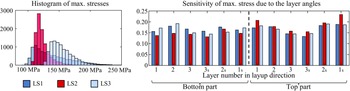
Figure 6 exemplary shows a histogram plot of the max. stresses and a sensitivity plot of max. stress due to the layer angles at all load steps. The layer angles were sampled using an LHS with standard normal distribution (μ = 0, 3σ = 15°) and a sample size of 10000. It can be seen that the stresses are relatively widely distributed, particularly at LSI and LS3, which indicates the influence of the layer angles on the resulting stress. From the sensitivity plot, it can be deduced that layers 2 and 2s of the bottom part have a slightly higher influence on the resulting stresses than the other layers. The outer layers of the top part have the greatest influence on the resulting stresses at LS2, while the influence of the part is lower at the other load steps. The innermost layers have the smallest influence on the stresses. The sensitivities of the top part are generally slightly higher which is in line with the expectations, as this part deflects more and therefore has to be bent more in order to assemble it when unfavorable variation combinations occur.
Histogram of max. stresses and sensitivity plot of max. stress due to the layer angles at all load steps for normally distributed angle variations

5.2. Case study 2
This case study is an example of a frame assembly of a racing seat (Reference Roth, Freitag, Franz, Goetz and WartzackRoth et al., 2024), which consists of a holder and a bracket (Figure 7). The seat is then mounted between two of these sub-assemblies. This is taken into account by the forces introduced in LS4, which represents the attachment of the seat between the two sub-assemblies. In LS5, a load of 100 kg is applied evenly to both sub-assemblies, resulting in a load of 50 kg for the individual sub-assembly. The laminate of the bracket ([0°/+45°/−45°/90°/0°] s ) and the holder ([90°/0°/90°/0°/90°] s ) both have 10 symmetrical layers, resulting in a total thickness of 2 mm.
Boundary constraints and max. deformation of the racing seat assembly

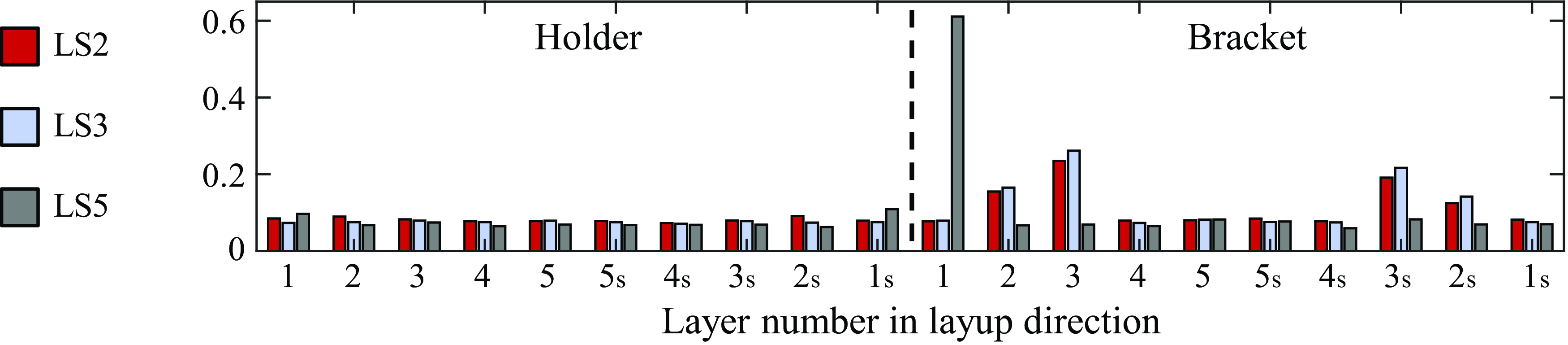
As in the first case study, a surrogate model is then trained by sampling angle variations, performing FEAs and evaluating the outputs. The CPU time of each FEA was 200 seconds for this case study. The trained surrogate models achieve an overall COP of 98.24% for the train data and 91.57% for the test data with only 500 data points for training and 100 for testing. Figure 8 visualizes the sensitivities of the max. stresses due to the sampled layer angles (see Sect. 5.1) at LS2 (curing), LS3 (assembling) and LS5 (operation). As expected, the sensitivities of the bracket are significantly higher, as this part can deform more during curing and the force is applied on this part in operation. The symmetry of the laminate layout of the bracket also shows in the sensitivities from outer to inner layers. In LS5, the individual parts are already assembled, which is why the symmetry is no longer noticeable. It is particularly noticeable that in LS2 and LS3 it is not the outermost layers but layers 2/2S and 3/3S that have the greatest influence on the resulting stresses of the bracket. This information can be helpful in the following steps of the simulation and manufacturing process, as particular attention must be paid to the correct alignment of these layers. At the operational load step (LS5), however, it appears that mostly variations in the angle of the layer 1 of the bracket have an effect on the resulting stresses. This is the layer that lies on the inner side of the bracket and the fiber orientation is in direction of the force. From this it can be deduced that this layer is the most important for achieving lower stresses and may has to be reinforced by additional patches or layers.
Sensitivity plot of max. stress due to the layer angles at load steps for 2, 3 and 5 for normally distributed angle variations

6. Summary and outlook
A framework for the continuous simulation of the production process of CFRP assemblies was proposed, which is able to take into account variations in all process steps. The assembly can then be analyzed further, e.g. by performing a structural analysis taking into account the stresses and deformations resulting from the production process. Furthermore, this simulation approach makes it possible to generate surrogate models with which any results in all process steps can be precisely predicted on the basis of the parameter variations that occur. The models can be used for simulating different variation distributions and analyzing their effect by performing a sensitivity analysis. Moreover, they can serve as the basis for further optimization approaches, e.g. tolerance optimization for optimal tolerance allocation or optimization of the production process. The presented continuous simulation was applied to two case studies, which showed first evidence of the applicability and advantages of the method.
In future research, more variations and especially combinations of different variations have to be considered and analyzed, including fiber waviness, local defects, draping, position and size of layers, curing parameters and assembly parameters. The method can easily be adapted to account for these variations, but it is expected that for a larger number of parameters a larger sample size will be required for surrogate modeling. The simulation of curing in particular was implemented, but was still too time-consuming to be used for larger sample sizes. A full curing simulation takes about 5 to 20 times longer than the linear cooling condition that is used in this work, which is still very time-consuming and limits the sample size. Therefore, advanced sampling methods must be investigated in order to achieve good prediction quality with smaller sample sizes.
Acknowledgments
This research was funded by the Deutsche Forschungsgemeinschaft (DFG, German Research Foundation) – project number 389616685 (WA 2913/29-2).






 Open access

