

Introduction
Today’s fast-paced, performance-driven, and innovation-oriented work environment places increasing demands on organizations to foster high levels of employee engagement and commitment. Additionally, employee well-being is widely accepted as a main prerequisite to achieve organizational success and to comply with businesses’ duty to benefit society at large (Sonnentag, Tay & Nesher Shoshan, Reference Sonnentag, Tay and Nesher Shoshan2023). In this line, the centrality of meaningful work – a subjective work-based experience whereby employees find purpose, significance, and fulfilment in their work (Rosso, Dekas & Wrzesniewski, Reference Rosso, Dekas and Wrzesniewski2010) – emerges as a central determinant of both individual and organizational outcomes. Seligman’s (Reference Seligman2011) PERMA model of well-being, for instance, identifies meaning as one of its five core components, underscoring the centrality of meaningful work for human flourishing. Experiencing meaningful work has been linked to enhanced employee health and well-being (Bowling, Eschleman, Wang, Kirkendall & Alarcon, Reference Bowling, Eschleman, Wang, Kirkendall and Alarcon2010), greater engagement and organizational commitment (Demirtas, Hannah, Gok, Arslan & Capar, Reference Demirtas, Hannah, Gok, Arslan and Capar2017; Meng et al., Reference Meng, Xu, Liu, Zhang, Tong and Lin2022; Steger, Dik & Duffy, Reference Steger, Dik and Duffy2012), as well as to improved innovative behavior and job performance (Amankwaa, Gyensare & Susomrith, Reference Amankwaa, Gyensare and Susomrith2019; Han, Oh & Kang, Reference Han, Oh and Kang2020). These outcomes contribute to organizational effectiveness and long-term success (Autin, Herdt, Garcia & Ezema, Reference Autin, Herdt, Garcia and Ezema2022; Bailey, Yeoman, Madden, Thompson & Kerridge, Reference Bailey, Yeoman, Madden, Thompson and Kerridge2019; Mostafa & Abed El-motalib, Reference Mostafa and Abed El-motalib2020), explaining why meaningful work has garnered increasing attention across fields such as organizational behavior, management, and organizational psychology (Blustein, Lysova & Duffy, Reference Blustein, Lysova and Duffy2023; Chaudhary, Reference Chaudhary2022; Frémeaux & Pavageau, Reference Frémeaux and Pavageau2022; Matsuo, Arai & Matsuo, Reference Matsuo, Arai and Matsuo2019; Vu & Gill, Reference Vu and Gill2023).
Despite the growing recognition of its importance, research on meaningful work remains highly fragmented (Lysova, Allan, Dik, Duffy & Steger, Reference Lysova, Allan, Dik, Duffy and Steger2019), as only a handful of studies have examined factors that contribute to experiencing meaningful work (Autin et al., Reference Autin, Herdt, Garcia and Ezema2022; Chaudhary, Reference Chaudhary2022). Among the predictors explored, supervision has emerged as a central determinant, influencing employees’ perception of task, social, and personal resources that drive meaningful work experiences (Bailey et al., Reference Bailey, Yeoman, Madden, Thompson and Kerridge2019; Frémeaux & Pavageau, Reference Frémeaux and Pavageau2022; Khan, Reference Khan2023; Walumbwa, Christensen & Muchiri, Reference Walumbwa, Christensen, Muchiri, Dik, Byrne and Steger2013). However, prior research has predominantly focused on constructive leadership styles, such as transformational leadership, while largely overlooking the potential associations of destructive leadership styles, including abusive supervision (Bailey et al., Reference Bailey, Yeoman, Madden, Thompson and Kerridge2019). Consequently, a significant gap persists in comprehending how employees’ negative evaluation of leadership styles, specifically abusive supervision, undermines their meaningful work experiences (Bailey et al., Reference Bailey, Yeoman, Madden, Thompson and Kerridge2019).
Abusive supervision is known to erode task-related, social, and personal resources by fostering a hostile work environment, often manifesting as workplace incivility, bullying, or overt hostility (Agarwal, Avey & Wu, Reference Agarwal, Avey and Wu2022; Gallegos, Guàrdia-Olmos & Berger, Reference Gallegos, Guàrdia-olmos and Berger2022; Sun et al., Reference Sun, Zheng, Li, Zhu, Liu, Zhou and Han2022; Tepper, Simon & Park, Reference Tepper, Simon and Park2017; Usman, Liu, Zhang, Ghani & Gul, Reference Usman, Liu, Zhang, Ghani and Gul2022; Wang, Hsieh & Wang, Reference Wang, Hsieh and Wang2020). Such resource depletion has been shown to significantly diminish employees’ experience of meaningful work (Blustein, Lysova & Duffy, Reference Blustein, Lysova and Duffy2023; Lysova et al., Reference Lysova, Allan, Dik, Duffy and Steger2019), suggesting a potential mediational role of key psychological resources in the relationship between abusive supervision and meaningful work. Despite this, limited attention has been devoted to unraveling these proposed underlying mechanisms through which supervision relates to the meaningful work experiences of employees (Matsuo, Arai & Matsuo, Reference Matsuo, Arai and Matsuo2019). This gap persists because most studies (e.g., Ahmad & Fatima, Reference Ahmad and Fatima2023; Chen, Wang & Lee, Reference Chen, Wang and Lee2018; Demirtas et al., Reference Demirtas, Hannah, Gok, Arslan and Capar2017; Meng et al., Reference Meng, Xu, Liu, Zhang, Tong and Lin2022; Mostafa & Abed El-motalib, Reference Mostafa and Abed El-motalib2020; Pradhan & Jena, Reference Pradhan and Jena2019) identify meaningful work as an intervening variable that elucidates the relationship between supervision and various work outcomes, such as engagement, commitment, and performance (Bailey et al., Reference Bailey, Yeoman, Madden, Thompson and Kerridge2019), leaving a gap in understanding how supervisor evaluations shape employees’ meaningful work experiences through the depletion or enhancement of key resources.
At the same time, the shift toward hybrid and remote work represents a relevant contemporary context that has received little attention in the meaningful work literature (Bloom, Han & Liang, Reference Bloom, Han and Liang2024; Byrd, Reference Byrd2022; Magrizos, Roumpi, Georgiadou, Kostopoulos & Vrontis, Reference Magrizos, Roumpi, Georgiadou, Kostopoulos and Vrontis2023). Despite ongoing return-to-office mandates, hybrid and remote arrangements remain prevalent (Buckman, Barrero, Bloom & Davis, Reference Buckman, Barrero, Bloom and Davis2025), reshaping employees’ work experiences and potentially altering the mechanisms through which supervisor perceptions relate to meaningful work (Bloom et al., Reference Bloom, Han and Liang2024; Blustein et al., Reference Blustein, Lysova and Duffy2023). On the one hand, emerging evidence suggests that hybrid and remote workers may face challenges in sustaining meaningful work due to reduced opportunities for building interpersonal relationships, establishing belonging, and receiving recognition from supervisors and colleagues (Antonacopoulou & Georgiadou, Reference Antonacopoulou and Georgiadou2021; Byrd, Reference Byrd2022; Magrizos et al., Reference Magrizos, Roumpi, Georgiadou, Kostopoulos and Vrontis2023; Nemkova, Demirel & Baines, Reference Nemkova, Demirel and Baines2019). On the other hand, the increased autonomy and self-efficacy often associated with hybrid and remote work can enhance perceptions of meaningfulness (Lange & Kayser, Reference Lange and Kayser2022; Vassiley, Shafaei, Nejati, Onnis & Bentley, Reference Vassiley, Shafaei, Nejati, Onnis and Bentley2025; Wells, Scheibein, Pais, Dalluege, Czakert, & Berger, Reference Wells, Scheibein, Pais, Dalluege, Czakert and Berger2023).
In this context, the bulk of existing studies (e.g. Chen et al., Reference Chen, Wang and Lee2018; Frémeaux & Pavageau, Reference Frémeaux and Pavageau2022; Lips-Wiersma, Haar & Wright, Reference Lips-Wiersma, Haar and Wright2020; Pradhan & Jena, Reference Pradhan and Jena2019; Tummers & Knies, Reference Tummers and Knies2013; Vu & Gill, Reference Vu and Gill2023) primarily focuses on office workers and, in some cases, generalizes findings across different employee categories without distinguishing between hybrid or remote and in-office contexts. This has resulted in a limited understanding of how supervisor perceptions are associated with meaningful work in hybrid or remote contexts and whether the mechanisms through which supervisor perceptions are related to meaningfulness are consistent across work arrangements. Crucially, a comparative analysis between hybrid/remote and office workers is needed to determine whether abusive supervision is related differently to meaningful work experiences of hybrid/remote versus in-office employees and to identify the key resources that mediate these relationships.
To address these research gaps, this study examines the indirect relationships of abusive supervision, referring to employees’ perceptions of hostile behaviors enacted by their immediate supervisors, on their experiences of meaningful work across both hybrid/remote and in-office contexts. Consistent with recent leadership research, we focus on follower perceptions as the theoretically proximal drivers of subjective work experiences, while not inferring causal effects of leader behavior (Antonakis et al., Reference Antonakis, Bendahan, Jacquart and Lalive2010; Fisher & Sitkin, Reference Fischer and Sitkin2023).
Specifically, we investigate the underlying mediating mechanisms through which abusive supervision is associated with meaningful work by focusing on three key resources: autonomy (task-related), sense of belonging (social-related), and self-efficacy (personal-related). By exploring these mediating mechanisms, this study aims to clarify how abusive supervision relates to employees’ perceptions of meaningful work and whether these relationships differ across hybrid/remote and office-based work arrangements.
By doing so, this study offers significant contributions to meaningful work and leadership research. First, it extends meaningful work research by moving beyond the conventional emphasis on constructive leadership styles, to consider the role of a destructive style, specifically of abusive supervision, for employees’ work experiences (Bailey et al., Reference Bailey, Yeoman, Madden, Thompson and Kerridge2019). Second, this study is the first to compare indirect resource-depletion pathways from abusive supervision to meaningful work across hybrid/remote and in-office workers.
By examining both hybrid/remote and in-office workers, the study addresses a critical gap in understanding how supervisor evaluations may be differently related to meaningful work in contemporary work arrangements, providing a more nuanced view of contextual variation and focusing on job and psychological resources. Finally, the study advances knowledge of the underlying mechanisms by exploring autonomy, belonging, and self-efficacy as mediators, thereby illuminating the relationship between employees’ perceptions of abusive supervision and their perceptions of meaningful work.
Theory and hypothesis development
A resource-based perspective provides a robust foundation for understanding how perceived supervisor behaviors shape employees’ work experiences by affecting access to valued resources. The Job Demands–Resources (JD-R) (Demerouti, Reference Demerouti2025) model proposes that work characteristics can be classified broadly into job demands and job resources, with demands potentially depleting employee resources and resources supporting motivation, well-being, and positive work outcomes. JD-R’s flexibility in accommodating a wide range of demands and resources makes it well suited for explaining how varied work conditions relate to meaningful work experiences (Bakker & Demerouti, Reference Bakker and Demerouti2017; Demerouti, Reference Demerouti2025). Recent JD-R scholarship also emphasizes that meaningful work itself emerges from sufficient resource availability and motivational processes, positioning meaningfulness as a core outcome of resource-supportive work environments (Demerouti, Reference Demerouti2025). The Conservation of Resource (COR) theory complements this by emphasizing the psychological impact of resource loss and the motivational drive to protect and acquire resources (Hobfoll, Halbesleben, Neveu & Westman, Reference Hobfoll, Halbesleben, Neveu and Westman2018).
Within this framework, supervision functions as a salient contextual condition associated with employees’ resource environments. Abusive supervision operates as a resource-depleting demand, restricting access to task, social, and personal resources and thereby undermining employees’ ability to experience their work as purposeful and fulfilling. The sections that follow specify hypotheses about (a) the association between abusive supervision and meaningful work and (b) the mediating role of key resource types: autonomy (task-related resource), belonging (social resource), and self-efficacy (personal resource) across hybrid/remote and in-office work arrangements.
Abusive supervision and meaningful work
Meaningful work refers to the subjective work-based experience whereby employees find purpose, significance, and fulfillment in their work (Rosso et al., Reference Rosso, Dekas and Wrzesniewski2010). It goes beyond the mere completion of tasks and involves a deeper connection to the broader objectives, values, and goals associated with one’s work (Blustein et al., Reference Blustein, Lysova and Duffy2023). Individuals who perceive their work as meaningful often feel a sense of personal fulfillment, accomplishment, and satisfaction in their professional work. As such, meaningful work is a central factor for sustainable employee well-being and a foundational pillar of Decent Work conditions (Berger & Czakert, Reference Berger, Czakert, Berger and Dalluege2025; Blustein et al., Reference Blustein, Lysova and Duffy2023).
In contrast to the wealth of knowledge regarding the positive relation between, e.g., transformational leaders and employees’ meaningful work experiences (Chen et al., Reference Chen, Wang and Lee2018; Han et al., Reference Han, Oh and Kang2020; Walumbwa et al., Reference Walumbwa, Christensen, Muchiri, Dik, Byrne and Steger2013), very little is known about the effects of abusive supervision on employees’ meaningful work experiences. Abusive supervision can be defined as ‘subordinates’ perception of the extent to which superiors engage in a sustained display of hostile verbal and non-verbal behavior, excluding physical contact’ (Tepper, Reference Tepper2007, p.178). Whereas some studies report low prevalence rates of abusive supervision (Fischer, Tian, Lee & Hughes, Reference Fischer, Tian, Lee and Hughes2021), others frame it as an ‘ubiquitous organizational phenomenon’ (Liao, Lee, Johnson, Song & Liu, Reference Liao, Lee, Johnson, Song and Liu2021, p. 377) or even ‘escalating phenomenon’ (Tariq, Obaid, Burhan, Subhan & Babar, Reference Tariq, Obaid, Burhan, Subhan and Babar2023, p. 505). Yet, scholars widely agree on its relevance, given its association with numerous deleterious outcomes (Fischer et al., Reference Fischer, Tian, Lee and Hughes2021; Tariq et al., Reference Tariq, Obaid, Burhan, Subhan and Babar2023; Tepper et al., Reference Tepper, Simon and Park2017). Following this, we posit that abusive supervision may relate negatively to employees’ experiences of meaningful work. Abusive supervision encompasses perceptions of various behavioral tendencies, such as consistently criticizing subordinates, demoralizing them, appropriating credit for their achievements, neglecting their contributions, raising one’s voice, displaying anger, invading their privacy, or employing tactics of bullying and intimidation (Tepper, Reference Tepper2007; Tepper et al., Reference Tepper, Simon and Park2017).
Research consistently highlights the adverse consequences of abusive supervision on various facets of employees’ well-being and performance as well as the overall quality of their working lives (Gallegos et al., Reference Gallegos, Guàrdia-olmos and Berger2022). Studies by Avey, Agarwal, and Gill (Reference Avey, Agarwal and Gill2022) and Simard and Parent-Lamarche (Reference Simard and Parent-Lamarche2022) indicate that the presence of abusive supervision correlates with diminished job satisfaction, heightened turnover intentions, and adverse impacts on the physical and psychological well-being of employees, thereby influencing their perception of the meaningfulness of their work. Employees subjected to abusive supervision often grapple with heightened stress, anxiety, and emotional exhaustion (Ronen & Donia, Reference Ronen and Donia2020), collectively contributing to the creation of a toxic work environment.
Systematic reviews conducted by Fischer et al. (Reference Fischer, Tian, Lee and Hughes2021) and Gallegos et al. (Reference Gallegos, Guàrdia-olmos and Berger2022) further consolidate the deleterious well-being outcomes associated with abusive supervision, encompassing increased burnout, anxiety, stress, depression, anger, and frustration. Additionally, these reviews identify negative consequences such as decreased task performance, organizational citizenship behaviors, and an increase in counter-productive work behavior, deviant behaviors, and turnover intentions. These multifaceted negative outcomes underscore the pervasive impact of abusive supervisors on various aspects of employees’ professional lives, potentially undermining their experience of meaningful work.
Surprisingly, empirical examinations of the associations between abusive supervisors and the meaning of work remain scarce or absent in reviews (Gallegos et al., Reference Gallegos, Guàrdia-olmos and Berger2022), with Rafferty and Restubog (Reference Rafferty and Restubog2011) being an exception. Their study, conducted in the Philippines, found that abusive supervision indeed negatively influenced the meaningful work experiences of employees. We argue that the perception of abusive supervisors fundamentally undermines the positive aspects of work, creating a challenging environment for employees to derive a sense of purpose, fulfillment, and significance from their professional roles. When an abusive supervisor consistently highlights an individual’s past mistakes and failures or fails to acknowledge significant efforts in a job, it diminishes the individual’s sense of meaningfulness toward their work (Arshad, Sun & Desmarais, Reference Arshad, Sun and Desmarais2021; Rafferty & Restubog, Reference Rafferty and Restubog2011).
In the context of hybrid/remote and office workers, hybrid/remote workers, by nature of their working arrangement, may have reduced or no presence in the office. This physical distance can act as a buffer, providing some insulation from direct and immediate exposure to abusive behaviors that may occur in a traditional office setting. In-office workers, on the other hand, may be more susceptible to the direct and immediate impact of abusive supervision due to their physical proximity to supervisors (Antonacopoulou & Georgiadou, Reference Antonacopoulou and Georgiadou2021; Byrd, Reference Byrd2022; Magrizos et al., Reference Magrizos, Roumpi, Georgiadou, Kostopoulos and Vrontis2023; Nemkova et al., Reference Nemkova, Demirel and Baines2019). Thus, based on the above literature, we state the following hypothesis:
H1: Abusive supervision is negatively associated with employees’ experience of meaningful work, and this direct relationship is stronger for in-office workers than hybrid/remote workers.
The mediating role of autonomy
Existing research underscores the substantial influence of supervisors in shaping task-related resources for employees (Berger, Czakert, Leuteritz & Leiva, Reference Berger, Czakert, Leuteritz and Leiva2019; Czakert & Berger, Reference Czakert and Berger2024). Initially categorized within the realms of either job resources or job demands contingent on the specific leadership approach (Bakker & Demerouti, Reference Bakker and Demerouti2007), recent scholarship has posited leaders as an independent predictive factor directly influencing the job demands and resources of employees (e.g., Bakker, Demerouti & Sanz-vergel, Reference Bakker, Demerouti and Sanz-vergel2023; Berger et al., Reference Berger, Czakert, Leuteritz and Leiva2019; Czakert & Berger, Reference Czakert and Berger2024; Swanzy, Czakert & Berger, Reference Swanzy, Czakert and Berger2025).
The perceived degree of autonomy among employees has consistently emerged as a key predictor of their meaningful work experiences (Lysova et al., Reference Lysova, Allan, Dik, Duffy and Steger2019). The significance of autonomy in fostering meaningful work is supported by various theories and studies. Hackman and Oldham (Reference Hackman and Oldham1976) identified autonomy as one of the five essential characteristics of work contributing to employees’ experience of meaning in their jobs. Ryan and Deci’s (Reference Ryan and Deci2000) self-determination theory (SDT) underscores autonomy as a critical component of the three basic psychological needs, leading to desirable outcomes such as a meaningful work experience. Thwarting autonomy, according to Ryan and Deci (Reference Ryan and Deci2000), may negatively impact the fulfillment of other basic psychological needs, including competence and relatedness, thus affecting the overall psychological well-being crucial for employees to experience the meaningfulness of their work. From the perspective of the JD-R model, autonomy is considered a pivotal job resource that results in favorable outcomes (Bakker et al., Reference Bakker, Demerouti and Sanz-vergel2023; Berger et al., Reference Berger, Czakert, Leuteritz and Leiva2019). The JD-R model posits that job resources are essential for achieving work-related goals, alleviating job demands, and catalyzing personal growth and development (Bakker & Demerouti, Reference Bakker and Demerouti2007). Therefore, providing autonomy to employees is likely to increase their sense of control, freedom, and command they have over their jobs (Chaudhary, Reference Chaudhary2022). This sense of control and freedom may encourage employees to engage in proactive changes and make a positive impact on other employees as well (Grant & Shandell, Reference Grant and Shandell2022). Following this, we argue that abusive supervision relates to employees’ work autonomy, which can subsequently relate to their meaningful work experiences.
Abusive supervision stands as a potent force with adverse consequences for the perception of task-related resources of employees, particularly by fostering a hostile and challenging workplace environment (Brender-Ilan & Sheaffer, Reference Brender-Ilan and Sheaffer2019; Gallegos et al., Reference Gallegos, Guàrdia-olmos and Berger2022). Regarding autonomy, abusive supervisors may impede employees’ perception of autonomy through micromanagement, unclear or no instructions, undermining decision-making authority, and intruding into their personal space. This erosion of autonomy diminishes employees’ perceived control over their work. According to Khan, Moin, Zhu, and Lahlouh (Reference Khan, Moin, Zhu and Lahlouh2023), abusive supervisors diminish the degree of autonomy employees have over their work by burdening them with assignments that impede goal advancement. In alignment with this, Ronen and Donia (Reference Ronen and Donia2020) discovered in their study that abusive supervisors significantly reduced job autonomy among 306 full-time employees across various North American organizations. Additionally, Arshad et al. (Reference Arshad, Sun and Desmarais2021) found that abusive supervisors significantly diminished employees’ psychological empowerment by restricting the autonomy they have in their jobs. Given these findings, we posit that perceived abusive supervision will relate negatively to employees’ perceived autonomy.
Prior literature (Marstand, Epitropaki & Kapoutsis, Reference Marstand, Epitropaki and Kapoutsis2025) offers competing perspectives on whether in-office or hybrid/remote employees are more vulnerable to the perception of abusive supervision. Yet, we argue that these perspectives capture distinct mechanisms rather than mutually exclusive outcomes. Specifically, whereas in-office workers may experience stronger direct relationships due to physical proximity and more frequent exposure to abusive behaviors (see Hypothesis H1), hybrid and remote workers may be more vulnerable to the indirect relationships of abusive supervision because their work context increases reliance on supervisors for access to key task, social, and psychological resources (Czakert & Berger, Reference Czakert and Berger2024; Marstand et al., Reference Marstand, Epitropaki and Kapoutsis2025) and social and contextual cues (Rasheed, Weng, Umrani & Moin, Reference Rasheed, Weng, Umrani and Moin2021; Rudolph, Allan, Clark, Hertel, Hirschi, Kunze, & Zacher, Reference Rudolph, Allan, Clark, Hertel, Hirschi, Kunze and Zacher2021). As a result, resource loss may be more important in hybrid/remote settings, amplifying indirect relations with meaningful work.
Following this, one could argue that autonomy related to work schedule and work location is inherent to remote and hybrid work settings, and even degrees of decision-making and method autonomy are often higher when not working in the office (George, Maneethai, Atwater & Madera, Reference George, Maneethai, Atwater and Madera2025). Consequently, autonomy may represent a particularly salient psychological resource in these work arrangements because it enables employees to manage their work independently, exercise discretion, and experience greater ownership over how tasks are accomplished (Höcker, Bachtal, Voll & Pfnür, Reference Höcker, Bachtal, Voll and Pfnür2024). This heightened importance of autonomy suggests that threats to employees’ sense of control may carry stronger consequences in hybrid and remote contexts than in traditional co-located settings.
Moreover, while hybrid/remote working is often assumed to grant employees greater freedom, the realization of this autonomy frequently depends on supervisory practices and expectations (Ronen & Donia, Reference Ronen and Donia2020). In virtual environments, abusive supervisors may undermine perceived autonomy through excessive monitoring, intrusive communication, digital surveillance, or ICT-enabled micromanagement, thereby constraining employees’ discretion over when, where, and how work is performed (Carnevale & Hatak, Reference Carnevale and Hatak2020; Wells et al., Reference Wells, Scheibein, Pais, Dalluege, Czakert and Berger2023). Such behaviors may be especially detrimental in hybrid and remote settings because they erode a resource that employees not only expect to possess but also rely upon for effective functioning and meaningful work experiences. Due to this pronounced role of autonomy, particularly for the beneficial functioning of remote and hybrid settings, we hypothesize:
H2a: Work autonomy will mediate the negative relationship between abusive supervision and the meaningful work of both office and hybrid/remote workers.
H2b: The mediating mechanism of autonomy between abusive supervision and meaningful work is stronger for hybrid/remote workers than for in-office workers.
The mediating role of self-efficacy
While autonomy captures the extent to which employees have control over their work, the experience of meaningful work also depends on how capable the employees perceive themselves to be in performing their tasks (Martela & Riekki, Reference Martela and Riekki2018). In this regard, self-efficacy represents a central personal resource that complements autonomy by reflecting employees’ perceived competence and capability in their work roles. Self-efficacy is defined as ‘people’s judgments of their capabilities to organize and execute courses of action required to attain designated types of performances’ (Bandura, Reference Bandura1986, p. 94). In short, one feels that one is capable of what one does and is able to accomplish projects and achieve one’s goal. Work-related self-efficacy has often been considered one of the key personal resources to achieve beneficial well-being and performance outcomes. The social cognitive theory argues that self-efficacy is based on four sources that include enactive mastery experience, vicarious learning, social persuasion, and physical states (Bandura, Reference Bandura1986).
Previous research has found that self-efficacy as a personal resource is linked to the experience of meaningful work (Martela & Riekki, Reference Martela and Riekki2018). In fact, it has been argued that the absence of self-efficacy is what makes our efforts meaningless (Baumeister, Bratslavsky, Finkenauer & Vohs, Reference Baumeister, Bratslavsky, Finkenauer and Vohs2001). In turn, when we perceive self-efficacy, we invoke more meaning into our task accomplishments at work and tie it to our valuable self-concepts. Alike autonomy, self-efficacy is a fundamental psychological need underpinned by SDT. Often used interchangeably with the satisfaction of the need for competence, self-efficacy is therefore a critical component of the three basic psychological needs, leading to desirable outcomes such as meaningful work experience. In recent years, self-efficacy and its link to meaningful work have been considered under threat due to the rise of artificial intelligence (e.g., Winter, Turk & Winter, Reference Winter, Turk and Winter2025).
Despite technological threats that might thwart perceptions of self-efficacy and thereby meaningful work, we contend that abusive supervision is negatively related to the self-efficacy of their subordinates, emanating from the negative and hostile behaviors they perpetuate. These behaviors are often evaluated as persistent criticism, belittling, and demoralizing employees by emphasizing their mistakes and failures (Farh & Chen, Reference Farh and Chen2014; Tepper et al., Reference Tepper, Simon and Park2017), which may lead to negative social persuasion. The continuous exposure to such negative conduct erodes employees’ confidence and perceived competence in accomplishing their tasks, leading to a decline in self-efficacy and negative mastery experiences (Rasheed et al., Reference Rasheed, Weng, Umrani and Moin2021). Also, abusive leaders may increase workplace stressors such as role stress, workload, and job insecurity. This increase in work stressors can have deleterious effects on employees’ self-efficacy as they interfere with successful job performance (Bowling et al., Reference Bowling, Eschleman, Wang, Kirkendall and Alarcon2010). Additionally, abusive supervisors may appropriate credit for their employees’ accomplishments while neglecting their contributions (Tepper et al., Reference Tepper, Simon and Park2017), diminishing the sense of achievement and the probability of vicarious learning opportunities, while fostering a perception of incompetence and perceived negative social persuasions. Unfavorable affect and emotional states resulting from abusive supervision undermine the necessary emotional conditions to experience self-efficacy (Bandura, Reference Bandura1986; Gallegos et al., Reference Gallegos, Guàrdia-olmos and Berger2022).
Self-efficacy plays a particularly important role in hybrid and remote settings, compared to in-office settings (Qi, Xu & Liu, Reference Qi, Xu and Liu2023). Adding to this, Rudolph et al. (Reference Rudolph, Allan, Clark, Hertel, Hirschi, Kunze and Zacher2021) argue that hybrid/remote employees face amplified self-efficacy threats due to ambiguity, evaluation anxiety, and impression management demands when not physically present. Moreover, hybrid and remote work arrangements often provide fewer opportunities for employees to demonstrate their competence through informal interactions, receive spontaneous feedback, or gain visibility for their contributions (Nemkova et al., Reference Nemkova, Demirel and Baines2019; Wells et al., Reference Wells, Scheibein, Pais, Dalluege, Czakert and Berger2023). In other words, when distance from the workplace increases, employees’ belief in their capacity to complete tasks remotely becomes more salient for performance and well-being outcomes (Tramontano, Grant & Clarke, Reference Tramontano, Grant and Clarke2021). Therefore, as out-of-office substantially relies on individual abilities, self-regulation, and individual initiative to perform tasks effectively, we contend that self-efficacy is more strongly related to meaningful work in such settings. When abusive supervisors undermine competence through criticism, withholding recognition, or negative signaling, the resulting blow to self-efficacy is especially harmful for remote workers, who have fewer social and contextual cues to restore confidence (Rasheed et al., Reference Rasheed, Weng, Umrani and Moin2021; Rudolph et al., Reference Rudolph, Allan, Clark, Hertel, Hirschi, Kunze and Zacher2021). Moreover, ICT-enabled supervision practices such as electronic monitoring and micromanagement can intensify perceived incompetence and reduce employees’ sense of capability (Carnevale & Hatak, Reference Carnevale and Hatak2020; Molino, Cortese & Ghislieri, Reference Molino, Cortese and Ghislieri2019). We therefore hypothesize the following:
H3a: Self-efficacy will mediate the negative relationship between abusive supervision and the meaningful work of both office and hybrid/remote workers.
H3b: The mediating mechanism of self-efficacy between abusive supervision and meaningful work is stronger for hybrid/remote workers than for in-office workers.
The mediating role of belonging
Belongingness is a social resource and refers to the fundamental psychological need to feel accepted, valued, and connected to others within a group or organization (Baumeister & Leary, Reference Baumeister and Leary1995; Ryan & Deci, Reference Ryan and Deci2000). It encompasses employees’ perceptions that they are legitimate and integral members of their work community and that they share mutual commitment and identification with colleagues (Leuteritz, Navarro, Czakert & Berger, Reference Leuteritz, Navarro, Czakert and Berger2022). As a social resource, belongingness has consistently been linked to work-related well-being (Seligman, Reference Seligman2011), engagement, and motivation, as it fulfills the basic need for relatedness described in SDT (Ryan & Deci, Reference Ryan and Deci2000).
A growing body of research identifies belongingness as a key contributor to meaningful work experiences. When employees feel that they are part of a valued social group, they are more likely to perceive their roles as significant and tied to a broader purpose (Lips-Wiersma et al., Reference Lips-Wiersma, Haar and Wright2020; Martela & Riekki, Reference Martela and Riekki2018). In contrast, reduced perceptions of belonging have been associated with reduced perceptions of meaning, engagement, and contribution (Chaudhary, Reference Chaudhary2022). Put differently, meaningful work is not only constructed individually, but socially embedded through interaction, affirmation, and shared identity in the workplace.
Abusive supervision is considered to pose a serious threat to belongingness by fostering climates of exclusion, interpersonal hostility, and social invalidation. Abusive supervisors may humiliate, ignore, isolate, or demean subordinates, directly severing the social bonds that sustain group identification and perceived acceptance (Rafferty & Restubog, Reference Rafferty and Restubog2011; Tepper, Reference Tepper2000). Empirical research has shown that abusive supervision undermines employees’ sense of belonging by communicating that they do not matter, are not respected members of the work group, or are peripheral to team identity (Eissa, Wyland & Gupta, Reference Eissa, Wyland and Gupta2020; Yang, Zheng, Liu, Lu & Schaubroeck, Reference Yang, Zheng, Liu, Lu and Schaubroeck2020). These experiences may heighten feelings of alienation, detachment, and relational insecurity, weakening the social foundations necessary for meaningful work.
Recent studies further suggest that belongingness is especially salient in hybrid and remote working arrangements. Specifically, physical distance from coworkers reduces informal interaction, spontaneous affirmation, and social visibility, making employees more reliant on limited supervisory and team-based cues to maintain a sense of connection (Byrd, Reference Byrd2022; Peters & Jetten, Reference Peters, Jetten and Prislin2025). In these contexts, supervisors often become a more prominent source of social support, recognition, and interpersonal connection because opportunities for collegial interaction are comparatively constrained (Czakert, Reference Czakert2024; Magrizos et al., Reference Magrizos, Roumpi, Georgiadou, Kostopoulos and Vrontis2023). Consequently, abusive supervision may be particularly associated with employees’ sense of belonging, as it weakens an important relational resource within the work environment. Hybrid and remote workers are also more vulnerable to social fragmentation and misrecognition, which intensifies the harm caused by exclusionary or demeaning leader behavior (Contreras, Baykal & Abid, Reference Contreras, Baykal and Abid2020). When belongingness is threatened under virtual or hybrid conditions, employees may struggle to maintain identification with collective values or see their contributions as socially meaningful.
In-office employees, by contrast, often have access to additional relational cues and informal contact with coworkers that may temper the negative relationship between abusive supervision and belongingness. Physical proximity may also offer opportunities to seek social support, observe group dynamics more accurately, or reaffirm social identity through everyday interactions. Thus, belongingness may exert a comparatively stronger mediating role in hybrid or remote contexts, where social deprivation heightens dependence on the leader as a primary conduit of workplace inclusion.
Given the above theorizing, we propose the following hypotheses:
H4a: Belongingness will mediate the negative relationship between abusive supervision and the meaningful work of both office and hybrid /remoteworkers.
H4b: The mediating mechanism of belongingness between abusive supervision and meaningful work is stronger for hybrid/remote workers than for in-office workers.
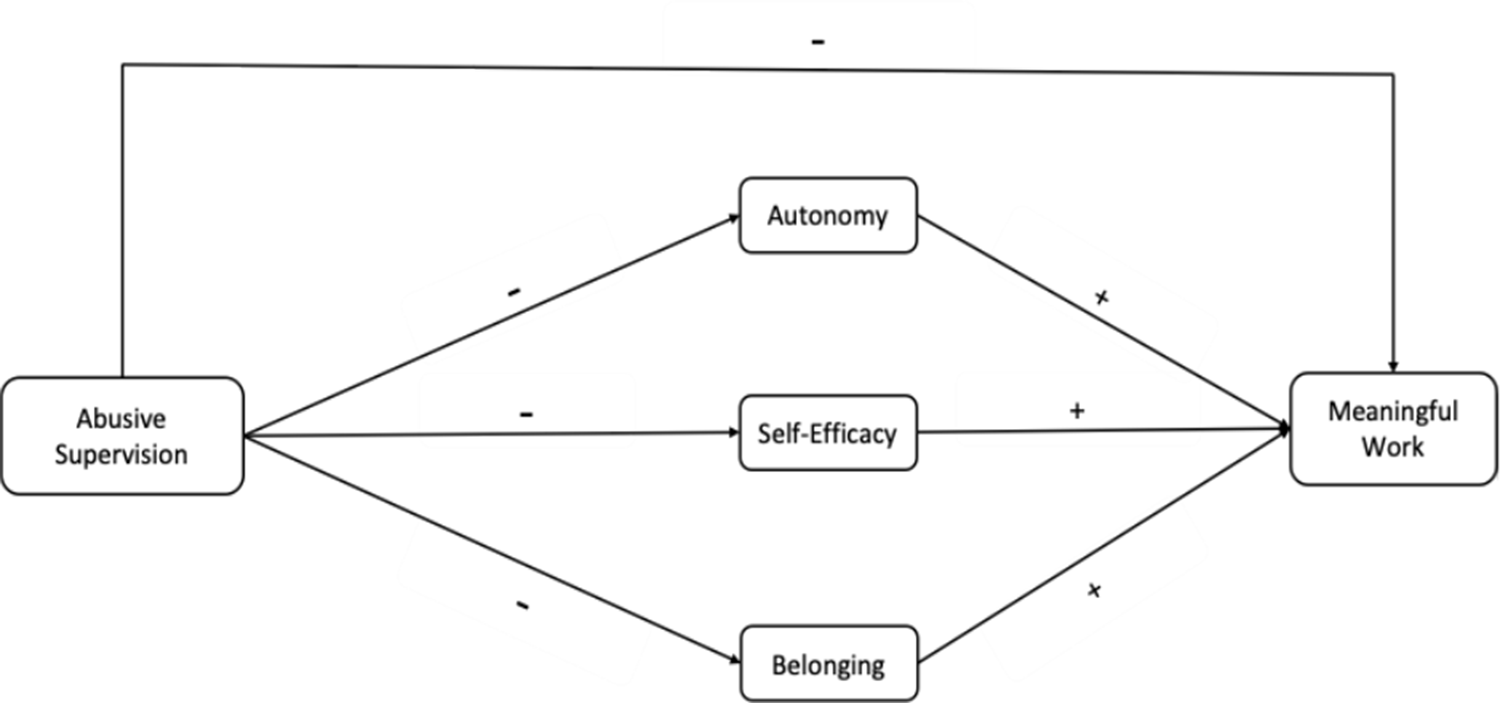
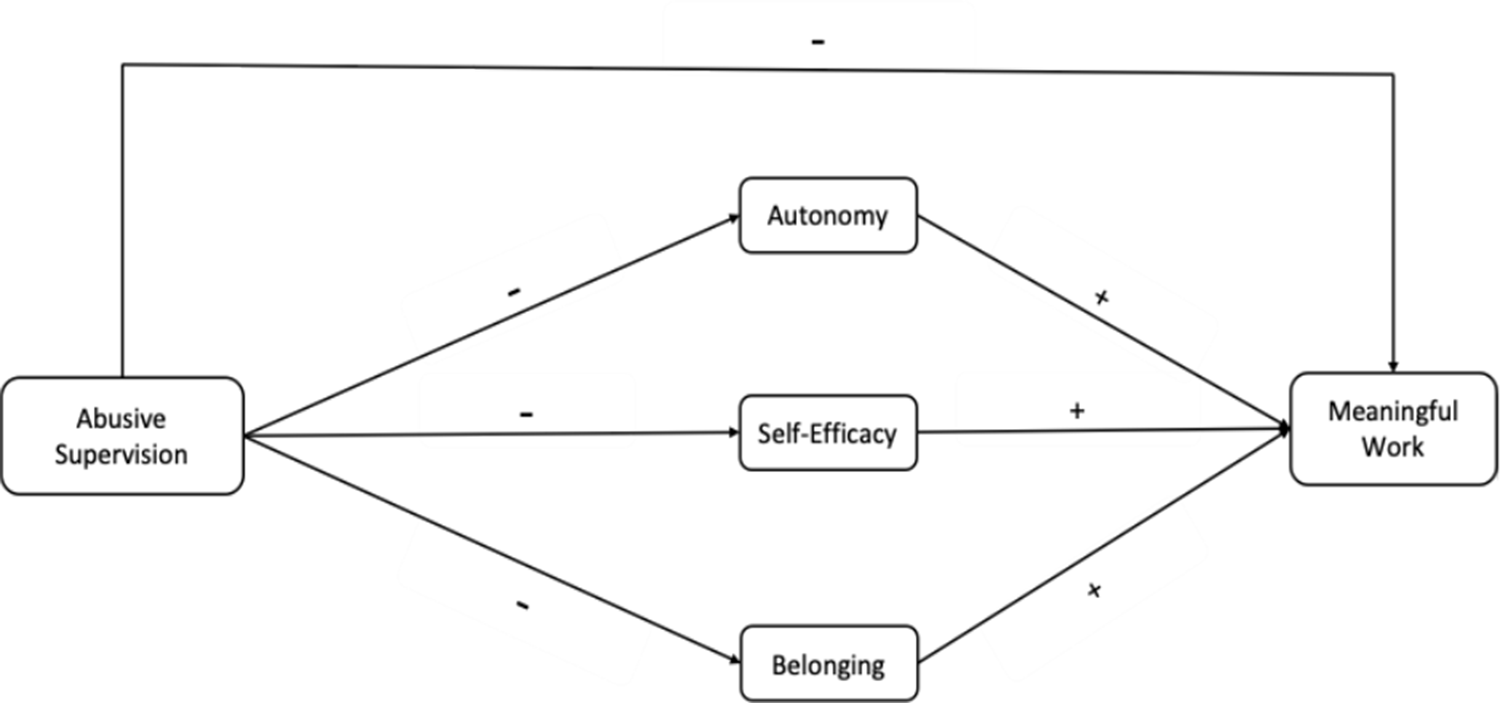
The hypothesized research model is presented in Figure 1.
The research model.
Method
Participants and procedures
Participants were recruited as part of a larger European project (Project No. 020-1-ES01-KA203-083282). Data were cross-sectionally collected using an online Qualtrics survey. All procedures received approval from the Institutional Review Boards (IRB00003099). The measures were translated following the International Test Commission Guidelines (ITC, 2017).
In total, 512 employees took part in the study, with 208 respondents based in Spain and 304 in Portugal. In terms of employment status, the majority of participants were employed full-time (79.3%, n = 406), followed by part-time employees (13.1%, n = 67). Smaller proportions identified as students (5.9%, n = 30) or self-employed (1.8%, n = 9).
Regarding educational attainment, most participants held a bachelor’s degree (39.3%, n = 201), while 25.6% (n = 131) had completed secondary school education. Participants with a master’s degree represented 15.6% (n = 80) of the sample, and 12.7% (n = 65) reported having completed trade, technical, or vocational training. Smaller proportions reported primary school education (2.3%, n = 12), doctoral degrees (1.0%, n = 5), or other educational qualifications (3.5%, n = 18).
Occupationally, participants were drawn from a broad range of sectors. The largest proportion worked in Professional and Administrative Services (32.06%, n = 160), followed by Health (16.63%, n = 83), Education and Research (15.03%, n = 75), Manufacturing and Engineering (11.22%, n = 56), and IT and Telecommunications (9.02%, n = 45). Smaller proportions were employed in Hospitality, Retail, and Tourism (6.81%, n = 34), Financial Services (4.21%, n = 21), Transport and Logistics (2.61%, n = 13), Agriculture and Food Production (1.20%, n = 6), and Public Safety and Operational Services (1.20%, n = 6). Thirteen participants did not indicate their occupational sector. Overall, the sample reflected a heterogeneous workforce across service-oriented, technical, educational, and industrial occupations.
The sample comprised 199 hybrid or remote workers and 313 in-office workers. Among hybrid/remote workers, 59.3% were female (n = 118), 30.7% male (n = 61), 4.5% identified as a third gender (n = 9), and 5.5% preferred not to disclose their gender (n = 11). Regarding age distribution, 26.1% were aged 35–49 years (n = 52), 25.6% were 18–24 years (n = 51), 25.1% were 25–34 years (n = 50), and 0.5% were 65 years or older (n = 1). Among in-office workers, 56.5% were female (n = 177), 30.4% male (n = 95), 6.7% identified as a third gender (n = 21), and 6.4% preferred not to say (n = 20). In terms of age, 35.1% were 35–49 years (n = 110), 23.0% were 18–24 years (n = 72), 21.1% were 25–34 years (n = 66), and 20.8% were 50–65 years (n = 65).
Measures
All constructs were assessed using validated three-item subscales on a 5-point Likert scale (1 = strongly disagree, 5 = strongly agree). Higher scores reflected higher levels of each construct.
Abusive supervision. Abusive supervision was measured with a three-item short form of Tepper’s (Reference Tepper2000) scale (e.g., ‘My boss makes negative comments about me to others,’ ‘My supervisor invades my privacy,’ ‘My supervisor doesn’t give me credit for jobs requiring a lot of effort’). Cronbach’s alpha was α = .71 (hybrid workers) and α = .64 (in-office workers).
Meaningful work. Meaningfulness was assessed using the three-item version of the Work and Meaning Inventory (Steger et al., Reference Steger, Dik and Duffy2012): ‘I have a good sense of what makes my job meaningful,’ ‘My work helps me make sense of the world around me,’ ‘The work I do serves a greater purpose.’ Cronbach’s alpha was α = .79 (hybrid workers) and α = .77 (in-office workers).
Autonomy. Perceived autonomy was measured with three items from Breaugh (Reference Breaugh1985): ‘I can make my own decisions about how to schedule my work,’ ‘I am allowed to decide how to go about getting my job done (the methods to use),’ ‘I am able to modify what my job objectives are (what I am supposed to accomplish).’ Cronbach’s alpha was α = .77 for both samples.
Self-efficacy. Self-efficacy was assessed using three items based on Salanova, Schaufeli, Llorens Gumbau, Peiró Silla, and Grau Gumbau (Reference Salanova, Schaufeli, Llorens Gumbau, Peiró Silla and Grau Gumbau2000), for instance, ‘In my opinion, I am good at my job’ ‘In my work, I am confident that I am effective in getting things done,’ ‘I contribute effectively to the goals of my organization.’ Cronbach’s alpha was α = .85 (hybrid workers) and α = .86 (in-office workers).
Belongingness. Belongingness was measured with three items based on Leuteritz et al. (Reference Leuteritz, Navarro, Czakert and Berger2022): ‘We feel we are an important part of this group,’ ‘We share tools, resources and information,’ ‘Members feel committed to the achievement of the group objectives.’ Cronbach’s alpha was α = .81 (hybrid workers) and α = .75 (in-office workers).
Age and gender were controlled for in this study.
Analytical strategy
Analyses were conducted in two steps: preliminary and main analyses. Preliminary analyses such as model fit, reliability, and validity indices were conducted using SMARTPLS. SPSS was used to examine descriptive statistics, including mean, standard deviation, and correlations between variables. SPSS PROCESS was used to examine the main analyses (Model 4). Indirect effects were analyzed using the bootstrap approach based on 5,000 bootstrap samples with a 95% confidence interval, following the recommendation of Hayes (Reference Hayes2020).
Results
Measurement model
The Confirmatory Factor Analysis (CFA) indicated a satisfactory fit for the hypothesized model for both hybrid (χ2 (80) = 124.1, χ2/df = 1.56; CFI = 0.96; TLI = 0.95; RMSEA = 0.053; SRMR = 0.052) and in-office workers (χ2 (80) = 152.9, χ2/df = 1.91; CFI = 0.95; TLI = 0.94; RMSEA = 0.054; SRMR = 0.055). All standardized loadings were within acceptable ranges for both hybrid/remote workers (0.60–0.86) and in-office workers (0.52–0.89), signifying a good convergent validity. Composite reliability scores also ranged from 0.71 to 0.85 for hybrid/remote workers and from 0.67 to 0.86 for in-office workers. Average Variance Extracted (AVE) for both groups of workers exceeded the recommended threshold of 0.50, except for abusive leaders, which fell slightly below the recommended threshold for both groups of workers. However, Fornell and Larcker (Reference Fornell and Larcker1981) contend that lower AVE can be acceptable if composite reliability scores exceed 0.60.
Descriptive findings
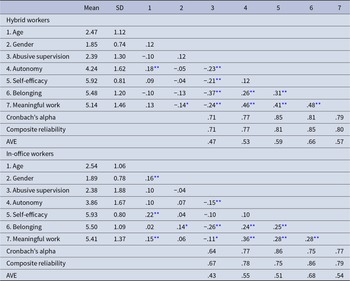
Descriptive statistics and bivariate correlations were calculated to show the average scores and associations between the study’s variables. Results showed that abusive supervision was negatively associated with belongingness, autonomy, self-efficacy, and meaningful work in both groups. In contrast, autonomy, belongingness, and self-efficacy were positively associated with meaningful work. Correlation strengths ranged from small to moderate in magnitude (see Table 1).
Descriptive statistics, correlations, reliability, and validity indices (N = 512)
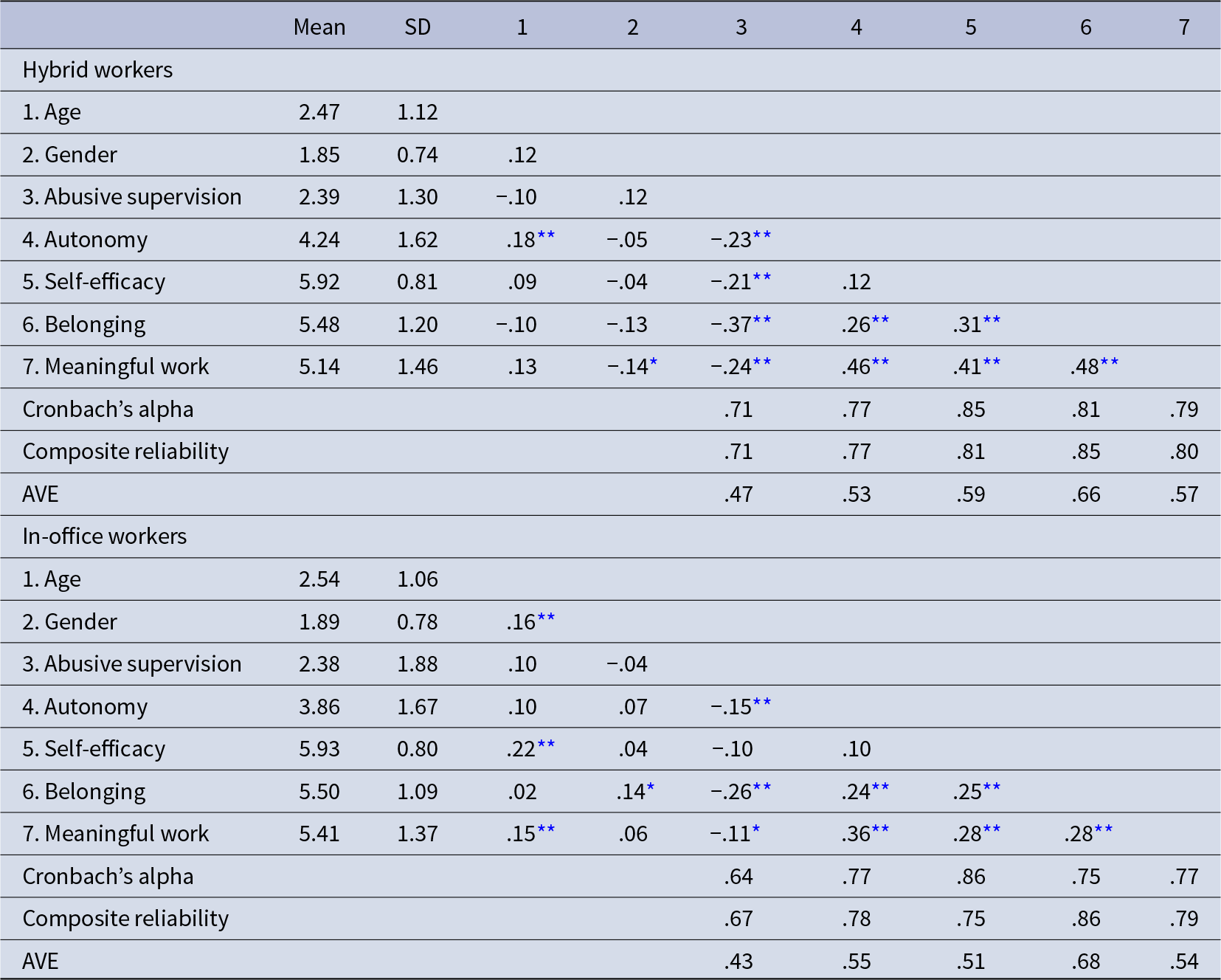
Table 1 Long description
The table reports means, standard deviations, and correlations among age, gender, abusive supervision, autonomy, self-efficacy, belongingness, and meaningful work for hybrid/remote and in-office workers, plus reliability and validity indices for the multi-item scales. For hybrid and remote workers, abusive supervision relates to lower autonomy, self-efficacy, belonging, and meaningful work, with the strongest association being with belonging. For in-office workers, abusive supervision also relates to lower autonomy, belonging, and meaningful work, while its link with self-efficacy is small and not statistically reliable. Autonomy shows a strong positive relationship with meaningful work in both groups, and it is also positively related to belonging, especially for hybrid and remote workers. Self-efficacy is positively related to belongingness and meaningful work in both groups, with larger associations among hybrid workers. Mean levels are similar across groups, with hybrid workers reporting slightly higher autonomy and slightly lower meaningful work than in-office workers. Internal consistency and composite reliability are generally acceptable across constructs, though abusive supervision is lower for in-office workers; average variance extracted values are moderate, suggesting convergent validity is adequate but not uniformly strong. Correlations indicate associations only and do not establish cause and effect.
AVE = average variance extracted.
** Note: p < .01, * p < .05.
Hypotheses testing
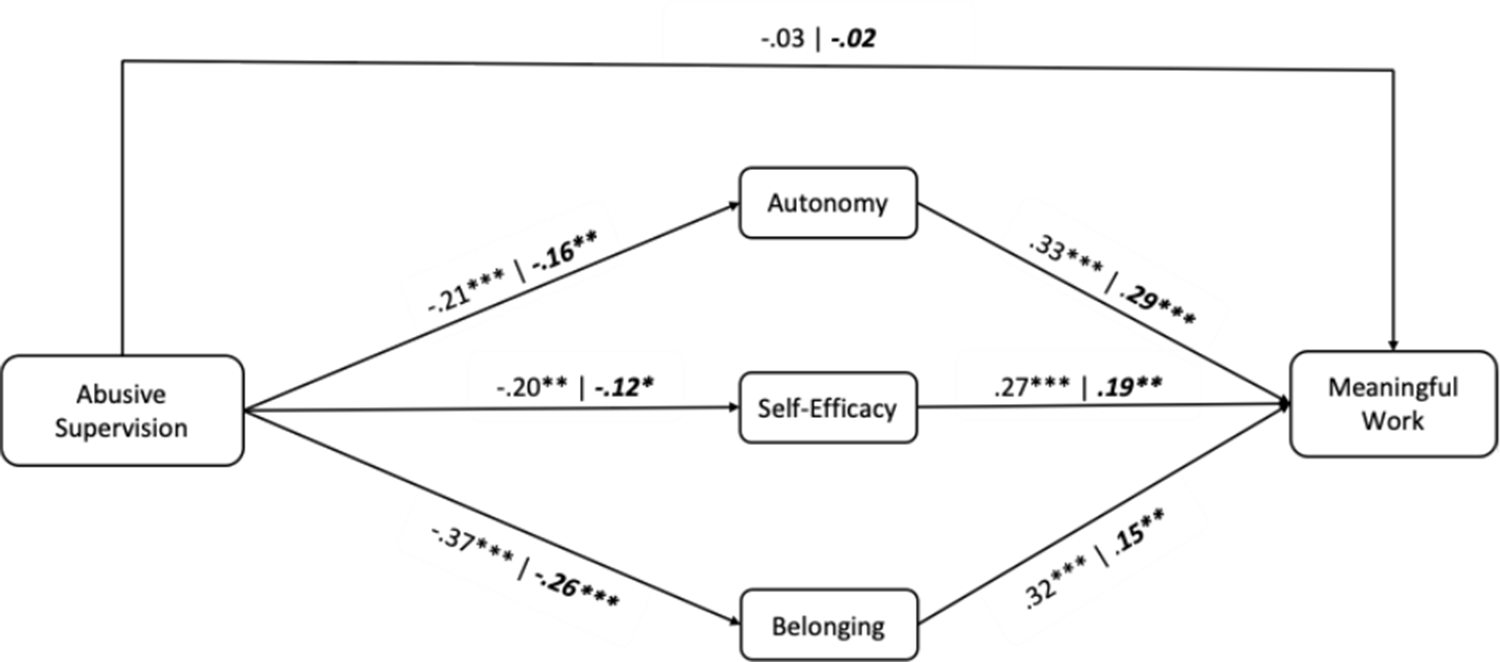
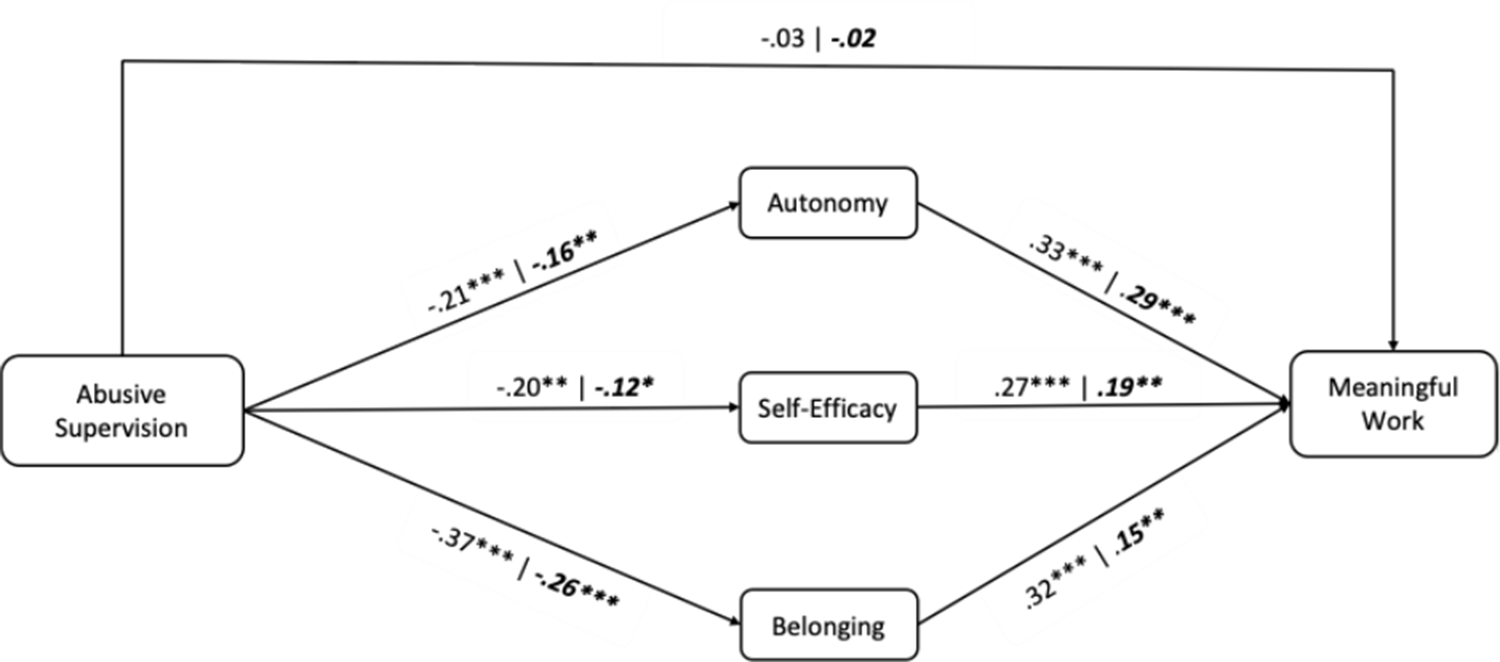
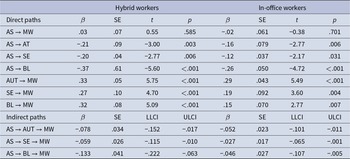
The findings displayed in Table 2 and Fig. 2 illustrated the direct and indirect relationships between abusive supervision and both hybrid and in-office workers’ meaningful work.
Abusive supervision’s relationship with meaningful work via psychological resources.
Results of direct and indirect effects of abusive supervision (N = 512)
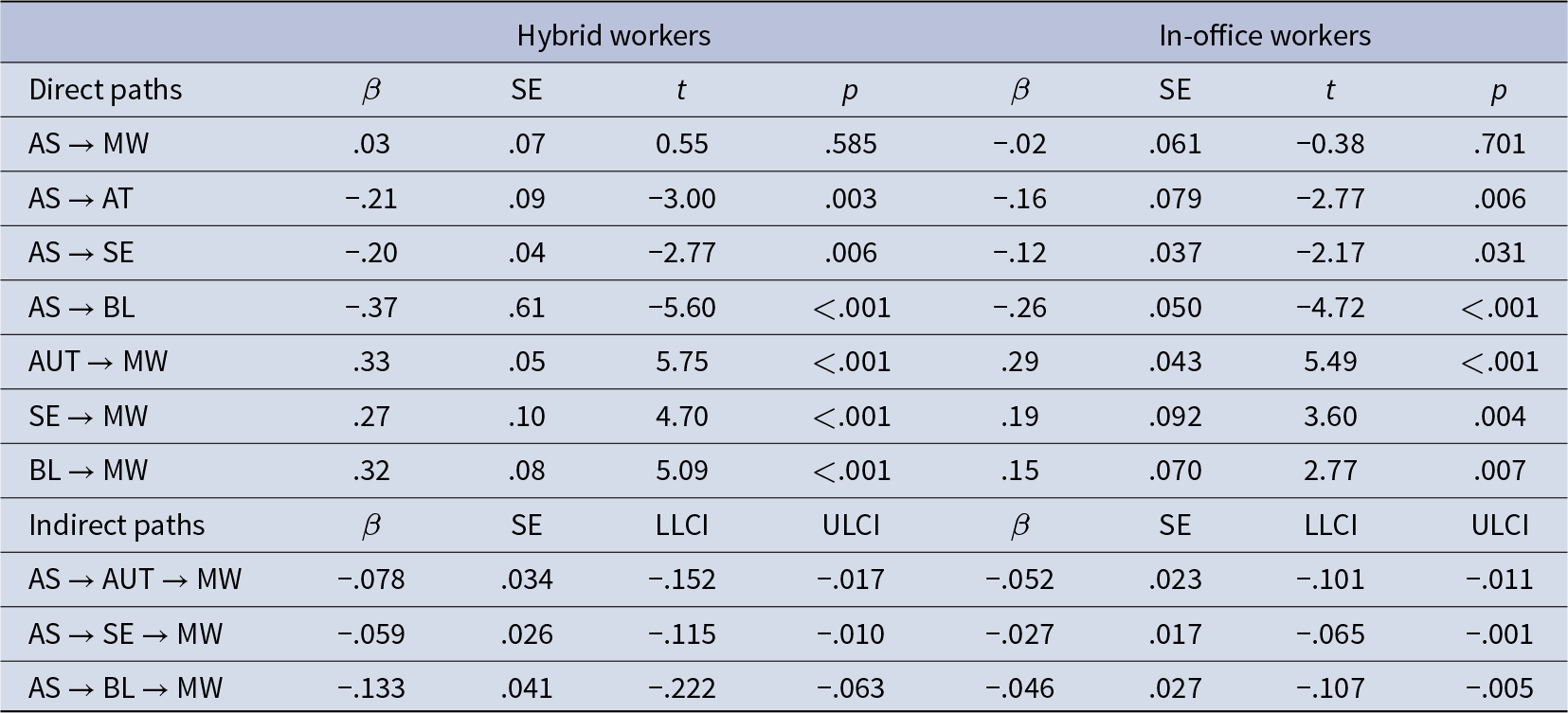
Table 2 Long description
The table reports standardized effects for hybrid/remote and in-office workers, testing how abusive supervision relates to meaningful work directly and through autonomy, self-efficacy, and belongingness. In both groups, abusive supervision has no meaningful direct link to meaningful work, but it is linked to lower autonomy, lower self-efficacy, and lower belonging, with statistically significant tests. Autonomy, self-efficacy, and belonging are each positively linked to meaningful work for both groups, with the strongest positive links generally for autonomy and belonging. Indirect effects show abusive supervision reduces meaningful work through all three mediators in both groups, with confidence intervals that do not include zero. The indirect pathway through belonging is the largest in the hybrid group, while all three indirect pathways are smaller in the in-office group. Overall, the pattern suggests abusive supervision undermines meaningful work mainly by reducing key psychological resources rather than through a direct effect, and effect sizes differ by work arrangement.
Note: SE = standard error; LLCI: 95% bootstrap BCa confidence interval lower limit; ULCI = 95% bootstrap BCa confidence interval upper limit; AS = abusive supervision; MW = meaningful work; AT = autonomy; BL = belonging; SE = self-efficacy.
Direct effects
Direct effects were interpreted as direct associations. Hypothesis 1 predicted that abusive supervision would be negatively associated with employees’ experiences of meaningful work, with a stronger association for in-office workers compared to hybrid and remote workers. The results did not support this hypothesis. Abusive supervision was not significantly related to meaningful work for hybrid/remote workers (β = .03, p = .585) nor for in-office workers (β = –.02, p = .701). Although no direct effect was observed, abusive supervision significantly predicted all three mediators for both groups. Specifically, abusive supervision was negatively associated with autonomy among hybrid/remote (β = – .21, p = .003) and in-office workers (β = –.16, p = .006), with self-efficacy for hybrid (β = – .20, p = .006) and in-office workers (β = –.12, p = .031), and with belongingness for hybrid (β = –.37, p < .001) and in-office workers (β = –.26, p < .001). Across all relationships between abusive supervision and the three mediators, the relationships were consistently stronger for hybrid/remote workers than for in-office workers, suggesting that hybrid employees may be more sensitive to the psychological consequences of abusive supervision even though the direct association with meaningful work was not significant.
In turn, autonomy (β = .33, p < .001 for hybrid; β = .29, p < .001 for in-office), self-efficacy (β = .27, p < .001 for hybrid; β = .19, p = .004 for in-office), and belongingness (β = .32, p < .001 for hybrid/remote; β = .15, p = .007 for in-office) were each positively associated with meaningful work. Notably, these associations were consistently stronger among hybrid and remote workers, indicating that their experience of meaningful work is more strongly shaped by fluctuations in autonomy, self-efficacy, and belongingness compared to in-office workers.
Mediational effects
Mediational effects were interpreted as indirect associations. Hypothesis 2a proposed that autonomy would mediate the negative relationship between abusive supervision and meaningful work for both hybrid/remote and in-office workers. This hypothesis was supported. Abusive supervision indirectly reduced meaningful work through diminishing autonomy for hybrid and remote workers (β = –.078, 95% CI[–.152, –.017]) and for in-office workers (β = – .052, 95% CI[–.101, –.011]). Consistent with Hypothesis 2b, this indirect effect was stronger for hybrid/remote workers, indicating that abusive supervision relates to hybrid employees’ experience of meaningful work via reductions in autonomy more strongly than it does for in-office workers.
Hypothesis 3a predicted that self-efficacy would mediate the relationship between abusive supervision and meaningful work in both work settings. This hypothesis was supported. Significant indirect effects were found for hybrid and remote workers (β = –.059, 95% CI [–.115, –.010]) and for in-office workers (β = –.027, 95% CI [–.065, –.001]). Supporting Hypothesis 3b, the indirect effect was stronger among hybrid/remote workers, suggesting that abusive supervision undermines meaningful work through reduced self-efficacy more substantially in hybrid and remote contexts than in in-office settings.
Hypothesis 4a proposed that belongingness would mediate the relationship between abusive supervision and meaningful work for both groups. This hypothesis was supported. The indirect effect through belongingness was significant for hybrid workers (β = –.133, 95% CI[–.222, –.063]) and for in-office workers (β = –.046, 95% CI[–.107, –.005]). Consistent with Hypothesis 4b, the indirect effect was markedly stronger among hybrid and remote workers. This indicates that feelings of belongingness are more strongly influenced by abusive supervision in hybrid/remote arrangements, which in turn has a greater detrimental effect on meaningful work for hybrid and remote employees compared to in-office workers.
Across all three mediating mechanisms – autonomy, self-efficacy, and belongingness – the indirect effects were consistently stronger for hybrid/remote workers compared to in-office workers. These results indicate that, although abusive supervision does not directly reduce meaningful work, it exerts a substantially stronger indirect influence among hybrid and remote employees by more deeply eroding the psychological resources that foster meaningfulness. Furthermore, the pattern of mediation differed by work arrangement. For hybrid workers, abusive leadership is most strongly related to meaningful work through belongingness, followed by autonomy and self-efficacy. In contrast, for in-office workers, autonomy emerged as the most salient pathway through which abusive supervision diminished meaningfulness, followed by belongingness and then self-efficacy.
Discussion
The present study examined how abusive supervision relates to employees’ experience of meaningful work through key task-related, personal, and social resources – namely autonomy, self-efficacy, and belongingness – and whether these indirect relationships differ across hybrid/remote and in-office work arrangements. Consistent with prior theorizing (Martela & Riekki, Reference Martela and Riekki2018; Rosso et al., Reference Rosso, Dekas and Wrzesniewski2010; Ryan & Deci, Reference Ryan and Deci2000), the findings reinforce that these resources are central mechanisms underpinning meaningful work. Across both work arrangements, abusive supervision was associated with lower autonomy, self-efficacy, and belongingness, which in turn related to lower meaningful work. Notably, abusive supervision showed no direct relationship with meaningful work, suggesting that its influence operates primarily through resource-depletion processes. This pattern is consistent with JD-R and COR perspectives, which propose that adverse work conditions affect employee outcomes by eroding critical resources.
Importantly, these indirect relationships were consistently stronger among hybrid and remote workers than among in-office employees. This finding suggests that the consequences of abusive supervision depend on contextual features of work arrangements that shape employees’ reliance on task-related, personal, and social resources for meaning-making.
Several mechanisms may explain this heightened vulnerability. First, virtual work environments provide fewer contextual and interpersonal cues, making supervisory behaviors more ambiguous and potentially more difficult to interpret (Nemkova et al., Reference Nemkova, Demirel and Baines2019). Such ambiguity may undermine employees’ ability to make sense of negative supervisory experiences, an important process in constructing meaningful work (Lips-Wiersma et al., Reference Lips-Wiersma, Haar and Wright2020; Rosso et al., Reference Rosso, Dekas and Wrzesniewski2010). Furthermore, although autonomy is often viewed as a defining advantage of flexible work arrangements (George et al., Reference George, Maneethai, Atwater and Madera2025; Höcker et al., Reference Höcker, Bachtal, Voll and Pfnür2024), abusive supervision may erode this resource through excessive monitoring, intrusive communication, or ICT-enabled micromanagement (Ronen & Donia, Reference Ronen and Donia2020; Rudolph et al., Reference Rudolph, Allan, Clark, Hertel, Hirschi, Kunze and Zacher2021), transforming perceived flexibility into experienced constraint.
Second, hybrid and remote work settings frequently require employees to maintain visibility and demonstrate competence with fewer opportunities for spontaneous feedback and recognition (Nemkova et al., Reference Nemkova, Demirel and Baines2019; Wells et al., Reference Wells, Scheibein, Pais, Dalluege, Czakert and Berger2023). As a result, supervisory behaviors that undermine confidence may have stronger implications for self-efficacy and, ultimately, meaningful work. Third, hybrid and remote employees often rely more heavily on supervisors as sources of social connection, recognition, and inclusion because opportunities for informal interaction are comparatively limited (Czakert, Reference Czakert2024; Magrizos et al., Reference Magrizos, Roumpi, Georgiadou, Kostopoulos and Vrontis2023). Consequently, abusive supervision may more strongly undermine belongingness, which has been identified as a key pathway to meaningful work (Martela & Riekki, Reference Martela and Riekki2018).
In contrast, in-office workers may have greater access to alternative sources of information, feedback, and social support, making them less dependent on supervisors for meaning-making processes (Martela & Riekki, Reference Martela and Riekki2018). Face-to-face interactions provide richer social cues, immediate feedback, and informal affirmation from colleagues, which may help employees contextualize or offset hostile leadership behaviors (Lu, Wang, Ni, Shapiro & Zheng, Reference Lu, Wang, Ni, Shapiro and Zheng2022). These additional resources may partially preserve autonomy, self-efficacy, and belongingness despite abusive supervision. Importantly, our findings challenge the assumption that physical distance inherently buffers employees from abusive supervision (Antonacopoulou & Georgiadou, Reference Antonacopoulou and Georgiadou2021; Byrd, Reference Byrd2022; Magrizos et al., Reference Magrizos, Roumpi, Georgiadou, Kostopoulos and Vrontis2023; Nemkova et al., Reference Nemkova, Demirel and Baines2019). Instead, they suggest that reduced proximity may amplify the harmful effects of abusive supervision by limiting access to informational, social, and relational resources that support meaningful work.
Together, the findings offer three key theoretical contributions. First, they extend meaningful work research by shifting attention from predominantly constructive leadership styles to a destructive style, demonstrating that abusive supervision not only negatively relates to traditional performance or well-being outcomes but also to employees’ deeper experiences of purpose, significance, and fulfillment (Gallegos et al., Reference Gallegos, Guàrdia-olmos and Berger2022; Rafferty & Restubog, Reference Rafferty and Restubog2011; Tepper, Reference Tepper2007; Tepper et al., Reference Tepper, Simon and Park2017). Direct empirical examinations of this relationship remain scarce (Rafferty & Restubog, Reference Rafferty and Restubog2011), and the present study further extends it by replicating and theoretically grounding the association within a resource-based framework across two distinct work contexts.
Second, the study identifies autonomy, self-efficacy, and belongingness as key mechanisms through which abusive supervision relates to meaningful work, providing support for resource-based perspectives (JD-R and COR; Bakker & Demerouti, Reference Bakker and Demerouti2017; Hobfoll et al., Reference Hobfoll, Halbesleben, Neveu and Westman2018) and showing conceptual alignment with SDT’s basic psychological needs framework (Hackman & Oldham, Reference Hackman and Oldham1976; Martela & Riekki, Reference Martela and Riekki2018; Ryan & Deci, 2000). The results, therefore, suggest that abusive supervision undermines meaningful work not only through resource depletion but also through the frustration of core psychological needs as included in SDT. By examining these pathways simultaneously, the study moves beyond documenting the relationship between abusive supervision and meaningful work to explaining how this relationship unfolds through the erosion of critical psychological resources and need satisfaction.
Third, and most distinctively, work arrangement emerges as an important boundary condition. The stronger mediational relationships observed among hybrid/remote workers suggest that contemporary work contexts can amplify the psychological consequences of abusive supervision, highlighting how structural and contextual features shape the salience of specific psychological and social resources and needs in sustaining meaningful work (Czakert, Reference Czakert2024; George et al., Reference George, Maneethai, Atwater and Madera2025; Wells et al., Reference Wells, Scheibein, Pais, Dalluege, Czakert and Berger2023). To the best of our knowledge, this is the first study to compare these indirect associations between abusive supervision and meaningful work across hybrid/remote and in-office workers, extending JD-R, COR, and SDT theorizing into the domain of flexible work arrangements. Collectively, these contributions advance theory by integrating leadership, resource, and work design perspectives to explain meaningful work in modern organizational work contexts.
Practical implications
First, the findings underscore the critical need for organizations to proactively address abusive supervision, particularly in flexible work arrangements where employees are more relationally, structurally, and psychologically exposed. Implementing mechanisms such as 360-degree feedback, anonymous reporting channels, and regular employee surveys may help identify abusive behaviors of direct supervisors early and prevent the erosion of employees’ autonomy, self-efficacy, and sense of belonging (Gallegos et al., Reference Gallegos, Guàrdia-olmos and Berger2022; Tepper et al., Reference Tepper, Simon and Park2017). In line with Fischer et al. (Reference Fischer, Hambrick, Sajons and Van Quaquebeke2023), those measures should focus on the evaluation and perception of supervisor abuse, as they are the most proximal antecedents of detrimental outcomes. Proactive monitoring and timely interventions are essential to sustain employees’ meaningful work experiences across both hybrid/remote and in-office contexts.
Second, leadership development programs should be tailored to hybrid and remote contexts. Managers need training to maintain supportive and inclusive behaviors virtually, provide timely and constructive feedback, recognize contributions, and foster collaboration despite physical distance. They also need to be made aware that follower-based evaluations of their behaviors may be altered through ICT communications (Contreras et al., Reference Contreras, Baykal and Abid2020). These interventions help preserve employees’ key psychological resources and reduce the indirect harm of abusive supervision in settings where employees rely heavily on supervisors for guidance and validation (Byrd, Reference Byrd2022; Magrizos et al., Reference Magrizos, Roumpi, Georgiadou, Kostopoulos and Vrontis2023; Wells et al., Reference Wells, Scheibein, Pais, Dalluege, Czakert and Berger2023).
Third, reinforcing autonomy-supportive practices is vital for safeguarding meaningful work. Organizations should grant employees greater discretion over task execution, decision-making, and work schedules, while minimizing intrusive monitoring or ICT-enabled micromanagement. By preserving autonomy, especially in flexible work arrangements, organizations enable employees to maintain control over their own work, which is central to sustaining engagement, purpose, and meaningfulness (George et al., Reference George, Maneethai, Atwater and Madera2025; Höcker et al., Reference Höcker, Bachtal, Voll and Pfnür2024).
Fourth, enhancing employees’ self-efficacy may reduce the negative relationship between abusive supervision and meaningful work. Organizations can boost self-efficacy by providing coaching, developmental support, skill-building opportunities, and timely recognition of achievements. Reinforcing competence beliefs allows employees to maintain confidence in their abilities and continue finding significance and purpose in their work, even in the presence of strained supervisory dynamics (Gallegos et al., Reference Gallegos, Guàrdia-olmos and Berger2022; Rasheed et al., Reference Rasheed, Weng, Umrani and Moin2021).
Fifth, fostering a sense of belonging is particularly critical in hybrid and remote teams, where reduced physical proximity limits informal social interactions. Structured opportunities for social connection, peer recognition, mentorship, and team-building initiatives can strengthen employees’ relational ties, provide validation, and counteract the social resource depletion caused by abusive supervision (Antonacopoulou & Georgiadou, Reference Antonacopoulou and Georgiadou2021; Czakert, Reference Czakert2024). Supporting belongingness ensures that employees continue to feel connected and valued, which is fundamental for meaningful work experiences.
Limitations and future research
Several limitations should be considered when interpreting the findings. First, the cross-sectional design and reliance on self-reported data limit causal inference and raise the possibility of common method bias (Podsakoff, MacKenzie, Lee & Podsakoff, Reference Podsakoff, MacKenzie, Lee and Podsakoff2003). While the cross-sectional design makes it difficult to establish the temporal ordering of relationships and draw causal conclusions, the exclusive use of self-reported data may inflate associations due to shared-source variance (Podsakoff et al., Reference Podsakoff, MacKenzie, Lee and Podsakoff2003). Hence, future research could strengthen causal inference through longitudinal or experimental designs while reducing common method concerns through multi-source and dyadic data collection (e.g., coworker or supervisor ratings) and the incorporation of objective indicators of supervisory behavior (e.g., emails, instant messaging, meeting invitations, contact after regular working hours, etc.), especially when focusing on behaviors instead of perceptions.
Second, the abusive supervision measure demonstrated only modest reliability, particularly among in-office workers. Although the reliability coefficients remained within acceptable ranges for exploratory research, measurement error may have attenuated some of the observed relationships. Future studies should consider employing more comprehensive measures or alternative operationalizations of abusive supervision to improve measurement precision, capture a broader range of evaluations and perceptions of destructive leadership behaviors, and provide a more robust assessment of their effects on employees’ psychological resources and meaningful work.
Furthermore, contextual and organizational factors warrant deeper investigation. Our findings suggest that remote and hybrid work arrangements intensify the psychological consequences of abusive supervision, yet the mechanisms may vary based on access to leadership structures, digital norms, or peer support. Future research could examine whether autonomy-supportive practices, targeted leadership training, and/or organizational climate buffer these harmful effects. In line with calls by Rudolph et al. (Reference Rudolph, Allan, Clark, Hertel, Hirschi, Kunze and Zacher2021), longitudinal designs would help clarify whether the depletion of psychological resources precedes changes in meaningful work over time or whether reciprocal effects exist (e.g., Winter et al., Reference Winter, Turk and Winter2025).
Lastly, although the present study distinguished between hybrid/remote and in-office work arrangements, it did not examine whether different forms of abusive supervision manifest and affect employees differently across these contexts. When adopting behavioral perspectives, abusive behaviors in traditional workplaces may be more overt (e.g., public criticism or displays of anger), whereas hybrid and remote settings may facilitate more subtle forms of abuse, such as exclusion from virtual interactions or ICT-enabled micromanagement. Future research should investigate how different expressions of abusive supervision vary across work arrangements and whether they are perceived differently and differentially affect employees’ autonomy, belongingness, self-efficacy, and meaningful work. Related to the different work arrangements, we did not distinguish between remote and hybrid workers. It might be possible that hybrid workers could have different or better access to organizational cues, peer and supervisor contact, and social relations. Therefore, future research should further analyze remote and hybrid work arrangements separately to understand whether abusive supervision via autonomy, self-efficacy, and belongingness is related differently to meaningful work in remote or hybrid work arrangements.
Conclusion
This study investigated how abusive supervision relates to the meaningful work experiences of hybrid/remote and office workers via key psychological resources – autonomy, self-efficacy, and belongingness. The findings reveal that while abusive supervision is not directly associated with meaningful work, it significantly relates negatively to these resources, which in turn corresponds to lower levels of employees’ sense of purpose, significance, and fulfillment. Notably, the indirect relationships were stronger among hybrid and remote workers, highlighting the heightened vulnerability of employees who rely more heavily on leaders for clarity, support, and social connection in physically dispersed work contexts. By integrating insights from resource-based perspectives and Self-Determination Theory, the study advances understanding of how abusive supervision is negatively associated with meaningful work and identifies critical mediating mechanisms. Practically, the results emphasize the need for organizations to mitigate abusive supervision and strengthen autonomy, belongingness, and self-efficacy, particularly in flexible work arrangements, to safeguard employee engagement, well-being, and overall work fulfillment.
Conflict of interest
We have no known conflict of interest to disclose.

 Open access

