




Introduction
Blood Falls is a unique feature that appears at the snout of the Taylor Glacier in the upper Taylor Valley, East Antarctica. It is an iron-rich brine that occasionally gets expulsed from a subglacial source due to the weight and movement of the overlying glacier. The brine that emanates stains the glacier as it oxidizes at the surface and flows towards the West Lobe of Lake Bonney (WLB). Recent work (Spigel et al. Reference Spigel, Priscu, Obryk, Stone and Doran2018, Lawrence et al. Reference Lawrence, Doran, Winslow and Priscu2020) has shown that, besides the Blood Falls contribution, the brine enters the WLB all along the front of Taylor Glacier, creating cold water anomalies at the depth where this subglacial brine’s density is matched by the surrounding lake water. Mikucki et al. (Reference Mikucki, Auken, Tulaczyk, Virginia, Schaper and Sørensen2015) detected substantial brine at the base of Taylor Glacier using an airborne transient electromagnetic sensor. Badgeley et al. (Reference Badgeley, Pettit, Carr, Tulaczyk, Mikucki and Lyons2017) used radio echo sounding to delineate the brine further and to show that there are subglacial flow pathways that direct the brine to the centre and south side of Taylor Glacier’s snout, in addition to what flows from Blood Falls.
In this Short Note, we report on a serendipitous alignment of observations collected in September 2018, when continuous Global Positioning System (GPS) data from the surface of Taylor Glacier, a time-lapse camera focused on Blood Falls and thermistor strings in the WLB all recorded simultaneously. This sensor cluster recorded an ~15 mm down drop of Taylor Glacier that was coincident with a Blood Falls outflow event and a cold-temperature anomaly in the WLB. The locations of the observation stations are shown in Fig. 1.
Location of TYLG Global Positioning System (GPS) station (yellow), the in-lake thermistor string (blue) and the time-lapse camera (red). Iron oxide staining of the ice surface from Blood Falls is observable south of the Blood Falls camera. Base imagery: Sentinel−2, 10 m resolution (acquired 18 November 2019), Copernicus/ESA.

Methodology
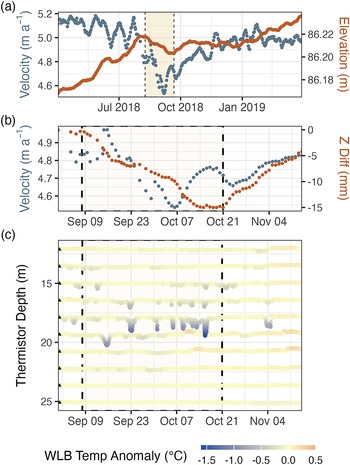
We downloaded data from GPS station TYLG (Gooseff & Doran Reference Gooseff and Doran2017), which was installed in 2017 at 77.7256° S, 162.2653° E on Taylor Glacier. We processed daily RINEX data between 9 November 2017 and 5 January 2021 to kinematic positions using the Canadian Spatial Reference System Precise Point Positioning (CSRS-PPP) version 3 software (Banville et al. Reference Banville, Hassen, Lamothe, Farinaccio, Donahue and Mireault2021). We converted the TYLG position time series at 15 s resolution to a daily elevation and velocity time series (Fig. 2a) by collating 15 days of data centred on each day when GPS data were recorded and then calculating the median elevation coordinate and estimating the best-fit velocity to the full resolution subset of the data (between 22,550 and 86,400 data points per processing window).
a. Velocity and elevation of TYLG Global Positioning System (GPS) station on Taylor Glacier. b. GPS data showing velocity decrease and an ~15 mm drop from 9 September to 22 October 2018. c. The West Lobe of Lake Bonney (WLB) temperature anomalies (relative to seasonal mean), with triangles denoting the depth of the thermistors, red indicating a positive temperature anomaly and blue indicating a negative temperature anomaly.

The camera used in this study was a Campbell Scientific model CC5MPX mounted on a Campbell 6 ft tripod. Images were taken daily at 12h01 (+13 UTC).
The WLB lake water temperature was recorded at 10 depths with an RBR Concerto T10 thermistor string at 77.723°S, 162.285°E, ~150 m from the centre of the glacier terminus (Lawrence et al. Reference Lawrence, Dugan and Doran2025). The thermistors were spaced vertically 1.44 m apart and sampled at 60 s intervals with an accuracy of ± 0.002°C.
Results
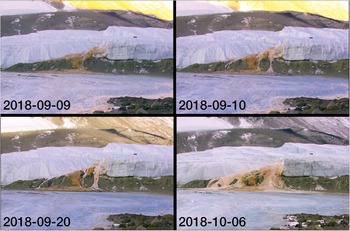
The GPS data show a vertical displacement of ~ −15 mm between 10 September and 22 October 2018. This period also corresponds with a nearly 10% slowdown in glacier velocity (from 5.0 to 4.6 m a−1). Water temperature data show multiple negative temperature anomalies of up to −1.5°C from the median temperature at the 17.89 m depth thermistor in late September and early October 2018. The largest negative anomalies occurred on 23 September and 16 October. From Blood Falls camera imagery, a flow event was initiated on 10 September. New discharge is visible daily from 19 September through the end of the month, with intermittent discharge occurring until mid-October. The visible stain area expanded significantly during this period.
Discussion
The 2018 subglacial discharge event is characterized by a period of surface lowering that contrasts with adjacent time periods of gradual elevation gain (~60 mm over the 3 year study period). The concurrent slowdown in horizontal velocity is similarly a substantial anomaly compared to the periods before and after the surface-lowering event, when velocity was relatively stable. The stable velocity after the September–October 2018 event may be ~0.2 m a−1 slower than the velocity before the event, but a longer time series is needed to fully assess longer-term velocity changes of Taylor Glacier related to brine discharge events.
Time-lapse imagery (Fig. 3) shows that brine discharge at Blood Falls began on 10 September, coinciding with the onset of glacier subsidence. Daily new discharge in the imagery starting on 19 September aligns with cold-temperature anomalies at depth in the WLB. The depth of temperature anomalies corresponds to the depth of equal density for subglacial brine and lake water, reinforcing prior observations of episodic, density-driven injections (Spigel & Priscu 1998, Spigel et al. Reference Spigel, Priscu, Obryk, Stone and Doran2018, Lawrence et al. Reference Lawrence, Doran, Winslow and Priscu2020) and suggesting the surface lowering and deceleration recorded at the GPS station are related to both subsurface and surface brine drainage events.
Time-lapse camera images of Blood Falls.

The serendipitous recording of three different datasets provides a rare, coherent signal of a subglacial brine drainage event. These observations demonstrate that an extended brine discharge event, characterized by episodic pulses of brine sourced from beneath Taylor Glacier over ~1 month, reduces subglacial water pressure, which lowers the surface and reduces ice velocity. The GPS elevation data also increase faster before the event than after, potentially indicating how transient pressure buildup beneath Taylor Glacier can periodically open flow pathways and initiate brine outflow to both the glacier surface and proglacial lake. Such events perturb lake temperature stratification and may alter nutrient transport, underscoring the tight coupling between glacier dynamics, subglacial hydrology and ecosystem processes in the McMurdo Dry Valleys. Although limited in spatial resolution by data coming from only a single GPS station, a single time-lapse camera and a single thermistor string, this synchronous record highlights the importance of multi-sensor monitoring for resolving short-lived but high-impact subglacial processes. Continued (and spatially expanded) high-frequency glacial and limnological monitoring will provide a robust dataset capable of enabling the detection of changes in the frequency and magnitude of events driven by long-term environmental change.
Acknowledgements
We are grateful to Thomas Nylen for first noticing the drop in the data and the C511 team over the years (especially Krista Myers) for the maintenance of these records. GPS data were accessed from the NSF GAGE data archive operated by EarthScope Consortium (NSF award 1724509). All processing code and data are archived at https://doi.org/10.5281/zenodo.17298618.
Author contributions
PTD conceived of the Short Note and oversaw data collection and writing of the manuscript. JPL led lake temperature data collection. All authors participated in data analysis/visualization and writing.
Financial support
This research was supported by NSF grants OPP-2224760 and 2145407.
Competing interests
The authors declare none.


 Open access

