




Sometimes people declare violently, “Oh I wish that things wouldn’t rot.” It would be a rather uncomfortable world to live in were there no decay at all. Imagine, if you please, that every fallen leaf, and twig, every dead animal did not decay after death. There would not be much room left for the living to clamor about.
The fiction of independence and impenetrability is one that only a few bodies can bear.
At the time that Childs, a young ornithologist, had conjured the rather strange-sounding scenario quoted above, it was, ironically, not far from the truth of what was happening in his own city. Providence, Rhode Island, is the shape of what in the past it could neither use nor throw away. In the lowland neighborhoods and along the urban coastal edges, much of the city’s land was made with trash: tin cans, bottles, old furniture, ash, and demolition rubble, among many other thrown-away things. For most of the industrial era, as I detail below, the city relied on neighborhood dumps for deposition of these “clean materials,” and so the neighborhoods faced an ever-swelling glut of them. Where, exactly, did all this trash go? A lot of it landed in the many ponds and lakes that could once be found throughout the city, as nearly every one of them became a short-lived dumpsite.Footnote 3 This trend continued until, by the 1950s, virtually all low, wet places had been filled, along with significant stretches of the Providence River coastline. Thereafter, having exhausted other options, Providence followed many other U.S. cities in outsourcing its trash to a landfill on the metropolitan outskirts—and from there, across chains of the global waste economy to sites unknown to local actors.
In this paper, I trace the loss of Providence’s inner-city ponds and lakes to the early years of this waste crisis which, as I argue, was symptomatic of an iterative, ongoing metabolic rift that is now only limited by the finitude of planetary sinks. Locally, meanwhile, in the wake of rapid, serial landfilling, the erstwhile sites of small water bodies throughout the city have been layered over with roads, buildings, and paved surfaces. Despite their ancient provenance, the former ponds and lakes leave no surficial traces, and so current-day residents have no reason to suspect that they were ever there. By following these waters across time and space—through archives, landscapes, and sense impressions—I hope to shed light on how cities metabolize and discard, and how those processes bind disparate things together, from the soil beneath expressways to distant oceanic gyres. This water-centered approach thus shows how Providence’s local story of filled ponds evinces planetary processes, while in turn bringing planetary contradictions to a human scale.Footnote 4
I begin this text with a reflection on the city’s role in larger circuits of waste. Discard practices continue both to shape the local landscape and to limit its vital capacities while implicating the city in the ruination of distant, unseen places. I then circle back to what is closer to hand and yet no less obscure: that is, the relatively recent loss of ancient water bodies to landfilling with trash on the West End and throughout the city. And yet, as explored in this text’s third and final section, even this near-total saturation leaves vital remainders of more-than-human life.
Circuits and Ground
One August morning, I took part in a cleanup along the banks of the West River in the near North End of Providence. In that part of town, parking lots and warehouses surround the river and what remains of its wetlands. Automobile exhaust hangs in the air, and the groan of long-haul trucks is constant. Railroad tracks and highways cut across on all sides, leaving the river and the surrounding industrial sites severed from the rest of the city.
There is a certain lushness in the summer all the same. Where the road crosses the river, wild plants like sumac and bittersweet reach toward the sidewalk from behind wire fences. It must be a challenging place for them to root, but they grow profusely, unpruned.
Our cleanup crew included about twenty people. We focused on a strip of riverside land about twenty feet wide and five hundred feet long on the edge of a Stop & Shop parking lot beneath a high retaining wall. To get there, we had to follow a very short path through thickets from the higher ground of West River Street, where the sidewalks are narrow and traffic rushes past.
Down along the river, climbing plants and trees provided some cover from the asphalt severity of the landscape above. It is the slimmest possible strip of woods, but when the trees, vines, and shrubs are leafing, it envelops you. The air becomes palpably cooler and less gritty. The rumble of commercial traffic gives way to a trickle of water from combined sewer overflow pipes. Other forms of life emerge from hiding. At one point, we saw a groggy-looking raccoon peek out from one of the pipes, curious but hardly fazed by the presence of so many humans.
Under the cover of brush, vines, and trees, we found a lot of trash on the river’s banks. A lot of trash. Layered thick over the ground in colorful, jagged licks and whorls, it looked like the ruins of a small village in the wake of a tornado. There were small clearings where things had been more deliberately placed, however—an indication that people were living there, or had been very recently. We steered clear of those sites so as not to upset any occupants who might return.Footnote 5
It was a daunting job for a small group of volunteers on a weekend morning. Like most other people present, I worked the same ground for what felt like a long time, a sweep of earth about ten feet wide. A thick bed of litter pressed into the surface—plastic bottles, old magazines, hypodermic needles, shreds of clothing, and a profusion of plastic bags. Eventually, after many rounds of picking, I began to see the soil beneath. But the dividing line between the litter and the ground was surprisingly uncertain.
At one point, I started tugging at a shirt sleeve that pushed up from beneath the surface. The fabric had become enmeshed in the root systems of surrounding plants and trees, and the tiny roots made a snapping sound as I continued pulling. Most of the fabric did eventually tear free, and with it, giant earthworms that had to be shaken or plucked out lest they be sent to the landfill. It was progress, of a sort. But the more of the roots and worms that I found, the more I began to wonder if my pursuit of trash into ever-deeper layers of living soil was doing more harm than good.
For me, it was a visceral reminder that everything drawn from the earth returns to it, though sometimes so completely reconstituted that the return becomes a sort of violence. I am thinking most of all about plastics—how they break down without ever decomposing, to become inseparable from the assemblages of soil, air, water, and other bodies whose vitality they short-circuit nonetheless. At the West River site, for example, the mostly plastic trash was embedded too deep to be cleared completely. This means that all the shreds of single-use items enmeshed in dirt will continue breaking down into smaller and smaller particles, intermixing with the finer substances that make up the soil matrix until there is no telling them apart.
The forever-ness of microplastics is unsettling, but less is known about their impacts on terrestrial environments than one might expect, given the scale of the problem. The first field study to focus specifically on soil was not completed until 2020. When microplastics are introduced, the authors found, “reductions of abundance and shifts in the community composition of soil fauna” follow. These life-diminishing effects “cascaded through the soil food web, leading to stronger indirect effects on soil microbial functioning than the direct effect induced by microplastics themselves.”Footnote 6
Other harms not specific to soil fauna are only somewhat better known. Plastics release greenhouse gases as they decompose, “a potentially vast and uncontrollable source of emissions.”Footnote 7 Chemicals released from decomposing plastic can also leach into groundwater and streams to compromise the health of creatures that drink from those sources. Chemical additives including bisphenol A (also known as BPA) and phthalates (a class of compounds that increase durability), for example, have been shown to induce hormonal changes in many animals. Nanoplastics, which are the end product of plastics’ disintegration sans decay, are known to breach cell walls, cause inflammation, “and even cross highly selective membranes such as the blood-brain barrier or the placenta.”Footnote 8
The plastic waste that blows or tumbles into the West River sometimes gets caught behind fallen branches, creating trash jams. But most of the river’s waste finds its way to the ocean (see Figure 1). And some of it, like the eels that make a home in this watershed, will ride the southerly Atlantic currents to the Sargasso Sea, where a gyre of microplastics has been growing for more than fifty years.Footnote 9
Plastics deposited by high tide at Collier Point Park on the outer harbor of the Providence River, which is connected to Narragansett Bay and the Atlantic Ocean beyond. Photo by author, 2022.

In any case, the planetary skein of plastic continues to spread and thicken, becoming part of every living body and so perhaps defining a kind of internal limit to bodily health and flourishing on this Earth. As Heather Davis observes, plastic “fills the stomachs of various organisms without providing any usable energy, without metabolizing itself under most conditions.”Footnote 10 Plastics thus make real the world without decay that Henry Childs had imagined back in 1921, a world where it is indeed becoming harder “for the living to clamor about.”Footnote 11
We used plenty of plastics on the river the day of the cleanup: plastic gloves, plastic water bottles, and plastic food wrappers. Eventually, we threw everything into black plastic bags, along with the litter we cleared from the ground, and then left the bags in a long row on the sidewalk for the Department of Public Works (DPW) to pick up. The DPW, in turn, probably sent them to Rhode Island’s Central Landfill in the town of Johnston, about five miles away from where we worked.
At the Central Landfill, everything will be compacted, covered, and eventually capped. The capping material, as well as the ground-level liner that is supposed to prevent leachate from entering groundwater, is also made of plastic. It “seals the trash inside like a giant Zip-loc bag,” as the Rhode Island Resource Recovery Corporation (RIRC) explains.Footnote 12 But like any Ziploc, the phase containers keeping trash separate from the host environment will eventually break down, and the leachate will be drawn into earthly circulations again. Moreover, only dump phases laid after 1993 are lined.Footnote 13
What if we had put the plastics from the river cleanup in curbside bins to be recycled? They would have gone to a sorting facility on the same grounds as the landfill, separated out from other recyclables, and eventually staged for shipping. And whence from there? As a company representative told me, RIRC “enlists the services of a broker who sells the material into the global supply chain … As a result, Resource Recovery may be far removed from end users and may not know of the materials’ final destination or what specific items the materials will be made into.”Footnote 14
The Dumps
There was a time when Providence did not throw its trash “away.” At least not away to landfills and recycling facilities in other towns or other countries. With the exception of sewage, the city did not begin exporting its refuse until the mid-1950s, more than a decade after reaching its peak population of 253,504 (in 1940). Until that time, whatever trash was not scavenged, recycled, or burned was left to accumulate in dumps. And these dumps, whether municipal or private, were very often sited in lowlands, including the edges of ponds and lakes. As they grew, the dumps eventually swallowed adjacent water bodies, at times haphazardly, but almost always with the complicity of landowners and officials who sought to make new land from sites that were once too wet to build on.Footnote 15
Inner-city dumping claimed nearly all the city’s ponds and lakes from the 1880s to the 1950s. In those years, the production of household waste, not to mention industrial waste, rose steadily and sharply, but the city had yet to achieve a comprehensive system of collection and disposal. In the meantime, even as trash clogged streets and filled backyards, a number of the city’s ponds, lakes, and other lowland sites became sprawling dumps that only temporarily met the need for waste containment.
Dumping was not new to the late nineteenth century. For generations, dregs, broken things, and middens of all kinds lay in heaps behind residents’ houses, on the slopes of hills, and indeed, along the edges of water bodies. However, as economies of waste complexified and grew in the late 1800s, waste management practices stayed the same, and the once-minor logistical problem of household waste disposal rose to crisis levels.Footnote 16
The surge in waste was rapid enough to be felt by older residents of Providence in the early twentieth century, who saw trash heaps quickly grow on vacant lots to dystopian levels. Not many years prior, as one Providence Sunday Journal reporter remarked in 1910, “the quantity [of rubbish] was just sufficient to make the lot an eyesore and a blot on the beauty of the community, but accumulations never became full-fledged nuisances and always seemed to remain about the same.”Footnote 17
What happened? There were at least three drivers of the waste glut in the late 1800s and beyond. First and most apparent to contemporaries, there were more people living closer together than ever before.Footnote 18 The population of Providence doubled from 1860 to 1880, from 50,666 to 104,857; and then doubled again over the next three decades, to reach 224,326 in 1910 and 253,504 in 1940.Footnote 19
Second, though less remarked upon at the time of its occurrence, to quote Susan Strasser, “mass production and mass distribution literally generated more stuff, and more trash.”Footnote 20 The volume of U.S. manufactures tripled from 1899 to 1927.Footnote 21 At the same time, more and more products were coming prepackaged and/or packaged in smaller units like, for example, the proverbial tin can.Footnote 22 The sheer quantity of such materials outpaced the demand for scavenged and recycled goods in local economies. Dump sites multiplied and metastasized, then, not so much because residents grew careless, but because compared to previous generations, their day-to-day activities produced more waste unwittingly.
“By world standards—even in this period—the United States produced exceptionally large quantities of waste,” as Martin Melosi observed: twice as much per capita in U.S. cities compared to English ones between 1888 and 1913.Footnote 23 In Providence, the daily tonnage of organic household waste, also known as garbage, rose from 44 tons per day in 1899 to 125 tons per day in 1944.Footnote 24
At the same time, the rising exchange value of urban land did nothing to discourage the ponds’ destruction. For decades, the city had permitted, and even incentivized, the filling of lowland sites, including “marshy dales, hollows, and flats.” Once the land was dried and brought to grade, as officials well knew, it could be developed and taxed at a higher rate. For the property owners too, then, dumping was a way to reap “pecuniary reward” from otherwise unbuildable plots.Footnote 25 For sanitary officials, the eventual drainage of water from these sites promised to foster a “more salubrious” environment, free of mosquitoes and other vectors of disease.Footnote 26
Local dumps received local trash until the 1950s, but they did not take all types of trash, at least not legally. In fact, “trash” was not a term widely used in the early twentieth-century Northeast. Providence Superintendent of Health Dr. Charles V. Chapin used the word trash only once in his 992-page report on national municipal sanitation practices (1900), and only in order to point out how, in other regions, it was a synonym for what most New Englanders knew as “dry rubbish”—i.e., those “other forms of waste, particularly ashes and general rubbish,” that did not count as “garbage” (and were not collected at curbside in most U.S. cities). It was this “dry rubbish,” most of all, that fed the growth of local dumps from the 1880s until the 1950s.Footnote 27
Nearly everything else that residents discarded was classed as “garbage,” which Chapin defined in 1900 as “animal and vegetable waste matter, subject to rapid decay, from dwellings, hotels, markets, etc.” However, in the classificatory systems of the time, “It [did] not include slaughter-house refuse, dead animals, night soil, street sweepings, or anything else.” Other regional uses of the term were roughly similar across the United States in 1900, although, as Chapin noted, “in some localities garbage include[d] far more than the above.”Footnote 28
Garbage was handled differently than dry rubbish in Providence, as in many other cities in the late 1800s and early-to-mid 1900s. Garbage had to be separated by residents from other kinds of refuse and left in receptacles (typically old beer kegs) in yards or at curbside so that it could be collected two to three times per week by licensed scavengers.Footnote 29
Valuable nutrients including nitrogen, phosphorus, and potash could be found in garbage, which farmers were therefore happy to receive for use as fertilizer and pig food.Footnote 30 However, some people’s garbage was worth more than others’. “The poorer the people, the poorer the garbage,” as Chapin observed, “for the grease and nitrogen matters are more completely used [by the poor] as food.”Footnote 31 Hotel garbage, on the other hand, was typically high in nutrients, and farmers were willing to pay or barter with hotel proprietors for a claim to it.Footnote 32
Whatever its value, plenty of garbage always slipped through the cracks, and even the official dumps, in at least a few cases, started as informal ones where illicitly deposited garbage intermixed with rubbish and even night soil. Chapin complained that vacant lots “wherever they are found” very quickly “become covered with all sorts of litter which private parties find more convenient to dispose of in that way than to retain upon their premises until the stated calls of the official scavengers.”Footnote 33
To summarize, in the early 1900s Providence, the city contracted dumps to accept rubbish, a class of refuse that encompassed a range of materials that did not break down easily: “tin cans, old paper, broken bottles, ashes, cinders, dilapidated furniture, tattered mattresses, old barrels,” and more.Footnote 34 There was no municipal system for picking dry rubbish up, however, so residents had to either pay to have things removed, bring them to the dumps themselves, or dump illegally elsewhere. Garbage, on the other hand, was picked up at curbside multiple times per week and recycled into the local agricultural economy. This was the general order of things until the 1920s.
The economy of waste did change as the city assumed ever-greater responsibility for the problem. When the first municipal incinerator opened in 1927, the old market for garbage-as-fertilizer-and-swill was made obsolete. The way things were sorted also changed. When the incinerator opened, the city instructed residents to wrap their garbage in paper to facilitate combustion and to leave it in the same receptacle as other combustible items. Thenceforward, only noncombustibles were classified as rubbish. From broken bottles to old radios, these items remained the responsibility of residents until 1954, when after much pressure, the city finally instituted municipal rubbish collection through the Department of Public Works.
Neither incineration nor rubbish collection did much to slow the growth of dumps, however. From the 1930s on, as detailed in the following pages, new dumps reached capacity within months not decades, each time destroying another often-ancient body of water or landscape feature and displacing the life, human and otherwise, that low, wet places supported.
The Ponds
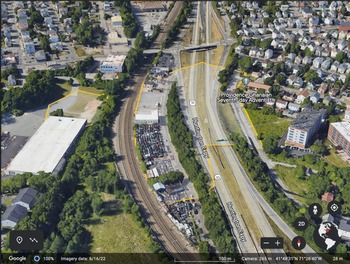
As I learned not long ago, there was a rather large pond—two adjacent ponds actually—underneath what are now the north and south lanes of the 6–10 Expressway in the West End of Providence near the Cranston Street overpass (see Figures 2 and 3).Footnote 35
The 6–10 (aka Huntington) Expressway corridor in Providence, where Benedict Pond and Little Benedict Pond used to be. The view is facing north, and the ponds’ former prints are outlined in yellow. The street that falls within the larger pond’s footprint in the northeastern corner is Anthony Avenue, intersected by Benedict Street. Created with Google Earth Pro, Version 7.3.6.9345. Source: Google Earth (pond prints outlined by author based on historic USGS maps).

Benedict and other West End ponds circa 1894. Source: USGS topographic maps, Providence 1894 (Survey Year 1887), 1894, Historical Topographic Map Collection (HTMC), 1894, https://ngmdb.usgs.gov/maps/topoview/viewer (accessed Aug. 20, 2025).

By the 1800s, the bigger of the two ponds was called Benedict, and the smaller was known as Little Benedict. They were good places to fish and, in the winter, good places to harvest sheets of ice. They were also popular swimming holes, despite the grim fact that people drowned in them nearly every summer, mostly children who waded too far out into the deep, cold waters near the ponds’ steep edges.Footnote 36
There were ponds here. There were ponds here, on ground that looks so irrefutably dry and solid, beneath a junkyard, a tow yard, a parking lot, and the highway itself—all these deadening features that seem to insist on their own permanence. It was a stunning revelation, to me at least: a small rupture in the apparent order of the world. Of course, I know that this place has not always looked the way it does now, nor will it always. But knowing that does not necessarily trouble my own experiential sense of the givenness of the urban landscape; the way that, to quote a historian of Providence, the “sheer weight” of the built environment—and the even greater weight of the worlding logic that reproduces it—makes it hard to sustain a felt sense of other worlds, whether possible, submerged, or co-present.Footnote 37
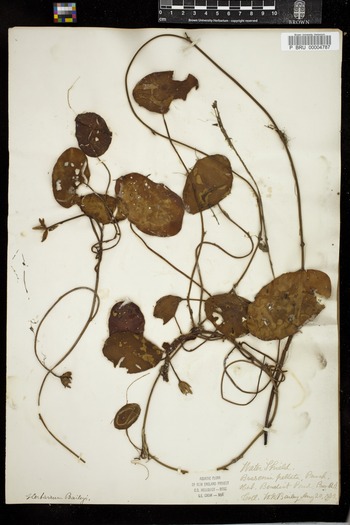
Turn-of-the-century botanist William Whitman Bailey described Benedict and Little Benedict as “treasure grounds” for many “adventitious” and rare plants that grew along their shores.Footnote 38 One of Bailey’s favorites was a type of lily with tiny purple flowers called brasenia schreberi, which residents harvested for ornamental purposes (see Figure 4). According to Bailey, “the site of pond lilies [for sale] on the street appears to be quite distinctive of Providence; at least we have never seen it so prevalent elsewhere.”Footnote 39 Other plants that Bailey and others reported seeing around the pond, where the sun shone brightly, included coreopsis rosea, boltonia, Virginia plantain, nymphaea, spatterdock, floating hearts, and linnaea.Footnote 40
Brasenia schreberi, one of the plant specimens that Bailey collected around the ponds and lakes of Providence. Source: W.W. Bailey, Brasenia schreberi J.F. Gmel, 20 August 1873, herbarium specimen, Rhode Island, United States of America, Catalog No. PBRU00004787, Brown University Herbarium, from Brown Digital Repository, https://repository.library.brown.edu/studio/item/bdr:395316/ (accessed Aug. 21, 2025).

The West End was a place of many ponds and lakes in the mid-to-late 1800s, including Benedict, which is now mostly beneath the Route 10 Expressway parallel to Anthony Avenue and Salvati Way; Little Benedict, just to the west of its sibling pond (see Figures 2 and 4); Long Pond, roughly situated in the triangle of land where Daboll, Dexter, and Bucklin Street now meet; Duck Pond, south of Waldo Street (see Figure 5); Mashapaug Pond to the west of Reservoir Avenue on the Providence–Cranston city line; and Silver Lake, in the Silver Lake neighborhood beneath Neutaconkanut Hill. There were ponds on the Southside too, including Dexter Pond and Hospital Pond. Today, of these and others, only Mashapaug Pond is left.
All the ponds were, and remain, sites of great importance to Narragansett, Wampanoag, and other Native people, who “looked at ponds with greater magnitude than they did at the [other] lands,” as Narragansett Indian Tribal Council president Gideon Ammons testified in 1879 when the state was moving to abolish the tribe as a legal entity.Footnote 41 In 1699, according to an English settler born in Cranston not far from Mashapaug Pond, “it was usual to meet or pass more Indians than white people” in what came to be known as the West End.Footnote 42 Two centuries later, Native people continued to live around Mashapaug Pond and in homes close to Long and Benedict Ponds (even after those ponds were filled).Footnote 43
Until the early twentieth century, non-Indigenous residents also (though differently) valued the ponds as sources of food, repose, and even profit, thanks to all the ice they yielded. But as the neighborhoods grew, the edges of the ponds also increasingly came to function as dump sites. The dumps swelled, faster as the years advanced, and eventually displaced the ponds’ waters. Over a span of about fifty years, from the 1880s to the 1930s, nearly all of the West End ponds and lakes were filled in this way: Long Pond, Duck Pond, Benedict Pond, Little Benedict, and Silver Lake, until by the mid-twentieth century, only Mashapaug, the biggest of the ponds, remained.Footnote 44
How could such a thing happen? The practice of dumping in lowlands was not new at the turn of the century, nor had it been seen as incompatible with other uses of the ponds and pond environs in prior years. However, as discussed in the previous section, the city was changing in ways that made the relatively benign cultural practices of one era into the ostensible root of crises for the next.
Benedict and the other ponds of the West End were all casualties of the growing city’s waste abundance. They were filled, in almost every case, because people had nowhere else to put their trash. Although many residents did keep heaps of waste in their own backyards for long periods, the practice was illegal circa 1900 under the city’s growing body of sanitation laws, which meant that neighborhood dumps were the only sites where rubbish could be legitimately taken.Footnote 45 Meanwhile, it was widely believed that the city’s growth necessitated the filling and grading of low wet places (not to mention the leveling of hills), whether in the interests of profit, aesthetics, or public health. And landfilling, albeit messy, was a reliable way to achieve this goal while simultaneously managing waste.
Complacency was the norm among officials, but the proliferation of dumps did impress upon some the need for regional, long-term planning. At the state level, the Metropolitan Park Commission (MPC), chartered in 1904, represented one coordinated effort to meet this need. Led by an executive committee of elder statesmen and local patricians, the MPC was an outgrowth of the Providence-based Public Park Association, which was founded in the 1880s to prevent the filling of the downtown Cove Basin for the sake of railroads’ expansion.Footnote 46 The goal of the MPC was to create a network of protected, state-managed open spaces across Greater Providence, including contiguous river corridors and scenic parkways. For the MPC, Providence’s waste-choked Long Pond served as a cautionary tale, having become “a melancholy fragment and a public nuisance.” If no action were taken to protect “the fragments of ponds remaining unfilled,” the MPC warned, they “will be public nuisances to all their surrounding neighborhoods, as is Long Pond today.”Footnote 47 The MPC did not commit, however, to saving those inner-city ponds and lakes that had already come to serve as dumps. Moreover, the MPC’s work proceeded haltingly in the urban core for lack of support from state governors and General Assembly members—despite the popularity of open spaces—until finally the committee was folded into the new Department of Agriculture and Administration in 1935 on account of the state’s administrative restructuring.Footnote 48
The first and largest of the ponds to become a dump was Long Pond, near the Southside neighborhood. These days, its invisible footprint envelops a row of old warehouses, triple-deckers, and an athletics field between Dexter and Bucklin Streets. No trace of surface water remains, but the odd angle of the intersection attests to the fact that surrounding streets used to terminate at the pond’s former edges.
The artist Walker Mettling created a mural in tribute to Long Pond on an outer wall of the West End Rec Center, which also sits within the pond’s outline. With a you-are-here star lower center, the mural colorfully reproduces a fire insurance map of the pond environs from circa 1875, including the smaller Duck Pond just a block down off Waldo Street (see Figure 5).
Walker Mettling’s mural representing Long Pond circa 1875 and the same site in 2021. West End Rec Center, Providence. Source: https://walkermettling.com/longpond (accessed Feb. 23, 2026).

A plaque between the two panels describes the pond as a hub of neighborhood life, not unlike Benedict and Little Benedict. At Long Pond, “People collected lilies, some napped beneath willow trees and after a hard freeze up to 2,000 people would ice skate on it at the same time. It was used for swimming and bathing, fishing and sailing, as well as baptisms.” The Perkins Sheet Metal Co. drew the pond’s waters at a rate of one hundred gallons every minute, the mural informs us, and ice was commercially harvested from the pond in the winter.Footnote 49 Perhaps the metal processing spoiled the pond for swimming and fishing. In any event, as Mettling notes, the pond became “the first official dump in Providence,” and by 1891 there was no pond left.Footnote 50
Still surrounded by “open country” in the early 1890s, the Benedicts held on for longer, but the neighborhoods around them were expanding, and the dumping had intensified by century’s end. Little Benedict was filled first, when the National Biscuit Company (Nabisco)—incidentally a forerunner in disposable packaging—built a warehouse on the site in 1908.Footnote 51 It is hard to know how neighborhood people felt about it, but the Providence Journal did not question, let alone lament Little Benedict’s imminent demise. “Within a few weeks,” they wrote, with headlines of recent drownings in mind, “there will be little left of the dangerous waters which have claimed many victims.”Footnote 52
The drownings were a real cause for concern, of course, but their invocation on the verge of the pond’s destruction was not innocent. It evinced a tendency on the part of powerful people, including reporters, officials, and industrialists, to recast water bodies as sites of danger and nuisance in advance of plans to fill them for reasons other than the public welfare. Dumping, especially informal dumping, made this kind of move all the easier, because it literally gave development interests cover in the form of a visceral and spectacular problem, ostensibly of other, less powerful people’s making.
The larger Benedict outlasted its sibling pond, but all kinds of refuse were accumulating on its shore in the early 1900s: tin cans, ashes, food scraps, and horse carcasses, among other things. By 1922, though it was still represented as a blot of blue on official maps, Benedict was already two-thirds filled, and the city decided, as one observer told it, to “finish the job the public has been on for the last 40 or more years.”Footnote 53 They did not entirely succeed, however, for by 1931, the ten-acre Huntington Avenue Dump was still active, and the pond still partly unfilled. The Providence Journal described the place in that year as “a deep canyon of rubbish, with what was left of the pond rapidly losing its identity in a heap of rusting chassis parts.”Footnote 54
Overtaking Benedict in place and name, the Huntington Dump was one of the city’s two biggest and most troublesome landfills in the early 1930s. The other was off Allens Avenue at Burgess Cove on the Southside waterfront. Known by many people simply as the “City Dump,” the latter opened in 1910 under ownership of the Providence Ash Company, just as (yet another) dump across the street had reached capacity.Footnote 55 Initially, the City Dump was only permitted to accept dry rubbish, but in the mid-1920s, neighbors complained of “fish heads and other animal refuse” left to rot in the open air.Footnote 56
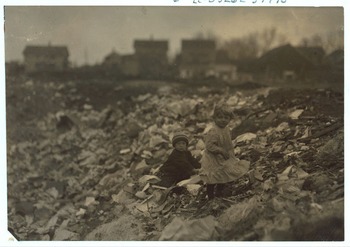
The poorest residents made daily visits to the bigger dumps to scavenge. “Scores of women and children,” according to one account from 1910, gathered cinders and kindling from the rubbish to feed their stoves and picked for junked items that could be resold (see Figure 6).Footnote 57 Health officials tried to stop the practice, but the dumps remained a part of neighborhood life for as long as they existed.Footnote 58 In the mid-1920s, little boys were also using the Burgess Cove dump as a playground. For a feature article titled “Allens Avenue Dump is Magic Carpet-Land for Youth,” one reporter followed the children around the site for a day, watching them build forts and “pirate craft” from the scrap materials around them, all the while staying in the good graces of Carmine Angel, the grounds superintendent, who described the kids as “well-behaved.”Footnote 59
Children scavenging in an unidentified Rhode Island dump. Source: Hine, Lewis Wickes, photographer. A dump in Rhode Island. Location: Rhode Island. United States Rhode Island, November 1912. Photograph. https://www.loc.gov/item/2018677415/.

People also lived at the dumps, which supported about a dozen permanent residents in 1931 by one count.Footnote 60 The shanties of scrap dealers dotted Burgess Cove that year, while the northern end of the Huntington site was home to professional scavengers Mike and Domenick Pinelli, two brothers who had learned the business in New York City. The Pinellis collected fees from users of the dump while drawing additional income from salvaged goods including metals, car parts, radio parts, rags, and papers.Footnote 61 Each brother had his own sheet-metal shack on site, where they also sheltered a resident watchman.Footnote 62
Fires were constant at the dumps. A city councilman remarked in 1925 that “The Allens Avenue dump has been on fire for years and the odor from it sometimes blankets South Providence heavily.”Footnote 63 By the mid-1930s, the fire department was getting called to the site every week as the constant inflow of paper waste fed fires that blazed and shrank and blazed again without ever dying.Footnote 64
Calls to close the dumps grew louder in the 1930s as the outflow of rats, roaches, flies, and acrid smoke made life unbearable for those who lived nearby. The city was slow to intervene, though a first attempt to close the Huntington Dump was made in 1935 when, with federal funds from the Emergency Relief Act, a crew of hundreds cleaned and graded about half of the grounds. They laid macadam over the erstwhile pond to extend Wadsworth Street. A playground was also promised. But by the following year, the improved part was buried in rubbish again, and cars using Wadsworth had to drive up onto the sidewalk to avoid rolling over stray bits of junk.Footnote 65 Residents complained that people dumped illegally under cover of night by turning off their headlights before approaching.Footnote 66
In the spring of 1936, the Board of Aldermen finally, permanently closed Huntington by upon recommendation of the municipal Health Committee.Footnote 67 The dump at Burgess Cove remained in service for another seven years at least, but by the late 1930s, the city was redirecting its rubbish and incinerator ash to a dump off Murray Street on the far West End, in a neighborhood called Silver Lake.Footnote 68
There was no “silver lake” in Silver Lake by the time the other municipally contracted dumps had filled. There was a lake a generation prior, but the installation of sewer lines beneath Neutaconkanut Hill in the early 1900s diverted the lake’s main source of water. And so the lake began to dry out. By 1912, it was described as “little better than a frog pond” on the low-lying floor of a desiccated basin.Footnote 69
In the winter of 1929, the public works commissioner ordered the Silver Lake basin to be used as a temporary garbage hole because the municipal incinerator had broken down.Footnote 70 “It was an emergency … and he simply had to do it,” remarked Dr. Chapin (still superintendent of health at the time) in the commissioner’s defense. The incinerator was fixed in a matter of months, but for whatever reason, dumping into the Silver Lake basin continued for another four years, leaving fourteen feet of rot where the lake used to be.Footnote 71
The Murray Street dump stayed open for ten years thereafter. When it reached capacity in 1949, the city capped the land with fill from highway excavations and turned it over for redevelopment. A supermarket occupied the site for years after, followed by an Ames department store, and now an indoor flea market called the American Expo Center.
When the Murray Street dump closed, the city replaced it with another landfill on Cortez Street in Olneyville: an abandoned quarry with forty-foot rock walls and a one-and-a-half to two-acre “pond” beneath. Acting Superintendent of Health Dr. Edwin M. Knights expected it “to make us an excellent dump for some time to come.”Footnote 72 It did not. Within a year of its opening, Cortez was full, and like its predecessors, constantly on fire. Children living near the dump got sick, as did the firemen who fought blazes rising up from the old quarry at all hours. One neighbor told of having to remove “grime” from “windowsills, light fixtures, and furniture” multiple times per day on account of the relentless drift of smoke.Footnote 73
As Cortez Street burned, officials puzzled over where to send the city’s stream of rubbish next. A joint proposal by heads of the Providence Redevelopment Agency (PRA) and the Department of Public Works called for opening a new dump off Gano Street in the Fox Point neighborhood along the Seekonk River (north of the Washington Bridge). By doing so, they argued, the city could eventually lay claim to 1,000,000 square feet of new land in place of muddy tidal flats at the foot of bluffs.Footnote 74 The plan stalled for a time, but then in early 1953, the city council did approve funds to buy the flats from the New York, New Haven & Hartford Railroad.”Footnote 75 Dump trucks started rolling in immediately.
It took only four years for the Gano Street/Seekonk River dump to max out. Adjoining a neighborhood playground, it was subsequently graded and converted into parkland. Today, the old dumpsite is most often used for soccer games and community gardening, while on the river’s artificial edge, where the city once planned to build a highway, an extension of the Blackstone River Bikeway has been open to riders since 2020.
After the Gano Street/Seekonk River dump’s closure in 1957, the city secured a new dumpsite in the Moshassuck River Valley lowlands off Powell Street, right over the Providence–Pawtucket city line. As the first dump beyond city bounds, the Pawtucket site’s opening signaled the beginning of the end of inner-city dumping. It was not a decisive end, to be sure—demolition rubble, household rubbish, and incinerator ash were still sent to Providence’s Fields Point from the late 1950s until the 1970s. But with so few ponds, lakes, or quarries left to fill, it was in these years that the city started to look beyond its borders for other, bigger sinks.
Of all the ponds that used to array the landscape, today, only Mashapaug Pond is left, but not left untouched by municipal land-use policies of the not-so-distant past. There was a neighborhood of about 1,600 people, or 500 families on the banks of Mashapaug in 1960, when the PRA announced a plan to seize 102 acres of pondside land for the Huntington Expressway Industrial Park.Footnote 76 Residents at the time regarded it as “a fine example of a truly integrated neighborhood,” where Black owners built new homes in the post–Second World War years. Many of those residents “opposed the project bitterly” and brought the city to court, but the PRA prevailed against them, and people were forced to leave their homes between January 1961 and mid-1962.Footnote 77 The city then proceeded to clear-cut and grade the formerly hilly land in preparation for selling off new parcels, the first of which, sold to the Providence Wholesale Drug Company, broke ground in April 1963.Footnote 78 For a 2013 thesis study titled “Grafting Memory,” Brown student Lucy Asako Boltz interviewed people who had been displaced by the industrial park and other mid-century renewal projects throughout Providence. Former residents’ memories of the city’s “vaporized” sections are hard to reconcile with the published reports of the Providence Redevelopment Agency. Where officials documented only statistical indicators of blight (rates of poverty, disease, delinquency, etc.), former residents recalled familiar, often beautiful places rich in personal and shared meanings. Daniel Waldron’s memories of the pond neighborhood, for instance, point to a world that planners and other bureaucrats utterly failed to notice:
… there were a lot of Indians over there. The Indian community was loaded over there. There were a lot of grapes, peach trees and pear trees and apple trees. A mecca for food. And it was awesome. Paved it all down and put up factories. They didn’t hire from the community. Our community, anyway.Footnote 79
Mashapaug was known to occupants as “West Elmwood” and among kids as “Jungletown” for its especially lush environs. As Waldron mentions, it was home to many Native American people, including Wampanoags and Narragansetts, who retained a strong sense of ancestral connection despite their invisibility to census takers. Officials trained to measure rates of tuberculosis and venereal disease also missed the neighborhood’s abundance of homegrown food.Footnote 80 Ed Hooks recalled:
… peach trees, plum trees, apple trees. I mean all kind of apples, everything from a Crab Apple to a Macintosh. Grapes, both white grapes and black grapes were all through here. On the hills this area as you call it around the pond, there were blueberry bushes and raspberries, I mean. You could eat your way through there … And it was fun.Footnote 81
From 2008 until 2017, artist Holly Ewald led an annual event called the Urban Pond Procession (UPP) at Mashapaug that brought together artists, musicians; and current and former residents of the area to celebrate its life and history.Footnote 82 Beyond anyone’s expectations, over the years of its happening, UPP spawned a wealth of other creative projects, research, intergenerational conversations, and rediscovered ties to place. For me (and surely for others), it also revealed a still-vibrant and storied landscape while modeling ways of relating to that landscape differently.
New Dumps, New Ponds
In the summer of 2023, I walked the unmowed margins of the Route 10 expressway, which still dips slightly where Benedict Pond used to be. Official signs warned that dumping was not allowed, but mattresses, stacks of tires, motor oil containers, and contractor bags were crowded along the fence line. It is nothing in comparison to the volumes now sealed beneath ground, but as this smaller mess suggests, people continue to dump in the same kinds of places and for broadly the same reasons as a century earlier. Excepting the usual litter, the refuse is still of a class of things that are hard to dispose of legally, and so people are still tempted (or maybe compelled by circumstances) to drop and run. Similar arrays can be found in other low-lying, low-income margins throughout the city—riverbanks, rail corridors, and wild-grown lots where tenements and mills used to be.
A lot has changed, but the nature of that change is less radical than what the naked eye might glean. No official could get away with requisitioning a city pond for a city dump these days, but the scramble for new sinks continues beyond the frame of the city as a site of urbanization, and if Providence mirrors national patterns, then “consumer waste” is only a tiny fraction, about 3 percent, of the output.Footnote 83 Similarly, early twentieth-century images of (White) Rhode Island children rummaging through once-ponded acres of broken, rotted things may elicit shock, and for some, a reassuring sense that “we’ve come a long way,” but such scenes are only distant in space, not in time (as seen in Figure 6). It is simply that the most conspicuous “negative externalities” of urban growth have been geographically externalized and thus made obscure.Footnote 84
Meanwhile, what may seem distant in time remains subtly, incipiently nearer in space than I, for one, had imagined before having walked the once-ponded landscape for myself. Where Benedict used to be, there is very little standing water left, and there are certainly no fish, no pond lilies, and no cattails. There are probably few to none of the rare and exotic flora that seeded at the site in the late nineteenth century (some introduced by way of human discard). And yet, it was not the picture of desolation that I had braced for. Somehow, after all this time, the site still feels pondy—sun-drenched, fragrant, low, and lush.
At least it did on the one summer day that I walked alongside it on foot. On the other hand, it would be no less true to say that the site is just a few strips of dirt where common urban flora such as broadleaf plantain and mugwort predominate. Benedict is certainly not coming back. Its destruction is irreversible, and virtually everything around its hidden footprint has changed. But I believe there is something to the dissonance between this manifest closure and my own felt sense of pondiness. The lowland site of the filled pond still collects water, albeit mostly diverted by drains or soaked up by the soil, and in this sense, water never entirely ceased ponding in Benedict’s footprint (and similar lowlands throughout the city). While thinking about this, I had in mind a passage in Robin Wall Kimmerer’s Braiding Sweetgrass, where she writes, “A bay is only a noun if water is dead.”Footnote 85
The quote is from a chapter of that book titled “The Grammar of Animacy,” in which the author contemplates the predominance of verbs over nouns in Potawatomi, her own ancestral tongue.Footnote 86 To Kimmerer, the very structure of the language (which is an Algonquin language in common with Narragansett) registers the dynamic agency of water and of the more-than-human world at large. She continues:
When bay is a noun, it is defined by humans, trapped between its shores and contained by the word. But the verb wiikwegamaa—to be a bay—releases the water from bondage and lets it live. “To be a bay” holds the wonder that, for this moment, the living water has decided to shelter itself between these shores, conversing with cedar roots and a flock of baby mergansers. Because it could do otherwise—become a stream or an ocean or a waterfall, and there are verbs for that, too.Footnote 87
Kimmerer’s call is not for non-Native speakers to learn Indigenous languages per se, but rather to be open to the animacy of terrestrial formations and forms of life that speakers of English are normatively conditioned to perceive as inanimate, or static, and ontologically enclosed.Footnote 88 A pond, for instance, is a convergence of active presences under ripe conditions that cannot be contained by the act of naming, presences that may in fact remain present in the wake of the destruction of what was named (i.e., the life of the pond and the conditions that once enabled a pond’s formation). This is not to say that these places will return to what they used to be at some idealized moment in the past, if only left free from human interference. On the contrary, the landscape has always been humanly co-produced, and indeed, whatever incipient possibilities now exist for re-ponding (or re-laking, or re-marshing, or re-coveing) are too tentative to cohere without active human nurturance.Footnote 89 As Kimmerer writes, “human beings are part of the system, a vital part.”Footnote 90
I can offer one contemporary local instance of a ponding supported by human interaction. On the other side of the city from Benedict’s remains is an old municipal cemetery called the North Burial Ground. Within it there is a vernal pool of standing water fed by rainwater from surrounding roads. I am told by word of mouth that there was a pond on the site years ago that the city decided to fill, but no water body has been drawn on maps of this location since at least 1875. Perhaps instead the water started pooling in the 1960s, when the nearby Moshassuck River was disconnected from its floodplain and buried beneath Interstate 95.Footnote 91
Whatever its origins, the pool has become a breeding ground for the city’s only known population of Fowler’s toads: a small, warty, nocturnal creature that bleats like a sheep. But it is a precarious niche, because silt intrudes from a dirt road during storm events and displaces the water. The pool is thus getting shallower over time and will eventually disappear, leaving the toads with no place to breed or develop from tadpoles.
A local videographer and longtime activist named Greg Gerritt noticed the toads about ten years ago. He was fascinated by the creatures, more so perhaps for their success in making a home of an urban graveyard beside a major highway, where the nearest river is buried and “it is hard to say what is natural and what is not.” Over the course of several years, he has returned to the site at all hours to observe the Fowler’s toads (and their cohabitants, the tree frogs) in their brief uncertain cycles of birth and reproduction. He describes the pond as “a rainwater system”—a delicate ecology entirely dependent on precipitation but paradoxically endangered by the silt that water delivers.Footnote 92
Amphibians breathe partly through their skin, which makes them highly sensitive to pollution and thus a bellwether species of ecological health. As the United States Geological Survey (USGS) warns, “worldwide occurrences of amphibian declines and deformities could be an early warning that some of our ecosystems, even seemingly pristine ones, are seriously out of balance.”Footnote 93 It is really a wonder that they are still here, and needless to say, there is no guarantee that they will remain.
In 2016, Greg’s organization Friends of the Moshassuck (FOTM, of which I am a member) devised a plan to improve the tadpoles’ chance at survival. FOTM proposed to dig out six inches of silt from the pond bottom, thereby extending the toads’ breeding season by several days or more. By late 2017, they had secured all the necessary permits and by early 2018 had dredged the pond in time for the coming spring. The project was a success, even though in the drought year of 2020, as Greg reports, “the pool went completely dry and all of the tadpoles perished” (an eventuality that they are conditioned as a species to weather).Footnote 94
The pond is one of the most biodiverse sites in the city, but it is not a conservation area. It is just a low point where the water happens to pool, and it is only thanks to the protected status of the graveyard that it was not leveled and paved long ago, as most of the surrounding city has been. This is typical of these kinds of urban refugia (habitat oases amid harsh conditions): many are only accidentally favorable to the otherwise displaced forms of life that find a niche in them, and they remain largely at the mercy of developmental logics that don’t account for them. To be sure, at the state and federal levels, there are stronger protections for wetlands and water bodies now compared to a century ago—for example, FOTM had to secure a permit from the Rhode Island Department of Environmental Management to dredge—but environmental law is still constrained by superordinate notions of landscape as static, separate from, and subordinate to human activity.Footnote 95
What does the precarity of proto-pond assemblages have to do with the city’s entanglement in the globalized waste economy? Both are symptomatic of the socioecological disconnection of the city from the living landscape; the “metabolic rift” that has alternately benefited and bedeviled local urban society, however unevenly, since the emergence of Providence as a regional industrial center.Footnote 96 Ponds still do not matter to the normative critical functioning of urban systems, whether local ponds or distant ponds in the blast zones of global waste deposition. The local ones are much better protected, of course, but they are protected from urban metabolic processes rather than as part of them; because they are no longer factored into “the vital conditions of [local] existence.”Footnote 97 In the meantime, those conditions must still be met at the expense of other societies and living landscapes, which are now more occluded (even to local supply chain intermediaries like Rhode Island Resource Recovery) than they have ever been.Footnote 98




 Open access

