


Introduction
Women are underrepresented in politics in most European countries. On average, in the 28 countries that were members of the EU in 2016, only 26% of lower/single house members of national parliaments and 27% of senior, national government ministers, respectively, were women (European Commission, 2018). This underrepresentation has received increasing attention in all European countries and has become a key issue in the political agenda of several nations. While many studies consequently examine the causes of this underrepresentation (for a review, see Paxton et al., Reference Paxton, Hughes and Barnes2020), our understanding of public attitudes towards this persistent gender gap remains far more limited (for an exception, Allen and Cutts, Reference Allen and Cutts2018). In fact, public opinion in European countries continues to display noticeable dissensus in this regard. According to the 2017 Eurobarometer used in this study, 41.3% of all EU28 citizens do not believe there should be more women in politics (European Commission, 2018). Interestingly, popular support for increasing female representation varies substantially cross-nationally. The proportion supporting this increase is twice as high in the country with the highest support for a stronger gender balance – Portugal – than in the country with the lowest support – Latvia.
We have strong indications regarding the importance of public attitudes towards the presence of women in politics. As Hatemi and McDermott (Reference Hatemi and McDermott2016: 333) synthesized, attitudes are ‘independent drivers of a wide array of (…) behavioural sequelae of great personal and societal consequence’. Understanding attitudes towards the number of women in politics is crucial because attitudes (together with other factors) are commonly predictors of political preferences and behaviours (Lizotte, Reference Lizotte and Thompson2018). For example, those who think more women ought to be in politics are more supportive of female political candidates (with their money, time and/or vote) than those who think otherwise (Dolan, Reference Dolan2010: 70). In fact, some women who believe more women should be in politics might even consider running as candidates for political office themselves.
This study examines the scope conditions of the support for increased female representation in politics by focusing on the substantial, cross-national divide in embracing this attitude. To determine why the proportion of those holding this belief varies across the 28 countries that were EU member states in 2017, we analyse the roles played by the political-economic empowerment of women and the prosperity levels of countries as stressed by previous work in the gender and politics literature.
As an alternative to these factors we consider the role of legislative gender quotas (hereafter, ‘gender quotas’ or simply ‘quotas’). Expanding on the quotas and policy feedbacks literatures, we argue that quotas have informational and normative effects. Our focus in this study lies on the role of legislative quotas but not quotas adopted voluntarily by political parties (hereafter ‘party quotas’). We focus on legislative quotas because – unlike party quotas – only these are discussed in parliament and therefore can be expected to draw more intense attention from mass media and the public at large. Moreover, operationalization of party quotas has proven far more difficult and debatable than the operationalization of legislative quotas (Hughes et al., Reference Hughes, Paxton, Clayton and Zetterberg2019).
Although previous work persuasively documents that quotas foster women’s political representation, we still know less about their indirect consequences. In this study, we argue that quotas have the indirect repercussions of fostering support for more women in politics through an informational and a normative effect. Quotas raise awareness about the underrepresentation of women in politics (informational effect) independent from achieving increases in women’s representation. Once adopted, they also send a clear signal that a persistent imbalance is a social problem that exists and must be redressed (normative effect). Using a 2017 Eurobarometer and multilevel models, the results presented below support our quota-based approach. Citizens living in countries that already possess quotas are more likely to support increases in the number of women in politics than citizens in countries without gender quotas.
Literature review
In contrast to the extensive literature on changes in the political representation of women (Paxton et al., Reference Paxton, Hughes and Barnes2020), few scholarly works assess attitudes towards this gender divide in descriptive representation. The few studies on attitudes towards gender balance in political leadership posts are based either on a single country (Sanbonmatsu, Reference Sanbonmatsu2003; Dolan and Sanbonmatsu, Reference Dolan and Sanbonmatsu2009; Dolan, Reference Dolan2010; Dolan and Lynch, Reference Dolan and Lynch2015; Allen and Cutts, Reference Allen and Cutts2016; Espírito-Santo, Reference Espírito-Santo2016) or two countries (Galligan and Knight, Reference Galligan and Knight2011). Most existing research in this area is no doubt important, but of limited utility for studying the phenomenon across countries. Subsequently, we also review studies with a dependent variable related to (but not the same as) attitudes towards the current number of women in politics – including feminist attitudes (Banaszak and Plutzer, Reference Banaszak and Plutzer1993a, Reference Banaszak and Plutzer1993b) and citizens’ support for gender quotas (Gidengil, Reference Gidengil1996; Barnes and Córdova, Reference Barnes and Córdova2016; Keenan and McElroy, Reference Keenan and McElroy2017; Beauregard, Reference Beauregard2018).
The extant literature offers four main categories to explain variations in the support for increased female descriptive representation: socio-demographic, economic, political and cultural. Most existing scholarship focuses on individual-level factors, although a few additional studies do present explanations of cross-national variations.
Many studies comprising of socio-demographic explanations consider individual-level features. Unsurprisingly, given that women have more to gain from improving their political representation, they are more likely than men to believe that more women should be in politics (Sanbonmatsu, Reference Sanbonmatsu2003; Galligan and Knight, Reference Galligan and Knight2011; Allen and Cutts, Reference Allen and Cutts2016; Barnes and Córdova, Reference Barnes and Córdova2016; Espírito-Santo, Reference Espírito-Santo2016). Education, age, being in non-traditional family arrangements (cohabiting, separated/divorced, without children), being employed/unemployed and having a wife in the labour market (for men) also affect individual support for increased women in politics (Banaszak and Plutzer, Reference Banaszak and Plutzer1993a, Reference Banaszak and Plutzer1993b; Gidengil, Reference Gidengil1996; Dolan, Reference Dolan2010; Dolan and Lynch, Reference Dolan and Lynch2015). Having paid employment, for instance, augments one’s chances of meeting high-achieving, female professionals who break traditional gender norms and demonstrate women’s competency as decision-makers. Therefore, having paid employment – especially among women – should increase the support for increased female representation in politics (H1).
The dominant factor analysed in the literature on economic explanations is the general level of a country’s economic development. Inglehart and Norris (Reference Inglehart and Norris2005[2003]) posited that socio-economic development shapes the predominant culture of a given country, which, in turn, influences ideas about gender and the proper role of women and men in the family, employment and politics. In agrarian and less-developed societies, people face constant uncertainties and risks such as illness or malnutrition. Due to this unstable equilibrium, people tend to hold traditional ideas about proper gender roles and support women’s dedication to home, family and kinship. With industrialization, increasing numbers of people work in industries and the service sector, live in cities and begin feeling partially freed from want and fear. People adopt new long-term orientations that prioritize self-expression, autonomy and other post-material goals – including gender equality. From this scholarship, we expect individuals living in more affluent countries to display higher support for increased female representation (H2).
Political explanations of attitudes regarding women in politics have examined both individual factors and supra-individual conditions. Concerning individual factors, political interest or adherence to a left-of-center ideology shows an increased probability of supporting more women in politics. On the one hand, those interested in politics know more about politics and participate in it to a higher extent than those who lack political interest (Beauregard, Reference Beauregard2018: 9). People knowledgeable about politics may be aware of female underrepresentation in politics and more willing to see the situation redressed than those less interested in politics and possibly unaware of the problem (Sanbonmatsu, Reference Sanbonmatsu2003). On the other hand, in Western countries, left-of-center parties have historical links with women’s movements and were often the first to include feminist goals in their platforms. Once in office, they adopted gender equality policies despite sometimes putting feminist goals on the sidelines (Banaszak and Plutzer, Reference Banaszak and Plutzer1993b: 33–34; Dolan and Lynch, Reference Dolan and Lynch2015: 121–122; Beauregard, Reference Beauregard2018). Hence, individuals with left-of-center ideologies should be more likely to support increased female descriptive representation (H3).
Political supra-individual conditions have also received attention – in particular, the degree of feminization among the political elite and governance quality. Regarding this dimension, the common expectation is that a higher presence of women in political leadership posts, such as MPs or cabinet members, leads to a higher proportion of citizens believing that more women should be in politics. Women occupying high-ranked, political decision-making positions send the message that politics is not exclusively a man’s game and that women are capable of governing (Dolan and Sanbonmatsu, Reference Dolan and Sanbonmatsu2009). Female MPs are also more likely than male MPs to raise awareness about the persistent underrepresentation of women in all spheres of power. Following this cumulative hypothesis, we predict that the higher the presence of women among political decision-makers, the higher the proportion of people who think more females should be in politics (H4).
Political dimensions unrelated to formal representation have received consideration as well. The quality of governance, for example, may matter in explaining public attitudes related to female representation in politics. In countries of good governance, citizens are more confident about state capacity and, subsequently, about their government’s policies – including quotas. In fact, Barnes and Córdova (Reference Barnes and Córdova2016) show for Latin America that in countries with good governance citizens are more supportive of gender quotas than in countries without such track records. Since citizens in such countries perceive their polities in a more favourable light and as being legitimate, they should be more confident in the stability of the political institutions even in the face of changes regarding gender balance in political representation. Therefore, citizens in countries with good governance would be more supportive of a greater female substantive representation (H5).
Cultural explanations have been advanced too. The predominant culture of a given society shapes beliefs about the proper roles of women in family, employment and politics that affect political attitudes and behaviour. Egalitarian views of sex roles (on family, employment and politics) influence political attitudes and behaviours, presumably in an egalitarian direction (Inglehart and Norris Reference Inglehart and Norris2005[2003]). On a more general level, Welzel (Reference Welzel2013) stated that ‘emancipative values’ constitute ‘an orientation that emphasizes freedom of choice and equality of opportunity’ (p. 5). These values thus drive the individual and collective quest for an ‘existence free from domination’ (p. 1). The thesis that emancipative values and ideas increase the number of people who believe that women should increase their political representation has received some empirical support from research examining individuals (but not comparing societies). For the United States in 2007, Dolan (Reference Dolan2010) found that people who perceive women as possessing the policy competences expected of successful politicians were more likely to support the idea of more women being represented in political office (see also Sanbonmatsu, Reference Sanbonmatsu2003; Dolan and Sanbonmatsu, Reference Dolan and Sanbonmatsu2009). This has clear implications for the attitudinal consequences of having traditional gender values: individuals holding traditional gender norms should display lower support for increased female representation (H6).
In sum, the literature to understand attitudes towards a higher presence of women as politicians has stressed the influence of socio-demographic, economic, political and cultural dimensions. Yet, prior research overlooks a factor that, based on prior theoretical research, could have crucial explanatory capacity: the existence of gender quotas in politics.
Gender quotas and public demand for more female political representation
We argue that gender quotas in politics explain the cross-national variation of attitudes towards the number of women in political office. Quotas, in this particular case, are legislative devices intended to increase female representation among political decision-makers. Quotas mandate that a given number or proportion of candidates or officials be women (Dahlerup, Reference Dahlerup2013; Krook, Reference Krook2010; Franceschet et al., Reference Franceschet, Krook and Piscopo2012). Currently, more than 70 countries across the world have gender quotas (Hinojosa and Kittilson, Reference Hinojosa and Kittilson2020: 22). By 2017, nine of the then EU28 countries had adopted these quotas. To the best of our knowledge, there is no study regarding the effects of gender quotas on attitudes towards the number of women in politics. Nonetheless, existing research suggests effects caused by quotas on other political attitudes – specifically, the political interests of men and women and their attitudes towards women as political leaders.
As for political interest, the results of previous studies are mixed. In an analysis of 31 countries, Kittilson and Schwindt-Bayer (Reference Kittilson and Schwindt-Bayer2012) documented that gender quotas diminish the gender gap in political interest. This decrease in the gender gap happens not because women’s interest in politics increases but because men’s interest in politics diminishes (Kittilson and Schwindt-Bayer, Reference Kittilson and Schwindt-Bayer2012: 37–40). In contrast, analyzing 17 Latin American countries, Zetterberg (Reference Zetterberg2009) found no impact of quotas on political interest.
Regarding attitudes towards women as political leaders, Allen and Cutts (Reference Allen and Cutts2018) examined 48 democracies worldwide and found that gender quotas increase the proportion of people who see women as capable political leaders. In the same vein, Beaman et al. (Reference Beaman, Chattopadhyay, Duflo, Pande and Topalova2009) conducted a study regarding a natural policy experiment in India, involving the random assignment of gender quotas in some village councils. They found that men in villages with quotas were more likely to link women with leadership than men in villages without them. Also, this research documented an improvement in the male villagers’ assessment of their female leaders’ effectiveness. These changes resulted from the male villagers’ exposure to women officials elected, thanks to the quotas.
We build on previous research to theorize the potential consequences of quotas on public demand for increasing women’s descriptive representation. Quotas are so notorious and salient around the world that we should expect them to have their own effects, independent from the increase in the proportion of women policy makers or changes in policy making that they may cause (Allen and Cutts, Reference Allen and Cutts2018: 151). Previous work emphasizes that – like other policies (Campbell, Reference Campbell2011, Reference Campbell2012) – gender quotas generate policy feedback effects (Weeks, Reference Weeks2016) by sending signals or cues to current and future policy makers (Weeks, Reference Weeks2016; Clayton and Zetterberg, Reference Clayton and Zetterberg2018) and the general public (Zetterberg, Reference Zetterberg2009; Weeks, Reference Weeks2016; Hinojosa and Kittilson, Reference Hinojosa and Kittilson2020). Building on this work, we theorize that quotas may change public opinion through a combination of informational and normative effects.
Quotas can have an informational effect because the process of quota adoption goes hand in hand with discussions about women’s level of descriptive representation and the best means to balance party strategies and improvements in women’s representation. Since legislative proposals on quotas discussed in European countries tend to include consequential sanctions for offending political parties (Hughes et al., Reference Hughes, Paxton, Clayton and Zetterberg2019), their introduction generates intense debates in parliaments and political parties regarding women’s underrepresentation. Those debates among policy makers likely reverberate into the wider public sphere and raise public awareness of the underrepresentation of women in political decision-making. Being aware of this numeric underrepresentation should help adopt the belief that there are not enough women in politics. In this regard, like quota adoption, quota implementation can produce the aforementioned informational effect. After quota adoption, the issue of women’s underrepresentation in subsequent elections often continues as part of the political conversation of a given country – although perhaps with less intensity than at the moment prior to adopting the policy, as the parliament and other institutions and parties begin to determine the best means of enacting the policy and calibrating its level of implementation.
Gender quotas can also have normative effects. By adopting quotas, the symbolic power of the national parliament as the locus of national sovereignty sends a powerful message that politics is an arena open to both women and men (Kittilson and Schwindt-Bayer, Reference Kittilson and Schwindt-Bayer2012; Hinojosa and Kittilson, Reference Hinojosa and Kittilson2020). Thereafter, female underrepresentation in formal politics likely becomes collectively framed as a problem in need of redress. This emerging collective moral belief should discourage dismissive attitudes towards the political capacities of women and stimulate collective pressures to endorse increasing the number of women in politics. Women become seen as equally competent in political representation as men and deserving equal representation as men. Supporting this expectation, Weeks (Reference Weeks2018) shows that after the adoption of quotas, political parties increase their attention to social justice topics such as the need to end sex-based discrimination. Similarly, Xydias (Reference Xydias2007) finds that after the introduction of quotas, female MPs in Germany speak more often about feminist and traditional women’s issues. We thus predict that citizens living in countries that have already adopted gender quotas are more likely to support a stronger presence of women among political decision-makers (H7).
The informational and normative effects of these particular policies can furthermore be especially relevant for attitude formation because they address an issue with medium-low salience – the level of women’s representation – with which average citizens are probably unfamiliar (Barnes and Córdova, Reference Barnes and Córdova2016; Hinojosa and Kittilson, Reference Hinojosa and Kittilson2020). Since in countries without quotas the media rarely discuss this aspect of politics, baseline knowledge of the public on this aspect is likely to be low and systematic thought on the matter generally limited, creating favourable conditions for substantial influence of polices on attitude formation.
Of course, gender quotas can raise opposition, which may eventually foster beliefs that the number of women in politics was already appropriate. Political developments in Lesotho – where gender quotas were randomly assigned in electoral districts – exemplify this pattern. As Clayton (Reference Clayton2015) shows, three years after introducing the quota, political interest decreased in districts with quotas, with the decrease more pronounced in the case of women. Quotas were perceived as illegitimate and subsequently produced a backlash. It is important to note that the quotas randomly assigned in Lesotho (and India) were reserved seats for women where men could not compete to be elected. But these are not the type of quotas in place in EU member states, where men can also electorally compete. Therefore, while acknowledging that quotas can raise adverse reactions, we expect that, overall, the existence of gender quotas likely increases attitudes favourable to a higher number of women in politics.
While we know that quotas can change public attitudes, our understanding of how these statutes may shape attitudinal cleavages remains limited. To advance the literature, we further hypothesize that quotas possibly bolster two divides in support of more women in politics: the educational and the ideological ones. Since, as noted above, the substantive representation of women in politics is not a consistently high-salience topic in most European countries, citizens are not equally likely to receive information on this matter. Of all groups, highly educated citizens should be the most likely to receive inputs about it by virtue of their higher attention to politics and higher political knowledge (Fraile, Reference Fraile2013). This means that highly educated individuals should also have disproportionate exposure to the descriptive and prescriptive messages emanated from the establishment during parliamentary debates on gender quotas and after quota adoption. Following this reasoning, we infer that the education divide in the support for more women in politics should be significantly stronger among gender quota countries than non-quota countries (H8).Footnote 1
By increasing the salience of the issue of gender equality in political representation, quota adoption may also enhance the ideological divide in attitudes on this matter. As left parties usually lead quota adoption (Caul, Reference Caul2001), they commonly highlight it publicly as one of their major, past legislative achievements. By discussing the existence of quotas more often, left parties may raise awareness among their core voters about the social problem that political gender quotas seek to redress, thereby activating the demand of their voters for more substantive representation. As a result, we predict that the effect of quota adoption is stronger among citizens with a left-of-center ideology (H9).
A clarification is necessary at this point. We posit that quotas can foster attitudes favourable to increased female representation in politics; but we deem the opposite causal influence possible, although probably less intense. A case can be made that quotas are not fully exogenous to public sentiment because their adoption may be more probable in cases where public demand for women in politics is higher. Yet, gender quotas can hardly be considered a general outcome of a grass-roots demand by broad sectors of the female population mobilized for that purpose. Studies concur that quota adoption normally occurs as a result of elite-driven initiatives. Pressures in favour of quotas often come from strategic actors such as women’s groups within political parties, women’s policy agencies within the state or women participating in constituent assemblies or peace talks. Quotas are ultimately established thanks to the efforts of a few policy entrepreneurs (usually women) and their allies (Hughes et al., Reference Hughes, Paxton and Krook2017; Allen and Cutts, Reference Allen and Cutts2018). Hence, we consider quotas partially exogenous to public opinions. With this caveat in mind and based on the principles of the policy feedbacks literature and empirical research, we argue that, all things equal, quotas likely foster public opinion’s belief that there should be more women in politics.
Data and methods
In this study, we analyse a two-level data set that combines individual-level evidence provided by the Eurobarometer (EB) 87.4 (European Commission, 2019a) and country-level evidence on countries that participated in the survey. To our knowledge, the Eurobarometer 87.4 is the only cross-national survey with a questionnaire item concerning citizens’ support for an increase in women’s representation in politics. EB 87.4 fieldwork was conducted in June 2017 and includes only the then 28 EU member states.
The question used to construct our dependent variable reads: ‘In your opinion, which of the following statements regarding the number of women currently in political decision-making positions in [our country] applies best?’ Possible answers read: ‘There should be more women’; ‘The current number of women is about right’; ‘There should be fewer women’.Footnote 2 As noted in the Introduction section, we focus on this item because it is unambiguous and goes to the heart of the ongoing, cross-national debate on gender balance in formal political representation. Although the original questionnaire has an ordinal structure, we dichotomize this variable for the main models in our main analyses to distinguish those who support that ‘there should be more women [in political decision-making positions]’ (1) from those who consider that ‘The current number of women is about right’ (0) or ‘There should be fewer women’ (0). We follow this approach for two reasons. First, only 3.0% of all respondents consider there should be fewer women in politics, which makes it a residual option. Second, ordinal logistic models rest on the assumption that parameter estimates are the same regardless of the response category, which is commonly violated (Long and Freese, Reference Long and Freese2006). This assumption is also violated in this case. Based on ordinal logit models for women and men and with individual-level covariates, Brant tests indicate the existence of significant differences in the coefficients (χ2 = 102.04; p < .01 and χ2 = 55.42; p < .01, respectively), which makes the use of ordinal logit models unwarranted. Sensitivity analyses with ordinal logit models, however, produce equivalent results to the evidence in the logit models discussed below.
Concerning independent variables, we test our institutional and policy-based account through an indicator of gender quotas. Our main source is the Varieties of Democracy data set (Coppedge et al., Reference Coppedge, Gerring, Knutsen, Lindberg, Teorell, Altman, Bernhard, Steven Fish, Glynn, Hicken, Lührmann, Marquardt, McMann, Paxton, Pemstein, Seim, Sigman, Skaaning, Staton, Cornell, Gastaldi, Gjerløw, Mechkova, von Römer, Sundtröm, Tzelgov, Uberti, Wang, Wig and Ziblatt2019; Hughes et al., Reference Hughes, Paxton, Clayton and Zetterberg2019) that includes an ordinal variable v2lgqugen that identifies the existence of an implemented national-level gender quota for the lower chamber of the legislature. By implemented we mean that the quota policy was already on the books during at least one election prior to the year considered (Hughes et al., Reference Hughes, Paxton, Clayton and Zetterberg2019). For this and all other country-level variables, we take the values for 2016 to prevent a reversed causality bias. Possible categories are ‘No national level gender quota’ (0), ‘A statutory gender quota for all parties without sanctions for noncompliance’ (1), ‘A statutory gender quota for all parties with weak sanctions for noncompliance’ (2), ‘A statutory gender quota for all parties with strong sanctions for noncompliance’ (3) and ‘There are reserved seats in the legislature for women’ (4). In 2016, Croatia, France, Ireland and Portugal were in category 2; and Belgium, Greece, Poland, Slovenia and Spain in category 3 and the remaining 19 countries considered were in category 0.Footnote 3 Given the limited number of countries with either weak (four) or strong (five) sanctions, we dichotomize the key independent variable in the main models and distinguish between countries with (1) and without (0) a gender quota.
Five country-level variables address alternative approaches and provide a set of controls. Support for more gender balance in political representation may obviously hinge on the degree of effective descriptive representation (H4). We test this prediction with two variables that reflect the percentage of female MPs and the percentage of female cabinet members in 2016 (European Commission, 2019b). Previous work highlights the centrality of governance quality (Barnes and Córdova, Reference Barnes and Córdova2016) in the country-level support for more gender balance in politics (H5). Given that the index of governance quality used by Barnes and Córdova (Reference Barnes and Córdova2016) covers only Latin American countries, we draw on an alternative variable – the indicator of quality of government (ICRG) – that captures the degree of ‘[absence of] corruption’, ‘law and order’ and ‘bureaucratic quality’ in the country (Teorell et al., Reference Teorell, Kumlin, Dahlberg, Rothstein, Pachon and Svensson2019), covers all European countries and has strong conceptual affinities with the index of governance quality employed by Barnes and Córdova (Reference Barnes and Córdova2016). The prediction of an influence of country prosperity (H2) is moreover tested through the (logged) 2016 GDP per capita.
Although, as noted above, most previous work considering the influence of women’s employment considers individual characteristics, the average national level of women’s economic empowerment may also affect attitudes towards gender balance in political representation. As women’s economic empowerment differs substantially cross-nationally (World Economic Forum, 2018), citizens may draw implications for the political field in countries characterized by more economic gender equality and extrapolate that there is less need to boost gender equality in formal politics. The models hence control for the ratio of female/male labour force participation that divides the 2016 percentage of economically active women, 15–64, by the 2016 percentage of economically active men, 15–64 (Teorell et al., Reference Teorell, Kumlin, Dahlberg, Rothstein, Pachon and Svensson2019). This ratio provides a better indication than the female labour force rate, which may be affected by women’s employment participation but also by education expansion and average retirement ages (World Economic Forum, 2018).
Our main interest lies in the association between country-level factors and the support for increases in female presence among political decision-makers. Yet, we include individual-level variables to prevent country-level covariates from absorbing compositional effects. The multilevel logit models presented below control for individual-level variables known to predict attitudes towards women in politics: citizens with more political interest, a left-of-center ideology and higher levels of educational attainment are more favourable towards women’s ability to hold political positions and establish more gender equality in general (Davis and Greenstein, Reference Davis and Greenstein2009; Dolan, Reference Dolan2010; Barnes and Córdova, Reference Barnes and Córdova2016; Allen and Cutts, Reference Allen and Cutts2018).
Barnes and Córdova (Reference Barnes and Córdova2016) and Dolan and Sanbonmatsu (Reference Dolan and Sanbonmatsu2009) also show that having traditional gender stereotypes affect preferences for gender parity in government. Our models thus control for individual values on gender equality through two ordinal variables indicating agreement with the statement that ‘the most important role of a man is to earn money’ and ‘the most important role of a woman is to take care of her home and family’.Footnote 4 Given the strong statistical and theoretical association between both variables (r=.67, p<.05), we utilize principal component factor analysis of those two dimensions that returned one factor (Eigenvalue=1.67, explained variance=83.49%) and the scores of this factor constitute the variable traditional gender norms. Age has also proven a relevant determinant of attitudes in this area (Dolan and Sanbonmatsu, Reference Dolan and Sanbonmatsu2009). Since certain occupational groups display substantial gender segregation (e.g. manual workers), workers in those groups may be especially supportive of traditional gender norms in the field of formal politics as well. In response, the models also control for seven occupational groups (managers, other white collar, manual workers, house persons, unemployed, retired and students). To assess potential non-linear associations between education and the outcome, we include two dichotomous variables: formal education until ages 16-19 and formal education until age 20 or older (three common age groups identified in reports of the European Commission utilizing Eurobarometer data). Table A1 includes descriptive statistics of all variables.
Regarding the analytical approach, our data are nested in two levels. At the first level, we have individuals; at the second, countries. Given the two-level structure and the dichotomous nature of our dependent variable, we use multilevel logit models. Multilevel models have the critical advantage that they account for the variance in the outcome at different levels, predispose researchers to explore contextual influences and allow researchers to estimate the effect of country-level variables without underestimating their standard errors (Bilder and Loughlin, Reference Bilder and Loughin2014; Finch et al., Reference Finch, Bolin and Kelley2014).
Two types of multilevel models are commonly utilized in the social sciences: random-slopes models (RSM) and random-intercept models (RIM). The former seeks to identify determinants of higher unit variation in lower unit parameter estimates; the latter seeks to identify the determinants of the higher unit average levels. For theoretical and substantive reasons, for the main models, we estimate separate RIM for male and female respondents. In substantive terms, our interest does not lie on an attitudinal gender gap, which could be addressed effectively through RSM models; rather, we are interested in the role of gender quotas on the average public support among men and women in a more gender-balanced political representation, thus making separate RIM models for each gender an adequate analytical strategy.
In theoretical terms, the correlation of several individual characteristics with the response variable may vary by gender. For example, women may extract different implications from having a paid employment than men. Employed women may be especially likely to infer the need for gender equality in other social arenas like the formal political field. Separate RIM for each gender allow us to reflect such heterogeneous associations of both individual and country-level factors across men and women while avoiding a large number of interaction terms.According to Equation (1),
 $${\beta _0}$$
is the log-odds of y=1,
$${\beta _0}$$
is the log-odds of y=1,
 $$\beta$$
represents the effect of a 1-unit change in the vector of individual-level variables
$$\beta$$
represents the effect of a 1-unit change in the vector of individual-level variables
 $$x^\prime,\;\delta$$
represents the effect of a 1-unit change in the vector of country-level variables
$$x^\prime,\;\delta$$
represents the effect of a 1-unit change in the vector of country-level variables
 $${w^\prime }$$
and
$${w^\prime }$$
and
 $${\mu _j}$$
is the error term.
$${\mu _j}$$
is the error term.
 $$\log \left( \pi _{ij}\over1 - \pi _{ij} \right) = \beta _0 + \beta x^\prime_{ij} + \delta w^\prime_j + \mu _j$$
Descriptive results
Given our interest in the country-level support basis for increased female presence among political decision-makers, it is critical to determine whether we observe meaningful and significant variation in this political preference across countries. We estimate the intra-class correlation coefficient (ICC) that allows us to determine the proportion of overall variance in the dependent variable produced at the country level (Hox et al., Reference Hox, Moerbeek and van de Schoot2010). The ICC indicates that among women and men, 9.84% and 11.33%, respectively, of the variance outcome occurs across the 28 countries considered. These ICC values are considered substantial (Hox et al., Reference Hox, Moerbeek and van de Schoot2010) – even actually surpass those of other studies concerning attitudes towards women’s empowerment (Morgan and Buice, Reference Morgan and Buice2013; Goltz et al., Reference Goltz, Buche and Pathak2015) – and warrant a multilevel analysis of the determinants of this variance.
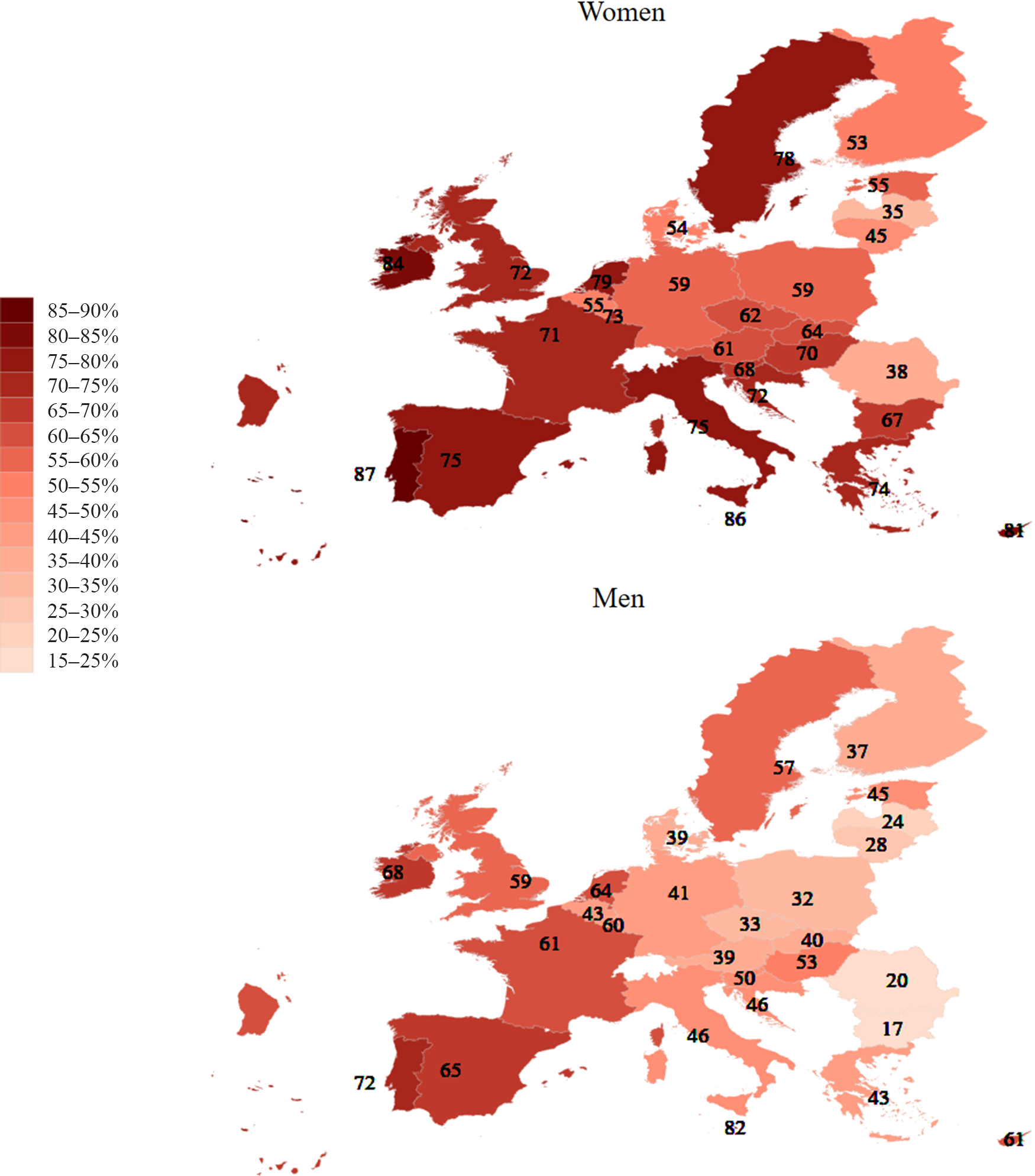
This substantial, cross-national variation in the dependent variable is reflected in Figure 1 that depicts the percentage of the female/male population in the 28 countries considering increased female representation in politics. Most obviously, Figure 1 indicates that a more gender-balanced political representation finds stronger support among women than men. On average for all 28 countries, 65.1% and 47.8% of women and men, respectively, share this belief. But more importantly, both maps reveal substantial cross-national variations. The proportion of women supporting this statement is 2.69 times larger in Portugal (the highest support) than in Latvia (the lowest support). Generally speaking, Western and Southern European countries display higher endorsement levels than do Eastern and Central European countries. But what factors account for this cross-national variation? To answer, we now turn to the multivariate results.
Percent population considering there should be more women in politics, 2017.
Multivariate results
To facilitate interpretation of the results, we separate the analyses for each gender into two tables – Tables 1 and 2 – including each 6 logit RIM with the same combination of variables. As regards individual-level factors, substantial similarities emerge across both genders. Considering only individual-level covariates, Models 1 and 7 indicate that for both women and men, socio-demographic, cultural and political factors are correlated with the outcome. Citizens with more formal education and those less committed to traditional gender norms are more likely to hold this belief. A standard deviation in traditional gender values is associated with a reduction in the predicted support of .086 and .119 absolute points for women and men, respectively.Footnote 5 This is consistent with H6. Additionally, age displays a curvilinear relationship; or more specifically – age and support for an increase in the number of female political decision-makers have an inverted-U shape. For women, support increases until age 50.04 when it starts to decrease, respectively. Generally, individual social class has no significant association with this preference, although male manual workers are significantly less supportive than the self-employed. That said, as neither unemployed nor retired are significant, the evidence does not suggest that having a paid employment is related to the support for more gender equality among political decision-makers and is inconsistent with H1.
Multilevel Logit Models Predicting Support for Higher Number of Women in Political Decision-Making

+ p < .1; * p < .05; ** p < .01; *** p < .001; t-statistics in parentheses (except variance of the constant).
Multilevel Logit Models Predicting Support for Higher Number of Women in Political Decision-Making
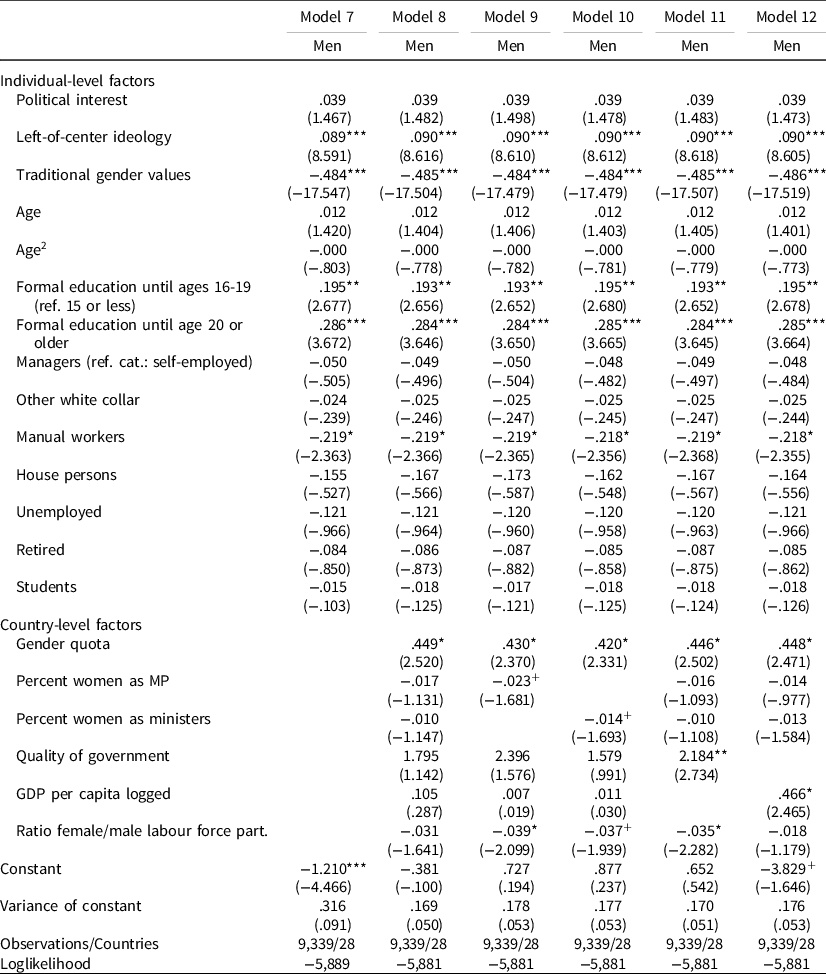
+ p < .1; * p < .05; ** p < .01; *** p < .001; t-statistics in parentheses (except variance of the constant).
Individual political positions also affect support for this political preference. Interestingly, women with stronger political interest show preference for more representation of women among decision-makers, although this correlation is non-significant for men. This finding suggests that intense political interest has different implications for men and women: women highly interested in politics probably pay more attention to topics related to gender equality than highly interested men. Additionally, supporting H3, women and men with a left-of-center ideology prove more supportive of rebalancing the gender distribution in political representation. A standard deviation change in left-of-center ideology is associated with a .025 and .049 point change in the probability of supporting this statement among women and men, respectively.
Overall, citizens with lower age, more egalitarian gender values, more years of formal education and a left-of-center ideology are more likely to support increased numbers of women among political decision-makers. What country-level factors shape this preference? To assess this, Models 2 and 8 include all six country-level factors discussed in the Data and Methods section. Interestingly, percent women as MP and percent women as ministers have negative associations with the outcome, yet the correlations are not robust and statistically significant. This is inconsistent with the expectation that the level of women’s political representation in executive and legislative branches affects women’s demand for a stronger presence of women in formal politics (H4), a prediction formulated by Dolan and Sanbonmatsu (Reference Dolan and Sanbonmatsu2009). In Europe, public demand for a more gender-balanced political representation does not increase with the effective level of gender (in)equality in this area.
Although further research could shed light on the implications individuals draw about the effective level of female political representation, this null finding may be due to countervailing forces: for a group of respondents, comparatively high (but non parity) levels of effective female representation may induce lower concern on this issue; but for another sizable group, comparatively high levels actually may raise awareness of the persistent gender imbalance and the demand for full gender parity. The combination of these processes would be consistent with the negative, non-significant association between effective female representation and the outcome.
Based on Models 2 and 8 in Tables 1 and 2, two other country-level factors do not consistently affect the support for this statement either. Contrary to H2, citizens living in countries with higher economic development are not more likely to endorse more female political representation than citizens in countries with low economic development. Similarly, contrary to H5, citizens living in countries with higher government quality are not consistently more likely to endorse more female descriptive representation. In contrast, the coefficient of ratio female/male labour force participation is negative and significant at the 10% level in Model 2. Women living in a country where women and men are equally active in the labour market are less likely to demand increases in the number of female political decision-makers.
More important, the coefficients of gender quota in Models 2 and 8 are positive and significant at the 5% level. Women and men living in countries with gender quotas for political representation display a significantly higher likelihood of demanding an increase in female representatives than those living in countries without such quotas. Based on Models 2 and 8, for women living in countries with and without a gender quota, the probability is .744 and .650, respectively, a .096 difference. For men, the corresponding predicted probabilities are .445 and .556, respectively, a .111 difference. The presence of a gender quota is thus associated with a substantial difference in the outcome. The evidence supports H7.
Due to the limited number of higher level units, the results discussed so far could be sensitive to the configuration of models. We therefore estimate a series of sensitivity analyses. First, we consider the potential sensitivity of results to the combination of country-level factors considered. Since percent women as MP and percent women as ministers are highly correlated (r = .548, p < .05), they may lack statistical significance due to limited statistical power. Models 3, 4, 9 and 10 thus replicate the analysis of Models 2 and 8 by excluding one of these two variables from each model. The evidence indicates that this strong correlation between these two indicators of women’s political empowerment does not affect the findings regarding women, but interestingly does affect the results regarding men. In the case of men, percent women as MP and percent women as ministers are negative and significant (at the 10% level).
Moreover, GDP per capita and quality of government prove highly correlated (r = .903, p < .05), hence they may also lack statistical significance due to limited statistical power. To assess this, Models 5, 6, 11 and 12 replicate the analysis of Models 2 and 8 but excluding these two variables from each model. We also observe interesting heterogeneous patterns in this regard. Unlike for women, for men, when we do not exclude the GDP per capita and quality of government, both are a positive and significantly related with the outcome. Most importantly, in all models the coefficient of gender quota remains positive and significant.
We estimate three further, sensitivity analyses: first, a RSM with interactions between gender and all country-level variables; second, an ordinal RIM with a dependent variable distinguishing respondents who consider that ‘There should be fewer women’ (0), ‘The current number of women is about right’ (1) and ‘There should be more women’ (2); third, a RIM with a weight variable. These analyses, available in Table A2, produce equivalent results: gender quota is positive and significant in all six models (in Model 19 at the 10% confidence level). Model 15 in Table A2 also shows the interesting result that none of the six considered country-level factors shape the gender gap in the demand for political representation. This indicates that macrolevel conditions affect men and women similarly in the formation of this belief. Further work could examine the individual-level conditions moderating the gender gap in support for greater female representation. The evidence included in Tables 1, 2 and A2 provides clear evidence supporting our contention of an association between gender quotas and attitudes towards the gender balance in political representation. Table A3, moreover, replicates Models 2 and 8 but has differentiated between legislative quotas and voluntary party quotas.Footnote 6 In line with the centrality of public policies discussed above, this additional evidence indicates that only legislative quotas (and not voluntary party quotas) have a significant association with the outcome.
To further elucidate the link between gender quotas and attitudinal cleavages, we test H8 and H9. For this purpose, Table 3 includes an RSM with interaction terms for gender quota and left-of-center and the two dichotomous variables of formal education. In Models 13 and 14, gender quota*left-of-center is not positive and significant. This is inconsistent with H9. In Model 13 – which considers only women – the interaction terms between gender quota and the two levels of education are not significant either. The divide between highly educated and not highly educated women in the outcome considered is not significantly larger in countries with gender quotas than in countries without quotas. This pattern, however, differs for men. In their case (Model 14), the interaction gender*formal education until age 20 or more is positive and strongly significant. This indicates that the divide between highly educated and not-highly-educated men in the support for more women in politics is significantly larger in countries with gender quotas than in countries without them. The evidence is partially consistent with H8.
Multilevel Logit Models Predicting Support for Higher Number of Women in Political Decision-Making with Interactions

+ p < .1; * p < .05; ** p < .01; *** p < .001; t-statistics in parentheses (except variance of the constant, left and education levels).
A case study of longitudinal changes in public opinion
The multilevel evidence presented and discussed so far is strictly cross-sectional. It compares average levels of demand for greater women’s representation in countries with and without quotas under the assumption that the adoption of the quota is the reason why countries with quotas display those public perceptions. Yet, the robust correlation between quota adoption and demand for women’s representation may actually reflect the influence of an unobserved time-constant dimension associated with quota adoption and the outcome. It is therefore informative to consider whether the adoption of a gender quota is associated with temporal shifts in public perceptions on this matter. As a preliminary examination of this aspect, we can consider the association between policy reforms and attitudes changes in a single European country with mandatory quotas.Footnote 7 Spain, which adopted a quota in 2007 (Verge, Reference Verge2012), provides relevant evidence in this regard.
In 2007 as well as five years before and five years after quota adoption, the Spanish Center of Sociological ResearchFootnote 8 asked citizens if they felt that women had better, worse or equal access to positions with political responsibilities than men. In the long-term, Spanish public opinion has become decreasingly likely to think that women have worse access than men to political positions.Footnote 9 This implies that if quota adoption radiates information and normative messages about the need to redress women’s political underrepresentation, we should observe a shift in public opinion trends in the post-quota-adoption period. More specifically, we should observe a gradual slowing of the long-term decline in the perception that women have worse access than men.
Supporting this expectation, Figure 2 shows a large decline during the pre-reform period in the proportions of female and male respondents considering that access is worse for women than men and a much weaker decline during the post-reform period. This evidence indicates a temporal correspondence between the presence of the gender quota and trends in public opinion – i.e., once the quota was in place, the previous decline in concern over women’s access to positions of political responsibility slowed substantially. This finding is in line with empirical work on quotas within single country cases different to Spain. Research on France suggests that public support for quotas and/or parity (and presumably more inclusion of women in politics) grew over time, especially after quota adoption (Murray, Reference Murray2012; Murray et al., Reference Murray, Krook and Opello2012).
Percentage of citizens in Spain that consider that women in Spain have better, equal or worse access than men to positions of political responsibility.
Note: Proportions and 95% confidence intervals.

Discussion
The persistent underrepresentation of women in formal politics clashes with the democratic principle that major social groups in society should enjoy representation in official political institutions. The many voices that raised awareness of this underrepresentation and the need to achieve a better gender balance among political decision-makers have now helped it become a salient issue in the public sphere of many advanced democracies. This manuscript seeks to contribute to the literature on gender and politics by expounding the scope conditions of popular support for increased female representation among top elected officials in 28 European countries. Four main findings emerge from the analysis.
First, from a strictly descriptive perspective, the study shows both a predominant rejection of the status quo – i.e. women’s underrepresentation – and substantial cross-national variations in this rejection. As many as 59% of all citizens in the 28 countries believe that ‘there should be more women in political decision-making positions’ while only 41% of all citizens think that ‘the current number of women is about right’ or should be reduced. Yet, there remains important cross-national variation in this regard. Unsurprisingly, this demand proves substantially greater among female respondents than male respondents, yet it is also interesting that one in every three women do not demand more women’s political representation. Moreover, demand for more female descriptive representation is predominant in only 21 of the 28 countries.
Second, focusing on this cross-national variation and supporting the main hypothesis of the study, the analysis reveals that the preexistence of gender quotas in legislative power is associated with attitudes concerning the number of women in politics. Citizens living in countries that have legislated compulsory mechanisms to increase women’s representation in politics display significantly higher levels of demand for more women in political decision-making positions than countries without such legislative mechanisms. Such a pattern occurs among both female and male respondents and proves robust to several statistical specifications.
This finding has the important theoretical implication for gender and politics literature that legislation of gender quotas may have multiple cross-field effects – i.e. a situation when ‘change in field A sparks concurrent, co-constitutive changes in field B’ (Mora, Reference Mora2014: 184). Studies on quotas abound, with the majority of them analyzing quota adoption. There is less research on quota effects in the political realm, specifically on the increased number of female political officials and the subsequent changes in policy making. Studies on the societal impact of quotas are even fewer (Hughes et al., Reference Hughes, Paxton and Krook2017). Our study advances this literature by being the first to theorize the mechanisms by which gender quotas play a role in fostering public opinion demands. We argue that gender quotas generate feedback effects in public opinion through their informational and normative effects. Debates between policy-makers on the design and implementation of gender quotas reverberate into public opinion, raising public awareness over the underrepresentation of women in this field. Moreover, through the adoption of a gender quota, national parliaments send a strong symbolic message about the need to redress this underrepresentation. The empirical evidence presented herein hints that the very existence of quotas can trigger a positive cycle by which the adoption and implementation of quotas foster societal attitudes in favour of higher numbers of female politicians. These attitudes may incline citizens to vote for female candidates and judge women politicians as being legitimate policy makers.
Third, although quotas are linked to support for a gender-balanced political representation, it is not a uniform association across social groups. We again advance the literature by showing that quota adoption does not display a uniform relationship across all education groups. Our analysis shows that for men living in a country with a quota has a significantly stronger association with the outcome if the respondent is highly educated than if the respondent is not highly educated. In contrast, for women living in a country with a quota proves having an equivalent association with the outcome whether the respondent is highly educated or not.
How can we account for this unexpected difference in patterns between men and women? It cannot be attributed to ceiling effects among women because the predicted probability for highly educated women in non-quota countries (.651) is far from the maximum possible level. A more likely cause lies in potential heterogeneous mechanisms by gender. Highly educated men have few incentives to be generally informed and aware of the ethical implications of the persistent gender gap in political representation. For them, living in a country with quotas can hold both informational and normative effects. In contrast, being members of a generally subordinated group, highly educated women – living in countries with or without quotas – are likely informed about the persistent gender gap in political representation. For them, the effect of gender quotas for women should be restricted to a normative effect, attenuating the transformative consequences with respect to non-highly educated women. Since EB 87.4 does not include indicators of political knowledge on this matter, we are unable to test potential gender heterogeneity in mechanisms.
Future studies based on surveys including questions on respondents’ beliefs and knowledge on this matter could help test the expectation that quotas influence male perceptions through normative and informational effects, whereas they influence female perceptions only through normative effects. Other studies could also continue to explore the potential collective implications of gender quota adoption by considering its relevance for persistent gender gaps (e.g. in the demand for women’s representation, nonconventional political participation or political interest). Until that research is conducted, this study contributes to our understanding of politics and gender by showing that in line with the prediction of the policy feedbacks approach, countries with gender quotas display significantly higher levels of support for greater women’s representation in politics.
Supplementary material
To view supplementary material for this article, please visit https://doi.org/10.1017/S1755773921000126.
Acknowledgements
The authors thank Antonio Jaime-Castillo, four anonymous reviewers and the editors of European Political Science Review Carlos Closa and Matt Qvortrup for their comments on earlier drafts. We are also grateful to Richard Frederick and Ildi Clarke, who edited the text. The project received financial support from the Spanish State Research Agency (project: RT2018-0988781-B-I00).


 Open access

