


1. Introduction
Air inclusions in polar ice cores provide the only direct archive to reconstruct a record of ancient air composition. The Dome F (Antarctica) ice core, for example, has yielded air up to 720 ka old (Reference MotoyamaMotoyama and others, 2007; Reference Goto-AzumaGoto-Azuma and others, 2008). However, the air bubbles originating from the space between snow particles in the firn become compressed with increasing depth in accordance with the increasing overburden pressure. When this pressure exceeds the temperature-dependent dissociation pressure of air-clathrate hydrate (hereafter, simply air hydrate) the air bubble transforms into air hydrate. As the air hydrate is transparent and sub-millimeter, the ice core becomes fully transparent after all air bubbles transform into air hydrates. But not all air bubbles transform into air hydrates at the same depth; rather, bubble and hydrate coexist in the bubble–hydrate transition zone (BHZ).
Air hydrate is a clathrate compound that traps air molecules (mostly nitrogen N2 and oxygen O2) within a cage-like water structure. Their existence in deep ice sheets was predicted by Reference MillerMiller (1969) and later confirmed by Reference Shoji and LangwayShoji and Langway (1982) in Dye-3 (Greenland) ice cores. After that, air hydrates were found in every deep ice core in Greenland including Camp Century (Reference Shoji and LangwayShoji and Langway, 1987), GRIP (Reference Pauer, Kipfstuhl and KuhsPauer and others, 1997), NGRIP (Reference Kipfstuhl, Pauer, Kuhs and ShojiKipfstuhl and others, 2001) and GISP2 (indirectly, Reference Suwa and BenderSuwa and Bender, 2008). They were also found in Antarctica including cores drilled at Byrd (Reference Shoji and LangwayShoji and Langway, 1987), Vostok (Reference Uchida, Hondoh, Mae, Lipenkov and DuvalUchida and others, 1994a), Dome Fuji (Reference NaritaNarita and others, 1999) and EPICA-DML (Reference Faria and HondohFaria and others, 2009).
Within the air hydrates, the variation of the O2/N2 ratio correlates to the local summertime insolation (Reference BenderBender, 2002; Reference Fujita, Okuyama, Hori and HondohFujita and others, 2009), meaning that the annual oscillations of this ratio can be counted to date older ice. However, when an air bubble transforms into air hydrate, fractionation of the gases occurs, which changes the N2/O2 ratio in the air inclusions in the BHZ (Reference IkedaIkeda and others, 1999). Below the BHZ, the N2/O2 ratio becomes the same as that above the BHZ (Reference IkedaIkeda and others, 1999; Reference Ikeda-Fukazawa, Hondoh, Fukumura, Fukazawa and MaeIkeda-Fukazawa and others, 2001). Once the core is put into storage, the N2/O2 ratio does not change, provided the storage temperature is carefully controlled (Reference KawamuraKawamura and others, 2007), meaning that the measured fractionation of gases occurred in the BHZ. It is therefore very important to understand the bubble–hydrate transformation processes for the ice-core analyses.
To study this transformation, we must know the precise phase-equilibrium conditions. However, owing to the high pressures and low temperatures involved, the phase diagram of air hydrate has been poorly known. But recently, Reference Yasuda, Oto, Shen, Uchida and OhmuraYasuda and others (2013) carefully measured the phase-equilibrium conditions of air (mixed N2 and O2) hydrate over a wide temperature range, finding corrections to the previous reported data (Reference MillerMiller, 1969; Reference Kuhs, Klapproth, Chazallon and HondohKuhs and others, 2000; Reference Mohammadi and RichonMohammadi and Richon, 2010). Our approach here is to review the BHZ of each deep ice core from both Antarctica and Greenland, and use the most precise phase-equilibrium data to analyze their common and specific features. Our re-analysis of air-hydrate distribution in the Byrd ice core supports the new phase-equilibrium data. Use of this accurate supersaturation data then suggests a super-saturation for transforming air bubble to air hydrate in the natural condition.
2. Methods
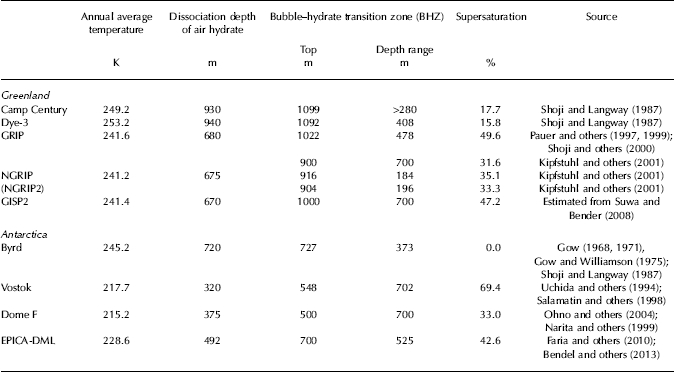
We examine here previously published data on the airhydrate distribution, temperature profile and age of ice in deep ice cores. Data of air-hydrate distributions are listed in Table 1. The locations and other sources are as follows: for Greenland, Dye-3 and Camp Century (Reference Shoji and LangwayShoji and Langway, 1982; Reference Shoji, Miyamoto, Kipfstuhl, Langway and HondohShoji and others, 2000; Reference VintherVinther and others, 2006, Reference Vinther2009), GRIP (Reference Gundestrup, Jensen, Johnsen and RossiGundestrup and others, 1993; Reference Pauer, Kipfstuhl and KuhsPauer and others, 1997, Reference Pauer, Kipfstuhl, Kuhs and Shoji1999; Reference Shoji, Miyamoto, Kipfstuhl, Langway and HondohShoji and others, 2000; Reference VintherVinther and others, 2006, Reference Vinther2009), NGRIP (Reference Kipfstuhl, Pauer, Kuhs and ShojiKipfstuhl and others, 2001; Reference VintherVinther and others, 2006, Reference Vinther2009) and GISP2 (Reference MeeseMeese and others, 1994; Reference GowGow and others, 1997; Reference Suwa and BenderSuwa and Bender, 2008); for Antarctica, Byrd (Reference Gow, Ueda and GarfieldGow and others, 1968; Reference MillerMiller, 1969; Reference Gow and WilliamsonGow and Williamson, 1975; Reference Shoji and LangwayShoji and Langway, 1987; Reference Craig, Shoji and LangwayCraig and others, 1993; Reference Hammer, Clausen and LangwayHammer and others, 1994; Reference Shoji, Miyamoto, Kipfstuhl, Langway and HondohShoji and others, 2000), Vostok (Reference Uchida, Hondoh, Mae, Lipenkov and DuvalUchida and others, 1994a,Reference Uchida, Duval, Lipenkov, Hondoh, Mae and Shojib; Reference Lipenkov and HondohLipenkov, 2000; Reference Shoji, Miyamoto, Kipfstuhl, Langway and HondohShoji and others, 2000), Dome Fuji (Reference NaritaNarita and others, 1999; Reference Ikeda-Fukazawa, Hondoh, Fukumura, Fukazawa and MaeIkeda-Fukazawa and others, 2001; Reference Ohno and HondohOhno and others, 2004, Reference Ohno and Hondoh2010; Reference KawamuraKawamura and others, 2007; Reference Uchida, Miyamoto and HondohUchida and others, 2011) and EPICA-DML (Reference Wilhelms, Sheldon, Hamann, Kipfstuhl and KuhsWilhelms and others, 2007; Reference Faria and HondohFaria and others, 2009, Reference Faria, Freitag and Kipfstuhl2010; Reference BendelBendel and others, 2013). The precise depth of the top of the BHZ in each case is uncertain owing to observation difficulty: here the experimenter must find at least one ~10 µm diameter, transparent hydrate inclusion among larger, opaque air bubbles. Nevertheless, different studies of the same ice core give estimated depths for the top that agree within 50 m (22 m in the GRIP core (Pauer and others, 1999; Reference Shoji, Miyamoto, Kipfstuhl, Langway and HondohShoji and others, 2000), and ~50 m in the Dome Fuji ice core (Reference NaritaNarita and others, 1999; Reference Ohno and HondohOhno and others, 2004)). Thus, we consider that the uncertainty of the BHZ is at most ±50 m.
Air-hydrate distribution in various deep ice cores
To determine the degree of non-equilibrium of the observed air hydrates, we must first know the equilibrium conditions. We use the recent measurements of Reference Yasuda, Oto, Shen, Uchida and OhmuraYasuda and others (2013) for air hydrates of air composition N2: O2 = 0.791: 0.209, but because their experimental conditions are limited, we extrapolate their data to lower temperatures by fitting the empirical equation (Reference MillerMiller, 1969)

Here Pi d is the dissociation pressure (MPa) of component-i hydrate at temperature T (K), and A and B are constants. Using least-square fitting for their data, we obtain A = 8.711 and B = –1.646 × 10³ (K–1) for N2 hydrate, and A = 8.761 and B = –1.678 × 10³ (K–1) for air hydrate with N2: O2 = 0.791: 0.209.
To compare these hydrate P–T curves to the observed depth distributions in the ice core, we convert the pressure P (MPa) to the depth d (m) using the overburden pressure– depth relation

which was estimated from Byrd ice core (Reference Gow and WilliamsonGow and Williamson, 1975). This relation was applied to all ice-core depth distributions in the present study. Although pore-close-off depths vary by drilling site, ranging from 64 m at Byrd station to 104 m at Dome Fuji station, this depth variation is much smaller than the depth for the top of the bubble–hydrate transformation zone (>500 m). To estimate the uncertainty in Eqn (2), we assume that the density difference between firn and ice is 0.2 g cm–3 in the depth range 64–104 m. As a result, the depth uncertainty at the firn–ice transition is less than ~10 m. Therefore the depth uncertainty due to differences in pore close-off depth is much smaller than the abovementioned uncertainties of optical observations for the BHZ boundaries.
Another source of uncertainty is the variation in air-bubble composition. At shallower depths of the BHZ, the air composition roughly equals that of the atmosphere (Ikeda and others, 1999) and the air-hydrate P–T relation applies. But, at greater depths of the BHZ, the air bubbles become N2-rich. Therefore, the maximum deviation of depths due to this composition change would be the difference of P N2 d and P air d. At 260 K, the highest temperature in the BHZ, the pressure difference is 0.763 MPa from Eqn (1), which is equivalent to a depth difference of 91 m from Eqn (2).
3. Results and Discussion
We now use the phase equilibria data to analyze the d–T profiles of deep ice cores. Figure 1 shows the temperature profiles of Antarctic ice and Greenland ice. The depth range between the shallowest and deepest observed air hydrates (solid and open circles) is defined as the BHZ. This figure shows that the top of the BHZ always lies at greater depth than that for air-hydrate equilibrium. This result indicates that the experimental data for air-hydrate equilibrium conditions below the ice point are accurate enough for us to analyze the phase-transition process between air bubbles and air hydrates.
Phase equilibria of N2 hydrate (thick dotted line) and air hydrate (thick solid line) compared with depth–temperature profiles of deep ice cores in Antarctica (solid lines) and Greenland (dashed lines). Dissociation pressure is converted to depth through Eqn (2). The BHZ lies between the observed shallowest depth with air-hydrate observation (solid circle) and the deepest depth with air bubbles (open circle).

The present data may clear up an unresolved issue of the air hydrates in the Byrd ice core. Reference Shoji and LangwayShoji and Langway (1987) and Reference Craig, Shoji and LangwayCraig and others (1993) found air hydrates ~100 m above the equilibrium depth predicted by Reference MillerMiller (1969). Based on the analysis of the flowline trajectory of ice passing through the Byrd Station drill site, Reference Craig, Shoji and LangwayCraig and others (1993) considered that these air hydrates had been anomalously preserved in the ice sheet. However, using the newer equilibrium data, we find the top of the BHZ to be consistent with the phase-equilibrium condition. Thus the present study indicates that all air hydrates pushed up by the upstream flow dissociate when they cross the phase-equilibrium condition. This finding also confirms the accuracy of Reference Yasuda, Oto, Shen, Uchida and OhmuraYasuda and others’ (2013) new phase-equilibrium data. Moreover, the anomalous preservation of air hydrates, when it occurs, requires temperatures below 223 K (Reference Uchida, Hondoh, Mae, Shoji and AzumaUchida and others, 1994d; Miyamoto and others, 2009). As the bore-hole temperature of Byrd Station is much higher, air hydrate in the Byrd ice core cannot be preserved anomalously. Thus the present result is also consistent with this temperature criterion for the anomalous preservation of air hydrates.
In the other ice cores, the top of the BHZ is more than 100 m deeper than the air-hydrate equilibrium depth. That is, the air hydrates first form at a higher-than-equilibrium pressure. Even considering the uncertainty in the BHZ top, this result suggests that the transformation from air bubble to air hydrate requires supersaturation. This supersaturation is likely to be intrinsic given the extremely slow rate of pressure increase. To estimate the degree of supersaturation σ, we calculate the pressure difference between P top, the overburden pressure at the top of the BHZ, and P air d, divided by P air d:

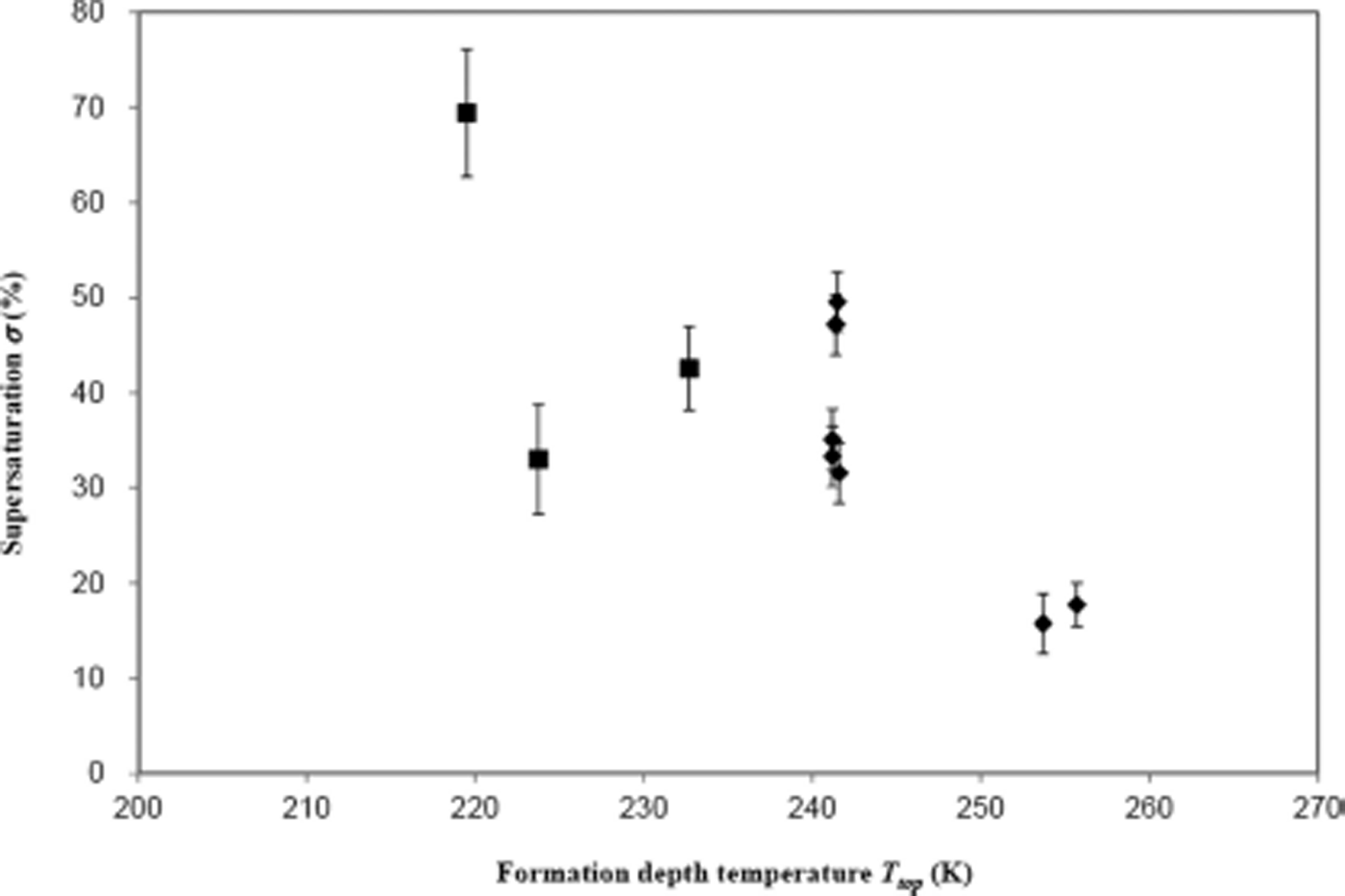
We now investigate how σ relates to the physical parameters at the top of the BHZ. We find that σ correlates with temperature T top (Fig. 2), in which σ is small when the ice temperature is high. This result holds for different ice cores exhibiting similar physical conditions. The driving force of air-hydrate nucleation is estimated as the chemical potential Δμ, which for homogeneous nucleation is

Temperature T dependence of the supersaturation σ for the transformation of air bubble to air hydrate. Solid squares show σ data in Antarctic ice, and solid diamonds show data in Greenland ice. Error bars arise from the uncertainty in the top depth of the BHZ. Note that the data in Byrd ice core are not shown because the shallowest depth is not related to the formation depth of air hydrate.
where η = 3/17 is the reciprocal of the number of water molecules per cage, and k is Boltzmann’s constant (Reference HondohHondoh, 1989). The critical radius of nucleus r * on the air bubble surface is

where v is the average volume occupied by water molecule in the hydrate phase and γ is the interfacial tension between the air-hydrate crystal and the surrounding ice matrix. At the top of the BHZ, Δμ ranges between 20 and 80 J mol–1 between sites, which is only a small percentage of the value of kT. The resulting critical nucleus is 53 ± 13 nm, which is ~30 unit cells of the air-hydrate crystal. As the critical nucleus is very large, we consider homogeneous nucleation unlikely, meaning that nucleation must be heterogeneous.
Figure 2 also shows that one of the major controlling factors of air-hydrate nucleation is temperature. Thus, we assume that air-hydrate nucleation is a thermally activated process, and use the temperature dependence of the supersaturation to estimate the apparent activation energy for nucleation, Q n. The absolute value of this apparent activation energy Q n is estimated from the regression-line fit to the σ vs 1/T plot

As a result, we estimated Q n as 11.3 ± 5.0 kJ mol–1. Although the estimation of σ includes the uncertainty derived from the variation in the observed BHZ (as described in Fig. 2), the uncertainty of Q n is mainly due to the larger variation of σ related to the site. In previous works (Reference Salamatin, Lipenkov, Hondoh and IkedaSalamatin and others, 1999, Reference Salamatin, Lipenkov, Fukazawa and Hondoh2001), the activation energy of air-hydrate formation was assumed to be 70 kJ mol–1, based on homogeneous nucleation theory and on an analogy with the self-diffusion of water interstitial in ice. Compared with this ideal state, the obtained apparent activation energy is only 16%. This result also suggests heterogeneous nucleation on/in the air bubble.
Although the nucleation of the first air-hydrate crystals correlates with σ and with T, we cannot find correlation with the depth range of the BHZ (the depth between the top and bottom of the BHZ). For example, even ice cores with similar temperature profiles (e.g. GRIP, NGRIP and GISP2), have a range of BHZ that varies from 200 to 700 m. Since the transformation from a bubble to an air hydrate completes within several days of the air-hydrate nucleation (Reference Uchida, Hondoh, Mae and DuvalUchida and others, 1994c; Reference Salamatin, Hondoh and UchidaSalamatin and others, 1998; Reference Shimada and HondohShimada and Hondoh, 2004), the number-density profile of air-hydrate crystals in the BHZ would relate to the probability of air-hydrate nucleation on air bubbles. This is based on the assumption that the transformation of bubble to hydrate occurs individually and does not propagate catalytically. The existence of a bubble-free band in the BHZ (Reference Faria, Freitag and KipfstuhlFaria and others, 2010; Reference BendelBendel and others, 2013) supports this assumption. The number-density profile of airhydrate crystals in the BHZ fits to the cumulative normal distribution curve (Reference Uchida, Duval, Lipenkov, Hondoh, Mae and ShojiUchida and others, 1994b; Reference NaritaNarita and others, 1999; Reference Ohno and HondohOhno and others, 2004; Reference Pauer, Kipfstuhl, Kuhs and ShojiPauer and others, 1999; Reference Kipfstuhl, Pauer, Kuhs and ShojiKipfstuhl and others, 2001), which indicates that the nucleation probability is normally distributed. Therefore, the bubble-hydrate transformation occurs mainly in the middle depth of the BHZ. The depth range of the BHZ is, in contrast, related to the difficulty of air-hydrate nucleation at that site. The large variation of the depth range of the BHZ in Greenland ice cores would indicate that air-hydrate nucleation in natural ice sheets depends not only on the temperature–pressure conditions, but also on the existence of site-specific heterogeneous nucleation conditions.
As a nucleation accelerator, Reference Kuhs, Klapproth, Chazallon and HondohKuhs and others (2000) considered grain boundaries on the bubble surface. Reference Shimada and HondohShimada and Hondoh (2004) and Reference Ohno and HondohOhno and others (2004, Reference Ohno and Hondoh2010) pointed out, however, that micro-inclusions on the bubble were more effective than grain boundaries. The concentration and the distribution of chemical impurities usually differ by site, so chemical impurities may cause variations in the depth range of the BHZ. By analogy with the memory effect of gas-hydrate formation (Reference Sloan and KohSloan and Koh, 2008), other gas hydrates with lower dissociation pressures, such as CO2 and methane hydrates, may form before the air hydrate and act as nuclei. In addition, Reference Lipenkov and HondohLipenkov (2000) and Reference BendelBendel and others (2013) indicated that small air bubbles preferentially transformed into air hydrates. This result suggests that the heterogeneity of air-hydrate nucleation is also affected by the wall curvature of the bubble. The existence of various inclusions on a bubble would then act as the nucleation accelerators by changing the physical and chemical conditions of the bubble-wall surface.
The existence of bubble-free bands in the BHZ (Reference Faria, Freitag and KipfstuhlFaria and others, 2010; Reference BendelBendel and others, 2013) strongly suggests that preferential nucleation of air hydrates occurs under high-impurity and small-bubble-size conditions. These observations conversely suggest that the effect of impurities or bubble sizes was confined to small regions (of the order of centimeters). Thus, to understand the hundreds-of-meters variation of the depth range of the BHZ, we should also consider nucleation inhibitors.
The fractionation effect in the air-hydrate formation process is considered a nucleation inhibitor. Raman spectroscopy (Reference IkedaIkeda and others, 1999; Reference Ikeda-Fukazawa, Hondoh, Fukumura, Fukazawa and MaeIkeda-Fukazawa and others, 2001) indicates that the gas composition of the remaining air bubbles in the BHZ becomes N2-rich compared with that above the BHZ owing to the fractionation effect of airhydrate formation, especially in deeper parts. As the dissociation pressure increases with increasing N2 concentration, the driving force of air-hydrate nucleation becomes smaller.
Nucleation acceleration and inhibition effects would act in different combination at each site. The resulting variation of air-hydrate nucleation probability would produce variation in the BHZ depth range. This variation would add to the variation from the different pressure–temperature conditions.
4. Conclusion
New equilibrium data of air hydrates obtained by the modeled air + ice system were accurate enough to analyze the deep ice cores. Using these new equilibrium data on nitrogen and air clathrate hydrates, we found that all bubble– hydrate transition zones in existing deep ice cores in Antarctica and Greenland have occurred under conditions of air-hydrate supersaturation. This supersaturation was not considered transient because the change in pressure–temperature conditions is sufficiently slow to be considered steady-state at each depth. However, the estimated super-saturation for air-hydrate nucleation was lower than that predicted by homogeneous nucleation theory. Moreover, the apparent activation energy of air-hydrate nucleation was estimated to be much smaller than that predicted previously for a pure ice system. We then concluded that heterogeneous nucleation occurs on the bubble surface, which is consistent with previous studies. Finally, by assuming that the depth range of the bubble–hydrate transition zone reflects the probability of air-hydrate nucleation, we argued that the variation of the depth range among different coring sites probably results from site-to-site variations in the nucleation acceleration and inhibition factors.
Acknowledgements
We thank A. Miyamoto (Hokkaido University), H. Ohno (Kitami Institute of Technology) and K. Kawamura (National Institute of Polar Research) for useful discussions on airhydrate observation and for the review of the d–T diagram, and S. Kipfstuhl (Alfred Wegener Institute) and B.M. Vinther (University of Copenhagen) for their generous support of ice-core data. We also thank reviewers (S.H. Faria and anonymous) and J. Nelson for their kind suggestions.



