

In Trump v. Casa (2025), the U.S. Supreme Court limited lower court federal judges’ ability to issue nationwide injunctions. Before the decision, nationwide injunctions allowed a single federal judge to halt a federal law or policy across the entire country instead of just a single district (Harvard Law Review 2024). There has been a rise in federal judges issuing these injunctions beginning under the Obama administration, then escalating under the first Trump administration through the current one (Harvard Law Review 2024, 1705). An important characteristic of the injunctions is that they are often issued by judges appointed by a president of the opposing party; this has led to a practice of forum shopping by both conservative and liberal interest groups in search of a judge who will be receptive to their legal argument (1709). Thus, given that the Supreme Court limited federal court judges’ ability to issue this type of remedy under the current Trump administration, many commentators saw it as a win for President Trump to further push his policy agenda without being checked by the courts (Gerstein Reference Gerstein2025; Goldsmith Reference Goldsmith2025; VanSickle Reference VanSickle2025).
In Trump v. Casa, a majority of the Court argued that there was no long historic practice in the common law of giving lower courts such a powerful remedy. Writing for the majority, Justice Amy Coney Barrett cited a law review article in support of this position written by University of Chicago Law School law professor Samuel Bray. However, she did not stop with the single citation. Justice Barrett would go on to cite Bray eleven times in the majority opinion, covering four different articles he has authored. Justice Barrett’s reliance on Bray raises an important question on which prior scholarship provides little empirical data and even less theoretical insights: how do Supreme Court justices use legal scholarship in their opinions?
There are many ways in which Supreme Court justices might use legal scholarship in their opinions that fit both within attitudinal and strategic explanations of the judicial decision-making (Spriggs and Wahlbeck Reference Spriggs and Wahlbeck1997; Epstein and Knight Reference Epstein and Knight1998; Maltzman et al. Reference Maltzman, Spriggs and Wahlbeck2000; Segal and Spaeth Reference Segal and Spaeth2002; Collins et al. Reference Collins, Corley and Hamner2015; Huang and Roemheld Reference Huang and Roemheld2016; Hazelton et al. Reference Hazelton, Hinkle and Spriggs2019). There may be clear ideological connections between the justices and their citations, such that conservative justices cite conservative legal scholars, and conversely liberal justices cite liberal legal scholars, with the goal of supporting their own preferred ideological positions. Thus, unabridged attitudinalism could be the explanation for the justices’ increased citation to legal scholarship. However, there could also be a strategic element to the justices’ citations to law review articles. Justices may use legal scholarship to attempt to justify recent unpopular decisions and thus use legal scholarship to achieve traditional strategic goals. Determining whether the justices’ motivation for drastically increasing their use of legal scholarship in recent years is attitudinal or strategic is difficult but important to understanding the Court’s push to the conservative right and apprehending how the justices are attempting to persuade the public that this massive shift is warranted.
This article does not attempt to answer why the justices might cite law review articles in their opinions. Instead, in this article, I set out to examine how Supreme Court justices use legal scholarship in their opinions and analyze recent trends. To do so, I develop and then draw on an original database of citations to legal scholarship by Supreme Court justices during the Roberts Court (2005–2023). Leveraging this new dataset, I find that there is a strong upward trend in the number of citations to legal scholarship, with large increases in more recent years. Further, there is a surge in the percentage of opinions that cite legal scholarship. Importantly, the justices are utilizing legal scholarship most frequently in some of the Court’s recent, highly salient decisions, including those expanding individual gun rights, entrenching protections for religious freedom, and limiting affirmative action programs in college admissions. Additionally, the justices are overwhelmingly cited legal scholarship published in the most elite law review journals, with Harvard Law Review and Yale Law Journal emerging as the preferred outlets. Lastly, the data show that the distribution of law professors cited is highly skewed, with a small number of individuals accounting for a disproportionately large share of citations, the majority of which have ties to the Federalist Society.
These trends establish a sharp change in the way the justices on the Court are using legal scholarship in their opinions. The existing body of literature on the Supreme Court’s use of legal scholarship is theoretically incoherent. This article sets the foundation for future theoretical work to examine the number of explanations that could help us understand this change by the justices and what is driving it. This transformation in the citation to legal scholarship has important implications in helping us understand how justices craft their decisions and make them more persuasive to their audiences. Further, understanding this shift will assist scholars of the Court in comprehending how the justices are attempting to justify pushing the law to the conservative right by examining what they cite in their opinions. The contents of the Court’s opinions are binding precedent on lower courts, constrain future Supreme Courts, and limit other government actors (Corley, Collins, and Calvin Reference Corley, Collins and Calvin2011). My data show that the justices have shifted the way in which they construct opinions.
The article proceeds in four parts. The first section explores the broader literature on the Supreme Court’s citation to legal scholarship in its opinions. Next, I explain the data and offer descriptive findings about the Supreme Court’s use of legal scholarship and examine important trends: a rise in the number of citations to law reviews by the justices, the types of cases the justices cite the most legal scholarship in, and which justices are driving this change. In the following section, I examine which law review journals the justices tend to favor, the distribution of citations to law professors, and the most cited legal scholars. Lastly, I explore the possible explanations for why the Supreme Court has increased its use of legal scholarship and provide important theoretical questions that future work must grapple with to fully comprehend this transformation on the Court.
Crafting a persuasive opinion
Supreme Court justices have a plethora of legal authorities to cite when justifying their decisions. The main vehicle under the common law system is citation to precedent (Fowler et al. Reference Fowler, Grofman and Masuoka2007; Choi and Gulati Reference Choi and Gulati2008; Clark and Lauderdale Reference Clark and Lauderdale2010). Under this system, courts base their decisions on prior controlling cases with similar facts under the legal doctrine of stare decisis – to stand by things decided (Knight and Epstein Reference Knight and Epstein1996). However, justices also cite to the briefs provided by the parties (Hazelton and Hinkle Reference Hazelton and Hinkle2022), lower court opinions (Corley et al. Reference Corley, Collins and Calvin2011), or one of the many amicus briefs submitted in an attempt to influence the opinion of the Court (Spriggs and Wahlbeck Reference Spriggs and Wahlbeck1997; Collins, Corley, and Hamner Reference Collins, Corley and Hamner2015; Huang and Roemheld Reference Huang and Roemheld2016; Feldman Reference Feldman2017; Hazelton, Hinkle, and Spriggs Reference Hazelton, Hinkle and Spriggs2019). Additionally, research tells us that they cite the Federalist Papers (Corley, Howard, and Nixon Reference Corley and Nixon2005) or implement other rhetorical sources (Hume Reference Hume2006) to make their opinions seem more persuasive to other actors.
While precedent holds a more prominent place in judicial decision-making, judges also use non-authoritative sources in their opinions (Hume 2010). Federal judges use instrument-choice strategies – efforts by judges to use the language of their opinions to win support for their judgments – to make their opinions more persuasive to their audiences through the content in their opinions, such as legal support for their position (Smith and Tiller Reference Smith and Tiller2002; Corley et al. Reference Corley and Nixon2005; Hume Reference Hume2006; King Reference King2007). These strategies include non-authoritative sources such as law review articles, and judges cite to them when they anticipate problems accomplishing their goals to give the impression that their decisions are well-supported and use them in expectation that other actors will try to limit their decision (292, 311). These differ from policy-choice strategies, which are when judges change the substance of a policy to win the support of others (Maltzman et al. Reference Maltzman, Spriggs and Wahlbeck2000).
Hume’s work is rooted in a rich tradition of prior work analyzing the role of legal scholarship in judicial opinions. The Supreme Court’s legal scholarship citation practices have garnered the attention of legal scholars since the 1980s (Sirico and Margulies Reference Sirico and Margulies1986). Early research showed that the total number of citations decreased from the early 1970s to the 1980s (Sirico Reference Sirico2000). However, more recent work found that the Court’s use of legal scholarship is stable from a long-term perspective (McClintock Reference McClintock1998). Further, there is empirical evidence that the justices use legal scholarship when they are deciding important or difficult cases (Petherbridge and Schwartz Reference Petherbridge and Schwartz2012, 1016). Conversely, normative accounts of the Supreme Court’s use of legal scholarship argue that law reviews have become less helpful to judges in recent years as the profession has changed and the sheer number of publications has exploded (Wood Reference Wood2014; Posner Reference Posner2016).
One thing that is not addressed by prior research is exactly how the justices know about the law review articles they may cite. There are several possible explanations. First, it could be that the justices regularly read legal scholarship. This is plausible, but is unlikely to account for how they come across the bulk of legal scholarship, given judges’ desire to balance their time (Posner Reference Posner1993; Clark et al. Reference Clark, Engst and Staton2018) and the difficulty of reading enough scholarship to stay up to date on the current debates with the vast array of issues that come before the court (Rice Reference Rice2019). Second, the justices could be made aware of the law reviews by their law clerks (Ward and Weiden Reference Ward and Weiden2006; Peppers and Ward Reference Peppers and Ward2012; Peppers and Zorn Reference Peppers and Zorn2008; Kromphardt Reference Kromphardt2015a). This explanation is more probable given a comment by Justice Brett Kavanaugh at the 2023 Notre Dame Law Review Federal Courts Symposium, “They’re [law review articles] always required in the binders that they [his clerks] prepare with all the background material.” Third, it could be that the attorneys in the case bring relevant law review articles to the attention of the justices through their legal briefs (Hazelton and Hinkle Reference Hazelton and Hinkle2022). Or maybe the law review articles are being brought to the justices’ attention in amicus curiae briefs or lower court opinions (Collins Reference Collins2008; Collins et al. Reference Collins, Corley and Hamner2015; Johnson Reference Johnson2016). Determining how a justice first became aware of a law review is difficult, given the multitude of avenues by which the justices obtain information. Understanding the exact mechanism by which the justices become aware of any given law review article is complex and is beyond the scope of this research. Instead, I explore empirical regularities involving the Supreme Court’s citations to legal scholarship to establish a foundation for future research.
Data collection
To examine the Supreme Court’s citation to legal scholarship, I collected the text of the opinion for every decision decided on the merits during the Roberts Court using Westlaw’s legal research database. Investigating the Roberts Court allows me to examine a cohesive period under the guidance of a single Chief Justice that witnessed significant change in the composition of the justices. This permits an analysis of the dynamics of the current era while holding constant the most important leadership position, the Chief Justice. To construct the database, I then searched within those opinions for every available law review journal abbreviation to only capture opinions with a citation to a piece of legal scholarship.Footnote 1 Next, I merged my citation data with the justice-centered data available from the Supreme Court Database (Spaeth et al. Reference Spaeth, Epstein, Matin, Segal, Ruger and Benesh2024).Footnote 2 The merged dataset features 3,002 total observations, representing each opinion issued by a justice on the Court during the term of study, with the unit of analysis being the opinion. The data spans from September 2005, when Chief Justice Roberts joined, through the 2023 term. In total, the dataset comprises 1,498 majority, concurring, and dissenting opinions that have at least one citation to legal scholarship. Altogether, there are 1282 total cases represented in the data, of which 388 cite legal scholarship. I also collected information on the justice, citing the law review article, the year the case was decided, the author(s) of the article, and the law journal in which the article was published.
How the Roberts Court is using legal scholarship
In this section, I explore the number of citations to law review articles and how it has changed over the course of the Roberts Court. Next, I examine the proportion of opinions that cite legal scholarship. Then, I look at which types of opinions the justices are citing legal scholarship in: majority, concurring, or dissenting. Afterward, I assess the proportion of cases that cite legal scholarship based on the legal issue before the Court. Then, I investigate which cases the justices are citing the most legal scholarship in. Lastly, I review which justices are citing the highest proportion of legal scholarship in their opinions.
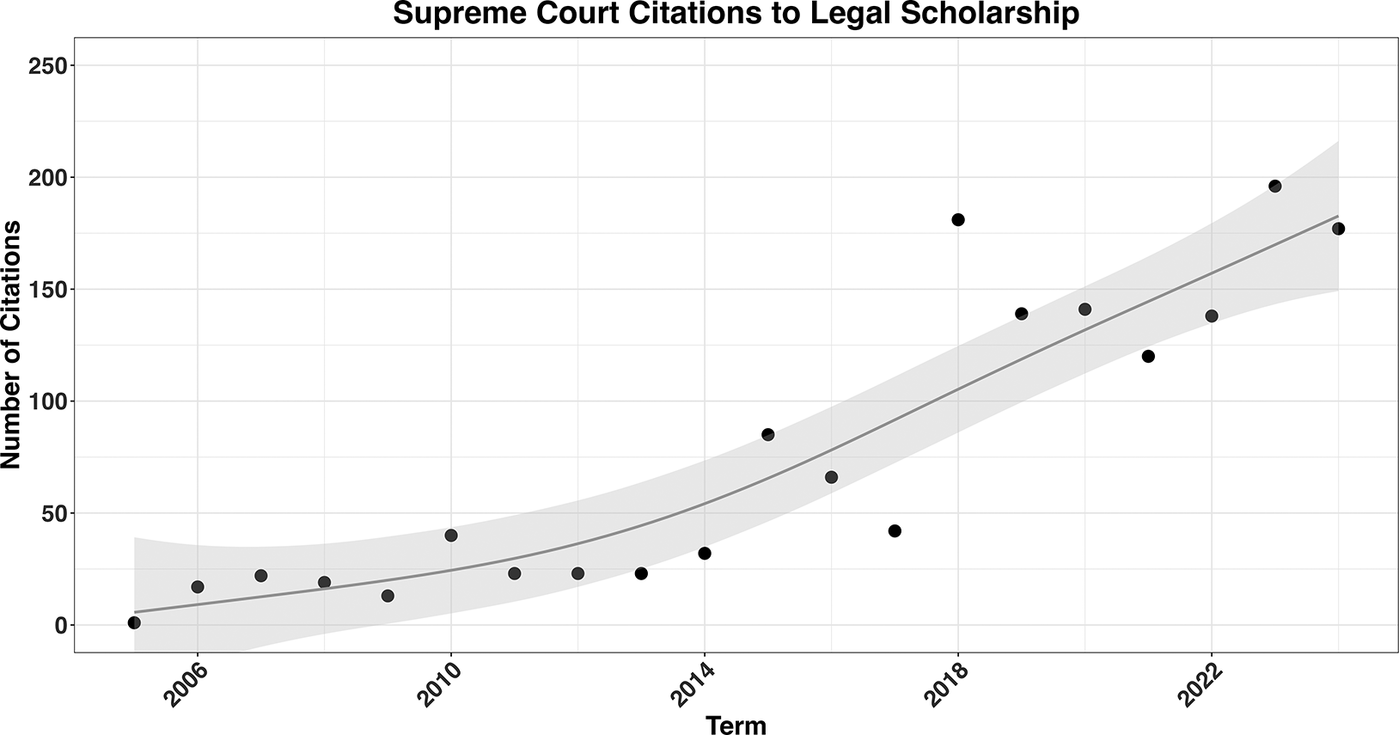
Figure 1 plots the number of citations to legal scholarship by term for the Supreme Court since Chief Justice Roberts joined the Court. The y-axis is the number of citations to legal scholarship per term, and the x-axis represents the term. The gray line provides a smoothed fit (using a generalized additive model fit), and the shaded gray region is the associated 95% confidence interval. The plot provides evidence of a major increase in the number of citations to law review articles by the Supreme Court over the past two decades. The mean number of citations per term is 75, the median is 46, and the standard deviation is 65. The fewest citations came during the 2008 term, with 13, although that was on par with the early years of the Roberts Court. As shown in the figure, there was a large jump in the number of citations starting in the 2017 term when the number ballooned to 176. The number of citations has stayed in the upper range of the plot since then, with a peak of 199 citations in the 2022 term. It is important to note that the number of law review citations is increasing as the Supreme Court is continuously shrinking the size of its docket (Lane Reference Lane2022). Therefore, even though the Supreme Court is deciding a smaller number of cases, they are still increasing how frequently it cites legal scholarship in its opinions, as explored in the next figure.
The Number of Citations to Legal Scholarship by the Roberts Court.

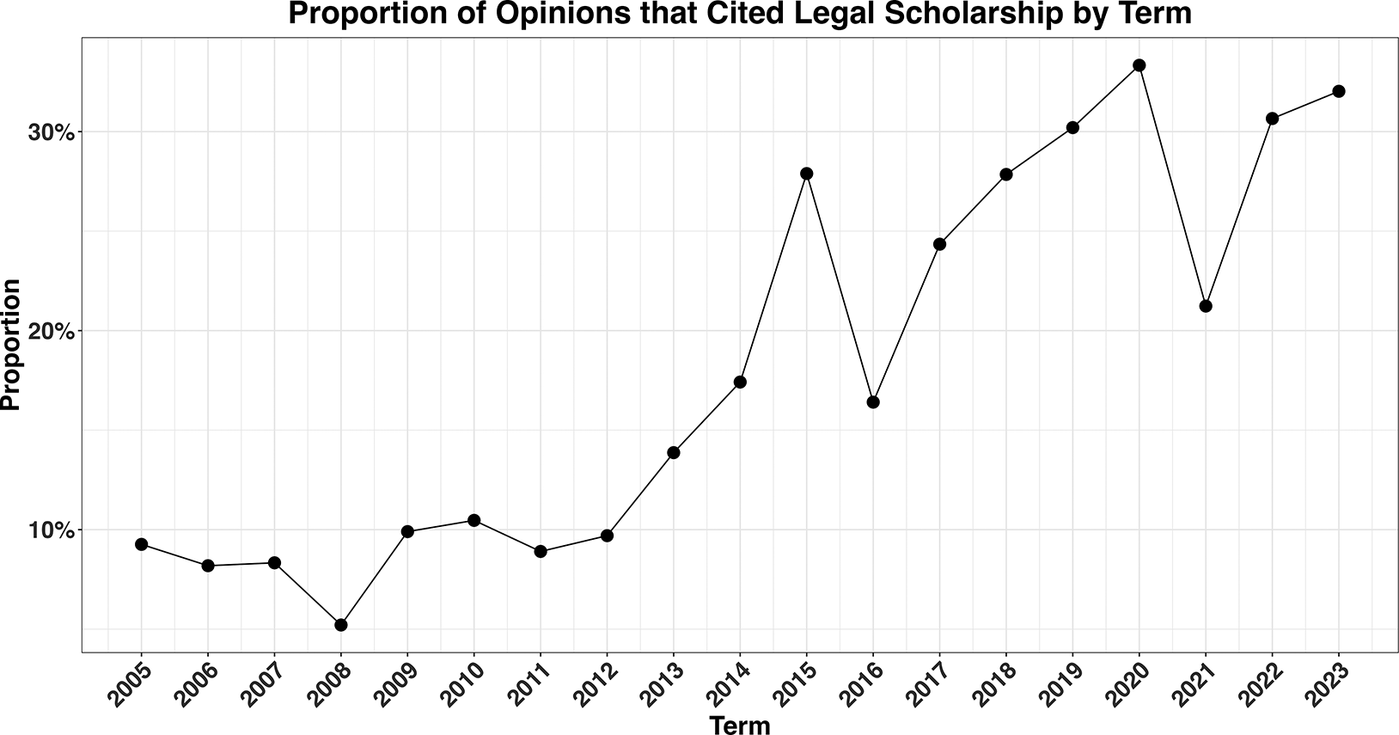
The previous figure provides clear evidence that the raw count of citations is increasing, but that needs to be contextualized to get a better understanding of the change that is occurring. It could be that the justices are citing many articles in a handful of cases, and thus the change in the Court’s practice would be limited to a specific set of issues. Figure 2 plots the percentage of opinions written by the justices that cite at least one law review article per term over the course of the Roberts Court. The y-axis is the proportion of opinions that cite legal scholarship per term, and the x-axis represents the term. This plot provides evidence that there is not only an increase in the number of citations to legal scholarship but also that the justices are using legal scholarship in a higher proportion of their opinions in recent years. The mean percentage is 17.3%, the median is 13.9%, and the standard deviation is 9.7%. The lowest percentage of opinions with a citation to legal scholarship came in 2008 with 5%, although that follows similar low proportions for nearly the first decade of the Roberts Court. There was a jump in the 2014 term with the justices citing law review articles in 17.4% of their opinions. There has been a steady increase in the percentage of opinions citing legal scholarship since then, with the peak coming in the 2020 term, with 33.3% of opinions citing at least one law review article. Next, I will examine the breakdown of which type of opinions the justices are citing legal scholarship to determine whether the justices are using them in more pivotal majority opinions or if they mostly arise in concurring or dissenting opinions.
The Proportion of Opinions That Cite Legal Scholarship Per Term.
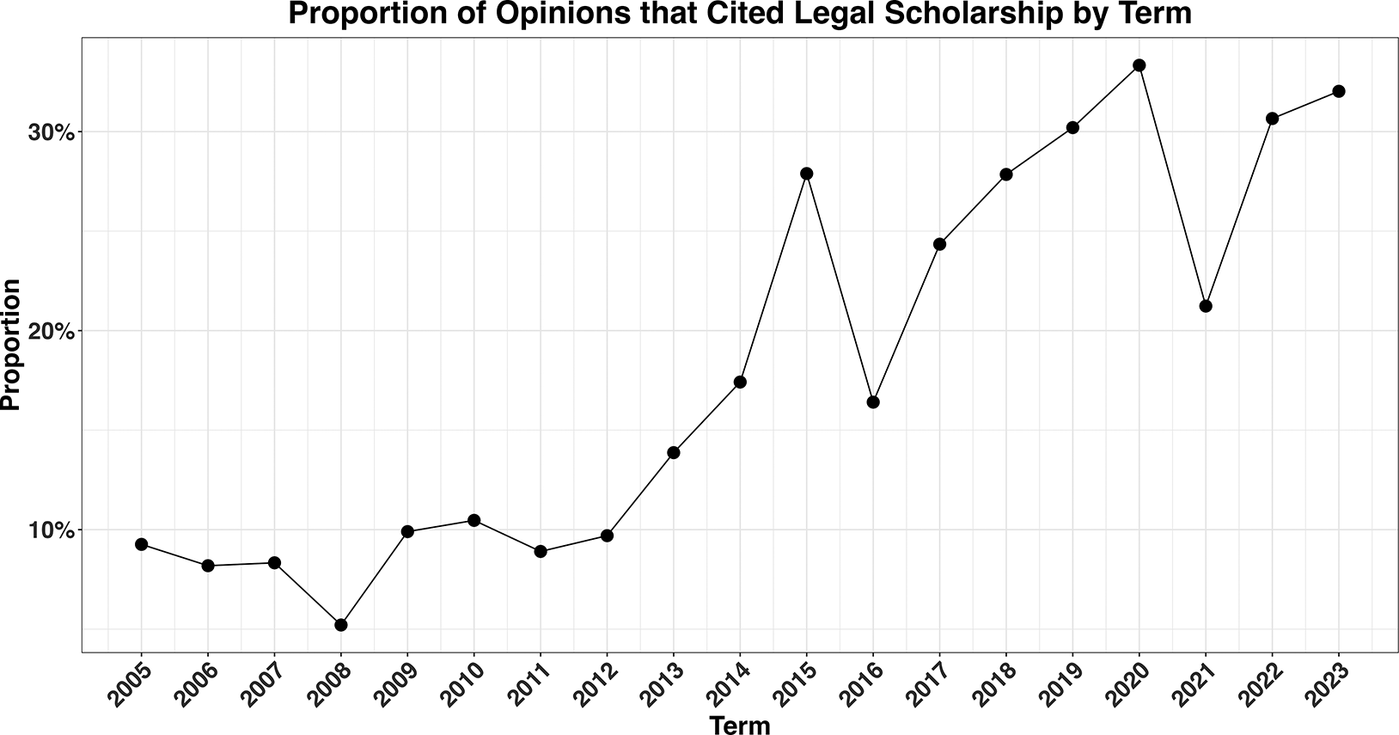
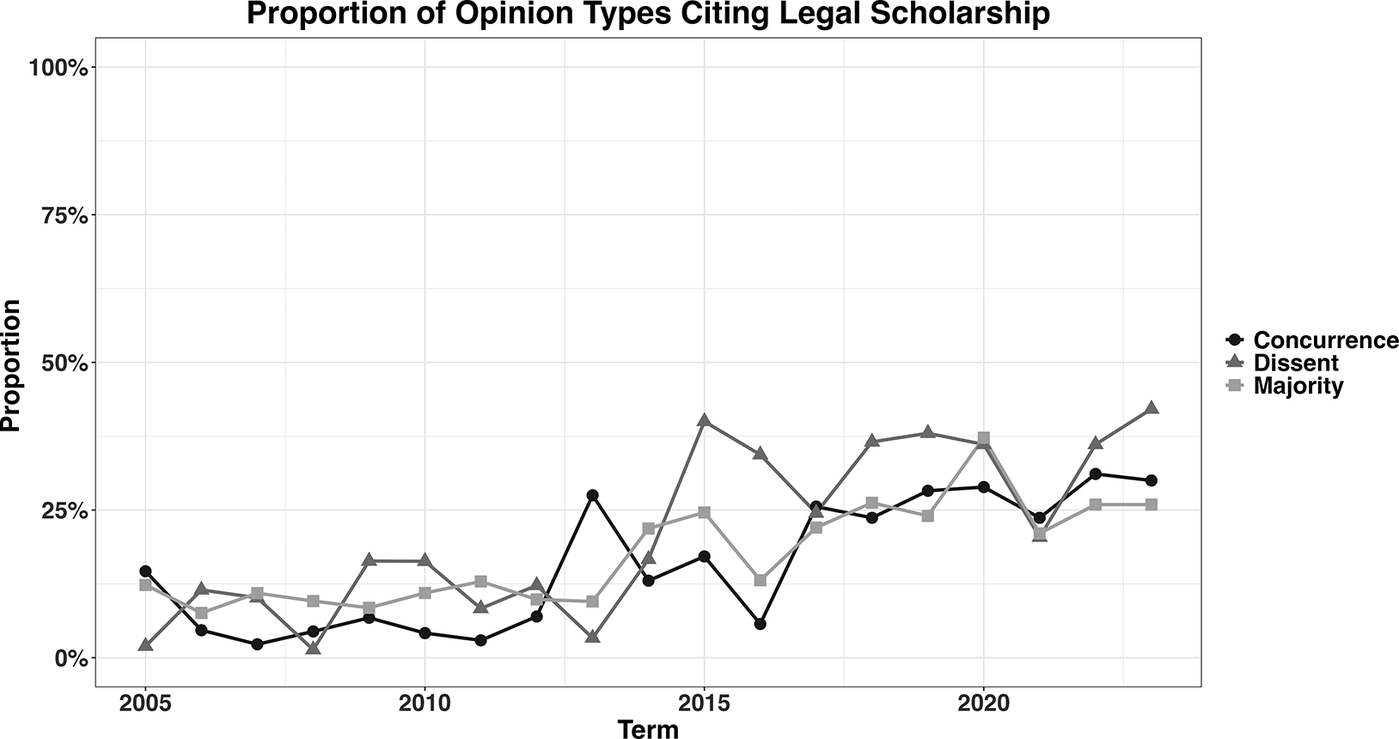
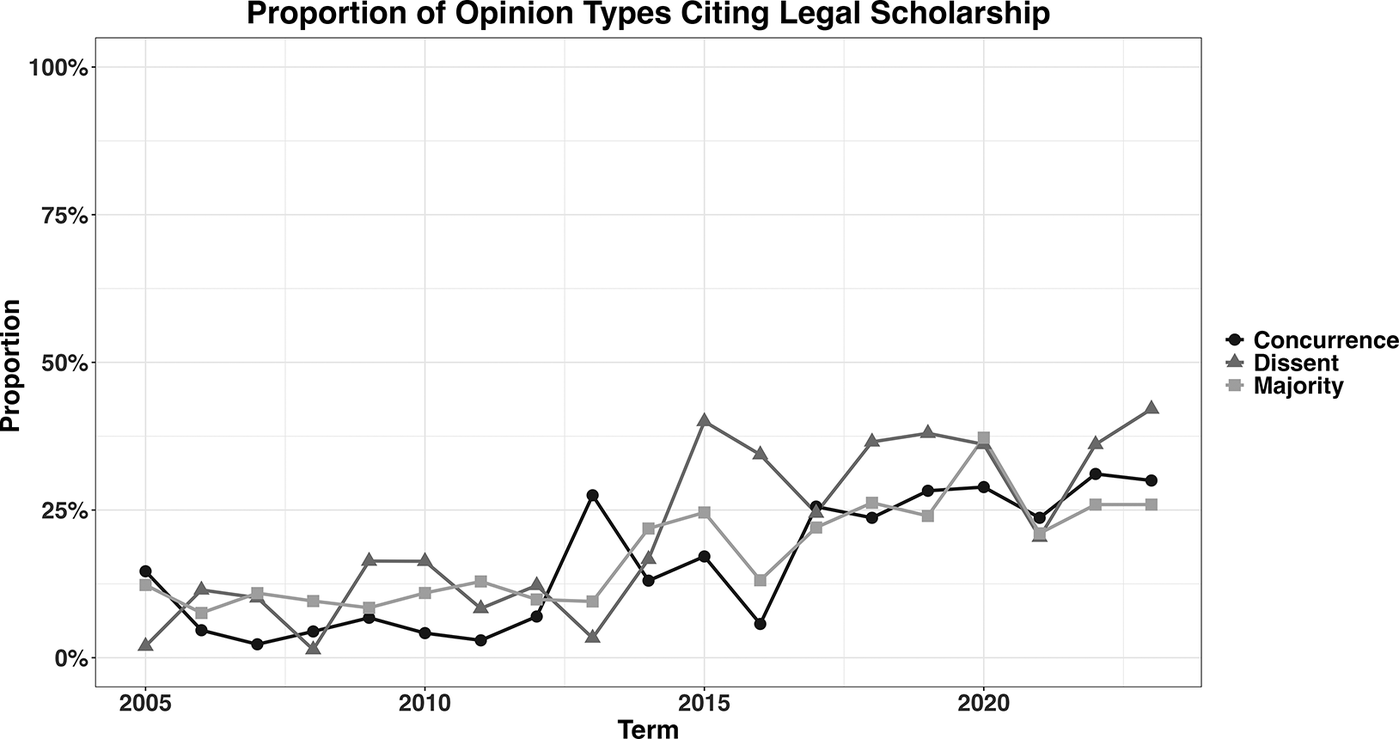
Figure 3 reports the proportion of different types of opinions per year that the justices cite legal scholarship in: majority, concurring, or dissenting. Majority opinions are built on consensus building, while concurring and dissenting opinions represent modes of conflict on the Supreme Court (Calderia and Zorn Reference Calderia and Christopher1998). Given this, it is important to note whether the justices are citing legal scholarship more often in majority opinions, which would present this change at the Court as an institutional endeavor. However, if the citations occur more frequently in concurring or dissenting opinions, which represent the views of a minority of the Court or a single justice, then it would provide evidence that this increase is individualistic. Across the Roberts Court, dissenting opinions most frequently cite legal scholarship with a mean of 20.9%, followed by majority opinions at 17.2%, and concurrences at 15%. This could be explained because there is a great deal of bargaining that goes into writing majority opinions, given the need for the majority opinion author to accommodate the desires of a majority of justices. Conversely, in concurring and dissenting opinions, less bargaining and accommodation are likely to occur (Spriggs et al. Reference Spriggs, Forrest and Paul1999). Further, it could be attributed to the fact that the justices are writing longer dissents than in previous eras of the Court (Feldman Reference Feldman2018). Overall, there is a strong upward trend in citation rates with a strong growth beginning in 2014. Next, I examine the possible impact that the issue area of the case might have on the Court’s citation to legal scholarship.
Proportion of Opinion Types That Justices Cite Legal Scholarship Per Term.
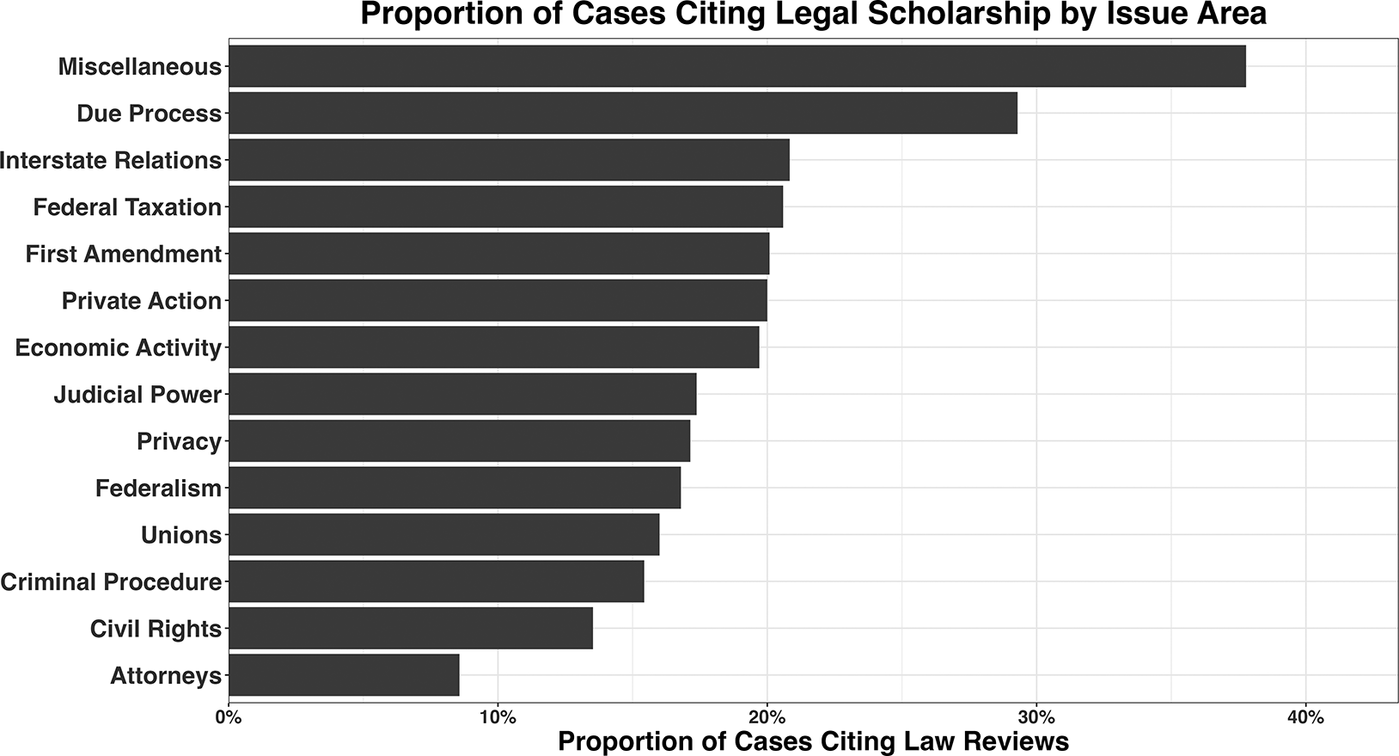
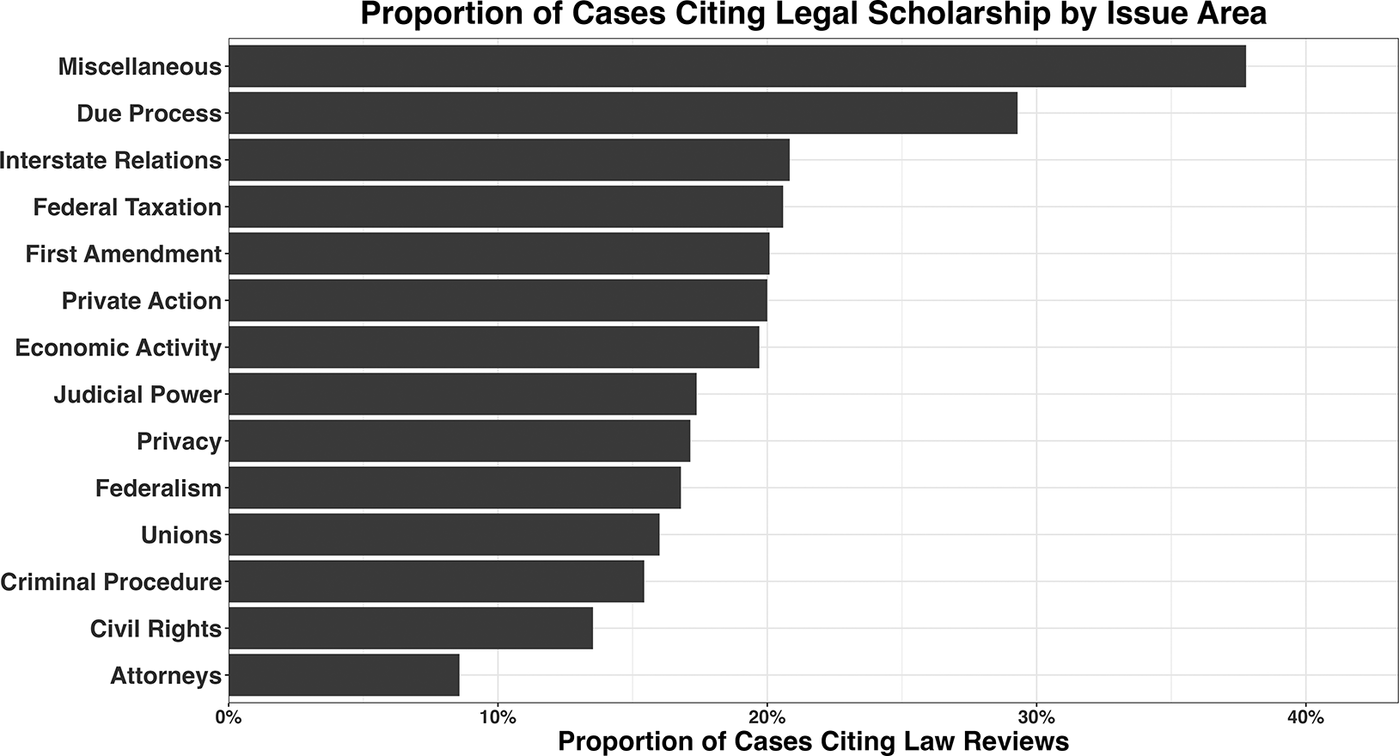
Research tells us that identifying the issue area of a case has important implications for understanding judicial behavior, the rhetorical strategies of the justices, and how the justices manipulate the structure of their opinions (Rice Reference Rice2017; Reference Rice2019). Therefore, it is reasonable to assume that the issue in a case would affect the justice’s likelihood of citing legal scholarship. Figure 4 reports the number of citations broken down by the legal issue the Supreme Court is considering. The issue area is based on coding in the Supreme Court Database (Spaeth et al. Reference Spaeth, Epstein, Matin, Segal, Ruger and Benesh2024). The variable is broken down into fourteen different legal categories. Figure 4 displays the proportion among all cases for each issue area that had a citation to legal scholarship. As exhibited by the figure, the three issue areas that have the highest proportion of citations to law review articles are Miscellaneous, Federal Taxation, and Due Process. Interestingly, the top two legal issue areas that received the highest proportion of citations are areas where the Court only hears a small number of cases. Miscellaneous is a combination of three legal areas that do not fit within the other 13 categories, and Federal Taxation concerns any issue related to the Internal Revenue Code or related statutes. However, the third highest category, Due Process, concerns all non-criminal guarantees to due process and comes before the Court more frequently. It is noteworthy to see judicial power and the First Amendment among the grouping of nearly one-fifth of cases containing a citation to legal scholarship given the rise in decisions by the courts concerning judicial power (Shaw Reference Shaw2024) and a number of salient clashes between First Amendment rights and anti-discrimination laws, such as in Masterpiece Cakeshop, Ltd. v. Colorado Civil Rights Commission (2018). Overall, this figure demonstrates that the justices are citing legal scholarship rather evenly among several core issues, with a few smaller categories having the highest proportion of citations. Next, I will examine which cases the justices are citing the most legal scholarship in.
The Proportion of Citations Based on Issue Area.
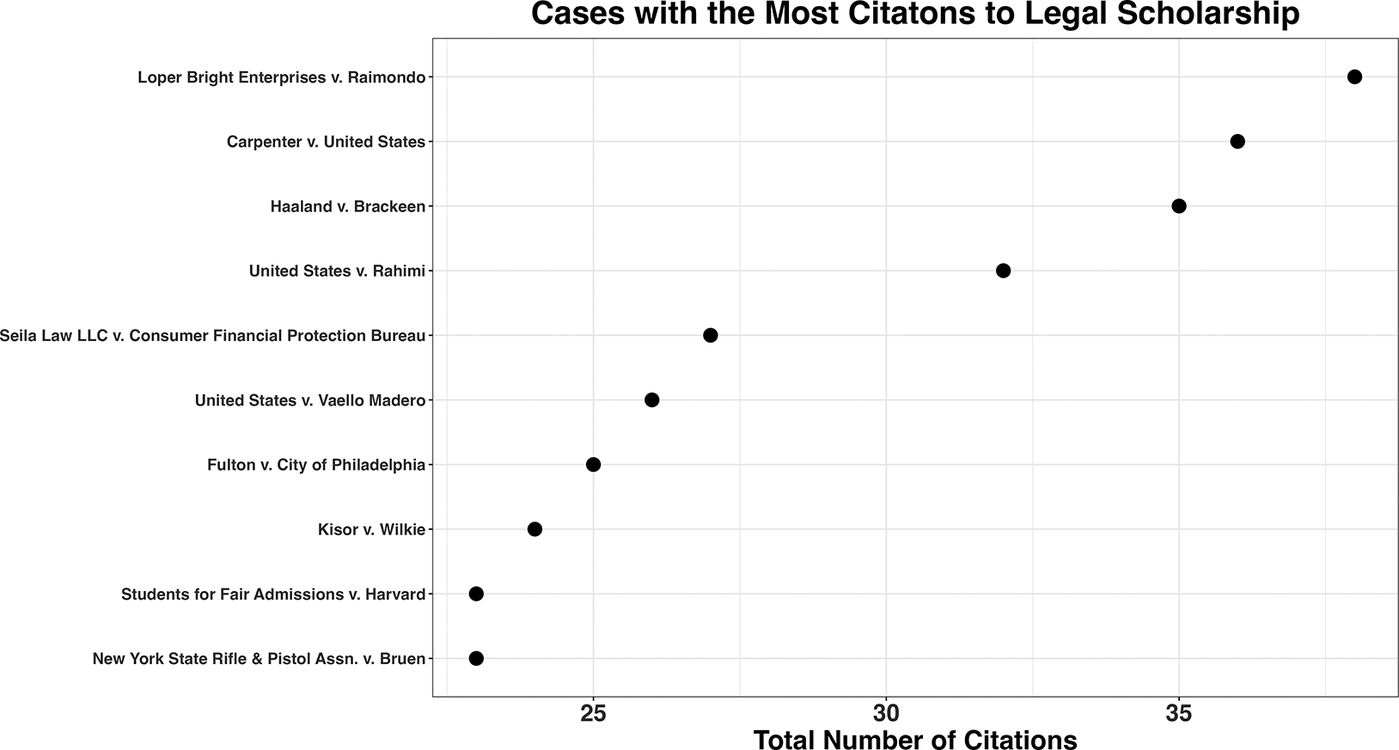
The salience or importance of a case plays a major role in the study of judicial politics (Collins and Cooper Reference Collins and Cooper2012; Clark et al. Reference Clark, Lax and Rice2015; Truscott Reference Truscott2024). Given this, it is vital to examine which cases the justices cite the most legal scholarship in to determine whether the justices are citing law review articles in their most pressing cases. If the justices are using legal scholarship in salient cases, that provides support for the efficacy of researching this aspect of the justices’ opinion writing. Figure 5 displays the ten cases in which the justices cited the most legal scholarship during the Roberts Court. Evident from the figure, the justices cited the most legal scholarship in prominent cases concerning issues such as gun rights, religious liberty, affirmative action programs in college admissions, and administrative power and authority. The first striking thing from this figure is that many of the Court’s recent decisions are receiving more citations than the Court would cite across an entire term during the first decade or so of the Roberts Court, as shown in Figure 1.
The Cases with the Most Citations to Legal Scholarship.
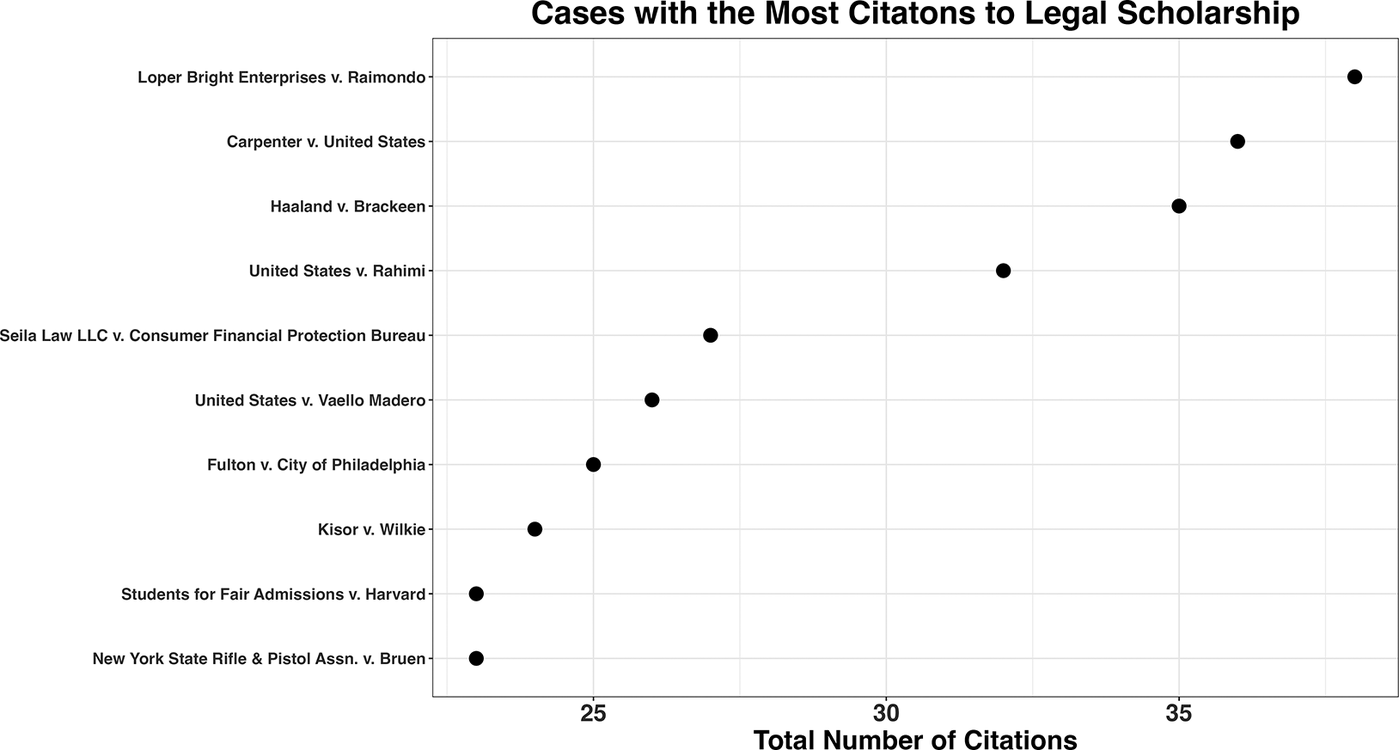
The Justices relied heavily on legal scholarship in two of the Court’s most consequential cases that resulted in an expanded protection of individual gun rights, New York State Rifle & Pistol Association v. Bruen (2022) and United States v. Rahimi (2024). The Court also turned to legal scholarship to reshape affirmative action programs in college admissions in Students for Fair Admissions v. Harvard (2023), where the Court overruled Regents of California v. Bakke (1978), which held that using race as a criterion in higher education admission was constitutionally permissible. The justices also turned to law reviews in the Court’s efforts to further entrench protections for religious liberty in Fulton v. City of Philadelphia (2020) and overturn the often criticized by conservatives Employment Division v. Smith (1990). Lastly, the Court cited the most legal scholarship in Loper Bright Enterprises v. Raimondo (2024), which overturned Chevron v. NRDC (1984). This decision was criticized as a step toward dismantling the administrative state and as a power grab for the courts, most prominently by Justice Elena Kagan in her dissenting opinion, joined by the two other liberal justices on the Court. All in all, the justices are citing legal scholarship in many of the most consequential decisions handed down by the Court in recent years. Next, I examine which justices are driving this change.
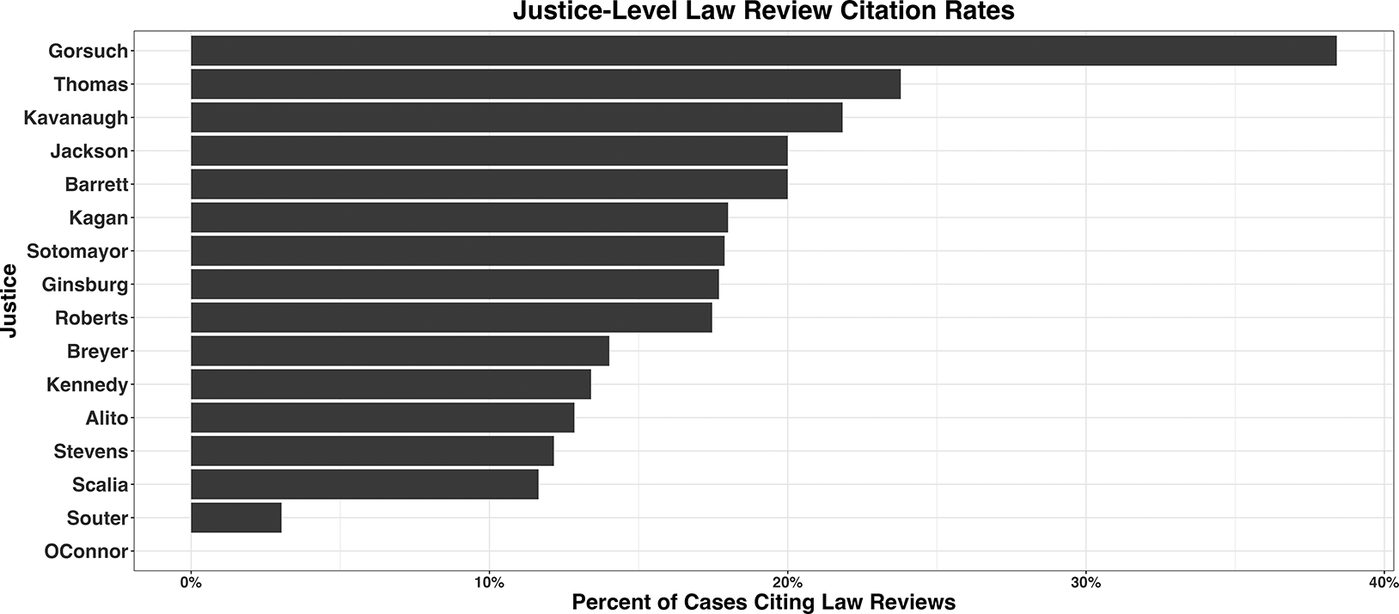
The makeup of the Court has shifted substantially in the last decade. Four justices joined the Court during that time: Gorsuch, Kavanaugh, Barrett, and Jackson. During this overhaul of the Court, two important changes took place. First, swing justice Anthony Kennedy was replaced with a more consistently conservative Brett Kavanaugh. Second, the addition of Amy Coney Barrett resulted in a six-to-three conservative supermajority on the Court. The shakeup of the justices on the Court coincides with the rise in citations to legal scholarship; therefore, it is important to examine which justices cite to legal scholarship the most to see if any particular justices stand out as the catalyst for the changing practice. Figure 6 displays the percentage of opinions that cited at least one law review article by a justice during their entire time on the Court. Justice Gorsuch uses legal scholarship the most frequently in his opinions, with Justices Kavanaugh and Jackson just behind him. What is really interesting is that Justice Thomas cited legal scholarship in 27% of his opinions, given that previous studies showed him as the least likely justice to cite law review articles in opinions with just over 10% (Petherbridge and Schwartz Reference Petherbridge and Schwartz2012, 1025). This provides support that there might be evidence of within-justice change in citation practices, where long-standing justices who rarely cited legal scholarship changed their practices to begin to utilize them as a tool. Examining that reasoning and why there was a change will be important in understanding what is going on with this change in how the justices craft their opinions.
The Percentage of Cases Citing Legal Scholarship by Justice.

Who the justices are citing
In this section, I first examine which law review journals the justices cite the most legal scholarship from. Then, I look at the distribution of citations among the cited legal scholars. Lastly, I review the twenty most cited law professors by the justices.
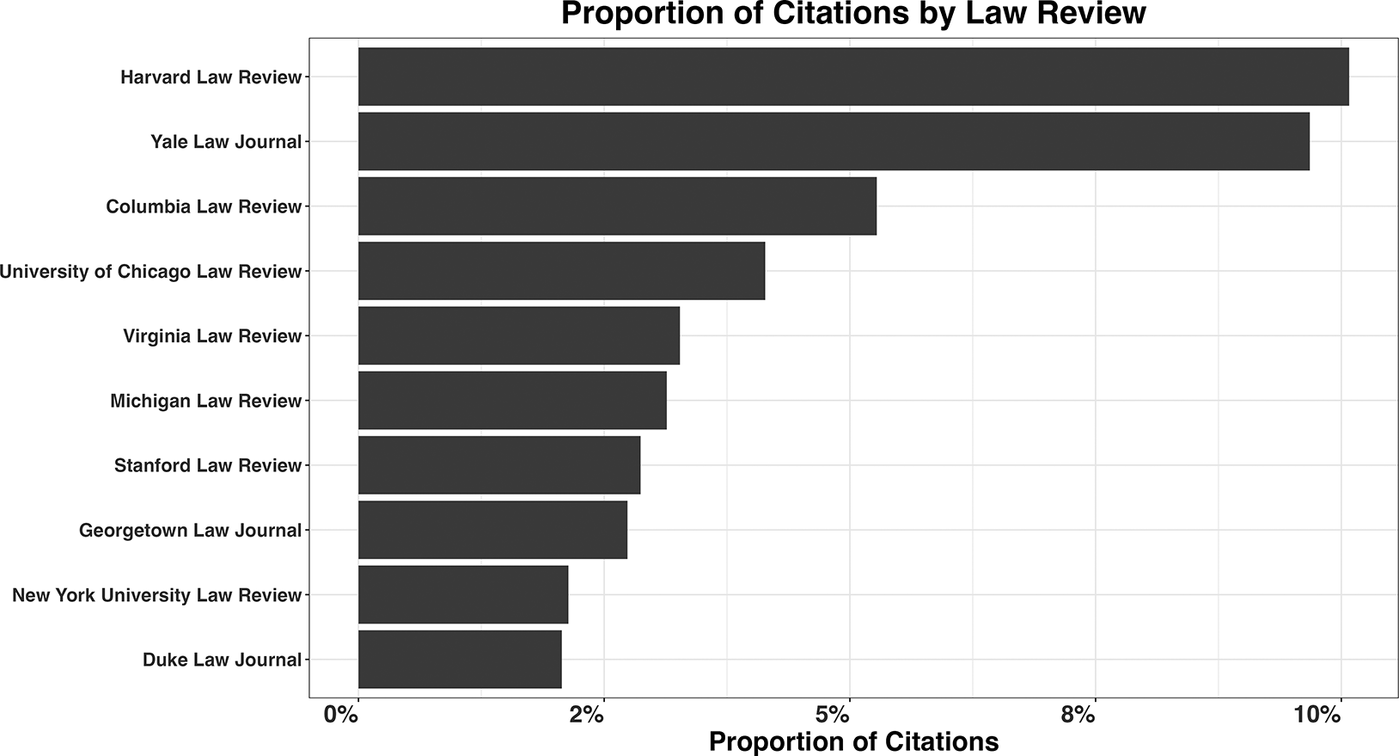
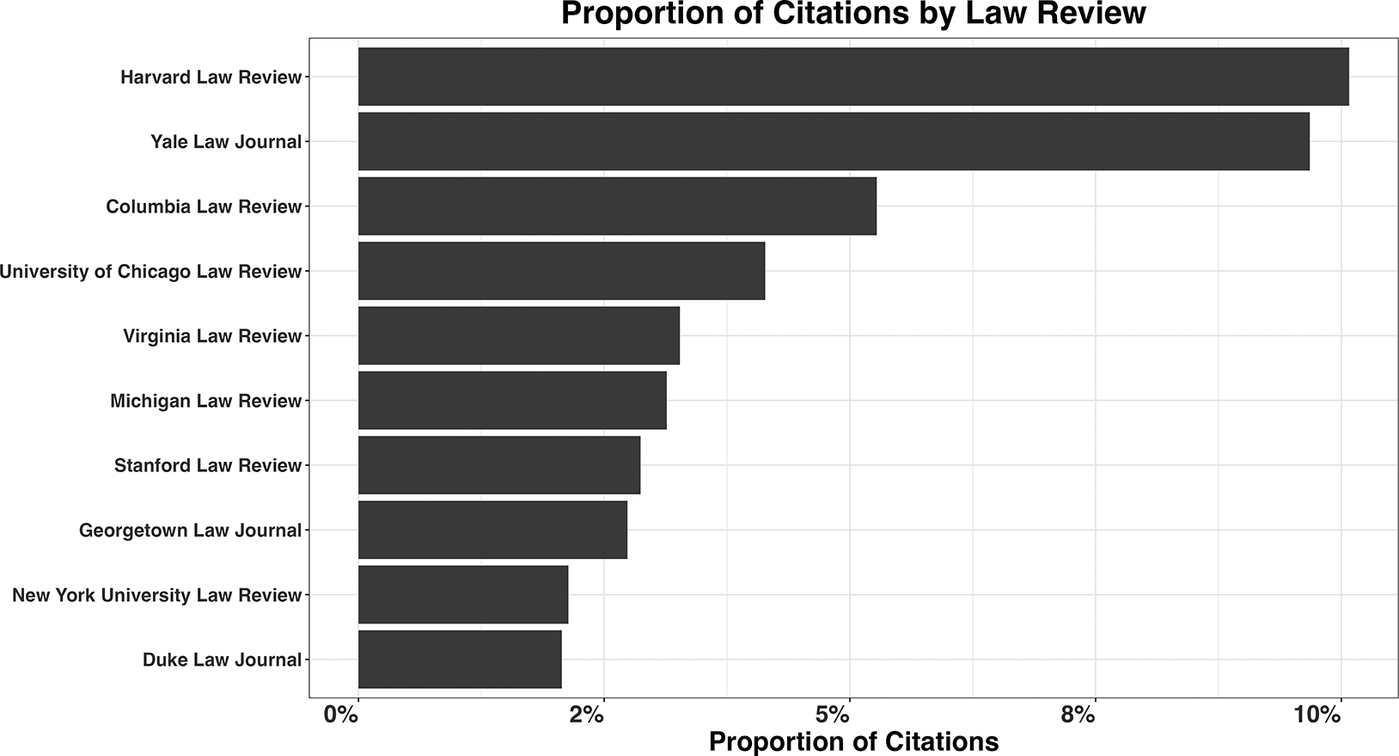
The justices on the Supreme Court historically come from the same elite law schools and also tend to hire law clerks from the same handful of law schools (Kromphardt Reference Kromphardt2015b). Thus, I would expect to see that they tend to favor articles published in the same elite institutions. Figure 7 reports the proportion of legal scholarship cited by the Roberts Court based on the law review journal in which the article was published. As evidenced by the figure, the Justices disproportionately favor legal scholarship published at elite law schools.Footnote 3 These findings corroborate earlier studies that found that the justices cite research published in the most competitive law journals (Sirico Reference Sirico2000; Newton Reference Newton2011). Further, the vast majority of citations stem from articles published in Harvard Law Review and Yale Law Journal. Harvard and Yale account for a combined twenty percent, roughly ten percent each individually, of the total citations to law review articles by the justices. The next most highly ranked journal is Columbia Law Review, which accounts for five percent of total citations, but even that is half of the proportions that both Harvard and Yale garner. The monopoly Harvard and Yale have on citations by Supreme Court justices is evident across hiring in legal academia as well, with almost a third of law professors attending the aforementioned law schools (Editors Reference Editors2020). This provides further evidence that there is an upper echelon even among the elite law schools. Next, I will examine the distribution of citations to legal scholars.
The Proportion of Citations Based on Law Review.
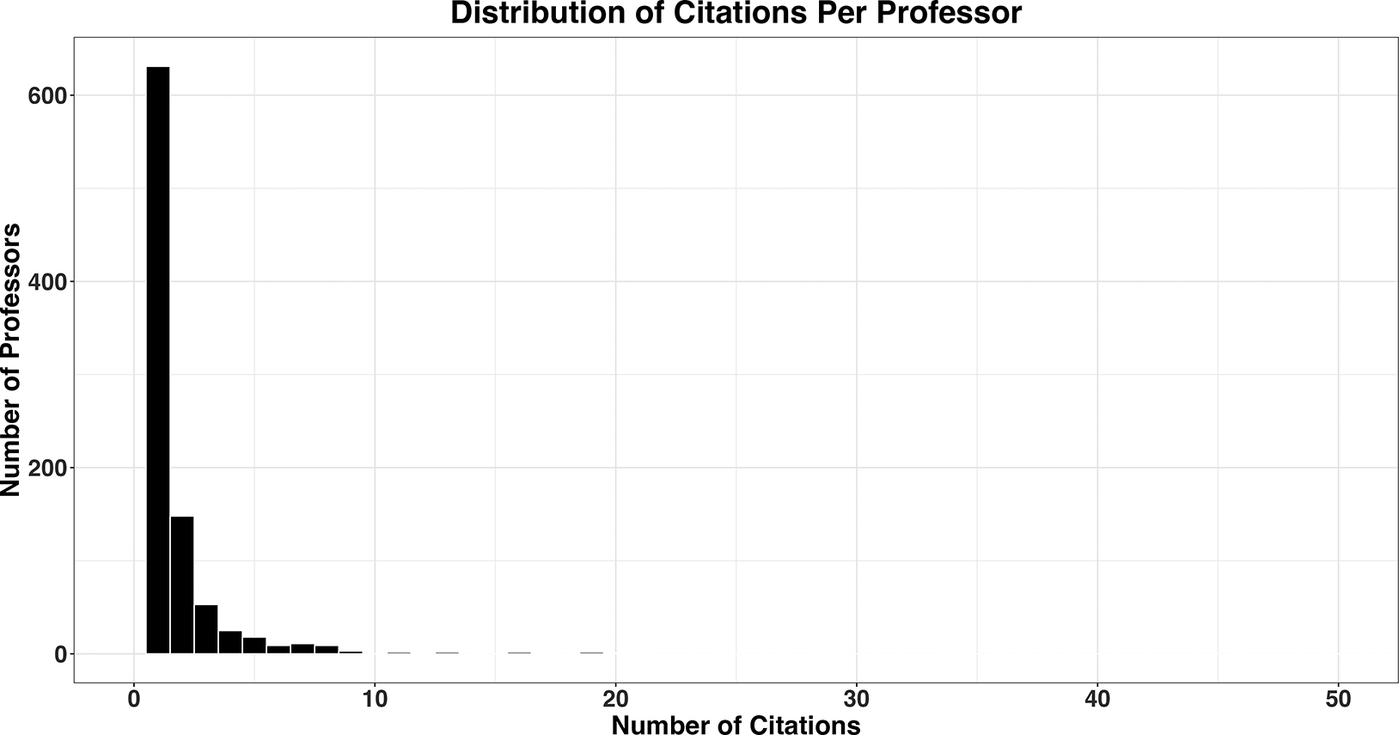
To take a deeper look at who the justices are citing, I examined the distribution of citations. This allows me to determine whether the justices are citing many legal scholars or if most of the citations are going to a handful of individuals. If the justices are repeatedly returning to a small number of legal scholars, it could be perceived as a biased citation practice. As noted earlier, when creating the dataset, I captured the author of each article that was cited by a justice; this includes the second and third authors. Figure 8 displays the overall distribution of legal scholars cited by the Roberts Court. As is readily evident, the distribution of citations is heavily skewed, with only a few scholars accounting for larger citation numbers. 631 of the total 921 law professors were cited a single time by the Court. Fourteen legal scholars, less than two percent, were cited more than ten times. Only four law professors, less than half of a percent, were cited twenty or more times by the justices. Taken together with Figure 7, the data reveal that the justices are favoring a handful of legal scholars and elite law reviews. This connection is imperative to grasp for future research in its task of comprehending how and why the justices are increasing their use of legal scholarship in their opinions. Next, I will examine which legal scholars the justices more frequently cite, and those scholars’ ties to the conservative Federalist Society.
The Distribution of Citations to Legal Scholars.

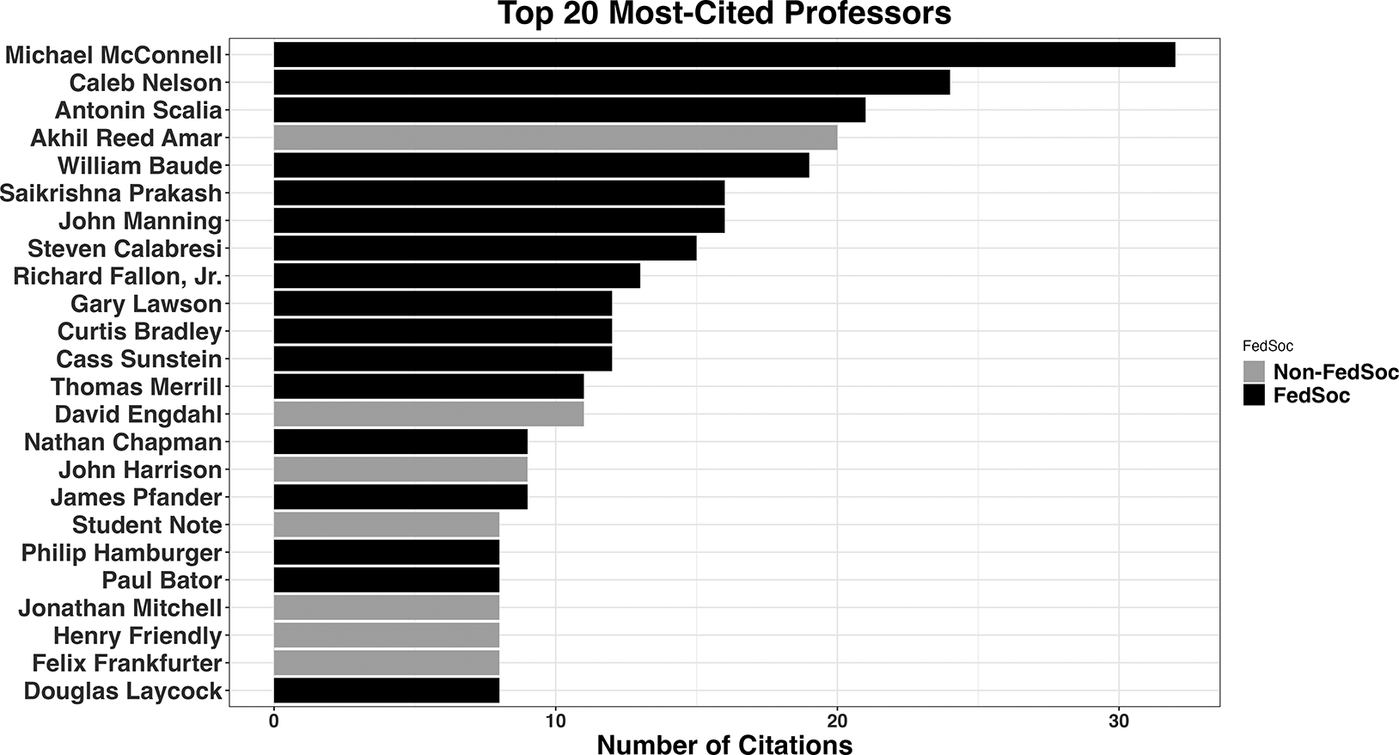
Justices may include citations to rhetorical sources in their opinion to persuade the number of audiences they are speaking to in a decision (Hume Reference Hume2006). Of these sources, the justices cite to respected nonjurists such as the founders, philosophers, or scholars whose authority is recognized and respected by their readers in an effort to make their opinions more appealing and thus increase legitimacy (Hume Reference Hume2006). Based on the idea that who a justice cites plays an important role in the perception of that authority vis-à-vis their audience, it is useful to examine which legal scholars the justices cite the most in their opinions. Figure 9 displays the twenty most cited law professors during the Roberts Court. The total citation number is a combination of articles where the author was first, second, or third author to capture a legal scholar’s total impact, given the rise of co-authorship in law reviews (Ginsburg and Miles Reference Ginsburg and Miles2011).
The Twenty Most-Cited Law Professors by the Roberts Court.

Ideology plays a prominent role in judicial decision-making (Segal and Spaeth Reference Segal and Spaeth2002); therefore, it is reasonable to assume that the ideology of the scholar is an important factor when a justice is looking for legal research to cite in their opinion. To determine the ideology of cited scholars, I ascertained whether the scholar is associated with the Federalist Society and thus likely conservative. The Federalist Society is a network of 70,000 academics, practitioners, judges, politicians, and law students dedicated to advancing conservative and libertarian legal principles (Montgomery Reference Montgomery2019). The Federalist Society promotes the doctrine of originalism, and research shows that justices affiliated with the Federalist Society are both more conservative and more consistently conservative than their non-Federalist Society colleagues, Democrat and Republican (Komatsu and Collins Reference Komatsu and Collins2025). I determined affiliation with the Federalist Society by searching for the law professors cited by the Roberts Court on the Federalist Society’s website to examine their role as contributor for past events. If a law professor was a speaker for two or more Federalist Society events, I coded them as affiliated with the Federalist Society. If they participated in one or fewer events, I did not identify them as affiliated with the Federalist Society. I chose two events as the cutoff because I could imagine several scenarios where a new faculty member was invited to an event by a colleague or student, then, after attending an event, realized that they did not share the values of the conservative organization. I then filtered out threeFootnote 4 well-known liberal law professors who are often invited to Federalist Society events, but do not share the values of the conservative group (Bird and McGee Reference Bird and McGee2023).
Figure 9 demonstrates that the justices are overwhelmingly citing Federalist Society-affiliated legal scholars. Twelve of the top thirteen most cited law professors are associated with the conservative organization. The only exception is Professor Akhil Reed Amar.Footnote 5 The overrepresentation of citations to conservative legal scholars is troubling. The impact of the Federalist Society and the conservative legal movement on the law is a developing area of research in political science (Teles Reference Teles2008; Hollis-Brusky Reference Hollis-Brusky2011; Hollis-Brusky Reference Hollis-Brusky and Sarat2013; Reference Hollis-Brusky2015; Southworth Reference Southworth2018; Bird and McGee Reference Bird and McGee2023; Bird et al. Reference Bird, King and McGeeForthcoming). As revealed by the figure, the Federalist Society has been very effective at transmitting its intellectual capital to the justices on the Supreme Court (Hollis-Brusky Reference Hollis-Brusky2015). Future theory must try to understand what role the connection between the justices and conservative organizations is playing in the story of the justices’ increased use of legal scholarship in their opinions.
Discussion
Many of the trends found in this article are consistent with both attitudinal and strategic explanations of judicial decision-making (Epstein and Knight Reference Epstein and Knight1998; Maltzman et al. Reference Maltzman, Spriggs and Wahlbeck2000; Segal and Spaeth Reference Segal and Spaeth2002). On one hand, if it were determined that conservative justices tend to cite legal scholarship written by conservative law professors and vice versa for liberal justices, then that would provide strong support for an attitudinal explanation because the justices are citing legal scholarship written by their ideological allies in legal academia in support of their own preferred positions. This is certainly plausible, and it would be important for future work to determine the ideology of the cited legal scholars, as prior work has attempted to do (Bonica et al. Reference Bonica, Chilton, Rozema and Sen2018) or through a connection to the justices on the Court, possibly through affiliation to the Federalist Society (Teles Reference Teles2008; Hollis-Brusky Reference Hollis-Brusky and Sarat2013; Bird and McGee Reference Bird and McGee2023).
Of course, there might also be strategic measures at play (Epstein and Knight Reference Epstein and Knight1998; Maltzman et al. Reference Maltzman, Spriggs and Wahlbeck2000). Perhaps, the justices are turning to legal scholarship as a persuasive source to attempt to justify many of their most recent unpopular opinions, several of which overrule long-standing precedents on federal protections on abortion, affirmative action programs in college admissions, and the power and autonomy of administrative agencies. Legal scholarship may enable the justices to achieve a number of traditional strategic goals, such as maximizing their policy preferences, adhering to interpretive principles, and increasing their efficiency (Posner Reference Posner1993; Epstein and Knight Reference Epstein and Knight1998; Maltzman et al. Reference Maltzman, Spriggs and Wahlbeck2000; Epstein and Jacobi Reference Epstein and Jacobi2010). Whether the motivation for the Court’s increased citation to legal scholarship is attitudinal or strategic is difficult to discern on the surface.
An important element that could be influencing the Court’s increased use of legal scholarship is the changing of the justices themselves. As depicted in Figure 1, the first big spike in citations to the Supreme Court came in 2017 after Justice Gorsuch joined the Court. Coupled with the data from Figure 8, which shows that Justice Gorsuch has used legal scholarship at the highest percentage of his opinions than any other justice, it may be that this change at the Court was sparked by President Trump’s first appointment to the Supreme Court. Perhaps Justice Gorsuch brought this new practice, and through viewing several citations to legal scholarship in his opinions, the other justices have adopted the practice, whether because they thought it was a good idea to include them or in response to his use of legal scholarship. Additionally, it will be important to note what role replacing a moderate and long-time swing justice, Anthony Kennedy, with a more reliably conservative Brett Kavanaugh in 2018 might play in the story. Further, it is imperative to examine what, if any, effect a six-to-three conservative supermajority has on the Court’s citation practice after the confirmation of President Trump’s most recent nominee, Amy Coney Barrett. This newly constructed supermajority may allow for unconstrained attitudinalism, corroborating Segal and Spaeth’s(2002) argument that the justices are just legislators in robes.
All of this is to say that there are many ways in which we might imagine legal scholarship to be used and under what conditions the justices choose to do so. Currently, the literature is theoretically incoherent, with theoretical development held back in part by such limited data on the practice. By filling this empirical gap, this article aims to establish a foundation for future research seeking to address the vexing theoretical question of why justices cite legal scholarship, and why that behavior is increasing. Whether the justices’ motives are attitudinal or strategic is a difficult question, but the original data presented in this article provides clear evidence that there has been a change in the way the justices are using legal scholarship in their opinions and sets the stage for future theoretical work.
Conclusions
The Supreme Court has handed down several salient and unpopular decisions in recent years, including reversing federal protections for abortion, weakening federal voting rights laws, expanding the scope of the Second Amendment, and entrenching protections for religious freedom. Concurrently, during this time, the justices have drastically increased their use of legal scholarship in their opinions. While historically, the Supreme Court’s citation to law review articles has been mostly static (McClintock Reference McClintock1998), since around 2017, there has been a significant spike in both the number of citations and the percentage of opinions that cite legal scholarship. Furthermore, the justices are turning to legal scholarship in the most salient cases the Court has handed down in recent years. This shift at the Court has important implications in understanding how the justices attempt to make their opinions more persuasive and could reveal important insights into the Court’s hard turn to the conservative right. Additionally, the justices overwhelmingly cite scholarship that is published in the most elite law review journals, particularly Harvard Law Review and Yale Law Journal. Lastly, as the Court increases its citation of legal scholarship, the justices are favoring a small percentage of law professors, who nearly all share ties to the Federalist Society.
This article opens the door for an array of future work. As mentioned above, the theory on the Court’s use of legal scholarship is disjointed, and future scholarship must wrestle with how to properly test whether the Court is simply acting ideologically or if there are strategic considerations at play. Future efforts should also examine whether the public cares about the Court’s use of legal scholarship, especially as a justification to push law to the conservative right and overturn precedent. In all, this work provides a convincing foundation for future theoretical work concerning an important and emerging trend in Supreme Court decision-making at a moment when the Court is at the center of American politics and opens the door to important next steps in understanding how that change fits within American democracy.

 Open access

