


Introduction
Formal modeling is generally understood as a tool for developing and clarifying causal mechanisms (Fiorina Reference Fiorina1975), “tightening the connections between assumptions and conclusions” (Powell Reference Powell1999), and making empirical predictions. Although mathematical by definition – and hence using a language more often associated with quantitative analyses – recent work emphasizes the natural affinities between formal modeling and qualitative research, owing to the shared focus on causal pathways (Lorentzen, Fravel, and Paine Reference Lorentzen, Fravel and Paine2016).
In addition, I argue here, the tools of formal theory are useful in all types of conceptual work, in ways equally relevant to quantitative and qualitative researchers. These uses include: providing precise and parsimonious definitions of concepts and their ranges of variation; clarifying their relationships to other concepts (e.g., hierarchical, family resemblance, diminished subtype); and making well-founded aggregating and disaggregating (“lumping” and “splitting”) arguments. It is noteworthy that formal conceptualization is so common in economics, and even among formal modelers in political science, that it goes largely unnoticed. Nonetheless, it has helped define and characterize a host of important and enduring concepts. This chapter draws attention to the practice and illustrates its commonalities with natural-language concept formation, by examining four prominent examples (Table 22.1).
Conceptualizing violent and nonviolent corruption.
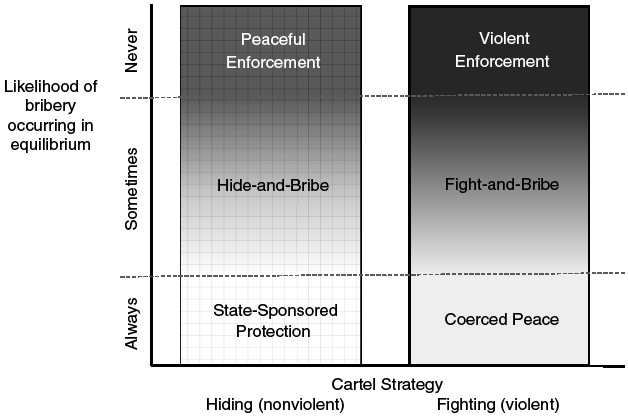
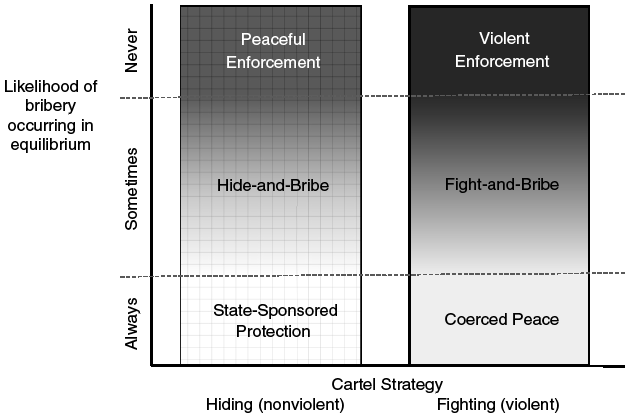
Figure 22.1 Long description
The bar graph x-axis identifies cartel strategy, ranging from hiding (non-violent) on the left to fighting (violent) on the right. The y-axis indicates the likelihood of bribery occurring in equilibrium, with aways at the bottom, sometimes in the center, and never at the top. The left bar from top to bottom is as follows: peaceful enforcement, hide-and-bribe, and state-sponsored protection, depicted in a gradient from light to dark gray. The right bar from top to bottom is as follows: violent enforcement,fight-and-bribe, and coerced Peace, depicted in a gradient from light to dark gray.
| Section | Concept | What it Exemplifies | Sources |
|---|---|---|---|
| 2.1 | Elasticity | Formal Conceptualization of Primitives | Samuelson and Nordhaus (Reference Samuelson and Nordhaus2010) |
| 2.2 | Audience Costs | Formal Conceptualization of Primitives | Fearon (Reference Fearon1994) |
| 3.1 | State-Sponsored Protection | Formal Typology of Equilibrium Outcomes and Disaggregating a Preexisting Concept | Lessing (Reference Lessing2018) |
| 3.2 | Commitment Problems | Clarifying Defining Characteristics and Aggregating Seemingly Distinct Mechanisms | Powell (Reference Powell2006) |
Perhaps the clearest and most important commonality has to do with aggregation, disaggregation, and conceptual “stretching” (Sartori Reference Sartori1970). Just as scholars working in natural language pay careful attention to the extension and intension of concepts (Collier and Mahon Reference Collier and Mahon1993),Footnote 1 the mathematical language of formal theory is centrally concerned with sets, classes, and the criteria that define membership in them. Many formal results consist in proving that seemingly distinct classes share common (mathematical) characteristics, or that seemingly similar classes differ in key ways. Another important commonality is the role of ideal types: illustrative characterizations of logical extremes that real-world cases may resemble, combine, or approximate. In formal conceptualization, ideal types often take the form of limit cases, or corner solutions, where some key value or ratio goes to zero, one, or infinity. Real-world cases may approximate these limit cases asymptotically (approaching but never reaching). Alternatively, they may usefully be characterized as a probabilistic mix of them.
The glaring dissimilarity between formal and informal conceptualization is the role played by math. While scholars of all stripes may sometimes use mathematical objects to characterize their concepts (e.g., dichotomous versus continuous scales; ratios with nominators and denominators), these are often invoked as metaphors or operationalizations of underlying concepts whose true definition in natural language has come first. In formal theory, the priority is reversed: The mathematical object is the concept. If such objects appear crude, they also have precise properties that can be deduced and manipulated through mathematical analysis. Thus the formal theorist hopes to gain purchase on the real-world phenomenon onto which their concept has been mapped using natural language. For better or for worse, “one can tolerate more conceptual ambiguity in an informal argument than in a formal one” (Fiorina Reference Fiorina1975: 137).
Nevertheless, Sartori’s (Reference Sartori1970) dictum “concept formation stands prior to quantification” still applies, if in modified form. Formal concept formation, though mathematical, remains distinct from and epistemologically prior to the analysis of models. It occurs, as I see it, at two distinct moments in the modeling process, each prior to an important analytic step. The first is during the setup of formal models, and concerns their primitives or theoretical building blocks, including choice variables, parameters, and payoffs (outcomes).Footnote 2 Whereas nonformal scholarship can express such building blocks mathematically, formal scholars must do so. Transforming the ideas to be studied into mathematical objects such as ratios, variables, or probability distributions – all with transparent ranges of variation – is precisely what it means to specify a model or, for that matter, to model something in the first place. And precisely because these specifications ultimately determine the output of the model, the formation of building-block concepts must be well founded prior to and independently of the mathematical analysis to come.
With formal building-block concepts in hand, modelers typically write down a game – a sequence of moves by different players with a set of possible actions at each step, leading to different outcomes over which players have preferences – and then go about solving it. This generally involves identifying one or more equilibria – that is, combinations of player strategies in which each is a “best response” to the others.Footnote 3 Finally, modelers generally conduct comparative statics analysis, exploring how changes in parameter values affect outcomes of interest within an equilibrium, or provoke shifts from one equilibrium to another.
Just before, though – and easy to miss – comes a second concept-formation step: characterizing (and naming!) a model’s equilibria and mapping them to recognizable real-world outcomes and/or extant concepts from the literature. Here, the order is in a sense reversed. The analysis of the model produces, mechanically, mathematical objects (usually equilibria),Footnote 4 which must then be carefully defined in terms of the ideas we are studying. Doing so gives meaning to subsequent comparative-statics analysis and the empirical predictions it generates, and it allows for meaningful aggregation and disaggregation at the higher level of model outcomes. Each conceptualization phase thus precedes and fundamentally shapes subsequent analytic steps.
Overall, what value does formal concept formation have for nonformal scholarship? As David Collier and James Mahon (Reference Collier and Mahon1993: 853) point out:Footnote 5
When scholars create a technical language, they may well succeed in achieving greater clarity and consistency or in highlighting what they view as important aspects of the phenomena they study. On the other hand, it is possible that this new language will not be anchored in the familiar linguistic prototypes that play such an important role in making categories interesting and vivid.
Formal conceptualization may seem like an extreme example of this trade-off: It offers the exceptional clarity and consistency of mathematical language at the potential price of alienating scholars without the extensive training and mathematical fluency required to fully understand, much less produce, formal models. The good news is that, in general, the conceptual aspects of formal work are largely distinct from and more transparent than the equilibrium and comparative-statics analysis that – I will argue here – they undergird. As I hope the examples developed later demonstrate, a passing familiarity with algebra is usually sufficient to see how formal conceptualization works, and even to incorporate aspects of it in one’s own work.
Formalization of Conceptual Building Blocks in Economics and Political Science
Elasticity: Formal Primitives in Economics
In modern economics, virtually all theory is formal, captured in mathematical models of the phenomenon or setting under study. This requires that all the working parts of a theory – its primitives – be defined mathematically. A fine example comes in part 1 (“Basic Concepts”) of Paul Samuelson and William Nordhaus’ (Reference Samuelson and Nordhaus2010: 65) canonical textbook:
The quantitative relationship between price and quantity purchased is analyzed using the crucial concept of elasticity. We begin with a careful definition of this term and then use this new concept to analyze the microeconomic impacts of taxes and other types of government intervention.
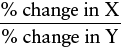
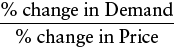
The authors are speaking of price elasticity of demand, which they first describe in words as “the response of consumer demand to price changes,” then define more parsimoniously and precisely using mathematical symbols:

This notation makes several characteristics immediately clear. First,  is a “classical subtype” of the broader category of elasticities, defined as any ratio of changes in quantities. Other subtypes can be defined by swapping in the relevant quantities:


Second, elasticities are unitless – because both the denominator and numerator are expressed as percent changes – and continuous variables, able to take on any numerical value. Yet key values such as 0 and 1 suggest intuitive, categorical distinctions: If  , then changes in price produce proportionally smaller changes in quantity demanded; we call such cases “inelastic” and those with
  “elastic.” The theoretical range of variation also follows transparently from the formal definition: at
  , demand is “perfectly inelastic,” remaining constant for any change in price. At
  , even a tiny increase in price eliminates demand altogether. These extremes can be seen as ideal types: We may never observe perfectly elastic or inelastic demand in the real world, but as conceptual bookends they are useful, including for theory building. For example, in competitive markets with homogeneous products and many firms, individual suppliers face elastic demand, since consumers can always buy from someone else. As these individual demand curves approach perfect elasticity, suppliers become pure “price takers” – able to sell as much as they want at the market price but not a whit for a penny more – and competition becomes “perfect.” The ideal type of perfect elasticity is thus crucial to the larger theory of perfect competition in markets.
With this formal definition of elasticity, economists create a precise but flexible building block for theory building and testing. Elasticities can be transparently included as parameters in models, allowing scholars to analyze how changes in their value affect players’ payoffs and resulting optimal strategies. Often a critical value for ε can be identified, on either side of which the dynamics of the model switch or flip. For example, when demand for a good is price-inelastic – as with addictive substances – negative supply shocks actually increase sellers’ revenues. This is one reason why illicit-drug repression has not eradicated drug trafficking (Becker, Murphy, and Grossman Reference Becker, Murphy and Grossman2006).
Audience Costs: Formal Conceptualization of Primitives in Political Science
If “economics has gained the title ‘queen of the social sciences’ by choosing solved political problems [i.e., economic transactions] as its domain” (Lerner Reference Lerner1972: 259), formal theory in political science often focuses on the very opposite domain: war. Indeed, the following examples all flow from James Fearon’s (Reference Fearon1995) foundational reorientation of the study of conflict as a puzzling failure to find mutually beneficial bargained solutions. One version of this puzzle arises in international crises, in which countries issue escalating threats to one another, and sometimes end up fighting. Each participant in such a war of nerves presumably learns something about the other’s resolve, strength, or goals in the process. But if so, why do they end up fighting?
To answer this question, Fearon (Reference Fearon1994) produces a sophisticated formal model of crisis bargaining, yielding novel and provocative theories of why they occur and why democracies may be better able to cooperate under the security dilemma than autocracies. Underlying and analytically prior to these is a major conceptual contribution, highlighted in the second sentence of the abstract: the concept of audience costs. Three decades and 3,500 citations later, this contribution endures, even as empirical evidence for audience costs remains scant (Schultz Reference Schultz2012).
Fearon introduces the concept informally, using natural language: “If a state backs down [during a crisis], its leaders suffer audience costs that increase as the crisis escalates” (Reference Fearon1994: 577). As with elasticity, this mirrors a more precise, formal definition of the concept; in this case, the formal definition is inseparable from the structure of the model, in which two states take turns choosing among three actions: attack, back down, or escalate a crisis.
If state i quits the crisis before the other has quit or attacked, then its opponent j receives the prize [v] while i suffers audience costs equal to ai(t), a continuous and strictly increasing function of the amount of escalation [measured by the variable t for “time”] with ai(0) = 0.
The definition specifies two important dimensions of variation. First, for each player, audience costs start at zero (since there is not yet a crisis from which to back down), rise over time, and are only paid by the player that backs down (if either does). This time variation makes players’ choices to enter and prolong crises an effective costly signal of their military strength.Footnote 6
Perhaps more importantly, audience costs vary across players. The subscript i is critical: It allows Fearon to specify individual audience-cost functions, so that once a crisis begins, one player’s cost of conceding can be consistently higher than the other’s. This lays the foundation for Fearon’s conjecture about the democratic peace. This flows in part from the comparative-statics analysis of the model, “a striking feature” of which is that “the state less able to generate audience costs (lower ai) is always more likely to back down in disputes that become public contests” (Reference Fearon1994: 585). Yet equally important is Fearon’s intuition that democracies – with their elections and free press – generate greater audience costs than autocracies; this can be expressed formally – 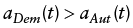 for all t – as an operationalization of how different regime types score on his core concept.
In defining audience costs in terms of a game-theoretic model, Fearon takes advantage of one of formal theory’s great strengths: its clear specification of all possible outcomes, including those that may not occur in equilibrium. These “off the equilibrium path” outcomes nonetheless influence what does occur: If we all stop at red lights, it is because of the bad outcomes that would occur if we did not. This quality contributes to the enduring value of the conceptual innovation. When critics argued, for example, that empirically audience costs seem rare and small, and hence theoretically unimportant, defenders countered, “If we can observe only the domestic costs that leaders choose to pay, then we will generally miss the cases in which these costs are large” (Schultz Reference Schultz2001: 33). The concept as defined also proved capable of traveling: While Fearon saw audience costs as domestic (and hence likely to be greater in democracies), nothing in his formal definition required this. States may care more about their reputation among other states for following through on threats and promises (e.g., A. Sartori Reference Sartori2002), but these can be seen as an international form of audience costs (Schultz Reference Schultz2012: 371), since they create the same disincentive to back down.
They thus invite further, often novel theorization and (sometimes) modeling of these underlying mechanisms or microfoundations. For example, economists theorizing the possibility of negative elasticity ( , such that demand increases in response to price increases) have proposed two diametrically opposed mechanisms. Higher prices for so-called Veblen goods – status symbols such as Gucci handbags or fancy restaurants – might make them more attractive. Conversely, price increases for Giffen goods – generally food staples (such as rice) that dominate low-income household budgets – may force consumers to cut back on relatively expensive items (such as steak) and consume more of the staple. Similarly, Fearon’s specification of ai assumes the existence of an actual audience – presumably, the voting public in democracies and the selectorate in autocracies – that reliably punishes leaders for backing down in international crises. Subsequently, a rich body of scholarship has sought to explicitly theorize and test possible mechanisms by which this might occur.
Formal Aggregation and Disaggregation of Concepts
It may seem trivial that conceptualization of a model’s primitives stands prior to solving it. But formal concept formation also occurs at a higher level, with respect to the equilibria that models produce. Here, conceptualization comes after solving the model yet prior to comparative-statics and parameter-space analyses that, among other things, generate meaningful empirical predictions. Because they capture equilibria, these higher-level concepts cannot always be defined as concisely as primitives. Nonetheless, they have precise mathematical definitions and characteristics that can be usefully invoked when doing formal conceptual work. Such work involves familiar strategies: creating a typology of outcomes; refining a preexisting concept by disaggregating (or splitting) it from similar concepts; and aggregating (or lumping) seemingly distinct phenomena within a single conceptual category. In each of these, familiar concerns arise, to which formal theory can sometimes provide powerful and elegant solutions.
Typologies often consist of ideal types, which raise questions of how to score intermediate or mixed cases (Collier, LaPorte, and Seawright Reference Collier, LaPorte and Seawright2012);Footnote 7 formal typologies can characterize such cases in terms of a probability distribution over ideal-type outcomes. Comparative-statics analysis then demonstrates how changes in key variables affect the relative probability of each. Disaggregation adds inclusion criteria that place limits on how far a concept can travel; this can leave excluded cases unexplained and reduce a concept’s overall relevance. Formal theory can employ off-the-equilibrium-path outcomes as differentiating criteria, creating two similar but critically distinct concepts and a better fit with empirical outcomes that might otherwise be largely observationally equivalent. Finally, aggregation enlarges the set of cases to which a concept applies or travels but risks stretching – ignoring or relaxing the criteria that make the concept theoretically useful in the first place. Formal analysis can help avoid conceptual stretching by precisely identifying disparate cases’ common defining features. I explore these strategies through two examples: my model of violent corruption in drug wars, and Robert Powell’s (Reference Powell2006) work on commitment problems.
Bribery and Violence in Drug Wars: Formal Typologies and Disaggregating a Preexisting Concept
Drug wars in Latin America are often characterized by both rampant police corruption and intense cartel–state conflict. This is puzzling since the point of bribery is, supposedly, to avoid confrontation. To gain purchase, Benjamin Lessing (Reference Lessing2018) develops a model of bribery and law enforcement. The game is simple: Police demand a bribe from a drug cartel in exchange for nonenforcement of the law. The cartel either pays or rejects the bribe demand; if the latter, the police enforce the law, imposing losses on the cartel, and the cartel responds with either nonviolent hiding or violent fighting.
As in most models, variables and parameters constitute primitives that receive formal definitions. One is uncertainty: If police knew the cartel’s profits, they would demand bribes just large enough that the cartel would always pay, and we would never observe drug busts and cartels’ hiding or fighting responses. Because of uncertainty – formalized as a probability distribution over a range of possible profit amounts – police generally demand bribes that the cartel will reject with positive probability.
Another building-block concept is conditionality of repression: how much additional punishment the police impose if the cartel responds violently. This may occur if, for example, police are authorized to use lethal force only after being fired upon. Conditionality is also defined formally, as the ratio (from 0 to 1) of repressive force in response to nonviolent versus violent cartel behavior. As with elasticity, zero indicates perfect conditionality, corresponding in this case to decriminalization of nonviolent drug trafficking, such that traffickers only face police repression if they are violent.
Higher-level formal conceptualization occurs after solving the model but prior to comparative-statics analysis. Arraying the possible equilibria in a modified 2 x 2 table yields a formal typology of potential outcome scenarios (Figure 22.1). The vertical dimension shows the ex-ante probability (in equilibrium) that the cartel pays the bribe – or, conversely, the probability it does not and enforcement occurs. The horizontal axis captures the cartel’s dichotomous choice of what it will do if it does not pay the bribe: either hiding or fighting. On its own, this typology is simply a collection of mathematical objects: equilibrium outcomes of a formal model. These must be mapped to real-world dynamics and/or other extant concepts and theories. Then, and only then, can comparative-statics analysis make meaningful predictions about how changes in independent variables might shift outcomes from one equilibrium to another.
In the corners of Figure 22.1, the model produces four ideal-type equilibria, in which bribes are either always or never paid, and correspondingly the law either never or always enforced. Under peaceful enforcement, bribe agreements are never reached, enforcement is sure to occur, and cartels respond with nonviolent, evasive tactics. This is how policing is supposed to work, and often does in other contexts. For example, there is usually no real chance of bribing state troopers when they pull us over for speeding, and though we might evade or minimize fines by using a radar detector or appealing to officers’ mercy, we are unlikely to respond violently if they fine us. Violent enforcement is equally noncorrupt, but cartels now respond to enforcement by fighting back as a purely defensive tactic. Under state-sponsored protection and coerced peace, enforcement never occurs because bribe agreements are always reached.
Between these ideal types lie more realistic hide-and-bribe and fight-and-bribe equilibria. In these, both bribery and enforcement occur with some probability. These middle scenarios are the most interesting for comparative-statics analysis, because changes in parameter values affect the relative likelihood of bribery and enforcement – that is, in Figure 22.1, movement along the vertical axis. In particular, increases in state repression can push cartels to fight more frequently, a key finding flowing from the model and central to the larger argument (Lessing Reference Lessing2018). Conversely, in ideal-type scenarios, marginal changes in parameter values may not affect outcome variables, and formal modelers may discount these as inelegant corner solutions.Footnote 8 Yet from a conceptual perspective, formal characterization of ideal types can make critical contributions.
In this case, it provides a hopefully useful refinement of state-sponsored protection rackets, an influential concept first introduced by Richard Snyder and Angelica Durán-Martínez (Reference Snyder and Durán-Martínez2009: 254): “State-sponsored protection rackets are informal institutions through which public officials refrain from enforcing the law or, alternatively, enforce it selectively against the rivals of a criminal organization, in exchange for a share of the profits generated by the organization.”
Building on this conceptual innovation, the authors make the important claim that state-sponsored protection rackets can pacify illicit markets, while their breakdown can lead to violence. This raises the question of why or when, once bribery breaks down and police enforce the law, criminal groups would find high-profile violence more appealing than evasion. Comparative-statics analysis of the model offers some purchase, and formal conceptualization precedes and undergirds that analysis by disaggregating state-sponsored protection (SSP) from coerced peace.Footnote 9 Both are classes of equilibria in which bribe negotiations never fail, and so are (roughly) observationally equivalent: All we see is nonenforcement and, if we are lucky, regular bribe payments. Yet these scenarios differ in what cartels would do if no bribe agreement were reached: hiding and fighting, respectively.
Such off-the-equilibrium-path distinctions are of enormous substantive importance. To police demanding a bribe, for example, it matters whether a trafficker would respond to a bust by shooting or simply running off. Clarifying such distinctions is one of formal theory’s strengths. Here, the distinction sustains a key finding: SSP requires low police uncertainty over drug profits, and coerced peace can occur with high uncertainty, because cartel threats of violence can cow police into making low-ball bribe demands that are always accepted. Moreover, small disturbances that undermine otherwise well-established bribery relations lead to different outcomes. Under SSP, it leads to enforcement without violent cartel response, as happened in Mexico under the PRI’s long-standing SSP when then top capo Felix Gallardo was peacefully arrested. Under coerced peace, it leads to enforcement followed by violence, as with Pablo Escobar’s arrest by an unusually incorruptible police commander, who was subsequently murdered.
In sum, the different equilibria of a formal model can serve as the basis for formal typologies, producing ideal types whose defining characteristics are expressed in terms of the outcomes of the model. Because these criteria are mathematical, they must be carefully mapped onto substantive cases and preexisting concepts. Once this is done, comparative statics analysis of the model can point to potential causal factors producing different ideal-type outcomes and mixed cases. In addition, formal typologies can illuminate off-the-equilibrium-path distinctions between empirically similar outcomes, and hence useful and disciplined criteria for disaggregating existing concepts.
Commitment Problems: Formal Aggregation
War is a costly means of settling disputes, destroying part of what was fought over, so why don’t potential belligerents find peaceful divisions of spoils that would leave both better off? Fearon (Reference Fearon1995), unsatisfied with extant theories that invoked “anarchy” without saying how it actually leads to inefficient bargaining failure, proposes a sweeping conceptual partition of all possible rationalist explanations for war into just three categories.Footnote 10 One, information asymmetries, we have already seen at work in uncertainty over opponents’ military capacity in the audience-costs model and cartel drug profits in the bribery model. Commitment problems, in contrast, do not involve uncertainty. Rather, commitment problems undermine agreements that both sides find preferable to fighting because they cannot commit to honoring them in the future. Finally, issue indivisibilities might undermine bargaining over things that cannot be easily or meaningfully divided, such as holy sites. If any agreement must assign the entire prize to one or another player, then one side may always prefer war, even if it is a costly way to decide the matter.
In a series of articles, Robert Powell (Reference Powell2004, Reference Powell2006) clarifies the concept of commitment problems and, through conceptual aggregation, greatly expands its extension, that is, the set of cases that belong to it. Most vividly, he demonstrates that issue indivisibilities are, in effect, a subtype of commitment problem. The two sides in a dispute over an indivisible prize, Powell (Reference Powell2006) argues, could always design a costless lottery that mirrors each side’s chance of prevailing in a destructive fight. Since this would avoid the costs of war, it should be ex ante preferable to both. The problem is thus not that the prize is indivisible but that neither side can commit to honoring such a lottery, since the loser would be better off fighting. Thus, for Powell, “one should not think of bargaining indivisibilities as … conceptually distinct … [T]here are two, not three rationalist approaches to the inefficiency puzzle of war” (Reference Powell2006: 179–80).
Powell goes on to aggregate several additional phenomena under the heading of commitment problems, in a way that is remarkably attuned to the risks of climbing too high on Giovanni Sartori’s (Reference Sartori1970) ladder of abstraction, such that the concept loses analytic value: “If the only thing different cases have in common is that the states are in an anarchic realm, that is, the states are unable to commit themselves, then the concept of a commitment problem is really not doing any theoretical work and is largely serving as a catch-all label” (Powell Reference Powell2006: 171).
Instead, Powell seeks to “establish that a handful of … mechanisms illuminate a significant number of empirical cases” (171). His formal analyses allow him to do just this, identifying the intension of “commitment problem” in terms of four key attributes that more clearly “define the category and determine membership” (Collier and Mahon Reference Collier and Mahon1993, 846):
The bargainers are … trying to divide a flow of benefits or “pies” in a setting in which (1) the bargainers cannot commit to future divisions of the benefits … (2) each actor has the option of using some form of power … to lock in an expected share of the flow; (3) the use of power is inefficient in that it destroys some of the flow; and (4) the distribution of power, that is, the amounts the actors can lock in, shifts over time.
Equilibrium analysis (Powell Reference Powell2004) further clarifies criterion 4 – as a per-period shift of power larger than the min-max continuation payoff – and shows how prominent explanations of many seemingly distinct phenomena all share these core attributes. The concept of commitment problems, in other words, travels to democratic transitions (Acemoglu and Robinson Reference Acemoglu and Robinson2001), congressional policy insulation (De Figueiredo Reference Figueiredo and Rui2002), and prolonged civil war (Fearon Reference Fearon2004), among other contexts.
Conclusion: Conceptual Accounting
Concepts are just as important in formal modeling as in other styles of research. Formal conceptualization of theoretical building blocks occurs as part of model specification, sometimes unconsciously, and so it is worth dwelling on its similarities to concept formation outside the domain of formal theory. At a higher level, concepts categorize equilibria outcomes and enrich subsequent comparative-statics analysis. Good conceptualization at this stage helps models speak to real-world cases and interact fruitfully with preexisting concepts, both formal and nonformal, in the literature.
Formal modeling requires fully mathematizing one’s concepts. This makes their analysis precise and pristine – admitting definitive proofs and derivations – while placing enormous pressure on their “fit” with the real-world phenomena to be studied. Scholars making fine-grained, causal-process arguments may find such precision constraining and retain natural-language definitions of their concepts. Even then, scholars may find the basic tools of formal modeling – and, indeed, algebra – useful, because they discipline our thinking about how concepts are defined and relate to one another. Simply trying to write down an actor’s utility function, with letters as placeholders for the things the actor cares about, forces us to group those things into categories and think about whether they should be added together, multiplied, or even divided by one another. Sketching out the sequence of decisions that might make up a game tree, or what happens at the end of each branch, can help us think more clearly about what lies off the equilibrium path and how it affects the outcomes we do see. One may not need to specify and solve, or even know how to specify and solve, a complex model. Even with a few basic tools, scholars can gain analytic traction through some simple, back-of-the-envelope conceptual accounting.
Surely many important concepts cannot be fruitfully formalized, just as many questions in political science cannot fruitfully be studied with game theory. Yet most of the qualities we look for in informal conceptualization are natural features of mathematical language: precision, parsimony, and consistency. Equations may seem a blunt tool for capturing nuanced political realities, but their bluntness is also a form of frankness or transparency. Even where we cannot formalize our concepts, it may be worth trying and learning why not.
Glossary
- Audience costs
In Fearon’s (Reference Fearon1994) original article of international crisis bargaining, a cost paid by a politician or leader who escalates a crisis and later backs down, imposed by a domestic audience observing the escalatory act. The concept has been expanded to include other audiences and other settings in which actors might face costs imposed by observing parties for backing down or out.
- Choice variable
A value that is chosen or set by a player as an action within a game; for example, an offer or side payment, or a dichotomous acceptance/rejection of an offer. Generally contrasted with parameters, which characterize general conditions that do not change during an iteration of a game.
- Comparative statics
A method of analysis in formal theory and economics, in which scholars explore how changes in one or some parameter values, while holding everything else constant, affect outcomes of interest within an equilibrium or provoke shifts from one equilibrium to another. A classic example, attributed to Hume, is the prediction that an increase in the supply of gold would lead to an increase in general price levels.
- Corner solution
A situation in which the optimal or preferred outcomes of a model occur at the boundary of a set of possible options or choices, where one or more variables or constraints reach an upper or lower limit. This often prevents a complete optimization of all factors involved and implies that marginal changes in parameter values may produce no changes in outcomes of interest. Because this can result in outcomes that are not fully efficient, satisfying, or interesting from a theoretical perspective, corner solutions are sometimes dismissed as inelegant or uninformative; however, they often correspond to analytically useful “ideal types” or conceptual bookends.
- Costly signal
Signaling occurs in games of incomplete information, where one or more players’ type (or characteristics) are not known to other players. Costly signals are actions in a game that all types of players could take but whose costliness to different types varies, such that only some types may be willing to take them. An effective costly signal is one that, in equilibrium, only some types will send, such that when other players observe it they learn something about the sender’s type.
- Elasticity
A ratio between changes in two different quantities, where “the X elasticity of Y” refers to
 . A typical example is “Price elasticity of demand,” which means .
- Equilibrium
A set of strategies that meets a specific set of criteria, known as a “solution concept.” Nash Equilibrium is one example of a solution concept. In general, equilibria are sets of strategies in which each player’s action is a “best response” to all other players’ actions, such that no player would wish to change their action in light of other players’.
- Parameter
In formal modeling, a quantity whose specified value captures fixed or slow-moving characteristics of a situation for a given iteration of a game, such as players’ discount rates or the degree of their uncertainty. Often distinguished from choice variables, or just “variables,” which players within the game choose as part of their actions within a game.
- Payoffs
In formal models, payoffs represent the value that each player experiences for each possible outcome or branch of a game tree. These are often expressed in terms of cardinal utility.
- Primitives
The basic building blocks of a formal model, including players, timing and sequence of play, information structure, parameters, variables, and payoffs. Distinguished from a model’s solutions, and secondary or refining assumptions made to focus attention on subsets of solutions.

 Open access