





1. Introduction
Rapid development of artificial intelligence (AI), especially in biomedical research and healthcare, calls for urgent incorporation of ethical considerations. A growing body of publications is addressing the challenge of ethical engagement with various models and frameworks. The complex and emerging ethical challenges of the development and implementation of AI in the healthcare context cannot be fully addressed by simply applying ethical principles that were created to guide biomedical research. Current approaches of AI ethics, especially principlist approaches, have been critiqued for lacking specificity, relevance, practicality and enforcement in real-world applications (Mittelstadt Reference Mittelstadt2019; Munn Reference Munn2023). Furthermore, the evolving technical landscape presents new challenges to existing governance frameworks. For example, governance through existing bioethical frameworks has limitations in regulating AI-driven biomedical research. Those frameworks primarily focus on the protection of human subjects in biomedical research and are limited due to AI’s opacity, dynamic nature and shifting distribution of responsibilities (Herington and Cho Reference Herington and Cho2025).
The current interdisciplinary framework of embedding ethics in scientific research, which has been used in Ethical, Legal and Social Implications (ELSI) initiatives, has been put forward as a practical model to address these challenges, yet it carries limitations. Originating in the context of genomic science, ELSI research has adopted an embedded approach that brings together scholars from the social sciences and humanities to examine ethical concerns alongside and in conjunction with scientific research. In the US, federal funding agencies have increasingly mandated ELSI integration in funding calls, including AI-related programs. However, the integration is also met with challenges. Ambiguity exists around the ethical goals, communities and partnership in conducting ELSI investigation and a lack of power in addressing justice-related issues (Conley et al. Reference Conley, Prince, Davis, Cadigan and Lazaro-munoz2020; Martschenko et al. Reference Martschenko, Grannuci and Cho2024; Reardon et al. Reference Reardon, Lee, Goering, Fullerton, Cho, Panofsky and Hammonds2023; Vasquez et al. Reference Vasquez, Foti, McMahon, Jeske, Bentz, Fullerton, Shim and Lee2023). The gap between calls for embedded ethical practice and the lack of institutional, conceptual and operational clarity in how ethics is actually realized needs to be addressed, especially in large-scale, federally funded AI research. To address the gap, empirical evidence on how interdisciplinary efforts unfold and develop in AI research is needed to contextualize the challenges in scoping and executing ethics goals.
Within this context, this paper identifies gaps and challenges of AI ethics integration in federally funded AI-related research programs, which were conducted by academic researchers. Drawing on empirical case studies, including semi-structured interviews and documentation analysis of large, US federally funded AI research projects responsive to funding requirements for embedded ethics, we have observed the lack of clarity in defining AI ethics and conflict in deciding the scope of ethics work, which poses significant barriers in implementing ethics-related goals in research practices. It exacerbates the differences in disciplinary cultures, contentious boundaries between technical and ethical expertise and the lack of power and impact of the ethics team. We discuss the implications of such findings, including the importance of aligned values during team building and among leadership, power-sharing and institutional and organizational commitment needed to foster the process.
2. Contextualizing ethics and embeddedness in large research consortia
2.1 Principlism and AI ethics’ scoping problem
The widespread implementation of AI in biomedical and health-related research is recognized as creating a range of ethical challenges, including algorithmic fairness and decision-making autonomy. A core aspect of AI ethics work is identifying the scope and applicability of ethical principles. However, ethical frameworks developed primarily in the clinical research context are often a poor fit for the development and implementation of AI-based tools. The blurred line of development and implementation in AI research practices obscures the subject matter of ethical guidelines and frameworks (Doerr and Meeder Reference Doerr and Meeder2022; Ferretti et al. Reference Ferretti, Ienca, Hurst and Vayena2020). First, these frameworks are predicated on a clear distinction between “research,” which aims to create new, generalizable knowledge typically relevant to populations, and “clinical practice,” which seeks to benefit specific individuals. These goals determine the prioritization of ethical principles and who has ethical responsibility. For AI applications in biomedicine, this distinction is difficult to maintain, rendering the application of ethical frameworks inappropriate or poorly matched at best, especially because research ethics analysis is largely limited to weighing risks and benefits of a particular intervention to individuals enrolled in specific studies (Bereza Reference Bereza2017). Furthermore, neither standard research ethics nor clinical ethics frameworks account for broad societal harms such as those that have already arisen from AI (Ferretti et al. Reference Ferretti, Ienca, Hurst and Vayena2020). In addition, the dependence on identifiability in the regulatory definition of human subjects in the US means that AI research is largely not considered human subjects research and thus exempt from that aspect of regulatory oversight. For example, current regulatory schemes designed to evaluate drugs, devices and even biological systems struggle to assess black-boxed and dynamic AI algorithms, especially machine learning-based models, whose performance is designed to change in response to new data but are inscrutable because they do not provide a rationale for their output (Mittelstadt and Floridi Reference Mittelstadt and Floridi2016).
Most importantly, the requirement for widely distributed networks of actors to create and analyze the vast datasets necessary for AI (Leonelli Reference Leonelli2016), or data ecosystems (NIH Office of Data Science Strategy 2022), means that responsibility is also widely distributed or difficult to assign. Although Leonelli (Reference Leonelli2016) suggests that data scientists attach ethical responsibilities according to the division of labor in the data ecosystem, standard bioethics frameworks do not account for distributed responsibilities (Herington and Cho Reference Herington and Cho2025). Furthermore, these frameworks also fail to account for the complexity of interest holders and decisions in biomedical research that have ethical implications (Shim et al. Reference Shim, McMahon, Saco, Bentz, Foti and Lee2025). For healthcare AI in particular, a host of different ethical issues are raised over the course of the translational process that involve a range of interest holders, including data donors, data collectors, data analysts, AI model developers, clinicians or patient users, AI system purchasers and implementers. The temporal and spatial diversity of the data ecosystem presents many different possible scopes for which relevant responsibilities and ethical issues can be identified.
The wider societal impact of AI, which is not generally anticipated during the development stage, poses further challenges around who is accountable for AI ethics deliberation and at what stage ethical interventions might be required. Ethical inquiries need to extend beyond immediate harms or instances of unprofessional conduct or “human subjects protections” and may require social science expertise to consider broader societal consequences that are often unforeseen during the developmental stages. Ethical reviews by the Institutional Review Boards (IRBs), with their focus on respect for individuals, are explicitly limited in their capacity to consider potential harms to groups or broader societal impacts (Reardon et al. Reference Reardon, Lee, Goering, Fullerton, Cho, Panofsky and Hammonds2023) – precisely the types of risks most relevant to AI-related research. De-identified, electronic data and automated algorithms are usually not considered the subject of IRB oversight (Metcalf and Crawford Reference Metcalf and Crawford2016). In case of underrepresented data, biased data proxies or discriminatory categories, it is not clear who is responsible to anticipate, scale and mitigate the downstream harm, which makes interventions in the development stage difficult (Lazar and Nelson Reference Lazar and Nelson2023; Metcalf et al. Reference Metcalf, Moss, Watkins, Singh and Elish2021). Responsibility for data bias is especially difficult to locate for healthcare AI that uses data collected from electronic health records, which are notorious for capturing preexisting societal biases that become reified in algorithms (Gerke et al. Reference Gerke, Minssen and Cohen2020). The current informed consent process is inadequate in protecting patients’ autonomy and privacy in cases where data are delinked, aggregated and harmonized (Emam et al. Reference Emam, Khaled, Arbuckle and Malin2011; Mittelstadt and Floridi Reference Mittelstadt and Floridi2016), which becomes an imminent challenge in the era of platformized health data. Nevertheless, for data-centric research such as AI research, the temptation to focus on ethical issues in obtaining data allows these concerns to overshadow the implications of data use or downstream effects.
In the professional fields of engineering and computer science, despite the fact that responsible AI and AI ethics have become a cottage industry, many of the ethical endeavors have been either limited to the issuance of relatively non-specific codes of ethics (Munn Reference Munn2023), with limited effect, or restricted to making technical fixes to address narrow ethical issues, such as debiasing or fine-tuning algorithms and models. More importantly, critics point out that the current practices of ethical AI are “bounded” as they fall short of addressing historical injustices and marginalization, which have been deeply embedded in the systematic design and data collection, and will disproportionately affect certain communities without meaningful inclusion (Creary Reference Creary2021; El-Azab and Nong Reference El-Azab and Nong2023; Ferryman Reference Ferryman2023; Ferryman et al. Reference Ferryman, Cesare, Creary and Nsoesie2024; McCradden et al. Reference McCradden, Joshi, Mazwi and Anderson2020). Only relying on a reductionist, technologist and Western-centric perspective might overlook the lived experiences and societal complexities of those affected by emerging AI systems (Amoore Reference Amoore2023).
2.2 Understand the multiplicity and heterogeneity of the scoping problem
Understanding how ethics are connected to the complex, real-world development and implementation practices in a data ecosystem requires deeper attention to how “ethics” are defined, interpreted, operationalized and institutionalized across different domains. Values and ethics are not fixed, preexisting entities. In organizational and institutional contexts where multiple stakeholders intersect, the scope of ethics is not singular and clear, but rather dynamic, heterogeneous, shaped and stabilized during interactions and negotiations around technological and material artefacts. The field of Science and Technology Studies (STS) provides useful conceptual tools to unpack and understand the multiplicity, heterogeneity and dynamics in scoping ethics. Influenced by Actor-Network Theories and Praxeography (see Latour Reference Latour1996; Mol Reference Mol2008; Reference Mol2003; Mol and Berg Reference Mol and Berg1994; Schatzki et al. Reference Schatzki, Knorr-cetina and von Savigny2001), STS scholars have investigated the multiplicity of practices during biomedical knowledge-making, which lead to various framing strategies among various agencies, and such knowledge reflects not only material existence but also relational networks and resources that researchers enlist, engage and enroll in (Crabu Reference Crabu2018; Hollin Reference Hollin2017; Wilson‐Kovacs and Hauskeller Reference Wilson‐Kovacs and Hauskeller2012). For example, Crabu (Reference Crabu2016) examined the laboratory arrangements performed by scientists and clinical oncologists to render biological materials and knowledge immediately “usable” in clinics. Similarly, AI and data-driven systems produce a multitude of societal actions regarding what AI predictions mean in clinics and how the numbers are situated in management systems, which require negotiation, repair and reconciliation (Elish Reference Elish2018; Elish and Watkins Reference Elish and Watkins2020; Hoeyer Reference Hoeyer2019). AI ethics, in this context, are ontologically disparate regarding goals, measurements and outcomes (Wehrens et al. Reference Wehrens, Stevens, Kostenzer, Weggelaar and de Bont2023) and need to be developed in line with the emergent power of AI and algorithms that mobilize a network of agents and decision-making processes (Ananny Reference Ananny2016). A relational perspective is particularly key in understanding the constitution of ethics, as Pols (Reference Pols2015) has shown, in which the patients’ perception of ethics and care are shaped through technological interactions and clinical relationships. The ethics of AI in biomedicine and healthcare require a dynamic, heterogeneous and grounded point of view that examines sociotechnical relationships and phenomena to contextualize discussions of ethical principles in practice.
An embedded model, in which scientists work alongside ethicists and other social scientists to identify and resolve ethical challenges, has been put forward as a viable option. Embeddedness ideally allows ethical deliberation through iterative processes between ethicists and scientists, and responding to emerging issues (McLennan et al. Reference McLennan, Fiske, Tigard, Müller, Haddadin and Buyx2022). The interaction and relationship, therefore, become a point of inquiry to understand how ethics are conceived and practiced within multidisciplinary spaces.
2.3 Embeddedness: interdisciplinary promise and limitation
The US National Institutes of Health (NIH) ELSI research program was originally developed in tandem with the Human Genome Project by the National Center for Human Genome Research (now the National Human Genome Research Institute, or NHGRI) (Thomson et al. Reference Thomson, Boyer and Meslin1997). Initially implemented as supporting independent streams of genetic and ELSI research, NHGRI more recently has sought to integrate social sciences and humanities into large genome research consortia, to examine societal and ethical implications, regulation and governance, public accountability and scientific responsibility for genetic research. It has supported a community of scholars who address socially sensitive issues related to research of the human genome, and later neuroscience research (Balmer et al. Reference Balmer, Calvert, Marris, Molyneux-Hodgson, Frow, Kearnes, Bulpin, Schyfter, MacKenzie and Martin2015, Reference Balmer, Calvert, Marris, Molyneux-Hodgson, Frow, Kearnes, Bulpin, Schyfter, Mackenzie and Martin2016; Karabin et al. Reference Karabin, Adsit-morris, Lee, Fullerton, Cho and Reardon2024). The idea of embeddedness indicates a high level of interdisciplinary collaboration and cross-institutional, transdisciplinary communications and ELSI mandate and requirements have been brought into state-funded, large-scale programs such as the BRAIN initiative and, more recently, the Bridge2AI project funded by the National Institute of Health. In these projects, this interdisciplinary collaboration was not just aspirational, but a requirement of funding and a way to support science as to create policy tools for widen science’s public good (Adsit-Morris et al. Reference Adsit-Morris, Collins, Goering, Karabin, Lee and Reardon2023; Juengst Reference Juengst1996). Although the ELSI model is particular to the US context and applied mostly in the publicly funded project, similar models could be seen elsewhere and were referred to as ELSA in Europe.
Day-to-day work through interdisciplinary collaboration is essential for addressing emerging ethical issues. However, interdisciplinarity alone does not guarantee effective incorporation of ethics in ELSI initiatives. Critics have argued that the ELSI program was not designed to transform science in ways that would address and mitigate potential harms and inequities. Rather, its primary function was to protect and support the expansion of “big science.” Those initiatives often incorporate justice and ethical concerns in limited and marginal ways. The goal of ELSI, they contend, has been to develop policy tools that would facilitate the growth of genomic research, rather than to ensure that the public equitably benefits from the substantial investments in genomics (Adsit-Morris et al. Reference Adsit-Morris, Collins, Goering, Karabin, Lee and Reardon2023; Juengst Reference Juengst1996; Reardon et al. Reference Reardon, Lee, Goering, Fullerton, Cho, Panofsky and Hammonds2023). The prioritization of science and the biomedical research enterprise results in tensions and marginalization of ELSI scholarship and justice and equity goals (Conley et al. Reference Conley, Prince, Davis, Cadigan and Lazaro-munoz2020; Martschenko et al. Reference Martschenko, Grannuci and Cho2024). For example, the diversity goals of precision medicine are usually framed around recruiting participants, not equity and inclusion of partners and communities (Jeske et al. Reference Jeske, Vasquez, Fullerton, Saperstein, Bentz, Foti, Shim and Lee2022; Vasquez et al. Reference Vasquez, Foti, McMahon, Jeske, Bentz, Fullerton, Shim and Lee2023). In practice, scholars with expertise in relevant domains are typically brought on board too late in the process to provide meaningful input into decisions about the categories that frame research and the questions and aims that guide it (Reardon et al. Reference Reardon, Lee, Goering, Fullerton, Cho, Panofsky and Hammonds2023). However, including ELSI investigators while preserving their autonomy, objectivity and intellectual independence also presents ongoing challenges (McEwen et al. Reference McEwen, Boyer, Sun, Rothenberg, Lockhart and Guyer2014).
The scope of ethical and societal issues has been influenced by federal research funders. For example, in recent years, the NIH directed attention at equity issues, addressing injustices in biomedical research ranging from underrepresentation of gender, racial and ethnic minorities in clinical studies to lack of diversity in the scientific workforce. As a result, the NIH instituted a number of comprehensive, large-scale initiatives such as the UNITE Program to address structural racism in the biomedical research enterprise (Collins et al. Reference Collins, Adams, Aklin, Archer, Bernard, Boone, Burklow, Evans, Jackson, Johnson and Lorsch2021). Individual research projects had additional requirements to ensure workforce diversity, equitable research participation and inclusion of diverse perspectives in research. For some of the large consortia with requirements for ethics expertise, there were also requirements for subgroups to address workforce issues specifically. However, as shown in the empirical findings in later sections of this paper, it was also not clear who was responsible for addressing diversity, equity or inclusion mandates in these consortia.
Such institutionalized and formalized ways of integration and governance are also challenged by political uncertainties, and concepts linked with social justice can be subject to changing ideologies. In 2025, the United States, the Trump administration denounced the Diversity, Equity and Inclusion (DEI) initiatives in education and employment (some required by NIH policy developed under previous administrations), terminating grants that were focused on social justice issues such as health equity or workforce diversity, which included a number of AI ethics initiatives (National Institute of Health 2025). The administration also rescinded the previous administrations’ AI safety initiatives (The White House 2025), resulting in uncertainty and ambiguity in setting AI governance goals, especially in publicly funded projects, in terms of how the governmental agencies determine their ethical standard in response to public accountability. Elsewhere, institutionalized assessment methods, such as Responsible Research and Innovation and anticipatory governance models, indicate a need for governance and public accountability; still, those approaches are subject to criticisms such as methodology, vulnerability to politicization and misuse of public participation (Casiraghi Reference Casiraghi2023; Shanley Reference Shanley2021). There is a lack of consensus and scattered international efforts, leaving a patchwork of models and ambiguities regarding jurisdiction and impact.
2.4 Vertical versus horizontal: is embeddedness the answer?
Principalist approaches to ethics, along with related governance frameworks, fall short in addressing the complex, systemic and heterogeneous nature of AI. Treating ethics as the application of abstract principles through a top-down regulatory framework and focusing primarily on relationships and responsibilities between individuals has been increasingly critiqued for its limitations in AI, particularly its lack of clear articulation of problems, mechanisms for accountability and lack of power (Chi et al. Reference Chi, Lurie and Mulligan2021; Mittelstadt Reference Mittelstadt2019; Rességuier and Rodrigues Reference Rességuier and Rodrigues2020; Shneiderman Reference Shneiderman2020). Similarly, previous ELSI models also fall short in responding to broader social issues such as public trust (Juengst Reference Juengst1996; Reardon et al. Reference Reardon, Lee, Goering, Fullerton, Cho, Panofsky and Hammonds2023) and fail to represent the interests of the marginalized communities (Lee et al. Reference Lee2008). The top-down, principle-based approaches correspond to what is termed as “vertical” (Helm and Gerlek Reference Helm and Gerlek2026 in this issue). In contrast, a horizontal approach seeks to engage with the broader system and lifecycle of AI technologies, including its structural and historical injustices and downstream consequences. Such an approach advocates for a contextualized and situated understanding of ethical principles, grounded in everyday practices (Keane Reference Keane2016; Pols Reference Pols2024). It emphasizes the sociotechnical network in which AI is embedded and aims at co-framing ethical considerations among stakeholders, ensuring that responsibilities for ethical design, data practices and implementation are fairly and effectively distributed across the AI lifecycle. Therefore, constructing a horizontal approach requires critical reflection not only on how ethics are understood and conceptualized, but also on where (and when) ethical deliberation occurs and who holds the authority to enact it, especially how the “embeddedness” is solving the aforementioned challenges in the decision-making. The calls for embedded ethical practice and the lack of institutional, conceptual and operational clarity still remain a consistent challenge. From the concept of ELSI and embeddedness to the project designs, institutional arrangements, on-the-ground practices and relationship-building, there has not been a standard or a consensus, and reports from embedded experts have made substantial critiques and reflections on their experience (e.g. Balmer et al. Reference Balmer, Calvert, Marris, Molyneux-Hodgson, Frow, Kearnes, Bulpin, Schyfter, MacKenzie and Martin2015). Empirical investigations, therefore, are needed in answering these key questions: Where are ethics teams located within research and development processes? What mechanisms ensure that ethical objectives are incorporated into scientific goals and not subordinated to them, or subject to conflicts of interest? In multidisciplinary teams, who has the expertise – and power – to define what counts as “ethical AI”? Who is held accountable for ethical outcomes throughout development and deployment? Finally, does the embeddedness of ethics promote deeper engagement with systemic and societal concerns that may lie beyond the immediate scope of a given scientific and technical project?
Our empirical study adopts a sociotechnical and grounded approach to examining the embedded ethics and the role of the ethicists. We focus on the differences and barriers in the context of large research consortia, and how organizational and institutional goals influence the framing and scoping of ethics work. We also focus on the embeddedness of value and the process value-(dis)alignment during interdisciplinary collaborations, and the facilitators and barriers of such processes. Such approaches will inform the “crux” of interdisciplinary collaboration in the era of AI and how to tackle it – building teams, sharing power and aligning values during negotiation and co-production of ethics, responding to both technological evolvement and historical injustice. Importantly, our empirical study examines these dynamics not just in framework or principles (vertical) but in practice (horizontal): how are ethics goals framed and scoped within large AI research consortia? Where does the vertical logic of top-down governance create friction with the horizontal goals of embedded ethics? What structural and relational conditions enable or undermine meaningful ethics integration?
3. Method and materials
Our study involves two in-depth case studies of federally funded, large, multi-institutional consortia focused on biomedical and AI research and leveraged expertise from fields such as bioethics, anthropology, social sciences and team sciences. The study team screened and selected cases that demonstrate the current landscape of embeddedness in AI-related biomedical research. We selected the projects that have an explicit requirement for the inclusion of an ethics component. The two consortia met our criteria. Each consortium has a wide range of expertise engaged and includes sub-projects which run independently on different subject matters in AI (such as using AI-ready data for a certain disease), which allow us not only to compare and contrast each sub-project in terms of effectiveness of integration but also dynamics between different organizations. The limitation is representativeness – as AI is a fast-developing field, new integration mechanisms might emerge and would warrant new phase of investigations in future work. While these two consortia do not represent the full range of AI ethics integration efforts, they are among the earliest and largest US federally funded AI research programs with mandated ethics components and the depth of our data across multiple sub-projects and roles supports analytic insights into the structural dynamics of embedded ethics.
This study was conducted across two research consortia, each structured with a coordination center and multiple independent projects focused on different AI domains in biomedicine and health. Each consortium maintained an ethics working group at the coordination level, while individual projects operated their own ethics teams that collaborated with technical, workforce and infrastructure teams. Cross-consortium collaboration occurred through shared resources and overlapping ethics expertise.
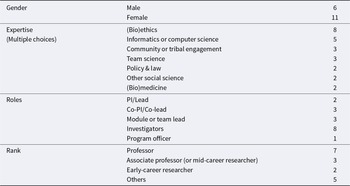
Our methods consisted of document review and semi-structured in-depth interviews. We analyzed funding documents, abstracts, websites and other secondary materials, including institutional press releases, about the funded projects. We conducted thematic and discourse analysis to highlight the inclusion of ethics-related languages and to identify the goals of ethics integration as envisioned by the funding agencies and funded projects. We then leveraged this to develop an interview protocol that sought to investigate how stated priorities mapped into actual implementation, specifically examining how researchers interpreted the ethics-language in funding calls, how ethics definitions informed practice and how structural and relational dynamics supported or limited the achievement of the ethics goals set out by funding agencies and funded projects. We recruited 17 interviewees across the two consortia, identifying investigators associated with the funded projects and using snowball sampling. Our sample included ethicists and social scientists, data and computer scientists who worked on ethics-related projects and attended ethics working groups and a program officer at the funding agency (see Table 1). Questions regarding their expertise, roles, day-to-day work, goals and evaluations, organizational structures, funding mechanisms, integration efforts and conflict were asked in semi-structured online interviews, which lasted approximately 60 minutes (see Table 2). Interviews were transcribed through closed captioning tools embedded in Zoom and were anonymized to protect interviewees’ privacy. Three team members are involved in coding using MAXQDA. A shared coding scheme was produced during team discussions, and the transcripts were coded by at least two members to ensure consistency. The first round of coding was centered around the definition of ethics, barriers and facilitators of carrying out ethics work, and the organizational structures and dynamics surrounding ethics. This was followed by a second round of coding to analyze the underlying meanings and connections of the emerging themes, centered around expertise, scoping and power dynamics. The coders met frequently, harmonizing the coding schemes and analysis, and important findings were organized in a shared chart with associated empirical evidence from both documentation analysis and interviews for drafting the narratives.
Interviewee identities, role and expertise

Table 1 Long description
Counts summarize interviewees by gender, areas of expertise (multiple selections allowed), project role, and rank. Gender totals show 11 female and 6 male participants. For expertise, (bio)ethics is most frequent with 8, followed by informatics or computer science with 5; community or Tribal engagement and team science each have 3; policy and law, other social science, and (bio)medicine each have 2. Roles are led by investigators with 8, with 3 each as co-PI or co-lead and module or team lead, 2 as PI or lead, and 1 program officer. Rank includes 7 professors, 3 associate professors or mid-career researchers, 2 early-career researchers, and 5 listed as others. Because expertise allows multiple choices, expertise counts should not be compared to the gender, role, or rank totals as if they represent unique people.
Interview guide (sample)
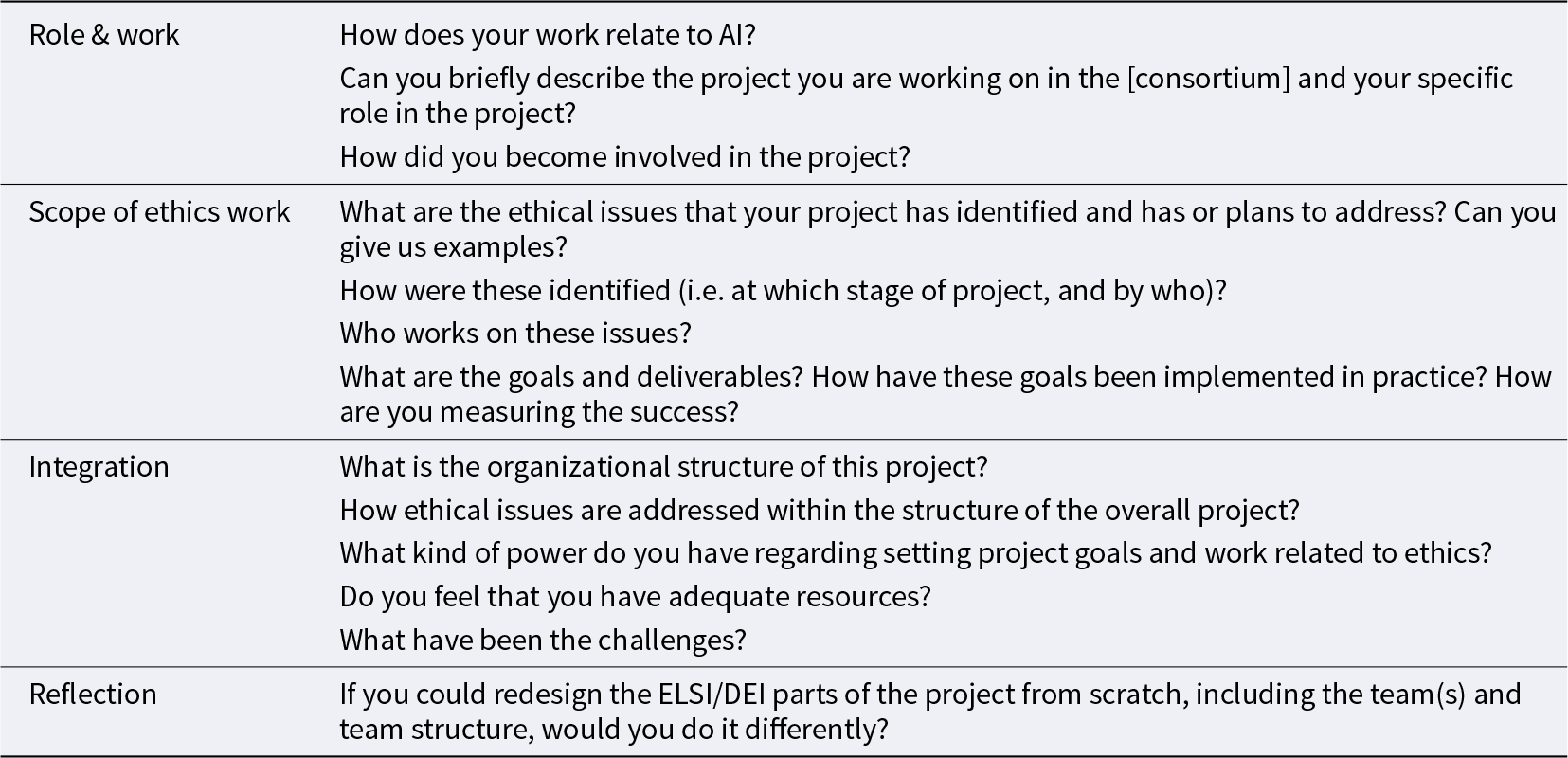
Table 2 Long description
The table is an interview guide organized into four thematic sections, each listing open-ended questions. The first section asks about the interviewee’s role in a consortium project, how their work relates to AI, and how they became involved. The second section focuses on the scope of ethics work, including which ethical issues were identified, when and by whom they were identified, who addresses them, and what goals, deliverables, and success measures exist. The third section examines integration, asking about project organizational structure, how ethical issues are handled within it, the interviewee’s influence over ethics-related goals, available resources, and challenges. The final section prompts reflection on whether the ethics, legal, social implications, diversity, equity, and inclusion components and team structure would be redesigned differently. The content is qualitative and provides prompts rather than results or numerical comparisons.
Our study is situated within the tradition of empirical bioethics and uses qualitative social science research to identify and characterize the structural and institutional conditions under which ethical frameworks are integrated (Hedgecoe Reference Hedgecoe2004). We use empirical findings to surface the organizational, relational and epistemic barriers that shape how ethics is operationalized and to inform normative arguments about what systemic changes are needed for meaningful ethics integration.
4. Findings: vertical pressure and horizontal struggles
We present empirical findings from our two in-depth case studies. The documentation analysis of the funding calls shows explicit requirements of incorporating ethics into the project design. For example, one large funding mechanism shows in their call that project proposals need to include a module that directly addresses “ethical and trustworthy AI” and must include diverse, interdisciplinary expertise. Funding programs require explicit plans “develop transdisciplinary collaboration(s) that require unique expertise and/or solicit diverse perspectives to address research question(s)” (Funding document A); and to “bridge expertise across biomedical and behavioral research domains, ethics, AI/ML data science and data management” (Funding document B). Questions remain around how different teams and expertise are integrated in research practices, and how the scope of “ethical and trustworthy AI” is contextualized in various projects. Specifically, although funding agencies often specify that data collection must be “FAIR (findable, accessible, interoperable, reproducible) and ethically sourced, trustworthy, well-defined and accessible” (Funding document A), FAIR principles largely serve technical values, and the meaning of “ethically sourced” remained unclear, but appears to limit moral attention to procurement of data rather than impacts of AI.
While funding agencies increasingly emphasize AI ethics integration as “front and center” (AI-Q, a funding agency program officer), we observed a fundamental tension between stated priorities and actual implementation. Importantly, funding mechanisms and budget allocations remained data-centric, creating pressure for teams to focus primarily on data collection and AI-ready data preparation rather than addressing emergent ethical issues. AI development occurs within a relative regulatory vacuum that leaves core ethical concepts poorly defined, creating fundamental ambiguities about what constitutes ethical work.
We also observed that this data-centric approach reinforced hierarchical structures and practices that undermined the “horizontal” approaches necessary for embedded ethics. In the execution of the AI projects, clear technical and data milestones have been set by project leaders and program officers to guide projects and dictate the priorities and trajectories of the research. Such practices have left significant ambiguity around what constitutes ethical work and who qualifies as an ethics expert. Consequently, the “vertical” executions sidelined ethics goals and marginalized the contributions of ethics teams. Such executions manifest in two key characteristics – a tendency to make techno-fixes as ethics work, and a structural loss of power of ethics during what we called “widgeti-zation.”
4.1 Techno-fix tendency and disciplinary barriers
We have observed a significant discrepancy between definitions of ethics and the scope of ethics work between different disciplines, and major barriers in collaboration and communication. Without clear guidance, ethics teams struggled with data scientists over what these commitments actually meant. As one ethicist (AI-D) noted: “ethical sourced data is a concept they (the funding agency) put in there. But nobody knows what it means.” The scope and definitions of fairness or trustworthiness remained very general and detached from the research context, creating significant ambiguities about what constitutes ethical work in AI development.
Amid uncertainty and lack of clarity of what the scope of ethics work, our findings reveal that AI’s unique characteristics create distinct barriers to ethics integration that manifest through undefined requirements, competing frameworks and systematic disciplinary marginalization. Unlike more regulated biomedical research, AI development occurs within a context that privileges technical solutions over interdisciplinary collaboration. AI’s engineering-dominated culture creates a significant barrier to ethics integration through “techno-fix,” or the systematic assumption that ethical problems can be, and should be, solved through technical measures. Social and political complexity of ethics then becomes “reduced” to questions of engineering and design, which limits the scope of ethical work and fails to respond to further societal or justice concerns (Leese et al. Reference Leese, Lidén and Nikolova2019; Sætra and Selinger Reference Sætra and Selinger2024; Selbst et al. Reference Selbst, Boyd, Friedler, Venkatasubramanian and Vertesi2019). This culture also treats ethical issues as technical problems requiring computational solutions, systematically excluding non-technical disciplines from meaningful participation in defining and addressing ethical challenges.
One interviewee (AI-M) explained how this technical framing narrows ethical consideration:
A computer scientist, for example, may follow a quantitative definition and their [quantitative] approach. But it is a narrow aspect of how most people think about fairness … other disciplines may think about fairness differently. So they may have, like social scientists, a more qualitative view.
This techno-fix tendency manifested in disputes over the scope of ethics work. One interviewee (AI-C) complained that some data scientists claimed “they’re doing ethics,” “but in reality what they’re really doing is just saying how do I debias an algorithm.” In contrast, a bioethics expert (AI-K) argued for examining “the way the data were collected, who had a say and how the data were collected, how representative the data [are], and their disparate impacts downstream,” which are considerations that the technical fix approach systematically overlooks.
Part of the techno-fix tendency stems from the problem- and technique-oriented engineering culture that ignores human factors. It creates novel ethical tensions through competing frameworks that operate simultaneously within the projects’ collaborative space, generating critical differences. The engineering culture in the AI projects treated data as nothing but numbers and AI as tools, making ethical conversations particularly contentious. For ethicists who previously worked with clinicians, the lack of focus on human factors in the “data people” was difficult to work with. The bioethicist (AI-K) noted that,
… the group of folks who are doing AI are … self-selected folks than the group of folks … they just don’t look up - as much as geneticists do now - from their computers versus from the lab bench to think about the people behind the data. I have heard people at [the lead institution] say, you know, if it’s de-identified clinical data, it’s not human subject data, it’s not human data …. No, that’s simply not true.
Another interviewee (AI-J) highlighted the conflict between “different ethics”:
I keep saying there are two sides - there is the ethics of sharing and there is also the ethics of not sharing …. You know, protecting the privacy and so on, but there is a little on the ethics of … what are the consequences of withholding too much? …. And I think that balance has, when you put both the clinicians and the lawyers in the same room, that’s where you see more of those two sides … but then how we harmonize and dealing with different aspects of it?
The open-source ethos of making data freely available for technological advancement directly conflicts with the emphasis on privacy protection and patient safety in healthcare ethics. This tension is particularly acute because the same datasets serve both open-source AI development and clinical applications, creating competing ethical demands. Interviewees expressed the intention of looking for a “middle ground.” However, these competing constitutions of practices operate with fundamentally incompatible accountability mechanisms, stakeholder networks and success metrics, making consensus-building extremely difficult. These conceptual differences created significant communication challenges that reinforced disciplinary isolation. The communication barriers were exacerbated by mutual gaps in expertise. As one interviewee (AI-C) described:
When you get computer scientists who are very much interested in just focusing on algorithmic fairness problems and then you know they’re sitting in one corner of the room and then in another corner of the room you’ve got a lawyer who is trying to tell you like you know what is a contract versus a licensing agreement … it’s like, how do you get them to talk with each other?
Multidisciplinary experts capable of bridging these conversations were rare, and the techno-fix tendency meant that ethical expertise was systematically devalued. Computer scientists and data scientists typically lack exposure to human factors and bioethics training, and they “don’t necessarily see ethical issues” (AI-M) as relevant to their work. One interviewee (AI-P) described resistance when “ethics wanted to be part of those conversations” about tool development related to privacy, but “data collection [team] had their lane and they didn’t think that ethics should be in their lane.” This territorial defensiveness emerges because data work is perceived as purely technical rather than involving human considerations despite its ultimate human impacts. An interviewee (AI-A) noted that,
… they got into total nit picking about licenses versus a data use agreement. You know, they’re way down to the weeds and they need to kind of come up to that to figure out how this is gonna go forward.
These disciplinary tensions resulted in the systematic marginalization of ethics expertise. Ethicists reported feeling “unintentionally disrespected by people who just wanted to keep doing data generation” (AI-Q). They struggled to establish credibility within AI teams and recognized that gaining respect required “ELSI folks demonstrating our value to the scientific folks” (AI-K) – a challenging and time-intensive process.
Critically, this marginalization was structural rather than interpersonal. The research programs were organized in ways that systematically sidelined ethics work, creating barriers to the horizontal integration that embedded ethics approaches require. As the interviewees noted, ethics work was “by design” undermined by program structures that prioritized technical milestones over ethics integration.
4.2 Widgeti-zation
These disciplinary tensions become operationalized through specific funding mechanisms and organizational structures that systematically marginalized ethics work. Despite rhetoric about embedded ethics in the funding documents, the actual implementation treated ethics as what we term “widget-ization” or a modular add-on rather than an integrated component of research design.
The contrast between ambiguous ethical goals and clear technical objectives became operationalized through funding structures that prioritized data collection milestones. Both funding agencies and research consortia asserted clear and pressing scientific goals to generate AI-ready data and shareable databases. Specific funding mechanisms tied data collection milestones directly to continued funding, creating immense performance pressure on principal investigators (PIs) who were accountable for these deliverables.
This “centrality of ‘science goals’” systematically sidelined ethics considerations, reinforcing the techno-fix identified in the previous section. The data collection and dissemination components, referred to by ethicists as the “science part,” reported directly to administration and funding agencies, gaining significantly more institutional traction than ethics work.
Meanwhile, funds for ethics teams were frequently significantly delayed so that teams could not even be formed, and ethics proposals were regularly rejected.
Despite project rhetoric about bringing diverse disciplines and stakeholders together, execution remained highly centralized, particularly in the distribution of grant funding. The decision-making structure was hierarchical, as one interviewee (AI-B) explained: “[The PI’s University] was the ‘prime’ and everybody else was a ‘sub’.” This hierarchy enabled PIs to unilaterally override interdisciplinary considerations, operationalizing the power imbalances implicit in the techno-fix tendency. The same interviewee described how collaborative input was dismissed:
So adding anything like blockchain or smart contracts or anything like that was off the table because they were gonna make the data completely open, because that’s what [the PI] promised the [funding agency]. And so that’s the battle we’ve been fighting the whole time. ‘Cause everybody was like, ‘but that’s not interdisciplinary’. But [the PI’s] the prime and … I guess [the PI] gets to make those decisions.
Rather than being embedded and integrated as promised in funding calls, ethics work was treated as a modular component in “widget-ization.” This means positioning ethics teams as replaceable resources without embedded deliberation or grounded empirical research integration. It also sees aerial expertise as of less value than fulfilling certain functional objectives or “checkboxes” such as drafting legal documents. As one interviewee (AI-A) described their role: “we are available as a resource. And we’re called upon as a resource.” Widget-ization manifested through activities like hosting office hours and organizing seminars, positioning ethics teams as external consultants rather than research collaborators. The utility of ethics teams depended entirely on how they were “called upon” and how technical teams understood their value. One ethicist (AI-L) noted that during office hours, “rarely anybody came in with ethical questions, but technical ones.” Importantly, interviewees did not critique consultation models per se, recognizing their legitimate role in responsible research practices. Their frustration stemmed from the gap between promised “paradigm changing” approaches to ethically sourced data and the reality that their scholarship on how to bring paradigm change was downplayed.
The widget-ization was compounded by team restructuring processes that treated ethics expertise as transferable between projects without consideration for specialized ethics knowledge, preexisting collaborative relationships or contextual knowledge. A funding agency program officer explained that some original ethics teams “scored low” in grant reviews, leading to their replacement with “high scoring ethics teams from the unfunded proposals” who were added to other funded projects. This restructuring process scrapped the originally developed proposals and research plans. One interviewee (AI-D) expressed the frustration, summarizing what was relayed to them: “The [funding agency] said we don’t like your ethics work. So we expect you to get rid of the team that you planned for ethics; and to integrate this new team, that you never heard of, into your already developed project.” Another interviewee (AI-K) explained: “the scope of work that our team came in with based on the expertise of the folks who were involved was no longer going to happen.” New ethics teams inherited predetermined scope and goals from project leadership, with little to no impact on the research design itself.
The restructuring created “plug-and-play” ethics, which reflected a perception held by both funding agencies and project team members that ethics work could be seamlessly transferred between projects without consideration for the embedded scholarship that effective ethics integration requires.
The structural marginalization created critical timing problems that undermined ethics integration. Ethics work was consistently “brought on too late” in project timelines, contradicting embedded ethics principles that require early integration into research design. One team attempted to establish a community advisory council for input on data collection. As an interviewee (AI-B) reported,
the council couldn’t be seated for a year as the budget was not available to them, and the data collection had already begun.
Interviewees consistently reported insufficient time and effort allocated for teams to build relationships before beginning technical work. In reorganized projects where new ethics teams were added through the “plug-and-play” restructuring process, trust levels remained particularly low. Several interviewees described perceived hostility toward ethics teams, in which ethics work was viewed as a barrier rather than an asset.
… I think there was a lack of trust between the core [leadership] and the project. There was almost hostility. We could have fixed it if we just sat together …. And these are people who did not choose to work together. (AI-E)
Even in some more successfully integrated cases, ethics teams required “constant negotiation of deliverables to justify their work.” Much ethics work fell outside formal deliverable lists, particularly when addressing emerging issues such as raising and discussing data privacy concerns across the consortium before the data is released. An interviewee (AI-D) said,
By being embedded that [some ethical issues] are not on our deliverable list. And that creates a challenge of prioritizing because if we’re on a timeline for our qualitative study and this issue of protecting the privacy of the data that’s about to be released comes up, we divert energy to writing this statement … that takes away hours from our deliverables. So we’re constantly negotiating those extras.
Some interviewees attributed the widgeti-zation to a lack of history. Unlike more mature fields such as ELSI in genomics, interviewees reported that the field of AI has not grown to recognize the value of ethics work. Most ethics teams were recruited through existing relationships, but many of these were “inherited” from genomics research and required additional effort to adapt to AI contexts. One interviewee (AI-K) reflected on this transition:
… [I] think the success of the ELSI program was not just like the research we’ve done, but the community it built and the expectation it built within the scientific community about what it meant to do that work, and the value of folks like us in the room.
These findings reveal that the hierarchical, “vertical” project structure and widget-ization of ethics work fundamentally limited how ethics could be scoped and operationalized. The gap between embedded ethics rhetoric and modular implementation demonstrates that current organizational approaches systematically undermine the collaborative scholarship that embedded ethics requires. The systematic nature of this marginalization through funding mechanisms, hierarchical decision-making, team restructuring and timing misalignments shows that techno-fix becomes institutionalized through specific organizational structures.
5. Discussion: moving toward systemic change
The incommensurable differences between disciplines, as well as a lack of regulatory mechanisms and frameworks in AI space, created territorial disputes when ethics teams attempted to engage with technical processes. This represents a fundamental departure from embedded ethics principles toward a “plug-and-play” model that contradicts the collaborative scholarship such approaches require.
Given the multiplicity and heterogeneity of ethical goals in AI, differences in ethical narratives and definitions are to be expected. As such, the scope of ethics must move beyond a vertical approach in which ethical principles are simply “applied” in a top-down manner, creating the “principles to practice gap”(Whittlestone et al. Reference Whittlestone, Nyrup, Alexandrova and Cave2019). It is therefore crucial to establish explicit frameworks for ethics integration in a horizontal way, in which ethical objectives are discussed and articulated during the research design phase. Such a horizontal approach needs to include grounded empirical insights for reframing ethical issues such as fairness (Mittelstadt Reference Mittelstadt2019; Selbst et al. Reference Selbst, Boyd, Friedler, Venkatasubramanian and Vertesi2019), as well as deliberations over human-machine interactions and interpretations (Chen et al. Reference Chen, Clayton, Novak, Anders and Malin2023; Shneiderman Reference Shneiderman2020).
Our findings suggest that successful integration of ethics in AI research requires addressing systemic issues through interconnected interventions. We highlight three critical, mutually reinforcing components: intentional community-building to counter the dominance of techno-fixes; leadership development to challenge the “widget-ization” of ethics; and power redistribution to enable genuine, cross-disciplinary collaboration.
A community-building process is critical in creating trust and mutual understanding, which is also key in addressing and anticipating the differences, especially considering AI field’s lack of established recognition around ethics integration. As described in the previous section, without established trust, conversations around ethical topics became “charged” – perceived as attacks or complaints rather than collaborative problem-solving. As one interviewee noted, building trust was essential to ensure that “ethics teams are not seen as ‘the ethics police’” (AI-E), and that ethics expertise could be recognized and integrated effectively. This observation further highlights that successful ethics integration requires not just individual project success but field-wide community development and expectation-setting, which are processes that take years to establish and were absent in the cases we studied.
Strong and committed leadership also plays a central role – not only in ensuring respect for ethics expertise but also in confronting the structural imbalances that often marginalize ethical perspectives within AI research teams. While structural marginalization and widget-ization created systematic barriers to ethics work, committed leadership emerged as a critical factor in overcoming these constraints. Whether ethics teams gained meaningful influence beyond being the “widget” depended heavily on PIs’ commitment to ethics integration and their willingness to challenge hierarchical structures and assumptions about technical fixes. One interviewee (AI-O) described how supportive leadership could counteract structural marginalization:
The overall leader [project PI], really being committed to making sure that your voices are amplified and valued, even though people might not understand what you do, I think it has really kept me engaged and so I find a way to insert my voice when I need to.
This leadership support was particularly crucial given the hierarchical decision-making structures and funding mechanisms that otherwise sidelined ethics work. Committed leaders can create space for ethics integration despite systemic pressures toward achieving technical milestones.
Interestingly, our findings revealed alternative approaches to ethics integration that challenged both disciplinary boundaries and techno-fix. One data scientist (AI-N) led ethics components through hackathons, describing how this work “almost incited more advocacy and more activism in each one of us.” Under his leadership, teams developed shared values around justice and equity, though not in a traditional way, nor with embedded ethicists. This case demonstrates that effective ethics integration may require value-driven leadership that transcends traditional disciplinary expertise and challenges techno-fix assumptions from within engineering culture. However, the long-term impact and sustainability of such approaches remain unclear, particularly without established evaluation frameworks for assessing their effectiveness.
Ethicists consistently perceived a lack of power and emphasized the importance of ensuring that “institutional and organizational arrangements” do not undermine or “take away” (AI-B) their influence. The power deficit was particularly problematic during project scoping and goal-setting stages, where ethics considerations needed recognition before technical work began. Without power-sharing mechanisms, ethics teams remained relegated to consultative roles rather than collaborative partnerships, regardless of individual goodwill or leadership support. This represents the antithesis of embedded ethics, which requires shared authority over research design and implementation. Trust-building and power-sharing are not isolated solutions but collective capacities that must be cultivated to overcome disciplinary silos and institutional hierarchies.
Drawing on our empirical findings, we argue that institutional and organizational commitment is essential for recognizing and enabling the contribution of ethics in AI research, especially embedded, horizontal ethics that address systemic problems and anticipate wider societal impact. Such commitment must extend beyond rhetorical endorsement to include concrete mechanisms that embed ethics meaningfully within the research process. The recognition of ethics expertise cannot be reduced to the mere presence of ethics personnel or interdisciplinary collaboration. Rather, it requires organizational structures that reframe ethical concerns as integral to research design, evaluation and goals throughout the AI lifecycle.
As our findings reveal differences and conflicts between ethicists and data scientists, this phenomenon is not exclusive to AI. Ethics expertise often challenges scientific boundary work (Gieryn Reference Gieryn1983), wherein scientists and technologists assert their jurisdiction as autonomous and independent. Within this boundary, ethics may be strategically invoked to distance certain practices from “bad science” (Sleeboom-Faulkner Reference Sleeboom-faulkner2010) or to position researchers as moral entrepreneurs (Vale Reference Vale2024). Yet ethics expertise is inherently interdisciplinary and seeks to transcend these boundaries, functioning as a kind of “connective tissue” (Orr and Davis Reference Orr and Davis2020) or as interactional expertise (Collins and Evans Reference Collins and Evans2008), rooted in dialogical and collaborative engagement (Emmerich Reference Emmerich2015). From the perspective of Sociology of Expertise, the defining feature of ethics expertise lies not in professionalization or disciplinary demarcation, but in clarifying the “tasks and problems” (Abbott Reference Abbott2014) that constitute ethical inquiry. This involves the creation of interactional spaces and structural arrangements that enable scoping, problematization and the practical exercise (Eyal Reference Eyal2013). To make ethics integral and functional in scientific and technological pursuits, collective deliberation at early stages of research and co-constructed scoping processes are essential. Power must be redistributed through meaningful co-design and co-production of ethical knowledge and practices, ensuring that ethicists are not treated as peripheral advisors but recognized as integral contributors to scientific and technological innovation. It is also critical to create a space where differences and tensions can be negotiated with mutual respect and understanding.
A sociotechnical perspective would also be helpful, which helps to develop frameworks to ground ethical conversations in the social and organizational context to overcome the narrow focus of traditional bioethics (Shaw and Donia Reference Shaw and Donia2021). Such an approach makes the systematic connections visible and helps practitioners and researchers pay attention to the environmental and organizational interactions that are critical in ethics deliberation during the design and implementation of AI (McCradden et al. Reference McCradden, Joshi, Mazwi and Anderson2020, Reference McCradden, Joshi, Anderson and London2023; Salwei and Carayon Reference Salwei and Carayon2022).
Lastly, the challenges of integrating ethics into AI development require a critical examination of foundational assumptions about what ethics entails in relation to technological advancement. This includes attending to the shifting distribution of responsibilities, the entangled nature of human–technology relationships and the importance of situated, on-the-ground practices. Meaningful ethics integration must therefore consider the loci of embeddedness and acknowledge the relational and distributed nature of ethical expertise. Birhane (Reference Birhane2021) advocates for alternative ethical frameworks grounded in relational, rather than individualistic or reductionist, conceptions of ethics, drawing from non-Western epistemologies. Similarly, Bezuidenhout and Ratti (Reference Bezuidenhout and Ratti2021) propose a virtue-based approach that embeds ethics in day-to-day practices and behaviors, moving beyond the dominant deontological paradigms of bioethics.
Moving into a horizontal model and operationalizing integration could transcend the traditional boundaries between research and practice by addressing the problems along the pipeline of scalable data systems and distribution of responsibility in the development and integration of AI systems, hence overcoming the limitations of principlism and hierarchical models of ethics integration. Future frameworks must conceptualize ethics as relational, embodied and practice-based, responsive to context, inclusive of diverse epistemic communities, and attentive to the evolving landscape of moral perception and judgment. The design and implementation of ethics goals should be developed in conjunction with – and, at times, in transformation of – the aims of science and technology.
6. Conclusion
As the top-down, “vertical” approaches of ethics face limitations amid the rapid development of AI and wide-ranging ethical and societal challenges, we examined whether the embeddedness model would provide the “horizontal” solution to the persistent integration challenges. Our empirical study examined how embedded ethics initiatives are operationalized within large, federally funded AI research consortia in the United States. We identified ambiguities surrounding the definition and scope of “AI ethics,” and the lack of authority of ethics expertise within multidisciplinary teams. Unresolved jurisdictional disputes hinder the embedded research practices, particularly regarding disciplinary cultures (the techno-fix tendency) and the structurally constrained authority (widgeti-zation) of ethics teams. We argue that effective integration depends on institutionalized mechanisms that cultivate trust, mutual recognition of expertise, and shared power and accountability between technical and ethical researchers; and future development of embeddedness should be grounded on the recognition of difference, friction and epistemological challenges toward inclusive, relational and sociotechnical models.
Acknowledgements
This research is part of the Leadership in the Equitable and Ethical Design of STEMM (LEED-STEMM), which aims at creating guidelines for the design, coordination, implementation and dissemination of STEMM research that leads to more equitable and just science and technology. We thank the LEED-STEMM Team for the joint work. We would like to thank Juana Becerra Sandoval for her contribution to the revision. We appreciate the anonymous reviewers for providing valuable feedback to our manuscript.
Funding statement
This research was supported by the National Science Foundation (Grant No. 2220631), United States.
Competing interests
There is no competing interest or conflict of interest associated with the authors to declare.

 Open access

