



All the world is made of faith, and trust, and pixie dust.
— J.M. Barrie, Peter PanThe following text is not a scientific paper, nor is it an artist statement. It is more of a personal account describing how a true collaboration between a scientist and an artist can serve as a catalyst for serendipity, to the benefit of both. It sometimes seems that artists and scientists are essentially different in their practices and that they speak two different and non-translatable languages. Yet, in recent years there is a surge of groundbreaking artworks at the intersection between art and science, many of which are fruits of cross-disciplinary collaborations (Gewin, Reference Gewin2021). These artworks are inspired by scientific ideas and may use science and technology as a medium. However, one may argue that such collaborations are not worth the effort. For a researcher before tenure, and an artist in the midst of her career, is not an art–science collaboration a shift of focus and a waste of precious time and energy? It is our belief that such collaborations can lead to synergistic and meaningful results if both sides are truly engaged in the collaborative effort, bridging the Science-Art language gap. We identify the interface between art and science as a frontier, which, as such, presents new opportunities. Put in scientist and astronaut Donald Pettit’s own words (Pettit, Reference Pettit2009), ‘Frontiers are places where our normal intuition does not apply. The answers are not in the back of the book. Frontiers are rich in discovery’. In these cases, the combined toolboxes, influences and inspirations can lead to serendipitous outcomes that spark new directions and ideas, leading to better, more imaginative scientists and artists. We are certainly not alone in recognising the importance of such collaborations (Nature Editorial, 2021), as attested by the increasing number of interdisciplinary centres aimed at fostering such projects, backed by funding, such as the MIT Media Lab, La Chaire Arts & Sciences at the Ecole Polytechnique, Le Laboratoire, Dyson School of Design Engineering at Imperial College London which collaborates extensively with the Royal College of Art, and Bezalel Academy of Arts and Design in collaboration with the Hebrew University of Jerusalem—to name a few.
But first thing’s first, let us introduce ourselves and how this collaboration came about.
1. Who we are, what we do, and how we started to collaborate
We first met during our MSc studies at Tel Aviv University, where we worked with the same supervisor, David Horn. Our life trajectories diverged since then.
Y.M. pursued an academic path as a physicist and is now a principal investigator at Tel Aviv University. Her lab studies physical concepts underlying computational and behavioural processes in plants (Meroz, Reference Meroz2021), such as memory phenomena, active sensing, decision-making, and collective behaviour. Her research capitalises on her team’s multidisciplinary backgrounds, combining theory with experiment. While Y.M. is a researcher, she has always been drawn to art, both as creator and audience. She recognises the important roles art has in our lives, particularly in promoting creativity and original thought, and thus encourages art sessions with her students in the lab.
‘Tropism’ art installation, inspired by differential growth in plant tropisms. (a) Phototropism. Three snapshots of an Arabidopsis thaliana seedling while exposed to blue light from the right, at the time of exposure, after 4 hr, and after 8 hr. The initially straight shoot bends in the direction of light thanks to differential growth, where one side of the shoot grows at a higher rate than the other (images courtesy of Mathieu Rivière). (b) Robotic shoot design. Each robotic shoot is constructed with a flexible spine erected from a heavy concrete base. Four light sensors are mounted on the base, sensing the direction of light. The signal is translated into a bending movement in the direction of the most dominant light. In order for the spine to bend, it is connected to two orthogonal closed belts (belt X, belt Y) driven by motors. Each belt drives the motion of two strings. In order to make a shoot bend to the right, for example, the belt rotates clockwise, pulling the right string (string XR) while relaxing the left one (string XL). The mechanism is covered with a flexible duct hose, retaining the cylindrical form of the stems. (c) Installation view at the Genia Schreiber University Gallery as part of the exhibition ‘Plan(e)t’. Inset shows detail of the carbon fibres sleeve covering the hose.

L.S. graduated with an MSc in Computer Science and Biology and then moved on to the tech industry where she worked as a Machine Learning researcher. A few years later she shifted her career path, following her passion, and is now an internationally established contemporary artist, fusing together art, science and technology. L.S. observes human existence in an age of Big Data and asks questions about intimacy versus alienation, control, identity, memory, presence, and communication. In her art practice she is materialising the digital, using software, electronics, mechanics, and information as materials.
Life has a sense of humour, and years later we were reunited thanks to an adventitious opportunity. We were approached by the Genia Schreiber Tel Aviv University Art Gallery, which consistently promotes collaborations between artists and the university’s researchers. The gallery commissioned our first joint artwork, ‘Tropism’, as part of the exhibition Plan(e)t (TAU Genia Schreiber Gallery, n.d.). This was the beginning of our first collaboration, and of a synergistic relationship. Its success is based on friendship, mutual respect and trust.
2. Our collaborative projects
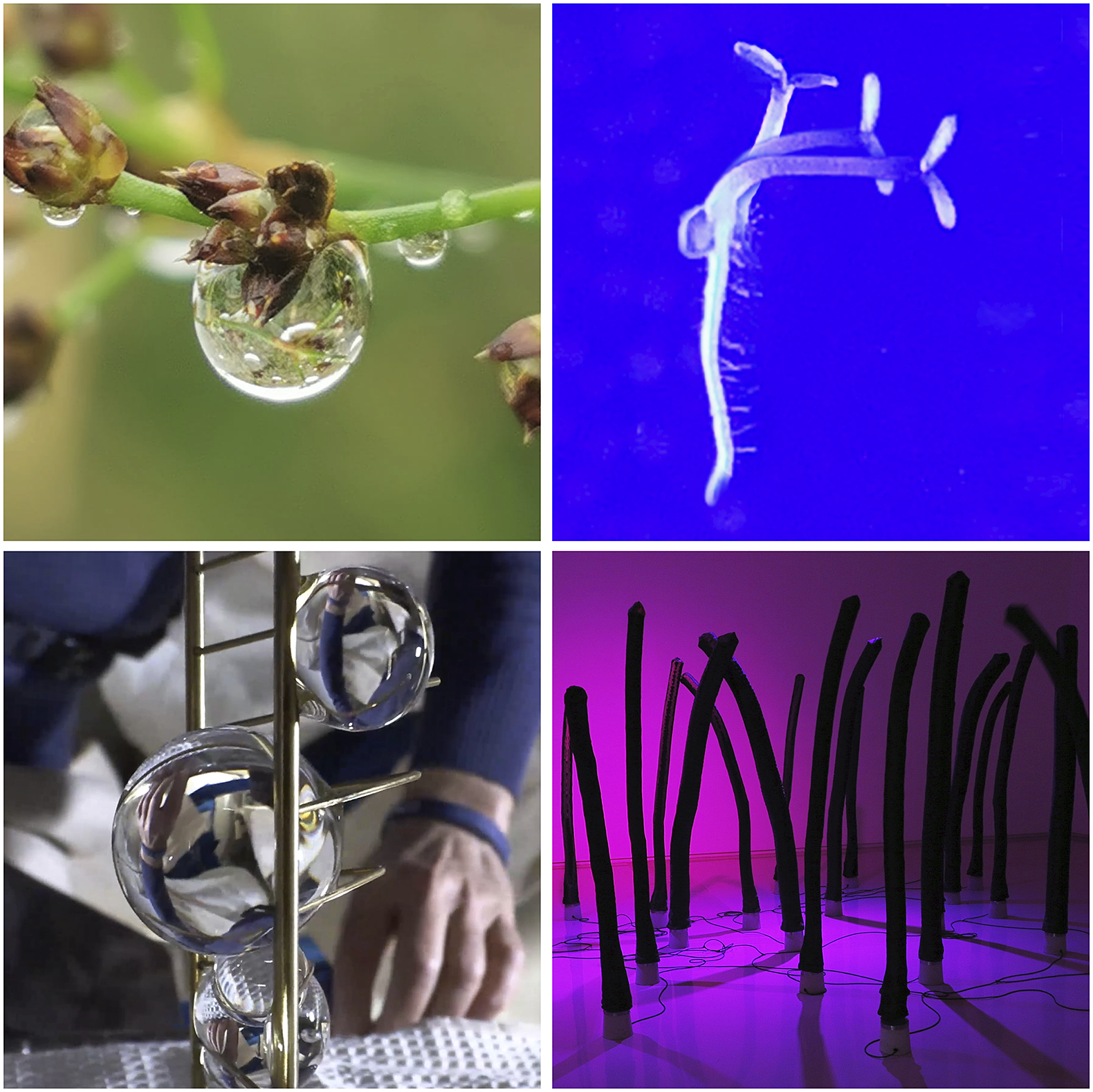
‘Tropism’ (Segal & Meroz, Reference Segal and Meroz2020) is an immersive art installation, exhibited at the exhibition ‘Plan(e)t’ at the Genia Schreiber University Gallery. The title of the work refers to the biological process allowing plants, which are sessile in nature, to move by changing their morphology according to environmental stimuli. Namely, tropisms are the redirection of growth of a plant organ towards or away from a directional stimulus such as light (phototropism), or gravity (gravitropism). These stimuli are sensed by specific sensory cells, which cause a differential growth rate along the organ cross-section, leading to bending and reorientation of the organ. An example is shown in Figure 1a. The artwork, shown in Figure 1b,c, takes inspiration from this process. A field of robotic plants is positioned within the gallery. The large shoots are covered by carbon fibres, giving them a futuristic feeling while referring to natural carbon-based beings. Magenta lights create artificial sunrises and sunsets reflected from the gallery walls, and the massive shoots slowly move in response to the changing lights. The magenta lights, used in greenhouses for plant growth, give the viewer an uncanny and surreal feeling. The shoots independently sense the surrounding lights using directional light sensors and react by arching their structures towards the most dominant light source. Figures 1 and 2 show different aspects of the technical work involved in the construction, as we will detail later on. Each autonomous shoot is affected by the changing light, as well as by the shadowing patterns emerging from the behaviour of its neighbours.
Construction of ‘Tropism’. Development and construction of the artwork are all done in-house and include the physical structure, electronics, mechanics and software. At L.S.’s studio: (a) casting concrete bases, (b) development of the robot electronics and control system, (c) assembling mechanical parts and (d) installation process at the gallery.

‘Impossible Object’ on Earth and aboard the ISS. (a) The structure of the sculpture, built as a composition of brass rods and tubes, is mounted on a pedestal. The sculpture’s composition of rods and tubes resembles a wavy staircase that has no directionality. (b) Aboard the ISS, the astronaut connected the tubes to a water bag. As the astronaut applied pressure on the bag, water flowed through the tubes and out through small holes. With no gravitation to direct the water downwards, the water formed a dynamic three-dimensional liquid composition, shaped by the interplay between water surface tension, and its adhesion to the structure (image courtesy of Eytan Stibbe and Rakia).

In the words of Tamar Mayer and Sefy Hendler (Mayer & Hendler, Reference Mayer and Hendler2022), the curators of the exhibition: “Tropism aspires to offer a mindful observation about our environment: plants, rooted in the ground, act as an integral element of a wide net of species—allies and rivals. Even though plants compete for resources, they succeed in establishing an optimal balance between their need for survival and their need to protect their immediate environment. In this sense, we, human beings, have a great deal to learn from plants about the equilibrium required for a sustainable way of life” (Segal & Meroz, Reference Segal and Meroz2020).
‘Impossible Object’ (Segal & Meroz, Reference Segal and Meroz2022), our second joint work, is an artwork that was sent to the International Space Station (ISS) in April 2022, as part of Rakia’s Art Mission (Rakia, 2022)—an initiative that seeks to create art that captures the essence of humanity through the medium of outer space. It was operated by Israeli astronaut Eitan Stibbe during mission AX-1, the first private astronaut mission on the ISS. ‘Impossible Object’ is a sculpture made of liquid water (Figure 3), whose three-dimensional form does not get its shape from any vessel, and as such cannot exist on Earth, but only in outer space in the absence of gravity. This work is experimental by nature, as we, its creators, could never actually test it and observe its full form on Earth, before sending it away to space (Figure 5b). As our Earth-based intuitions regarding the form and dynamics of water were useless when planning this sculpture, we went back to the basics. The main forces which govern the form and dynamics of water are surface tension, adhesive forces, and gravity. On small scales on Earth, surface tension and adhesive forces dominate gravitational forces, leading to interesting elastocapillary effects (Figure 4a), crucial for both the survival and function of plants. For example, plants transport water from root to crown (spanning great distances) using capillary forces, while cactus needles harvest water droplets in the morning mist (Liu et al., Reference Liu, Xue, Chen and Zheng2015; Masrahi, Reference Masrahi2020). In the case of micro-gravity, adhesion forces and surface tension dominate on all scales, and elastocapillary effects, observable only in small scales on Earth, govern the behaviour of water on a macroscopic scale, allowing large spherical drops or two-dimensional films of water (Pettit, Reference Pettit2009). This concept is at the basis of the artwork ‘Impossible Object’ (Figure 4b). The structure of the sculpture, built as a composition of brass rods and tubes (Figure 5), is mounted on a pedestal and connected by a silicone tube to an astronaut water drinking bag. On the ISS the sculpture was assembled and activated by an astronaut. As the astronaut squeezed the water bag, water flowed through the tubes and out through small holes. With no gravitation to direct the water downwards, the water formed a dynamic three-dimensional liquid composition, shaped by the interplay between water surface tension, and its adhesion to the structure. The sculpture’s composition of rods and tubes resembles a wavy staircase that has no directionality. The work questions shape and form. In the absence of gravitation, what is the shape of a piece of sea or a handful of a wave?
In ‘Impossible Object’ physics is the artistic medium. The main forces which govern the form and dynamics of water are surface tension, adhesive forces, and gravity. (a) On Earth, elastocapillary effects are observed only on the micrometre scale, where gravity is negligible (image courtesy of Lilach Hadany). (b) In the case of micro-gravity, surface tension and adhesive forces dominate, regardless of scale, and elastocapillary effects govern the behaviour of water on a macroscopic scale, allowing large spherical drops (image courtesy of Eytan Stibbe and Rakia).

Development and testing of ‘Impossible Object’ (images courtesy of Naomi Meroz). (a) Geometrical plan and construction of the sculpture. (b) Testing water flows through the structure on Earth.

3. Serendipity as a driver of scientific discoveries
Scientific research is about gaining an understanding of the basic mechanisms which form the world around us. The process of scientific investigation involves answering questions, but more importantly, it requires asking the right questions in the first place. Both processes require creativity and curiosity and are exploratory in nature. If we are to compare these exploratory processes with common search and optimization problems, such as animal foraging or evolutionary processes, it is clear that a random component is key (Lomholt et al., Reference Lomholt, Tal, Metzler and Joseph2008). Indeed, it is reasonable to say that many great scientific achievements were driven at some point by serendipitous events (Copeland, Reference Copeland2019).
Examples, apocryphal or not, are ubiquitous, spanning human existence: Greek polymath Archimedes takes a bath and realises that – ‘Eureka!’—the more his body sinks into the water, the more water is displaced, that is, the displaced water is an exact measure of his volume. An apple hits Isaac Newton’s head, and suddenly it hits him (pun intended) that the same force that made the apple fall downwards also keeps the Moon falling towards the Earth and the Earth falling towards the Sun, namely gravity. Bacteriologist Alexander Fleming returned to his lab after a long vacation, finding culture dishes contaminated by a fungus (an annoying event that had happened to many bacteriologists before him, who typically discarded these dishes). However, Fleming noticed a zone around this fungus that was clear of the bacteria, leading to the discovery of penicillin. Chemistry graduate student Jamie Link was working on a silicon chip at UCSD in 2003. The chip shattered by accident, and Link and her supervisor discovered that tiny bits of the chip were still sending signals. These microelectromechanical devices, later called ‘smart dust’, include sensors and computational ability.
In arts, randomness serves as a catalyst for creativity and even as an artistic method or a conceptual material. Dadaist artist Tristan Tzara, for example, harnessed the power of chance in the creation of poetry by cutting words from a newspaper and randomly selecting fragments into a new composition (Caws, Reference Caws1970). The resulting verses become a reflection of the collective consciousness and creativity of humanity. Randomness and serendipity played a crucial role in Jackson Pollock’s action paintings too, as he relinquished control over the brush and embraced spontaneous gestures such as dripping, pouring, and splattering paint onto the canvas, allowing chance to determine the final composition. More recent examples can be seen in algorithmic generative art that often embraces chance as a method for producing unpredictable and sometimes ‘human-like’ outcomes. In this sense, it is interesting to further think of the role of chance in human creative process in general.
Fortuitous events also direct life trajectories, such as Y.M.’s current research, which is completely unrelated to her previous research endeavours. During her postdoc, working in L. Mahadevan’s lab at Harvard, Y.M. developed a mathematical model describing a memory phenomenon observed in the chemotactic response of neutrophil cells exposed to two opposing chemical stimuli (Prentice-Mott et al., Reference Prentice-Mott, Meroz, Carlson, Levine, Davidson, Irmia, Charras, Mahadevan and Shah2015). She excitedly told a fellow postdoc, Renaud Bastien, about these decision-making experiments. As a plant scientist, he responded with a smile that ‘plants behave similarly, but nobody would say that they make decisions’. This remark started a cascade of events which ultimately led Y.M. to realise that plants are complex, behaving organisms, and to fall in love with the concept of distributed computational processes in plants.
Similarly, L.S.’s career shift to art has its seed during her time working at Microsoft Innovation Labs. There she came across a programmable microcontroller and started playing and tinkering with it. She soon realised that her geeky projects initiated conversations and thoughts by their observers. L.S. discovered that scientific concepts and technology can be her expression materials.
4. Art–science collaborations as a generator of serendipitous effects
We can think of serendipity as ‘fairy dust’ for advances in scientific research, as well as for artistic work. So, what if we had a ‘fairy dust generator’? Here we suggest that collaborative work between artists and scientists can be viewed as a process which sparks serendipitous events and new ideas, where the interplay and feedback between an artist and a scientist leads to new questions and understandings (both from the artistic and scientific points of view)—which otherwise would have been left unexplored.
New ideas can spawn from two different aspects of such work; conceptual and technical. For example, the conceptual idea behind the artwork ‘Tropism’ is related to the notion that plants are not thought of as behaving organisms, possibly due to the fact that as humans we cannot perceive their slow growth-driven movements. While this is not strictly a scientific view, it affects Y.M.’s work and the way in which it is viewed by her peers. Indeed, the effect of human psychology on the progress of science is an interesting question. ‘Tropism’ investigates this point within the broader context of the relationship between humans and their plant environment, making the robotic stem movements slow yet perceptible, enabling the audience to relate to them. Another interesting outcome of this art installation is that it practically acts as a physical simulation of collective behaviour. While it was not designed for this purpose per se, the shoots interact with the changing light and shadows, hence, with each other. When visitors walk among the large shoots, they become a part of this collective too. Impossible Object involved an unforeseen aspect of random influences since it could not be tested on earth, and was operated by astronauts. This interrogates the boundary between artistic and scientific experiments, acknowledging the role of external effects in shaping both. The sculpture elicited a playful, curiosity-based response from the operating astronauts, and as such represents the spirit, or state of mind, of both an artist and researcher.
The technical aspect also presents an opportunity for inspiration. Paraphrasing Richard Feynman’s famous words ‘What I cannot build, I do not understand’, the act of constructing something inspired by a physical or biological process raises basic questions regarding our understanding of a system. Indeed, this concept is at the basis of the emerging field of robophysics (Aguilar et al., Reference Aguilar, Zhang, Qian, Kingsbury, McInroe, Mazouch, Li, Maladen, Gong, Travers, Hatton, Choset, Umbanhowar and Goldman2016), where animal locomotion is studied through the use of physical robots.
One example came up during the development of the artwork ‘Tropism’, where the underlying mechanism for the shoot’s bending is inspired by differential growth in plant tropisms. Each shoot is made up of a flexible spine planted in a heavy concrete base. In order for the spine to bend in a specific direction, it is connected to two orthogonal closed belts, driven by motors. Each belt is connected to two strings that hold the far end of the spine. To bend to the right, for example, the belt pulls the right string and relaxes the left one. This whole mechanism is covered with a flexible duct hose, retaining the cylindrical form of the stems, while allowing them to bend along two axes of motion (Figure 1b). It turns out that the helical structure of the off-the-shelf duct hose (Figure 2d) introduces radial movement; that is, when the right string was pulled the stem bent to the right, but also turned in the same handedness as the helicity of the duct hose. This unexpected behaviour sparked research-related questions regarding movement in plants, since plant cells exhibit helicity, both at the single cell level (helical formation of cellulose; Chakraborty et al., Reference Chakraborty, Luo and Dyson2021), as well as the tissue level (Nakamura & Hashimoto, Reference Nakamura and Hashimoto2020).
A second example came up in the work ‘Impossible Object’, where it can be argued that physics is the medium. As mentioned earlier, before we could design and construct our sculpture, we needed to gain an understanding of the physical principles governing water dynamics in space. To do so we delved into papers on the beautiful world of elastocapillary effects and watched hours of footage of astronauts experimenting with water aboard the ISS. In particular, we were deeply inspired by the curiousity-driven experiments run by NASA astronaut Donald Pettit, which he called ‘opportunistic observations, […] made during my off-duty time simply because I was there and could’ (Pettit, Reference Pettit2009). The outcome of ‘Impossible Object’ aboard the ISS infused Y.M.’s research with a deeper and more intuitive understanding of the role of elastocapillary effects in plants. At the same time, these new understandings lead to question whether a micro-scale version of the artwork on Earth would exhibit similar water behaviour, and so the artistic–scientific exploration continues.
Both collaborations, ‘Tropism’ and ‘Impossible Object’, have injected into our work, new energy and ideas—providing both of us with invigorating and enriching experiences. Indeed, we found that artists and scientists are not so different after all. Both observe the world, are driven by curiosity, ask questions and search for truth. The artistic process, much like the scientific one, grows from an inner seed that germinates in its creator’s mind followed by observation, research, and experimentation. However, we note that the success of these collaborations was also enabled by an institutional and financial infrastructure. For example, in the case of Tropism Tel Aviv University Art Gallery actively approached Y.M. from the beginning, pursuing their stated mission to create a meaningful dialogue between artists and the research community of the university. Funding was generally provided by the commissioning body and art funds. It is worth noting that very few research-oriented funding agencies allow to use budget for related art projects (outreach)—a critical contribution towards encouraging and enabling art–science collaboration.
It can be argued that being an artist with a scientific background, as in the case of L.S., may have an advantage for an art–science collaboration. One benefit it can bring to the collaboration is a mutual cultural language. Many terms that may be trivial in one discipline are unfamiliar or have different meanings in the other. This is the case for both disciplines and having a baseline for communication as well as a shared set of cognitive tools and references may jumpstart the joint work more efficiently. On the other hand, as long as both the scientist and the artist have curiosity and patience to learn and to teach, discussing terms that one may have taken for granted may also mean revisiting them in a beginner’s mind. This, for itself, may induce fresh observations and creative ideas. It is important to stress that our collaboration is special in the art–science collaborative scene. Many times, such projects are essentially a unidirectional pipeline: a scientist provides research-based data or images to an artist, who then reinterprets these within an artwork or uses them as inspiration. The collaborative effort we describe here is bidirectional, with a continuous feedback and exchange of ideas, leading to a synergistic result. We both came to the table with an open mind, not limiting ourselves to our titles and definitions, while also hoping to learn new concepts—whether artistic or scientific. It is our belief that only with a true collaboration (Nature Editorial, 2021), where both sides are seriously invested, the fairy dust can work its magic.
Acknowledgements
We would like to thank David Horn, our MSc supervisor, the most curious person we know, NASA astronaut Donald Pettit for inspiring us with his beautiful insights and videos aboard the ISS, AX-1 astronaut Eytan Stibbe for making our ‘Impossible Object’ possible, Tamar Mayer and Sefy Hendler for sparking our first art–science collaboration and Naomi Meroz and Assaf Arviv for their kind and mindful documentation of our journey.
Financial support
This work has received funding from the European Union’s Horizon 2020 research and innovation program under grant agreement no. 824074 (GrowBot); The George S. Wise Faculty of Life Sciences at Tel Aviv University; Mifal Hapais grant agreement no. 56712 and Asylum Arts grant 2022.
Competing interest
The authors declare none.
Authorship contribution
Y.M. and L.S. wrote the article.
Data availability statement
No relevant data or code for this article.


 Open access


Comments
Re: Submission of Segal and Meroz manuscript.
Dear Editor,
We are most enthusiastic to submit our manuscript “Art-Science Collaborations: Generators of New Ideas and Serendipitous Events” by Liat Segal and Yasmine Meroz, for the Special Collection “Art and Science and Society” in Quantitative Plant Biology.
In this manuscript we question the value of collaborative projects between artists and scientists, particularly in view of funding and resources. We suggest here that such collaborations are NOT a waste of time, neither for artists or scientists, and that one of the most significant outcomes is something that cannot be planned for in advance: serendipitous events. Such events lead to fresh perspectives and imaginative ideas, the fairy dust underlying many great works of art and science. We propose this based on our personal experience, and bring an informal account of our collaborative efforts, as an artist and a scientist.
We feel that the interdisciplinary audience of QPB could be interested and perhaps inspired by the notion of art-science collaborations, and their advantages.
Please do not hesitate to contact us, should you require any further information.
Sincerely,
Liat Segal and Yasmine Meroz