





Introduction
The diagnosis of a terminal illness, such as cancer, disrupts the lives of patients and their family members, particularly the caregivers, bringing profound changes in daily life that can negatively impact their psychological well-being (Klikovac and Djurdjevic Reference Klikovac and Djurdjevic2010; Singer Reference Singer2018; Teixeira et al. Reference Teixeira, Applebaum and Bhatia2018). The experience of terminal illness can be viewed as a delicate transitional process during which the participants involved face multiple situations of loss and grief (Benoliel Reference Benoliel1985). Grief is generally defined as a process that follows death (Johansson and Grimby Reference Johansson and Grimby2012); however, it can be prolonged and can occur even before a person’s death (Parkers Reference Parkers1996). It has been proposed that the threat of death or separation due to serious illness may result in psychological distress that requires major adaptive efforts by caregivers (Coelho et al. Reference Coelho, Silva and Barbosa2017). In this context, it was found that a substantial number of caregivers tended to develop depressive symptoms before the patient’s death (Pop et al. Reference Pop, Puia and Mosoiu2022). Interestingly, non-pharmacological treatments, such as exercise enhancement, have been shown to be effective in both reducing and treating depressive symptoms (Belvederi Murri et al. Reference Belvederi Murri, Ekkekakis and Magagnoli2019), even in primary caregivers of patients with life-threatening progressive illnesses (Pop et al. Reference Pop, Puia and Mosoiu2022).
Noteworthy, during the terminal phases of illness, the imminent and irrevocable loss has been found to be associated with several emotional, physical, and social reactions in caregivers (Rando Reference Rando1988). Interestingly, the pre-loss reactions appeared to be similar to those experienced in the mourning phase after loss, suggesting that there is a continuum between the 2 conditions (Gilliland and Fleming Reference Gilliland and Fleming1998; Rando Reference Rando1988). In this regard, pre-loss or pre-death grief is defined as a grieving reaction due to multiple losses faced by caregivers during the end-of-life phase of terminally or severely ill patients (Lindauer and Harvath Reference Lindauer and Harvath2014). Pre-loss grief can have long-term negative repercussions on psychological health (Johansson and Grimby Reference Johansson and Grimby2012) and has been associated with complicated grief (Fee et al. Reference Fee, Hanna and Hasson2021; Holm et al. Reference Holm, Alvariza and Furst2019; Nielsen et al. Reference Nielsen, Neergaard and Jensen2017). In the oncology context, caregivers of terminally ill patients experience pre-loss symptoms, high levels of burden, and have an increased risk of developing prolonged grief (Lai et al. Reference Lai, Luciani and Morelli2014, Reference Lai, Luciani and Galli2015; Treml et al. Reference Treml, Schmidt, Nagl and Kersting2021; Veloso and Tripodoro Reference Veloso and Tripodoro2016).
The risk of negative mental health outcomes for caregivers appears to be associated with relational factors, such as attachment style and family functioning (Lai et al. Reference Lai, Luciani and Galli2015; Nissen et al. Reference Nissen, Trevino and Lange2016; Schuler et al. Reference Schuler, Zaider and Kissane2012). In particular, an insecure attachment style could lead to difficulties in processing the loss and increase the level of burden (Karantzas et al. Reference Karantzas, Evans and Foddy2010; Lai et al. Reference Lai, Luciani and Galli2015; Romaniello et al. Reference Romaniello, Farinelli and Matera2015; Shear et al. Reference Shear, Monk and Houck2007). Moreover, caregivers who belong to families characterized by low levels of cohesion might show a lowered ability to cope with pre-loss grief (Schuler et al. Reference Schuler, Zaider and Kissane2012). On the contrary, open communication between family members before the patient’s death has been associated with better psychological outcomes for caregivers (Otani et al. Reference Otani, Yoshida and Morita2017; Schuler et al. Reference Schuler, Zaider and Kissane2012). In addition, it has been reported that making patients more informed and aware of their terminal condition could help in improving their quality of life during the terminal phase (Chittem et al. Reference Chittem, Norman and Harris2015; Lai et al. Reference Lai, Luciani and Galli2017). Previous studies have identified cross-cultural differences in family propensity to make patients aware of their terminal condition (Tang Reference Tang2019; Zahedi Reference Zahedi2011). Cultures focused on individualism, such as Western societies, tend to preserve the individual’s decision-making autonomy throughout the entire care and treatment process (Tang Reference Tang2019). In contrast, in Eastern cultures, the family system is an integral part of the decision-making process, and critical issues are disclosed, shared, and managed by the entire family (Tang Reference Tang2019). Therefore, previous research has reported that family caregivers in Western countries are more likely to share unfavorable information with patients compared to Asian ones (Tang Reference Tang2019). In addition, it has been reported that caregivers’ resistance to disclosing the patient’s terminal condition may derive from concern about causing further distress in the patient and the belief that they are protecting their loved ones (Lai et al. Reference Lai, Aceto and Pellicano2022).
During this complex transitional process, a delicate moment is represented by the choice of the place where the patient will spend the last days of life. Possible choices are home care services and hospice, which is a residential social care facility for the terminally ill patients (Kumar et al. Reference Kumar, Wright and Hatfield2017; Shepperd et al. Reference Shepperd, Gonçalves-Bradley and Straus2016). The home care setting represents the patient’s most desired choice and is the most shared on a sociocultural level (Carlsson and Rollison, Reference Carlsson and Rollison2003; Nilsson et al. Reference Nilsson, Blomberg and Holgersson2017). Often, for the caregivers, the decision about the setting care may depend more on the patient’s desire than on their own needs (Stajduhar Reference Stajduhar2003; Stajduhar and Davies Reference Stajduhar and Davies2005). In the home care setting, the caregivers reported high levels of burden and sleep problems, especially in the last days of the patient’s life, when the symptoms become more intense (Carlsson and Rollison, Reference Carlsson and Rollison2003). In contrast, the caregivers who indicated hospice as the primary care setting reported high levels of perceived support, considering the hospice setting the ablest to aid with the patient’s care needs (Bainbridge and Seow Reference Bainbridge and Seow2018; Finlay et al. Reference Finlay, Higginson and Goodwin2002).
It has not been investigated how attachment style and family functioning could influence this choice. Shedding light on this phenomenon could increase knowledge about the psychological factors that contribute to increasing the psychological well-being of patients and caregivers in this delicate phase of life.
The purpose of this cross-sectional study was to evaluate the associations between the attachment style, the family functioning, the care setting (hospice or home), the levels of pre-loss grief symptoms, the burden, and the belief in the awareness of the patient’s diagnosis in caregivers of patients with terminally ill cancer. The hypothesis was that more insecure attachment style, low levels of family cohesion/adaptability, and home-setting care were associated with higher levels of pre-loss grief symptoms, higher burden, and lower awareness of the diagnosis of the patient in the caregivers.
Methods
Participants
The study was approved by the Ethical Committee of the Department of Dynamic and Clinical Psychology, and Health Studies “Sapienza,” University of Rome (Prot. n. 0000539, 10/05/2021) and it conformed to the provisions of the Declaration of Helsinki (Rickham Reference Rickham1964). The inclusion criteria were family relationship with a patient with terminal cancer, Italian speaking, ability to give informed consent, and age of at least 18 years. The caregivers were included in the study during the period before the patient’s death (mean, 21 days). After signing the informed consent, caregivers of patients in residential care at the palliative care center of Rome “Fondazione Sanità e Ricerca” and caregivers of patients in home care were recruited. A psychologist of the hospice interviewed the caregivers with a demographic schedule and with questions investigating the caregivers’ attitudes toward the patient’s terminal condition. Subsequently, 4 self-report questionnaires were completed by the caregivers.
Measure
The Attachment Style Questionnaire (ASQ) is a self-report questionnaire which includes 40 items rated on a 6-point Likert-type scale (totally disagree = 1, totally agree = 6) (Fossati et al. Reference Fossati, Feeney and Donati2003). It includes 5 subscales: “confidence” representative of secure attachment, “discomfort with closeness” representative of avoidant attachment, “need for approval” and “preoccupation with relationships” representative of preoccupied or anxious attachment, and “relationships as secondary” representative of dismissing attachment.
The Family Adaptability and Cohesion Evaluation Scales (FACES III) is a self-report questionnaire, which includes 20 items rated on a 5-point Likert scale (almost never = 1, almost always = 5). It is divided into 2 subscales: “cohesion,” which measures the level of emotional bond and individual autonomy within the family and “adaptability,” which measures the flexibility or rigidity of family roles and the ability to respond to stressful situations. From the scores obtained in the 2 dimensions, it is possible to classify 3 types of families: balanced families, intermediate families, and extreme families (Forjaz et al. Reference Forjaz, Cano and Cervera-Enguix2002).
The Prolonged Grief Disorder questionnaire (PG-12) is a 12-item self-report questionnaire which investigates the pre-loss grief symptoms, whether it results from a serious illness, a bereavement, or other life situations (Chiambretto et al. Reference Chiambretto, Moroni and Guarnerio2008; Coelho et al. Reference Coelho, Silva and Barbosa2017; Dehpour and Koffman Reference Dehpour and Koffman2022). Eleven items, rated on a 5-point Likert scale (never = 1, many times a day = 5), were summed to assess the severity of the pre-loss grief symptoms, and the last dichotomous item (Yes/No), measures the caregiver’s perception of significant difficulty in social, occupational, or other important areas of functioning (Chiambretto et al. Reference Chiambretto, Moroni and Guarnerio2008).
The Caregiver Burden Inventory (CBI) is a self-report questionnaire that measures the burden of a caregiver through 24 items rated on a 5-point Likert scale (not at all = 0, much = 4). It is composed of 5 subscales: “objective burden,” due to the reduction of time for oneself; “psychological burden,” derived from the sense of the caregiver not being able to satisfy her/his own hopes and expectations; “physical burden,” characterized by physical stress and somatic disorders; “social burden,” caused by the conflict of roles; and “emotional burden,” derived from negative feelings of the caregivers toward the patient’s behaviors (Marvardi et al. Reference Marvardi, Mattioli and Spazzafumo2005).
Finally, the caregiver’s belief about the patient’s awareness of her/his diagnosis was directly asked the caregivers through dichotomous questions (Yes/No): “Do you think that your beloved one is aware of her/his terminal condition?” Moreover, the caregivers were asked whether they felt it was right to inform the patient about her/his terminal illness, the question was: “Do you think that it is right to inform your beloved one about her/his terminal illness?”
Statistical methods
The multivariate analysis of variance (MANOVA) was conducted to evaluate the differences in the means of the scores of ASQ, FACES III, and CBI subscales, between caregivers with patients in residential hospice care and those with patients in home care.
Analyses of the variance (ANOVAs) were calculated to evaluate the difference between the means of age, years of education, and the difference in PG-12 scores of the caregivers of patients in residential hospice care and the caregivers of patients in home care. Chi-squared test was used to determine whether there was a statistically significant difference (p < 0.05) between the expected and the observed frequencies in the gender, the relationship of the caregiver with the patients, civil status, and the caregiver’s belief about the patient’s awareness of the diagnosis among the 2 groups of caregivers (residential hospice care/home care).
Correlation analyses (Pearson’s r and Point Biserial when necessary) were conducted to evaluate the relationship between the gender, age, and year of education; scores in the subscales of ASQ and FACES III; the scores of PG-12 and CBI; and patient awareness of the diagnosis.
Linear regression models were carried out using independent variables. These variables significantly (p < .05) correlated with PG-12 and CBI. A logistic model was used for the categorical dependent variable “caregiver’s belief about the patient awareness of the diagnosis (Yes/No).” In addition, the care settings variable was included in the models if significant differences were found in the ANOVAs on PG-12, CBI scores, and caregiver belief about the patient’s awareness of the diagnosis.
Mean and standard deviation were reported, and p < 0.05 was considered statistically significant. The program used for the statistical analysis was STATISTICA version 8. All data and research materials will be made available upon request.
A priori power analyses were conducted using G*Power software 3.1 (Düsseldorf, Germany) (Faul et al. Reference Faul, Erdfelder and Lang2007). A power analysis for 1-way ANOVA was conducted with a power set at 80%, an effect size f 2 = 0.30, an alpha error probability of 0.05, and 2 groups indicating a required total sample size of 90 participants. The power analysis for linear multiple regression models was conducted with a power set at 80%, effect size f 2 = 0.20, an alpha error probability of 0.05, and 7 predictors indicating a required total sample size of 80 participants.
Results
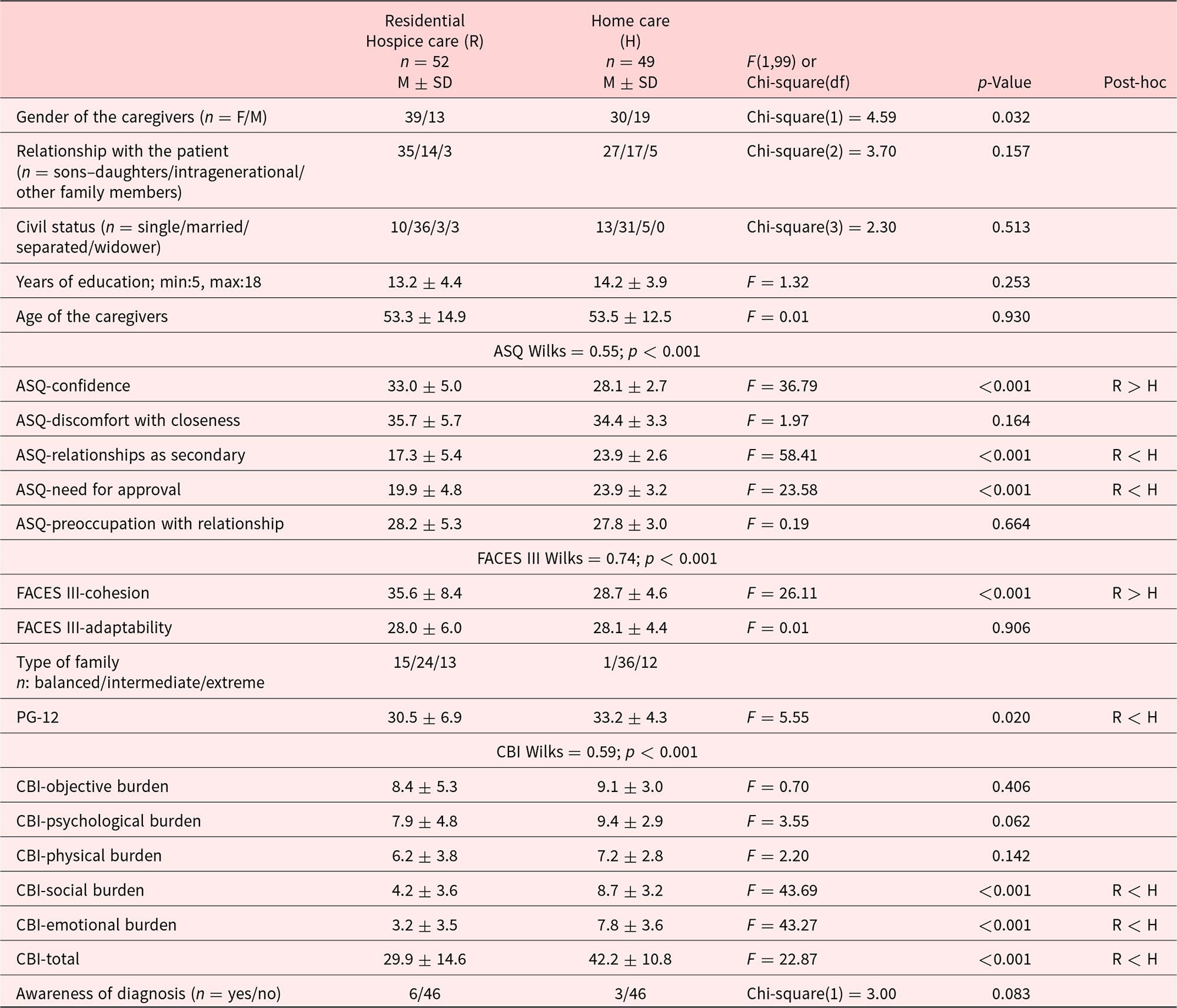
In the final sample, 52 participants were caregivers of patients in a residential hospice care setting and 49 were caregivers of patients in a home care setting (Table 1). The difference in gender of the caregivers was significant (69 women and 32 men). In residential hospice care, 75% of caregivers were women (39 women and 13 men); in home care, 61% of the caregivers were women (30 women and 19 men) (Table 1).
Comparisons (chi-squared, MANOVAs, and ANOVAs) between residential hospice care vs. home care on gender, relationship with the patients, age, and the scores of Attachment Style Questionnaire (ASQ), the Family Adaptability and Cohesion Evaluation Scales (FACES III), the Prolonged Grief Disorder Questionnaire (PG-12), the Caregiver Burden Inventory (CBI), and patient awareness of the diagnosis

In the present study, the measures showed the following reliability values (Cronbach’ alphas): ASQ-confidence = 0.74; ASQ-discomfort with closeness = 0.52; ASQ-need for approval = 0.68; ASQ-relationships as secondary = 0.78; ASQ-preoccupation with relationships = 0.57; FACES III-cohesion = 0.86; FACES III-adaptability = 0.59; PG-12 total score = 0.75; CBI-total score = 0.89; CBI-objective burden = 0.80; CBI-psychological burden = 0.75; CBI-physical burden = 0.79; CBI-social burden = 0.79: and CBI-emotional burden = 0.84.
In total, 9 caregivers believed that patients were aware of their diagnosis and 92 caregivers believed that the patients were unaware of it. Among the 9 caregivers who believed that the patients were aware of their diagnosis, only 2 (22%) affirmed that it was not right to inform the patients about her/his terminal ills, and 7 declared that it was right. Among the 92 caregivers who believed that the patients were unaware of their diagnosis, 74 (80%) affirmed that it was not right to inform the patient about her/his terminal condition, and 18 declared that it was right (Table 1).
The score in the scales of ASQ showed a significant difference between the 2 groups. The caregivers of the patients in residential hospice care had significantly higher scores in the subscale of ASQ “confidence” and a significantly lower score in the subscales of ASQ “relationships as secondary” and “need for approval,” compared to those of the patients in home care (Table 1).
Even the difference in FACES III scores was significant among the 2 groups of caregivers. In particular, the subscale of FACES III “cohesion” was higher in the caregivers of the patients in residential care compared to those with patients in home care. From the scores of the FACES III, 15 balanced families, 24 intermediate families, and 13 extreme families were identified in the residential hospice care setting. One balanced family, 36 intermediate families, and 12 extreme families were identified in the home care setting (Table 1).
In addition, the caregivers of the patients in residential hospice care had significantly lower PG-12 scores compared to those of the patients in home care (Table 1).
The CBI total score was significantly different between the caregivers of patients who received residential care and those who received home care. The caregivers of patients in residential hospice care showed significantly lower levels of total CBI score, and social and emotional burden scores compared to those with patients in home care (Table 1).
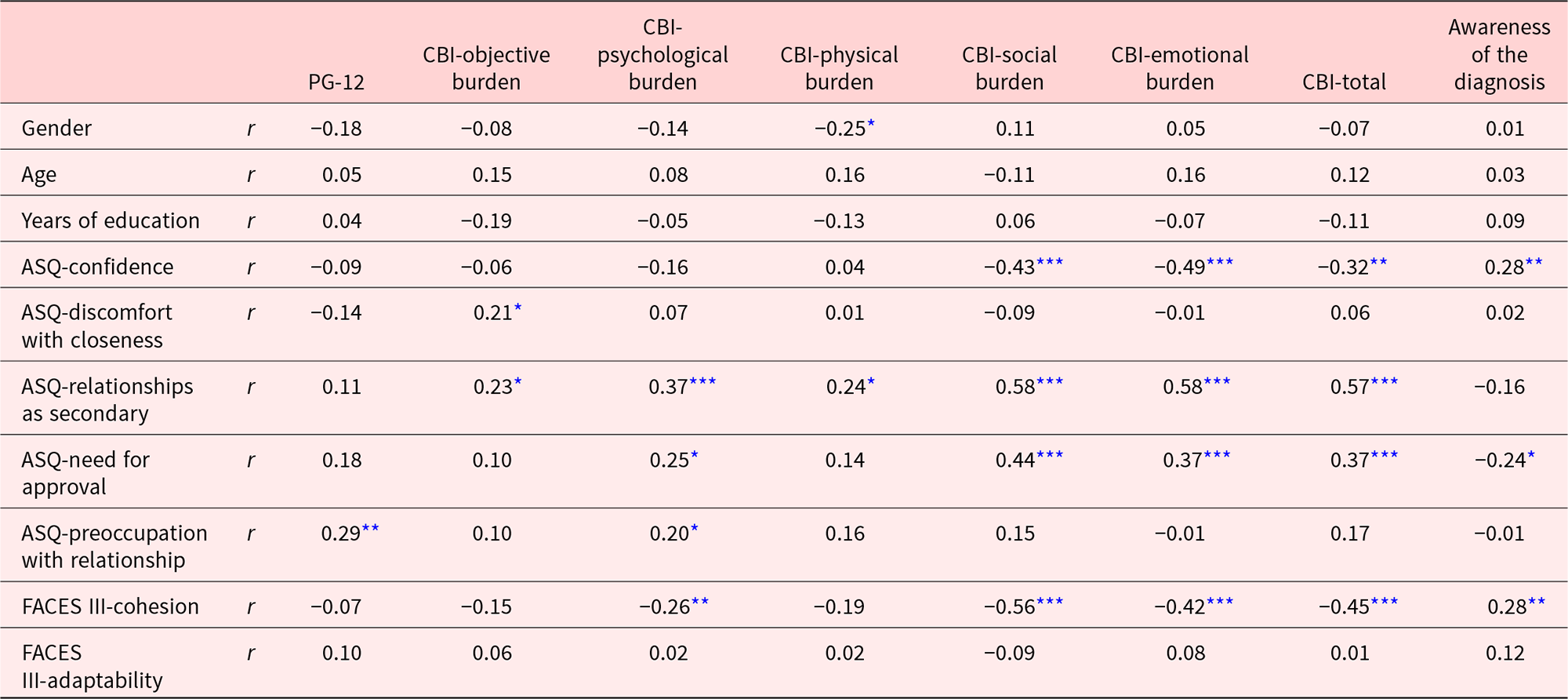
The following significant correlations are presented in Table 2. Gender was negatively correlated with physical burden. The ASQ subscale “confidence” was negatively related to social, emotional burden, and CBI total score and positively related to patient awareness of diagnosis. The subscale ASQ “discomfort with closeness” showed a positive correlation whit the objective burden. ASQ “relationships as secondary” had positive correlations with all the CBI scores. The subscale ASQ “need for approval” was negatively related to the patient’s awareness of the diagnosis and positively correlated with the psychological burden, social burden, emotional burden, and CBI total score. ASQ subscale “preoccupation with relationships” showed a positive correlation with the PG-12 and psychological burden. The subscale FACES III “cohesion” was positively correlated with patient awareness of the diagnosis and negatively related with psychological, social and emotional burden, and CBI total.
Correlation analyses (Pearson’s r and Point Biserial rpb) between the scores of Attachment Style Questionnaire (ASQ), the Family Adaptability and Cohesion Evaluation Scales (FACES III) and the scores of the Prolonged Grief Disorder Questionnaire (PG-12), the Caregiver Burden Inventory (CBI), and patient awareness of the diagnosis

* p<0.05, **p<0.01, ***p<0.001.
The variables that were significantly correlated with PG-12, CBI, and patient awareness of diagnosis scores were inserted in multiple linear regression models and in 1 logistic regression model, as independent variables of PG-12 and CBI and patient awareness of the diagnosis. In addition, the care settings variable was included in the models when significant differences were found in the ANOVAs on PG-12, CBI scores, and caregiver belief about the patient’s awareness of the diagnosis.
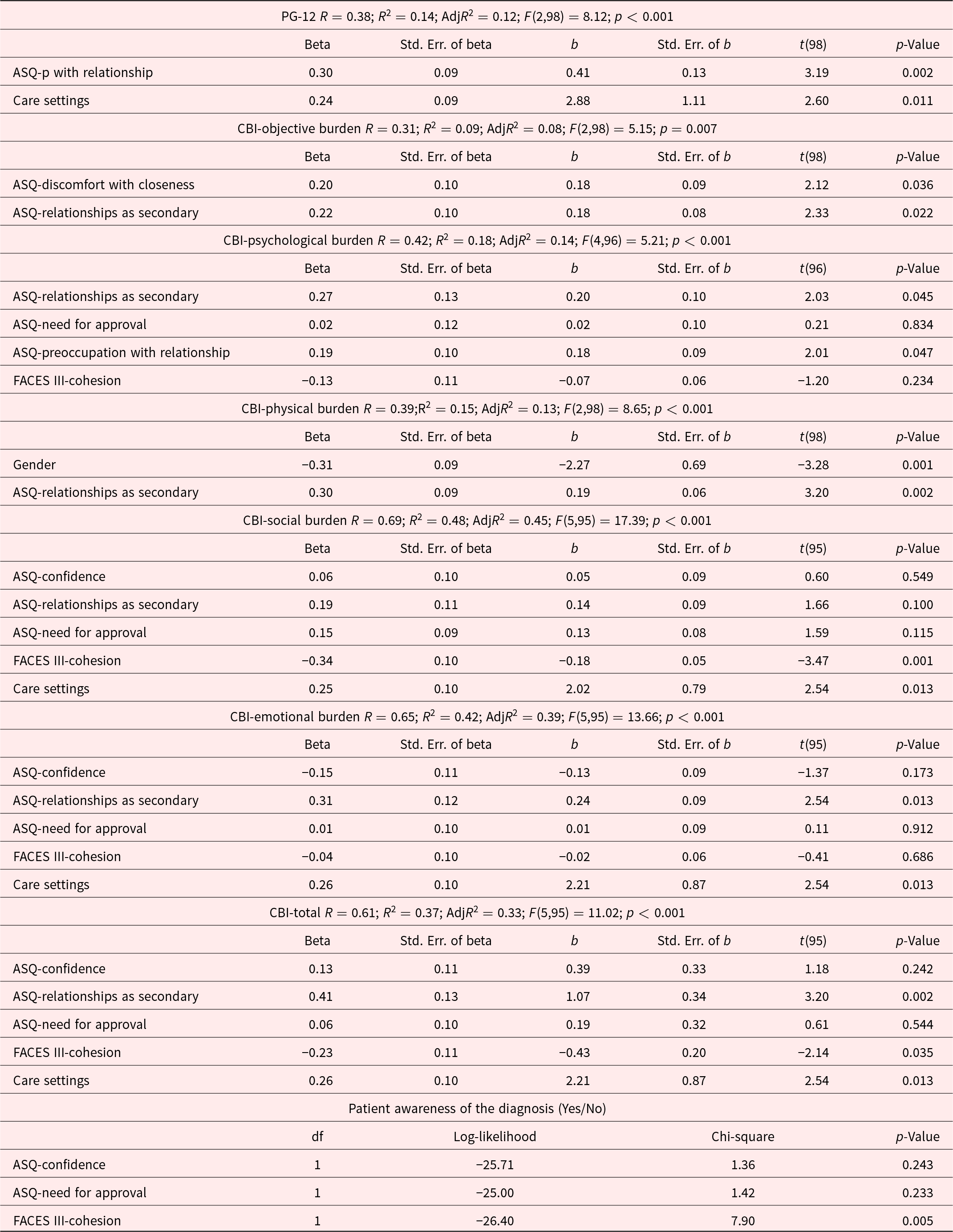
As shown in Table 3, the models were significant. The ASQ subscale “preoccupation with relationships” and care settings were significantly associated with PG-12 scores. ASQ subscales “discomfort with closeness” and ASQ “relationships as secondary” were significantly associated with CBI objective burden. The ASQ subscale “relationships as secondary” and ASQ subscale “preoccupation with relationships” were significantly associated with CBI psychological burden. Gender and ASQ subscale “relationships as secondary” were significantly associated with CBI physical burden. The FACES III “cohesion,” and care settings were significantly associated with the social burden. The subscale ASQ “relationship as secondary” and the care settings were significantly associated with CBI emotional burden. The ASQ “relationships as secondary,” the FACES III “cohesion” subscale, and care settings were significantly associated with CBI total score. The subscale FACES III “cohesion” was significantly associated with the patient awareness of diagnosis.
Linear and logistic regression on The Prolonged Grief Disorder Questionnaire (PG-12), the Caregiver Burden Inventory (CBI) and patient awareness of the diagnosis with the scores of the Attachment Style Questionnaire (ASQ), the Family Adaptability and Cohesion Evaluation Scales (FACES III) and care settings as independent variables

Discussion
The findings of this study showed that insecure attachment style, characterized by preoccupation with relationships, and home care setting were associated with higher severity of pre-loss grief symptoms in the caregivers of patients with terminal cancer. It has previously been found that caregivers with an anxious attachment style may live the patient’s end-of-life phase with great concern and worry, which may interfere with a functional response to loss (Lai et al. Reference Lai, Luciani and Galli2015). Moreover, caring for a patient with terminal cancer at home implies a commitment and attention to the patient that is relevant for a caregiver (Götze et al. Reference Götze, Brähler and Gansera2018). Therefore, caregivers may be exposed to higher levels of emotional and psychological distress (Götze et al. Reference Götze, Brähler and Gansera2018) and these might be associated with an increased risk of experiencing symptoms of pre-loss.
Another interesting finding of the present study was the effect of gender, attachment style, family functioning, and care setting on caregiver burden. In particular, the subscales of ASQ “relationship as a secondary” were found to be risk factor for the caregivers’ CBI total score. This result showed that reduced trust in others and difficulties in sharing their own emotions, fears, and concerns could increase the perceived burden (Magai and Cohen Reference Magai and Cohen1998). In addition, it was found that women may be at greater risk of perceiving a physical burden. It has previously been reported that women seem to spend more time than men caring for the terminally ill patients and tend to seek less support from others family members, which may contribute to increased feelings of fatigue and stress (Schrank et al. Reference Schrank, Ebert‐Vogel and Amering2016).
Furthermore, the family’s cohesion resulted to be a protective factor for the caregivers’ burden. This result is consistent with the Family Systems Theory, according to which the family can be considered as an “interactive unit” in which no member can exist in isolation from the others (Mehta et al. Reference Mehta, Cohen and Chan2009). The caregiver belonging to families characterized by closeness and a good degree of autonomy could feel more supported and more confident in asking for help from others, leading to lower burden levels. Coherently, a previous study found that supportive families had better outcomes than the more detached ones (Nissen et al. Reference Nissen, Trevino and Lange2016).
It was also found that caregivers of patients in home care setting showed higher levels of social and emotional burden than those with patients in hospice. In home care, the greatest burden may be due to conflicts between family and work activities (Marvardi et al. Reference Marvardi, Mattioli and Spazzafumo2005), which 20% of cases lead to a family member having to give up work to care for their loved one (Covinsky et al. Reference Covinsky, Goldman and Cook1994).
In this regard, interesting results emerged in evaluating the differences in the attachment style and family functioning of the caregivers of patients in hospice or home care. The caregivers of patients in hospice reported greater levels of secure attachment, compared to those with patients in home care. These caregivers could be likely to have more confidence in the institution and health-care professionals, and as a result, they may feel safe letting someone else take care of their loved one. Moreover, family cohesion was significantly higher in the caregivers with patients in residential hospice care and it was associated with the patient awareness of her/his diagnosis. According to the Family System Theory, when a family member receives a diagnosis of a terminal illness, the whole system is affected, and to restore homeostasis, a new balance between stability and change is required (Mehta et al. Reference Mehta, Cohen and Chan2009). In this regard, it was documented that family ties are considered important resources for better adjustment in the palliative care context (Nissen et al. Reference Nissen, Trevino and Lange2016). It was previously reported that family cohesion was associated with more effective problem-solving, mutual affection, and greater expressiveness (Chin et al. Reference Chin, Jaaniste and Trethewie2018). Probably, belonging to families with good connections could help in making a shared decision, focused on the needs of patients with terminal cancer (Lai et al. Reference Lai, Luciani and Galli2017). In addition, it is possible that the cohesion between family members may promote communication between caregivers and patients, increasing the possibility of openly sharing thoughts and emotions related to the terminal condition. On the contrary, more detached families may prefer to avoid direct dialogue with the patient for fear of being unable to deal with the distress this may cause to the patient.
In addition, in this study, it was found that the percentage of female caregivers was higher in hospice care setting than in home care setting. This may be attributed to the fact that women are more inclined to refer to specialized centers and interface with health professionals than men.
Surprisingly, in our sample, only 9 of 101 caregivers declared that patients were aware of their diagnosis. In addition, most caregivers retained that it was not right to inform the patient about his terminal ills. Despite this trend, a previous study showed that 69% of unaware terminally ill patients desired to receive more information on their condition (Brokalaki et al. Reference Brokalaki, Sotiropoulos and Tsaras2005). This result is significant at a clinical level because many studies showed that unaware patients seem to suffer more distressing symptoms, anxiety, depression, and less perceived support (Chittem et al. Reference Chittem, Norman and Harris2015; Kao et al. Reference Kao, Cheng and Chiu2013; Lai et al. Reference Lai, Luciani and Galli2017; Justo Roll et al. Reference Justo Roll, Simms and Harding2009). Although it may not be easy, good communication and preparation for death among the medical staff, the family, and the patient could be a protective factor for patients and family’s health (Forbat et al. Reference Forbat, McManus and Haraldsdottir2012).
This study is not free of limitations. The low number of participants and the unbalanced composition of the sample with respect to gender, most of them were women, did not allow to consider the results as representative of the general population. Furthermore, the use of self-report tools may be subject to biases such as social desirability. Future studies should include the use of further assessment methods, in addition to self-report tools such as, for example, interviews, and clinical observations, to have a better overall assessment. In addition, new research could also consider the patient in the assessment, to evaluate the consistency of beliefs about the patient’s and the caregiver’s awareness of the diagnosis. Lastly, given the present study’s cross-sectional design, a causal relationship among the variables could not be inferred. It is suggested to implement longitudinal studies to establish true cause-and-effect relationships.
The present study pointed out the importance of exploring the relational dynamics and the family system in the context of terminal illness, to promote a better quality of life during this phase. Psychologically supporting family members could help them better manage the commitments associated with caring for a terminally ill loved one. Moreover, the clinicians could assess attachment style as well as family functioning to identify individuals most at risk of developing burden and pre-loss symptoms. Tailored supportive interventions aimed at reducing the negative consequences on physical, emotional, and social well-being could be particularly useful for individuals with insecure attachment styles and with families characterized by low cohesion. Indeed, being the caregiver of a person with terminal cancer involves numerous difficulties that often lead to experiencing health problems (such as sleep disturbances and fatigue) and emotional distress related to the impending loss. In addition, caregivers modify their lifestyles to adapt to the patient’s needs, limiting social interactions, work, and leisure activities. Moreover, the supportive interventions could use telemedicine to provide remote assistance to those who choose a home care setting for the patient during the end-of-life phase.
Despite the relevance of these considerations, there is a need to expand research on caregiving and bereavement during the end-of-life phase. It is of interest to investigate the extent to which pre-loss grief may influence post-loss adjustment and possibly lead to complicated grief. In this regard, future research should consider additional factors that may play a relevant role in fostering better adaptation to loss, such as preparedness for death. Properly preparing a caregiver for the impending death of a loved one, both cognitively and emotionally, could promote different outcomes regarding the grief reaction. This could prove particularly important for caregivers who choose to care for the terminally ill patient at home. Despite being a demanding care setting, home care could allow both practical benefits such as cost-savings and greater privacy, and socio-emotional advantages as sharing the last days of life alongside the patient preserving a sense of normalcy (Kassam et al. Reference Kassam, Skiadaresis and Alexander2014). In this regard, there is a need to develop interventions that adequately support and prepare the entire family system involved in home care for the ill person. The dissemination of effective and reproducible family intervention models would make it possible to outline internationally shared guidelines useful for professionals involved in home care service in making informed decisions based on the specific needs of patients and their families.
In conclusion, insecure attachment style and home care setting were associated with worse outcomes in caregivers of patients with terminally ill cancer, increasing the severity of pre-loss grief symptoms and perceived burden. Moreover, family cohesion can promote low social burden and the patient’s awareness of their own terminal condition.
Data availability statement
The data that support the findings of this study are available on request from the corresponding author.
Acknowledgments
The authors thank Fondazione Sanità e Ricerca and the participants of this study for their time and effort.
Funding
This research received no specific grant from any funding agency, commercial or not-for-profit sectors.
Competing interests
The authors report there are no competing interests to declare.

 Open access

