

Introduction
Lameness in dairy cows is mainly caused by claw problems (Toussaint Raven, Reference Toussaint Raven1977), although occasionally other conditions such as arthritis (caused by mycoplasma infection for example) may occur. In a recent study from the University of Liverpool, an average lameness prevalence of 31.6% was found (Griffiths et al., Reference Griffiths, Grove White and Oikonomou2018). This is in line with previous studies in the Netherlands (Barkema et al., Reference Barkema, Westrik, van Keulen, Schukken and Brand1994; de Vries et al., Reference de Vries, Bokkers, van Schaik, Botreau, Engel, Dijkstra and de Boer2013), who estimated a prevalence of 34 and 33% respectively. This shows that there has been hardly any progress in improving claw health on dairy farms in the past 25 years. Claw disorders can be differentiated between infectious (ICD; mainly digital dermatitis (DD), interdigital dermatitis/heel horn erosion and interdigital phlegmon) and non-infectious disorders (NICD; mainly sole hemorrhage, sole ulcer, white line disorders and toe necrosis; Greenough et al., Reference Greenough, Bergsten, Brizzi and Műlling2007). Another term for NICD nowadays is claw horn disruption (CHD: Machado et al., Reference Machado, Caixeta, McArt and Bicalho2010). ICD is primarily related to infections of skin tissue in the claw area, while CHD is related to damage to the claw horn tissue itself. The likelihood of developing ICD or CHD is determined by a combination of factors such as genetics, nutrition, housing and management (Benz, Reference Benz2002; Bergsten et al., Reference Bergsten, Greenough, Gay, Seymour and Gay2003; van der Waaij et al., Reference van der Waaij, Holzhauer, Ellen, Kamphuis and de Jong2005; Bicalho et al., Reference Bicalho, Machado and Caixeta2009; van der Spek et al., Reference van der Spek, van Arendonk and Bovenhuis2015; Heringstad et al., Reference Heringstad, Egger-Danner, Charfeddine, Pryce, Stock, Kofler, Sogstad, Holzhauer, Fiedler, Müller, Nielsen, Thomas, Gengler, de Jong, Ødegård, Malchiodi, Miglior, Alsaaod and Cole2018). Knowledge of the risk factors, in combination with the results of different intervention studies, should lead to the formulation of good advice, which can reduce the risk of claw disorders and lameness (Somers et al., Reference Somers, Frankena, Noordhuizen-Stassen and Metz2005; Holzhauer et al., Reference Holzhauer, Döpfer, de Boer and van Schaik2008, Reference Holzhauer, Bartels, Bergsten, van Riet, Frankena and Lam2012; Fjeldaas et al., Reference Fjeldaas, Sogstad and Osterås2011; Cutler et al., Reference Cutler, Cramer, Walter, Millman and Kelton2013; Gomez et al., Reference Gomez, Cook, Socha and Döpfer2015; Kofler, Reference Kofler2017; Newsome et al., Reference Newsome, Green, Bell, Bollard, Mason, Whay and Huxley2017; Huxley, Reference Huxley2019). Although it is generally recognized that an analysis of the registered claw disorders on a dairy farm can provide insight into the herd problem, this appears to be done too little in practice. The reason for this is that, in The Netherlands for example, only 11% of dairy farms make recordings in the Dutch National Recording system (Digiklauw) at the time of regular claw trimming (Holzhauer and van Egmond, Reference Holzhauer and van Egmond2019). This makes it difficult to formulate a high quality substantiated claw health advice for a herd. In addition to the analysis of the registered claw health problems on a farm, it has recently become possible to test trace elements (zinc and manganese), vitamins (biotin) and the number of antibodies against Treponema spp. in bulk milk. This information contributes to a better insight into some aspects of the nutrition and DD infection pressure in herds. Due to a lack of good quality information about the claw-health situation on dairy farms, the chance of the given advice being effective is minimal. Despite the limited amount of information, often claw health advice is formulated on 2 or 3 simple topics, such as the (un-)regular use of a walk-through foot bath, strategic trimming or trimming twice a year and sometimes culling cows with recurrent claw problems. We, as claw health experts, fail our dairy farmers and their herds by giving limited advice based on insufficient information. With the use of higher quality information, it is feasible to improve the claw health situation on most dairy farms. However, even if all mentioned claw health information is available, implementation of such targeted advice by the farmer often proves difficult. Effective communication and the setting of achievable goals between the consultant and the farmer are essential if progress is to be made (Derks et al., Reference Derks, van Woudenbergh, Boender, Kremer, van Werven and Hogeveen2013; Ritter et al., Reference Ritter, Adams, Kelton and Barkema2018; Bard et al., Reference Bard, Main, Roe, Haase, Whay and Reyher2019). The aim of this article is to develop or describe a tool for consultants who want to focus on claw health improvement based on a scientifically based holistic approach and provide consultants and farmers with an aid to structurally identify and mitigate the main risk factors that can affect claw health on dairy farms. We base this on a relatively brief overview of a limited range of previously published articles, in combination with the authors' own experience, and therefore recognize that this is a preliminary analysis and further work is required to implement a 7-point plan as described.
The importance of communication to advise successfully
Beside better knowledge of the etiology and pathogenesis of both ICD and CHD at herd level, good communication between the advisor and the farmer is of great importance to motivate the farmer to actually implement a recommended advice (Derks et al., Reference Derks, van Woudenbergh, Boender, Kremer, van Werven and Hogeveen2013; Ritter et al., Reference Ritter, Adams, Kelton and Barkema2018). Two recent studies from Sweden and the UK looked at different styles of communication (directive vs. motivational interviewing) and their effect on the farmer's willingness to implement given advice. A directive communication style generally works well if a farmer asks for a diseased animal to be treated. The client's need is clear in this situation, fix the sick cow, and the veterinary practitioner knows what to do to solve the problem. However, a motivational interviewing (MI) style appears to function better for more complex herd problems where a plan and a longer process is required to come to the intended solution or goal.
This MI style is aimed at facilitating the internal motivation of the farmer (advised person) to change. Consultants who use an MI style have a thorough knowledge of the subject, empathy, understanding of the farmers' situation and reasonable options to change, which they can communicate in a client-oriented way (Sorge et al., Reference Sorge, Kelton, Lissemore, Godkin, Hendrick and Wells2010). Thye also follow up the given advice regularly at pre-agreed times. By taking into account the change-related knowledge, wishes, goals, situation and options of the farmer, the acceptance to implement a given advice will increase (Silverman et al., Reference Silverman, Kurtz and Draper2013; Adams and Kurtz, Reference Adams and Kurtz2017) such that a well substantiated advice based on scientific knowledge is easier for the farmer to adopt (Sorge et al., Reference Sorge, Kelton, Lissemore, Godkin, Hendrick and Wells2010). If there is little interaction between the farmer and the veterinary practitioner during the communication and the veterinary practitioner shows dominant behavior, this negative relationship may obstruct the farmer's compliance to implement a piece of advice. Human research shows that the quality of the communication between a health care professional and a client can improve the compliance of the final advice by using shared decision-making (consensus) and having respect for the experiences and opinions of a client (Silverman et al., Reference Silverman, Kurtz and Draper2013; Adams and Kurtz., Reference Adams and Kurtz2017). For a consultant, asking open questions and showing empathy contributes to discovering the real drivers of the farmer's actions, and there needs to be recognition of the direct link between the farmer's motives and his subsequent satisfaction and preparedness to implement advice (Robinson and Heritage, Reference Robinson and Heritage2006; McArthur and Fitzgerald, Reference McArthur and Fitzgerald2013). These scientific findings on communication indicate that consultants can take advantage of knowledge about communication styles to enhance the value of their advice, and these improved communication skills can motivate farmers to be more willing to change their habits/working procedures. More focus on communication skills instead of more claw health knowledge might drive claw health improvements more rapidly than has been the case in recent decades. Besides good communication a structured approach to improve claw health is needed to realize even more progress. A structured plan is especially helpful for bovine practitioners, advisors and farmers who are not a specialist in claw health.
The 7-point hoof health approach
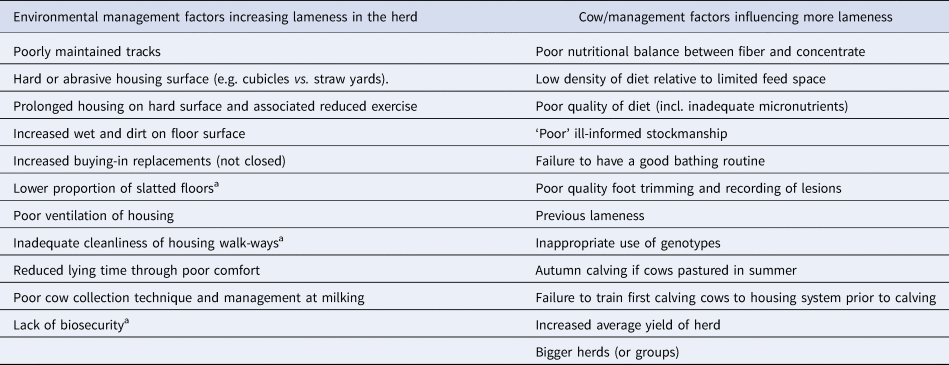
An important question is how evidence-based hoof health knowledge can be used for the benefit of dairy cows, dairy farmers and society as a whole, all of whom will benefit from better welfare and less use of antibiotics. As described earlier, the communication style between the consultant and the farmer appears to be important for acceptance and implementation of advice (Derks et al., Reference Derks, van Woudenbergh, Boender, Kremer, van Werven and Hogeveen2013; Ritter et al., Reference Ritter, Adams, Kelton and Barkema2018). Insufficient knowledge of the objectives of a dairy farm makes it difficult to provide good and appropriate advice. As a result, compliance and motivation by the farmer to implement the advice will be limited or even negligible (Sorge et al., Reference Sorge, Kelton, Lissemore, Godkin, Hendrick and Wells2010). It is clear that lameness is a multifactorial and complex problem. The usual holistic approach for these disorders is essential to achieve results in the long term and is based on risk factors, the most important of which are shown in Table 1.
Major risk factors for lameness of all types based on papers from literature review.
This leads us to a structured holistic approach incorporated within a 7-point plan.
a NB primarily associated with infectious skin conditions
The 7-point claw health plan includes:
1. Maintenance of clean and dry slatted floor or concrete and comfortable cubicles/pens
2. Use a strategic hoof trimming approach of all cows before dry off and 2–3 months after the start of lactation (record data)
3. Treat lame cows immediately (record data)
4. Use selective disinfection of the hooves of all dairy cows, depending on the herd's digital dermatitis status
5. Optimize nutrition (vitamins, macro minerals and trace elements) to improve immunity, skin and hoof-horn quality
6. Manage body condition: 3–3.5 at calving (BCS on a 1–5 scale) advised reduction of BCS 0.5 point after calving.
7. Pay attention to hoof health when selecting bulls. Cull cows with recurring (≥3 times) hoof disorder.
Point 1. Maintenance of a clean and dry slatted floor or concrete, comfortable cubicles/pens and systematic disinfection of claw-trimmings equipment
Clean and dry floors, comfortable cubicles and suitable biosecurity measures as well as equipment that is properly disinfected after trimming a cow with an infectious disorder and, of course, after finishing activities in a herd are necessary to limit the risk of DD (Ahrens et al., Reference Ahrens, Platz, Link, Mahling, Meyer and Erhard2011; Relun et al., Reference Relun, Guatteo, Auzanneau and Bareille2013; Evans et al., Reference Evans, Murray and Carter2016). A major objective is to avoid unnecessary standing time which gives compression of the pododerma which is a risk factor for CHD (Ossent and Lischer, Reference Ossent and Lischer2000). Free stall housing increases the exposure of dairy cows' claws to concrete walk-ways and to manure between periods of rest, and generally shows the highest rate of lameness compared with other dairy management systems. However, there is great variation within a system, and the rate of new cases of lameness can be reduced to very low levels provided time spent resting per day is maximized through good stall design, access to stalls through stocking density control and comfortable transition cow facilities. Limiting the time spent waiting to be milked, provision of adequate heat abatement and good leg hygiene are also important. Sand bedded stalls are useful as they also permit lame cows to maintain adequate daily rest and can result in less point load on the claw when cows are getting up and lying down due to a better distribution of the pressure under the sole (Cook and Nordlund, Reference Cook and Nordlund2009). Additionally, work is needed to examine the effectiveness of improved housing and management for prevention of issues of animal well-being, such as lameness and other musculoskeletal injuries, while accounting for production gains or losses. Future investigation should focus on how to assist producers in lesser-performing groups to either better utilize or successfully adopt best management practices, in facility design, and in technologies for improved overall production performance. More work should also be done to describe how labor is best utilized on dairy farms for promoting improved overall performance (Brotzman et al., Reference Brotzman, Döpfer, Foy, Hess, Nordlund, Bennett and Cook2015). In our region, there are various housing systems such as a free range or ‘court’ system with, for example, compost litter as perhaps the ideal top layer for preventing claw and hock problems, but the most common housing type is a cubicle-based system (Somers et al., Reference Somers, Frankena, Noordhuizen-Stassen and Metz2003; Kester et al., Reference Kester, Holzhauer and Frankena2014; de Vries et al., Reference de Vries, Bokkers, van Reenen, Engel, van Schaik, Dijkstra and de Boer2015). The dimensions of the cubicles naturally depend on the dimensions of the cows, but the following minimum dimensions are currently recommended for Holstein Friesian cows (cross height >1.50 m): 2.50–2.70 m length with open or closed front and 1.18–1.20 m wide and knee bar at 1.70 m from the rear tube. A shoulder bar or band is placed directly behind the knee bar to prevent the cows from standing too far in the cubicles so the risk of soiling the cubicle is minimal. It is important that the cubicles are comfortable for the cow so that the cows lie down within 1 min after entering a cubicle. Similarly the design and number of alleyways and dimensions of the feed fence as well as the density of the diet are important factors to consider. Standing on hard unclean surfaces for a long time increases the incidence of ICD and CHD disorders considerably (Bergsten and Frank, Reference Bergsten and Frank1996; Livesey et al., Reference Livesey, Harrington, Johnston, May and Metcalf1998). Also, roughening the floors can lead to more microtrauma to the skin and on wet floors the bacterial load is higher (Barker et al., Reference Barker, Amory, Wright, Mason, Blowey and Green2009), which can increase the infection pressure and incidence of DD. This is in line with the results of recent studies in the Netherlands, where the use of rubber on the grids is a preventive factor for both CHD and DD (Biesheuvel et al., Reference Biesheuvel, Holzhauer, Derkman, Velthuis, van Schaik and Santman-Berends2019). The risk of CHD lesions has to do with continued compression, resulting in ischemic necrosis of the pododerma, which results in the production of poorer quality sole horn (Lischer and Ossent, Reference Lischer and Ossent2002). Another aspect is that prolonged compression can cause the development of spikes (exostosis) on the ventral side of the claw bone (Newsome et al., Reference Newsome, Green, Bell, Bollard, Mason, Whay and Huxley2017). The formation of these spikes increases the risk of recurring sole horn problems due to irritation of the pododerma. When cows have had their first claw disorder they are more likely to become lame than cows that have never had a claw disorder before. This means that after the first contracted claw disorder, a vicious circle can develop which often results in early culling of the animal (Huxley, Reference Huxley2019). Studies conducted on farms with a low DD prevalence identified that these farms had increased attention for the hygiene of the alleyways in the barn where the manure scraper does not come (for example around the drinking places) and good ventilation to keep the floors dry (Holzhauer and van Egmond, Reference Holzhauer and van Egmond2019). This indicates the importance of a clean dry environment, which reduces the DD infection pressure. Animal to animal transmission via manure seems to be the main DD transmission route, although indirect transmission through boots cannot be excluded (Rodriguez-Lainz et al., Reference Rodríguez-Lainz, Hird, Walker and Read1996a, Reference Rodríguez-Lainz, Hird, Carpenter and Read1996b; Evans et al., Reference Evans, Timofte, Isherwood, Brown, Williams, Sherlock, Lehane, Murray, Birtles, Hart and Carter2012). As we have learned from studies in Chile and New Zealand, there is a large influence of suboptimal cow tracks and climatic circumstances (rainfall, for example) (Blowey and Chesterton, Reference Blowey and Chesterton2012; Yang et al., Reference Yang, Laven and Chesterton2019) and serious attention should be paid to aspects such as the start of the pasturing season (when there are higher protein concentrations in the ration) and the end of the season with decreased quality of the pasture (Alstrup et al., Reference Alstrup, Søegaard and Weisbjerg2016).
Point 2. Use a strategic hoof trimming approach of all cows before dry off and 2–3 months after the start of lactation (record data)
Systematic hoof trimming twice a year is a traditional approach on most farms, originally based on care at the beginning and end of the grazing season to avoid problems (Toussaint Raven, Reference Toussaint Raven1977). Due to increasing herd size nowadays, it is almost impossible to properly trim all cows within a limited time with this approach. The hoof care of large herds can also result in a lot of stress and a negative impact on animal welfare. This, combined with the insight that most hoof disorders occur in the first months after calving, suggests that strategic hoof trimming is an excellent alternative, which might yield more progress in the long run. Strategic hoof trimming is intended to anticipate and quickly detect and treat problems in this vulnerable period (first 3 months post-partum). The definition of strategic hoof trimming used here is as follows: monthly trimming of a group of cows at the start of the dry period, cows 2–3 months after calving and of cows that need extra attention due to (subacute) lameness. In this way you ensure that cows at the parturition start with sound hooves, so the cow can function optimally after calving. In a Swedish study, strategic hoof care was compared to trimming all cows at the same time twice a year. The conclusion was that strategic claw care resulted in significantly fewer disorders and abnormally shaped claws, and thus a lower risk of hoof disorders. The study confirmed that long-term strategic hoof care provides better outcomes for reducing both ICD (Odds ratio (OR) = 0.83, P = 0.04) and CHD (OR = 0.71, P = 0.05) problems at herd level (Manske et al., Reference Manske, Hultgren and Bergsten2002; Bergsten et al., Reference Bergsten, Åkerström and Nyman2019). It is important to keep good records of the detected hoof disorders so that subsequent analysis enables good, substantiated advice. A third approach could be objective routine lameness monitoring and claw trimming of those cows identified through the monitoring without the routine preventive trimming of cows based on calving date or DIM. Studies that have used this approach for claw trimming can then be compared to the other suggested approaches. This allows the consultant and farmer to make an informed decision on which of the options best suits the on-farm situation (Chapinal et al., Reference Chapinal, de Passillé and Rushen2010).
Point 3. Treat lame cows immediately (record data)
Rapid treatment of both CHD and DD lesions combined with good pain management increases the chance of rapid recovery. This not only limits the loss of production (Green et al., Reference Green, Hedges, Schukken, Blowey and Packington2002) and condition, but also minimizes damage to animal welfare. By treating lame cows immediately, the cow will continue to function well in the herd, the dry matter intake will be maintained and animal health will be assured. In the case of a painful CHD lesion, prompt treatment with, among other things, a block under the healthy claw and good pain management gives the best prognosis (Thomas et al., Reference Thomas, Remnant, Bollard, Burrows, Whay, Bell, Mason and Huxley2016). This should be combined with good recordings, which include: date of treatment, number of cow, affected leg and diagnosis according to the ICAR atlas (ICAR, 2020) as well as applied therapy. For DD, healing of smaller DD lesions has been shown to be significantly better compared to larger DD lesions, meaning rapid intervention accelerates recovery (Relun et al., Reference Relun, Lehebel, Bareille and Guatteo2012). Rapid individual treatment of an acute DD lesion is desirable for welfare reasons (pain at this stage, Döpfer et al., Reference Döpfer, Koopmans, Meijer, Szakall, Schukken, Klee, Bosma, Cornelisse, van Asten and ter Huurne1997; Bell and Vanhoudt, Reference Bell and Vanhoudt2020), to prevent an increase in infection pressure for the rest of the herd and good recordings with distinction between acute and chronic lesions. Especially during the erosive stage acute DD needs topical treatment, while in case of chronic stages the application of footbaths is advised (Bell and Vanhoudt, Reference Bell and Vanhoudt2020). Both acute and chronic lesions may spread Treponema bacteria to herd mates increasing the risk of new DD lesions (Döpfer et al., Reference Döpfer, Holzhauer and van Boven2012; Biemans et al., Reference Biemans, Bijma, Boots and de Jong2018). Once again, it is important to keep a good record of the detected claw disorders.
Point 4. Use selective disinfection foot baths depending on the herd's DD status
The necessity of disinfection of the interdigital claw skin and the skin just above the claw capsule depends mainly on the DD infection pressure in the herd. Regular use of disinfectants in foot baths is a standard practice on many farms. Irrespective of the DD stages in a herd, the same strategy is usually followed. Claw disinfection (by foot baths or a backpack sprayer) could be done more cheaply, more effectively and more strategically than it is done currently. The footbath is an excellent choice for the ‘treatment’ of M4 DD lesions (actually it prevents transition to an acute painful DD lesion; Döpfer et al., Reference Döpfer, Holzhauer and van Boven2012; Bell and Vanhoudt, Reference Bell and Vanhoudt2020). While there is relatively little reliable data on the best disinfectant, most seem to work to some degree. Similarly, the length of the footbath is open to question, but should be at least 4 m in length (Speijers et al., Reference Speijers, Baird, Finney, McBride, Kilpatrick, Logue and O'Connell2010; Logue et al., Reference Logue, Gibert, Parkin, Thomson and Taylor2012; Ariza et al., Reference Ariza, Relun, Bareille, Oberle and Guatteo2017). However, for the treatment of the highly infectious M2 DD lesions, formalin solution (4%) cannot be recommended for use in footbaths, because these solutions are toxic (Mitchell and Law, Reference Mitchell and Law1984). Acute M2 DD lesions are open wounds and disinfectants are detrimental to wound healing because they dry out the wound edges, which delays the wound healing process. For these M2 DD lesions, individual topical treatment with a registered product under bandage is, therefore, the appropriate therapy (Klawitter et al., Reference Klawitter, Döpfer, Braden, Amene and Mueller2019; Bell and Vanhoudt, Reference Bell and Vanhoudt2020). It is advisable to combine preventive measures with rapid individual treatment and monitoring of M2 lesions (Krull et al., Reference Krull, Shearer, Gorden, Scott and Plummer2016) Depending on the type of DD lesions in the herd, the treatment advice should be different. Recently a DD bulk-milk test was made commercially available (GD Animal Health, The Netherlands) that gives insight into the amount of Treponema spp. antibodies present. This value is correlated with the most common DD stage in the herd. Based on this information, it is possible to tailor the best DD treatment approach at herd level (individual vs. herd ‘treatment’; Holzhauer and van Egmond, Reference Holzhauer and van Egmond2019).
Point 5. Optimize nutrition (vitamins, minerals and trace elements) to improve immunity, skin and claw-horn quality
Good claw-horn quality and structural and functional integrity of the claw horn are important for the maintenance of hoof health (Vermunt, Reference Vermunt2004). Production of good skin and hoof horn quality that gives sufficient resistance to an attack from the environment, starts with well-balanced nutrition. The reduction of nutrient supply to the epidermal keratinocytes leads to the production of an inferior horn quality and an increased sensitivity to environmental chemical, physical or microbial damage (Weber et al., Reference Weber, Stamer, Junge and Thaller2013). This highlights the importance of the daily provision of the correct ration with macro elements including calcium and sulfur, trace elements copper, zinc, selenium and manganese as well as vitamins including biotin (Wedekind et al., Reference Wedekind, Hortin and Baker1992; Zimmerly and Weiss, Reference Zimmerly and Weiss2001; Santschi et al., Reference Santschi, Berthiaume, Matte, Mustafa and Girard2005; Plaizier et al., Reference Plaizier, Li, Tun and Khafipour2017; Seck et al., Reference Seck, Linton, Allen, Castagnino, Chouinard and Girard2017). The overall intake of vitamins, macro and trace elements from the gastrointestinal tract is a complicated process, highly dependent on the actual dry matter intake (Lean et al., Reference Lean, Golder and Hall2014; van Vuuren, Reference van Vuuren2014) and bioavailability of the individual vitamins, macro elements and trace elements. For example, competition between the different trace elements influences the availability for absorption (must be Keen and Zidenberg, Reference Keen, Zidenberg-Cherr, Ziegler and Filer1996). For a long time, it was assumed that sufficient B vitamins such as biotin were produced by the micro-organisms in the rumen. Due to increased milk production during the last decades and the associated changed rations, it appears possible that, in many cases, insufficient biotin is formed in the rumen of dairy cows, especially those that are fed higher amounts of concentrate and may be experiencing subclinical rumen acidosis (Holzhauer and van Egmond, Reference Holzhauer and van Egmond2019). In this situation, the skin and claw horn quality will be impaired which results in a higher risk damage causing lameness. To monitor the supply of important trace elements like manganese and zinc and vitamins like biotin at herd level, bulk-milk tests are available that provide consultants and farmers with a better understanding of the actual available quantity. Adaptations can be made in the ration supply of these elements to more or less exclude nutrition as a risk factor for hoof problems.
Point 6. Manage body condition: 3–3.5 at calving (BCS on a 1–5 scale), maximum reduction of BCS 0.5 point after calving
To prevent a decreased quality of the shock absorbing capacity of the claw horn cushions, correct management of the body condition around calving is important (Newsome et al., Reference Newsome, Green, Bell, Bollard, Mason, Whay and Huxley2017). Optimal moments for scoring body condition (BCS) are at the start of the dry-off period, around calving and 2 months into lactation, but even better might be automatic body condition scoring, done constantly to support operational and tactical decisions (Roche et al., Reference Roche, Friggens, Kay, Fisher, Stafford and Berry2009). A smaller condition decrease after calving helps to prevent all kinds of other health problems such as acute- and chronic endometritis, abomasal displacements and ketosis (Dann et al., Reference Dann, Morin, Bollero, Murphy and Drackley2005), which can be prevented by an optimal transition from dry-standing period to start of lactation (Kuhla et al., Reference Kuhla, Albrecht, Kuhla and Metges2009). Research over the past decade at Cornell University has shown that the occurrence of sole ulcers and white line disease is significantly associated with the thickness of the digital cushion between the pedal bone and pododerma (Bicalho et al., Reference Bicalho, Machado and Caixeta2009). A more recent study has quantified the effects of the decrease in BCS. The study concluded that post-partum metabolic problems and 8% of all lameness problems could have been prevented by limiting BCS loss to less than 0.5 point (on a 5 point scale) after calving (Lüttgenau et al., Reference Lüttgenau, Purschke, Tsousis, Bruckmaier and Bollwein2016; Randall et al., Reference Randall, Green and Huxley2018; Sepúlveda-Varas et al., Reference Sepúlveda-Varas, Lomb, von Keyserlingk, Held, Bustamante and Tadich2018). It is not only decreased BCS after calving that is important, since cows that start too thin seem to have an impaired shock absorbing capacity. Cows with a BCS of ≤ 2 at the beginning of the dry period were more likely to be treated for lameness in the following 4 months compared to cows with a BCS > 2 (Offer et al., Reference Offer, Logue, Brockelhurst and Mason2004). A reduction of more than 0.5 point in BCS is usually the result of insufficient dry matter intake compared to the energy requirement for maintenance and milk production at the start of lactation (Roche et al., Reference Roche, Friggens, Kay, Fisher, Stafford and Berry2009). An optimal BCS between 3–3.5 during the dry period and a maximum loss of 0.5 point after calving is a good goal to optimize claw health on farms. A simple rule is: the less BCS loss after calving the better.
Point 7. Pay attention to claw health when selecting bulls. Cull cows with recurring (≥3 times) same claw disorder at the same leg
In a German study, heritability estimates (h 2) for DD, heel horn erosion, white line condition and sole ulcer were, respectively 0.14, 0.10, 0.11 and 0.06 (Schöpke et al., Reference Schöpke, Weidling, Pijl and Swalve2013). Advances in claw health can, therefore, be achieved through breeding, but at best it is a slow process. Cattle farmers, however, use multiple selection criteria in their bull choice, so the genetic progress of hoof health is often less rapid than you would expect based on the heritability. Cows with chronic M4 lesions will have to be culled to break the DD infection circle (Biemans et al., Reference Biemans, Bijma, Boots and de Jong2018). Lame cows with more repetitions of serious infectious or non-healing CHD lesions should be culled to reduce the infection pressure within the herd (Biemans et al., Reference Biemans, Bijma, Boots and de Jong2018), increase animal welfare and ensure the social license to produce.
Discussion and conclusion
The financial loss due to hoof disorders in dairy cows in The Netherlands was calculated as an average of 81 euros per cow/year in 2011. For an average Dutch herd of 100 milking cows, this means a loss of EUR 8,100 per year (Bruijnis et al., Reference Bruijnis, Hogeveen and Stassen2010). Interventions that may reduce lameness will increase income, although the interventions will have a cost. However, the study just mentioned dated from the period in which production in the EU was regulated by the milk quota system. As a result, the costs for the loss of milk production caused by hoof disorders has changed. Additionally, in recent years, lameness criteria for lame cows presented for slaughter became more strict, resulting in fewer lame cows accepted in abattoirs. In the current market situation of dairy farming, the total costs of lameness will be considerably higher than in the 2011 study (Dolecheck et al., Reference Dolecheck, Overton, Mark and Bewley2019), due to a loss of milk production and the inability to slaughter lame cows.
Only a small percentage of farms register claw disorders detected at hoof-trimming via a central website in the Netherlands, although an unknown percentage of farmers probably register the detected claw disorders themselves. Even fewer farmers analyze and discuss these data with their claw health experts (Holzhauer, personal observation). If good data is available, it can be quite a challenge for the advisor as the farmer is clearly well motivated and informed and may already have strong opinions on the best interventions. By using all available information such as the recorded data of the prevailing claw disorders in a herd, a careful appraisal of the buildings and walkways inside (and out if appropriate), the diet including a bulk-milk test for important trace elements and vitamins that play a role in the formation of good claw horn and skin quality, good advice can be formulated. If insufficient information is available, in particular about the claw health situation, the advice may not be appropriate. It is important to have the required information before formulating an advice and improvement plan, whilst making sure that one uses an empathic communication style. Research has shown that many veterinary practitioners have difficulty advising livestock farmers, especially when initiating the change needed to improve hoof health (Tschoner et al., Reference Tschoner, Sauter-Louis, Peinhofer and Feist2021). A motivating interviewing style appears to be most effective in tackling more complex, often multifactorial, herd problems (Svensson et al., Reference Svensson, Emanuelson, Bard, Forsberg, Wickström and Reyher2019). Ultimately, the advice is only effective if it is implemented by the farmer, a process that is likely to happen only if they value its relevance, and if the advice matches their goals. Consultants' insight into the goals, priorities, and respect of the knowledge of the farmer and practicalities of the changes in relation to these and the farm's structure and economics increases the chances of acceptance and implementation of the advice (Derks et al., Reference Derks, van Woudenbergh, Boender, Kremer, van Werven and Hogeveen2013; Silverman et al., Reference Silverman, Kurtz and Draper2013). This also ensures that the consultant can bring added value with his claw health knowledge to the farmer and his dairy cows. For consultants who want to focus on claw health herd advice, the 7-point claw health plan has been developed to support a structured holistic approach to improve claw health in dairy herds. This plan has been developed following the successful 5 and later 10-point plans to improve udder health (Murphy, Reference Murphy1956; Dodd et al., Reference Dodd, Neave and Kingwill1964), fertility (Trimberger and Davis, Reference Trimberger and Davis1943; Senger, Reference Senger1994) and 5 point sheep lameness plan (Clements and Stoye, Reference Clements and Stoye2014). By using several standard points, it is possible to determine, at a herd level, which points are most relevant for that specific herd. The plan is based on current knowledge and the available scientific literature on hoof health to date, with a focus on Western Europe. It can give direction in addressing all the relevant risk factors which play a role in hoof health. It ensures that all relevant factors can be discussed and if possible implemented by the farmer. To the best of our knowledge, this is the first time that such a structured hoof health plan has been presented as a support tool to improve hoof health on dairy farms.


 Open access

