


1. Introduction
In view of the 17 UN Sustainable Development Goals (Reference WallasUN, 2015), it is essential to improve the current situation towards a more sustainable and responsible use of resources. Lightweight design is recognized as a key technology for achieving a resource-efficient future especially in the German industry (BWMK, 2021), as mass-reduced solutions can optimize material and energy consumption throughout the product life cycle (Reference Herrmann, Dewulf, Hauschild, Kaluza, Kara and SkerlosHerrmann et al., 2018). However, typical lightweight solutions may require a complex material design drastically reducing recyclability and, thus, can conflict with the principles of the circular economy (Reference König, Mathieu and VielhaberKönig et al., 2024) - another key driver of sustainability. This makes it even more important to develop innovative lightweighting solutions that are environmentally friendly throughout the entire product life cycle, in particular, including the retention of value at a product’s end-of-use.
This work highlights the importance of fostering innovation through creativity, emphasizing collaborative teamwork in design, as a powerful tool for achieving this objective aligned with the perspective of Corazza Reference Corazza(2016). By focusing on the early phases of product development, which offer significant design freedom and exceptional potential for optimization (Reference Chebaeva, Lettner, Wenger, Schöggl, Hesser, Holzer and SternChebaeva et al., 2021), the present work explores insights into how creativity techniques can be applied during the early phases of product development to generate innovative, lightweight, and sustainable solutions.
Therefore, Section 2 provides an overview of the methodological foundations and recent advancements in using creativity for idea generation in the context of lightweight design and ecodesign. In Section 3, best practices from the collaborative, and creative development of innovative solutions for the use case of a bicycle trailer are presented from a small and medium-sized enterprise (SME). Thereby, a generic framework for the implementation of creativity techniques in lightweight design is introduced that balances lightweighting and sustainability objectives, and, subsequently, discussed in Section 4. The present work concludes with a discussion, conclusion and an outlook on future work in Section 5.
2. Fundamentals and literature review
2.1. Lightweight design and sustainability
Since the awareness of man-made climate change has grown, methods for assessing product-environment interactions have gained prominence in the field of product development, with the ‘life cycle assessment’ being a key example. Such methods have laid the groundwork for optimizing the environmental performance of products by identifying weaknesses for implementing improvements, such as reducing emissions, energy consumption, and materials or water use. One design approach in this context is the weight reduction achieved through lightweight design (Reference Herrmann, Dewulf, Hauschild, Kaluza, Kara and SkerlosHerrmann et al., 2018).
However, the lightweighting of technical systems has an ambivalent character upon closer examination in regard to environmental benefits. On one hand, reducing a product’s weight can decrease the overall material consumption, also leading to energy savings during manufacturing. In addition, for dynamically operated products, a weight reduction results in lower energy consumption during the use phase and, depending on the power source, reduced emissions. On the other hand, lightweighting solutions can conflict with environmental objectives in other life cycle stages. For instance, complex material solutions like carbon fibre-reinforced plastics increase energy and material consumption during production and present significant challenges for recycling at the end-of-use (Reference König, Kaspar and VielhaberKönig et al., 2023a).
To ensure sustainable lightweighting, a life cycle perspective is crucial. The SyProLei framework (Reference Kaspar, König, Scholz, Quirin, Kleiner, Fleischer, Herrmann and VielhaberKaspar et al., 2022) integrates methods to optimize lightweight design while minimizing costs and CO2 emissions. Other approaches, such as those by Ferro and Bonollo Reference Ferro and Bonollo(2023) and König et al. Reference König, Mathieu and Vielhaber(2024), address material scarcity and circularity in lightweight design.
In general, sustainability is increasingly framed not solely through its environmental dimension but rather as encompassing the triple bottom line (Reference Elkington and RowlandsElkington and Rowlands, 1999), carefully balancing environmental, social, and economic aspects. In practice, a common challenge arises when expenses related to environmental and social compatibility are justified by the pursuit of higher profits (Reference RockströmRockström, 2015). In the authors’ view, profit maximization should not come at the expense of environmental integrity. Consequently, the present work adopts the perspective of Kara et al. Reference Kara, Herrmann and Hauschild(2023), focusing exclusively on the environmental dimension, as the Earth’s planetary boundaries should constitute absolute constraints on human development. Therefore, we focus on environmental aspects of lightweight design (Reference König and VielhaberKönig and Vielhaber, 2024a).
2.2. Creativity in product development
A key factor for technological innovation of lightweighting solutions towards sustainability may be creativity, enabling a shift away from existing solutions, already known to be negative, towards creating novel and sustainable innovations, may with positive environmental effects (Reference CorazzaCorazza, 2016). In general, there are various perspectives on the definition of creativity. We draw from Runco and Jaeger Reference Runco and Jaeger(2012) defining creativity as the ability to generate original (or novel) and useful ideas with innovation as the process of successfully bringing the best ideas to reality.
Until today, there exist various reviews and process models how creativity can be implemented in product development, as it is summarized for example in the work of Howard et al. Reference Howard, Culley and Dekoninck(2007) or Wang and Nickerson Reference Wang and Nickerson(2017). In particular, based on the review of Howard et al. Reference Howard, Culley and Dekoninck(2007) about creativity in the engineering design process, it becomes evident that in the early phases (starting at ‘establishing a need’ onwards to the ‘embodiment design cycle’) creativity techniques typically gain entry. Each single creative process in such an individual design phase usually consists of three consecutive steps: starting with the problem recognition and analysis (‘what needs to be creatively worked on?’) via the generation of solutions or ideas (‘how could the problem be solved?’) up to the evaluation and selection of the most suitable ones (‘how is the problem best implemented?’). Thus, it is composed of an initial divergent solution synthesis and the subsequent convergent idea analysis (Reference Cropley, Corazza and AgnoliCropley, 2016).
Among the earliest systematic approaches to creativity, Wallas Reference Wallas(1926) introduced a four-stage model of the creative process, consisting of (1) Preparation, where the problem is defined and initial exploration occurs, (2) Incubation, where subconscious processing takes place, (3) Illumination, the sudden emergence of insight, and (4) Verification, where the idea is refined and validated. This model remains a foundational reference for understanding creative cognition and continues to influence modern frameworks.
2.3. Idea generation: a design team sport
Idea generation is defined as the process of coming up with alternative solutions to a problem (Reference Mumford, Mobley, Reiter-Palmon, Uhlman and DoaresMumford et al., 1991). Thus, creativity and idea generation are closely interconnected. Especially in the early phase of product development, a wide solution space exists. As a result, many concept alternatives can be creatively generated, thus these phases (product planning and conceptual design) of product development are considered crucial for effective changes to a product enabling the greatest possible effects to be realized (Reference Cropley, Cropley, Kaufman and SternbergCropley and Cropley, 2010).
The actual realization of creative idea generation processes is based on the application of single methods in a specific sequence, whereby each existing method has different characteristics and thus advantages and disadvantages depending on the intended purpose of use (Reference Chulvi, González-Cruz, Mulet and Aguilar-ZambranoChulvi et al., 2013). In product development, multi categorizations between the methods can be performed. We refer to Shah et al. Reference Shah, Kulkarni and Vargas-Hernandez(2000), who distinct between intuitive, logical and systematic creativity methods for idea generation.
Systematic idea generation methods are characterized by a conscious step-by-step approach starting at problem definition to the final solution identification, thus they are discursive in their emphasis.
In contrast, intuitive and logical methods are less systematic techniques that capitalize on group dynamics, including inspiration triggered by the spontaneous contributions of other group members (Reference Pahl, Wallace, Blessing and PahlPahl et al., 2007). A central aspect of these methods is the necessary positivity among the participants, as each individual has a unique approach to creativity, resulting in the generation of distinct ideas (Reference Diener, Thapa and TayDiener et al., 2020).
Recent work by Fiorineschi et al. Reference Fiorineschi, Frillici, Rotini and Tomassini(2018) have explored structured idea generation techniques, emphasizing the use of systematic approaches like TRIZ in combination with creative methodologies to enhance conceptual design activities. Fiorineschi and Rotini Reference Fiorineschi and Rotini(2021) also developed novelty metrics to assess the effectiveness of creativity techniques, providing quantitative measures for evaluating idea originality and usefulness. These insights are highly relevant to ensuring that creativity techniques contribute effectively to lightweight and sustainable design goals.
The composition of the team plays a crucial role for another reason: a highly diversified team, consisting of both designers and non-designers, produces exceptionally good results, particularly in terms of the rarity of ideas (Reference Ou, Goldschmidt and ErezOu et al., 2022). Thus, considering the entire product development process, collaborative teamwork in the creative problem-solving phase significantly enhances innovation.
2.4. Creative idea generation for a lightweight and sustainable design
The increasing need to align creativity, innovation, and sustainability highlights a pressing challenge in product development (Reference Brem and Puente-DíazBrem and Puente-Díaz, 2020). While generic models addressing the influence of sustainability on the generation of business models exist, they lack methodical support for the creative processes required during the idea generation phase in design (Reference Stock, Obenaus, Slaymaker and SeligerStock et al., 2017). This gap underscores the importance of incorporating human-centred approaches into sustainability-focused creativity and idea generation research, as they foster the exploration of innovative solutions to address global challenges (Reference Saleh and BremSaleh and Brem, 2023). In view of lightweight design, an initial domain-specific approach has been presented by König et al. Reference König, Zeidler, Walter, Friedmann, Fleischer and Vielhaber(2023b), lacking a sustainability perspective. Therefore, the incorporation of both domains within a human-centred approach offers great potential for research.
3. Best practice: extending the useful life of a bicycle trailer
3.1. Use case description: designing a bicycle trailer
Bicycle trailers have the potential to become a sustainable mobility solution for transporting multiple individuals by bike, requiring less energy and land use. The primary focus of children’s bicycle trailer development is ensuring the child’s safety and comfort while using non-toxic materials. These trailers, exposed to varying weather and terrain, are vulnerable to surrounding traffic due to their low weight, making structural integrity crucial for occupant safety. This creates a conflict between lightweight design and sustainability. On one hand, reducing weight is important to ease cycling effort and save energy, especially with electric drives. On the other hand, environmentally friendly materials are needed, which also ensure durability in harsh conditions, as the mechanical system must meet safety and functional requirements.
The useful life of a children’s bicycle trailer typically lasts only a few years per child. Given that the mechanical durability often exceeds this period, the case study focuses on the creative idea generation for possible solution concepts extending the trailer’s useful life. Thereby, by redesigning the product or its associated product system is conceivable. From an environmental perspective, prolonging the useful life can save resources, but the solution must still prioritize a low weight to maintain the ratio of payload to self-weight. As shown in Figure 1, the SME typically search for such solutions during the planning phase of a new trailer generation, exploring concepts like product portfolio expansion or design changes.
Problem statement for the use case and classification within product development

3.2. A framework for the generation of lightweight and sustainable ideas
The case study was performed based on the theoretical foundations presented in Section 2, as well as the company-specific conditions and the associated product development process outlined in Figure 1. First, a generic framework for idea generation with a focus on lightweight and sustainable design was developed, which is presented in Figure 3. The framework foresees three major steps (grey) as it was derived from the state of the art. Starting with the analysis of the existing problem (step 1), the identification of the optimal solution from a lightweight and sustainability viewpoint follows (step 2) and is characterized by four successive subphases, until the process finishes with a final problem elimination via idea integration and knowledge management (step 3). To implement this framework to the specific use case, possible methods for each phase were collected, and the fundamental principles of lightweight and sustainable design were incorporated in the generic framework. The potential impact of lightweight design and sustainability during each step of the idea generation process was discussed and incorporated based on experts from the SME.
The starting point of the process is characterized by the definition and subsequent analysis of a problem relevant to lightweight and sustainable design, as already discussed for the use case in Section 3.1. Besides, in this process step also the further approach for finding the best solution is specified. This means the team composition and the selection of appropriate methods for the subsequent step 2 of the framework is carried out.
The second step of the framework is characterized by an ongoing generation and condensation of ideas via an alternation between the creative idea generation and evaluation enabling a ‘breathing’ process. The aim of this is to first generate as many solutions as possible (‘creative phase I’), then to reduce their number to a certain extent (‘evaluation phase I’) for a smaller number of possible solutions to be refined (‘creative phase II’), from which the optimal solution can finally be selected (‘evaluation phase II’).
Notwithstanding, the framework is complemented by the third step containing activities for integrating the selected solution into an existing overall system. Therefore, verification and validation are the common principles to backcheck a solution with the initial defined problem (Reference Pahl, Wallace, Blessing and PahlPahl et al., 2007). Furthermore, activities for establishing and saving gained knowledge within the company are part of step 3.
The generic framework for a creative idea generation process for a lightweight and sustainable design

3.3. Implementation of the methodological framework
3.3.1. Initialization of the idea generation process
As stated in the fundamentals, idea generation is a team activity in product development. Therefore, the team composition plays a crucial role in generating innovative concepts. In the case study, the team composition varied throughout the idea generation process depending on the availability of the staff and the task to be performed. In the first creative phase, a total number of eight participants covering the fields marketing, engineering design/product development, production and customer service accomplished the quantitative idea generation. Afterwards, the management (two persons) and the head of engineering design performed the first evaluation phase discarding all unfeasible concepts while storing them in the knowledge storage. In the second creative phase, six from the original eight participants (not part of the evaluation team) focused on idea detailing. Finally, again the same group from the first evaluation phase, conducted the second evaluation phase. The head of engineering design has been part in each phase of the process acting as moderator throughout idea generation process, and as decision support in evaluation phase to present and explain concepts. He already possessed expertise in creativity techniques, capable of introducing the methodology and selecting from the catalogue of creativity techniques based on his knowledge. The SME maintains a young employee structure, thus the composed team performing the creative idea generation phases included younger employees between 20 and 40 years. In view of step 3 of the methodology and due to the reduced development capacity within the SME, currently lacking large-scale knowledge management, an online spreadsheet was chosen as method for classifying the generated idea generation artifacts along the idea generation process, maintained by the product developers themselves.
3.3.2. Creative phase I
The first creative phase as starting point of step 2 of the methodical framework primarily pursues the goal of an intuitive as well as quantitative generation of ideas focusing on lightweight design and sustainability. Therefore, performing a standard brainstorming was selected from the moderator for the first creative phase.
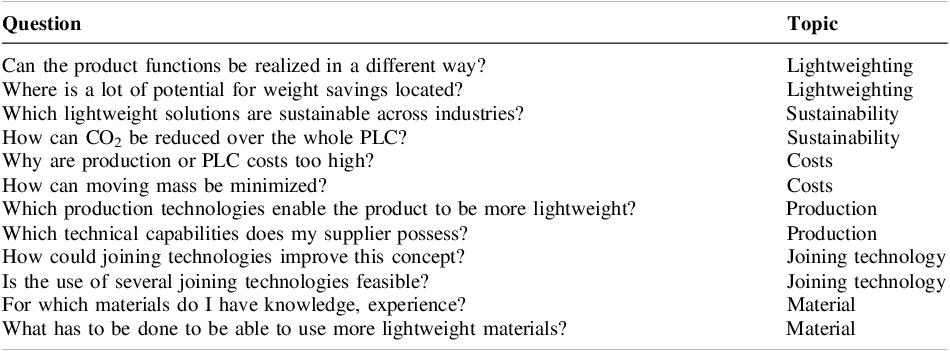
To integrate aspects of lightweight design and sustainability, the moderator selectively introduced questions from Table 1, which had been prepared in advance based on the fundamental principles of lightweight and sustainable design. An excerpt of the results from this quantitative idea generation session is shown in Figure 4. To quickly and easily bring all participants together, an online collaboration platform (the Miro board) was used to facilitate the creative idea generation via brainstorming.
Excerpt of results from the creative phase I focusing on quantitatively generating ideas

Excerpt of results from idea detailing using the 6-hats-method proposed by König et al. Reference König, Zeidler, Walter, Friedmann, Fleischer and Vielhaber(2023b) with changed perspectives of each hat

Excerpt of questions used to support and guide the creativity in intuitive methods

3.3.3. Evaluation phase I
As a result of the first creative phase, a large number of possible solution concepts with a strong focus on sustainability emerged, which were then transferred to the first evaluation phase. In this phase, the management and the head of engineering design first eliminated all absolutely unfeasible concepts. Secondly, they selected six remaining concepts to be elaborated in more detail on. All discarded ideas have been stored in the online spreadsheet document for a later re-evaluation (e.g., in another project) if boundary conditions of development change.
3.3.4. Creative phase II
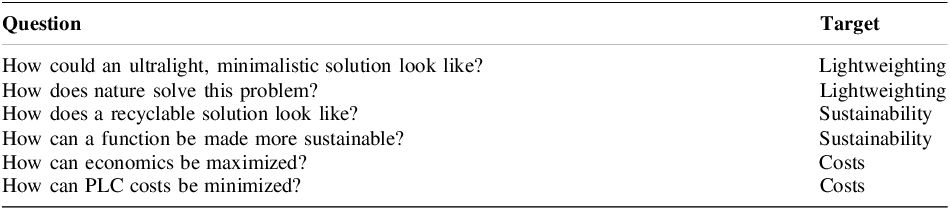
Following the first evaluation phase, the second creative phase concentrated on the qualitative detailing of ideas with a focus on lightweight and sustainable design. Solely six from the original eight participants remained in the team working for this stage of the process. Based on the literature review, creativity techniques for idea detailing are predominantly deductive methods (Reference Gausemeier, Dumitrescu, Echterfeld, Pfänder, Steffen and ThielemannGausemeier et al., 2019). Therefore, the team employed the by König et al. Reference König, Zeidler, Walter, Friedmann, Fleischer and Vielhaber(2023b) proposed 6-hats-method with changed perspectives (or hats). An excerpt of the results from the idea detailing session, conducted on the online collaboration platform, is shown in Figure 4. The perspectives presented in this Figure were specifically chosen as they address key aspects of economically viable and sustainable lightweight design (König and Vielhaber, Reference König and Vielhaber2024b). To facilitate this process, a series of guiding questions were provided to help creatively refine the ideas, and a selection of these questions is listed in Table 2.
Excerpt of questions for idea detailing focusing on a lightweight and sustainable design

3.3.5. Evaluation phase II
A standardized template, as illustrated for the ‘handcart’ concept in Figure 5, was used to evaluate all proposed solution ideas, offering immediate insight into the potential for extending the product’s useful life or, at the very least, that of its components. Ultimately, the decision to pursue the selected idea rested with the management, who made the final choice based on the completed templates.
Standardized template to evaluate the solution concept in the second evaluation phase, i.e. for the handcart concept to extend a trailer’s useful life

4. Discussion of the methodology - lessons learned
To analyse the methodological implications and identify potential areas for optimization, the “lessons learned” approach was applied with the participants of the creative idea generation process. The feedback collected from the participants was subsequently clustered to uncover generalizable insights. Four key aspects emerged from this analysis.
-
1. Methodological process and framework. Two types of artifacts emerged from the creative sessions: innovative conceptual ideas and boundary conditions or implementation hints. The evaluation team must identify which artifacts to further develop and which to archive in a knowledge storage. Proper classification of artifacts in terms of sustainability and lightweight design would ensure reusability for future projects. Documenting each artifact according to a defined knowledge management methodology is critical. While some ideas may initially lack feasibility, only clearly unworkable ones should be archived early, as they may still hold hidden sustainability potential.
Evaluation criteria and methods should be flexible and tailored to company-specific needs and objectives, such as environmental benefits, cost implications, and implementation feasibility. Emotional biases can distort the evaluation process, with participants either overvaluing or undervaluing their own ideas (Reference Baer and BrownBaer and Brown, 2012). To ensure objectivity, a separate team should perform evaluations objectively.
Iterations within the creative process have been recommended. For instance, a sustainability-focused idea might redefine the problem or prompt re-evaluation in light of new insights. Similarly, iterations between creative and evaluation phases can refine ideas, ensuring innovative and viable solutions.
-
2. Integration of lightweight and sustainable design aspects. The integration of sustainability and lightweighting aspects depends on the creativity technique used. For the brainstorming session, interspersing targeted questions proved effective, encouraging intuitive and deductive thinking. Such questions can be derived from established tools such as Brezet’s Reference Brezet(1997) ecodesign checklist. For other methods, such as analogy searches, visual stimuli may better align with participants’ cognitive processes. Future research could explore how lightweighting and sustainability principles can be embedded into specific creativity techniques more effectively.
-
3. The moderator’s role. The literature recommends the use of a moderator who assists in the process of idea generation (Reference Tu, Lu, Choi and GuoTu et al., 2019). From the case study, it can be concluded that the moderator plays a central role in balancing the problem definition with desired outcomes in lightweight and sustainable design. By selecting and guiding appropriate creativity techniques, the moderator ensures the creative process remains aligned with project goals. In terms of social pressure, the moderator may influence the creativity of the team members. Therefore, it is strongly recommended that future research develop guidelines for selecting moderators, focusing on their expertise and methodological knowledge. Additionally, recommendations regarding their role, behaviour, and influence throughout the creative idea generation phases should be provided to enhance the effectiveness of the process.
-
4. Selection of methods. The moderator’s pre-selection of creativity techniques, based on suitability for quantitative or qualitative idea generation as well as its knowledge about the SME’s in-practice ways of work, streamlined the methodological approach. Initially intuitive methods, such as brainstorming, lowered participants’ barriers to engagement. This approach generated a large pool of initial ideas, which were refined through a subsequent idea detailing session. In general, guidelines for selecting creativity techniques have been requested for future work. From the case study, four aspects emerged to be considered when choosing methods: the team composition, the company’s ways of work, the inherent characteristics of each method, and the desired outcome or benefit of the chosen method.
5. Conclusion and outlook
Future research should focus on refining creativity techniques tailored to lightweight and sustainable design challenges. This includes developing comprehensive guidelines for method selection and integration, exploring the role of and providing recommendations of action for the moderator, as well as leveraging digital collaboration tools for remote teamwork. Additionally, expanding the use case across industries can validate the framework’s generalizability.
Emphasizing creativity as a powerful tool for the collaborative generation of innovative, lightweight, and sustainable products, this paper has introduced a methodological framework for creative idea generation, focusing on the use case of extending the useful life of bicycle trailers. Key elements of the methodology include individual methods that enable the implementation of lightweight and sustainable design principles within the innovation process. The framework follows an alternating structure between creative idea generation and evaluation phases to iteratively refine solution concepts. Based on the case study, lessons learned have been discussed, highlighting methodological insights and areas for improvement.
To strengthen the scientific rigor of the approach, future research should focus on validating the proposed framework through structured scientific protocols. This could include experimental studies comparing different creativity techniques in controlled settings, longitudinal case studies assessing the real-world impact of the methodology, or empirical studies involving multiple design teams to quantify effectiveness and reproducibility. Developing validation strategies will enhance the applicability of the framework. Additionally, refining creativity techniques tailored to lightweight and sustainable design challenges remains an essential research avenue. This includes developing comprehensive guidelines for method selection and integration, as well as exploring the role of the moderator in shaping the creative process. Providing concrete recommendations for moderator actions and interaction strategies can enhance the effectiveness of ideation sessions. Furthermore, leveraging digital collaboration tools for remote teamwork can enhance accessibility and scalability of the methodology. Future research should examine how digital platforms can support creativity techniques, facilitate real-time evaluation, and improve knowledge management in distributed design teams.
Acknowledgment
The authors thank the “Technologietransfer-Programm Leichtbau (TTP LB)” of the Federal Ministry for Economic Affairs and Climate Action (BMWK) for supporting their research within their project “SyProLei” (03LB2007H).




 Open access

