


On Genesis
The term genetic as a method of scientific study of the emergence, development or change of a phenomenon or an organism has a long history that can be traced back to the writings of presocratics like Anaximander and Heraclitus where one can identify the interest in the study of a changing world as a process rather than as a collection of static objects. Aristotle also believed that we cannot really understand something unless we understand its development (Kaplan, Reference Kaplan1967). Nevertheless, a first clear vision of the genetic method as the study of the development of an organism can be located in the work of Goethe, who articulated an organismic theory of development, which was the key inspiration for the seminal work of the 20th-century developmental psychologist Heinz Werner (Wagoner, Reference Wagoner2024).
The more recent and direct predecessors of the theoretical framework being developed here can be found in Jean Piaget’s genetic epistemology, Lucien Goldmann’s genetic structuralism, Serge Moscovici’s genetic model of social influence and, more recently, Gerard Duveen, who was working in Cambridge until his untimely passing in 2008 towards a genetic social psychology, greatly inspired by the vision of his first PhD supervisor Hans Furth, for an integrative social developmental psychology situated in historical time.
There is a common thread that binds all the aforementioned thinkers together, specifically the grasp of the totality of an object of study through an investigation of its development through time. This dialectic of genesis and structure refers directly to some of the more fundamental epistemological questions with which not only classical philosophy but also the modern philosophy of Kant, Hegel and Marx engaged. Indeed, by returning to the philosophical roots of these ideas when disciplinary boundaries were not as sharply defined as today one realises that the dimension of historical change is inextricably intertwined with what is proposed here. While it is very ambitious indeed to be proposing an interdisciplinary field of study that merges social and developmental psychology with history, we do believe that such a new discipline is what can help psychology out of what Valsiner (Reference Valsiner, Moscovici, Jovchelovitch and Wagoner2013) described as its deep crisis, caused by its success in amassing large quantities of empirical evidence while rarely addressing the question ‘what for?’
Indeed, the value of such accumulation of empirical evidence for the generalising power of science is specifically questioned by Valsiner (Reference Valsiner, Moscovici, Jovchelovitch and Wagoner2013, p. ix), who highlights the life work of the late Gerard Duveen as ‘a good illustration of what kind of scholarship could bring psychology out of its crisis of limited generalization value’ and explicitly describes Duveen’s life project of genetic social psychology as ‘the idea that will live’; hence the optimistic and future-oriented subtitle of Part I of this book, ‘a once and future discipline’.
Vygotsky and Piaget in Context
From an epistemological point of view one can go back to the enlightenment ideas and Kant to get a clear sense of the limits of human knowledge because of its constrained nature through both sensations and deductive thinking. However, for Kant sensations are worked on and given form by the a priori categories (space, time, etc.), and in that sense these categories themselves were not constructed but given. True dialectical thinking, as argued by Lucien Goldmann (Reference Goldmann1959, Reference Goldmann1967, Reference Goldmann, Cohen and Wartofsky1969), can only be found in the more sociological and historical thinking of Hegel and Marx, who offer the tools to understand the socially constructed nature of these categories themselves. Moving from philosophy to psychology, the elaboration of this dynamic and transformative view of genesis and structure is later taken on by Piaget, Vygotsky, Moscovici, and Duveen in the 20th century. Genesis relates to the Greek word γέννησις and γίγνεσθαι, the first meaning the process of being born or created and the second the process of change and transformation. In that sense it refers to the beginning of something new and its tranformation. But, of course, nothing is completely new; new structures are built on old structures, and in that sense there is also continuity. As pointed out by Piaget, there is no genesis without structure and no structure without genesis. The main research interest then becomes the study of how structure A transforms into structure B.
In the psychological field Vygotsky (Reference Vygotsky1962, Reference Vygotsky1978) dealt with a similar problem of the emergence of higher psychological functions and scientific concepts, but his formula of the general genetic law of cultural development – the Janet–Vygotsky law according to Valsiner (Reference Valsiner2000, p. 40) – was somewhat different from Piaget’s. Vygotsky proposed a clearer directional sociogenetic view compared to Piaget’s interactivist view. Whilst Vygotsky’s emphasis was on mediation by signs and sign systems, for Piaget knowledge was built through the subject’s action on objects. The internalisation formula offered by Vygotsky from social speech to thought was, according to Moscovici (Reference Moscovici, Duveen and Lloyd1990, p. 179), ‘too good to be true’, and Duveen (Reference Duveen, Smith, Tomlinson and Dockerell1997) argued it failed to grasp the mediating role of social identity.
There is an open debate about how Marxist Vygotsky really was (Kozulin, Reference Kozulin1990; Elhammoumi, Reference Elhammoumi2002; Sève, Reference Sève2018), but what has become clear by now is that there is a Western reading of Vygotsky that attempted to sanitise Vygotsky from Marx so that his writings could be more easily accepted in the West during the Cold War era. Piaget also fell victim to an individualist reading of his work, especially in his reception in the United States (Hsueh, Reference Hsueh, Müller, Carpendale and Smith2009). These kinds of processes of sociogenetic transformation of a theory in their reception in a new context is easily rendered intelligible through a reading of the second part of Moscovici’s (Reference Moscovici1976/Reference Moscovici2008) book on psychoanalysis, where he describes the way any new ideas are domesticated in a local setting. In his case it was the study of the reception of the scientific theory of psychoanalysis by different interest groups and ideologies (liberal press, church and the communist party) in French society in the latter part of the 1950s.
In fact, it can be shown that both Piaget and Vygotsky proposed a thoroughly dialectical theory, where logic and consciousness emerge from the activity of the psychological subject in his/her social and historical environment. However, the universalist overtones of Piaget’s theory relegate the role of sociocultural variations to a secondary role of acceleration or deceleration of cognitive and moral development through a single path from sensorimotor, through pre-operational and concrete operational, to formal operational thinking. We do believe in the universality of the distinction between social relations of constraint and co-operation as the prototype of relations between child–adult (constraint/unilateral respect) and child–child (peer/mutual respect) dyads. In any society of this world such relations are present and have predictable consequences for the cognitive and moral development of the child. Their manifestation in both one-on-one interpersonal relations and part–whole relations (the way individuals are embedded in groups), we claim, introduces most of the variability in ways of thinking, values and morality observed in different geographies and historical points in human evolution systematised recently by Harvard Professor Joseph Henrich (Reference Henrich2016, Reference Henrich2020).
Henrich synthesised many findings from anthropology, economics and human and cultural evolution, which cry out for the existence of this important distinction and its consequences in various societies. Although he has not a single citation to Piaget’s work and his social psychology, the historical processes Henrich identified (urbanisation, forms of religiosity, kin-based society organisation and political economy, etc.) relating to cultural evolution can all be considered distal predictors of outcomes (cognitive and moral development) identified by Piaget. Henrich is, however, missing the mediating and crucial role of relations of constraint and co-operation (Psaltis, Reference Psaltis, Sammut, Andreouli, Gaskell and Valsiner2015a, Reference Psaltis, Psaltis, Gillespie and Perret-Clermont2015b; Psaltis et al., Reference Psaltis, Gillespie and Perret-Clermont2015; Psaltis & Zapiti, Reference Psaltis and Zapiti2014). Such relations are essential to ontogenesis, though in a more messy and complex way than the one foreseen by Piaget (Reference Piaget1932, 1995) where varieties of conflicting asymmetries can still create conditions of equilibration and re-equilibration (Psaltis & Duveen, Reference Psaltis and Duveen2006, Reference Psaltis and Duveen2007) and the coordination of perspectives through a process of true engagement of the subject and participation in the co-construction of knowledge.
The crucial role of social relations of co-operation in leading thinking to gradually becoming less and less dependent on content as later structures emerge through reflection on the psychological actions of the subject towards the object, rather than the object itself, is key here. At the same time, it is clear from reading Piaget’s Psychogenesis (Garcia & Piaget, Reference Garcia and Piaget1989) that these structures (e.g. mathematics) are not historically unchanged universals but are also the result of historical evolution. Vygotsky’s cultural historical theory, strongly influenced by Marxist theory, lays fewer universalist claims but is rather weak in formulating the role of social relations in human development. This is something rather unexpected from a Marxist (see Psaltis & Zapiti, Reference Psaltis and Zapiti2014) and recognised as one of the weakest points of Vygotskian theorising by Marxist psychologists and philosophers also (Seve, Reference Sève2018; Wartkofsky, Reference Wartofsky, Kessel and Siegel1984). It requires rectification in the form of future efforts to build psychology’s own capital (Elhamoummi, Reference Elhammoumi2002). Despite developments of the post-Vygotskian tradition in the three generations of cultural historical activity theory (CHAT) (Engerström, Reference Engeström2008) that expanded the purview of our understanding of human development as embedded in interacting activity systems, this theoretical expansion clearly failed to capitalise on the strong epistemological foundations of Piaget’s theory as well as the theorisation of the role of social relations of power asymmetries in these activity systems.
For Piaget the genetic process of the transformation of structure A to structure B entails a process of disequilibrium and re-equilibration of cognitive structures. Equilibrium is the idea that makes possible the synthesis between genesis and structure. In a discussion that took place in a symposium on 26 July 1959 on genesis and structure with Derrida, Goldmann and Gadillac (Gandillac, Goldman & Piaget, Reference Gandillac, Goldmann and Piaget1965), Piaget gave the example of transition from pre-operational to operational thinking on the conservation of mass, suggesting that conflict of centrations (focusing on only one aspect of a situation at one time) on different dimensions of clay (length, thickness) under transformation is the reason for transition from structure A to structure B. As rightly pointed out by Duveen (Reference Duveen2002), this is one of the weakest parts of Piaget’s theory, and the reason for this is that it carries too much of an idealist-Hegelian overtone of consciousness being in a position to fix its own inconsistencies by reflection within the same structures of a self-regulated system (that is, conflicting cognitive schemes resolving their inconsistencies within the cognitive system). However, in the same discussion Piaget importantly makes a clear linkage between equilibrated structures and the agency of the child. Piaget’s own words are instructive here:
The equilibrium thus defined is not something passive, but on the contrary something mostly active. It takes an activity that is all the greater as the balance is greater. It is very difficult to maintain a balance of mental point of view. The moral balance of a person presupposes a strength of character to resist disturbances, to preserve values we care about, etc. Balance here is synonymous with activity.
Knowing Piaget’s social psychology and methodology in clinical interviews, one would expect to see some linkage between the capacity to resist an adult’s counter-suggestion and its cultivation through relations of co-operation, but Piaget does not make this link in his example here.
Such a link could relate to Piaget’s distaste for authorities, ideologies or institutions imposing their views on people and the negative implications stemming from relations of constraint for both the cognitive and moral development of the person. The weakness seen by Duveen in Piaget here is created from Piaget’s hesitation to create a closer link between his relations of co-operation and equilibration as a process of co-construction with others and not simply an autoregulation of one’s own structures. This is one of the manifestations of the ‘social’ occupying an unstable element in Piaget’s thinking (see Duveen & Psaltis, Reference Duveen, Psaltis, Mueller, Carpendale, Budwig and Sokol2008). There is an interplay between self-regulation and other-regulation that Piaget’s interest in the epistemic subject did not allow to be empirically investigated. The linkage can be rendered intelligible by the embedding of the epistemic subject in group life and a network of social interactions, where the positions held by an individual for an object are intertwined with the representations of the other and self in the subject–object–other triad in both symmetrical and asymmetrical relationships.
Knowledge and Social Structures
From an epistemological point of view, any genetic theory needs to be able to distinguish between surface and depth knowledge. In the Marxist tradition (although Marx never elaborated any epistemological framework himself), the proletariat are those who act on objects, and consciousness is formed by action in the world. This is why the Piagetian notion is compatible with Marxism, and one can see here why Goldmann was so keen on pointing out the similarities between Piagetian genetic epistemology and Marxism on various occasions (Goldmann, 1966; Zimmerman, Reference Zimmerman1978). Ultimate knowledge of seemingly hidden realities, essences behind appearances such as Kant’s elusive ‘thing-in-itself’ was given only to those who had created that reality (in the way an artist can understand the work he or she has created). Only they could overcome the analytic contradiction of surface and depth dialectically. This distinction between depth and surface knowledge is crucial in Piaget, who proposed a distinction between empirical and reflective abstraction. It is also found in his distinction between relations of constraint and relations of co-operation, where he relates forms of knowing with different qualities of social relations. It is again later found in Moscovici’s (Reference Moscovici1976) dual genetic model of social influence, as well as in the work of Social Genevans (Doise, Mugny & Perret-Clermont, Reference Doise, Mugny and Perret-Clermont1975; Doise & Mugny, Reference Doise and Mugny1984) who discussed two ways of resolving socio-cognitive conflict (epistemic/constructivist versus relational), further deepening the original insights of Piaget (Reference Piaget1932) in his Moral Judgment of the Child and his Sociological Studies (Piaget, 1995) in this direction.
In the work of other genetic theorists more sociologically and critically minded than Piaget, such as Moscovici and the Social Genevans (Doise et al., Reference Doise, Mugny and Perret-Clermont1975), the consequences of symmetrical or asymmetrical forms of social relations on consciousness also became the target of empirical study. The Social Genevans made a distinction between two ways of resolving socio-cognitive conflict: relational regulation, which looked like conformity and did not lead to real cognitive change; and epistemic regulation, which looked like the reconstruction of knowledge in Piagetian terms towards more equilibrated structures. There is a parallel here with Lucien Goldmann’s description of how the subject–other relationship can be downgraded into a subject–object relation through processes of objectification, reification or alienation. Similar ideas can be found in the field of the study of intergroup relations today with dehumanisation or infrahumanisation where out-group members in an antagonistic context often lead in forms of non-recognition of others as thinking subjects or even, in worst cases (linked to genocidal tendencies), denigrating them as non-humans.
This strong sense of a dual process of social influence is found more recently in the work of Gerard Duveen, who was convinced that there are two opposing ways in which representations change. In viewing social representations theory as a genetic theory, Duveen and Lloyd (Reference Duveen, Lloyd, Duveen and Lloyd1990) argue that a genetic perspective is implied in the conception of social representations, in the sense that the structure of any particular social representation is a construction, and thus the outcome of some developmental process. Three types of transformations, associated with social representation as a process, are proposed: sociogenesis, which concerns the construction and transformation of the social representations of social groups about specific objects in historical time; ontogenesis, which concerns the development of individuals in relation to social representations during a lifetime; and microgenesis, which concerns the evocation and (re)construction of social representations in social interaction in micro-time.
A careful reading of the oeuvre of Duveen’s first PhD supervisor Hans G. Furth leaves no doubt that Duveen’s vision of integrating social and developmental psychology came from him. Furth was born in 1920 in Austria and was well known for his significant contributions to our understanding of cognitive development. His early work was deeply influenced by Piaget’s theory and focused on the cognitive abilities of deaf children and, later on, the role of language and social interaction in cognitive development (Furth, Baur & Smith, Reference Furth, Baur and Smith1976). He was also a psychoanalyst, and he tried to marry Piagetian ideas with Freud’s theory. His early life was significantly impacted by the political upheaval of the time as he fled Austria after the Anschluss with Nazi Germany in 1938 at the formative age of 18, eventually making his way to the United States after spending years in displacement in Croatia, Switzerland and the United Kingdom. This experience of displacement and adaptation to new cultures and languages would later influence his professional work and perspectives. He also served for about a decade as a monk in the Carthusian order until his departure to Canada where he got a master’s degree in clinical psychology from the University of Ottawa in 1954. He later received a doctorate in psychology from Portland State University in the United States in 1960 and that same year became a professor of psychology at the Catholic University of America in Washington, DC. In the mid-1960s he worked while on sabbatical at the University of Geneva with Piaget. In 1973–1974 Furth spent time at the University of Sussex in the UK where he crossed paths with Duveen (Jovchelovitch, Reference Jovchelovitch2010; Lloyd, Reference Lloyd2010).
It was a period when Furth began to integrate more complex societal elements into his analysis of cognitive development (Furth et al., Reference Furth, Baur and Smith1976). He started to examine how children’s understanding of social structures, such as family dynamics, racial categories and gender roles, emerged and evolved. This period marked a shift from focusing solely on individual cognitive processes to a more holistic view that included the impact of societal factors. Furth’s work on symbol formation (Furth, Reference Furth1987), particularly in relation to Freud and Piaget, also influenced Duveen. This work highlighted his interest in how children use symbols to make sense of the world. This was a crucial part of Furth’s theory, as it linked cognitive development with cultural and societal influences. He argued that children form symbols not only to understand their immediate environment but also to navigate and make sense of larger societal constructs. In this process of symbol formation, the affective domain and desire occupied a key position. The perception of society and history is constituted by social significations as something new, qualitatively different from preceding forms of social reality. Piaget’s symbol competency is, for Furth, precisely the organ to create this newness in evolution: an understanding of human society and history. In brief, according to Furth, children around the age of two, along with a first glimmer of historical time and of social categories such as sex, ‘race’ and generations, develop the symbolic competency to create signifiers. Here the emphasis is on the active child who assimilates a given society-culture with a framework the child has developed from within. In this respect the child is able to bring novelty to the given social reality.
As Sandra Jovchelovitch (Reference Jovchelovitch2010, p. xvii) wrote about Duveen’s connection to Hans Furth,
But in line with his teacher and early supervisor, Hans Furth, Duveen problematised this agency [of the child] by introducing the dynamic of desire in the constitution of the epistemic subject. To know-my-object is also to want-my-object. This insight probed a long-term commitment to the deep psychology of Freud, which was never too far from Duveen’s thinking and way of seeing the world. In writing about the development of representation and culture in the pretend-play of young children he goes back to the links between knowledge and desire to show how the drive that moves the child to create and construct the world as innovator is not far from libidinal organisation.
In Furth’s last book, Desire for Society (Reference Furth1996), he explores more complex themes, such as how children’s cognitive development is affected by the political and economic structures of society, which includes examining how children understand and internalise societal norms, values and beliefs. In this work Furth also shows his admiration for the work of Cornelius Castoriadis and his notion of the ‘radical imaginary’, in this way pointing to the role of social scientists in not only studying societies but also transforming them in the direction of more equal and peaceful ones. The last chapter can be seen as his legacy to the future generation of social scientists (Furth died three years after the book’s publication). It is titled ‘Postlude: The nightmare of history’, and it starts with the words of Walter Benjamin: ‘There has never been a document of culture which was not at the same time a document of barbarism.’ In this chapter Furth claims that humanity needs to be guided by the memory of two historical events, Auschwitz and Hiroshima, corresponding to a condemnation of the morality of total annihilation which was made possible by nuclear weapons. The historical consciousness that connects these two historical events with the imagination of destroyed earth in the future, he proposes, can guide humanity towards the creation of a peaceful future. The notion of historical consciousness and historical thinking is crucial for the development of the current theoretical framework that wants to understand processes of ethnic conflict transformation and change, and we will have a lot more to say about this in what follows.
From Learning and Cognitive Development to Ethnic Conflict
Under the influence of his second supervisor, Barbara Lloyd, Duveen took it on himself to explore the ontogenesis of social representations of gender in childhood in the years after his PhD (Lloyd & Duveen, Reference Lloyd and Duveen1992). His personal friendship with Serge Moscovici offered him an unparalleled understanding of the theory of social representations, and his developmental take on this theory was truly original. Since 2000, under the supervision of Duveen at Cambridge, we began to explore the role of social representations of gender and social interaction in learning and cognitive development in the educational context. This work in epistemological terms could be described as moving from the study of the epistemic subject in Piaget towards the study of the social psychological subject (Moscovici, Jovchelovitch & Wagoner, Reference Moscovici, Jovchelovitch and Wagoner2013), introducing a study of the role of social identity and gender asymmetry dynamics into the co-construction of knowledge around cognitive tasks. This work was later extended at the University of Cyprus as one strand of the ‘third generation of research in peer interaction and cognitive development’ (Leman & Duveen, Reference Leman and Duveen1999; Psaltis, Reference Psaltis2005a; Psaltis & Duveen, Reference Psaltis and Duveen2006, Reference Psaltis and Duveen2007; Duveen & Psaltis, Reference Duveen, Psaltis, Mueller, Carpendale, Budwig and Sokol2008; Psaltis, Duveen & Perret-Clermont, Reference Psaltis, Duveen and Perret-Clermont2009; Psaltis, 2011, Reference Psaltis, Marková and Gillespie2012a, Reference Psaltis2012b; Psaltis & Zapiti, Reference Psaltis and Zapiti2014). In this chapter it will be further extended into a study of the articulation of microgenetic, ontogenetic and sociogenetic processes (Psaltis, 2015), through the study of intergroup relations between Greek Cypriots and Turkish Cypriots in the 20-year period from 2003 to 2023, which is a second line of research we have been working on since 2005 at the Oxford Centre for the Study of Intergroup Conflict.
In the first line of research, we observed peer interaction in the educational context of collaborative problem solving in 6–7-year-olds in Cyprus. These social interactive processes were connected to the sociocultural and historical context of social representations of gender related to asymmetrical structures of patriarchy and with the culture of honour that favours a passive femininity, allowing males more space in the public space and control over objects whilst retaining the strengths of a structural analysis of Piagetian constructivism. These series of studies explored the interplay of representations and identities through the articulation of intrapersonal with interpersonal, intergroup and ideological/social representational dynamics (Perret-Clermont, Reference Perret-Clermont1980; Doise, Reference Doise1986), building on Piagetian insights into the role of social relations in cognitive development (Piaget, Reference Piaget1932) and functionalist-structuralist reading of Piaget and his social psychology (Kitchener, Reference Kitchener and Smith2002, Reference Kitchener, Müller, Carpendale and Smith2009, Reference Kitchener, Carpendale and Müller2014), together with the empirical work of the social Genevans on peer interaction and cognitive development (Doise, Mugny & Perret-Clermont, Reference Doise, Mugny and Perret-Clermont1975; Perret-Clermont, Reference Perret-Clermont1980).
Some critical engagement with the initial ideas we developed with Duveen came from another scholar influenced in his work by both Piaget and Moscovici – Antonio Castorina in Buenos Aires. Castorina proposed a similar model to the one presented here that he calls revised genetic psychology; however, he is sceptical of the merging of the disciplines of social and developmental psychology, not because of epistemological incompatibility, but out of respect for their own traditions, methodologies, theories and questions posed.
Castorina made his positive yet critical and constructive expositions in two papers. In the first (Castorina, Reference Castorina2010) – a tribute to Duveen shortly after the former’s untimely death – Castorina outlines the points he seems to appreciate in Duveen’s work. He writes, ‘The leitmotif of Duveen’s work has been the process through which children assimilate the beliefs of their communities and thus acquire their social identity, which in turn enables them to become social actors’ (p. 18.1). Duveen, according to Castorina, (1) elucidates the dialectical process of the development of representations, (2) acknowledges Vygotsky’s contribution to the Theory of Social Representations while questioning some aspects of his concept of culture, (3) shows the correlative construction of subject and object in the dialectics of knowledge and (4) establishes the conditions for social representations to be accepted by developmental psychologists.
In this commentary Castorina wrote something that both we and Patrick Leman (Reference Leman2010) found objectionable in his rendering of Duveen’s work, namely ‘the significance of some of [Duveen’s] empirical studies which link psychological development to social identity’ as describing a process of individuation in social psychology. I believe there is no place in genetic social psychology for individuation (which I take here as meaning social representations forming a sense of individuality). There are at least two reasons for this: (1) Duveen was describing the process of ontogenesis of social representations as the emergence of the social actor and the internalisation of a social identity, not a personal or ego identity; (2) Duveen was interested in the social psychological and not the psychological subject.
Even in the original genetic psychology of Piaget the epistemic subject, the study of which was Piaget’s research interest, is not an individual subject but a mere abstraction dealing with the coordination of actions irrespective of whether these take place intra- or interpersonally. Already in his PhD thesis (Duveen, Reference Duveen1983) on a discussion of the epistemic subject Duveen makes clear that the epistemic subject is not an individual subject. Piaget used the example of two individuals building a bridge as an example of co-operation, and Duveen cited the example of two individuals moving a piano that Lucien Goldmann gave to discuss the trans-individual subject, a unit that cannot be reduced to one or the other psychological subject but characterises the dyad. Still, what the epistemic subject was missing (given that it is an abstraction), according to Duveen, was valorisation and resistance, which appear on the scene once we bring into play the subjects belonging to the social group where one shares social representations about an object. This is why, later on, we suggested the idea of operativity in context (Psaltis, Duveen & Perret-Clermont, Reference Psaltis, Duveen and Perret-Clermont2009), and I think we have demonstrated this through the dynamics of social interaction in our own work (Psaltis & Duveen, Reference Psaltis and Duveen2006, Reference Psaltis and Duveen2007) in an Fm dyad (a dyad where the female was a conserver interacting with a male that was a non-conserver) and how it facilitates a conflict of asymmetries that creates the space for the construction of true novelty. In that sense the social gender identity dynamics are co-constructed and do not characterise any individual property.
This brings us to the second criticism voiced by Castorina (Reference Castorina2017). In this paper we see both points of agreement and disagreement between Castorina’s revised genetic psychology and what is proposed here as genetic social psychology. On the one hand, we agree with Castorina that there is epistemological compatibility between Moscovici’s social representations theory and Piaget’s genetic psychology, which goes against the position of Ivana Marková (Reference Marková2010) who argued that the two approaches are epistemologically incompatible. Nevertheless, even within a social constructivist epistemology there is still an issue of how much similarity or difference one sees between the construction of scientific knowledge and the construction of understanding and representations of social objects such as gender, ethnicity, a social problem and so forth.
Castorina makes too strong a distinction when he is stating that above all, social representations are inherently evaluative and shaped through social discourse, not limited by the argumentative logic of concepts. Duveen would certainly accept that in the case of scientific knowledge, we have the construction of what Leslie Smith (Reference Smith, Tryphon and Vonèche2013) called ‘necessary knowledge’ – a kind of knowledge that has a logical necessity absent in the case of representations discussed in this chapter. I feel Castorina is overstretching the differences between genetic psychology and social representations. On this point Duveen talks about relative autonomy and never fails to remind his readers that Moscovici was inspired the notion of representations from his reading of Piaget’s The Child’s Construction of the World. We argued for the embedding of the epistemic subject in the social psychological subject, which means that operative structures can still be found in social representations. Social representations, however, will not be exhausted by them. For example, the binary distinction of gender or race relations in early childhood do appear to be regulated by cognitive developmental constraints of the pre-operational stage. But in older children we see that there is an interplay between the cognitive and the social that cannot be empirically disentangled, as for example when the part–whole relationships become a prerequisite for the understanding of relations between Cypriots and the other community, Greece and Turkey, that of course do not necessarily relate to positive or negative attitudes towards these groups.
Castorina claims that values cannot be organised in the logical sequence that could be given precisely by the structure of a research conducted within developmental psychology, which is true. Still, in the ontogenesis of social representations that Duveen studied (Gender, Friendships, Economy) there was a clear developmental path that was largely defined by two orientations, the practical and the reflective, directly related to the transition from the pre-operational to operational thinking. So, in terms of content, we do agree that there is no evaluative criterion to judge one value over another. However, in terms of structure, there is a clear developmental course suggested by theorising in genetic social psychology.
Castorina in his Reference Castorina2017 paper also states that the claim that genetic social psychology does not differ from developmental psychology, or that the latter always implies the former, is debatable. While, according to Castorina, introducing social representations in developmental psychology can reformulate genetic psychology itself when studying children’s social ideas, it is not acceptable to claim that ‘the operating Piagetian structures, as Duveen states (Reference Duveen, Smith, Tomlinson and Dockerell1997) and following Moscovici (1989/Reference Moscovici2000) could actually be understood as social representations’ (Psaltis & Zapiti, Reference Psaltis and Zapiti2014, p. 38).
Regarding the first statement by Castorina, I think that we never intended to make such a claim, especially when so many varieties of developmental psychology exist. But on the second point I feel that I need to defend our position in Psaltis and Zapiti (Reference Psaltis and Zapiti2014).
I think that here we see a re-emergence of the individual–social antinomy that I discussed earlier on the issue of individuation under a different guise. In his ‘Psychological Development as a Social Process,’ Duveen (Reference Duveen, Smith, Tomlinson and Dockerell1997), citing Guida de Abreau’s work on social representations of mathematics, writes: ‘[W]e do not usually think of children’s internalization of representations of mathematics as being linked to specific social identities, but this can indeed be the case’ (p. 55). He goes on to give the work of Carugati (Reference Carugati, Duveen and Lloyd1990) on the study of social representations of intelligence as another example. In this way he wanted to show that valorisation, the symbolic value of social representations and social stakes are inextricably interlinked with the development of operative structures. The process of ‘socially representing’ is at play when children co-construct their operational structures. Duveen’s favourite example was the work of Doise and Mugny (Reference Doise and Mugny1984) on social interaction and cognitive development that offered for him the most convincing evidence in this direction. This is the work that we extended in our work with Duveen in Cambridge and later expanded with Anna Zapiti at the University of Cyprus. This was the culmination of work ‘which condensed many years of experimental and ethnographic research in Geneva, Sussex and Cambridge on how the construction of the mental is not only permeated by social interaction but dependent on it’ (Jovchelovitch & Wagoner, Reference Jovchelovitch, Wagoner, Moscovici, Jovchelovitch and Wagoner2013).
Having already explored the contours of a model of transition from pre-operational to operational thought in children through the study of varying forms of communication, such processes could be expanded to a more general model of the role of social relations and communicative forms (Duveen, Reference Duveen2002; cf. Castorina, Reference Castorina2010; Jovchelovitch, Reference Jovchelovitch2010; Leman, Reference Leman2010) in the transition from representations of belief to representations of knowledge in the public sphere (see Duveen, Reference Duveen2008; Moscovici, Reference Moscovici2000) and sociogenetic processes (Wagner, Reference Wagner1994) if scaled up.Footnote 1 One field of research that affords the exploration of sociogenetic processes in historical time is that of conflict transformation in societies and changing representations of conflict and its roots. In this sense the Cypriot context of a divided and post-conflict society is an ideal setting for the expansion of these ideas to an exploration of sociogenetic processes beyond what Henrich (Reference Henrich2020) calls WEIRD societies (Western, Educated, Industrial, Rich, Democratic). Drawing more on conflict and post-conflict settings in such synthetic efforts as the one by Henrich will allow more decentring from a WEIRD way of looking at systems of values, ideas and practices in historical time and cultural evolution.
In our first line of research we did not have the opportunity to study sociogenetic processes. We instead concentrated on the links between microgenesis and ontogenesis in childhood, exploring the interplay between social representations of gender and the co-construction of new knowledge around cognitive Piagetian tasks in 6–7 and 9–10 years age groups. The lack of emphasis on sociogenetic processes in our first line of research left us open to criticism raised by Nicolopoulou and Weintraub (Reference Nicolopoulou and Weintraub2009) that the third generation of research in peer interaction and cognitive development did not yet offer a comprehensive sociocultural framework for the study of human development. In what follows we aim at opening a window to the study of sociogenetic processes through the study of longer-term changes that take place in historical time complementing recent formulations of cultural evolution by Henrich (Reference Henrich2016, Reference Henrich2020).
Thus, more recent work in our Genetic Social Psychology Lab at the University of Cyprus has as its main aim the articulation of the three processes of genesis (microgenesis, ontogenesis, sociogenesis) (Psaltis, 2015). Our main research interest (intergroup contact between the two communities in Cyprus) was initiated at the Oxford Centre for the Study of Intergroup Conflict in 2005, but the theoretical articulation offered below is a direct continuation of the work at Cambridge. It explores the role of social interaction in the reduction of prejudice based on Allport’s (Reference Allport1954) contact hypothesis and its recent developments. Here, we have been exploring the effects of social interaction, termed intergroup contact in mainstream social psychology (Allport, Reference Allport1954), between Turkish Cypriots and Greek Cypriots on the reduction of prejudice and promotion of trust at different ages (Psaltis, Reference Psaltis, Marková and Gillespie2012a; Tausch, Hewstone, Kenworthy, Psaltis, Schmid, Popan, Cairns & Hughes, Reference Tausch, Hewstone, Kenworthy, Psaltis, Schmid, Popan and Hughes2010). More recently we have also embarked on interdisciplinary work with history educators and historians exploring the interplay between representations of history and social psychological theories of intergroup relations (Psaltis, Reference Psaltis, Marková and Gillespie2012a; Psaltis, Lytras & Costache, Reference Psaltis, Lytras and Costache2011; Lytras & Psaltis, Reference Lytras and Psaltis2011; Psaltis, Carretero & Cehajic-Clancy, Reference Psaltis, Carretero and Cehajic-Clancy2017) as well as deepening the exploration of the internal heterogeneity of social identity positions within conflicting societies as they produce and represent cultural artefacts valorised as symbols (Psaltis, Beydola, Filippou & Vrachimis, Reference Psaltis, Beydola, Filippou, Vrachimis, Dezalia and Moeshcberger2014) or structure their oral historical accounts about life in formerly mixed villages in Cyprus (Psaltis, Cabrera, Lytras, Filippou, Cakal & Makriyianni, Reference Psaltis, Cabrera, Lytra, Filippou, Cakal, Makriyianni and Briel2014; Kende, Psaltis, Reiter, Fousiani, Cakal & Green, 2022).
The transition from the study of social representations of gender to the study of social representations of ethnic conflict clarified for me the developmental dimension of what is often argued by feminist writings in the field of peace and conflict studies (Hadjipavlou & Mertan, Reference Hadjipavlou and Mertan2010, Reference Hadjipavlou and Mertan2019; Demetriou & Hadjipavlou, Reference Demetriou, Hadjipavlou, Byrne and McCulloch2021) when they approach militarism and nationalism as dimensions of patriarchy. The ‘womb’ of asymmetrical social relations of constraint is not only relations between children and adults but also relations between girls and boys in early childhood. The first instances of microgenetic marginalisation of girls from boys take place in early childhood (Duveen & Lloyd, Reference Duveen, Lloyd, Duveen and Lloyd1990), and variations of this marginalisation are later found in hierarchical institutions related to the reproduction of the nation and traditional culture (army, church, political parties). The issue of the marginalisation and sidelining of women from decision-making processes is a phenomenon that can be traced back to the social interaction of students as young as 6–7 years in Cyprus, as we found. Traditional perspectives or honour cultures (Uskul et al., Reference Uskul, Kirchner-Häusler, Vignoles, Rodriguez-Bailon, Castillo, Cross and Uchida2023) oppose the political/public sphere to that of the domestic or personal and equate the first with men and the second with women. Such perspectives have long been superseded by both feminist thought and democratic precepts. The public–private distinction has been shown to perpetuate militarism and sexism, making gender inequalities appear ‘natural’. In both cases of gender and ethnic asymmetries the position of submission is that which ends up in marginal or non-existent participation by the subject, leading to the transmission of a superficial layer of beliefs that minimises the possibilities for knowledge construction and overcoming of asymmetries.
Engagement with the issue of ethnic conflict made more imperative the theoretical understanding of processes of power and the political dimension of party politics, especially as they relate to sociogenetic changes in the social representations of the Cyprus issue when attempting an understanding of sociogenetic changes in the period since the opening of the checkpoints in 2003. In this sense, the articulations between Doise’s intergroup and ideological level of analysis concern not only intergroup relations between the two communities in Cyprus but also intragroup political processes, policies and ideologies relating to the valorisation of bicommunal relations and the solution of the Cyprus problem. This has also led us to interdisciplinary work with political scientists and sociologists (Psaltis, Cakal, Loizides & Kuşçu-Bonnenfant, Reference Psaltis, Cakal, Loizides and Kuşçu Bonnenfant2020) exploring the views of the internally displaced persons (IDPs) in the two communities as well as policy implications of our work for the negotiation of a settlement and decision-making processes on a referendum for the solution of the Cyprus issue (Loizides et al., Reference Loizides, Psaltis, Morgan-Jones, Sudulich, Popp and Baykiz2022). In this research we revealed not only the feeling of loss by IDPs but also their marginalisation from ongoing discussion to resolve the problem and the feeling of injustice in their own community.
In theoretical terms, the broad vision of Furth, the theoretical and methodological sociological insights of Goldmann – one of Duveen’s favourite sociologists – and our recent work on historical thinking and historical consciousness in this extension of the theory are crucial. The work of Goldmann is key not only because he applied Piagetian insights to sociological theorising but also because his sociological outlook brings to our attention the significant structures that constrain the agency of the individual as he/she is embedded in the transindividual subject (dyads, groups, social classes) and the understanding of the role of social relationships more generally in the formation of consciousness.
Lucien Goldmann’s Genetic Structuralism
Goldmann (Reference Goldmann1959, Reference Goldmann1967, Reference Goldmann, Cohen and Wartofsky1969) criticised Marxist interpretations that reduced explanations of societal consciousness to the economy and relations to the means of production. He offered the crucial insight that the predominance of relations to the means of production is only a recent symptom of late capitalism through processes of reification, and that we should be seeing such relations only as one of various expressions of social relations that generally have always been at the centre of the production of societal consciousness throughout humanity’s history. This is a politically crucial insight because it suggests that any social critique that concentrates solely on relations through the means of production would be playing strictly in the field of capitalism and not offering a truly critical theory that would manage to transform society at its core. Similarly, Serge Moscovici emphasised the importance of social psychological theorising beyond the monopoly of social class to the study of the relations between various minorities in the context of the conflict with dominant ideologies and views. This broadening of view beyond the narrow focus on social class calls for an understanding of intergroup relations, asymmetries of power and phenomena that have been at the epicentre of study in social psychology after the Second World War. We find the same broadening of the study of social relations in the work of Duveen where he explored beyond the ontogenesis of the representations of social relations of production and the economy to include the ontogenesis of social representations of friendships and gender. In all of these works his emphasis was on the transition from pre-operational to operational understandings of social relationships. One of the main problems caused by asymmetrical social relations is that of reification as shown by Lukacs and later by Goldmann (Reference Goldmann1967). Thus, a critique of the situation we are currently living in should be performed through an analysis of how reification (in its various forms) works in the formation of consciousness.
According to Petrovic (Reference Petrovic, Bottomore, Harris, Kiernan and Miliband1991), reification in the Marxists tradition is
the act (or result of the act) of transforming human properties, relations and actions into properties, relations and actions of man-produced things which have become independent (and which are imagined as originally independent) of man and govern his life. Also transformation of human beings into thing-like beings which do not behave in a human way but according to the laws of the thing-world. Reification is a ‘special’ case of alienation, its most radical and widespread form characteristic of modern capitalist society.
These, however, are not the only possible subject–object distortions. Both anthropologists and Piaget identified different mentalities in ontogenetic and historical lines of development. One characteristic form of mentality is the one described by Levy-Bruhl as guided by the logic of participation and by Piaget as magical thinking. In this connection the link between magical thinking and existential anxieties is clear. Non-differentiation between subject and object is a specific structure that serves a specific function of soothing existential anxieties. This totality between structure and function was central in both Piaget’s and Goldmann’s genetic theorising. Egocentric thinking was one of the manifestations of subject–object non-differentiation and the difficulties in overcoming egocentrism in Piaget related to asymmetrical relations of constraint, whilst on the contrary, relations of co-operation (based on mutual respect) help to overcome egocentrism through decentration. Duveen (Reference Duveen2002) also suggested that ‘belief’ is a certain form of understanding that is sustained by relations of constraint. On the contrary, ‘knowledge’ (a more flexible and less rigid form of understanding) is sustained by relations of co-operation. In his studies of the ontogenesis of representations of friendship, economy and gender (see Duveen’s essays in Moscovici, Jovchelovitch & Wagoner, Reference Moscovici, Jovchelovitch and Wagoner2013) he identified a number of structural differences between two orientations that broadly overlapped with Piaget’s stages of pre-operational and operational thinking.
For example, in friendships he identified an action-oriented understanding in younger children and a conceptual understanding in older children. In terms of understanding of time and what could be described as early forms of historical consciousness, younger children were trapped in the here and now: a friend was the one who was playing with them. In the older children there was differentiation of time with friendships attaining a history and a move of knowledge from the ‘periphery to the centre’ which entailed a more complex understanding of the subjective characteristics of friends (traits, characteristics) and of their intentions, thus differentiating action from its meaning.
Duveen also believed that the genetic study of the development of representations should entail the effort to articulate Doise’s (Reference Doise1986) four levels of analysis. He criticised the social cognition paradigm for only exploring the intrapersonal level of analysis. In his work on friendships it was clear that he suggested the study of the subjective understandings of social relations by children but also an understanding of the possible structures of social relationships in social interaction. He considered this dual emphasis necessary because of the lack of a clear endpoint of development that was there for Piaget in his effort to understand the development of scientific thinking but could not be established in the case of the understanding of social relations causing a methodological recursivity problem. This was also done by Piaget (Reference Piaget1923) himself in his first book on thought and language but also suggested as the key to understanding society as comprised of various forms of social relations and the rules of their transformations (Piaget, 1995). In my own work with Duveen (Psaltis & Duveen, Reference Psaltis and Duveen2006, Reference Psaltis and Duveen2007) we moved further in this direction by identifying varying types of conversation as a microgenetic process that we related with various forms of social recognition and cognitive change, in an effort to typify these forms of social interaction and articulate all four levels of analysis suggested by Doise (Reference Doise1986).
As I will show later, the original work of Piaget and Weil (Reference Piaget and Weil1951) offers a broad framework for synthesising many of the theories and empirical findings about the development of prejudice in childhood and for understanding the totality of interethnic relations and consciousness beyond the narrow focus of prejudice and prejudice reduction that has become mainstream (see relevant critique by Dixon & Levine, Reference Dixon and Levine2012). The use of the iceberg metaphor for the system of values ideas and practices as a position of an individual in the representational field employed by Duveen and Lloyd (Reference Duveen, Lloyd, Duveen and Lloyd1990) and Daniel Bar-Tal in his idea of the ethos of conflict in the context of interethnic conflict in Israel is useful here: We are interested not only in the tip of the iceberg in this system of thinking, which could be a single isolated attitude or feeling towards an out-group (e.g. prejudice), but in the greater, submerged part of the iceberg that is comprised by values, ideas and practices (threats, stereotypes, identifications, perspective taking, trust, representations of the past) of a group or the transindividual subject in Goldmann’s terms that sustains positive or negative emotions towards an out-group. This position in the representational field also extends in time as it refers to past, present and future and as such, it is a form of historical consciousness.
Historical consciousness is a concept that deals with people’s understanding of the relation between the past, present and future, and it has become central recently in history as a discipline, and researchers from across the world deploy the concept in a variety of approaches to history didactical research (Thorp, Reference Thorp2014). Historical consciousness is becoming influential in policymaking too. In Sweden, the Netherlands and a number of states of the German Federation, for instance, (Grever & Adriaansen, Reference Grever and Adriaansen2019), the history curricula state that the primary aim of teaching history in schools is to develop the historical consciousness of pupils, since it influences their identities and conceptions of morality. However, this field of study has rarely made links to the literature discussed here. Indirectly one could bring up some theoretical links in the work of Rüsen (Reference Rüsen and Seixas2004) who theorises about the way narrations of history exhibit different forms of historical consciousness through different uses of history that can be placed on a developmental ladder. First, a traditional narration makes use of history to maintain or uphold tradition. Second, an exemplary narration uses history to generate rules of conduct so that history teaches us how to lead our lives. Third, the critical narration uses the historical example to criticise historical and contemporary societies and cultures. Finally, the genetic narration uses history to explain continuity and change in historical and contemporary societies and cultures. One can easily recognise in Rüsen’s theorising the links with Piaget’s social psychology.
Historical Thinking, Historical Culture and Transformative History Teaching
The development of historical thinking through history teaching is expected to influence the significant structure of Goldmann or what we call the position in the representational field, because, as stated by various researchers (e.g. Lee, Reference Lee, Perikleous and Shemilt2011; Shemilt, Reference Shemilt, Perikleous and Shemilt2011; Seixas, Reference Seixas, Carretero, Berger and Grever2017), progression in historical thinking is transformative in the way it changes how people see the world, the present and future. But genetic social psychology proposes a more powerful, broader and more enriched conception of history teaching which goes well beyond traditional descriptions of the disciplinary approach. It not only proposes the merging of the historical thinking literature with the historical consciousness literature, as recently proposed by Seixas (Reference Seixas, Carretero, Berger and Grever2017), but it also suggests the transformation of history teaching into an interdisciplinary endeavour that we called transformative history teaching (Psaltis, Carretero & Cehajic-Clancy, Reference Psaltis, Carretero and Cehajic-Clancy2017). This entails the study of all processes of genetic change (microgenesis, ontogenesis and sociogenesis) and particularly the change in time of the system of representations of the past, which is very similar to what was described by Mario Carretero (Reference Carretero, Psaltis, Carretero and Čehajić-Clancy2017) as historical culture being the result of influences from three different fields: history teaching, academic history and popular history.
What is discussed as social representations of the past by Liu and Hilton (Reference Liu and Hilton2005) and Psaltis (Reference Psaltis2016) is also examined within the social sciences under the concept of ‘historical culture’ (Carretero, Reference Carretero, Psaltis, Carretero and Čehajić-Clancy2017). This term offers a different perspective on how various groups emotionally and effectively engage with their history. The term ‘culture’ in this context is better seen as a system of social representations (Duveen, Reference Duveen2007; Psaltis Reference Psaltis2012b), steering clear of any static, rigid or essentialist implications often associated with ‘culture’. The way the past is represented is not static but a living process of public and internal dialogue. This involves sharing, negotiating and discussing interpretations of the past from various angles, including academic, educational and public history, as seen in monuments, commemorations, museums, films and historical novels (Papadakis, Reference Papadakis2008; Carretero, Reference Carretero, Psaltis, Carretero and Čehajić-Clancy2017). In post-ethnic conflict settings like Cyprus or, for that matter, any context where conflict along any other line of categorisation exists, transformative history teaching becomes essential, as it facilitates the change of social representations of the past. These changes can take the form of what has been described by Barreiro and Castorina (Reference Barreiro and Castorina2017) as dialectical inferences in the ontogenesis of social representations or the more disciplinary approaches of the progression of historical thinking (Seixas, Reference Seixas, Carretero, Berger and Grever2017).
Genetic social psychology emphasises the importance of different actors involved in conflict transformation – such as policymakers, educators, civil society and grassroots organisations – to actively reconstruct their perceptions of the past. This reconstruction should not simply replace one dominant narrative with another overly simplistic or strategically essentialist narrative. Instead, there’s a need for a more epistemologically sophisticated approach to history teaching. This approach should transcend collective memory or history taught merely as heritage (Lowenthal, Reference Lowenthal1998; Makriyianni & Psaltis, Reference Makriyianni and Psaltis2007). It should embrace more decentred and multi-perspective knowledge forms, as suggested by Piaget’s genetic epistemology, which are more advanced than one-sided victimisation narratives. Additionally, fostering historical literacy and an epistemological understanding of history (Nasie et al., Reference Nasie, Diamond and Bar-Tal2016) enables a more informed, critical and reflective view on various historical interpretations and representations. The key message here is the shift from disciplinary to interdisciplinary history teaching. History teachers, equipped with knowledge of social psychological theories, can engage more effectively with historical texts and concepts such as historical significance, continuity and change, cause and consequence, as well as the ethical dimensions of historical interpretations outlined by Seixas (Reference Seixas2005). This enhanced approach to teaching expands the concept of historical literacy to include the study of historical culture (Grever & Stuurman, Reference Grever and Stuurman2007) and historical consciousness (Rüsen, Reference Rüsen and Seixas2004) in the classroom. This inclusion enables students to reflect on the role of collective memory and history teaching in conflict transformation and to understand how various forms of historical consciousness link the past, present and future (Van Alphen & Carretero, Reference Van Alphen and Carretero2015; Psaltis, Reference Psaltis2016). It involves understanding how attributions of past wrongdoings (Doosje & Branscombe, Reference Doosje and Branscombe2003) are connected to processes like moral disengagement, apology, guilt, shame or regret (Imhoff et al., Reference Imhoff, Bilewicz and Erb2012); how realistic and symbolic threats can hinder prejudice reduction, confidence building and reconciliation; and how intergroup contact can lead to reconciliation. This type of history teaching, which is interdisciplinary and transformative, not only promotes historical thinking but also aids in conflict transformation.
Actual and Potential Consciousness: Utopias, Imagination, Hope and Historical Consciousness
To return to Goldmann and his theorising of totality, one of the most important insights was his distinction between actual and potential consciousness. Actual consciousness refers to the consciousness of the transindividual subject (groups, classes, etc.) which is structured and reflects the everyday world view of a group. In contrast, potential consciousness is captured by an articulated philosophy, ideology or work of art or literature that crystallises in the clearest way possible the structural part–whole relations of the world view of the transindividual subject. In that sense it could be argued that potential consciousness is an orientation towards an ideal world view. In terms of social representations theory, we could say that the actual consciousness is expressed in the messy and polyphasic, sometimes inconsistent everyday practices of individuals as an expression of values and ideas that is context dependent, whilst in sociological or social psychological analyses or works of art or literature, the potential consciousness is expressed in its clearest way as a structured abstraction of those values, ideas and practices and a clear consistent and coherent world view. Both forms of actual and potential consciousness contain various types of narration as proposed by Rüsen (Reference Rüsen and Seixas2004). In particular, the two lower levels of historical consciousness (traditional and exemplary) are forms of reification where human constructions (historical narratives) come to dominate the life of the person and where the past dominates the present, forming a relation of constraint with the representation of the past in the dominant role. In contrast, the two higher forms, the critical and the exemplary, free the person from the constraints of the past either through a critical stance on hegemonic narratives or a better grasp of both continuity and change. Thus, one could see how the two higher forms of historical consciousness directly relate to future utopias and the hope (Leshem, Reference Leshem2017, Reference Leshem2019) for a better future, whilst the former two are past oriented and conservative in which the past becomes sacred, filled with nationalist symbols and heroes (Psaltis et al., Reference Psaltis, Beydola, Filippou, Vrachimis, Dezalia and Moeshcberger2014) and a rising sense of collective threat and existential anxieties through the cultivation of collective victimhood (Psaltis, Reference Psaltis2016; Smeekes, McKeown & Psaltis, Reference Smeekes, McKeown and Psaltis2017). In this way positions in the representational field include in themselves the seed of either conservation or change in sociogenetic processes. The motor of change is the process of microgenesis in social interaction, and in the case of war or civil conflict it takes the form of intergroup contact (Allport, Reference Allport1954) or semantic forms of contact (Gillespie, Reference Gillespie2020) that refer to various ways of coming into contact with the perspective and ideas of the out-group even if this does not happen through direct physical contact.
Intergroup Contact and Its Varieties as a Microgenetic Process
The origins of the idea of microgenesis can be traced in the German context of the 1920s and 1930s with the work on Aktualgenese by Sander, Krueger and Werner (Catan, Reference Catán1986; Psaltis, 2015; Valsiner & Van Der Veer, Reference Valsiner and Van der Veer2000; Wagoner, Reference Wagoner, Valsiner, Molenaar, Lyra and Chaudhary2009). Werner was actually the first to use the term ‘microgenesis’ in the English language in 1956 as an approximate translation of the German term Aktualgenese, although the concept as a method informed his work since the 1920s (Catán, Reference Catán1986). For Werner microgenesis referred to ‘any human activity such as perceiving, thinking, acting etc. as an unfolding process, and this unfolding or “microgenesis” whether it takes seconds or hours or days occurs in developmental sequence’ (Werner, Reference Werner1956, p. 347). In his 1926 book The Comparative Psychology of Mental Development, he presented the microgenetic method as a way of uniting the contents and methods of experimental and developmental psychology as a means of overcoming the dualism between experimental psychology and Volkerpsychology promoted by Wundt. Werner was interested in formulating general developmental laws that would apply to phenomena on all developmental levels (e.g. ontogenesis, ethnogenesis), and he was clearly inspired by Goethe’s insights about the importance of the study of genetic processes and his organismic theory (Wagoner, Reference Wagoner2024).
Closer to the theoretical model developed here, the microgenetic process is the evocation of social representations in social interaction as well as the process of socio-cognitive conflict of perspectives which emerges in social interaction that creates a rupture in the taken-for-granted and introduces doubt (Duveen & Lloyd, Reference Duveen, Lloyd, Duveen and Lloyd1990; Duveen, Reference Duveen2002) in the thinking or consciousness of the individual. The way of resolving this socio-cognitive conflict (superficial conformity to the other or reconstructive coordination of perspectives) is of crucial importance, as it might or might not lead to change depending on the degree of experience and elaboration of this conflict. Thus, the motor of any change in the transindividual subject (subject–other–object triad), the significant structure of Goldmann, is microgenesis. This is the changing triad that comprises the basic epistemological unit of analysis in the social constructivist framework of genetic social psychology.
People communicate through social interaction, and thus social representations are evoked through the social identities asserted in the activity of individuals. A process of negotiation and (re)construction of both social representations and identities is also taking place within social interaction. From the genetic point of view, microgenesis thus holds a privileged and central position, as it is the motor for ontogenesis and sociogenesis of social representations (Duveen & Lloyd, Reference Duveen, Lloyd, Duveen and Lloyd1990). Microgenesis is defined as ‘the genetic process in all social interaction in which particular social identities and the social representations on which they are based are elaborated and negotiated’ (Duveen & Lloyd, Reference Duveen, Lloyd, Duveen and Lloyd1990, p. 8).
As shown in our previous collaboration with Duveen, such configurations create asymmetrical expectations of control in the triad. In that sense the triad metaphor (see Figure 1.1) (Zittoun et al., Reference Zittoun, Cornish, Gillespie and Psaltis2007) is not a symmetrical but an asymmetrical triad imbued with power relations. In this triad any discussion about an object of representation is a socio-cognitive process implicating coordinations of actions and operations by both subject and other as well as pragmatic moves (through the use of words, gestures and actions) that position the psychological subject vis-a-vis the other. Thus, in the subject–object–other triad social interactive microgenetic moments are moments of potential change of all three points in the triangle as well as their relationship. This position is always suggestive of forms of social recognition, and in our past work we have identified recognition of the other as a thinking subject but also instrumental recognition (Psaltis & Duveen, Reference Psaltis and Duveen2007). These forms of recognition regulate the participation and engagement of subject and other in less or more symmetrical social relationships as originally described by Piaget (Reference Piaget1932) as social relations of constraint (asymmetrical-based on unilateral respect) and relations of co-operation (symmetrical-based on mutual respect) (see Figure 1.1). In our work exploring the effects of intergroup contact on prejudice reduction, trust building and political positions on a compromise solution when measuring the quality of contact we have always included measurements directly related to the notion of relations of co-operation as positive quality of contact (‘when meeting with a member of the other community, I feel that this is based on mutual respect’) to facilitate theoretical links between our two lines of research.
The processes to be studied by genetic social psychology.
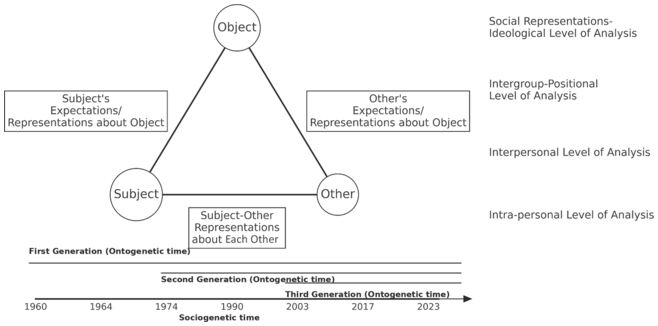
Figure 1.1 Long description
A chart displays a triangle with the sides labelled as follows. Between Object and Subject lies Subject's Expectations or Representations about the Object. Between the Object and the Other lies Others' Expectations or Representations about the Object. Between Subject and Other lies Subject-Other Representations about Each Other. Positioned to the right of the triangle, four levels of analysis are listed vertically from the top downward as social representations, ideological level of analysis, next, intergroup positional level of analysis, next, interpersonal level of analysis, and finally, intra-personal level of analysis. Below the triangle, a timeline labelled Sociogenetic Time, spans from 1960 to 2023, divided into three generational periods, First Generation, Ontogenetic time, from 1960 to 1974; Second Generation, Ontogenetic time, from 1974 to 2003; and Third Generation, Ontogenetic time, from 2003 to 2023.
The definition by Duveen and Lloyd (Reference Duveen, Lloyd, Duveen and Lloyd1990) is focused on change as a form of construction through socio-cognitive conflict in social interaction, but it is unique because it implicates in this process social identity and social representations as they are enacted. According to this perspective, the evocation of social representations in social interaction occurs in the ways in which individuals construct an understanding of the situation and position themselves and their interlocutors as social subjects in the field of social representations. This process can run smoothly along the lines of the ‘taken for granted’, but it can also lead to ruptures (see Zittoun, Gillespie, Duveen, Ivinson & Psaltis, Reference Zittoun, Duveen, Gillespie, Ivinson and Psaltis2003). The opening of the checkpoints in 2003 in Cyprus was exactly such a critical historical juncture or rupture point, as we will see in later chapters, that made possible a different form of microgenetic processes taking not only the usual form of intragroup social interaction but making possible intergroup social interactions.
However, this potential for change also comes from indirect forms of contact when, for example, a member of one group does not have an out-group friend but his or her best in-group friend does (Zhou et al., Reference Zhou, Page-Gould, Aron, Moyer and Hewstone2019). Beyond this extended form of friendship there is now a burgeoning literature about other indirect forms of contact (Harwood, Reference Harwood2017). Indirect contact covers a broad array of possibilities, which can be subdivided in the following forms: (1) vicarious contact which occurs when we observe contact between an in-group and an out-group member but do not participate in it; (2) mediated contact which is when some of the contact process occurs via a technologically mediated channel (e.g. computer based such as email, texting, conferencing, social media, or TV based such as parasocial contact with an out-group actor in a TV series); and (3) imagined contact which refers to mental visualisations or simulations of contact to operate in similar ways to ‘real’ contact (Miles & Crisp, Reference Miles and Crisp2014). The mechanisms often identified as mediating the prejudice reduction effects are increase of trust, empathy, perspective taking, self-disclosure, recognition of out-group heterogeneity and decrease of inter-group anxiety, realistic and symbolic threats, and stereotypes. Sometimes such mediating processes are also related to collective identity recategorisation processes (Aberson, Reference Aberson2019; Pettigrew et al., Reference Pettigrew, Tropp, Wagner and Christ2011).
From the perspective of genetic social psychology, the aforementioned processes only touch upon a part of the significant structure of the subject–object–other triad (see Figure 1.1). They are mostly focused on the subject–other relationship and its quality but have much less to say about the subject–object and the other–object relationship as well as about the role of intragroup contacts and communication. Kadianaki and Gillespie (Reference Kadianaki and Gillespie2015) have also identified a crucial role for self-reflection as a motor for the microgenetic transformation of social representations through the emergence of doubt (Duveen, Reference Duveen2002) in the subject. The meeting with alterity is key in creating self-reflection and can take the following forms: (1) rupture with the physical world (alterity in action), (2) social contact (alterity in other), (3) movement between contexts (alterity in self) and (4) semiotic dialogicality (alterity in the structure of knowledge).
The work of Gillespie (Reference Gillespie2008, Reference Gillespie2020) on semantic contact also points to the way others (both in-group and out-group members) often propose disruptive and disagreeable views of the world (alternative representations of the object) that go against the dominant representations of a society. In this case there is often the phenomenon of resistance (Duveen, Reference Duveen, Deaux and Philogène2001) by dominant groups who attempt to raise defensive mechanisms against possible change of the representation of the object by the subject. Gillespie (Reference Gillespie2020) identifies three layers of defence that take the form of semantic barriers: avoiding, delegitimising and limiting. Semantic barriers are meanings used to reinforce the semantic boundary between the self’s views and the views of others, thus protecting the self’s universe of meaning from being destabilised. The first layer of semantic barriers avoids acknowledgement of the motives, beliefs or feelings of the out-group. The second layer of semantic barriers acknowledges the existence of the out-group’s perspective but works to delegitimise that perspective to such an extent that it can be dismissed. The final and deeper layer of defence acknowledges to some extent the legitimacy of the out-group perspective but works to limit its destabilising impact.
Thus, microgenetic processes of change in social representations need to be seen as potentially engaging all parts of the triad in the significant structure of a position in the representational field, and it concerns a process of possible resistance or reorganisation towards a holistic structure with a certain coherence that involves changes in how self is understood (identity), changes in the subject–other relationship, changes in the representation of the other (e.g. deconstruction of negative stereotypes) and changes in representations about a conflict itself (e.g. an ethnic conflict and its history). Such processes of microgenesis can take the form of intragroup social interaction but also the form of intergroup contact and are shaped by sociogenetic processes of public and mass-mediated communication within and across groups (Wagner, Reference Wagner1994). Of course, one of the main lessons of the first line of research at Cambridge was that the depth of such change varies and directly relates to the quality of social interaction or contact. In that sense not all microgenetic processes lead to ontogenetic or sociogenetic change. In this book we are mostly interested with the articulation of microgenesis with ontogenesis (Chapter 2) and sociogenesis (Chapter 3) at different levels of analysis (Psaltis, 2015) as they relate to the representation of the Cyprus issue identifying instances of rupture and change but also of continuity.

 Open access