



INTRODUCTION
In this globalized world, the spread of new, exotic and re-emerging diseases has become one of the most important threats to animal production and public health, thus requiring the collaborative effort of many disciplines (‘One Health’ approach) [Reference Coker1]. Some examples include the appearance of ‘new’ threats, such as Schmallenberg virus (SBV) or bioterrorism agents, the spread of West Nile disease across naive populations of birds, horses and humans in the USA, previously considered ‘exotic’ (i.e. limited to the Eastern hemisphere), or the ‘re-emergence’ of the avian influenza pandemic. The occurrence of these threats has highlighted the continuous change in disease spread patterns, perhaps as the result of the changing environment, the fact that the world population has increased, and the intensification of livestock productions and global trade [Reference Lloyd-Smith2–Reference Rabinowitz5]. Containing the spread of such diseases in this changing, ever-interconnected world requires new surveillance strategies for the rapid recognition of outbreaks and the diagnosis of causative agents, but also for the cost-effective allocation and implementation of resources for an efficient, timely response [6].
Early detection (or early-warning surveillance) can be defined as the ‘surveillance of health indicators and diseases in defined populations in order to increase the likelihood of timely detection of undefined (new) or unexpected (exotic or re-emerging) threats' [Reference Hoinville7]. Early detection of disease (re-)introduction minimizes the potentially devastating consequences of disease spread [Reference Binder8]. For instance, the emergence of a new coronavirus responsible for the severe acute respiratory syndrome (SARS) pandemic in 2002–2003 resulted in thousands of human cases in Vietnam, Canada, Singapore, and Hong Kong, with more than 800 human deaths worldwide in less than 1 year [Reference Emanuel9]. This scenario demonstrated that proper infrastructure, protocols and techniques to quickly trace the origin and spread of the outbreak and accelerate its control were lacking [Reference Kuiken10]. Another example of the lack of effective techniques, in this case for a re-emerging disease, is the outbreak of foot-and-mouth disease (FMD) in the UK in 2001, which affected more than 10 million livestock and brought about economic losses of more than US$12 billion, mainly due to farmer compensations and trade restrictions [Reference Kitching, Thrusfield and Taylor11].
Historically, animal disease surveillance activities have focused on measuring the effects of specific endemic diseases or on detecting the introduction of given exotic diseases [Reference Kellar12]. These conventional disease-specific surveillance systems included the passive detection of cases combined with active sampling in the target population. Therefore, these unifocal strategies may result in delayed detection of new, exotic or re-emerging infectious diseases which, by definition, are unexpected and may be caused by unusual, or previously unknown, pathogens [Reference Tataryn, Berezowski and Campbell13, Reference Morse14]. The resulting poor timeliness, influenced by the time between the onset of an outbreak and its detection [Reference Wagner15], is a major concern for highly contagious diseases [Reference Kuiken10, Reference Morse14]. Other limitations of conventional surveillance systems include the high costs and poor sensitivity of active surveillance based on random sample surveys, and the frequent need to combine passive surveillance with an active surveillance component to improve the ability to detect hazards early [Reference Doherr and Audige16, Reference Thurmond17]. However, as these conventional methods might be still very efficient, the development of tools and strategies for more effective implementation is needed.
In recent years, new approaches have been developed in response to these emerging needs, which have led to the risk-based selection of hazards and the screening of populations at increased risk [Reference Stark18]. Although these novel epidemiological methodologies have the potential benefit to improve surveillance systems, they have not yet been sufficiently recognized to become a standard component of current internationally recognized surveillance systems. Thus, the RISKSUR project was initiated ‘to find efficient and practical solutions by taking advantage of the novel scientific methodologies' and ‘to define frameworks and integrated tools that allow the design and implementation of epidemiological and economically optimized animal health surveillance systems'. Consequently, the aim of this paper is to review conventional and novel methods that have already been developed and used to improve the likelihood of early detection of new, exotic and re-emerging diseases taking any legal requirements into account. A special focus of the review was the risk-based nature of the approaches, as well as to extract the main applications, benefits and limitations of each methodology. Wherever appropriate, gaps in the methodological concepts that can be targeted by new developments have been identified, as well as potential synergies between the described methodologies.
METHODS
Literature sources and search strategy
The systematic review targeted scientific documents on surveillance methods, systems and approaches related to early detection. The literature search was performed on 21 January 2013 using the CAB Abstracts and the Scopus databases, which cover more than 90% of veterinary journals [Reference Grindlay, Brennan and Dean19]. It was restricted to documents written in English (for reviewing convenience) that have been published over the last 20 years (i.e. 1993–2012) to represent the most up-to-date scientific information. This search included published articles, conference proceedings and reports.
A list of search terms was combined into a Boolean query in order to identify articles containing information on animal health surveillance and methodologies for early detection (Table 1). The search terms were searched for in the titles and abstracts of the documents.
Terms used for the systematic search of scientific literature on early detection
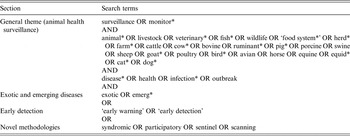
* Wildcards (searches for any word that includes the stem presented).
Definitions
For the purpose of this review, we defined the epidemiological terms and concepts in accordance with the report from a workshop held by international experts on surveillance (http://www.animalhealthsurveillance.org/index.php?n=Main.TerminologyFinal). This report distinguishes between the patterns of disease occurrence as follows: (i) ‘New’: a previously undefined (unknown) disease or condition, which may result from the evolution or a change in an existing pathogen or parasite, which causes a change of strain, host range, vector, or an increase in pathogenicity; or it may imply the occurrence of any other previously undefined condition; (ii) ‘Exotic’: a previously defined (known) disease that crosses political boundaries to occur in a country or region in which it is not currently recorded as being present; and (iii) ‘Re-emerging’: a previously defined (known) disease that is currently absent or present at a low level in the population in a defined geographical area that reappears or significantly increases in prevalence. In the ‘Re-emerging’ category, we also considered those new or exotic vector-borne diseases that reoccur in subsequent vector seasons after their first introduction into a region.
Study selection
The literature selection process is illustrated in Figure 1. A two-step process was followed to apply the primary and secondary exclusion criteria in order to select articles that are relevant for the purpose of this review. The first step consisted in excluding the papers that fulfilled at least one of the primary exclusion criteria when reading the title and abstract (Table 2). Then, the full text of each selected paper was assessed in a second screening round for eligibility by five reviewers, who reviewed different sets of articles independently (i.e. the sets of articles were exclusive per reviewer), but all followed common criteria. These reviewers selected the eligible articles by reading the full text and after applying both the primary and secondary exclusion criteria (Table 2).
Flowchart summarizing the article selection process.

Frequency and proportion of each exclusion criterion used in the article selection process

A list of 47 variables was defined for the purpose of this review (see Supplementary Table S1). The selected variables allowed to extract the following information from the selected articles: disease or threat considered, species involved, area and time-frame of the study, type and characteristics of the approach used (e.g. risk-based nature, objective, data source and management, sampling strategy, main results, etc.), stage of surveillance that the approach can support, cost-effectiveness, limitations, future prospects, and method(s) used for validation/evaluation.
Certain variables deserved further explanations. First, the variable ‘Pattern of disease occurrence’ was composed of the categories ‘New’, ‘Exotic’, ‘Re-emerging’ (see Definitions section above), ‘Endemic’ and ‘Not applicable (NA)’. Second, the variable ‘Disease presence’ complemented the information of the previous one as far as the disease status in the study region was concerned. This variable included the categories ‘Present’, ‘Absent’, ‘Suspected’ (i.e. present, but neither detected nor yet confirmed), ‘Unknown’, and ‘Early detection’. This last category entailed those articles which focused on describing early detection methods that had been applied in multiple diseases or in diseases whose status was not clearly defined, which were linked to the category ‘NA’ of the ‘Pattern of disease occurrence’ variable. Third, the variable ‘Surveillance scope’ was related to the target of surveillance in terms of only one (i.e. ‘Single’) or several threats. In the latter case, two further options were considered: (a) ‘General’, when the surveillance system targeted a wide range of threats without specifying any disease (e.g. livestock diseases); (b) ‘Multi-objective’, when the aforementioned system focused on two or more specific threats (e.g. porcine circovirus-associated disease and porcine reproductive and respiratory syndrome).
Grouping of surveillance approaches
The papers included in this review included different types of surveillance approaches, which were divided in two categories. While some described the data collection, performance and/or results of surveillance activities (i.e. surveillance modalities), there were other papers that described different epidemiological methods for improving such activities. Thus, in order to allow a proper analysis and to create an inventory of surveillance approaches, we grouped all papers into the two main categories ‘Surveillance modalities' and ‘Tools and methodologies supporting the implementation of surveillance activities’. The first one was divided into the two sub-categories ‘Active’ and ‘Passive’ surveillance, which were further divided into several types of active and passive strategies, respectively. Regarding the second category, the specific tools and methodologies used in each article were specified, as well as the stage of surveillance that they support. For the purpose of this review, we considered the following stages: (i) ‘Risk profiling’: procedures to estimate the probability of occurrence of diseases or threats or to determine the risk for certain population strata; (ii) ‘Sampling design’: procedures focused on the selection of representative members of the population that should be tested (e.g. when and where to sample, number and type of samples); (iii) ‘Data collection and management’: procedures to capture, processing, and store relevant surveillance information and data; (iv) ‘Data analysis’: procedures to explore the information and to test hypotheses; and (v) ‘Evaluation’: procedures to assess the accomplishment of surveillance criteria to specified requirements or to compare performance of different surveillance systems.
All these categories and sub-categories were not exclusive, so combinations of them were indicated in detail for each article for further analysis.
Data extraction
Relevant information was extracted from the articles and was stored in an Excel (Microsoft Corp., USA) database. To ensure the harmonization of the criteria adopted to extract the information from the articles read by the reviewers and to minimize potential reviewer bias, two additional reviewers validated the Excel databases. These two additional reviewers read all full-text articles, cross-checked the entered variables, and resolved any potential disagreement.
Data analysis
Descriptive analyses of the collected data were performed. Variables were analysed separately and in combination in order to obtain as much information as possible from the articles. A special focus was the identification of the main applications, benefits and constraints of each type of methodology found in the review.
RESULTS
Selection process
The results of the selection process are shown in Figure 1. The search made in the scientific databases returned 3183 papers. By applying the primary criteria, 308 papers were selected for which we were able to access the full text for 271. In the second screening round, 70 articles were excluded based on the primary exclusion criteria, which had not been possible based on the information provided in the title and abstract (Table 2). In addition, 76 papers were excluded based on the secondary exclusion criteria, meaning that the provided information was not appropriate for the purpose of this review. The frequency of exclusion in this second screening round is shown in Table 2. The secondary criterion that most commonly led to exclusion was reviews of methods for surveillance (n = 29). While these excluded articles revised the use of and provided good knowledge about surveillance methods, the information presented was too general (i.e. applications not provided, not focused on early detection, lack of examples of new, exotic and/or re-emerging diseases). After completion of the screening rounds, 125 articles were included in the review (Tables 3 and 4).
Frequency of the different surveillance modalities found in the review, also identifying the use of risk-based methods and the number of papers addressing multiple threats (for both, expressed as a count and percentage in parenthesess)

Frequency of the different methodologies and tools found in the review, also identifying the surveillance purposes the papers address

Descriptive results
Most of the documents included in the review were research articles (n = 99), although poster proceedings (n = 13), reviews (n = 5), reports (n = 4) and oral communication proceedings (n = 4) were also included. The majority of the documents were published after 2005, particularly in 2011 (n = 33) and 2012 (n = 26).
Exotic (n = 49) and re-emerging (n = 27) diseases were the most commonly represented health threats in this review, while new diseases appeared less frequently (n = 11). In addition, the majority of studies were related to zoonoses (n = 66). Particularly, West Nile fever (n = 22), bluetongue (n = 16), and the ‘avian influenza’ group (n = 15) stood out from the rest of diseases or categories of threats (Table 5). In addition, 17 articles dealt with several rare or diverse diseases affecting livestock, so it was not possible to include them in any specific category (i.e. considered in the category ‘Livestock diseases and syndromes’).
Diseases or threats studied in the articles, grouped according to the general categories used in the systematic review

For the ‘Pattern of disease occurrence’ variable, we considered different categories: endemic (End), new (New), exotic (Ex), re-emerging (Rem), not applicable (NA) and not defined (ND). The ‘NA’ category was indicated for those articles dealing with early detection methods to be applied in multiple diseases or in diseases whose status was not clearly defined for the study areas. Note that the total count is higher than the number of papers considered in the review, since some papers deal with several diseases. Additionally, the sum of the frequencies might be higher than the count since the same disease might be included in the same study, but for several regions with different patterns of disease occurrence.
Regarding the geographical location of the studies, most related to North America (n = 35) and Europe (n = 57, Table 6). In fact, the countries that most frequently appeared (Fig. 2) were the USA (n = 20), Canada (n = 15), Germany (n = 10), France (n = 9), Italy (n = 9), the UK (n = 8), and Spain (n = 7).
Frequency of the study countries in the review. (a) Considering all the papers, and (b) considering only the risk-based papers.

Frequency of papers according to target diseases in different world areas

The category ‘World’ was assigned to those papers whose study areas were located in all the continents. Note that the figures in Figure 2 do not have to coincide with those in this table since this Table indicates the frequency of papers per world region, while Figure 2 indicates the frequency of the study countries (i.e. the study described in an article might have been performed in three countries in Europe).
The review covered a wide range of domestic and wild target host species (Fig. 3). The commonest species was cattle (n = 41). Interestingly, a large proportion of studies published from 2001 onwards (i.e. 28·00%) focused on methods involving wildlife, especially in relation to exotic or re-emerging diseases (n = 29).
Distribution of the number of papers according to target host species. The main host species include domestic animals (Dom, in blue), wildlife (Wild, in red), vectors (Vec, in green), and a combination of several of those (in yellow). The papers in which the target host was not specifically defined (ND), or those in which the species was not applicable (NA), are also indicated (in grey).

Description of the approaches used in the articles
We explored the approaches used in the articles by collecting variables about surveillance modalities or tools, data source (i.e. primary and secondary data), risk-based nature and surveillance scope. Twenty-three papers focused on active surveillance strategies, five on passive surveillance strategies, and 57 papers included tools and methodologies that support surveillance strategies. The remaining articles contained more than one of the above-cited categories (n = 40, e.g. active surveillance to collect data, followed by the implementation of an epidemiological model).
We identified papers whose data source was primary (i.e. data obtained from their own study; n = 55), secondary (i.e. data collected from other studies or sources; n = 52), or both (n = 18). Most papers were based on real data (n = 61), although 40 were based on simulations, and 24 on both.
The ‘risk-based’ concept already appeared in the eldest articles included in the review (i.e. 1995) (Fig. 4). In total, 60 papers included risk-based approaches, especially those including tools and methodologies (i.e. 50 of 60). When evaluating the risk-based categories (see Supplementary material, section S1), risk-based sampling (n = 21) and risk-based requirement (n = 36) seemed to be the most frequently used ones. Both types aimed to increase the chance of early detection of hazards by either selecting the target population to be sampled or identifying the critical points of surveillance programmes to intensify and improve their performance. Risk-based sampling was used mainly when considering sentinel surveillance for exotic diseases. Conversely, risk-based requirement was applied to multiple disease types (i.e. new, exotic and re-emerging) and approaches. In this review, risk-based analyses (n = 7) were not highly represented, and risk-based prioritization (n = 6) was a minor category that was applied to methodologies dealing with absent diseases.
Distribution of the papers according to a risk-based (in red) or non-risk-based (in blue) approach. (a) Considering the year of publication. (b) Considering the most relevant threats. (c) Considering the most representative countries of Europe and North America.

Regarding the ‘surveillance scope’, almost half (n = 61) of the papers covered multiple diseases, based on either general (n = 41) or multi-objective (n = 20) approaches. Most of the papers based on general methods were related to syndromic surveillance, which has a generalist nature per se. A multi-objective scope was typical of the papers describing methods, active surveillance strategies, and a combination of both. These papers dealt mainly with (i) methods that focused on specific diseases in certain host species (n = 10); (ii) methods that focused on a single disease, but can be applicable for others (n = 5); and (iii) vector surveillance (n = 5).
Specific approaches found in the papers: surveillance modalities
Each active or passive approach found in the review was assigned to a specific category in accordance with the methodologies applied and described in the paper (Table 3).
Active surveillance approaches
The two most often cited active surveillance activities found in the reviewed papers were vector surveillance (n = 18) [Reference Marfin20–Reference Van den Hurk37] and sentinel surveillance (n = 15) [Reference Marfin20–Reference Giovannini22, Reference Purse24, Reference Racloz25, Reference Alba33, Reference Savini35, Reference Ward38–Reference García-Bocanegra45].
Vector surveillance
This approach focused on three main groups of vectors of interest: Culicoides spp. (n = 8), mosquitoes (n = 8, especially Culex spp.) and ticks (n = 2). Culicoides midges are relatively frequently represented due to widespread surveillance efforts focusing on bluetongue. Mosquito monitoring has been a surveillance component for several diseases, such as Rift Valley fever, West Nile fever, Usutu virus, or St Louis encephalitis, all of which have been important new (n = 2), exotic (n = 9) or re-emerging (n = 4) diseases in recent years. The main benefit of these approaches was their characterization of the distribution of vectors, not only for the target disease, but also for other similar diseases. Hence their potential spread can be predicted. Another issue, when deciding to place collection traps in areas at high risk of disease occurrence, was that vector density may have been overestimated. Therefore, most studies recommended increasing the sampling area. This strategy, when combined with sentinel surveillance (n = 7), seemed sufficiently effective for early warning and for setting up control measures.
Sentinel surveillance
The incorporation of sentinels into surveillance systems raised the probability of detection of the first incursion of a particular disease to the earliest possible time since they were in place to provide early information on the species (n = 5), time periods (n = 3) and/or areas (n = 8) at higher risk. Therefore, it could be a more effective system than conventional active surveillance activities. However, difficulties can arise to efficiently implement sentinel surveillance, even when objectives have been appropriately designed.
Pathogen and serological determinations
These categories were cited in many studies in an attempt to detect antigens or nucleic acids of new, exotic or re-emerging pathogens (n = 13) [Reference Reisen21, Reference Buscaglia46–Reference Ziegler57] or antibodies against them (n = 13) [Reference Marfin20, Reference Giovannini22, Reference Alba33, Reference Savini35, Reference Buscaglia46, Reference Bryan51, Reference Radaellii53, Reference Ziegler57–Reference Lelli62]. Different applications of these studies were found: (i) as a permanent component of surveillance systems, as occasional complementary activity (n = 10); (ii) as a data source for the parameterization of statistical models (n = 4); or (iii) as a preliminary screening for new, exotic or re-emerging pathogens (namely West Nile, avian influenza, emerging salmonellosis, pigeon paramyxovirus, simian African viruses or eosinophilic meningitis) in order to obtain a preliminary overview of the sanitary situation before applying specific measures.
Participatory surveillance
A novel technique within the sub-category active surveillance (i.e. earliest publication included in the review in 2005) was the use of participatory surveillance (n = 7) [Reference Makgatho, McCrindle and Owen63–Reference Bala69]. The application of this method can result in enhanced collaboration and communication among different sectors and institutions to better understand the causes of success or failure (i.e. strengths or weaknesses) of current surveillance programmes to help policy reforms, or to obtain a quick overview of the epidemiological situation in a given area. Most were conducted in developing countries (n = 4). The main limitation was the non-response rate, mainly due to reluctance to answer or lack of trust in such approaches. This lack of participation might impede further analyses being undertaken in most situations. In addition, this approach relied on the reporting by observers (e.g. animal owners, veterinarians) to be efficient when, in fact, outbreak reporting may be often disincentivized because of the potential adverse economic impact on livestock holdings or on the sector. Other issues could be the poor representativeness of interviewees or inadequate questionnaire design, which could require a second round to be solved.
Other active methods
Other active approaches included in the review that could not be included in any major sub-category were the monitoring of animal shipments and revenue collection [Reference Ogundipe70], the identification of bird species that could be involved in West Nile virus transmission [Reference Balança and Hars71], and periodic active clinical inspections in farms [Reference Ouagal72].
Passive surveillance approaches
As passive surveillance modalities, we found clinical investigations (n = 13) [Reference Marfin20, Reference Giovannini22, Reference Ogden32, Reference Alba33, Reference De Clercq47, Reference Wilking49, Reference Nwankiti52, Reference Slavec55, Reference Alba59, Reference Rockx73–Reference Walker, Ogola and Knobel76], syndromic surveillance (n = 10) [Reference Leblond, Hendrikx and Sabatier74, Reference Walker, Ogola and Knobel76–Reference Vourc84], mortality investigations (n = 5) [Reference Marfin20, Reference Alba33, Reference Savini35, Reference Wilking49, Reference Slavec55], parameter monitoring (n = 2) [Reference Alsaaod and Buescher85, Reference Lutz86] and other passive activities (n = 3) [Reference Ouagal72, Reference Hernández-Jover75, Reference Hyder87].
Syndromic surveillance
This review revealed that syndromic surveillance was a novel method (i.e. first articles in 2006) characterized by its general surveillance scope (n = 10). Although pure syndromic methods were mainly described in the articles, they were also linked to digital surveillance frameworks (n = 6). In general, these articles proposed a method for the early detection of changes in population health (e.g. clinical cases, abnormal mortality rates, post-mortem findings) which were defined as syndromes. In fact, shortening the detection time was highlighted in the majority of the studies as being the main advantage (i.e. even several weeks prior to the laboratory testing). Other benefits were their potential cost-effectiveness, the integration and optimization of data from different sources, or the simplicity of having an easy system covering multiple threats. However, in the reviewed articles these methods always appeared as retrospective approaches since they were designed based on historical data. The retrospective nature of these approaches suggests that future validation would be necessary to determine their full applicability and benefit.
Moreover, criteria harmonization was an important requirement when defining syndromes since data can be obtained from several sources. It was also indicated that the continuous update of syndrome definition would be necessary in order to include new diseases with distinct pathological profiles. These approaches should also include an effective mechanism to prevent ‘false alarms’ (i.e. increase in the number of syndromes identified, which were later not found to be associated with any true hazard). Several authors highlighted that it was not possible for this method to replace conventional surveillance methods, but that it was useful for early warning, supporting planning and policy development.
Other passive methods
Other passive surveillance approaches (i.e. clinical and mortality investigations) identified in the current review consisted mainly of conventional methods used as a source of data input for epidemiological tools and methodologies (n = 4) or as a component of a surveillance system for exotic and re-emerging diseases (n = 8). Some other minor passive strategies were parameter monitoring (i.e. movement activity, milk yield, feeding, water intake [Reference Alsaaod and Buescher85], and temperature [Reference Lutz86]), conduction of awareness-raising meetings [Reference Ouagal72], a post-farm-gate passive surveillance scheme for pigs at sale yards and abattoirs [Reference Hernández-Jover75], and a scanning surveillance system based on submissions where a diagnosis could not be reached (DNR) [Reference Hyder87].
Specific approaches found in the papers: tools and methodologies that support surveillance
Each tool and methodology found in the review was assigned to a specific category in accordance with the methodologies applied and described in the paper (Table 4). In Table 4, the stage of surveillance that each tool found in the review supports was also indicated. In this section we described the main applications, benefits, and limitations per tool as directly extracted and compiled from the papers.
Spatial epidemiology and GIS-based approaches
This was the most represented category in the methodological papers (n = 27) [Reference Purse24, Reference Linthicum26, Reference Racloz27, Reference Ogden29, Reference Racloz30, Reference Lv48, Reference Wilking49, Reference Radaellii53, Reference Soumare58, Reference Odoi77, Reference Mostashari88–Reference Thrush and Peeler104]. The main spatial approach found was risk mapping (n = 12), which consists in obtaining risk maps for the probability of environmental suitability for a specified vector or disease by spatial overlaying the relevant risk factors using statistical or other algorithms. This methodology was applied particularly to multi-factorial and/or vector-borne diseases because they allowed the inclusion of multiple factors and resulted in easily interpretable outputs, with direct applications to the cost-effective allocation of surveillance and control resources. However, major constraints included lack of adequate quality data, the risk of missing important information in the spatial model, both of which result in potentially biased model outputs. Thus almost all the studies included a validation step in their approaches (n = 9 of the 12).
GIS approaches were also frequently forming part of digital surveillance frameworks (n = 10) in order to support the visualization of the surveillance results or to implement certain spatial transformations of the data. In addition, other applications of spatial methodologies to early detection were: (i) supporting active surveillance activities, such as designing sampling sites (n = 2) or processing and presenting surveillance results (n = 8); and (ii) supplementing epidemiological tools and methodologies (n = 10), such as regression models, cluster analysis, risk assessments or simulation modelling, mainly as a tool to represent and interpret their results.
Basic statistics
This category [Reference Purse24, Reference Ward38, Reference Shimoda42, Reference García-Bocanegra45, Reference Cummings50, Reference Bryan51, Reference Boadella61, Reference Pultorak67, Reference Leblond, Hendrikx and Sabatier74, Reference Robertson80, Reference Weber83, Reference Lutz86, Reference Bayot96, Reference Martinez98, Reference Thomas-Bachli103, Reference Carpenter, Chrièl and Greiner105–Reference Perrin109] included different statistical tests (e.g. Mann–Whitney, χ 2, Student's t, Fisher's exact probability), formulas (e.g. sensitivity, specificity, positive predictive value, incidence rate), or equations (e.g. sample size calculator, cumulative sum control chart, modified two-stage method). These were applied for the analysis of the results from surveillance activities (n = 11) or the output of epidemiological tools and methodologies (n = 5). These statistics also offered the possibility to enhance the improvement of surveillance activities, by calculating sample sizes according to the required situation (n = 3), or evaluating surveillance options by comparing their attributes or their sampling schemes (n = 6).
Regression modelling
This category considered mathematical models that were used to explore epidemiological and disease data related to surveillance and/or to evaluate distinct health measures (n = 20) [Reference Racloz27, Reference Ogden32, Reference Wilking49, Reference Cummings50, Reference Radaellii53, Reference Boadella61, Reference Ouagal72, Reference Amezcua79, Reference Bayot96, Reference Recuenco, Blanton and Rupprecht101, Reference Thomas-Bachli103, Reference Perrin109–Reference O'Sullivan117]. We found a wide range of models, such as linear, logistic, binomial, Poisson, time series, or CART. Some of them presented an original use of these methodologies in the early detection context. For instance, O'Sullivan et al. [Reference O'Sullivan117] used regression models to illustrate the potential identification of a novel swine disease (i.e. porcine circovirus-associated disease), and employed test requests for porcine reproductive and respiratory syndrome.
In general, this was the category that offered the widest range of applications for surveillance. Most of the regression methodologies described in the papers were applied to data analysis (n = 15), either to assess the role of a set of variables to disease epidemiology or to analyse trends and patterns of disease occurrence. Moreover, these methods were applied to explore risk factors or to model disease occurrence (n = 5). Another potential consisted in its application for syndromic surveillance (n = 7), used for examining the association of certain variables with the defined syndromes or for obtaining the alarms. As for evaluation of surveillance, regression models were used for comparing the performance of newly developed early detection strategies with conventional surveillance activities (n = 4). Typically, the utility of the outputs generated by regression models was affected by restrictive or inaccurate model assumptions and/or data acquisition and management problems. However, the review showed the potential utility of these methods for the development of enhanced, risk-based surveillance systems in numerous articles dating back to past decades.
Digital surveillance
Although there is no precise definition of the term, it broadly includes the use of the internet and computer technologies for collecting and processing health information, including outbreak reports and surveillance data [Reference Morse14]. The articles included in this category (n = 18) [Reference Ouagal72, Reference Leblond, Hendrikx and Sabatier74, Reference Odoi77, Reference Robertson80, Reference Veldhuis82–Reference Vourc84, Reference Mostashari88–Reference Gosselin90, Reference Maroney92–Reference Shuai94, Reference Bayot96, Reference Iannetti97, Reference Pinto99, Reference Kloeze118, Reference Robertson119] comprised several tools for data collection, management and processing, which normally involved several diseases (n = 12). Digital surveillance approaches were normally linked with governments, and with health and research institutions, and were beneficial for inter-institutional relationships and decision-making. Another advantage was their real-time nature, which allowed the constant update of the situation and earlier detection, and intervention should animal health threats occur. As additional benefits, these platforms were considered useful, simple, flexible and timely. Their main limitations were that they were still under development (i.e. pilot phases), which implies the need for future adjustments and calibrations, and a standardized way to submit safely and easily information and to provide good quality data was lacking.
Simulation modelling
Simulation models (n = 10) [Reference Racloz30, Reference Verdugo, Cardona and Carpenter41, Reference Iannetti97, 107, Reference Robertson119–Reference Souza Monteiro124] aimed to mimic disease transmission in a population in time, and sometimes in space, terms in specific circumstances. The outputs from the simulations could be used for estimating the risk of disease spread (n = 5). In addition, simulation models allowed to evaluate surveillance activities (n = 5), by obtaining surveillance performance attributes, as well as comparing the effectiveness of different surveillance strategies for early detection. In case the epidemics were established, they also proved useful to evaluate the effectiveness of different mitigation measures. Moreover, the outputs from the model could be used as inputs for other epidemiological tools (n = 4). A novel inclusion in these models was the estimatation of the cost or the benefit of surveillance and management activities. For this kind of tools, sensitivity analyses were mostly performed in order to evaluate the approaches and try to overcome the potential degree of subjectivity when assigning model parameter values.
Decision modelling
This category mostly included scenario tree models (n = 6) [Reference Alba59, Reference Hernández-Jover75, Reference Sanson and Thornton120, Reference Hadorn and Stärk125–Reference Goutard127], although it also comprised other decision methods such as neural networks [Reference Dórea81, Reference Pan128] or the info-gap decision theory [Reference Souza Monteiro124]. The scenario tree and the info-gap models reviewed were used for the evaluation of surveillance systems (n = 7), and also to demonstrate how the likelihood of early disease detection can be improved by combining the most appropriate passive and/or active strategies in surveillance programmes for exotic and re-emerging threats. Data quality and model assumptions greatly influenced the usefulness of outputs, therefore sensitivity analyses and validation procedures were often performed (n = 6). Other applications of decision models consisted in their use in syndrome classification in syndromic systems (n = 1), or the definition of risk categories and factors (n = 3).
Cluster analysis
Cluster analysis [Reference Ogden32, Reference Odoi77, Reference Hyder87, Reference Mostashari88, Reference Martinez98, Reference Recuenco, Blanton and Rupprecht101, Reference Thomas-Bachli103, Reference Lupo129] was used for early warning in order to detect clustering of epidemiological events (e.g. disease cases, deaths, outbreak signals) or estimates (e.g. relative risk) and then lead to a risk characterization (n = 6). In terms of data analysis (n = 4), this tool proved to be useful for validating the main GIS-based tool used, or if combined with syndromic and scanning surveillance data (n = 3). It could even serve for enhancing prospective real-time surveillance strategies in highlighted areas (n = 1). However, in general, detected clusters might not represent real outbreaks, so further epidemiological research is required to determine the cause of any spatial, temporal or space-time clustering. For this reason, all the papers validated their models using field data.
Environmental modelling
This category could be considered as a special type of statistical model. These models aimed to predict the climatic and environmental factors that affect diseases directly (e.g. effect on the incubation period or resistance of the pathogen in the environment, n = 2) [Reference Thrush and Peeler104, Reference Liu130], indirectly (e.g. effect on the vector population dynamics or movements; n = 5) [Reference Linthicum26, Reference Menzies44, Reference Lv48, Reference Tachiiri91, Reference Anyamba131] or both (n = 1) [Reference Martin93]. The environmental approaches reviewed here included normalized difference vegetation index (NDVI) anomalies (n = 3), air or water temperature variations (n = 3), degree-day models (n = 2) and a wind-borne spread model. Output from all these tools could be considered to determine areas and/or periods at higher risk. However, it should be noted that the modelled variables constitute single components in the multi-factorial system of disease epidemiology, so results should be applied with caution.
Expert opinion
Expert opinion methods (n = 5) [Reference Forbes, Sanson and Morris66, Reference Scotch, Rabinowitz and Brandt68, Reference Hadorn and Stärk125, Reference Hendrikx132, Reference Peyre133] were conducted in order to evaluate surveillance systems in place (n = 4), to identify risk factors and population strata at higher risk (n = 1), or to obtain risk estimates for disease entry and exposure (n = 1). Considering that this is a purely subjective method, caution is needed when using the outputs derived from these approaches. However, they could serve as a starting point for future studies.
Risk assessment
Risk assessment was a purely risk-based method (n = 5) [Reference Martinez98, Reference Brown100, Reference Martínez134–Reference Mur136], which generated risk estimates to be used to design and assess risk-based surveillance systems, although they focused on the release and/or exposure of pathogens, and not on surveillance itself. Risk assessments can also provide information about the evaluation of variations in risk, based on a standardized model framework that can be adjusted and updated. This helps improve the effectiveness of surveillance if the disease epidemiology, and therefore, the risk changes over time. Similarly to other methods, the quantity and quality of the data used to parameterize models determined the usefulness of the outputs.
Other minor epidemiological methods
Four literature reviews were included since they provided good knowledge and examples of the use of methodologies for early detection. Specifically, two studies identified patterns of global disease occurrence [Reference Cowen137, Reference Thrush, Dunn and Peeler138], while the other two reviewed the use of animals as sentinels for bioterrorism [Reference Rabinowitz5] or for human disease [Reference Scotch, Odofin and Rabinowitz139].
Some other methodologies identified in the current review, but only used rarely, were: data mining techniques, applied to syndromic frameworks [Reference Dórea81, Reference Veldhuis82, Reference Warns-Petit140] or investigate disease risk classification as a proxy for compromised biosecurity in cattle [Reference Ortiz-Pelaez and Pfeiffer141]; network analysis, which contributed to the assessment of potential spread patterns through animal movements [Reference Iannetti97, Reference Bajardi122]; a framework to integrate veterinary health reporting with public health systems [Reference Gubernot, Boyer and Moses142]; or studies to select the best sample for early detecting classical swine fever [Reference Donahue143]. Although these papers can provide relevant information for use in surveillance design or for modelling purposes, they proved too heterogeneous to allow a proper analysis of the approach as a whole in the remit of this systematic review.
DISCUSSION
The present paper aimed to review approaches and methodologies that have been developed, described and implemented over the last 20 years for the early detection of new, exotic, and re-emerging diseases. Unlike previous reviews, which have usually focused on general or specific aspects of one surveillance type (i.e. syndromic surveillance or participatory surveillance), this systematic review of the scientific literature is the first that aimed to cover as many approaches and methodologies targeting early detection as possible. Several methods were highlighted in the review as the most commonly cited in the papers. It is worth to mention that those are not necessarily the ones most commonly used for early detection. Special attention was paid to the review of methodologies in order to document the benefits and current limitations of each method.
Traditionally, passive components have formed the core of the surveillance approaches used for the detection of new, exotic and re-emerging threats [Reference Doherr and Audige16]. These ‘traditional’ surveillance activities are likely to remain as an essential component of early warning surveillance in the future, but may need to be supplemented with new approaches. The evaluation of conventional surveillance systems in terms of their accuracy (sensitivity or specificity), precision (repeatability), timeliness, multiple utility, value and cost-effectiveness [Reference Thurmond17] has highlighted the need for improvement, especially after the 2001 FMD outbreak in the UK. In recent years, many new surveillance approaches have been developed.
One of these developments is the use of risk-based surveillance methods, which are likely to be more efficient than conventional methods [Reference Stark18]. When applied together with traditional design approaches, these risk-based methods allow the incorporation of prior information about disease occurrence to surveillance design and, thus, assure an appropriate and cost-effective data collection [Reference Stark18]. The ‘risk-based’ concept is not new as such surveillance systems have already been implemented as ‘targeted surveillance’ since the 2000s. Some examples could be the surveillance of bovine spongiform encephalopathy [Reference Stark18] or the surveillance of vector-borne diseases such as bluetongue, including sentinel surveillance in areas at high risk [Reference Ward38, 144]. However, the incorporation of risk-based approaches into existing surveillance programmes is not very frequent and their use over countries has not been properly adapted. As an illustration, this review has identified 60 papers that deal with newly proposed risk-based methods. Conversely, we found that only 10 papers actually reported risk-based methods that have already been implemented into countries’ surveillance systems.
The current review shows that risk-based methods have been particularly applied for vector-borne diseases. Risk mapping, environmental models and vector spread simulations are risk-based approaches that have been used to identify the areas and time periods in which surveillance is more likely to detect these threats early and successfully. Other diseases in which risk-based methods have been applied are avian influenza and FMD. For avian influenza, the risk-based approaches analysed focused mainly on early detection of disease entry by wild birds, and took into consideration environmental factors such as presence of wetland areas. Regarding FMD, the articles analysed mainly described risk-based models for identifying optimal procedures for the early detection of this disease if there was an outbreak and the virus spread.
In summary, risk-based methods have been developed mainly for diseases for which (i) biotic factors exist (such as vectors or wild birds) whose presence depends directly on abiotic environmental factors, and which are essential for the presence and spread of the disease; or (ii) different scenarios pose varied levels of risk for the introduction and spread of the disease. In addition, the application of risk-based approaches was related to the nature of the surveillance. While most of the studies that focus on a specific disease are risk-based (68·75%), it seems that those approaches dealing with multiple diseases (i.e. general or multi-objective) are mainly non risk-based (73·77%). Thus, the potential development of risk-based methods for simultaneous application on multiple diseases is an interesting field for further research. However, identification of suitable risk factors to predict the occurrence of multiple diseases is a considerable challenge, but may explain why risk-based approaches for effective multi-objective surveillance systems have not yet been widely implemented.
The review has shown that a significant amount of work has been done in relation to the development of risk-based approaches for identifying populations at high risk for certain infections, especially by risk mapping. Although risk maps are relatively easy to interpret and provide extremely useful information to allocate preventive measures, there is still work to be done to integrate the results of these analyses into the design of risk-based sampling strategies for early detection.
The same limitation applies to the other approaches identified in this review. Methods such as regression or simulation models, cluster analyses, and risk assessments can be used to inform risk-based surveillance and to provide useful information regarding disease patterns, relevant risk factors and estimates, or to the efficiency of surveillance activities. However, their use in operational surveillance systems is not common [Reference Perez145]. This is mainly due to the complexity of the underlying epidemiological concepts, algorithms, and/or software used, and to decision makers not confiding in the outputs obtained and/or to their inability or unwillingness to work constructively with the uncertainty estimates associated with these model outputs. Therefore, outputs generated by these quantitative methods need to be communicated more effectively to decision-makers and better evidence for the value of risk-based surveillance strategies is required.
Other methodological challenges found in the review include limited sample size, failure to account for clustering in space or time or for imperfect test characteristics, lack of risk estimates, bias in the selection of risk factors, low public awareness of the emerging threat, inclusion of out-of-date surveillance results, multiple data sources and poor quality of data. These limitations can be overcome by appropriately selecting the method to use according to the threat of interest. In addition, those studies including a validation of the particular methods investigated which have used real disease data have demonstrated the benefits of their inclusion in surveillance programmes. The adoption of risk-based methods and other new approaches can be facilitated by providing evidence for their cost-effectiveness. This is essential since it is typically being argued that risk-based designs involve additional costs given their increased complexity if compared to random sampling approaches.
Another recent development in surveillance methods with a clear application to early detection systems is the use of syndromic data. It has been applied for the early detection of seasonal increases in incidence of known human hazards, such as influenza or heat-related mortality (e.g. [Reference Perry146–Reference Josseran148]), or for assessing the impact of environmental disasters on the health of populations (e.g. [149, Reference Elliot150]). Although some debate exists, syndromic surveillance could be considered as an ‘enhanced passive’ method, since the provision of data is observed-initiated (i.e. passive), but there is an active involvement of the investigators. The potential role of syndromic surveillance as a part of early detection in animal health requires further research. Syndromic data collection can be useful, but the role it plays in the detection of different health events needs to be further clarified or demonstrated, and systems that are currently being developed need further validation as more data become available. Syndromic data analysis following the alert for a new, exotic or re-emerging disease, or in the face of an increased risk of incursion of a currently absent disease, may also prove useful to speed up the investigation of potential outbreaks in order to limit disease spread. The combination of these methods with rapid systems for data collection or good inter-institutional communication may be very advantageous. For instance, the incorporation of syndromic approaches into digital surveillance systems, which are still in their very early development stages, could result in a real-time health monitoring system. Nevertheless, it is important to recognize that these systems will still rely on the availability of effective laboratory testing to diagnose the underlying infectious causes of any emerging trends and alarms [Reference Koopmans151].
Developments have also been made in the active surveillance activities applied for early detection. Although these activities are practically and economically not always the most efficient, the review showed their great potential for early detection and interest in their improvement. Sentinel surveillance, as shown in this review, can be a very useful surveillance system component when dealing with new, exotic or re-emerging diseases as it increases the probability and timeliness of detecting recently infected or newly diseased animals. It is also useful for vector monitoring, an important feature if we consider that most of the emerging diseases in recent years were vector-borne [Reference Racloz, Griot and Stark152, Reference Pfeffer and Dobler153]. Thus, the combination of sentinel and vector surveillance could be particularly relevant for monitoring vector-borne diseases with easily distinguishable clinical symptoms and rapid onset. In fact vector surveillance as a monitoring activity has proven very useful for disease early detection and control in recent years. For instance, it is believed that the outbreaks of bluetongue in Europe could have been detected and controlled faster if more information about the vector distribution and competence had been available [Reference Giovannini154, Reference Pérez de Diego, Sánchez-Cordón and Sánchez-Vizcaíno155]. As a result of the control efforts for this infection in Europe, Culicoides spp. distribution is now well-documented, and this information will also benefit the design of surveillance programmes for other Culicoides-borne diseases, such as the recent Schmallenberg disease [Reference Goffredo156].
Most of the methods developed for surveillance have been traditionally linked to domestic livestock. In recent years, early detection applied to surveillance in wild populations has become an emerging research area [Reference Morner157]. In this review, 34 articles dealing with surveillance methods for wildlife infectious diseases were identified (especially from 2001). However, the meeting organised in 2009 by the European Wildlife Disease Association (EWDA) highlighted that only 14 of the 25 represented European countries performed some kind of surveillance activity in wild animal populations [Reference Kuiken158], probably due to certain limitations in the implementation of surveillance activities in wild species [Reference Giovannini154]. Most of the surveillance strategies that focused on wildlife compiled from this review investigated morbidity and mortality events, identified new pathogens, and monitored the status of known diseases within wild animal populations. These activities may provide insight into infectious disease pathologies and agents, as well as new host ranges [Reference Morner157]. All the conclusions reached from these activities should be quickly shared worldwide in order to prevent the transboundary spread of new, exotic and re-emerging pathogens. Fortunately, the 2011 EWDA meeting set the basis to create an international network for wildlife health surveillance and to foster cooperation between public and animal health professionals [Reference Kuiken158]. Since the interactions of the interface connecting humans, livestock and wildlife have intensified in the last 20–30 years (mainly as a result of anthropogenic factors), they have become an important driver of disease emergence [Reference Siembieda159]. Therefore, further studies need to be conducted to establish data collection and diagnostic methods for new, exotic and re-emerging pathogens adapted to this interface.
The expansion of the European Union and the increase in population over the past 20 years have led to important socioeconomic and health consequences for Member States (MS). This development includes the promotion of the ‘open trade’ concept, which means removing regulatory barriers for the purpose of encouraging trade between countries and enhancing competitiveness both within and outside the European Union. Consequently, the risk of introducing new, exotic or re-emerging diseases into MS increases with the number of movements between countries, and the trade of live animals is one of the main introduction routes for infectious diseases. For this reason, MS agreed to follow strict legal and health requirements with a view to minimizing high-risk contacts. The implementation of surveillance programmes for infectious diseases also needs to provide protection against the entrance of new, exotic, and re-emerging diseases through trade and via other entry routes (e.g. contacts with wildlife). However, some of the lessons learnt from recent health crises include the need to further improve the detection of new pathogens, such as SBV [Reference Doceul160], and to minimize the time until implementation of control measures for exotic or re-emerging diseases. This depends on local characteristics that can result in delayed detection, such as the outbreaks of classical swine fever in The Netherlands and Belgium in 1996–1997 [Reference Elbers161, Reference Mintiens162] or the incursion of FMD in the UK in 2001 [Reference Kitching, Thrusfield and Taylor11].
This systematic review of the literature provides a thorough summary of methodologies that can be considered in the design of surveillance programmes aimed at such that their ability to detect new, exotic, and re-emerging diseases early is improved. The number of research publications related to surveillance topics and methods is continuing to increase. In addition, the concepts and terms related to surveillance have been continuously evolving over time. However, we have captured the main tools that could be used for surveillance purposes but we are conscious that new methods may arise in addition to the ones included in this review. Those included could also be combined resulting in different ways of applying such tools. Our objective was to summarize a set of epidemiological tools that have offered useful results for the early detection of diseases without aiming to be prescriptive or limiting the potential expansion of research towards new methodologies. A group of publications that are not included in this systematic review is related to those articles dealing with outbreak preparedness. One could argue that some of the epidemiological tools mentioned in this review have been used for preparedness of exotic diseases. Some examples are the spatio-temporal cluster analysis and the observed-to-expected ratios for H5N1 avian influenza outbreaks in the absence of population data [Reference Iglesias163], ‘Be-FAST’, a novel simulation model for infectious disease spread both within and between farms, which also considers the specific farm-to-farm contact network [Reference Martinez-Lopez164, Reference Martinez-Lopez165], and/or the combination of a cluster analysis with a social network analysis to identify farms at high risk for the introduction and spread of infectious diseases [Reference Martinez-Lopez, Perez and Sanchez-Vizcaino166, Reference Martinez-Lopez, Perez and Sanchez-Vizcaino167]. Articles dealing with preparedness would focus on obtaining epidemiological information or on testing hypotheses about disease dynamics and target population structures prior to, during, or after an outbreak of a new, exotic or re-emerging threat rather than identifying populations, locations or timeframes at a higher risk of infection. However, ‘preparedness’ can be interlinked and complementary with surveillance concepts to minimize their consequences in a timely, efficient and cost-effective way. Finally, unpublished literature was not included in order to minimize the potential bias of over-representing those available as the observers’ information source. Therefore, we have covered a detailed list of methods in early detection that allow a reliable overview and analysis.
The complexity and dynamism of the underlying eco-social system within which these pathogens emerge has emphasized the need for interdisciplinary collaboration to improve early warning surveillance systems, thus comprising epidemiologists, producers, field veterinarians, pathologists, animal health consultants, diagnostic laboratories, ecologists, wildlife experts, economists, social scientists, and national and international institutions [Reference Leung, Middleton and Morrison168]. The establishment of these ‘One Health/Ecohealth’ networks will become a key requirement for the effective protection of public health, trade, and animal health and welfare [Reference Zinsstag169]. The approaches identified in this review that follow these holistic perspectives comprise risk-based methods, monitoring health events combined with specific disease outbreaks, enhancing of participatory surveillance and the use and integration of digital information to allow the rapid, cost-effective identification of threats to also improve timeliness. The next steps to improve surveillance systems in the European Union are: (i) the development of evaluation frameworks to study the applicability of these novel methodologies integrated with, or replacing, currently used methods, while maintaining or improving the sensitivity and specificity of current standards of surveillance systems; and (ii) the definition of parameters that should be considered and recorded in each country and which level of detail this information should have (i.e. minimum requirements) to implement novel approaches and risk-based methods. Thus, the present literature review provides key information about the advantages, disadvantages, limitations and potential application of methodologies for the early detection of new, exotic and re-emerging diseases.
SUPPLEMENTARY MATERIAL
For supplementary material accompanying this paper visit http://dx.doi.org/10.1017/S095026881400212X.
ACKNOWLEDGEMENTS
The research leading to these results has received funding from the European Community's Seventh Framework Programme (FP7/2007–2013) under grant agreement no. 310806. Víctor Rodríguez-Prieto, Marina Vicente-Rubiano and Consuelo Rubio-Guerri hold an FPU pre-doctoral scholarship funded by the Spanish Ministry of Education and Science. Almudena Sánchez-Matamoros is in receipt of a scholarship from the PICATA Programme (CEI Campus Moncloa). Mar Melero is the recipient of a PhD student grant from the Complutense University of Madrid. We thank the three referees for their valuable comments on the manuscript, and Eduardo Fernández Carrión for his assistance in interpreting the results.
DECLARATION OF INTEREST
None.



