





Introduction
Among the most robust findings over decades of sociolegal scholarship is that across a wide spectrum of potentially judicable events, the most common response is for individuals to do nothing (Baumgartner Reference Baumgartner1988; Ellickson Reference Ellickson1991; Felstiner et al. Reference Felstiner, Abel and Sarat1980; Galanter Reference Galanter1974; Hoffmann Reference Hoffmann2005; Sandefur Reference Sandefur, Pleasance, Buck and Balmer2007). Pleasence et al. (Reference Pleasence, Balmer and Reimers2011) argue that many people simply do not perceive their problems to be legal problems with legal remedies; rather they often think of them as individual or social problems. A baseline assumption of this scholarship is that people often “lump” their problems because they lack relevant information that might help them pursue legal or collective solutions (Sandefur Reference Sandefur, Pleasance, Buck and Balmer2007). However, this assumption is likely dated. The Internet has radically changed the nature, amount, and content of information people can access easily. Through social media, people are increasingly “crowd sourcing” information, relying on social arbitration among hundreds or thousands of connected users to access information, make decisions, cope with hardship, and solve problems. In what ways, then, does social media impact decisions to take legal action? We approach this question through interviews with parents whose children experienced brachial plexus injuries (BPIs) at birth, a potentially judiciable adverse medical event.
Understanding how people come to think of their individual circumstances as legal problems is particularly important because personal injury lawsuits, such as those associated with medical injuries, have the potential to be widely transformative. In the medical context, legal actions have the potential to create individual, institutional, or even professional change. For example, after a lawsuit, physicians may alter their practices, hospitals may modify normal operating procedures, or the profession may change its standard of care. It is also important because the place-based norms which have impacted identity, legal mobilization, and access to justice are changing as social media expands definitions of and access to collectivities beyond the local, and are thus only partially explained by existing theories.
This study presents a unique case in which parents of injured children find themselves embedded in a new type of social environment that impacts how legal schemas are formed and understood by individuals, what Silbey (Reference Silbey2005) follows Bourdieu (Reference Bourdieu and Adamson1990) in calling a “structuring structure.” As a structuring structure, social media helped parents develop a legal consciousness that resulted in legal action by restructuring a deeply personal issue into a potentially judiciable event. Through peer validation, routinized advice, and narrative templates, community members restructured parents’ moral responsibility, identity, interpretive schemas, and access to legal knowledge and resources. Drawing upon 100 in-depth interviews with parents of children injured at birth, we set out to discover specific factors that may impact legal consciousness and the decision to deploy the law. Two notable patterns stood out. First, the parents in this study had very high levels of naming their child’s injury as a legal problem and mobilizing the claiming process. Second, parents’ actions appeared to be influenced by their membership in online support groups related to their child’s injury, rather than by geographic, political, or demographic characteristics. Thus, we ask why social media use correlated with high levels of legal action for these parents, and what can it help us understand about social media as a novel structuring structure in the formation of legal consciousness.
The parents in our study initially blamed themselves for their child’s injury and went online seeking logistic information, emotional support, and medical guidance, not legal advice. Our findings show social media transformed the ways these parents thought about themselves as good or bad parents, how they understood their child’s injury, and why they decided to take legal action. We begin with background research on why people do or do not sue and the relationship between social media, community, and legal consciousness, before discussing our case, data, and findings. We conclude with a discussion of the implications of our research for empirical and theoretical development on legal consciousness and legal mobilization.
Medical malpractice claiming
In the medical malpractice context, most research examines individuals considering their own injuries (as opposed to those of a loved one), and find that there are any number of reasons why patients might not pursue legal action. Individuals with relatively minor injuries may see their injuries as temporary or insignificant and thus do nothing (Hyman and Silver Reference Hyman and Silver2006; Meyers Reference Meyers1987; Studdert et al. Reference Studdert, Thomas, Burstin, Zbar, Orav and Brennan2000; Thomas et al. Reference Thomas, Studdert, Burstin, Orav, Zeena, Williams, Howard, Weiler and Brennan2000). Other patients may find that their treatment is covered by their health insurance, and so perceive no need to seek further compensation (Johnson et al. Reference Johnson, Brennan, Newhouse, Leape, Lawthers, Hiatt and Weiler1992). Still others might fear being “blacklisted” by their own or other physicians and switch providers rather than make a claim (several doctors in Texas, for example, began refusing to see malpractice claimants during the 2004 medical reform campaigns, reported in Wiebe Reference Wiebe2004; see also May and Stengel Reference May and Stengel1994). Others may anticipate that the process of finding a lawyer would be expensive or cumbersome, and thus do nothing, though the literature on unmet legal needs suggests that cost is less of a barrier than expected (Sandefur Reference Sandefur2015). Finally, many patients may simply be unaware that they have experienced a preventable, adverse medical event, or they may learn of it only after the statute of limitations makes bringing suit impossible (Hickson et al. Reference Hickson, Clayton, Githens and Sloan1992; Huycke and Huycke Reference Huycke and Huycke1994; Saks Reference Saks1992).
Previous studies yield contradictory results about whether the severity of an injury influences a patient’s likelihood of complaining. Some medical researchers find little to no correlation between extent of injuries and complaints (see, e.g., Brennan et al. Reference Brennan, Sox and Burstin1996; Fishbain et al. Reference Fishbain, Bruns, Disorbio and Lewis2007; Localio et al. Reference Localio, Lawthers, Brennan, Laird, Hebert, Peterson, Newhouse, Weiler and Hiatt1991). Many socio-legal scholars and other medical researchers, in contrast, find that the greater a person’s injury, the greater the likelihood that they will complain and/or file suit (Hyman and Silver Reference Hyman and Silver2006; May and Stengel Reference May and Stengel1994; see also Jennett et al. Reference Jennett, Tarby and Krauss2002).
Researchers have identified several social and demographic characteristics associated with medical malpractice claims-making. Individuals who claim are significantly more likely to discuss their medical/legal problems with family and friends (May and Stengel Reference May and Stengel1994), less likely to have health insurance (Sloan and Hsieh Reference Sloan and Hsieh1995), more likely to be White than Black (Carroll et al. Reference Carroll, Cooper, Blackford and Hickson2005; Sloan and Hsieh Reference Sloan and Hsieh1995), wealthy (Burstin et al. Reference Burstin, Lipsitz and Brennan1993, but see Sloan and Hsieh Reference Sloan and Hsieh1995, who find no income effect), and more likely to have had previous litigation experience (May and Stengel Reference May and Stengel1994).
People who make legal claims also have a wide variety of reasons for doing so, and money is not necessarily chief among them (Genn Reference Genn, Zuckerman and Cranston1995; Hickson et al. Reference Hickson, Clayton, Githens and Sloan1992; Relis Reference Relis2006; Vincent et al. Reference Vincent, Young and Phillips1995). Rather, many people seek legal representation at the advice of a close friend or family member (Hickson et al. Reference Hickson, Clayton, Githens and Sloan1992), or because they felt they had been misled by the doctor and wanted to learn the truth about what had happened to them, or to receive an apology (Genn Reference Genn, Zuckerman and Cranston1995; Hickson et al. Reference Hickson, Clayton, Githens and Sloan1992; Relis Reference Relis2006; Sloan and Hsieh Reference Sloan and Hsieh1995; Vincent et al. Reference Vincent, Young and Phillips1995). Numerous people report making claims in order to prevent what happened to them from happening to other people in the future (Genn Reference Genn, Zuckerman and Cranston1995; Hickson et al. Reference Hickson, Clayton, Githens and Sloan1992; Relis Reference Relis2006; Vincent et al. Reference Vincent, Young and Phillips1995).
Studies have also examined how the quality of the doctor–patient interactions may lead to complaints or lawsuits versus no action at all in the aftermath of an adverse medical event. Hickson et al. (Reference Hickson, Clayton, Entman, Miller, Githens, Whetten-Goldstein and Sloan1994) find that patients are most likely to complain when their doctors make them feel rushed or ignored, or when they failed to explain procedures or test results. Other research shows that when doctors are open and honest about accidents or complications, patients are less likely to sue, regardless of the severity of the injury (Cohen Reference Cohen2000; Hickson et al. Reference Hickson, Clayton, Githens and Sloan1992; Hickson and Jenkins Reference Hickson and Jenkins2007; Vincent et al. Reference Vincent, Young and Phillips1995, but see Studdert et al. Reference Studdert, Mello, Gawande, Brennan and Wang2007).
While each of these studies contributes to knowledge about who is likely to make medical malpractice claims and why, this body of research involves injured patients making their own decisions. Little is known about how parents make legal decisions on behalf of their children, or whether the same factors are influential. The studies that have examined relational decision-making of parents, do so by thinking through how children will be impacted by the legal decisions parents make about their own injuries, medical care, or litigation (Cherry Reference Cherry2015), or examine the legal decision-making of parents who wish to withhold medical care from their children, often for religious reasons (Wadlington Reference Wadlington1994; Salter Reference Salter2012; Minow Reference Minow1991). In addition, few studies consider the effects that changing social support networks may have on parents’ decisions to pursue legal action. While a few previous studies highlight the role of advice from close friends and family members (e.g., Hickson et al. Reference Hickson, Clayton, Githens and Sloan1992; May and Stengel Reference May and Stengel1994), these studies predate the influence of the internet and social media. Few have analyzed how social support networks matter in the disputing process, and none have taken place since the widespread availability of information on the Internet and ties to similar others through social media sites.
Network ties may significantly impact the disputing and claiming process, and it is important to consider relationships and networks in the context of litigation behavior because disputing is a fundamentally social process. Individuals simply do not make sense of injuries, frame their understandings, and make decisions about what action to take in a vacuum. Functional specificity theory proposes that the composition of a person’s social network shapes the kinds of supportive resources they are able to access (Perry and Pescosolido Reference Perry and Pescosolido2010). Research on pediatric cancer, for example, finds that close intimate ties to friends and family are more likely to yield logistical support (such as rides to medical appointments and assistance with household chores), while network ties who have first-hand experience with the illness a person is coping with are more likely to offer specialized health-related informational support (such as tips for symptom management) and emotional support (such as encouragement and empathy) (Gage-Bouchard et al. Reference Gage-Bouchard, LaValley, Panagakis and Shelton2015). Importantly, that research found that for parents coping with pediatric cancer, support offered by other parents caring for children with cancer and health-related professionals was most helpful (Gage Reference Gage2013; Gage-Bouchard Reference Gage-Bouchard2017; Gage-Bouchard et al. Reference Gage-Bouchard, LaValley, Panagakis and Shelton2015, Reference Gage-Bouchard, LaValley, Mollica and Beaupin2017). This suggests that the types of people in a parent’s network shape the nature and helpfulness of available support. Specifically, for parents in our study, network ties experienced with the injury may offer tailored support of direct relevance to caring for a child with a BPI. Network ties familiar with medical procedures and interactions may also have unique perspectives on blame and guilt.
Moreover, much of this research includes individuals with a wide range of injuries and medical problems, and includes only those people who have actually made a complaint or sued, without comparing them to others with comparable injuries but who have not pursued legal action. Such studies take a group of people who behaved similarly from the outset and search for patterns and disjunctures within that group, making it difficult to differentiate effects of assorted explanatory variables.
Social media, legal consciousness, and legal mobilization
The process by which people begin to frame and understand troubles in their lives as legal problems has been conceptualized as “naming, blaming, and claiming” (Felstiner et al. Reference Felstiner, Abel and Sarat1980). This process starts when a person comes to view an issue or injury as a problem. That person then assigns blame for the issue to an outside party, and then makes a claim to that party to remedy the issue or injury. Of course, the process is not always so linear, and sometimes attributions of fault are crystallized (or dissipated) after the start of a claim (see Lloyd-Bostock Reference Lloyd-Bostock1991). While some claims are informal (e.g., “you need to fix this”), others are more formal and involve seeking legal advice and adjudication. Each step of this process is impacted by factors such as guilt and sense of responsibility for the issue (Liu Reference Liu2023), access to legal information (Young Reference Young2014), political and social pressures (Haltom and McCann Reference Haltom and McCann2005; Wang Reference Wang2023), and access to legal professionals within one’s social network (Cornwell et al. Reference Cornwell, Poppe and Bea2017; Mayhew and Reiss Reference Mayhew and Reiss1969; Sandefur Reference Sandefur2008).
Previous research asserts that communities are integral to processes of legal socialization and legal mobilization. Community norms shape how people think about law, as well as whether and how they apply law to their problems (e.g., Engel Reference Engel1984; Engel and Engel Reference Engel and Engel2010; Ewick and Silbey Reference Ewick and Silbey1998). That is, whether someone identifies an event as a justiciable injury worthy of legal action is influenced by their community’s norms and values. Local communities have norms and attitudes which may discourage litigation based on a variety of factors, including attitudes toward government (Tyler Reference Tyler2006), ideas of independence (Engel Reference Engel1984), norms regarding community and familial obligation (Marella Reference Marella2011; Wang Reference Wang2019) social class differences (Baumgartner Reference Baumgartner1988; Hernández Reference Hernández2010), or the sense that engaging the law is not “neighborly” and that disagreements should be handled informally (Ellickson Reference Ellickson1991). Access to justice, too, varies by community, with disadvantaged communities more likely to have unmet legal needs (Sandefur Reference Sandefur2014). In their 2020 Justice Needs Survey, the Hague Institute for Innovation of Law (HiiL) and the Institute for the Advancement of the American Legal System (IAALS) (Gramatikov et al. Reference Gramatikov, Núñez, Banks, Barendrecht, Brouwer, Kauffman and Cornett2021) found that personal injury is a common potentially judiciable legal problem, and that access to justice and just resolutions to this and other legal problems is unequally distributed by race and class, whether the law is actually invoked or not. This suggests that despite the many paths available to reach just resolutions, existing structural inequalities continue to impact access to justice. Thus, people’s ideas about law and the decisions they make to mobilize law may be shaped by community norms, cultural context, and existing inequality between both individuals and communities.
While community norms and attitudes about mobilizing the law are powerful, they are not static. They can shift over time, and they can change as barriers to litigation are removed. For example, in her study of low-income American women, Hernández (Reference Hernández2010) finds that barriers to legal understanding and mobilization accumulate for marginalized people, eroding their shared sense that, “the law, legal actors, procedures and institutions are available resources that constitute a viable option in the resolution of everyday problems.” When free clinics removed barriers to legal access in the area she studied, Hernandez found that norms and attitudes changed among community members and rates of adjudication increased, even though their social class remained the same. Community norms and attitudes can also be deliberately molded. Politicized rhetoric about litigation has often varied along political, and therefore, spatial lines. This is particularly relevant for medical birth injury cases, since a great deal of political rhetoric focused on “horror stories,” particularly as they related to the plight of obstetricians and gynecologists (OB/GYNs; American Medical Association 2003; Baker Reference Baker2005; Daniels and Martin Reference Daniels and Martin1995). Tort reform campaigns in the 1980s, 1990s, and 2000s each focused on diminishing obstetrical care as a prime example of the need for tort reform associated with medical malpractice (Baker Reference Baker2005; Daniels and Martin Reference Daniels and Martin1997). These campaigns were significantly more common and intense in specific geographical areas of the U.S., and one would expect them to have a suppressing effect on litigation. However, it is possible that the advent of social media makes these local campaigns less salient than they had been in the past.
Only a few studies have examined the relationship between legal consciousness and online communication more broadly. Robertson (Reference Robertson2012), for example, examined the democratization of legal information, and how this can increase the ability of low-income litigants to represent themselves in civil cases, and Creutzfeldt (Reference Creutzfeldt2021) analyzed the digitalization of the legal system itself, via an increase in online case filing and court appearances. Others have studied social media specifically, by surveying Instagram comments to see evidence of existing legal consciousness regarding sexual assault litigation (Van de Graaf Reference Van de Graaf2023), or looking at hashtags to understand unrealistically positive attitudes of injured individuals toward their injuries (Rizkalla et al. Reference Rizkalla, Lines, Daoud and Zide2022). The HiiL and IAALS Justice Needs and Satisfaction Survey (Gramatikov et al. Reference Gramatikov, Núñez, Banks, Barendrecht, Brouwer, Kauffman and Cornett2021) found that Americans are increasingly going online to seek legal advice, and that the Internet now outranks lawyers as the most common source of information, with over 30% of respondents seeking legal advice online. Combined, these studies suggest that online legal information may impact the naming, blaming, and claiming process, though the mechanisms of this impact remain unclear.
However, previous studies have not examined online groups, nor the mechanisms by which digitally mediated spaces combine legal information with social support in ways that may shape, rather than merely reflect, legal consciousness. Most existing work centers on individuals acting on their own behalf or on geographically bounded communities. Yet online groups constitute a distinct socio-technical environment whose characteristics may structure legal meaning-making differently. Research on digital communities has identified features such as persistence, scalability, searchability, and relative anonymity as central to how norms and identities form within “networked publics” (Boyd Reference Boyd and Papacharissi2010, Reference Boyd2014; Walther and Whitty Reference Walther and Whitty2021). These structural features may intensify exposure to similar injury narratives, lower the threshold for expressing suspicion or blame, and enable the rapid circulation of legal information across weak ties. At the same time, like physical communities, online groups generate insider norms, shared vocabularies, and boundary work that shape interpretations of responsibility and recourse (Wang Reference Wang2023). Thus, rather than assuming a categorical distinction between “real” and “virtual” communities, we examine how the architecture of online support groups, as organized around a shared experience rather than geography, interacts recursively with parental identity and impacts legal consciousness. Notably, the groups our respondents encountered were not organized around legal advocacy or framed as legal resources. They were framed as spaces for logistical and emotional support. Yet precisely through these relational processes, participants’ understandings of their injury were transformed from private misfortune to potentially actionable harm.
The case: Erb’s Palsy birth injuries
We interviewed parents whose children all shared the same injury: Erb’s Palsy, the most common type of BPI sustained during childbirth, about their decisions whether or not to sue their doctors. The injuries that characterize Erb’s Palsy occur when the nerves of the brachial plexus (an area that runs from the spine into the neck and arm) are stretched, torn, or compressed during birth, often from tugging or pulling on the arm or the neck of the emerging infant. Damage to these nerves during childbirth can result in permanent loss of muscle function, stunted growth, and often, paralysis of the upper arm and elbow. A small percentage of such injuries heal within 1 or 2 months, but these are generally permanent injuries. Erb’s Palsy can occur in adults (by, e.g., falling on the shoulder), but such instances are unusual; it almost always occurs during childbirth. BPIs are relatively rare (occurring in about 2 of 1,000 live births; Manske et al. Reference Manske, Wilson, Wise, Hedriana, Melnikow and Tancredi2025), yet still common enough that most major children’s hospitals in the U.S. appear to have a clinic or program dedicated to addressing such injuries.
We selected potential litigation associated with birth injury cases as the appropriate focus for this study for several reasons associated both with legal climate and characteristics of the putative victims. First, legal professionals have historically characterized Erb’s Palsy as a result of medical negligence, as it is often avoidable through Cesarean section (Seymour Reference Seymour2003; Smith and Shandell Reference Smith and Shandell2006). Meaningful racial disparities in Erb’s Palsy exist, however, with Black women being more likely to have children with a BPI despite Black women also being more likely to have Cesarean sections. This suggests that mechanisms other than shoulder dystocia during vaginal births may also contribute to these injuries (Manske et al. Reference Manske, Wilson, Wise, Hedriana, Melnikow and Tancredi2025), making the avoidability of these injuries more contested, and increasing the risk of bringing these cases to trial. The association between Cesarean sections and the injury, though, has meant that personal injury lawyers generally consider brachial plexus birth injuries more often preventable than not, and therefore a potentially viable medical malpractice case, or at the very least an event that would warrant a family to consider legal action or seek legal advisement.
Second, tort reform campaigns calling for decreased access to courts and the dangers of filing lawsuits against doctors often focus on the malpractice plights of OB/GYNs (American Medical Association 2003; Baker Reference Baker2005; Daniels and Martin Reference Daniels and Martin1995). For example, advertising sponsored by the Insurance Information Institute (an insurance industry advocate of tort reform) in the mid-1980s carried the text, “A medical survey shows one out of every nine obstetricians in America has stopped delivering babies” (Daniels and Martin Reference Daniels and Martin1995). Former President George W. Bush weighed in on the idea of a medical malpractice-generated OB/GYN shortage in his 2004 campaign speech, when he (now famously) lamented, “Too many good docs are getting out of business. Too many OB/GYNs aren’t able to practice their love with women all across this country” (Los Angeles Times 2004).
A third reason to study birth injury cases is that issues associated with children are heavily affected by the consequences of tort reforms, particularly caps on damages, since cases involving children (who may confront a lifetime of diminished quality of life) often rely heavily on noneconomic damages. Cases involving injured children can also potentially generate extremely large payoffs, often in the millions, theoretically representing an attractive and lucrative type of case for lawyers (a Houston Chronicle article commented that BPIs in particular return “verdicts and settlements easily topping $1 million” (Hopper Reference Hopper2006)). Finally, to the extent that a victim can be held entirely blameless for the outcome of a medical intervention, infants injured during childbirth represent one of the most sympathetic victim pools. In fact, this was a category of cases that lawyers studied in one Trautner’s previous research discussed extensively (Trautner Reference Trautner2011, Reference Trautner2009).
BPIs also offer an ideal case to analyze the development of parental legal consciousness because parents often leave the hospital with very little information about what occurred and why, what the injury is, and the long-term prognosis. They often do not have a name for the injury (they are typically told it is just a “shock” that will clear up in a day or two), they do not think of blaming, and without blame, claiming is not on their minds at all, so it is possible to witness the role that social media and support networks play in transforming “unperceived injurious experiences (Felstiner et al. Reference Felstiner, Abel and Sarat1980) into perceived injurious experiences, followed by the blaming and claiming trajectory. Thus, the characteristics of BPIs (a severe and sympathetic injury, a morally compelling claimant (infant), potentially high damages, and a legal narrative that is relatively easy to translate into negligence in many public-facing accounts of the injury) may be unusually conducive to mobilization.Footnote 1
Data and methods
The data for this project are based on interviews with 100 families whose children experienced the same type of birth injury about decisions whether or not to pursue legal action against their doctor. While we targeted parents in the largest cities in Arizona, Texas, Washington, and Pennsylvania (for reasons explained below), we also talked with parents in 14 additional states. In order to better understand the medical, legal, and political contexts of decision-making, we also interviewed 37 legal and medical professionals in the four target states, including plaintiffs’ lawyers, defense lawyers, state insurance commissioners, OB/GYNs, neurosurgeons, orthopedic surgeons, cosmetic surgeons, occupational and physical therapists, and directors of state trial lawyer associations. The research design and interviews were approved by our university’s Institutional Review Board (approval #030-625866).
Sampling strategy
There are numerous barriers to gaining access to families that have experienced a BPI in birth (e.g., HIPAA privacy restrictions, reluctance on the part of doctors and hospitals, etc.). Identifying and gaining access to research subjects are issues that affect a range of injuries and justice problems (e.g., other kinds of medical errors, domestic violence, discrimination, etc.). Thus, it was necessary to implement creative strategies to find potential claimants to explore a research question like the ones we have posed. Our goal was to design a sampling strategy to capture a wide variety of families, some of whom decided to pursue legal action, some of whom did not. The initial research design did not include considerations of or questions about social media usage; this aspect of families’ experiences emerged from the data.
To avoid sampling bias of only interviewing parents who had taken legal action, we recruited parents through several different access points. The first access point was with local and national Erb’s Palsy and BPI support groups. These groups stated that they offered practical and emotional assistance, and were not explicitly not focused on legal action. We emailed group organizers, asking for their assistance in recruiting parents to interview, who forwarded our announcements to their group members. Moreover, 36% of our sample came from these groups. Our second access point was soliciting assistance from medical professionals (occupational therapists, brachial plexus clinics, physical therapists, and surgeons) for assistance in locating parents (25% of sample). They posted flyers for us in waiting rooms and gave us direct contact information for a handful of parents. Third, we asked lawyers in each target city who worked with parents of children born with Erb’s Palsy to send their clients a letter on our behalf requesting their participation in this study, which yielded only two to three respondents. We then used snowball sampling, asking each person we met with to suggest other parents we could contact to solicit participation (16% of the sample). Because online groups on Facebook and other sites emerged as a location in which parents were interacting with one another, our last access point was to join and recruit through those six to eight of these groups, which yielded 20% of our final sample (half of these groups allowed lawyers to join, while the other half did not). The advantage of this multipronged recruitment strategy is that it resulted in a wide range of experiences with support networks, social media, the legal process, and community norms.
We targeted families in politically liberal and politically conservative cities in states that had recently experienced major tort reform campaigns, and in states that did not: Seattle, Houston, Philadelphia, and Phoenix, with the initial goal of understanding whether such media campaigns encouraged or suppressed legal mobilization among parents with injured children. In the decade before interviews took place, both Washington and Texas experienced increased media coverage against medical malpractice and other personal injury lawsuits as voters decided by ballot whether or not to enact damage caps and other tort reforms. In 2005, voters in Washington defeated Initiative 330, which would have, among other restrictions, placed a $350,000 limit on noneconomic damages in medical malpractice cases. Voters in Texas, however, in 2003 voted in favor of Proposition 12, which ultimately allowed the Texas Legislature to limit awards on noneconomic damages in medical malpractice cases to $250,000 (House Bill 4). In both cases, proponents of the damage caps (mainly physicians, medical associations, the insurance and pharmaceutical industries, other business groups, and the political right) spent millions on television, radio, and billboard advertising, op-ed pieces in local newspapers, billboards, direct mail advertisements, and flyers, and campaigns were featured prominently in local newspapers (Falkenberg Reference Falkenberg2003; Weiss Reference Weiss2006). Washington residents continue to see advertising in favor of and against various tort reform measures, and King County (where Seattle is located), was listed in the conservative American Tort Reform Association’s 2024 list of “Judicial Hellholes” as being a venue less friendly to business and insurance interests (ATRA 2024). The 2003 caps in Texas remain in effect today, although recent moves in the legislature to further limit caps were recently defeated in the State Senate (Kamal Reference Kamal2025). Seattle and Houston were paired with the largest two cities in states that had not experienced such heightened exposure to these campaigns (Philadelphia and Phoenix), though recently, and after these interviews took place, Pennsylvania has become a focal point for legislative tort reform efforts, having been named in 2023 as a “judicial hellhole” by the American Tort Reform Association. There have been no recent campaigns in Arizona, beyond a 2021 law restricting lawsuits for ordinary negligence related to COVID-19 treatment (which was reversed in 2025) (Arizona Medical Association 2025). All four states have similar regulations regarding statute of limitations on birth injury claims.
While our nonrandom sample may not represent the experiences of every family in every context, the depth and richness of the data allows for deep and textured understanding of families’ legal decision-making processes, facilitating theory construction. Families’ understanding of injuries, medical malpractice, and the civil justice system can best be explored by using the interviewees’ own words.
Data collection and analysis
Given the sensitive nature of this research – asking parents to recount a painful, confusing, and personal time in their lives – we aimed to do as many interviews in person as possible, rather than by phone. Trautner traveled to Houston, Phoenix, Seattle, and Philadelphia, and completed as many interviews in those cities and surrounding areas as she was able to over the course of 6–8 weeks in each locale. She interviewed families at the place of their choosing, which was usually their home, but a few parents preferred to meet at coffee shops or their workplace. The remaining interviews were completed by phone. Most interviews were with mothers only, but a few interviews included both mother and father (n = 4), one interview included a mother and her adult child with a BPI, one interview was with a grandmother who was the primary caretaker and legal guardian of her daughter’s 2-year-old child with a BPI, and one interview was with a father alone.
Interview questions were designed to elicit narratives about the injury and how the family dealt with it, avenues through which people received information and advice about the injury (e.g., communities, workplaces, close personal relationships, religion, doctors, etc.), previous legal experience, as well as people’s attitudes and beliefs about suing, lawyers, doctors, and civil trials, and knowledge of and attitudes about local tort reform campaigns. We tried to keep questions generally consistent from interview to interview, though questions evolved over time in response to previous interviews and preliminary analyses. For example, interviews did not initially include any questions about social media or online support groups, but because mention of social media arose immediately and consistently in early interviews, later interviews did prompt questions about social media if it was not initially mentioned by respondents (which it nearly always was). The majority of parents who agreed to be interviewed were women, white, and middle class (see Table 1). The ages of injured children at the time of the interview ranged from 3 months to 40 years, with the median age being 6 years.
Sample characteristics

Note: Percents may not add to 100 due to rounding error.
Each family received a $50 gift card in compensation for their time, which is, according to Glasmeier’s Living Wage Calculator, a close approximation to a living wage for 2 person-hours for an individual supporting two adults and two children. Living wage ordinances in cities and counties operate under the principle that tax dollars should not be used to finance poverty-level jobs (see Grant and Trautner Reference Grant and Trautner2004); Phillips (Reference Phillips2011) argues that the same rationale should be applied to research subjects, particularly those offered compensation from government grants.
One potential issue with interviewing families about events that happened 10 or more years prior is the potential for recall bias (Giele and Elder Reference Giele and Elder1998; Powers et al. Reference Powers, Goudy and Keith1978). While several studies suggest that recall of attitudes and events is not significantly diminished over time (e.g., Gutek Reference Gutek1978; Jaspers et al. Reference Jaspers, Lubbers and De Graaf2009), life course and survey researchers find recall bias to be more widespread with regard to exact timing of various events. Fortunately, memory and recall are increased with regard to significant life events such as the birth of a child (particularly an injured child) (Johnsen Reference Johnsen, Regan, Paterson, Goriely and Fleming1999). These interviews revealed very detailed memories of timelines, events, decisions, and emotions, even among parents of the oldest children. It is important to note, however, that while we are interested in what happened and when, we are more interested in people’s narratives of what happened and how they came to make the decisions they did. “Stories people tell about themselves and their lives,” Ewick and Silbey (Reference Ewick and Silbey1995:198) argue, “both constitute and interpret those lives; the stories describe the world as it is lived and understood by the storyteller.” Another potential issue is that the landscape of social media has changed quite a bit over the past 20 years, particularly with the advent of Facebook, which ended up supplanting an earlier online support group and message board hosted by the United Brachial Plexus Network (UBPN). Yet, as we will discuss below, even parents of older children cited online sources as pivotal in their development of legal consciousness.
Trautner and a small team of undergraduate student research assistants handled all of the transcription. We checked each transcript for errors, filling in any parts of the transcript that the research assistants were unable to decipher. Coding the interview data took several passes. In the first pass, the interviewer coded their notes while still in the field. After completing each interview, the interviewer recorded ethnographic notes on the conversation, including information on observable characteristics relating to the family’s situation, including basic demographic and social characteristics, the nature of and circumstances surrounding the child’s injury, the decisions they made about suing, household characteristics, and other major themes that emerged during the interview. Once the interviews were transcribed, the research team worked on coding, using both in vivo and deductive codes to sort the general themes and patterns.
We began by open-coding broadly for (1) initial reactions to the birth injury; (2) grievances associated with the injury voiced and to which parties; (3) methods of making sense of the injury; (4) decision-making processes regarding legal intervention; (5) perceptions of tort reform and awareness of local and national tort reform campaigns; and (6) characteristics of the relationships with doctor(s) and hospital(s). After this broad open-coding, we continued to attend to potential subcategories that emerged from the data as we read, coded, and recoded the interview transcripts (Strauss and Corbin Reference Strauss and Corbin1990).
Findings
Our interviews yielded two significant findings. First, despite previous research suggesting that most people “lump it” in cases of potentially judiciable events, a striking majority of parents in this sample engaged in some form of invoking the law. As seen in Table 2, 82% had considered calling a lawyer, 68% had actually contacted a lawyer, and over half (52%) either planned to initiate a lawsuit or had already done so at the time of the interview. Second, social media emerged as a significant influence on the high levels of legal mobilization, while location, history of tort reform, and demographic characteristics of parents did not. Despite the fact that few, if any parents, sought out BPI-focused social media groups for legal advice, they report that these groups had a profound impact on them, functioning as a new kind of community that reframed their parental identities and roles in their child’s injury, thus acting as a “moral community” that reallocated responsibility. The online space also acted as an “interpretive community” that supplied causal stories, and as a “proto-legal field” that essentially prescreened claims and normalized litigation scripts, thus impacting the naming–blaming–claiming process and sequence.Footnote 2 This suggests that theories of legal consciousness, legal mobilization, legal needs, and access to justice should be expanded to explain why social media groups had such a powerful impact on the legal consciousness of these parents. We begin our analysis by showing how parents found themselves needing to find out information about their child’s injury, which, for many parents, started the naming–blaming–claiming process.
Naming and claiming medical malpractice
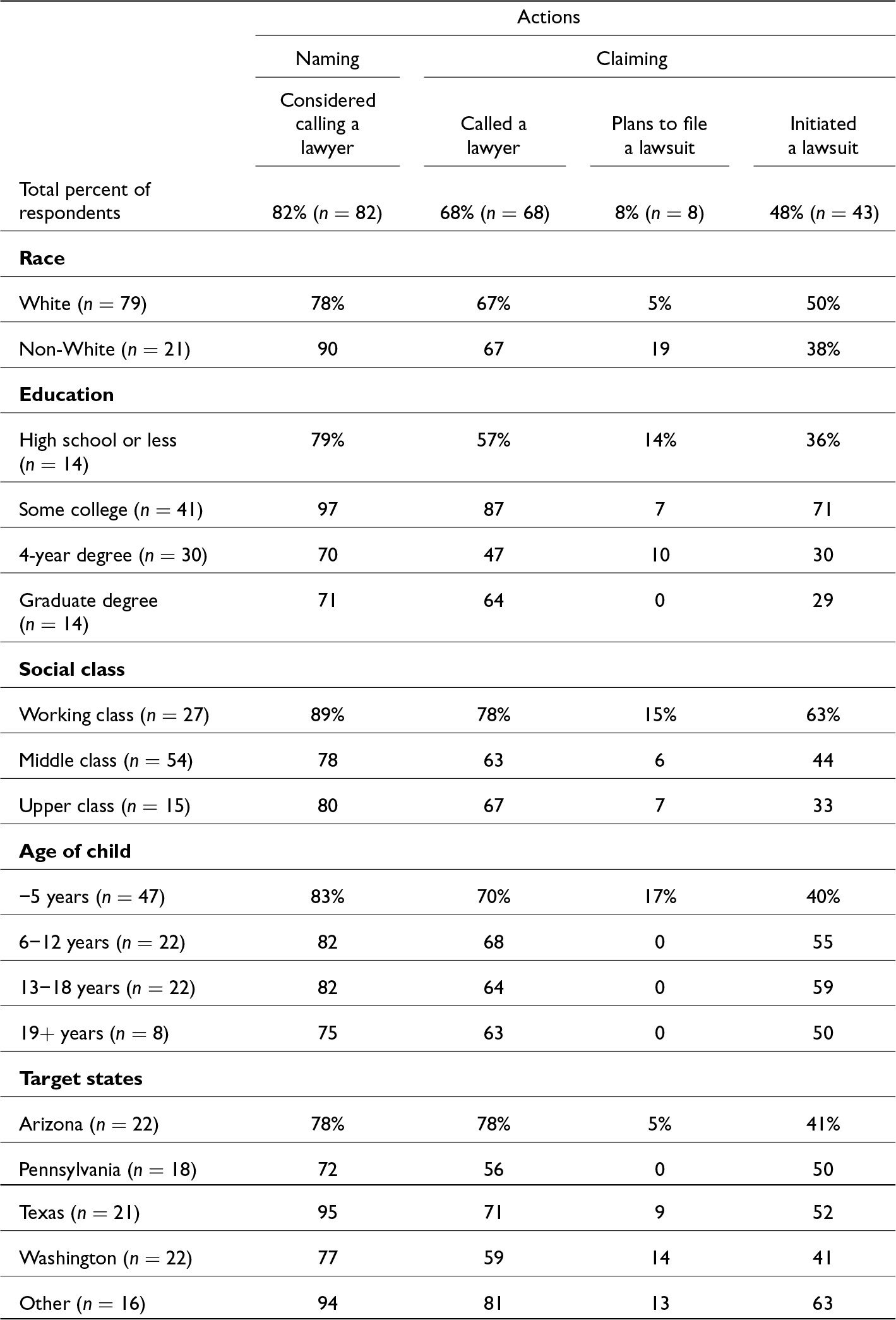
Note: N = 100.
Realizing and researching the medical problem
In contrast to many other kinds of personal injury cases, parents in this study had no prior context to understand their experience and their child’s injury. They had never heard of this injury before, the possibility of it was not mentioned in any birthing classes or medical appointments, and they had never met or seen anyone with this type of injury. Even when they asked their medical professionals about the injury in the aftermath of the birth, they were given very little information, sometimes not even the name of the injury. This meant that the naming-–blaming-–claiming process for these parents often began literally, and necessitated that parents do their own research and fact-finding.
This lack of disclosure was consistent across respondents, from those with infants to those whose children are now adults. Likewise, there were remarkable similarities in the birth experiences parents described. Nearly all the parents (n = 89) described the delivery as tough and chaotic: “The nurse was literally straddling on top of me pulling my legs and trying to push him out,” Carmen said (PA, Latinx, 41, high-school educated bookkeeper). Marisol, a Texas mother remembered, “The nurses pulled my legs up and started punching my stomach” (Latinx, 32, PhD, clinical psychologist). A Washington mother, Veronica, said that her doctor “Called some kind of code … [and then there were] so many people in the room” (White, 47, self-employed with two Master’s degrees). Sandra, another woman from Washington said, “It hurt a lot. My husband was crying” (White, 46, clinical social worker with an MSW). An Alabama mother, Amanda (34, White, stay-at-home mom with a BA degree), said her doctor “was telling the nurse to call the ER…They [were] yelling at each other and it was mass pandemonium.” Brooke, a 41-year old Arizona mother said, “It was a horror show.… All of a sudden there was 15 people in the room” (White, MBA, business developer). Similarly, Nicole, an Illinois mother, remembered, “my husband stayed in the room but he was pushed into the corner and it was chaotic, we had people running in, I had nurses physically on top of me. It was very obvious, they were not hiding the fact that they were scared” (White, 31, BA degree, high school teacher). Monique, a Black mother from Michigan, recalled, “I remember it being very chaotic in my room. They had residents, and students, and several doctors, and several nurses” (Black, 40, MD physician). Ana, a Latinx mother from Arizona said, “I could see the look of panic on the doctor’s face” (48, BA, newborn care specialist). A Texas mother, Ana, said that her husband told her “it looked like they were going to pull [the baby’s] head off” (Latinx, BA, 34, stay-at-home mom).
At some point, parents would notice that one of their baby’s arms did not move – rarely was this brought to their attention by a medical professional. When they asked their delivering doctor or nurses, they were usually told that it was no big deal, just a pinched nerve, and that it would be fine in a few days or a couple of months. For example, Courtney said, “they didn’t really tell me anything, they told me ‘Oh he’s got, you know his arm had a little problem, and you know it’ll probably be okay in a few days’” (TX, White, 48, BA, broadcaster). Sophie, a mother in Washington, had a similar experience, saying, “I remember them saying that she had a stunned shoulder, it happened a lot, and it would most likely bounce back in a like a week or two” (White, 29, AA degree, stay-at-home mom). In Arizona, Chelsea said, “[the doctor] basically said it’s just like a pinched nerve and that it resolves itself very quickly. They never said it could be a bigger issue, it was always, ‘it’s gonna be fine in two weeks’” (White, 32, AA, finance counselor). Past studies argue that being brushed off, ignored, or not informed of an injury by doctors is a contributor to the decision to seek legal remedy (Cohen Reference Cohen2000; Hickson et al. Reference Hickson, Clayton, Githens and Sloan1992; Hickson and Jenkins Reference Hickson and Jenkins2007; Vincent et al. Reference Vincent, Young and Phillips1995), and this is one of the few areas where our parents’ actions aligned with past research.
While some parents started performing internet searches from the delivery room, most of the parents we interviewed left the hospital not knowing the name of the injury their child sustained or how it happened. After some time passed, especially when the time that they were told the injury would improve passed and there was no change in their baby’s arm movements, parents turned to the internet, and there they found the name of the injury. Once they had a name, many of them then searched on Facebook to see if there was any medical and logistical information there (at the time of this writing, there are dozens of groups dedicated to BPIs on the site). Facebook, and other forms of social media, appears to be a game-changer, both medically and legally.
Interview data suggest that social media sites are a core source of medical information and support for families of children with brachial plexus birth injuries. Over 75% of families we interviewed mentioned Facebook specifically as an important resource, and many discussed other online support groups such as the UBPN forums or other social media sites focused on infant care (UBPN in particular was a key resource for parents whose children were born before the ubiquity of Facebook). Social media affords the opportunity for parents to interact with others who have first-hand experience with BPIs and exchange highly specialized information, advice, and support. But social media does not just simply transform the way people access information, it also, as we argue, transforms parents’ self-identity and their formation of legal consciousness.
Social media as information and support
Nearly every parent in our study went to online support groups not because they wanted to sue their doctors, make friends, or transform their identity, but because they were looking for information and knowledge about their child’s injury. Indeed, these groups became a core source of information on how to care for their injured children. Consistent with other parents’ characterizations, Samantha, an Arizona mother (23, White, college student) found the groups to be “an awesome resource” that could provide a wealth of information. That information ranged from how to modify their child’s clothing after surgery to fit their brace, strategies for doing physical therapy at home, ideas for using Kineseo tape to improve range of motion, opinions about doctors, how to request accommodations for their child at school, “just like any questions you have,” as Rosa remarked (TX, Latinx, 34, BA, stay-at-home mom). In another example, when asked what she liked about the online groups, Molly (PA, White, 31, registered nurse) responded that through Facebook, she got:
… different ideas for how to keep him safe, because he didn’t have use of that left arm, the thing was when he started rolling and sitting up, [if] he falls, he can’t catch himself on that left side. How do I protect him from smacking his head on the floor? So they told me to put down foam mats, so I got foam mats, you know, something so simple, I was like okay, that would protect him and at least give a cushion, that way when he falls he’s not going to smack his head on the floor if he falls on that side.
Abby, a mother in Washington (33, White, AA degree, stay-at-home mom), said that other parents she met online often gave more thorough information than her doctor, and helped her set expectations about what the aftermath of surgery would be like. She said that having the resources of the Facebook groups was:
Kind of a relief that, if I have a question and I can’t get to a doctor to ask it, I can ask them and either they can point me in the right direction of getting the answer, or they can answer it for me. So like, what do I expect after he had surgery? Now the doctor will tell me, “It all depends, just be careful.” And when you talk to a parent, they’re like, “You know what? They tell you to be careful, but your kid is gonna be so violently kicking around and wanting to roll and wanting to move, that you’re sitting there trying your hardest to keep him still, but all they wanna do is move, so let him move.” And I did, I let him kick his legs, he was kicking his legs about 2 hours after surgery.
But the Facebook and UBPN groups provided more than just concrete information, they also became a resource for emotional support. For most parents of children with BPIs, they are the only person they know who has experienced, or even heard of this injury. As a result, their family and friends can offer limited emotional support, but they do not necessarily understand what it is like to be their position. While the legal needs literature suggests that injured parties often rely on family and friends for all kinds of advice and support, several parents remarked that they found it difficult to talk with their friends and families about their child’s injury because those network ties often downplayed the injury, trying to make the parent feel better. For example, Chloe (PA, White, 41, MBA-educated government office director) said that for her, finding the online groups was especially comforting because:
When you go outside the brachial plexus community and talk about things, people either tell you, “Well, you know, it’s just his arm,” or, “it’ll get better.”… And people that you’re friends with, you kind of expect that you maybe get a little more of the caring ear, you know, and not to discount what you’re going through. So it’s nice to be able to talk with somebody and say, “Here’s what we’re going through, here’s what we’re experiencing…” Just to know that you’re not alone in the whole thing.
Tara, another mother from Pennsylvania (39, White, Associate’s degree, medical technician) shared a similar frustration with people in her everyday life, saying:
The big thing that I struggled with was people who didn’t understand, who weren’t in my shoes, would tell me, “Oh, it could be worse.” And I hated that. And then to be around other people who were going through the same thing I was going through was like, they understood that this was my worse, this was my son and someone hurt him, and now he’s got to live with that for the rest of his life. And for me that was my worst, like if anybody hurts your kid, it’s horrible, and I got so frustrated constantly hearing from people who didn’t understand, “Oh it could be worse.” So to be around people who were like, “Yeah I get it, and I’m tired of hearing that too,” it was refreshing.
Online communities, as Gabriela from Washington (39, Latinx, receptionist, some college) put it, made these parents feel less “alone”:
When I found the posts on Facebook, I was up for hours reading posts that people would put on there, especially the ones that have babies or have young children, ones that have teenagers that were born with it, people asking about surgeries, and the same type of surgery my daughter has had. I was overwhelmed at seeing all that and just finally knowing that I wasn’t alone.
Amanda (White, AL, 34, BA, stay-at-home mom) echoed that sentiment, saying, “I found all these Facebook groups, and there are thousands of us, and it was so comforting to find other people who’ve gone through this. I don’t know how people go through this alone.” Likewise, Chloe elaborated on her earlier quote, sharing that “being able to talk to people that were going through the same kind of thing just pulls you through.” Daniella, a stay-at-home mom in Texas (24, Latinx, some college) said of the online groups, “it feels good to know that someone understands me, understands my pain, my worries, understands me being angry.” Courtney (TX, quoted earlier) said, “They were experiencing the same kind of emotional tornado I was, and I felt like, okay, this is a good thing for me to find, because finally I’m around people who get it, and maybe I can get some help here.” While the legal needs literature points out that the use of family and friends for emotional and informational support is not geographically limited (Buck and Smith Reference Buck and Smith2015; Sandefur Reference Sandefur2015), it does not necessarily speak to the relationships being described in Facebook groups, which are not between individuals with existing social ties, but rather, strangers with no connection beyond the shared experience of their child’s injury.
“Wow, you can sue your doctor?” Social media as a transformer of guilt into blame
These groups not only offered parents a shared community but also impacted the ways that parents framed their own parental identity and how they understood their role in their child’s injury. Over half of the parents we interviewed expressed guilt over their child’s injury. Brooke, from Arizona (quoted earlier) said, “I was so guilty, I was like, ‘It’s my body. My body breaks my children’.” Hannah, another mother in Arizona (White, 50, educator with a doctorate) said, “I felt like my body had done this to him, my bones, my pelvis was not wide enough – how could I be so fat and not have a wide enough pelvis?” Kelly (AZ, White, 26, high school graduate and stay-at-home mom) echoed similar thoughts, saying, “I blamed myself, like I pushed too hard, my birth canal is too small, and now [my child] is hurt.” Allison (AK, 34, White, some college, office manager) reported similar feelings, saying, “I felt very guilty, I held a lot of guilt for this happening, like basically it’s my fault that my daughter’s arm is all … she can’t move it.” Cheryl (TX, 43, BA, stay-at-home mom) elaborated on this point, saying:
You feel so powerless. You feel like you have failed the only job in the world you’re given, and this is to protect your child. Your job now is to take care of a baby, and you’ve already failed day one. You get mad at yourself. You have a tremendous amount of guilt, like, I should’ve said something else to make them understand that I was serious, I wasn’t just complaining to complain. I wasn’t, I should’ve demanded. I should’ve asked for a patient liaison. I should’ve went to a different hospital. I should’ve went to a different doctor. I should’ve known, I should’ve known more than I did.
David, a father in Washington (31, White, some college, regulatory inspector) summed up sentiments of guilt, saying he and his wife felt horribly responsible:
We thought, for the first 6 months, we thought we were so irresponsible that we let our child get injured and he’ll never use his right arm again. We had chosen the OBGYN, and we felt like we should’ve fought for him harder, and post-injury we thought, “Oh my gosh, why didn’t we do more?” Especially after, we just thought, “Wow, we disastrously failed our child.”
These parents expressed feeling responsible for their child’s injury, and that they had failed in their role as protector for their child. Many parents who turned to their new online communities for logistical advice, also received advice on how to manage these emotions. On Facebook, these expressions of guilt often get re-framed by commenters as failings of the doctor rather than failings of the mother, For example, Margo (WA, 33, White, high school degree, accountant) said “There’s moms who are posting, ‘Don’t think that your baby was too big, because there’s babies that are smaller and end up with injury as well.’ Other moms saying, ‘Don’t feel like it’s your fault’.” Lindsey, from Pennsylvania (33, White, BA, part-time house cleaner) said about Facebook that “there’s people who will post how guilty they feel and why, and then there’s equal amount of posts explaining why you shouldn’t feel guilty, and where the guilt really lies, where the fault really lies.”
Beyond facilitating a transformation of guilt into blame and a transformation of identity and moral self-understanding, parents in online communities provided legal knowledge and actively encouraged one another to think about the injuries as legally actionable problems – and the result is that many ended up doing exactly that (see Table 2). Unlike their in-person social networks, which downplayed their child’s injury, UBPN and Facebook communities exposed respondents to comments like this one from a mother (not in this study) who wrote, “I’ve decided after 15 months of crying and trying to not think about it that it is time to do something. I have no idea where to begin, suggestions are appreciated.” Although she did not mention legal action specifically, she received replies encouraging her to contact a lawyer, including: “You need to Google lawyers in your area,” “Get an attorney right away!” and “Go to 20 different [lawyers] if you have to, don’t just take one’s opinion.”
Another interaction that respondents saw involved a poster who wrote, “What I’d give to go back a year and change what happened. Will the guilt over my lo’s [little one’s] BPI ever go away?” In this example, the mother expressed guilt about the injury, presumably believing she is in some way responsible for the injury to her “little one.” She received several comments from other mothers who said that they too felt guilty until they learned to shift the blame away from themselves and toward the delivering doctor, such as this comment:
My daughter is 11 and it gets better but never goes away. I get very angry at the doctor when I look at pictures of her when she was a baby.… I know I did NOTHING wrong. I put confidence in my doctor. I place all the blame on him, and that’s where it belongs.… You didn’t do anything wrong just like every other mom in this group. We trusted our doctors.
Several parents we interviewed said that Facebook became a core method by which they learned to think of their child’s injury as legally actionable. Michelle (PA, 27, White, some college, home health aide) said she never thought about calling a lawyer until coming across the online groups, explaining, “When I found the support groups, I emailed so many moms, and they would tell me, ‘Yeah, we’re suing our doctor.’ And I’m like, ‘Wow, you can sue your doctor?!?’ And she’s like, ‘Yeah you can sue because it was medical malpractice.” Likewise, Ashley from Texas (41, White, master’s degree, librarian) said that online, consulting lawyers became almost normalized: “There were so many parents on there that had talked to an attorney, I guess in some ways I felt like, this is what brachial plexus families do, they talk to attorneys.”
In another example, Lindsey talked about how seeing a lawyer’s response to someone else’s post on Facebook made her think differently about what happened to their own child. Lindsey explained,
I recently saw a post where a lawyer interjected. There was a mom saying she felt guilty or she didn’t want to sue because she felt like the doctor saved the baby’s life, and he made a very good analogy. He said, “Would you feel grateful to a man who threw you overboard on a cruise ship, and then at the last minute right before you died, throws you a life jacket?” Like the doctor’s ultimately the one who put [my child] in that position. Even though it’s like—it could have happened to anybody, these things happen, but if the proper precautions were taken and the right things were noted beforehand, it probably could have been avoided. So yeah, he saved his life, but he’s also the one who put him in danger.
Later in the interview, Lindsey shared that she had “defended [her doctor] up and down for years, but after that lawyer made the comment on Facebook that was like, ‘Yeah I never saw it that way.’” Thus, her thinking about the injury, as she tells it, completely changed from something that “just happened,” to something that was the doctor’s fault. This comment was made in one of the four Facebook groups studied that were open to lawyers and legal professionals (the others were closed, and available to parents and caregivers only).
Some parents discovered on Facebook that their doctor had a history of BPIs. For example, David, the father who shared that he and his partner felt that they “disastrously failed their child” discovered through the online groups that
the OB that had delivered our son actually had a record for those things. He actually had a history of that. It makes us both angry. Parents put a lot of trust in OBs, and they expect them to protect their child the best they can. We feel like he should’ve been more sensitive to us and he should’ve, you know, if he had a history of delivering kids and giving them brachial plexus injuries then he should’ve been a little more concerned when my wife said [the baby] feels like he’s big, can you do an ultrasound or something?
As David says, through Facebook, he and his wife came to understand that not only was the injury not their fault but also the legally actionable fault of their doctor.
Other families said that lawyers contacted them on Facebook after they posted questions to the group about their child’s injury. After Lydia (Washington, 27, White, Associate’s degree, stay-at-home mom) revealed to me that she was in the midst of a lawsuit, we asked how she found a lawyer to work with. She replied, “well, the lawyer found me online.” She was startled by and skeptical of the private message from the lawyer, and posted a screenshot of his message to one of the Facebook groups to which she belongs, asking, “Has anyone heard of these people or have been contacted by them? I received this as a private message.” She received over 150 comments in response, many of which shared their own stories of working with that lawyer (or a different one). For example, one mother replied, “Yes! They are a blessing to the BPI community!” Another replied, “We used him. He’s legit. He worked miracles for my son.” As a result of these comments from other BPI parents, Lydia messaged the lawyer back, and he is now working on her case. Thus, when contacted by a lawyer, she might have ignored the message without the support and encouragement of their online community, who she went to for advice.
Skepticism and negative opinions about lawyers, such as what Lydia initially expressed, was common among the parents in our sample. In contrast to one of the long-standing findings in the sociology of law about the importance of knowing a lawyer for people coming to think of their personal problems as legal problems (Mayhew and Reiss Reference Mayhew and Reiss1969), parents we interviewed in both conservative and liberal states seemed distrusting of lawyers, even when they personally knew a medical malpractice lawyer. For example, Kristen (AZ, White, 24, BA degree, stay-at-home mom) shared, “My mom’s brother is a medical malpractice attorney, so I avoided talking to him because I’m like nope, I know what he’s going to say, I don’t want to talk to him.” It was not until she started doing research online, where “they explain the injury and what the doctor’s done wrong,” that she and her husband “figured out it was the doctor’s fault” and contacted a lawyer. Likewise, Veronica (WA, 47, self-employed, White, MA degree) said, “Some of my best friends are lawyers, but doggon’ there’s some aggressive, nasty lawyers out there…I was like, ‘I’m not interested, I’m not gonna do that.’” Similarly, Daniela’s (TX, Hispanic, 24, some college, stay-at-home mom) uncle was a lawyer who suggested she sue her doctor, but she disregarded his advice and it was not until nearly a year later, after “everybody [online] was telling me this has to be medical malpractice,” that she “did talk to one of [the mothers on Facebook] about the lawyers and her experience with lawyers” and concluded that “they might be right,” and started conversations with a lawyer. Thus, the online groups, filled with people in similar circumstances, rather than their in-person networks, became a conduit through which these parents developed a legal consciousness that made them more likely to take legal action.
Discussion and conclusions
This study presents a unique case in which parents whose child experienced a brachial plexus birth injury find themselves embedded in a new type of “structuring structure,” social media, that impacts and accelerates the development of a legal consciousness that results in legal action. Our analysis demonstrates that what changes first for these parents is not legal knowledge, but rather moral self-understanding, and that the online collective performs a kind of affective and normative labor that converts guilt into blame before parents can plausibly inhabit a legal subject position.Footnote 3
Past research shows that one’s sense of self, perception of one’s roles, and relation to one’s community are crucially important in the development of legal consciousness (e.g., Wang Reference Wang2023). Parental status and its accompanying roles is a particularly powerful and salient relational identity. For most parents of children with BPIs, they are the only person they know who has experienced, or even heard of this injury. As a result, their family and friends can offer emotional support, but they do not necessarily understand what it is like to be in the parents’ position. Their local communities, as “structuring structures,” thus have very different perspectives and levels of experience and information than online groups entirely centered around the experience of BPI within the family. The overwhelming majority of parents in this study initially blamed themselves for their child’s birth injury, and went to social media groups seeking logistic information, emotional support, and medical guidance, not legal advice. These groups emerged in interviews as a powerful force in the transformation of parental identity and the formation of not just parental identity but their legal consciousness, with strikingly high levels of legal action, across racial, social class, and geographic groups (see Table 2).
The process of “naming, blaming, and claiming” (Felstiner et al. Reference Felstiner, Abel and Sarat1980) was accelerated and reshaped by these online communities, which provided both informational and emotional support. Mothers reported that they felt that their identities as good mothers were compromised by an injury they believed they had caused. The transformation of this guilt into blame toward a doctor came as a result of mothers’ participation in online communities. Mothers expressed in interviews that their role as a mother was to protect their child and that they failed to do so during their births. Online BPI groups, which became a primary source of medical and eventually legal information, helped reassert their identities as responsible caregivers by reaffirming their maternal role as protectors, but placing the blame for their child’s injury on their doctors and offering a way to embody that role via legal action. Thus, parents who initially blamed themselves for their child’s injury reorganized the naming–blaming–claiming trajectory (Lloyd-Bostock Reference Lloyd-Bostock1991) and came to see the injury as a preventable, legally actionable event. The support of other parents in online groups and the resultant openness to interactions with legal professionals on social media further encouraged the pursuit of legal remedies. This digital legal mobilization transcended traditional barriers such as local context, social class, education, and prior legal experience, highlighting the impact of social media on legal consciousness.
These groups may also impact access to justice, as the reframing of guilt into blame and accompanying legal action occurred both in groups where lawyers were allowed, and those where they were not. The legal consciousness of the few parents who were approached by attorneys was particularly impacted by groups, because these respondents initially reacted with deep skepticism and were impacted by others who framed these attorneys as “blessings to the BPI community.”
This research advances legal consciousness scholarship in several ways. First, it highlights the increasing importance of delocalized, digital communities in shaping perceptions of law and justice. Traditionally, legal consciousness has been understood as rooted in geographically bound communities, workplaces, and other local institutions (Engel Reference Engel2012; Silbey Reference Silbey2005). However, our findings show that online communities serve similar functions, providing legal socialization and shaping mobilization decisions across diverse social and geographic contexts, for example, Ashley from Texas who had concluded, “I guess this is what brachial plexus families do, they talk to attorneys.” Similarly, comments from mothers who encouraged one another to trust unsolicited inquiries from attorneys, referring to specific lawyers as “a blessing to the BPI community,” show how these social media groups functioned and were experienced as novel communities with specific, unique legal norms. They were also structurally unique, and like many social media groups, had fluid and amorphous internal organization and memberships. As such, these communities do not graft neatly onto the insider/outsider dynamics that have been discussed in past studies of the impacts of community norms on adjudication (e.g., Engel Reference Engel1984). But the “BPI community,” as a network group, seems to be more influential than close ties with in-person community and family members in the formation of legal consciousness, suggesting that these communities may be operating in theoretically distinct ways. To be sure, the characteristics of BPIs may be unusually conducive to mobilization, so future research might explore the extent to which what we have argued here is a general dynamic of digital legal consciousness or an interaction between a particularly litigation-ready injury and an online support ecology.
Law and society scholars understand that the law itself has become a globalized phenomenon, increasingly untethered to nation-states, and that “society” increasingly transcends locality and national groups (Engel Reference Engel2012). In his study of evolving legal consciousness in Thailand, Engel (Reference Engel2005) points out that changes in large-scale global norms can impact not only legal consciousness but also resultant litigation rates. The democratization of information and reorganization of community inherent in online life is also a global event with potentially meaningful impacts on legal consciousness, though the mechanisms by which this occurs remain under-theorized. Halliday and Osinsky (Reference Halliday and Osinsky2006) argued that the spread of globalized legal liberalism occurred as an interplay between “key actors” who create and propagate global legal norms, and the localities where these norms are accepted, rejected or changed. But the key actors envisioned in these theories were powerful politicians, NGO leaders, and other influential individuals located in global capitals and centers of authority. This is less useful for understanding the more horizontal, intranational transmission of legal norms found in online communities of ordinary people. And orientations toward a rights discourse offer a less discreet variable than understanding of a specific injury or condition.
In their review of legal consciousness scholarship, Chua and Engel (Reference Chua and Engel2019) assert that the legal consciousness literature is divided into several “schools.” Identity school studies are focused on ways that identity and legal consciousness are mutually constitutive. Mobilization school studies, Chua and Engel argue, point to the significance of place in the formation of legal consciousness, by highlighting “the role of local norms and practices” on the invocation of law, and the ways these local norms and practices may limit social change by molding the worldview of individuals with regards to the perception of law as “helpful and relevant” or something to be avoided. They also point to a methodological continuum within legal consciousness scholarship that runs from the individual to the relational. An individual focus examines how people make individual assessments and views others as external variables which impact individual decision-making. Conversely, fully relational methodologies argue that we “are our relationships” and that the self is distributed across a network of others (Chua and Engel Reference Chua and Engel2019). Embedded within this methodological continuum are “vertical” and “horizontal” perspectives, that argue that rights consciousness and other legal norms and attitudes either move vertically from powerful actors and localities down to ordinary people, or move horizontally among ordinary people via shared interpretations based on shared social fields (Engel Reference Engel2012).
We argue that the unusually high levels of legal action in our sample are poorly explained by previous research because the legal consciousness of parents of children with justiciable injuries develops in an under-examined theoretical space, operating between identity and mobilization conceptually, and the individual and the relational methodologically. The identity in question, that of parent, is inherently relational. It is an identity defined by a relationship between self and others. But the way that parental responsibility for a child’s injury is internalized is a matter of how individuals view and inhabit their parental identity, an identity that was influenced and at least partially transformed through participation in online communities. Mobilization scholars acknowledge that community norms influence the use of law to enact social change, but in this case the community is delocalized and represents a unique social field. Past theory argues that the horizontal, shared interpretive practices of ordinary people have been rooted in socialization into systems of meaning within communities such as neighborhoods, schools, and places of work, and that these shared practices have impacted their legal consciousness in a globalizing world (Engel Reference Engel2005). Online community groups represent a new social space, wherein legal norms do not flow downward from sources of legal or medical authorities to ordinary parents, nor are they born from geographically rooted norms and attitudes. The legal consciousness of parents in this study has been formed within what Silbey (Reference Silbey2005) called the “middle-level” structures between citizens and formal legal structures. This middle level “is embodied by social institutions such as the family unit, schools, corporations, or churches where the formation of cultural meaning, social hierarchy, and ultimately legal consciousness can be empirically observed” (Wang Reference Wang2019). Social media, specifically groups centered around a shared injury to one’s child, operate as a unique middle space with distinctive and demonstrable influences on legal knowledge, identity, emotion, and social support that interact and inform legal consciousness, resulting in unusually high levels of invoking the law for redress rather than lumping the reality of their children’s birth injuries.
While the theoretical space developed here may apply to other types of medical malpractice or personal injury cases, further research is needed to confirm its broader applicability. While we found that even the parents with older children mentioned that they utilized discussion forums and online groups that were hosted by the UBPN that influenced their thinking in similar ways to the newer parents operating in Facebook groups, further research will be needed to focus on social media groups themselves, their mechanics, membership and group norms, and participant involvement; for example, one might track the frequency with which people engage with the groups or how active they are in posting. Additional quantitative research using this theoretical frame could also ascertain whether social media as a structuring structure impacts the legal consciousness of parents if their child experiences a well-known and understood injury or illness, such as childhood lead exposure. The relational and parental role impacts may also be different if the child is old enough to communicate, or when the illness or injury is not considered preventable, such as childhood cancers. Future research might also consider tracking the development of legal consciousness through a longitudinal study that follows parents over time. Do parents who initially consider legal action follow through, or do they encounter barriers that deter them? How do their views on law and justice evolve as they interact with medical professionals, lawyers, and the legal system? We would also be interested to see scholars expanding the scope of research beyond birth injuries to other medical malpractice or personal injury contexts, which could help determine whether social media’s impact on legal consciousness is generalizable. For example, do patients with misdiagnosed illnesses or workplace injuries experience similar social media–driven transformations in legal consciousness? Finally, further investigation into the role of lawyers’ direct engagement on social media could deepen our understanding of legal mobilization, and help quantify the impacts of peer socialization and social solidarity versus exposure to legal professionals in social media groups. While this study identified instances of lawyers contacting potential clients via Facebook, more research is needed to understand how legal professionals shape, amplify, or constrain the formation of legal consciousness in online spaces.
This study provides empirical and theoretical insights into the evolving nature of legal consciousness and mobilization in the digital age. Social media serves as a powerful force in shaping parents’ perceptions of their child’s injuries as legally actionable, challenging existing assumptions about why people do or do not pursue legal action. By examining how online communities facilitate the transformation from guilt to blame and encourage collective legal mobilization, this study contributes to broader sociolegal debates about the role of digital technologies in shaping contemporary legal consciousness. Future research should continue to explore these dynamics to better understand how law and society interact in an increasingly digitized world.
Acknowledgements
The authors are especially grateful to all the parents, doctors, lawyers, and others who agreed to be interviewed for this project. They also wish to thank Richard Patti, Joseph Buttino, Bridget Scott, Komal Siddiqui, Alejandro Corona Espinosa, Lauren Majewski, Breana Gorman, and Jenna Rossi for research assistance. Thanks also to Sandra Levitsky, Elizabeth Chiarello, Anna Maria Marshall, and Debra Street, who offered feedback on earlier drafts of this paper.
Funding statement
This research was funded by a grant from the National Science Foundation (#SES-1421442) and was also supported by the Baldy Center for Law and Social Policy at the University at Buffalo.
Conflicts of interest
The authors declare no competing interests.


 Open access

