









1. Introduction
The aim of this article is to give some more evidence that torus knot groups behave like Artin groups (or more generally complex braid groups) of rank two. The most basic observation that can be done is that the
$3$
 -strand Artin braid group
$B_3$
-strand Artin braid group
$B_3$
 is isomorphic to the knot group of the trefoil knot, the most elementary nontrivial (torus) knot, and that this isomorphism maps braided reflections to (powers of) meridians. More generally, Artin groups of odd dihedral type are isomorphic to torus knot groups, and the complex braid groups of the exceptional complex
$2$
is isomorphic to the knot group of the trefoil knot, the most elementary nontrivial (torus) knot, and that this isomorphism maps braided reflections to (powers of) meridians. More generally, Artin groups of odd dihedral type are isomorphic to torus knot groups, and the complex braid groups of the exceptional complex
$2$
 -reflection groups
$G_{12}$
-reflection groups
$G_{12}$
 and
$G_{22}$
and
$G_{22}$
 as well. Both families are distinct, but share several group-theoretic properties: for instance, it has long been known that, like Artin braid group, torus knot groups are torsion free, with an infinite cyclic center [Reference Schreier22], and linear. In a more modern language, it has been observed that both turn out to be Garside groups [Reference Dehornoy and Paris9], and form two of the most elementary, though already extremely rich, families of such groups.
Artin groups admit a natural quotient given by the corresponding Coxeter group. In a previous work [Reference Gobet12], we showed that one can define similar quotients for torus knot groups, and that these quotients behave like (in general infinite) complex reflection groups of rank two. Such a quotient is called a toric reflection group, and the corresponding torus knot group behaves like its braid group.
In this article, we go one step further by showing in Section 4.3 that for a large family of torus knot groups, we can define an analog of the (reduced) Burau representation of
$B_3$
 .
.
The Burau representation [Reference Burau6] is perhaps one of the most fascinating representations of Artin braid group. It is obtained by deforming the natural action of the corresponding Coxeter group, namely, the symmetric group
$S_n$
 , on its root system. For
$n\geq 5, $
, on its root system. For
$n\geq 5, $
 it is unfaithful [Reference Bigelow2], for
$n=4,$
it is unfaithful [Reference Bigelow2], for
$n=4,$
 the faithfulness is still open, while for
$n=3,$
the faithfulness is still open, while for
$n=3,$
 it is faithful (see [Reference Birman3, Theorem 3.15] and the references therein). There is also a definition for all Artin groups of rank two, and it is faithful in this case [Reference Lehrer and Xi17], [Reference Squier23]. Similarly, the representation that we construct will be faithful, as expected for a family of groups that we claim to behave like Artin groups (or complex braid groups) of rank two.
Let
$n,m \geq 2$
 and let

When n and m are coprime, this is a presentation of the knot group of the torus knot
$T_{n,m}$
 (every torus knot, except the unknot, is isotopic to some
$T_{n,m}$
(every torus knot, except the unknot, is isotopic to some
$T_{n,m}$
 ).
).
The following statement will be our main tool to construct faithful representations of the groups
$G(n,m)$
 and can be used without the assumption that n and m are coprime.
Proposition 1.1. Assume that
$m, n \geq 2$
 are two (not necessarily coprime) integers, let
$M_X, M_Y\in \mathrm {GL}_2(\mathbb {C}[t^{\pm 1}, q^{\pm 1}])$
are two (not necessarily coprime) integers, let
$M_X, M_Y\in \mathrm {GL}_2(\mathbb {C}[t^{\pm 1}, q^{\pm 1}])$
 satisfy the following three conditions:
-
1. We have $M_X^m = M_Y^n$
 , that is, the matrices define a representation of
$G(n,m)$
.
, that is, the matrices define a representation of
$G(n,m)$
. -
2. For all $1 \leq k \leq m-1$
, the matrix
$M_X^k$
has the form $$ \begin{align*}t^{nk} \begin{pmatrix} c_1(k) & c_2(k) \\ c_3(k) & c_4(k)\end{pmatrix},\end{align*} $$where $c_i(k)\in \mathbb {C}$
for all i, and
$c_2(k)\neq 0$
.
-
3. For all $1 \leq k \leq n-1$
, the matrix
$M_Y^k$
has the form $$ \begin{align*}t^{mk} \begin{pmatrix} P_1(k) & P_2(k) \\ P_3(k) & P_4(k)\end{pmatrix},\end{align*} $$where $P_i(k) \in \mathbb {C}[q^{\pm 1}]$
for all i,
$\deg (P_i(k))\leq 0$
for
$i\neq 3$
, and
$\deg (P_3(k))=1$
.



Then the assignment
$X \mapsto M_X$
 ,
$Y \mapsto M_Y$
,
$Y \mapsto M_Y$
 defines a faithful representation of
$G(n,m)$
defines a faithful representation of
$G(n,m)$
 . Moreover, the representation obtained by setting
$t=q$
. Moreover, the representation obtained by setting
$t=q$
 stays faithful.
It might look difficult at first to find matrices satisfying the above conditions, but as we shall see in Section 4 below, several such representations can naturally be constructed.
The main strategy for the proof of this proposition will be to show that one can recover the Garside normal form of an element u of the Garside monoid
$\mathcal {M}(n,m) = \langle X, Y \ \vert \ X^m=Y^n \rangle \hookrightarrow G(n,m)$
 from its matrix
$M_u$
from its matrix
$M_u$
 in the representation. This follows Krammer’s philosophy, who used this approach to show that braid groups are linear [Reference Krammer16] (see §2.1 below for more details). Krammer’s arguments are indeed purely Garside-theoretic, but it seems that his strategy has not been applied outside the particular family of Garside groups given by Artin groups of spherical type; to the best of our knowledge, the above proposition gives a first example of another family of Garside groups for which one can use Krammer’s approach.
Proposition 1.1 will be proven in Section 3, after recalling a few basic properties of Garside groups in Section 2; in fact, the Garside-theoretic properties of
$G(n,m)$
 are not required for the proof since they are in fact reproven when proving Proposition 1.1, but having them in mind may be enlightening. In Section 4, we then construct various faithful representations of the groups
$G(n,m)$
are not required for the proof since they are in fact reproven when proving Proposition 1.1, but having them in mind may be enlightening. In Section 4, we then construct various faithful representations of the groups
$G(n,m)$
 using Proposition 1.1, including in Section 4.3, the aforementioned representation generalizing the Burau representation, which we also show to be unitarizable. Section 5 is devoted to showing that for those torus knot groups for which we can build a Burau representation, the faithfulness can be used to show that these groups embed into an analog of Hecke algebra of the attached toric reflection group. In particular, this will yield a faithful Burau representation for the complex braid groups of the exceptional complex reflection groups
$G_{12}$
using Proposition 1.1, including in Section 4.3, the aforementioned representation generalizing the Burau representation, which we also show to be unitarizable. Section 5 is devoted to showing that for those torus knot groups for which we can build a Burau representation, the faithfulness can be used to show that these groups embed into an analog of Hecke algebra of the attached toric reflection group. In particular, this will yield a faithful Burau representation for the complex braid groups of the exceptional complex reflection groups
$G_{12}$
 and
$G_{22}$
and
$G_{22}$
 (see Examples 4.11 and 4.12).
2. Preliminaries
In this article, we shall be interested in representations of the following groups.
Notation 2.1. Let
$m, n \geq 2$
 be two integers. We denote by
$G(n,m)$
be two integers. We denote by
$G(n,m)$
 the group defined by the presentation
$\langle X, Y \ \vert \ X^m = Y^n \rangle $
the group defined by the presentation
$\langle X, Y \ \vert \ X^m = Y^n \rangle $
 .
.
2.1. Garside groups and their representations
By [Reference Dehornoy and Paris9], the groups
$G(n,m)$
 are Garside groups. We will not recall all the theory of Garside monoids and groups here, but only some properties that we will use later on. For the interested reader, more on Garside structures can be found in [Reference Dehornoy, Digne, Krammer, Godelle and Michel8], [Reference Dehornoy and Paris9]; as explained in Remark 2.2 below, the fact that
$G(n,m)$
are Garside groups. We will not recall all the theory of Garside monoids and groups here, but only some properties that we will use later on. For the interested reader, more on Garside structures can be found in [Reference Dehornoy, Digne, Krammer, Godelle and Michel8], [Reference Dehornoy and Paris9]; as explained in Remark 2.2 below, the fact that
$G(n,m)$
 is a Garside group is in fact not needed in this article, but our approach rather reproves some important properties that
$G(n,m)$
is a Garside group is in fact not needed in this article, but our approach rather reproves some important properties that
$G(n,m)$
 admits as a Garside group.
Roughly speaking, saying that
$G(n,m)$
 is a Garside group means that
$G(n,m)$
is a Garside group means that
$G(n,m)$
 is the group of fractions of the monoid
$\mathcal {M}(n,m)$
is the group of fractions of the monoid
$\mathcal {M}(n,m)$
 defined by the same presentation (which we will call a Garside presentation), that the latter is cancellative and has good divisibility properties, and that there exists an element
$\Delta $
defined by the same presentation (which we will call a Garside presentation), that the latter is cancellative and has good divisibility properties, and that there exists an element
$\Delta $
 (the Garside element) whose set of left- and right-divisors coincide, and form a finite generating set
$\mathrm {Div}(\Delta )$
(the Garside element) whose set of left- and right-divisors coincide, and form a finite generating set
$\mathrm {Div}(\Delta )$
 of
$\mathcal {M}(n,m)$
of
$\mathcal {M}(n,m)$
 (and hence of
$G(n,m)$
(and hence of
$G(n,m)$
 ), called the set of simple elements of
$\mathcal {M}(n,m)$
), called the set of simple elements of
$\mathcal {M}(n,m)$
 . In our case, the Garside element is given by
$X^m = Y^n$
. In our case, the Garside element is given by
$X^m = Y^n$
 and is central (a Garside element always has a central power, and since Garside groups are torsion-free, a Garside group in particular has a nontrivial center). In this case, it is even a generator of the center, as shown by Schreier [Reference Schreier22].
In a Garside group G attached to a Garside monoid
$\mathcal {M}$
 , every element
$g\in G$
, every element
$g\in G$
 can be written in the form
$x^{-1}y$
can be written in the form
$x^{-1}y$
 , where
$x, y\in \mathcal {M}$
, where
$x, y\in \mathcal {M}$
 . Garside groups have a solvable word problem and every element admits canonical left- and right-normal forms, whose factors are elements of the set
$\mathrm {Div}(\Delta )$
. Garside groups have a solvable word problem and every element admits canonical left- and right-normal forms, whose factors are elements of the set
$\mathrm {Div}(\Delta )$
 . In fact, given any element
$x\in \mathcal {M}\backslash \{1\}$
. In fact, given any element
$x\in \mathcal {M}\backslash \{1\}$
 , the good divisibility properties of
$\mathcal {M}$
, the good divisibility properties of
$\mathcal {M}$
 ensure that there is a unique element
$x_1$
ensure that there is a unique element
$x_1$
 in
$\mathrm {Div}(\Delta )\backslash \{1\}$
in
$\mathrm {Div}(\Delta )\backslash \{1\}$
 , maximal for left-divisibility, that can be factored out from x. We thus have
$x=x_1 x'$
, maximal for left-divisibility, that can be factored out from x. We thus have
$x=x_1 x'$
 for some (by cancellativity uniquely-defined) element
$x'\in \mathcal {M}$
for some (by cancellativity uniquely-defined) element
$x'\in \mathcal {M}$
 , and one can go on factoring
$x'$
, and one can go on factoring
$x'$
 . The properties of Garside monoids guarantee that this procedure terminates, yielding a canonical decomposition
$x=x_1 x_2 \dots x_k$
. The properties of Garside monoids guarantee that this procedure terminates, yielding a canonical decomposition
$x=x_1 x_2 \dots x_k$
 with
$x_i \in \mathrm {Div}(\Delta ) \backslash \{1\}$
with
$x_i \in \mathrm {Div}(\Delta ) \backslash \{1\}$
 , the left-Garside normal form of x. Factoring out from the right yields the right-Garside normal form. In our case, we have
$\mathrm {Div}(\Delta )=\{1, X, X^2, \dots , X^{m-1}, Y, Y^2, \dots , Y^{n-1}, \Delta = X^m = Y^n\}$
, the left-Garside normal form of x. Factoring out from the right yields the right-Garside normal form. In our case, we have
$\mathrm {Div}(\Delta )=\{1, X, X^2, \dots , X^{m-1}, Y, Y^2, \dots , Y^{n-1}, \Delta = X^m = Y^n\}$
 .
.
We shall construct two-dimensional representations of
$G(n,m)$
 and show that they are faithful using the following procedure, which is the philosophy used by Krammer to show that Artin’s n-strand braid groups are linear [Reference Krammer16]:
-
1. To show that an action of a Garside group G (with Garside monoid $\mathcal {M}$
) on a set X is faithful, since every element of G can be written under the form
$x^{-1} y$
with
$x, y\in \mathcal {M}$
, it suffices to show that the monoid
$\mathcal {M}$
acts faithfully. -
2. To show that the action of $\mathcal {M}$
is faithful, one can try to reconstruct the Garside normal form of every element
$m\in \mathcal {M}$
from its corresponding automorphism of X.


This approach has been successfully applied to show that several (linear or categorical) actions of braid groups or more generally spherical-type Artin–Tits groups are faithful (see, for instance, [Reference Brav and Thomas4], [Reference Digne10], [Reference Jensen15], [Reference Lehrer and Xi17], [Reference Licata and Queffelec18]). Since Krammer’s approach is Garside-theoretic, it is natural to wonder whether it can be applied for other families of Garside groups. To the best of our knowledge, this has not been investigated before, and we shall do it below for the family of groups
$G(n,m)$
 , which is among the easiest families of Garside groups distinct from spherical-type Artin–Tits groups.
Remark 2.2. The fact that
$G(n,m)$
 is a Garside group is not needed a priori in this approach, which in fact reproves the various properties of a Garside group: the point
$2$
is a Garside group is not needed a priori in this approach, which in fact reproves the various properties of a Garside group: the point
$2$
 in the above philosophy implies that
$\mathcal {M}(n,m)$
in the above philosophy implies that
$\mathcal {M}(n,m)$
 embeds into a group (the group of automorphisms of X), hence that it is cancellative (a property that is hard to show in general for a monoid defined by generators and relations). The fact that every element of
$G(n,m)$
embeds into a group (the group of automorphisms of X), hence that it is cancellative (a property that is hard to show in general for a monoid defined by generators and relations). The fact that every element of
$G(n,m)$
 can be written as a fraction in two elements of
$\mathcal {M}(n,m)$
can be written as a fraction in two elements of
$\mathcal {M}(n,m)$
 can also be established easily in this case using the fact that if
$x, y\in \mathrm {Div}(\Delta )$
can also be established easily in this case using the fact that if
$x, y\in \mathrm {Div}(\Delta )$
 , then writing
$x x'= yy' = \Delta $
, then writing
$x x'= yy' = \Delta $
 , we have
$x^{-1} y= x' {y'}^{-1}$
, we have
$x^{-1} y= x' {y'}^{-1}$
 , hence in any word in
$\mathrm {Div}(\Delta )$
, hence in any word in
$\mathrm {Div}(\Delta )$
 (recall that
$X, Y\in \mathrm {Div}(\Delta )$
(recall that
$X, Y\in \mathrm {Div}(\Delta )$
 ), negative powers can be inductively moved to the right of the word. It is thus worth mentioning that the above philosophy can in fact also be used to show some properties of G and
$\mathcal {M}$
), negative powers can be inductively moved to the right of the word. It is thus worth mentioning that the above philosophy can in fact also be used to show some properties of G and
$\mathcal {M}$
 , such as the cancellativity of
$\mathcal {M}$
, such as the cancellativity of
$\mathcal {M}$
 . This was used, for instance, by Paris to show that Artin monoids, which in general are not Garside, embed in the corresponding groups [Reference Paris21].
2.2. Properties of the groups under consideration
As already pointed out, the groups
$G(n,m)$
 form one of the easiest families of Garside groups. Let us point out some additional features:
-
• If $n=2$
and m is odd, then
$G(n,m)$
is isomorphic to the Artin group of dihedral type
$I_2(m)$
. -
• If $(n,m)=(3,4)$
, respectively,
$(3,5)$
, then
$G(n,m)$
is isomorphic to the complex braid group of the exceptional complex reflection group
$G_{12}$
, respectively,
$G_{22}$
(see [Reference Bannai1]). -
• If $n, m$
are coprime, which in particular covers all the examples above, then
$G(n,m)$
is the knot group of the torus knot
$T_{n,m}$
. Since every torus knot (except the unknot) is of this form, it covers all the torus knots apart from the knot group of the unknot, which is isomorphic to
$\mathbb {Z}$
.





Since
$G(2,3)$
 is isomorphic to the three-strand braid group
$B_3$
is isomorphic to the three-strand braid group
$B_3$
 , the groups
$G(n,m)$
, the groups
$G(n,m)$
 can be considered as generalizations of
$B_3$
can be considered as generalizations of
$B_3$
 . Note that the presentation
$\langle X, Y \ \vert \ X^3 = Y^2 \rangle $
. Note that the presentation
$\langle X, Y \ \vert \ X^3 = Y^2 \rangle $
 is not the standard Artin presentation of
$B_3$
is not the standard Artin presentation of
$B_3$
 . The standard Artin presentation of
$B_3$
. The standard Artin presentation of
$B_3$
 can in fact be generalized when n and m are coprime as we now recall, and this suggests to investigate whether properties of
$B_3$
can in fact be generalized when n and m are coprime as we now recall, and this suggests to investigate whether properties of
$B_3$
 can actually be generalized to the groups of the form
$G(n,m)$
can actually be generalized to the groups of the form
$G(n,m)$
 with n and m coprime. In a previous work [Reference Gobet12], we introduced and classified analogs of the complex reflection groups appearing as quotients of
$B_3$
with n and m coprime. In a previous work [Reference Gobet12], we introduced and classified analogs of the complex reflection groups appearing as quotients of
$B_3$
 when adding torsion on the generators of the standard presentation, and studied Garside structures on
$G(n,m)$
when adding torsion on the generators of the standard presentation, and studied Garside structures on
$G(n,m)$
 analogous to those that are known for
$B_3$
analogous to those that are known for
$B_3$
 [Reference Gobet11]. Note that Haladjian recently generalized some of these results to a larger family of Garside groups, in such a way that they include all the complex braid groups of complex reflection groups of rank two [Reference Haladjian13], [Reference Haladjian14]. In this article, we continue this program by taking a more representation-theoretic road: we will see that for most groups
$G(n,m)$
[Reference Gobet11]. Note that Haladjian recently generalized some of these results to a larger family of Garside groups, in such a way that they include all the complex braid groups of complex reflection groups of rank two [Reference Haladjian13], [Reference Haladjian14]. In this article, we continue this program by taking a more representation-theoretic road: we will see that for most groups
$G(n,m)$
 with n and m coprime, we can construct a representation generalizing the Burau representation of
$B_3$
with n and m coprime, we can construct a representation generalizing the Burau representation of
$B_3$
 and show that it is faithful using the philosophy recalled in Section 2.1. This will be done by proving Proposition 1.1—which in fact will allow us to produce faithful representations for all the groups of the form
$G(n,m)$
and show that it is faithful using the philosophy recalled in Section 2.1. This will be done by proving Proposition 1.1—which in fact will allow us to produce faithful representations for all the groups of the form
$G(n,m)$
 , that is, not only when n and m are coprime (see §4.2 below).
2.3. Case where the parameters are coprime
Let
$n,m \geq 2$
 with n and m coprime. The group
$G(n,m)$
with n and m coprime. The group
$G(n,m)$
 admits the presentation

where indices are taken modulo n if
$n<m$
 . Since
$G(n,m)\cong G(m,n)$
. Since
$G(n,m)\cong G(m,n)$
 , it also admits the presentation

For
$B_3 \cong G(2,3)$
 (more generally for the Artin group of dihedral type
$I_2(m)$
(more generally for the Artin group of dihedral type
$I_2(m)$
 with m odd, which is isomorphic to
$G(2,m)$
with m odd, which is isomorphic to
$G(2,m)$
 ), Presentation (2.1) is nothing but the classical Artin–Tits group presentation, while Presentation (2.2) is nothing but its Birman–Ko–Lee or dual presentation. An explicit isomorphism between
$G(n,m)$
), Presentation (2.1) is nothing but the classical Artin–Tits group presentation, while Presentation (2.2) is nothing but its Birman–Ko–Lee or dual presentation. An explicit isomorphism between
$G(n,m)$
 and the group with Presentation (2.1) is given by
$X \mapsto x_1 x_2 \dots x_n$
and the group with Presentation (2.1) is given by
$X \mapsto x_1 x_2 \dots x_n$
 ,
$Y \mapsto x_1 x_2 \dots x_m$
,
$Y \mapsto x_1 x_2 \dots x_m$
 . We refer to [Reference Gobet11, Section 3] for more details and proofs of these facts. The above two presentations are also Garside presentations.
Definition 2.3 ([Reference Gobet12, Section 2.2])
Let
$n,m\geq 2$
 be coprime and
$k \geq 2$
be coprime and
$k \geq 2$
 . The toric reflection group
$W(k,n,m)$
. The toric reflection group
$W(k,n,m)$
 is the quotient of
$G(n,m)$
is the quotient of
$G(n,m)$
 obtained by adding the relations
$x_i^k = 1$
obtained by adding the relations
$x_i^k = 1$
 in Presentation (2.1) for all
$i=1, \dots , n$
in Presentation (2.1) for all
$i=1, \dots , n$
 .
.
In fact, since n and m are coprime, all the
$x_i$
 ’s are conjugate in
$G(n,m)$
’s are conjugate in
$G(n,m)$
 . It thus suffices to add the relation
$x_1^k=1$
. It thus suffices to add the relation
$x_1^k=1$
 . These groups behave like reflection groups in some sense, and the corresponding torus knot groups like their braid groups, generalizing the quotient
$B_3 \twoheadrightarrow S_3$
. These groups behave like reflection groups in some sense, and the corresponding torus knot groups like their braid groups, generalizing the quotient
$B_3 \twoheadrightarrow S_3$
 (see [Reference Gobet12]).
Definition 2.4. Let
$n,m$
 be as above. A group of the form
$W(2,n,m)$
be as above. A group of the form
$W(2,n,m)$
 will be called a 2-toric reflection group.
Remark 2.5. Let
$a, b \in \mathbb {Z}$
 such that
$an - bm = 1$
such that
$an - bm = 1$
 . Using the above isomorphism between
$G(n,m)$
. Using the above isomorphism between
$G(n,m)$
 and the group with Presentation (2.1), we see that
$Y^b X^{-a}$
and the group with Presentation (2.1), we see that
$Y^b X^{-a}$
 is mapped to
$x_i^{\pm 1}$
is mapped to
$x_i^{\pm 1}$
 for some i. Hence, since all the
$x_i$
for some i. Hence, since all the
$x_i$
 ’s are conjugate, to get a presentation of
$W(k,n,m)$
’s are conjugate, to get a presentation of
$W(k,n,m)$
 from the presentation
$\langle X, Y \ \vert \ X^m = Y^n \rangle $
from the presentation
$\langle X, Y \ \vert \ X^m = Y^n \rangle $
 , it suffices to add the relation
$(Y^b X^{-a})^k =1$
, it suffices to add the relation
$(Y^b X^{-a})^k =1$
 . This will be needed later on in Section 4.3. In fact, when n and m are coprime, the group
$G(n,m)$
. This will be needed later on in Section 4.3. In fact, when n and m are coprime, the group
$G(n,m)$
 is isomorphic to the fundamental group of the complement of the torus knot
$T_{n,m}$
is isomorphic to the fundamental group of the complement of the torus knot
$T_{n,m}$
 in
$S^3$
in
$S^3$
 , and
$Y^b X^{-a}$
, and
$Y^b X^{-a}$
 is a meridian in this group (see [Reference Burde, Zieschang and Heusener7, Proposition 3.38(b)]).
3. Proof of Proposition 1.1
3.1. Preliminary observations
Let
$n,m \geq 2$
 . Recall from Section 2.1 that the presentation
$\langle X, Y \ \vert \ X^m = Y^n \rangle $
. Recall from Section 2.1 that the presentation
$\langle X, Y \ \vert \ X^m = Y^n \rangle $
 defines a Garside structure on
$G(n,m)$
defines a Garside structure on
$G(n,m)$
 . Denote
$\mathcal {M}=\mathcal {M}(n,m)$
. Denote
$\mathcal {M}=\mathcal {M}(n,m)$
 the corresponding Garside monoid with
$\Delta = X^m = Y^n$
the corresponding Garside monoid with
$\Delta = X^m = Y^n$
 . Let
$u\in \mathcal {M}$
. Let
$u\in \mathcal {M}$
 be an element such that
$u\neq 1$
be an element such that
$u\neq 1$
 and u does not admit
$\Delta = X^m = Y^n$
and u does not admit
$\Delta = X^m = Y^n$
 as a left- (equivalently right-) divisor and denote by
$\mathcal {M}_{\Delta \not \leq }$
as a left- (equivalently right-) divisor and denote by
$\mathcal {M}_{\Delta \not \leq }$
 the set of such elements of
$\mathcal {M}$
the set of such elements of
$\mathcal {M}$
 . Then u can be uniquely written in the form

where
$k\geq 1$
 ,
$1 \leq m_i \leq m-1$
,
$1 \leq m_i \leq m-1$
 for all
$i=1, \ldots , k-1$
for all
$i=1, \ldots , k-1$
 ,
$0 \leq m_k \leq m-1$
,
$0 \leq m_k \leq m-1$
 ,
$1 \leq n_i \leq n - 1$
,
$1 \leq n_i \leq n - 1$
 for all
$i=2, \dots , k$
for all
$i=2, \dots , k$
 ,
$0 \leq n_1 \leq n-1$
,
$0 \leq n_1 \leq n-1$
 . We denote by
$L(u)$
. We denote by
$L(u)$
 the first letter of the above word, and by
$R(u)$
the first letter of the above word, and by
$R(u)$
 its last letter. Every factor
$X^{m_i}$
its last letter. Every factor
$X^{m_i}$
 ,
$Y^{n_i}$
,
$Y^{n_i}$
 is a simple element (in fact, their concatenation as above yields both the left- and right-Garside normal form of u); we call such factors the Garside factors of u. Let
$\ell (u)$
is a simple element (in fact, their concatenation as above yields both the left- and right-Garside normal form of u); we call such factors the Garside factors of u. Let
$\ell (u)$
 denote the Garside length of u, that is,

We denote by
$\ell _w(u)$
 its weighted length, that is, the integer
$Mn+Nm$
its weighted length, that is, the integer
$Mn+Nm$
 , where
$M=\sum m_i$
, where
$M=\sum m_i$
 and
$N= \sum n_i$
and
$N= \sum n_i$
 . For later use, for an arbitrary
$x\in \mathcal {M}$
. For later use, for an arbitrary
$x\in \mathcal {M}$
 , one can define
$\ell _w(x)$
, one can define
$\ell _w(x)$
 by choosing a word for x, counting the number M (resp. N) of occurrences of X (resp. of Y), and setting
$\ell _w(x) = Mn+ Nm$
by choosing a word for x, counting the number M (resp. N) of occurrences of X (resp. of Y), and setting
$\ell _w(x) = Mn+ Nm$
 ; the relation
$X^m = Y^n$
; the relation
$X^m = Y^n$
 guarantees that it is well-defined. Given a Laurent polynomial
$P\in \mathbb {C}[t^{\pm 1}, q^{\pm 1}]$
guarantees that it is well-defined. Given a Laurent polynomial
$P\in \mathbb {C}[t^{\pm 1}, q^{\pm 1}]$
 , denote by
$d_q(P)$
, denote by
$d_q(P)$
 its degree in q. By convention, the polynomial
$P=0$
its degree in q. By convention, the polynomial
$P=0$
 has degree
$-\infty $
has degree
$-\infty $
 .
.
To show that the representation
$X \mapsto M_X$
 ,
$Y \mapsto M_Y$
,
$Y \mapsto M_Y$
 from Proposition 1.1 is faithful, we first establish the following.
Proposition 3.1. Assume that
$M_X, M_Y$
 satisfy the assumptions of Proposition 1.1. In particular, they define a representation
$\rho : G(n,m)\longrightarrow \mathrm {GL}_2(\mathbb {C}[t^{\pm 1}, q^{\pm 1}])$
satisfy the assumptions of Proposition 1.1. In particular, they define a representation
$\rho : G(n,m)\longrightarrow \mathrm {GL}_2(\mathbb {C}[t^{\pm 1}, q^{\pm 1}])$
 . Let
$u\in \mathcal {M}_{\Delta \not \leq }$
. Let
$u\in \mathcal {M}_{\Delta \not \leq }$
 and let
$M_u:=\rho (u)= \begin {pmatrix} a_{11} & a_{12} \\ a_{21} & a_{22} \end {pmatrix}$
and let
$M_u:=\rho (u)= \begin {pmatrix} a_{11} & a_{12} \\ a_{21} & a_{22} \end {pmatrix}$
 . Let
$n_q(u)= (k-1) + \mathbf {1}_{n_1 \neq 0}$
. Let
$n_q(u)= (k-1) + \mathbf {1}_{n_1 \neq 0}$
 . Then the following holds:
-
1. If $n_1 \neq 0$
and
$m_k=0$
, then
$d_q(a_{21})= n_q(u)$
and
$d_q(a_{ij}) < n_q(u)$
for all
$(i,j) \neq (2,1)$
. -
2. If $n_1 \neq 0$
and
$m_k \neq 0$
, then
$d_q(a_{22})= n_q(u)$
,
$d_q(a_{21}) \leq n_q(u),$
and
$d_q(a_{ij}) < n_q(u)$
for all
$(i,j) \neq (2,2), (2,1)$
. -
3. If $n_1= 0$
and
$m_k= 0$
, then
$d_q(a_{11})= n_q(u)$
,
$d_q(a_{21}) \leq n_q(u)$
, and
$d_q(a_{12}), d_q(a_{22}) < n_q(u)$
. -
4. If $n_1= 0$
and
$m_k\neq 0$
, then
$d_q(a_{12})= n_q(u)$
and
$d_q(a_{ij}) \leq n_q(u)$
for all
$(i,j) \neq (1,2)$
.


In particular, the highest degree in q of the coefficients of
$M_u$
 is equal to
$n_q(u)$
is equal to
$n_q(u)$
 .
.
We symbolize the four situations occurring in Proposition 3.1 in Figure 1.
Corollary 3.2. The elements
$L(u)$
 and
$R(u)$
and
$R(u)$
 can be read off from
$M_u$
can be read off from
$M_u$
 . The integer
$\ell (u)$
. The integer
$\ell (u)$
 can be read off from
$M_u$
can be read off from
$M_u$
 .
.
Reading the first and last letters of the word from the matrix.

Proof. It follows from the above proposition that
$Y=L(u)$
 if and only if the maximal power of q among the coefficients of
$M_u$
if and only if the maximal power of q among the coefficients of
$M_u$
 appears only in the second line of
$M_u$
appears only in the second line of
$M_u$
 . We can thus recover
$\mathbf {{1}}_{n_1 \neq 0}$
. We can thus recover
$\mathbf {{1}}_{n_1 \neq 0}$
 from
$M_u$
from
$M_u$
 . Similarly, we have
$X=R(u)$
. Similarly, we have
$X=R(u)$
 if and only if the maximal power of q appears in the second column of
$M_u$
if and only if the maximal power of q appears in the second column of
$M_u$
 . We can thus also recover
$\mathbf {{1}}_{m_k \neq 0}$
. We can thus also recover
$\mathbf {{1}}_{m_k \neq 0}$
 .
.
Since the maximal power in q of a coefficient of
$M_u$
 is equal to
$n_q(u)= (k-1) + \mathbf {{1}}_{n_1 \neq 0}$
is equal to
$n_q(u)= (k-1) + \mathbf {{1}}_{n_1 \neq 0}$
 , we can thus recover k, hence also
$\ell (u)$
, we can thus recover k, hence also
$\ell (u)$
 .
.
Proof of Proposition 3.1
The proof will be by induction on
$\ell (u)$
 . If
$\ell (u)=1$
. If
$\ell (u)=1$
 , then
$u=X^k$
, then
$u=X^k$
 for some
$1\leq k \leq m-1$
for some
$1\leq k \leq m-1$
 or
$u=Y^k$
or
$u=Y^k$
 for some
$1\leq k \leq n-1$
for some
$1\leq k \leq n-1$
 , hence we either lie in Situation
$1$
, hence we either lie in Situation
$1$
 or in Situation
$4$
or in Situation
$4$
 , and the result holds by assumption on the matrices
$M_X^k$
, and the result holds by assumption on the matrices
$M_X^k$
 ,
$M_Y^k$
,
$M_Y^k$
 .
.
Hence, assume that
$\ell (u) \geq 1$
 and let
$\alpha $
and let
$\alpha $
 be a Garside factor such that, denoting
$v= \alpha u$
be a Garside factor such that, denoting
$v= \alpha u$
 , we have
$\ell (v)= \ell (u)+1$
, we have
$\ell (v)= \ell (u)+1$
 . Assume that the result holds by induction on u. Let
$M_u=\begin {pmatrix} a_{11} & a_{12} \\ a_{21} & a_{22} \end {pmatrix}$
. Assume that the result holds by induction on u. Let
$M_u=\begin {pmatrix} a_{11} & a_{12} \\ a_{21} & a_{22} \end {pmatrix}$
 . If
$\alpha =X^k$
. If
$\alpha =X^k$
 for some
$1 \leq k \leq m-1$
for some
$1 \leq k \leq m-1$
 , then

where the
$c_i(k)$
 ’s are complex numbers.
If
$\alpha =Y^k$
 for some
$1\leq k \leq n-1$
for some
$1\leq k \leq n-1$
 , then

where the
$P_i(k)$
 ’s are Laurent polynomials in q.
Assume that u lies in Situation 1. This means that the first Garside factor of u is a nontrivial power of Y, hence that
$\alpha =X^k$
 for some
$1\leq k \leq m-1$
for some
$1\leq k \leq m-1$
 . We have
$n_q(\alpha u)= n_q(u)$
. We have
$n_q(\alpha u)= n_q(u)$
 . By induction, the maximal degree of a coefficient of
$M_u$
. By induction, the maximal degree of a coefficient of
$M_u$
 is
$n_q(u)$
is
$n_q(u)$
 and is achieved in
$a_{21}$
and is achieved in
$a_{21}$
 and only in this coefficient. The above calculation for
$M_v=M_X^k M_u=(b_{ij})_{1\leq i,j \leq 2}$
and only in this coefficient. The above calculation for
$M_v=M_X^k M_u=(b_{ij})_{1\leq i,j \leq 2}$
 then yields that the maximal degree of a coefficient in
$M_v$
then yields that the maximal degree of a coefficient in
$M_v$
 is still
$n_q(u)$
is still
$n_q(u)$
 and achieved in
$b_{11}$
and achieved in
$b_{11}$
 and possibly in
$b_{21}$
and possibly in
$b_{21}$
 as well, but not in the other coefficients. Since v lands in Situation
$3$
as well, but not in the other coefficients. Since v lands in Situation
$3$
 , this shows the statement in this case.
Assume that u lies in Situation 2. The first Garside factor of u is as in the previous case, we can thus argue similarly. We have
$n_q(\alpha u)= n_q(u)$
 and by induction, the maximal degree of a coefficient of
$M_u$
and by induction, the maximal degree of a coefficient of
$M_u$
 is equal to
$n_q(u)$
is equal to
$n_q(u)$
 and is achieved in
$a_{22}$
and is achieved in
$a_{22}$
 and possibly in
$a_{21}$
and possibly in
$a_{21}$
 , but not in the other coefficients. The above calculation for
$M_v=M_X^k M_u=(b_{ij})_{1\leq i,j \leq 2}$
, but not in the other coefficients. The above calculation for
$M_v=M_X^k M_u=(b_{ij})_{1\leq i,j \leq 2}$
 then yields that the maximal degree of a coefficient in
$M_v$
then yields that the maximal degree of a coefficient in
$M_v$
 is still
$n_q(u)$
is still
$n_q(u)$
 and achieved in
$b_{12}$
and achieved in
$b_{12}$
 and possibly in any other coefficient of
$M_v$
and possibly in any other coefficient of
$M_v$
 as well. Since v lands in Situation
$4$
as well. Since v lands in Situation
$4$
 , this shows the statement in this case.
Assume that u lies in Situation 3. This means that the first Garside factor of u is a nontrivial power of X, hence that
$\alpha =Y^k$
 for some
$1\leq k \leq n-1$
for some
$1\leq k \leq n-1$
 . We have
$n_q(\alpha u)= n_q(u)+1$
. We have
$n_q(\alpha u)= n_q(u)+1$
 . By induction, the maximal degree of a coefficient of
$M_u$
. By induction, the maximal degree of a coefficient of
$M_u$
 is
$n_q(u)$
is
$n_q(u)$
 and is achieved in
$a_{11}$
and is achieved in
$a_{11}$
 and possibly in
$a_{21}$
and possibly in
$a_{21}$
 , but not in the other coefficients. The above formula for
$M_v=M_Y^k M_u=(b_{ij})_{1\leq i,j \leq 2}$
, but not in the other coefficients. The above formula for
$M_v=M_Y^k M_u=(b_{ij})_{1\leq i,j \leq 2}$
 then yields that the maximal degree of a coefficient in
$M_v$
then yields that the maximal degree of a coefficient in
$M_v$
 is
$n_q(u)+1$
is
$n_q(u)+1$
 and is achieved in
$b_{21}$
and is achieved in
$b_{21}$
 and only in
$b_{21}$
and only in
$b_{21}$
 . Since v lands in Situation
$1$
. Since v lands in Situation
$1$
 , this shows the statement in this case.
Finally, assume that u lies in Situation 4. The first Garside factor of u is as in the previous case, we can thus argue similarly. We have
$n_q(\alpha u) = n_q(u)+1$
 . By induction, the maximal degree of a coefficient of
$M_u$
. By induction, the maximal degree of a coefficient of
$M_u$
 is
$n_q(u)$
is
$n_q(u)$
 and is achieved in
$a_{12}$
and is achieved in
$a_{12}$
 and possibly in any other coefficient. The above formula for
$M_v=M_Y^k M_u=(b_{ij})_{1\leq i,j \leq 2}$
and possibly in any other coefficient. The above formula for
$M_v=M_Y^k M_u=(b_{ij})_{1\leq i,j \leq 2}$
 then yields that the maximal degree of a coefficient in
$M_v$
then yields that the maximal degree of a coefficient in
$M_v$
 is
$n_q(u)+1$
is
$n_q(u)+1$
 and is achieved in
$b_{22}$
and is achieved in
$b_{22}$
 and possibly in
$b_{21}$
and possibly in
$b_{21}$
 as well, but not in the other coefficients. Since v lands in Situation
$2$
as well, but not in the other coefficients. Since v lands in Situation
$2$
 , this shows the statement in this case.
We now have all the tools at our disposal to show the faithfulness.
3.2. Proof of Proposition 1.1
Proposition 3.3. Assume that
$M_X, M_Y$
 satisfy the assumptions of Proposition 1.1. Then
-
1. The representation $X \mapsto M_X$
,
$Y \mapsto M_Y$
is faithful. -
2. The specialization of the representation at $t=q$
stays faithful.


Proof. It suffices to show the second statement to get the first one. Since
$\mathcal {M}$
 is a Garside monoid, it suffices to show that the restriction of the representation to
$\mathcal {M}$
is a Garside monoid, it suffices to show that the restriction of the representation to
$\mathcal {M}$
 is faithful (see §2.1). Let
$u,u'\in \mathcal {M}$
is faithful (see §2.1). Let
$u,u'\in \mathcal {M}$
 and assume that
$M_u=M_{u'}$
and assume that
$M_u=M_{u'}$
 . We want to show that
$u=u'$
. We want to show that
$u=u'$
 . We can assume that u and
$u'$
. We can assume that u and
$u'$
 have no common nontrivial left-divisor. If
$\Delta $
have no common nontrivial left-divisor. If
$\Delta $
 left-divides either u or
$u'$
left-divides either u or
$u'$
 , say u, then
$u'=1$
, say u, then
$u'=1$
 , otherwise u and
$u'$
, otherwise u and
$u'$
 would have a common left-divisor. Now the condition
$M_X^m = M_Y^n$
would have a common left-divisor. Now the condition
$M_X^m = M_Y^n$
 guarantees that the determinant of
$t^{-m} M_Y$
guarantees that the determinant of
$t^{-m} M_Y$
 is a complex number. It follows that in the specialized representation, the determinant of the matrix
$M_u$
is a complex number. It follows that in the specialized representation, the determinant of the matrix
$M_u$
 of any element u of
$\mathcal {M}$
of any element u of
$\mathcal {M}$
 is of the form
$q^{2\ell _w(u)} z,$
is of the form
$q^{2\ell _w(u)} z,$
 where
$z\in \mathbb {C}^*$
where
$z\in \mathbb {C}^*$
 and
$\ell _w(u)$
and
$\ell _w(u)$
 is the weighted length of u. If
$\Delta $
is the weighted length of u. If
$\Delta $
 left-divides u, we have
$\ell _w(u)> 0$
left-divides u, we have
$\ell _w(u)> 0$
 , hence we cannot have
$\det (M_u)= 1$
, hence we cannot have
$\det (M_u)= 1$
 , which contradicts
$M_u=M_{u'}$
, which contradicts
$M_u=M_{u'}$
 .
.
We can thus assume that both
$u, u'$
 lie in
$\mathcal {M}_{\Delta \not \leq } \cup \{1\}$
lie in
$\mathcal {M}_{\Delta \not \leq } \cup \{1\}$
 . By a determinant argument again, we can assume that
$u, u'\neq 1$
. By a determinant argument again, we can assume that
$u, u'\neq 1$
 . By Corollary 3.2, we can read the
$L(u), L(u')$
. By Corollary 3.2, we can read the
$L(u), L(u')$
 from
$M_u, M_{u'}$
from
$M_u, M_{u'}$
 (note that the specialization at
$t=q$
(note that the specialization at
$t=q$
 just multiplies every coefficient by the same power of q, hence the content of the table in Figure 1 summarizing Proposition 3.1 stays valid), hence
$L(u)=L(u')$
just multiplies every coefficient by the same power of q, hence the content of the table in Figure 1 summarizing Proposition 3.1 stays valid), hence
$L(u)=L(u')$
 , thus u and
$u'$
, thus u and
$u'$
 have a common nontrivial left-divisor, a contradiction. This concludes the proof.
3.3. Recovering the Garside normal form from the representation
Assume again that
$M_X$
 and
$M_Y$
and
$M_Y$
 satisfy the assumptions of Proposition 1.1. The aim of this section is to show that we can recover the Garside normal form of any element u of
$\mathcal {M}$
satisfy the assumptions of Proposition 1.1. The aim of this section is to show that we can recover the Garside normal form of any element u of
$\mathcal {M}$
 from its matrix, that we still denote
$M_u$
from its matrix, that we still denote
$M_u$
 .
.
Consider an element
$u\in \mathcal {M}$
 . We can write it in the form
$u' \Delta ^k$
. We can write it in the form
$u' \Delta ^k$
 Footnote
1
, with
$u'\in \mathcal {M}_{\Delta \not \leq }\cup \{1\}$
Footnote
1
, with
$u'\in \mathcal {M}_{\Delta \not \leq }\cup \{1\}$
 . In our representation, we then have

Now since
$\Delta =X^m=Y^n$
 is central in
$G(n,m)$
is central in
$G(n,m)$
 , the matrix
$M_\Delta =t^{nm}\begin {pmatrix}a & b \\ c & d \end {pmatrix}$
, the matrix
$M_\Delta =t^{nm}\begin {pmatrix}a & b \\ c & d \end {pmatrix}$
 , with
$a,b,c,d\in \mathbb {C}$
, with
$a,b,c,d\in \mathbb {C}$
 has to commute with both
$M_X$
has to commute with both
$M_X$
 and
$M_Y$
and
$M_Y$
 . Writing
$P_i=P_i(1)$
. Writing
$P_i=P_i(1)$
 and
$c_i=c_i(1)$
and
$c_i=c_i(1)$
 for simplicity, this implies that

yielding

and

Since
$\deg (P_3)=1$
 while
$\deg (P_2) \leq 0$
while
$\deg (P_2) \leq 0$
 , this last equality of matrices forces to have
$b=0$
, this last equality of matrices forces to have
$b=0$
 , yielding
$c P_2=0$
, yielding
$c P_2=0$
 and
$a=d$
and
$a=d$
 . The first equality becomes

yielding
$c=0$
 since
$c_2 \neq 0$
since
$c_2 \neq 0$
 . The matrix
$M_\Delta $
. The matrix
$M_\Delta $
 is thus the diagonal matrix
$t^{nm}\begin {pmatrix} a & 0 \\ 0 & a \end {pmatrix}$
is thus the diagonal matrix
$t^{nm}\begin {pmatrix} a & 0 \\ 0 & a \end {pmatrix}$
 .
.
It follows that the matrix
$M_u$
 has the same degrees of coefficients (in q) as
$M_{u'}$
has the same degrees of coefficients (in q) as
$M_{u'}$
 . One can thus with Proposition 3.1 recover
$L(u')$
. One can thus with Proposition 3.1 recover
$L(u')$
 from
$M_u$
from
$M_u$
 , and inductively recover the Garside normal form of
$u'$
, and inductively recover the Garside normal form of
$u'$
 (recall that the Garside length is also recovered): we consider the matrix
$M_{L(u')}^{-1} M_{u}$
(recall that the Garside length is also recovered): we consider the matrix
$M_{L(u')}^{-1} M_{u}$
 and iterate the procedure until reaching a diagonal matrix with the same coefficients on the diagonal (note that, since by convention
$\deg (0)= -\infty $
and iterate the procedure until reaching a diagonal matrix with the same coefficients on the diagonal (note that, since by convention
$\deg (0)= -\infty $
 , Situations
$1$
, Situations
$1$
 –
$4$
–
$4$
 cannot produce such a matrix). This matrix is then
$M_\Delta ^k$
cannot produce such a matrix). This matrix is then
$M_\Delta ^k$
 , and one recovers the exponent by looking at the power of t of any diagonal coefficient (which has to be
$t^{knm}$
, and one recovers the exponent by looking at the power of t of any diagonal coefficient (which has to be
$t^{knm}$
 ). This allows one to recover the (right) Garside normal form
$x_1 x_2 \dots x_\ell \Delta ^k$
). This allows one to recover the (right) Garside normal form
$x_1 x_2 \dots x_\ell \Delta ^k$
 of u. The
$x_i$
of u. The
$x_i$
 ’s are just the maximal powers of X or Y that are obtained during the procedure.
Note that the algorithm still works in the representation specialized at
$q=t$
 : in this case, the matrix
$M_u$
: in this case, the matrix
$M_u$
 does not have the same degrees of coefficients in q as
$M_{u'}$
does not have the same degrees of coefficients in q as
$M_{u'}$
 if
$k>0$
if
$k>0$
 , but all coefficients are just multiplied by the same power of q (which is
$q^{knm}$
, but all coefficients are just multiplied by the same power of q (which is
$q^{knm}$
 ), hence one can still apply Proposition 3.1 until reaching a diagonal matrix with the same coefficients on the diagonal.
4. Construction of representations satisfying Proposition 1.1
The aim of this section is to construct representations satisfying the assumptions of Proposition 1.1. In Section 4.1, we show that the Burau representation of odd dihedral Artin groups can be treated in this way. In Section 4.2, we construct a faithful representation for all groups of the form
$G(n,m)$
 . In Section 4.3, we construct a faithful representation generalizing the Burau representation of odd dihedral Artin groups to a large family of groups of the form
$G(n,m)$
. In Section 4.3, we construct a faithful representation generalizing the Burau representation of odd dihedral Artin groups to a large family of groups of the form
$G(n,m)$
 , which includes some complex braid groups. In Section 4.4, we show that the representation constructed in the previous section is unitarizable.
For
$k\geq 1$
 an integer, we let
$\zeta _k$
an integer, we let
$\zeta _k$
 denote
$e^{2i \pi / k}$
denote
$e^{2i \pi / k}$
 .
.
4.1. Odd dihedral Burau representation
Let
$m=2$
 and
$n=2\ell +1 \geq 3$
and
$n=2\ell +1 \geq 3$
 be odd. Then
$G(n,m)$
be odd. Then
$G(n,m)$
 is isomorphic to the Artin group of dihedral type
$I_2(n)$
is isomorphic to the Artin group of dihedral type
$I_2(n)$
 ; its classical Artin presentation is Presentation (2.2) in this case, which we shall write

The generator Y corresponds to
$\sigma _1 \sigma _2$
 while X corresponds to
$\underbrace {\sigma _1 \sigma _2 \dots }_{n~\text {factors}}$
while X corresponds to
$\underbrace {\sigma _1 \sigma _2 \dots }_{n~\text {factors}}$
 . In the classical (reduced) Burau representation
$\rho _1 : G(n,m) \longrightarrow \mathrm {GL}_2(\mathbb {R}[q^{\pm 1}])$
. In the classical (reduced) Burau representation
$\rho _1 : G(n,m) \longrightarrow \mathrm {GL}_2(\mathbb {R}[q^{\pm 1}])$
 , one has

where
$c = 4 \cos ^2(\pi / n)$
 (see, for instance, [Reference Lehrer and Xi17, (3.2), (3.3.1), and Proposition 4.1]). To apply Proposition 1.1 with the matrices
$M_X:=\rho _1(X)$
(see, for instance, [Reference Lehrer and Xi17, (3.2), (3.3.1), and Proposition 4.1]). To apply Proposition 1.1 with the matrices
$M_X:=\rho _1(X)$
 and
$M_Y:=\rho _1(Y)$
and
$M_Y:=\rho _1(Y)$
 , one needs to calculate the powers of
$M_Y$
, one needs to calculate the powers of
$M_Y$
 , which is done in [Reference Lehrer and Xi17, Lemma 3.3]: for
$k \geq 0$
, which is done in [Reference Lehrer and Xi17, Lemma 3.3]: for
$k \geq 0$
 , setting
$[\zeta _n]_k:=\frac {\zeta _n^k - \zeta _n^{-k}}{\zeta _n - \zeta _n^{-1}}$
, setting
$[\zeta _n]_k:=\frac {\zeta _n^k - \zeta _n^{-k}}{\zeta _n - \zeta _n^{-1}}$
 , we have

Since
$m=2$
 , the only power of
$M_X$
, the only power of
$M_X$
 to consider is
$M_X$
to consider is
$M_X$
 itself, while for
$M_Y,$
itself, while for
$M_Y,$
 it is
$M_Y^k$
it is
$M_Y^k$
 for all
$1\leq k \leq n-1$
for all
$1\leq k \leq n-1$
 . Since n is odd, we have
$c\neq 0$
. Since n is odd, we have
$c\neq 0$
 ,
$\zeta _n^\ell \neq \zeta _n^{-\ell }$
,
$\zeta _n^\ell \neq \zeta _n^{-\ell }$
 , and
$[\zeta _n]_k \neq 0$
, and
$[\zeta _n]_k \neq 0$
 for all
$1\leq k \leq n-1$
for all
$1\leq k \leq n-1$
 , hence the conditions of Proposition 1.1 (with
$q=t$
, hence the conditions of Proposition 1.1 (with
$q=t$
 ) are fulfilled. This yields a new proof that the Burau representation of odd dihedral Artin groups is faithful. This will be reobtained in Section 4.3 below (see Example 4.10) by viewing the odd dihedral Burau representation as a particular case of a representation built for a larger family of groups inside the family of groups of the form
$G(n,m)$
) are fulfilled. This yields a new proof that the Burau representation of odd dihedral Artin groups is faithful. This will be reobtained in Section 4.3 below (see Example 4.10) by viewing the odd dihedral Burau representation as a particular case of a representation built for a larger family of groups inside the family of groups of the form
$G(n,m)$
 .
.
4.2. A faithful representation for arbitrary groups of the form
$X^m=Y^n$

Let
$n,m\geq 2$
 be two integers. We shall construct a faithful representation
$\rho _2 : G(n,m) \longrightarrow \mathrm {GL}_2(\mathbb {C}[t^{\pm 1}, q^{\pm 1}])$
be two integers. We shall construct a faithful representation
$\rho _2 : G(n,m) \longrightarrow \mathrm {GL}_2(\mathbb {C}[t^{\pm 1}, q^{\pm 1}])$
 . Note that if
$\ell \geq 2$
. Note that if
$\ell \geq 2$
 is an integer, for all
$k\geq 0,$
is an integer, for all
$k\geq 0,$
 we have

Let
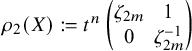
$\rho _2(X) := t^n \begin {pmatrix} \zeta _{2m} & 1 \\ 0 & \zeta _{2m}^{-1} \end {pmatrix}$
 . For all
$k \geq 0,$
. For all
$k \geq 0,$
 we thus have

Let
$\rho _2(Y):=t^m \begin {pmatrix} \zeta _{2n} & 0 \\ q & \zeta _{2n}^{-1} \end {pmatrix}$
 . Noting that
$\rho _2(Y) = P (\rho _2(Y))_{q=1} P^{-1}$
. Noting that
$\rho _2(Y) = P (\rho _2(Y))_{q=1} P^{-1}$
 , where
$P=\begin {pmatrix} 1 & 0 \\ 0 & q \end {pmatrix}$
, where
$P=\begin {pmatrix} 1 & 0 \\ 0 & q \end {pmatrix}$
 , we get that for all
$k\geq 0$
, we get that for all
$k\geq 0$
 ,
,

Setting
$M_X=\rho _2(X)$
 and
$M_Y=\rho _2(Y),$
and
$M_Y=\rho _2(Y),$
 we then have:
-
• $M_Y^n = - t^{nm} I_2=M_X^m.$
-
• For all $1 \leq k \leq m-1$
(resp. for all
$1\leq k \leq n-1$
), the matrix
$M_X^k$
(resp.
$M_Y^k$
) satisfies assumption
$2$
(resp.
$3$
) of Proposition 1.1 (observe that
$[\zeta _{2\ell }]_k=0$
if and only if
$\ell $
divides k).


By Proposition 1.1, we thus get that
$\rho _2$
 is faithful.
Remark 4.1 (Specializing t or q to
$1$
)

Specializing t to
$1$
 yields a representation of
$G(n,m)$
yields a representation of
$G(n,m)$
 which is not faithful since
$(\rho _2(Y))_{t=1}^n = - I_2 = (\rho _2(X))_{t=1}^m$
which is not faithful since
$(\rho _2(Y))_{t=1}^n = - I_2 = (\rho _2(X))_{t=1}^m$
 , hence
$(\rho _2(Y))_{t=1}$
, hence
$(\rho _2(Y))_{t=1}$
 and
$(\rho _2(X))_{t=1}$
and
$(\rho _2(X))_{t=1}$
 have finite order while X and Y have infinite order inside
$G(n,m)$
have finite order while X and Y have infinite order inside
$G(n,m)$
 . The question of whether the above representation with q specialized at
$1$
. The question of whether the above representation with q specialized at
$1$
 is faithful or not seems interesting; if
$n=m=3$
is faithful or not seems interesting; if
$n=m=3$
 , then the representation is not faithful as setting
$A:=(\rho _2(X))_{q=1}$
, then the representation is not faithful as setting
$A:=(\rho _2(X))_{q=1}$
 and
$B:=(\rho _2(Y))_{q=1}$
and
$B:=(\rho _2(Y))_{q=1}$
 , one checks that
$ABAB=BABA$
, one checks that
$ABAB=BABA$
 , while
$XYXY\neq YXYX$
, while
$XYXY\neq YXYX$
 inside
$G(3,3)$
inside
$G(3,3)$
 (to see this, one can use the fact that
$\langle X, Y \ \vert \ X^3 = Y^3 \rangle $
(to see this, one can use the fact that
$\langle X, Y \ \vert \ X^3 = Y^3 \rangle $
 is a Garside presentation of
$G(3,3)$
is a Garside presentation of
$G(3,3)$
 , hence, the monoid with the same presentation embeds into
$G(3,3)$
, hence, the monoid with the same presentation embeds into
$G(3,3)$
 ; both elements
$XYXY$
; both elements
$XYXY$
 and
$YXYX$
and
$YXYX$
 lie in this submonoid, and differ inside it). For
$n=2$
lie in this submonoid, and differ inside it). For
$n=2$
 and
$m=3$
and
$m=3$
 , we do not know whether it is faithful or not. It seems reasonable to expect the representation to not be faithful if n and m are not coprime, but for coprime n and
$m,$
, we do not know whether it is faithful or not. It seems reasonable to expect the representation to not be faithful if n and m are not coprime, but for coprime n and
$m,$
 we do not have a clear idea of what to expect, leading to the following question.
Question 4.2. Assume that n and m are coprime. Does the representation
$X \mapsto (\rho _2(X))_{q=1}$
 ,
$Y \mapsto (\rho _2(Y))_{q=1}$
,
$Y \mapsto (\rho _2(Y))_{q=1}$
 stay faithful?
4.3. A Burau representation for some torus knot groups
In this section, we shall assume that
$n, m\geq 2$
 are coprime and that m is not divisible by
$3$
are coprime and that m is not divisible by
$3$
 .
.
Let
$a, b\in \mathbb {Z}$
 be such that
$an-bm=1$
be such that
$an-bm=1$
 . Consider the matrices

where
-
• $U= \zeta _{4m}^{3m-2} + \zeta _{4m}^{3m+2} = \zeta _{4m}^{3m-2} - (\zeta _{4m}^{3m-2})^{-1}$
. -
• $U^{\prime } = U + \lambda _1 + \lambda _2$
, where
$\lambda _1= \zeta _{4m}^{3m-6}$
and
$\lambda _2= \zeta _{4m}^{3m+6}$
. Note that
$\lambda _2 = - \lambda _1^{-1}$
. -
• $V= -1 - \zeta _{m} - \zeta _{m}^{-1}$
if
$m> 2$
, and
$-1$
otherwise. Since
$m\neq 3,$
we have
$V \neq 0$
. Note that
$U^{\prime } U + V^2 = 1$
. -
• $\mu _1= \zeta _n$
and
$\mu _2=\zeta _n^{-1}$
. -
• For $k\in \mathbb {Z}$
,
$[\boldsymbol {\lambda }]_k=\frac {\lambda _2^k - \lambda _1^k}{\lambda _2 - \lambda _1}$
, and
$[\boldsymbol {\mu }^b]_k= \frac {\mu _2^k - \mu _1^k}{\mu _2^b - \mu _1^b}$
. Note that
$[\boldsymbol {\lambda }]_0=0$
,
$[\boldsymbol {\lambda }]_1=1=[\boldsymbol {\lambda }]_{-1}$
, and
$[\boldsymbol {\lambda }]_k=0$
if and only if m divides
$3k$
, if and only if m divides k since we assumed that
$3$
does not divide m. In particular,
$[\boldsymbol {\lambda }]_a\neq 0$
since
$(a,m)=1$
. Similarly, we have
$[\boldsymbol {\mu }^b]_k=0$
if and only if n divides
$2k$
. -
• $A_k= q^{-1} U^{\prime } [\boldsymbol {\lambda }]_a + q^{-1} [\boldsymbol {\lambda }]_{a-1} - \mu _k^b$
(where
$k\in \{1,2\}$
).


Proposition 4.3. Let
$k\in \mathbb {Z}$
 . We have

Proof. Straightforward computation by induction on k.
Proposition 4.4. The above matrices define a representation
$\rho _3$
 of the torus knot group
$G(n,m)=\langle X, Y \ \vert \ X^m = Y^n \rangle $
of the torus knot group
$G(n,m)=\langle X, Y \ \vert \ X^m = Y^n \rangle $
 .
.
Proof. We have
$[\boldsymbol \lambda ]_m=0$
 ,
$[\boldsymbol \lambda ]_{m-1}=(-1)^{m+1} i^m = [\boldsymbol \lambda ]_{m+1}$
,
$[\boldsymbol \lambda ]_{m-1}=(-1)^{m+1} i^m = [\boldsymbol \lambda ]_{m+1}$
 , and
$[\boldsymbol \mu ^b]_n=0$
, and
$[\boldsymbol \mu ^b]_n=0$
 , thus using Proposition 4.3, we get

We now apply Proposition 1.1 to the above-constructed representation, under the further assumption that n is odd.
Proposition 4.5. Let n,
$m\geq 2$
 be coprime and assume that n is odd and that m is not divisible by
$3$
be coprime and assume that n is odd and that m is not divisible by
$3$
 . The above-constructed representation of
$G(n,m)$
. The above-constructed representation of
$G(n,m)$
 is faithful.
Proof. We check the conditions of Proposition 1.1. The first condition was obtained in Proposition 4.4. The second condition is clear from Proposition 4.3, since all the entries of
$t^{-nk} M_X^k$
 are complex numbers,
$V\neq 0$
are complex numbers,
$V\neq 0$
 , and
$[\boldsymbol \lambda ]_k =0$
, and
$[\boldsymbol \lambda ]_k =0$
 if and only if m divides
$3k$
if and only if m divides
$3k$
 , if and only if m divides k since m is not divisible by
$3$
, if and only if m divides k since m is not divisible by
$3$
 . The last condition is also obtained from Proposition 4.3 since
$[\boldsymbol {\lambda }]_a\neq 0$
. The last condition is also obtained from Proposition 4.3 since
$[\boldsymbol {\lambda }]_a\neq 0$
 ,
$[\boldsymbol \mu ^b]_k=0$
,
$[\boldsymbol \mu ^b]_k=0$
 if and only if n divides
$2k$
if and only if n divides
$2k$
 , if and only if n divides k since n is odd.
Remark 4.6.
-
1. Since $G(n,m)\cong G(m,n)$
, in some cases, we get two faithful two-dimensional representations of
$G(n,m)$
. We did not investigate whether these two representations are isomorphic or not in general. Moreover, using this isomorphism, in some cases where the pair
$(n,m)$
does not satisfy the assumptions that n is odd and m is not divisible by
$3$
, we can permute them. Using this, we can define at least one “Burau-like” representation when none of the parameters n and m is divisible by
$6$
. -
2. The above-defined representation is also defined without the assumption that n is odd, but is not faithful in this case: if $n=2n'$
, we have
$[\boldsymbol \mu ^b]_{n'}=0$
, hence
$M_Y^{n'}$
is a scalar matrix, hence it commutes with
$M_X$
, while in
$G(n,m),$
we have
$X Y^{n'} \neq Y^{n'} X$
(arguing, for instance, as in Remark 4.1).


For
$k\in \mathbb {Z,}$
 we have
$[\boldsymbol {\lambda }]_{-k}=(-1)^{k+1} [\boldsymbol {\lambda }]_k$
we have
$[\boldsymbol {\lambda }]_{-k}=(-1)^{k+1} [\boldsymbol {\lambda }]_k$
 . Using Proposition 4.3, we thus have

and setting
$A=q^{-1} U^{\prime } [\boldsymbol {\lambda }]_a + q^{-1} [\boldsymbol {\lambda }]_{a-1}$
 , we have

We calculate
$M_Y^b M_X^{-a}$
 using that
$[\boldsymbol \lambda ]_a^2 - [\boldsymbol \lambda ]_{a-1} [\boldsymbol \lambda ]_{a+1}=(-1)^{a+1}$
using that
$[\boldsymbol \lambda ]_a^2 - [\boldsymbol \lambda ]_{a-1} [\boldsymbol \lambda ]_{a+1}=(-1)^{a+1}$
 ,
$[\boldsymbol \lambda ]_{a} (\lambda _1 +\lambda _2) + [\boldsymbol \lambda ]_{a-1} - [\boldsymbol \lambda ]_{a+1}=0$
,
$[\boldsymbol \lambda ]_{a} (\lambda _1 +\lambda _2) + [\boldsymbol \lambda ]_{a-1} - [\boldsymbol \lambda ]_{a+1}=0$
 and
$V^2 = 1 - U^{\prime 2} +(\lambda _1+\lambda _2)U^{\prime }$
and
$V^2 = 1 - U^{\prime 2} +(\lambda _1+\lambda _2)U^{\prime }$
 . We write

and explicitly determine
$a_{11}, a_{12}$
 , and
$a_{22}$
, and
$a_{22}$
 , which will be enough for our purposes. We have

We thus get that
$M_Y^b M_X^{-a}$
 is of the form

This yields the following lemma.
Lemma 4.7.
-
1. If a is odd, then $(M_Y^b M_X^{-a})_{t=q=1}$
is the matrix of a complex reflection of order
$2$
. -
2. If a is even, then $(M_Y^b M_X^{-a})_{t=1, q=i}$
is the matrix of a complex reflection of order
$2$
.


Proof. For these values of a and specializations, the matrices have the form
$\begin {pmatrix} \pm 1 & 0 \\ \star & \mp 1 \end {pmatrix}$
 , which are matrices of complex reflections of order
$2$
, which are matrices of complex reflections of order
$2$
 .
.
Recall the 2-toric reflection group from Definition 2.4.
Corollary 4.8.
-
1. If a is odd, then $(M_X)_{t=q=1}$
and
$(M_Y)_{t=q=1}$
define a representation of the
$2$
-toric reflection group
$W(2,n,m)$
. -
2. If a is even, then $(M_X)_{t=1, q=i}$
and
$(M_Y)_{t=1, q=i}$
define a representation of the
$2$
-toric reflection group
$W(2,n,m)$
.


Remark 4.9. The above corollary suggests that, whenever a is odd, the representation
$\rho _3$
 is a “Burau representation” for
$G(n,m)$
is a “Burau representation” for
$G(n,m)$
 . Whenever a is even, it suggests to replace q by
$iq$
. Whenever a is even, it suggests to replace q by
$iq$
 to get a “Burau representation”; it is indeed expected from a generalization of the Burau representation to specialize to the generalization of the dihedral group obtained when
$m=2$
to get a “Burau representation”; it is indeed expected from a generalization of the Burau representation to specialize to the generalization of the dihedral group obtained when
$m=2$
 and n is odd, which is given by the attached
$2$
and n is odd, which is given by the attached
$2$
 -toric reflection group
$W(2,n,m)$
-toric reflection group
$W(2,n,m)$
 . In the examples below, we explore this property by showing that
$\rho _3$
. In the examples below, we explore this property by showing that
$\rho _3$
 indeed generalizes the dihedral Burau representation, and that for the cases
$(n,m)=(3,4)$
indeed generalizes the dihedral Burau representation, and that for the cases
$(n,m)=(3,4)$
 and
$(n,m)=(3,5)$
and
$(n,m)=(3,5)$
 , the same phenomenon appears: in this case,
$G(n,m)$
, the same phenomenon appears: in this case,
$G(n,m)$
 is the complex braid group of the exceptional complex reflection groups
$G_{12}$
is the complex braid group of the exceptional complex reflection groups
$G_{12}$
 and
$G_{22}$
and
$G_{22}$
 , and there should exist a faithful two-dimensional representation deforming the reflection groups. We check that it is what
$\rho _3$
, and there should exist a faithful two-dimensional representation deforming the reflection groups. We check that it is what
$\rho _3$
 does.
does.
We now study some particular cases of the representation that we just constructed.
Example 4.10. Let
$n \geq 3$
 be odd and assume that
$m=2$
be odd and assume that
$m=2$
 . In this case,
$G(n,2)$
. In this case,
$G(n,2)$
 is isomorphic to the Artin group of dihedral type
$I_2(n)$
is isomorphic to the Artin group of dihedral type
$I_2(n)$
 . We have
$U=U^{\prime }=0$
. We have
$U=U^{\prime }=0$
 and
$V=-1$
and
$V=-1$
 . Denoting
$n=2n' + 1,$
. Denoting
$n=2n' + 1,$
 we have
$a=1$
we have
$a=1$
 and
$b=n'$
and
$b=n'$
 . This yields the matrices

Conjugating these two matrices by the matrix
$P=\begin {pmatrix} 1 & 0 \\ 0 & \frac {\zeta _n^{-1}- \zeta _n}{\zeta _n^{n'} - \zeta _n^{-n'}} \end {pmatrix}$
 yields after simplification the two matrices

Recall that, in the notation of Section 4.1, the isomorphism between
$G(n,2)$
 and the dihedral Artin group of type
$I_2(n)$
and the dihedral Artin group of type
$I_2(n)$
 sends Y to
$\sigma _1 \sigma _2$
sends Y to
$\sigma _1 \sigma _2$
 and X to
$\underbrace {\sigma _1 \sigma _2 \dots }_{n~\text {factors}}$
and X to
$\underbrace {\sigma _1 \sigma _2 \dots }_{n~\text {factors}}$
 . Replacing q with
$q^{-1}$
. Replacing q with
$q^{-1}$
 and specializing t to q yields the matrices for the lift of
$w_0$
and specializing t to q yields the matrices for the lift of
$w_0$
 and
$st$
and
$st$
 of the reduced Burau representation of
$I_2(n)$
of the reduced Burau representation of
$I_2(n)$
 , which can also be found in [Reference Lehrer and Xi17, (3.2), (3.3.1), and Proposition 4.1].Footnote
2
We thus get that, when the group is
$G(n,2)$
, which can also be found in [Reference Lehrer and Xi17, (3.2), (3.3.1), and Proposition 4.1].Footnote
2
We thus get that, when the group is
$G(n,2)$
 , the representation
$\rho _3$
, the representation
$\rho _3$
 is isomorphic to the reduced Burau representation of the Artin group of type
$I_2(n)$
is isomorphic to the reduced Burau representation of the Artin group of type
$I_2(n)$
 .
.
Example 4.11 (Burau representation for
$G_{12}$
)

The previous example shows that the representation
$\rho _3$
 is not new when
$m=2$
is not new when
$m=2$
 . The “smallest” case for which our representation is new is the case
$n=3, m=4$
. The “smallest” case for which our representation is new is the case
$n=3, m=4$
 . In this case, the group
$G(3,4)$
. In this case, the group
$G(3,4)$
 is isomorphic to the complex braid group of the exceptional complex reflection group
$G_{12}$
is isomorphic to the complex braid group of the exceptional complex reflection group
$G_{12}$
 . We have
$U=- \sqrt {-2}$
. We have
$U=- \sqrt {-2}$
 ,
$U^{\prime }=0$
,
$U^{\prime }=0$
 ,
$V=-1$
,
$V=-1$
 ,
$a=b=-1$
,
$a=b=-1$
 ,
$[\boldsymbol {\lambda }]_{-2}= U$
,
$[\boldsymbol {\lambda }]_{-2}= U$
 ,
$[\boldsymbol {\lambda }]_{-1}=1$
,
$[\boldsymbol {\lambda }]_{-1}=1$
 , and
$[\boldsymbol {\mu }^{-1}]_{1}=-1$
, and
$[\boldsymbol {\mu }^{-1}]_{1}=-1$
 . This yields the matrices

Specializing q and t to
$1$
 yields matrices generating the complex reflection group
$G_{12}$
yields matrices generating the complex reflection group
$G_{12}$
 . One way to check this is as follows: the group
$G_{12}$
. One way to check this is as follows: the group
$G_{12}$
 has order
$48$
has order
$48$
 , with a reflection presentation given by Presentation (2.1) with
$n=3$
, with a reflection presentation given by Presentation (2.1) with
$n=3$
 ,
$m=4$
,
$m=4$
 , and the additional relations
$x_i^2=1$
, and the additional relations
$x_i^2=1$
 for all i. The
$x_i$
for all i. The
$x_i$
 ’s are reflections and there is only one conjugacy class of reflections. Using Remark 2.5, we get that an alternative presentation of
$G_{12}$
’s are reflections and there is only one conjugacy class of reflections. Using Remark 2.5, we get that an alternative presentation of
$G_{12}$
 is given by
$X^4 = Y^3$
is given by
$X^4 = Y^3$
 and
$(Y^{-1} X)^2=1$
and
$(Y^{-1} X)^2=1$
 , with
$Y^{-1} X$
, with
$Y^{-1} X$
 sent to some
$x_i$
sent to some
$x_i$
 . Since
$M_X$
. Since
$M_X$
 and
$M_Y$
and
$M_Y$
 satisfy the first relation (hence so do their specializations) and
$M_Y^{-1} M_X = M_Y^b M_X^{-a}$
satisfy the first relation (hence so do their specializations) and
$M_Y^{-1} M_X = M_Y^b M_X^{-a}$
 has the form (4.1) hence specializes to a matrix of order
$2$
has the form (4.1) hence specializes to a matrix of order
$2$
 , we get that
$\langle (M_X)_{t=q=1}, (M_Y)_{t=q=1} \rangle $
, we get that
$\langle (M_X)_{t=q=1}, (M_Y)_{t=q=1} \rangle $
 is a quotient of
$G_{12}$
is a quotient of
$G_{12}$
 . But one checks using a computer that this group has order
$48$
. But one checks using a computer that this group has order
$48$
 , we thus obtain an isomorphism and the conjugacy class of the
$x_i$
, we thus obtain an isomorphism and the conjugacy class of the
$x_i$
 ’s is the same as the conjugacy class of
$M_Y^{-1} M_X$
’s is the same as the conjugacy class of
$M_Y^{-1} M_X$
 which is indeed a complex reflection.
Example 4.12 (Burau representation for
$G_{22}$
)

Consider the case
$n=3, m=5$
 . In this case,
$G(3,5)$
. In this case,
$G(3,5)$
 is isomorphic to the complex braid group of the exceptional complex reflection group
$G_{22}$
is isomorphic to the complex braid group of the exceptional complex reflection group
$G_{22}$
 . We have
$U= \zeta _{20}^{13}+\zeta _{20}^{17}$
. We have
$U= \zeta _{20}^{13}+\zeta _{20}^{17}$
 ,
$U^{\prime }=-i$
,
$U^{\prime }=-i$
 ,
$V=\zeta _5^2+\zeta _5^3$
,
$V=\zeta _5^2+\zeta _5^3$
 ,
$a=2, b=1$
,
$a=2, b=1$
 ,
$[\boldsymbol {\lambda }]_{2}= \zeta _{20}^9 + \zeta _{20}$
,
$[\boldsymbol {\lambda }]_{2}= \zeta _{20}^9 + \zeta _{20}$
 , and
$[\boldsymbol {\lambda }]_1={[\boldsymbol {\mu }^1]}_1=1$
, and
$[\boldsymbol {\lambda }]_1={[\boldsymbol {\mu }^1]}_1=1$
 . Since a is even, following Remark 4.9, we replace q by
$iq$
. Since a is even, following Remark 4.9, we replace q by
$iq$
 in the defining matrices, yielding the matrices

As for Example 4.11, specializing q and t to
$1$
 yields matrices generating the complex reflection group
$G_{22}$
yields matrices generating the complex reflection group
$G_{22}$
 : this can be checked in the same way as for
$G_{12}$
: this can be checked in the same way as for
$G_{12}$
 .
.
4.4. Unitarizability
If a is odd, then the representation constructed in Section 4.3 is unitarizable: setting
$J= \begin {pmatrix} 0 & 1 \\ 1 & 0 \end {pmatrix}$
 , it is straightforward to check that
${ }^t\!{\overline {M_X}} J M_X = J$
, it is straightforward to check that
${ }^t\!{\overline {M_X}} J M_X = J$
 and
${ }^t\!{\overline {M_Y}} J M_Y=J$
and
${ }^t\!{\overline {M_Y}} J M_Y=J$
 , where for
$P\in \mathbb {C}[t^{\pm 1}, q^{\pm 1}]$
, where for
$P\in \mathbb {C}[t^{\pm 1}, q^{\pm 1}]$
 , we set
$\overline {P(q,t)}= \overline {P}(-q, t^{-1})$
, we set
$\overline {P(q,t)}= \overline {P}(-q, t^{-1})$
 . Note that in this case, since
$\overline {\lambda _j} = - \lambda _k$
. Note that in this case, since
$\overline {\lambda _j} = - \lambda _k$
 (where
$\{j,k\} = \{1,2\}$
(where
$\{j,k\} = \{1,2\}$
 ),
$\overline {U^{\prime }} = - U^{\prime }$
),
$\overline {U^{\prime }} = - U^{\prime }$
 ,
$\overline { [\boldsymbol {\lambda }]_a} = [\boldsymbol {\lambda }]_a$
,
$\overline { [\boldsymbol {\lambda }]_a} = [\boldsymbol {\lambda }]_a$
 , and
$\overline { [\boldsymbol {\lambda }]_{a-1}} = - [\boldsymbol {\lambda }]_{a-1} $
, and
$\overline { [\boldsymbol {\lambda }]_{a-1}} = - [\boldsymbol {\lambda }]_{a-1} $
 , we have
$\overline {A_j}= A_k$
, we have
$\overline {A_j}= A_k$
 (where
$\{j,k\}=\{1,2\}$
(where
$\{j,k\}=\{1,2\}$
 ).
).
If a is even, then we again replace q by
$iq$
 in the matrices from Section 4.3. For
$P\in \mathbb {C}[t^{\pm 1}, q^{\pm 1}],$
in the matrices from Section 4.3. For
$P\in \mathbb {C}[t^{\pm 1}, q^{\pm 1}],$
 we again set
$\overline {P(q,t)}= \overline {P}(-q, t^{-1})$
we again set
$\overline {P(q,t)}= \overline {P}(-q, t^{-1})$
 . Since
$\overline {\lambda _j} = - \lambda _k$
. Since
$\overline {\lambda _j} = - \lambda _k$
 (where
$\{j,k\} = \{1,2\}$
(where
$\{j,k\} = \{1,2\}$
 ), we still have
$\overline {U^{\prime }} = - U^{\prime }$
), we still have
$\overline {U^{\prime }} = - U^{\prime }$
 , but since a is even, we get
$\overline { [\boldsymbol {\lambda }]_a} = -[\boldsymbol {\lambda }]_a$
, but since a is even, we get
$\overline { [\boldsymbol {\lambda }]_a} = -[\boldsymbol {\lambda }]_a$
 and
$\overline { [\boldsymbol {\lambda }]_{a-1}} = [\boldsymbol {\lambda }]_{a-1} $
and
$\overline { [\boldsymbol {\lambda }]_{a-1}} = [\boldsymbol {\lambda }]_{a-1} $
 . This again yields
$\overline {(A_j)_{q \mapsto iq}}= (A_k)_{q \mapsto iq}$
. This again yields
$\overline {(A_j)_{q \mapsto iq}}= (A_k)_{q \mapsto iq}$
 (where
$\{j,k\}=\{1,2\}$
(where
$\{j,k\}=\{1,2\}$
 ). Then the same matrix J as above yields unitarizability.
5. Hecke algebras of
$2$
-toric reflection groups

Let
$n,m\geq 2$
 with n and m coprime. Let
$\mathcal {A}=\mathbb {Z}[q^{\pm 1}]$
with n and m coprime. Let
$\mathcal {A}=\mathbb {Z}[q^{\pm 1}]$
 .
.
Definition 5.1. The Hecke algebra of the
$2$
 -toric reflection group
$W(2,n,m)$
-toric reflection group
$W(2,n,m)$
 is the associative, unital
$\mathcal {A}$
is the associative, unital
$\mathcal {A}$
 -algebra
$\mathcal {H}(2,n,m)$
-algebra
$\mathcal {H}(2,n,m)$
 with generators
$x_i$
with generators
$x_i$
 ,
$i=1, \dots , n$
,
$i=1, \dots , n$
 and the following relations:
-
• The defining relations of $G(n,m)$
from Presentation (2.1). -
• The relations $x_i^2 = (q^{-2} - 1) x_i + q^{-2}$
, for all
$i=1, \dots , n$
.


In the cases where
$W(2,n,m)$
 is finite, then it is a finite (complex) reflection group W, and this is nothing but the usual (one-parameter) Hecke algebra from [Reference Broué, Malle and Rouquier5], which coincides with the Iwahori–Hecke algebra in the real case. In this case, it is a free
$\mathcal {A}$
is finite, then it is a finite (complex) reflection group W, and this is nothing but the usual (one-parameter) Hecke algebra from [Reference Broué, Malle and Rouquier5], which coincides with the Iwahori–Hecke algebra in the real case. In this case, it is a free
$\mathcal {A}$
 -module of rank
$|W|$
-module of rank
$|W|$
 , with a basis deforming the basis of
$\mathbb {Z}[W]$
, with a basis deforming the basis of
$\mathbb {Z}[W]$
 (obtained by specializing q to
$1$
(obtained by specializing q to
$1$
 ) formed by the elements of the group (see [Reference Marin20] and the references therein). It is tempting to conjecture that it still holds in the infinite case that
$\mathcal {H}(2,n,m)$
) formed by the elements of the group (see [Reference Marin20] and the references therein). It is tempting to conjecture that it still holds in the infinite case that
$\mathcal {H}(2,n,m)$
 is a free
$\mathcal {A}$
is a free
$\mathcal {A}$
 -module with a basis deforming the basis of
$\mathbb {Z}[W(2,n,m)]$
-module with a basis deforming the basis of
$\mathbb {Z}[W(2,n,m)]$
 formed by the elements of the group, but we do not know how to attack such a question since already in the finite case, the proof is case-by-case (see [Reference Marin20] for a detailed list of references).
A Burau representation for complex braid groups should factor through the Hecke algebra. For
$G_{12}$
 and
$G_{22}$
and
$G_{22}$
 studied in the previous section, matrix models for two-dimensional representations of the Hecke algebra of these groups may be found in [Reference Malle and Michel19].Footnote
3
studied in the previous section, matrix models for two-dimensional representations of the Hecke algebra of these groups may be found in [Reference Malle and Michel19].Footnote
3
As a corollary of the previous sections, we can show the following.
Proposition 5.2. Assume that
$n,m \geq 2$
 are coprime, that n is odd, and that m is not divisible by
$3$
are coprime, that n is odd, and that m is not divisible by
$3$
 . Then the group
$G(n,m)$
. Then the group
$G(n,m)$
 embeds into
$\mathcal {H}(2,n,m)^\times $
embeds into
$\mathcal {H}(2,n,m)^\times $
 via
$x_k \mapsto x_k$
via
$x_k \mapsto x_k$
 . In particular, the complex braid groups of
$G_{12}$
. In particular, the complex braid groups of
$G_{12}$
 and
$G_{22}$
and
$G_{22}$
 embed into their one-parameter Hecke algebra.
In the case where
$m=2$
 (and thus n is odd), this is known by the work of Lehrer and Xi [Reference Lehrer and Xi17]: it is the embedding of the Artin group of dihedral type
$I_2(n)$
(and thus n is odd), this is known by the work of Lehrer and Xi [Reference Lehrer and Xi17]: it is the embedding of the Artin group of dihedral type
$I_2(n)$
 inside the corresponding Iwahori–Hecke algebra. For the cases where
$(n,m)=(3,4), (3,5)$
inside the corresponding Iwahori–Hecke algebra. For the cases where
$(n,m)=(3,4), (3,5)$
 , this reformulates into saying that the braid groups of the exceptional complex reflection groups
$G_{12}$
, this reformulates into saying that the braid groups of the exceptional complex reflection groups
$G_{12}$
 and
$G_{22}$
and
$G_{22}$
 embed into their (one-parameter) Hecke algebra.
Proof. We first give a presentation of
$\mathcal {H}(2,n,m)$
 using the generators X and Y of
$G(n,m)$
using the generators X and Y of
$G(n,m)$
 . By Remark 2.5, the defining relations with this set of generators become
$X^m = Y^n$
. By Remark 2.5, the defining relations with this set of generators become
$X^m = Y^n$
 , and
$(Y^b X^{-a})^2 = (q^{-2} - 1)Y^b X^{-a} + q^{-2}$
, and
$(Y^b X^{-a})^2 = (q^{-2} - 1)Y^b X^{-a} + q^{-2}$
 . We now construct a map from
$\mathcal {H}(2,n,m)$
. We now construct a map from
$\mathcal {H}(2,n,m)$
 to
$\mathrm {M}_2(\mathbb {C}[q^{\pm 1}])$
to
$\mathrm {M}_2(\mathbb {C}[q^{\pm 1}])$
 using the representation
$\rho _3$
using the representation
$\rho _3$
 from Section 4.3.
By (4.1), we have that
$\rho _3(Y)^b \rho _3(X)^{-a}$
 has the form

We know that
$X \mapsto \rho _3(X)$
 ,
$Y \mapsto \rho _3(Y)$
,
$Y \mapsto \rho _3(Y)$
 defines a faithful representation of
$G(n,m)$
defines a faithful representation of
$G(n,m)$
 for generic values of q and t. The idea is to build a map
$\psi :\mathcal {H}(2,n,m) \longrightarrow \mathrm {M}_2(\mathbb {C}[q^{\pm 1}])$
for generic values of q and t. The idea is to build a map
$\psi :\mathcal {H}(2,n,m) \longrightarrow \mathrm {M}_2(\mathbb {C}[q^{\pm 1}])$
 such that, composing with the map
$\varphi $
such that, composing with the map
$\varphi $
 from
$G(n,m)$
from
$G(n,m)$
 to
$\mathcal {H}(2,n,m)$
to
$\mathcal {H}(2,n,m)$
 sending every
$x_k$
sending every
$x_k$
 to itself, we recover
$\rho _3$
to itself, we recover
$\rho _3$
 . By faithfulness of
$\rho _3$
. By faithfulness of
$\rho _3$
 , this will yield the injectivity of
$\varphi $
, this will yield the injectivity of
$\varphi $
 .
.
Since
$\rho _3$
 defines a representation of
$G(n,m)$
defines a representation of
$G(n,m)$
 for generic values of q and t, it suffices to make choices such that the above matrix has the form
$\begin {pmatrix} q^{-2} & 0 \\ \star & -1 \end {pmatrix}$
for generic values of q and t, it suffices to make choices such that the above matrix has the form
$\begin {pmatrix} q^{-2} & 0 \\ \star & -1 \end {pmatrix}$
 . This can be achieved as follows:
-
• If a is odd, say $a = 2 \ell + 1$
, then if
$\ell $
is odd, setting
$t=q$
yields a matrix of the above form. If
$\ell $
is even, then replacing t by
$-t$
, and then setting
$t=q$
yields a matrix of the required form. -
• If a is even, say $a= 2 \ell $
, then if
$\ell $
is even, replacing q by
$iq$
and t by
$-t$
, then setting
$t=q$
yields a matrix of the above form. If
$\ell $
is odd, replacing q by
$iq$
and then setting
$t=q$
also yields a matrix of the required form.


We need to justify that under the various specializations made, the modified representation of
$G(n,m)$
 into
$\mathrm {GL}_2(\mathbb {C}[q^{\pm 1}])$
into
$\mathrm {GL}_2(\mathbb {C}[q^{\pm 1}])$
 is still faithful. Let
$M_X', M_Y'$
is still faithful. Let
$M_X', M_Y'$
 denote the matrices obtained from
$M_X, M_Y$
denote the matrices obtained from
$M_X, M_Y$
 after replacing q by some element in
$\{q, iq\}$
after replacing q by some element in
$\{q, iq\}$
 and t by some element in
$\{t, -t\}$
and t by some element in
$\{t, -t\}$
 according to the above rules depending on the parities of a and
$\ell $
according to the above rules depending on the parities of a and
$\ell $
 . Since
$M_X$
. Since
$M_X$
 and
$M_Y$
and
$M_Y$
 satisfy the relations
$M_X^m = M_Y^n$
satisfy the relations
$M_X^m = M_Y^n$
 for generic values of q and t, it is clear that we still have
$(M_X')^m =(M_Y')^n$
for generic values of q and t, it is clear that we still have
$(M_X')^m =(M_Y')^n$
 . Moreover, it is clear that the matrices
$M_X'$
. Moreover, it is clear that the matrices
$M_X'$
 and
$M_Y'$
and
$M_Y'$
 still satisfy assumptions
$(2)$
still satisfy assumptions
$(2)$
 and
$(3)$
and
$(3)$
 of Proposition 1.1. Hence, by the latter,
$M_X'$
of Proposition 1.1. Hence, by the latter,
$M_X'$
 and
$M_Y'$
and
$M_Y'$
 still define a faithful representation of
$G(n,m)$
still define a faithful representation of
$G(n,m)$
 and their specialization to
$t=q$
and their specialization to
$t=q$
 as well.
We thus have that
$X \mapsto (M_X')_{t=q}$
 ,
$Y \mapsto (M_Y')_{t=q}$
,
$Y \mapsto (M_Y')_{t=q}$
 is a faithful representation of
$G(n,m)$
is a faithful representation of
$G(n,m)$
 factoring through
$\mathcal {H}(2,n,m)$
factoring through
$\mathcal {H}(2,n,m)$
 , whence the result.
Acknowledgements
The idea to construct Burau representations for torus knot groups grew up in February 2022 while I was attending the semester program Braids at ICERM (Providence). I thank ICERM and the organizers for the invitation and financial support. I thank Igor Haladjian for useful discussions and comments on a preliminary version of this work. I also thank Eddy Godelle, Abel Lacabanne, Ivan Marin, Hoel Queffelec, and Emmanuel Wagner for useful discussions. Finally, I thank an anonymous referee for insightful comments.
Funding statement
The author declares that no specific funding has been received for this article.


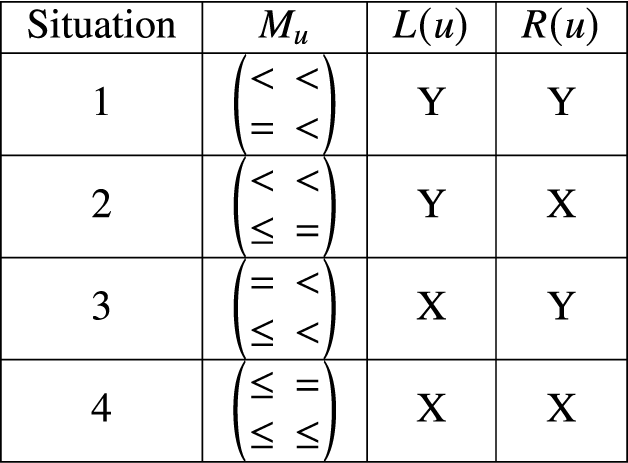

 Open access

