


Social group living is a fundamental survival strategy employed from birth. Newborn infants instinctively seek and maintain affiliative bonds with adult caregivers who provide care and protection. These human capacities are subserved by the ‘social brain’ whose function is to navigate the complexities of social interaction. When children have difficulties in one or more aspects of social interaction, the impact on development and mental health can be immense. Also, disordered social interactions play a pervasive role in many, if not all, psychiatric disorders. It has been further suggested that these disorders may result as much from an ‘interaction mismatch’ across persons as from the breakdown of individual brains.Reference Schilbach1 Yet the most promising recent efforts to improve psychiatric diagnoses – through blood tests, neuroimaging, genetics or ‘digital phenotyping’Reference Insel2 – have continued to focus on the individual to the neglect of social interactional deficits. Meanwhile, the burgeoning field of social neuroscience has already established the feasibility of investigating the concurrent social behaviour of two (or more) interacting participants.Reference Leong, Byrne, Clackson, Harte, Lam and Wass3–Reference Wass, Noreika, Georgieva, Clackson, Brightman and Nutbrown5 Here, we contend that the neurobehavioural study of social interactions – or interaction-based ‘sociometrics’ – holds much promise for developmental psychology and psychiatry, particularly as a tool for identifying disorders in the social domain, improving diagnostic procedures and providing quantitative outcome measures that could be used to track treatment progress and success.
Imagine walking into a child developmental clinic of the future. Your infant is brought into a play room where electroencephalogram (EEG) electrodes are placed on her scalp to measure brain activity, and electrocardiogram electrodes on her chest measure heart rate and arousal. These electrodes wirelessly transmit her neural and physiological signals to the monitoring station next door. A microphone is buttoned onto her vest and motion capture cameras track her movements and posture. Each toy is equipped with eye-tracking software that dynamically monitors your child's gaze patterns as she switches her attention from one toy to the next. Next, a psychologist, who is similarly equipped with measurement devices, walks into the room and manoeuvres the social interaction through different phases, each designed to elicit a different social response. High-performance computers then analyse the complex data-set, using powerful machine learning algorithms. But rather than focusing on your child's individual data, these algorithms extract sociometrics that quantify how your child relates to the psychologist, as illustrated in Fig. 1. Some sociometric indices lie within the typical range for children her age, but other indices may be less typical – such as the way she tends to avert her gaze from direct eye contact and has a sluggish neural synchronisation with (and faster decoupling from) the psychologist's brain activity patterns.
Illustration of interaction-based sociometric data collection and analysis. (Left) Examples of different sociometric indices that may be concurrently collected from the infant (top) and adult (bottom) during social interaction. (Right) Examples of interaction-based sociometric analyses to identify temporal contingencies and statistical dependencies between infant and adult indices, such as joint gaze (top) and neural synchrony (bottom). Written consent has been provided for the use of these images. EEG, electroencephalogram.
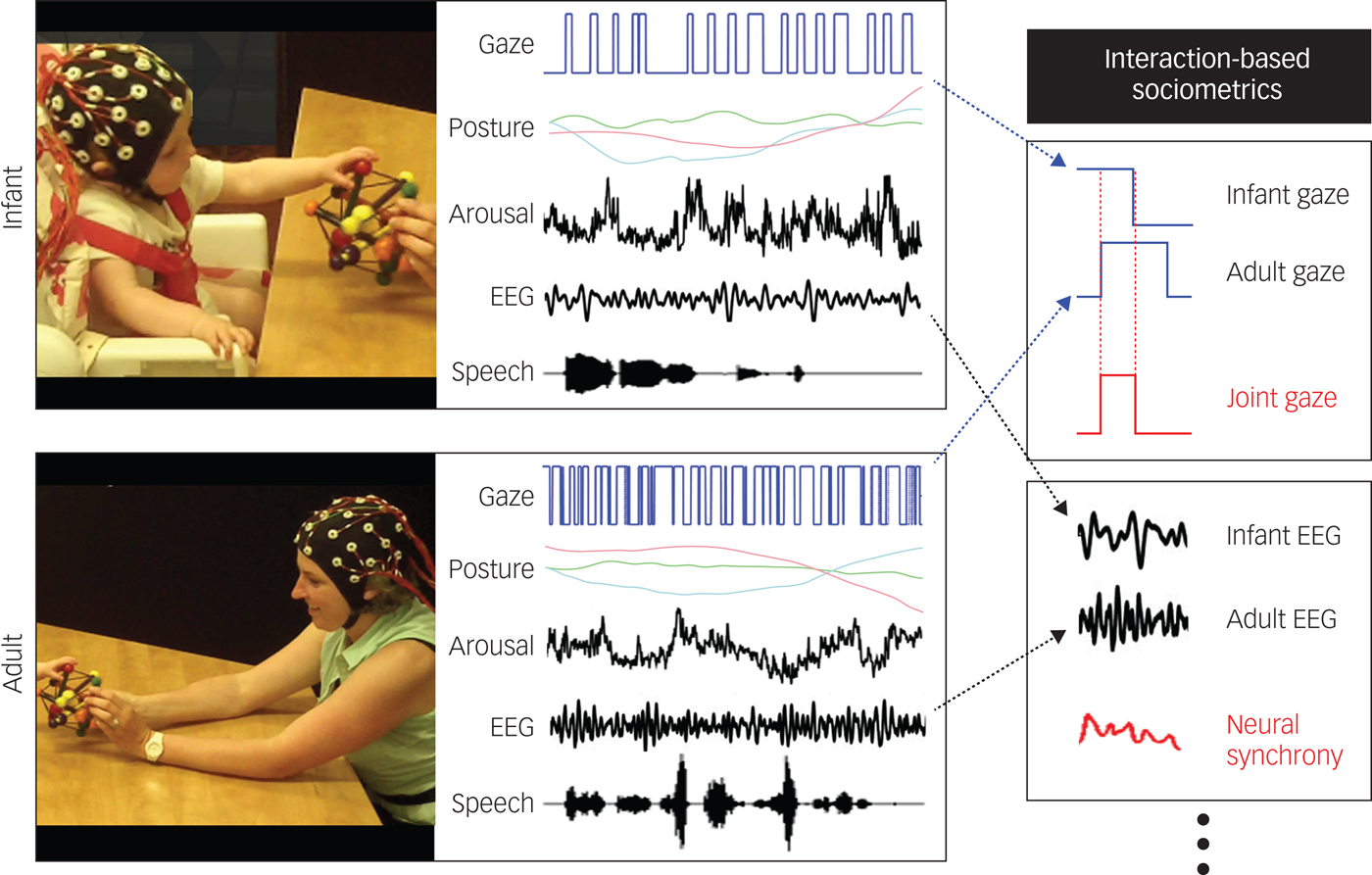
Accordingly, in our view the promise of interaction-based sociometrics is that this approach may lead to earlier, more sensitive identification of abnormalities in social development. Although social observation scales and instruments currently exist to diagnose different conditions (such as the Autism Diagnostic Observation Schedule and Early Social Communication Scales), these rely heavily on the assessor's subjective judgement, experience and training. Similarly, outcome measures in clinical trials are often dependent on the observer, which has been recognised as an important limitation in the area of neurodevelopment. Further, some key aspects of social behaviour are not captured by these tests, such as gaze, postural or neural changes. Meanwhile, findings are emerging from the field of social neuroscience that speak directly to this gap in knowledge. Even very subtle shifts in the social interactional status within dyads produce changes in inter-individual neural synchrony when participants are engaged in reciprocal and freely forming interaction. For example, Leong et al Reference Leong, Byrne, Clackson, Harte, Lam and Wass3 showed that a brief aversion of the adult's eye gaze was sufficient to produce a significant and reliable drop in neural synchronicity between adult–infant pairs, even when no overt changes in infants' own eye gaze patterns were detected.
A second benefit of the sociometric approach is its potential to advance a mechanistic understanding of social interaction difficulties throughout the lifespan. Psychiatric disorders are ubiquitously characterised by social impairments, and it has been suggested that they can be characterised as disorders of social interaction.Reference Schilbach1 Consequently, the contingency of social interaction between partners (rather than the independent behaviour of a patient) may be a novel and quantitative measure that could inform transdiagnostic assessments of social impairment in psychiatry, and may even predict interaction success between patient and therapist. For example, Bilek and colleaguesReference Bilek, Stößel, Schäfer, Clement, Ruf and Robnik4 recently showed that, in borderline personality disorder, cross-brain connectivity in control–patient dyads was significantly lower as compared with control–control dyads. However, for remitted patients, cross-brain connectivity was restored. Interaction-based measurements, therefore, deliver state-associated biomarkers that may help to guide diagnostic and therapeutic procedures in the future. There is also immense potential for sociometric methods to be used to study human interactions in a more ecological and naturalistic manner – capturing everyday social behaviour in homes, schools or work environments. For example, one recent studyReference Wass, Noreika, Georgieva, Clackson, Brightman and Nutbrown5 used a sociometric approach to investigate the contingency of mothers' and infants' neural activity and gaze while they were playing together or separately in a naturalistic environment. The authors used wireless EEG technology to concurrently monitor parents' and infants' brain activity, which provided greater freedom for dyadic interaction. The study found that when parents played together with their infants, parental brain activity tracked and responded to their infants' looking behaviour. Further, when the parent's neural activity was more responsive to their child, the infant's attention was sustained for longer. This novel demonstration of ‘neural scaffolding’ by parents illustrates the utility of the sociometric approach for studying natural human interaction dynamics.
Several major challenges currently limit the use of sociometric indices as envisioned. One significant technical challenge is the quantitative assessment of interpersonal movement kinematics and their impact on other measured biological signals, such as the introduction of movement artefacts into the measured EEG signal. To address this, new automated tracking tools are needed to support more sensitive motion detection and correction. Similarly, benchmarks for more stringent control in two-person experimental setups need to be established. A second major challenge pertains to the statistical analysis of interactional data. Standard approaches used in stimulus–response tasks fail to capture the complex and interdependent nature of social interaction behaviour. Consequently, new conceptual and statistical solutions need to be established: Here, interaction-based sociometrics could make a significant contribution by providing an objective quantification of the ongoing behaviour of individual partners, as well as their mutual temporal contingencies such as joint gaze and neural synchrony. These statistical dependencies, which can be formulated in Bayesian terms, could reveal not only infants' level of responsiveness to adult behaviour, but adults' responsiveness to infants as well, which may have relevance for conditions such as maternal postnatal depression.
Therefore, an interaction-based sociometric approach combined with new methods for the analysis of interactional contingencies may provide new insights into the neurobehavioural mechanisms of social interaction, as well as powerful new tools for characterising disorders of social interaction during early development and across the lifespan, which may help to improve diagnostic procedures in psychiatry and could provide objective measures of treatment success.




eLetters
No eLetters have been published for this article.