


4.1 Introduction
While traditional support for the Social Democrats used to be firmly rooted in the industrial working classes, and social democratic party programs prioritized their interests, both the composition of the social democratic electorate and its programmatic appeal seem to have changed (Karreth et al. Reference Karreth, Polk and Allen2013; Gingrich and Häusermann Reference Gingrich and Häusermann2015; Abou-Chadi and Wagner Reference Abou-Chadi and Wagner2019). As discussed in the introduction of this volume, as a consequence of these developments social democratic parties are increasingly considered middle-class parties. In light of the transformation of the social structure of knowledge societies due to educational and occupational upgrading, we ask to what extent the current middle-class support for the Social Democrats is a legacy of early-life socialization in traditional working-class milieus, in the context of the family. Looking ahead, we ask: what would that imply for social democratic parties’ capacity to retain these voters in the long term, given patterns of occupational change? Which parental classes of origin increase support for the left in their offspring for younger generations?
Party competition in Western Europe has also increased due to the emerging success of radical right parties – with a support base among traditional working classes (Oesch Reference Oesch2008a) – and the growth of green and left-libertarian parties with a strong middle-class electoral base. This implies that, especially in PR systems, mainstream parties of the Left and Right face greater competition between and within ideological blocs(as evidenced in Chapters 3, 6 and 7 in this volume). Previous studies have identified the consequences of post-industrialization on cleavage politics and electoral alignments (Kriesi et al. Reference Kriesi, Grande, Lachat, Dolezal, Bornschier and Frey2008; Beramendi et al. Reference Beramendi, Häusermann, Kitschelt, Kriesi, Beramendi, Häusermann, Kitschelt and Kriesi2015) as well as the changes in the composition of the electorate of social democratic parties (Kitschelt Reference Kitschelt1994; Gingrich and Häusermann Reference Gingrich and Häusermann2015). These findings have direct implications for the relevance of social class for political behaviour in general, and Social Democracy in particular, as the core supporters of the Social Democrats are no longer the industrial workers, but increasingly socio-cultural professionals (SCPs) and other middle-class voters (Oesch and Rennwald Reference Oesch and Rennwald2018), also referred to as the new middle class.
However, what these studies do not consider is the intergenerational class mobility that current generations of middle-class voters may have experienced and the relevance of parental class of socialization. Due to processes of post-industrialization, specifically occupational and educational upgrading, many voters with working-class roots now find themselves in the middle class (Fernández-Macías Reference Fernández-Macías2012; Oesch Reference Oesch2013). We investigate to what extent the current levels of left-wing support among the working and middle classes are a legacy of these individuals having been socialized in a traditional social democratic milieu, the industrial working class, in the context of their families. Moreover, we ask what this parental legacy might mean for future levels of party support, given the numerical decline of the working class. If contemporary party support for the Left in general – and the Social Democrats in particular – is still heavily dependent on socialization in parental (working) class of origin, what does that imply for younger generations? Are new legacies being built by the new (middle-class) strongholds of the Left, that will sustain future levels of support? To answer these questions, we analyse support for the Social Democrats in contrast to other party families by parental class of origin and patterns of social mobility, for different generations in Western Europe, using European Social Survey (ESS) data from five rounds and for nineteen countries.
The results of our analyses indeed demonstrate a remaining legacy of parental class of origin in current party support. Respondents differ in their support for different party families depending on parental social class – irrespectively of their current class position. In the left field, social democratic parties receive higher support from voters socialized in the working classes, while green and left-libertarian parties are mostly supported by the offspring of SCP. Even though SCPs form a contemporary class base of the Social Democrats, being socialized in this class is not associated to relatively greater support for these parties, but rather for other left-wing alternatives. Taken together, we demonstrate that the legacy of workers’ social democratic support is passed on to the next generation, while among younger generations, SCPs only generate this legacy for the green and left-libertarian, and radical left party family. To a large extent, contemporary social democratic support from the SCP hinges on their working-class origins, while this class does not display patterns of remaining socialization into lasting social democratic support for future generations. The analyses by generations reveal a particularly strong social democratic legacy among voters with working-class origins in older generations, unparalleled by other effects of parental class of origin among younger generations. This speaks to a uniquely strong influence of past industrial alignments.
These findings contribute to the comparative literature on post-industrial class voting by demonstrating the lasting working-class legacy that still operates in the contemporary middle-class support for the Social Democrats. However, the fact that we do not find a similarly strong legacy through socialization of younger generations within the newer class constituency of the SCP implies that this particular intergenerational legacy is weakening. At the same time, there is no evidence for a general trend of dealignment, as parental class of origin continues to influence party preference also along post-industrially realigned patterns. What we conclude is that the lasting impact of class of origin among younger generations might be more geared towards socialization in the broader left field rather than specific to social democratic parties. This could potentially lead to more volatility in class–party alignments within the Left.
4.2 Theoretical Framework
In recent decades, substantive scholarly evidence has shown altered patterns of cleavage politics and corresponding electoral realignment in Western Europe due to processes of globalization, the expansion of the welfare state, educational upgrading, or the tertiarization of the occupational structure (Kriesi et al. Reference Kriesi, Grande, Lachat, Dolezal, Bornschier and Frey2008, Reference Kriesi, Grande, Dolezal, Helbling, Höglinger, Hutter and Wüest2012; Beramendi et al. Reference Beramendi, Häusermann, Kitschelt, Kriesi, Beramendi, Häusermann, Kitschelt and Kriesi2015; Oesch and Rennwald Reference Oesch and Rennwald2018). Within this literature, a strong focus has been placed on explaining new patterns of class voting in post-industrial societies (Houtman et al. Reference Houtman, Achterberg and Derks2008). Production workers are regarded the ‘old’ preserve of the Social Democrats but in most countries still show above-average support for the Left (Oesch Reference Oesch2008b). SCPs (and to a lesser extent service workers), on the other hand, appear as a new core electorate of social democratic parties (Kriesi Reference Kriesi1989; Güveli et al. Reference Güveli, Need and Dirk de Graaf2007; Oesch and Rennwald Reference Oesch and Rennwald2018). In light of these developments, social democratic parties have increasingly become ‘middle-class parties’ due to the changed composition of their electorate, in particular the decline of the working-class vote (Kitschelt Reference Kitschelt1994; Gingrich and Häusermann Reference Gingrich and Häusermann2015).
However, not only the size of the social democratic working-class electorate has decreased, the blue-collar working class itself has experienced a strong numerical decline, which is identified as one of the drivers for the declining electoral performance of social democratic parties (Benedetto et al. Reference Benedetto, Hix and Mastrorocco2020). Post-industrial transformations of the occupational structure, due to educational expansion and technological change, have altered the composition of the class structure and classes’ relative sizes. These developments have generally led to occupational upgrading and the growth of the service sector (Oesch Reference Oesch2006), albeit with variations across countries. Specifically, these post-industrial changes have materialized in a decline in low- and unskilled industrial jobs and a growth of professionals and low-skilled workers in the service sector (Wright and Dwyer Reference Wright and Dwyer2003; Oesch and Rodríguez Menés Reference Oesch and Menés2010; Fernández-Macías Reference Fernández-Macías2012, Oesch Reference Oesch2013). While the manufacturing sector has declined throughout whole Western Europe, countries in Northwestern Europe have particularly experienced fast occupational upgrading. In Anglo-Saxon and Southern European countries, on the other hand, post-industrialization has mainly led to polarization of the occupational structure, with a growth of low-skilled service sector jobs.
This means that, in a post-industrial context, we observe particular patterns of intergenerational social mobility in which growing post-industrial (middle) classes hold a different class location than their parents (Oesch and Rodríguez Menés Reference Oesch and Menés2010; Oesch Reference Oesch2013). Particularly relevant for our argument is the fact that consequently, many middle-class citizens have parents who were production workers (and as such, have experienced upward intergenerational social mobility). We relate these intergenerational trajectories to current patterns of class voting, by asking to what extent the middle-class support for social democratic parties is in part a continued legacy of socialization in the parental working classes.
Given the fact that the production workers were the traditional stronghold of the Left during the industrial era, with a strong collective class identity, we expect that generations socialized in that environment display a certain ‘stickiness’ of those partisan allegiances and are particularly more likely to support social democratic or other leftist parties. The field of political socialization identifies the parental home as the main socializing environment for the development of political preferences and behaviour during individuals’ ‘impressionable years’ (Sigel Reference Sigel1965; Jennings and Niemi Reference Jennings and Niemi1968; Percheron and Jennings Reference Percheron and Kent Jennings1981; Neundorf and Smets Reference Neundorf and Smets2017), of enduring influence until later in life (Jennings et al. Reference Jennings, Stoker and Bowers2009). Social learning is identified as a main explanation for this transmission process (Jennings and Niemi Reference Jennings and Niemi1968; Bandura Reference Bandura1977), as well as the inheritance of socioeconomic class and status (Beck and Jennings Reference Beck and Kent Jennings1982; Glass et al. Reference Glass, Bengtson and Chorn Dunham1986). In the latter mechanism, parents transmit a structural position or subjective identification therewith (Curtis Reference Curtis2016), which is linked to specific political preferences. In this framework, we expect that both mechanisms regarding the transmission of party preferences and the transmission of subjective class identity contribute to a so-called legacy of being socialized in the production working class for later partisan preferences – even after having experienced intergenerational social mobility to a middle-class position. Socialization in a working-class milieu may not only have distinct implications by generations as they have been socialized during different periods with corresponding stages of political alignment and realignment but also across countries. As such, we expect a stronger legacy of a working-class background in Anglo-Saxon and Northwestern European countries, as they are marked by stronger industrial class–party alignments compared to Southern Europe (Knutsen Reference Knutsen, Dalton and Klingemann2007; Evans and Tilley Reference Evans and Tilley2017).
We thus ask to what extent we can observe a continued impact of class of origin – independently from the class of destination – on partisan preferences among generations socialized under different contexts of party–class alignments: from older generations socialized in an industrially aligned opposition between a left-wing working class and a right-wing middle class, to younger generations in which class–party links have realigned. Who ‘continues’ (in intergenerational terms) to vote for the Left, in a context of increasing competition among different party families? Studying intergenerational mobility in a period in which party alignments have shifted entails that the party system in which individuals were socialized as young adults (in the context of their family) is likely to differ from the party system they face at the time of voting. Hence, even if parental class of origin might be a strong determinant of respondents’ class and party identification, these determinants of the vote might be affected by the configuration of the partisan supply at the time of voting. In the UK, for instance, working-class vote for the Labour party has decreased (mostly in favour of abstention) even if workers’ levels of identification with this class have remained constant (Evans and Tilley Reference Evans and Tilley2017). Hence, even a strong working-class and left-wing intergenerational attachment could be ‘demobilized’ if the supply side does not address workers’ demands at the time of voting. The analyses discussed later can get at some of these potential trends by comparing the impact of parental class of origin and respondents’ own class at the time of voting.
Moreover, related to contemporary patterns of class voting and the decline of the production working class, we ask what this would mean for future levels of party support among younger generations. If current levels of party support for the Left in general – and the Social Democrats in particular – are heavily dependent on socialization in parental class of origin, what does that imply for younger generations? Are new ‘legacies’ being built by the new stronghold of the Left, the SCP, that will sustain future levels of support?
4.3 Research Design
4.3.1 Data
The questions guiding this chapter pose quite high demands in terms of the data required to address them. To be able to assign individuals to their own and their parental social class, we need detailed information on their employment status and occupation, as well as their parents’ occupation when respondents were young. Therefore, we rely on data from ESS, merged with ESS-DEVO data (Ganzeboom Reference Ganzeboom2013) that provides a recoding of the answers to the open-ended question asking about parental occupation into four-digit ISCO codes. This is only available for ESS rounds 1–5, hence restricting our analyses to the period 2002–10. Our analytic sample consists of respondents aged 18 and over (eligible to vote) with information on their current occupation and parental occupation when respondents were young. We restrict the analysis to respondents from West European countries (nineteen in total), because occupational transformations and the structure of party competition differs for post-communist democracies. These countries are grouped into Northwestern Europe, Southern Europe, and Anglo-Saxon countries. In a second step of the analyses, when we zoom in on whether current patterns of class voting may be generating new ‘realigned legacies’ of left-wing support among the offspring of SCP, we restrict the analyses to the Northwestern European sample. Scandinavian and Continental European countries display stronger patterns of electoral realignment and, hence, represent a better sample to address the future of intergenerational transmission of left-wing support. In spite of this focus, additional analyses on all countries indicate that the trends here identified are largely consistent across Western Europe.
4.3.2 Variables and Operationalization
Our dependent variable captures whether the respondent voted for one of the following party families in the last national election: social democratic, green and left-libertarian, radical left, moderate right, and radical right, or other party families (including regionalist, agrarian and religious parties). For the recoding of party choice into these party families, we rely on the classification provided by the Chapel Hill Expert Survey. To characterize the full choice set, we also include a category for abstention, for respondents who indicate not having voted in the last national election. This means that our dependent variable for party choice is categorical, with seven non-ordered response categories. To facilitate interpretation, we restrict the presentation of the results to those outcome categories that are meaningful in the respective analyses (i.e. we frequently exclude abstention and ‘other parties’), but all categories are included in the model estimations.
The main independent variables are respondents’ class of origin and class of destination. Four-digit ISCO codes of occupations are used to classify occupations in different social classes. To minimize the number of observations without an assigned social class, we code class of the respondent based on their occupation and, when this is missing or the respondent is not in employment (as their main activity) we rely on partner’s class location, when the respondent is cohabiting with them. To code parental class, we rely on father’s occupation when the respondent was fourteen years old. If this information is missing (because the father was absent, not working, or because there is no information on his occupation), we rely on mother’s occupation. For the operationalization of social class, we use a simplified version of the Oesch eight-class scheme (Oesch Reference Oesch2006) – presented in Table 4.1, where the shaded cells indicate the six (aggregated) class categories used in the analyses.
| Interpersonal work logic | Technical work logic | Organizational work logic | Entrepreneurial work logic | |
|---|---|---|---|---|
| Middle class | Socio-cultural (semi-) professionals (University) teachers, journalists, social workers, medical doctors | Technical (semi-) professionals Engineers, architects, safety inspectors, computing professionals | (Associate) managers Public/business administrators, financial managers, tax officials | Large employers & self-employed professionals Firm owners, lawyers, accountants |
| SCP | TCP | OMC | ||
| Working class | Service workers Children’s nurses, cooks, shop assistants | Production workers Carpenters, assemblers, machinists, gardeners | Office clerks Secretaries, call centre employees, stock clerks | Small business owners (≤9 or no employees) Shop owners, hairdressers, farmers |
| Workers | CLERKS | SBO | ||
Note: Shaded cells indicate authors’ categories of (aggregated) classes used in the analyses.
We combine some of the classes into fewer categories because our main interest is in the class constituencies of the Left: the production and service workers – aggregated into ‘workers’ – and the SCPs. The old middle class (OMC) is operationalized by aggregating managers, self-employed professionals and large business owners and serves as a point of comparison in the analysis, as it represents a typical moderate right-wing constituency. Technical professionals (TCP) are kept separately as some research indicates that they are more left-leaning than the OMC (but less so than the SCP) (Kitschelt and Rehm Reference Kitschelt and Rehm2014). Office clerks (CLERKS) and small business owners (SBO) are kept as separate classes in the analyses without a specific partisan profile. The aggregation of certain classes simplifies the high number of potential intergenerational transitions between social classes, when we focus on different combinations of class of origin and destination, and their support for different party families. A respondent is socially mobile when their class of origin is different than their class of destination. To investigate our expectations regarding patterns of socialization and social mobility, specific combinations of class of origin and class of destination are used as categories of independent variables in the second set of analyses.
The analyses distinguish four generations of respondents: the silent generation (born 1928–45), baby boomers (1946–64), gen X (1965–80), and millennials (1981–96). While the silent generation and baby boomers have been socialized during periods of industrial alignments, the two younger generations have been socialized during post-industrialization periods. The median birth year in our sample is 1959 (mean: 1957); the 99th percentile is 1988. This means that most respondents are baby boomers, and that for the millennials, only relatively older respondents of that generation are included.
Control variables are included for gender, age, and marital status. To investigate whether part of the intergenerational transmission of left-wing support could act through a higher likelihood of being unionized, additional analyses (not shown) have been estimated that control for trade union membership of the respondents. The results remain unchanged with this additional control variable; so the figures here presented are based on the more parsimonious specification.
4.3.3 Analyses
Modelling the probability of voting for different parties or abstaining requires fitting a discrete choice model for non-ordered responses. Because not all respondents face the same choice set across the different countries under consideration (not all party families are represented in all countries), we implement a multinomial conditional logistic regression model that allows for varying individual alternative choice sets (Thurner Reference Thurner2000; Weber Reference Weber2011). To facilitate the interpretation of the results, and to avoid having to interpret log-odds relative to a reference category, we present the results from these analyses either as average predicted probabilities or as average marginal effects (AMEs) on probabilities. Standard errors are adjusted at the party-system (country) level to account for the different choice sets.
We estimate two sets of analyses. First, we analyse differences in party support by parental class of origin (and class of respondent, for comparison), using the OMC as a reference category. We further study differences in these patterns by estimating the model separately for the three geographical regions in Western Europe and four generations of respondents. These models are relatively restrictive because they include both class of origin and class of respondents in the same model, to estimate its impact net of each other. Second, we study how specific patterns of intergenerational social mobility (combinations of class of origin and class of destination) explain differences in party family support. We thereby focus specifically on transitions into the SCP and transitions out of the SCP (the latter for the two youngest generations of respondents only, because socialization in the SCP is less frequent among older generations). As mentioned earlier, this second set of analyses is restricted to North Western Europe, as the class–party realignment that this chapter builds on has started earlier there than in other regions within Western Europe.
4.4 Results
4.4.1 Party Family Support by Class of Origin and Class of Destination
Before presenting differences in party family support by class of origin, we present descriptive analyses of the class composition of the electorate, as the regression models we present next do not account for the size of the relative classes. Figure 4.1 displays the class composition of the electorate of different party families, for class of origin, and class of destination, respectively. The results indicate substantive differences in the class composition of the electorate of different party families (as already documented extensively by existing research), but, more importantly, that this heterogeneity is also manifested by class of origin (parental class). Differences between the class composition by class of origin and class of destination display the trends of occupational upgrading and tertiarization of the post-industrial employment structure, as well as the realignment of social classes and parties.
Composition of electorates of party families by respondents and parental class
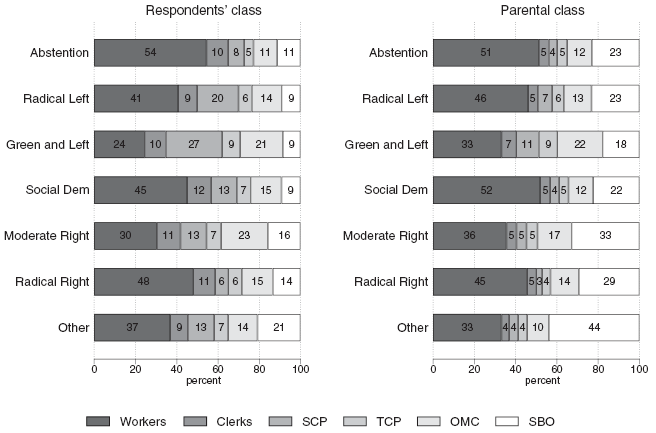
First, focusing on the composition of the electorates by class of destination (offspring class), it shows that social democratic parties rely to a large extent (45%) on support from production and service workers. The middle-class electoral base of the Social Democrats is also substantial with one-third (35%, the total of SCP, TCP, and OMC), but the green and left-libertarian parties rely much more on middle-class support (total of 57%, vs. 24% from workers), especially from SCP (27%). This relatively large middle-class social democratic support is in line with the changes in the electorate of Social Democracy documented in earlier work (Gingrich and Häusermann Reference Gingrich and Häusermann2015) and discussed in the introduction of this volume. Compared to the other party families, the Social Democrats rely more on working-class support than moderate right parties, or radical left parties. However, we see an even greater weight of workers’ support among the radical right and abstention categories (close to, or over 50%).
Second, we ask to what extent the support base of the Social Democrats stems from voters with working-class backgrounds in the parental class. When we contrast the foregoing figures with the composition of the electorate by class of origin rather than class of destination, 52 per cent of social democratic party support stems from offspring from workers (mainly production workers). Compared to other categories, the proportion of the social democratic electorate coming from a working-class background is similar to that of abstention, and larger than the one of the Radical Right. Radical left and green and left-libertarian parties also rely on substantial support from offspring from workers (respectively, 46% and 33%), but less so than the Social Democrats. Especially the green and left-libertarian parties have a relatively larger support base from middle-class offspring than the Social Democrats (42% compared to 21%).
Taken together, one of the most important conclusions is that social democratic parties draw over-proportionally on support from the offspring of the working class. By comparison, in their electoral base by class of destination, the support base among workers is lower, and among the middle class is higher. By class of destination, workers form a larger part of the support base of the Radical Right (or abstention). These differences can be attributed to compositional effects: due to the transformations of the occupational structure, class sizes differ in the parental and offspring class, which account for the differences in the composition of the electorate by class of origin compared to class of destination. This is most clearly illustrated by the large fraction of offspring of workers across all parties, compared to that by class of destination.
Put simply: many contemporary middle-class voters have a working-class background, which explains differences in the class base of parties between the two analyses. Class–party realignments and intergenerational social mobility thus go together in explaining change in the class base of parties in general, but the Social Democrats in particular. For the Social Democrats, middle-class voters currently comprise one-third of their electorate. The fraction of the electorate with a middle-class background is only likely to increase in the future, as the offspring of these middle-class voters are more likely to hold middle-class than working-class positions. What does that mean for the support for the Social Democrats in the long run? Are they able to retain the support of middle-class voters without the ‘legacy’ of the working class? We will focus on this question in the multivariate analyses.
Next, we present results of our regression analyses predicting party family support by class of destination and class of origin, respectively net of each other, with added control variables. In Figure 4.2, AMEs of support (reference: OMC) for the five party families of interest are displayed for our categories of social class of origin and destination. First, focusing on class of destination (respondent’s class), the results indicate some patterns of class voting documented by earlier research, showing that social class is associated with support for different party families. However, not all classes differ in support for the five party families of interest. Regarding the social democratic party family, workers, SCP, and TCP show similarly higher support levels than the OMC. Concerning green and left-libertarian parties, the new middle classes – particularly the SCP – show higher levels of support, while the working classes show much lower support than the OMC. This is the exact opposite pattern of what we observe for the Radical Right: relatively higher support from workers and lower support from the SCP. Support for the Moderate Right also shows a clear class pattern: the highest support comes from the OMC, as all other class categories show lower support levels.
AMEs of respondents and parental class on support for party families (reference category: OMC)
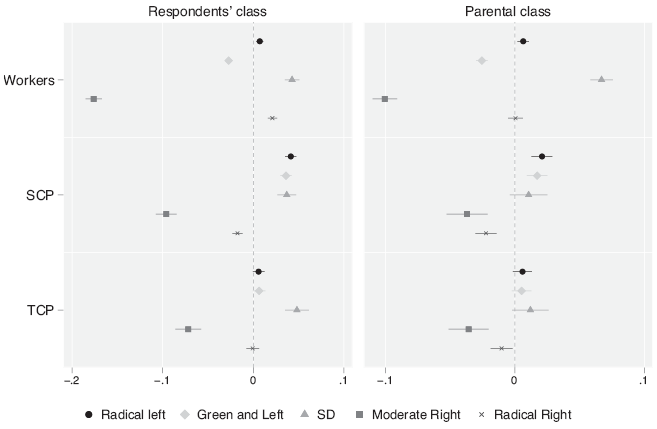
Second, when comparing support levels by class of destination with those by class of origin, some interesting differences and similarities in social democratic support become apparent, while support for other party families does not show many noticeable differences. Levels of social democratic support are quite similar across class of origin and destination when it comes to working-class voters and voters with working-class roots. However, social democratic support from offspring from SCP is not different from offspring from OMC, while the difference with working-class offspring is quite large. On the other hand, offspring of SCP and current SCP show similarly high support for green and left-libertarian parties. Offspring of SCP are also relatively more likely to support the Radical Left, a party family with a typically strong economically left-wing agenda – even to a greater extent than the offspring of workers. Given the trend of occupational upgrading, these findings may point at the fact that the relatively high social democratic support among contemporary SCP is mainly a legacy of their working-class background – and will decrease in next generations. Patterns of socialization in the SCP parental class of origin seem, however, to be related to left-wing support, but rather for green and left-libertarian and radical left alternatives. We take up the question of the SCP legacy further in Section 4.4.2, after we focus on differences in the effect of class of origin across regions and between generations of respondents.
In Figure 4.3, we present the AMEs of class of origin separately for the three regions of Western Europe. Northwestern Europe is the largest group of countries in our sample and therefore displays lower standard errors than the other two regions. The patterns across the three regions are relatively similar and mirror largely those from Figure 4.2, but there are some relevant differences. First, as expected, in Northwestern Europe we observe a relatively strong legacy of socialization in a working-class environment for left-wing support, particularly the Social Democrats. In the other two regions, we observe this as well, but the contrasts with an OMC background are smaller. Second, like concluded from Figure 4.2, having SCP roots does not have a similar effect as having working-class roots does (they do not show different levels of social democratic support than those with OMC roots, across all regions). However, in Northwestern Europe, socialization in the SCP does predict higher green and left-libertarian support, compared to socialization in the OMC. The fact that this difference is not present in the other two regions demonstrates the earlier transformation to post-industrial class–party realignments in Northwestern Europe, which is the reason why subsequent analyses focus on this region only.
AMEs of parental class (reference category: OMC) on support for party families, across geographical regions
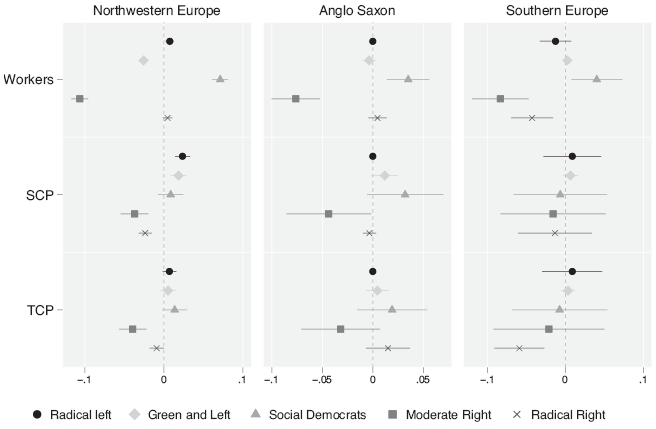
The results presented in Figures 4.2 and 4.3 suggest that parental class of origin generates a legacy in party leaning that persists over time and continues to influence offspring’s electoral behaviour, even net of respondents’ own class location. Moreover, some of the differences in the impact of parental class of origin and respondents’ class seem to indicate that current class–party alignments differ from those prevalent in the past. This is to be expected given the fast pace of post-industrial realignment. As different studies have manifested, the core electorates of left-wing parties have substantially changed over the past few decades (Gingrich and Häusermann Reference Gingrich and Häusermann2015; Benedetto et al. Reference Benedetto, Hix and Mastrorocco2020), and what were once their natural electoral preserve – workers – are now increasingly contested by radical right parties (Oesch and Rennwald Reference Oesch and Rennwald2018). This changing alignment between social class and parties could also affect the socialization into a specific partisan leaning. To illustrate this with an example, the kind of working-class left-wing legacy that was built in the 1960s – and the impact of socialization into this milieu – might take on very different nature in the early 2000s, as workers have increasingly realigned with the Radical Right. To explore this possibility, we disaggregate the effect of parental class of origin by different generations: from silent generation respondents to millennials.
Figure 4.4 presents AMEs of parental class of origin on support for different party families by generations. All coefficients indicate deviations from the reference category, offspring from the OMC. This figure presents some varying patterns of how the impact of class of origin differs across generations, which are exemplary for trends of realignment in which the class base of particularly parties on the left has changed. Focusing on parties in the left field and their core electorates, we observe that among voters from the silent generation there is a clear social democratic working-class legacy. Voters with working-class origins are almost 10 per cent more likely to vote for this party family than OMC offspring, while a similar impact is not visible for SCP offspring. On the contrary, the latter appear less likely to vote social democratic than voters with OMC roots. At the same time, a weak left-wing legacy in terms of support for radical left or green and left-libertarian parties is apparent for the offspring of SCP already in the silent generation.
AMEs of parental class (reference category: OMC) on support for party families, across generations, for Northwestern Europe
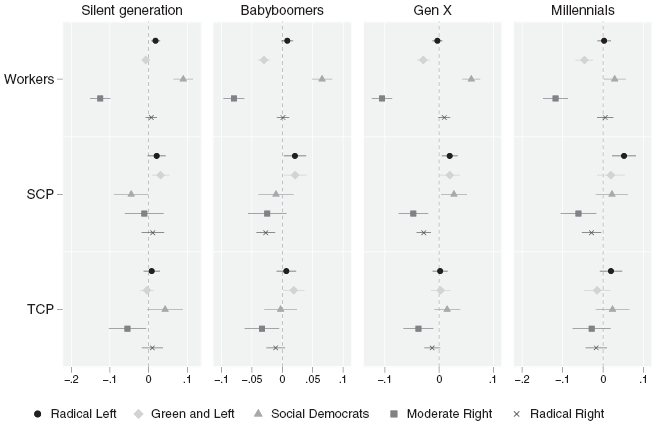
The picture, however, is quite different if we focus on gen X or millennial respondents, for whom patterns of class–party realignment are reflected in the impact of class of origin of new strongholds of the Left. In these younger generations, we find evidence for a left-wing legacy among the offspring of SCP, for all three party families in the left field. This points at offspring of SCPs having been socialized into generalized support for left-wing parties, from the Radical Left and the Green Left, to the Social Democrats. For millennials, some of these differences are not statistically significant, but this could be partly attributed to the lower frequency of observations in this generation. The fact that SCP offspring is not only more supportive of the New Left but also of the Radical Left compared to OMC offspring, displays a trend of increasing support for the Left in general, with a corresponding decline in support for the Moderate Right. This marks an increasing distinction of socialization in the OMC compared to the new middle class, the SCP. As some of the left-wing legacy becomes stronger for the offspring of SCP as we move to younger generations, we observe a parallel decline in these allegiances among workers’ offspring. In fact, among millennials, offspring of workers are as likely to vote social democratic as offspring of SCP. Interestingly, among the children of workers, we observe an increasing contrast in the lower likelihood to support green and left-libertarian parties in comparison to the offspring of the OMC.
While the left-wing impact of having a working-class origin appears to have diminished for younger generations, we do not observe a parallel increase in favour of a radical-right legacy. Moreover, the lower probability of voting for the Moderate Right among workers’ offspring (in comparison to the OMC) appears quite stable over generations. Hence, it appears that working-class origins have somewhat ‘de-aligned’ from the Left, but there has not been a parallel ‘realignment’ in support for the Right. Among SCP offspring, we do, however, find evidence of left-wing realignment, because, as explained earlier, support for the left field is higher among younger generations with this background. Among the offspring of TCP, we find little evidence of changing alignments. Their electoral preferences resemble those of the OMC across all generations.
Focusing on long-term legacies of left-wing support, these analyses clearly highlight that the kind of social democratic legacies apparent for the offspring of workers in older generations are not replicated for any other classes or generations. While SCP could be building a new left-wing legacy among its offspring (rather for green and left-libertarian and radical left alternatives), this is in no way comparable to the strong parental effects visible for silent generation respondents with working-class roots. This speaks to a certain unique imprint of having a working-class origin among older generations that is not replicated in current realigned patterns of class-party linkages.
4.4.2 Party Family Support by Patterns of Intergenerational Social Mobility
Previous analyses have shown relevant differences in party support across parental class of origin and respondents’ own class of destination but did not consider these two in conjunction with each other. Therefore, we now model specific combinations of class of origin and destination. To more precisely investigate to what extent the left-wing support of current SCP is contingent on their working-class background and explore whether a new model of SCP support is sustainable in the long run, we estimate regression models by different patterns of intergenerational social mobility. For the purpose of our analysis, we specifically focus on transitions into and out of the SCP class. In Figure 4.5, we present results for the former. The graphs display predicted levels of party family support.
Average predicted levels of support for party families by patterns of intergenerational mobility for Northwestern Europe (focus: into SCP)
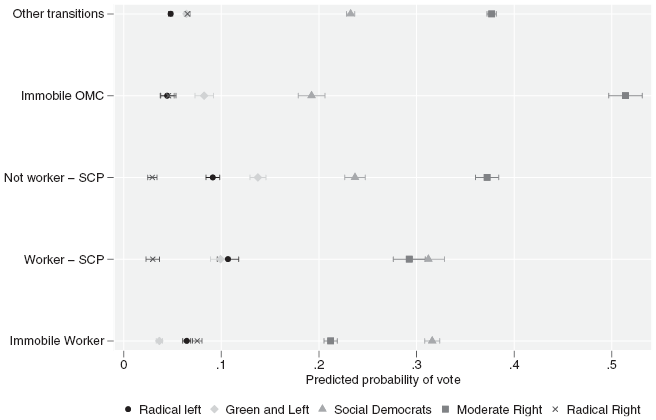
When comparing the social democratic support from SCP with and without a working-class background, it shows that SCP with working-class origins are not only more likely to support the Social Democrats, they also show a lower likelihood of voting for the Moderate Right. Hence, a working-class background is associated to a more distinct left-wing allegiance. Only immobile workers are less likely to support the Moderate Right compared to SCP with working-class roots – showing a certain pattern of so-called acculturation to the SCP class of destination (de Graaf et al. Reference De Graaf, Nieuwbeerta and Heath1995). Interestingly, SCP with a working-class background and intergenerationally immobile workers show similar levels of social democratic party support. In what concerns other types of left-wing allegiances, a working-class background aligns SCP more with radical left parties, and less so with green and left-libertarian parties. Hence, this working-class legacy appears more strongly related to party families pertaining to the left bloc on the economic dimension (rather than on the societal dimension).
When considering the different categories from the immobile OMC to the immobile workers, each category shows a decreasing level of support for the Moderate Right, and increasing support for the Social Democrats. While among immobile workers support for the Social Democrats is higher than support for the Moderate Right, this pattern is reversed for SCP with a non-working-class origin. Processes of adaptation to the class of destination for SCP mean that the Moderate Right is a direct competitor from the Social Democrats in the support from this class. In the long run, these results may point at decreasing social democratic support in the future, when the legacy of a parental working class is reduced over time by patterns of occupational upgrading. Other left-wing parties and the Moderate Right, on the other hand, hold relatively higher levels of support from SCP without working-class roots, a class that is likely to become larger over time.
In Figure 4.6, we explore the potential legacy of the SCP – the class displaying among the highest levels of social democratic and other left-wing party support – towards the next generation, by asking how being socialized in this class predicts levels of party support. To approximate what future patterns of intergenerational transmission of preferences might entail, we reduce the sample to the two youngest generations in the sample (Gen X and Millennials). These results need to be interpreted as a tentative answer to our question, since relatively few individuals have been socialized in the SCP (class of origin), compared to the current size of this class (as class of destination), and therefore the size of the sample is reduced (which also explains the larger confidence intervals). The findings indicate that those socialized in the SCP that moved to a different middle-class position (OMC) – a common transition of intergenerational social mobility in the post-industrial era – are not very likely to support the Social Democrats, displaying similar levels of social democratic support as the immobile OMC, and lower than the immobile SCP. These findings, together with the high support for the Moderate Right, mainly point at a process of acculturation to the class of destination.
Average predicted levels of support for party families by patterns of intergenerational mobility among Gen X or Millennial respondents for Northwestern Europe (focus: out of SCP)
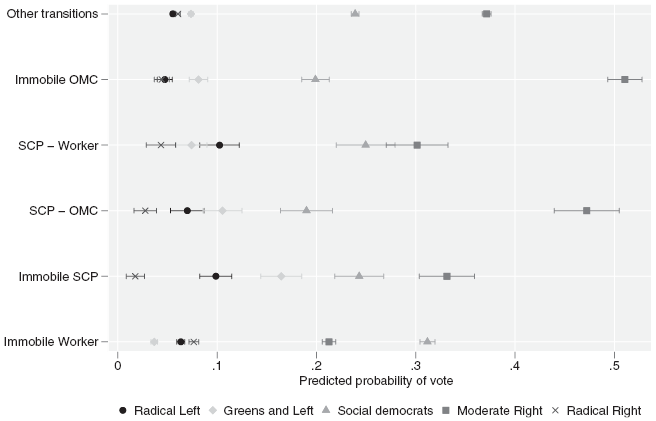
If we focus on other parties within the left-wing bloc, we see some indications of a slightly stronger left-wing legacy among SCPs offspring, but not to the extent of the left-wing alignment we observe among intergenerationally immobile SCPs. The immobile SCPs display highest support levels of all classes for the green and left-libertarian parties and the Radical Left. The probability to vote for these parties is lower for SCP-origin voters in the OMC but remains slightly larger than those displayed by the intergenerationally immobile OMC. We observe similar patterns among workers with SCP roots: they show higher green and left-libertarian and radical left support than immobile workers. These results are an indication of modest SCP-origin socialization effects, when offspring holds a different class. If being socialized in the SCP has any left-leaning legacy, it seems like its allegiance lies more with the Radical Left and green and left-libertarian parties, than with the Social Democrats.
Taken together, these findings indicate that, as the offspring of workers are likely to become less numerous over time, the same goes for the legacy of this class in retaining social democratic (and other left-wing party) support, predicting likely lower levels of social democratic support among future generations.
4.5 Discussion
In this chapter, we set out to study the extent to which different parties, particularly within the left, are successful in mobilizing the offspring of key social class electorates. The interest in parental class of origin and intergenerational class mobility stems from the recent transformations in the social structure and the importance of early political socialization in the family environment. The two lead us to expect that current patterns of class–party alignments are, in part, grounded on a legacy of socialization in an older class structure.
While several studies have documented, separately, a process of occupational upskilling and increasing support for the left among the middle classes, none of them have addressed whether this left-wing turn among professionals is dependent on them having been socialized in the working class in the context of their families. Our analyses suggest that this is, to a large extent, the case in Western democracies. The parental class of origin appears to exert a lasting impact on party preferences beyond individuals’ own class trajectories. Our analyses suggest that, indeed, many professionals have their roots in the working class and that social democratic parties draw their vote over-proportionally from the offspring of the working class.
Analyses predicting the impact of parental class of origin on left-wing party vote (net of respondents’ own class of destination) indicate that workers’ offspring are more likely to vote for the Social Democrats, while those with SCP roots are more likely to support other left-wing parties. While results are relatively similar across regions in Western Europe, we observe this pattern most strongly in Northwestern Europe, countries with early shifts to post-industrialization and corresponding class–party alignments. The comparison of class of origin and destination effects returned another interesting finding: while SCP are as likely as workers to vote for the Social Democrats when considering class of destination, this pattern is not replicated by parental class of origin. Hence, in terms of the ‘legacy’ that left-wing parties are able to mobilize, Social Democrats are able to ‘retain’ the vote from offspring from workers, while the alternative left is more successful in retaining those with SCP roots.
By disaggregating analyses by generations, we sought to approximate what post-industrial class–party realignments entail for the intergenerational transmission of party allegiances. This also allowed us to look into the future and identify the kind of intergenerational legacies that are being built in the present. Generational differences in how parental class of origin relates to political preferences tell a story of progressive dealignment of working-class origins from the Left, while a comparable realignment is not apparent among the offspring of the SCPs – at least in what concerns the strength of this association. The analyses return a particularly strong social democratic legacy for workers’ children in older generations, that is not replicated for other parties of the Left among younger respondents. Moreover, this working-class legacy appears rather related to parties categorized as left-wing on the economic dimension, but not necessarily for socio-culturally liberal parties (like the green and left-libertarian parties). Offspring from SCP, on the other hand, do display relatively higher support for green and left-libertarian and radical left parties. This new left legacy in the SCP parental class is apparent in Northwestern Europe but not replicated in Anglo-Saxon or Southern European democracies. This could be due to post-industrial realignment taking place later in these countries but also to the lower success of challenger left-wing parties in the majoritarian systems that characterize the Anglo-Saxon systems.
Further disaggregating party choice by specific intergenerational class trajectories indicated that support for the Social Democrats is more likely among SCPs with working-class roots, to a level that is similar to that of immobile workers. However, these support levels decrease substantively among these professionals when they have a different class of origin. These analyses provide further evidence for the conclusion that other left-wing parties seem better positioned to mobilize the SCP offspring than the Social Democrats.
Overall, our analyses indicate that early socialization in a social class and specific intergenerational class trajectories are associated with different patterns of electoral behaviour, and that this has varied with class–party realignment. In what concerns support for left-wing parties, the upskilling of the electorate can have important implications for parties’ strategies. Social democratic parties appear equally successful in mobilizing workers and SCPs in the class of destination, but, as the different analyses suggest, this is to a large extent grounded on the working-class origins of SCP. SCPs with different classes of origin are less likely to vote social democratic. Hence, the analyses return a picture of strong industrial legacy, particularly among the older generations.
What do these patterns entail for the future of the Left? First, there are clear signs that the type of intergenerational left-wing attachment present for respondents with working-class origins in older generations is not replicated for the offspring of SCP, nor for workers in younger generations. This would suggest higher levels of electoral volatility. Second, while current SCPs are relatively likely to vote for all left-wing parties – social democratic, green and left-libertarian or radical left, the ‘legacy’ they are likely to build for those socialized in this class is rather in favour of the latter alternatives, not the Social Democrats. It is important to emphasize that this left-wing attachment also includes radical left parties and hence is not exclusively related to socio-culturally left-wing issues. Third, our last analyses zooming in social mobility patterns among younger generations allowed us to identify that while immobile SCP display such left-wing legacy, this is much weaker among respondents socialized in the SCP parental class who moved into an OMC occupation. In sum, the SCP legacy – in favour of green and left-libertarian and radical left parties – is weaker than the one found for working-class offspring, and it is dependent on individuals remaining intergenerationally immobile in the SCP (and dilutes if they move to the OMC). All in all, this suggests a future of weaker (realigned) patterns of lasting socialization in classes of origin.


 Open access