





Impact Statements
This exploratory study examines how Real-Time Energy Feedback (RTEF) systems become embedded in the everyday practices of households with on-site renewable energy generation. It includes participants in pilot retrofit programmes and independent early adopters of RTEF. All households had used RTEF for at least12 months, providing a shared baseline familiarity despite differing adoption pathways. Moving beyond conventional evaluations focused on energy savings, the analysis highlights how RTEF operates as a sociotechnical mediator, reshaping awareness, enabling coordination of household energy practices, and prompting micro-level adjustments in consumption. Findings suggest that RTEF can enhance household capacity to coordinate energy-intensive activities and negotiate thermal comfort, though these capacities remain constrained. RTEF does not itself transform the wider economic, infrastructural, or institutional conditions shaping domestic energy use. Its primary effect lies in augmenting visibility and interpretive capacity, enabling households to better understand energy flows rather than directly altering systems, such as utility costs, access to affordable renewable energy or inefficient housing infrastructure. The study also raises important equality considerations within increasingly decentralised energy systems. Early observations suggest the capacity to engage meaningfully with feedback technologies is closely tied to prior access to assets such as solar PV, battery storage, and the knowledge required to interpret and act on real-time information. This points to a risk that cognitive and material resources may become increasingly important determinants of who can participate effectively in emerging energy configurations involving RTEF technologies. By offering a grounded, micro-level account of how RTEF is lived and negotiated in practice, this study contributes to discussions beyond energy efficiency relevant to debates aligned with key UN Sustainable Development Goals (SDG4, SDG7, SDG10, SDG13). It invites further research into how RTEF systems can be designed and deployed in ways that recognise existing constraints and avoid reproducing inequalities as these technologies scale beyond pilot-based interventions.
Introduction
Reducing household energy demand is a critical component of achieving net-zero goals and strengthening energy security. Real-time energy feedback (RTEF) systems have emerged as a promising intervention in this context, offering households live insights into their consumption patterns and potential cost reductions. Prior research suggests that RTEF can enhance energy literacy and inform decision-making, with reported energy savings of 15–20% under certain conditions (Darby, Reference Darby2006; Abrahamse et al., Reference Abrahamse, Steg, Vlek and Rothengatte2007; Fischer, Reference Fischer2008; Agarwal et al., Reference Agarwal, Garg, Tejaswini, Garg, Srivastava, Mathur and Gupta2023). However, far less is known about its long-term role in everyday life; particularly when integrated with microgeneration technologies like photovoltaic (PV) systems, which are increasingly common in residential retrofits (Fox, Reference Fox2022; Tellarini and Gram-Hanssen, Reference Tellarini and Gram-Hanssen2024). This study does not examine long-term outcomes; rather, it offers an exploratory, practice-based account of how households engage with RTEF after sustained periods of use. This gap is especially salient when considering broader questions of energy entitlement, user autonomy and how households negotiate their relationship with increasingly complex energy systems.
While the underlying logic of energy feedback – that providing information empowers consumers to reflect on and change their energy use – has remained broadly consistent (Vellei et al., Reference Vellei, Natarajan, Biri, Padget and Walker2016), the technological devices and the context in which these systems operate have evolved significantly. Early forms of energy feedback relied on delayed billing mechanisms, offering limited immediacy for users to adjust their consumption (Pallak and Cummings, Reference Pallak and Cummings1976). Contemporary RTEF systems, by contrast, employ a range of digital interfaces, including ambient in-home displays (IHDs) that show live cost-per-hour, mobile apps that send push notifications for consumption spikes and interactive web dashboards for analysing historical trends. These deliver immediate, data-rich insights directly to users (Tiefenbeck, Reference Tiefenbeck2017; Ableitner et al., Reference Ableitner, Tiefenbeck, Meeuw, Wörner, Fleisch and Wortmann2020). This shift towards instantaneity does more than accelerate information delivery; it repositions feedback from a retrospective accounting device to an active reference point that can guide everyday energy practices.
Early feedback initiatives were based on energy security concerns, particularly those prominent during the oil crises of the 1970s (Abrahamse et al., Reference Abrahamse, Steg, Vlek and Rothengatter2005), and assumptions of rational consumer behaviour rooted in behavioural economics (Vellei et al., Reference Vellei, Natarajan, Biri, Padget and Walker2016). In the twenty-first century, the drivers shaping feedback technologies have become more complex, driven by urgent climate mitigation goals, rapid technological innovation and evolving energy policies (Yang et al., Reference Yang, Xia, Huang, Qian, Li, Xu and Chen2024). While earlier interventions primarily promoted energy conservation within fossil fuel-based systems, contemporary feedback is delivered through interactive digital media and is increasingly linked to smart grids, and wider sustainability-related behaviours.
This evolution has also broadened the scope of feedback systems. Modern RTEF increasingly operates alongside distributed energy resources (DERs) such as PV systems and battery storage, enabling households to engage with both sides of the meter through demand response, peer-to-peer energy trading and local grid balancing. However, within comprehensive retrofit programmes, isolating the specific effects of RTEF remains challenging, as observed outcomes are often shaped by concurrent interventions such as insulation upgrades or heating system improvements (Bisello, Reference Bisello2020; Romano et al., Reference Romano, Margani, Mancini and Battisti2023; Vallati et al., Reference Vallati, Nastasi, de Santoli, Grignaffini and Giammarinaro2024).
As homes increasingly become sites of both energy consumption and production (Strengers, Reference Strengers2013; Hargreaves, Reference Hargreaves2018); the nature of energy equity is changing. This means that unequal access to acquiring and operating assets such as solar PV, appliances, electric vehicles, heat pumps and batteries also affects the cognitive and social capital required to acquire, interpret and act upon energy-related information. This is further complicated by whether the home is energy efficient, or not. These concerns sit at the intersection of multiple UN Sustainable Development Goals. Households without PV or interpretive skills may be excluded from decentralised energy benefits, undermining both universal access and equitable participation; key objectives of SDG 7 (Clean Energy) and SDG 10 (Reduced Inequalities). Engaging with RTEF requires interpretation of information flows to enable the micro-level coordination of energy use, which in turn contributes to broader decarbonisation goals. This links to SDG 4 (Digital Literacy) and SDG 13 (Climate Action). However, digital capability is unevenly distributed across populations. This study begins to explore these dynamics by examining how RTEF is domesticated in households with PV installed.
While existing studies address the technical performance of RTEF in DER-rich environments (e.g., Parrish et al., Reference Parrish, Heptonstall, Gross and Sovacool2020; Tushar et al., Reference Tushar, Saha, Yuen, Smith, Ashworth, Poor and Basnet2020), there remains little empirical insight into how these technologies move from novelty to enduring elements of domestic routines over time (Gomez et al., Reference Gomez, Carter, Lee, GhaffarianHoseini, Ghaffarianhoseini, Rahimian and Purushothaman2025). Moreover, the current evidence base is disproportionately shaped by middle-class, technologically literate homeowners. Comparatively little attention is paid to low-income, social housing or digitally excluded households (Thunshirn et al., Reference Thunshirn, Ettwein and Höferl2025). This imbalance suggests that, without careful attention to design and deployment contexts, interventions may risk reinforcing, rather than mitigating, existing energy inequalities (Priesmann et al., Reference Priesmann, ACJ, Zander and Praktiknjo2022). This leaves unresolved questions about how RTEF shapes households’ capacity to interpret and respond to energy information, and how it influences household vulnerability and perceived autonomy within evolving energy systems.
Positioned within these critiques, this exploratory study moves beyond predominantly utilitarian framings that prioritise measurable energy outcomes, often at the expense of lived experience. It examines how households engage with real-time feedback as it becomes embedded in everyday life. Rather than treating RTEF as a technology with predictable behavioural effects, the study focuses on what households do with feedback in practice, and how its integration with DERs shapes situated forms of agency (i.e. interpretation and coordination) and perceived control. Drawing on qualitative insights from 33 participants living in PV-equipped homes, the study offers an initial, in-depth look into how feedback systems and energy infrastructures are interpreted, negotiated and incorporated into daily routines, and how households navigate energy use within existing material and institutional constraints. While the evidence is cross-sectional rather than longitudinal, and thus limited in its ability to trace changes over time, it provides a necessary and valuable foundation for understanding the situated and relational dynamics of RTEF in domestic energy contexts.
To guide this enquiry, actor–network theory (ANT) was adopted as the analytical framework (Latour, Reference Latour2005). ANT is methodologically well suited to this study as it addresses the research question (what is the impact of RTEF?) from a relational perspective, while offering an alternative to dominant utilitarian paradigms that assess feedback technologies primarily through quantifiable energy savings (Darby, Reference Darby2006; Abrahamse et al., Reference Abrahamse, Steg, Vlek and Rothengatte2007; Darby, Reference Darby2020; Chatzigeorgiou and Andreou, Reference Chatzigeorgiou and Andreou2021; Li et al., Reference Li, Zhu, Pan, Xu and Wang2024). Whereas utilitarian approaches conceptualise RTEF as an informational input producing linear behavioural responses, ANT draws attention the relational effects that emerge through interactions among human actors, technologies and material infrastructures (Latour, Reference Latour2005; Sovacool et al., Reference Sovacool, Hess, Amir, Geels, Hirsh, Medina, Miller, Alcorn, Bator, van Veelen, Goedkoop, Karadag, Jones, Jennifer, Srivastava, Kuranova and Robinson2020).
A substantial body of research demonstrates the value of ANT for understanding technological innovations in this relational way (Geels, Reference Geels2010; Harsanto and Permana, Reference Harsanto and Permana2019; Sovacool et al., Reference Sovacool, Hess, Amir, Geels, Hirsh, Medina, Miller, Alcorn, Bator, van Veelen, Goedkoop, Karadag, Jones, Jennifer, Srivastava, Kuranova and Robinson2020; Kivimaa et al., Reference Kivimaa, Boon, Hyysalo and Klerkx2021; Aka, Reference Aka2025). In this study, ANT is used as a lens to understand how RTEF operates not only as a feedback device, but as an actor mediating relationships between households, energy infrastructures and wider systems of provision. This makes it possible to trace how household’s capacity to interpret, coordinate and respond to their energy systems (e.g. in seeking to control their immediate environment, reduce costs or optimise DERs) is shaped through interactions with technologies, such as PV panels, batteries and RTEF displays.
Rather than assuming linear behavioural responses to information, the analysis focuses on how these interactions are negotiated in everyday practice and how roles, responsibilities and expectations are distributed across human and non-human actors. By mapping the socio-technical networks that are assembled, tested and reconfigured over time, this study contributes to debates on the social dimensions of energy transitions, offering a grounded account of how digital energy technologies move from novelty to domestication in everyday life, and how their benefits and limitations are experienced differently across households and contexts.
Methodology
This exploratory, qualitative study examined the retrospective accounts of households who had used RTEF systems. Conducted a minimum of one year after the systems were installed, the study focused on participants’ recollections of how this technology became domesticated (shifting from initial novelty to routine use) within everyday energy practices. The study aims to (a) identify practices and discoveries recalled during RTEF initial use; (b) examine sociotechnical interactions between RTEF and DERs and (c) explore how households perceive RTEF to have influenced their energy awareness and their capacity to coordinate everyday practices.
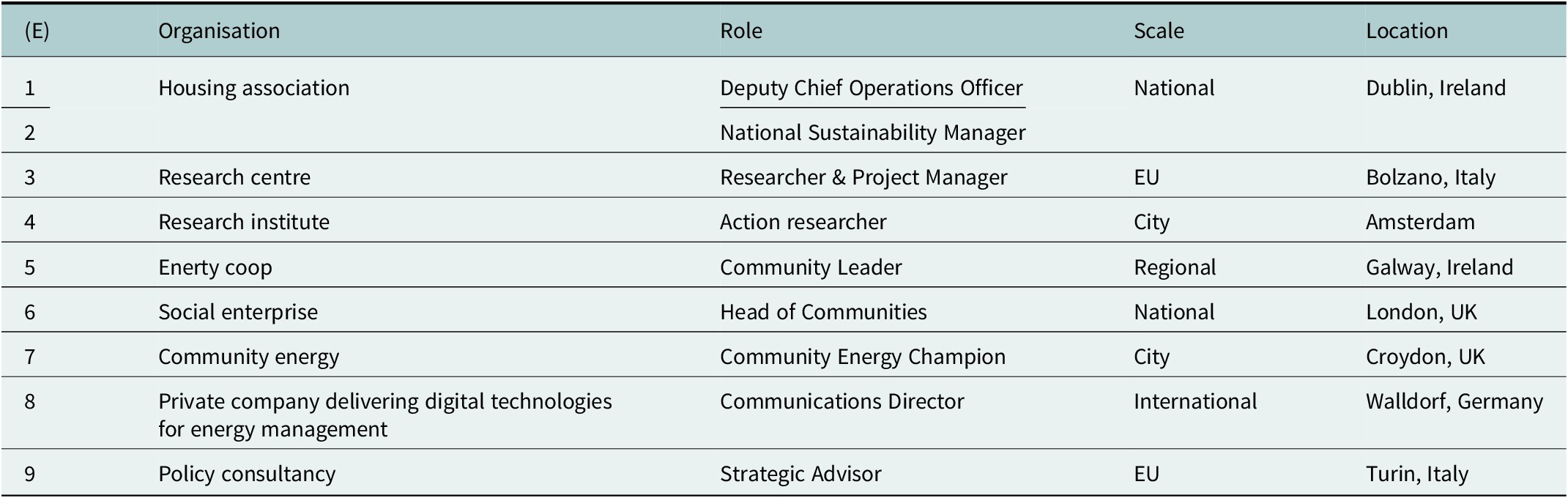
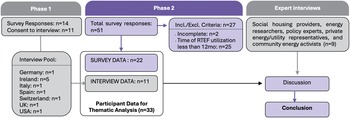
A mixed-mode qualitative design combined surveys and semi-structured interviews across two phases of data collection with households, followed by interviews with experts (see Figure 1). As shown in Table 1, experts included representatives from housing, research, energy cooperatives, policy consultancy and the private sector.
Methodological framework for data collection and analysis.

Expert interviewees and roles
Phase 1 (Exploratory, January–May 2025): Recruitment began with an online survey targeting households that had used RTEF for at least 12 months and in combination with DERs such as solar PV. Participants who provided consent were subsequently invited to take part in a semi-structured interview. This process yielded (n = 14) survey responses, of which (n = 11) participants agreed to be interviewed. Although the respondents were drawn from different countries and regulatory contexts, the purpose of this phase was not cross-national comparison but to surface shared patterns and contrasts in long-term engagement with RTEF across varied socio-technical settings. These accounts informed the refinement of interview prompts and analytical focus in the subsequent phase.
Phase 2 (Geographical-Boundary, June–July 2025): In response to recruitment challenges experienced in Phase 1, the second phase adopted a geographically bounded, community-based approach within Galway city, Ireland. Recruitment was conducted through community centres in Galway, targeting low-income districts involved in energy renovation pilot projects. A structured questionnaire, adapted from the original interview guide, was used to capture accessible yet comparable qualitative data. While this approach offered less narrative depth than semi-structured interviews, it enabled broader participation, particularly among low-income residents who had not been included in Phase 1. This phase yielded (n = 51) responses, of which (n = 22) were deemed valid for analysis.
Expert Interviews (January–July 2025): To complement household perspectives and support analytical interpretation, nine expert interviews (n = 9) were conducted with housing providers, policy specialists, energy researchers, utility representatives and community energy advocates from Ireland, the UK, Italy and Germany (see Table 1). These interviews were not intended to validate household findings but to contextualise them within wider European policy, institutional and technological frameworks. Expert insights informed the analysis of how RTEF and DERs are framed, supported and operationalised across different settings, and helped situate household experiences within broader policy and institutional contexts shaping domestic energy configurations.
Recruitment and participant selection
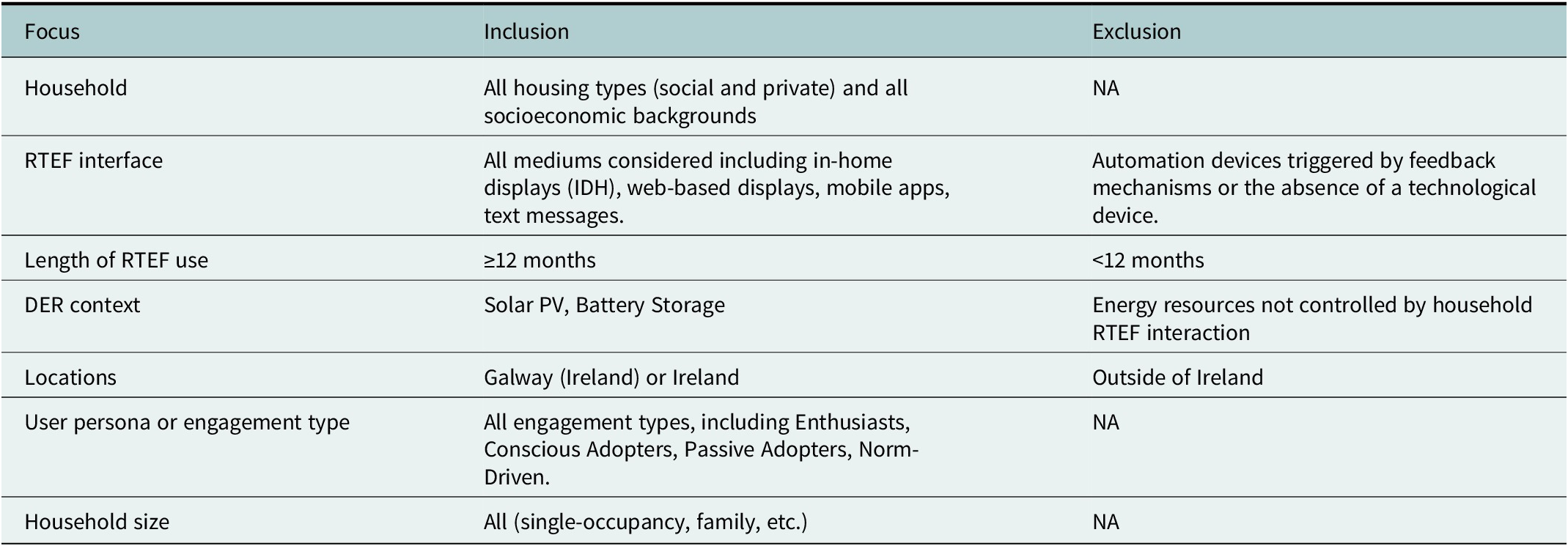
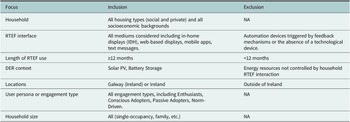
Participant recruitment was guided by inclusion and exclusion criteria (see Table 2). A central requirement was that all participants had used an RTEF system for a minimum of 12 months, ensuring the collected data reflected long-term domestication processes rather than short-term novelty effects. In total, (n = 33) household participants were recruited between January and July 2025 through a combination of online, organisational and community-based outreach strategies. These included sharing a promotional poster and the survey QR code via social media (LinkedIn, Bluesky and X); direct email invitations to social housing providers, community energy groups, university networks and targeted mailing lists such as the Energy Poverty Action Group (ENGAGER) and the fuel poverty research network. In addition, flyers were postered in selected Galway neighbourhoods with high solar PV uptake, including NetZeroCities pilot districts (Shantalla and Westside), and left on public notice boards in local community centres for residents to take away.
Inclusion and exclusion criteria
This sample size is small but sufficient for the study’s exploratory aims. In reflexive thematic analysis, adequacy is determined by information power – not statistical power – meaning the more relevant information a sample holds, the fewer participants are needed (Malterud et al., Reference Malterud, Siersma and Guassora2016). Our focused criteria provided data of sufficient depth, with later interviews confirming thematic saturation.
Participants were inductively profiled into four user engagement types that emerged during early stages of interviews:
-
1. Enthusiasts – actively optimising energy use.
-
2. Conscious adopters – primarily motivated by cost savings.
-
3. Passive adopters – engaging with RTEF as part of a bundled service or intervention.
-
4. Norm-driven adopters – motivated by peer influence or social norms.
In Phase 2, most households were classified as Passive Adopters, having received RTEF through a facilitated Horizon 2020 pilot project (Abrantes, Reference Abrantes2024). A smaller subset of Norm-Driven Adopters joined after observing neighbours’ participation, reflecting social influence dynamics documented in the adoption literature (e.g. Abrahamse and Steg, Reference Abrahamse and Steg2013; Bator et al., Reference Bator, Schultz and Silva2019). This typology was used as an analytical heuristic rather than a predictive model, supporting comparative interpretation of how different adoption pathways shape domestication processes and everyday engagement with RTEF.
Data collection and analysis
Figure 2 outlines the data collection flow. Survey and interview protocols were designed to explore three core dimensions of household experience: motivations for adoption, patterns of engagement over time and perceived benefits and limitations of RTEF. Interviews expanded on these dimensions through two analytical contrasts: expectations versus results (initial perceptions compared with long-term experiences) and awareness versus practices (how feedback was translated, or not, into everyday action).
Participant pool and data collection framework: Survey questions and interview prompts.
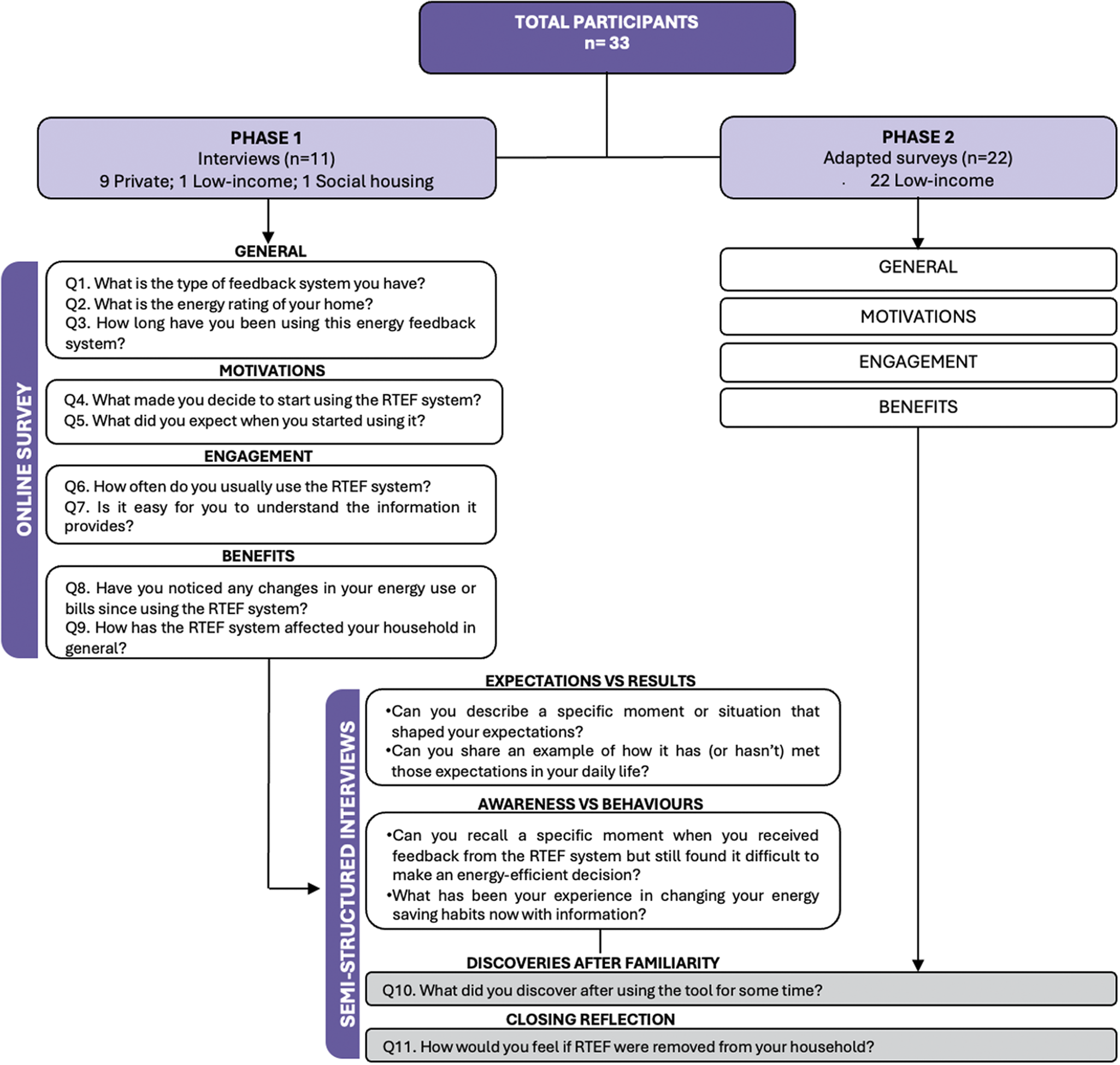
Later interview stages focused on discoveries emerging over time and hypothetical removal scenarios, inviting participants to reflect on the absence of RTEF in order to assess the extent to which it had become embedded in daily life. Neutral questioning was employed to minimise prompting effects, and limitations to recall were acknowledged and treated as part of the reflexive research design rather than methodological flaws.
Expert interviews were thematically aligned to explore operational, policy and social dimensions of RTEF deployment. While not directly comparable to household data, these accounts were used to situate domestic experiences within broader energy transition contexts. All interviews were audio-recorded, transcribed verbatim and analysed using reflexive thematic analysis (RTA) following Braun and Clarke’s (Reference Braun and Clarke2013) six-phase framework. RTA was selected for its emphasis on reflexivity, interpretative depth and contextual sensitivity, aligning with the study’s exploratory aims. Coding began manually to preserve narrative nuance and was later supported by NVivo software to enhance organisation and transparency. This iterative, inductive process ensured that themes remained grounded in participants’ lived experiences while capturing broader sociotechnical dynamics associated with RTEF domestication.
Results and discussion
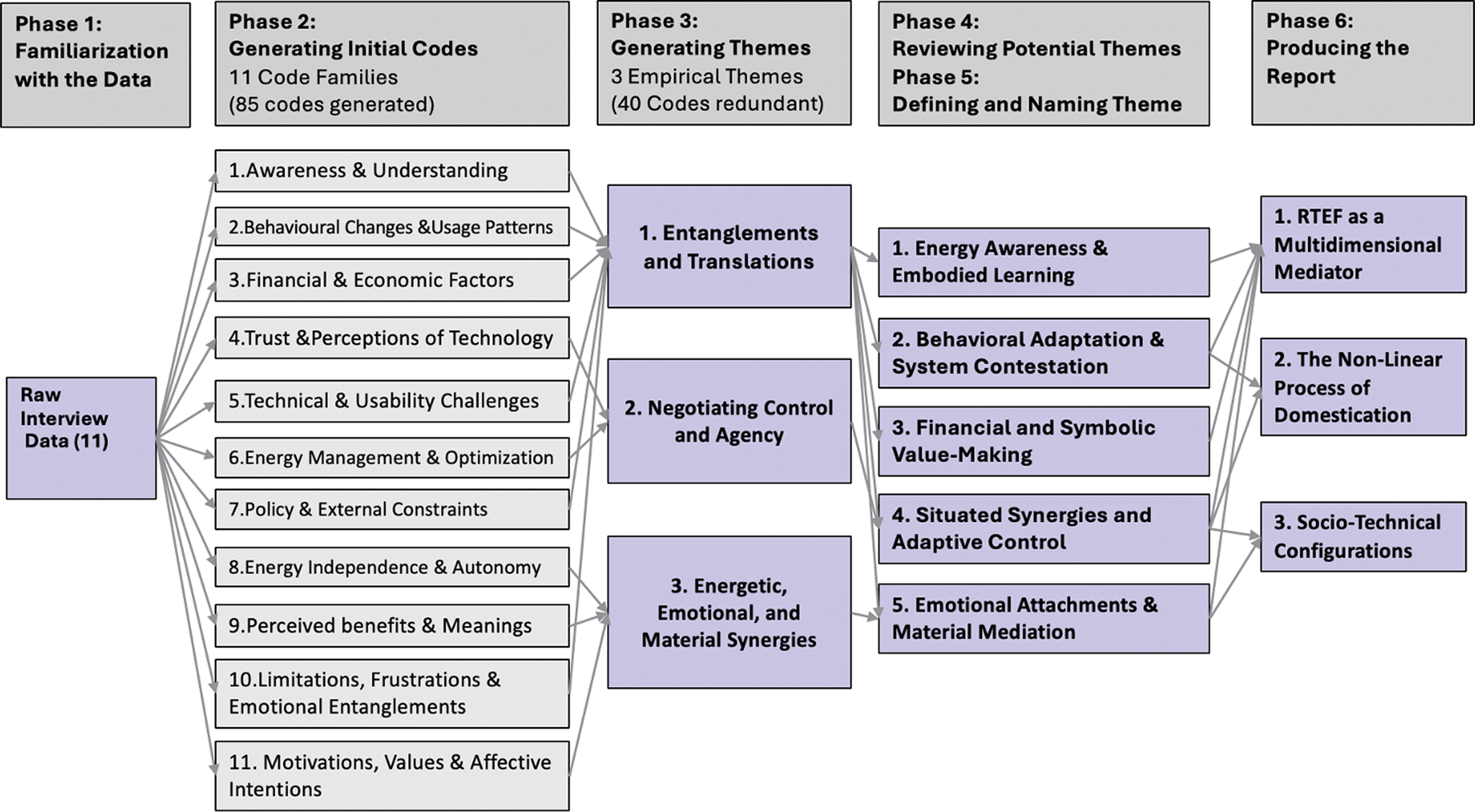
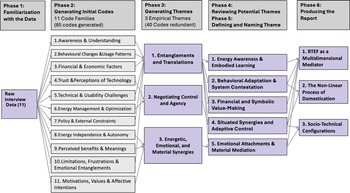
Analysis identified three central themes capturing how RTEF is experienced and negotiated over time within PV-equipped households. This process began with 85 initial descriptive codes, which were progressively clustered into 11 code families based on conceptual similarity and frequency. Through subsequent critical reflection on these families (examining their relationships, tensions and significance to the research questions) the analysis was refined to distil three central, overarching themes. These themes, presented below (Figure 3), capture the core dynamics of how RTEF is experienced and negotiated over time within PV-equipped households.
Thematic analysis process adapted from Braun and Clarke’s (Reference Braun and Clarke2013).
Theme 1: RTEF as a multidimensional mediator
Participants consistently described RTEF as playing an active role in their daily decisions, connecting the domains of energy, comfort, finances and environmental values. Rather than a neutral or passive informational object, it helped them navigate and reconcile these different priorities in practice.
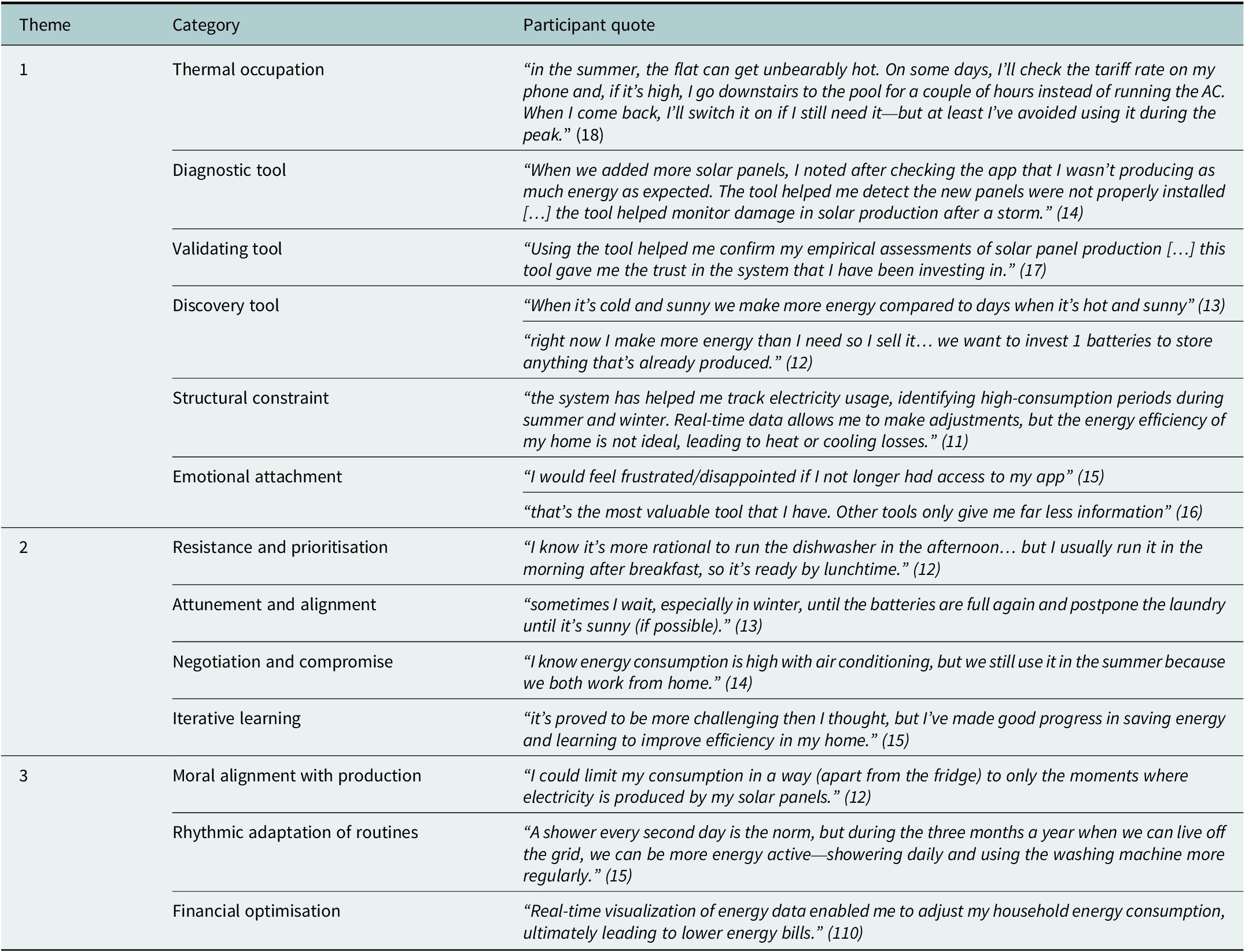
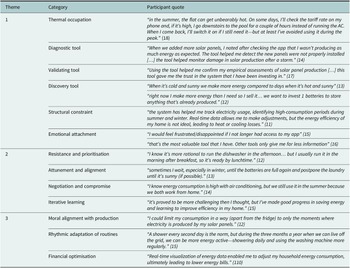
Interviews revealed RTEF becoming embedded in everyday routines, supporting practical and context-specific adjustments rather than isolated energy-savings. Some reorganised spatial or temporal practices based on tariff signals (I8), while others used the system as a tool of discovery, gradually learning how their household behaved energetically (I3, I2). For households equipped with renewable assets, RTEF often took on an additional diagnostic function, allowing users to verify the operation of their PV systems and batteries (I4). This did not grant control over the underlying infrastructure but provided a form of interpretative reassurance that investments were performing as expected (I7).
Emotional attachment to RTEF was common, with many participants expressing frustration or disappointment at the idea of losing access to the display, suggesting that it had become part of their sense-making apparatus rather than merely a device (I5, I6). However, this attachment was uneven: some users disengaged once novelty faded or when feedback ceased to align with their priorities, highlighting divergent domestication trajectories.
Importantly, RTEF also exposed limitations. Participants frequently reported that while inefficiencies became more visible, they were not necessarily remediable; poor insulation, appliance constraints and fixed heating systems restricted the scope of action (I1). This tension was also evident in survey data: although 74% reported high motivation to save energy, only 32% reported noticeable bill reductions. In this sense, RTEF acted more as a diagnostic tool than as a driver of change. Its effects were relational, emerging from the interplay between household practices and the constrains of material infrastructures.
Theme 2: The non-linear process of domestication
The domestication of RTEF unfolded as an iterative and negotiated process rather than a linear, adoption pathway. Users did not simply follow system prescriptions but actively aligned with, resisted or selectively incorporated them into everyday life. In some cases, households adapted their practices to solar or battery cycles, shifting activities such as laundry or cooking to periods of high generation (I3). In others, established routines (e.g. mealtimes, work schedules or family routines) overrode optimisation logics, such as running the dishwasher at convenient times despite lower solar availability (I2). More commonly, participants described compromises in which energy awareness was balanced against comfort, necessity or time constraints, for example, using air conditioning while working from home despite recognising the cost implications (I4).
Over time, users develop a more nuanced understanding of both their homes and the technology, learning where feedback was actionable and where it was not (I5). This learning was experiential and incremental rather than instructional. RTEF was therefore not passively adopted but continually re-interpreted within the household’s sociotechnical configuration, with agency distributed across people, devices and infrastructures.
Theme 3: The sociotechnical configurations
In households with DERs, RTEF made the relationships between production, storage and consumption visible, allowing residents to observe how electricity flowed through their homes. This visibility encouraged a shift from reactive use towards more intentional coordination but only where households had the flexibility to act on the information provided (I2).
Participants often framed their engagement in both moral and practical terms, describing efforts to “use their own power” by aligning consumption with periods of self-generation (I2) or by avoiding unnecessary export of surplus energy. These orientations were enacted through everyday negotiations between comfort and sustainability, leading to rhythmic adaptations in daily routines (I5). Over time, households developed embodied skills in interpreting the temporal rhythms of their homes; however, this capacity depended strongly on household flexibility, appliance ownership and housing quality.
Economic motivations also shaped engagement, with some participants reporting that real-time feedback enabled adjustments that reduced energy bills (I10). However, RTEF did not uniformly translate into savings. The configurations observed were therefore not simply technical but socio-material, shaped by the interaction of devices, domestic routines and housing conditions. Table 3 summarises key themes and representative participant perspectives.
Participant perspective on RTEF domestication and impact
Reframing RTEF: From energy saving tool to household mediator
The findings challenge the dominant utilitarian framing of RTEF as a behaviour-change instrument (Darby, Reference Darby2006; Tiefenbeck et al., Reference Tiefenbeck, Tasic, Schöb and Staake2016). In practice, RTEF operated less as a mechanism for inducing savings and more as a mediator that reorganises how households perceive and engage with energy.
Through processes of domestication, RTEF acquired affective and symbolic significance, becoming part of how households make sense of their energy systems. ANT helps to interpret this not as empowerment in a normative sense, but as the reconfiguration of sociotechnical relations. RTEF links weather, tariffs, appliances and routines into networks that shape what kinds of actions become possible. The analytical focus therefore shifts from asking whether RTEF “works” to examine how particular configurations of feedback, infrastructure and household practices are stabilised over time.
Differentiated capacities, inequality and network configuration
The capacities enabled by RTEF were not evenly distributed. Clear differences emerged between households where feedback was tightly coupled to DERs and those where it was not. Homeowners with integrated systems often used RTEF to interpret production and storage, while many tenants encountered displays that were poorly aligned with their actual energy systems.
tenants sometimes stop being onboarded, so they don’t understand the value of those objects.
(E6)IHDs didn’t provide any feedback on solar or batteries, only general tips for comfort and saving energy. People just stopped engaging because they felt it was imposed on them.
(E3)These accounts suggest that households’ capacity to act on energy information is shaped primarily by network configuration rather than by individual motivation. Where data, ownership and control are misaligned, RTEF becomes marginal or even alienating.
Expert interviews further situated these dynamics within governance structures:
what I see is that national policymakers often don’t understand the issues as well as urban or local policymakers do. At the EU level, there’s strong commitment and direction, and at the local level, people are trying to make things work. But in the middle, national politics get in the way—they bark a lot and sometimes even work against both ends.
(E9)This misalignment constrains how pilot technologies translate into durable household capabilities, particularly those in situations of energy vulnerability.
Designing for inclusion: Ethical and practical considerations
The findings suggest that RTEF does not enable empowerment per se, but rather differentiated energy capability. This can be defined as the ability to interpret, trust and act on energy information depends on material, institutional and social arrangements.
from a new business perspective, the opportunities are mainly in the private sector. But we know the future is about sustainability, and we are building tools that can also work for collective and social energy contexts.
(E8)Designing for inclusion therefore requires more than the distribution of devices. It entails aligning feedback content, system integration, onboarding processes and tenancy structures so that households can meaningfully engage with the information they receive.
RTEF emerges here as a form of living infrastructure, co-produced through technology, institutions and domestic practice. Without deliberate alignment across these domains, feedback systems risk reproducing existing inequalities rather than mitigating them.
Conclusion
This exploratory study examined how RTEF becomes integrated into everyday energy practices in households equipped with solar PV and related technologies. Rather than treating feedback as a behavioural lever, the findings show that RTEF functions as a mediating element within sociotechnical networks, shaping how households perceive, interpret and coordinate energy use over time. This mediating role was evident as participants rescheduled flexible activities around solar conditions, organising domestic rhythms in response to technical and economic signals.
Across this small, pilot-based sample, RTEF’s effects emerged relationally through interactions between technologies, household routines, housing conditions and institutional arrangements. These findings are consistent with ANT, which helps to conceptualise RTEF as an actant that participates in translating energy, comfort, cost and environmental concerns into everyday action. RTEF does not determine behaviour but reorganises relations between households, infrastructures and data, helping stabilise particular ways of seeing and managing energy without assuming that feedback automatically produces empowerment or structural change.
Theoretical contribution
This study demonstrates how ANT can be used to conceptualise feedback technologies as mediators within domestic energy networks. By tracing how RTEF enrols weather, appliances, tariffs and household practices into evolving configurations, the analysis shifts focus from how much energy is saved towards how energy practices are organised and stabilised through feedback. This provides a way to analyse feedback technologies without conflating household-level domestication with system-level energy transitions.
Empirical contribution
This study provides qualitative evidence on long-term RTEF engagement in households using DERs. Participants described iterative, negotiated routines that gradually aligned (or failed to align) with solar production and battery storage. RTEF also acquired emotional and interpretive significance, becoming for some households a tool for validating DER investments and fostering trust in system performance. However, these effects did not translate into universal improvements in costs or comfort. Feedback primarily enhanced situational awareness, with its practical value shaped by housing quality, appliance flexibility and system integration. These findings suggest that RTEF supports interpretive and coordinative capacity rather than directly delivering economic or welfare gains.
Equity and policy implications
The study identifies important differences in how RTEF functions across sociotechnical contexts. In private, well-integrated PV households, feedback often supported active engagement. In social housing and pilot deployments, however, RTEF was frequently poorly aligned with tenants’ actual systems, ownership structures and levels of control, limiting its usefulness. These disparities suggest that inequality in feedback systems may arise less from individual motivation than from network configuration; specifically, how data, assets, tenancy and institutional support are aligned.
These equity considerations are relevant to debates connected to key UN Sustainable Development Goals. SDG 7 (Affordable and Clean Energy) emphasises universal access to affordable and reliable energy services, yet the findings suggest that meaningful engagement with feedback technologies may depend on prior access to assets like solar PV and on the cognitive resources required to interpret real-time data. Similarly, SDG 10 (Reduced Inequalities) calls for greater inclusion, but without deliberate design and governance, feedback may risk amplifying existing differences in who can act on energy information. The study also intersects with SDG 4 (Quality Education), particularly in relation to digital and energy literacy, and SDG 13 (Climate Action), where micro-level coordination of energy use contributes to broader decarbonisation goals.
While RTEF can make energy visible, it does not overcome constraints related to income, tenure or building quality. Addressing these challenges therefore requires more than device distribution; it requires alignment across technical, institutional and social domains. Without deliberate design and governance, feedback may risk amplifying existing differences in who is able to act on energy information under certain configurations.
Limitations and future directions
The findings are based on a small, pilot-based sample and should therefore be interpreted as exploratory and context-specific. The households studied had access to PV, batteries, or pilot-installed feedback systems, which limits the generalisability of the findings to broader questions of inequality, energy system transformation or poverty alleviation. Furthermore, as a qualitative study relying on retrospective, self-reported data, the findings are shaped by participants’ narrated experiences and are subject to recall bias. These recollections and perceived effects vary significantly, shaped by distinct social relations, material arrangements and daily routines, and may therefore differ from directly observed engagement patterns.
Future research combining qualitative domestication studies with technical, financial and housing-level data could provide deeper understanding of the dynamics. Longitudinal research in social housing and non-prosumer contexts is particularly needed to understand how RTEF functions where ownership and flexibility are limited; contexts that are essential for understanding how energy access and inequity reduction goals might be realised in practice.
RTEF does not transform energy systems on its own. What it does, in the contexts studied here, is mediate how households interpret and coordinate their participation in PV-based energy systems. Its effects are modest, uneven and deeply shaped by sociotechnical arrangements. Understanding these dynamics requires attention not to feedback as a standalone solution, but to the networks in which it is embedded.
Open peer review
To view the open peer review materials for this article, please visit https://doi.org/10.1017/etr.2026.10014.
Supplementary material
To view supplementary material for this article, please visit http://doi.org/10.1017/etr.2026.10014.
Data availability statement
The data supporting this study are available from the corresponding author upon reasonable request.
Author contribution
E.G.: conceptualisation; methodology; investigation; data curation; formal analysis; visualisation; writing – original draft; project administration. K.C. and W.V.L.: supervision; methodology; validation; writing – review & editing.
Financial support
There is no funding support for this work.
Competing interests
The authors have no competing interests to declare that could influence the work reported in this article.
Ethics statement
All ethical aspects have been followed and approved by the institution Ethics Committee.
Participant protocols and AI tool disclosure
No personal data were collected, and interviews were designed to focus exclusively on participants’ experiences with RTEF systems. Informed consent was obtained from all participants, and provisions for anonymity, secure data storage and potential recall bias were integrated into the research design. AI tools were used for editing and illustration purposes only. Grammar and spelling checks were conducted using OpenAI’s o4-mini model, accessed through the University of Edinburgh’s secure ELM (Generative AI) platform. The graphical abstract was generated using ChatGPT’s Create Image function. All research design, analysis and intellectual contributions remain the sole responsibility of the authors.




 Open access


Comments
Dear Editor-in-Chief and Guest Editors,
We are pleased to submit our manuscript, “From Novelty to Familiarity: Exploring the impact of Real-Time Energy Feedback Systems in Energy-Producing Households,” for consideration for the Themed Collection “Energy Poverty and Justice in Sustainable Energy Transitions” in Cambridge Prisms: Energy Transitions.
Our study seeks to explore the core themes of this collection by venturing beyond the conventional, utilitarian framing of Real-Time Energy Feedback (RTEF). Rather than viewing it merely as a tool for energy savings, we investigate its role as it becomes embedded in everyday life. Through rich qualitative data from a mixed cohort of private homeowners and low-income social housing residents, we examine how RTEF may function not as a neutral tool, but as an active mediator that shapes energy practices, cultivates a sense of agency, and helps validate renewable energy investments.
Our findings point to a potentially critical energy justice gap. The empirical evidence suggests that while homeowners often find ways to leverage RTEF to consolidate a sense of energy autonomy, tenants in social housing frequently encounter systems that feel poorly integrated and externally managed, at times reinforcing passivity. This emerging disparity invites consideration of how technological interventions, however well-intentioned, might risk amplifying existing inequalities if their integration is not thoughtfully managed.
By mapping these differentiated lived experiences, our work aims to contribute actionable insights for policymakers, housing providers, and technology designers. We explore the possibility that realizing the broader potential of RTEF requires a conceptual shift: from treating it as a simple tool for savings to recognizing it as an active agent that can help build the social capital essential for a just transition.
We confirm that this manuscript is our original work, has not been published previously, and is not currently under consideration for publication elsewhere. All authors have approved the manuscript and consent to its submission to this Themed Collection.
Thank you for your time and consideration. We are enthusiastic about the focus of this collection and believe our exploratory research can contribute a meaningful, ground-level perspective to the urgent discussion on justice and equity in sustainable energy transitions.
Sincerely,
Edgar Gomez