


Early intervention services provide community-based treatment and support to young people with psychosis and their families, with an emphasis on maintaining normal social roles (Department of Health, 2001). The experience of psychosis can exclude a young person from a sense of autonomy, employment and youth culture (Reference Birchwood, Mcgorry and JacksonBirchwood et al, 1997). Young people aspire to social roles and goals: employment and education provide social identity and status, social contacts and support, a means of structuring and occupying time, activity and involvement, and a sense of personal achievement (Reference ShepherdShepherd, 1989). Quite apart from the money that can be earned, work tells us who we are and enables us to tell others who we are (Reference GallowayGalloway, 1991).
Poor employment outcomes are a constant finding in research into first-episode psychosis (e.g. Reference Mason, Harrison and GlazebrookMason et al, 1995; Reference Gupta, Anderson and ArndtGupta et al, 1997; Reference Singh, Croudace and AminSingh et al, 2000). Evidence suggests that employment can lead to improvements in outcome for people diagnosed with schizophrenia through increasing self-esteem, alleviating psychiatric symptoms and reducing dependency (Reference Cook and RazzanoCook & Razzano, 2000). Loss of social roles and goals, especially work, has been linked to depression and suicidal thinking in psychosis (Reference Birchwood, Iqbal and ChadwickBirchwood et al, 2000). Returning to (or establishing) a work pattern can become increasingly difficult when someone is unemployed, and the addition of a diagnosis of schizophrenia makes it even more difficult (Reference WarnerWarner, 1994).
An increasing body of evidence indicates that approaches to work and employment are more important in determining vocational success than the diagnostic and demographic characteristics of the patient (Reference Secker and MembreySecker & Membrey, 2000). Evidence-based supported employment (Reference Drake and BeckerDrake & Becker, 1996; Reference Bond, Becker and DrakeBond et al, 2001a ) has been demonstrated to be effective in enabling people with severe and enduring mental health problems to gain and retain employment.
Early intervention services are expected to provide effective pathways to education and occupation (Department of Health, 2001), with the National Institute for Clinical Excellence (2002) recommending that supported employment should be provided for people with schizophrenia who wish to return to work. We implemented evidence-based supported employment into an early intervention service by attaching a half-time vocational specialist to a newly developed service. The aims of this study were to evaluate the vocational outcomes and assess model fidelity.
Method
Clinical team
The Early Treatment and Home-based Outreach Service (ETHOS) is an early intervention service that has been in operation within South West London and St George's Mental Health National Health Service (NHS) Trust since June 2001. It provides a comprehensive package of community-based care for a maximum of 2 years to young people (aged 17-30 years) with a first episode of psychosis.
Intervention
A half-time vocational specialist was integrated into the ETHOS team to address the vocational needs of patients within the service. This specialist (K.M.) was an integral member of the multidisciplinary team but did not carry out care coordinator tasks. She coordinated all the vocational plans with the team, and worked directly with patients and their care coordinators to ensure that vocational goals were given a high priority. Direct client interventions included engagement, assessing vocational need, proactively helping patients to find (and keep) jobs and attend education courses, providing welfare benefits advice, addressing support needs and ensuring adjustments to enable patients to keep their jobs or remain in education. All patients within the service (n=40) received an intervention for 6 months, and 22 clients received it for 12 months.
Data collection
Data were collected from November 2001 to November 2002 for all patients who received vocational input. This information included:
-
• demographic variables: age, gender, ethnicity;
-
• clinical variables: primary diagnosis, duration of contact with the team, discipline of care coordinator.
Information on vocational status was collected on first contact with each patient and thereafter on a monthly basis.
Patients
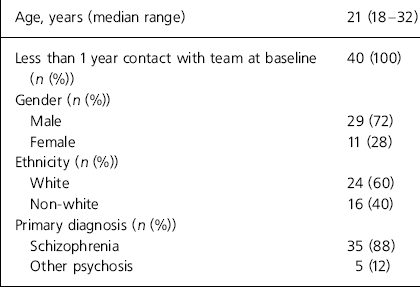
The vocational specialist worked with all 40 patients within the service; 35 had a diagnosis of schizophrenia and 5 had diagnoses of other psychoses. The median age was 21 years with a range of 18-32 years. The demographic and diagnostic characteristics of the cohort are given in Table 1.
Characteristics of the clients (n=40) who received the vocational intervention
| Age, years (median range) | 21 (18–32) |
|---|---|
| Less than 1 year contact with team at baseline (n (%)) | 40 (100) |
| Gender (n (%)) | |
| Male | 29 (72) |
| Female | 11 (28) |
| Ethnicity (n (%)) | |
| White | 24 (60) |
| Non-white | 16 (40) |
| Primary diagnosis (n (%)) | |
| Schizophrenia | 35 (88) |
| Other psychosis | 5 (12) |
Model fidelity
Fidelity refers to the degree of implementation of an evidence-based practice. The evidence-based Supported Employment Fidelity Scale is a 15-item instrument assessing the implementation of the critical ingredients of evidence-based supported employment for people with severe mental illness (Bond et al, Reference Bond, Becker and Drake1997, Reference Bond, Vogler and Resnick2001b ). The scale consists of three sections: ‘staffing’ addresses case-load size and the role of employment specialists; ‘organisation’ addresses integration with mental health treatment, employment specialist functioning within a vocational unit and zero exclusion to accessing vocational support; and ‘services’ addresses vocational engagement, assessment, job search and development, follow-along support, community-based services, and assertive engagement and outreach. The items are rated on a five-point response scale, ranging from 1 (no implementation) to 5 (full implementation).
Results
Model fidelity
The fidelity of the implementation into the early intervention service was assessed independently, and scored 71 out of a possible 75 indicating good implementation. Two items, the role of the employment specialist and job search, were each rated 4, with one item, assertive engagement and outreach, rated 3. The lower scoring of these three items was due to the limitations resulting from the part-time status of the vocational worker within the team.
Patient outcomes
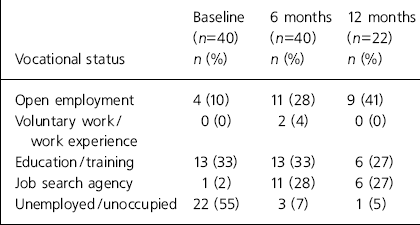
Table 2 shows the employment status of all 40 patients within the service whom the vocational specialist worked with, at baseline, 6 months and 12 months. All patients (n=40) received at least 6 months of the vocational intervention, and 22 of them received the vocational intervention for 12 months. Prior to the intervention, just under two-thirds the patients (n=27) were not engaged in any sort of work or education. Only 4 (10%) were engaged in open employment - a figure similar to that for the whole population of longer-term service users (Reference Perkins and RinaldiPerkins & Rinaldi, 2002).
Vocational status of clients at baseline, 6 months and 12 months
| Vocational status | Baseline (n=40) n (%) | 6 months (n=40) n (%) | 12 months (n=22) n (%) |
|---|---|---|---|
| Open employment | 4 (10) | 11 (28) | 9 (41) |
| Voluntary work/work experience | 0 (0) | 2 (4) | 0 (0) |
| Education/training | 13 (33) | 13 (33) | 6 (27) |
| Job search agency | 1 (2) | 11 (28) | 6 (27) |
| Unemployed/unoccupied | 22 (55) | 3 (7) | 1 (5) |
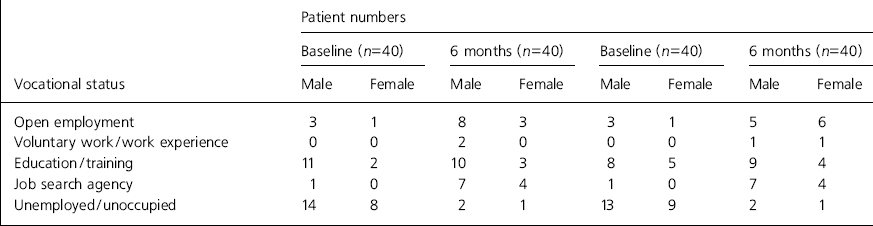
Following vocational profiling, and input from the vocational specialist and the team, there was a significant increase in the proportion of patients engaged in work or educational activity by 6 months (χ2=28.4, d.f.=12; P<0.005). Only 3 clients (7%) remained without any form of work or educational activity, the number engaged in open employment rose from 4 (10%) to 11 (28%), and the number engaged in educational activity remained constant at 13 (33%). Table 3 shows the employment status of the 40 clients at baseline and 6 months analysed by gender and ethnicity. Male clients demonstrated a significant increase in work or educational activity between baseline and 6 months (χ2=23.3, d.f.=12; P<0.05). However, for female clients this outcome was not significant (χ2=10.0, d.f.=6; P=0.121). There was no difference in vocational outcome in the White ethnic group (χ2=12.1, d.f.=8; P=0.143), but there was a significant difference in the non-White ethnic group (χ2=23.7, d.f.=12; P<0.05). Data for the 22 clients who received the vocational intervention for a year showed that, for months 6-12:
-
• everyone employed at 6 months continued to be employed;
-
• two previously unemployed clients gained employment;
-
• three patients moved into education or training;
-
• three patients completed courses, two of whom began a job search, and one gained employment.
Gender, ethnicity and vocational status at baseline and 6 months
| Patient numbers | ||||||||
|---|---|---|---|---|---|---|---|---|
| Baseline (n=40) | 6 months (n=40) | Baseline (n=40) | 6 months (n=40) | |||||
| Vocational status | Male | Female | Male | Female | Male | Female | Male | Female |
| Open employment | 3 | 1 | 8 | 3 | 3 | 1 | 5 | 6 |
| Voluntary work/work experience | 0 | 0 | 2 | 0 | 0 | 0 | 1 | 1 |
| Education/training | 11 | 2 | 10 | 3 | 8 | 5 | 9 | 4 |
| Job search agency | 1 | 0 | 7 | 4 | 1 | 0 | 7 | 4 |
| Unemployed/unoccupied | 14 | 8 | 2 | 1 | 13 | 9 | 2 | 1 |
There was a significant increase in the proportion of patients engaged in work or educational activity between the 6-month and 12-month assessments (χ2=23.1, d.f.=12; P<0.05). During this period only one patient remained without any form of work or educational activity. Between the 6-month and 12-month data points, no significant difference in engagement in work or educational activity was seen in any patient group, whether classified by gender or ethnic group: male gender (χ2=19.1, d.f.=12; P=0.086), female gender (χ2=7.4, d.f.=4; P=0.114), White ethnic group (χ2=18.0, d.f.=12; P=0.116) or broad non-White ethnic group (χ2=9.33, d.f.=4, P=0.053).
Discussion
The study demonstrates that the proportion of patients who were employed was greater 6 months after they were taken on by the service than when they were referred. At the point of referral, more than half (65%) were not engaged in any form of work or education, but after 6 months this figure had dropped to 7% and by 12 months to 5%. After 6 months of the intervention the employment rate rose from 10% to 28%.
It is important to note that the vocational specialist was not only assisting people to gain employment and education, but also addressing the issue of job or course retention. Seventeen patients (43%) were engaged in employment or education at the time of their referral to the service, and the vocational specialist along with the team supported clients in retaining this activity. Although three vocational status time periods are presented within the data, patients moved through different pathways within those times. Three people lost their job and then found another one within the periods presented. The role of the vocational specialist was to enable patients to see job transitions as normal and resume a rapid job search.
The vocational specialist did not work in isolation, but in conjunction with clinicians as part of the multi-disciplinary team. The positive results reflect the integration of both clinical and vocational expertise within one team. The vocational specialist developed good working relationships not only within the team, but also with local employers, employment agencies, colleges and mainstream training providers, and with the government employment service Jobcentre Plus.
The success of this intervention needs to be viewed in the context of the small sample size and the enthusiasm of a newly developed and motivated multidisciplinary team. The lack of a comparison group, along with other factors that could have resulted in the increase in employment rates, also needs to be considered. Poor employment outcomes are a constant finding in research on first-episode psychosis (e.g. Reference Mason, Harrison and GlazebrookMason et al, 1995; Reference Gupta, Anderson and ArndtGupta et al, 1997; Reference Singh, Croudace and AminSingh et al, 2000), with employment rates for people with longer-term schizophrenia reported to be as low as 4% (Reference Perkins and RinaldiPerkins & Rinaldi, 2002). O’Brien et al (Reference O'Brien, Price and Burns2003), in their study of the effects of training clinical staff in the practice of evidence-based supported employment without a vocational worker integrated into the team, found that only 6% of people achieved open employment thereafter, which compares with a figure of 11% found in a naturalistic study following people in a vocational rehabilitation programme (Reference Reker, Hornung and SchonauerReker et al, 2000). Evidence suggests that integrating a dedicated vocational worker with the clinical teams appears to be essential for improved occupational outcomes for people with severe mental health problems (Reference O'Brien, Price and BurnsO’Brien et al, 2003). These factors suggest that integrating a vocational specialist and effectively implementing evidence-based supported employment within the early intervention service increased employment, work and education opportunities for clients within the service. Longer-term vocational outcomes need to be evaluated to assess retention rates for jobs and educational courses and job tenure for this group.
These results lend support for an evidence-based supported employment approach where vocational rehabilitation is integrated into the clinical team, to help people with severe mental health problems gain and retain employment and education. There is a national commitment to the development of early intervention services (Department of Health, 2001), and consideration needs to be given to the successful engagement and outcomes of young people with first-episode psychosis within services. If these young people aspire to social roles and goals, then helping them to gain and retain employment and education should not only improve longer-term outcomes but also provide a potential key to engagement.
Acknowledgement
We thank Helen Fisher for assisting with the literature searching, data cleaning and editing of this manuscript.


 Open access


eLetters
No eLetters have been published for this article.