




1. Description and prescription
Western music notation has, historically, been regarded as falling into one of two categories: descriptive and prescriptive (Seeger Reference Seeger1958; Clarke Reference Clarke2012; Battier Reference Battier2015; Sköld Reference Sköld2022). Descriptive notation, such as transcriptions, records musical information like pitch, rhythm and dynamics, documenting how music sounds. By convention the markings on a score form a prescriptive symbolic language that signifies actions to be taken to realise the music. Through the twentieth century composers and artists began to chafe at the restrictions that staff notation imposed. Though Guido d’Arezzo’s pragmatic system for writing down music was wildly successful both in preserving an enormous musical canon for future performance and analysis, as well as proving to be an extraordinarily malleable tool for innovation in the thousand years that followed, charges against Western staff notation were many and, through the latter half of the twentieth century, increasingly voluble (Battier Reference Battier2015). Chief among them was that staff notation coarsely distils a rich, dynamic, multi-dimensional experience into a static image. Trevor Wishart describes this notation as a two-dimensional lattice, privileging discrete note and rhythmic events over the rich phenomenological experience of music (Wishart Reference Wishart and Emmerson1996). Additionally, staff notation is regarded as being limited in its ability to convey substantive information about timbre (Smalley Reference Smalley1997; Clarke Reference Clarke2012). A notation that privileges discrete pitch and rhythmic events necessarily devalues other elements of the musical experience. Consequently, composers are guided to marginalise those elements which are not neatly transferable to this two-dimensional lattice. The advent of sound-recording technologies and the ability to craft and manipulate audio signals at a granular level highlighted the disconnect between standard notational systems and the technologically enriched vocabulary available to composers. In the early twentieth century, Edgard Varèse anticipated that music notation would have to find new ways to accommodate the technologically mediated sounds that the new century would bring. If music notation was to remain serviceable as a writing tool in the days of electronic instruments and studio composition, Varese argued, it must find new ways to accommodate the sonic sprawl of contemporary musical expression (Varèse & Chou Reference Varèse and Chou1966).
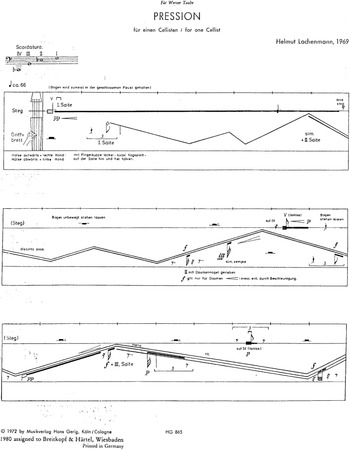
Staff notation and other graphic forms of symbolic inscription typically prescribe the interpretive actions to be taken by the performer without necessarily making much reference to the character of the resulting sound. By prioritising physical processes over sonic outcomes, prescriptive approaches may make musical works permeable to contingencies such as performer interpretation, environmental factors or the inherent unpredictability of certain sound-producing methods. Taken to its limits, prescriptive notation can defamiliarise and make strange instrumental technique (Lachenmann’s Pression, 1969), sound-making objects (Reich’s Pendulum Music, 1968) or even everyday tasks (Knowles’s Make a Salad, 1962). Though over time audiences and performers may accrue certain expectations regarding the sounds resulting from these actions, the focus of the work remains the physical, often exploratory processes from which the sounds and experiences emanate.
By contrast, descriptive notation typically visualises the sound rather than concerning itself with the physical actions that bring those sounds about. Through pictograms, audiographs and spectrographs, descriptive notation is often a listening or analytical tool for ex post facto analysis, or an aide memoire, particularly in circumstances where no prescriptive score exists (Smalley Reference Smalley1997). Oft-cited early examples of pictographic descriptive notation in electronic music are Stockhausen’s Kontakte (1958–60) and graphic designer Rainer Wehinger’s listening score for Ligeti’s Artikulation (Wehinger Reference Wehinger1970). However, pictographic notation played only a limited role in shaping these works. Though endorsed by the composer, Wehinger’s score was made more than a decade after Ligeti created Artikulation, and Marc Battier, who later worked as an assistant to Stockhausen, has queried the composer’s motivation for including pictorial notation in the score for Kontakte. Battier contends that rather than aiding new realisations of the work, it may have served as a reference for the composer during the work’s creation (Battier Reference Battier2015). The fact that Stockhausen did not continue to document his electronic work in this way suggests that pictographic notation held limited interest for the composer.
2. Notating experience
Early audio recording devices such as Édouard-Léon Scott de Martinville’s 1857 phonautograph and Thomas Edison’s 1877 phonograph allowed for the mechanical inscription of audio signals. This began to shift attention from symbolic and iconic representation to the analysis and synthesis of sound. Audio inscription helped composers to analyse sound and navigate effectively between acoustic and electronic sound sources, as exemplified in Jonathan Harvey’s Mortuos Plango, Vivos Voco (1980), Kaija Saariaho’s Jardin Secret II (1984–85) and Trevor Wishart’s Vox 5 (1979–86). In more recent years, composers have continued to explore hybrid approaches that mix digital technologies, innovative notational systems and sound manipulation techniques. Composers marry analytical tools such a spectrographs and audiographs with graphic and staff notation (Sköld Reference Sköld2022) or use graphic documentation as as useful rehearsal tool or aide memoire in the case of repeat performances (Hron Reference Hron2017). However, the embodied and ephemeral nature of sound and the physical actions which instantiate it remain elusive to the spectrographic and inscription-based approach. In her influential article Music – Drastic or Gnostic (2004), Carolyn Abbate critiques how music inspires ‘talk of inscription devices, deciphering and hieroglyphic traces, a metaphorical language that relocates the labour and carnality of performance’ in the physical motion and material products of machines (Abbate Reference Abbate2004: 514). Abbate laments this ‘neutering’ of music’s visceral, embodied reality, highlighting how much of musical experience is shaped by the labour and immediacy of performance (drastic) rather than its mechanical representation (gnostic). A recent study by Sköld (Reference Sköld2022) highlights this disconnect. Sköld directed students in how to interpret a hybrid form of notation based on spectromorphological analysis and symbolic representation. While the students became adept at interpreting the qualitative characteristics of the notated sounds, they often struggled to identify suitable means for reproducing these sounds (Sköld Reference Sköld2022). This underscores concerns raised by Abbate, Cook (Reference Cook2018) and others: by prioritising systems of representation in music discourse, the embodied, performative act of creating sound is often marginalised, leaving behind only traces that fail to fully capture the lived reality of musical experience.
While the performative turn in musicology has done much to redress this issue in theory, recent developments have highlighted efforts to confront the absence in notation of phenomenal experience in practice. One example is the video notation developed by Frame (Reference Frame2023) to retrospectively capture the gestural shapes of performers using Digital Musical Instruments (DMIs). By recording ‘what happens’ during the creation of the work, Frame seeks to capture the ‘playing experience’ (Frame Reference Frame2023). While the degree to which gestures constitute experience is open to debate, the approach reflects a clear intention to expand the scope of descriptive notation to include the physical act of performance. Such efforts promise a way to begin to address the ‘drastic’ in music notation, to account for the flow of action and experience that Abbate wishes to foreground in musicological discourse. While fixed notation has struggled to prescribe and describe the morphology of sound, animated screen-based notation has introduced new possibilities for real-time composition and the dynamic visualisation of complex musical phenomena (Vickery Reference Vickery2014; Hope Reference Hope2017). Animated digital scores bring something of the flow and immediacy of performance to notation. While increasingly prevalent in performance, creators of screen scores report similar challenges around the development of suitable symbolic representations of sound. Additionally, the ‘temporally sequential presentation of information’ must contend with the limitations of human visual perception, which imposes a unique set of constraints on their design and usability (Vickery Reference Vickery2014).
3. Notation’s performative turn
Taking up the challenge of the performative turn, Floris Schuiling contests the assertion that the ‘score is not the music’ (Schuiling Reference Schuiling2019). He cautions against the othering of notation, absenting it from the lived process of music making that the performative turn in musicology wishes to foreground. He argues that to relegate notation to the status of ‘secondary, non-sounding’ materials (Van Elferen Reference Van Elferen2020) misrepresents its importance to our ‘musicking’ behaviour (Schuiling Reference Schuiling2019). Schuiling points out that rather than being a ‘secondary’ static blueprint for performance, notation is an active, dynamic participant in the flow of actions and experiences that constitute music-making processes. He defines notation as ‘interfaces for imagining virtual musical relations’ (Schuiling Reference Schuiling2019: 432). We will return to that definition in more detail below. Music notation in their various instantiations, continues Schuiling, constructs:
forms of musical interaction. They mediate performed identities and inform notions of music as a cultural practice. They offer different ways of imagining sound as music, make different demands on musical knowledge and condition musicians’ creative agency. In short, they construct notation cultures (Schuiling Reference Schuiling2019: 431).
Music notation is never merely ‘prescriptive’ of actions to be taken, nor a limited retrospective description of sound; it is necessarily embedded in a ‘wider ecology of technologies and practices’ (Schuiling Reference Schuiling2019: 432). Following from Georgina Born, Schuiling proposes an ‘ethnomusicology of notation’ that tries to account for notation’s ‘relationality’. Perhaps, Schuiling writes, ‘we can seek the answer to the question of notation’s musicality not in its representation of musical structures, but in its mediation of the social and creative agency of musicians’ (Schuiling Reference Schuiling2019: 431). To study notation, Schuiling contends, is to compare notation cultures, to contend with the way notation is embedded within a plurality of cultures and practices.
4. Notation as a virtual index
Schuiling invokes Charles Sanders Peirce’s theory of signs as a foundational plank in this construction of an ‘ethnomusicology of notation’. Peirce classified signs into three types based on how they relate to an object: icon, index and symbol. An icon resembles its object. For example, a picture of a dog resembles the animal that it signifies. By contrast, a symbol is linked to its object by social convention. In English, the word ‘dog’ is a symbolic representation of the concept of that animal. It is the last category, ‘index’, that is Schuiling’s principal concern. An index has a direct connection to its object, often through causation or contiguity. Common examples of indexical signs are smoke as an index of fire, a scar as an index of a wound or fever as an index of illness. An index is often a trace or imprint of a physical process. For example, a trace fossil is a record of the movement or activity of an organism, such as a footprint or a burrow. Inscriptive notation, such as a wax cylinder, an audiograph or spectrograph, traces the materiality of the sound and the physical causes that produce them. Similarly, the rosin dust on a violin is an index of a musician’s performance.
Under Peirce’s system of signs, a printed score functions as a symbol, as it derives meaning from the established conventions of staff notation. A composer’s original manuscript may act as an index, as it bears the trace movements of the composer’s pen. Pictographic scores such as Lachenmann’s action notation and Rainer Wehinger’s graphic rendering of Ligeti’s Artikulation derive meaning through iconic resemblance to the actions or sounds they signify. Though many contemporary scores eschew or modify standard practices, a legend or set of instructions at the beginning of a score may establish a symbolic convention that guides the performance. Many contemporary scores mix iconic and symbolic signs in this fashion. Schuiling’s focus is the way notation is embedded within and ‘remediated’ by a network of other forms of technology and communication. Different forms of media, including notation, do not exist in isolation. They draw from existing technological and cultural patterns of use to establish a contingent relationship between signs and objects. Accordingly, this historicist account of music notation requires, in Schuiling’s view, an ethnomusicological study that highlights notation’s socially conditioned, interactive and experiential qualities. After the performative turn in musicology, fixed notation suffered from being the avatar of the work concept. Musicological discourse favoured the phenomenological accounts, regarding notation as an idealist Platonic interloper disconnected from the lived experience. Schuiling persuasively argues to the contrary, contending that notation belongs firmly within the purview of experiential accounts of music, viewing it as a site for contingent, creative interaction in its own right. Adopting this perspective requires a reevaluation of notation as being an integral part of our lived, dynamic, musicking behaviour, an interface that affords a flow of creative negotiation between performer and text. Schuiling acknowledges the history of open-form notation in experimental music, which invites the performer to ‘collaborate’ in the creation of the work by, in effect, filling in the gaps left by the composer, what Schuiling refers to somewhat pejoratively as the ‘discourse of absence’. Citing work from Liza Lim, he suggests that open-form works may use instruction as a foil for negotiating and co-producing ‘a certain direction’ between performer and text, a process Schuiling refers to as entextualisation. In the Lim example, this process of negotiation has a paradoxically liberating effect on the musicians as they are given a reference point to play off of, without which they tended to be uncertain and tentative in their improvisation. Such accounts seem to support Ian Pace’s assertion that scores can be a catalyst for ‘channelling performers’ creative imagination in otherwise unavailable directions, rather than as an obstacle’ (Schuiling Reference Schuiling2019: 432). Open scores need not leave things out to invite the creative input of performers. It can be liberating to retain parameters as a provocation to negotiate a common ground between musician and score.
To characterise reading a score solely as an act of connecting signs to meanings offers an incomplete picture of the act of reading. Schuiling cites Roger Chartrier’s assertion that ‘Reading is not uniquely an abstract operation of the intellect: it brings the body into play; it is inscribed in a space and a relationship with oneself and with others’ (quoted in Schuiling Reference Schuiling2019: 450). Schuiling argues that notation ‘mobilises various forms of social and technological mediation in the process of negotiating between text and performance and how it configures the agency of musicians in the process’ (Schuiling Reference Schuiling2019: 449). He invokes the term remediation to connect the concepts of entextualisation and mobilisation. Remediation highlights that musical signs are part of a wider social and technologically mediated ecology and that this network conditions the experience and agency of the performer.
Schuiling argues persuasively that notation finds its place within performative discourse, that it is an active agent within our flow of experiences. Composers and sound artists have responded with a range of notational practices that foreground the dynamic, experiential and material nature of the score itself. Graphic scores can act not only as symbolic signifiers of sound but also as purveyors of affect and embodied experience (Casey Reference Casey2015). Materialist practices acknowledge the causal, physical nature of sound and argue that notation must contend with material properties such as texture and intensity (Cox Reference Cox2018). Composers have used animated notation to explore the materiality and agency of music notation itself (Armitage & Magnusson Reference Armitage and Magnusson2023) and developed approaches that move beyond visual modalities to incorporate somatosensory feedback (Privato et al. Reference Privato, Magnusson and Einarsson2023). The work of these artists and researchers suggests that materialist, agential forms of notation may be well placed to negotiate, as Schuiling characterises it, between performer and spectromorphological concerns. Agential scores are capable of adapting and changing in response to performer inputs, highlighting the process of creative negotiation between performer, score and text. Despite presenting their own challenges and limitations, dynamic, animated and haptic forms of notation are, at least on the surface, well placed to encode the temporal flux of sound.
With concerns around remediation and sonic materialism in mind, I sought to develop a practice-led approach to explore possible methods for developing systems of notation that can act as ‘interfaces’ for a situated, playfully negotiated engagement with sound’s material texture and flow. The term ‘interface’ is used in accordance with Schuiling’s definition, which asserts the embeddedness of notation within wider social, cultural and technological networks. Here, we return to Schuiling’s definition of notations as ‘interfaces for imagining virtual musical relations’ (Schuiling Reference Schuiling2019: 432). The term ‘virtual’, in Schuiling’s writing, has a very specific meaning, drawing again from Peirce’s writings on signs. Peirce defines virtual not according to our contemporary understanding of immersive computer-generated environments designed to simulate aspects of the real world, but instead as:
‘A virtual X (where X is a common noun) is something, not an X, which has the efficiency (virtus) of an X. This is the proper meaning of the word: but it has been seriously confounded with ‘potential’, which is almost its contrary. For the potential X is of the nature of X, but is without actual efficiency’ (quoted in Schuiling Reference Schuiling2019: 452–3).
For Peirce, virtual means to suggest something that has the efficiency or functionality of an object but without any necessary ‘semblance’ to that object. If we recall that iconic graphic notation resembles its intended sound, or in the case of action notation, the physical gesture required to incite a sound, then the idea of virtual indexical relationships between notation and sound is an intriguing one. Is it possible, or even useful, to design notation that bears a causal indexical relationship to sound without bearing any iconic or symbolic resemblance to that sound? As an example of the ‘virtual’ in notation, Schuiling cites Catherine Laws’ reflections on rehearsing and performing Morton Feldman’s Palais de Mari. In Feldman’s piece the sustain pedal is held down throughout, allowing decaying resonances to commingle across long notated rests. These resonances, so important to the character of much of Feldman’s piano music, are not found in the notation. According to Schuiling:
‘they are virtually indicated in the score: they are not to be located in the notes that the pianist is instructed to play, nor in the rests – that is to say, they are not defined by semblance. They are part of the score’s efficiency, in that it signifies these resonances by virtue of causation. Crucially, this virtuality intervenes in Laws’s familiar protocols for piano playing and leads her to reconsider her role as creative agent in relation to her instrument’. (Schuiling Reference Schuiling2019: 454)
Key to this account, and the case study under discussion here, is that the virtual signifies the unfolding timbral qualities of the instrument’s sound. This suggests that virtual indexical signs may be an effective means for notating the spectromorphology of acoustic and electroacoustic sound sources. As Laws’s account suggests, the advantage that virtual indexical notation may have over symbolic representations of sound morphologies is that it may establish causal links that guide the performer towards exploring and discovering evolving sound textures and, in the process, highlight the embodied, negotiated and emergent agency of performer and score.
5. Undersong: A case study
To further develop and explore these ideas through a practice-led approach, I worked with flautist Lina Andonovska and cellist Judith Hamann. Lina and Judith provided invaluable feedback and insight through the creative process. Undersong was one of three works incorporating dynamic notation that were all composed through this period with input from Lina and Judith. Each composition explored a different theme: tuning, time, and timbre. This article focuses on timbre and the composition of the piece Undersong, which was composed to investigate the affordances of dynamic notation for exploring and representing timbre and the morphology of sound. Over the course of a year, workshops, video calls and email correspondence helped resolve important decisions around notation design. Visual and audio materials were exchanged as part of an ongoing collaborative feedback process.Footnote 2 Working with two very different instrumentalists was intended to build flexibility into the notational system so that, in principle, it could be adapted and retuned to a wider range of interpreters.
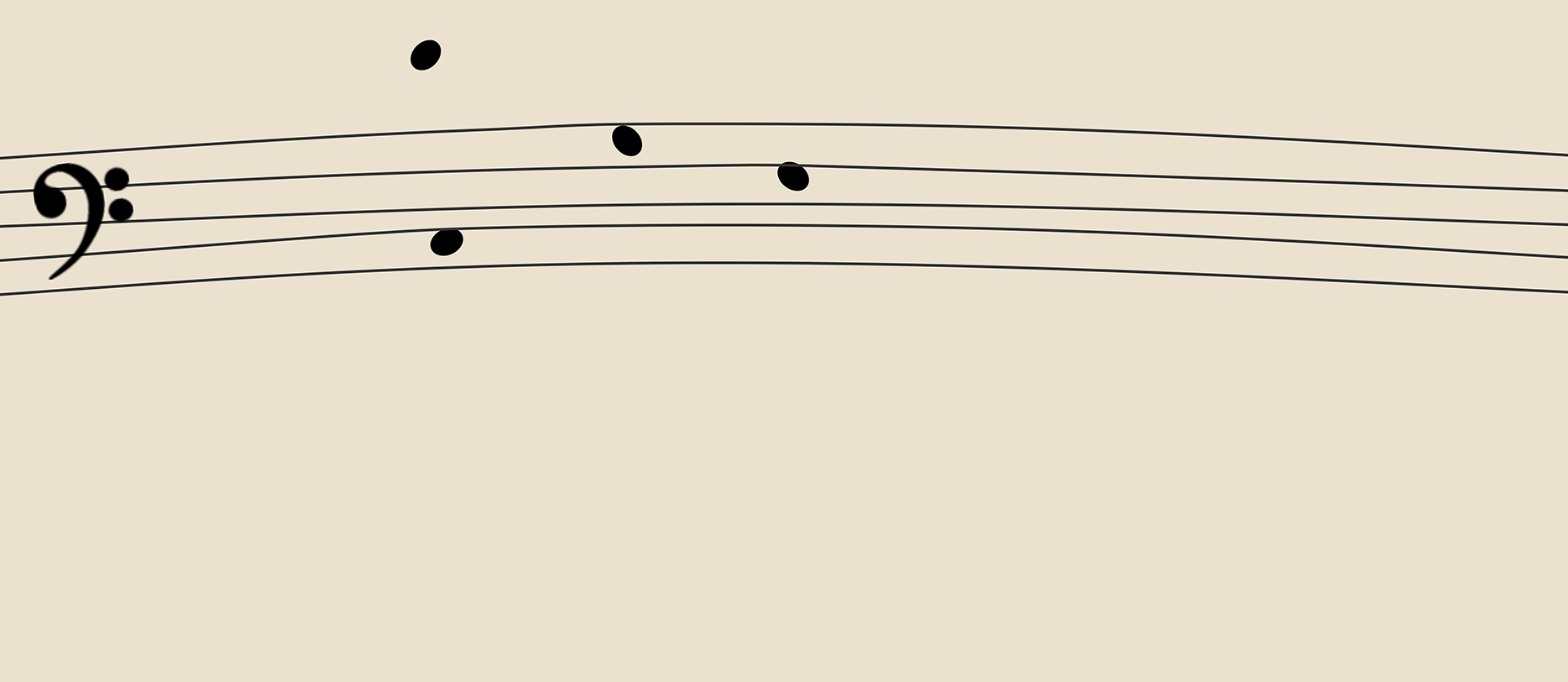
When developing the notation for Undersong, it was decided to playfully repurpose the symbolic elements of staff notation, deconstructing their culturally codified meaning and reimagining them as indexical virtual notation. The digital notation presents as a five-line stave, with a clef and noteheads appearing to settle on the lines of the stave. However, these familiar signs are, in this instance, not functioning as symbols. The digital score plays with the semiotic associations of western notation and the elusive phenomenological experiences that even grounded cultural signs may elicit in performers. They do not represent pitch and rhythm, nor do they signify any musical idea or meaning that has been culturally directed or unilaterally prescribed by the composer. Rather than employing any of the symbolic conventions of staff notation, Undersong adopts its visual language in order to make the subversion of these conventions explicit. Nor are the graphics in the notation iconic signs. That is to say, they do not try to signify desired sounds or their character through exhibiting some semblance to sonic qualities like timbre, morphology or gesture. The aim was to see if it was possible to defamiliarise the everyday musical image and in so doing encourage the performer to reconsider their negotiated relationship with the instrument, the material qualities of sound and the ways in which notation ‘reconfigures the agency of the performer’. Though redolent of a traditional stave and note heads, these graphics signify only the interplay of forces determined by the stability and noise content of the performer’s sound (see Figure 2). The decision to retain staff and note head forms rather than replace them with wholly abstract shapes was a deliberate invocation of works of art that co-opt familiar forms only to strip them of their meaning. Resonant examples include Magritte’s Treachery of Images (1929), which famously labels a pipe ‘Ceci n’est pas une pipe’; Cornelius Cardew’s Treatise (1963–7), a 193-page graphic score in which each page presents an empty five-line stave beneath abstract assemblages of the shapes and lines that would normally signify pitch and rhythm; and Xu Bing’s A Book from the Sky (1987–91), a set of four books containing four thousand invented Chinese characters that look authentic yet signify no semantic content. Similarly, in the case of Undersong, familiar notational graphics are divorced from their prescribed meaning, asking that they be encountered anew for their dynamic visual form, rather than their symbolic function.
Pression, page 1 (1972), by Musikverlage Hans Gerig, Köln 1980, assigned to Breitkopf & Härtel, Wiesbaden. Used by kind permission.

Still of the Undersong score showing staff lines and notehead shapes whose spatial behaviour is determined by the performer’s sonic stability and noise content.
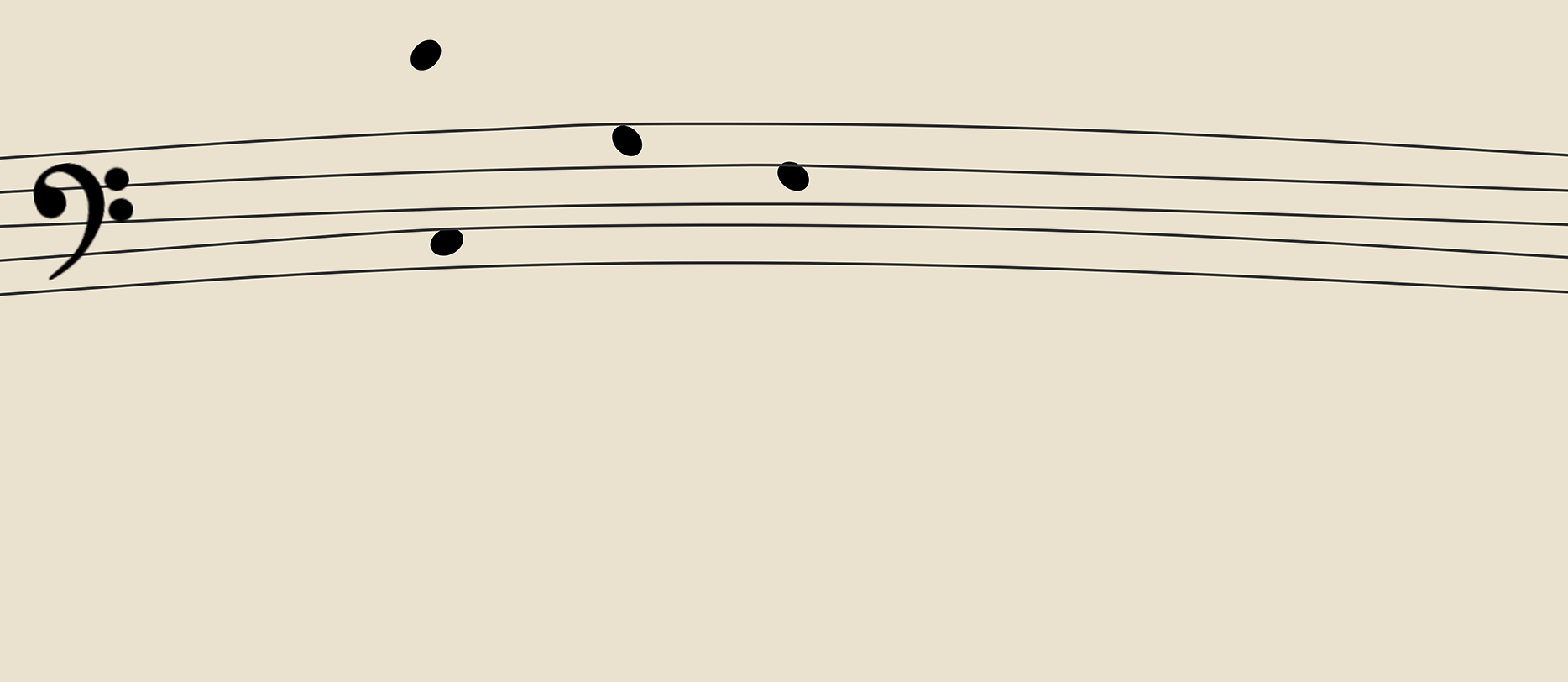
In practice, the deconstructionist intent was not immediately apparent to musicians. The expectation was that the graphics have some connection, however tangential, to notation’s symbolic conventions, and that they should be interpreted at least in part as signifying events or gestures. In workshops, it was necessary to emphasise that the graphics do not ‘mean’ anything, but that the score was there, in part, for its experiential aesthetic qualities, and to act, as Schuiling would describe it, as an ‘interface’ for imagining virtual material qualities of sound.
To foreground the material negotiation between performer and notation, the score continuously analyses the live audio’s noisiness and stability using FFT-derived metrics of spectral flux and variance. Those values power a physics engine with springs and constraints acting on the stave-line particles and torque and force applied to the note heads so that every nuance of timbre and dynamic reshapes the score’s form and motion. Agential notation challenges the view of notation as a passive, static representation of a composer’s authority. It is rather often dynamic and responsive to environmental factors or performer input. This dynamism allows for emergent behaviours to arise out of the relationships characterising the wider musical ecology, which includes the performer, the instrument, the notation and the ambient, resonant space. Echoing Théberge’s proposal that we consider instrument makers as designers of relationships rather than objects (Reference Théberge, Bovermann, de Campo, Egermann, Hardjowirogo and Weinzierl2017), agential notation, like Actor Network Theory (Born & Barry Reference Born and Barry2018), places emphasis on the assemblage of entangled relationships of the components of a musical, technological and cultural network rather than the objects themselves.
There are important precursors to concepts concerning the incitement of dynamic, chaotic feedback loops between performer and sonic materials, particularly within electronic music. Unpredictable feedback arising from electronic circuits has long fascinated instrument designers, electronic musicians and composers. Artists like Toshimaru Nakamura and Stefan Prins have viewed it as both a challenge and an inspiration. Daryl Worthington writes in Wire Magazine that 2024 signalled something of a feedback renaissance within contemporary music circles, citing the work of Luciana Rizzo and Dhangsha, aka sound artist Aniruddha Das as notable examples (Worthington Reference Worthington2025). Artists working with feedback highlight the materiality and unpredictable spectral flux of sound, treating it as raw material to be sculpted rather than discrete notes to be fixed to a two-dimensional frame.
Another key reference point for Undersong is Eliane Radigue’s Naldjorlak (2006), written for cellist Charles Curtis. With a renowned history as an electronic music composer, working most notably with the ARP 2500, it was perhaps natural for Radigue to attend to the emergent qualities of sound that stem from the often unpredictable recursive feedback loop established between performer, instrument and sound. Naldjorlak centres around the cello’s wolf tone, an unstable resonance often considered undesirable, which in this piece becomes a gateway into rich, evolving sonic textures. The piece invites the performer into an intuitive, embodied engagement with the cello, transforming the shifting wolf tone’s volatile vibrations into a continuous, dynamic exploration of sound and resonance that unfolds in real-time. Radigue’s composition is an exemplar of distributed, remediated agency. Echoing Schuiling’s description of notation, Naldjorlak establishes and mobilises relationships that allow the sounds to emerge, troubling our conceptions of the musical object, agency and responsibility. Taking Schuiling’s theories and these works as touchstones, Undersong queries how digital notation might enable composers to effectively mediate musical form through these entanglements and complex interrelationships?
By employing real-time analysis of a live sound source, Undersong, like Naldjorlak, also explores timbre and the elusiveness of stability in acoustic tones. Through FFT analysis, the system evaluates sound stability and noise content by measuring spectral flux, spectral flatness and peak count. Stability is assessed by checking if flux is consistently low over time when amplitude is above a given threshold, while noise content is derived from spectral flatness and peak complexity of the sound. These metrics feed into the 2D Matter.js physics engine, which simulates force-based interactions among the visual elements to produce a continuously evolving response to the performer’s sonic gestures. For example, at the outset of the piece, when spectral flux exceeds a given threshold, the particles comprising the stave bend and wobble outward, whereas when the flux is low, the spring network connecting the particles returns them to near rest. At the same time, noisy, high-flux signals increase rotational torque on each notehead, making them spin, while purer, more stable tones remove the torque, so they begin to decelerate and settle. Once the performer’s loudness exceeds a hard-coded amplitude, new note heads (up to a maximum of four) are instantiated with a low initial mass so they drift and tumble and are more susceptible to the simulated wind forces created by the audio signal. Over time, the mass of a note head gradually increases, causing it to fall more swiftly under gravity, breach the lines of the stave and resist the simulated forces until they disappear below the bottom edge of the screen.
6. Aesthetic striving play
A key challenge in this project was that the visual media had to avoid being a reactive rhythm game like Guitar Hero while being more than a novel audio visualiser of the performer’s timbre. Through a series of workshops with musicians, it became apparent that directing the performer towards a goal would be an engaging way to confer musical form on what otherwise may be of only passing interest to the musician. Hamann suggested that musical form might emerge not from fixed objectives but from shifting relational activities where the performer navigates evolving tasks working with noise and stability. For Hamann, evolving the relationship between performer, sound and notation would mean ‘the question of form becomes really interesting… how that relationship shifts over time, building a responsive relationship between score and performer’ (Hamann, personal communication, January 25, 2024). Hamann was pushing for the performer to be directed somewhat in their relationship to the score and to modulate that relationship over time. They were clear that the activity of navigating the moving trajectory of these relationships would be the point rather than an externally imposed goal. In this example, form arises from negotiating the changing conditions of these unstable entanglements. As discussed earlier, Schuiling cites composer Liza Lim’s experience that in her music, improvisers benefited from instructions, as establishing a defined path for improvisation allowed the improvisers to play more deliberately and confidently even when they were choosing to depart from this path. In his book on the International Composer’s Pool (ICP), Schuiling notes that in situations where notation and improvisation coexist together, ‘the freedom of an improviser does not simply consist in what is left unspecified by the score. Rather, it emerges from the relation between musician and the notated material’ (Schuiling Reference Schuiling2019: 143). Hamann is similarly motivated by framing the activity of engagement with the notation, but a frame that moves over time: a morphological shift of agency arising from which form emerges.
Hamann’s focus on agency in early workshops can find interesting parallels in C. Thi Nguyen’s writings on the aesthetics of games, particularly his theory of ‘striving play’. Nguyen’s concept of striving play builds upon earlier philosophies of games, most notably Suits (Reference Suits2005) and Huizinga (Reference Huizinga1938), who had characterised gameplay as the temporary and voluntary adoption of constraints while in pursuit of a goal. In activities like rock climbing or chess, the satisfaction may come from problem solving when navigating a particularly difficult route up a cliff face or responding strategically to an opponent’s moves. A game determines our in-game abilities and goals. These temporary goals are worthwhile not for their intrinsic value but for the activity set in motion by the pursuit of these goals. Nguyen contends that striving play allows us to attend to fluid modes of agency under changing conditions. The constraints presented by the topography of a cliff or the moves of an opponent may be the catalyst for engaging modes of effort and creativity that, in Nguyen’s framing, lead to a rich aesthetic experience. By imposing constraints upon our pursuit of a disposable goal, a game temporarily ‘sculpts’ our modes of agency. Through being exposed to alternative agential modes in gameplay, we may enrich our understanding of our own agency and become aware of alternative ways that we may inhabit it under changing circumstances. As Liza Lim found, prescribed guardrails can break a performer out of the limiting habits of their own nature to discover new possible creative avenues. Nguyen’s uses an evocative thought exercise to demonstrate how constraints can be a catalyst for creative agency. He asks the reader to imagine standing in an open field:
Imagine that we add some walls, a door and a roof. Now there’s a house in the middle of the field. In a very simple sense, my movement has been restricted. There are walls now; certain paths of movement are now impeded. But those simple restrictions themselves also help constitute a set of richer, more substantively different options. Now I can be inside or outside, sheltered or exposed. Restrictions can constitute new options, and these new options can be more richly meaningful than whatever options were lost (Nguyen Reference Nguyen2020: 78).
As with the creative role notation can play in improvisation, becoming more familiar with different agential modes makes us freer, more adaptable and more autonomous in our lives. Nguyen extends these ideas to assert that striving play is, like art, an aesthetic experience. For Nguyen, in striving play where the goal or the win is not the principal point, the process of striving for the goal is aesthetically meaningful. He writes:
‘The artist’s work is the game proper: the rules, the pieces, the software, the environment. But the attentive focus is the players’ experience of their own activity. An aesthetic striving game is successful, not when the game itself is aesthetically good, but when it inspires and shapes aesthetically valuable striving in the player’ (Nguyen Reference Nguyen2020: 144). The aesthetic experience in gameplay emerges from dual modes of attention: a focused pursuit of a temporary goal coupled with a reflective awareness of one’s own agency through that process (Nguyen Reference Nguyen2020). Hamann’s insights suggested that a way to meaningfully engage performers in a focused process of attending to their own agency, as well as that of the instrument and notation would be to frame the activity of performance as striving play.
7. Design and mechanics of a striving virtual index
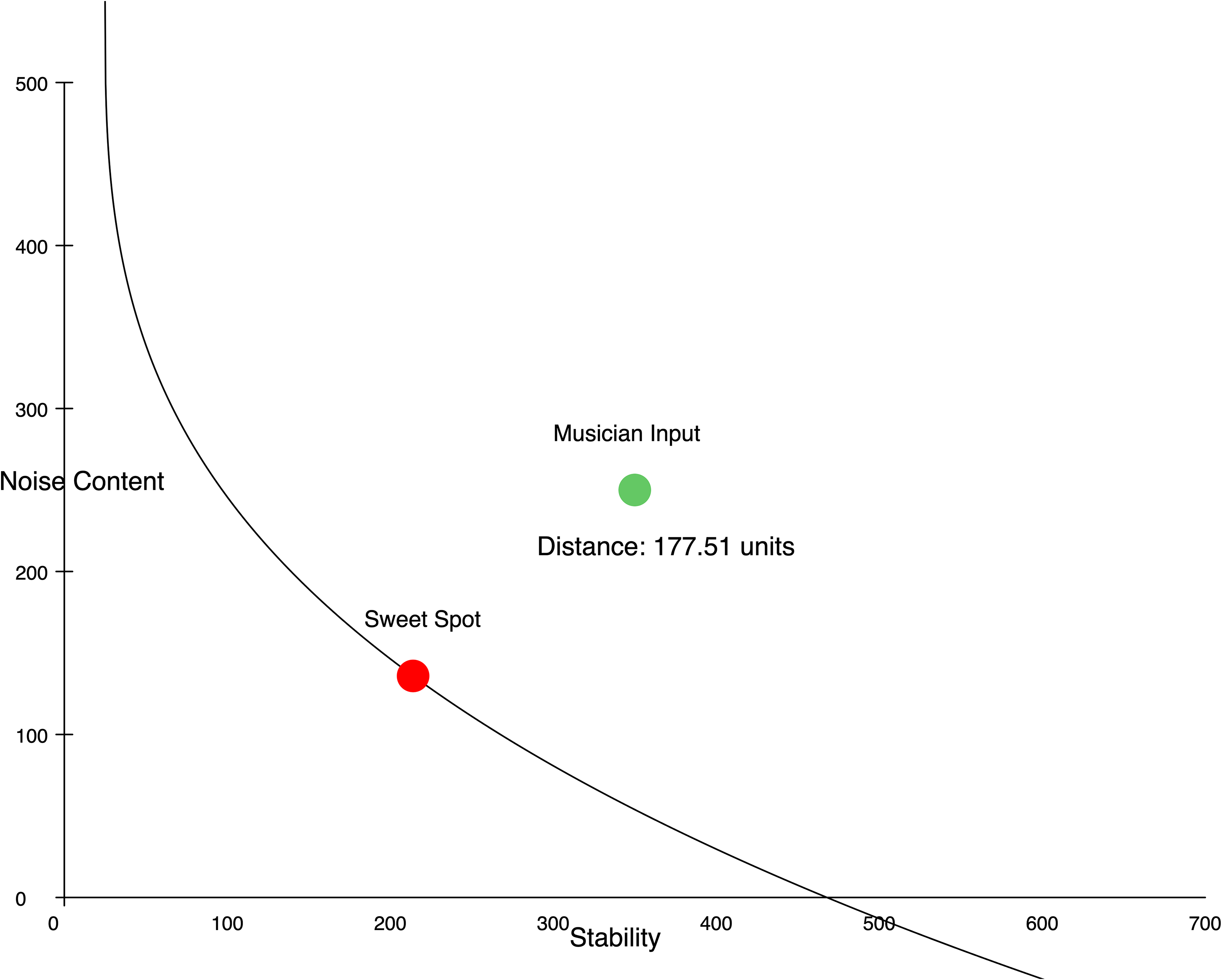
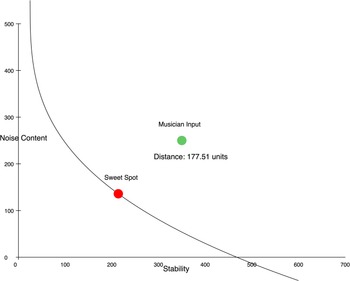
Early designs evaluated stability and noise, but absent any clear goal, did not act as a sufficient catalyst for the performer to focus their attention, prompting refinements. To emphasise this feature, the responsiveness of the digital notation is modulated over time. When the score is first run, maximum force is exerted on the graphics when the performer’s sound is noisy and unstable. As time progresses, the notation increasingly becomes more responsive to stable, purer tones. It was apparent that performers would benefit from directed shifting trajectories of activity to sustain aesthetic engagement, that embracing temporary goals not for their inherent value but as catalysts for the aesthetic value of the activity or struggle itself (Nguyen Reference Nguyen2020). Nguyen’s concept of striving play inspired the creation of a moving ‘sweet spot’ as reference point. It is a composite value of noise and stability determined by FFT analysis. Noise is measured on the x-axis, and stability on the y-axis. The closer the performer’s sound to the sweet-spot, the more pronounced the response of the digital image. The performers adjust their tone in exploring sonic targets, fostering a balance between exploratory freedom, shifting agential modes and striving play (see Figure 3).
Graph demonstrating moving target and dynamic evaluation of performer input.
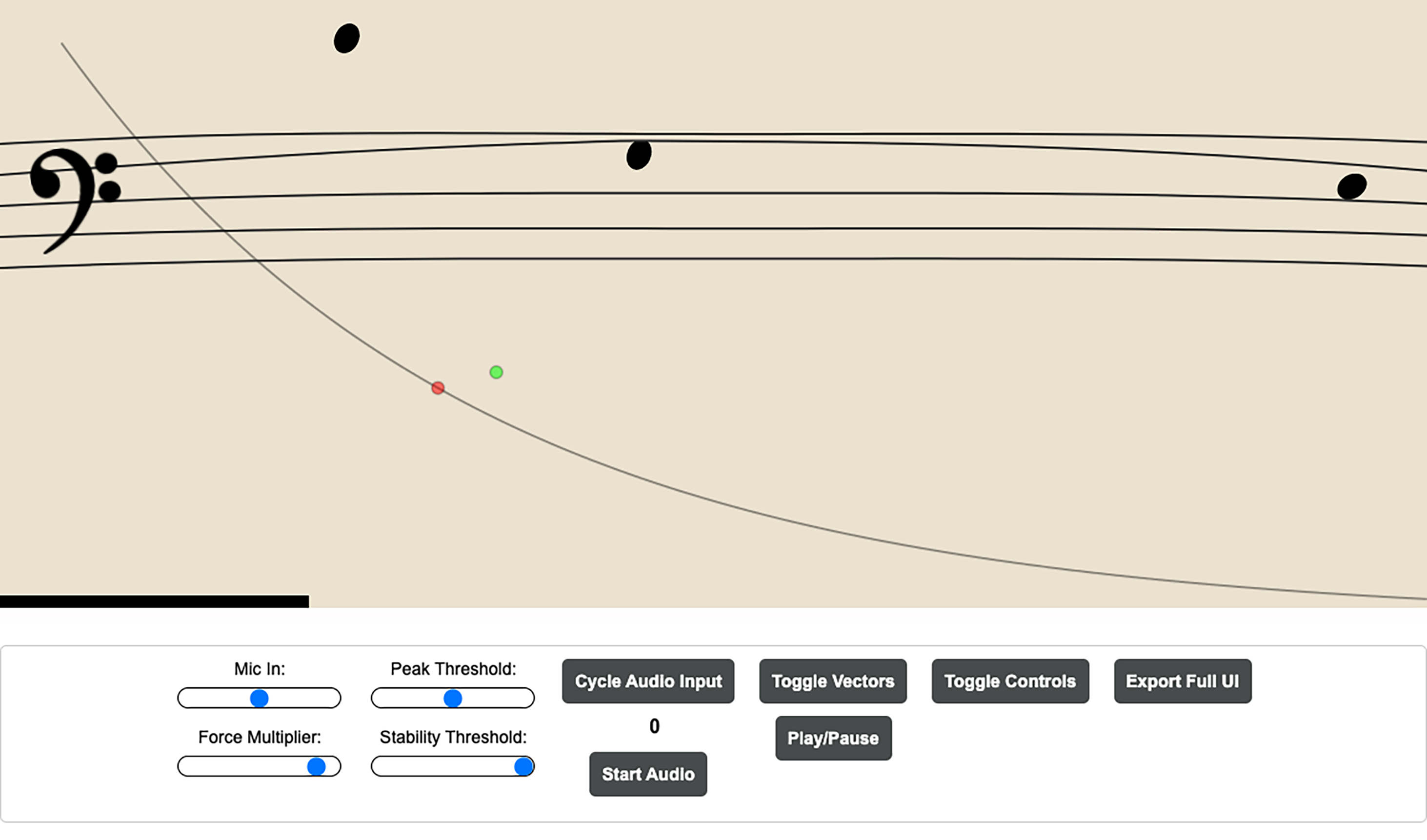
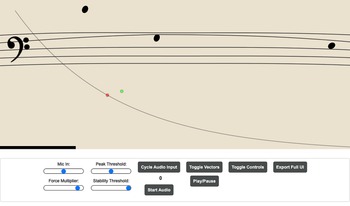
To help performers independently manage variables like room resonance and microphone placement, the practice UI provides controls for tuning responsiveness and temporarily overlaying the moving target ‘sweet-spot’ and input reference vector (see Figure 4).
Undersong score with added UI controls to aid rehearsal.
Supplementary Video 1 features Andonovska’s flute performance with the score in indexical mode without the reference overlays. Supplementary Video 2 adds practice input reference overlays to demonstrate the modulating response of the score to Hamann’s cello. It is important to emphasise that all symbolic overlays are disabled in performance to preserve the indexical nature of the notation. As flautist Andonovska reflected: ‘It was easier when the [overlay] vectors were on…but when taken away there was more of a sense of artistic freedom’. (Andonovska, personal communication, 5 December 2024). This experience resonates with Nguyen’s (Reference Nguyen2020) concept of the aesthetics of agency, particularly the notion of ‘striving play’. Andonovska’s ‘searching’ can be understood as an embodied engagement with a temporary elusive goal, a striving towards a musical experience that exists not as a fixed endpoint but as an ongoing process of exploration. The removal of the ‘vectors’, while providing a sense of artistic freedom, also necessitates a continuous process of searching, a navigation of the shifting constraints of the score, the instrument and the performer’s changing agential modes. The aesthetic value emerges not from achieving a predefined musical outcome but from the performer’s active and dynamic negotiation of these constraints, a process akin to the pursuit of a disposable goal in Nguyen’s framework. As Nguyen suggests, the value in such striving lies not in the attainment of the goal itself but in the aesthetic qualities of the struggle, the ‘grace, ingenuity, and intensity’ (Nguyen Reference Nguyen2020: 223) that the pursuit demands. In this way, Andonovska’s performance becomes a site of ‘aesthetic striving play’, where the continuous ‘searching’ that the virtual indexical score invites is the source of artistic meaning. Andonovska described the piece as:
‘An exercise in persistence and tonal control. As a flute player I play an instrument where there are so many variables determining sound colour. The ability to control that is advanced, you strive for that control’ (Andonovska, personal communication, 5 December, 2024).
8. Conclusion
Undersong is an attempt to draw together the strands of Schuiling’s and Nguyen’s ideas around indexical virtual signs, agential fluidity and striving play. The score is an index, as the signs bear no iconic semblance or symbolic connection to the sounds arising out of the performer’s interaction with the score. However, the incorporation of agential fluidity and concepts of striving play are designed to ensure that the notation is not a mere visualisation of the sonic input. Unlike a passive audio visualiser like a scrolling spectrogram or level metre, Undersong attempts to foreground the relationality of notation turning each sonic gesture into a moment of interactive striving play.
As Schuiling indicates, Indexical notation’s relationship to sound is primarily causal. Typically, indices like footprints, a thermometer, a weathervane or a spectrogram are physical traces of causation. By contrast, Undersong engineers the causal relationships that lead to sound rather than recording the physical traces of a sound. Unlike iconic or symbolic notation, where sounds arise from mimesis or learned convention, the performer negotiates the embodied material nature of sound and score through attending to the entangled dynamic and remediated agencies of text and performer. The notational index is dynamic in that it evolves over time, its shifting responses to noise and pure tones guiding discovery and exploration of changing agential modes. The score might be construed as an exploratory index, as the score is not merely pointing to or causing something but causes and shapes the discovery of sonic morphologies. In striving to meet the score on its terms, the performer also encounters new forms of agency. The score is virtual in the Peircean sense, as it has the efficiency (virtus) of indicating spectromorphological qualities without being or resembling spectral information. The spectral detail is not located within the score, yet the score functions to guide the performer towards these sonic qualities through causal experimentation. The entanglement of distributed agencies emphasises the negotiated process of mutual causation, discovery and creation. Abbate (Reference Abbate2004) cautioned that gnostic tendencies in music perpetuate the impression of music’s unintelligibility to the untrained or uninitiated. A score that guides causal interaction through drastic actions and experiences suggests a more inclusive approach to exploring and making meaning from complex sonic phenomena. Addressing the issue of inclusivity and possible pedagogical benefits, Andonovska suggested that the virtual indexical approach of Undersong ‘allows for a different kind of expression for students who are interested in new music… The way I experience it is, searching in tonal qualities and searching in timbral qualities’ (Andonovska, personal communication, December 5, 2024).
The searching, exploratory way in which performers are invited to interact with the score recalls another aspect of Peirce’s theory of indices: abduction. Abduction is a form of reasoning that requires an interpreter to infer meaning from partial or incomplete information (Paulsen, Reference Paulsen2013). A trace fossil does not explicitly tell the observer what animal made the imprint; it is an indexical sign that requires interpretation based on context and reasoning. Similarly with a virtual index score, inference is required. Without iconic resemblance or symbolic convention, the performer must infer causal relationships through a process of embodied discovery, further reinforcing the indexical function of the score.
Like any map, notation in its myriad forms functions in part due to its incompleteness. Schuiling’s framing of notation as an interface for imagining virtual musical relationships suggests its value is not in its completeness but in the relationships it brings forth. The relational perspective is pertinent to electroacoustic music in which the sonic materials often resist straightforward symbolic representation. The lack of standard and consistent forms of notation is often presented as a challenge for the composition and analysis of electroacoustic music (Smalley Reference Smalley1997; Patton Reference Patton2007; Battier Reference Battier2015). However, the wild heterogeneity of notation should be celebrated for the opportunity it affords. Rather than lamenting the loss of uniformity in music notation, we should embrace its capacity to inhabit multiple roles in our broad cultural and technological ecology. Extending Seeger’s typology of prescriptive and descriptive notation, the score is an agent within the fabric of meaning-making, embodied practice and aesthetic experience. Nelson Goodman distinguished between music notation and literature by arguing that a musical score defines a work, whereas a literary script is both notation and the work itself (Goodman Reference Goodman1968). Schuling’s theories posit that notation is not merely a definition of the work but a key part of the assemblage that constitutes it.
Just as different media invite alternate forms of creative dialogue between artist and material, we must recognise that notation shapes and is shaped by the act of making music. Ingold (Reference Ingold2013) describes how the creative act is not about imposing our will on inert material but is instead shaped by the reciprocity of our relationship with it. The relationship is not defined in advance; its boundaries emerge dynamically through the act of making. Ingold describes this process as ‘drawing out or bringing forth of potentials in a world of becoming. In the phenomenal world, every material is such a becoming, one path or trajectory through a maze of trajectories’ (Ingold, 2013: 31). Virtual indexical scores are one of a maze of approaches to notating spectromorphological information. It affords many possible ways to commune with and phenomenally experience notation, sound, music, the performing act and the aesthetics of striving, making and listening. Notation as a virtual index in which performers discover and respond to relationships within a remediated network suggests a new kind of musical literacy predicated not on symbolic convention or iconic resemblance but one based upon abductive, causal relationships, perhaps bringing us closer to the cause-and-effect materiality of sound. To paraphrase Landy (Reference Landy2007), Schuiling’s framework presents new possibilities for notational design in which the sonic ecology, in all its lived, distributed, embodied existence, and not the static artefact, is in focus.
Supplementary material
The supplementary material for this article can be found https://doi.org/10.1017/S1355771825100708.

 Open access

