



Catheter-related bloodstream infections (CR-BSI) are one of the most important nosocomial infections and are usually caused by normal skin flora, such as coagulase-negative staphylococci (CoNS), Staphylococcus aureus, Candida spp., Enterococcus spp. and Gram-negative bacilli. However CR-BSI caused by uncommon microorganisms are frequently published as individual case reports, from particular types of patients and often with imprecise clinical details to inform their significance [Reference Ramos1].
We report here a retrospective case-control study from January 2003 to December 2011 of patients with well documented CR-BSI caused by microorganisms that represented <0·5% of all CR-BSI episodes identified in a tertiary teaching hospital. The study was approved by the Hospital General Universitario Gregorio Marañón Ethics Committee. The hospital served a population that during the study period ranged from 704 030 to 810 445 inhabitants. Patients with CR-BSI were identified from the diagnostic microbiology laboratory database and assigned as cases with uncommon microorganisms, two controls with CR-BSI caused by a more common microorganism immediately before and after each case, were selected per each case.
Patients' data were collected by reviewing hospital medical records. Clinical data included demographics, McCabe & Jackson prognosis of underlying diseases, and comorbidity factors according to the Charlson index [Reference Charlson2, Reference McCabe and Jackson3]. For adult intensive care unit (ICU) patients, the Acute Physiological Assessment and Chronic Health Evaluation (APACHE) II score was calculated at the time of catheter withdrawal. Microbiological data from catheter and blood cultures were also recorded. Other captured data included neutropenia (neutrophil count ⩽500/μl) within the 7 days before catheter withdrawal, transplantation, and immunosuppressive treatment during the previous month, surgical procedures on admission, antibiotic treatment, and outcomes. The following clinical complications secondary to CR-BSI bacteraemia were also recorded: infective endocarditis, suppurative thrombophlebitis, recurrence of bacteraemia, mediastinitis, osteomyelitis, septic arthritis and secondary abscesses.
The definitions for CR-BSI are those detailed in the Clinical Practice Guidelines for the diagnosis and management of intravascular catheter-related infections [Reference Mermel4]. A confirmed diagnosis of CR-BSI required that the same microorganism was grown from at least one peripheral venous blood culture (two in the case of Bacillus spp., Corynebacterium spp., Lactobacillus spp., Leuconostoc spp., Micrococcus spp., and Streptococcus viridans) and a catheter tip culture within a period of 8 days. Polymicrobial CR-BSI was defined as the presence of colonization of the catheter tip and bacteraemia caused by two or more different clinically significant microorganisms. A patient was considered to have received adequate antibiotic therapy if the pathogen grown from blood cultures and catheter tip was susceptible, in vitro, to the antimicrobial prescribed. We considered mortality to be attributable to CR-BSI in all patients who died with persistent signs and symptoms of infection in the absence of another focus or clear alternative explanation for the death within a period of 30 days.
Blood cultures were processed according to routine methods using a semi-automatic culture detector (Bactec 9240; Becton Dickinson, USA). Catheter tips were cultured using the roll-plate Maki technique and ⩾15 c.f.u./plate was defined as significant microbial growth. Isolates were identified and tested for antimicrobial susceptibility by the automated MicroScan system (DADE Behring, USA).
Statistical analysis was performed using SPSS v. 12.0 (SPSS Inc., USA). Qualitative variables are shown with their frequency distribution and quantitative variables are expressed as the median and interquartile range (IQR). Normally distributed continuous variables were compared by t test and abnormally distributed continuous variables were compared by median test. The χ 2 or Fisher's exact test was used to compare categorical variables. A P value <0·05 was considered significant. A multivariate logistic regression model was used to identify the independent variables associated with CR-BSI due to uncommon microorganisms and shown as the odds ratio (OR) with 95% confidence intervals (CI).
During the study period, 1331 episodes of CR-BSI were detected in our institution. Of these, 31 episodes (2·3%) from 30 patients were caused by uncommon aetiological agents of CR-BSI representing 13 different genera (Table 1). In the control series (62 episodes) CoNS predominated (37%), followed by S. aureus (26%), Candida spp. (18%), Gram-negative bacilli (13%) and Enterococcus spp. (6%).
Clinical features of patients with catheter-related bloodstream infection due to uncommon microorganisms (cases) and by other pathogens (controls)
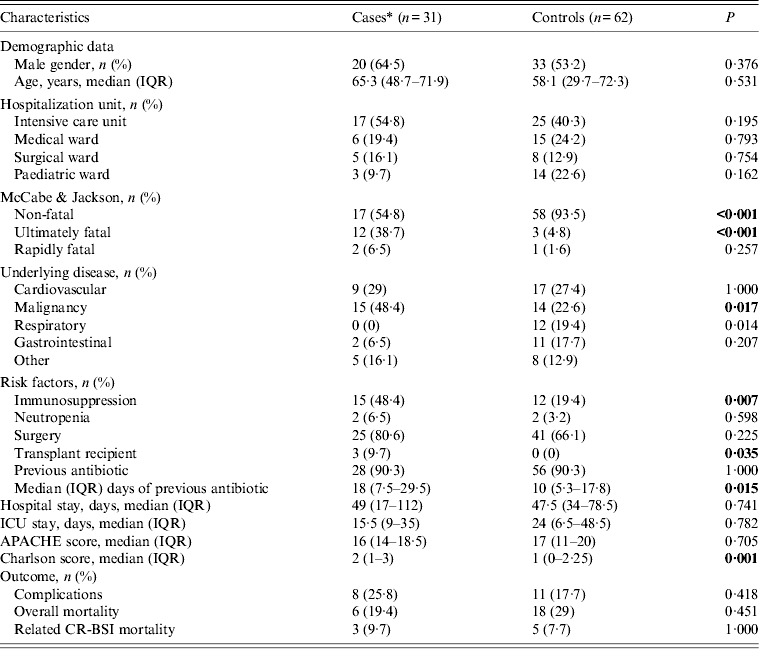
IQR, Interquartile range; ICU, intensive care unit; CR-BSI, catheter-related bloodstream infection.
* Streptococcus (7), Bacillus (4), Citrobacter (4), Burkholderia (3), Trichosporon (2), Lactobacillus (2), Morganella (2), Saccharomyces (2), Corynebacterium (1), Chryseobacterium (1), Leuconostoc (1), Micrococcus (1), and Providencia spp. (1).
Thirteen percent of CR-BSI episodes due to uncommon microorganisms were polymicrobial (12·9% in cases vs. 1·6% in controls, P = 0·041) with one each of Enterobacter aerogenes, Escherichia coli, Klebsiella oxytoca and S. aureus. There were no significant differences in the outcome of polymicrobial and monomicrobial CR-BSI due to uncommon microorganisms.
The clinical characteristics of cases and controls are described in Table 1. Patients' median age was 65 years, 65% were male, and 90% were adults. Most (55%) CR-BSI episodes occurred in adult ICUs. There was no difference in age, sex and hospitalization unit between cases and controls. Malignancy was the most common underlying condition, followed by cardiovascular disease and gastrointestinal disease. Twenty-five patients had undergone at least one surgical procedure during admission, 44% of which were abdominal, 32% cardiac, and 24% other. Cases had a higher Charlson's comorbidity index [cases 2 (IQR 1–3) vs. controls 1 (IQR 0–2·25); P = 0·001], more severity of underlying disease, such as ultimately or rapidly fatal illness and a higher percentage of underlying malignant disease (P = 0·017).
Risk factors for CR-BSI due to uncommon microorganisms were immunosuppression (48·4% vs. 19·4%, P = 0·007), transplant recipient (cases 9·7% vs. controls 0%, P = 0·035) and receiving prolonged antimicrobial therapy in the previous month (cases 18 days vs. controls 10 days, P = 0·015). Multivariate analysis showed that the only independent risk factor for having a CR-BSI caused by an uncommon microorganism was receiving previous prolonged antimicrobial therapy (OR 1·06, 95% CI 1·005–1·118, P = 0·032).
Regarding outcome, complications occurred in 25·8% of cases vs. 17·7% in controls, and complications in the cases were recurrent bacteraemia (4), thrombophlebitis (2), abscess (1) and mediastinitis (1).
Seventy-four percent of the cases received appropriate empirical antimicrobial therapy and this increased to 96·4% following antimicrobial susceptibility test results. There were no significant differences between cases and controls regarding appropriate empirical therapy (P = 0·597) and targeted therapy (P = 1·00).
Overall and related mortality to CR-BSI due to uncommon microorganisms vs. common microorganisms were 19·4% vs. 29% (P = 0·451) and 9·7% vs. 7·7% (P = 1·00), respectively. Further, there was no statistical difference between cases and controls in the type of catheter, insertion site or catheter days. The main reason for catheter withdrawal, both for cases and controls, was suspicion of local or systemic infection.
CR-BSI are a serious healthcare problem associated with significant morbidity, mortality, increased hospital stay, and costs [Reference Tacconelli5]. CoNS, S. aureus, Candida spp., Enterococcus spp. and Gram-negative bacilli have been reported as the most common aetiological agents of CR-BSI, which is consistent with data from our institution [Reference Reigadas6]. We found that 2·3% of all our CR-BSI episodes were due to less common microorganisms and this accords with other surveillance studies in the literature which report an incidence of <5% for such organisms from CR-BSI [Reference Richards7, Reference Ronveaux8]. Some studies have noted a rise in the proportion of Gram-negative bacilli with respect to Gram-positive bloodstream infections, including those caused by miscellaneous unusual microorganisms [Reference Castagnola9]. When searching for an origin in patients with bacteraemia due to these microorganisms, catheter site should be taken into consideration and should not be ruled out as catheter contaminants.
CR-BSI due to uncommon microorganisms is not exclusively associated with critical care, as a significant proportion of the episodes recorded here occurred in non-ICU adult units. The epidemiology of CR-BSI has rarely been investigated outside the ICU setting [Reference Marschall10, Reference Vonberg11] and similar CR-BSI rates in medical non-ICU wards and ICU medical wards have been reported [Reference Kallen12].
We found that patients with CR-BSI caused by uncommon microorganisms had a high prevalence of other clinically significant diseases, such as malignancy and immunosuppression. However, the only independent risk factor associated was receiving prolonged antimicrobial therapy.
The limitations of the study were those associated with its retrospective single-centre design which may have overestimated outcomes. We were not able to assess the need of catheter removal since the case definition required a positive catheter tip culture and therefore in all cases, catheters had been removed. However, to the best of our knowledge this is the first study that provides a working definition of them and describes the clinical and microbiological characteristics.
In conclusion, a variety of uncommon microorganisms occasionally cause CR-BSI. Although these infections are not associated with a higher mortality, they occur in a population with more severe underlying conditions and especially in patients who have received prolonged antibiotic therapy.
ACKNOWLEDGEMENTS
We thank T. O'Boyle for his help in the preparation of the manuscript, and J. M. Bellón (Unit of Statistics and Epidemiology, Hospital General Universitario Gregorio Marañón, Madrid, Spain) for his assistance with the statistical analysis.
No funding was received for this study.
DECLARATION OF INTEREST
None.



