

There has been a debate on the question whether having a sibling and the number of siblings in the family affects children's educational attainment and their social abilities. It is still unclear whether the presence of one or more siblings brings about a dilution of resources, or whether it provides a peculiar resource for the child (Downey & Condron, Reference Downey and Condron2004). Using Hungarian data from the 1980s, researchers have found that children from larger families tend to have lower educational attainment, and this supports the resource dilution model; however, as the age difference between siblings narrows, the average educational level grows (Van Eijck & de Graaf, Reference Van Eijck and de Graaf1995). As the smallest possible age difference is that between twins, we might expect a positive effect here. This issue has immediate relevance for us, as the main question of our work is: What are the positive effects of being a twin as far as the subjective experience of the twins is concerned? The proposition that adult twins play important roles in each other's lives is confirmed by numerous analyses (Métneki et al., Reference Métneki, Tárnoki, Tárnoki, Littvay and Czeizel2011; Tancredy & Fraley, Reference Tancredy and Fraley2006), but the question of how much twinship means as a resource in society has not yet been studied.
Twin birth and twin babies have always drawn more attention in society — in the family, in the immediate and wider environment, and in the media — than do single births (Métneki, Reference Métneki2005). But what about adult twins? What can you expect from life if you have the same-age sibling with a very similar outlook? Does it mean anything? Do monozygotic twins have a better life or more opportunities than do dizygotic twins? These questions motivated our research. Whereas much twin research — for example, in the medical and biological fields — is focused on distinguishing the effects of inheritance and environment (Métneki et al., Reference Métneki, Tárnoki, Tárnoki, Littvay and Czeizel2011), our interest is in the twins themselves, their life outcomes and social prospects.
Basically, we focused on the question whether being a twin has positive consequences across zygosities, but we aimed to investigate the social composition and status of twins as well, due to the lack of a large-scale social scientific research on twins in the literature. Our main question was whether twinship provides resources — ‘capital’ — to twin persons, and if so, what kind of differences exist between types of twins. By ‘capital’ we simply meant extra opportunities that improve twins’ lives. This type of question is very rarely investigated in social scientific research. Hungarian social scientists have mainly concentrated on demographic description (Pári, Reference Pári2011, Reference Pári2012; Saile, Reference Saile1928). Other Hungarian analyses concerning twins have focused on the biological or psychological aspects of mainly child-age twins: for example, Métneki (Reference Métneki2005), and Bóta's (Reference Bóta2011) informative booklet on twins. Such research has informed books written directly for parents with twin children, which have started to become popular in Hungary (Lehochki et al., Reference Lehoczki, Nemeshanyi, Rajnai and Wessely2008; Nagy Zsuzsa, Reference Nagy Zsuzsa2004). Therefore, our aim was to perform the first sociological survey of Hungarian twins that could serve as a unique base for further sociological research in Eastern Europe.
Subjects and Methods
In our study, we employed some indices for measuring the resource nature of twinship. We defined the range of benefits related to twinship more broadly than educational achievement and social status. Our questions encompassed benefits of social relations, twin appearance and the opportunity of being mistaken, and the feelings about and evaluation of these facts.
Three main types of benefits were determined: profit of attraction, as a sort of ‘material capital’; the easier obtainability of cultural goods when twins take part in it, as ‘cultural capital’; and positive aspects of an a priori existing dyadic relation, as ‘relational capital’. We did not examine negative capital — that is, the disadvantages of twinship. (At the same time, twins as a minority group, and the handicap stemming from it, are very exciting questions. Stewart (Reference Stewart2000) deals with it when she introduces the issue of being stigmatized as a twin.) Instead, we were interested in the difference among types of twins regarding advantages. We paid special attention to the five groups of twins derived from gender and zygosity (i.e., monozygotic females, monozygotic males, dizygotic females, dizygotic males, opposite-sex pairs).
Our Hypotheses
Hypotheses Regarding Gender
We hypothesized that the two genders experience feelings about their twinship with different intensity, and they use it in different ways and to a different extent. First, we proposed the following:
1. For women, twinship is more important and they experience its positive aspects more intensely. In society, twinship appears as physical characteristic — namely, similarity of appearance — and as such, is an identity forming factor that can be linked more to women than to men. Hence, we hypothesize that:
2.
(a) women enjoy the experience of twinship as a matter of physical appearance, a characteristic gained through birth (as with beauty) to a greater degree than men, whereas
(b) men are more active in making use of twinship in fields that can be connected to competition and efficiency (e.g., with learning).
Relying on the differences between male and female roles, we further proposed that the following:
3.
(a) Women make greater passive use of benefits of twinship (i.e., they enjoy the popularity given by twinship more than men), whereas
(b) men are more active users (i.e., they take greater advantage of the benefits than women do).
Finally, we hypothesized as follows:
4. Altogether, a greater proportion of women's personality is given by their twinship (see point 1), and as such they rely on it more — they ‘use’ their twinship more.
Hypotheses Regarding Different Types of Twins
1. Hypothesis regarding monozygotic and dizygotic twins: We expected that identical twins experience twinship more intensely and that they make more use of its advantages than dizygotic twins. Our supposition is based on the fact that monozygotic twins, simply from their similarity, appear in society as twins, and in this way during their lives continuously face the fact that they are not standing alone in the world.
2. Hypothesis on the combination of zygosity and gender: It is worthwhile to go beyond differentiating monozygotic and dizygotic twins, and to combine zygosity with gender. This way we get five types of twins: female–female monozygotic, male–male monozygotic, female–female dizygotic, male–male dizygotic, and opposite-gender dizygotic. Teachman (Reference Teachman1997) has already found that inside-outside factors have different effects on twin types of different genders: In the case of opposite-gender pairs, the effect of family is smaller on cognitive and school performance of children than in the case of the same-gender twins. Altogether, we hypothesized that these five groups can be ranked in the following order, from the highest intensity of experiencing kinship to the lowest intensity; and the highest usage of twinship to the lowest usage: monozygotic women, monozygotic men, dizygotic women, dizygotic men, and dizygotic opposite-gender twins.
Our Survey
Adult twins (mean age: 38.2 ± 14.6 years) were involved via the Hungarian Twin Registry (Littvay et al., Reference Littvay, Métneki, Tárnoki and Tárnoki2013; Tárnoki et al., Reference Tárnoki, Tárnoki, Horváth, Métneki and Littvay2013), and completed our questionnaire at three Hungarian summer twin festivals (printed questionnaires, 38%), in hospitals during medical twin studies (partly via e-mail and by printed version of the questionnaire, 32%). In addition, 30% of the responders completed the questionnaire online. (There were no twins who completed the questionnaire twice; we were able to check this by using some personal questions.) In total, the questionnaire was completed by 222 people, including 77 twin pairs (both members of the pair responding), 63 individual twin respondents, and members of two sets of triplets (five of the six members responding). Altogether, the data represented 140 twin pairs and two sets of triplets. Our analysis focused on twin pairs. If we had answers from both members of a pair, we used only one (randomly chosen). In determining zygosity, we relied on two sources of information: a multiple-choice, seven-part questionnaire (Heath et al., Reference Heath, Nyholt, Neuman, Madden, Bucholz, Todd and Martin2003) and respondents’ self-classification. We had eight cases where the two sources disagreed: these cases were classified as monozygotic twins, since both persons unanimously claimed they were identical twins and were of the same sex. The study was approved by the relevant ethical committee and conducted in full compliance with the regulations of the Declaration of Helsinki. All participants of the study signed an informed consent.
Majority of the responders were monozygotic twins (51.1% of the responders stated that they knew it for sure, and another 8.6% reported that it was probable; the others were dizygotic twins). Seventy-five percent of responders were women. The distribution of respondents by sex and zygosity is shown in Table 1.
Type of Twins by Sex and Zygosity

*One female respondent with a female twin did not know their zygosity, while two people did not answer the question about zygosity. These cases were only used in analyses unrelated to zygosity.
In our sample, the highly qualified (those with a college or university degree) were over-represented (51.8%). The respondents were younger on average than the Hungarian population, and the majority of them were of an active age (the percentage of respondents above 65 years is only 6.5%). The percentage of young (18–30 years) and middle-aged (31–65 years) respondents was 38.8 and 54.7% respectively.
According to their permanent addresses, the percentage of respondents who lived in the capital city (47.9%) was higher than that of the national population. This undoubtedly reflects in part the choice of sampling locations. (Among those who filled out the questionnaire online, the share of citizens of Budapest is a little less — only 44% — while the inhabitants of Budapest include only about 17% of the Hungarian population.)
Between males and females, and between monozygotic and dizygotic twins, no significant differences were observed in educational level, type of permanent address, or age.
The main question of our study was whether being a twin is a resource of the types described above, and whether there is a difference in this regard among various types of twins. We examined two questions as follows:
1. How deeply do individuals experience positive aspects of their twinship? On the whole, does their twinship provide them with an emotional plus?
2. What kind of benefits are attributed to twinship? On what level can twins use it as a ‘profit’?
Measures
We used the following indices:
1. How deeply do twins experience positive aspects of their twin status? Respondents evaluated pride, subjective importance, and the advantages of being a twin on a 0–2 scale (where 0 represents a negative response, 2 represents a positive response, 1 is neutral). The questions were: (a) ‘Are you proud that you are a twin?’; (b) ‘Is it important to you that you are a twin?’; and (c) ‘Is it advantageous or disadvantageous for you that you are a twin?’ A 7-point index (0–6) was constructed for the general experience of twinship by summing the responses to the above three questions.
2. To what extent does twinship represent a resource, and which characteristics of twinship are involved? Here we examined three dimensions, and we distinguished between active and passive usage of twinship.
(a) Dimensions
Attraction or ‘material capital’ (peculiarity): A 9-point index was constructed by summing responses to the following four questions evaluated on a 0–2 scale: (1) ‘Are you considered special because you have a twin?’; (2) ‘Do you like being recognized as twins?’; (3) ‘Do you like talking about twinship with others?’; and (4) ‘Do you emphasize your twinship by dressing in similar outfits?’
Relational capital: A 7-point scale was constructed by summing responses to the following three questions evaluated on a 0–2 scale: (1) ‘During your studies, did you take advantage of the possibility of learning together with your twin?’; (2) ‘Among people you don't know, is it easier to be for you if your twin is known?’; and (3) ‘Did you protect each other in childhood?’
Cultural capital: A 5-point index was created from questions about cooperation during learning (see above) and from the following question: ‘During your childhood, did it happen to you that you responded on behalf of each other?’
(b) Active and passive utilization
Active: A 9-point index was constructed from the cultural capital index and from the variable showing how twinship is emphasized with dressing.
Passive: A 5-point index was constructed from responses about the feeling of being special and the enjoyment of being recognized as a twin.
(c) The overall score
This index ranges from 0 to 17, and is based on all the variables used in previous indices (2(a)–2(b)), that is: how often did the respondent feel her- or himself special because of being a twin (0–2 scores), how often did the respondent save his or her twin pair from aggression during childhood (0–2 scores), the passive utilization index (0–4 scores), and the active utilization index (0–8 scores).
Results
With respect to our hypotheses, we obtained the following results.
The Role of Gender
1. About the gender distribution of variables forming the index of the general experience of twinship (measure 1), it can be said that the only significant effect found was on the subjective importance of twinship: more women said it was important or very important than men (by 3.6 and 2.4 percentage points respectively; p < 0.01). Nine percent of men reported that twinship was not at all important to them. Using the index containing the three variables together as a dependent variable, no significant relationship could be observed among gender and experiencing twinship (R 2 = 0.006; b 0 = 5.324; b 1 = -0.23; p = 0.355).
2.
(a) No major difference was observed between male and female respondents regarding the benefits caused by their physical abilities (attraction, or ‘material capital’).
As for the index constructed from the four variables, according to the linear regression, the difference between male and female responders is not significant in our sample (R 2 = 0.021; b 0 = 4.222; b 1 = -0.782; p = 0.119). Examining the individual components of the index, we can see that the only significant difference between men and women concerned the sentiment of feeling special (Table 2).
Do You Feel Sometimes That You Are Special Because of Being a Twin?

χ2 = 9.716; df = 2; p < 0.01.
However, if we take into account whether (as it is an essential difference in the possibilities of emphasizing attraction) the respondent is monozygotic or dizygotic, the effect of gender becomes significant (and its effect also increases by about two-tenths, b 1 = -0.954).
(b) With regard to the relationship between gender and the index measuring the joint cultural ‘capital’ of twins, women report taking a greater advantage of their twinship than men (R 2 = 0.037; b 0 = 1.717; b 1 = -0.482; p = 0.023).
3. When evaluating the indices constructed for active and passive uses of twinship, a significant result is that women report as more actively using their twinship status than men (R 2 = 0.032; b 0 = 3.643; b 1 = -0.776; p = 0.042). Women are also ‘better’ than men in passive usage of twinship (namely, enjoying that their twinship is interesting for others), although the difference between men and women on the index for passive usage is smaller and not significant (R 2 = 0.023; b 0 = 2.290; b 1 = -0.450; p = 0.104). Zygosity plays a major role here: when it is introduced as a control variable, the difference between men and women becomes significant (and this difference increases by one-tenth, b 1 = -0.535).
4. Our findings showed that women have more of the so-called ‘relational capital’ resulting from twinship — namely, the advantage that two can do more and they can support each other. On the 7-point scale, male twins scored less than female twins by over half a point (R 2 = 0.046; b 0 = 4.398; b 1 = -0.674; p = 0.015).
Given the results already presented, it will not be a surprise that women scored higher on the overall index, indicating that they are, on the whole, more likely to experience and take advantage of the benefits of twinship than men. Our results show that the grade of male twins on the 17-point scale is 1.5 points lower than that of women (R 2 = 0.037; b 0 = 9.212; b 1 = -1.503; p = 0.046).
Differences Between Twin Types
1. Monozygotic or dizygotic: Significant differences could be observed on all indicators between monozygotic and dizygotic twins. Using regression analysis, monozygotic twins obtained significantly higher values on all fields (general experience of twinship: R 2 = 0.068, b 0 = 4,870, b 1 = 0.654, p = 0.002; attraction: R 2 = 0.181, b 0 = 2.629, b 1 = 2.042, p < 0.001; social capital: R 2 = 0.043, b 0 = 3.864, b 1 = 0.574, p = 0.021; cultural capital: R 2 = 0.116, b 0 = 1.148, b 1 = 0.755, p < 0.001; active usage: R 2 = 0.147, b 0 = 2.532, b 1 = 1.456, p < 0.001; passive usage: R 2 = 0.152, b 0 = 1.472, b 1 = 1.034, p < 0.001; overall usage: R 2 = 0.191, b 0 = 6.656, b 1 = 3.123, p < 0.001 — monozygotic being always coded with 1 and dizygotic with 0), meaning that twinship was much more important for them, and they took greater advantage of the possibilities given by twinship, both in active and passive way.
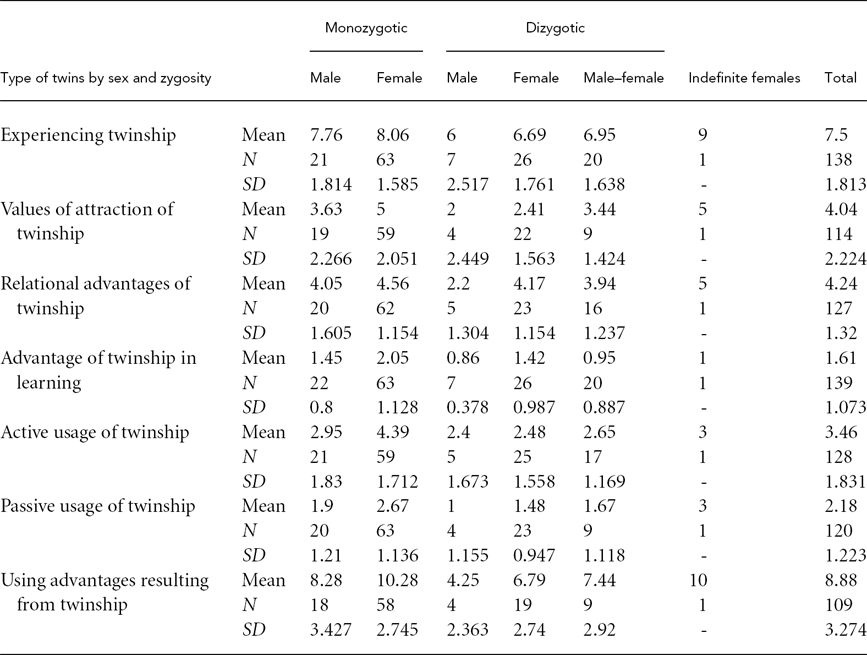
2. Differences between five twin types: Twins differed in their experience and ‘use’ of twinship depending on their zygosities and sex (Table 3). In the case of nearly every index presented below, the ranking of scores is as follows: monozygotic women, monozygotic men, dizygotic opposite-gender, dizygotic women, and dizygotic men. The order is different in the case of relational advantages and learning together, where dizygotic females’ scores are relatively high.
Differences in Five Twin Types, Mean Values of Indices*

*p < 0.01.
Discussion
In our sample, monozygotic twins constituted a majority, although more dizygotic twins live in Hungary, and we had far more females than males (three-quarter of the respondents were women), while the proportion of neonatal males and females is about equal in the Hungarian population as a whole and among twins (Központi Statisztikai Hivatal (KSH), 2014). These deviations are caused at least partly by the fact that more monozygotic twin sisters attended the twin festivals. Second, online surveys are usually completed by more women than men (Smith, Reference Smith2008).
Concerning our hypotheses on the role of gender, very large differences were not observed between men and women, but those that were noticeable were always to the ‘benefit’ of women. Regarding the four specific hypotheses on the role of gender, following were the observations:
1. Experience of twinship: Although the direction of the relation fitted our expectations, we have to point out that, contrary to our hypothesis, there were no significant and major differences between males and females in terms of how much they are affected by twinship (how important is it to them, how proud of it are they, or whether they consider it an advantage or not), even if some advantage can be seen on behalf of women.
2.
(a) Attraction: The difference is in the expected direction between males and females in profiting from the attraction of twinship, but the association is significant only in the case of feeling special. However, controlling for zygosity, the effect of gender on the whole ‘attraction index’ became significant.
(b) Cultural capital: Our hypothesis was not confirmed concerning the effect of gender on benefits from cultural activity of twins. On the contrary, we found women gaining more from using their twinship in this territory.
3. Passive and active uses of twinship: Although we thought men and women use different aspects of twinship, our results showed women are better in both passive and active use of twinship.
4. Overall differences: All in all, in our twin sample women had more advantages from being a twin than men.
Hypotheses about the differences between monozygotic and dizygotic twins were supported in our analysis. Monozygotic respondents were really more interested in their twinship and gained more from the state of being a twin.
Our expectation concerning the order of combined twin types in the advantages was proven on five out of seven fields, except for one point: dizygotic opposite-sex twins got higher scores than same-gender dizygotic twins.
In summary, our research showed that Hungarian twins involved in our research basically enjoy their twinship; during their lives they used and continued to make use of different benefits given by it. Dividing the sample population by gender and zygosity reveals a heterogeneous picture. Of note, female responders, especially identical twins, exploited the capital of being a twin in a greater proportion than other groups.
Of the two sides of resource dilution/strengthening theory, we only investigated the second, that is, strengthening; and according to our results — although generalization is restricted due to the specificities of our sample — twinship is beneficial for twins, with benefits varying in magnitude from one twin group to another.
Our findings reinforced the following two points: First, it is problematic to speak about twins on a general level because monozygotic and dizygotic twins are very different in several ways. Second, it is important to make additional distinctions than merely zygosity, as in reality there are five types of twins, and their possibilities and behavior are also very diverse.
Our study has several limitations due to its exploratory and testing characteristics. First, our sample is not a representative of the twin population in terms of gender and zygosity ratios. Since the sample was largely drawn from the participants in twin festivals, it disproportionately included identical female twins, who live their twinship intensively and are receptive toward attraction. Second, in order to obtain a more complete insight, a complex sample is needed in which both twin and non-twin groups are properly represented. Third, the questions of the survey need further refining. In order to better understand the social characteristics of twins and to get a clear insight on the role of twinship in different life phases of respondents, life path interviews are expected in the future studies.
Acknowledgments
We would like to thank Brent Ranalli for his help in preparing the English text and to the staff of the Hungarian Twin Registry for the involvement of twin pairs in our study. We also thank Ádám Domonkos Tárnoki, Dávid László Tárnoki, and Levente Littvay for their useful comments on an earlier draft of this paper.