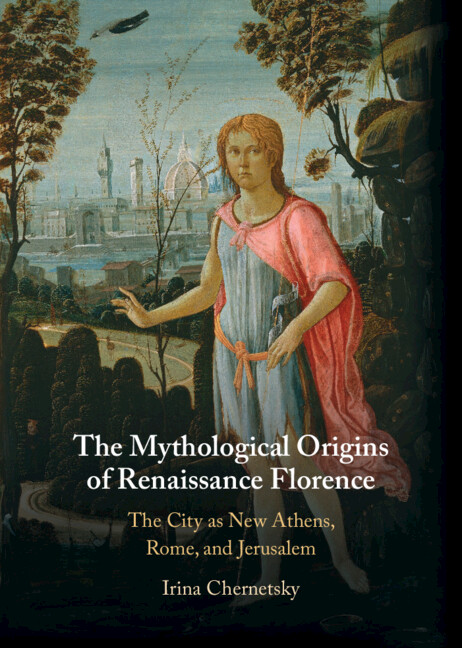
The Mythological Origins of Renaissance Florence

-
Select format
-
- Publisher:
- Cambridge University Press
- Publication date:
- 07 August 2023
- 13 October 2022
- ISBN:
- 9781009039116
- 9781316510957
- Dimensions:
- (244 x 170 mm)
- Weight & Pages:
- 0.58kg, 232 Pages
- Dimensions:
- Weight & Pages:
- Subjects:
- Art, Western Art
Show more authors 
You may already have access via personal or institutional login
Book description
In this book, Irina Chernetsky examines how humanists, patrons, and artists promoted Florence as the reincarnation of the great cities of pagan and Christian antiquity – Athens, Rome, and Jerusalem. The architectural image of an ideal Florence was discussed in chronicles and histories, poetry and prose, and treatises on art and religious sermons. It was also portrayed in paintings, sculpture, and sketches, as well as encoded in buildings erected during the fourteenth and fifteenth centuries. Over time, the concept of an ideal Florence became inseparable from the real city, in both its social and architectural structures. Chernetsky demonstrates how the Renaissance notion of genealogy was applied to Florence, which was considered to be part of a family of illustrious cities of both the past and present. She also explores the concept of the ideal city in its intellectual, political, and aesthetic contexts, while offering new insights into the experience of urban space.
Contents
Contents
Metrics
Altmetric attention score
Full text views
Full text views helpTotal number of HTML views: 0
Total number of PDF views: 0 *
 Loading metrics...
* Views captured on Cambridge Core between #date#. This data will be updated every 24 hours.
Usage data cannot currently be displayed.
Accessibility standard: Unknown
Why this information is here
This section outlines the accessibility features of this content - including support for screen readers, full keyboard navigation and high-contrast display options. This may not be relevant for you.
Accessibility Information
Accessibility compliance for the HTML of this book is currently unknown and may be updated in the future.