




Lady Wilhelmina “Minnie” Murray née Malcolm (1834–1912), was living in Morar, a cantonment town in Gwalior, in the Sindia state, when the Indian Rebellion broke out in May 1857.Footnote 1 Manuscript letters from Minnie, the wife of a general in the Indian Army, addressed to her sister Agnes Babington at home in the United Kingdom, record her flight to Agra, where she sought refuge with her family from the forces of the Gwalior Contingent, which mutinied in June 1857.Footnote 2 Someone, although it is not clear who, prepared these letters for publication: extracts appeared in The Times in September as well as in other British newspapers.Footnote 3 Her letters document the growing unrest in Gwalior in May 1857, the family's experiences in the fort of Agra, and their return to Gwalior in December. A microstudy of these letters, which provide hitherto unexamined eyewitness accounts of the uprisings in Gwalior and Agra, reveals how this type of writing facilitated the interaction of colonial families with the British news sphere at a time of imperial “crisis.” The widespread mid-nineteenth-century practice of circulating and publishing correspondence—to convey news, seek support, and intervene in imperial debates—meant that letter-writing families were able to exert considerable political and historical influence during the Rebellion and in its aftermath in 1857–58 through the narratives they forged and circulated.
Minnie's letters had been “previously hidden” in The Salvation Army International Heritage Centre in London. Perhaps they had seemed irrelevant to the archive's primary collecting focus on Salvation Army histories. Recataloguing efforts in 2012, however, brought the letters to light after a period of being “unknown to or of less interest to previous staff.”Footnote 4 Plumbing the rich social and cultural “biography” of Minnie's letters from their manuscript form and production to their dissemination and publication in India and England, reveals the myriad afterlives and deep genealogies of “mutiny” narratives.Footnote 5 These letters, however, are not isolated narratives. Rather, they were produced and remained in conversation with testimonies of Minnie's fellow Gwalior residents and those living as fugitives in the Agra Fort. The memoir of Minnie's brother-in-law, General Sir Richard Meade, an army officer and administrator, in fact draws on family letters from 1857, including Minnie's own correspondence. A Lady's Escape from Gwalior, the memoir of Ruth Coopland, the wife of an East India Company (EIC) chaplain, refers to the Murrays as fortress acquaintances, and recounts Ruth's experiences of the Gwalior “mutiny” and escape to Agra, partially using her own and her deceased husband's letters home.Footnote 6 Alexander and Annie Christison, friends of the Murray and Meade families, were also writing letters home from Hattrass (now Hathras) and Agra. These were addressed to Alexander's father, Sir Robert Christison, in Edinburgh. Without definitive permission from the couple, Robert censored and edited their letters and sent them to The Scotsman, which published them in a consecutive run between July and October 1857, just as an unknown agent did on Minnie's behalf.Footnote 7 Minnie's experiences and accounts of the “mutiny” drama thus furnished and overlapped with subsequent narrative texts and stories, including parliamentary papers and dispatches, John William Kaye and George Bruce Malleson's official histories, and Arthur Conan Doyle's The Sign of Four. “Mutiny” narratives were thus intertextually constructed:Footnote 8 familial and personal processes of writing, reading, editing, and censoring letters fed into wider historic genealogies of the evolution of British “mutiny” discourse.
From 1840, British postal reforms had putatively modernized the sending of letters, rendering this a more private and individualized experience.Footnote 9 Personal letters are conventionally associated with the development of a more subjective interiority of their writers, and a seemingly closed mutual relationship between writer and addressee. Yet letters often traversed the private–public divide. They wielded public influence as they found their way into various routes of circulation and distribution. Correspondents had to negotiate the everyday “vernacular publication” of letters, as it was expected that recipients would swap, share, and pass letters along, read them aloud, and archive them for the inspection of posterity.Footnote 10 In certain conditions, private letters were also published in the traditional sense. Recent scholarship, straddling the disciplines of literary, historical, and media studies, has begun to interpret the published letter as a platform that afforded disenfranchised and depoliticized groups agency to comment on and propagate political debate and military intelligence. Caroline Bland and Máire Cross have argued that women in particular have historically obtained “political literacy” through circulating and publishing their letters. Karin Wahl-Jorgensen and Allison Cavanagh have shown that individuals acquire self-awareness as “political beings” through participating in the “Letters to the Editor” features of the press, as correspondents. Through writing, women newly acknowledged the political and historical resonance of their experiences, making use of the press as “an alternate sphere of power” to contribute to public life as informed subjects.Footnote 11
Minnie's letters were a private-turned-public correspondence tool that were produced and circulated within this new media landscape. Priti Joshi and Laura Peters have demonstrated the existence of an empowering colonial public sphere formed through British and Anglo-Indian newspapers and periodicals, which leveraged moments of colonial crisis in India to either contest or shore up imperial hegemony.Footnote 12 If Nancy Paxton has argued that the aftermath of 1857 bred a public desire for “mutiny” “scripts” relating to “sexuality, violence, and power,” it is critical to understand how and by whom these “mutiny” motifs were initially conceived.Footnote 13 “Mutiny” narratives are often accredited to solitary men as authors, historians, commentators, and administrators. Yet knowledge about the events of 1857 was worked out and co-produced in the contexts of family.Footnote 14 Writing by imperializing women in the immediate circumstances of the revolt was formative to early efforts to script British “mutiny” narratives, which often used attacks on women, and more broadly assaults on the institution of motherhood and the English domestic space, as a providential opportunity for retribution and reclamation. They mythologized the masculine deeds of male participants around them, ultimately recasting colonial disorder and defeat into narratives of British martyrdom and imperial vengeance. Analyzing the actions of Indian actors, from “fanatical rebels” to “loyal” servants and princes, female correspondents grappled with the complexities of “native” subordination and the ambivalences of colonial relationships. Families who recognized the cultural “capital” of these narratives and communications brought them to the attention of the British public sphere, sometimes altering their meaning through censorship and amendments.Footnote 15 As families released letters from India into the public realm at home, these sensational “mutiny” stories unified a newly mobilized newspaper-reading public early on who were bound by a collective moral affinity with and empathy for imperiled members of the “imperial race” out in the colonies.Footnote 16
Contexts of the 1857 Indian Rebellion: Gwalior and Agra
In May 1857, sepoys (the Indian infantry of the Bengal Army) mutinied in Meerut and disaffection swept across central and northern India. Tensions climaxed with the Cawnpore (now, Kanpur) massacre in July 1857.Footnote 17 Two hundred European women and children imprisoned in the Bibighar or “House of the Ladies” were ordered by the deposed peshwa and central rebel leader, the Maharajah of Bithoor (Bithur), Nana Sahib, to be killed and thrown in a well. The British reacted to the massacre with collective outrage, commencing a retributive campaign of punishment and executions during and after the Rebellion itself. Initially, the uprisings were understated as isolated military “mutinies,” triggered by rumors that sepoys had been ordered to use Enfield rifle cartridges greased with animal fat. Such misinterpretations masked decades of Indian discontent with EIC rule and missionary interference, which escalated into a united Muslim and Hindu revolt in 1857.Footnote 18 Uprisings also erupted in those states still sometimes nominally ruled by a maharajah or “native” ruler, referred to in later Raj nomenclature as the Princely States, such as Gwalior. Indian Princely rulers and commanders, such as Nana Sahib, Tatya Tope, the Rhani of Jhansi, and Begum Hazrat Mahal, were influential agents in the conflict, as both British allies and rebel leaders.Footnote 19 Part of the Murray, Meade, and Christisons’ accounts are also derived from the families’ embeddedness in British activity in Princely India, which was in many ways critical to British (mis)fortunes during 1857.Footnote 20 Following the British victory in the Anglo-Maratha War in 1818, the EIC assumed indirect control of Gwalior, yet the region only came more fully under British rule in the 1840s, following the suppression of the unrest.Footnote 21 Prior to 1857, Gwalior was already operating as a meeting place for anti-colonial thinkers and activists. Ahmadullah Shah, one of the prominent rebel leaders, also known as the “Maulvi of Faizabad” (maulvi meaning Islamic teacher), was mentored in Gwalior by ex-soldier Mehrab Shah Qadri who promoted anti-colonial jihad against Europeans.Footnote 22 Notwithstanding a history of suspected anti-British leadership up to 1857, including most famously that of the maharani and queen, Baiza Bai, the Sindia state, during and from 1857 onwards, under the rule of the Maharajah Jayajirao Scindia, was actually rewarded for its fidelity to the British.Footnote 23
In Gwalior in June 1857, Indian soldiers in its Contingent (over 7,000-strong at this point) mutinied, and Minnie's immediate family, including her sister Emily Meade and brother-in-law, escaped and took sanctuary at Agra.Footnote 24 The Gwalior fugitives moved from the Agra barracks into the fort towards the end of the month, eventually leaving on 10 October 1857, following its relief by Colonel Edward Greathed.Footnote 25 Minnie had been in India since 1851, when she and her sister Emily had joined their father, Duncan Archibald Malcolm, a civil servant who had occupied the positions of assistant and Resident in Hyderabad, Jodhpur, Gwalior, and Baroda, where he died in 1855.Footnote 26 In 1854, Minnie married Sir John Irvine Murray and they had six children together.Footnote 27 Murray had gained an EIC cadetship aged sixteen and set off for India in 1842, beginning his Indian military career in the Second Anglo-Sikh War (1848–1849).Footnote 28 Emily had similarly made a military match. She was married to General Sir Richard Meade, Brigade-Major of the Gwalior Contingent from 1855 and also later respected Resident of Hyderabad.Footnote 29 Their sister Agnes, to whom they were sending their “mutiny” letters, also extended the family's dense web of imperial connections by marriage. Her first husband was a member of the Bombay Medical Service and she later also married into the Meade family, becoming wife to General J. M. de Courcy Meade.Footnote 30 The Murrays, Meades, and the Malcolms were parents to a number of acclaimed colonial and military servicemen and women, particularly Minnie and John's own children. Their son Archie pursued a career in the army and died in the Second Anglo-Afghan War. Their daughter Mary Stewart Murray OBE served with the Salvation Army during the South African War, which is probably how Minnie's letters came to be in the Salvation Army's archive.Footnote 31 Yet the defining narrative in the Murray and Meade family history is concentrated around the events of 1857. This was not least because Sir John Irvine Murray received recognition when stationed with the Gwalior Contingent in 1857. He was the acclaimed general of a new cavalry regiment, the 14th Bengal Lancers, or “Murray's Jat Horse,” formed from recruits from the North Indian Jat communities, to contain rebel forces near Agra.Footnote 32
Addressing Colonial Anxieties
Minnie's letters formed the only personal record of the family's experiences of the revolt as it occurred. Writing these missives was both anxiety inducing and heightened the insecurity of the colonizers’ position that the uprisings made manifest. Sending mail in India underwent significant change during the nineteenth century. Posting letters in the decades before 1857 had generally become faster and more efficient. The time it took for a letter to be sent from London to one of the main Indian cities was reduced from six months at the start of the century to six weeks by the 1850s.Footnote 33 In the 1857 Indian Rebellion, rebels prioritized cutting British telegraph wires and blockading roads, which disrupted normal postal patterns. In a letter written to Agnes on 15 September 1857, Minnie stated that the “last letters from you were dated 9 June,” meaning that Minnie had not heard from Agnes for at least three months.Footnote 34 “Mutiny” correspondence was susceptible to long delays as well as being lost or intercepted, and letters were eventually placed under weight and censorship restrictions. Coopland recalls having to be “guarded” in her communications. As the uprisings commenced in India, Minnie was aware that rebel spies were poaching letters, and sometimes Indian deputy post masters would seize and pass them onto rebel forces.Footnote 35 Internal communications were also undermined. Messages from Agra to Calcutta had to be transferred inconveniently through Indore or Bombay (Mumbai). Minnie notes having to pay off Indian runners with “large rewards” if they returned with replies, and to avoid detection letters had to be made smaller, to be concealed on the person of the carrier, or hidden inside other vessels, such as quills.Footnote 36
Minnie found writing to Agnes “most unsatisfactory” because of its futility. Writing a letter home started to seem absurd when, in her words, “[they] may never see [it].”Footnote 37 The revolt distorted British communication habits, at once severing fugitives’ contact with society outside their places of refuge but also engendering in them an all-consuming relationship with the mail and its anticipated arrival, however unpredictable or undependable it may have been. An “Anglo-Indian” feature on communications in India during the revolt depicted an intensified psychological attachment to the mail and mail days. English residents “lived by the post alone” and “till the post was in … no man could call his day his own.” On the mail days, the “tinkling bell of the letter carrier,” brought a great “rush made upon him for the letters!” and then someone would read aloud snippets of newspapers for the latest news. Using a female metaphor to equate incoming letters with the arrival of life-altering news, the author describes the mail suddenly becoming “pregnant with the interests of life and death,” a semi-regular reminder of the existential threat India had unexpectedly levied on its British occupants.Footnote 38
Yet early “mutiny” letters from May to July 1857 also repeatedly reference the comparative indifference and absence of reaction from home. The 10 June mail from England delivered news “full of the Derby and Manchester picture-show,” and the 26 June mails were preoccupied with the Handel Festival at the Crystal Palace. The “Anglo-Indians” were demoralized to learn “that the crisis was not appreciated in England.”Footnote 39 Coopland similarly recollected that “letters came from home full of news about the Manchester Exhibition [the Manchester Art Treasures Exhibition that began in May 1857], tours in Scotland, and all sorts of pleasures,” and that their friends at home “knew nothing” of their condition.Footnote 40 Rose Monckton at Futtehgurh (Fatehgarh) lamented “how little” their family in England knew of Indian events, and Minnie explained that Agnes had previously written to her “in complete ignorance of all the terrible doings.”Footnote 41 As Tamar Rozett reminds us, when communication technologies such as the mail failed or proved deficient at colonial sites, the “precarious position of colonizers” was laid bare to those closely involved in the imperial project. Equally, when so much of the colonizers’ sense of security was bound to empathic home replies, scant communications in content and frequency exacerbated their situation and magnified feelings of “exile” or isolation.Footnote 42
Writing, then, could be an affective experience reflective of the visceral anxieties of colonial life.Footnote 43 Minnie's manuscript letters bring to light symptoms of the trauma of the revolt, and their postal contexts attest to the anxieties of nineteenth-century writers. During the uprisings, correspondents wrote letters in the knowledge that family at home might never receive them, or that they would be killed in the interval between sending them and waiting for a reply. Writing can possess therapeutic properties for people during and post-trauma. It narrativizes past occurrences into a timeline of events that is more comprehensible, and it facilitates self-expression, thereby “constructing a witness where there was none before.”Footnote 44 The Agra residents’ sample of “mutiny” letters suggests that writing as a practice, not just an outlet, could also alleviate colonial anxiety. Insurance measures, for instance, were put in place to mitigate against postal disruptions. Composing a letter became part of a more arduous writing process that involved duplicating copies, and redrafting accounts, holding missives back for safer routes of passage, but also hastily dashing off notes if a letter carrier became available.Footnote 45 The consequences of potential last words to family and friends could be loaded into the dispatch of a single letter. Widening its chances of delivery was a central preoccupation of “mutiny” survivors. Writing in this context was a procedure calculated to safeguard, as far as possible, the conveyance of knowledge and news against frail communication systems. “Mutiny” communications were epistemic anxieties writ large, and an unknowing populace at home heightened colonizers’ feelings of disconnect.Footnote 46
The month prior to the uprising at Gwalior on 14 June 1857, a false alarm was raised, anticipating a mutiny in the Gwalior Contingent. In response, British women and children were sent to the Residency under the protection of the political agent at Gwalior, Samuel Charters Macpherson, and the maharajah.Footnote 47 Minnie described the period leading up to the first flight to the Residency as a “painfully anxious month.”Footnote 48 Other accounts elaborated that British confidence in their security at Gwalior was felt to be faltering, “suddenly” feeling as “strangers in a strange land.”Footnote 49 The sepoys were becoming “insolent” and Indian servants “impertinent.” British officers remained “true-hearted, faithful English gentlem[e]n,” incapable of comprehending that the paternalistic bond between soldier and officer could be sundered or that the “natives” they had “been petting for a century” could resist authority.Footnote 50 The more undefined and amorphous anxieties of feeling like “strangers,” living among a potentially hostile majority population, became increasingly fixed on an identifiable threat of anti-colonial insurrection. Protecting British women and children became the strategic focus of addressing rumors of insurgence.Footnote 51 Yet, at Gwalior, the decision to remove the women at the station to safety was contested, with the brigadier fearing it would incite the Contingent to rebel for lack of mutual trust. The women were eventually sent away between 28 and 29 May and Minnie's early letters to Agnes describe in detail the twenty-one-mile drive that she took with her dying infant son, Duncan, as well as the “wretched” conditions of their overnight stay at the Residency and palace.Footnote 52
Her account in the letter was recapitulated through various channels over time. Coopland's memoir also recalled “poor little children crying,” “ladies half dead with heat and fatigue, some in tears” and “one mother,” unnamed, but likely Minnie, “weeping over a child supposed to be dying.”Footnote 53 Official dispatches, parliamentary papers, and “mutiny” histories by Kaye and George W. Forrest went on to establish Minnie's narrative of escape as part of the legend of women's roles in the Rebellion.Footnote 54 An official dispatch was later made praising Minnie and her sister Emily for returning to the cantonment independently, as recommended to them by the brigadier. The governor-general stated “with the warmest admiration the calm confidence and decision, the noble indifference to personal danger exhibited by Mrs. Meade and Mrs. Murray … when they were informed by the Brigadier that their remaining at the palace was fraught with mischief.”Footnote 55 Accompanying Minnie's letters in the archive is also a series of newspaper clippings, one of which cites the sisters’ escape story to advocate for women to be awarded the Victoria Cross decades later.Footnote 56 Emily Meade herself was remembered for her “reminiscent moods”; she was “fond of describing the impressions made upon two young girls by a journey undertaken in a strange country, without escort, and with none of the travelling comforts of later times.” Emily continued to communicate the meanings of their Indian sagas through oral or vernacular forms of publication and dissemination.Footnote 57 Atrocities against female civilians became part of the exonerating myths that were reproduced over time to justify colonial countermeasures and the reconstitution of control. Yet more than this, narratives of the autonomy of women “mutiny” survivors who had to breach gender norms to endure colonial crisis, in turn framed India as a site not only rife with epistemic uncertainties, but also where social imbalance had to be restored and security restabilized.
Minnie and Coopland's respective accounts were also employed in later retellings of the official mutiny of the Gwalior Contingent in June. The editor of the biography of Richard Meade, Minnie's brother-in-law, for instance, sourced Minnie's letters and published extracts, editing these passages with a “few additional details” “inserted from a letter by Mrs. Meade [Minnie's sister], written about the same time” to recount their escape.Footnote 58 Minnie and John, and their last surviving child, Archie (having recently buried Duncan), and Emily and Richard with their two children, fled Gwalior together. They were hidden with the help of a havildar (Indian sergeant) and some “loyal” sepoys in a seven-foot high tower, who then escorted them across the Morar River.Footnote 59 The majority of women and children of the station were unharmed but approximately nineteen British residents were “massacred.”Footnote 60 The Murray and Meade families reached the Maharajah's Phool Bagh palace the next day, and he provided them with transportation and bodyguards to the Chambal River. During the rest of their journey to Agra they encountered Indian rebels and bandits, including a faction of “fanatic” “ghazis,” and were rescued by a Brahmin chief, Thakor Baldeo Singh, sent by the maharajah's British-approved dewan or prime minister.Footnote 61 The Maharajah Jayajirao's “loyalty” to the British was “conspicuous from the very beginning” and Queen Victoria later made him a Knight Grand Commander of the Order of the Star of India in 1861 for his support. Minnie also presented Jayajirao as an ally in her letters, explaining to her sister that “the Maharajah has done all in his power to keep them [the sepoys] quiet & has behaved admirably.”Footnote 62 Minnie likely refers here to Jayajirao's negotiations with the rebels to protect British women and children at the station and his pledge to continue paying the Gwalior Contingent, preventing them from progressing to the Agra Fort.Footnote 63
“Mutiny” discourse represented pockets of Indian “fanatical” disaffection within a broader “loyal” or subordinate populace. The Murray and Meade families continued to mark particular acts of loyalty after 1857, applying for government recognition for the havildar, Heera Lall, and a sepoy called Zalim Singh who had assisted their escape, with promotions and rewards of confiscated land. In his petition to the viceroy in the early 1860s, Meade insisted that, “Captain Murray and I have always felt that, under Providence, we owed our own lives and those of our families to the loyalty of Havildar Heera Lall and his Guard, and we have at various times endeavored to trace him out, but, till recently, without success.”Footnote 64 The figures of the “trusty” havildar, the maharajah, Thakor Baldeo Singh, and the dewan were key icons of Indian fidelity in British memory of 1857 that interpreted rebellious sepoys and civilians as aberrations in otherwise peaceable Indian-British relations.Footnote 65 Through compiling reports of the Gwalior retreat, writers were assessing overall Indian complicity with rebel objectives. Instances of demonstrative Indian “loyalty” went some way to nullifying the new threat posed by rebellious “natives,” when, disconcertingly, it was becoming clear that the motives of colonial subjects could never be wholly established or understood.Footnote 66 Colonial fear and anxiety fueled “mutiny” reports and was triggered by the perceived collapse of gender and race boundaries. Publishing these accounts magnified their underlying subtexts, which implied the precarity of imperial rule and the need to reassert control.
Publish or Perish: The Murray and Christison Letters
The British public were initially met by a paucity of information about the events of 1857. As “mutiny” news started to percolate into public consciousness, newspaper editors rushed to gather and publish letters sent in by readers, dispatches, and other reports that eventually arrived in the metropole. They initiated a polyvocal “explosion” of readerly engagement with the Victorian public sphere, in active dialogue with the columns of British and Anglo-Indian newspapers and emerging “mutiny” discourse.Footnote 67 Victorian assumptions about the authenticity of epistolary forms permitted editors to claim they were substantiating inadequate news sources on the uprisings by printing readers’ letters. By publishing letters, The Times could run sensationalist accounts of colonial atrocity to satisfy popular demand, whilst maintaining their traditionally masculine, more conservative, readership.Footnote 68
Prefacing its “Mutinies in India” page on 8 September, which included extracts from Minnie's letters, The Times stated that “we continue to publish from the numerous letters forwarded to us by the friends and relatives of officers in India such as contain any new details or matter of particular interest.” Copies of letters from three male correspondents were printed as well, with Minnie's providing the only perspective from a “lady.” The feature consisted of letters from two military officers and a clergyman, including an account from a named correspondent, Lieutenant-Colonel Luard, reporting the escape of a group of British officers from Neemuch. As the female relatives and ancillary associates of officers, women could also procure military intelligence through their personal channels and sociable networks. In Minnie's Times extract, published from her letters to Agnes, she was able to provide one of the first reports of the British defeat in the Battle of Shahgunge (Shahganj) on 5 July 1857. She observed the British retreat herself, describing the “booming of the cannon” and the “incessant firing,” because an officer guarding the fort had taken her to the “flagstaff bastion” where she “saw a great deal of what was passing below” and the “enemy's” movements.Footnote 69 The blockage of traditional news and communication outlets compounded public dependence on correspondence and “Letters to the Editor” columns. Civilian testimony could begin to shape public knowledge and “mutiny” consciousness in the metropole, which in some cases offered opportunities to influence and elicit particular kinds of public reaction and sentiment or even alter the course of military action throughout the conflict.
In her writing, Minnie seems receptive to the possibility of publication and the scrutiny of public opinion at home. She contemplated how Britain would react to news of the Cawnpore massacre, asking Agnes what the “state of the public mind at home [will be] when the dreadful tidings from Cawnpore … reaches them.”Footnote 70 The practice of publishing letters, in newspapers, biographies, and epistolary novels, for instance, had been well established in the period before the Rebellion, and we can begin to determine why, how, and under what circumstances Minnie's letters landed in The Times. A periodical described the process by which the British public received news of events during 1857. It began with “official despatches, preceded by the brief but comprehensive telegrams, and followed by private letters from sufferers amidst the scenes of carnage, [that] tell us fresh tales of woe.”Footnote 71 The printing of private letters, then, supplemented the brevity of official communications. The selection of Minnie's letters for The Times likely rested with its editor, John Thadeus Delane. A letter from one “P. Saunders,” of the Agra Volunteers, dated 25 November 1857, which is retained in Delane's papers, provides the only other indication he was receiving correspondence from Agra.Footnote 72 Insights from the related but separate style of the “Letters to the Editor” sub-genre also reveal that curated letters may have been selected and modified to conform to the editorial rules of “relevance, entertainment, brevity, and authority.”Footnote 73 Historically, “mutiny” letters have clear precedents in the transmission of Crimean War (1854–1856) news. In 1854 the Duke of Newcastle, as Secretary of State for War during the Crimean War, exhorted English newspapers to refrain from publishing officers’ letters provided by their families. A letter from the duke informed the House of Commons of the
Advantages conferred upon the enemy by the publication of intelligence from the seat of war, not only in letters from the correspondents of the English newspapers, but in letters written by officers to their friends at home in the spirit of confidential intimacy, and which those friends send to the newspapers, from feelings, no doubt, of pardonable vanity, but without consideration of the evil consequences to the army, and the public interests.
It was requested that there should subsequently be a “rigid supervision of all such letters” and the editors of the daily press were “urged” to “examine the letters they receive before they publish them” and “carefully expunge” sensitive information unintentionally relayed.Footnote 74 It was the first conflict in which the electrical telegraph had impacted military communications and strategy. Even so, war correspondence continued to meet public demand for witness accounts direct from the battlefield, despite the risk of information leaks.Footnote 75 Though correspondence and the telegraph coexisted in the Crimea context, the calculated destruction of telegraph wires in India in 1857 precipitated a news shortfall. Letters carried alternative intelligence drawn from spectators on the sidelines. Officers’ wives, for instance, observed and accrued knowledge from their proximity to the conflict. Other accounts remedied erroneous reports of the condition of particular garrisons, addressing a community of readers who had family and friends in India. Agra intelligence was circulated prior to the removal of the “Christian population” to the fort, stating they expected “to be the object of concentrated attack,” after their retreat and therefore lobbied for urgent relief.Footnote 76 News of the retreat triggered panicked responses, and a member of the public responded by sending a letter from a civil servant residing in the fort to the Illustrated London News (ILN). It was their way of placing at the editor's “disposal positive information from that fort up to the 22nd of July” because they felt that the “rumours respecting the safety of our countrymen in Agra are of a gloomy character, and calculated to cause unnecessary and unfounded alarm to their relatives and friends.” Another correspondent to this paper, “Mr Walter Riddell of … Roxburghshire” wrote about receiving a letter from his brother in Agra, which he had published for “the comfort of those who have friends shut up in the fort.”Footnote 77 Minnie's letters from June and July held a similar purpose but were also published in The Times in September for other reasons. The letters appealed for necessary relief and attempted to dispel emerging doubts about the potential corruption of British EIC officers, which was being broached as a leading cause of the Rebellion.
Minnie's letters, which then appeared in The Times, intimated that the British side desperately required further relief reinforcements.Footnote 78 They anticipated public questions at home about the state of the army, and the accountability of EIC officers. Minnie wrote to Agnes that “we piously hope and trust to see some more troops by November.” Her appeal for more troops later appeared in The Times: “how anxiously we are looking for the arrival of more regiments.”Footnote 79 Eventually 35,000 additional troops were deployed to India in June 1858, from the Bombay and Madras armies, as well as an expeditionary force that was en route to Canton and Beijing. Initially, skepticism about the scale and seriousness of the uprisings deferred public sympathy and government response.Footnote 80 Delayed and rerouted reinforcements were conflated in India with assumptions about the apathy of the public and of Parliament toward Indian affairs.Footnote 81 Minnie continued to gauge public reaction with Agnes in September, asking, “have the people at home taken alarm about India?” She assured Agnes that EIC corruption or Company policy was not responsible for the sepoy “mutiny”, refuting the culpability of officers like her husband.Footnote 82
Between 10 and 18 June 1857, correspondents were writing to the editor of The Times giving their opinion on the causes of the “mutiny”. They overwhelmingly focused on the deteriorating morals of the officer class in India and their increasing aloofness from the sepoys of their regiments. One correspondent argued that the young British officer had, over the last twenty years, “disencumber[ed] himself of Orientalism … liv[ing] on [as] a grumbling Englishman in a foreign land.” Another proposed putting “all the European officers on half-pay, seeing that their neglect is the chief cause of these misfortunes.”Footnote 83 Minnie and Alexander cited these Times debates in their letters and disputed their claims. Deflecting attention from EIC officers, Minnie attributed the events to a Muslim conspiracy: “surely when they hear of the hundreds who have been slain in cold blood, they will feel for us out here, and see that this is a religious insurrection of all the Mussalmans [sic] nearly over India, and not the fault of the officers as they at first said in the English papers.”Footnote 84 Alexander also declared in a bitingly sarcastic letter to his brother in August, “how mistaken all the ideas of the Home papers [are] about our faithful friends the Mahomedans [sic]! Why! It is they who are our constant bitter foes.”Footnote 85 Participating in early formative debates on the causes of 1857, Agra correspondents confronted critics, defended EIC conduct, and provoked unease about a native conspiracy that would polarize public opinion, turning Britons against a native adversary.
Whilst the publication history of Minnie's letters is unclear, Robert Christison's decision to send Annie and Alexander's letters to The Scotsman, without their permission, is expounded clearly in his replies to the couple. Sir Robert Christison was a notable physician in Edinburgh, specializing in toxicology and medical forensics, and he was famed for his contribution to the trial surrounding the Burke and Hare murders in 1829.Footnote 86 His son, Alexander, served as a surgeon with the Gwalior Contingent between 1855 and 1857, and then, in 1858, transferred to Meade's Horse regiment. He married Jemima Anne “Annie” Brown in 1854.Footnote 87 Editors of Robert's memoirs, which he was writing in the 1870s, note that “during the last thirty years of his life he maintained a regular correspondence, sometimes by letter, sometimes in the form of continuous journals with his eldest son and his daughter-in-law in India.”Footnote 88 Replies from Robert in July 1857 set out his rationale for publishing the letters from Alexander in Rambagh and Annie in Gwalior. He had found the letters “so interesting and so much more important than many which had been made public, in so far as they showed that the Contingent Troops were by no means to be depended on.”Footnote 89 In a letter to Annie in September 1857, Robert describes bringing the letters to the attention of the Scottish newspapers following a series of amendments, so they “might be made useful.” He had previously sent them to his local MP to no avail, and reverted to the power of the press instead,
Afterwards I thought it would be better to give them [the letters] for publication to The Scotsman, which was the largest circulation of Scotch newspapers, and is most consulted by English ones. So, I made some elisions and alterations, without altering the sense of what does appear; and, as you will see from The Scotsman of yesterday sent by this mail you [Annie] have become an authoress. When I tell you that both letters have attracted so much notice and received much commendation, I hope you will, neither of you, regret what I have done, and will be of opinion that I have done the duty of Editor judiciously, withholding especially every passage inferring blame to anyone.Footnote 90
As he alludes to here, Robert sent Annie's letters to The Scotsman as well, identifying them as letters from the wife of an officer at Gwalior.Footnote 91 In August, Robert forwarded the couple copies of The Scotsman that contained their letters. He clarified that he wanted to publish Annie's letters, because “there [was] still no clear account of the rising at Gwalior” except a letter from a different “officer's lady … which appeared in the ‘Times’ of the 21 [August] giving an account of her own adventures at Gwalior during the Mutiny.” Yet this Times letter did not display, according to Robert, “Annie's luminousness of composition” and was too vague about how the Gwalior “mutiny” had occurred.Footnote 92 The letter, provided by “a lady, dated Agra, June 27,” from the 21 August 1857 issue of The Times does survive. The extract allows one to assume that the author may have been Ruth Coopland. It contains descriptions of the author tying her wedding ring around her waist to evade its detection by the sepoys, which features almost identically in her memoir, A Lady's Escape from Gwalior.Footnote 93 These parallel accounts suggests that Coopland's letters too may have been published in the Times before her memoir was released in 1859. Jane Carlyle, the wife of the author Thomas Carlyle, herself an avid correspondent, commented in a private letter from October 1857 about reading the “mutiny” news via women's published letters, and deriving consolation from them: “the only comfort I have had in reading about these Indian affairs is in the letters of some of the women.” Jane praised the women who “write, in presence of their horrible fate, with a calm fortitude, and pious resignation that are sublime,” whereas “the men's letters are detestable generally—mess room slang and affected pococuranteism are shockingly out of place in these circumstances.”Footnote 94 Drawing upon the additional archive of the Christison family, it is evident that “mutiny” narratives in the letters of the Murray, Meade, and Christison women (and potentially Coopland) were deemed publishable by their readers according to gendered ideas about feminine sensibilities. These women were propelled into the imperial news sphere on the basis of the particular compositional strength and originality of women's writing as “mutiny” “authoresses.”
Robert informed Annie and Alexander that as a result of Annie's account being published in The Scotsman, she also “had the honour of being selected” by the ILN for its “News from the Mutinies” segments. So nearly three months after Alexander and Annie's letters appeared in The Scotsman for the first time, Robert once again laid out his intentions to send them for publication. In a letter to Alexander he explained that, given the interest they had clearly aroused,
I mentioned in one of my letters that I had given to the Editor of The Scotsman such parts of your accounts of the rebellion as seemed to me to admit of publication. … There was very little in any of the letters to withhold; and only a word or two required insertion to make your movements clear … They have excited much attention here, and are spoken of as the clearest and most interesting of the numberless letters which have appeared in the London and other newspapers. I withheld all censorious passages upon the conduct of individuals or government. In short I kept out such few passages or expressions as might by possibility compromise you in anyway. … Your letters are all the better for not having been intended for publication,—at least when there is someone to take the trouble of revision. So I hope you will still write with perfect freedom.Footnote 95
Only in January 1858 can Alexander and Annie's reaction be inferred in Robert's reply to their letters. It seems that the couple had provided some level of instruction on what to do with their letters, and Robert, somewhat apologetically, stated in reply, “I shall attend to your request regarding your letters. That which I received by the previous mail had been printed before your prohibition reached me” and he hoped they would not “regret” their appearance in the newspapers.Footnote 96 In December 1857, Robert had spoken of having the “allowable portion” of Annie's letters printed in The Scotsman, suggesting that Alexander and Annie had restricted his use of the letters to specific publishable parts suitable for “public” distribution, and made “requests” and “prohibitions” on the uses of other sections.Footnote 97 For Robert, Alexander's letters were valuable to the British public, a sentiment that outweighed any other concerns about their suitability for wider distribution. In the surviving letters, Alexander does not forbid publication. But he stipulated in at least one instance that his letters were “of course intended for all,” and this familiar refrain usually meant that recipients were free to share letters around kinship circles but not necessarily that they should also be available for public consumption.Footnote 98
In letters from other Agra Fort residents, the issue of publication was made more direct, and the topic of publishing letters and British press coverage was a major aspect of localized “mutiny” discourse from September 1857 to March 1858. In letters that John Stephens Blackett, an East Indian Railway surveyor, wrote monthly to his mother in Ireland, he criticized the practice of publishing letters, referring to it as egotistical. Although Blackett agreed to “spin out” his “diary” for his mother to give an “account” of his trip to Delhi, he also issued his mother warnings about any temptations she might have to publish: “only don't publish it; fellows here ought (if they are not so) to be heartily ashamed of their letters as published in the home papers. It is very fine to tell admiring friends at home that ‘they were very savage that morning’ and ‘killed 25 n******Footnote 99 to their own sword’ but we here know who is who & it won't go down.” Blackett, like Alexander, countenanced a more collective readership for his letters, but Blackett explicitly prohibited their publication. He stated that his mother could “show [his] letters to anybody” but asked her to “mind [that] they don't get printed” in case they were perceived as pretentious in the same way as the previous letters he describes.Footnote 100 If the publication of personal correspondence has often assumed a communal functionality, the Agra group registers tensions between rendering “mutiny” information accessible and eschewing social taboos of self-aggrandizement. British fugitives monitored the newspaper correspondence features, speculating over authorship and motive behind letters that surfaced in the home papers, and judged the accuracy of their contents. “Mutiny” narratives were constructed through a close interplay of agendas, concerns, and interventions felt and made in response to pertinent questions of whether to publish or not, which were disjointedly worked out by families, editors, and readers across the British and colonial news spheres.
In the publication process, content was not seamlessly reproduced. It was subject to editing, in relation to enhancing style, censoring personal identity markers and other sensitive information, and restructuring to meet newspaper standards. Through the dispatch of their letters, writers surrendered control over the text, unless they marked out its privacy in specific and unambiguous ways. This was because the “mutiny” news sphere of the 1850s was also situated within a longer history of public mistrust of widening participation in, and the democratization of, posting mail. The expansion of the British mail system was considered fertile ground for the spread of “vice,” misinformation, and proliferating deceptive “fraudsters” and “tricks.”Footnote 101 The legitimacy of authors was being called into question as the meanings of letters could be transformed even to the slightest degree through editing and reproduction, as shown by public speculation over the credibility of migrants’ letters, for instance.Footnote 102 Once published, their meanings were also further reconfigured in the context of the “cut-and-paste reprinting” strategies of the nineteenth-century newspaper industry, in which news and content was recycled among publications.Footnote 103
Minnie and Annie's letters circulated within this print economy. Annie's Scotsman letters were selected for ILN inclusion, and Minnie's Times letters were published in The Examiner in its 12 September 1857 issue of “mutiny” news. The Examiner featured a heavily redacted and abridged version of Minnie's letters, condensed into news about fellow Gwalior residents and reinforcements from China. The nature of “mutiny” narratives was contingent upon various transactions in the broader news world, beyond what was involved in the initial transformation of correspondence from manuscript to print.Footnote 104 The survival and availability of Alexander and Annie's letters in UK archives, like Minnie's, allow for a rare comparative study of the original manuscripts against the printed copies, bringing Robert's editorial hand to the fore. This work included censoring Alexander's comments about the conduct of named officials at Gwalior. To prepare the original letters for The Scotsman, he excised passages where Alexander freely questioned the “wisdom” of the political agent, Macpherson, in moving the ladies at the station to the Residency and Palace too prematurely. For Alexander, this course of action “reflect[ed]” little credit” on Macpherson because it indicated British mistrust of their regiments, “while the Officers of the Contingent,” on the other hand, “behaved like true Britons.”Footnote 105 These parts of the letter were removed from the newspaper copy. Minnie herself, and others, believed that Macpherson's impatience had indeed negatively compromised officer-troop relations. Given the nature of the final published letter, Robert had considered Alexander's reprove of Macpherson to be potentially harmful. “Mutiny” narrative formation was therefore collaborative. The British imperial news sphere was predicated on the conflicting needs of writers, readers, and editors at stake in the production and reproductions of letters. The participatory intellectual labor of correspondents in determining what was utterable or subject to censorship was intrinsic to how these events were ultimately received.
Restabilizing Order: Reporting Fort Life
Publishing private letters was a contentious issue before and during the revolt. Nonetheless, printed “mutiny” letters yielded sorely needed accounts of British attempts to restabilize the social and racial “order” in the wake of the uprisings. As they moved to safety in the forts, letters recorded the ways fugitives were reclaiming domestic space, which the rebels had targeted. Risks of rebels besieging British captives in fortresses and residencies, in addition to fears surrounding cholera outbreaks, frequent military skirmishes, and, in the case of Agra, the local jail break, invoked further terror. It has been estimated that 23,000 prisoners were released across the North-West Provinces during the uprisings, and over 3,000 of these were released at Agra, the largest prison in the world at that time.Footnote 106 During the hot weather, Coopland explained that “no-one but bodies of armed men … dared leave the fort; and even they ran great risks, and were shot at.”Footnote 107 Only with the British storming of Delhi on 14 September 1857 did concern subside. Minnie's letters made good copy for newspaper “mutiny” coverage, because they charted both the inversion of normative social hierarchies for fugitives confined in the forts, and their gradual realignment.Footnote 108
According to Coopland, the July census of the Agra Fort recorded over 5,000 residents with only 1,989 of those “Europeans,” including 924 women and children, 125 of whom were “ladies,” and “the rest” being “natives and half-castes” bundled together in an uncomfortable fortress.Footnote 109 In Arthur Conan Doyle's 1890 novella, The Sign of Four, Sherlock Holmes follows the mystery of a treasure heist in London, Agra, and the Andaman Islands, and one of the four “convicts,” Jonathan Small, implicated in the looting of this treasure, also describes his escape to the Agra Fort during the 1857 uprisings. Small's recollections of the uncanny aspects of fort life resemble Minnie's early reports from the forts. The old Mughal fortress, Small claims, was a “very queer place” that extended for “acres and acres” with a “labyrinth of passages and corridors.”Footnote 110 Doyle's description was also likely drawn from the memoirs of Mark Thornhill, magistrate of Muttra (now, Mathura), who was present at Agra in 1857. Thornhill remembered the Fort's imposing structure, the discovery of hidden passageways, and rumors among the residents that it was inhabited by fairies, demons, and ghosts, providing the necessary “Oriental” backdrop to Doyle's Holmes novel.Footnote 111 In addition to the Fort's unsettling structural qualities, writers like Thornhill and Minnie noted its incessant fleas, its “plague of flies,” and the heat and glare of the sun reflecting on the marble floors, as well as the lack of privacy and “overcrowding.”Footnote 112 In their representations of the Indian forts, Thornhill and Doyle cast British “mutiny” conditions as strange and unhomely. They threaded common “mutiny” tropes of sacrifices of home and security into the ongoing constructions of imperial “crisis” and associated jeopardies of colonial service, which Minnie's letters had earlier explored.
Minnie's letters to Agnes about life in the forts chronicled the domestic and social entropy created by the rebels’ incursions on the British private sphere. The absence of domestic servants, brought about by the revolt, thrust her into a more intimate and laborious relationship with her children and into an unfamiliar class and social territory as a “lady.”Footnote 113 When “Nurse Cameron,” their family aid and a Scottish soldier's wife, left them, Minnie complained to Agnes about assuming further childcare duties: “now I have three to look after & all so young I find I have enough to do.”Footnote 114 Coopland also explained that as the ladies of the Agra Fort: “we had to cook, wash our clothes, and clean out our ‘dens’.” With particular reference to women like Minnie, she wrote that “those who had children had the double task of attending to them and keeping them inside the “dens,” as it was dangerous to let them be outside on the stone walk alone,” and highlights an incident involving Minnie's son Archie who fell from one of these stone parapets.Footnote 115 Minnie's Times account added that at the Agra Fort, she and the Meades occupied bleak, cramped quarters; that it was “no easy task to keep the place clean and tidy,” and they had to do “everything for [themselves].”Footnote 116 Yet, in the 1908 commemorative events in honor of Minnie's husband, the Fort's residents were remembered for “preserv[ing] the emblem of British rule” “amid a scathing sea of revolt,” and in accounts by historians Kaye and Malleson we learn of their careful attention to what was “so characteristic of the British nation,” including the “love of order” and “arrangement.”Footnote 117 Residents organized themselves along class and racial lines, which created, in Thornhill's later analogy, the “same sociability” as seen “on board ship during a long voyage,” a microcosm of British society's various social stratifications.Footnote 118 Minnie herself also described the Agra Fort in The Times in September as “a very unsettled, ship-like kind of life.”Footnote 119
The colonial social order had been temporarily undone by the uprisings, and this was mirrored in the Agra Fort's population, which was extensive and diverse: it was “an extraordinary sight, filled with people of every colour.”Footnote 120 In Minnie and Coopland's accounts, the Murray and Meade parents anxiously regulated their sons’ interactions with Indian and Eurasian residents as well as the children of subaltern soldiers. “Swarms of half-castes and European children,” Coopland describes, would gather on the terrace to play “sham fights with wooden swords,” including one of the children in Minnie's care, her nephew “Jungy” Meade, who participated with a “small toy sword.” Minnie's son Archie also befriended their bearer's children around this time by offering them oranges. Minnie's original letters confirm that the boys participated in these play “fights,” describing how “Jhunghee [sic] … is full of fights, guns &c, he walks about calling out ‘come on my brave men’!”Footnote 121 Minnie stressed her disapproval to Agnes of the quickening cultural dilution of her family in the forts: “it is almost improbable to make him [Archie] speak English here but when he goes to Landour where there are numbers of children of his own age I must insist on it.”Footnote 122 During the siege of Lucknow, the diary-writer Georgina Harris was equally concerned about a child in her care, giving them a “great deal of time and attention” to be “kept away from natives” and improve his “mother-tongue.”Footnote 123 As colonial anglicizing projects progressed by the mid-nineteenth century, British parents were troubled by their family's proximity to and intimacy with Indian servants. They interpreted them as the root of their children's hybridized Hindustani lexicon in their distinct Indian “chi-chi” accent. Sending children away to guardians or boarding schools in Britain was normalized to separate them from “native” habits, as Minnie proposes to do here at Landour, a British hill cantonment town close to Mussoorie.Footnote 124 Gendered ideals of nineteenth-century women's maternal vocation or mission, which centered around reproducing and socializing future generations of the imperial “race,” marked out their position as assets of national strength and prestige. As colonial India was plunged into civil disarray, white middle-class and elite women attempted to regenerate imperial myths of cultural exceptionalism, by exhibiting lives of domestic virtue and management.Footnote 125 Representations of domestic instability, as well as its restabilization in the forts set forth in The Times by Minnie, and later reproduced by Coopland, Thornhill, and Doyle, were sustained as dominant “mutiny” narratives. They simultaneously exposed colonial insecurity, and revealed how order could be reimposed and imperial values reinforced.
As Minnie's writing was part of a broader landscape of reporting the uprisings, it was a potent tool not only for the self-formation of identity, but also managing the identity of others, particularly through resulting tribute and commemoration from the conflict.Footnote 126 On 24 August 1857, Minnie's husband gained military commendation for engaging in hand-to-hand combat with a “Moulvie” chief, “Abdool Zuleel,” as a volunteer sent out to capture “ghazi” forces at Aligarh.Footnote 127 His actions appeared in many official accounts and dispatches, reporting him “dash[ing] forward” into a “large party of fanatical Mussulmans” in an enclosed garden and “cut[ting] up” the “enemy.”Footnote 128 Kaye's account explained approvingly that “many brave men did their work well on that day; none better than Captain Murray.” Other narratives praised his military display as a Christian crusader against an extremist jihadi Muslim force that had “rushed on the very bayonets of the English soldiers, determined to conquer or die.”Footnote 129 The 1857 Rebellion eventually enhanced the commemorative culture around white male officers in colonial theaters of war, as figures like Sir Henry Havelock acquired mythic status as “soldier-heroes.” They personified the promise of an imperial masculinity justly regained.Footnote 130 Surviving letters and diaries from 1857 show that male correspondents, and their female relatives, instructed family to read and comment on military dispatches that commended them.Footnote 131 Minnie informed Agnes that John had been “mentioned … most highly in official dispatches” for his “dashing gallantry in the field” in Aligarh, and sent copies of them with her letters.Footnote 132 Minnie herself also participated in the masculine validation of Murray and his comrades, by vilifying Indian combatants as religious “fanatic” warriors or “ghazis.” She wrote to Agnes shortly after the battle, that the “Ghazees [sic]” John encountered had “fought like mad men” under the “green flag,” which is associated with the “holy war” of jihad. She described John's Muslim opponent as “a splendid looking man dressed in spotless white,” “he had flowing beard & was determined to die rather than give in.”Footnote 133 Kaye would later remark on the spectacle of the Muslim “jihadis” at Aligarh in 1857, in their dazzling white apparel, which, in colonial discourse, symbolized religious fanaticism.Footnote 134
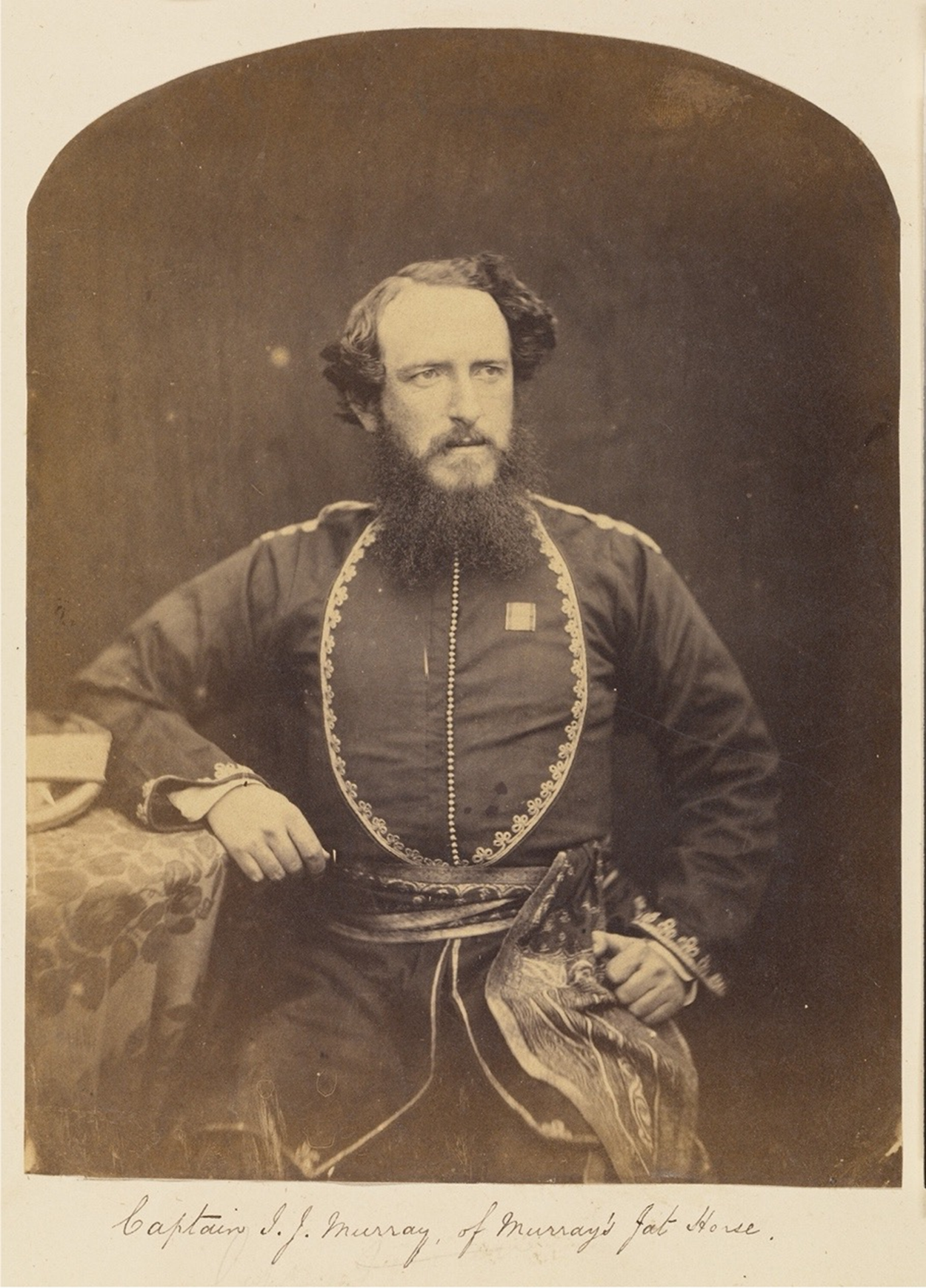
Reducing Muslim foes to irrational religious “zealots” delegitimized their position. Delineating racial “types” also served emerging martial policy that distinguished between racial and ethnic groups according to their “warlike” characteristics and perceived “loyalty” to the British regime.Footnote 135 John was supposedly venerated in the Jat community as “the great ‘Murray sahib’” and to commemorate John's death in 1902, members of his Jat regiment, which he had raised as part of British counterattacks during the uprisings, erected a “dharamsala” at Delhi for their annual “worship” to him, to mark the “special claim he had upon the Jats in bringing forward [their] warlike qualities.”Footnote 136 He was also documented as their officer by the prominent British-Italian war photographer Felice Beato (Figure 1). Beato produced one of the most iconic images of 1857—“Interior of the Secundra Bagh after the Slaughter of 2,000 Rebels by the 93rd Highlanders and 4th Punjab Regiment,” which memorialized the storming of the Sikandar Bagh villa by forces under Sir Colin Campbell, who were on their way to relieve the Lucknow residency in November 1857. Yet Beato arrived in India a number of months after the events at Sikandar Bagh. Determined to restage the site of the killings, Beato requested the exhumation of the rebels’ remains that had been recently buried in the grounds. The ensuing composition offered a satisfying pictorial narrative of violent retribution for a commercial audience in Britain.Footnote 137 Murray's portrait also memorialized aspects of the British offensive against the insurgents, but the photographic form of the portrait focused the triumph of retributive justice on the action of singular heroic men, like Murray, rather than its material aftermaths like the Sikandar Bagh. Minnie's writing likewise served as a wider public record of the military accomplishments of white imperial men. It established a commemorative culture dedicated not only to the memory of an imperial post-“mutiny” masculinity, but to marking out new contours of Indian loyalty and alliance, through the associated “martial” Jat or Gurkha soldier for instance.Footnote 138 Minnie's letters were also constructed in ways to promote British forts as sites recovering from the disorder of the revolt. They were remaining bastions of racial and cultural “purity” during moments of imperial struggle, as well as the last strongholds of imperial masculinity and its reincarnation.
Felice Beato, “Captain I. J. Murray, of Murray's Jat Horse” (1858–9) [Photograph], 84.XA.420.21 © Getty Museum (Digital image courtesy of its Open Content Program).
For Minnie, the social capital of the white, English imperial identity she was fashioning in the forts, embodied either through her husband or her children, was perhaps also part of her negotiation of her own Scottish and Indian heritage.Footnote 139 She originated from Dumfries, Scotland, from where her great-grandfather, an impoverished farmer, and many of her and John's ancestors sought employment in India. Her father was born in Bombay and was buried in Baroda, and she also grew up and married in India.Footnote 140 Writing through 1857 was an organ for Minnie's self-construction, propping up her own genteel femininity and white imperial maternalism, as well as restoring imperial masculine confidence for those around her and at home.
Post-lives and Archives
The social or material life of Minnie's original letters becomes ever more ambiguous at the point of their accession into the Salvation Army's archive. Information relating to the donation of the collection is non-existent, beyond its connection with Minnie's daughter, Mary Stewart Murray, a lieutenant colonel in the Salvation Army. Archivists suggest that the letters were deposited after Mary's death in 1938, not long after the Salvation Army archives were set up in a rudimentary form in the 1920s. However, as formal records of accessions only started to be compiled in the Army's archive in 1980, this cannot be verified. Another suggestion is that the donor papers were potentially destroyed in a fire at the Army's International Headquarters during the Second World War, whereas the letters survived. Until the superintendence of the archive was professionalized in the early 2000s, the priority of the Army was to collect materials that could narrate the organization's history. Minnie's letters did not ultimately cater to this task. As the archive came under closer archival management, recataloguing and outreach work highlighted the value of the letters for alternative purposes, which were more tangential to telling Salvation Army pasts directly.Footnote 141
Archival histories and the institutional placement of particular documents or collections further shape the processes by which historic narratives were not only constructed, but also hidden or repressed, and sometimes resurfaced or rediscovered. Reassembling the complicated genealogy of imperial narratives has revealed how formative letters and letter writers were in establishing some of the earliest interpretations of the revolt. The historical genealogy of accounts that emerged here can be traced from letters smuggled out of British forts and the anxieties of using the colonial mail, to the various agendas that brought letters and “mutiny” narratives to the imperial news sphere, and later to literature of the revolt such as memoirs, novels, and dispatches. Letters written home scripted an emergent “mutiny” discourse before such tropes were fully popularized and reproduced more widely in India and Britain. Disruptions to these colonial communications amplified the threats the rebels posed. The publication of personal correspondence that did filter through to the metropole not only populated early gaps in “mutiny” reportage, spread intelligence, and attempted to appeal for aid and influence public opinion, but also contributed to the early formation of narratives about British rule, prior to and following the uprisings.
Metropole-colony correspondence, often managed by women as part of the feminine responsibilities of family, and what Margot Finn has recently re-envisaged as the “female world of love and empire,” opened possibilities for discursive, literary, and political engagement in the imperial project.Footnote 142 Since at least the eighteenth century, as Elizabeth Elbourne has plotted, the construction of imperial narratives had been part of the “kinship politics” that sustained empire through family and epistolary networks of trust and communication. Within certain conditions of family life, women could act as gatekeepers, overseeing information that flowed in and out of family networks, and its subsequent “translation” into comprehensible narrative forms.Footnote 143 Women's writing on the sepoy's insurrection, in particular, captured public attention through their emotive epistolary style. Yet various editorial agendas at stake in their publication meant that women's accounts were mediated by family, editors, and other censors. Within their accounts, correspondents in India navigated issues surrounding the conduct of elite British women during the revolt, the nature of Indian “fidelity,” as well as the state of imperial manhood in the aftermath of imperial “crisis.” These themes, which were so central to “mutiny” narratives, became enduring aspects of colonial rhetoric as power was gradually restored. Similarly, Minnie's writing on life in Gwalior and Agra specifically fed literary interest in the domestic ruin caused by the rebels’ violence, but also in women's gradual reclamation of the colonial domestic sphere by tackling fractures in the racial and social hierarchy. Letters dwelled on the breakdown of imperial society, if only to set the scene for the later restabilization of imperial rule, through fortifying home and family life. Tracing the lives and afterlives of women's “mutiny” letters, and their intertextual engagement, thus allows for a reassessment of the origins of the narratives that shaped British interpretations of the 1857 Indian Rebellion both as these events unfolded and in their constant retelling.
Ellen Smith is an Economic and Social Research Council (ESRC) postdoctoral research fellow at the University of Bristol (grant number: ES/Z50418X/1). She is grateful to Clare Anderson, Kate Smith, Margot Finn, Eliza Riedi, and Liz Egan for reading and commenting on earlier drafts of this article, and to Sumita Mukherjee for supporting her with its latest version. Dialogue with Steven Spencer, the Director of The Salvation Army International Heritage Centre over a number of years has also been integral to this project and has been greatly appreciated. She would especially like to extend her thanks to the editors and peer reviewers of this journal whose comments pushed the article in new directions. Finally, this publication received the support of a Curran Fellowship awarded by the Research Society for Victorian Periodicals, funded from the bequest of the Eileen Curran estate.


 Open access

