

Beyond the Momentary Focus on RevolutionFootnote 1
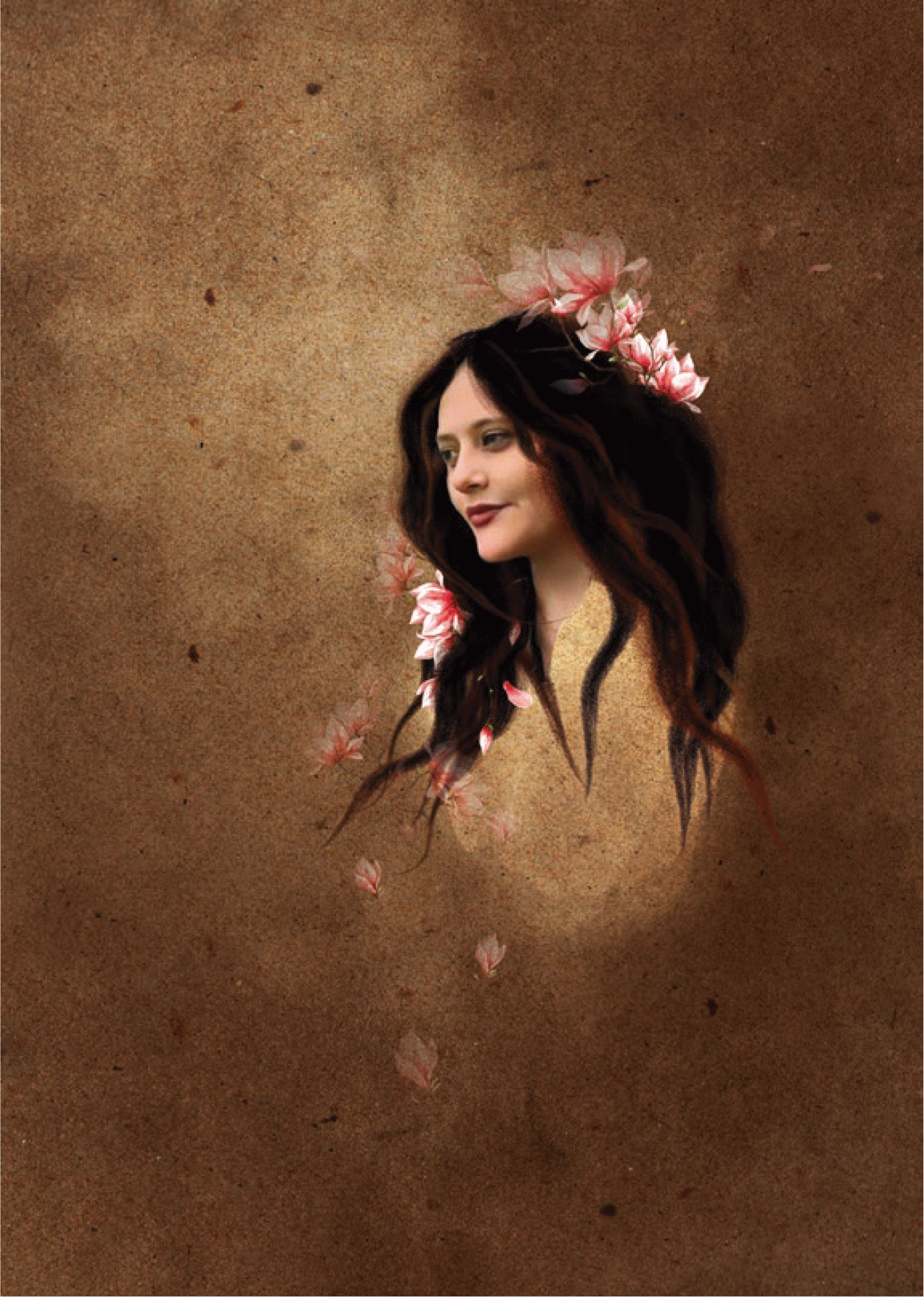
The murder of Jîna Aminî by the Iranian morality police in September 2022 led to widescale demonstrations in the country, which have been characterized as a “feminist revolution” by many journalists and academics.Footnote 2 It was often stressed that women were the ones leading the protests. A stream of online video clips and photographs documented women’s different performances during the protests as well as their inventiveness and creativity in demonstrating dissent. In photos, schoolgirls presented their long hair free of hijabs while flashing their middle fingers at the portraits of Iran’s leaders. Others filmed and posted provocative dancing, including in front of the notorious Evin prison. Sanitary pads were turned into meaningful installations—as covers on the spying CCTV cameras in Tehran’s underground commuter rail. Jîna Aminî’s resemblance was recreated and shared in a multiplicity of forms and contexts (fig. 1). All these actions made their way into the global mediaFootnote 3 and caused journalists and the public to raise the recurring question, informed by the memories of the 1979 Islamic revolution: Is what we are witnessing a sign of revolution in Iran? However, due to limited airtime given to the actions on worldwide media, attempts to answer this question rarely sufficiently illuminated the protests, their wider context, or their performative character.
Jîna Aminî (2023) by Rounak Resoulpour, a Kurdish Rojhelati artist currently living in Sweden. The image of the activist, killed in 2022 by Iranian morality police, was widely shared via social media and appropriated as a cover for a Kurdish journal (Bîrnebûn) in Türkiye. (Photo courtesy of Rounak Resoulpour)
Moving beyond the momentary focus on revolution with its expectation of immediate change, the performances by women of the “feminist revolution” in Iran are part of much more complex phenomena: performing citizenship—a long-lasting and intersectional process involving struggles and achievements of different generations of women. As stressed by Shahrzad Mojab, artistic activity has always been an important part of resistance in the Islamic Republic of Iran, but has only recently caught global attention, thanks to social media (Mojab Reference Mojab2023). Interviews with Kurdish artists, which we conducted in July 2022 on the eve of the dramatic protests in Iran, reveal the artistic engagement of Kurdish women in Iranian Kurdistan (Rojhelat) as a form of performed citizenship.Footnote 4 The study is based on ethnographic fieldwork, text analysis, photography, and semi-structured interviews and conversations with 20 Kurdish artists including photographers, writers and language activists, sculptors, painters, actors, and filmmakers from the Kurdish cities of Bane and Sine (aka Sanandaj), of whom 15 were women and 5 men. We asked them how they became engaged in art and discussed with them the meaning of some of their artworks and the role of art in their lives. Importantly, many of their performances taking place in everyday life are not just designed to demonstrate dissent within the patriarchal state and society but are primarily meant to create a new scene and new actors operating as activist citizens (Isin Reference Isin, Engin and Greg2008, Reference Isin2009, Reference Isin, Hildebrandt, Evert, Peters, Schaub, Wildner and Ziemer2016).
In order to link Kurdish women’s dissent in Iranian Kurdistan with universal women struggles, these actors draw from different local and global sources of inspiration. They challenge the Iranian colonialist regime, which imagines Iranian culture as expressing and producing official Iranian citizenship. The state-imagined Iranian citizens are entitled to interact with the global modern world but only the official Iranian culture and Persian language are deemed to represent all other minor and regional cultures (see Cabi Reference Cabi2021, Reference Cabi2022). While elevating particular forms of Iranian culture, the regime minoritized other cultures such as the Kurdish and Baluchi communities, branding them “backward” and only relevant locally, not as an acknowledged part of a national Iranian culture (see Cabi Reference Cabi2021, Reference Cabi2022). Resisting the regime’s designation as “minor,” Kurdish women performers attempt to establish a meaningful exchange with global audiences; they play with local as well as international themes. Their strategies correspond with what Hamid Keshmirshekan identifies as a crisis of belonging evoked by the encounter of indigenous artists with global art practices (2015) and can be considered a meaningful response to that crisis.
The concept of performing citizenship entails elements that are revolutionary. What this perspective mainly brings into focus are small-scale, contextualized actions that invite social negotiations based on contemplation, reflection, and the circulation of affect (Ahmed [Reference Ahmed2004] 2014). Such negotiations may result in a new moral imagination preparing the ground for more people to join the movement. Therefore, an action that may seem futile or unhappy (Austin Reference Austin1962; see also Isin Reference Isin, Engin and Greg2008 and Peters Reference Peters, David, Silverman and Wayne2016) in the short term (e.g., not able to immediately abolish a regime or pass a law) can have results in the long term. The actions of subalterns—which on the surface are mundane but on a deeper level contribute to subversion and resistance to oppression—were described by Michel de Certeau ([Reference de Certeau and Rendall1980] 1984) as tactics and by James C. Scott (Reference Scott1985, Reference Scott1990) as micropolitics.
In Iran, including Iranian Kurdistan, there are many limits imposed on artistic production. Artists have to self-censor and hide their works, or use underground networks to share them out of reach of oppressive regimes and conservative societal restrictions. Therefore, besides the artistic product in itself, the process of its production and the channels that enable it to be shared crucially determine its meaning and value. For example, the artist Mîran makes provocative feminist sculptures (figs. 2 and 3) that cannot be displayed anywhere in Iran. They are hidden in cartons in his workshop and can only be shown to a few people and through safe channels.Footnote 5 The risky process of hiding and showing them becomes part of the value of the artworks. A free market of art as exists elsewhere, and the meticulous focus on artistic techniques as well as an excessive concern with the art object, which so much troubles critics of the neoliberal version of “art for art’s sake” (Elliott et al. 2016), is largely irrelevant in Iran.
Virginity (2020), ceramic and leather sculpture by Mîran. In his works, the artist refers to women’s suffering, lack of sufficient legal protection, domestic violence and sexual abuse, and misogyny in Kurdish and Iranian society. (Photo by Joanna Bocheńska)

Bad luck (2020), wooden sculpture by Mîran. The owl is regarded as a symbol of bad luck and compared to the alleged bad luck women can bring. (Photo by Joanna Bocheńska)

Performing citizenship in Kurdistan further complicates the already doubtful division between public and private spheres. That which cannot become explicitly public is in no way devoid of political meaning. On the contrary, the space of the home and other secluded venues are transformed into meaningful political spaces. These spaces are extended by mobile phones and the internet—for example dancing out of sight of anyone, including the regime, and then publishing a self-made video of the dance online.Footnote 6
Performative Citizenship and “Doing Art” by Kurdish Women
Sibylle Peters underlines that it is precisely thanks to art’s autonomy and separation from politics that it can be regarded as performative citizenship (2016). Citizenship, according to Engin Isin’s concept acts of citizenship (2008), is more than a legal status or a civic practice enabled by this legal status. In the global network of complicated international economic interests, multilayered identities, and often conflicting loyalties that transcend the borders of a single state, acts of citizenship emerge as phenomena occurring outside of the established legal and institutional order. Acts of citizenship call into question the order’s very existence, proposing instead something new. Isin refers to Adolf Reinach (Reference Reinach1983:19) and suggests that what drives an act of citizenship is a need to be heard (in Isin Reference Isin2009:379). Acts of citizenship create new scenes performed by new actors. Linking the concepts of performative citizenship and the theory of “doing gender” (West and Zimmerman Reference West and Zimmerman1987; Butler Reference Butler and Case1990) helps to explain Kurdish women’s art as an intervention that aims to change the status quo for Kurdish women.
Contrary to active citizens who perform existing legal routines such as voting, activist citizens are not “a priori actors recognized in law, but by enacting themselves through acts [of citizenship] they affect the law that misrecognizes them” (Isin Reference Isin2009:382). Activist citizens create legal and political fictions and by enacting these fictions, they gradually force the existing order to perceive these acts as real and the activist citizens’ claims as justified. By performing an imagined alternative reality, the activist citizens impose the desired change on the political world surrounding them. According to Sibylle Peters,
performance art has been conceived as an art form that is focused on acts that create their own scene. To be able to do so, performance art relies on the self-constitutive power that was traditionally granted to the artwork by its autonomy. Nevertheless, it can function as a resource within those moments when citizenship is nonidentical with itself—in those gaps that occur when old constitutions of citizens’ agency are transformed by new constitutive movements and gestures. (2016:477)
To put it another way: it is precisely by being playful and fictional that acts of citizenship promote change. Their strength lies not only in enacting and transforming fictions into the real, but also in how these actions are connected to the moral and the political spheres (Nussbaum Reference Nussbaum1992, Reference Nussbaum2013). Active citizenship has a lot in common with the Iranian tradition of blurring fact and fiction, especially in the modern Iranian cinema where it is a way to deal with censorship (Dabashi Reference Dabashi2007; Vaziri Reference Vaziri2002; Wi≠cek Reference Wiącek2004).
The switching between worlds of fact and fiction was evident among some of our interlocutors, who, on the one hand, expressed a belief that their works and actions can and should invite social and political change, and, simultaneously, when asked directly about it, withdrew from such an explanation by claiming that what they do affects only the artistic realm. This allowed them to protect their works and professions from an excessive politicization, giving them the freedom to continue moving between the fictional and the real. Additionally, to a limited extent, it protected them from the repressive state apparatus; in case of any interrogation by Ettela’at,Footnote 7 they could simply withdraw and say that what they are busy with are fictions and dreams, not any intervention into the political order of the Islamic Republic. Therefore, following Hildebrandt and Peters we acknowledge that “citizenship is simultaneously in withdrawal and in the process of becoming” (2019:3). These attempts to evade persecution can be also analyzed as tactics, which de Certeau contrasted with strategies ([1980] 1984:28–43). Similarly, the seeming withdrawal of Kurdish artists from politics while still conveying an underlying social message is typical of Scott’s micropolitics: acts appearing to be an inherent part of everyday life that resist dominant forces (1985:304–05). Hence, the notion of performative citizenship imagines female artists’ practices as “essentially contested” and thus “permanently subject to revision and considerable modification” (Hildebrandt and Peters Reference Hildebrandt, Peters, Hildebrandt, Evert, Peters, Schaub, Wildner and Ziemer2019:3). Performative citizenship encompasses the actions of individual performing bodies working in a new space even though such undertakings often fail to bring about a new social or political order (2019:5).
Operating in a new space that is constituted by the performance, such actions deny the division of private and public by showing that what was considered private and nonpolitical becomes an inseparable part of the new political scene. Following Judith Butler’s criticism of Hannah Arendt’s division between the public (understood by Arendt as a verbally articulated independent sphere of mind, which is constituted by men) and the private (which is “left behind” and perceived as the realm of women, the body, existential needs, and dependence [Butler Reference Butler2015:44–45]),Footnote 8 we agree that “the idea of human and creaturely life that supports our efforts will be one that overcomes the schism between acting and interdependency” (45). This very much corresponds with a new sense of human dignity established in contemporary Kurdish literature that elevates the role of life on earth rather than an uncertain future in heaven or hell (Bocheńska 2018:46). Bakhtiyar Ali, the famous Kurdish novelist from Iraqi Kurdistan, in his novel Ġazalnus û Baxekanî Xeyal (Ghazalnus and the Imaginary Gardens, 2007; Eng. trans., I Stared at the Night of the City, 2016), described dignity by referring to love, perceived not simply as romantic or religious affect, but as a “great force that makes people care for others, makes them aware of a profound connection to all life” (2016:199).Footnote 9 Accordingly, the autonomy of art makes space for the body, sexuality, and the spirit of comedy (Nussbaum Reference Nussbaum2013; Allerstorfer Reference Allerstorfer2013).
Having said this, we can be certain that Kurdish women performers in their imagined project of a new Kurdistan create one of the most important fictions of the Middle East. This imagined project increasingly includes women’s emancipation. Although Kurdish women have been part of the Kurdish independence struggle in the Middle East since its very beginning, their contribution was often unacknowledged and ignored by their male counterparts. As in other national liberation struggles in Europe, Africa, or India (see Boehmer Reference Boehmer2005; Forker Reference Forker2007), the figure of the Kurdish woman became a conventionalized symbol of the homeland in need of protection (Mojab Reference Mojab and Mojab2001; Alinia Reference Alinia2013). But from the early 20th century individual Kurdish women became visible in the national struggle and from the 1970s onward they took up arms against state oppression as part of various Kurdish partisan forces. The first military units of Kurdish women appeared in Iran, within the Marxist-Leninist Komala party. Later women fighters became part of Kurdish forces in Iraq, Türkiye, and Syria. The Kurdistan Workers’ Party (PKK) was established in late 1970s in Türkiye where it took up military activities against the state in 1984. The movement later spread to Syria, Iran, and Iraq, and in recent decades it became known for its most radical emancipatory feminist discourse, jineolojî (knowledge of women), which gained momentum and also inspired women in Iranian Kurdistan. In short, while Kurdish women’s presence in politics was first largely symbolic, dismissed as empty rhetoric, thanks to women’s insistence and efforts, Kurdish women have gradually become a more powerful force.
A similar trajectory of change characterizes women’s artistic engagement. Historically, the intellectual and artistic activity of some women in Iranian Kurdistan became recognizable and these figures remain important symbols of women’s courage and creativity—for example, the poet and chronicler Mestûre Erdelan (1805–1847), the sculptor Xatû Zîn (1921–1993), and the poet Jîla Hosseinî (1964–1996).
While in the past women artists usually expressed themselves allusively, using various images and metaphors, such as fantastic animals (fig. 4), recently they have more explicitly become part of the feminist struggle. In July 2022, a young woman told us about wanting to be visible as a photographer:
Since I was small, I have heard that a Kurdish girl cannot do anything, she would reach nowhere because women cannot reach anywhere with what they do. I am 19 years old now, and I cannot work in many places, I cannot visit places due to some restrictions from my family […] and thus all my efforts and struggle is focused on this. I want to be able to say: “No! A Kurdish girl can reach somewhere.” Unfortunately, in Iran most of the photographers who are successful are men, not women. But I want to get on the stage in order to be able to say: “No, a girl can do it too!” (Soraya 2022)
Animal figure (undated) by Xatû Zîn. Malî Kurd museum, Sine. Self-taught and known for her fantastic animals, the artist is a symbol of women’s strength and creativity. (Photo by Joanna Bocheńska)

Although this is an individual’s desire, it is not focused on bringing fame to a particular girl but rather to girls in general; Soraya wants to change traditional gender roles. A similar goal reverberated in the majority of our interviews. Going beyond the roles of mother and housewife, our interlocutors want to be visible as female artists and to encourage other women to follow their path. By advancing their own art they develop self-confidence and want to achieve professional fulfillment. This demonstrates that even “art for art’s sake” can become political. In Kurdistan, insisting on obtaining artistic proficiency is in itself a meaningful achievement, which cannot be separated from advancing agency as a woman.
Self-Discovery and “Enjoying Life”
The initial task of Kurdistani female artists was to challenge the laws that oppress them (Isin Reference Isin, Engin and Greg2008, Reference Isin2009) and to assert themselves as creators. For example, Rana, a young Kurdish photographer, said:
Women, not only Kurdish women but all around the world, are creators [xulqenêr]. It comes from their essence: […] in the scope of art, when giving birth to children, breeding animals, in all fields we can think of, they are creators. And art is one of those fields where women can express their creativity [xulqenêrî]. And this offers me the best feelings and happiness, that as a girl, despite difficulties, I can do something myself, and that I can say that it is my work, my thought, and my belief which are behind this work. All my efforts are focused on becoming a creator. (Rana 2022)
Rana essentializes the notion of the creator as an innate feature of women. This is “difference feminism,” which underlines the unique traits and experiences of women (Rich Reference Rich1976; Jensen Reference Jensen1996) as different from seemingly nongendered but in fact male-oriented perspectives. The narrative about women’s creativity could be directly inspired by the Jineolojî movement (Jineolojî Committee Europe 2018). Hence, the female experiences of being mothers and housewives are reimagined as sources of inspiration for new creativity. This builds confidence as it invites women to draw from the previous generations of Kurdish women whose experiences are elevated and are now seen from a different angle. Another photographer, Ronak, directly linked the desire to know herself to women’s and human rights:
First of all, I look at the world as a human. To have my perspective on the world, on myself, and on all the human beings around me, […] first I need to know myself, my psychology. To know who I am in this world […] in order to express myself to the world. This is like a right. I believe that there are many more rights for us [women] to enjoy, than what was made possible to us in this society. (Ronak 2022)
Şifa, another photographer, said that her art allows her to ask questions about problems in families and society, but later she added:
Many times, I think, there are no answers to these questions. Many times, I cannot even find out what the questions are. But I think photographs in a way satisfy and calm me down. (Şifa 2022)
Şifa reveals not only her desire to work creatively and to challenge societal norms but also how she wants to use her art to raise questions without necessarily providing answers. Seeing art this way maintains a clear border between art and ideology (Kieślowski 1997). Another reason women’s art is vital for social change is because it sheds light on the world and lives of Kurdish women from a nonpatriarchal angle. Photographer Kajal said:
Our concerns are the conditions of our lives but nowhere have we learned how to enjoy our lives. We have never learned how to enjoy going to the mountains, walking on the street, recording nice photos and memories. Due to our social conditions and the strategic place of our city and nation, what we mainly face is war. We have always tried to prove something to ourselves and thus we did not learn how to enjoy a picture, a film, or positive events in our lives. We are only at war, and in our lives we must constantly prove something to ourselves […] Through photography I would just like to express my feelings. I would like to share with other people the joy I felt when taking the pictures. (Kajal 2022)
Clearly, in a world dominated by war, politics, and daily dangerous acts against oppression, little space remains for enjoying the beauty of life. What seems lost is the ability to experience the joy of life. Kajal reveals that the constant demand “to prove something to ourselves” obscures the deeper meaning of the struggle, which aims to create a better and more enjoyable life. Hence, a call for enjoying life is not hedonism but rather an invocation of the power of the senses. Also, it temporarily offers what Paul Ricoeur calls a happy forgetting (2004). Understood this way, enjoying life is a call for refreshing and resignifying performative citizenship and the struggle.
In Iran, a society with very limited space for women, obtaining experience out of which meaningful art is created is often a challenge. From the very beginning it involves imagination and metaphorical thinking. Doing art requires not only technical skills but also the awareness of how to use ordinary life experiences as the basis for art. A constant dynamic exists between daily life and art that cannot be described exclusively as public or private, but rather entails a constant dynamic between the two.
Negotiating the Sphere of Appearance
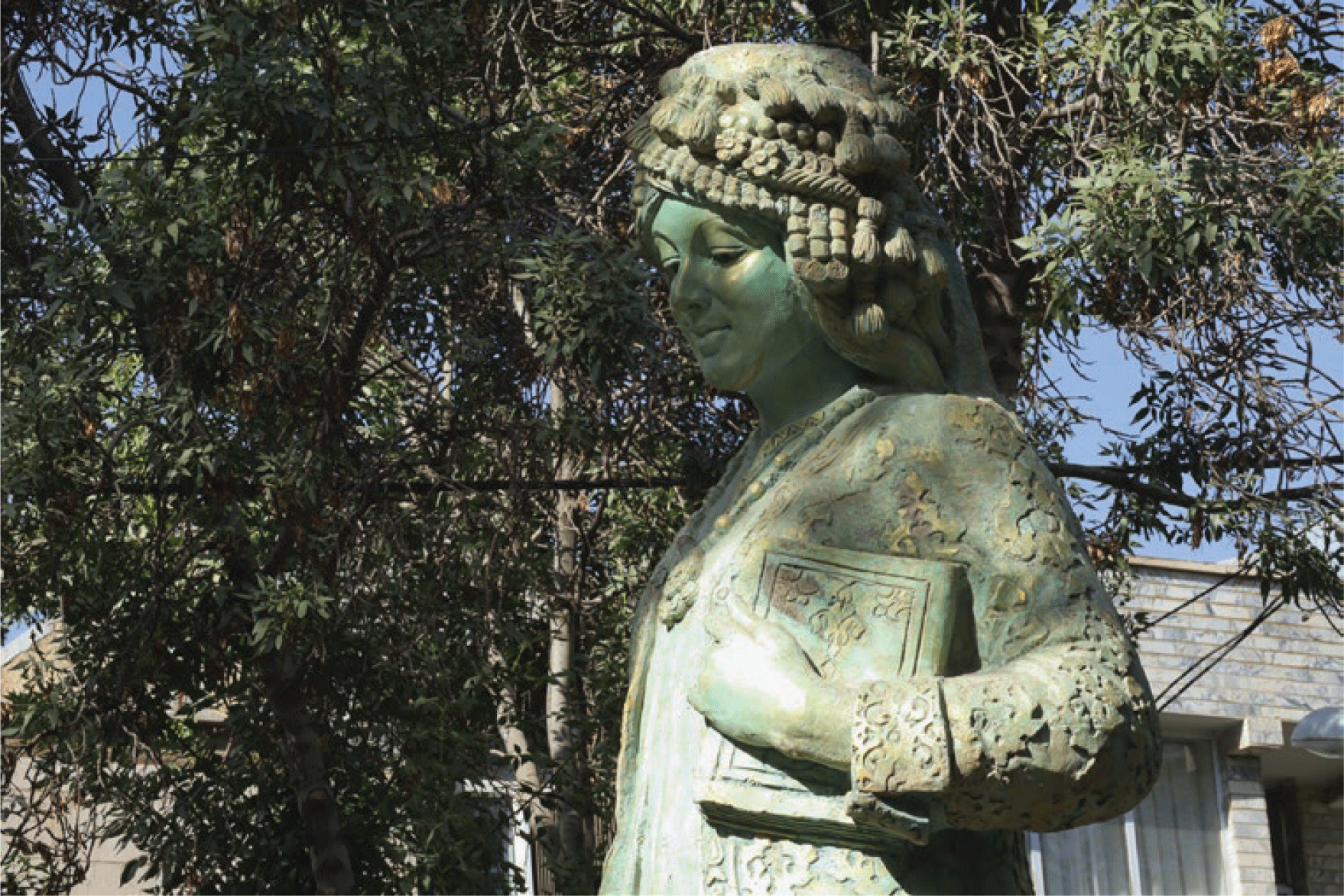
According to Butler, one of the ways of protesting precarious noncitizenship status is to claim the right of visibility when you are silenced and pushed outside of legal recognition. As Butler stresses, since the field of appearance is regulated by hierarchical and exclusionary norms of recognition, “the performativity of gender is thus bound up with the differential ways the subjects become eligible for recognition” (2015:38). While in most regions in Kurdistan, Kurds and other women do have some access to the legal status of citizenship, they often lack sufficient legal protection, and for women in Iran, the law explicitly places men above them. Women’s social and political presence and participation are highly marginalized (Fallah Reference Fallah and Behnaz Hosseini2019). Hence, one of the main strategies of women artists and activists is to make female bodies as well as the feminist content of their artworks visible in male-dominated spaces such as streets, cafes, traditional gyms (zurxane), etc. One of their sources of inspiration for claiming visibility and space for creativity is the statue of the poet Mestûre Erdelan by Hadî Ziaoddînî erected in 2011 in one of Sine’s squares. Public statues of women are rare in Iran and even if the exception is made the authorities usually allow mother figures only. In Sine, the woman poet Mestûre carries a book in her hand and does not wear an obligatory hijab but a Kurdish hat (kofi), which transforms her into a subtle symbol of dissent appreciated by many young female artists and activists (Bocheńska and Hajiagha 2024; fig. 5).
Statue of Mestûre Erdelan (2011) by Hadî Ziaoddînî, erected in a Sine public square, one of the very few public statues of a woman. (Photo by Joanna Bocheńska)
Our interlocutors indicated that performing art in Iranian Kurdistan enables women to enter male-dominated spaces because art is an acceptable pretext for occupying male space. Equipped with a book, a pen, a camera, or a brush, women enter such spaces with the visible but often unspoken declaration: “I am not just a woman but a photographer, painter, or writer.” This gives them the (social) right to enter. For example, as the writer Çinar emphasized in our interview, taking pictures was the pretext for her colleague Jana to enter the zurxane, the traditional gym, where only men can go. Çinar:
The domination of the image of a woman who only stays at home and does not work anywhere makes our job much more difficult. Therefore, we need a strong will so that the perspective of the society does not impact and bother you. So that you can go to a place which is normally designed for men, where women usually cannot go. For example, Jana went to the zurxane to take pictures there. This is a place for men only, but she went there and broke with the men’s order of things. (Çinar 2022)
What made it possible for Jana to enter the zurxane? In addition to her courage and strong will, it was Jana’s camera that on one level “disguised” her. The camera changed how Jana was perceived: she was no longer “just” a woman, but a photographer. Moreover, Jana’s performance inspired others. During the interview, Çinar turned this episode into a meaningful and encouraging story of entering a male space, a place different than those where women are usually seen. Rana also stressed the importance of entering male-dominated spaces:
Now I am working in a company that repairs cars. This is a very male job and the only woman who works there is me. It was amazing for them because I was the only girl working at this “city of repair.” I prefer to do jobs that can help me economically. Even though my work there is very hard and temporary, and I have many challenges, it helps me financially. I wanted photography to remain my passion, something I do from my heart, and for art only. But I wanted to work to earn money, to be independent and able to spend what I earn on my artworks. (Rana 2022)
Rana’s desire goes beyond becoming economically independent. Her experience of taking pictures in male spaces made her familiar with unknown men, leading to her job in the auto repair shop. She was able to explore her complicated feelings about such an unsafe space.Footnote 10
Şibin, a painter, shows her self-portraits in galleries, despite many difficulties.
The main topic of my works, what I brought to my paintings is my figure and face because I want to talk about it. I don’t care about my short hair. I use my hair in the paintings, and people often do not understand it. They wonder: “why does she cut her hair?” because this is normally not accepted in Kurdish culture. Some people want long hair but it is not important to me. I simply want to present in the painting what I want to see there, and to show it to people, to show what I can do. Also, the topic of my paintings is very much related to feminism. Kurdish society is patriarchal; all the girls, be it our daughters or sisters, face different problems. And I want to talk about this in my paintings. Sometimes men pretend they do not understand women. Now the situation has changed for the better, but sometimes the men close their ears not to hear women. So let them watch! You do not hear but you can watch. You cannot close your eyes if you came to see paintings […] Our women covered themselves under the çar≡af [robe covering the lower face and body] […] What would have happened if they became naked? Would the world collapse? […] For all the figures in my paintings I used myself as an example, I did not want [to create] a problem for anyone. I brought my own face into it so it represents people more generally. If you look at it, you will see her eyes looking quite strict; it is a heavy look. And always you see two eyes [in the background, coming] from behind her. All the power of patriarchalism is exposed there. (Şibin 2022; fig. 6)
Şibin’s untitled self-portrait with moustache (2016). (Photo by Joanna Bocheńska)

Here the artist tells us that making a woman visible in art becomes, for her, inseparable from feminism, from the problems women and girls face. She creates a representation of women to make men aware of something; it expresses a need that has not been heard. By appealing to human eyes (and not ears) through visual art, Şibin strategically makes use of the convention of looking at paintings in a gallery, because one cannot “close his eyes if he came to see paintings.” But Şibin is not only painting herself or her gender. She makes her face a representation of people in general, not simply women, and while doing so, her short hair challenges the conventional ways people tend to perceive women’s beauty. Her painting plays with the restrictions of the Islamic Republic by portraying a woman who could be imagined naked but does not show much of her nakedness and only implies it. It therefore remains ambivalent whether this painting crosses the line or not. What we see is not just a portrait of a woman, but also the representation of a man whose wide eyes stare out from behind her. Şibin explained that in this painting she sought a representation of the patriarchy universally, which she found in the work of Salvador Dalí:
I very much like Salvador Dalí, I have a lot of interest and love for him, for his individuality and works. Especially the works that touch upon his individuality, clarity, and transparency. […] When I talk about these feminist issues and men I do not want to show the Kurds. […] I do not want to point to Kurdish men, because the issue of men being bad to women happens everywhere in the world. It is not only in Kurdistan. We happen to live in Kurdistan because we were born here. In Europe there are also bad things happening to women. Freedom is not only about having our head uncovered. First your mind should be free. I will not be free only with my head naked. So, therefore, I do not want to make Kurdish men alone “bad.” This is the reason I brought Salvador Dalí into my painting, because I felt some closeness between me and him. I did not copy his work but I introduced his portrait into my paintings. As I said, our men have already changed for the better compared to the past. But still a man is above a woman; people look at it this way. Yet, a woman can be at the top, in a high place; she can substitute for hundreds of men. She has this power. (Şibin 2022)
Here we see an interesting combination of motives. First, Şibin avoids condemning Kurdish men and Kurdish people in general, who, in Western as well as Iranian orientalist and colonialist discourse have often been described as primitive, backward, and aggressive. Secondly, she universalizes her feminist content, making it relevant not only to Kurdistan and the Middle East but also to the global situation of women. Finally, she uses Salvador Dalí, especially his famous eccentric moustache, as a symbol of masculinity, making a connection between a characteristic of Kurdish men and a globally recognizable artistic motif. As Şibin says:
Women can never receive such respect as men with moustaches. If a man is very beautiful they say to him “you are very manly” [zor piawî]. For a woman they also say zor piawî. But if a woman is better than 100 men? Will this man always be above her? They say to her “you are more valuable than 100 men.” So I created these moustaches for myself. (Şibin 2022)
Obviously, applying Salvador Dalí’s moustache to her own face has ambivalent meaning. The moustache is a sign of masculinity in Kurdish as well as other cultures. She applies the proverbial meaning—the Kurdish phrase “being very manly”—and plays with it, referring to a strong woman, pointing to the fact that a woman’s value is always referred to through the image of man. Importantly, Şibin stresses that despite her admiration for Dalí, she does not imitate his style, but rather invites his figure to substitute for any man. Such an invitation is not necessarily motivated by anger or criticism, but rather by her closeness to Dalí as an artist. Decorating her own face with a moustache refers therefore both to her power and value as a female artist, being as strong as male artists, as well as to her struggle to liberate herself and other women from the enduring domination of men, in art as well as in daily life. This becomes even more meaningful because Dalí himself, as well as the surrealist movement and its poetics, have been criticized for objectifying women and their bodies (see for example Barbero Reference Barbero2015). Although we don’t know if Şibin herself wanted to allude to this critical discourse in Dalí’s homeland, her paintings enable such a reading too.
In another painting (fig. 7), Şibin showed sorrow and anxiety by applying found materials: cigarette butts. She collected and applied the cigarette butts left after smoking in moments of worry. The cigarettes became “objects saturated with affect, as sites of personal and social tension” (Ahmed [Reference Ahmed2004] 2014:11). They are introduced in and through the artwork, located in such a way that they play with the Muslim tradition of covering the head and the Christian motif of the halo for saints and the Madonna. Instead of focusing only on the local situation of women, this painting intertwines Kurdish and Christian art traditions.
Şibin’s untitled self-portrait with cigarette butts (2016). (Photo by Joanna Bocheńska)

Çinar, the author of several collections of short stories,Footnote 11 believes that the world of Kurdish women has not been properly presented in Kurdish literature, which of course is dominated by male authors. She started writing in her teens inspired by stories told in her family circle. By making use of local dialects in her writing, she portrays class differences and the differences between the village and the city. She explores the spaces for women described by her as behind the curtain:
I want the reader, without knowing this is Çinar, to recognize that the author of this short story is a woman. Only women can know what the women’s psyche is. I want the reader to know the Kurdish women’s world and I want my stories to be translated into other languages. In every place people have their own psychology. In Iran there are some places designed for women, for example beauty salons [arayi≡ga]. There is usually a thick curtain not allowing the outsider to see what is happening inside. I was always curious what happens behind that curtain, what the women who are there are saying and doing. When I was a child, I used to go to arayi≡ga with my sisters. Now I am going there myself. […] There is talk that goes on there, styles of beauty they choose. For whom do they make themselves beautiful, with what style do they do it, who has chosen that style for them? Was it their choice, or the choice of society? There are many such questions that the woman writer is trying to answer. (Çinar 2022)
Clearly, Çinar’s intention is not simply to make the private spaces of women more visible, but rather to ask more provocative questions about the nature of the curtain that divides the world of men from that of women. Contrary to many Kurdish male (and also some female) writers, she is neither focusing on men’s oppression of women nor is she objectifying women as muses or missing links that should complement men. Rather, she presents the patriarchal world’s grasp on women’s minds and imaginations. Similar to Şibin’s moustache, the curtain is a mechanism empowered by a gendered society; a system that must be dismantled to bring any durable changes. Çinar stresses that she does not only focus on Kurdish women:
When I say I am interested in women, this means all women, in the classical writing, from Mukriyan, from Sine, in the history, women in Tehran, women in old Tehran, women in Europe. I need to know all these and be able to Kurdify these different experiences in my short stories. (Çinar 2022)
Instead of universalizing Kurdish experiences, Çinar “Kurdifies” universal experiences opening for Kurdish readers other worlds. At the same time, she wants her work to be translated into other languages. “The best way to talk about women’s issues in Kurdistan is through literature. So that any other woman in any country can understand us. I cannot simply go to Europe and explain it.” Like Şibin, Çinar connects Kurdistan to universal motifs in order to enhance mutual understanding between women from different places and build bridges between them. Şibin and Çinar want to exchange ideas with audiences and viewers outside of the very restrictive Iranian and Kurdish world. Through (often imaginary) communication with the universal outside world, they attempt to escape from these limitations.
Our interlocutors manifest dissent in creative ways. They explained that art enables women to see the world from a different angle. The photographer Kajal explained that taking pictures may turn a life in difficult conditions into an enjoyable life worth sharing. Elsewhere in the interview, she mentioned how her art can encourage women to break with the rules that manage women’s visibility.
When I am going out and my headscarf is at the back of my head, 10 people on the street will say “lady, be careful with your headscarf.” But they cannot even imagine that I am enjoying this situation. I would like to use photography so that I can see life from another perspective, so that I don’t think I am a girl living with all these restrictions. (Kajal 2022)
Kajal’s performance enables her to move beyond state-imposed morality. Contrary to the normative expectations of the society, implying that women feel guilty about their “misbehavior” if not wearing the hijab properly, Kajal instead is “enjoying this situation.” This is possible because the perspective of photography and the experience of taking pictures and of “doing something different” take her somewhere else—to a world where such restrictions (imposed by the government and society) are turned into meaningful artistic and citizen performances.
According to Çinar, creating short stories that imagine women entering spaces normally not accessible to them such as teahouses (çayxanas) or gyms (zurxanes), inspires her to enter such spaces in her daily life. She believes she must experience them to be able to properly write about them. For example, when summoned by Ettela’at, the Iranian intelligence and security service that interrogates her regularly and demands a humble attitude, she manifests her dissent in a metaphoric, performative way:
They are all men, and it is very strange to them that I have the courage to lead such talks in their presence. […] For me it is very natural. I was there just a month ago. What I tell you now is a unique experience and I believe I must write about it one day. When they summon me, I dress in my best clothes, use the most careful makeup and hair style. I go there looking as if I was going to a wedding or to a party. This is a way of my resistance which says: you don’t want me like this, but I will come to you looking this way. Also, I have a special ring, it is a bird in a cage, which is sad and not comfortable. I want them to know they created such a cage for me. Moreover, I also answer their questions in a certain way. For example, they ask me if I am proud of being Iranian when I go to Türkiye. And my answer is: “No, I am never proud of being Iranian. Because I do not feel well in this country as a Kurdish Sunni Woman.” And I tell them everything that troubles me. And they answer: “You should not think this way, this is not a problem, we have so many successful women, doctors and lawyers.” And I ask again, “can I become the president of this country? Can I work in the ministry? Can I become a representative of my people in other countries? Can I be the mayor of the city?” They answer: “No.” And I continue, “so if this is not oppression, what it is then?” These talks are important. […] I cannot censor myself. Neither in my writing nor with them. I consider this very important. And I talk with respect. (Çinar 2022)
Instead of showing fear for Ettela’at, known for their intimidation, Çinar turns such visits into performances, where wearing special clothes, makeup, and even the symbolic ring are transformed into a message of resistance, exposing her womanhood proudly and loudly. In our interview, she talked about meetings with male authors where she, interestingly, did exactly the opposite because the men “were expecting me to wear nice clothes” and to stress her womanhood. She highlighted that they did so because of being reluctant to see her as a writer and wished her to remain a woman muse instead. This shows that exposing womanhood can be enacted differently in different contexts, depending on the audience and the kind of message women wish to deliver.
Furthermore, by asking the representatives of Ettela’at difficult questions Çinar—as if naively—initiates negotiations in a place that is not associated with citizenship debate but rather with extreme state oppression and intimidation. Paradoxically, the tool she used was behaving respectfully toward the male interrogators, which made them tolerate her behavior. Her performance invited her courage, protected her, and offered her the chance to make her message audible to them. Footnote 12 The “respect” she mentions cannot be read as respect toward the Islamic Republic they represent, because while behaving respectfully she simultaneously was attempting to undermine their trust in the republic. Her respect should therefore be understood as directed to their dignity as living creatures and human beings, not to their status as interrogators of a repressive regime (Hicks Reference Hicks2011). This is where agents can be distinguished from their acts, as such “intimate dissociation signifies that the capacity of commitment belonging to the moral subject is not exhausted by its various inscriptions in the affairs of the world. This dissociation expresses an act of faith, a credit addressed to the resources of self-regeneration” (Ricoeur 2004:490). We also found in other interviews (with Kurdish women from Iran, Syria, and Türkiye) such narratives about interactions with intelligence services of different countries where Kurds live. Being used to decades of state intimidation, people sometimes manage to turn these moments of direct contact with the authorities into powerful acts of resistance.
If we link this behavior to the moral imagination we find in Kurdish literature, which is relevant for an author like Çinar, we can understand her “naïve” power in the interaction with Ettela’at as rooted in the image of a dignified human in modern Kurdish literature, which gradually has drawn attention to antiheroes instead of heroes (Bocheńska 2018). She deliberately performed her naïveté to create an alternative platform, inviting her interrogators to see the surrounding world differently. Her main achievement was that she did not a priori reject the possibility that they could hear and understand her message. By putting her trust in something invisible and illusionary, a fiction assigning dignity (Anker Reference Anker2012; Bocheńska 2018) to the men who were interrogating her, she invited them to treat her with respect from their side as well.
Toward a New Scene Performed by Women
The different strategies of Kurdish women artists from Iranian Kurdistan are designed to contest the patriarchal structures of the state and society but also to negotiate a new scene performed by women. The background of the feminist revolution, which consists of small-scale initiatives that challenge the Iranian regime, introduces a new scene of negotiations. These initiatives appear and disappear, but even though they are unhappy performatives in Austin’s sense (1962), they constitute a continual process of becoming and withdrawal. The women “make a beginning” by discovering themselves as powerful creators and activists, who despite incredible difficulties, negotiate changes in order to gradually transform the state and society. They make visible women’s bodies and creativity and thus challenge women’s deeply rooted dehumanization, which continues to hamper their social and political advancement. However, entering the “sphere of appearance” (Butler Reference Butler2015) is not reduced to passively showing up somewhere but often engaging artistic practices to challenge the very foundations of systemic oppression.
The women intend to reconsider the many stereotypical images (moustaches, hijab) and everyday female practices (avoiding male spaces, making themselves beautiful behind curtains) to raise difficult questions within their society. They make use of Kurdish and global imaginaries and thus link the local with the global, avoiding Iranian intermediaries. In this way they challenge the entrenched dehumanization of the Kurds, perceived in Iran as representing only the local. Furthermore, through artistic means they make possible the circulation of affect to share both sorrow and anxiety and the positive emotions connected with female courage and strong will. “Doing art” invites them to continually cross the border between fiction and the real, private and public. They experiment and perform provocative acts in places like the Iranian intelligence office, and challenge the expectations connected to Butler’s “sphere of appearance.” By applying a seemingly naïve approach to the state’s representatives, they manage to do the unthinkable. They temporarily turn places associated with state violence into scenes of citizenship debate. This naïveté is, however, rooted in a form of respect, a fiction of dignity, and therefore equips women artists with courage, sensitivity toward other people including their oppressors, and self-confidence to continue with such performances.
This also proves that the aesthetic question of the how of the action is inseparable from its moral content (Nussbaum Reference Nussbaum1992, Reference Nussbaum2013), establishing the foundations for a new moral imagination that gradually may favor social debate over violent solutions. Therefore, acts of performative citizenship have the potential to bring revolutionary societal transformations while eluding the label of revolution and the danger of immediate change, neither of which grants enough time and space to rethink and reimagine something in detail. Even though enacting citizenship this way does not undermine people’s precarity, it forges invisible bonds and encourages both Kurdish women and men to be tirelessly brave and creative.


 Open access

