


Impact statement
Digital twins (DTs) are often treated as isolated digital tools, but their wider impact lies in enabling improved governance of assets across their life cycle. This paper presents the rationale for a structured DT framework tailored to Architecture, Engineering, Construction and Operation projects. The approach centres on embedding DT early in the project life cycle, using collaborative procurement (CP) principles as the foundation for maximising long-term value creation. The wider impact of this work lies in framing DT as an asset governance tool, which, if embedded systematically from the earliest project stages, can support long-term sustainability outcomes and provide the foundations required for achieving net-zero targets. The study contextualises this potential by situating DT adoption within industry-standard workflows in the United Kingdom, ensuring that adoption is systematic rather than reactive. Energy performance is a central outcome of DT adoption; however, without a structured framework, opportunities for later building performance optimisation are often missed. Incorporating energy considerations from the outset reduces the gap between predicted and actual outcomes. The findings are relevant to practitioners, policymakers and industry bodies seeking scalable, standardised approaches to digitalisation that advance both energy performance and sustainability goals.
Introduction
Digital twins (DT) represent a paradigm shift in how the built environment assets are designed, constructed and managed. The concept, rooted in the cyber-physical integration of data, aims to create a virtual representation of a physical asset, process or system (Kritzinger et al., Reference Kritzinger, Karner, Traar, Henjes and Sihn2018), enabling real-time monitoring, simulation and prediction (Opoku et al., Reference Opoku, Perera, Osei-Kyei and Rashidi2021). Despite these advantages, the absence of a clear, unified framework for DT adoption has hindered its practical application. This absence is in part due to the inherently multidisciplinary character of DT, which draws on cyber-physical systems research and faces additional complexities when adapted to the built environment. Current literature highlights the ambiguity surrounding DT definitions, classifications and implementation models, making it imperative to develop standardised frameworks that align with industry workflows and stakeholder needs (Ghorbani et al., Reference Ghorbani, Messner and Matts Professor2024).
Similar simulation-driven approaches are already emerging in adjacent infrastructure sectors. For example, the US National Renewable Energy Laboratory modelled airports as energy nodes to forecast electric loads, onsite generation and storage for grid resilience. Though not framed as a DT, this example reveals transferable challenges and cross-sector experimentation, reinforcing the need for a systematic, unified framework to embed DT within the built environment.
Barriers to adoption lie in limited data (including data quality) (Boje et al., Reference Boje, Guerriero, Kubicki and Rezgui2020; Wright and Davidson, Reference Wright and Davidson2020), cost of creating a DT (Bagireanu et al., Reference Bagireanu, Bros-Williamson, Duncheva and Currie2024) or the subsequent computational power (Opoku et al., Reference Opoku, Perera, Osei-Kyei and Rashidi2021). Another significant challenge lies in the limited integration of DT in the early stages of project development, particularly in pre-operational phases, where key strategic and sustainability decisions are made. This paper argues for the urgent need for a structured framework that supports early-stage DT adoption, ensuring that digital transformation aligns with built environment industry best practices, procurement strategies and long-term sustainability objectives.
DT holds significant potential for advancing climate resilience and net-zero strategies by enabling data-driven decision-making, leading to improved asset performance throughout its life cycle (Fuller et al., Reference Fuller, Fan, Day and Barlow2020; Boje et al., Reference Boje, Kubicki, Guerriero, Rezgui and Zarli2022). These capabilities allow stakeholders to optimise resource efficiency, reduce emissions and enhance the sustainability of infrastructure assets. However, without a structured approach to implementation, DT adoption may remain inconsistent, limiting its long-term impact.
To fully harness the potential of DT, it is essential to identify the requirements that a structured framework must meet, including alignment with Architecture, Engineering, Construction, and Operation (AECO) workflows, adaptability to different project scales, integration with procurement strategies and the capacity to support sustainability and net-zero objectives. Existing project delivery models, such as the Royal Institute of British Architects (RIBA) Plan of Work, provide a structured foundation for project workflows, yet they lack explicit provisions for DT integration. This research explores the conditions and requirements necessary for embedding DT within industry methodologies, establishing a rationale for their consistent and effective future adoption.
This paper bridges existing research gaps by synthesising cross-industry insights and evaluating established frameworks to highlight the need for a structured and industry-aligned approach to DT adoption in AECO projects. This research emphasises the importance of a unified framework that embeds DT across the project life cycle, ensuring effective integration and longer-term value creation.
State-of-the art review
Theoretical context
Despite the recognised potential of DT, defining research on the topic is still in its infancy, notably for the built environment compared to other industries. Several authors identify a gap in understanding how DT can support the early, pre-operational phases of a project, where design decisions shape long-term value (Jones et al., Reference Jones, Snider, Nassehi, Yon and Hicks2020; Davila Delgado and Oyedele, Reference Davila Delgado and Oyedele2021; Petri et al., Reference Petri, Rezgui, Ghoroghi and Alzahrani2023). Related studies also highlight the absence of clearly defined principles for DT implementation in AECO workflows (Kritzinger et al., Reference Kritzinger, Karner, Traar, Henjes and Sihn2018; Quirk et al., Reference Quirk, Lanni and Chauhan2020; Davila Delgado and Oyedele, Reference Davila Delgado and Oyedele2021), and the lack of an overarching theoretical framework capable of harnessing DT-generated data effectively (Boje et al., Reference Boje, Guerriero, Kubicki and Rezgui2020). This fragmentation is compounded by the absence of a unified technological infrastructure, as noted by Wright and Davidson (Reference Wright and Davidson2020), who argue that the diverse ecosystem of platforms complicates standardisation and consistent adoption (Wright and Davidson, Reference Wright and Davidson2020).
In response to these gaps, emerging research demonstrates the potential of early-stage DTs to support a range of project activities. Several studies demonstrate the use of DT for design simulation and forecasting to support early decision-making (Tao et al., Reference Tao, Sui, Liu, Qi, Zhang, Song, Guo, C-Y Lu and C Nee2019; Angjeliu et al., Reference Angjeliu, Coronelli and Cardani2020; Jones et al., Reference Jones, Snider, Nassehi, Yon and Hicks2020; van Beek et al., Reference van Beek, Nevile Karkaria and Chen2023). Damgravea et al. (Reference Damgravea, Slotb, van der Worpa and Luttersa2023) further demonstrate the role of DT in coordinating collaboration, including alignment with collaborative procurement principles (Damgravea et al., Reference Damgravea, Slotb, van der Worpa and Luttersa2023). Other work highlights the ability of DT to support feasibility assessment in the early stages of design (Weerapura et al., Reference Weerapura, Sugathadasa, De Silva, Nielsen and Thibbotuwawa2023; Bi et al., Reference Bi, Mueller and Mikkola2024) and underpin the enduring value of design choices in alignment with net-zero strategies (Papadonikolaki and Anumba, Reference Papadonikolaki and Anumba2022). Collectively, these studies illustrate DT’s capacity to de-risk innovation and support more informed project initiation in the built environment.
Yet, DT research within the built environment sector is still at an early stage. While many sectors have developed specific DT applications, the construction industry has been slow to standardise its approach. The ambiguity surrounding DT definitions has led to varying interpretations among stakeholders. While some view DT as a simple digital representation (Schroeder et al., Reference Schroeder, Steinmetz, Pereira and Espindola2016), others describe it as sophisticated systems with predictive capabilities enabled through advanced analytics and artificial intelligence (AI) (Macchi et al., Reference Macchi, Roda, Negri and Fumagalli2018; Agrawal et al., Reference Agrawal, Fischer and Singh2022).
As with most complex systems, the broader the range of attributes they encompass, the more challenging they are to define. Although sources vary in their terminology, they generally agree on fundamental principles: there needs to be a physical asset, a digital representation of it and a means of communication between them (Kritzinger et al., Reference Kritzinger, Karner, Traar, Henjes and Sihn2018; Bagireanu et al., Reference Bagireanu, Bros-Williamson, Duncheva and Currie2024). DT technology providers approach these core elements differently, emphasising specific functionalities depending on their industry focus. Some prioritise real-time monitoring and predictive analytics, while others highlight simulation capabilities and design feasibility. This variation has led to overlaps with Building Information Modelling (BIM), Internet of Things (IoT) systems and other digital modelling technologies, further complicating standardisation (Park et al., Reference Park, Han, Choi and Jo2019; Brink and Rutland, Reference Brink and Rutland2020; Douglas et al., Reference Douglas, Kelly and Kassem2021).
Existing DT frameworks and their limitations
Although there are no established comprehensive frameworks for DT implementation in the built environment, several frameworks have been developed across other industries, particularly in manufacturing and aerospace. Some emerging guidelines attempt to address DT adoption within construction, yet they remain fragmented and lack a standardised approach. Among the most recognised frameworks are the Gemini Principles, the National Institute of Standards and Technology (NIST) Digital Twin Framework, ARUP’s Digital Twin report and initiatives led by the Centre for Digital Built Britain (CDBB), all of which provide foundational principles especially around data interoperability and digital governance (ARUP, 2019; CDBB, 2021). Even within the built environment, current guidance primarily focuses on translating information system (IS) requirements rather than establishing a holistic framework that aligns DT with AECO-specific complexities (Ricondo et al., Reference Ricondo, Porto and Ugarte2021; Chiachío et al., Reference Chiachío, Megía, Chiachío, Fernandez and Jalón2022). As a result, DT adoption remains disjointed, with limited alignment between early-stage project planning, construction execution and operational outcomes.
The Gemini Principles, for example, outline key function values for DT development, including purpose, trust and function, providing a broad ethical and technical foundation for DT use in infrastructure and asset management. While they advocate for an interconnected DT ecosystem, they do not provide practical implementation strategies that align with existing AECO project workflows or design and procurement structures (Bolton, Reference Bolton2018). Similarly, the NIST Digital Twin Framework, by Shao (Reference Shao2024), which focuses on data-driven decision-making in manufacturing, lacks early-stage project integration and long-term stakeholder collaboration – both of which are critical in built environment projects but less relevant in the manufacturing industry, where processes are more controlled and standardised (Shao, Reference Shao2024).
CDBB has made progress in defining how DT can support UK infrastructure and construction, yet its focus remains primarily on DT applications in asset operations (CDBB, 2021). As DT are not yet mainstream, a DT framework must prioritise early-stage implementation, ensuring that stakeholder relationships, responsibilities and key decision-making processes are established from the outset (Opoku et al., Reference Opoku, Perera, Osei-Kyei, Rashidi, Famakinwa and Bamdad2022). Focusing on the earlier stages is essential to enabling a seamless transition into operational use, rather than applying DT retroactively, which can lead to inefficiencies and missed opportunities for integration.
One of the most critical limitations of current DT frameworks is their failure to integrate collaborative procurement (CP) principles, which are essential for ensuring long-term stakeholder engagement and data continuity (Mosey, Reference Mosey2019; Tripathi et al., Reference Tripathi, Hietala, Xu and Liyanage2024). CP refers to a project delivery approach that emphasises integrated practices, early stakeholder engagement and shared objectives to enhance collaboration across all project phases. This distinction between procurement as a process and procurement as a broader project delivery model is essential, as the integration of DT paradigms impacts not only procurement strategies but also the overall structure of project delivery and life cycle management (Mosey, Reference Mosey2019). DT require a collaborative environment where data can be continuously captured, leveraged (i.e., for machine learning) and refined to enhance decision-making and actualise the DT vision (Yu et al., Reference Yu, Gu and Masoumzadeh2024). Equally important is the establishment of stakeholder relationships and alliances that foster shared responsibility and long-term ownership of DT beyond the project phase, extending into asset management and operational use.
The absence of a CP-informed DT framework means that architectural projects struggle to embed DT adoption from the earliest stages, leading to fragmented implementation, limited stakeholder buy-in and inconsistent data management across project life cycles. This fragmentation further hinders project delivery, as data silos and misaligned workflows between design, construction and operation phases result in inefficiencies, rework and gaps between intended and actual performance outcomes (IET, 2019; Farhan Jahangir et al., Reference Farhan Jahangir, Peter, Schultz and Kamari2024). These inefficiencies directly contribute to a failure to meet net-zero and broader sustainability targets, as projects lack a structured mechanism to track, manage and optimise carbon performance across their life cycles.
These limitations extend to net-zero implementation strategies, where short-term thinking in project delivery often leads to the deprioritisation of long-term objectives (Craft et al., Reference Craft, Oldfield, Reinmuth, Hadley, Balmforth and Nguyen2024). Existing DT initiatives recognise the role of DT in carbon reduction, yet they do not provide a structured approach for embedding these considerations into project planning. Many sustainability-driven decisions in AECO are made under time and budget constraints, often resulting in compromises that hinder long-term environmental performance. Without a structured DT framework that explicitly aligns with net-zero targets from project inception, built environment projects miss a critical opportunity to leverage the data capture required to inform and to drive sustainable decision-making and long-term carbon reduction.
RIBA plan of work
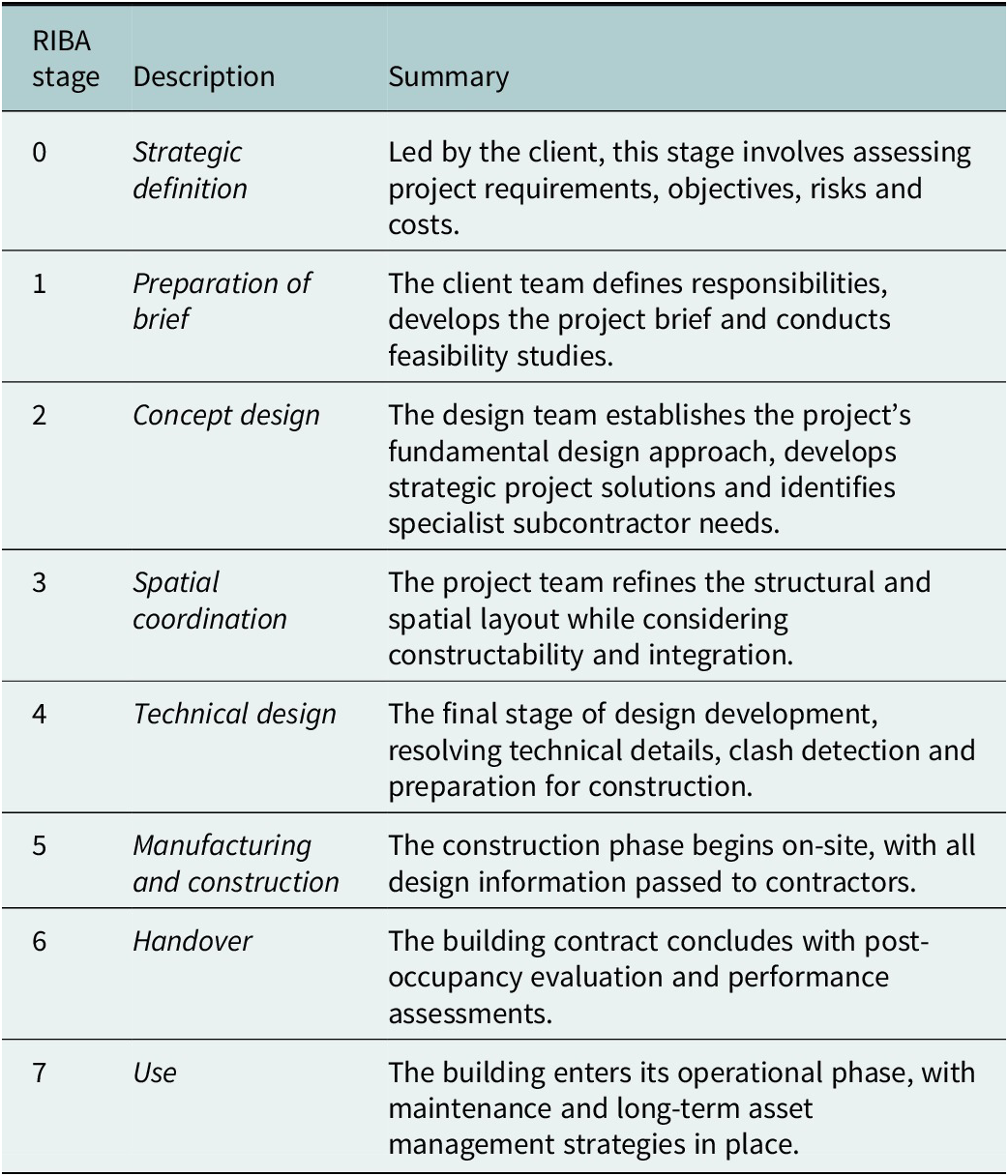
The RIBA Plan of Work is the most widely used project management framework in the United Kingdom, providing a structured methodology for project delivery in the built environment (RIBA, 2020). Similar project timelines are utilised in other countries, making its application relevant on an international scale (Bagireanu et al., Reference Bagireanu, Bros-Williamson, Duncheva and Currie2024). The Plan of Work outlines key stages of project development, from strategic definition to handover and operation, offering a standardised framework for organising project workflows (Table 1).
Summary of RIBA plan of work (RIBA, 2020; Bagireanu et al., Reference Bagireanu, Bros-Williamson, Duncheva and Currie2024)

Historically, the RIBA Plan of Work started with Stage 1, which focused on developing the project objectives, including quality, cost and scope. In 2020, the Plan was revised to include an additional preparatory stage in response to the need for a more comprehensive approach to “sustainability, BIM and procurement” (The RIBA Journal, Reference Sinclair2019; RIBA, 2024a). The update was seen as the most significant revision ever made since 2013’s version of the Plan, and incorporated feedback from architects and the industry at large. The addition clarified the needs of the sustainable vision for the project timeline before project inception, hence the additional Stage 0 and 7.
Alongside these structural changes, the 2020 update also re-evaluated the role of Overlays, which had previously provided additional guidance on specific industry concerns. Overlays under the RIBA Plan of Work are targeted resources that provide additional, focused guidance on specific aspects of project delivery, complementing the standard stages of the RIBA framework. Examples include the Sustainability Overlay, which integrates net-zero and environmental considerations into project workflows, and the Smart Building Overlay, which aligns digital technologies with building life cycle management. These Overlays help refine how industry professionals apply RIBA stages in response to evolving regulatory, technological and environmental demands (Designing Buildings, 2025).
With the revision, many Overlays were deemed redundant as their principles were integrated into the RIBA core tasks. For instance, the Green Overlay through the project strategy section or the BIM Overlay was absorbed into the project strategy section, ensuring that sustainability considerations were included throughout the project life cycle rather than as a separate addition. Similarly, the BIM Overlay was incorporated by expanding the information requirements outlined in RIBA’s updated framework.
The revision also introduced an expanded glossary of newly adopted industry terms, helping to clarify and integrate procurement and technical concepts that were previously misunderstood or inconsistently applied. Notably, this included references to DT and Digital Execution Plans (DEP). A DEP is a structured document used in the AECO industries to define the methodologies, workflows and standards for digital tools throughout a project’s life cycle. The purpose of a DEP is to align all stakeholders on digital methodologies and data governance from inception to completion. It represents an evolution of the BIM Execution Plan (BEP), originally promoted under the UK’s BIM Level 2 framework to enhance project coordination and interoperability.
These updates reflect a broader shift towards digital transformation, and while DTs remain largely absent from RIBA’s frameworks and Overlays, their role is implicitly acknowledged within the industry’s evolving trajectory. Just as BIM transitioned from an emerging concept to a structured industry standard, DT is likely to follow a similar path, requiring dedicated guidance to ensure integration within regulatory, contractual and operational workflows.
Given that DT implementation relies on early-stage alignment with project objectives, its absence from structured frameworks reveals a gap in industry guidance. The literature highlights the risks of late-stage DT adoption, including fragmented implementation and misaligned project goals (Farhan Jahangir et al., Reference Farhan Jahangir, Peter, Schultz and Kamari2024). These challenges underscore the need to explore how DT can be better embedded within structured project methodologies from the outset, much like BIM and other digital innovations that have been systematically integrated into industry standards.
This is not only important from a workflow and integration perspective, but it also highlights a more underdeveloped dimension of DT adoption – namely, its capacity to influence long-term sustainability outcomes. Energy performance is an important DT dimension that remains inconsistently addressed. DTs can support improved energy efficiency by capturing data through real-time monitoring, simulating alternative operational scenarios and optimising building systems. It is therefore important to ensure that energy considerations are embedded into structured frameworks from the outset, ensuring that DT are not limited to supporting project delivery but instead contribute directly to advancing net-zero and long-term sustainability objectives.
This recognition of the need for early-stage considerations is also evident in the Plan’s approach to Modern Methods of Construction, which it acknowledges as important but does not specify when or how they should be implemented (The RIBA Journal, Reference Sinclair2019). This gap reflects a broader challenge in integrating emerging digital and construction methodologies, reinforcing the necessity for a clear framework that embeds DT from the outset of project planning.
While DT remains absent from structured industry frameworks, the evolution of the RIBA Plan of Work demonstrates how industry practices adapt to emerging needs. The Plan’s revision acknowledges the way industry uses each RIBA Stage in practice, such as the existence of Stage 3 minus or Stage 4 plus. While it does not formally endorse these variations, the Plan attempts to integrate many of the industry’s evolving needs and increasing information requirements into additional stages. Certain additional tasks were incorporated into existing project phases, such as expanding Stage 5 to address manufacturing considerations and enhancing Stage 6 to support a more comprehensive handover of information (The RIBA Journal, Reference Sinclair2019).
The RIBA Plan of Work has continuously evolved to accommodate new priorities in project delivery. The most recent update to the RIBA Plan of Work (2020) represents one of the most substantial revisions since 2013, with sustainability as a central focus. This effort is embedded across the Stages and further expanded in the RIBA Sustainable Outcomes Guide, which provides metrics and tools for defining and measuring sustainable performance (The RIBA Journal, Reference Sinclair2019). Some sustainability considerations were deemed critical enough to influence project delivery, leading to the creation of Stage 0 (Strategic Definition) and Stage 7 (In Use). Stage 0 ensures early alignment between client requirements and sustainability goals, while Stage 7 acknowledges the building’s life cycle impact and long-term performance.
While sustainability-focused Overlays and revisions have influenced how projects integrate environmental and social considerations, CP has yet to be explicitly incorporated into RIBA’s structured approach. Given that integrated procurement models shape project workflows, the omission of CP leaves a gap in how RIBA Stages facilitate long-term stakeholder engagement and decision-making. The Engagement Overlay introduces some principles of collaboration, but it does not extend to procurement structures that influence project efficiency and contract models. Following the sustainability trajectory requirement, the Engagement Overlay provides a framework for engaging with various stakeholders throughout the project’s life cycle. Although it does not mention CP directly, a primary aim of the Overlay is fostering “co-creation,” or collective development of innovative strategies, ultimately contributing to positive social and environmental outcomes (RIBA , 2024b). As of 2024, this Overlay is a recent addition to the RIBA collection, and no specific collaborative procurement or digital tools have been formally integrated into it or alongside it yet.
RIBA’s recent focus on decarbonisation and sustainability in response to climate change has led to an expansion of guidance and Overlays, such as the Sustainable Outcomes Guide (RIBA, 2019). While DT are recognised for their role in energy modelling through carbon tracking and life cycle efficiency (Kaewunruen et al., Reference Kaewunruen, Rungskunroch and Welsh2018; Papadonikolaki and Anumba, Reference Papadonikolaki and Anumba2022), no comprehensive framework exists to systematically link DT adoption in support of net-zero strategies. ARUP introduced Digital Twin - Towards A Meaningful Framework report (ARUP, 2019), which points to the sector’s desire for structured integration but stops short of providing a full framework. Similarly, the Digital Twin Consortium has advanced international standards and best practices (digitaltwinconsortium.org, 2025), yet these remain broad and not specifically tailored to the AECO sector. Academically, the crossover between DT and sustainability is evident, but a structured approach to integrating DT within industry-standard practices remains absent, highlighting the need for a framework with criteria tailored to AECO workflows and grounded in principles capable of driving meaningful progress towards net-zero objectives.
DT framework
This review highlights the lack of structured guidance for DT adoption in the built environment, particularly in early project stages. While frameworks like the RIBA Plan of Work and Overlays have evolved to address digital transformation and sustainability, they do not provide explicit pathways for DT integration. The literature highlights the risks of late-stage DT integration, including fragmentation and misalignment with project workflows. This underscores the need for early-stage DT implementation within structured project methodologies to ensure seamless adoption and long-term impact. There is a need for a revised approach that aligns DT implementation with RIBA-recognised industry-standard project phases.
While Overlays or enhancements to existing frameworks may offer some guidance, they are insufficient for addressing the inherent complexities of DT adoption. Addressing the gaps in existing academic research requires expanding the scope of DT applications beyond individual phases and emphasising the interconnections between project stages. Overlays, by their nature, tend to lack the granularity and adaptability needed to maximise value within distinct project phases. A DT intended for decision-making during early design stages, for example, requires a different focus, data inputs and functionalities than one used for construction monitoring or operational optimisation. Due to their inherent complexity and long-term life cycle impact, there is a need for a framework that allows stakeholders to “zoom in” on specific phases and tailor DT applications to their unique asset needs.
Unlike a simple Overlay, a comprehensive DT framework needs to be designed for scalability and with industry adoption in mind, incorporating generalisable core principles and tasks applicable across diverse project contexts. A preparatory stage dedicated to DT strategy is essential for maximising its implementation across Stages 0–7, ensuring a DT is embedded from the outset rather than introduced reactively as an isolated digital tool.
The key knowledge gap lies in the absence of a structured DT framework that aligns with industry workflows to ensure effective project integration. While existing frameworks provide a foundation, they lack explicit guidance on DT adoption, offering an opportunity to learn from their methodologies and develop a rationale for a more integrated approach. The discussion will outline the principles and characteristics of a structured DT framework, addressing these gaps and proposing a more cohesive approach to DT implementation in the built environment.
Framework characteristics
This section explores key characteristics that are essential for a comprehensive DT framework, including scale adaptability, project type flexibility and the evolving complexity of stakeholder requirements.
Scale and project characteristics
Research by the McKinsey Global Institute indicates that digital transformation holds the greatest potential for larger-scale projects, where productivity improvements and cost reductions are more significant ((Koeleman et al., Reference Koeleman, Ribeirinho, Rockhill, Sjödin and Strube2019). This correlation between scale and potential benefits highlights the importance of prioritising large-scale projects for DT implementation, as the impact of productivity gains and cost savings becomes exponentially more meaningful in such contexts. Larger projects inherently involve greater complexity, larger datasets and extended timelines, making them better suited to leveraging DT capabilities effectively.
Data capture, a key component of DT and central to the Golden Thread concept, is particularly critical for projects involving large datasets that must be measured, monitored and managed over extended periods. The Golden Thread refers to the seamless flow of accurate, up-to-date and structured information throughout an asset’s life cycle. While originally emphasised in building safety regulations, it is increasingly applied to digital asset management, where DT play a crucial role in ensuring data continuity across project phases (IET, 2019; Asite, 2021). Managing such data requires an expanded team capacity, either through dedicated in-house expertise or collaboration with external specialists. This growing resource demand underscores the need for effective team coordination and robust technological infrastructure, making DT implementation more feasible for larger-scale clients, such as local authorities or private developers with long-term asset management strategies (e.g., managed rent models).
Currently, mainstream DT solutions are not widely available, leading many interested organisations to develop their own DT systems in-house (Boje et al., Reference Boje, Guerriero, Kubicki and Rezgui2020; Fuller et al., Reference Fuller, Fan, Day and Barlow2020). Regardless of whether a DT is created through co-creation efforts or purchased as a pre-designed system or platform, service customisation remains essential. Therefore, the “implementation” strategy is relevant in both scenarios. The framework must account for this variability, offering flexibility for DT systems to adapt to a diverse range of project contexts and organisational requirements.
An increasing number of digital tool providers are introducing subscription-based models (Hrubovcakova et al., Reference Hrubovcakova, Mesaros and Spisakova2024; ArchDaily, 2023), reflecting the long-term commitment required for both CP integration and the effective long-term management of DT. Subscription-based models are becoming integral to the adoption of digital tools in the built environment. For example, Autodesk Tandem provides a subscription-based platform for creating and managing DT in Architecture, Engineering, and Construction (AEC) projects, enabling life cycle data visualisation and performance monitoring. Azure Digital Twins offers a cloud-based platform for modelling entire environments. Tradogram facilitates subscription-based digitised procurement processes. This approach is not designed for a traditional procurement client typology, with a focus on short-term outcomes, but rather for one invested in the entire life cycle of the asset, with a clear purpose for data capture and its application in decision-making, optimisation and future-proofing. This type of client (i.e., asset managers, developers or local authorities) recognises the strategic value of data and its role in ensuring the asset’s performance and adaptability over time.
A distinction must therefore be made between projects that are more suitable for DT implementation based on their scale, budget, stakeholder type, environmental objectives or specific project requirements. The cost model for DT tools presents a further challenge. Subscription models may reduce upfront expenditure for short-term use, but in the longer term, their cumulative costs may become prohibitive, particularly for smaller firms. This raises questions of accessibility and scalability in life cycle DT adoption. Even though there may be smaller-scale projects suitable for isolated DT applications, such as energy optimisation or retrofitting, they still require clients invested in life cycle management and the strategic use of data. For example, a small commercial building using a simplified DT for energy optimisation would only benefit if the client, such as an owner-operator or small developer, prioritises long-term performance monitoring and data capture. Similarly, retrofitting projects that leverage DT for design simulations and life cycle insights are feasible when clients, such as property owners or local authorities, aim to extend the assets’ life cycle or meet regulatory objectives. This long-term interest in the asset is therefore paramount, as it aligns the project and client goals with a life cycle-oriented approach. Perhaps unsurprisingly, this aligns with the CP principles, which equally value long-term value creation through collaboration and cross-industry integration.
For firms, the adoption of DT offers tangible benefits, including reduced rework, improved pre-construction efficiency, enhanced compliance with regulatory and sustainability standards and better-informed decision-making across the project life cycle and throughout management. These outcomes translate into respective risk reduction and improved long-term asset performance.
Therefore, DT are primarily suited for large-scale projects with a long-term interest in asset life cycle management. These projects often feature greater complexity, extended timelines of operation and substantial data capture and management needs. The DT framework, therefore, focuses on enabling DT adoption for projects and stakeholders that align with these characteristics, ensuring scalability, adaptability and alignment with life cycle-oriented goals.
Stakeholder type
Successful project delivery depends on establishing stable relationships among stakeholders and fostering a collaborative environment that enables effective risk management throughout the project life cycle (Eriksson and Westerberg, Reference Eriksson and Westerberg2025). As projects progress through various stages, they tend to evolve in complexity, requiring the involvement of an increasing number of specialist contractors and consultants. This complexity underscores the importance of a framework that is adaptable to accommodate these changes, particularly as specialist roles become more prominent in the later design and construction stages. In the context of large-scale projects with extended timelines, stakeholder involvement becomes even more diverse, requiring expertise to support complex design processes and built environment management. The integration of DT introduces new responsibilities that must be supported by clear workflows, well-defined roles and collaborative structures to ensure seamless coordination across all project phases.
The concept of stakeholder has been widely applied to projects in general, and various stakeholders hold differing degrees of investment and interest in construction projects, effectively making them multiple clients or end-users with distinct expectations and requirements (Newcombe, Reference Newcombe2003). Liyanage et al. (Reference Liyanage, Tripathi, Päivärinta and Xu2022) identified 13 potential stakeholders in Digital Twin Ecosystems, categorising them as primary, secondary and tertiary based on their roles and interactions. The paper discusses primary stakeholders being directly involved in data creation, exchange and decision-making, while secondary and tertiary stakeholders provide supporting services and expertise (Liyanage et al., Reference Liyanage, Tripathi, Päivärinta and Xu2022). Additionally, CDBB addresses the importance of a shared vision and values among stakeholders in the development of DT for the built environment, naming stakeholders such as clients, government departments and technology providers (CDBB, 2019).
In Collaboration Between Stakeholders in Sustainable Public Procurement – Policy Brief, Felippe Vilaça discusses stakeholder selection from the perspective of including government (such as policymakers), market (such as suppliers and industry organisations) and society (e.g., non-governmental organisations) representatives (Vilaça, Reference Vilaça2024). This classification is particularly relevant when discussing complex, large-scale or public projects where policy-driven frameworks and multi-stakeholder coordination are essential. Zhu et al. (Reference Zhu, Xi, Hu, Chong, Zhou and Lyu2024) present a methodology for identifying and analysing stakeholder profiles in off-site construction projects. It categorises stakeholders based on their power and interest levels, providing insights into managing relationships with various parties involved in such projects (Zhu et al., Reference Zhu, Xi, Hu, Chong, Zhou and Lyu2024). Extrapolating the stakeholder mapping in the interest of dealing with and managing a DT paradigm, a similar mapping methodology is necessary to identify key stakeholders based on their influence, decision-making power and the insights they contribute to the DT ecosystem.
Building users and administrators are excluded from this categorisation, as the DT is typically set up for their use post-completion. However, a distinction is made regarding their potential involvement during early design stages, particularly in public consultation scenarios. Public sector projects, for instance, often require input from end users, aligning with a human-centric approach to design. Human-centric design inherently includes the perspectives of end users to ensure that built assets reflect their values and priorities. This is not only a cornerstone of sustainable design but also a critical factor in aligning social metrics with the long-term success of the asset (Human-Centred Design 101: UCEM, 2024; Goh and Chong, Reference Goh and Chong2023). End users’ needs must still be anticipated and embedded into the DT strategy, which further reinforces the necessity for early-stage alignment between CP principles and DT (Catapult and VR Forums, 2018; RIBA, 2020).
Given the complexity of the DT paradigm in the built environment, it is necessary to prioritise stakeholders who have direct influence over data creation, integration and long-term management. Existing research highlights a broad range of potential stakeholders, categorising them by influence, interest and role within the DT ecosystem (Liyanage et al., Reference Liyanage, Tripathi, Päivärinta and Xu2022; Zhu et al., Reference Zhu, Xi, Hu, Chong, Zhou and Lyu2024). However, for a structured and practical framework, it is essential to focus on those directly responsible for shaping, deploying and sustaining DT across project phases.
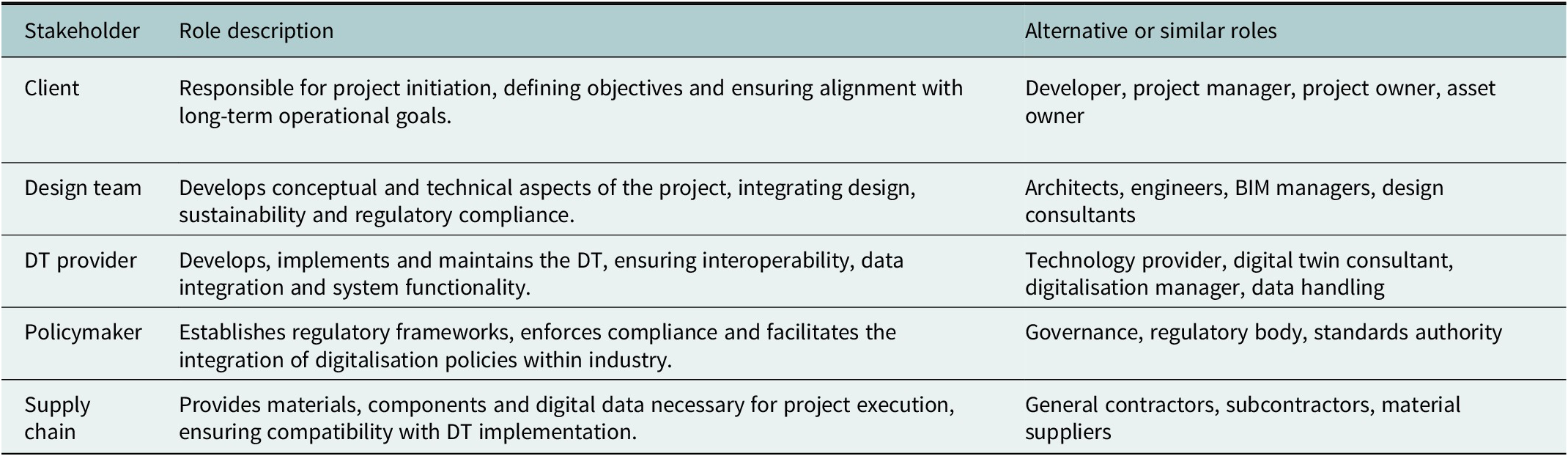
In large-scale projects, DT adoption is fundamentally driven by decision-makers who control project workflows, procurement, digital strategy and regulatory compliance. These responsibilities are concentrated within five key stakeholder groups: the client, design team, DT providers, policymakers and supply chain contractors (Table 10). These stakeholders hold both the authority and technical expertise required to ensure DT are effectively integrated and managed across project life cycles.
The inclusion of the DT provider as a distinct stakeholder category reflects the increasing importance of specialist expertise in managing the technical, operational and governance aspects of DT (Liyanage et al., Reference Liyanage, Tripathi, Päivärinta and Xu2022), and it is similar to other Overlays and guidance documents that endorse BIM managers and digital information specialists as essential figures in coordinating novel data processes.
Potential end users not directly included in the stakeholder selection but impacted by DT implementation may include building occupiers, asset owners, operational suppliers, tenant representatives and visitors. These stakeholders interact with DT-enabled operational processes but are not directly involved in data structuring and integration during earlier project phases. It is the responsibility of these stakeholder representatives to consider and incorporate end-user perspectives into the DT vision. This may occur through public consultations during early design stages and throughout operation.
Due to this limited direct interaction with DT development, end users are not included in the framework rationale. Instead, their needs and perspectives are accounted for indirectly, either through stakeholder representation, policy integration or structured feedback mechanisms that ensure the DT remains user-informed and accessible at later stages of the project life cycle.
It is worth noting that these roles are indicative, and they often change, switch and expand to absorb different roles and responsibilities from Stage to Stage and project to project, even more so under the CP binding. The dynamic and agile nature of built environment projects means that these roles are only indicative, and they merely “group” together different roles and responsibilities that may be typical of each stakeholder type.
Methodology
This study adopts a qualitative research approach to investigate the gaps and challenges in DT adoption within the built environment. Given the conceptual nature of this study, the methodology focuses on analysing existing literature, industry frameworks and methodologies to critically assess the need for a structured DT implementation approach. The methodology follows these key steps:
-
(1) Literature review: A comprehensive analysis of academic publications, industry reports and existing frameworks to identify trends, gaps and the extent to which current frameworks align with DT adoption needs.
-
(2) Evaluation of existing frameworks: An assessment of industry-recognised frameworks to extract principles, best practices and limitations relevant to DT adoption. This informs the identification of critical factors needed for the DT framework.
-
(3) Synthesis and framework rationale: This step establishes the need for a structured DT framework, highlighting gaps in current industry approaches and emphasising key components required for effective integration.
This methodological approach ensures that the discussion is grounded in both theoretical insights and practical industry considerations, providing a balanced and evidence-based perspective on the role of frameworks in DT adoption.
DT framework
The success of a built environment project is deeply connected with the organisational readiness and alignment preceding the project’s inception. Building on the insights from the literature review, the need for a DT framework becomes evident. The framework should aim to address critical gaps in understanding, adoption and implementation, while providing clarity on the concept of DT and CP synergy (DT-CP) and its broader applications. This chapter outlines the key justifications for developing such a framework, emphasising its importance in addressing the gaps identified in the literature review and aligning with the unique demands of the built environment as it intersects with the broader goals of digital transformation.
This subchapter outlines key justifications for developing this framework, highlighting its importance in addressing gaps identified in the literature and aligning with the specific demands of the built environment within the broader context of digital transformation.
Addressing gaps in existing academic research
To develop a robust and widely applicable DT framework, it is essential to address the gaps identified in the literature. While DT applications in adjacent industries provide valuable foundations, they do not fully account for the unique characteristics of the built environment, where project timelines, workflows and stakeholder dynamics differ significantly. There remains a lack of built environment-specific approaches that consider the distinct stages of project timelines and the divergence between the designed and built asset. A critical focus on early-stage implementation is necessary to bridge this gap and ensure a more integrated approach.
The absence of a comprehensive framework underscores a pressing need for a unified approach that not only integrates DT applications across project phases but also addresses the interdependencies between these phases and the application of DT based on project-specific phases (e.g., DT for operations or DTs for decision-making during design stages). A structured framework would provide a clearer understanding of how DT can support the life cycle of built assets, addressing a major barrier to industry-wide adoption. Table 2 summarises the stages required to address these gaps (see Table 3).
Stakeholder profile

Stages in developing a DT framework to bridge existing research gaps

Focus on early-stage implementation
The literature consistently highlights that DT are predominantly considered a tool for the operations phase, often leaving their implementation until it is too late in the project life cycle, as an add-on purchase rather than an integral part of the project’s early planning and development. This delayed focus undermines the potential benefits of DT across earlier stages, where their integration could establish a strong foundation for seamless transitions and outcomes. A framework that focuses on the early-stage implementation is critical for ensuring DT realise their vision.
Early-stage implementation also addresses stakeholder-specific needs by integrating diverse datasets tailored to the objectives of each phase while maintaining overall consistency. By focusing on early adoption, a cohesive DT framework ensures that stakeholder priorities and objectives are incorporated from the outset, enhancing outcomes throughout the life cycle. Table 4 outlines the importance of early-stage DT implementation and the corresponding approaches.
Approaches required to address early-stage implementation

Addressing the complexity of managing data, project processes and stakeholder interactions
The complexity of managing data, processes and stakeholder interactions across the project timeline is often overlooked or not adequately consolidated in existing literature. Similarly with BIM, realising the DT potential hinges more on systematic management changes rather than technology-related issues (He et al., Reference He, Wang, Luo, Shi, Xie and Meng2017). This is particularly evident during the implementation stages, where the challenges of ensuring effective stakeholder communication become more pronounced (Kober et al., Reference Kober, Gomez Medina, Benfer, Wulfsberg, Martinez and Lanza2024). A comprehensive DT framework must address these challenges by creating streamlined processes for data integration and collaboration, ensuring consistency and alignment across project phases.
While current literature emphasises the potential of DT for later phases, such as operations or construction, there remains a critical gap in establishing a cohesive framework that integrates DT applications across earlier stages. This integration is essential for ensuring data continuity and the consolidation of the Golden Thread concept, and ensuring later DT outcomes are streamlined due to an effective DT implementation. Table 5 presents the key factors necessitating the development of such a framework.
Approaches required to address the complexity of stakeholder interactions

Addressing the crossover between CP and DT
The integration of CP principles with DT represents a transformative opportunity, which is necessary for the DT vision to be realised. The framework needs to demonstrate this crossover by illustrating how CP principles can realise the full potential of DT technologies, and conversely, how DT can support the values and goals of CP. The foundational role of CP must be emphasised as a critical enabler of collaborative, transparent and efficient workflows within a DT ecosystem.
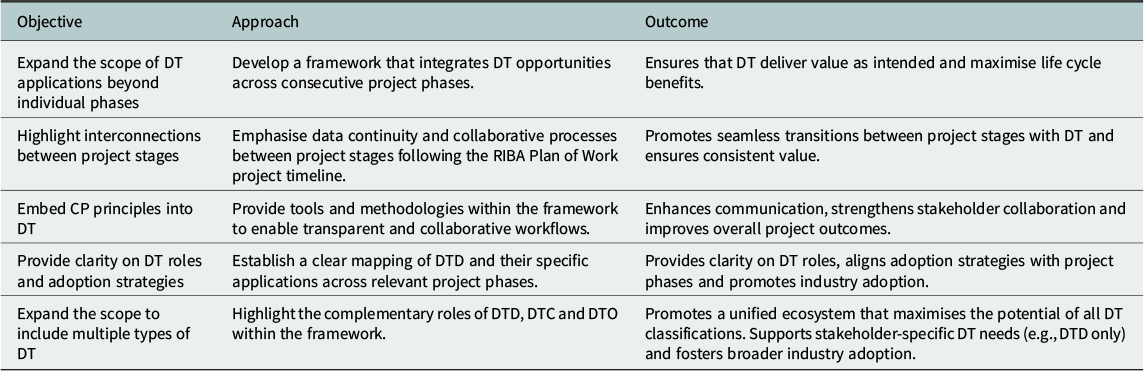
Combining CP and DT serves as a pathway to standardize and drive the broader adoption of CP principles, too. Their integration within the framework not only simplifies CP processes to be procurement method agnostic but also further demystifies them through the DT-CP synergy. A key outcome of this integration is leveraging the attention and momentum surrounding DT to increase awareness and interest in people-level changes, which lie at the core of CP’s collaborative approach. Table 6 summarises the objectives, approaches and outcomes of integrating DT with CP within a framework.
Approaches required to address the crossover between CP and DT

Clarifying DT implementation and industry adoption pathways
The literature highlights significant misunderstandings surrounding DT, which can lead to strategic misalignment and fragmented adoption. This confusion stems from the rapid emergence of DT-related technologies, making it difficult for practitioners to determine the appropriate level of technological sophistication for their projects. Many DT solutions claim to address all project needs comprehensively, creating unrealistic expectations and inconsistent implementation approaches.
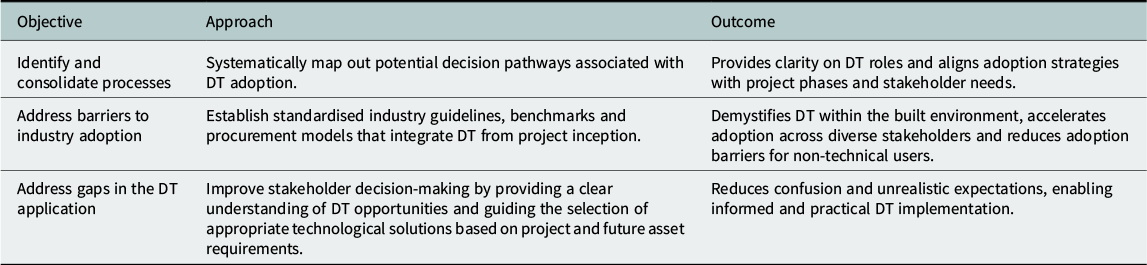
A structured framework must provide clear decision-making pathways, ensuring that stakeholders can systematically assess when, where and how DT should be implemented across project phases. Additionally, broader industry guidance is required to ensure that DT adoption is not limited to isolated pilot projects but embedded within standard procurement, contractual and regulatory structures. Without this guidance, DT risks remaining a technologically advanced but impractical solution, disconnected from industry workflows. Table 7 outlines how an integrated approach to decision-making and industry adoption can address these challenges.
Approaches for implementation pathways

Scalability
The DT framework must be designed with scalability to adapt to evolving regulatory and industry standards, ensuring their long-term relevance and applicability across different projects and contexts. To achieve this, a scalable framework must be both technology-agnostic and procurement approach-agnostic, focusing instead on core principles and core tasks that can be generalised for various use cases. This flexibility ensures that the framework can accommodate advancements in technology, shifts in regulatory requirements and differing procurement strategies, making it universally applicable. For example, if the scope of a project expands from 40 units to 200 units, the DT framework should remain applicable, but the increase in scale also amplifies data management, stakeholder coordination and governance demands. Scalability, therefore, refers not only to project size but also to the framework’s capacity to accommodate greater complexity while maintaining consistency in principles and processes.
Of course, principles of CP as a foundational basis, coupled with an emphasis on early implementation, are essential to ensuring that the core ethos of DT is effectively captured and applied. Table 8 summarises the approaches to ensure scalability in a DT framework.
Approaches for addressing scalability

The case for a DT preparatory stage in project workflows
As demonstrated by the evolution of the RIBA Plan of Work, the industry has continuously adapted to emerging priorities, including sustainability and procurement strategies. The introduction of Stage 0 was a direct response to the need for early-stage sustainability goal setting. However, while Stage 0 provides a foundation for defining project objectives, it does not establish the necessary alignment for DT implementation, particularly in planning for long-term data capture, optimisation and stakeholder strategic integration.
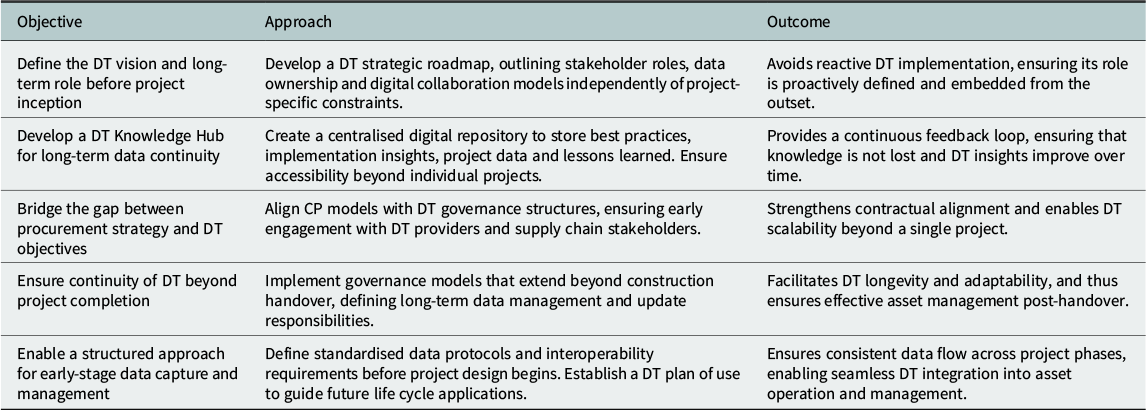
To fully embed DT within project methodologies from the outset, a dedicated preparatory stage is required. This stage would establish organisational readiness, inter-stakeholder collaboration and long-term sustainability objectives before project-specific considerations take shape, effectively functioning as a “Stage 0+” dedicated to DT integration. A key rationale for this additional stage is the development of a centralised repository of data, independent of individual projects, ensuring that DT strategies are informed by a broader, long-term perspective. This would take the form of a “DT Knowledge Hub,” designed to capture and consolidate critical data, implementation insights and digital asset planning strategies. The Knowledge Hub would act as a long-term reference point, supporting DT planning, procurement methodologies and operational knowledge across project stages and into the asset life cycle.
This approach mirrors existing industry precedents, such as the role of BIM in structuring information management. However, unlike BIM, which primarily supports project delivery and coordination, a DT Knowledge Hub would provide a continuous feedback loop, ensuring that lessons learned, evolving best practices and data-driven insights inform future projects and decision-making. Table 9 outlines the objectives, approaches and outcomes associated with establishing this dedicated preparatory stage.
Approaches for dedicated preparatory stage

Aligning with sustainability and net-zero goals
The growing emphasis on achieving net-zero carbon targets in the built environment highlights the importance of leveraging DT to achieve these sustainability goals. There is a notable lack of guidance on how to systematically integrate net-zero principles within a DT framework.
A robust DT framework must align with sustainability standards, regulations and best practices and maximise its contribution to net-zero objectives. This is particularly relevant, as integrating sustainability goals is most effective when addressed early in the project life cycle; similarly, DT are also most effective when implemented early. This overlap underscores the need for a framework that addresses the crossovers between early-stage sustainability integration and DT implementation. As such, the emphasis on early-stage DT integration and continuity under collaborative governance establishes the conditions through which net-zero-aligned practices can be more consistently supported. Table 10 below outlines the objectives, approaches and outcomes for aligning DT frameworks with net-zero goals.
Approaches addressing sustainability and net zero goals

Conclusion
This paper has highlighted the critical need for a structured framework to guide the implementation of DT in the built environment. While DT hold significant potential for optimising project delivery and asset performance, their adoption remains fragmented due to the absence of a unified approach. Existing frameworks, such as the RIBA Plan of Work and industry Overlays, provide valuable methodologies for project delivery, yet they do not explicitly integrate DT considerations. Similarly, while CP has been widely recognised for improving project outcomes, its role in facilitating DT adoption has not been systematically addressed.
Developing DT-oriented frameworks is essential for ensuring their successful integration. Standardisation across industry guidelines and contractual models, alongside clear governance structures defining roles, responsibilities and interoperability standards, will be key to driving widespread adoption. Achieving this requires a shift in industry mindsets towards long-term value creation, supported by collaboration between policymakers, practitioners and technology providers. CP reinforces this long-term vision by providing a structured foundation for sustained stakeholder collaboration and data continuity. As climate resilience and net-zero targets become industry imperatives, the absence of a structured DT framework risks undermining their full transformative potential. Without an approach that embeds long-term collaboration and strategic planning from project inception, DT may be reduced to fragmented, short-term digital interventions rather than serving as powerful enablers of sustainability. A well-integrated framework is essential to ensure DT are not just reactive tools, but fundamental drivers of efficiency, resilience and net-zero progress across the built environment.
This paper argues that early-stage integration is crucial for ensuring long-term stakeholder engagement and effective life cycle asset management, both of which are essential for advancing sustainable project outcomes. A structured approach to DT adoption must place greater emphasis on early-stage decision-making, with a stronger academic focus on stakeholder collaboration and DT-dedicated preparatory phases. This includes establishing robust data capture and continuity mechanisms, not only to support climate resilience and sustainability objectives but also to ensure that DT implementation is strategically embedded from the outset, preventing inefficiencies or missed opportunities in later project stages.
Open peer review
To view the open peer review materials for this article, please visit https://doi.org/10.1017/etr.2026.10009.
Data availability statement
This study is based on published literature. No new primary data were created or analysed.
Acknowledgements
The authors would like to acknowledge Stora Enso for the in-kind donation of supervision time provided until 31 December 2024, and Her Green Growth for their support from 1 January 2025 onwards.
Author contribution
The authors are solely responsible for the conception, design, analysis and writing of this work.
Financial support
This work was supported by the Energy Technology Partnership; the Housing, Construction and Infrastructure Skills Gateway; and Edinburgh Napier University.
Competing interests
The authors declare none.






 Open access


Comments
No accompanying comment.