


Introduction
Almost all European economies contracted in the first storm of the Great Recession, which hit the continent after the collapse of the investment bank Lehman Brothers in the autumn of 2008. Most economies recovered fairly quickly after the first ‘shock’, but the financial crisis soon developed into the so‐called ‘Euro Crisis’. The countries in Southern Europe especially have been caught in a spiral of stagnation, high unemployment and public debt ever since. Ultimately, several crisis‐ridden countries needed financial assistance and had to accept strong conditions by their international creditors. Cumulative research documents the political consequences of this crisis in Europe. Importantly, studying the link between economic grievances and political responses has been revived. Among others, social movement studies have examined the wave of anti‐austerity protests and reconsidered the link between economic strains and protest mobilisation (e.g., Beissinger & Sasse Reference Beissinger, Sasse, Bartels and Bermeo2014; Della Porta Reference Della Porta2015; Grasso & Giugni Reference Grasso and Giugni2016; Klandermans & Van Stekelenburg Reference Klandermans and Van Stekelenburg2016; Quaranta Reference Quaranta2016; Kurer et al. Reference Kurer, Häusermann, Wüest and Enggist2018), while electoral and party scholars have studied the massive punishment of incumbents and, in some cases, the breakdown of entire party systems and established lines of conflict (e.g., Bartels Reference Bartels, Bartels and Bermeo2014; Costa Lobo & Lewis‐Beck Reference Costa Lobo, Lewis‐Beck, Arzheimer, Evans and Lewis‐Beck2017; Hobolt & Tilley Reference Hobolt and Tilley2016; Hooghe & Marks Reference Hooghe and Marks2018; Hutter & Kriesi Reference Hutter and Kriesi2019; Otjes & Katsanidou Reference Otjes and Katsanidou2017).
However, the literature still lacks a systematic and large‐scale comparative analysis that connects the political responses to the Great Recession in the electoral and the protest arena. As McAdam and Tarrow (Reference McAdam and Tarrow2010, Reference McAdam, Tarrow, Van Stekelenburg, Roggeband and Klandermans2013) and Hutter (Reference Hutter2014) have argued, the bifurcation of scholarly work on social movements and protest, on the one side, and political parties and elections, on the other, has hampered our understanding of the dynamics of political conflict in contemporary democracies. This is unsatisfactory as the Great Recession has yet again offered multiple examples of the manifold connections and interactions. As exemplified by the recent protest wave and the rise of so‐called ‘movement parties’ from both the left and right (e.g., Altiparmakis & Lorenzini Reference Altiparmakis and Lorenzini2018; Della Porta et al. Reference Della Porta, Fernandez, Kouki and Mosca2017), the dynamic interactions of protest and electoral politics may trigger profound changes. Such reinforcing spirals of movement and party mobilisation tend to be most likely in a context of shifting alignment in times of economic and political crises (e.g., Hutter et al. Reference Hutter, Kriesi, Lorenzini, Snow, Soule, Kriesi and McCammon2019; Roberts Reference Roberts2017).
To advance our understanding of aggregate links between economic grievances, electoral and protest politics, we build upon and refine the economic voting framework (e.g., Duch & Stevenson Reference Duch and Stevenson2008; Lewis‐Beck & Stegmaier Reference Lewis‐Beck, Stegmaier, Dalton and Klingemann2007). Specifically, we ask the following questions. Have the changing economic conditions during the Great Recession affected European protest politics in the same way and with the same intensity as electoral politics? And to what extent has protest mobilisation in the streets contributed to the massive electoral punishment of parties in times of economic crisis?
To answer these questions, we proceed in two steps. First, we borrow arguments from the economic voting literature on the conditional effects of macroeconomic factors on electoral punishment and test whether they also apply to the level of economic protest in a given society (this is our ‘equivalence hypothesis’). We bring in research on economic voting because social movement studies have for a long time neglected the role of objective economic grievances (e.g., Buechler Reference Buechler, Snow, Soule and Kriesi2004) and lack equally established theoretical and empirical claims on the link between the economy and political protest.
Second, we aim to enrich the economic voting literature by introducing protest as a thus far neglected condition that may influence the extent of the economic vote. We start out from McAdam and Tarrow's (Reference McAdam and Tarrow2010, Reference McAdam, Tarrow, Van Stekelenburg, Roggeband and Klandermans2013) insight that even if there are no opportunities for immediate electoral punishment, the electoral cycle is embedded in an ongoing process of political mobilisation that interacts with elections in complex ways. More precisely, we emphasise the role of protests in politicising grievances. We argue that protests may act as a ‘signalling mechanism’ by attributing blame to decision makers and by highlighting the political dimension of deteriorating economic conditions (‘signalling hypothesis’). Ultimately, we do not expect a direct effect of protest on electoral punishment; rather, massive protests should amplify the impact of economic hardship on electoral losses of incumbents and mainstream parties more generally (‘destabilisation hypothesis’).
Overall, the study innovates by connecting social movement research with the economic voting literature, suggesting a mechanism through which protest may contribute to the further destabilisation of European party systems, and testing the plausibility of these arguments based on the first analysis of aggregate shifts in protest mobilisation and electoral outcomes across a large set of European democracies. Specifically, the empirical analysis combines original protest event data with data on electoral outcomes in 30 European countries from 2000 to 2015.Footnote 1
Theoretical framework and expectations
Borrowing insights from the economic voting literature to study protest politics
Social movement studies have neglected the role of objective economic conditions as an explanatory factor for increasing or declining protest levels for several decades. Based on the famous dictum of McCarthy and Zald (Reference McCarthy and Zald1977: 1215) that ‘there is always enough discontent in any society to support the grassroots supply for a movement’, the field rather focused on the role of organisations, the political context and discursive strategies to mobilise discontent in society (Buechler Reference Buechler, Snow, Soule and Kriesi2004). While (relative) economic grievances made their way back into social movement studies in the Great Recession (e.g., Beissinger & Sasse Reference Beissinger, Sasse, Bartels and Bermeo2014; Della Porta Reference Della Porta2015; Grasso & Giugni Reference Grasso and Giugni2016; Quaranta Reference Quaranta2016; Kurer et al. Reference Kurer, Häusermann, Wüest and Enggist2018), the field still tends to lack a set of well‐established arguments and findings on the relation between economic performance and aggregate protest levels. That is why in this article we resort to the economic voting framework.
The raison d'être of the economic voting literature is exactly the search for relations between economic indicators and political behaviour. It assumes instrumentally rational voters, who will reward the incumbents with their vote when the economy is good and punish them when the economy is bad. Much of the literature conceives of economic voting as any change in the support for the chief executive, but some research also focuses on changes in support for the government coalition. According to most studies, it is not the personal financial situation that is decisive for the economic vote but the perception of the national economy (e.g., Duch & Stevenson Reference Duch and Stevenson2008; Lewis‐Beck & Stegmaier Reference Lewis‐Beck, Stegmaier, Dalton and Klingemann2007). The literature thus shows that voting depends on the economic context and that economic voting is pervasive both in ‘normal’ and ‘crisis’ periods. Increasing work also documents how strongly incumbents were punished in the Great Recession and that the punishment varies in line with the predictions of the economic voting literature – that is, according to how hard the economic crisis hit individual countries (e.g., Bartels Reference Bartels, Bartels and Bermeo2014; Hernández & Kriesi Reference Hernández and Kriesi2016; Talving Reference Talving2018).
Furthermore, the literature on economic voting shows that the effects are conditioned by the political context. Three points are particularly important: First, Powell and Whitten's (Reference Powell and Whitten1993) landmark study has documented for the first time that the clarity of political responsibility conditions economic voting: the voters’ assessment of the government's economic performance plays a more decisive role if the national institutional context allows the voters to clearly attribute the responsibility for the economic performance to the government. Duch and Stevenson's (Reference Duch and Stevenson2008) much more detailed results confirm this evidence. Second, recent work also documents important differences depending on the institutionalisation of the party system (e.g., Hernández & Kriesi Reference Hernández and Kriesi2016) – that is, economic voting presupposes a certain degree of structured and long‐term interactions of the parties in a given system. In our sample, this mainly differentiates the party systems in Western and Eastern Europe. Measured against several criteria, the latter are far less institutionalised (Casal Bértoa Reference Casal Bértoa2014), and as Neff Powell and Tucker (Reference Neff Powell and Tucker2013) show, the high level of volatility in these systems since the democratic transition has above all been due to the entry and exit of parties. Finally, research in the economic voting tradition has documented that, in times of increasing globalisation, voters are less likely to punish national governments in bad economic times because they perceive the constraints of national governments’ influence on economic developments (e.g., Hellwig & Samuels Reference Hellwig and Samuels2007; Costa Lobo & Lewis‐Beck Reference Costa Lobo, Lewis‐Beck, Arzheimer, Evans and Lewis‐Beck2017).
As the current economic crisis brought to the fore the strong economic and political interdependencies in Europe, the previous arguments would lead us to expect that the impact of economic conditions on the punishment of incumbents should be weaker – or at least not stronger – in the Great Recession. This is also what some empirical studies show (e.g., Magalhães Reference Magalhães2014; Talving Reference Talving2018). However, other scholars in the economic voting field suggest being cautious here. For example, Costa Lobo and Lewis‐Beck (Reference Costa Lobo, Lewis‐Beck, Arzheimer, Evans and Lewis‐Beck2017: 616ff) emphasise that some of the negative findings might simply be methodological artifacts – that is, studies based on individual‐level cross‐sectional data are not able to grasp the effects of the economic vote because of restricted variance. In a context of a profound economic crisis, a large part of society – regardless of partisan attachments – acknowledges the economic problems.Footnote 2
There is yet another reason for why scholars might have found differing results of the crisis on the economic vote in the Great Recession – namely timing (Hernández & Kriesi Reference Hernández and Kriesi2016). The current economic crisis unfolded in stages: while the initial economic shock affected almost all European countries, the economic prospects of most, but not all, improved fairly quickly thereafter. The voters in the countries where the economy continued to stagnate or even experienced a pronounced double‐dip recession are, therefore, likely to have perceived the incumbents’ failure as particularly serious, not only compared to the pre‐2008 situation but also compared to other countries (on benchmarking, see Kayser & Peress Reference Kayser and Peress2012).
Taking these insights from research on economic voting and benchmarking as our starting point, we test whether the same dynamics are at play when looking at the ups and downs of protests over economic issues. As Piven and Cloward (Reference Piven and Cloward1977: 15) have already noted a long time ago, ‘ordinarily, defiance is first expressed in the voting booth simply because, whether defiant or not, people have been socialized within a political culture that defines voting as the mechanism through which political change can and should properly occur’. Accordingly, the first signs of popular discontent are sharp shifts in voting patterns. However, as highlighted before, the movement literature also emphasises that, in the absence of immediately available options in institutionalised arenas, discontented groups are likely to resort to the protest arena and try to force concessions from political elites by directly appealing to the public. In other words, we expect that protest mobilisation related to economic matters should also be driven by bad economic performance, especially in later stages of the crisis and under ‘favourable’ political conditions, such as clarity of responsibility and high party system institutionalisation (this is our ‘equivalence hypothesis’).
Enriching the economic voting literature: The signalling function of protest politics
In addition to establishing whether the same economic and political factors drive the ups and downs in protest politics as in electoral politics, we shall focus on the questions of whether and how protests might have aggravated electoral losses of incumbents in the Great Recession. More specifically, we emphasise the role of protest as a ‘signalling mechanism’ that attributes blame to decision makers and highlights the political dimension of deteriorating economic conditions (see Lohmann Reference Lohmann1993).
Regarding the dynamics of electoral and protest politics, we build on Schattschneider's (Reference Schattschneider1960) idea of the ‘expansion of conflict’. According to this idea, public protest is designed to unleash a public debate, to draw the attention of the public to the grievances of the actors in question, to create controversy where there was none, and to obtain the support of the public for the actors’ concerns. Put differently, protest fulfils three essential functions that may drive the dynamic relation between protest and electoral politics: they draw attention to the public's grievances and may unleash a controversy (attention function); they attribute political responsibility for (economic) disparities (attribution function); and they can strengthen allies in the political system (spin function) (for a related discussion, see Gillion & Soule Reference Gillion and Soule2018: 2ff)
Such a view of political conflict is most prominent in the agenda‐setting literature, and recent contributions from that tradition emphasise the power of protest to signal discontent and raise the salience of certain issues in more institutionalised arenas (e.g., Vliegenthart et al. Reference Vliegenthart2016). In addition, the pressure from below tends to strengthen the opposition and other allies of the protesting groups in the political system, which may be the main reason why opposition parties support or even create such protest in the first place. The controversial public debates that result from the expansion of conflict by protest mobilisation increase the legitimacy of speakers and allies of movements with journalists and decision makers, who tend to closely follow the public debates (Gamson & Meyer Reference Gamson, Meyer, McAdam, McCarthy and Zald1996: 288). Wolfsfeld's (Reference Wolfsfeld1997: 47) ‘principle of political resonance’ formulates this relationship in a concise way: challengers who succeed in producing events, which resonate with the professional and political culture of important news media, can compete with much more powerful adversaries.
For our argument, it is important that such protest actions may set in motion contentious episodes involving a sequence of interactions between the government and its challengers (see Kriesi et al. Reference Kriesi, Hutter and Bojar2019; McAdam et al. Reference McAdam, Tarrow and Tilly2001). In this sequence, the challengers’ protest attributes responsibility for the problem at stake to the incumbents – that is, it serves as a signal for the political dimension of the problem. This was also the case for the social movements and protest campaigns that emerged in the context of the Great Recession: they had a clear message, opposing austerity and calling for democratic renewal, which emphasised the responsibility of both national and European elites for mismanaging the economic crisis and for exacerbating problems of democratic representation (e.g., Altiparmakis & Lorenzini Reference Altiparmakis and Lorenzini2018; Della Porta Reference Della Porta2015). Given their structural constraints, incumbent parties have above all resorted to procedural concessions to accommodate the pressure from the streets: changes in leadership, reshuffles of the cabinet composition, calls for early elections or ceding responsibility to a caretaker government composed of technocrats. The situation of governments in the countries that were hardest hit by the crisis proved to be particularly uncomfortable in this respect. Not only were they exposed to domestic pressure in the streets, but they also faced pressure from international stakeholders who expected them to act responsibly and execute the measures deemed necessary by the ‘markets’.
Consequently, the interaction dynamics between protest and electoral politics seem particularly closely coupled in a crisis context. A typical scenario for the interaction between protest and electoral politics in the countries most severely hit by the crisis may look like this: The discontented groups mobilise against austerity measures even before the next elections, and in response to the protests, the incumbents make some procedural concessions. Yet, the incumbents fail in satisfying the voters, who severely punish them in the first national elections after the crisis. In these elections, the established opposition parties win office. Once in charge, however, the new government is hardly able to adopt any other policy than the previous government, given the economic constraints imposed on them. Such a situation is likely to further boost protest in the streets, which emphasises the responsibility of the government for the economic situation and increases electoral punishment in later crisis elections. Partly because of the protests, the voters are bound to notice that the new government is forced to take the same measures as its predecessors, whom they had voted out of office, and they may resort to punishing the mainstream parties as a whole in the following elections – by turning to new challengers or by exiting from the established electoral channel altogether. The eventual result may be a profound destabilisation of the national party system (Roberts Reference Roberts2017).
While case studies of countries in Southern Europe support this scenario (on Spain, see, e.g., Vidal Reference Vidal2018), we aim for an aggregate analysis and formulate two important expectations about the impact of protest mobilisation on electoral punishment in the Great Recession. First, while we do not expect a direct effect of protest on electoral punishment, we do expect that protests play an important role in attributing responsibility for the economic decline and the growing cross‐national disparities to the national and European elites. Massive protests should thus amplify the connections between economic misery and the losses of governments in national elections. We suggest calling this the ‘signalling mechanism’ of protest and, empirically, we expect to find that economic voting is stronger in contexts of high protest mobilisation (‘signalling hypothesis’).
Second, protest mobilisation is expected to intensify the feeling among voters that there is a more fundamental ‘crisis of representation’ as a change in government may not result in a change of policy. Therefore, we expect that protest mobilisation may act as an important trigger of the further destabilisation of European party systems by highlighting that mainstream parties (both in opposition and in government) no longer fulfil their representative functions and are, therefore, punished in national elections regardless of whether they are in government or not (‘destabilisation hypothesis’). Note that both expectations depend on the power of the economic vote in the first place – that is, if electoral punishment is hardly related to economic developments, such as in less institutionalised and highly volatile party systems, it is unlikely that protests may serve the signalling function envisioned in our ideal‐typical scenario.
Data and operationalisation
The empirical analysis is based on electoral outcomes and protest levels in 30 European countries from 2000 to 2015.Footnote 3 To the best of our knowledge, this is the first attempt to study aggregate shifts in electoral results and protest mobilisation in such a large‐N setting. The analysis covers countries from Western and Eastern Europe, considering differences in party system institutionalisation and the general extent of the economic vote. The 16‐year time frame allows us to examine the relationship between electoral and protest politics during the Great Recession of 2008–2015 and to compare it with the pattern from the pre‐crisis period of 2000–2008.
To this end, we combine two datasets. First, we use a novel and extensive dataset on protest events in the 30 countries from January 2000 until December 2015. The dataset was created using semi‐automated content analysis of ten English‐speaking international news agencies. We first developed a strategy of automated selection of news reports on protest events that enabled us to select the news documents that are most likely to report on protest events. Afterwards, we relied on a large team of human coders to retrieve information about protest events in each article (e.g., number of events and participants, action forms, issues and actors). The action repertoire covered by our research mirrors the standard approach in protest event analysis, ranging from petitions, strikes and demonstrative forms to more confrontational and violent activities. Online Appendix A‐1 explains how the dataset was created in more detail and provides some evaluations of the quality of the data. In general, the semi‐automated tools introduced some biases in terms of country coverage or action forms included in our dataset, but a careful evaluation of our tools and a comparison of our procedure with data based on the coding of national news shows that our dataset is of good quality (Kriesi et al. Reference Kriesi, Lorenzini, Wüest and Häusermann2020). In total, our unique dataset includes 31,000 protest events on a variety of different issues. For the analysis in this study we include protest on public economic issues only – that is, protests about economic issues that concern the general public and not only selected individuals or companies. This leaves us with around 9,200 protest events that are included in our main analysis, but we also performed some ‘placebo’ tests with other non‐economic protest events (see below).
For our second dataset, we collected information about the election results from the same 30 countries before and after the Great Recession. The dataset includes information on the performance of political parties in the two national legislative elections prior to the Great Recession and all elections that have taken place since then, up to and including the 2015 Spanish election. In total, it includes 118 elections. Online Appendix A‐2 lists all elections covered and provides further information about the sources of the data. Note that we include parties that received at least 3 per cent of the vote in any given election and won representation in parliament. A list of all parties is also included in Online Appendix A‐2.
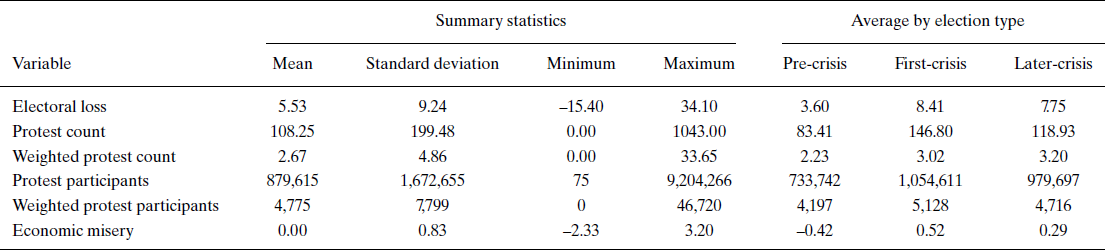
In order to make the measures for electoral and protest politics as comparable as possible we combine the two datasets and focus on electoral changes and protests in the same time frame (i.e., in a given legislative period). To begin with, we calculate the level of electoral loss of the prime minister's party as the change in the vote share of that party between elections at time t and t‐1. Table 1 shows the summary statistics of this variable. It is noteworthy that, according to this measure, the five elections with the largest loss for the incumbents are all from Eastern Europe with the exception of the Greek 2012 election, indicating the relatively high electoral volatility in Eastern European party systems.
Summary statistics of key variables for 118 European elections

Notes: On the left, the table shows summary statistics across all elections (for the measurements, see main text and Online Appendix A). On the right, it shows the averages by election type. It distinguishes between three types of elections: all elections that took place before October 2008 are coded as ‘pre‐crisis’; the first election in each country after October 2008 is coded as ‘first‐crisis’ and all later elections are coded as ‘later‐crisis’. The total of 118 elections includes 59 pre‐crisis, 30 first‐crisis and 29 later‐crisis elections.
Similarly, from our protest dataset we compute an indicator for the level of protest in each legislative period. More precisely, we study the total number of reported protest events for each legislative period, and we account for the differing length of the legislative periods by dividing the number of protest events with the duration in months. This ‘weighted’ measure of the relative number of protest events allows us to compare the development of protest over time in 30 different countries.Footnote 4 As a robustness check, we repeat our analysis with the number of protest participants (divided by the logged population size of each country). Data for the number of participants is more susceptible to outliers as individual large protest events may drive the results. Yet, the results are very similar (see Online Appendix B‐1). Table 1 shows the summary statistics for both the count of protest events and protest participants by legislative period. In terms of the event count, the legislative periods with the highest weighted amount of economic protest (above 500) are: Greece, 2009–2012; France, 2007–2012 and 2002–2007; Italy, 2008–2013; and the United Kingdom, 2005–2010. For our analysis, we combine the information about the weighted event count for each legislative period with the data on electoral outcomes and standardise both measures to make them more easily comparable.
To measure the change in economic conditions in a given country between the election at time t‐1 and t, we rely on three economic indicators that were especially pertinent during the latest economic crisis: change in the unemployment rate; change in the gross domestic product; and change in the level of government debt (as a percentage of GDP).Footnote 5 These measures refer to retrospective and objective assessments of the economy. To reduce the complexity of our analysis, we follow Hernández and Kriesi (Reference Hernández and Kriesi2016) and use factor analysis to combine the three indicators. The results of the factor analysis are shown in Online Appendix A‐3. They indicate that all three variables load strongly on a single factor, and therefore, we estimate a misery index based on the factor scores. This index is a single measure of a country's economic performance and it increases as economic conditions worsen. It is useful for evaluating the impact of the economy on electoral and protest politics because citizens are more likely to respond to general economic trends and not to the evolution of specific macroeconomic indicators. Table 1 also shows the summary statistics of this index and, as expected, the legislative periods with the highest change in economic misery are all from the post‐2008 period. They include: Ireland, 2007–2011; Iceland, 2007–2009; Greece, 2009–2012; Spain, 2008–2011; and Latvia, 2006–2010.
Empirical findings
The drivers of electoral and protest politics in the Great Recession
Following the literature on economic voting, we start our analysis by assessing the importance of the economic context on electoral losses and protest levels. We compare the factors that drive economic voting and economic protest mobilisation during the 118 legislative periods included in our dataset. A descriptive analysis reveals that both electoral losses and protests are positively correlated with economic misery. Consequently, we also find that both the average electoral loss and average protests sharply increased in post‐crisis Europe. As Table 1 shows, the average electoral loss of the incumbent increased from 3.60 percentage points in the pre‐crisis period to 8.41 and 7.75 percentage points in first‐crisis and later‐crisis elections, respectively. At the same time, the average number of protest events increased from around 83 in the pre‐crisis period to around 147 in the first‐crisis period, while the average number of protesters increased from 733,742 in the pre‐crisis period to 1,054,611 in the first‐crisis period. A further look at the data with bivariate correlations and scatter plots reveals that economic misery is correlated with both electoral volatility and protests, but it already suggests that the electoral arena follows more closely the ups and downs of the economic cycle (see Online Appendix A‐4). Moreover, the relationship between the economy and electoral and protest politics turns out to be significantly weaker in the less institutionalised party systems in Eastern Europe than in Western Europe.
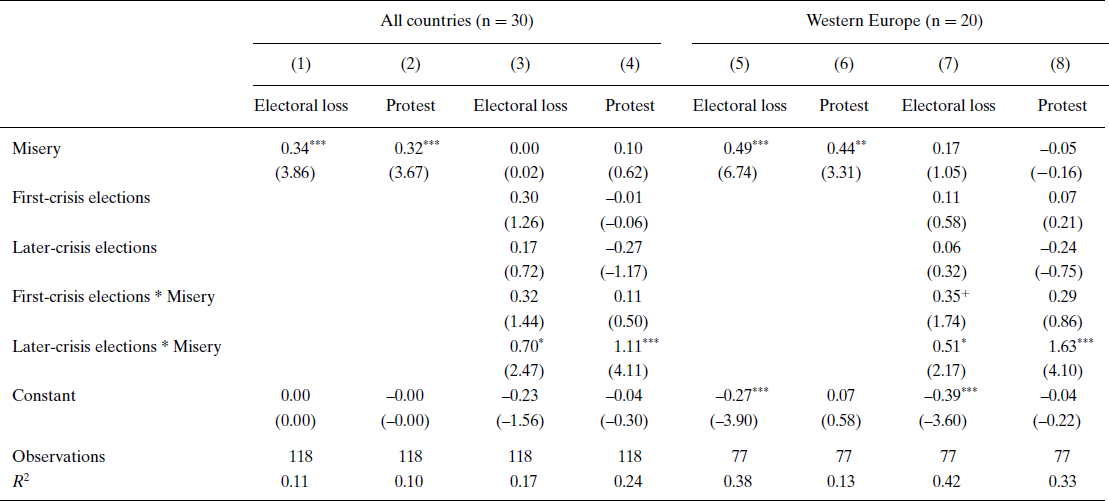
These patterns are confirmed by the regression analysis presented in Table 2. We use simple ordinary least squares (OLS) regressions with the electoral loss of the prime minister's party and the number of protest events in a given legislative period as dependent variables in separate analyses.Footnote 6 As expected, a larger change in economic misery is related to larger electoral losses. According to model 1, a one standard deviation increase in misery is associated with a 0.34 standard deviation increase in electoral loss of the incumbent, which is equivalent to 3.14 percentage points.Footnote 7 Turning to protest, we find a similar pattern: a larger change in economic misery is related to a higher level of economic protests (model 2). This effect is a little smaller, but also significant: a one standard deviation increase in misery is associated with a 0.32 standard deviation increase in the number of protests. This is equivalent to an increase in protests by around 18.7 events per year or 27,000 people per 1 million inhabitants per year (see Online Appendix B‐1).Footnote 8
The impact of economic misery on electoral loss and protest

Notes: t statistics in parentheses. +p < 0.1; *p < 0.05; **p < 0.01; ***p < 0.001.
As expected, this relationship between misery and electoral loss and protest, respectively, becomes even stronger when we focus on Western Europe exclusively. As models 5 and 6 in Table 2 show, both the regression coefficient and the R2 increase significantly compared to models 1 and 2, respectively. This confirms that the electoral and protest arena are more closely associated with the ups and downs of the economy in Western Europe than in Eastern Europe.
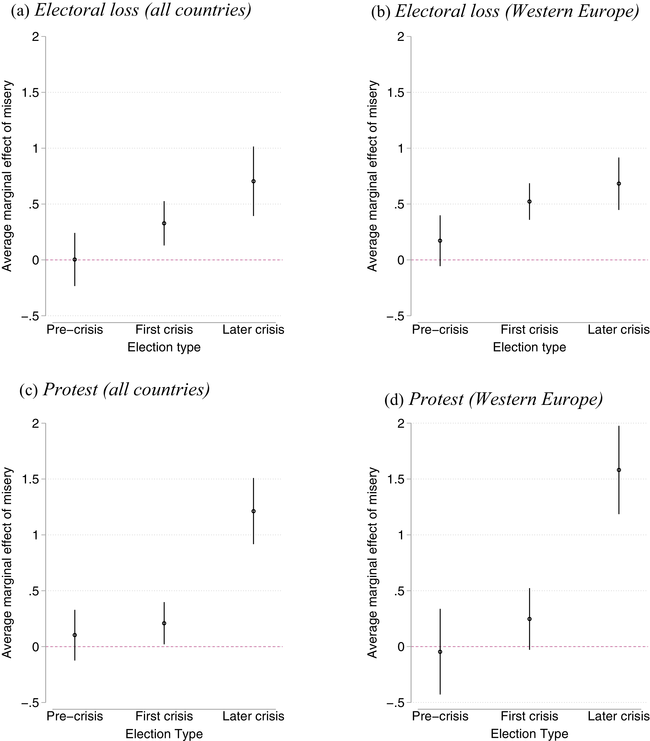
The results presented in Table 2 also suggest that timing matters for both electoral and protest dynamics. To test this, we considered an interaction effect of economic misery and the timing variable (models 3 and 4 for all countries; models 7 and 8 for Western Europe only). The results are best interpreted with the help of Figure 1, which plots the marginal effect of misery by election type. Figures 1a and 1b suggest that economic misery and electoral loss became more closely correlated over time: a change in the prevailing economic conditions was not associated with electoral losses in the pre‐crisis period, but it had a positive marginal effect during the crisis. In later‐crisis elections especially, citizens perceived the worsening economic conditions as a failure of the incumbent parties and punished them at the voting booth. In other words, as the crisis progressed, the fate of governments tended to be increasingly tied to the economic performance of their country. Figures 1c and 1d show the same relationship for protest. They indicate that a change in economic misery neither predicted whether citizens took to the streets before the crisis nor whether they did so in the immediate aftermath of the collapse of Lehman Brothers. However, we find a strong positive effect of economic misery on the level of economic protest during later stages of the economic crisis. This is well exemplified by the massive protests and electoral turmoil in countries like Greece or Portugal, which only erupted after the first ‘crisis’ elections in 2009.
Average marginal effect of a change in misery on electoral loss and protest by election type [Color figure can be viewed at wileyonlinelibrary.com]
Note: The average marginal effects are calculated based on models 3, 4, 7 and 8 in Table 2, respectively. For each period, they are obtained by calculating the marginal effect of misery for each observation and then taking the average across all observations for a given period.

To test the robustness of these results, which suggest that the Great Recession affected the electoral and the protest arena in a relatively similar way, we conducted several additional analyses. First, we re‐estimated the regressions with country‐clustered standard errors to account for a possible correlation of errors from the same country (Online Appendix B‐3). The results are very similar to the ones shown above, indicating that our results are robust to possible country‐level clusters. Second, given the relatively small number of cases, we tested whether our results are driven by outliers in two different ways (Online Appendix B‐3): we estimated quantile (median) regression and robust regressions to reduce the importance of outliers.Footnote 9 Using these techniques, the coefficients for protest become smaller, but they are still significant and generally support the patterns that we found above. Finally, in the spirit of a ‘placebo’ test, we used the number of cultural and political protests as the dependent variable (Online Appendix C‐1). For these non‐economic protests, economic misery and the crisis did not systematically affect the number of events. In other words, only economic protests are positively associated with misery, increasing our confidence that the uncovered relationship between misery and economic protests is, indeed, meaningful.
Protest and the economic vote
As suggested above, both arenas are interwoven with national and international political dynamics and there is reason to believe that protest politics and electoral politics are closely related. Consequently, we try to move beyond the search for equivalent relations and test the importance of protest mobilisation as a signalling mechanism that may reinforce electoral punishment. Again using OLS regression, we repeat the analysis from the first step with electoral losses as the dependent variable, but we now include our measure of protests as an independent variable. To test whether there is a signalling mechanism, we include an interaction between protests and our economic misery indicator. Otherwise this analysis mirrors the analysis from the first step.
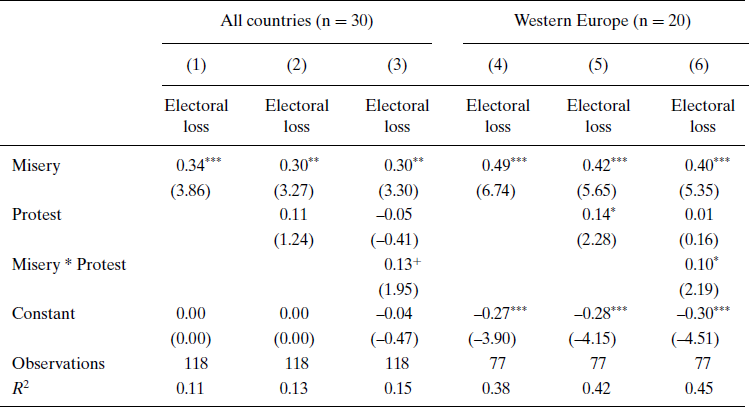
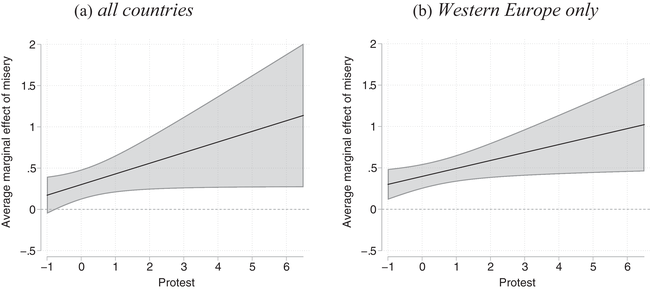
Table 3 shows the results of this exercise. The analysis confirms that a change in misery has a strong effect on the electoral performance of incumbents (see model 1). Looking at results from all 30 European countries, however, the interaction effect of protest and misery is only statistically significant at the 10 percent significance level (see model 3). When we repeat the analysis for Western Europe only (see models 4–6), the results become stronger: there is now a positive and clearly statistically significant interaction effect of protest and economic misery. Following the recommendation of Brambor et al. (Reference Brambor, Clark and Golder2006), we plot the average marginal effect in Figure 2 to illustrate this interaction. The plot shows how the average marginal effect of economic misery on the electoral loss of the incumbent changes across the observed range of protest. It demonstrates that this effect varies over the range of protest, but the interaction effect is only significant when we focus on Western Europe (Figure 2b). In this region, a change in misery has only a small effect on electoral punishment when protests are low, but as protests increase, the average marginal effect of misery also increases. Protests thus seem to amplify the impact of an increase in economic misery on the electoral performance of incumbents, supporting our expectations about the signalling effect of protest in Western Europe.Footnote 10 As theorised above, opposing austerity and linking that opposition to a fundamental critique of representative democracy – ‘real democracy now’ as the battle cry of the Indignados went – was key for the most recent wave of protest in Southern Europe. For Eastern Europe, where party systems are less institutionalised, Hernández and Kriesi (Reference Hernández and Kriesi2016) already showed that voters are less likely to punish governments for worsening economic conditions than in Western Europe. Hence, and as outlined above, it is not surprising that we do not find a strong signalling effect of protest on electoral punishment in Eastern Europe, either.Footnote 11
The impact of economic misery and protest on electoral loss

Notes: t statistics in parentheses. +p < 0.1; *p < 0.05; **p < 0.01; ***p < 0.001.
Average marginal effect of a change in misery on electoral loss across the range protest
Note: The average marginal effects are calculated based on models 3 and 6 in Table 3, respectively.

Additional analyses shown in the Online Appendix suggest that this signalling effect of protest is robust. When we use the number of protest participants instead of the number of events to measure protest levels (Online Appendix B‐1), the signalling effect is marginally smaller but remains statistically significant. Quantile median and robust regression models show that our results are again robust to potential outliers (Online Appendix B‐3). Moreover, there is no signalling effect for protests that address non‐economic issues as shown in Online Appendix C‐1. We again treat this as a ‘placebo’ test, which indicates that it is not any kind of protest that has an impact on economic voting. Only economic protests act as a signal for economic discontent and attribute blame for misery to the government. This is also supported by an analysis, in which we tested whether higher economic voting is associated with higher economic protests afterwards (Online Appendix C‐2). Generally, we find that the punishment of incumbents tends to dampen economic protests in the legislative period after a given election. Although we expect that the effect of elections on protest might be different in the short term (given that citizens sometimes express their dissatisfaction with the electoral contest by protesting), we treat this as evidence indicating that economic protests trigger the punishment of incumbents and not vice versa.
Protest and the decline of mainstream parties
These results give us reason to believe that the economic crisis and the resulting mobilisation in the streets have had deeper consequences for political competition in Europe than the short‐term punishment of incumbents. Therefore, in the final step of our analysis, we turn to a more careful analysis of whether the crisis has also accelerated the decline of mainstream parties and how this decline is related to political contestation in the protest arena. To this end, we move to the party level and analyse the electoral losses of all parties (and not exclusively incumbents) – that is, we calculate the level of electoral loss for each individual party as the change in its vote share between a given election at time t and t‐1. Given our results so far, we restrict our analysis to Western Europe only and study electoral results from 77 elections in 20 Western countries from 2000 to 2015.
In order to analyse the impact of protest on the dynamics of party competition we classify the parties in two ways. First, we code parties as mainstream versus non‐mainstream parties according to their party family, as indicated by the Chapel Hill Expert Survey: parties from the conservative, Christian democratic, social democratic and liberal party families are classified as mainstream, whereas parties from all other party families are classified as non‐mainstream. Second, we classify parties according to their left‐right ideology: parties that are social democratic, green or far left are classified as left parties, whereas all other parties are classified as non‐left parties.Footnote 12
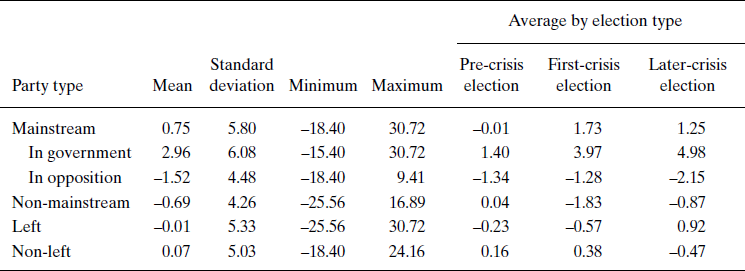
The summary statistics for each party family are shown in Table 4. On average, mainstream parties lose 0.75 percentage points in an election during our period of study, but there are important differences across time. In the pre‐crisis period, mainstream and non‐mainstream parties, on average, hardly experienced electoral gains or losses. Yet, this changed during the crisis: in the 20 first‐crisis elections in Western Europe, mainstream parties on average lost 1.73 percentage points, while they lost 1.25 percentage points in later‐crisis elections. At the same time, non‐mainstream parties benefited from the crisis: on average, they increased their vote share by 1.83 percentage points in first‐crisis elections and by 0.87 percentage points in later‐crisis elections. The average vote share of left‐wing parties remained relatively stable across our period of study, but it changed from one period to the other: the left gained votes in pre‐ and first‐crisis elections, but lost votes in later‐crisis elections.
Electoral losses by party type in Western Europe

Note: The data shows the electoral loss of different types of parties – that is, the difference in the vote share of parties between elections at times t and t+1. Positive values indicate a loss in vote share; negative values indicate a gain.
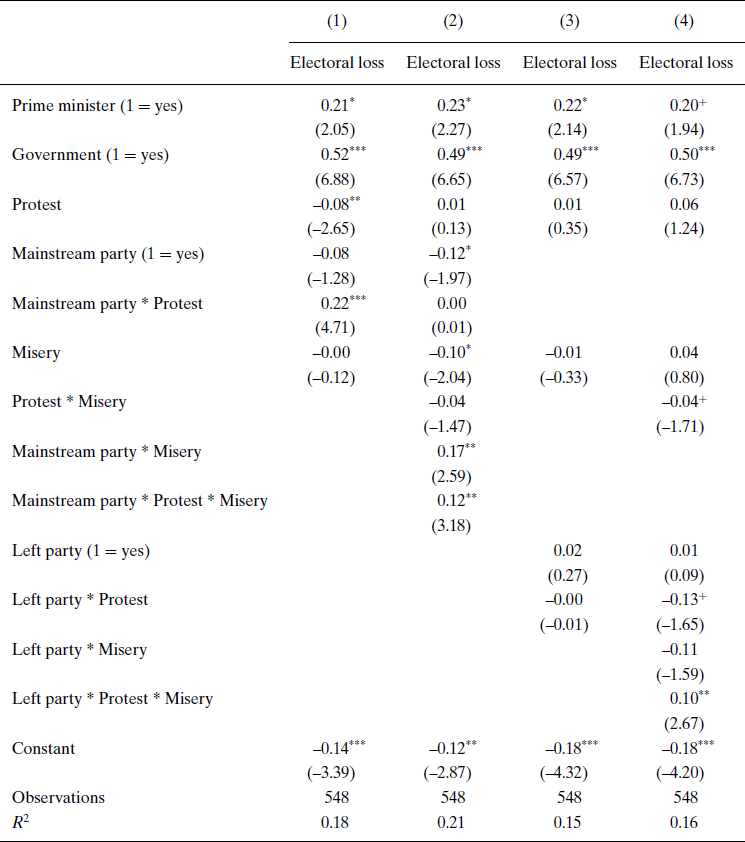
To assess the gains and losses of the different types of parties more systematically, we again resort to OLS regressions, but we now use the electoral losses of individual parties as our dependent variable. We use the same independent variables as in the previous steps of our analysis, but following the literature on economic voting, we also include two dummy variables that capture whether a party was in government, and whether the prime minister was from that particular party during a given legislative period. In the baseline model we then include a dummy variable for mainstream parties and test the differential effect of a change in economic misery and protests on mainstream versus non‐mainstream parties by including an interaction effect with this dummy variable. Similarly, we repeat the analysis and examine the differential effect of economic misery and protest punishment for left‐ and right‐wing parties in separate models.
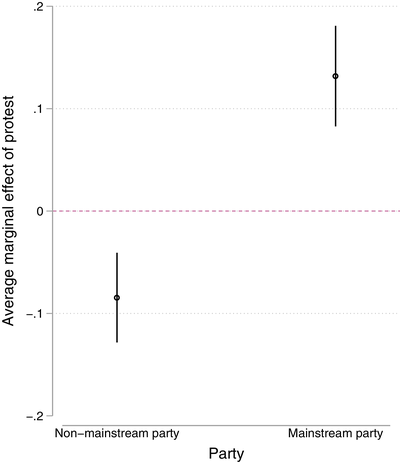
The results of these analyses are shown in Table 5. Model 1 confirms our earlier finding that governing parties are punished more consistently at polls than other parties, but in general, there is no negative effect for mainstream parties. These parties are not losing consistently during our period of study, shedding some doubt on the general thesis of the long‐term decline of mainstream parties. Yet, the results suggest that the electoral fortunes of mainstream parties are related to the level of protest in a given legislative period. The interaction effect between mainstream parties and protests is positive and statistically significant, indicating that the electoral punishment of mainstream parties increases as protests become larger. To interpret this interaction effect, it is useful to plot the marginal effect of protest by party type (Figure 3). The results indicate that the marginal effect of protest for non‐mainstream parties is negative, while the effect is positive for mainstream parties. Put differently, protests increase the electoral losses of mainstream parties, while non‐mainstream parties fare better in elections after such protests. As we expected, this results in the fragmentation of the party system and highlights the need to integrate the study of protest into analyses of party competition.
The effect of misery and protest on the electoral loss of different parties in Western Europe

Notes: t statistics in parentheses. +p < 0.1; *p < 0.05; **p < 0.01; ***p < 0.001.
Average marginal effect of protest on electoral loss of mainstream vs. non‐ [Color figure can be viewed at wileyonlinelibrary.com]
mainstream parties
Note: The average marginal effects are calculated based on model 1 in Table 5.

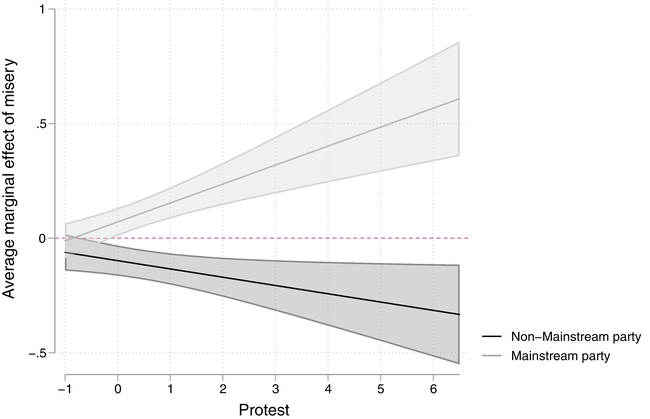
Model 2 in Table 5 goes one step further and investigates whether the signalling effect of protest also holds at the level of individual parties, thereby contributing to the restructuring of the party system in Western Europe. It includes a three‐way interaction between party type, protest and economic misery to test whether the impact of a change in economic misery on the electoral support for mainstream parties is amplified by protest. To interpret the results, we again visualise the interaction effect by showing the average marginal effect of a change in misery on the electoral losses of different party types over the observed range of protest (Figure 4). When the level of protest is low, misery has no significant effect on the economic performance of different types of parties. Yet, as the level of protest increases, the average marginal effect of misery becomes positive for mainstream parties but negative for non‐mainstream parties. This suggests that the relationship between the prevailing economic conditions and the punishment of mainstream parties is not direct. Instead, citizens are more likely to defect from mainstream parties when there is a relatively large amount of economic protest, which, as we posit, politicises the fact that the economy is doing poorly.
Average marginal effect of misery on electoral loss of mainstream vs. non‐ mainstream parties across the range of protest [Color figure can be viewed at wileyonlinelibrary.com]
Note: The average marginal effects are calculated based on model 2 in Table 5.

Models 3 and 4 of Table 5 repeat this analysis, but we now distinguish between left‐wing parties and all other parties. The results indicate that there is only a weak interaction between protest politics and the fortunes of left‐wing parties. The latter do not generally benefit from protests – something that is also illustrated by the descriptive results shown in Table 4 and the marginal effects plot (included in Appendix C‐4). This questions the general idea of a close alliance between social movements and parties from the left in Europe.Footnote 13 Yet, when we include a three‐way interaction between left‐wing parties, misery and protests, an interesting pattern emerges: generally left‐wing parties somewhat gain during economic downturns, but this effect ceases to exist as protest increases. In fact, the results in Online Appendix C‐4 show that left‐wing parties only benefit from a worsening of economic misery when there is little economic protest. Taken together, models 3 and 4 indicate that the effect of protest did not systematically move Western European party systems in one direction or the other in terms of the traditional left‐right spectrum during the Great Recession. This supports earlier findings by Bartels (Reference Bartels, Bartels and Bermeo2014), who could not find clear‐cut ideological shifts to the left or right in the electoral arena during the Great Recession.
Finally, these results are also supported by our robustness tests. First, when we consider the number of participants instead of events, we also find that mainstream parties lose more in elections that follow a high level of protest in a given legislative period (Online Appendix B‐1). Second, the analysis is also robust to outliers, as indicated by the results from quantile median and robust regressions models (Online Appendix B‐3). Third, the results are very similar if we study relative losses, taking into account the differing vote shares of the parties (Online Appendix B‐4). Finally, the ‘placebo test’ in Online Appendix C‐1 shows that mainstream parties are not punished following non‐economic protest. Overall, these results suggest that economic protests tend to be an important factor that has driven the destabilisation of Western European party systems during the Great Recession.
Conclusion
In the Great Recession, incumbents were heavily punished in the electoral arena. However, this punishment was not limited to the electoral arena; instead, citizens also punished the government by voicing their grievances in the street. By and large, our analyses show that electoral losses and protest were both driven by the poor economic performance of a given country, confirming the economic voting model. This relationship between economic performance and economic voting as well as protests was particularly strong in later stages of the crisis, as the economic fate of countries in Europe diverged and citizens mobilised against governments in countries that remained mired in the economic stagnation.
Still, it is misleading to treat punishment in the electoral and protest dynamics as independent from each other. The analyses in this article suggest that these protests were coupled with electoral punishment in the sense that larger protests were also associated with stronger electoral punishment of incumbents. We present evidence that protests can amplify the importance of economic conditions for electoral punishment – at least in the more institutionalised party systems of Western Europe. By attributing responsibility, mobilising citizens and channelling their grievances into the electoral arena, protest increases the importance of economic conditions for the next general election. Thus, protest may be an indicator of an emerging public sphere, which can make politicians responsible and accountable especially in crisis situations. The ‘placebo test’ with non‐economic protests underlines that this effect is driven by economic protests that target public policies and institutions.
Our analysis further suggests that this kind of signalling effect of protest is not only limited to the punishment of incumbents, but it tends to extend to all mainstream parties: during the crisis, as economic conditions worsened, citizens were more likely to defect from mainstream parties when there was a relatively large amount of economic protest. The beneficiaries of this destabilisation of the party system were non‐mainstream parties. They feed off the discontent that citizens voiced in the streets and were likely to win more votes in the next election following large protests. In sum, our analyses point to a destabilising effect of the Great Recession on political competition in Europe but this destabilisation has not been resolved in one way or the other: the political system across Europe has not systematically swung in one direction, as different parties have benefited in different regions. Importantly, we do not observe a close connection between the electoral fortunes of the political left and economic protests in the streets.
More research, however, is needed to further disentangle the complex relationship between electoral behaviour and protests. In this article, we have taken an important step by providing the first large‐scale comparative study of the dynamics of protest and electoral politics. Yet, we have only established aggregate empirical relations and suggested a potential mechanism linking protest and electoral politics. Future research needs to either zoom‐in on specific contentious episodes or use an experimental set‐up to properly assess the mechanisms at work and to answer several open questions. How are protests embedded into the electoral cycle? What kind of sequences can we observe between objective economic indicators (as we studied them), protests and perceived grievances? Do protests that occur shortly before an election have a greater impact than other protests? How is the effect of protests moderated by the economic and political features of individual countries? How can some parties ride protest waves while others get swept aside by them? How closely – in terms of time – is the occurrence of protest related to the decline of some parties and the rise of others? We hope that the findings of our study will encourage others to tackle some of these questions in the future.
Acknowledgements
The authors acknowledge funding by the ERC project ‘Political Conflict in Europe in the Shadow of the Great Recession’ (POLCON) (Project id: 338875). Swen Hutter also acknowledges funding by the Volkswagen Foundation during the final stages of the project. Previous versions of this article have been presented at the ECPR Joint Sessions of Workshops in 2017, the Annual Meeting of the American Political Science Association in 2017 and at workshops at the Autonomous University in Barcelona (UBA), Humboldt University Berlin, the European University Institute (EUI) and the WZB Berlin Social Science Center. We are very grateful for insightful comments on each occasion, and we thank Diana Burlacu, Heiko Giebler, Silja Häusermann, Herbert Kitschelt, Mark Kayser, Jasmine Lorenzini, Sidney Tarrow, Julia Schulte‐Kloos, Bruno Wuest, two anonymous reviewers and the editors of the EJPR for excellent feedback. Moreover, we thank all members of the POLCON team and coders in Florence and Zurich for their help.
Online Appendix
Additional supporting information may be found in the Online Appendix section at the end of the article:
Table A‐1: Average number of protest events and participants by country (monthly)
Table A‐2: List of all elections covered
Table A‐3: List of all parties included
Table A‐4: Factor loadings
Table A‐5: Predicted factor
Table A‐6: Change in economic conditions by legislative period
Table A‐7: Correlation matrix of key variables for 118 European elections and 77 Western European elections
Figure A‐1: Scatterplots of misery and electoral loss/protest
Figure A‐2: Scatterplots of electoral loss and misery by election type
Figure A‐3: Scatterplots of protest and misery by election type
Figure A‐4: Scatterplots of electoral loss and misery by intensity of protest
Table B‐1: The impact of economic misery and timing on electoral loss and protest (protest participants)
Table B‐2: The impact of economic misery and protest on electoral loss (protest participants)
Table B‐3: The effect of misery and protest on the electoral loss of different parties in Western Europe (protest participants)
Table B‐4: The impact of unemployment on electoral loss and protest
Table B‐5: The impact of unemployment and protest on electoral loss
Table B‐6: The effect of unemployment and protest on the electoral loss of different parties in Western Europe
Table B‐7: The impact of economic misery on electoral loss and protest with additional control variables
Table B‐8: The impact of economic misery, protest and additional variables on electoral loss
Table B‐9: The impact of economic misery, timing and bailouts on electoral loss and protest with country‐clustered SEs
Table B‐10: The impact of economic misery and protest on electoral loss with country‐clustered SEs
Table B‐11: The effect of misery and protest on the electoral loss of different parties in Western Europe with country‐clustered SEs
Table B‐12: The impact of economic misery, timing and bailouts on electoral loss and protest (quantile regression)
Table B‐13: The impact of economic misery and protest on electoral loss (quantile regression)
Table B‐14: Explaining the electoral loss of mainstream and left‐wing parties in Western Europe (quantile regression)
Table B‐15: The impact of economic misery, timing and bailouts on electoral loss and protest (robust regression)
Table B‐16: The impact of economic misery and protest on electoral loss (robust regression)
Table B‐17: Explaining the electoral loss of mainstream and left‐wing parties in Western Europe (robust regression)
Table B‐18: The effect of misery and protest on the relative electoral loss of different parties in Western Europe
Table C‐1: The impact of economic misery and timing on electoral loss and non‐economic protest
Table C‐2: The impact of economic misery and non‐economic protest on electoral loss
Table C‐3: The effect of misery and non‐economic protest on the electoral loss of different parties in Western Europe
Table C‐4: The impact of economic misery and electoral loss on protest
Figure C‐1: Marginal effect of protest on electoral loss across the range of economic misery
Figure C‐2: Average marginal effect of protest on electoral loss of mainstream vs. nonmainstream parties across the range of economic misery
Figure C‐3: Average marginal effect of protest on electoral loss of left vs. non‐left parties
Figure C‐4: Average marginal effect of misery on electoral loss of left vs. non‐left parties across the range of protest
Figure C‐5: Average marginal effect of protest on electoral loss of left vs. non‐left parties across the range of economic misery


 Open access

