





Introduction
Theories of judicial politics aim to explain changes in judicial behavior within a single court over time, focusing on factors such as ideology, institutional constraints, and political dynamics. In exploring these factors, one central question is whether shifts in judicial behavior stem primarily from changes in the court’s composition or from adjustments made by the same judges in response to institutional reforms. One possibility is that new trends in judicial behavior mainly reflect a diverse composition of the institution (for example, reflecting premeditated court-packing). A quite different explanation is that the same judges, serving before and after an institutional reform, adjusted their behavior in some palpable way. Both explanations are plausible (and not necessarily mutually exclusive) but have significantly different implications for theory and policy.
In this article, we focus on the case of the Polish Constitutional Tribunal to investigate which explanation is more likely to describe the controversial judicial transformation since 2015. Due to important changes in the Polish political branches of government, the Constitutional Tribunal (and other institutions such as the National Council of the Judiciary) has been under a stage of judicial mutation that has attracted the deserved attention of many commentators and legal scholars. From the parliamentary elections of October 2015 to the recent elections of October 2023, the Polish case has been regarded as a prominent case of democratic backsliding, an example of court curbing in action, and a poster child for the EU’s rule of law crisis.
In their review of the events in the period 2015–2018, Kovács and Scheppele (Reference Kovács and Scheppele2018) pointed out that the long struggle to control the Polish Constitutional Tribunal (Trybunał Konstytucyjny; hereafter TK) was about the ruling party gaining a comfortable majority. The authors suggested that this new majority resulted from a combination of changes in composition and the regrouping of old allies. Once the TK was considered sufficiently amenable to the ruling party, constitutional ‘innovations’ stopped (Sadurski Reference Sadurski2019a).
In a recent article, Bricker (Reference Bricker2020) empirically documented modifications in rates and style of separate opinions in the Polish Tribunal after 2015. Still, previous empirical literature has already shown that the Polish Constitutional Tribunal tends to reflect judicial politics in line with other European constitutional courts and in contradiction with the more traditional legalist myth of political insulation. Kantorowicz and Garoupa (Reference Kantorowicz and Garoupa2016) explained (with great detail) party alignments in the TK for the 2003–2013 period. Fałkowski and Lewkowicz (Reference Fałkowski and Lewkowicz2021) further verified the impact of possible political variables in organizing adjudicating panels for the 2005–2014 period. Therefore, ideology – as often proxied by party affiliation of appointers – was shown to be an important determinant (although not the sole determinant) of judicial behavior in the court well before 2015.
This article proposes a different approach. The goal is to assess the observable changes in judicial behavior. These changes are mainly explained by shifts in composition or realignments within the TK, conditional on other features (case and personal) affecting judicial behavior. Empirically, we assess the overlapping generations of judges in the TK to identify which explanation is more likely to inform judicial transformation and to concentrate on the behavior of judges that were on the bench in the periods before and after the general elections of October 2015.
An important insight provided by our empirical results is that, for judges appointed by the ruling party, alignment with the executive branch appears stronger after 2015 (in terms of supporting the legislation voted by the ruling party). Although party alignment already existed well before 2015, as documented by previous studies (Kantorowicz and Garoupa Reference Kantorowicz and Garoupa2016, Fałkowski and Lewkowicz Reference Fałkowski and Lewkowicz2021), it emerged more significantly after 2015. Thus, the judicial transformation of the Polish Constitutional Tribunal cannot be understood merely as a change in political or ideological majorities within the judiciary. Rather, it signifies a deeper shift in the degree of political alignment, reflecting a more pronounced convergence between the TK and the ruling political forces.
Our findings provide evidence that judges on the bench before the 2015 elections did not show strong significant behavioral shifts in their voting patterns after October 2015. However, newly (i.e., after the October 2015 elections) appointed judges embraced voting positions more strongly aligned with the populist government that ruled Poland from November 2015 to October 2023. The populist PiS (Prawo i Sprawiedliwość; Law and Justice) also won the parliamentary elections in October 2023 (already at the end of our period of analysis), but without a parliamentary majority, thus ceding PiS to the opposition by December 2023.
In Section 2, we review the relevant literature, and we summarize the institutional details in the following section. The theory is presented in Section 4. The data, empirical strategy, and findings are discussed in Section 5. Section 6 concludes the article.
Review of the literature
Theory and evidence of judicial transformation
In the last couple of decades, different theories have been developed to explain judicial decision-making, mainly in the context of the United States. These theories have been applied and refined with many applications to constitutional courts in Europe. In this respect, there is an important distinction between whether judges are guided by formal law or by personal ideology. Formalists take the view that judges simply interpret and apply the Constitution and the law in a conformist view of precedents. Judges are largely guided by what the law says and abide by a strict legal authoritative interpretation. The attitudinal model sees judicial preferences, with special emphasis on ideology, as the main explanatory model. Finally, agency theory recognizes the importance of judicial preferences (broadly defined) but argues that judicial choices consider political and institutional realities (Epstein and Weinshall Reference Epstein and Weinshall2021).
Judicial transformation is associated with a significant change in judicial behavior. There are two distinct explanations. One possibility is that courts are packed with new judges who are different from previous judges and more loyal to the appointer (who has an important legislative agenda). A second possibility is that the same judges are subject to new incentives, thus adjusting their behavior accordingly (new appointments to the court make little difference). These two mechanisms (new judges and new incentives to judges appointed before the change in government) are not mutually exclusive.
Importantly, it could be that the nature of legislation subjected to constitutional review varies. For example, Garoupa et al. (Reference Garoupa, Gili and Gómez-Pomar2021) analyzed judicial voting in the Spanish Constitutional Court in the last four decades. They detected a significant shift in judicial behavior in 2012, but it seemed more related to different legislative priorities (namely, Catalonia and austerity to a lesser extent) and not much to modes of collegial or panel composition.
In the case of the Portuguese Constitutional Court, many local commentators identified a deep transformation in judicial behavior when debating decisions concerning the austerity measures imposed by the European Union in the early 2010s. However, Coroado et al. (Reference Coroado, Garoupa and Magalhães2017) found no significant statistical evidence to support such a perception. They concluded that the observed changes were due to austerity legislation and not to new patterns of judicial behavior.
In Austria, there are indications that governments under populist parties produced more unconstitutional policies from 1980 to 2021 (König and Swalve Reference König and Swalve2023). Unsurprisingly, judicial transformation under populism is explained by a higher rate of unconstitutional legislation, not adjustments in judicial behavior.
Additionally, it could be that judicial transformation reflects a swift evolution in judicial philosophy induced by political context. A well-known illustration is the so-called strategic defection model (Helmke Reference Helmke2002 & Reference Helmke2004; Escresa and Garoupa Reference Escresa and Garoupa2013), where judges realign in the political spectrum as a function of a new regime in office. More precisely, judges defect from their appointer – the previous regime – to join ranks with the judges appointed by the new regime. In particular, Helmke (Reference Helmke2002) suggested that judges may defect from supporting the existing government when it starts losing power.Footnote 1 This effect could be particularly striking if there is a perception that the new regime will prevail for a long time.
Empirical evidence on democratic backsliding and judicial behavior
There is vast theoretical and empirical evidence on democratic backsliding (Grillo et al. Reference Grillo, Luo, Nalepa and Prato2024). However, the interaction between democratic backsliding and judicial behavior from an empirical perspective is less developed.
One particular case is the rise of populism in Turkey. Varol et al. (Reference Varol, Dalla Pellegrina and Garoupa2017) studied the impact of significant changes in the selection mechanism to appoint judges to the Turkish Constitutional Court. They concluded that the court seemed more conservative (in the sense of being more deferential to the executive branch) after the changes occurred in 2010, mainly due to the new composition of the bench.
The case of the Hungarian Constitutional Court has deserved attention from scholars, particularly after 2010 (Kovács and Tóth Reference Kovács and Tóth2011; Chronowski and Varju Reference Chronowski and Varju2016; Kovács and Scheppele Reference Kovács and Scheppele2018).Footnote 2 There is empirical evidence that ideology or political inclinations mattered well before 2010 (Pócza et al. Reference Pócza, Papp, Dobos and Gyulai2022). Still, a study of dissenting coalitions in the Hungarian Constitutional Court (Pócza et al. Reference Pócza, Dobos, Gyulai and Belov2019) shows a complex geometry. Left-wing judges formed a more cohesive group before 2010 and published dissents almost exclusively together. After 2010, some of the old right-wing judges (elected before 2010) joined the old left-wing judges in dissenting. New judges elected by the right-wing constitutional majority became the majority and left-wing judges left the benches in later periods. Dissenting rates have been on the rise since 2013, when the court became politically homogeneous and favorable to the ruling party.
Literature on populism
A large body of literature in comparative politics examines the rise of right-wing populism, with particular attention to the Polish case – an analysis that falls beyond the scope of this article. Notably, the erosion of judicial oversight has been a hallmark of democratic backsliding (Varol Reference Varol2015; Ginsburg et al. Reference Ginsburg, Huq and Versteeg2018; Scheppele Reference Scheppele2018). It is therefore unsurprising that the rise of populism and the decline of the rule of law are deeply interconnected (Lacey Reference Lacey2019; Gora and de Wilde Reference Gora and de Wilde2022).
In populist discourse, courts are frequently depicted as elitist obstacles to the ‘will of the people’ (Mudde and Kaltwasser Reference Mudde and Kaltwasser2017), making them prime targets for political attacks. Once in power, populist executives often seek to weaken judicial independence and curtail civil liberties as part of their broader strategy to consolidate authority. Strikingly, these efforts have been pursued largely through legal mechanisms and institutional reforms, with securing control over high courts – responsible for constitutional and statutory review – emerging as a key priority (Nalepa et al. Reference Nalepa, Vanberg and Chiopris2025).
Scholars have conceptualized these processes using terms such as autocratic legalism, constitutional retrogression, and abusive constitutionalism (de Sa e Silva Reference de Sa e Silva2022), underscoring the ways in which legal frameworks are repurposed to undermine democratic norms while maintaining a façade of legitimacy.
Past and present of the Polish TK
The TK in years 1982–2015
The TK was formally (constitutionally) established under the socialist regime in 1982. However, it took three more years to promulgate its foundational statute (April 1985) and appoint the first judges (November 1985). Eventually, the first ruling of the TK was issued in 1986. As stressed by Garlicki (Reference Garlicki and Landfried2019: 142), in its formative years the TK was institutionally weak. For instance, its judgments were not final as they could be nullified by the parliament.
However, the circumstances of the late 1980s and the demise of the communist party quickly resulted in the TK gaining more autonomy. The TK engaged in an active role, filling a constitutional vacuum in post-socialist Poland and contributing to institutional stabilization in the first years of transformation (Garlicki Reference Garlicki and Landfried2019: 143, Sadurski Reference Sadurski2019b). Note that it was only in 1997 when Poland finished a long-overdue process of drafting a new democratic constitution. As a result of gaining enough legitimacy in its early years and being perceived as an indispensable part of the Western-like institutional setup, there was no opposition to the TK remaining in the new constitution (Garlicki Reference Garlicki and Landfried2019: 143).
Still, differences among the drafters revolved around the extent of authority which endowed upon the TK. Ultimately, the powers of the TK vis-à-vis the parliament were strengthened so it could properly serve its duty of protecting the new constitutional order. According to Garlicki (Reference Garlicki and Landfried2019: 143), when establishing the TK prerogatives, the drafters of the 1997 Constitution followed, to some extent, the logic of the ‘insurance function’ of constitutional adjudication. For them, the TK was supposed to be shielded from abrupt changes due to alternating political majorities. Although abrupt changes are indeed unlikely, the system of appointments does not entirely prevent the TK from being ‘politically’ captured; it merely slowed it down. While other institutional details concerning the TK are described in the ‘institutional’ appendix (online Appendix A1), it is crucial to mention that candidates for the TK are nominated by a group of at least 50 Sejm (the lower chamber of the parliament) deputies or the Presidium of the Sejm. From the nominees, the Sejm then appoints those candidates who obtain an absolute majority of votes with at least half of the deputies present. It is furthermore important to note that in the current setup the TK is composed of 15 judges appointed for a tenure of nine years each.
Overall, in the period from the late 1980s to 2015, the TK managed to establish itself as a trustworthy and well-functioning institution able to effectively protect the democratic process and the rule of law. This is not to say that the TK rulings were always uncontroversial, but that, on the whole, the assessment of the TK was, by and large, positive.Footnote 3
Much changed when the Law and Justice party (PiS) won both the presidential elections in May 2015 and the parliamentary elections in October 2015.Footnote 4 More about it follows in the next subsection. However, 2015 was not the first time that PiS assumed power in Poland. A PiS nominee – Lech Kaczyński – won the presidential campaign in May 2005, and in the autumn of the same year, PiS won parliamentary elections. Yet back then, with roughly 27% of the voters’ support, PiS was not able to establish a single-party government. The coalition government was formed by PiS together with two junior partners – Liga Polskich Rodzin (receiving close to 8% of voters’ support) and Samoobrona (receiving 11.4% of voters’ support). This coalition survived for only two years, and new elections were called as early as 2007. The fact that in the years 2005–2007 PiS was ruling in a coalition with two other parties, which had relatively high public support, could explain why PiS was not yet so radical toward the TK.
In fact, in the period 2005–2007, PiS did not manage to entirely monopolize judicial nominations and appointments. Based on the investigation of the nomination processes performed by Kantorowicz and Garoupa (Reference Kantorowicz and Garoupa2016), the PiS and its junior political partners separately nominated the candidates for the TK (four and three judicial appointments, respectively). Moreover, to obtain the support from the coalition partners for its nominees, PiS was likely incentivized to put forward somewhat more moderate candidates than it would have when no support from junior coalition partners was needed. Importantly, 2005–2007 was PiS’s first experience in governing. For a party having majoritarian political tendencies, it clearly became frustrating to be restrained by a counter-majoritarian body such as the TK, which was declared unconstitutional and blocked several of PiS’s legislative proposals. According to Sadurski (Reference Sadurski2019b: 61), ‘the memory of these collisions between the PiS government and the TK in 2005–2007 certainly colored PiS’s attitude to constitutional review when it turned to power in 2015’.
By derailing some of the PiS legislative proposals, the TK triggered growing antipathy from PiS. Yet even without the derailment of legislative reforms in the years 2005–2007, the PiS’s approach toward the TK would be rather negative after assuming power in 2015, as, by and large, PiS’s circles were and are rather critical of the 1997 Constitution, which gave birth to a more institutionally empowered TK. The fact that President Kaczyński has never filed a petition to the TK for an ex ante preventive review during his nearly five-year presidential term is interpreted by some as PiS’s symbolic expression of discomfort with this institution (Sadurski Reference Sadurski2019b: 52).
The TK under pressure and the new normal
Shortly after PiS regained power in November 2015, the ‘battle’ with and over the TK began, arguably a first step toward authoritarian backsliding in Poland (Nalepa Reference Nalepa2021). The actions undertaken by PiS aimed to pack the TK with its appointees and to paralyze its functioning, at least until PiS would secure a safe majority in the court. The timeline of the events follows the meticulous description by Sadurski (Reference Sadurski2019b: 58–95).Footnote 5 A notable sequence of events is also presented in Grzymala-Busse and Nalepa (Reference Grzymala-Busse and Nalepa2016) and Nalepa (Reference Nalepa2017a, Reference Nalepa2017b).
The most consequential decision by PiS was to block the appointments of five TK judges elected by the previous center-right PO-PSLFootnote 6 governing coalition. The end of 2015 was marked by the end of the term of five TK judges; three judges were finishing their term in early November and two others in the first days of December. The outgoing PO-PSL coalition, anticipating that PiS would win the forthcoming elections, decided in October 2015 to fill all five vacancies, even though the new parliament should have already appointed the two December judges. This, what some describe, dishonest and, what turned out later, also unconstitutionalFootnote 7 step by the PO-PSL coalition provided PiS with a justification for its later failure to recognize all five appointees, even though three out of the five were appointed correctly. In an attempt to legalize this move, the newly established Sejm adopted a resolution on November 25 declaring the appointment of all five judges invalid, and based on this, President of the Republic Andrzej Duda refused to take oaths of office from all. On December 2, PiS pushed forward its own appointees for all five seats,Footnote 8 even though three vacancies were filled correctly by the previous parliament and PiS’s prerogative was to appoint only two judges.Footnote 9 President Duda swore in all five PiS appointees during the same evening, just hours before the TK declared that the appointment of three extra judges was unconstitutional (judgment K 34/15 from December 3). The three allegedly wrong-appointed judgesFootnote 10 received salaries and offices in the building of the TK; however, they were not assigned any cases for adjudication until December 2016, when Julia Przyłębska, a PiS appointee, was elected as the President of the TK. Justice Przyłębska was elected as the President supposedly by the full bench of judges,Footnote 11 including, what came to be known in popular parlance, the three ‘pseudo’ judges. Some thus consider the election of Justice Przyłębska as the President of the TK to be invalid. The first judgment involving the ‘pseudo’ judges occurred in February 2017.Footnote 12
The election of Justice Przyłębska as the President of the TK coincided with some successful attempts to ‘remove’ several judges appointed by the PO-PSL coalition, to diminish their roles, and to keep them away from adjudicating proceedings. The first attempt was orchestrated by the Minister of Justice and the Attorney General, Zbigniew Ziobro, who challenged the validity of appointments of three PO-PSL judgesFootnote 13 , who in 2010 were supposedly wrongly elected en bloc rather than separately. This challenge was then used to remove all three judges from cases involving a full bench. The petition for removing these judges was supported with an argument that the judges in question may express their prejudices against the office of Attorney General, who is part of TK proceedings even in cases not challenged by the Attorney. The measure to remove the three PO-PSL appointed judges from adjudicating was authorized by a bench of three PiS-appointed judges and the duration of the removal was at the discretion of the President of the TK, i.e., Justice Przyłębska. The second attempt was to effectively remove Justice Biernat, a PO appointee and the back-then Deputy President of the TK, from administrating and adjudicating by obligating him to use outstanding holiday leave entitlements. The decision to send Justice Biernat for compulsory vacations was issued by Justice Przyłębska in April 2017. Justice Biernat remained de facto removed from the TK until the end of his term in June 2017. One could consider such a strategy of removing a judge from adjudication as a court-packing technique from within (Kosař and Šipulová Reference Kosař and Šipulová2023) or an informal court-packing technique (Aydin-Cakir Reference Aydin-Cakir2024).
Lastly, on several occasions, Justice Przyłębska replaced judge rapporteurs on pending cases where old PO-PSL judges were assigned this role, and she deviated from the statutory rule to assign the cases in an alphabetical order in composing adjudicating benches. The latter strategy was likely to avoid composing the panels where remaining PO-PSL judges would have the majority, at least in most politically sensitive cases. In June 2018, all remaining old judges issued a letter to Justice Przyłębska contesting her decisions of appointing judge rapporteurs and panels’ chairpersons, changing the composition of panels without providing any reasons for these changes, and systematically overlooking some judges when composing the benches.
Besides the court-packing operations, claimed as part of decommunization (Nalepa Reference Nalepa2021), PiS had another tactic to derail the operation of the TK until the moment it would gain the majority in the court. This tactic relied on producing new laws concerning the TK with an attempt to paralyze the court when it was supposed to adjudicate on issues involving itself. Between November and December 2016, there were six new statutes concerning the TK. This legislative inflation, combined with successful attempts at court-packing and refusal by the government to publish certain TK judgments,Footnote 14 resulted in changing the public perception of the TK. In the opinion poll conducted in December 2020, 59% of the respondents evaluated TK negatively and only 20% positively (CBOS, 2020). Furthermore, the term ‘Julia Przyłębska’s Tribunal’ took hold in popular parlance, demonstrating the perception that the TK was fully captured by the PiS and that its decisions should not be taken seriously.
In June 2016, when PiS finally gained the majority in the TK, a new era started in the relationship between the TK and the governing coalition. Legislative and court-packing offenses stopped, and the TK converted into a rubber stamp for PiS’s controversial legislative proposals. Under this ‘new normal’, as specified by Sadurski (Reference Sadurski2019b: 7), constitutional review does not function as a check on power, but rather as a tool to consolidate power and restrain the opposition.
Theory and hypotheses
Judicial behavior theories can be broadly categorized into three main approaches. The formalist perspective posits that judges strictly interpret and apply the Constitution and legal statutes, adhering to precedent in a rigid and authoritative manner. According to this view, judicial decision-making is primarily guided by legal texts, with minimal deviation based on personal or external influences.
The attitudinal model, by contrast, emphasizes the role of judicial preferences – particularly ideological commitments – as the primary determinant of judicial decisions. This model suggests that judges’ rulings are shaped by their personal policy views rather than by legal constraints.
Finally, agency theory acknowledges the significance of judicial preferences but argues that judicial behavior is also shaped by political and institutional contexts. Judges, under this framework, are seen as strategic actors who take into account external pressures, incentives, and constraints when making decisions.
From a formalist perspective, political transformations should exert little influence on judicial decision-making. Any variation in judicial outcomes would stem from changes in the legislative process – such as fluctuations in the enactment of unconstitutional laws – rather than shifts in judicial ideology.
A narrow interpretation of the attitudinal model, which assumes that judges have stable and sincere ideological preferences, predicts that political change affects courts primarily through judicial appointments. Sitting judges, according to this view, remain unaffected in their ideological commitments. However, a broader formulation of the attitudinal model, which incorporates the dynamic evolution of judicial preferences, suggests that political transformation may influence judicial decision-making as ideological commitments evolve in response to changing political conditions.
Agency theory, in contrast, readily accounts for judicial transformation as a response to political change, driven by strategic adaptation to external incentives. Under this model, judges may modify their behavior not necessarily to reflect their sincere preferences but as a strategic compromise between personal inclinations and institutional constraints.
New judges
A prominent explanation in judicial decision-making posits that observable changes primarily stem from shifts in the court’s composition. A plausible theoretical explanation for adjustments in judicial behavior is that the court’s median ideological position shifts, leading to a corresponding transformation in its political orientation. In this view, newly appointed judges bring distinct interpretations of formal law, which in turn shape their adjudication of new legislation.
Judicial transformation, therefore, can be understood as a selection effect, wherein political actors nominate and confirm judges with divergent ideological commitments and professional backgrounds. Under this hypothesis, the central debate should focus on selection mechanisms that may be susceptible to excessive political influence – for instance, court-packing strategies, as discussed by Castillo-Ortiz (Reference Castillo-Ortiz2019). Judicial transformation, in this context, is fundamentally about restructuring judicial coalitions, as the introduction of new members alters the prevailing ideological balance. Consequently, this explanation suggests that judicial transformation is driven by the decisions and voting behavior of new appointees, rather than by shifts in the behavior of sitting judges before and after political transitions or legal reforms.
New incentives
An alternative explanation posits that judicial transformation arises not only from changes in court composition but also from the behavioral adjustments of judges who serve both before and after an institutional reform. Sitting judges modify their behavior in response to shifting legislative or institutional incentives. This adjustment effect aligns with agency theory, which suggests that judges adapt their decision-making to evolving institutional constraints and political contexts. However, it stands in contrast to the attitudinal model, which assumes that judicial preferences are stable and ideologically driven, and to formalism, which holds that judges adhere strictly to legal principles rather than responding to political dynamics, policy shifts, or changes in governmental authority.
Under this perspective – where judicial behavior is shaped by evolving incentives rather than by ideological rigidity – the expectation is that judicial transformation is primarily driven by the actions of incumbent judges rather than by the appointment of new members to the court.
Hypotheses
Most of the literature on judicial lawmaking suggests that judges are loyal to the political ideology of their appointers, showing alignment between their individual votes and government interests (i.e., a vote in favor of the government cast by a judge allegedly affiliated with the governing party, where alleged affiliation corresponds to the political party of the appointer). We theorize that judges of the Polish TK should behave like the judges of many other courts analyzed in the literature (for example, Kantorowicz and Garoupa Reference Kantorowicz and Garoupa2016, Fałkowski and Lewkowicz Reference Fałkowski and Lewkowicz2021). Based on the standard attitudinal model, we posit the following:
Hypothesis 1: Judges appointed by the ruling party were more likely to vote for legislation supported by the ruling party.
Anecdotal reports and case law discussion indicate that judicial transformation in Poland occurred after the outbreak of the 2015 parliamentary elections. In the Polish context, judicial transformation may reflect a swift evolution in judicial philosophy induced by the success obtained by PiS in the 2015 parliamentary elections. Moreover, from the literature on populism and the rule of law (see the previous sections), populist parties embrace significant judicial reform (formal and informal) to promote their policies and shape favorable court decisions. Hence, contextual incentives and judicial strategic behavior under agency theory suggest the following hypothesis:
Hypothesis 2: After the October 2015 elections, judges appointed by the ruling party were more likely to vote for legislation supported by the ruling party.
Combining Hypotheses 1 and 2, we should observe that judges of the Polish TK appointed by PiS as the ruling party were more likely to vote in favor of the government policies once the PiS took over in 2015.
Hypothesis 2, however, leaves room for possible additional interpretations regarding the mechanisms underlying judicial transformation, with special concern for judges appointed by PiS. We address the explanations based on a change of incentives and modifications to bench composition.
The first explanation is that a transformation process has occurred on the part of older-generation judges (that is, judges appointed before October 2015). Therefore, considering government policies, PiS judges became more supportive of PiS political interests in the period surrounding the 2015 elections due to political incentives as suggested by the literature on populist governments (discussed in the previous sections). In this case, the following hypothesis may hold:
Hypothesis 2a: After the October 2015 elections, judges appointed by the ruling party were more likely to vote for legislation supported by the ruling party due to a change in the voting behavior of the constitutional judges appointed by the ruling party before October 2015 (change in context hypothesis).
The second explanation is that there has been a change in the process of appointing new judges of the TK since the 2015 election. Under this view, judicial transformation could have been the result of a selection effect, such that judges chosen by a given party or coalition in power were ideologically closer to their appointers compared to previous selections (that is, judges appointed in earlier periods). Specifically, their ideological background became more aligned with the political interests of their appointers. The theoretical explanation is that PiS was more careful and selective in terms of picking judges aligned with a populist agenda after the 2015 election.
This leads us to formulate the following hypothesis:
Hypothesis 2b: After the October 2015 elections, judges appointed by the ruling party were more likely to vote for legislation supported by the ruling party due to a change in the composition of the court operated by the party that won the elections in 2015 (selection hypothesis).
We are particularly concerned about the possibility that judges appointed by PiS after the October 2015 elections showed more inclination to please government interests than other PiS judges.
Finally, power consolidation by PiS may have occurred in the period of analysis, as it won the parliamentary elections in October 2019 by a larger majority than in 2015. Therefore, the political context could be perceived as being more favorable to PiS for a longer time horizon, thus inducing judicial strategic behavior more friendly to PiS. This leads us to formulate the following hypothesis under agency theory:
Hypothesis 3: Judges appointed by the ruling party (PiS) after the October 2015 elections were more likely to vote for legislation supported by the ruling party as time goes by.
Empirical analysis
Data
For this study, we assembled data on all abstract judicial review cases. Abstract judicial review can be triggered by many different actors,Footnote 15 of which the most important are the President of the Republic, a group of at least 50 MPs, and the Ombudsman. Accordingly, we gathered all information on decisions from ex ante and ex post abstract reviews for the period January 2003 to October 2023.Footnote 16
All (ex ante and ex post) abstract review(s) and final judgments were extracted from the Internet Portal of Rulings (Internetowy Portal Orzeczeń, IPO). Overall, the IPO dataset contains information on 443 final judgments in the period of interest. Each judgment may consist of multiple decisions that can be issued as to a particular decision. In the analyzed period, there were nearly three decisions per final judgment on average.
Our original database includes 10,389 votesFootnote 17 on 1,269 decisions of the TK taken from January 1, 2003, to the latest elections that occurred on October 15, 2023. Nearly 91% of the votes came from ex post abstract reviews, and the remaining 9% from ex ante abstract reviews.Footnote 18 Almost 37% of votes were on the cases petitioned or co-petitioned by the members of the lower chamber of the parliament (Sejm) and 34% by the Ombudsmen. These two groups of actors were the dominant petitioners for the analyzed cases in the period under investigation.Footnote 19
The general elections for the renewal of the parliament (Sejm and Senate) took place on October 25, 2015, and the first session of the new parliament took place on November 12, 2015. We compare the political ideology of the judges at the TK before and after the end of October 2015. Following the electoral outcome of 2015, the PiS obtained an absolute majority in parliament, and for the first time since 1989 (restoration of democracy), no left-wing party was elected to parliament. We consider the 2015 parliamentary elections rather than the presidential elections, which took place in May of 2015, as our treatment. This is because judges are appointed by the lower chamber of parliament (Sejm), and we assume that political affiliation is determined by the appointers.
The list of judges, including the appointers’ political affiliations,Footnote 20 is presented in Table A1 in the online Appendix. It is worth noting that there are 49 constitutional judges in the original dataset, of which 48 participated in decisions analyzed in this study.Footnote 21 Out of these 48 participating judges, 16 voted only in the period before the 2015 elections, 17 voted only in the period after the 2015 elections, and 15 judges voted in both periods before and after the elections.
Regression analysis
Baseline estimation
We use regression analysis to test our hypotheses. The dependent variable is a binary indicator coded as 1 if the judge voted in favor of the government (i.e., the party in power at the time of the decision), and 0 otherwise. This classification is based on a detailed content analysis of each decision. In most cases, the position of the government, the Marshal of the Sejm, the parliamentary majority, or other relevant political actors was explicitly stated in the judgment. When such references were unavailable, we determined the position of the government based on the political party responsible for drafting the law under review.Footnote 22
The main explanatory variables are dummies identifying judges’ political affiliation (Political affiliation j ), assigned according to the political orientation of the judge’s appointer (typically a group of at least 50 MPs or the Presidium of the Sejm), as shown in Table A1 in the online Appendix.
To estimate changes in judicial behavior following the 2015 parliamentary elections, we implement a difference-in-differences (DiD) framework, according to the following specification:
 $$\eqalign{ {\rm{Pr}}\left( {Vote\;pro\;go{v_{ijt}} = 1| \cdot } \right) & = \alpha + \beta Post\;e{l_t} \times Political\;affiliatio{n_j} + \gamma Post\;e{l_t} \cr & + \;\delta Political\;affiliatio{n_{j\;}} + \lambda {W_j} + \theta {X_i} \cr} $$
where i denotes the decision, j is the judge, and t is the time of the decision. In equation (1), X i are case characteristics, mainly the applicant of the case (President of the Republic, the Ombudsman, a group of senators, or a group of deputies of the lower chamber of the parliament). In a subset of regressions, we add other case characteristics, such as length of the proceeding in months, validation of the legislation under consideration as consistent with the constitution, and instances of unanimous voting of TK judges on the decision. For robustness check, we also extend the baseline regression model to include W j , which are personal characteristics of the judges (other than political affiliation) that may correlate with judges’ decision-making. These characteristics include age, gender, and previous profession before appointment to the TK.Footnote 23
The main coefficient of interest in equation (1) is β, estimating the impact of the 2015 elections on the likelihood of a vote in favor of the government through the interaction terms: Political affiliation PIS × Post el (measuring behavioral change of PiS-appointed judges according to their political affiliation with the ruling government after 2015, respectively), and Political affiliation PIS × appointed Post el × Post el (focusing on the behavior of PiS judges appointed after 2015).
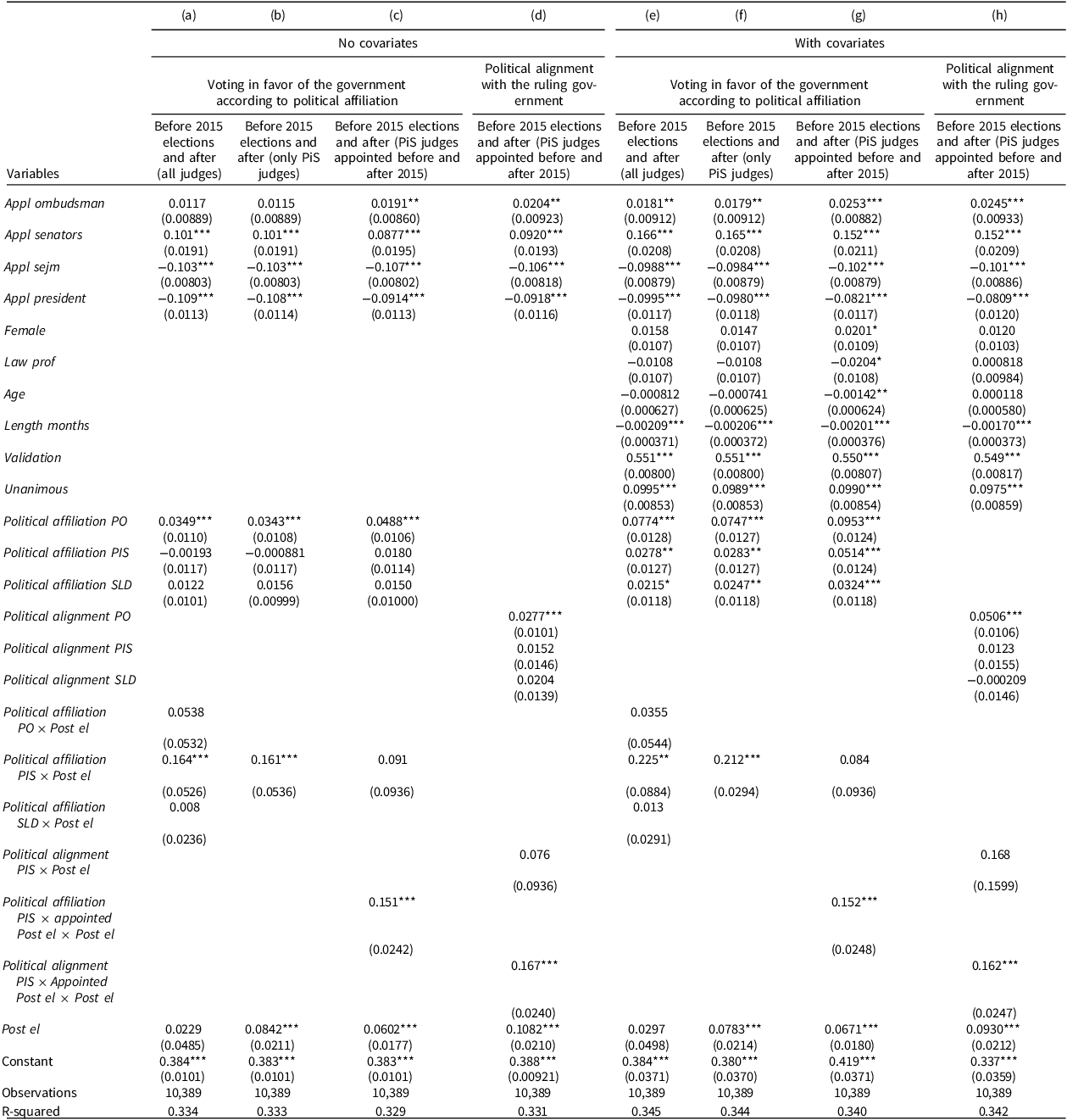
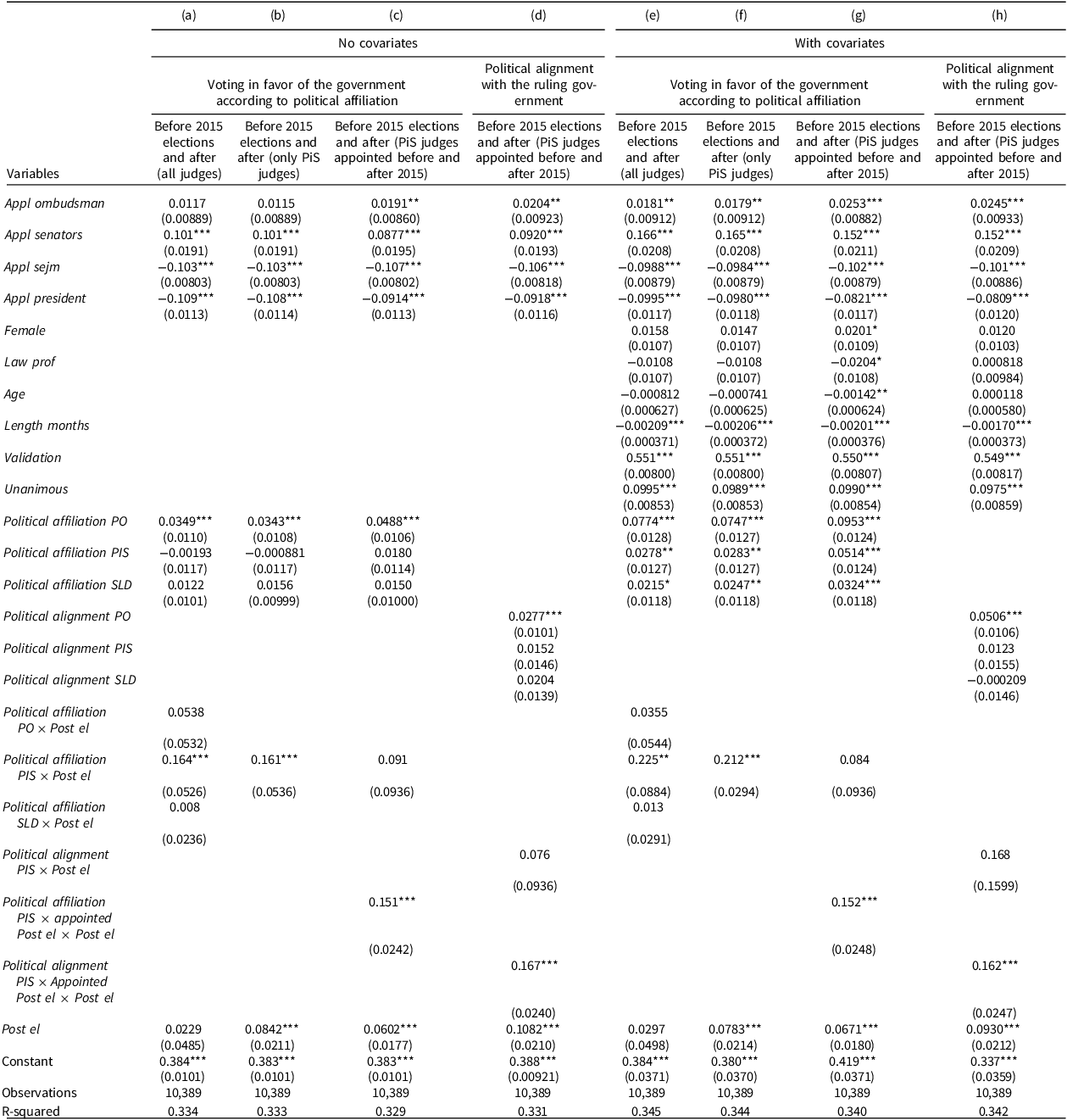
We estimate a linear probability model to capture possible changes in judicial behavior occurring after the 2015 elections.Footnote 24 The results of the baseline regressions are presented in Table 1. Columns (a) to (c) report models without covariates, while columns (e) to (g) include judge-level and case-level controls.
Estimation of the likelihood of voting in favor of the government: 2003–2023 – baseline regressions linear probability model
Standard errors clustered at the case level in parentheses. Clustering at both judge level and case level provides analogous results (available upon request). *** p < 0.01, ** p < 0.05, * p < 0.1.
The baseline regression outcome with full sample specification (column (a)) offers several key insights. In the pre-treatment period, PO-affiliated judges exhibited a statistically significant tendency to support the government, consistent with PO’s role in government between 2007 and 2015. The positive coefficient on political affiliation PO in the pre-2015 specification confirms that judges appointed by the ruling party tend to rule in favor of legislation supported by their political counterparts, consistent with Hypothesis 1. No comparable effects are observed for PiS- or SLD-affiliated judges during the same period, as the estimated coefficients on political affiliation PIS and SLD are not statistically distinguishable from zero. These results indicate that political alignment effects emerge primarily when affiliated parties hold power.
Turning to the post-treatment period, a substantial and statistically significant shift emerges for judges affiliated with PiS in the baseline model.Footnote 25 The coefficient on the interaction term Political affiliation PIS × Post el is positive and significant in the full sample specification (column (a)), indicating that PiS-affiliated judges became more likely to support government positions once PiS assumed executive power. The size of this coefficient (0.164, significant at the 1% level) suggests a considerable behavioral shift associated with the post-election institutional context. This outcome supports Hypothesis 2, which posits an increase in alignment between judges and the ruling party after the 2015 elections.
Column (b) presents a restricted version of the baseline specification, focusing exclusively on the interaction between PiS affiliation and the post-election period, while treating other party affiliations and their interactions as part of the residual category.Footnote 26 This specification addresses potential imbalances in party representation and allows for a more parsimonious estimation of the PiS effect. The coefficient on the interaction term Political affiliation PIS × Post el remains positive and statistically significant (0.161, significant at the 1% level), confirming that judges affiliated with PiS became significantly more likely to vote in favor of the ruling PiS government following the party’s return to power.
However, the simple presence of a positive interaction is insufficient to determine whether this shift was driven by changes in the behavior of existing judges (as proposed in Hypothesis 2a) or by a transformation in the composition of the TK (as posited in Hypothesis 2b). To investigate this further, the model is extended to account for the timing of judicial appointments. We introduce a three-way interaction between PiS affiliation, post-election period, and a dummy for whether the judge was appointed after October 2015 (column (c)). The interpretation of this interaction term isolates the effect of being both PiS-affiliated and appointed under a PiS-led government.
The results indicate that the behavioral change observed among PiS judges post-2015 is driven entirely by those appointed after the elections. The coefficient on political affiliation PIS × Appointed Post el × Post el is large and highly significant (0.151, significant at the 1% level), while the original two-way interaction term, capturing behavior of pre-2015 appointees, loses significance when the three-way interaction is included. This pattern supports Hypothesis 2b by showing that the increase in pro-government voting among PiS-affiliated judges is not due to a transformation of the existing bench, but to the entry of a new cohort of ideologically aligned judges appointed after the change in political leadership.
This interpretation is reinforced when we shift from a framework based on formal affiliation to one based on alignment. We define alignment as a situation in which the judge’s political affiliation coincides with the party in government at the time of the decision (column (d)). Using this operationalization, we create an indicator variable (Political alignment PIS)Footnote 27 and again interact with the post-election period (Post el) and the appointment timing: Political alignment PIS × Appointed Post el × Post el. The results remain consistent: judges aligned with PiS who were appointed after the 2015 elections exhibit a statistically significant and substantively large increase in the probability of voting in favor of the government (coefficient is 0.167, significant at the 1% level), while no such effect is observed among the older generation of aligned judges. The magnitude and significance of the result, together with the insignificance of other alignment terms, further support the interpretation that the transformation in judicial behavior is driven by selection rather than adaptation.
The inclusion of covariates related to judges’ characteristics (columns (e)–(h)) does not materially affect the main results. The estimated treatment effects remain stable in size and significance across specifications. Nevertheless, the covariates themselves yield additional insights. The negative and significant effect of length in office suggests that longer-serving judges are somewhat more insulated from political incentives, while the consistently positive coefficients on validation and unanimous decisions indicate that institutional consensus is strongly associated with rulings favorable to the government. Gender and age exhibit weak or inconsistent effects, with some evidence that female judges may be slightly more likely to support the government, although this varies by specification. The identity of the case applicant also matters: decisions originating from the Ombudsman or Senate are associated with higher levels of pro-government rulings, while those referred by the President or Sejm tend to receive less favorable treatment. These findings reflect patterns of litigation strategy and institutional role rather than judge bias, but they underscore the importance of controlling for case context in estimating the political behavior of judges.
Overall, the baseline DiD analysis confirms the core expectations of our theoretical framework. Judges appointed by the ruling party are more likely to support government interests when that party holds power (Hypothesis 1). This effect intensifies following a major institutional shift, namely the 2015 elections (Hypothesis 2), but the realignment is not uniform across judges. Rather, it is confined to those appointed after the change in political leadership, suggesting a selective and strategic use of judicial appointments to shape the orientation of the court (Hypothesis 2b). The behavior of judges appointed before 2015 remains largely unchanged, providing no evidence for a contextual or adaptive transformation in their voting patterns (Hypothesis 2a).
These results point to an important mechanism of judicial capture in political systems undergoing democratic erosion: not through overt pressure on existing judges, but through a systematic replacement and recruitment strategy aimed at gradually aligning the court’s jurisprudence with the priorities of the executive.
Robustness analysis: uniform pre-post 2015 elections temporal bandwidth
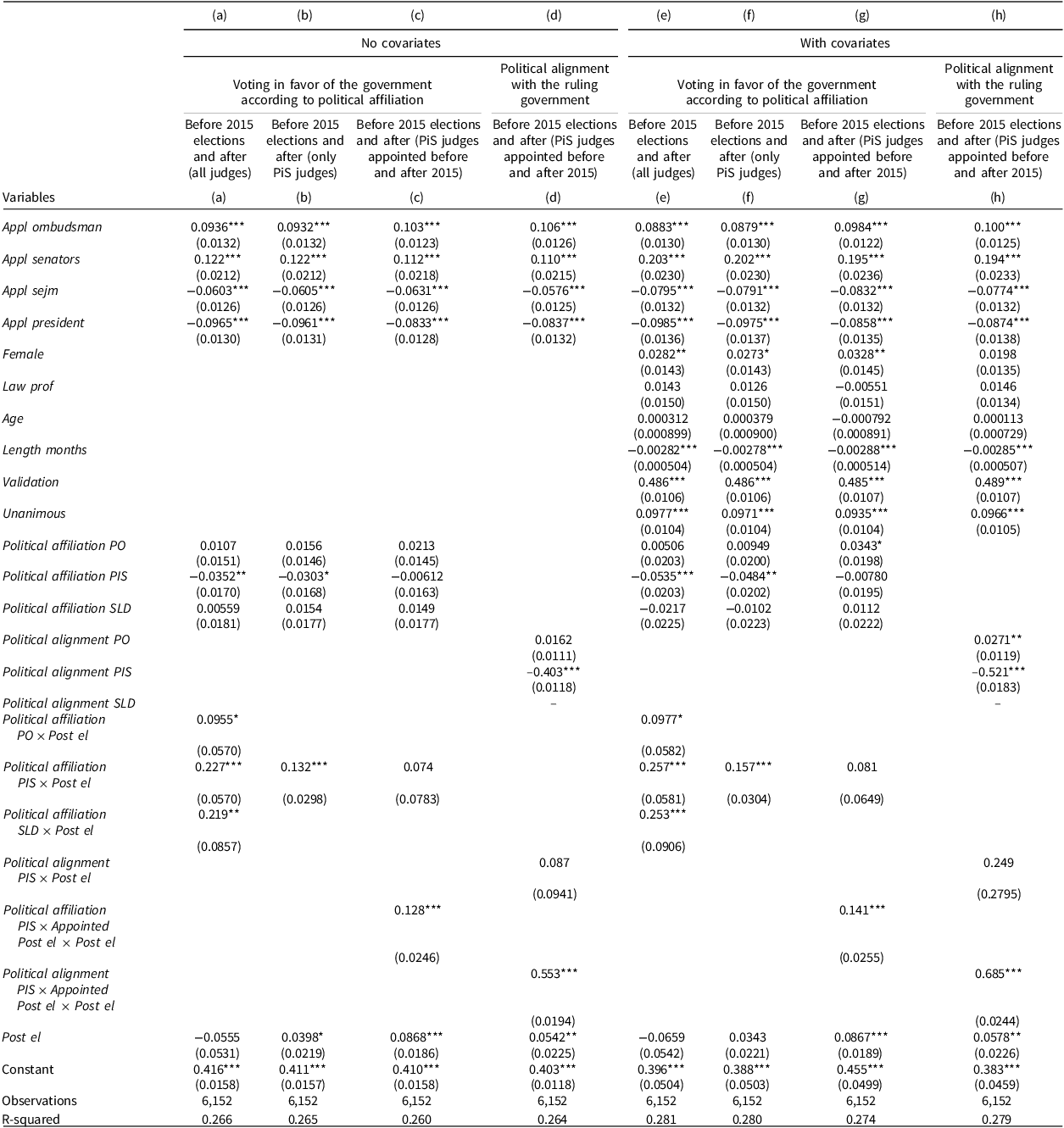
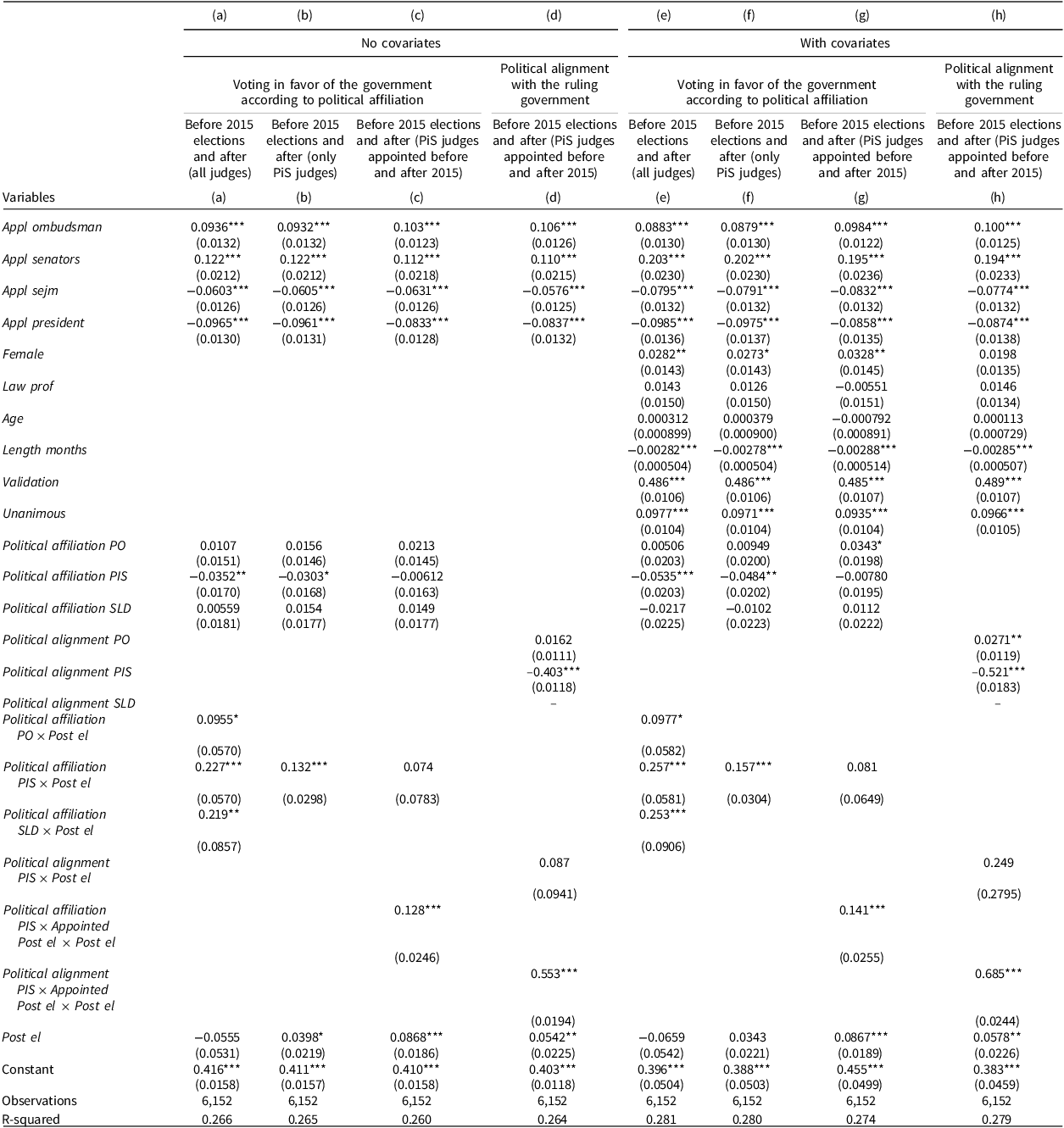
Having data on TK decisions from 2003 through 2023, our database is unbalanced in favor of a more extended period (and consequently a larger number of decisions) preceding the October 2015 elections. Also, as noted before, from 2003 to 2005, the Polish government was formed by a coalition of parties led by PiS. To overcome the possible bias in the size of the estimated parameters due to period unbalances and altering governments, we chose to conduct robustness analysis by comparing judges’ behavior along periods of the same length before and after the elections. Taking the 2015 elections as the starting date, we considered an overall period of sixteen years (October 2007–October 2023), eight years before the elections, and eight years after the 2015 elections. Table 2 illustrates the results obtained from the baseline model adjusted to make the pre- and post-election period of the same duration. As in Table 1, models a through d present the results without individual-level controls, while models e through h add covariates to account for observable personal characteristics of the judges and case characteristics.
Linear probability model estimates of the likelihood of judges voting in favor of the government — baseline regressions with balanced pre- and post-2015 election periods (October 2007–October 2023)
Standard errors clustered at the case level in parentheses. Clustering at both judge level and case level provides analogous results (available upon request). *** p < 0.01, ** p < 0.05, * p < 0.1.
A first difference that emerges comparing the regression outcomes of Tables 1 and 2 is that in Table 2, when balancing the pre-election as well aspost-election periods, the support provided by PO-affiliated judges (Political affiliation PO) to the incumbent party in the period preceding the 2015 elections is positive but no longer significant, while the parameter associated with judges affiliated with PiS becomes negative and statistically significant. This is reasonable because the party that governed for a longer period, from 2007 to the end of 2015, was not PiS, but PO.
An important confirmation that emerges from Table 2 is the stability and consistency of the main interaction effects, shaping the behavior of PiS judges after the 2015 elections, already seen in Table 1. Considering the full sample of judges and using party affiliation as the main independent variable, the coefficient on the interaction term PiS × Post-election remains strongly significant and positive (columns (a) and (e) of Table 2).
The effect is somewhat attenuated – but still statistically significant – when the relevant parameters are estimated for only PiS-affiliated judges (columns (b) and (f) of Table 2, compared with columns (b) and (f) of Table 1). The interaction terms remain positive and significant, though their magnitude is slightly smaller, suggesting that intra-party variation is smaller than the stark contrast between PiS-affiliated and nonaffiliated judges. Still, this supports the hypothesis of strategic alignment rather than a mechanical partisan reaction: PiS judges appear to align more closely with the government once it gains full institutional power. Overall, balancing the pre- and post-2015 election period reinforces the evidence from Table 1: after the 2015 elections, judges affiliated with the ruling party (PiS) became significantly more likely to vote in ways that support the government’s position.
Turning to columns (c) and (g) of Table 2, the interaction term PIS × Appointed Post el × Post el remains positive and statistically significant, confirming that PiS judges appointed by PiS after the 2015 election were more likely to vote in favor of the government. This evidence provides further support for the selection hypothesis (Hypothesis 2b). Interestingly, when the analysis moves from formal party affiliation to political alignment – a broader measure that incorporates perceived ideological proximity to the ruling party – the effects become even more pronounced than in the baseline regressions of Table 1 (columns (d) and (h)). Such large effects confirm that political alignment, rather than formal affiliation, is a stronger predictor of favorable voting, echoing the findings of Table 1.
This robustness across specifications increases the credibility of the hypothesis that judicial behavior became more politically responsive after 2015, especially for judges whose ideological profiles are aligned with the ruling party and who were appointed under its mandate. Table 2 offers compelling micro-level evidence of a broader political dynamic: the increasing instrumentalization of judicial power, where loyalty and alignment become central predictors of judicial decision-making. In this light, the post-2015 period appears not just as a phase of political transformation, but as one of deep institutional reconfiguration, in which the neutrality of the judiciary has been increasingly called into question.
A dynamic specification
In this section, we allow for a more flexible specification of the estimated equation to provide a more accurate representation of the dynamic effects of judges’ voting behavior. Following Bielen and Grajzl (Reference Bielen and Grajzl2021), we use a dynamic DiD model, specifying the following equation (2):
 $$\eqalign{ & {\rm{Pr}}\left( {Voteprogo{v_{ijt}} = 1| \cdot } \right) = \alpha + \mathop \sum \limits_\tau {\beta _\tau }Perio{d_\tau } \times Political \ affiliatio{n_j} \cr & + \mathop \sum \limits_\tau {\gamma _\tau }Perio{d_\tau } + \;\delta Political \ affiliatio{n_{j\;}} + \lambda {W_j} + \theta {X_i} \cr} $$
In equation (2), Period
τ
are time dummies of one-year length (τ
1
= November 1, 2011–October 31, 2012, τ
2
= November 1, 2012–October 31, 2013, onwards); $Perio{d_\tau } \times Politicalaffiliatio{n_j}$
are the interactions between the indicator for judges’ political affiliation and time dummies. The remaining variables are as defined in equation (1).
$Perio{d_\tau } \times Politicalaffiliatio{n_j}$
are the interactions between the indicator for judges’ political affiliation and time dummies. The remaining variables are as defined in equation (1).
We focus on judges appointed by PiS parliamentary members, leaving judges with different affiliations as a residual category.Footnote 28 For identification purposes, and following the standard practice, we omit the Period τ dummy immediately preceding the 2015 Parliamentary elections (τ 4 , November 1, 2014–October 31, 2015). According to equation (2), the Period τ fixed effects fully absorb the timing of the decision date relative to the timing of the elections, rendering a separate inclusion of Post el t on the right-hand side of equation (2) redundant.
The use of a dynamic DiD model is motivated by two key considerations. First, it enables us to trace the evolution of partisan judicial behavior over time, rather than imposing a static, average treatment effect. Second, it helps assess the validity of the parallel trends assumption – a key identification condition for causal inference under DiD – by allowing visual and statistical inspection of pre-treatment trends. Our empirical strategy builds on recent applications of dynamic DiD in institutional legal settings (e.g., Bielen and Grajzl Reference Bielen and Grajzl2021; Callaway and Sant’Anna Reference Callaway and Sant’Anna2021), adapting their framework to examine Poland’s 2015 judicial shift as a natural experiment.
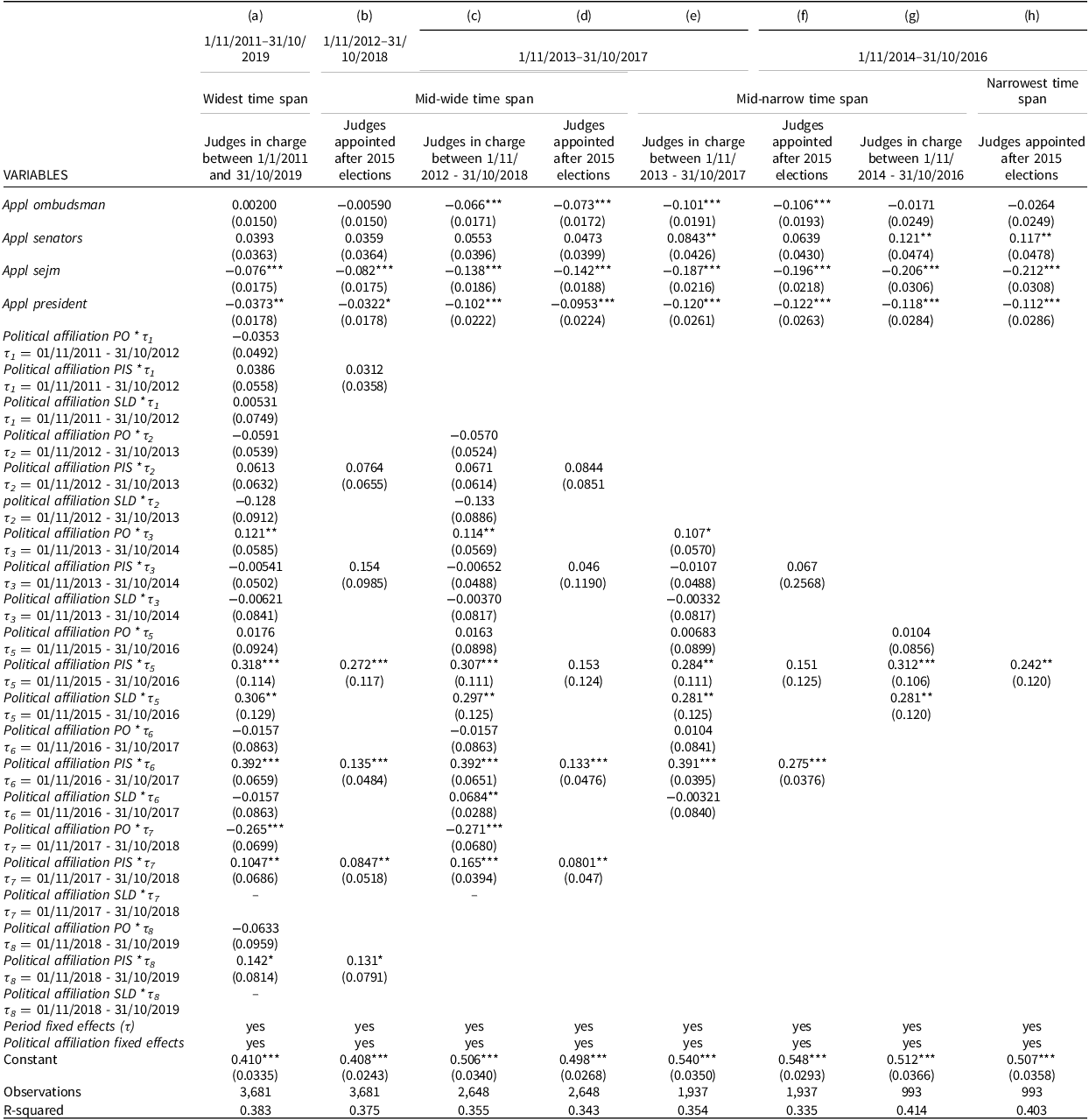
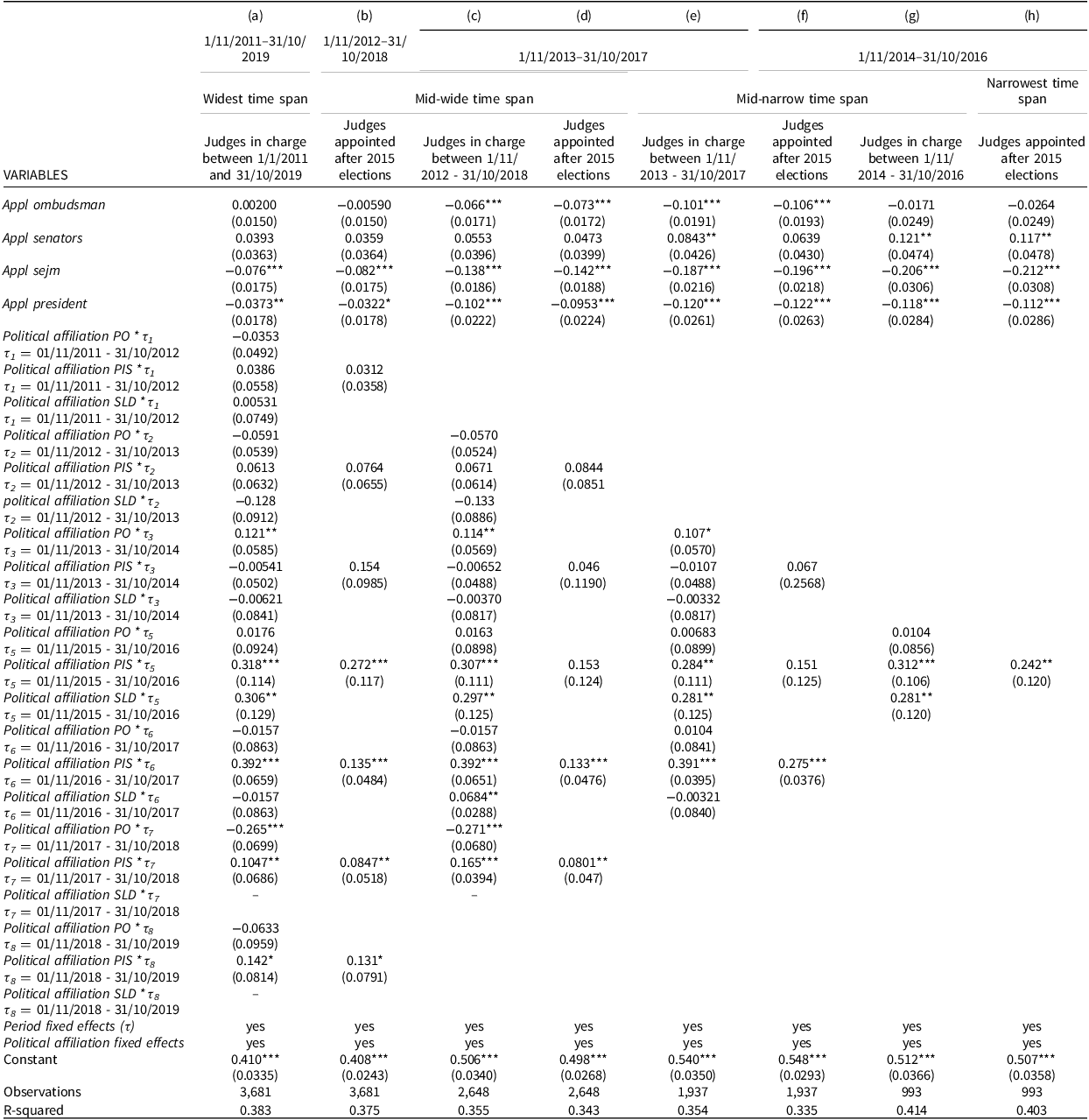
Table 3 reports the results from equation (2), with columns corresponding to different symmetric time windows around the 2015 elections. Odd-numbered columns use the full set of judges active in each window, while even-numbered columns restrict the sample to judges appointed after 2015.
Linear probability model estimates of the likelihood of judges voting in favor of the government — dynamic specification
Standard errors clustered at the case level in parentheses. Clustering at both judge level and case level provides analogous results (available upon request). *** p < 0.01, ** p < 0.05, * p < 0.1.For identification purposes, we omit the Period τ dummy immediately preceding the 2015 Parliamentary elections (τ 4 , November 1, 2014–October 31, 2015).
In the pre-election period, coefficients for PiS-affiliated judges are generally not statistically significant and fluctuate around zero. For instance, in the widest window (column (a)), the coefficients on the interaction terms Political affiliation PIS × τ 1 - Political affiliation PIS × τ 3 are not significant, confirming the absence of systematic pre-treatment divergence between PiS-affiliated and other judges. This finding lends empirical support to the parallel trends assumption, which underpins the causal interpretation of the post-2015 effects.
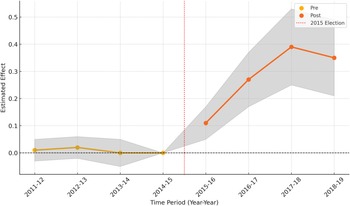
After the 2015 elections, however, the behavior of PiS-affiliated judges changed markedly. In all time windows, the coefficients for post-2015 periods associated with PiS judges are positive and statistically significant, reflecting a distinct behavioral shift in favor of government positions. For example, in the broadest time frame (column (a)), the estimated coefficients for τ 5 to τ 8 range from 0.105 to 0.392, all significant at the 1%-10% level. These results indicate that judges affiliated with PiS became significantly more likely to support government-backed legislation after PiS came to power, confirming Hypothesis 2. When the analysis is restricted to judges appointed after the 2015 elections – the so-called ‘new generation’ – the magnitude of the alignment is generally smaller in the first two post-election years (τ 5 and τ 6 ), but still positive and significant in most cases.
As for Hypothesis 3, which predicts increasing alignment over time as PiS consolidates its power, the evidence is mixed. While the coefficients from τ 5 to τ 7 remain positive and statistically significant across most models, they do not increase monotonically. For instance, in column (b), the coefficients drop from 0.272 (τ 5 ) to 0.135 (τ 6 ) and 0.085 (τ 7 ). Similarly, in column (f), the coefficients start at 0.151 for τ5, rise to 0.275 in τ 6 , and then decrease again. This non-linear trend suggests that the level of alignment may be responsive to the broader political context or electoral cycles, rather than increasing mechanically over time.
In sum, the dynamic DiD analysis corroborates the main findings from Tables 1 and 2 while offering a more nuanced view of the temporal evolution of judicial alignment. It shows that the 2015 elections marked a clear turning point in the behavior of PiS-affiliated judges, with significant increases in government-aligned voting thereafter. However, the pattern of alignment over time appears non-monotonic, supporting a view of judicial behavior that is strategic and politically sensitive, rather than purely structural.
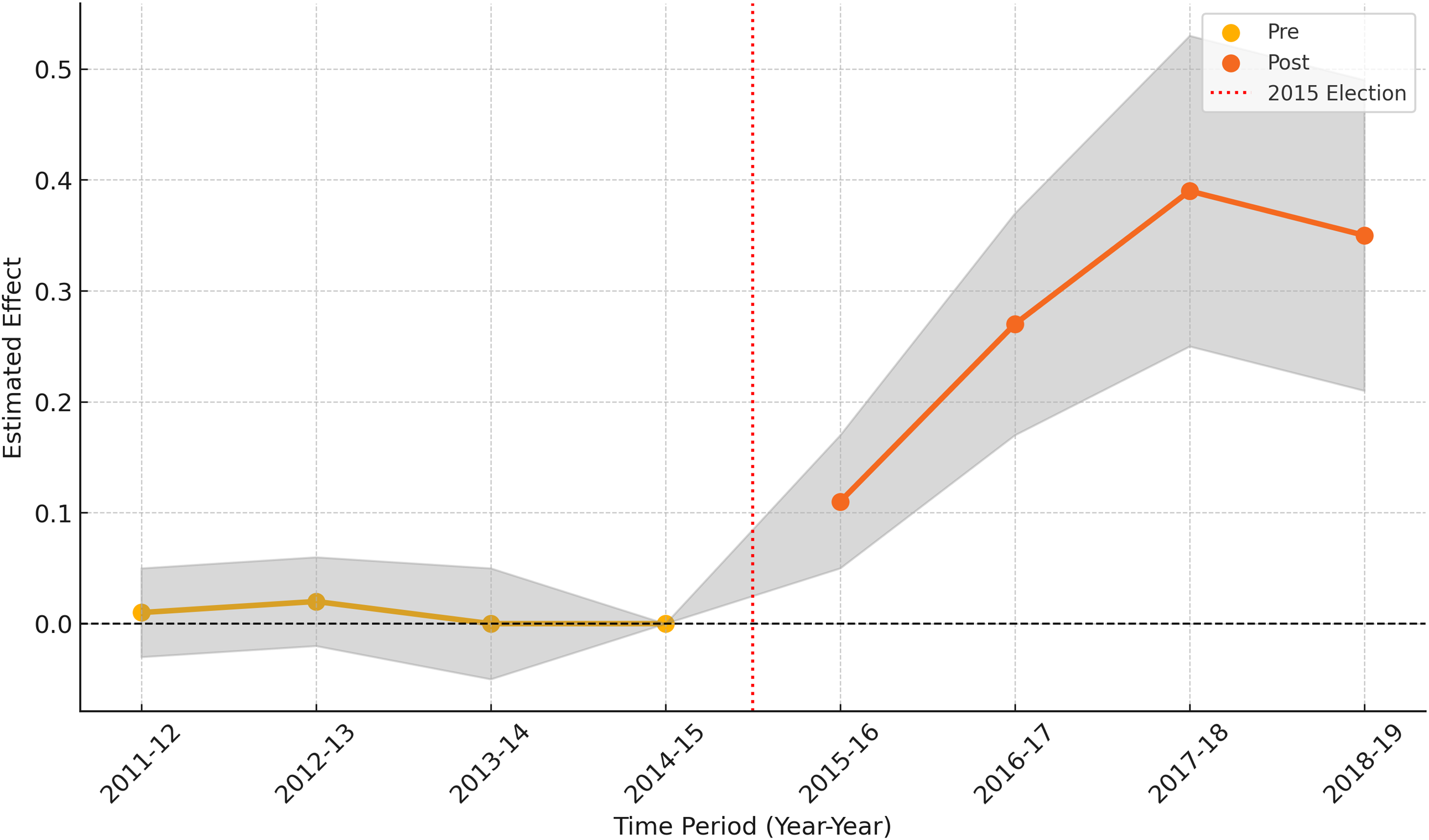
Figure 1 visually represents the results of the dynamic DiD analysis presented in Table 3. The coefficients estimate the yearly effect of PiS affiliation on the likelihood of voting in favor of government-backed legislation, with the omitted period ( ${\tau _4}$
: 2014 – 2015) serving as the baseline. The absence of significant pre-treatment trends supports the parallel trends assumption. After the 2015 elections, the behavior of PiS-affiliated judges shifted markedly, with statistically significant and positive effects observed across most post-treatment years. The non-monotonic evolution of these effects suggests strategic responsiveness to changing political conditions rather than a uniform trend of alignment.
${\tau _4}$
: 2014 – 2015) serving as the baseline. The absence of significant pre-treatment trends supports the parallel trends assumption. After the 2015 elections, the behavior of PiS-affiliated judges shifted markedly, with statistically significant and positive effects observed across most post-treatment years. The non-monotonic evolution of these effects suggests strategic responsiveness to changing political conditions rather than a uniform trend of alignment.
Dynamic DiD: effects of PiS affiliation on pro-government voting.
Note: Dynamic Difference-in-Differences Estimates: Effect of PiS Affiliation on Pro-Government Voting (2011–2019). The graph plots annual interaction coefficients for PiS-affiliated judges, omitting the baseline period (τ4: 2014–2015). Gray shading indicates 95% confidence intervals. A vertical dashed red line marks the 2015 elections.
Further robustness analysis: item response theory (IRT)
According to consolidated practice regarding judicial ideology,Footnote 29 we carry out a robustness check adopting a Bayesian approach to estimate the posterior distributions of judges’ ideal points, using the Item Response Theory (IRT). Ideal points are supposed to reflect judges’ ideology on some latent dimension, which is normally conjectured as being of a political nature (Martin and Quinn Reference Martin and Quinn2002).
We assume that x ij is the vote of each judge j (j = 1, …, J) for case i (i = 1, …, N). We assign value 1 to dissenting opinions (x ij = 1) and 0 otherwise. According to equation (3), the (random) utility of each judge while deciding on each case brought before the court (z ij ) responds to the personal attributes of the judge as well as the characteristics of the decision, as follows:
 $${z_{ij}} = -{\rm{ }}{\alpha _i} + {\rm{ }}{\theta _j} + {\rm{ }}{e_{ij}}$$
We assume that each judge’s ideal point (θ j ) is a latent variable that can be measured indirectly by observing the judge’s votes (x ij ) on decisions of the court. We assume that x ij = 1 if z ij > 0 and x ij = 1 if z ij ≤ 0.
We allow the presence of possible case characteristics that adjust the preference of an individual judge to the relevant dimension when faced with a specific decision. In particular, the parameter α i accounts for a particular location of the decision in the relevant space, assuming heterogeneity across cases decided by the court.Footnote 30 We also assume that e ij is a zero-mean error term.
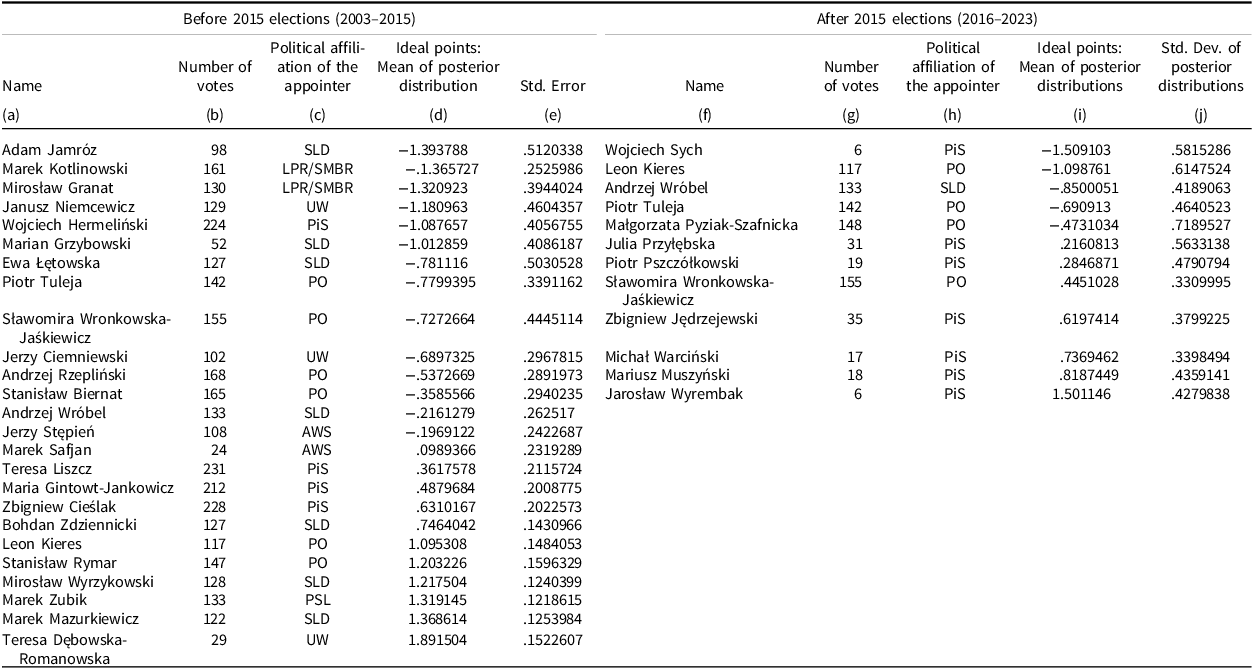
We set up the IRT model to provide two sets of judges’ ideal points, before and after 2015, considering only nonunanimous cases (i.e., cases with dissenting opinions).Footnote 31 Before the 2015 elections, twenty-five judges expressed their dissent in at least one decision of the court, while twelve judges expressed dissent in the decisions taken after the 2015 elections. We are interested in observing any possible shifts in the ideal points of judges appointed by each political party along a hypothetical ideological spectrum.
We fit the IRT model via maximum likelihood estimation using a standard adaptive Gauss–Hermite quadrature to compute the mean and variance of the ideal points. Results are illustrated in Table 4. Columns (a)-(e) report the IRT estimation conducted in the period before the 2015 elections, whereas columns (f)-(j) refer to the post-election period. Ideal points estimated for the pre-election period are 25, while 12 ideal points are estimated for the post-election period. To facilitate the interpretation of the results, the ideal points corresponding to each judge have been sorted from lowest to highest in Table 4.
IRT estimations
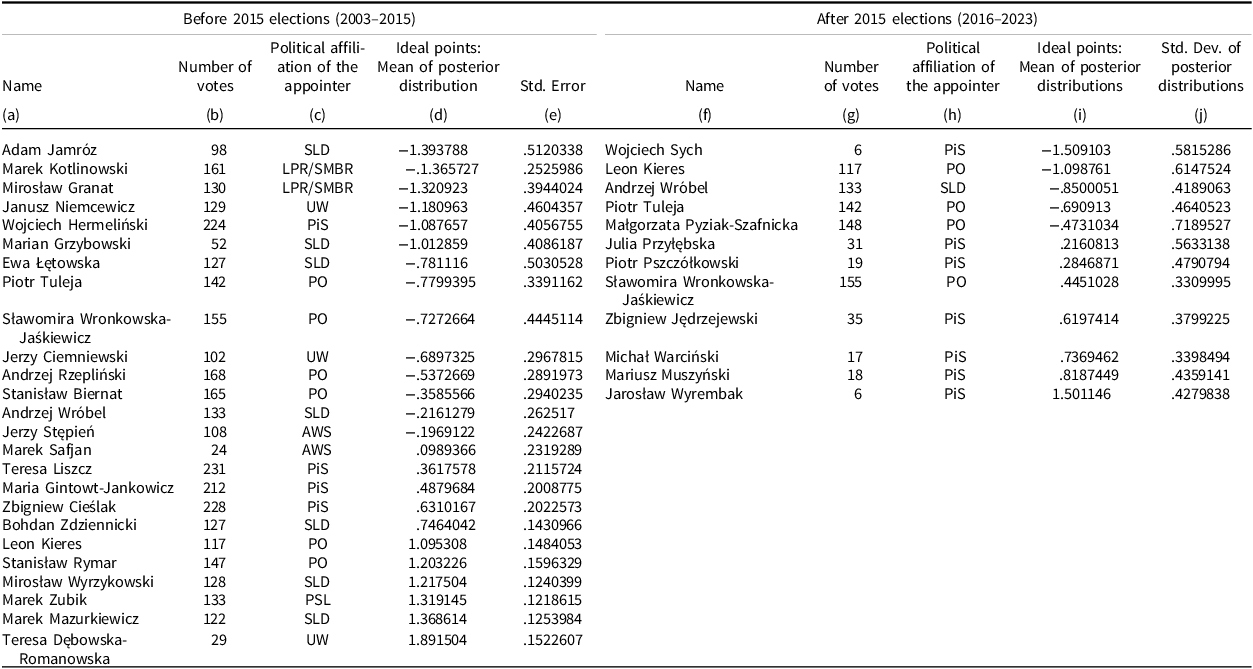
IRT Estimation: pre-election period (January 2003–October 2015); post-election period (November 2015–October 2023). Maximum likelihood estimates are reported.
From the IRT analysis conducted before the 2015 parliamentary elections, no specific orientation of the judges in terms of political alignment seems to emerge. This is inferred by the fact that there are no clusters of judges appointed by a specific party or coalition in one of the two extremes of the interval on which the ideal points are represented (i.e., there is no clear party clustering in column (c)).
Instead, a stronger political orientation seems to have emerged after the 2015 elections. Lower ideal points (negative values) are associated with judges nominated by PO and SDL, whereas positive values of the ideal points are associated with judges nominated by PiS. The only exceptions are Justices Wojciech Sych and Jarosław Wyrembak, who seem to align with the ideology of the allegedly opposite coalition. However, it should be noted that these two judges are the ones who cast the lowest number of votes in nonunanimous decisions in the period of interest, a factor that can affect the reliability of the estimate of their ideal points.
Discussion of results
Our findings are crucial for understanding the judicial transformation within the Polish Constitutional Tribunal. Prior to 2015, party affiliation was a significant factor influencing judicial behavior, as evidenced by previous studies (Kantorowicz and Garoupa Reference Kantorowicz and Garoupa2016; Fałkowski and Lewkowicz Reference Fałkowski and Lewkowicz2021). However, our analysis indicates that after the 2015 parliamentary elections, the influence of party alignment and support for the executive branch intensified, as reflected in both regression analyzes and ideal point estimations.
We find more compelling evidence that judicial transformation is primarily driven by new appointments to the court by the Law and Justice Party (PiS), reflecting an active court-packing strategy by the populist government, rather than changes in behavior among older judges. The hypothesis that judicial transformation is shaped by a shift in context finds only limited support in our data. According to our ideal point estimation, earlier PiS appointees were less polarized against Civic Platform (PO) appointees, distinguishing them from PiS appointees after November 2015.Footnote 32 Although there is some indication that the behavior of older PiS appointees may have begun to change prior to the 2015 election, this result is not statistically significant across all regression analyzes. Additionally, there is no evidence supporting the conventional strategic defection theory; PO appointees did not change their voting patterns.
A limitation of our study is the small sample of judges who served during both periods. The cohort of judges serving before and after October 2015 is relatively small (15 judges) compared to the other two cohorts, those serving exclusively before or after this date. Another possible limitation is that our dataset includes abstract reviews but excludes concrete reviews or constitutional complaints. Given that abstract review, by its political nature, is more susceptible to partisan polarization than concrete review, it is unlikely that the small number of judges who served during both periods altered their behavior in concrete review without doing so in abstract review. Consequently, the judicial transformation we document in our empirical analysis is likely more nuanced within the general population of cases.
Our empirical findings are consistent with standard rational choice theories of judicial behavior, particularly the attitudinal model and agency theory. The attitudinal model suggests that judicial transformation stems from changes in court composition, with newly appointed judges exhibiting stable and sincere conservative ideological preferences. Meanwhile, agency theory posits that new judges align their rulings with the preferences of the populist government due to prevailing institutional incentives and strategic considerations. Both perspectives account for the observable patterns in judicial decision-making following political shifts, reinforcing the idea that courts are not insulated from broader political dynamics.
Conversely, our findings offer limited support for a formalist explanation of judicial behavior. Formalism assumes that judges decide cases based solely on legal doctrine and statutory interpretation, independent of political considerations or personal ideological inclinations. If this were the case, one would not expect to observe a statistically significant shift in judicial decision-making following the October 2015 political transformation, after controlling for case characteristics and judicial demographics. The observed changes in judicial outcomes suggest that factors beyond pure legal reasoning – such as ideology and strategic adaptation – play a critical role in shaping judicial behavior.
Conclusions
In this article, we have examined the Polish TK over the period 2003–2023. Our findings reveal a significant increase in the alignment between the court and the executive branch following the parliamentary elections of October 2015, highlighting a substantial judicial transformation. The empirical evidence points to a major shift in the composition of the bench, with weaker indications of strategic behavior by older conservative judges (that is, conservative constitutional judges appointed before October 2015).
Broadly speaking, our findings support explanations that emphasize court-packing with new appointees, while also leaving open the possibility that older judges, especially those appointed by the same party in the past, may have been subject to mechanisms of discipline or incentivization. In the context of democratic backsliding, limited judicial tenure combined with a concentrated government (through selection mechanisms) facilitates unwelcome shifts in constitutional review.
These findings have significant implications for the extensive literature on populism (Scheppele Reference Scheppele2018; Castillo-Ortiz Reference Castillo-Ortiz2019). From a populist government’s perspective, court-packing appears to be a more effective strategy for achieving desired outcomes than relying on strategic defection, which is less likely to sway older judges. One possible explanation is that populism may not be viewed as a long-term threat by judges nearing the end of their terms, even in cases like Poland, where the populist party governed uninterruptedly for eight years. Another possible, non-mutually exclusive explanation is that older judges may exhibit stronger loyalty to European courts and the values they uphold, possibly due to longer periods of socialization. As a result, institutional conflicts between a populist government and the judiciary are likely to persist until court-packing achieves the intended outcomes.
Our findings underscore the broader implications of judicial transformation in contexts marked by populist rule. They reveal how political actors, particularly those with a strong electoral mandate, can effectively reconfigure judicial institutions by exploiting mechanisms such as strategic appointments, court-packing, and the manipulation of institutional incentives. This process not only alters the composition of courts but also reshapes their normative orientation and decision-making behavior, thereby weakening the judiciary’s capacity to function as an autonomous check on executive authority.
In such politically charged environments, the erosion of judicial independence poses a significant threat to the foundational principles of constitutional democracy, including the separation of powers, the rule of law, and the protection of fundamental rights. When courts are transformed into instruments for legitimizing executive preferences rather than upholding legal neutrality, their role as guardians of constitutional order is fundamentally compromised.
By empirically documenting these dynamics in the case of the Polish Constitutional Tribunal, our study contributes to the expanding literature on judicial politics, democratic erosion, and authoritarian legalism. It highlights the urgent need for institutional safeguards – such as appointment procedures insulated from partisan capture, tenure protections, and meaningful oversight mechanisms – to preserve judicial autonomy in the face of political pressures. More broadly, our analysis calls attention to the fragility of liberal-democratic institutions and the importance of resilience strategies in periods of constitutional stress.
Supplementary material
To view supplementary material for this article, please visit https://doi.org/10.1017/S1475676525100340.
Data availability statement
Replication material for this study is available at https://doi.org/10.7910/DVN/UO8B7U.
Acknowledgments
We are grateful to three anonymous referees, as well as to Jeff Staton, Abe Wickelgren, and participants at EALE 2022 (Lisbon), LAWLE 2022 (Bogotá), ASCL 2023 (Miami), and AEDE 2025 (Lisbon) for their valuable comments and suggestions. Lucia Dalla Pellegrina acknowledges financial support from the Baffi Centre (Bocconi University). Madeline Conn and Savanah K. Patterson provided excellent research assistance. The usual disclaimers apply.
Funding statement
Lucia Dalla Pellegrina acknowledges financial support from the Baffi Centre (Bocconi University).
Competing interests
None of the authors reports any conflict of interest.
Ethics approval statement
This research did not require ethics approval.
Permission to reproduce material from other sources
Not applicable.


 Open access

