


Introduction
Low fertility trend in East Asian countries has been widely acknowledged and raised much attention. Studies have identified diverse factors impacting an individual’s childbearing intentions, with economic status and income being among them. This is particularly true in China, as increasing childrearing costs, especially in terms of education, have become an important consideration in the parenthood decision (Jones Reference Jones2019; Lau et al. Reference Lau, Huo, Wang, Shi, Li, Mu, Peng, Wang, Ng and Chan2018; Yang Reference Yang2019). While the importance of economic status has been well acknowledged in fertility studies, the instability of economic development and the labour market has grown in interest, as precarity affects costs of childbearing and uncertainty is redefining people’s images of their families (Fahlén and Oláh Reference Fahlén and Oláh2018; Sobotka et al. Reference Sobotka, Skirbekk and Philipov2011; VignoliBazzani et al. Reference Vignoli, Bazzani, Guetto, Minello and Pirani2020).
Economic uncertainty and decreased fertility
Across various countries and eras, economic uncertainty has been consistently associated with decreased fertility (Fahlén and Oláh Reference Fahlén and Oláh2018; Gozgor Reference Gozgor2022; Hofmann and Hohmeyer Reference Hofmann and Hohmeyer2013; Hondroyiannis Reference Hondroyiannis2010). Economic downturns, including the Great Recession, have been shown to influence fertility behaviour, with fertility rising and falling with the business cycle (Sobotka et al. Reference Sobotka, Skirbekk and Philipov2011). The impact of the Great Recession on fertility in Europe varied by region, age, and parity, with countries hit hardest by the recession showing reduced fertility, especially among younger age groups (Goldstein et al. Reference Goldstein, Kreyenfeld, Jasilioniene and Örsal2013; Testa and Basten Reference Testa and Basten2014). Schneider and Hastings (Reference Schneider and Hastings2015) addressed the relationship between economic conditions and fertility in the US in the years after the Great Recession. They found that the economic impact of the Great Recession, captured by state-level economic conditions, had a strong negative effect on fertility in models with state- and year-fixed effects. The drop in fertility was likely caused by greater economic hardship and uncertainty. Fahlén and Oláh (Reference Fahlén and Oláh2018) used European Social Survey data from 2004 and 2011 to examine the relationships among economic conditions, individual economic uncertainty, and first-birth intentions in Europe before and after the Great Recession. They found that societal economic uncertainty was negatively associated with short-term parental intentions, especially among men. Similarly, another study found a decrease in the odds of having a first child during the Great Greek Recession (Dantis and Rizzi Reference Dantis and Rizzi2020).
As a by-product of economic downturns, employment instability has been a stronger predictor of fertility intentions than pure economic insecurity (Gatta et al. Reference Gatta, Mattioli, Mencarini and Vignoli2022). Modena and Sabatini (Reference Modena and Sabatini2012) focused on Italy, showing that economic insecurity, including job instability and economic disadvantages, had influenced fertility intentions based on feelings of anxiety and economic insecurity. This negative impact of employment instability on fertility has become even stronger over time, particularly in Southern European countries (Alderotti et al. Reference Alderotti, Vignoli, Baccini and Matysiak2021). Job instability and economic disadvantages, such as low household wealth, also have been shown to discourage childbearing decisions (Modena and Sabatini Reference Modena and Sabatini2012). Hanappi et al. (Reference Hanappi, Ryser, Bernardi and Le Goff2017) explored the link between employment, perceived material insecurity, and fertility intentions, emphasising the importance of resolving unfavourable work situations before having children. Gatta et al. (Reference Gatta, Mattioli, Mencarini and Vignoli2022) considered perceived stability of employment and resilience to potential job loss as dimensions of employment uncertainty in relation to fertility decision-making. Perceived resilience to job loss seems of particular relevance in fertility planning compared to perceived stability of employment (Gatta et al. Reference Gatta, Mattioli, Mencarini and Vignoli2022). Vignoli et al. (Vignoli Bazzani et al. Reference Vignoli, Bazzani, Guetto, Minello and Pirani2020) further proposed that the impact of job uncertainty on fertility intentions would be channelled by subjective well-being. In sum, the impact of economic uncertainty on fertility remains complex.
Differentiated influences of unemployment on fertility
Different perspectives by sex have also been highlighted in studies; however, the findings have diverged across countries. Some studies have shown that unemployment among men has had a significant negative effect on fertility in Europe (Alderotti et al. Reference Alderotti, Vignoli, Baccini and Matysiak2021; Goldstein et al. Reference Goldstein, Kreyenfeld, Jasilioniene and Örsal2013). At the same time, Hofmann and Hohmeyer (Reference Hofmann and Hohmeyer2013) discovered that strong economic concerns among women in Germany had reduced fertility, highlighting the impact of perceived economic uncertainty on fertility decisions. Perceived income security was less important at older ages for both sexes as well as for women below the age of 30, especially in the aftermath of a crisis. Men in their early thirties showed the lowest fatherhood intentions in a constrained situation (Fahlén and Oláh Reference Fahlén and Oláh2018). However, according to another study in Italy, persistent joblessness, especially among men, significantly reduced fertility intentions (Busetta et al. Reference Busetta, Mendola and Vignoli2019). Low subjective well-being caused by job uncertainty was also found to be more pronounced among men during economic crises across Europe (Vignoli Mencarini et al. Reference Vignoli, Mencarini and Alderotti2020).
Past pandemics have raised awareness of the influence of economic uncertainty on fertility caused by other crises or unexpected events (Arpino et al. Reference Arpino, Luppi and Rosina2021; Liu Reference Liu2017; Luppi et al. Reference Luppi, Arpino and Rosina2023; Vignoli Bazzani et al. Reference Vignoli, Bazzani, Guetto, Minello and Pirani2020). For instance, Luppi et al. (Reference Luppi, Arpino and Rosina2023) examined the impact of the economic uncertainty generated by the COVID-19 crisis on the fertility plans among young Italians, highlighting the role of occupational and financial uncertainty during the pandemic. Such results collectively contribute to the understanding of the complex relationship between economic uncertainty and fertility decisions.
Fertility intentions in contemporary China
A variety of terms have been used in the research to measure and compare the individual’s perceptions and wills of fertility (Philipov, Reference Philipov2009). The use of different terms is due to the pursuit of more reasonable and accurate estimation for fertility and fertility trend, as there is always a difference between intended and actual fertility. Fertility intentions and actual behaviour vary considerably at different stages across a woman’s reproductive career. Additionally, their fertility goals can be reformulated from an early age towards old age as the reproductive career unfolds. Research on fertility intentions in China has started from the 1980s. Intended number of children and ideal family size have become the most common indicators in investigating Chinese residents’ fertility intentions. Fertility studies in China have long been dominated by factors embedded in the fertility decision-making process, including heavy economic burden and time consumed on childcare (Bao Reference Bao2017; Ni Reference Ni2023; Wu Reference Wu, Gu, Ma and Mao2014; Yao et al. Reference Yao, Wu and Li2010), while recently relevant studies have focused on the second-child intentions after the introduction of universal two-child policy. Based on data from the national fertility survey in 2017 in China, this study reported the average ideal number of children being 1.96, while the intended number of children was 1.76 (Zhuang et al. Reference Zhuang, Jiang and Li2020). Studies also paid attention to other stakeholders in family reproduction and identified a discrepancy between maternal fertility intention and realised childbearing partly due to husband’s and the firstborn child’s attitude (Liu and Lummaa Reference Liu and Lummaa2019; Zhang et al. Reference Zhang, Liu and Lummaa2022). Moreover, researchers have growingly focused on young women’s situations and dilemmas under the new policy context (Ji et al. Reference Ji, Wang, Liu, Xu and Zheng2020; Ji et al. Reference Ji, Wu, Sun and He2017; Liu Reference Liu2017; Shen and Jiang Reference Shen and Jiang2020b). For example, Shen and Jiang (Reference Shen and Jiang2020a) pointed out that childbearing would interrupt women’s career and further impair their career development. Liu (Reference Liu2017) centred on the conflict between work and family for women of childbearing age and found it adversely impacted their fertility intention to have a second child.
However, little attention has been paid to uncertain prospects in China’s literatures. Owing to the rapid economic development over the past several decades, China’s citizens have seldom linked concerns about the future economy with their childbearing intentions. Apart from the small family size restricted by stringent family planning policies, childbearing desires and plans have been established based on a couple’s considerations of the family’s economic situation, childcare workload, and so forth. Using data from the 2017 and 2019 Chinese General Social Surveys, Tian (Reference Tian2022) examined the impact of employment stability on fertility intentions among families at different income levels. The results showed that only middle-income families were negatively influenced by unemployment or unstable employment, whereas both low- and high-income families were positively influenced by job uncertainty.
Overall, previous studies have highlighted the complex relationship among economic uncertainty, job uncertainty, and fertility intentions, emphasising the need to consider various factors that influence an individual’s decision to have a family. The Narrative Framework proposed by Vignoli (Reference Vignoli, Bazzani, Guetto, Minello and Pirani2020) suggests that individuals’ fertility decisions are influenced by the ‘narrative of the future’. Thus, traditional indicators cannot comprehensively capture contemporary fertility trends and statistical models, as fertility decisions are not a mere ‘statistical shadow of the past’. In particular, China’s case merits further exploration for several reasons. First of all, fertility in China has been heavily influenced by Family Planning Policy before the 2010s, in contrast to other Western countries. The economy in China also experienced a soaring development from the economic reform onwards. Therefore, there is no real basis for discussing this topic in China until the recent decade, especially after the pandemic. Furthermore, unlike their parents, the young Chinese people of today have been brought up in small families; as such, they may share different family norms and perceptions of childbearing.
To consider these issues in a current framework, this study investigated perceived economic uncertainties among young Chinese men and women, assessed the associations between these uncertainties and their childbearing values and intentions, and identified common demographic and socioeconomic characteristics related. The dimension of this analysis is an individual’s perceived economic uncertainty rather than the actual economic downturn for the following reasons. The top reason is that in comparison to the Great Recession and Financial Crisis in 2008, current economic situation is still varying. The macro-level uncertainty has been observed but is still underway. It is more feasible to consider people’s perceptions of economy and future at the micro-level. Secondly, as a planned behaviour, childbearing is regarded to be significantly linked with individuals’ subjective notions of their situations and lives (Ajzen Reference Ajzen2011; Ajzen and Klobas Reference Ajzen and Klobas2013). Hence, this study aims to contribute to the knowledge of the associations between perceived economic uncertainties of young people and their fertility intentions, with an emphasis on China’s case.
Methods
Data
An online survey was conducted in September and October 2023 among young Chinese individuals through the professional data collection platform Credamo. Credamo is a reliable Chinese data collection platform similar to the Qualtrics Online Sample service. A sample of Chinese adults born between 1990 and 2006 (aged 17 to 33) was recruited, with 918 questionnaires collected. The recruitment attempted to include sufficient responses from respondents with diverse backgrounds. For instance, all provinces in China were covered, but no single province was overrepresented in an unproportionate size. Sex distribution was also examined throughout the entire process. The respondent statistics are listed in Table 1.
Characteristics of Sample

Dependent variables
Two questions were asked to understand the value the respondents placed on the childbearing and childrearing experience and to reflect their attitudes towards having children. These were: ‘Do you think childbearing and childrearing is a necessary life experience?’ and: ‘How many children do you plan to have?’. In this way, the study measured the value of childbearing and fertility intentions among China’s younger generation. Regarding the first question, the answers were initially presented in five categories: unnecessary, somewhat unnecessary, neutral, somewhat necessary, and very necessary. Based on the limited number of certain responses, the first and last two options were merged, leading to three categories in the analysis: not necessary, neutral, and necessary. The answer to how many children they planned to have mostly ranged from 0 to 2, with few respondents proposing three or more children. This variable was grouped into three categories: no children, one child, or two or more children. Due to the minimal share of three or more children (13 out of 918), the category of ‘two and more children’ was presented as two-children intention in the models.
Independent variables
Previous studies have introduced a set of variables pertinent to economic uncertainty. For macroeconomic change, variables of unemployment rate, youth unemployment rate, the cost of public debt, and the consumer confidence index are commonly used as indicators (Gozgor et al. Reference Gozgor, Bilgin and Rangazas2021; Wang and Zhong Reference Wang and Zhong2022). To measure micro-level economic uncertainties, variables mainly range from present job security to financial security. Corresponding questions are formulated like, ‘What do you think is the percent chance that you will lose your job during the next 12 months?’, ‘How confident are you about finding a new job?’, or ‘Will the next 12 months be better, worse, or the same?’ (Gatta et al. Reference Gatta, Mattioli, Mencarini and Vignoli2022; Vignoli Guetto et al. Reference Vignoli, Guetto, Bazzani, Pirani and Minello2020).
In this study, three indicators were employed as the main explanatory variables to represent young people’s perceptions of economic uncertainty: present economic situation, job attainment difficulties, and the economic trend in three years. Compared with objective tendencies tracked in the economy and labour market, young people’s views and expectations are key to understanding the value they place on family commitments and fertility plans. Views of the current economic situation were originally designed with five options: very poor, poor, normal, good, and very good. The options of very poor and very good counted for 46 (5.01%) and 35 (3.81%). The tabulations of this variable with five options and the two dependent variables show that some cells cannot reach the minimum counts of five for further analysis (e.g. 3 for ‘very good’ and ‘not necessary’ to experience childbearing and rearing, 0 for ‘very good’ and ‘neutral responses’ to experience childbearing and rearing). Therefore, the options of very poor and very good were respectively merged to the options of poor and good. Similarly, job-hunting difficulty was ultimately categorised into three options and the economic trend in three years was presented as getting worse, remaining the same, or getting better. These three variables were designed to understand young people’s views on current economy, difficulties in acquiring a job, and future economy.
Demographic and economic characteristics were included as covariates. The demographic factors included age group, sex (male and female), place of residence, number of siblings, marital status, child status, hukou type (household registration type which indicates citizens’ household registration place and mainly has two categories of agricultural or non-agricultural/urban type), and educational level. Specifically, marital status covered the option of ‘in cohabitation’ to indicate new trends among young people (these are rare in traditional data in China but have become an important factor in current analysis). Economic characteristics included self-rated economic status, housing status, and employment status.
Statistical analysis
The association between perceived economic uncertainties and childbearing value and intention was assessed using multinomial logistic regression analysis, adjusting for demographic and financial characteristics. Multicollinearity was tested for among the perceived economic uncertainties, as well as the covariates. One of the two variables was considered if a high correlation was found between them. To show the different effects the independent variables could have, the results of two samples were compared. All covariates were retained in the analysis rather than performing the backward elimination procedure. Stata software version 16 was used for all statistical analyses. The multinomial logistic regression model results are presented as odds ratios (OR) with 95% confidence intervals to determine the factors associated with young people’s fertility attitudes in China.
Results
Respondent statistics
The 918 respondents aged between 17 and 33 years (see Table 1) were segregated into four age groups: below 20 (17–19), 20–24, 25–29, and over 30 (30–33); the distribution was 8.93%, 46.95%, 36.27%, and 7.84%, respectively. Of the respondents, 42.48% were male and 57.52% were female. Regarding marital status, 28.65% were married and 68.41% were single. A small number (2.94%) was cohabitating. The majority were of Han ethnicity. Among the respondents, over 75% had no children, 21.57% had one child, and 3.16% had two. Most respondents had a tertiary education, with most receiving a bachelor’s degree; 9.15% had reached junior college and 12.20% had a postgraduate degree. More than half the respondents were registered in agricultural households. In terms of location, 41.07% lived in East China, 25.38% in Central China, 29.85% in West China, and 3.70% in Northeast China. Almost 50% of the respondents had one sibling and 30.72% were only children. In terms of financial status, 58.49% rated their economic condition as average, 31.70% as better than their peers, and 14.81% considered themselves below average. Of all the respondents, 39.87% had bought their house, while 19.93% rented a room in a shared flat. Finally, over 60% of the respondents were employed.
For the group in the employed sample, most characteristics were similar in distribution to the global sample, while the other respondents had different profiles. For instance, the employed respondents were generally older than their unemployed counterparts, with 67% aged over 25 years. Of these, 45.25% were married and 3.87% cohabitated. A higher share of employed respondents had child(ren) compared with the whole sample. With regard to their economic situation, more employed respondents tended to rate themselves as financially better than others. Moreover, most owned their own house (57.22%).
Value of childbearing and fertility intention of young people
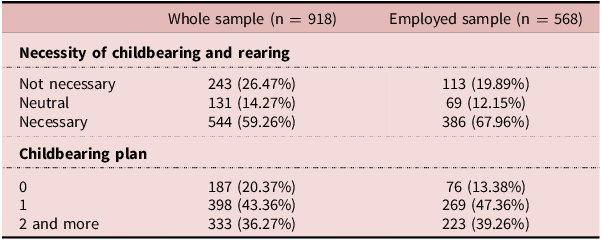
Table 2 presents the descriptive statistics of the two outcome variables for different sub-samples. In the entire sample, 544 out of the 918 respondents agreed with the need to experience childbearing and childrearing, whereas 243 reported no such need. Regarding intentions, having one child or more accounted for 43.36% and 36.27% of the respondents, respectively, with approximately 20% preferring to remain childless. Young people who were employed shared a similar distribution of these attitudes but were more prone to wanting children. For instance, those who considered childbearing and rearing necessary largely outnumbered those who considered them unnecessary. Similarly, employed respondents who chose childlessness accounted for only 13.38% of the total.
Childbearing and Planning Attitudes
Factors associated with the value of childbearing
Table 3 summarises the OR for the association between the predictor variables and the individuals’ responses regarding having children. The reference category of outcome variable is ‘considering it necessary to experience childbearing and rearing’. Model 1 presents the model on the entire sample. Primarily, individuals who took an optimistic view of the current and future economy were 63% (OR = 0.368; 95% CI: 0.193–0.700) and 67% (OR = 0.327; 95% CI: 0.192–0.556), respectively, less likely to choose the no need to experience childbearing option. However, females were much more likely than men to consider it unnecessary (OR = 5.149; 95% CI: 3.423-7.745) or respond neutrally (OR = 3.303; 95% CI: 2.107–5.180) to having child-related experiences. Compared to endorsing the necessity of childbearing experiences, single people had higher odds of choosing the little need (OR = 2.866; 95% CI: 1.266–6.490) or no need options (OR = 2.675; 95% CI: 1.054–6.793) than married respondents did. In contrast, people who had two children already were more likely to be neutral towards childbearing (OR = 4.654; 95% CI: 1.250–17.235). Regarding financial factors, self-rated economic status was positively associated with individual need to experience childbearing and rearing (OR = 0.474; 95% CI: [0.241, 0.933]). Moreover, ownership of an apartment/house lowered the odds of considering childbearing and rearing unnecessary compared with those living in rented accommodation (OR = 0.551; 95% CI: 0.316–0.960).
Factors Associated With No Need and Neutral Responses to Childbearing Among Young Respondents

Note: ***p < 0.001, **p < 0.01, *p < 0.05.
a For employed sample, there is a relatively high correlation (0.61) between ‘difficulty in job attainment’ and ‘present economic situation’. In models of employed sample, ‘difficulty in job attainment’ was retained because it can reflect perceived employment trend.
b Due to the small number of employed sample aged under 20, this group is recategorised into age group 17–24 in all models regarding employed sample.
c Secondary education was recategorised into “below undergraduate” due to its minimal counts.
Model 2 (Table 3) shows that among those who were younger and working, a decreasing perceived difficulty in job attainment predicted a lower possibility of reporting a neutral attitude towards experiencing childbearing (OR = 0.265, 95% CI: 0.077–0.906). Compared to agreeing with the necessity of childbearing experiences, those who viewed future economy as remaining unchanged (OR = 0.455; 95% CI: 0.232–0.891) or getting better (OR = 0.305; 95% CI: 0.156–0.594) were significantly associated with positive values for childbearing and rearing. With regard to demographic and financial factors, working respondents shared a similar pattern with other respondents, except for sibling status. Employed respondents with two siblings were 61% less likely to consider childbearing unnecessary than their only child counterparts (OR = 0.391; 95% CI: 0.160–0.954). No associations were found between the young respondents’ views on the need to have a child and age group, residence area, hukou type, education level, or employment status.
Factors associated with fertility intentions
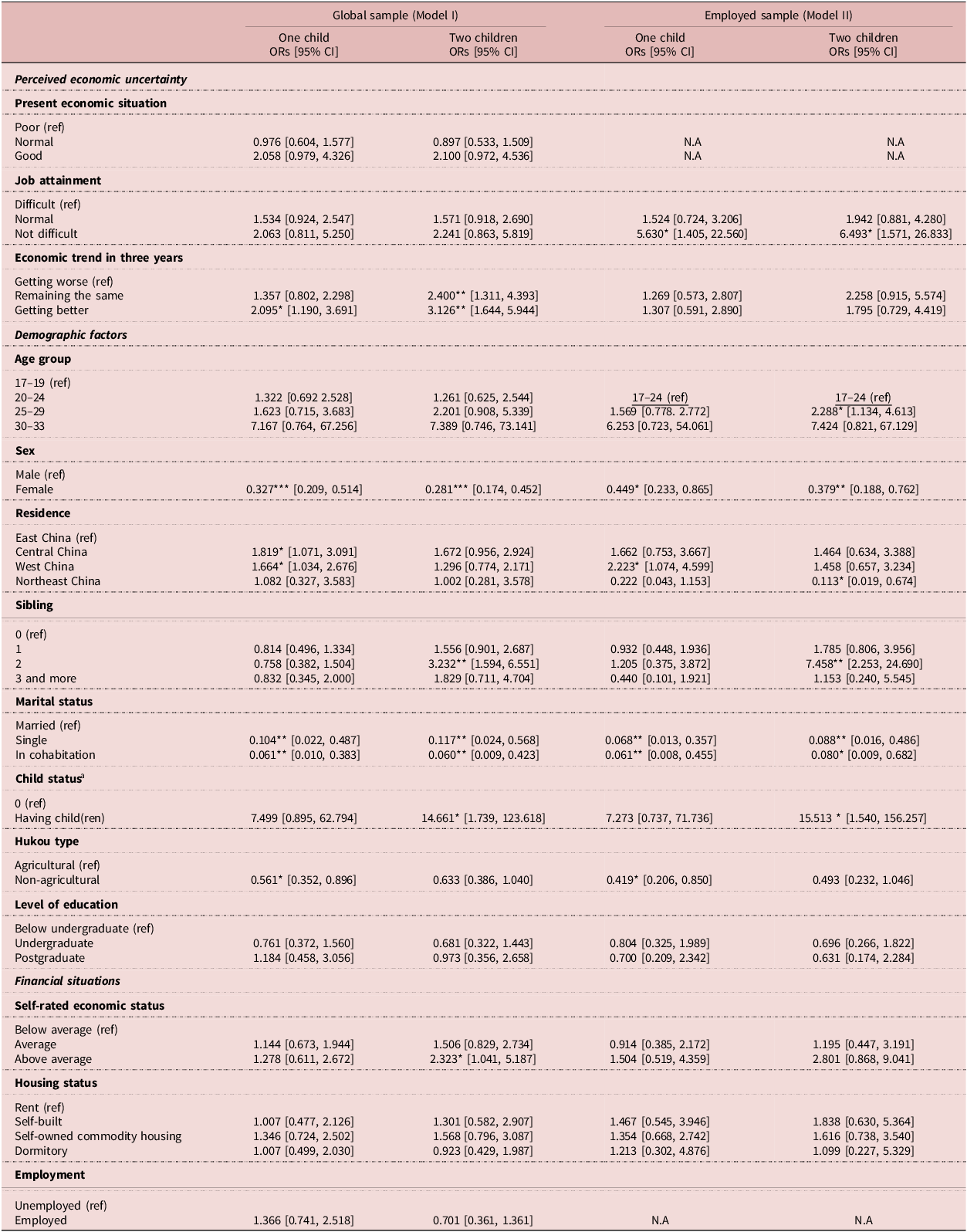
The reference category for this outcome variable is the intention of no child. For the entire sample, Model I (Table 4) shows that high expectations for the future economy were associated with active childbearing intentions. People who were optimistic about future economy shared 100% greater odds (OR = 2.095; 95% CI: 1.190–3.691) than their pessimistic counterparts to desire one child. In a similar case, young individuals who forecast an unchanged or better economy in three years were 1.4 times (OR = 2.400; 95% CI: 1.311–4.393) or 2.1 times (OR = 3.126; 95% CI: 1.644–5.944) more likely to desire two-children, respectively, than those with pessimistic economic forecasts. Being male was a significant predictor of non-zero childbearing intentions, as females were 67% (OR = 0.327; 95% CI: 0.209–0.514) or 72% (OR = 0.281; 95% CI: 0.174–0.452) less likely to long for one child or two children, respectively. In comparison to selecting childlessness, young people living in Central China (OR = 1.819; 95% CI: 1.071–3.091) or West China (OR = 1.664; 95% CI: 1.034–2.676) were more likely to plan for one child than those living in East China. Having two siblings increased the odds (OR = 3.232; 95% CI: 1.594–6.551) of a two-child family intention. Marital status worked statistically significant in predicting fertility intentions. The odds of desiring one child and two children of single persons were 90% (OR = 0.104; 95% CI: 0.022–0.487) and 88% (OR = 0.117; 95% CI: 0.024–0.568) lower than those for married respondents. People in cohabitation shared an identical trend with single people that they intended to have one child (OR=0.061; 95% CI: 0.010-0.383) or two children (OR = 0.060; 95% CI: 0.009–0.423) rather than staying childless. Having a child(ren) substantially increased the likelihood (OR = 14.661; 95% CI: 1.739–123.618) of desiring a family with two children, whereas non-agricultural hukou decreased the possibility (OR = 0.561; 95% CI: 0.352–0.896) of the one-child intention. Among the financial factors, only those with an above-average economic status were significantly more prone to the two-child intention (OR = 2.323; 95% CI: 1.041–5.187) instead of being childless.
Factors Associated With One- and Two-Child Intentions Among Young Respondents
Note: ***p < 0.001, **p < 0.01, *p < 0.05.
a Due to the requirements for cell counts, child status is recategorised as binary variable of childless and having child(ren).
Among those who were employed, a variety of variables influenced childbearing intentions. A lower level of perceived job-hunting difficulty suggested a noticeably higher likelihood for both one-child (OR = 5.630; 95% CI: 1.405–22.560) and two-child intentions (OR = 6.493; 95% CI: 1.571–26.833), compared to choosing childlessness. Young people aged 25–29 were 1.3 times more likely (OR = 2.288; 95% CI: 1.134–4.613) to embrace the two-child plan than younger people aged 17–24 years. Young working females were less interested in having either one-child (OR = 0.449; 95% CI: 0.233–0.865) or two-child (OR = 0.379; 95% CI: 0.188–0.762) family, indicating their greater preference for childlessness. Place of residence also influenced those who were employed. Living in West China indicated higher odds of preferring one child (OR = 2.223; 95% CI: 1.074–4.599), whereas those residing in Northeast China were the least likely to prefer two children (OR = 0.113; 95% CI: 0.019-0.674). Individuals with two siblings were much more likely (OR = 7.458; 95% CI: 2.253–24.690) to desire two children instead of no child, compared with their only children peers. Being married turned out a powerful predictor of fertility intention since being single or cohabiting drastically decreased the odds of desiring one child or two children. Moreover, having child(ren) produced a higher possibility of preference for a two-child family (OR = 15.513; 95% CI: 1.540–156.257) than other childless couples. Working people registered as non-agricultural hukou were less likely (OR = 0.419; 95% CI: 0.206–0.850) to desire one child than being childless. Educational level and housing status were not significantly associated with fertility intentions for either group.
Discussion and conclusions
This study investigated how the value young people put on fertility and further intentions are influenced by their expectations for the economy and the labour market. It examined the demographic and socioeconomic factors underlying childbearing preferences and the links to perceived economic uncertainties.
First, there was a clear relationship between economic uncertainty and the need for the experience and intentions for having children. Those with optimistic expectations for the future economy and labour market were more favourable toward childbearing and childrearing and reflected more possibilities in having a child. This key finding is consistent with studies in other societies (Anelli et al. Reference Anelli, Giuntella and Stella2024; Dantis and Rizzi Reference Dantis and Rizzi2020; Gozgor Reference Gozgor2022; Sobotka et al. Reference Sobotka, Skirbekk and Philipov2011). For the young overall, their attitudes towards economic trends turned out to be significant in predicting the value they placed on having children or their childbearing plans. However, for those who were employed, apart from the macroeconomy, competition in the labour market contributed to their individual/family future life decisions. This may be because employment uncertainty and potential job loss are much more pressing than economic downturns for these individuals (Gatta et al. Reference Gatta, Mattioli, Mencarini and Vignoli2022). Under the influence of subjective well-being, young people’s family beliefs and intentions fluctuate (Vignoli Bazzani et al. Reference Vignoli, Bazzani, Guetto, Minello and Pirani2020).
Growing up in a climate of small families and individualism, childbearing values among the young in China tended to converge, regardless of their different demographic characteristics. Unless under certain conditions in the analysis, the common variables used in fertility studies, namely, age, place of residence, hukou type, and educational attainment, worked marginally in predicting the childbearing values and intentions of the young. In terms of the need for childbearing and childrearing experience, age group, place of residence, hukou type, and education level were not statistically significant, reflecting the convergence of young people’s recognition of the value of childbearing. When it came to fertility intentions, education did not make a difference. Young people living in the central and western parts of China were more likely to have a child than those in the east, whereas those who worked and lived in the northeast were the least in favour of the two-child plan. One possible explanation is the fact that the northeast has been among the areas with the lowest fertility in China for several decades (Hou Reference Hou2018; Sun and Yu Reference Sun and Yu2021). Retrospectively, the Northeast has been the high-performing area under the family planning policy. As evidenced by fertility values and intentions, depressed socioeconomic development in recent decades has been regarded as another factor driving fertility traps in the Northeast (Hou Reference Hou2018). Simultaneously, the lower intention to have children of people from non-agricultural households is consistent with previous studies, as people with agricultural hukou are more influenced by traditional norms (Feng Reference Feng2010; Reference Feng2020).
In addition to the abovementioned variables, a set of demographic and socioeconomic predictors was identified as influencing young people’s childbearing intentions. Sex was among the most powerful indicators. The values and intentions for having children were less favoured by young Chinese women than by men, and the two-child plan was less acceptable than the one-child plan. This finding coincides with other research on young Chinese women (i.e. Du and Dong Reference Du and Dong2013; Ji et al. Reference Ji, Wang, Liu, Xu and Zheng2020; Lan and Kuang Reference Lan and Kuang2016; Li and Jiang Reference Li and Jiang2019). In recent years, young women in China, particularly in urban China, have shown increasing reluctance to bear a child for fear of the ensuing family responsibilities, as men’s absence in childcare is still common. Sex equity in the private sphere (family) has proceeded much slower than that in the public sphere (education and labour market), producing a paradox for young women with higher expectations of sex divisions within the family (Zhou Reference Zhou2019). This reluctance may be complicated in the presence of perceived economic uncertainty. The decrease in nuptiality and fertility may continue until better solutions and progress in sex equality are observed.
Marital status and current child status played vital roles in childbearing-related issues. Compared with married persons, those who were single or cohabiting were less likely to agree with the need to have children, and their willingness to have children was rather low. The results indicated that there was little difference in childbearing values and intentions between young people who were single and those cohabiting. This situation is significantly different from that in Western societies. Childbearing within cohabitation has increased throughout Europe (Perelli-Harris et al. Reference Perelli-Harris, Sigle-Rushton, Kreyenfeld, Lappegård, Keizer and Berghammer2010) and the proportion of fertility outside of marriage has also increased sharply. In 2018, extramarital births outnumbered births within marriages in eight EU Member States, including France (60%), Bulgaria (59%), and Sweden (55%) (Eurostat 2020). Marriage and childbearing are considered separately in many European countries. However, in China, young people continue to connect childbearing with marriage (Ji et al. Reference Ji, Wang, Liu, Xu and Zheng2020; Yang Reference Yang2019), suggesting the importance of a legal marriage and becoming a permanent partner in their minds. Other East Asian countries, such as Japan and South Korea, reflect similar situations. Despite the increasing trend in premarital cohabitation, it is unlikely to alter the rigid order of marriage and childbearing in Japan (Fukuda Reference Fukuda2020). Out-of-wedlock births in South Korea increased from 0.6% in 1997 to 2.1% in 2011, which remains a very low figure (Jones Reference Jones and Dudley2018). Based on this study, cohabitation may only be an option for living arrangements, instead of a potential substitute for marriage. In China’s family culture, marriage is a prerequisite for conception (Ji et al. Reference Ji, Wang, Liu, Xu and Zheng2020; Yang Reference Yang2019). From this perspective, as long as the marriage rate falls, the fertility rate will fall as well. However, the fact that marriage and childbearing are so closely linked in China may result in a default situation: if an individual has no intention of getting married, then he/she will decide to be childless and vice versa. In this loop, staying single and remaining childless are rationalised.
This study also found that those who were better off were more likely to agree with the importance of having children and were more willing to do so. Specifically, the desire for a second child was significantly affected by the self-rated economic level and was much stronger than that among people at lower economic levels. House/flat ownership markedly affected young people’s perceived need for having children, but did not statistically affect their plans to have children. This may imply that having one’s own property could indirectly influence childbearing plans and predict young people’s beliefs and opinions about children. For Chinese families, housing is closely related to educational resources for children (Feng Reference Feng2020; Ji et al. Reference Ji, Wang, Liu, Xu and Zheng2020). Therefore, this could become an indicator of young people’s parenting philosophy or a weakening of attention and expectations on children’s education, in contrast to their parents’ generation.
Overall, the study findings imply that economic uncertainties for the future and the accompanying employment uncertainty are key factors influencing perceptions of the need for childbearing and childrearing among the young in China. Good economy now or in the near future increases the value that young people put on childbearing, making childbearing a necessary life experience for them. In terms of fertility intentions, perceived economic uncertainty in the future contributes more significantly. Optimistic forecast of future economy greatly increases the intention of having two children. Difficulties in acquiring a job make a difference in fertility intentions of employed young cohort. In a word, this study contributes to the current understanding of the perceived economic uncertainties and young people’s views on having families with children and fertility intentions in China. The narrative framework of economic uncertainties is under-explored in China’s case while this study attempted to extend its use to East Asian countries. Simultaneously, a great share of recent studies on China’s fertility only targeted people aged 35 and over based on the mainstream pathway on investigating second or more births while young cohorts’ views and behaviour have been overlooked. Therefore, this study adds empirical evidence to narrative framework of uncertainties, as well as fertility studies on young cohorts. The analysis also reflects that economic uncertainties are effective indicators to further used in studying young people’s fertility intentions and plans.
On top of this main contribution, this study also adds empirical evidence to exploration of Chinese young cohorts’ socioeconomic status, including cohabitation and house/flat ownership. Because of the effects of other socioeconomic factors, young people share different images of the future economy and family. Their narratives of an uncertain future shape their decisions regarding life course events, thereby influencing future fertility. Thus, assisting young people in gaining a sense of security when faced with social uncertainty is critical for the government if a fertility rebound is still expected. This study has potential limitations. On the one hand, the value of childbearing and fertility intention could be better measured if a set of relevant questions is complemented in the questionnaire. On the other, although most Chinese young people use online services now, it is possible that the sample pool of the data collection platform can be biased due to certain people’s limited online participation. Increasing the coverage and representativeness of young people should be given further thought in the future.
Funding statement
This research was supported by a Ministry of Education (China) Humanities and Social Sciences Research Project under Grant number: 22YJC840022.
Competing interests
The authors have no conflicts of interest to declare.
Ethical standard
The authors assert that all procedures contributing to this work comply with the ethical standards of the relevant national and institutional committees on human experimentation and with the Helsinki Declaration of 1975, as revised in 2008.


 Open access

