

1. Introduction
In June 2020, in the middle of the first COVID-19 lockdown in India, my close friend Natasha and I were incarcerated in Jail No. 6, the women’s prison of Tihar Central Jail in New Delhi, South Asia’s largest high-security prison. Arrested for our participation in the peaceful protests against the Citizenship Amendment Act 2019, we were falsely charged in multiple cases, including under the draconian Unlawful Activities Prevention Act (hereafter UAPA). Nothing could have prepared us for the first weeks in the lockdown prison as we were thrust into the “isolation cells” created to quarantine prisoners—what I describe in my prison notes as “The Demon Jail inside Jail.” It was inside an isolation cell in Ward 8 that I began furiously writing. Tormented by a crushing solitude while confronting the injustice of being accused as a “terrorist,” writing became a mechanism of survival. It is excerpts from these diaries that I return to for this paper.
By documenting the haunting struggles for life inside these isolation cells, I argue that underlying what was framed as a public health measure was an attempt to impose a de facto solitary confinement on the “bare lives” imprisoned in these cells. As per law, solitary confinement can only be imposed through a judicial order, which was not the case here. Simultaneously, during the first wave of the pandemic, all rights and provisions entitled to a prisoner under the jail manual came to be suspended without any form of judicial oversight. While the jail administration swiftly activated the more repressive aspects of and beyond the prison manual, the Supreme Court constituted High Powered Committees (hereafter HPC) imposed arbitrary and exclusionary criteria for determining which prisoners were to be eligible for interim release—who deserved to live and who were to be left to the deadly conditions of incarceration. In addition, multiple other changes were also instituted to prison rules during the pandemic—alterations that restructured everyday prison life and routine in ways that extended beyond temporary measures, entrenching intensified forms of discipline and surveillance. This paper primarily draws on experiences from the first two months of our incarceration that coincided with the first wave of the pandemic in India. What we witnessed during the second wave inside prison was devastating and shattering in ways that have not found translation in legal or social imagination, but this could not be addressed in this paper.
I suggest that these ethnographic insights into Tihar Jail’s isolation cells may be read as a microcosm of the broader shift towards increasing authoritarianism and the strengthening of the carceral state in India—where I draw on my personal experience of incarceration during the pandemic to illustrate the terrifying and dangerous shifts that were being introduced and experimented with by the state with regard to its penal policies. The pandemic had produced a moment of global rupture, exposing different fault lines across societies. In the context of Indian prisons, as I demonstrate through my paper, it laid bare a regime of deadly impunity—where penal experiments on life and death came to define the carceral regime. However, it is important to locate this impunity in the deep continuities of carceral violence and excess that mark the history of Indian prisons—where colonial legacies continue to be reproduced in post-colonial prison administration. As Baxi and Eckert remind us, “carcerality could be said to be the ever-present kernel of ‘majoritarianism’ in liberal orders.” The demographic reality of Indian prisons—disproportionately populated by undertrials from historically oppressed castes and religious minorities—manifests the core logic of this majoritarian legality that remained embedded within India’s liberal democratic framework. Custodial violence and deaths have not been aberrations but normalised practices of penal governance in Indian prisons, compounded by overcrowding, exploitative prison labour, and inadequate access to legal aid, healthcare, and sanitation (Baxi, Reference Baxi1982; Kalita, Reference Kalita, Tadros, Mader and Cheeseman2023). It is these long-standing continuities of majoritarian legalism that also created a context where measures such as a complete suspension of prisoners’ rights guaranteed under the jail manual could find easy introduction and, most severely, affect the lives of women prisoners marginalised on the axes of caste, religion, race, and sexuality (also see Purkayastha, Reference Purkayastha2025).
Notwithstanding these continuities, Hindutva also inaugurates a qualitatively distinct legal-political order, one that openly redefines law, legitimacy, and rule through the explicit project of establishing a Hindu majoritarian state (Jaffrelot and Verniers, Reference Jaffrelot and Verniers2020; Hansen and Roy, Reference Hansen and Roy2023). Baxi and Eckert highlight how Hindutva, now elevated to the raison d’état, “attributes a new legitimacy to the production of impunities, and novel spheres of bare life.” This transformation, they observe, becomes apparent in the routinisation of extraordinary security laws to suppress dissent, the enactment of legislation that unabashedly advances the Hindutva agenda and the institutionalisation of dual law regimes that grant majoritarian violence ever-increasing impunity while not only stripping marginalised groups of legal protections but actively criminalising their very existence—particularly Muslims, as well as lower caste, tribals and other religious minorities. Building on this, I contend that the pandemic-era prison becomes not just a site where old carceral legacies are reproduced, but also a laboratory where this emergent legal order is enacted and made visible in its most brutal form. The violence of the isolation cell, accompanied by the suspension of prisoners’ rights during the first wave of the pandemic, inaugurates a state of exception in which prisoners’ lives are classified by juridical categories that determine the “deservingness” of life itself and where violence and death come to vehemently entrench themselves into the carceral space with heightened impunity. Through life-stories of women prisoners who were forced to endure this regime and of those whose lives were lost to custodial abuse and neglect, I demonstrate how the designation of certain lives as “undeserving of life” was inextricably tied to the exclusions and hierarchies of Hindutva’s majoritarian project.
Finally, by offering thick descriptions of the experiences inside the lockdown prison during the pandemic’s first wave, I also seek to foreground how this new impunity and cementing of majoritarian legality come to be co-produced, fissured, and re-created by multiple actors inhabiting the carceral system. In these penal experiments, power is not only imposed from above but it is also dispersed and sustained through diffused everyday practices that reconfigure both the meaning and accessibility of law. This paper traces these processes of co-production across multiple sites—the judiciary, state bodies, and the prison administration—and through a range of figures within the jail itself, such as the Superintendent, Deputy and Assistant Superintendents, medical officers, legal aid lawyers, matrons, convict warders, and even co-inmates.
I interweave my prison notes with memories of incarceration, ethnographic observation, and conversation with fellow inmates—the narratives are filled with numerous minute details and interactions, marked by an intensity of feelings that together produce a visceral archive of survival, struggle, and loss.
2. The isolation cell in the lockdown prison
On 16 March 2020, the Supreme Court had taken suo motu cognisance of the issue of overcrowding in Indian prisons to prevent mass contagion. It directed the formation of state-level HPCs for the decongestion of prisons and to recommend the release of prisoners on interim bail/parole or furlough. In this order, the Supreme Court had also remarked that it is “pleased to note” that in certain states like Kerala and Delhi, isolation cells had been set up inside prisons as part of “preventive measures.”Footnote 1 Yet the Apex Court did not direct judicial scrutiny nor order inspections of these isolation cells. A prisoner quarantined inside an isolation cell was to be confined alone for 14 days, locked up 24 × 7, with no access to the basic rights entitled to a prisoner such as legal aid, phone calls, and time outside the cell. No one was allowed to go near the isolation cells or talk to inmates lodged in them. An isolated prisoner would sometimes not even be produced for their court hearings, which had mostly shifted online by then. This policy was followed for all “new entrants” to prison and also for older inmates showing symptoms of COVID-19, such as cough, fever, or cold, or for those who might have had to go out of the prison for court or hospital visits.
The first wave of the pandemic inside prison witnessed a complete suspension of the enabling features of the jail manual that guaranteed certain minimum safeguards to prisoners. All mulaqaats (prison visits) by lawyers, family members, and friends were stopped. Newspaper subscriptions were prohibited, and no clothes or books from outside were allowed to come in. The jail library and creche were closed. All educational, vocational, and recreational activities for inmates stood indefinitely discontinued. Even external inspection visits by judges or activities organised by NGOs were halted. There were many inmates who ended up being in a permanent state of quarantine, not allowed to leave their cells for weeks and months—like the co-accused in the case against us, Safoora, a young Muslim woman and student activist from Jamia Millia Islamia. She was three months pregnant when she was arrested in April 2020 and hence had to be taken for regular ultrasound check-ups to a hospital outside the prison. Safoora was put under perpetual quarantine, a handwritten notice pasted outside her cell by the jail authorities—“Nobody is allowed to talk to Safoora or enter her cell.”
For women prisoners, these isolation cells effectively marked an attempt at the imposition of solitary confinement in ways that directly contradicted established legal safeguards. Sections 73 & 74 of the Indian Penal Code (hereafter IPC) retained the colonial provision of solitary confinement. However, its duration was capped at no more than 7 or 14 days at a time, depending on the length of the sentence awarded, and it must be separated by mandated intervals. Various judgements in response to petitions by prisoners put in prolonged solitary confinement have also further limited the scope of solitary confinement by stipulating that it can only be imposed in rare and extraordinary circumstances as a form of rigorous imprisonment and can only be executed by prison authorities if there is a judicial order. In the case of Sunil Batra v. Delhi Administration (1978), the Supreme Court held that solitary confinement of the prisoners under Section 29 of The Prisons Act cannot be left to the whim and caprice of prison administration; it must be given as per the fair procedure and if the confinement is done in the absence of judicial appraisal prescribed, then it would be in violation of Articles 14 & 21 of the Indian Constitution. Nevertheless, prison administrations across India have continued to arbitrarily deploy extended solitary confinement as an instrument of carceral discipline, even on undertrial prisoners, often couched in other variants such as “separate” or “cellular” confinement or “safe custody”.Footnote 2 These pre-existing authoritarian practices thus laid the groundwork where solitary confinement in the form of the isolation cells could be seamlessly introduced into the lockdown prison and be justified as a measure necessitated by the “extraordinary” circumstances created by the pandemic.
How did women prisoners survive these isolation cells and survive this extreme form of incarceration and solitary confinement? What stories, emotions, screams, tears, and breakdowns unfolded inside these quarantine cells that came to be marked by fear, violence, suicide, and death? How did the inmates negotiate, challenge, and rupture these new regimes of discipline and punishment that had been instituted by the jail administration as a response to the outbreak of the pandemic? These are questions that I take up in this paper. While the prison officials would constantly reiterate to us that “everyone is in isolation,” the isolation cells became something far more sinister than a preventive health measure. From the perspective of women prisoners, they functioned as punitive instruments—mechanisms of intensified control, torture, and punishment inscribed upon our lives and bodies.
3. Cells covered with tiles: time and in/sanity
10th June 2020
I keep asking those outside the cell, what is the time? Someone said today that we can demand a clock in our cell, every cell is supposed to have one, that I should write an application for a clock. Somehow the thought of having a clock in the cell feels daunting, time is already passing so painfully slow. I don’t know if I will be able to bear ticking time.
11th June 2020
I feel so…angry right now. They torture you here, they deliberately delay & prolong things…They break you so bad, they strip you of all dignity and hope.
Maybe 9 PM
I lost my grip today. I had a terrible attack. It was different from a panic attack that I occasionally have. It was sheer anger. I lost grip of reality, time. I could not hear. I could just scream, I screamed and screamed and screamed, that this jail may crumble down from my screaming … I could not stop screaming. I felt if I screamed loud enough, these jails will disappear, that a new reality will appear… I think I will toy at the edge of insanity here all the time, maybe to endure this, we must be insane, be hysterical. Even if my daily calling comes through, I may be able to hold on, at least there would be something of the “other world,” something to look forward to…Having a phone call will be something stable, something to hold your mind with. It’s crazy, one worried about the world, one fought for the world, but right now the world has disappeared, one is just fighting one’s own mind, holding it desperately at the edge of sanity through the quarantine period…
The jail staff was really alarmed at my state. I could not hear them, I could not stop crying and howling and screaming, time had suspended. Somewhere I realised…I needed to take control. I cannot lose it. I rushed to the bucket of water and doused my head on it to feel where I am. By that time, matrons and my friends were at the cell door, my breathing was still heavy, my mind was still racing into explosion. One of the convicts, our ward munshi (convict warder), she grabbed my hands and started chanting, “D is a brave girl, D is very brave.” It felt like she does this often, she was calm, calmly reciting this almost like a chant. I returned, I returned slowly to reality, breathing heavy, but real. Maya (name changed) was holding my hand and still chanting. I could see Gul and Mishika (name changed) outside my cell and two matrons, I was still there. I had not managed to scream myself out of reality. My brain was not so powerful, it could not transcend. I must train my mind to transcend.
My breakdown scared the jail staff, though. There were multiple assurances that my phone call application will be looked into.
12th June 2020
I found it weird that cells are covered with tiles. Natasha had remarked on the first day that it was the oddest thing. I remember reading a Galeano poem about prisoners violently scratching their fingernails on the prison walls in insanity or developing a secret code language of scratching the walls, the fingertip language, maybe that is why there are tiles, so that the nails can’t scratch…
The ordeal of the isolation cell was a herculean struggle against time and one’s own mind to somehow keep a grip on reality through trauma after trauma. Pre-COVID, any new entrant into prison would be put in a barrack in Ward No. 8, which is the ward where prisoners were lodged for the first six months of their imprisonment. The company of other inmates would make the first weeks of prison life a little easier; they explain legal processes, jail life, and rhythms, and reassure you; there are shoulders to cry on, there are people to fight with and be distracted by. The isolation cell was the exact opposite—where a new entrant to prison was supposed to endure 14 days being locked up all the time, devoid of any company or communication. Yet, women thrown into these cells devised various ways to survive and to reach out to one another—they would talk loudly to the walls all day, cry, howl, or laugh hysterically, interrupting the eerie silence of the night. Often, I would hear inmates scream and try to speak to one another across cells until a matron on duty came by to shut them up. Others would sing songs, pray loudly, or incessantly ring the emergency bell. Adjoining barracks would put their TV on full volume so we could hear some music in our cells. I tried to pass the time by reading and writing.
The jail authorities could have worked to ensure a more humane quarantine experience for inmates that did not strip them of all safeguards provided in the prison manual. It would not have been impossible to provide quarantined inmates access to phone calls and legal aid, communication on provisions for interim bail, some time spent outside the cells, permitting listening to music or radio, access to writing and art material or counselling. As a result of various forms of resistance undertaken by prisoners that I elaborate on later, some changes did eventually happen. This attempt to impose a form of solitary confinement through quarantine measures could never become fully effective, as it was repeatedly ruptured by the actions of inmates.
We wrote endless applications demanding basic things—to be allowed a phone call, to be given clothes, even a bucket. Yet, it was ultimately my breakdown inside the cell that actually led to my daily phone call being allowed. Safoora, after many weeks of struggle, was able to win a small victory—for her cell door to be kept open during khuli ginti (open hours) in prison so she would not be overwhelmed by a feeling of acute claustrophobic suffocation. Even these little things made a huge difference. Similarly, after a long round of pleading and arguments with the Deputy Superintendent, even quarantined inmates were allowed to sit outside their cells and walk around a little for half an hour every day. This half hour of time to breathe outside our cells meant the world.
One of the most crucial things that helped inmates survive the horrors of the isolation cell were the daily rituals of forbidden interactions. Even though other inmates (who were not in isolation and could walk around the ward during open timings) were not allowed to go near the isolation cells, they did it nonetheless. They would steal little moments, sitting outside the isolation cells with their masks and social distancing, answering anxious questions, offering words of solace, and sharing a laugh. Sometimes, if we needed something—a soap to bathe with or a packet of milk from the canteen—they would slip it in through the rods of the cell door when a matron was not looking. I would have never endured the nightmare of isolation if it were not for the books that other inmates provided to me. The diary notes from that time exist because of the notebook and pen that another inmate had sneaked into my cell. Devoid of any contact with those outside, prisoners had only each other to hold through moments of extreme despair and uncertainty, and it is really these friendships of care and camaraderie, even if often fragmented and fissured, that made it possible to survive incarceration in the midst of a raging global pandemic.
The most absurd thing about these isolation cell rules inside the prison was how arbitrary they were, and how they primarily depended on what was convenient for the jail authorities. Natasha and I had pleaded to be lodged together in a cell for our quarantine. But the jail authorities refused to yield to our demands. Yet, as more and more new inmates started coming in and they ran out of isolation cells, they randomly started putting these new entrants into cells with inmates who were already in the middle of their quarantine period, exposing them to the very risks of the virus that the isolation cell was supposed to be protecting the inmates from. Thus, when faced with infrastructural constraints, the quarantine regime could be readily abandoned.
These contradictions also reveal how these isolation policies were not necessarily centrally orchestrated through top-down dictates, but they took shape through a series of improvised and arbitrary decisions taken by various actors across different levels of the prison and state bureaucracy. These fragmented interventions continually recalibrated the limits of what could be imposed—experimenting with how far isolation, control, and punishment could be extended. Yet, these efforts could never become absolute. They were persistently contested and disrupted by the everyday acts of solidarity, care, and resistance among inmates. In doing so, prisoners not only resisted the dehumanising logic of these quarantine measures but also reaffirmed their agency in the face of a regime that sought to erase it.
4. Silence, ghosts, and azaadi: Ward No. 9
Throughout my quarantine period, I would keep telling myself that if Gulfisha could conquer and survive being isolated in a cell in the dreaded Ward No. 9, I could survive this too. Endearingly called Gul, she is also an accused in our case and was arrested two months before us—a young Muslim woman, a first-generation learner and educator from North-East Delhi who had participated in the protests. Gul had a mild fever when she was brought to prison. As a result, she was sent to Ward No. 9, a high-security ward that had now been transformed into a hyper-isolation ward for those coming into jail with symptoms of the virus. For the first few days of her isolation, Gul was the only person in the entire ward, all alone. When she had narrated to me the experience of her quarantine, as she counselled me sitting outside my isolation cell, I had been overwhelmed with a simultaneous feeling of extreme anger and fear. I remember her telling me, still shuddering as she spoke, “It was walls, everywhere you looked, there were walls, no windows, no sunlight, only walls and a silence, a never ending silence.”
Finally, after a few days, Gul had a companion in Ward No. 9—Mishika (name changed), a young woman in her early 20s, who was lodged in one of the cells. She had been arrested in an NDPS (Narcotic Drugs & Psychotropic Substances) case and had a fever too. Gul was relieved to have the company of another woman to share words and screams with. Poignantly, Mishika’s presence brought no relief. She was given such heavy doses of medication to manage her drug withdrawal pains by the medical staff that she would be in deep sleep most of the time. In fact, Gul’s fears increased. Sometimes, when Mishika would not respond to her, she would worry if Mishika was still alive.
It was the month of Ramzan when Gul was lodged in Ward 9. Praying to Allah and offering namaaz became her only solace. Overwhelmed with an irrational fear of ghosts, she would feel sleepy but force her eyes to stay open through the eerie silence of the night until it was time for the fajr namaaz to be offered. One such night, she heard earth-shattering screams. Gul was terrified. No matron came for a night round either. Later she learnt that on the intervening night of 26 and 27 April, Praveen, alias Kavita, accused of conspiring with her husband to kill her in-laws, had committed suicide in cell 17 of ward No. 8. The two other women quarantined in the cell with her woke up in the middle of the night to find their cellmate hanging from the ceiling fan above, and their screams reverberated through the entire jail.
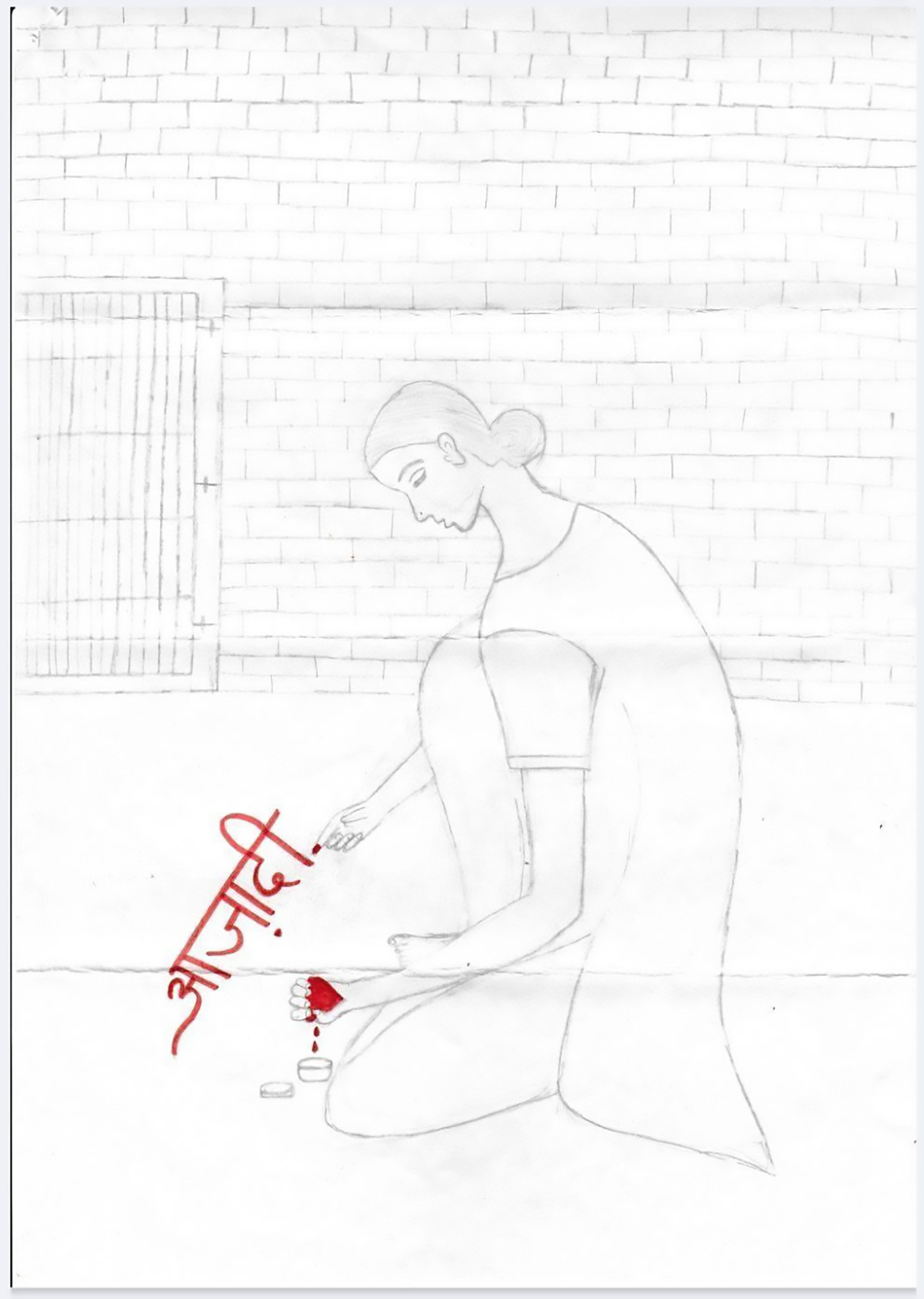
Gul had not even been informed that this isolation period was for 14 days—she believed that the isolation cell in Ward 9 would be where she would be imprisoned, however many years she might be incarcerated for. The isolation experience had a devastating impact on Gul. Many months later, as she drew this painting, she still had tears run down her eyes; it was no less than a miracle for her that she did not commit suicide or go mad inside that cell. To still hope for azaadi (freedom) when crushed in solitary confinement was extremely difficult, if not impossible, as represented in her heartbreaking sketch (see Figure 1). Somehow, a copy of Nelson Mandela’s memoir had reached Gul’s cell. She held the book very, very dearly; read and reread it as she tried to hold on to a thread of sanity and build courage to endure incarceration for the “crime” of exercising her constitutional right to protest. It was after nearly six long and unforgiving years that Gulfisha was finally released from Jail No.6 in January 2026 with very stringent bail conditions.
Drawing by Gulfisha, made in Tihar Jail No. 6 in 2020, depicting her experience in the isolation cell of Ward No. 9
The unnerving silence that haunted Gul, the hallucinations of ghosts, the tender prayers whispered into the night, the fear of whether her fellow inmate was still alive, her own struggles to hold on to life, and the terror of actually receiving the news of another woman’s suicide—all speak to how inside these isolation cells the spectre of death lingered as an ever-present possibility. The violence of these custodial experiments created a regime of impunity where, in the name of protection from and prevention of COVID-19, prisoners’ lives were subject to a state of extreme vulnerability and abandonment, trapped between precarious survival and annihilation. For Muslim women political prisoners, like Gulfisha and Safoora, these experiences of quarantine were markedly harsher than those endured by other inmates, underscoring the intersection of these carceral experiments with majoritarian logics of violence and exclusion.
5. The shrieking siren: Use of “minimum force” and the second lockdown
16 June 2020
9.15 AM
I had kind of dozed off, woke up to a crazy sound of an endless, howling blazing siren, which in my sleep first felt like many, many women howling and crying together. We switched off the TV, the siren blazing was intense enough to give you a panic attack, get your heartbeat & anxiety racing. This went on for almost half an hour. Now there is an eerie silence… We haven’t got any food since morning…
Reality feels so broken, so warped. If I was alone here, I might have lost it very soon.
9.30 AM
These horrible sirens have gone blazing once again. What is…happening?
When will this siren stop? Stop please … stop, I can’t take it, please stop, please someone get me out of here, please! The crows are so confused too, they are cawing madly in panic. What is the siren for? What is happening?
3.30 PM
Really horrible news is floating around in the jail. Everyone is still locked in. The inmates who come to deliver food are saying that around 10 people have been brutally beaten up by the jail staff. All foreigners who had protested yesterday for their COVID bail have been assaulted, someone’s head has been split into half, there is blood on the pathways. The Medical Room is full of injured inmates. Even male police were brought in to attack the protesting foreigners, most of whom are Africans.
A day preceding this diary entry, on 15 June 2020, Natasha and I had been shifted out of our respective cells into an isolation barrack with other inmates. Late at night, an entourage of matrons entered our barrack, full-body searched Natasha and me, and ransacked our few belongings. They yelled at us when we told them that it does not make any sense for them to be touching us and our items all over if we are meant to be in quarantine—once again highlighting the often farcical nature of these quarantine measures. The same thing happened with Safoora in her cell and Gulfisha in her barrack. Only the four of us had been targeted that night for this “routine search.”
We were told later by other inmates that on that same night, a few Black women prisoners had been brutally attacked by jail staff in their cells. They were being punished for protesting during the day with placards saying, “We are also human,” demanding that the provision of interim bail on account of the pandemic be extended to foreign prisoners as well. The next day, when a few other Black women prisoners had gone to that ward to enquire about the well-being of their friends, a reign of terror and violence was unleashed by the jail authorities while the deafening sound of the “emergency” siren reverberated loudly through every corner of the prison premises. The constitutional right to protest is not permitted inside prisons and, as per jail rules, is considered to be a serious offence that warrants what are called “major punishments.” Yet, this protest by the foreign inmates was not an exception. As soon as news of the pandemic started trickling into prison, there was tremendous panic among the inmates, especially in a context where there was very little information being made available to them. We came to know from other inmates that there were protests by prisoners inside different jails in Delhi demanding interim release, especially as the virus began to spread inside the prison and all mulaqaats came to be suspended. Everyone was terrified about their lives and health, including the jail staff. Fearing difficulties in the maintenance of prison discipline, the jail administration was also keen on some form of relief being provided by the courts towards the decongestion of prisons. It is thus important to note here that the guidelines for decongestion of prisons that came to be directed by courts were not solely an act of magnanimity by the courts but something that also arose from prisoners’ collective actions—stories of which never reached the outside world.
The HPCs, constituted as per the mandate of the Supreme Court, instead of affirming a principle of fundamental equality of all human life, instituted a juridical calculus that stratified life into hierarchies of value—prisoners were divided into juridical categories that classified whose life was worth protecting and who was to be condemned to the mounting risk of death within prison walls. In determining which “category/class” of prisoners were to be deserving of interim release, the HPC focused on the “severity” and “nature” of offences, length of sentences, and “other relevant factors.” Factors like age, gender, pregnancy, health, comorbidities, and other vulnerabilities were not prioritised as criteria for release (Baxi, Reference Baxi2022). Even when they did, they were not to apply to categories of prisoners who came to be completely excluded from any grant of interim bail. One of the groups who found themselves excluded were all foreign prisoners, irrespective of the offences they were charged with. Along with foreigners, prisoners charged under laws related to offences of child sexual abuse, rape, organised crime, corruption, drug trafficking, money laundering, terrorism, and those being investigated by the central government or special agencies were characterised as being not within the “consideration zone for being released on interim bail” (Delhi High Court, 2020). Undertrials like us, charged under the anti-terror law UAPA, thus also found ourselves excluded. The online functioning of courts meant that trials could not be held, further prolonging incarceration for undertrials who did not meet the HPC criteria for release.
After having participated in protests together with Indian inmates demanding release, the foreign prisoners were immensely dejected to know that the provision of interim bail/parole stood completely denied to them, while many of their Indian co-inmates began to be released from prison. They submitted a memorandum to the HPC to consider their demands, hoping to be heard, but did not receive any response. It was as a last resort that they decided to hold a small protest inside the prison premises. To ensure that no one else dared to raise their voices, a collective punishment was meted out to all prisoners. The entire jail was put under “lockdown,” everyone was to be locked inside their cells 24 × 7, and all phone calls were indefinitely suspended. It was clear that this was not a lockdown for COVID-19; it was a lockdown imposed to suppress dissent and obstruct the circulation of information beyond the prison walls. Anyone the jail authorities suspected might speak out in court, including us, was not produced for our scheduled online hearings. Instead, the judge was told that the undertrial prisoner is displaying COVID symptoms and is in isolation. This episode of custodial violence against Black women prisoners brought to the fore the extraordinary impunity that could be exercised by the jail authorities during the first wave of the pandemic as a result of the blanket suspension of prisoners’ rights guaranteed under the jail manual. With the suspension of physical court hearings, no external inspection visits inside prisons, all mulaqaats, phone calls and postal services stopped, how was one to relay information of this brutal custodial torture to the outside world?
Worried after not hearing from us for a few days, our lawyers approached the High Court with the plea that, since all legal visits stood suspended as a result of the pandemic, alternative mechanisms of communication through video conferencing be initiated by the jail authorities. As a result, we were able to speak to our lawyers and inform them about the violence by the jail administration, which came to be widely reported in the media. In the court hearing, the state counsel completely denied the occurrence of violence and claimed that the suspension of phone calls was a “connectivity issue” (Singh, Reference Singh2020). It was only when the judge directed that the jail authorities file a status report that they finally admitted that an “untoward incident” had occurred, and “sensing trouble and having no other alternative, an alarm was sounded in the jail around 8.30 am, reinforcements were called and these inmates were physically controlled by minimum use of force” (Singh, Reference Singh2020). That “the phone facility of inmates was temporarily restricted” to “curb the movement of inmates and their gathering” (Singh, Reference Singh2020). The report mentions that the jail authorities tried hard to counsel the protesting inmates about how “their cases do not fall under the prescribed criteria for consideration for grant of bail” but they did not seem “amenable to reason” (PTI, 2020). The so-called “unreasonable” behaviour of the Black women prisoners was thus presented as a justification to warrant the use of violence, while the racist principles underlying their exclusion from those deserving life and health could not even emerge as a matter of judicial concern. It is pertinent to mention here that the majority of imprisoned foreign women we met were not white. They were primarily working-class women from countries in Africa and Latin America, mostly charged under the stringent NDPS Act that makes bail very difficult.
As a result of this legal intervention, phone services were resumed inside the prison after a week, even as the lockdown restrictions continued. The behaviour of the jail staff also changed from initially trying to intimidate us to being more careful about us—they now knew that our lawyers had our back—a privilege of our caste and class locations. Our presence was an anomaly inside prison, composed primarily of those from disadvantaged backgrounds without resources to hire private lawyers, dependent solely on the extremely slow and frustrating legal aid system. While so-called normalcy was restored for other prisoners, the Black women prisoners continued to face harassment. They were thrown into a “punishment ward,” where they were to be locked inside their cells 24 × 7, no one was allowed to interact with them, and they were not allowed any access to phone or canteen services. To us, it was devastating that despite the jail authorities admitting to the violence inside prison, once phone services were restored, no independent judicial enquiry was ordered into the matter. What was claimed to be “minimum force” in court had led to many serious injuries—one of the inmates who was attacked, Ugandan national Jesca Sarah Kafeeco, died a month and a half later while undergoing surgery for an injury that she had sustained during this attack (Commonwealth Human Rights Initiative, 2020). The use of male police force, even if permissible under Delhi Prison Rules 2018 (vaguely referred to as “reinforcements” in the status report), was an extreme measure, which was unheard of in the women’s prison.
The incident also laid bare the internal fissures within relations among inmates. Interactions between foreign and Indian inmates and staff were often strained. Particularly with regard to Black women prisoners, who were called by the derogatory term “hapshis,” there was a simultaneous interplay of both fear and prejudice. Imprisoned far away from their home countries with very minimal or non-existent legal support, one of the key survival mechanisms for the foreign prisoners was a sense of unity and collectivity among themselves. Whenever disagreements or fights would erupt among prisoners, the foreign inmates would gather together as a group. This was deeply resented by the Indian prisoners. While most Indian inmates believed that the violence was “bad”, a section also felt that finally the “domination” of foreigners had been checked. They would complain and blame the foreigners’ actions for the lockdown, whose consequences were now being borne by all prisoners (see also Chitkara and Kumar, Reference Chitkara and Kumar2020; Bandyopadhyay and Mehta, Reference Bandyopadhyay and Mehta2022, p. 202; Baxi, Reference Baxi2025, pp. 11–12).
While both groups had stood together to demand interim bail in light of the pandemic, solidarity between them towards challenging this incident of custodial violence could not be achieved. The brutal repression by the jail administration had, of course, also terrified everyone, making any form of collective action extremely difficult. Different actors in the prison hierarchy began to draw legitimacy from this incident to assert their powers in various little everyday micro-contexts. In the days following the incident, most matrons on duty started behaving in harsher and more authoritarian ways. On the day of the incident, when our munshi (convict warder) had come to serve food, she announced to us, “The foreigners were attacked on court orders. The DG (Director General of Prisons) has said that anyone who does not listen to staff or munshis will henceforth be dealt with like this.”
From the matrons who arrived to threaten us to the deployment of male police officials to assault Black women prisoners to the increased aggression displayed by jail staff and convict warders in the lower ranks of the bureaucracy, the prison administration’s responses to the emerging discontent exemplified a series of fragmented, ad hoc penal interventions—manifestations of discretionary excess through which various actors within the carceral system continuously tested the thresholds of permissible violence as they sought to restore “order.” But this was not merely a reassertion of a disrupted status quo; rather, these experiments functioned as mechanisms for instituting a new carceral order—one marked by enhanced impunity and authoritarian control over prisoners’ bodies, movements, and everyday lives.
A key change in jail rules that happened after this incident and the subsequent lockdown in prison was the prohibition of “intermingling”—all inter-ward movement of inmates came to be stopped. For prisoners who had been around for a long time, this was a huge shock, and the confinement to just one’s ward became a highly suffocating and shattering experience. It became an everyday struggle for fresh air, light, and a sense of space. This was also justified as a necessary measure required to prevent and regulate the spread of COVID-19. The restrictions on intra-prison mobility for inmates continue to remain even now—in fact, even stricter rules to prevent intermingling and association time between prisoners have been brought in for maintaining “better” discipline inside prison. Any prisoner going outside the ward is issued a ticket to keep a strict record of their movement inside prison—a mechanism that is likely to be replaced by a biometric system in the near future. When the library reopened after several months, prisoners were no longer allowed to sit and read there to limit association time between those from different wards—they were only allowed to borrow books and leave. Matrons on duty now have body cameras that they can turn on and off as per their whim to record instances of “misbehaviour” by inmates.
This episode and its aftermath illustrate how the pandemic became a critical juncture for the reconfiguration of carceral authority. What began as an “emergency” response to a protest inside prison was transformed into an opportunity for experimenting with new techniques of discipline, surveillance, and control that massively expanded carceral power. These repressive measures were not withdrawn after the lockdown was lifted but instead became sedimented into the everyday life of the prison, completely restructuring the experience of incarceration for women prisoners. In tracing these shifts, this section demonstrates how the suspension of prisoners’ rights provided the conditions for consolidating impunity inside prison, where gendered and racialised forms of violence could be inflicted without facing any accountability. While juridical attention was narrowly focused on the issue of decongestion, those excluded and left behind inside prisons—particularly marginalised working-class women prisoners—remained invisible and outside the horizon of judicial concern. This judicial apathy and neglect were central in enabling the emergence of this intensified regime of carceral power. These exclusions were not incidental but constitutive: they exemplify how the juridical and carceral apparatuses converged during the pandemic to normalise new forms of abandonment and violence that render visible the strengthening of majoritarian legality under Hindutva.
6. Puri raat upar dekhti reh gayi: Death and freedom
21 June 2020
…Fiza is such a nice name…She had not been able to sleep at all night, “puri raat upar dekhti reh gayi (all night I kept staring up),” “naso me bohut daard ho raha hai (my nerves are paining severely),” the doctors gave her many pills to numb the drug withdrawal pain, she was unsure, the old swag lady, screamed from the opposite cell, “lele, dard kam ho jayega (take them, the pain will reduce),” it was a trusting voice. It’s difficult to trust the jail authorities, you are suspicious of them, especially their pills. It’s quite common practice to give prisoners sleeping pills, when anyone complains or is under mental or emotional trauma. It’s dangerous – the older inmates warn you as soon as they can to reject those sleeping pills, to not numb oneself, to not grow dependent on them. “Isolation” is increasing the need for these pills even more, but yet people are somehow persisting through…
29 June 2020
Fiza had not been doing well at all. She had been struggling very badly with time in the isolation cell, “mere se nahi kaat raha hai time (I am not being able to pass time)” she would tell me repeatedly, every time I would pass by her cell on way to fill water or something else, she would call out to me. Talking wasn’t easy, every time some matron or munshi (convict warder) would come by and scold you, ask you not to talk or be near the quarantine/ isolation people. To lock women up like this, mostly alone with no access to counselling, phone calls or legal services, for 14…days is just inhuman, anyway, prison life is harsh, to come and have to endure this.…
It was Swag GFootnote 3 who saved Fiza that afternoon. In the morning, I had spent almost an hour outside Fiza’s cell, talking to her, telling her it will be ok, that her bail will happen, she will have to be patient, that these 14 days are extremely difficult, but they too shall pass. She had said how she feels like banging her head on the walls or hanging herself. I thought I had talked her out of it…I nonetheless informed the staff that they keep an eye on her, that mentally she ain’t doing well, that she needs attention, she has been crying and breaking down incessantly. The insensitive shithole that this place is the responses that I got were “kuch logo ko drama karne ki aadat hai (some people are in the habit of doing drama).
That afternoon, during bandh ginti (closed timings), Fiza started tearing apart with her teeth the new bedsheet that she had just been given. The inmate Sheela (name changed) on the opposite cell was curious and asked her what she was up to, she smirked and signalled that she wants to hang herself. Sheela found the declaration absurd and thought she was joking, the black mosquito net through the door also means that you cannot see someone’s expressions exactly. Sheela kind of dozed off.
Natasha and I had court hearing for our 50/20 case, so a matron had come to fetch us from the barrack, when someone started ringing the emergency bell incessantly in alarm. It was Sheela, she could see Fiza hanging. Vinesh (name changed), the nice matron, rushed there, opened the door (usually matrons take time to find the right key, but she opened immediately). Thankfully she had unlocked the barrack to let me and Natasha out… On hearing screams, I ran towards the cell and there was Fiza hanging from the moving fan. Babita was holding her up so that the knot did not tighten on her neck…Thankfully Swag G also entered behind me and she immediately jumped up on the divider to untie the knot, I rushed to the chakki to get staff & a pair of scissors. By the time we reached back, Swag G had managed to unknot, recalling that moment she said how it was really difficult to undo the knot, she would untie something and the cloth would swirl again to the moving fan—“Jab maine ishu mashi ka naam liya tab jaake fanda khula (It was only when I took the name of Jesus did the knot open).” Fiza kept swearing at her and asked her not to interfere. She kept screaming at the matron to let her die. As Swag G, fell down with Fiza, she said “abhi toh tumne bacha liya, baad me kaise bachaoge, raat me bhi fasi lagaungi (You managed to save me now, but how will you save me later, I will hang myself at night too).”
An entourage of matrons and medical staff, AS (Assistant Superintendent), a few slaps on Fiza’s face. Then I lost it. I screamed at the matrons not to hit her, that she had been showing signs and not been OK for the last 3 days, it wasn’t her fault but the staff’s negligence which has led to this. One of the matrons had the… gall to say that Fiza didn’t intend to die, she was doing drama. She was rushed to the MI (medical inspection) room by this delegation. I was quite shaken. Did we all just somehow, by a few minutes and a stroke of luck, escape witnessing death? It was just sheer coincidence that Vinesh had come to fetch us for court; otherwise inmates can keep ringing the emergency bell, and no-one shows up at all.
1st July 2020
…She (Fiza) is still struggling with time, despite her mother being with her. But the girl is sharp, she knows how to have her way. The staff doesn’t exactly know how to handle her. They try to intimidate her, but are also scared after her suicide attempt. Fiza also refuses to wait, when something comes to her, she obsesses over it, she cries, she calls out to us, she calls the matrons, she demands immediate attention and hearing, which often doesn’t happen given this shitty place, but some things which I had not seen earlier are happening—someone comes by to ask all new mulaizzas (undertrial) for first call, the DS (Deputy Superintendent) is also making a round, the govt. lawyer also comes by, although the woman lawyer whom I saw “counsel” was mostly useless, as someone said today, “koi kaam ki nahi hai, bas tassali dene ke liye aa jaate hai (she is of no use, just comes by to reassure)” Fiza was asking updates on if that woman lawyer who had filed her bail as she had promised, no-one told her…
Today she was insistent about being allowed another try at her first call. After her suicide attempt, the jail staff did get her father’s number from the IO (Investigating Officer), but it was unreachable. She and her mother both were crying. The jail staff again did their usual nonsense, the DS (Deputy Superintendent) visited her a while back, hope something has worked out…The jail staff fail to break her completely. Yesterday afternoon, when she wasn’t given the extra rice she had asked for, she threw out of her cell the food packets given to her and refused to eat. The doctors got worried as she did need to take food for her daily dose of strong medication. The staff tried to scold/intimidate her, but she did not yield. Her mother mostly stays silent the whole time.
That afternoon when Fiza had tried to kill herself, she was seeking freedom. She thought if she was saved, she will threaten the matrons to discharge her. If she died, she would fly off from cell no. 7 as a ghost: free and haunt all those who have wronged her, including the jail staff. She did realise later that even if she were to try to kill herself again and again, even if she killed herself—they would not let her go. The matrons tried to tell her that even if she dies, her ghost won’t be able to be free, those who die in jail by suicide, their ghosts linger in their cells, they cannot leave, how inmates and staff continue to see the ghost of the woman who killed herself in Cell 17. That she keeps sitting there, crying, a pale ghost, that is why no new mulaizza (undertrial) is kept in that cell or the adjoining ones if possible.
After the attempt at taking her life, once Fiza was brought back to the ward, she was sitting on the floor in the middle of the veranda in that long frock that Chaya (name changed) had just given her that morning. She sat there talking in the most animated manner, catching everyone’s attention with her witty remarks, talking almost incessantly, an almost rapturous performance, every now and then she would give a hysterical laugh, she was mostly laughing at herself, her life stories and habits and making others laugh too. The matron was asking many questions, egging her on, almost for a show, an amusement. I sat there in absolute amazement, that this bundle of wit had tried to kill herself just a few hours back. Swag G, in her characteristic style, asked her, “ek baat bata, tumne chalte hue fan me kaise fasi laga di (tell me one thing, how did you manage to hang yourself from a moving fan)?” In her animated style, Fiza enacted how she put her index finger on the circle of the fan, it stopped for a brief moment when she swung the cloth around it. Her animated chirpiness both relieved and disturbed me deeply. I could barely say anything the whole time. I could not laugh at the jokes either. It was too twisted for me.
It was during this performance that I noticed all the marks on Fiza’s body, which was soon exhibited again and again as a response to the matron’s questions. This was someone who had played with her life many, many times, each scar a mark of a willing or unwilling survival. Her left hand and leg were full of deep scars from attempts at cutting herself with a blade or knife or cigarette butt marks. She said she didn’t harm her right hand or leg because she wanted to keep one side of her body clean, to remember herself.
The unscarred right side of her body, which made her remember herself in this tarrying with death in custody, was illegible to prison authorities. The prison system was also equally immune to the fact that Fiza, a young Muslim woman from North East Delhi, arrested for theft, was easily eligible for the grant of bail under the criteria set by the HPC. Yet, because when she was thrown into that isolation cell, she was denied access to legal aid or a phone call, she had to undergo a gruelling experience where she came to risk her very life. For someone like Fiza, with no access to any resources, tarrying with her life was the only resource through which she sought to escape or resist the horrifying conditions of prison. Not only did she manage to yield concessions like phone calls and legal aid counselling for herself but also for other quarantined prisoners.
Fiza eventually did get bail, but she was re-arrested in another case and came back to prison after a few months as a “repeat offender.” She was someone we held very dearly; the jail authorities always struggled to handle her and her irreverence. At some point, she was transferred from Tihar to the women’s prison in Mandoli Jail in Delhi. After we were out on bail, we received the devastating news that Fiza attempted suicide again in Mandoli Jail, when she was locked up in a cell alone as punishment for an act of indiscipline. This time, she did not survive. Fiza’s death cannot be seen as an aberration; her life’s end is a searing testimony to the brutal impunity that characterised the prison regime during the pandemic under the Hindutva state. In 2020, the year we came to meet Fiza, the total number of reported deaths in Indian prisons had risen to 1887 from 1764 in 2019 (Commonwealth Human Rights Initiative, 2022). Of the total deaths, 1642 were reported as emerging from “natural causes,” and 189 were from “unnatural” causes like suicide, firing, murder by inmates, and assault by “outside elements” (NCRB, 2021, p. 178). Roughly 56 deaths occurred due to reasons stated as “yet to be known” (NCRB, 2021, p. 177). There had been an 18.1% rise in the deaths by so-called “unnatural” causes (Baxi, Reference Baxi2022).
In the context of the pandemic prison—where prisoners’ rights were curtailed, judicial oversight vanished, and majoritarian legality found increasing legitimacy under Hindutva—the carceral state was further emboldened to decide whose lives deserved protection and whose could be easily discarded. Fiza’s life came to embody precisely the kind of existence that could be extinguished with complete impunity by the jail administration without much fear of legal action or institutional accountability. Fiza had escaped an abusive marriage when she was very young. She had started consuming drugs with her husband—a habit she could not leave even after she left him. For the jail authorities, a working-class Muslim woman drug addict was not a life and voice that was worthy of any attention—she was not only Muslim, she was also a “bad” woman. During our prison time, we met many women like Fiza—who were as much prisoners of structural oppression as they were “criminals” under the ambit of law—where they came to be in transgression not just of the law, but also of what society deems as being a “good” woman.
As per the juridical categories set by the HPC, Fiza’s “crime” was not classified as “severe” or “heinous,” she was not excluded from the grant of interim relief, yet she had to die inside prison. Qualifying for “deserving” of life under the HPC framework did not shield her. The identities and intersections that marked Fiza’s life—Muslim, poor, a woman, and defiant—render her story emblematic of how the lockdown prisons under Hindutva operated, transforming prisons into laboratories where existing structural inequalities of caste, class, gender, and religion were weaponised with renewed force, while eroding any possibility of redress or accountability. The prison thus functioned not only as a site for disciplining political dissidents (many of whom were already disproportionately Muslims, targeted under “exceptional” laws), but also as a space where marginalised women were doubly punished: cast as “bad women” and stripped of legal safeguards, subjected to violence, and treated as individuals whose lives held no value.
Any redressal Fiza sought from the jail administration could only be seen as “drama” of a malingerer. The carceral system had no place for recognition of the grave mental health struggles and systemic injustice that would have defined the life of someone like her. Fiza may not have been subjected to direct physical assault, as some of the Black women prisoners were, yet her story lays bare the inherent punitive and coercive intent of these isolation cells. Her repeated confinement in these cells, where she had struggled tremendously to survive and already attempted suicide once, constituted a form of custodial negligence and cruelty that pierces through what would have been classified in prison records as an “unnatural death” caused by suicide. I write about Fiza with her real name. One afternoon, when I was writing my diary in jail, Fiza had asked me, amused, “aap itna kya likhte rehte ho (what do you keep writing all the time)?” I had told her that I write so that I can remember all the stories of life and struggle of the women I am meeting in prison, maybe someday I will write a book about us, “hum guneghar auratein (we criminal women).” She laughed loudly and said, “badhiya! Fiza chorni ke baare me zarur likhna (wonderful! do write about Fiza, the thief ).”
7. A heart attack: This is normal in jail
28th July 2020
8.30 AM
It was her plaster that had first made me walk up to her to talk. I wanted to know if her injury was caused by the jail authorities. She was the first person from whom we had heard the whole account of what happened. With Jessica, we had sat and spoken in length, she wanted to talk to a judge, to a lawyer about the brutality of what she faced, about her pain, her suffering, she wanted justice, she hoped her truth will be heard. That was the day when notices had been put up in the wards about VC with lawyers, we had told her about it, explained the procedure. She hoped her lawyer may be able to do something once he knows.
Jessica’s fracture was very bad, but they did not take her to the hospital outside, to DDU (Deen Dayal Upadhyay Hospital), in fact they did not take anyone there, everyone was treated in the little MI (medical inspection) room here, inadequate, insufficient treatment, they wanted to “hide” their brutality, most likely. It was only now when it was refusing to heal that they decided to take her to DDU. On return from there, they put her in isolation in Ward 1 all alone…instead of Ward 8 which is also an isolation ward and had people and empty cells for her. She had begged to at least be put in a cell in Ward 8—she was scared of being alone with her thoughts. She was crying…I cannot even imagine what horrible mental state Jessica must have been, locked alone in that godforsaken cell, all by herself, battling demons in her head.
12.40 PM
.…A prayer ceremony happened in this cell, that she was last in. We didn’t go as the Supri (Superintendent) would have done drama about us going there, we sent flowers. All the foreigners, her Black sisters from Ward 10 and a few other friends attended the ceremony. Even to mourn her death, for her friends to pray and say goodbye, the jail staff was not relenting, they feared the “blacks would create ruckus again if they gathered together to mourn their dear friend. The Superintendent had come to the wards for a visit yesterday—they only mostly come for “visits” when someone dies or attempts to die. She went to barrack 4, where Jessica used to live and announced her death. “Jessica died of a heart attack, do not let negative thoughts come to you, ask me if any of you have any questions.” What a farce, covering their murderous tracks, lying, thinking we are fools who will believe their comical cover-ups, how can they lie like this?
Jessica was skinny, it would always amaze me how she would go about her daily tasks with her broken hand—wash dishes, fill buckets. We would help her carry her bucket sometimes. She would always smile sweetly at you, a frail smile, but a smile. I still cannot believe she is no more. They killed her…
So many injured broken bodies, one death, one suicide, two other attempted suicides—it’s really scary, I cannot but think of that horrid DS (Deputy Superintendent) Reema (name changed)— “tumhare liye naya hoga (this must be new for you), this is normal in jail.”
An undertrial prisoner charged under the NDPS Act, JescaFootnote 4 was among the 53 foreign nationals who had made a representation to the HPC in March 2020 for her case to be considered for the grant of interim bail. But she was not part of the protest. She was returning from the langar (kitchen) to her ward when the siren started, and then suddenly found herself being mercilessly hit with a baton by male jail officers. There were two Indian inmates who were present with her, but only Jesca was attacked. The only reason Jesca was attacked that day was because she was a Black woman. It did not matter if she had been a part of the protest or not, being Black meant that she was already criminalised. The jail authorities also knew this, hence she was not sent to the punishment ward after the incident.
A day before we learnt about Jesca’s death, newspapers had started to come inside the jail again. We had felt excited to read about how the Black Lives Matter movement had resurrected across cities in the US to protest against the murder of George Floyd, a 46-year-old unarmed African American man who was killed by the Minneapolis city police during an arrest. The next day, as we found ourselves in a state of disbelief and helplessness, this news felt poignant. We do not know if there was any judicial enquiry into Jesca’s death, despite it receiving attention from the media and human rights groups. Jail authorities would repeatedly emphasise to inmates that Jesca’s demise was a “natural death,” and it was probably how it came to be recorded in the prison death statistics as well. Yet, the piercing questions remained for all of us—would Jesca have died if she had not been attacked that day? Would she have died if she had received timely and proper medical attention for her injuries? Would she have had a heart attack during her surgery if she had not been kept all alone in an entire ward for her isolation, if she had another human being to speak to, if that isolation cell was not where she would have had to spend the last days of her life? Would she have died if the HPC had not excluded her from being deemed worthy of the right to life and health?
The HPC in Delhi received many representations from those excluded from the class of prisoners to be granted interim relief. However, all such petitions were rejected. Drawing from the Supreme Court’s order dated 13 April 2020 which clarified that it had not directed the States/Union Territories to compulsorily release the prisoners from their respective prisons, the HPCs in their replies to these representations had a standard response:
no prisoner in whatsoever category/class he falls and whatever nature of offence he is facing trial, can seek or claim to be released from prison as a matter of right…
This Committee while arriving at its decision in earlier meetings as well as in laying down the criteria today for release of the categories of prisoners on interim bail herein above, had taken into account the overall holding capacity of Delhi Prisons, existing strength on the dates of the Meetings and also the nature of offences for which the prisoners were lodged in jails.…
The criteria was adopted taking into consideration class/category of offences in mind and not having a particular prisoner-centric approach. (Delhi High Court, 2020).
This response makes it quite clear that concerns about prison population management and discipline were prioritised over any consideration for human life or dignity in determining the criteria for interim bail. These decongestion measures were far from being an attempt at de-carceration in the face of a global pandemic, but were instead premised on the fear that excessive overcrowding would make the situation “unmanageable,” as described by the DG (Prisons) himself (Delhi High Court, 2021a). By January 2021, only 3499 undertrial prisoners and 1184 convicts had been released from Delhi’s prisons (Delhi High Court, 2021a). At the peak of the deadly second wave of the pandemic on 4 May 2021, Delhi Prisons had a total of 19,679 inmates against the optimum holding capacity of 10,026 (Delhi High Court, 2021b). By the prison administration’s own admission, until then, only on one occasion had the maximum population of Delhi prisons touched 18,000 (Delhi High Court, 2021a). Many prisoners who qualified under the HPC criteria could also often not procure bail because of a range of factors, such as inability to arrange bail sureties or even just a local address for release on personal bond.
Despite this continued overcrowding, the state’s efforts remained geared towards deepening securitisation and consolidation of carceral power. The HPC continued to deny many prisoners the right to life and health by refusing to modify its exclusion criteria that were premised on the construction of perceived “threats” to societal order and national security. Underlying what appeared to be neutral bureaucratic categories of classification based on severity and nature of offences was, in fact, a process of dispossession and denial of the right to life to those already excluded and marginalised in the criminal justice system—foreigners who predominantly belonged to working-class Black and Hispanic communities or those charged under “exceptional” security laws overwhelmingly comprising Muslims, Adivasis, Dalits, those from “disturbed” areas, and political dissidents. What the HPC criteria for interim release did was to provide juridical sanction to pre-existing hierarchies of caste, gender, race, and religion and reconfigure the legal order to regulate life and death inside prisons in accordance with Hindutva’s majoritarian project.
It is revealing that instead of considering broadening the criteria for interim bail, the HPC concentrated its focus on expanding the carceral infrastructure by setting up more isolation wards and temporary jails. For instance, from 31 July 2020, the Police Housing Complex near Mandoli Jail was converted into a “temporary jail,” creating an isolation facility for new inmates and COVID-positive cases, with the capacity to hold up to 1800 individuals (Babu, Reference Babu2020). Baxi notes that the HPCs’ classification of prisoners is also likely to have influenced bail outcomes during the pandemic, as is evident in the 2020 Prison Statistics Report that revealed a 41.2% decline in the release of convicts and a 19.6% decline in the release of undertrial prisoners at a national level (Baxi, Reference Baxi2022). In comparison to 2019, the number of undertrial prisoners had increased by 11.7%, and the number of detenues increased by 11.4% in 2020 (Baxi, Reference Baxi2022). This highlights how, rather than reducing incarceration, the pandemic period saw a sharp intensification of punitive measures and increasing criminalisation, locking more people behind bars and creating further impediments to the release of prisoners (Baxi, Reference Baxi2025).
8. Conclusion
In this paper, I have tried to demonstrate how during the first wave of the pandemic, the measures enacted in the lockdown prison—legitimised as necessary due to the “exceptional” circumstances created by a public health emergency—did not merely respond to the crisis but emboldened existing practices of violence and established a regime of heightened impunity as a concrete manifestation of majoritarian legalism aligned to Hindutva politics. Specifically, I trace: (i) the introduction of de facto solitary confinement through “isolation cells”; (ii) the suspension of prisoners’ rights and safeguards under the jail manual; (iii) the hierarchisation of life operationalised by the HPC’s criteria for interim release; and (iv) the reorganisation of everyday prison routines around increased securitisation and surveillance. While the “exception” of the pandemic was invoked to justify measures that intensified repression on prisoners’ lives, the same “exception” was conspicuously denied when it came to safeguarding their lives within prison or granting interim release. The violence of these measures was borne most acutely by prisoners from working-class backgrounds and those marginalised on the basis of gender, religion, race and caste.
The deaths of Fiza and Jesca were not just “normal in jail” tragedies; they were custodial murders—cruel indictments of a carceral system that deemed certain lives as unworthy of any relief and weaponised isolation cells during the pandemic to strip away all humanity through the profound violence of solitary confinement—where life itself came to be extinguished, unseen, and unaccounted for. Despite the legal restrictions on the use of solitary confinement by prison authorities, it has long persisted as an authoritarian practice across Indian prisons, much like custodial violence. It is this entrenched extra-legal use that enabled its easy incorporation into pandemic-era prison management without requiring any judicial review. Historically, prisoners subjected to prolonged solitary confinement beyond its legal sanction have typically been death row inmates, gangsters, or those accused under terror laws—figures the state deemed “high security,” “hardened,” or “dangerous.” In women’s prisons, cases of solitary confinement are actually quite rare. The isolation cells created during the pandemic, however, expanded the scope of solitary confinement and normalised its use as a routine instrument of carceral governance that can be used indiscriminately on all women prisoners, even those accused of petty crimes—like Fiza. It no longer remained an instrument of punishment reserved for the “dangerous” or those accused of violating prison discipline.
Many inmates found themselves indefinitely locked up, with no mechanisms to challenge either the conditions or the duration of their isolation. Neither the courts nor the HPCs accounted for the fact that, inside a lockdown prison where all enabling provisions of the jail manual had been withdrawn, quarantine in an isolation cell was not comparable to the already arduous experience of quarantine outside. Even in the outside world, the COVID-19-related quarantine regulations brought with them an excess of state power, surveillance and policing. But within prison walls, they assumed a far harsher punitive form—stripping prisoners of rights, cutting them off from legal access, and subjecting them to unmitigated control and punishment. This, coupled with court hearings being held online inside the jail itself, made the impact of these isolation cells on prisoners’ lives particularly deadly.
A Muslim woman inmate had aptly remarked, “It’s like we are inside a grave; no one can hear us, we cannot hear anyone.” The prison—already a space from which little information could escape—was transformed into an impenetrable black hole. Inside this strictly enclosed space, custodial violence could be buried without scrutiny, deaths could disappear without inquiry, and the prison administration became empowered to act with near-total impunity. The attempt at imposition of a de facto solitary confinement could, however, never be fully realised. There were never enough isolation cells inside prisons that continued to remain overcrowded during the pandemic. Most importantly, it could not happen because of the courage and irreverence of women prisoners who contested this quarantine-induced solitary confinement in myriad ways that I discuss in this paper. Yet, despite such resistance, the structural violence inscribed in the very architecture and logic of the isolation cells remained inescapable—manifesting in its most devastating form in the deaths of Fiza and Jesca.
Except in the case of the Supreme Court mandating the establishment of guidelines for the interim release of prisoners, none of the changes that I discuss in this paper, which led to accelerated erosion of civil liberties, required any overt legislative reform to take place. They were materialised not through explicit statutory change but through incremental, bureaucratically sanctioned practices that were justified under the discourse of pandemic management—ordinary administrative acts that enabled extraordinary violence. These measures were often piecemeal and ad hoc, arbitrary decisions taken by different actors within the carceral system, constantly testing the limits of what can be imposed, how, and on whom. What is clear is that the current socio-political context under Hindutva and its consolidation of state power across various institutions—including the judiciary—provided fertile terrain for such experiments to unfold.
It is not just a coincidence that the Bharatiya Nyaya Sanhita 2023 and the Model Prisons and Correctional Services Act 2023 were formulated during the pandemic. The BNS, which masquerades as a “decolonial” overhaul of Indian law, retains the provision of solitary confinement in Sections 11 and 12 in terms virtually identical to the earlier IPC. It has been criticised for significantly expanding state and police power. For instance, while the colonial-era offence of sedition was officially removed, it has effectively been reintroduced under broader and more ambiguous provisions that considerably widen the grounds for criminalisation (Bajpai et al., Reference Bajpai, Gupta and Indusekhar2024; Pandey et al., Reference Bajpai, Gupta and Indusekhar2024). The new criminal laws inscribe what Gopal terms “emergency powers” into the fabric of “normal law,” enabling their use for “targeted, biased, and political persecution” in accordance with Hindutva’s ideological project without facing legal obstruction (Gopal, Reference Gopal2023). Similarly, the Model Prisons and Correctional Services Act 2023 crystallises pandemic-era modifications of prison rules into the legal architecture of prison governance. Like the BNS, it is framed in the language of decolonisation and reform. In advocating for “scientific and technological innovations in prison management,” it basically seeks to establish greater securitisation and surveillance through mechanisms such as CCTV, biometric control, RFID tracking, electronic monitoring of those released on bail or parole, enhanced intelligence gathering and coordination, etc. Provisions such as Clause 40(5), authorising “separate confinement not exceeding one month,” demonstrate the entrenchment of punitive practices such as solitary confinement. I conclude by suggesting that the incremental changes and penal experiments that were being conducted during the pandemic have come to be further consolidated and legitimised under these new legal frameworks.
Finally, but most importantly, what this paper seeks to do is bring to the fore the memories of how the new and intensified regime of impunity that was produced inside the lockdown prison was lived, endured, and resisted every day by the women with whom we were imprisoned. Presented here is a raw archive laden with detailed narratives and the smallest encounters that capture the fragile textures of survival, camaraderie and loss during the first wave of the pandemic in Jail No. 6. It is an act of remembrance—to embrace and honour the lives of Galeano’s “nobodies”—“who do not appear in the history of the world, but in the police blotter of the local paper” (Galeano, Reference Galeano1991, p. 73); to challenge the erasures that render them invisible; to refuse forgetting and to ensure that their lives do not remain reduced to “natural” or “unnatural” deaths in prison records, but instead break through as powerful testimonies of struggle in the context of a brutal and authoritarian regime under Hindutva.
Acknowledgements
I am grateful to the women I met in prison whose friendship and camaraderie helped me survive those brutal months of incarceration and who always urged me to write about our prison experience. This paper is dedicated to the memory of Fiza and Jesca, whom I had befriended in prison and whose lives were brutally snatched away by the carceral state. I am thankful to Pratisha Baxi and Julia Eckert for giving me this opportunity and for their valuable feedback.

 Open access

