


1 Introduction
The moderate redshift Universe (0.1 ≲ z ≲ 1) has in the past decade become accessible for large surveys of galaxies at optical and infrared (IR) wavelengths. However, most radio surveys have sampled different populations from these, mainly because most bright radio sources represent the synchrotron emission from active galactic nuclei (AGN) (e.g. Heckman & Best Reference Heckman and Best2014), which are relatively uncommon in optical and IR surveys. This is now changing, as the largest area radio surveys are now reaching the sensitivity where they are dominated by low-redshift star-forming galaxies (SFG) (e.g. Norris Reference Norris2017), in which the radio emission is powered by star formation processes. Thus, it is an opportune time to compare radio and galaxy surveys to find the same objects emitting in radio and optical/IR bands.
The Evolutionary Map of the Universe (EMU) (Norris et al. Reference Norris2011) is a wide-field radio continuum survey planned for the new Australian Square Kilometre Array Pathfinder (ASKAP) telescope (Johnston et al. Reference Johnston2008). The primary goal of EMU is to make a deep (r.m.s. ~10 μ Jy/beam) radio continuum survey of the entire Southern sky at 1.3 GHz, extending as far North as +30 declination, with a resolution of 10 arcsec. EMU is expected to detect and catalogue about 70 million galaxies, including typical SFG up to z˜1, powerful starbursts to even greater redshifts, and AGN to the edge of the visible Universe. Here we report early EMU observations, taken during the commissioning phase of ASKAP, with the goal of characterising the galaxy and radio galaxy samples.
Radio galaxies can be divided into two classes: SFG and AGN. The radio emission from SFG is synchrotron emission of cosmic-ray electrons accelerated by shocks from supernovae, and so the radio emission is confined to the inner few kpc of a galaxy and is seen in the radio image as a single unresolved component. The radio emission is relatively weak, is strongly correlated with the far-IR flux, and is typically detected from galaxies in the nearby Universe, with a median redshift z < 0.5. In AGN, the radio emission is synchrotron emission emitted by the jets and lobes of relativistic electrons accelerated from the environs of a supermassive black hole, and may appear as a single, double, or triple component, or sometimes as a complex structure with visible jets. The radio emission can be very strong and easily detectable up to very high redshifts.
Although these two types of radio source are powered by very different physical mechanisms, it is notoriously hard to distinguish between them from the radio data alone (Norris et al. Reference Norris2013). While multiple-component sources and strong high-redshift sources are probably AGN, a single component source at low redshift, or with no measured redshift, may be either AGN or SFG.
Optical line ratios have been used as a diagnostic to classify galaxies as SFG or AGN since it was proposed by Baldwin, Phillips, & Terlevich (Reference Baldwin, Phillips and Terlevich1981). We use this Baldwin–Phillips–Terlevich (BPT) diagnostic in the form developed by Kewley et al. (Reference Kewley, Dopita, Sutherland, Heisler and Trevena2001), which uses the line ratios [O III]λ5007/Hβ and [S II]λλ6717,6731/α (e.g. Hopkins et al. Reference Hopkins2013). The line ratios are sensitive to the spectral hardness of the radiation which ionises the gas and can be used to determine when the radiation is too spectrally hard to originate from star formation, i.e., the ionising radiation can only be produced by an AGN. We refer to the ([O III]λλ5007/Hβ) versus ([S II]λλ6717,6731/Hα) diagnostic as the BPT diagram and refer to this set of lines as the BPT lines.
AGN generates thermal radiation in the accretion disk surrounding a supermassive black hole. Much of this is reradiated in IR by dust with a wide range of temperatures, resulting in characteristic red mid-IR colours which can be distinguished from the mid-IR colours resulting from stars. The WISE mid-IR colour criterion W 1 - W 2 > 0.8 was introduced by Jarrett et al. (Reference Jarrett2011) and is used here to aid in distinguishing AGN from other galaxies.
In this paper we present radio data obtained with ASKAP during its commissioning phase. One main emphasis is to verify that the radio observations are detecting real radio sources rather than imaging artefacts. The second is to use the radio data, in conjunction with optical and IR data, to study galaxy populations.
The optical data used here are from the Galaxy And Mass Assembly (GAMA) survey (Driver et al. Reference Driver2011), and the IR data from the WISE all-sky survey (Wright et al. Reference Wright2010). GAMA is a spectroscopic survey of galaxies at low-to-moderate redshift (z ≲ 1). The GAMA regions of the sky are accessible to EMU, thus GAMA is ideal for providing optical data on the galaxies observed by EMU. With the combined radio, optical, and IR data of the galaxy surveys, we investigate their masses, redshifts, and states of activity (SFG vs. AGN). Our goal is to measure properties which distinguish different galactic populations, using the unique combination of depth and sky coverage of ASKAP.
This paper is organised as follows. The ASKAP radio data analysis, GAMA optical data, and WISE IR data are described in Section 2. In Section 3, we identify optical and IR counterparts to the radio sources and describe the statistical properties of the various sets, including redshifts and stellar masses derived from the optical data. In Section 3.3, we apply optical and IR AGN diagnostics to classify galaxies and radio sources and compare redshift, mass, and luminosity distributions of the different subsets. The properties of the radio sources and of the differences in AGN classification using optical and IR methods are discussed in Section 4. A summary of the main results is given in Section 5.
We calculated luminosity distance from redshift, using standard cosmological parameters: flat universe with H 0 = 70 km/s/Mpc, Ωm = 0.27, and Ω∧ = 0.73. Stellar masses were determined using a Chabrier (Reference Chabrier2003) stellar initial mass function.
2 Observations and Data Analysis
2.1 Radio data
The ASKAP (Johnston et al. Reference Johnston2008) is a new radio telescope approaching completion in Western Australia. It has a maximum baseline of 6 km and operates with a bandwidth of ~300 MHz over the frequency range 700–1800 MHz. Each of the 36 antennas is equipped with a Phased Array Feed (PAF; Schinckel et al. Reference Schinckel, Bunton, Cornwell, Feain and Hay2012) giving it a field of view of ~35 deg2, resulting in a high survey speed. ASKAP’s continuum survey is the EMU (Norris et al. Reference Norris2011), which is expected to generate a catalogue of about 70 million galaxies at 1100 MHz.
At the time of the observations described here, the telescope was in a commissioning phase (McConnell et al. Reference McConnell2016). Only 12 of the antennas were used, with a maximum baseline of 2 km. An observation of PKS B1934–638 was performed immediately adjacent in time to each observation of the target field for purposes of instrumental calibration. Each calibration observation contained one calibrator scan of duration ~5 min at the centre of each of the 36 PAF beams. Using these data, the ASKAPsoft task ‘cbpcalibrator’ was run to solve for the instrumental bandpass of each beam and to set the initial flux density scale based on the model of Reynolds (Reference Reynolds1994). As is customary with ASKAP, a phase reference calibrator was not included in the schedule due to the large overhead that would be incurred by observing it at the centre of each beam. Instead, initial phases were transferred from the observation of the bandpass calibrator and further refined using self-calibration of the target field, and the astrometry was adjusted to match an external reference catalogue.
The observing parameters are listed in Table 1. The PAF beam configuration was 36 beams in a 6×6 square, with two observations A and B offset by half a beam width, at a position angle of 45°. The 936 MHz map covers a larger region (~7.3° by ~6.8°) than the 1320 MHz image (~6.6° by ~6.1°) because of the larger primary beam size at 936 MHz. The data were reduced in ASKAPsoft using W-snapshots (Cornwell, Voronkov, & Humphreys Reference Cornwell, Voronkov and Humphreys2012), which is a hybrid wide-field algorithm combining W-projection and warped snapshot imaging. The image was cleaned (deconvolved) using the Cotton-Schwab algorithm and a single (delta function) spatial scale.
ASKAP observation details.
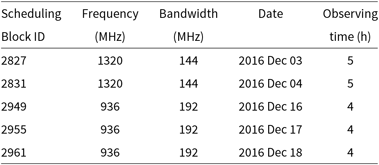
The resulting synthesised beam was 32.7 arcsec by 17.8 arcsec at 936 MHz and 15.8 arcsec by 12.0 arcsec at 1320 MHz. The synthesised beam of the higher frequency observations is more circular than the beam at lower frequency because of the differences in the U–V coverage, which is due primarily to differences in hour angle coverage and different amounts of antenna-based flagging. In both cases, the output images consisted of 7784 × 7387 pixel images, where each pixel is a 4-arcsec square.
Because these data were taken at an early stage of ASKAP commissioning, our flux density and astrometry calibration were still in a preliminary state, and so these had to be corrected after processing. This was done by comparing the ASKAP images with the NVSS (Condon et al. Reference Condon, Cotton, Greisen, Yin, Perley, Taylor and Broderick1998) and SUMSS (Bock, Large, & Sadler Reference Bock, Large and Sadler1999) catalogues. We used only non-blended, unresolved sources detected at signal-to-noise (hereafter SN) above 5σ in ASKAP, NVSS, and SUMSS, and which were not flagged as problematic.
The offsets of the raw 1320 MHz ASKAP positions from the NVSS positions are shown in the top panel of Figure 1. The scatter plot for 936 MHz is similar. The medians of the 1320-NVSS and 936-NVSS position offsets were used as the position corrections for the 1320 and 936 MHz images, respectively. The 1σ astrometric accuracy was estimated by using the median absolute deviation, converted to 1σ. At 936 MHz the resulting 1σ accuracy is 3.00 arcsec in R.A. and 3.40 arcsec in Dec. and at 1320 MHz the resulting 1σ accuracy is 2.37 arcsec in R.A. and 2.64 arcsec in Dec.
Top panel: offsets of the raw 1320 MHz ASKAP positions from the NVSS positions for sources detected in both surveys. The colour bar gives the scale for signal-to-noise (SN) of individual ASKAP sources. The offsets are small compared to the synthesised beam size of 15.8 arcsec by 12.0 arcsec at 1320 MHz. The median 1320 MHz-NVSS offset of −5.69 arcsec in R.A. and 0.26 arcsec in Dec. was used to correct the raw ASKAP 1320 MHz positions. The median 936 MHz-NVSS offset of −6.71 arcsec in R.A. and 1.04 arcsec in Dec. was used to correct the raw ASKAP 936 MHz positions. Bottom panel: ratios of NVSS-SUMSS predicted 1320 MHz flux density to ASKAP raw measured 1320 MHz flux density for sources measured in all 3 surveys. The median ratio for 1320 MHz sources of 0.8830 was used to correct the ASKAP 1320 MHz flux densities. The median ratio for 936 MHz sources of 0.8810 was used to correct the ASKAP 936 MHz flux densities.

The flux density scale was calibrated by using sources that were in both NVSS and SUMSS. We interpolated between SUMSS (843 MHz) and NVSS (1420 MHz) flux densities for each source assuming a power-law spectrum. We tabulated the ratios of the calculated 936 and 1320 MHz NVSS–SUMSS flux densities to the raw 936 and 1320 MHz ASKAP flux densities, respectively. The histogram of these ratios for 1320 MHz is shown in the bottom panel of Figure 1. The median calculated to raw 936 MHz flux density ratio was 0.8810 and the median for 1320 MHz was 0.8830. These median ratios were used as flux density correction factors for the ASKAP 936 and 1320 MHz images, respectively.
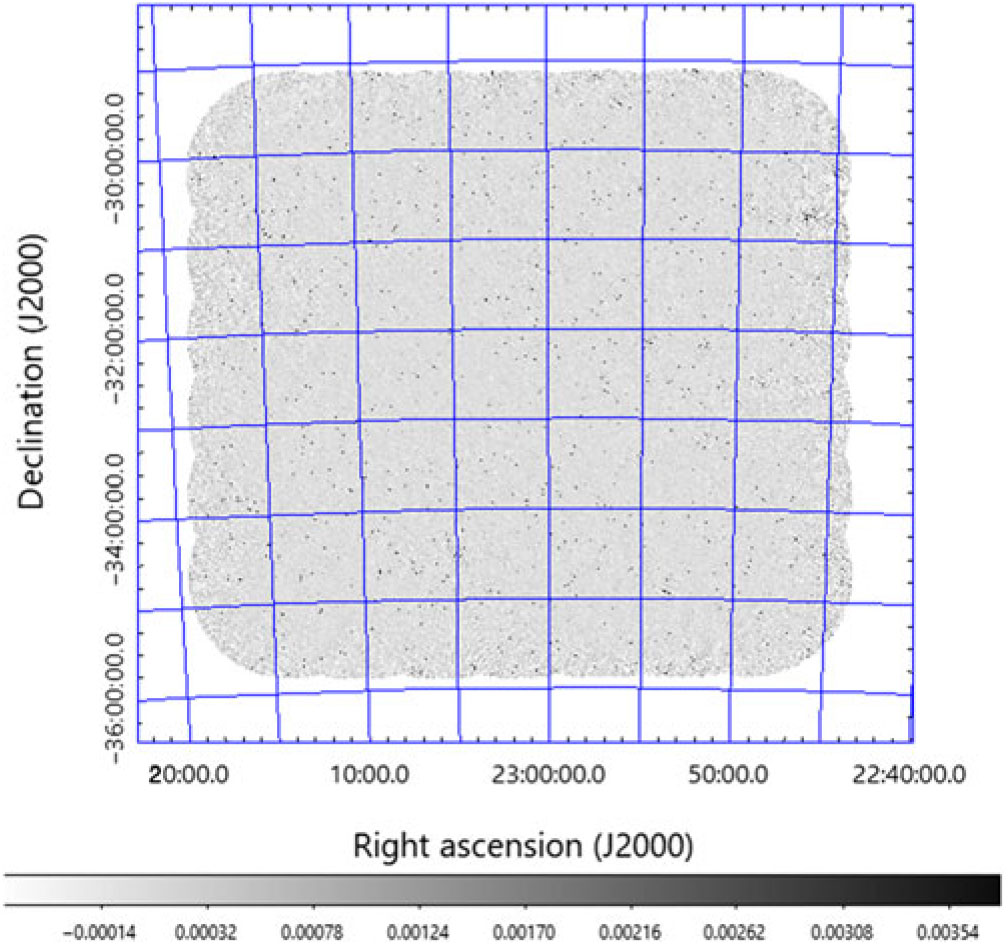
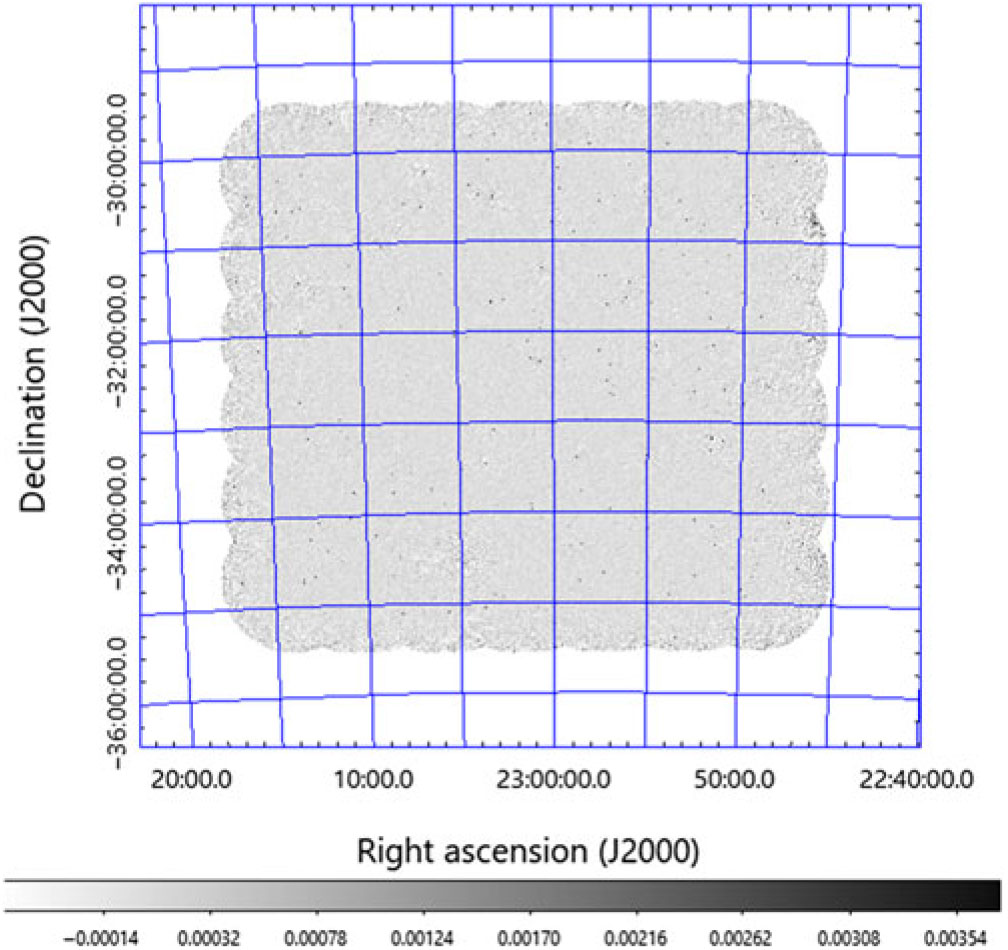
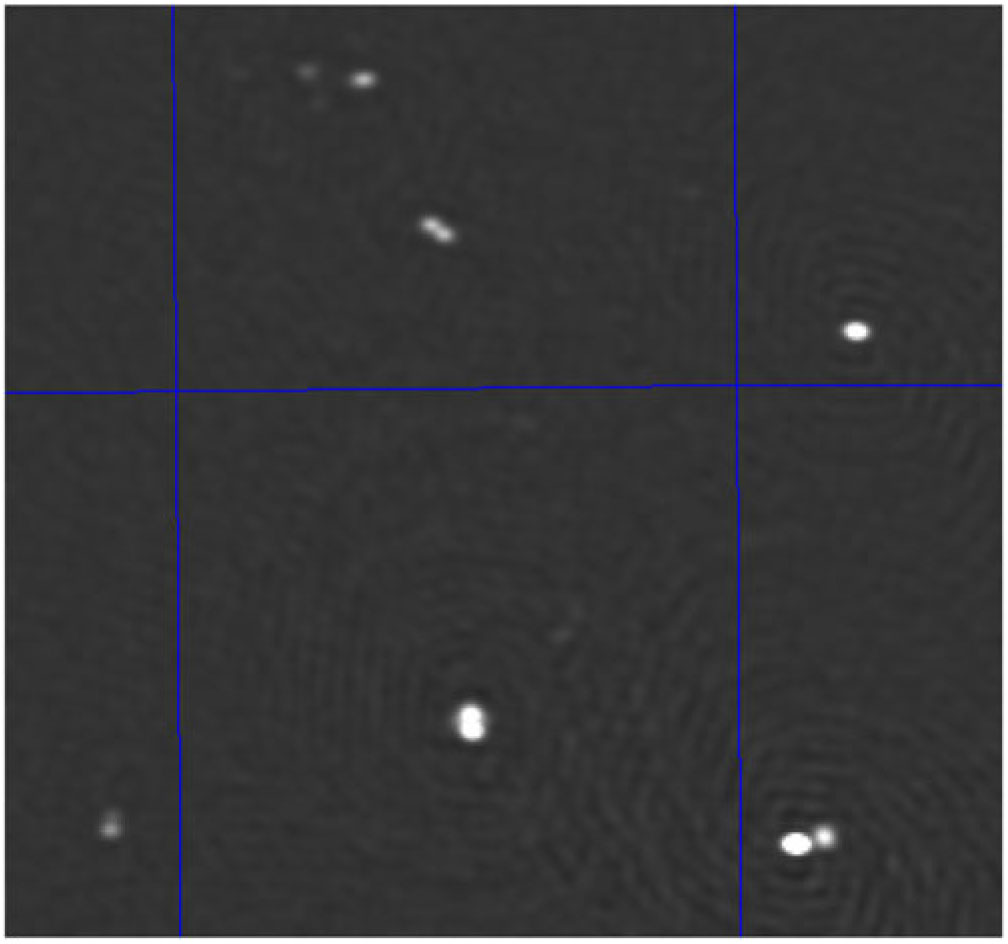
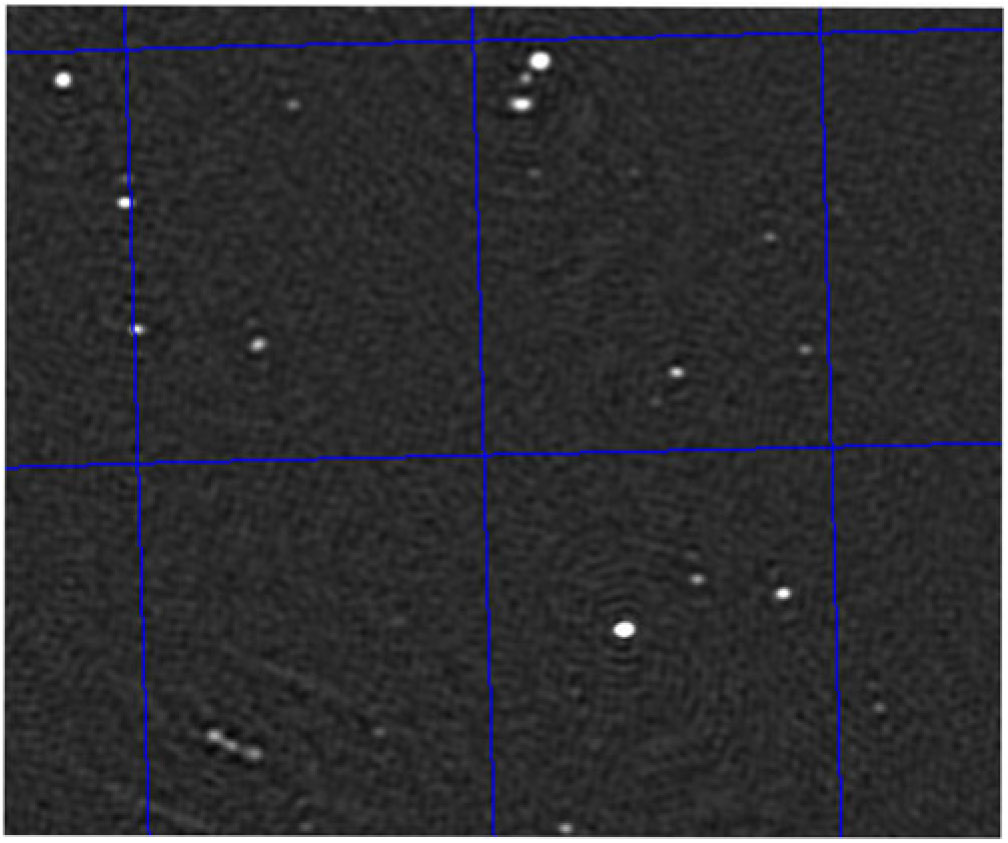
The resulting images are shown in Figures 2 and 3. The root-mean-square (r.m.s.) noise of source free regions in both 936 and 1320 MHz images is ~0.1 mJy/beam. To illustrate the image quality obtained with ASKAP in its commissioning phase, we show images on spatial scales of tens of arcminutes. Figures 4 and 5 show regions with typical r.m.s. noise level in the maps (0.1 mJy). The first illustrates some double radio sources. The latter shows one triple source (central source plus two lobes) at the top centre of the image and a fainter triple source at the lower left.
The 936 MHz final processed radio image for the GAMA 23 region. This covers a sky area of ~7.3° in R.A. by ~6.8° in Dec. The greyscale bar at the bottom is in units of Jy/beam.
The 1320 MHz final processed radio image for the GAMA 23 region. This covers a sky area of ~6.6° in R.A. by ~6.1° in Dec. The greyscale bar at the bottom is in units of Jy/beam.
Enlargement of the 1320-MHz image in an area centred on R.A. 23h01m10s, Dec. −32°13′30′ in a region containing some double radio sources. The grid spacing is 0.2°. The intensity greyscale is linear, from −5 to +20 mJy/beam.
Enlargement of the 1320-MHz image in an area centred on R.A. 23h10m24s, Dec. −33°10′30′, in a region containing two radio triples (central source plus two lobes). The grid spacing is 0.2° in R.A and in December. The intensity greyscale is linear, from −1 to +5mJy/beam.
2.1.1 Source extraction
We make the distinction between components, which are individual point-like detections in a radio image, and sources, which can be either a single component or composed of multiple components, such as a double-lobed radio galaxy. The Aegean software (Hancock et al. Reference Hancock, Murphy, Gaensler, Hopkins and Curran2012) was used for component extraction. We used a 4 σ threshold, resulting in a list of 6 053 components at 936 MHz, and 3 827 at 1320 MHz.
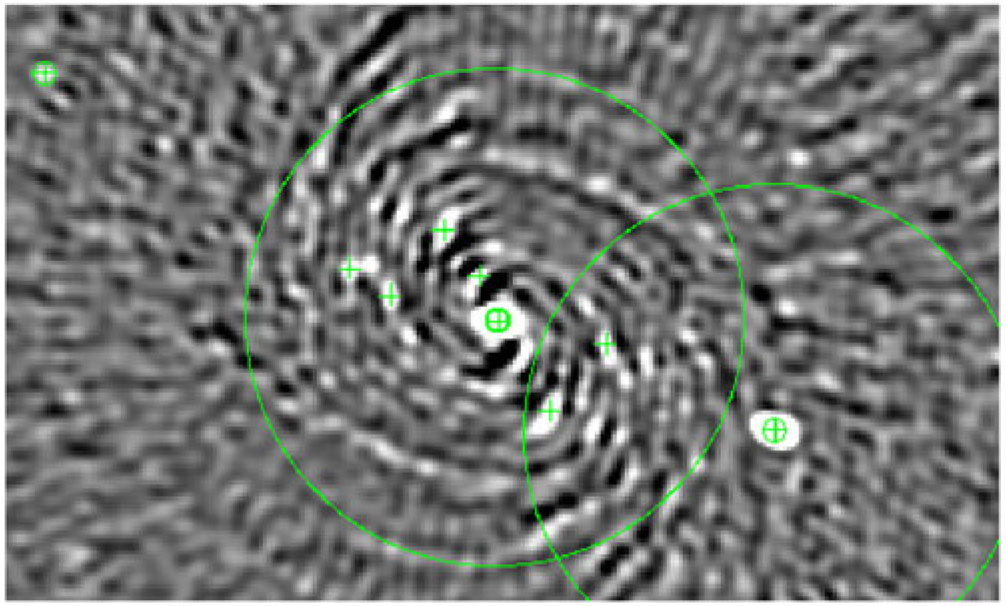
Small but significant residuals, of order 1% of the peak flux density, are found around bright components. The residuals occur in a spiral pattern which extends out to a radius of about 6 arcmin (~10 times the synthesised beam). Figure 6 shows a bright component exhibiting such residuals, the resulting false components, and our correction for them. The flux densities of the false components were all less than 1.25% of the integrated flux density of the bright central component at 936 MHz, and less than 1.6% at 1320 MHz. We started with the brightest component in the map and labelled it as the ‘source’. All components within 6 arcmin radius of the ‘source’ which were fainter than 1.25% (at 936 MHz) or 1.6% (at 1320 MHz) of the ‘source’ were added to a list of possible false components. This was repeated for the second brightest component in the map, and so on, until a complete list of possible false components was created. The false components were removed from the original component list except for those few not consistent with the spiral beam residual pattern. After artefact removal, the catalogue contained 5 968 components at 936 MHz, and 3 757 at 1320 MHz.
Enlargement of the 936 MHz image centred on a bright component (integrated flux density 0.78 Jy) which exhibits a spiral shaped pattern of residuals. The large circles are 240 arcsec in radius. The crosses show the detected components (4 sigma above background) before the correction. The small circles show the components after the correction. The intensity greyscale is expanded to show faint features and is linear from −1 mJy/beam (black) to +1.5 mJy/beam (white). Most sources are saturated at this scale.
2.1.2 Source counts
The source counts normalised by the Euclidean slope (S2.5 dN/dS vs. flux density) are shown in Figure 7 for 936 and 1320 MHz. The smooth line is a fit to the compilation of published source count data from Hopkins et al. (Reference Hopkins, Afonso, Chan, Cram, Georgakakis and Mobasher2003). The flux densities for 936 MHz sources and 1320 MHz sources were adjusted to 1.4 GHz flux densities using a spectral index of α = –0.7.
Source counts normalised by the Euclidean slope, S2.5dN/dS, from the 936 MHz and 1320 MHz observations, with Poisson error bars. The smooth line is a polynomial fit to the compilation of published source count data (Hopkins et al. Reference Hopkins, Afonso, Chan, Cram, Georgakakis and Mobasher2003).
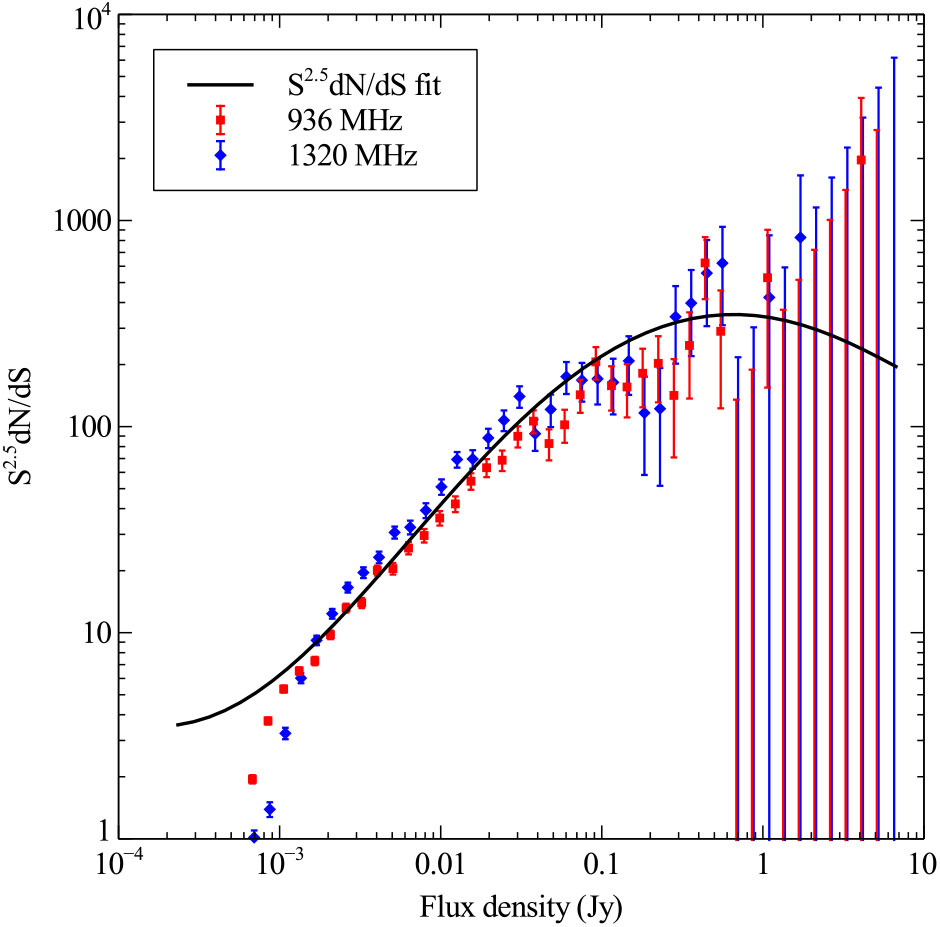
The data for both frequencies match well the fit line between ~1.2 mJy and ~0.2 Jy. Above 0.2 Jy, the counts are dominated by small number statistics, reflected in the large error bars. Below ~1.2 mJy, the observations fall below the expected source counts, indicating that they are incomplete at this level, particularly at 1320 MHz. The map r.m.s. is 0.1 mJy excluding the edges. The r.m.s. rises nearly linearly from to ~0.1 mJy at ~ 0.5° from the edges to ~ 0.5 mJy at the edges. It also rises from ~ 0.1 mJy at ~ 0.25° away from ~0.5 Jy sources to ~1 mJy at ~0.05° away. The fraction of the map area with r.m.s above ~0.1 mJy is ~0.2. Thus a significant fraction of sources below ~ 1 mJy are not detected at the 4σ level.
2.1.3 Identifying complex radio sources
About 95% of radio sources at the mJy level, which we term ‘simple’, consist of a single component which is coincident with the optical host galaxy (e.g., Norris et al. Reference Norris2006). The remaining ~5% are complex sources, such as double-lobed radio galaxies which appear on the radio image as two isolated components typically separated by tens of arc seconds, with the optical host galaxy located roughly halfway between them. Cross-matching simple sources with optical/IR data are straightforward, and can be achieved using any of the several algorithms and tools such as those available within TopCat (Taylor Reference Taylor2011).
To identify the complex sources, we compiled one list of candidate complex sources from the list of ‘islands’ generated by Aegean, and a second list of candidates by using TopCat to identify pairs and groups of more than two sources within a radius of 6 arcmin. There was a significant overlap (~50–70%) between these two lists of candidates. The difference between the two lists illustrates the difficulty of using a single algorithm to identify complex sources. The visual inspection of Aegean islands and TopCat groups resulted in a revised list of singles, doubles, and triples. The singles include those components that were put in islands or groups by the software, but had no visual evidence of association. All islands and groups of 4 or more were found to consist of a double or triple plus unrelated singles.
We tested the doubles against the Magliocchetti criterion (Magliocchetti et al. Reference Magliocchetti, Maddox, Lahav and Wall1998), for which the flux density ratio of the two lobes is required to be between 1/4 and 4, and the separation is required to be  $$ \lt 100\,{\rm{ arcsec}} \times \sqrt {{S_{{\rm{tot}}}}/100\,{\rm{ mJy}}} $$. We used a flux density ratio between 1/3 and 3, to err on the side of rejecting sources, but only found one source with flux density ratio between 1/4 and 1/3 (or 3 and 4) that also passed the separation test. Sources that failed this test were split into components and added back to the singles list.
We scanned the full ASKAP radio images for radio doubles or triples not identified by either Aegean or TopCat algorithms, and found several more radio doubles and triples, typically those with large angular separation. The resulting numbers of single, double, and triple radio sources are shown in Table 2.
Number of sources, by morphology, in the radio source catalogue.

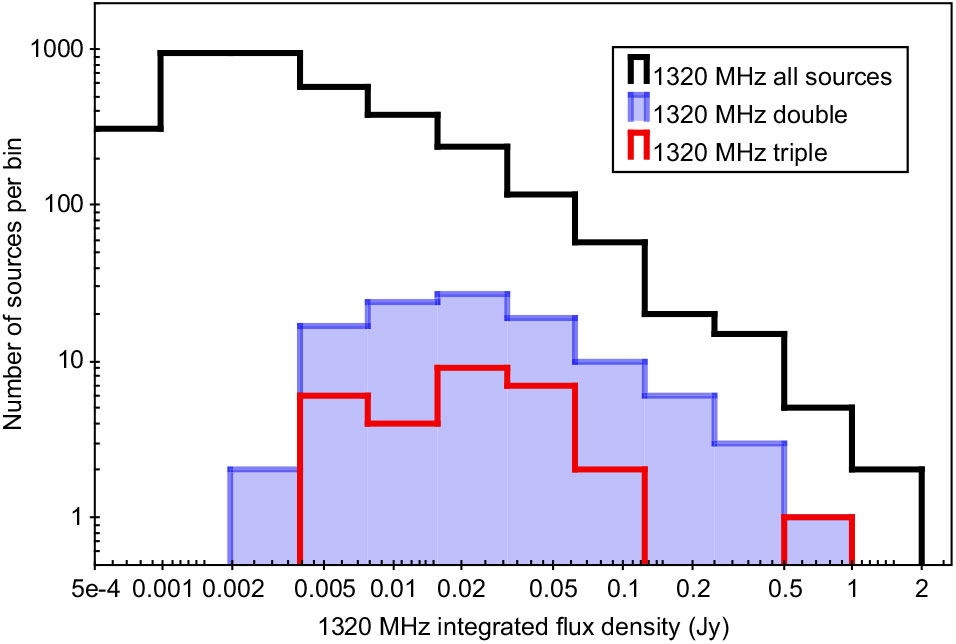
To estimate host galaxy positions and integrated flux densities for the double sources, we calculated the flux density-weighted centroid and the total integrated flux density. For the triples, we assumed the host position to be that of the component closest to the centre. The distribution of 1320 MHz integrated flux densities for the double sources, triple source and full set of singles, doubles and triples is shown in Figure 8.
Distribution of integrated 1320 MHz flux densities of all sources (black line), double sources (blue shaded histogram), and triple sources (red line). The all source category is dominated by single sources. The doubles are brighter on average than the triples and both are much brighter than single sources.
2.2 Comparison with NVSS and SUMSS surveys
We compared our 936 and 1320-MHz images and components with the 1420 MHz NVSS and SUMSS 843 MHz catalogues to verify the ASKAP imaging and source detection algorithms.
Figure 9 shows a region from the 936-MHz map comparing the 936-MHz detected components with components from the NVSS and SUMSS catalogues. In the full area covered by the 936-MHz image, there are 5 897 936-MHz components, 2 718 NVSS components, and 1 152 SUMSS components. There are 2 209 936-MHz—NVSS cross-matches within 20 arcsec, 879 936-MHz—SUMSS matches, and 943 NVSS—SUMSS matches. In the full area covered by the 1320-MHz image, there are 3 756 1320-MHz components, 1 724 NVSS components, and 735 SUMSS components. There are 1 532 1320-MHz—NVSS cross-matches within 20 arcsec, 702 1320-MHz—SUMSS matches, and 701 NVSS—SUMSS matches.
Enlargement of the 936-MHz image in an area centred on R.A. 23m 04m, December −29°40′. The small green circles show the 936-MHz detected sources, the large green circle is the area around a bright source within which false components were removed (see text, Section 2.1.1). Overlaid are the NVSS 1420 MHz sources (small magenta circles) and SUMSS 843 MHz sources (blue squares). The intensity greyscale is linear, from −1 to +2 mJy/beam, which is expanded to show the background noise level. The grid spacing in December is 5 arcmin and the grid spacing in R.A. is 30 s.
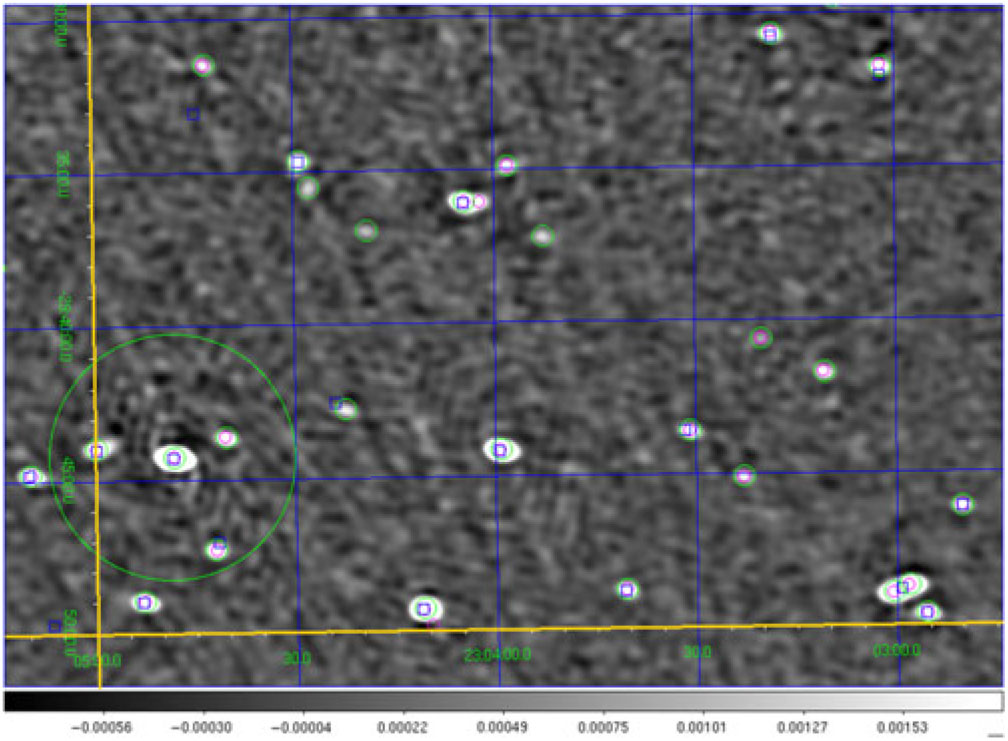
All bright components (≳ 20 mJy) are detected in all 3 data sets, ASKAP, SUMSS, and NVSS. The number of faint matches is consistent with expectations for detections of real components with noise, given the different sensitivities of the data.
2.3 Optical Data
The GAMA G23 imaging and i-band photometric data are from the VLT Survey Telescope (VST) Kilo-Degree Survey (KiDS, de Jong et al. Reference de Jong, Verdoes Kleijn, Kuijken and Valentijn2013), and ZYJHKs-bands data are from the VISTA Kilo-degree Infrared Galaxy survey (VIKING, Edge et al. Reference Edge, Sutherland, Kuijken, Driver, McMahon, Eales and Emerson2013). The GAMA photometry is described in Driver et al. (Reference Driver2016) and was obtained from the GAMA Data Management Unit (DMU) ‘G23InputCatv6’. All magnitudes are in the AB system. The G23 spectroscopic sample was VST KiDS i-band selected with a magnitude limit of 19.2. The GAMA spectral catalogue is described in Hopkins et al. (Reference Hopkins2013). The data reduction, spectral analysis, and redshift completeness are described in Liske et al. (Reference Liske2015). The spectral line information is from the GAMA DMU ‘SpecLineSFRv5’. There are 37359 galaxies with spectra and redshifts for the area overlapping the 936 MHz field.
Because full SED-derived stellar mass estimates were not yet available for G23, we obtained stellar mass estimates for G23 galaxies by matching each G23 galaxy to galaxies with similar redshift and iZYJHKs photometry in the GAMA equatorial catalogues, and assuming they had a similar mass. We use a Gaussian weighting kernel, with size of 0.005 in the redshift dimension and sizes of the photometric 1σ errors in the photometric dimensions, to find the average mass-to-light ratio of the ‘similar’ reference galaxies, and assigned that mass to the G23 galaxy. This idea is similar in spirit to kernel-density estimation photometric redshift estimation of Wolf et al. (Reference Wolf2017). We have validated this approach by testing our ability to recover the SED-fit mass estimates for half of the equatorial catalogue, using the other half of the catalogue as a reference sample. We find that the global random error in the mass estimates derived in this way is of the order of 0.15 dex, compared to a median formal uncertainty of 0.12 dex for the SED-fit mass estimates described in Taylor et al. (Reference Taylor2011). This yields 35353 galaxies with mass determinations.
2.4 IR data
The IR data were taken from the ALLWISE catalogue of the WISE satellite (Wright et al. Reference Wright2010). A detailed description of the WISE mission and catalogue is online at the Infrared Science Archive (IRSA) at NASA/IPAC (http://irsa.ipac.caltech.edu). The catalogue (hereafter referred to as WISE) contains Vega magnitudes and errors for wavebands at 3.4, 4.6, 12, and 22 micron wavelengths (bands W1,W2,W3,W4). The angular resolution is 6.1, 6.4, 6.5, and 12.0 arcsec in the four bands, respectively. The w1mpro, w2mpro, w3mpro, and w4mpro magnitudes and errors were used in the current analysis. The appendix of Cluver et al. (Reference Cluver2014) discusses the effect for resolved (nearby) sources on the WISE mpro magnitudes. The w1mpro and w2mpro magnitudes are fainter than isophotal magnitudes by ~0.4. Here we are using W1 - W2 colour which is much less affected for resolved sources.
3 Multi-wavelength analysis of the ASKAP radio sources and G23 galaxies
3.1 Source cross-matching
We cross-matched the 936 and 1320 MHz catalogues of radio sources to the G23 galaxies by matching positions within a specified radius using TopCat. For each cross-match, we first plotted the separation distribution for the real catalogues and for the case where one of the catalogues had the positions randomised. Then we compared the separation distributions to determine an optimum radius for separating real from random matches. The 936 and 1320 MHz catalogues were matched using a radius of 7 arcsec. The 1320 MHz catalogue was matched with G23 using radius 5 arcses. The 936 MHz catalogue was matched with G23 using radius 7 arcsec. Because the 1320 MHz sources were essentially a subset of the 936 MHz sources, we mainly report results for the larger set of 936 MHz cross-matches.
We cross-matched the 936 and 1320 MHz catalogues and the matched 936/1320 MHz catalogue with WISE using a radius of 4 arcsec. This is smaller than for the cross-match of radio catalogues with G23 because of the much higher source density on the sky for WISE than G23.
G23 was cross-matched with WISE using radius of 1.5 arcsec. This gives low contamination (0.84%) and yields a large fraction of cross-matches (87.6%). For the GAMA G12 and G15 fields, Cluver et al. (Reference Cluver2014) found similar results: 77% (for G12) and 88% (for G15) of the galaxies had WISE W1 and W2 detections at > 5σ.
We compared the cross-match of the 936 MHz/WISE catalogue to G23 with the cross-match of the 936 MHz catalogue with the G23/WISE catalogue. The latter yields better results: the number of cross-matches is somewhat reduced, but there is much lower contamination with random cross-matches. The reason for this is the superior spatial resolution of both G23 positions (sub-arcsec) and WISE positions (≃0.2-0.3 arcsec) compared to the uncertainties of the radio positions (~5 arcsec).Footnote a
From these different catalogues, we then extracted the following subsets:
1. all galaxies with spectra and masses;
2. all galaxies with spectra, masses, and BPT line flux measurements;
3. all galaxies with spectra, masses, and all BPT lines in emission;
4. all galaxies with spectra, masses, and at least one BPT line in absorption;
5. all galaxies with spectra, masses, and all BPT lines in absorption.
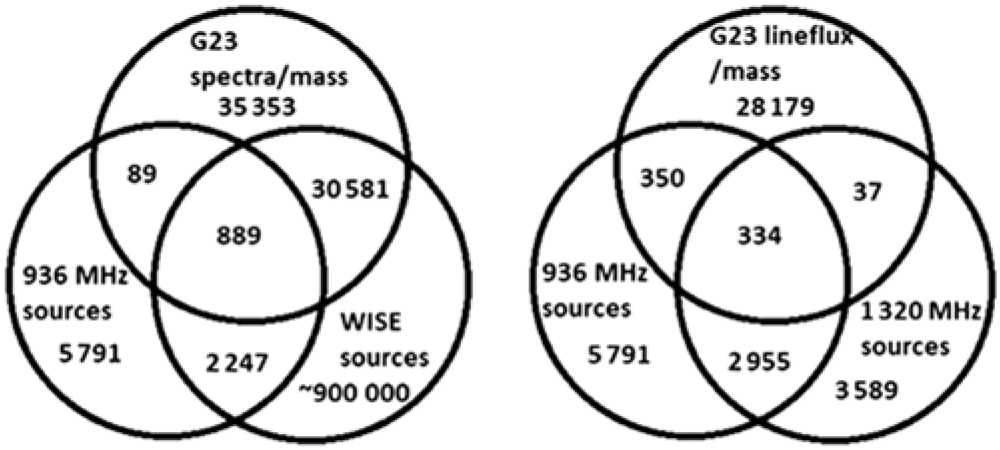
Summaries of the numbers of sources in the different subsets are given in Table 3 and, in part, in Figure 10. All galaxies with spectra have redshifts.
Population measures for 936 and 1320 MHz sources, G23 galaxiesa, and cross-matches with WISE photometry.
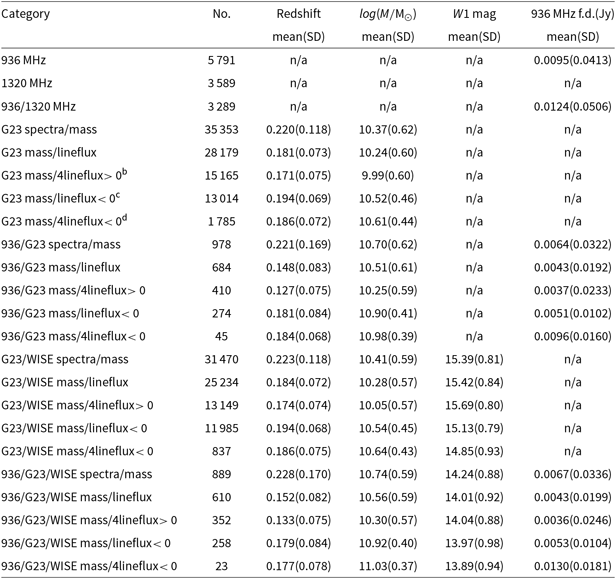
a The GAMA23 stellarmasses were based on stellarmasses from the GAMA equatorial fields as described in Section 2.3.
b 4lineflux> 0 means Hα, Hβ, [O iii]λ5007, and [S ii]λλ6717,6731 all have lineflux> 0.
c lineflux< 0 means any one of Hα, Hβ, [O iii]λ5007, and [S ii]λλ6717,6731 has lineflux< 0.
d 4lineflux< 0 means Hα, Hβ, [O iii]λ5007, and [S ii]λλ6717,6731 all have lineflux< 0.
Number of matches between 936 MHz sources, 1320 MHz sources, G23 galaxies, and WISE sources. The central set of 889 in the left diagram was obtained by first matching the 35 353 G23 galaxies with spectra and masses to the WISE sources, and then matching the resulting 30 581+889 galaxies to the 5 791 936-MHz sources. The central set of 334 in the right diagram was obtained by first matching 5 791 936-MHz and 3 589 1320-MHz sources, and then matching those 2 955+334 to 28 179 G23 galaxies with linefluxes and masses.
3.2 Properties of cross-matched sources
A mass-redshift diagram for G23 galaxies and their 936 MHz radio counterparts are given in the top panel of Figure 11. At all redshifts, the radio sources occur in the high-mass end of the galaxy mass distribution. The radio source mean masses (‘936/G23 spectra/mass’ and ‘936/G23/WISE spectra/mass’) are significantly higher than for the full galaxy population (‘G23 spectra/mass’), by factors of 2.14 and 2.34, respectively. The 936 and 1320 MHz mass distributions are not significantly different.
Top panel: Stellar mass in units of log(M/M⊙) versus redshift for the 936 MHz/G23 sources (red), and for all G23 galaxies (grey). This shows that galaxies with detected radio emission are mainly galaxies with larger masses and shows the effect of redshift-dependent completeness on the lower limit of detected G23 galaxies and radio counterparts. Middle panel: i-band magnitude versus redshift for the galaxy sample and for the galaxies with detected 936 MHz radio sources. The lines are for a galaxy of absolute i band magnitudes −17 and −19. Bottom panel: Integrated 936 MHz flux density versus redshift for the G23 galaxies with radio counterparts (red points). The blue lines are for sources of constant radio luminosity (differing by one order of magnitude). Radio counterparts which would have flux densities below the limits of the current ASKAP data fall below a horizontal line at ~5 × 10⁻⁴ Jy. Radio counterparts which would be beyond the current redshift limit of the G23 galaxies fall to the right of a line at z ~ 0.6.
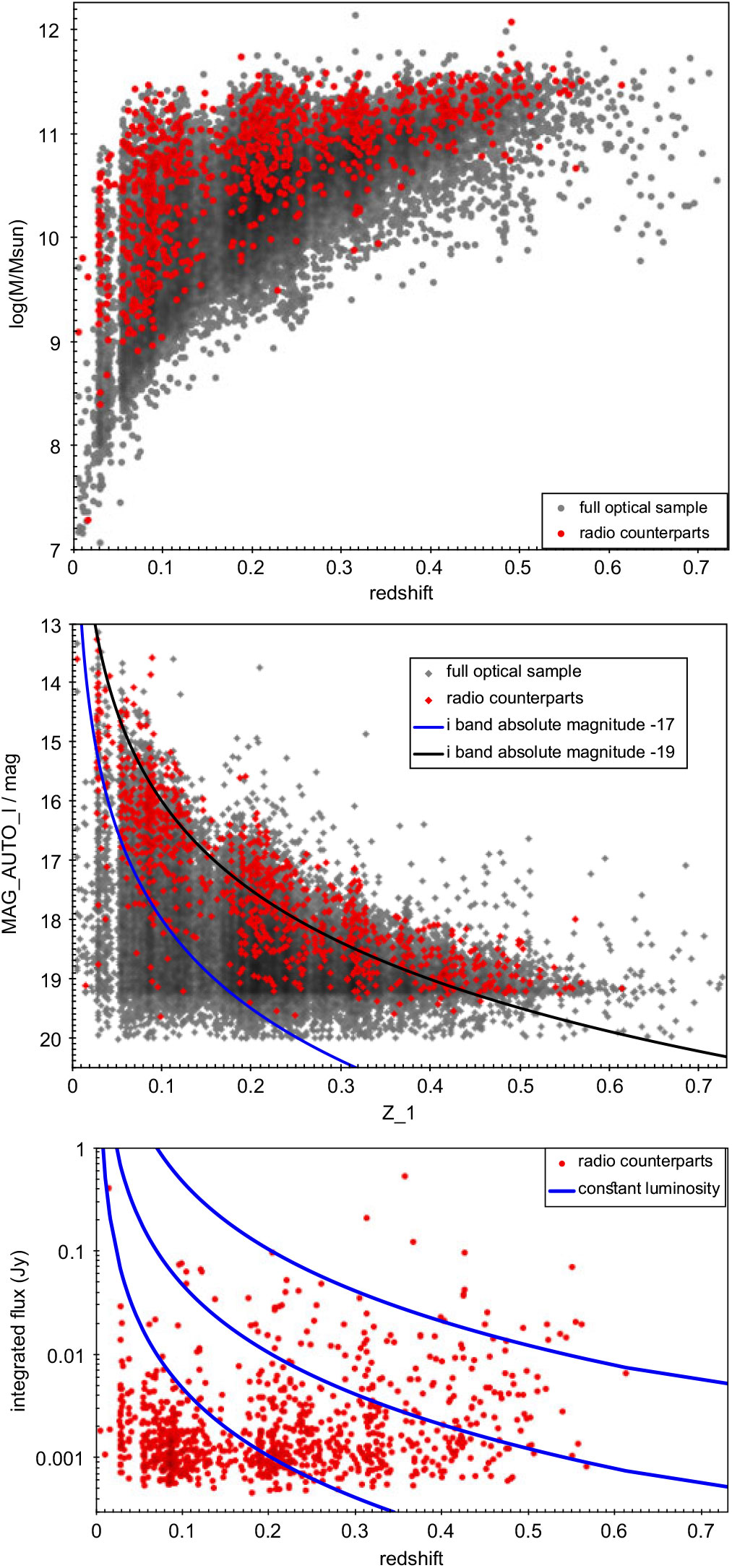
The middle panel of Figure 11 shows i-band magnitude versus redshift for the G23 galaxies and for radio counterparts compared to lines of constant i-band absolute magnitude −17 and −19. The radio sources are associated with the optically most luminous galaxies, consistent with them having higher than average stellar masses. The fact that the radio counterparts extend down to the detection limit of the G23 region (a horizontal line at i band magnitude of 19.2) implies that the radio observations are fairly complete for redshifts z < 0.6.
The bottom panel of Figure 11 shows integrated radio flux density versus redshift for the 936 MHz radio counterparts. Lines of constant radio luminosity are shown. Cosmological volume increases rapidly with redshift, so the number of luminous radio sources (e.g. within a band between a pair of blue lines) should increase rapidly. This illustrates increasing incompleteness with redshift of radio counterparts and of galaxies.
There are two reasons why we do not observe more radio counterparts:
Radio counterparts are not detected below the lower edge of the observed distribution because of the limited sensitivity of the radio observations.
Radio counterparts are not observed at high redshift (z > 0.6) because of the lack of such galaxies in G23. The gradual decrease in radio counterparts between redshift 0.1 and 0.6 is consistent with the decrease in the number (i.e. completeness) of optically measured galaxies with redshift, as seen in the top and middle panels.
Both factors contribute to lack of observed radio counterparts. The number of observed radio sources (5791 at 936 MHz) is much larger than the number with optical counterparts (978). Those without optical galaxy counterparts may lie either at z < 0.6 with their optical counterpart fainter than the G23 magnitude limit, or at z > 0.6. The relatively high radio flux density limit of these observations suggests that most are likely to be high radio luminosity AGNs at high redshifts (e.g. Seymour et al. Reference Seymour2008) or, possibly, dust obscured galaxies at lower redshifts (z ≲ 0.6).
Radio sources, such as broad-line AGN and SFG, typically have bluer near-ultraviolet (NUV)–r colours than the overall galaxy population (Heckman & Best Reference Heckman and Best2014). We used NUV magnitudes from the G23 input catalogue derived from GALEX observations (Liske et al. Reference Liske2015). The mean NUV magnitude is 21.11 for galaxies detected at 936 MHz compared to 21.94 for all galaxies. For NUV magnitudes brighter than 19, the probability of a galaxy to have radio emission is higher by a factor of ~5. For SFG, brighter UV magnitudes imply higher star formation rates (Brown et al. Reference Brown2017). The UV could be from accretion disks of AGN; however, recent measurements of the AGN UV luminosity function (Ricci et al. Reference Ricci, Marchesi, Shankar, La Franca and Civano2017)Footnote b imply that the UV input to the universe from SFG is significantly larger than from AGN. Thus the brighter UV from radio-detected galaxies in most cases is dominated by star formation.
The brightest emission line galaxies in either Hα or Hβ are mostly detected as 936 MHz sources: 8 out of the 10 brightest Hα emitters and 7 out of the 10 brightest Hβ emitters are 936 MHz sources, whereas only 1 in 25 galaxies with Hα and Hβ emission lines is a 936 MHz source. Thus, radio sources are highly over-represented in the population of brightest Hα and Hβ galaxies.
Compared to the full optical sample, the fraction of strong Hβ absorption line systems is larger by a factor of ≃2 for the radio counterparts. The mass distributions are shown in the top panel of Figure 12. The mean log(M/M⊙) is 10.37 for the whole galaxy sample, 10.68 for the optical galaxy Hβ-absorption-line sample, and 11.00 for the 936 MHz detected Hβ-absorption-line sample. The stronger Hβ absorption line strengths for 936 MHz galaxies are related to the higher masses for 936 MHz Hβ absorption line systems. This is similar to the result from Best et al. (Reference Best, Kauffmann, Heckman, Brinchmann, Charlot and White2005) that the fraction of galaxies that host a radio AGN rises strongly with host stellar mass. While the radio flux density limit of the current data is significantly lower than in that work, and the current set of radio sources includes a larger fraction of SFG, it is clear that the highest mass systems include those with old stellar populations, and their radio emission is likely driven by an AGN.
Top panel: The distribution of stellar masses (number of galaxies per mass bin, units of log(M/M⊙)) for radio counterparts (936/G23 set) with Hβ in absorption (red), and for all radio counterparts (black). Overlaid on these are the distributions for G23 galaxies with Hβ in absorption (blue), and for all G23 galaxies (grey). This illustrates (i) the significantly larger masses for galaxies with Hβ in absorption compared to all galaxies; and (ii) the shift to even larger masses for both sets of galaxies when they have 936 MHz radio emission. Bottom panel: comparison of the 22 μm luminosity distribution for radio-emitting galaxies (red histogram) with that for a mass-matched set of non-radio galaxies (blue histogram).
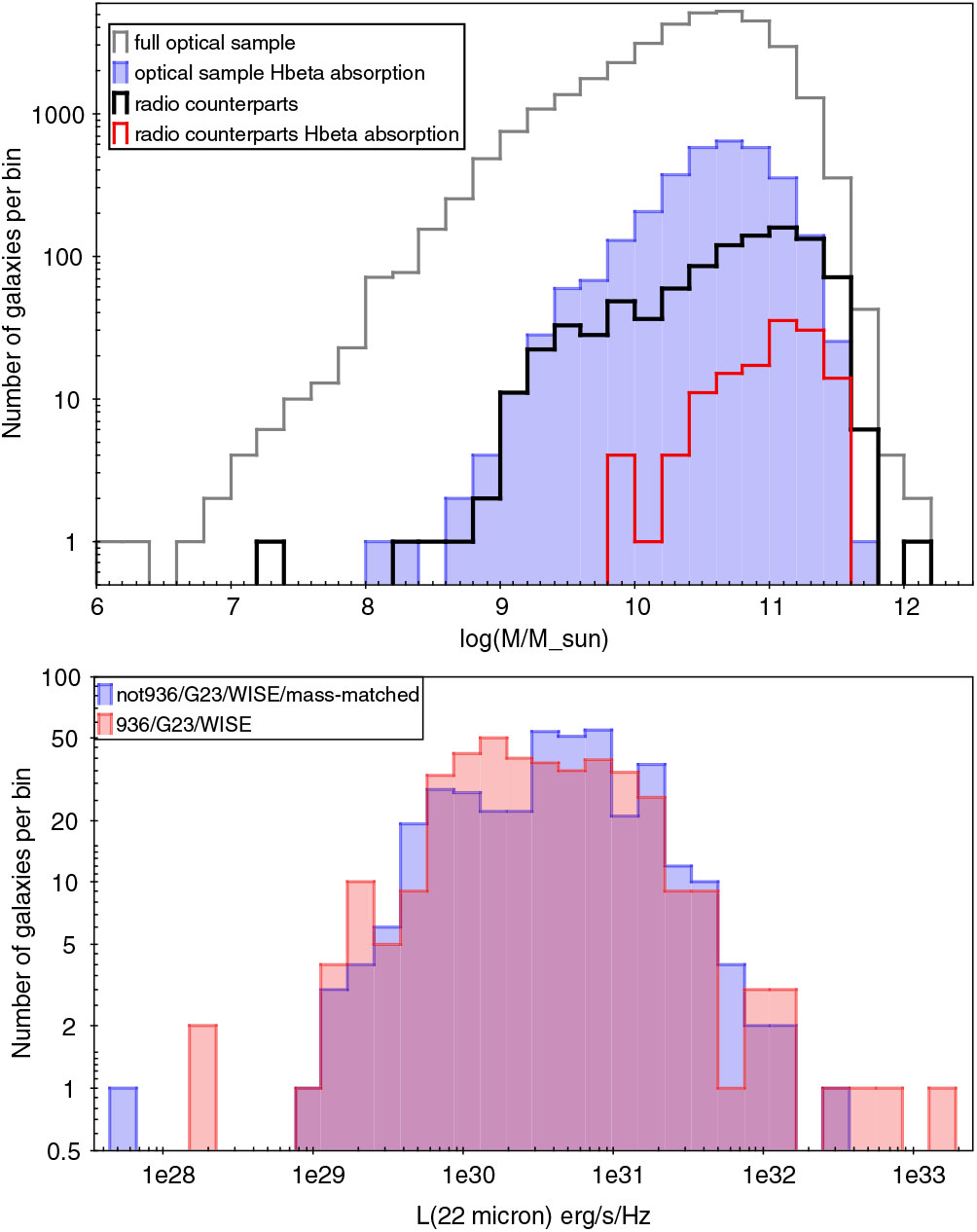
Radio sources have much stronger mid-IR emission than non-radio galaxies in general (see Table 3). The 936/G23/WISE sources have a mass about a factor of ~4 higher than the G23/WISE galaxy population. We created a sample of not936/G23/WISE galaxies by excluding the radio-emitters. Then we selected a mass-matched set of non-radio galaxies by choosing the best match by mass from the not936/G23/WISE set for each radio galaxy in the 936/G23/WISE set. We verified that the mass distribution of the not936/G23/WISE/mass-matched set is essentially identical to that of the 936/G23/WISE set. The resulting 22 μm luminosity distributions of the radio and non-radio emitters are shown in the bottom panel of Figure 12. There is no difference, except for the 3 radio sources with highest 22 μm luminosity, so we can conclude that the higher mid-IR emission of radio sources is consistent with being associated with increased mass of the galaxy.
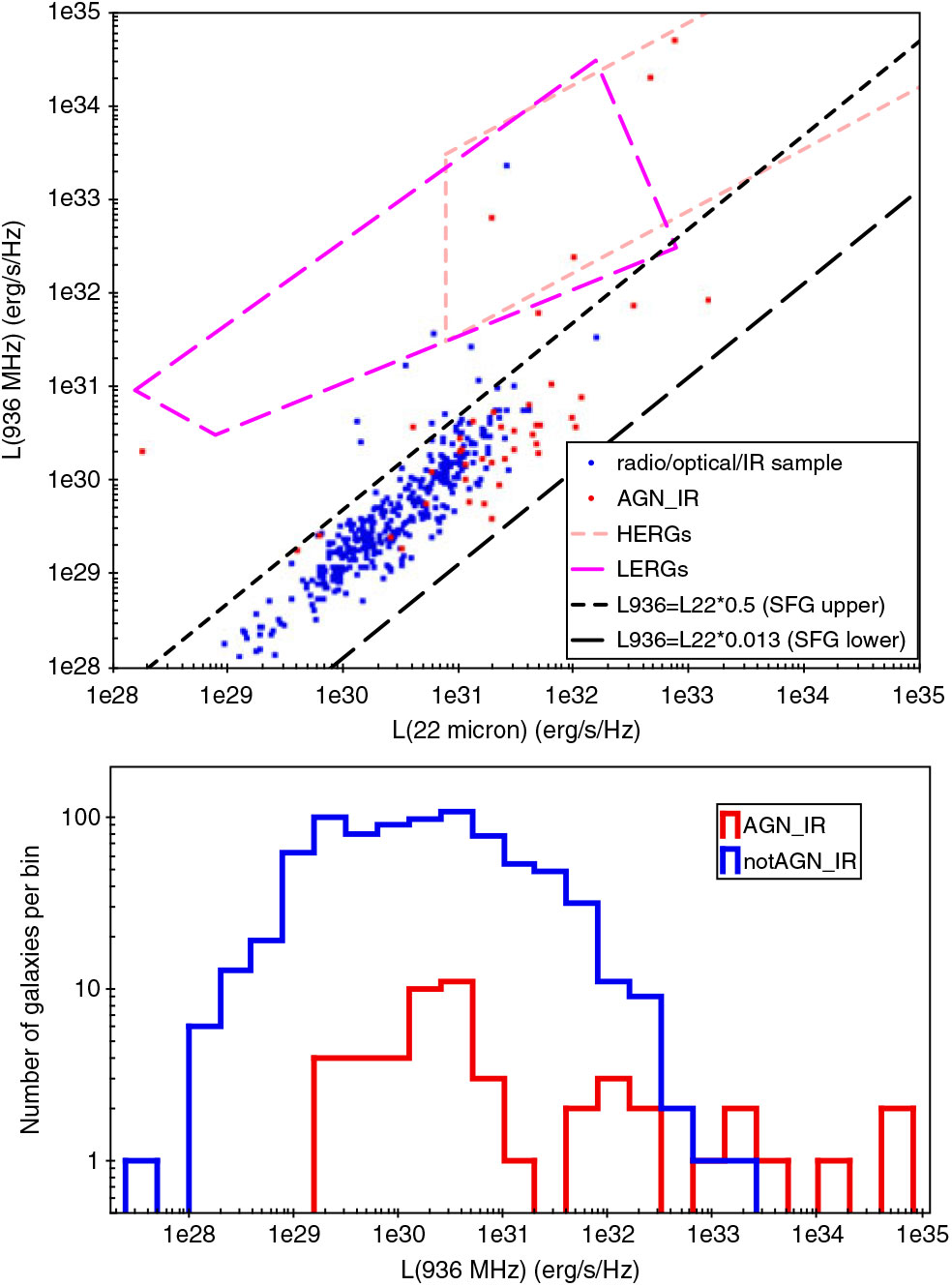
Both 22 μm and ~1.4 GHz luminosities are star formation rate indicators for SFG (e.g. Kennicutt et al. Reference Kennicutt2009, Rieke et al. Reference Rieke, Alonso-Herrero, Weiner, Pérez-González, Blaylock, Donley and Marcillac2009, Brown et al. Reference Brown2017, Cluver et al. Reference Cluver, Jarrett, Dale, Smith, August and Brown2017). For AGN, they are indicators of AGN activity (Gürkan, Hardcastle, & Jarvis Reference Gürkan, Hardcastle and Jarvis2014). We show the tight correlation between 22 μm and 936 MHz luminosities (L v, units erg/s/Hz) for the 936/G23/WISE galaxies in the top panel of Figure 13.Footnote c We also show the range of ratio 936 MHz to 22 μm luminosity found by Rieke et al. (Reference Rieke, Alonso-Herrero, Weiner, Pérez-González, Blaylock, Donley and Marcillac2009) for SFG by the two black dashed lines. In all, 68% (95%) of the data falls within ±0.3 dex (±0.6 dex) of a 936 MHz to μm luminosity ratio of 0.13. Consistent with our results, Brown et al. (Reference Brown2017) finds that 150 MHz, 1.4 GHz, and μm luminosities as a function of Hα luminosity have scatter of 0.2 dex. Thus it is seen that the majority of our radio/optical/IR galaxies are consistent with their radio and μm emission powered by star formation.
Top panel: 936 MHz luminosity versus W4 band (22 μm) luminosity, both in units of erg s−1 Hz−1, for the 936/G23/WISE sources with WISE W4 signal-to-noise (SN) ≥3 (blue points), and for the AGNIR subset (red points). Most sources (96%, 436 of 452) fall in the band for star-forming galaxies, delimited by the two lines shown (derived from Rieke et al. Reference Rieke, Alonso-Herrero, Weiner, Pérez-González, Blaylock, Donley and Marcillac2009). The regions outlined by the pink and magenta dashed lines indicate the regions occupied by HERGs and LERGs (Gürkan et al. Reference Gürkan, Hardcastle and Jarvis2014). The sources detected here mainly have lower L 936 MHz than HERGs and LERGs. Bottom panel: 936 MHz luminosity distribution for AGNIR and notAGNIR from the 936/G23/WISE sample.
3.3 AGN and SFG diagnostics
3.3.1 IR AGN diagnostic
The WISE mid-IR colour criterion W1 - W2 > 0.8 was introduced by Jarrett et al. (Reference Jarrett2011) to distinguish AGN from other galaxies. Stern et al. (Reference Stern2012) found that AGN can be identified, with 95% reliability and 78% completeness, using this criterion. Sources with W1 - W2 > 0.8 (> 1σ) are labelled AGNIR and those with W1 - W2 < 0.8 (> 1σ) are labelled notAGNIR. The W - W2 test gives an AGN IR classification for 374 sources and a notAGNIR classification for 29 983 sources.
The AGNIR and notAGNIR galaxies have strikingly different properties. Figure 13 (top panel) shows the AGNIR constitute ~1/2 of the outliers from the radio versus 22 μm relation, whereas they are only a small fraction (0.08) of the radio and 22 μm emitting galaxies. The bottom panel of Figure 13 shows the radio luminosity distributions of AGNIR and notAGNIR. The AGNIR are more luminous on average by a factor of 156 at 936 MHz.
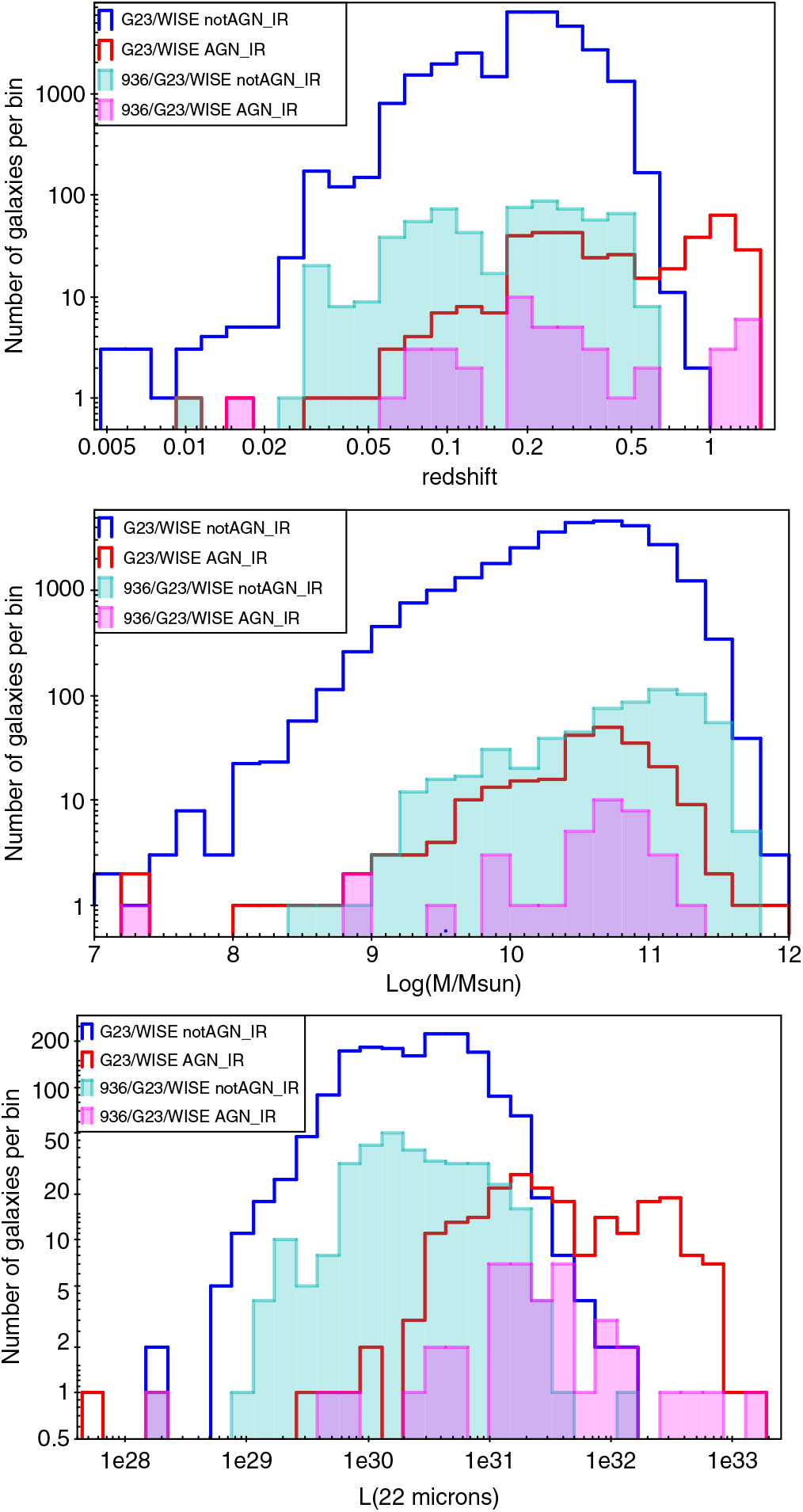
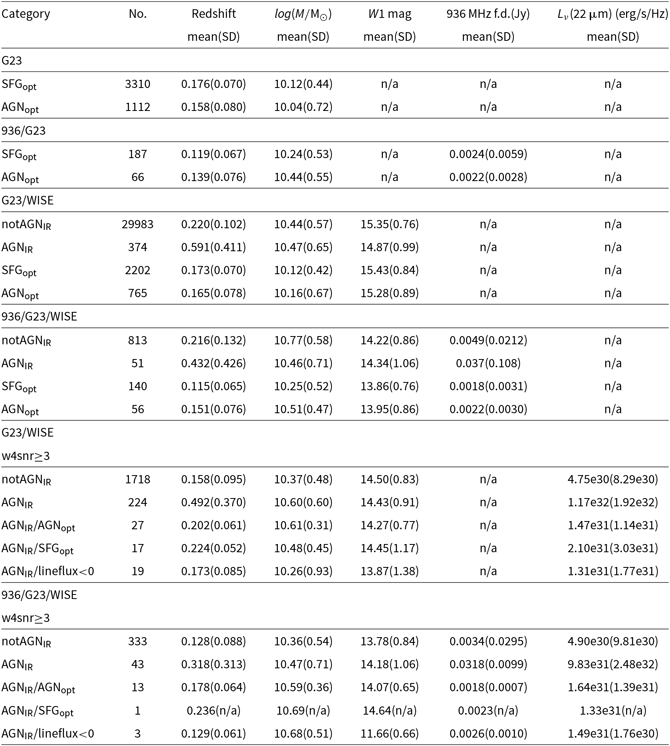
Figure 14 shows the redshift, mass, and 22 μm luminosity distributions for G23/WISE and 936/G23/WISE samples. The mean redshift of AGNIR is much higher than for notAGNIR (see Table 4). The mean mass of G23/WISE AGNIR is nearly the same as for notAGNIR, and the mass distributions are nearly the same (Figure 14 middle panel). The mean 22 μm luminosity of AGNIR is higher by a factor ~ 25 than for notAGNIR (for the G23/WISE w4snr>3 sample).
Comparison of the optical/IR galaxy sample with 936 MHz emitting subsets. Shown are distributions of: redshift (top panel); mass (second panel); and 22 μm luminosity, L(22 μm), in erg/s/Hz (third panel, for subset with w4snr>3). Sets shown are G23/WISE notAGNIR (blue), G23/WISE AGNIR (red), 936/G23/WISE notAGNIR (cyan), and 936/G23/WISE AGNIR (magenta).
Propertiesa of SFG and AGN subsets using BPT and W1 - W2 criteria.
a The GAMA23 stellarmasses were based on stellarmasses from the GAMA equatorial fields as described in Section 2.3.
For the 936 MHz detected G23/WISE galaxies (whole and w4snr>3 subsample, see Table 4), the AGNIR redshifts and 936 MHz radio flux densities are higher (by factor ~ 3 for red-shift and ~ 8 for flux density) than for notAGNIR.There is an even more extreme difference considering luminosities: the 22 μm luminosities are higher by a factor of 20 than for notAGNIR (for the w4snr>3 subsample). The AGNIR mean masses are similar for the whole 936/G23/WISE sample and the subsample with w4snr>3. However, the notAGNIR mean mass is higher (by a factor of 2.0) for the whole 936/G23/WISE sample compared to the subsample with w4snr>3.
The fact that such strong differences in redshift and luminosity are seen between the AGNIR and notAGNIR categories indicates that the contamination of AGNIR by notAGN galaxies and of notAGNIR by AGN is not a large fraction of either category. Contamination of notAGNIR by low luminosity AGN would not strongly affect the redshift and radio luminosity difference we see between the AGNIR and notAGNIR sets.
3.3.2 Optical AGN/SFG diagnostic
As a complement to the W1−W2 colour criterion, we use the BPT diagnostic to distinguish AGN from SFG. Requiring observed BPT line fluxes rejects all galaxies which have z > 0.315 because the [S II]λλ6717,6731 lines are redshifted out of the observed spectra. This has the side effect of rejecting high mass galaxies (~1/3 to 2/3 of those above 5 × 10¹⁰M⊙).
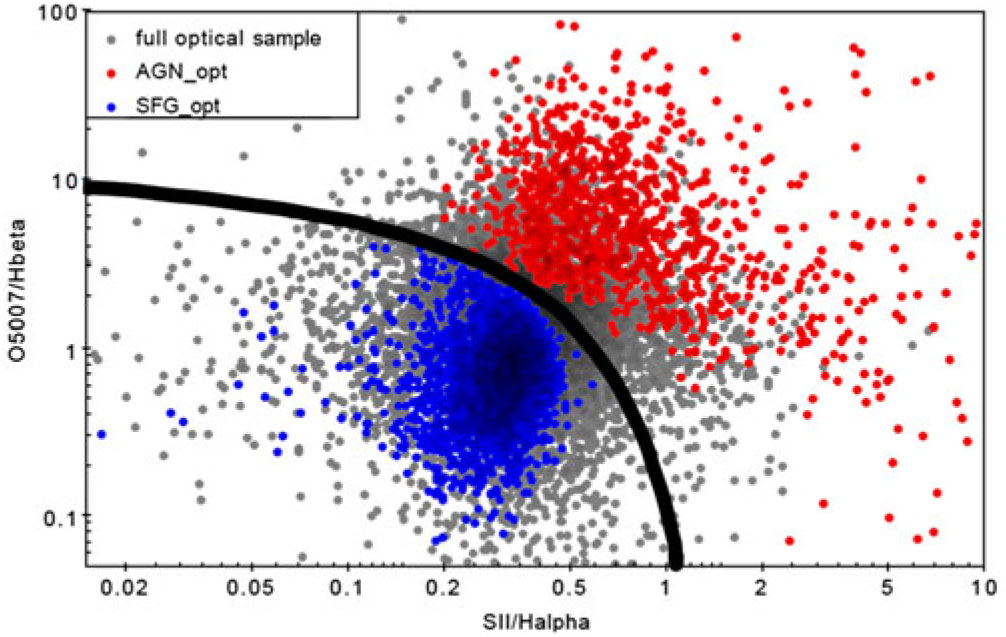
To classify a galaxy as AGNopt or SFGopt, we required the entire error box in the BPT diagram to lie on the AGNopt or SFGopt side of the diagnostic BPT line. Figure 15 shows the BPT diagram. Galaxies which have an ambiguous classification because of line flux uncertainties are shown by the grey points.
The BPT diagram, [O III]λ5007/Hβ versus [S II]λλ6717,6731/Hα, for the set of G23 galaxies with all of the required lines in emission (grey). The dividing line between AGN and SFG (Kewley et al. Reference Kewley, Dopita, Sutherland, Heisler and Trevena2001) is shown in black. The galaxies for which the error box lies entirely on the AGN side or on the SFG side of the dividing line are labelled AGNopt (red) or SFGopt (blue), respectively.
For the G23 sample, about half (Table 3) of the galaxies with measured line fluxes have one or more of the BPT lines in absorption, and of the ~15 000 with emission lines, ~4 400 had high enough SN to be classified by the BPT diagnostic. Table 4 gives the numbers of AGN and SFG for different subsets.
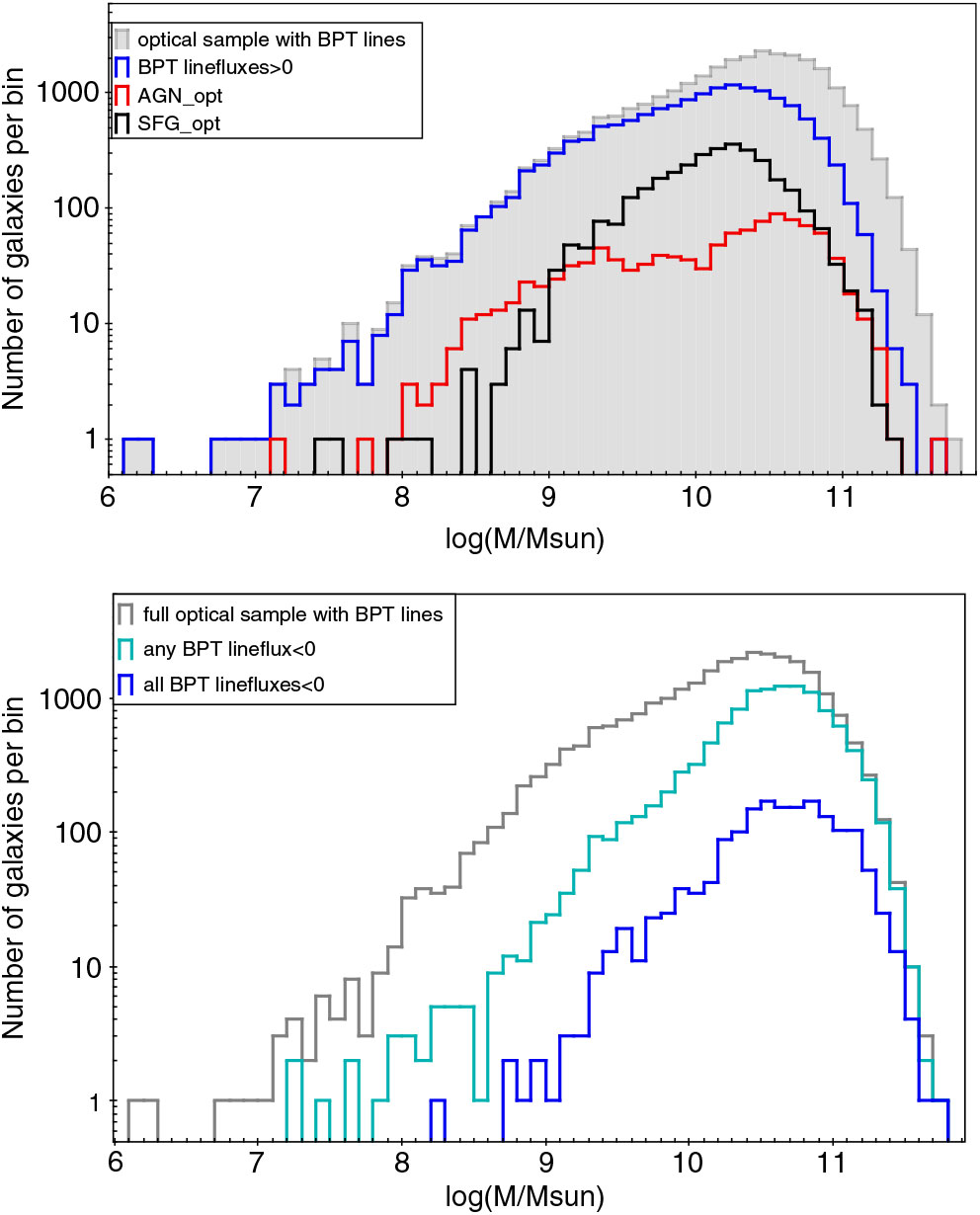
The mass distributions for the different categories are shown in the top and bottom panels of Figure 16. In order, from highest mean mass to lowest mean mass, the categories are: galaxies with all BPT lines in absorption; galaxies with at least one BPT line in absorption; SFGopt;AGNopt; and galaxies with all BPT lines in emission. The AGNopt-classified galaxies have the broadest mass distribution, inconsistent with single-peaked distribution and characteristic of a bimodal mass distribution. A χ 2 fit to the distribution shows it requires two components: a high mass component peaking at ~ 3 × 10¹⁰M⊙, and a low mass component peaking at ~ 2 × 10⁹M⊙.
The distribution of masses (number of galaxies per mass bin, in units of log(M/M⊙)) for the different categories of G23 galaxies, all with measured BPT line fluxes. Top panel: the full sample (grey), galaxies with all 4 BPT lines in emission (blue), SFTopt with BPT lines in emission (black), and AGNopt with BPT lines in emission (red). Bottom panel: the full sample (grey), galaxies with at least one BPT line in absorption (cyan), and galaxies with all 4 BPT lines in absorption (blue). The top panel illustrates that galaxies with all BPT lines in emission have lowest mean mass, and AGNopt have a broader, likely bimodal mass distribution. The bottom panel illustrates that galaxies with all BPT lines in absorption have highest mean mass.
To compare the BPT criterion with the W1−W2 criterion, we use the G23/WISE sample. The requirement of a WISE detection in effect rejects low mass galaxies (see Table 3): it results in rejection of ~1/6 or more of the galaxies below 3 × 10⁹M⊙. Table 4 shows that the increase in mean mass for G23/WISE compared to G23 depends on the AGN classification: G23/WISE AGNopt has mean mass higher than G23 AGNopt by factor 2.24; and G23/WISE SFGopt has mean mass higher than G23 SFGopt by factor 1.35.
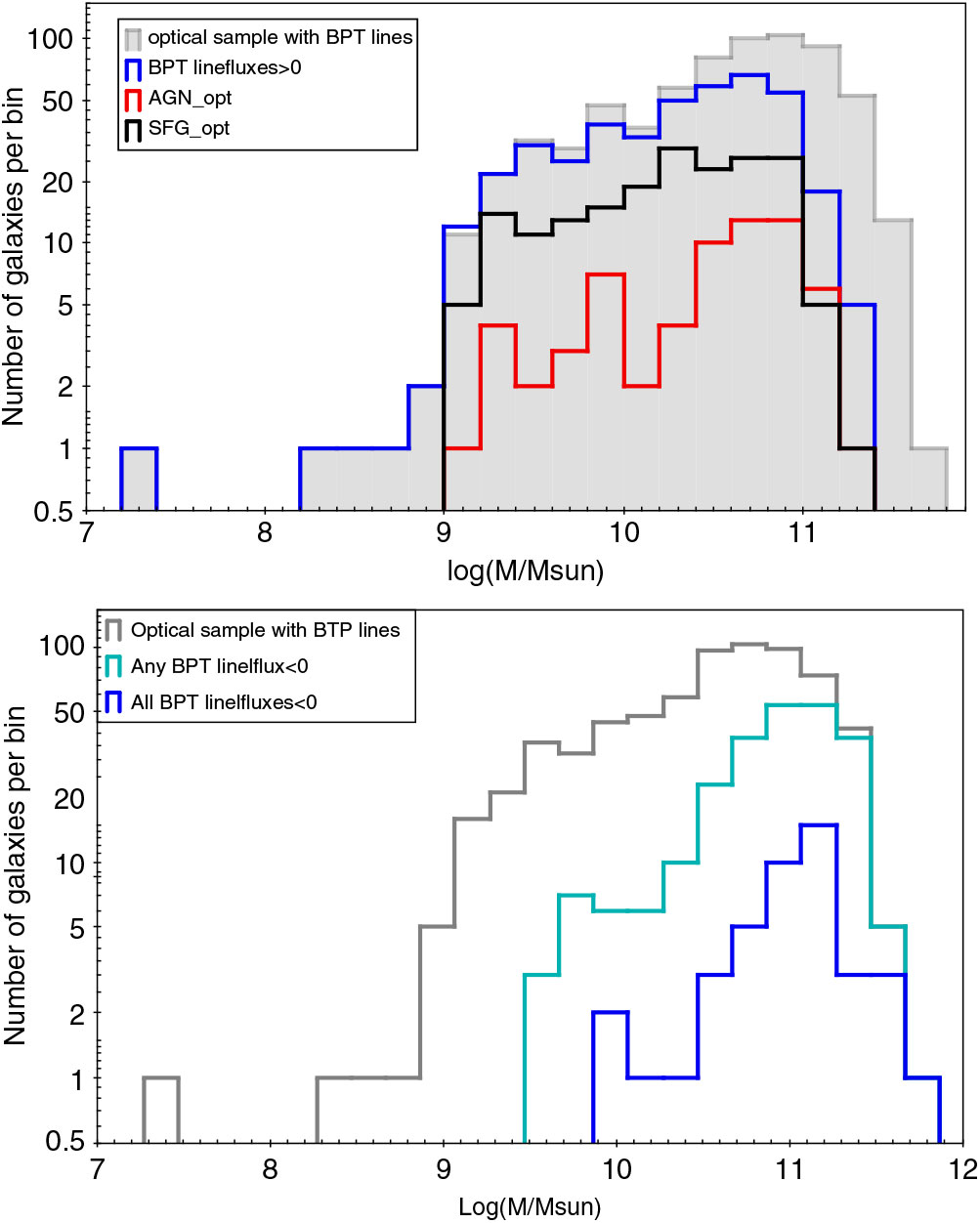
Next, the BPT diagnostic was applied to the radio detected 936/G23 sample. Figure 17 shows the mass distributions for the 936/G23 galaxies and their five sub-categories. Comparison of the mass distributions in Figure 17 with those in Figure 16 shows that masses for galaxies with 936 MHz emission are higher compared to galaxies without radio emission: AGNopt with 936 MHz emission has mean mass higher by factor 2.5 than the whole AGNopt set; and SFGopt with 936 MHz emission has mean mass higher by factor 1.3 than the whole SFGopt set. Similar results to that for 936/G23 are obtained when we apply the BPT diagnostic to 936/G23/WISE sample.
The distribution of masses (number of galaxies per mass bin, in units of log(M/M⊙)) for the different categories of G23 galaxies with 936 MHz emission, all with measured BPT line fluxes. Top panel: the full radio/optical sample (grey), those with all 4 BPT lines in emission (blue), SFGopt with BPT lines in emission (black), and AGNopt with BPT lines in emission (red). Bottom panel: the full radio/optical sample (grey), those with at least one BPT line in absorption (cyan), and those with all 4 BPT lines in absorption (blue). The requirement of a 936 MHz detection constrains the sample to relatively high masses, and the mass distributions of the optically classified AGN and SFGs with radio detections are similar.
3.3.3 Comparison of optical-classified and IR-classified samples
The G23/WISE galaxies were separated into four categories: notAGNIR/SFGopt; notAGNIR/AGNopt;AGNIR/SFGopt;and AGNIR/AGNopt. These are shown on a BPT diagram in the top panel of Figure 18. The AGNIR and notAGNIR galaxies are scattered on both sides of the line which forms the BPT criterion demonstrating that there is no clear correlation seen between the BPT and W1−W2 diagnostics.
G23/WISE galaxies, classified as AGN or notAGN/SFG by the BPT and W1 − W2 diagnostics. The full optical/IR set of galaxies is shown in grey, notAGNIR and SFGopt galaxies are marked in blue, galaxies classified as notAGNIR and AGNopt are marked in yellow, galaxies classified as AGNIR and SFGopt are marked in magenta, and those classified as AGNIR and AGNopt are marked in red. The top panel shows the BPT diagram, with the BPT line (Kewley et al. Reference Kewley, Dopita, Sutherland, Heisler and Trevena2001) separating SFGopt and AGNopt in black; and with the line that marks the division (Sharp & Bland-Hawthorn Reference Sharp and Bland-Hawthorn2010) between AGN-photoionised gas (upper-left of the cyan line) and shock-ionised gas (lower-right of the cyan line). The middle panel shows W1−W2 colour versus W2−W3 colour for sources with W3snr≥3. The division between AGNIR and notAGNIR is at W1 − W2 = 0.8. The bottom panel shows the distribution of W2−W3 colours for the different subsets (histograms) and the colour ranges (pairs of vertical dashed lines) for spirals, for LIRGs and for starbursts/liners/ULIRGs from Figure 12 of Wright et al. (Reference Wright2010).
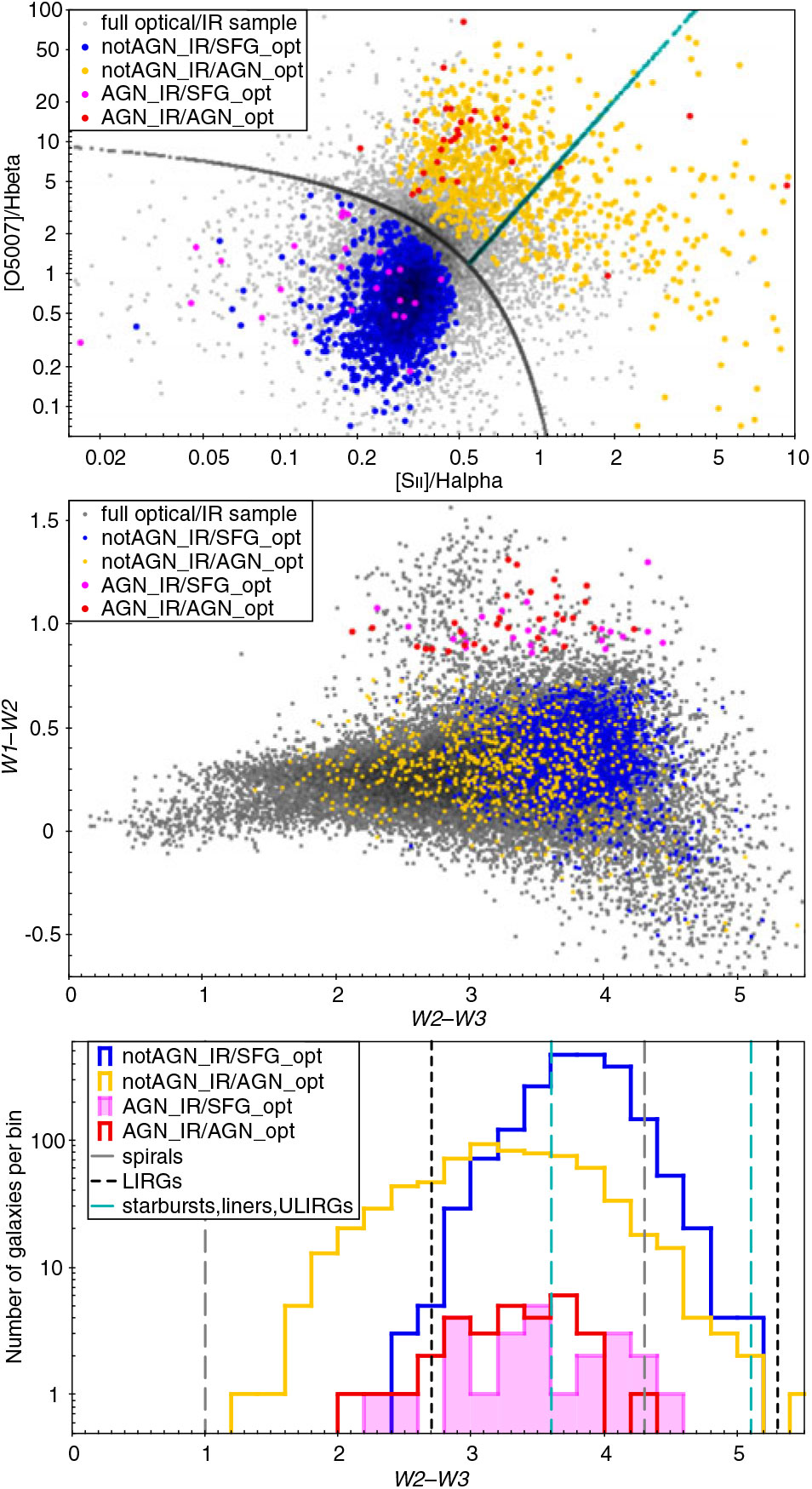
The middle panel of Figure 18 shows the various classes of galaxies placed in the WISE colour-colour diagram. Wright et al. (Reference Wright2010) and Jarrett et al. (Reference Jarrett2011) showed that the notAGNIR types include: ellipticals with W2−W3 of 0.5 − 1.5; spirals with W2−W3 of 1.0 − 4.3; luminous IR galaxies (LIRGs) with W2−W3 of ≃2.7 − 5.3; and starbursts, liners, and ultra-luminous IR galaxies (ULIRGs) with W2−W3 of ≃3.6 − 5.1. The colour limits for these groups are shown in the bottom panel of Figure 18 overlaid on the distribution of W2−W3 colours. The notAGNIR/SFGopt have a W2−W3 colour range consistent with that for LIRGs or a mixture of LIRGS and starbursts/liners/ULIRGs. The notAGNIR/AGNopt have a wide W2−W3 colour range, consistent with a mixture of spirals and one or both of the other groups of galaxies (LIRGs and star-bursts/liners/ULIRGs).
Table 5 shows that there is little quantitative correlation between the W1−W2 criterion and BPT criterion. Generally, the BPT classes of W1−W2 classified sources show poor correlation, e.g. for the G23/WISE sample, AGNIR are 6.4% classified as SFGopt and 8.2% classified as AGNopt.The W1−W2 classes of both SFGopt and AGNopt show most to be classified as notAGNIR.
Numbers of AGN/notAGN/SFG using W1-W2 and BPT criteria, or of Emission-line Galaxies.
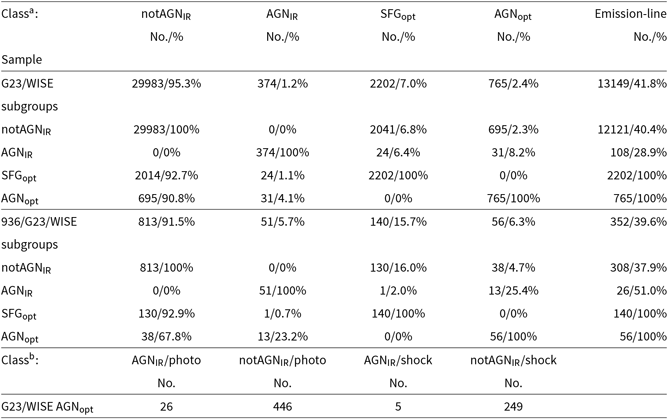
a The samples are listed in the first column; the numbers and percentages within each sample are listed across the rows in columns two to six.
b The breakdown of AGNopt types into photoionised and shock-ionised categories is given in the lowest section of the table.
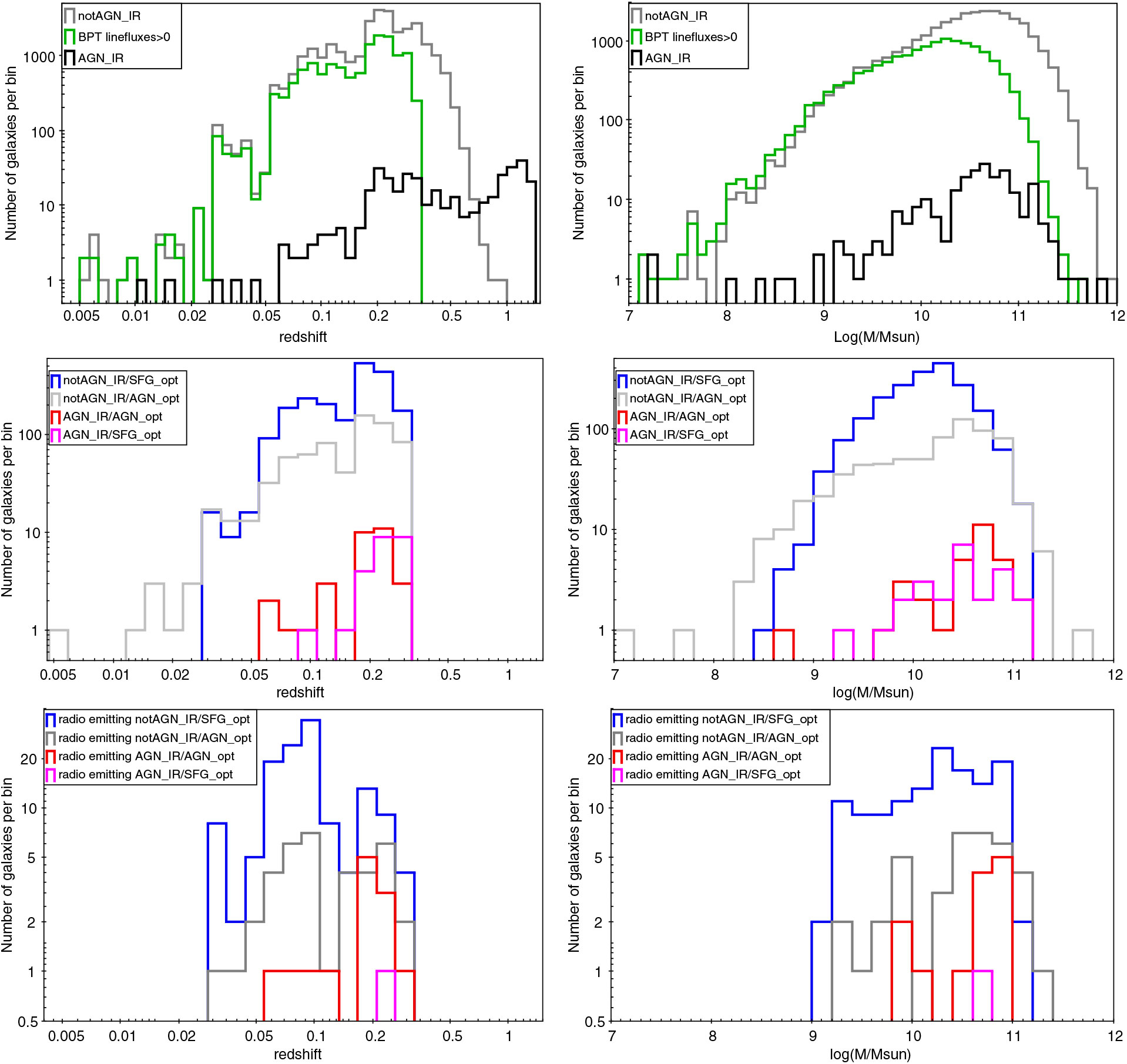
The redshift distributions for the various categories of G23/WISE galaxies are shown in the left panels of Figure 19. The Kolmogorov–Smirnov test was applied and showed that the notAGNIR/AGNopt subset has a different redshift distribution (lower redshifts) than the AGNIR/SFGopt subset at >99.9% confidence. The notAGNIR/AGNopt have lower redshifts than notAGNIR/SFGopt at the 99% confidence level, and the AGNIR/AGNopt have lower redshifts than AGNIR/SFGopt at only the 97.5% confidence level. The mass distributions for the various categories of G23/WISE galaxies are shown in the right panels of Figure 19.
Distributions of redshift (number of galaxies per redshift bin, left panels) and distributions of mass (number of galaxies per mass bin, units of log(M/M⊙), right panels) for the various subsets of G23/WISE galaxies. Subsets shown in the top two panels are notAGNIR galaxies (grey), AGNIR galaxies (black), and G23/WISE with all BPT lines in emission (green). Subsets shown in the middle and bottom panels are notAGNIR/SFGopt (blue), notAGNIR/AGNopt (grey), AGNIR/AGNopt (red), and AGNIR/SFGopt (magenta).
We further split the G23/WISE AGNopt galaxies into subsets based on the dominant mechanism of ionisation (Sharp & Bland-Hawthorn Reference Sharp and Bland-Hawthorn2010): gas dominated by photoionisation is left of the line (cyan line in the top panel of Figure 18) and shock-ionised gas is right of the line. Essentially the same line in the BPT diagram (Kewley et al. Reference Kewley, Groves, Kauffmann and Heckman2006) separates Seyferts (left of the line) from LINERs (right of the line). Of the AGNopt galaxies, 64% are photoionised/Seyferts and 36% are shock-ionised/LINERs.
The redshift and mass distributions of the photoionised and shock-ionised subsets of AGNopt galaxies are shown in Figure 20. The AGNIR subsets are small in number with 26 in the photoionised subset and 5 in the shock-ionised subset. Thus the redshift distributions cannot be distinguished. The AGNIR/photo subset has a higher mean mass than the AGNIR/shock subset, by a factor of ~ 1.5.
Distributions of redshift and mass for G23/WISE AGNopt galaxies split into a subset dominated by photoionisation (‘/photo’ in the label) and a subset dominated by shock ionisation (‘/shock’ in the label). The sets shown are notAGNIR/AGNopt/photo (light grey), notAGNIR/AGNopt/shock (blue), AGNIR/AGNopt/photo (dark grey), and AGNIR/AGNopt/shock (red).
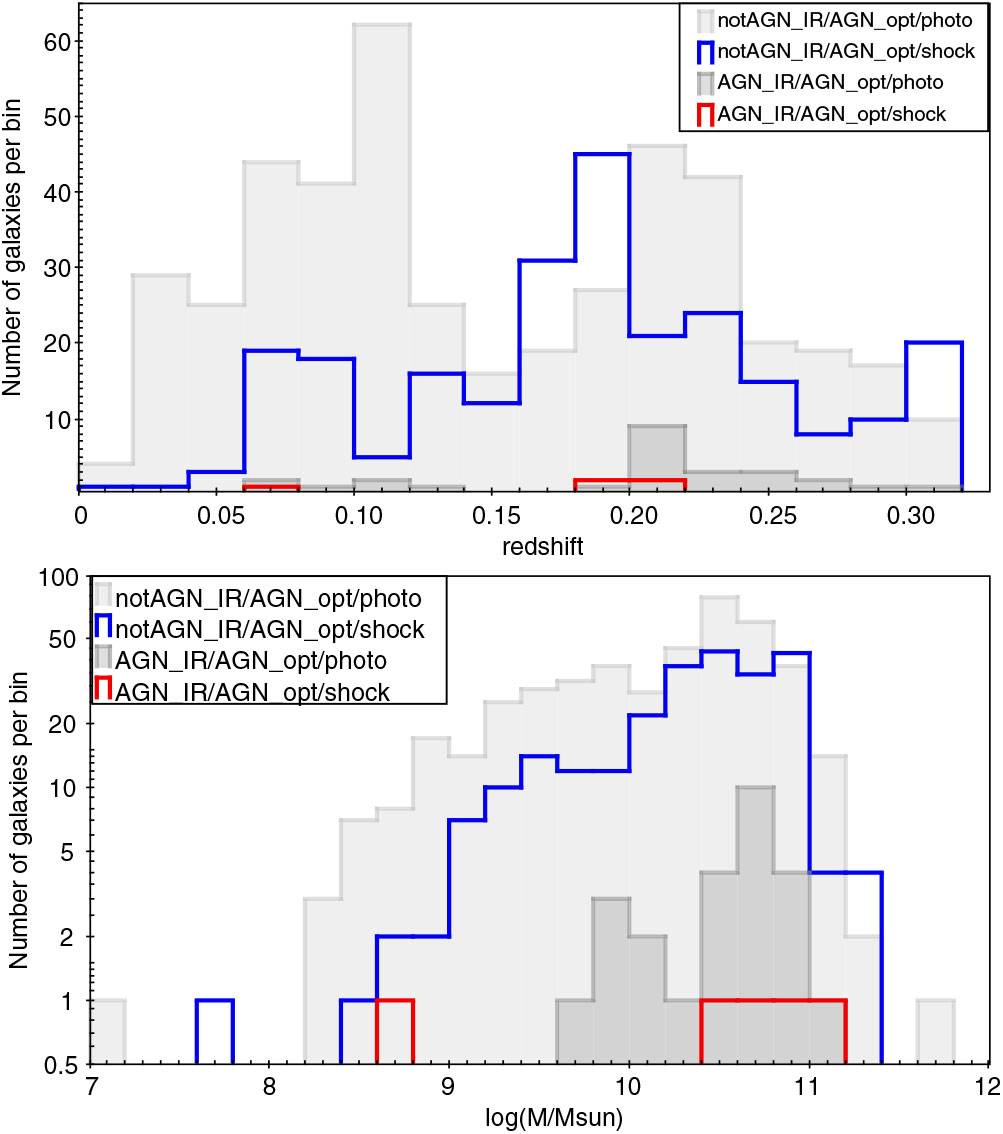
Comparison of the notAGNIR/photo subset with the notAGNIR/shock subset shows that the shock-ionised fraction increases with redshift: from near 0 at z < 0.01 to ~50% for z > 0.15. The notAGNIR/shock subset has a narrower mass distribution than the photoionised subset and higher mean mass, by a factor of ~ 1.6. For the notAGNIR, the shock-ionised subsets are shifted to higher redshift and to higher mass compared to the photoionised subsets. Because of the correlation of mass with redshift (see Figure 11), which is a selection effect of the galaxy survey, these are not independent effects.
3.3.4 Comparison of optically classified and IR-classified samples for the radio sources
Table 4 lists basic properties of the our different samples of G23 galaxies, with additional selections based on detection by WISE, by 936 MHz emission or by WISE W4(22 μm band). The goal here is to determine how the radio emitters differ from their parent samples. The SFG radio emitters (936/G23/SFGopt) have lower mean redshift but similar mean mass, than the parent galaxy sample (G23/SFGopt). The AGN radio emitters (936/G23/AGNopt)have lower mean redshift but higher mean mass, by factor 2.5, than the parent galaxy sample (G23/AGNopt). The lower redshift can be understood as a selection effect, but the higher mass should be intrinsic.
The WISE selected radio and non-radio emitting samples, 936/G23/WISE and G23/WISE, are compared. SFGopt and AGNopt have lower redshift for the radio emitters, but the mean masses of 936/G23/WISE SFGopt and AGNopt are essentially the same as for G23/WISE. With WISE selection, there are additional AGNIR and notAGNIR categories. The radio emitters have lower redshift for AGNIR and notAGNIR than for the G23/WISE sample. The mean masses of radio emitting AGNIR and the G23/WISE/AGNIR are the same, but the radio emitting notAGNIR have higher mean mass than G23/WISE/notAGNIR, by factor 2.1. The W1magni-tudes, related to the mass of the galaxy, of the radio emitters (936/G23/WISE) are brighter by ~1 magnitude for all 4 subsets than for G23/WISE.
The radio (936 MHz) emitting subsets of AGNIR, notAGNIR, SFGopt, and AGNopt sets are next compared. Table 4 lists some properties of these subsets, with the 936 label. First we consider the 936/G23/WISE sets. The highest redshift set is the AGNIR subset. The notAGNIR has highest mean mass (by a factor of ~ 2 − 3 over the other subsets). AGNopt and AGNIR are of similar mean masses and SFGopt are of lowest mean mass. The mean 936 MHz radio flux density of AGNIR is much higher than any of the other subsets (by a factor of ~ 9 above the overall mean for 936/G23/WISE galaxies). notAGNIR have the second highest radio flux density, higher than either AGNopt or SFGopt, by a factor of ~ 2.5.
Of the 936/G23/WISE sources, 396 have W4 luminosity with SN≥3 (labelled 936/G23/WISE w4snr≥3). The subsets’ sample sizes are small except for notAGNIR.The AGNIR are the most luminous subset at 936 MHz and at 22 μm. The sub-categories, AGNIR/AGNopt,AGNIR/SFGopt, and AGNIR/lineflux< 0, are consistent with the same luminosity in the 22 μm band, and the same flux density at 936 MHz.
Table 5 shows the breakdown of G23/WISE and 936/G23/WISE samples into IR AGN categories, BPT categories, and the emission line galaxies category. The G23/WISE sample has a small fraction (1.2%) classified as AGNIR compared to notAGNIR. It has several per cent classified as SFGopt or AGNopt. For the radio emitting sample, 936/G23/WISE, the fraction of AGNIR is 5.7%, larger by factor ~ 5. The fraction of SFGopt or AGNopt for 936/G23/WISE is larger by a factor of ~ 2 − 2.5 compared to G23/WISE. The rest of Table 5 is discussed in Section 4 below.
4 Discussion
4.1 Radio Source Distribution
We compared flux density distributions of the single, double, and triple sources (Figure 8), and found that the peak for doubles and triples occurred at ~20 mJy compared to ~1 mJy for the singles. All of the doubles and triples (except one) are AGNIR.The single notAGNIR triple does not have a G23 optical galaxy counterpart or redshift. In contrast, the singles are dominated by the lower radio luminosity SFG (813 notAGNIR vs. 51 AGNIR).
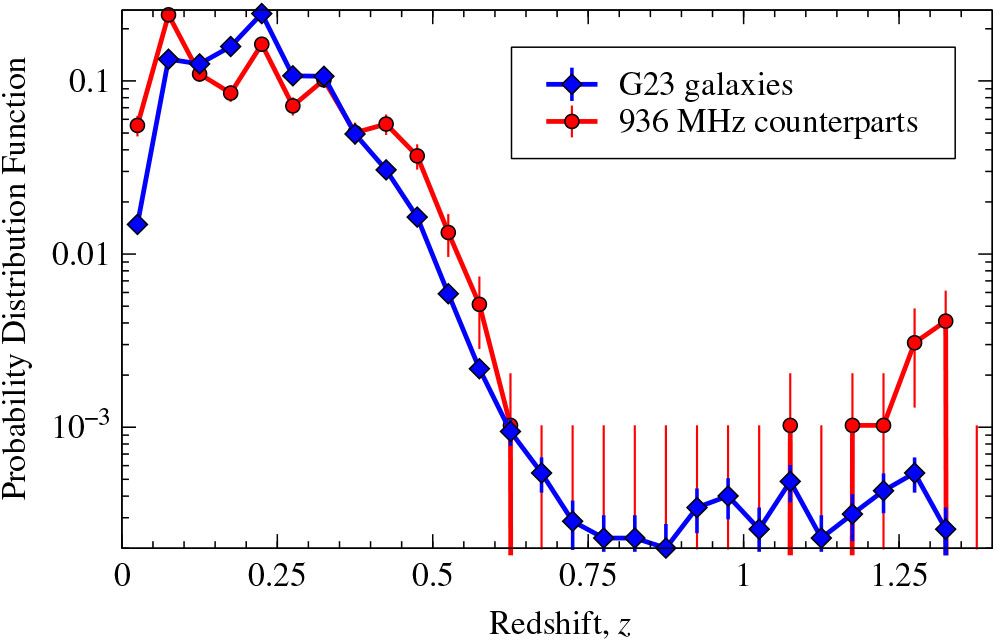
The redshift distributions of the G23 galaxies and those with 936 MHz emission are shown in Figure 21. The radio emitters have similar redshifts to G23 galaxies, but they have real (> 3σ ) excesses at redshifts of ≃0.0−0.10 and 0.35–0.60 and a deficit at redshifts of 0.10–0.30. There is a weak (2σ ) excess for z >1.2. This may be a result from having multiple types of radio sources (SFG and AGN), each with a different spatial distribution. We find that the median redshifts for doubles and triples (which are all AGN) are 0.39 and 0.37, whilst the median redshift for single sources (which includes AGN and SFG) is 0.21.
Redshift distributions (Pi for redshift bin i) for G23 galaxies and for 936 MHz counterparts are shown by the blue and red curves. These are normalised by ΣiPi = 1. There is an excess of radio counterparts for some redshift ranges and a deficit for other ranges. The Pi for 1320 MHz counterparts is almost identical with that for 936 MHz counterparts, except that it has slightly larger error bars.
Figures 11 and 12 illustrated that galaxies that are radio sources are more massive than average. The mean mass is higher by a factor of ≃2.3 and the peak mass of the distribution is shifted higher by a factor of ≃3.2.
We found K band and NUV magnitudes for G23 galaxies and radio counterparts by obtaining photometry from the G23 input catalogue. First we selected the set of G23 galaxies with photometry for the same sky area as the 936 MHz map. We also selected the subset with photometry and spectra, to check for selection effects of requiring spectra. We then cross-matched the 936 MHz sources to the G23 set and G23 subset with spectra to obtain photometry for the radio counterparts. Table 6 shows the means and standard deviations (SD) for the K band and NUV magnitudes of the galaxies and the radio counterparts. The mean K band flux for the radio-emitting galaxies is higher by a factor of 3, consistent with the mass excess. The mean NUV band flux for the radio emitters is higher by a factor of 2. The main effect of the additional requirement of having spectra (sp in Table 6) is the removal of the faint end of the magnitude distribution, hence reduction in the mean magnitudes by a small amount.
K and NUV magnitudes of G23 galaxies and 936 MHz counterparts.
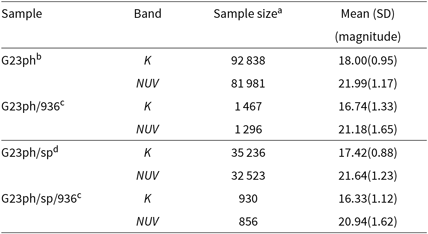
a Galaxies with measured K band magnitudes (<21) and with measured NUV magnitudes (<25) were selected for K and NUV samples, respectively.
b G23ph is the set of G23 galaxies with photometry.
c 936 indicates that the sample is cross-matched with the 936 MHz source catalogue using radius of 7″.
d G23ph/sp is the set of G23 galaxies with photometry and spectra.
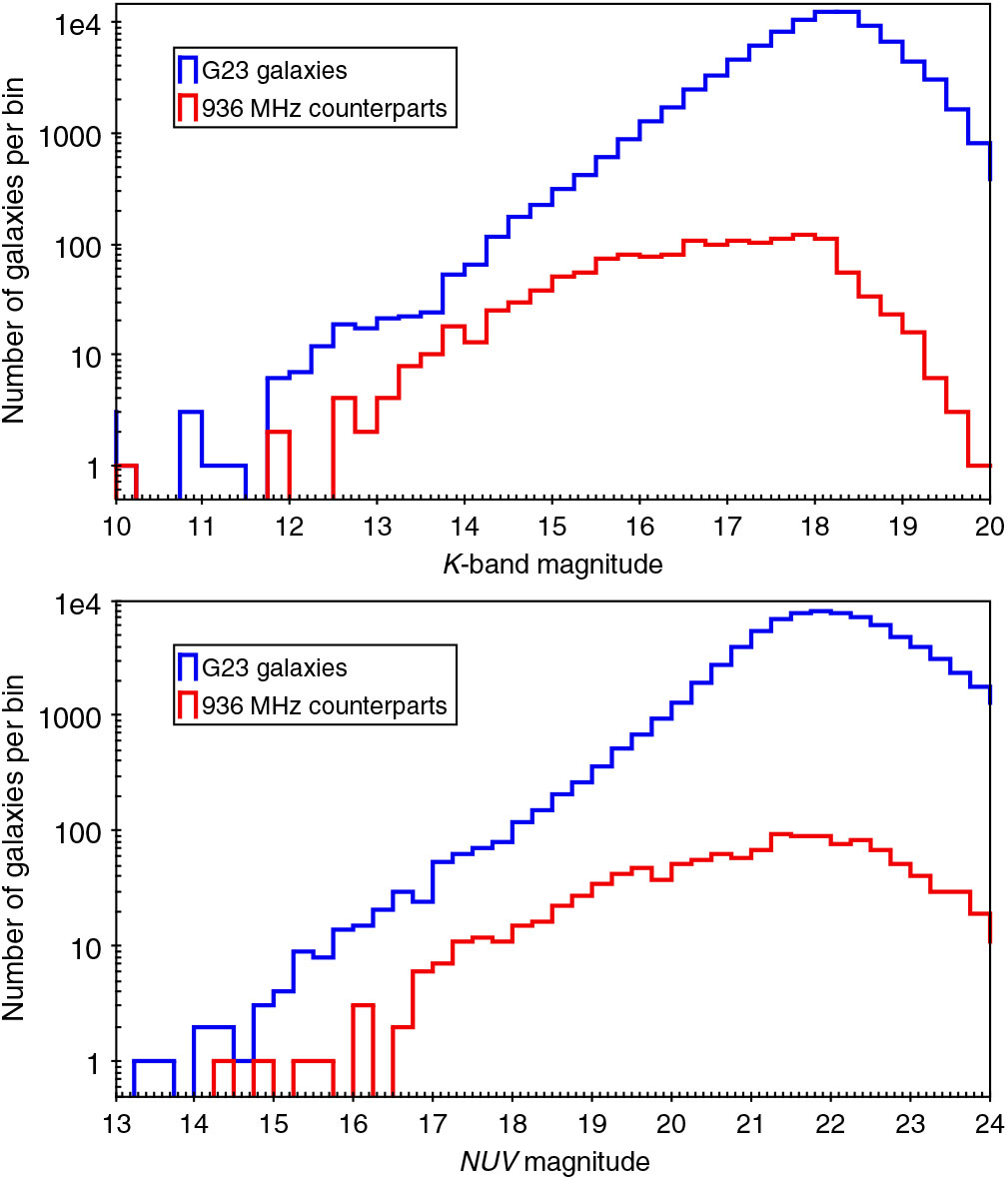
Figure 22 shows the distributions of K-band magnitudes and NUV magnitudes for the G23 galaxies with photometry and for the radio emitting subset. The radio emitters have much flatter distribution to low (brighter) magnitudes for both K and NUV. Radio-emission is detected much more frequently at high mass (> 1011M⊙) (Figure 12), at bright K magnitude (< 15.5) and at bright NUV magnitude (< 19), by factors which range from ~ 5 − 10. Mass and K magnitude are expected to behave similarly because the mass is dominated by K and M stars (main-sequence and giant), and the optical light is dominated by K and M giants. The excess UV magnitude can come from active star formation or from the accretion disk associated with an AGN.
Top panel: K-band magnitude distributions for G23 galaxies with photometry (blue histogram) and for 936 MHz counterparts (red histogram). Bottom panel: NUV magnitude distributions for G23 galaxies with photometry (blue histogram) and for 936 MHz counterparts (red histogram).
The fraction of galaxies that host a radio-loud AGN is known to rise strongly with stellar mass (Best et al. Reference Best, Kauffmann, Heckman, Brinchmann, Charlot and White2005), from nearly zero below stellar mass of 1010 M⊙ to > 30% for mass > 5 × 10¹¹ M⊙. For massive early-type galaxies, a strong correlation of radio power with K-band absolute magnitude has been demonstrated (e.g. Sadler, Jenkins, & Kotanyi Reference Sadler, Jenkins and Kotanyi1989; Fabbiano, Gioia, & Trinchieri Reference Fabbiano, Gioia and Trinchieri1989; Brown et al. Reference Brown, Jannuzi, Floyd and Mould2011). For our full optical sample of galaxies (Figure 12), we find that there are no radio emitters below 2 × 10⁸M⊙ (with one exception). For the absorption line galaxies, which should be mostly massive early type galaxies, there are no radio emitters below 6 × 10⁹M⊙. This is consistent with the results of Brown et al. (Reference Brown, Jannuzi, Floyd and Mould2011) and Best et al. (Reference Best, Kauffmann, Heckman, Brinchmann, Charlot and White2005), despite the difference in galaxy samples.
4.2 AGN–SFG discrimination
In Section 3.3.2, we used two tests to distinguish SFG from AGN: W1−W2 and BPT. Both tests have weaknesses. Two main types of AGN (for a review, see Best & Heckman Reference Best and Heckman2012) are High Excitation Radio Galaxies (HERGs) and Low Excitation Radio Galaxies (LERGs). The W1−W2 AGN diagnostic accepts some galaxies that are not AGN and misses AGN with weak mid-IR emission, such as LERGs. The BPT test can miss AGN with optically obscured nuclei and cannot be applied to the large fraction of galaxies that only present absorption lines.
Stern et al. (Reference Stern2012) showed that W1−W2 has high reliability using empirical AGN spectra and the galaxy spectral templates of Assef et al. (Reference Assef2010). However, that study did not consider all galaxy types. Some AGNIR are not true AGN: Brown et al. (Reference Brown2014b) used observed spectra of nearby galaxies to show that observed spectral energy distributions of low metallicity blue compact dwarfs and extremely dusty luminous IR galaxies (LIRGS) give W1−W2 colours like AGN. LIRGs are found predominantly in older, massive galaxies with strong stellar absorption lines, thus would be found among the ~13 000 optical galaxies with absorption lines and not classified by the BPT criterion.
The WISE colours of LERGs and HERGs were investigated by Gürkan et al. (Reference Gürkan, Hardcastle and Jarvis2014). They show that LERGs are found in the WISE color-colour diagram with W1 − W2 < 0.8 and W2−W3 in a broad range of ~2–6. The LERGs stand out most clearly from the other classes of AGN in the WISE 22 μm versus radio 151 MHz luminosity diagram (their Figure 8). We converted the boundaries of the regions containing HERGs and LERGs to 936 MHz luminosity using a spectral index of −0.7 and plotted those boundaries on Figure 13. The HERG and LERG regions are distinct from the region occupied by SFGs. Most galaxies in our sample of radio emitting galaxies are located in a region consistent with SFGs, and few are consistent with HERGs or LERGs.
The 22 μm versus radio luminosity diagram was made for the subcategories of notAGNIR/SFGopt, notAGNIR/AGNopt, AGNIR/AGNopt,and AGNIR/SFGopt. We find notAGNIR/AGNopt and notAGNIR/SFGopt are not distinguishable in 22 μm versus radio luminosity. The AGNIR/AGNopt and AGNIR/SFGopt are at higher 22 μm and radio luminosity than the two notAGNIR sets. However, all 4 sets lie in the region of the blue points in the top panel of Figure 13,Footnote d and are in the region of SFGs rather than the regions of HERGs or LERGs.
The optical and IR classifications as AGN do not agree for a significant number of galaxies (see Table 5). Of the SFGopt, 24 are AGNIR (vs. 2014 notAGNIR), and AGNopt are mostly notAGNIR (695) with few AGNIR (31). What causes the difference between BPT and W1−W2 classifications?
The W1−W2 classification is based on the slope of the 3.4–4.6 μm IR spectrum. This is on the long-wavelength Rayleigh-Jeans side of the stellar continuum peak for all stars, whether they are hot, massive and young, or old and cool. The presence of a strong AGN implies a significant contribution to the IR continuum by dust which is reradiating the AGN continuum. This results in a mid-IR spectrum flatter than that seen in typical starbursts.
An AGN can have high extinction from the surrounding interstellar medium of the galaxy preventing the optical BPT lines from the AGN from being seen, while emission from star formation in the regions of the galaxy outside the high-extinction region may be detected. In this scenario the result is that such a galaxy will be classified as SFGopt, despite the presence of an AGN. Thus the SFGopt/AGNIR galaxies can be explained as high-extinction AGN, accounting for one of the two conflicting classification pairs.
The extinction of galaxies is too small in the 3.4−4.6 μm range to affect the spectral slope, so the W1−W2 diagnostic can distinguish strong AGN from SFG. Faint AGN where the stellar continuum has a significant contribution (≳50%) in the 3.4– 4.6 μm range has W1 − W2 < 0.8 (Figure 2 of Stern et al. Reference Stern2012), which results in faint AGN being classified as notAGNIR/SFGopt galaxies.
Wright et al. (Reference Wright2010) (their Figure 10) shows the WISE colourcolour diagram with different classes of galaxies in partially overlapping regions. The WISE colour-colour diagram for our sample (middle panel of Figure 18) shows that notAGNIR/AGNopt galaxies are at smaller W2−W3 than notAGNIR/SFGopt galaxies. Both of our sets overlap the spiral, LIRG, and starburst regions. From the lower 2 panels of Figure 18, we find that notAGNIR galaxies with optical emission dominated by star formation (SFGopt, blue histogram) are most consistent with W2−W3 colours of LIRGs. The notAGNIR/AGNopt (yellow histogram) have W2−W3 colours consistent with the mixture of spirals and LIRGs and possibly star-bursts. The two AGNIR categories (SFGopt and AGNopt)havefew objects but spread across the LIRG, Seyfert, starburst, QSO, and ULIRG regions of Figure 10 of Wright et al. (Reference Wright2010).
The notAGNIR/AGNopt galaxies have optical lines showing AGN-like ionisation, but their mid-IR is powered mainly by stellar emission. The W1 − W2 < 0.8 notAGNIR criterion corresponds to the AGN contributing <62% of the mid-IR emission (Stern et al. Reference Stern2012) for redshift z < 0.32 (the upper limit of galaxies classified by BPT). The left panel of Figure 2 of Stern et al. (Reference Stern2012) shows that almost the same limit (<58%) applies for E(B − V) = 1and this doesn’t change much for higher extinction if z < 0.32. Thus the AGN can contribute up to 60% to the mid-IR emission, yet a galaxy will be classified as notAGNIR. We refer to this case as a weak AGN.
The notAGNIR/AGNopt could be weak AGN where the stellar mid-IR dominates over the AGN mid-IR, but the AGN optical emission would have to dominate over the stellar optical emission to give the AGNopt classification. Using the Kewley et al. (Reference Kewley, Groves, Kauffmann and Heckman2006) criterion, we find that 64% of AGNopt are Seyferts and 36% are LINERs. Because the vast majority of both sets are notAGNIR,this implies both Seyferts and LINERs, with few exceptions, are not classified as AGN using IR colours.
Some fraction of AGN should be in the phase where the AGN has shut off but the AGN photoionisation remains. Such AGN would be seen as AGNopt/notAGNIR/photo, whereas active AGN would be seen as AGNopt/AGNIR/photo. Table 5 gives the observed number of these two types (446 and 26, respectively). The ratio of these two types of ~ 17 in the current sample would imply that the timescale for AGN photoionisation to linger is greater than the AGN active phase by a factor of ~ 17. The estimated timescale for lingering photoionisation in AGN is 104 to 105 yr (Schawinski et al. Reference Schawinski, Koss, Berney and Sartori2015), and the AGN active timescale is estimated at 105 yr. Thus the expected ratio of AGNopt/notAGNIR/photo to AGNopt/AGNIR/photo should be ~ 0.1 to 1, rather than ~ 17. So, either: a) only ~3 to 30 of the 446 AGNopt/notAGNIR/photo can be explained by lingering photoionisation; or b) the AGN on and off timescales are inaccurate by 1 to 2 orders of magnitude. In the first case, there must be another explanation for most of the AGNopt/notAGNIR/photo.
In summary, there is the explanation of extinction for the apparent conflicting classification AGNIR/SFGopt, but no single convincing explanation for notAGNIR/AGNopt.
5 Summary and Conclusion
We have processed ASKAP commissioning observations of the GAMA G23 field in two frequency bands centred at 936 MHz and 1320 MHz, and have demonstrated that ASKAP produces excellent image quality, allowing identification of radio sources down to ~1 mJy with positions accurate to ~ 5 arcsec. We extracted the radio components and identified multiple component radio sources to produce 936 and 1320 MHz radio source catalogues.
The radio sources were position matched to GAMA G23 galaxies, to WISE IR sources and to G23 galaxies with WISE IR counterparts. The masses for the G23 galaxies were based on masses of photometry-matched galaxies from the GAMA equatorial fields. A summary of our analysis of the multi-wavelength data set is as follows.
Of the ~5 800 radio sources, ~1 000 have counterparts amongst the G23 galaxies, ~3 000 have WISE IR counterparts, and ~900 have both G23 galaxy and WISE counterparts. Some fraction of the radio sources without WISE counterparts will be AGN too faint to be detected by WISE (IR-faint radio sources; e.g. Collier et al. Reference Collier2014). The G23 galaxy radio sources tend to be those at the high-mass end (≳ 1010M⊙) of the galaxy distribution (top panel of Figure 11).
Galaxies that are detected in radio are observed to be more massive and brighter at K-band and UV, than those without radio sources. Radio emission from AGN is expected to be brighter for more massive galaxies, which are brighter in K band. Similarly, radio emission from star formation and UV emission are stronger for galaxies with active star formation.
The majority of the ASKAP radio sources show the well-known correlation (Rieke et al. Reference Rieke, Alonso-Herrero, Weiner, Pérez-González, Blaylock, Donley and Marcillac2009) for SFG between the radio and mid-IR luminosities (Figure 13). A few tens of sources have excess radio emission and are likely to host AGN, although not all are classified as AGN by their IR colour.
The G23 galaxies were classified as AGNIR or notAGNIR, based on the W1−W2 indicator. ~380 galaxies are classified as AGNIR, compared to ~30,000 classified as notAGNIR.AGNIR have higher redshifts than notAGNIR (factor ~ 3) but similar masses. AGNIR have much higher 22 μm luminosities (factor ~ 30). Only ~50 of these AGNIR are radio sources.
Using the BPT diagnostic, galaxies were classified as AGNopt or SFGopt. ~770 galaxies are classified as AGNopt and ~2200 classified as SFGopt.AGNopt have similar redshifts to SFGopt but a broader mass distribution.
We find disagreement between these two AGN indicators. Of the 55 AGNIR 24 are classified as SFGopt and ~700 of 2800 notAGNIR are classified as AGNopt (Table 5). The AGNIR/SFGopt galaxies can be explained in terms of obscured AGNIR. The reasons why AGNopt are classified as notAGNIR are not clearly understood yet.
The radio sources were separated into AGNIR, notAGNIR, AGNopt, and SFGopt subsets. These radio subsets are smaller by ~1 order of magnitude than the galaxy subsets. Each of the 4 radio subsets has indistinguishable redshift distribution from that of the corresponding parent galaxy subset (Figure 19, left panels). We find that the level of disagreement between optical and IR AGN diagnostics is similar for the radio emitting subsets as for the corresponding parent galaxy subset (Table 5).
The results presented in this paper are a first step towards combining large deep radio survey data with large well-studied samples of galaxies in the nearby Universe with extensive multi-wavelength data. The EMU survey will be almost an order of magnitude more sensitive than the observations presented here, and this, combined with even deeper optical and IR observations, will provide even greater overlap between the radio, optical, and IR samples of galaxies, enabling radio observations to become another tool that will be used routinely to characterise and understand galaxies in the local Universe.
Author ORCIDs
Denis A. Leahy https://orcid.org/0000-0002-4814-958X; A. M. Hopkins https://orcid.org/0000-0002-6097-2747; N. Seymour https://orcid.org/0000-0003-3506-5536.
Acknowledgements
The Australian SKA Pathfinder is part of the Australia Telescope National Facility which is managed by CSIRO. Operation of ASKAP is funded by the Australian Government with support from the National Collaborative Research Infrastructure Strategy. ASKAP uses the resources of the Pawsey Supercomputing Centre. Establishment of ASKAP, the Murchison Radio-astronomy Observatory, and the Pawsey Supercomputing Centre are initiatives of the Australian Government, with support from the Government of Western Australia and the Science and Industry Endowment Fund. We acknowledge the Wajarri Yamatji people as the traditional owners of the Observatory site. GAMA is a joint European-Australasian project based around a spectroscopic campaign using the Anglo-Australian Telescope. The GAMA input catalogue is based on the data taken from the Sloan Digital Sky Survey and the UKIRT Infrared Deep Sky Survey. Complementary imaging of the GAMA regions is being obtained by a number of independent survey programmes including GALEX MIS, VST KiDS, VISTA VIKING, WISE, Herschel-ATLAS, GMRT, and ASKAP providing UV to radio coverage. GAMA is funded by the STFC (UK), the ARC (Australia), the AAO, and the participating institutions. The GAMA website is http://www.gama-survey.org/. This publication makes use of data products from the Wide-field Infrared Survey Explorer, which is a joint project of the University of California, Los Angeles, and the Jet Propulsion Laboratory/California Institute of Technology, funded by the National Aeronautics and Space Administration. DL is supported by a grant from the Natural Sciences and Engineering Research Council of Canada. The referee is acknowledged for a number of suggestions that led to improvements in this paper.



