


Impact statement
The transition to a circular economy is viewed as a key component of the movement toward a more sustainable society, as it aims to ensure that production, consumption, use and disposal occur with lower resource consumption and reduced environmental impact. However, many proposed circular solutions fail to bring about real change because the gap between theory and practice is not sufficiently illuminated. This study addresses this critical gap by examining the drivers of single-use nonsterile glove consumption in healthcare and exploring how circular strategies can reduce plastic use in practice. Focusing on hospitals and elderly care in two Scandinavian countries, the findings highlight that the use phase, where frontline healthcare staff make real-time decisions, holds the greatest potential for reducing plastic consumption, far more than procurement or recycling interventions alone. By applying a circular economy lens to the use of single-use gloves, this research provides actionable insights into how circular strategies can be implemented in complex, highly regulated public systems. The paper also explores practical barriers to reducing material consumption. This case is particularly compelling because it represents substantial and varied material use, while also offering insights that extend beyond the immediate context. These findings are broadly applicable across the healthcare sector, especially for other single-use items with low end-of-life recycling value, such as aprons and incontinence products. The study contributes to advancing circularity in healthcare by reframing how and where circular strategies can be most effectively implemented. It supports policymakers, procurement officers, healthcare managers and healthcare staff in designing interventions that go beyond recycling, encouraging systemic changes in behavior and institutional routines. In this way, the study offers valuable and novel insights to help close the knowledge gap between theoretical understanding and practical approaches to transitioning toward a more circular healthcare sector.
Introduction
The healthcare sector is both critical to societal well-being and a significant contributor to environmental impacts. At large, healthcare systems contribute with 4.4% of the global total CO₂ emissions (Pichler et al., Reference Pichler, Jaccard, Weisz and Weisz2019), while simultaneously generating significant volumes of solid waste amounting to an annual 100 million tons (Wyssusek et al., Reference Wyssusek, Keys and van Zundert2019; van Boerdonk et al., Reference van Boerdonk, Krikke and Lambrechts2021). In Sweden alone, the healthcare sector generates ~3 million t CO₂e annually, with 20% of this, about 600,000 tons, attributed to the consumption of materials, such as gloves, tubes and single-use textiles (Teghammar et al., Reference Teghammar, Sand Lindskog, Fagerberg and Berko2019). Single-use plastics account for 25% of the waste generated from hospitals (Gibbens, Reference Gibbens2019), of which the vast majority is incinerated, despite 85% of it being nonhazardous (Word Health Organization, 2018).
Nonsterile single-use examination gloves, called single-use gloves in this study, constitute a substantial part of the waste generated by single-use plastics and are among the leading consumables in the total plastic consumption in healthcare (Ivanović et al., Reference Ivanović, Meisel, Som and Nowack2022). Criticism of their extensive and ever-growing use has been raised in prior research (Rizan et al., Reference Rizan, Mortimer, Stancliffe and Bhutta2020; Rizan et al., Reference Rizan, Brophy, Lillywhite, Reed and Bhutta2022), with an observation study finding 42% of glove use to be inappropriate (Loveday et al., Reference Loveday, Lynam, Singleton and Wilson2014). Still, existing research has primarily approached glove use from an infection control perspective and is based mainly on data collected in the United Kingdom. While the commentary by Rizan et al. (Reference Rizan, Mortimer, Stancliffe and Bhutta2020) broadly mentions the impacts of plastic use and the potential of implementing circular strategies, there is a lack of empirical evidence and practical guidance on how to implement such approaches within public healthcare systems. One recent study, however, underpins the need for involvement of healthcare practitioners for the implementation of circular initiatives that are effective in practice (Oturai et al., Reference Oturai, Ramos, Ndwiga and Syberg2025). Research on circularity within the public sector at an organizational level is nascent, and investigations at different governmental levels, such as regional, are imperative (Klein et al., Reference Klein, Ramos and Deutz2022).
Currently, only a small fraction of single-use plastics in healthcare are recycled (Joseph et al., Reference Joseph, James, Kalarikkal and Thomas2021), primarily due to hygiene risks, spatial constraints and logistical barriers. These end-of-life challenges make upstream interventions, focused on reducing use and improving efficiency, especially critical. While circular strategies – R-Strategies – (Potting et al., Reference Potting, Hekkert, Worrell and Hanemaaijer2017) are widely heralded as viable approaches to maintaining resource value, their operationalization in the use phase, particularly in healthcare, remains underexplored.
The current study addresses this gap by investigating the drivers of glove overconsumption and identifying how circular strategies can be applied to reduce the consumption of single-use plastics in healthcare. Grounded in empirical research across two Scandinavian countries, including workshops and interviews with healthcare professionals, the study examines glove consumption practices in hospitals and elderly care settings. It adopts a user-focused lens to understand how product use behaviors, institutional routines and procurement systems interact to drive plastic waste, and how these can be reshaped using circular approaches (derived from the 9R strategies). The article specifically aims to answer the following research questions:
RQ1: What are the main driving forces behind the increased consumption of plastic gloves?
RQ2: How could circular strategies contribute to a reduction in plastic glove consumption?
RQ3: What are the main barriers to the implementation of circular strategies for plastic glove consumption?
By focusing on the use phase, where real-time decisions about plastic consumption are made, this research provides novel insights into implementing circular economy principles in complex, highly regulated environments. Single-use gloves are used here as a case to examine broader trends in healthcare’s growing reliance on single-use products and as an indicative example of this overall trend. More broadly, this study refines the application of circular economy theory by illustrating how R-strategies must be tailored to specific life cycle phases, particularly for products with low end-of-life recovery value.
Background
The EU policy and the 9R framework
The large volumes of single-use plastics consumed significantly contribute to the public sector’s environmental impact. However, as public procurement accounts for 14% of the European Union’s (EU’s) GDP (European Court of Auditors, 2023), it wields a substantial influence on public spending toward more sustainable and circular alternatives (European Commission, 2008b; Witjes and Lozano, Reference Witjes and Lozano2016). The EU action plan for a circular economy specifically mentions plastics as a main target area (European Commission, 2015). The strategy’s primary focus is on recycled content, biodegradable materials and waste reduction measures, while decreasing consumption is not a mentioned strategy (The European Parliament and the Council, 2019). The policy context thus lacks clear incentives to reduce single-use plastic consumption.
Different strategies have been introduced to support the reduction of resource and material consumption throughout the value chain. Since its introduction by Potting et al. (Reference Potting, Hekkert, Worrell and Hanemaaijer2017), the circular strategies framework has been highly impactful, refined (Blomsma et al., Reference Blomsma, Pieroni, Kravchenko, Pigosso, Hildenbrand, Kristinsdottir, Kristoffersen, Shahbazi, Nielsen, Jönbrink, Li, Wiik and McAloone2019; Kurilova-Palisaitiene et al., Reference Kurilova-Palisaitiene, Sundin and Sakao2023) and applied to a wide variety of products (Alamerew et al., Reference Alamerew, Kambanou, Sakao and Brissaud2020; Kambanou et al., Reference Kambanou, Matschewsky and Carlson2024). Circular strategies range from end-of-pipe focused efforts, such as energy recovery and recycling, to entirely rethinking value creation through new ways of satisfying customers or avoiding the production and use of a product altogether. Altogether, the circular strategies framework suggested by Potting et al. (Reference Potting, Hekkert, Worrell and Hanemaaijer2017) covers nine strategies. In policy, the 4R framework has been deployed by the EU since the adoption of the European Commission’s Community Strategy for Waste Management (European Commission, 1989) as the so-called waste hierarchy and the adoption of the waste framework directive in 2008 (European Commission, 2008a). According to Potting et al. (Reference Potting, Hekkert, Worrell and Hanemaaijer2017), the nine strategies can be grouped into three main categories:
-
• 0R Refuse, 1R Rethink and R2 Reduce are associated with smarter product use and manufacturing.
-
• R3 Reuse, R4 Repair, R5 Refurbish, R6 Remanufacture and R7 Repurpose are associated with the durability and lifespan of products and their parts.
-
• R8 Recycling and R9 Recover are associated with traditional waste management practices focusing on the application of waste materials.
The R-framework is generally regarded in academic literature as a practical way of operationalizing the circular economy into applicable strategies (Diaz et al., Reference Diaz, Schöggl, Reyes and Baumgartner2021). Circular solutions require customer acceptance, and several behavioral aspects provide barriers, such as customer understanding and knowledge of the product, impact on everyday life, quality, risks and benefits derived from solutions (Camacho-Otero et al., Reference Camacho-Otero, Boks and Pettersen2018; Muranko et al., Reference Muranko, Andrews, Newton, Chaer and Proudman2018). However, studies often focus on customer behavior in the initial purchasing stage (Hazen et al., Reference Hazen, Mollenkopf and Wang2017), not the product’s use phase.
Single-use plastic gloves in the healthcare sector
Previous studies on single-use plastics have primarily focused on the potential for recycling (e.g., see Joseph et al., Reference Joseph, James, Kalarikkal and Thomas2021; RISE Research Institutes of Sweden, 2019) and plastic waste management (Ramos et al., Reference Ramos, Christensen, Oturai and Syberg2023). There are also studies on particular product types, such as formula bottles for infants (Leissner and Ryan-Fogarty, Reference Leissner and Ryan-Fogarty2019), single-use medical sensors (Leppälä et al., Reference Leppälä, Vornanen and Savinen2023) and other medical devices (Guzzo et al., Reference Guzzo, Carvalho, Balkenende and Mascarenhas2020; Lingegård et al., Reference Lingegård, Martin and Gheitasi2025). However, single-use nonsterile examination gloves, with a low end-of-life value, are unexplored. This type of glove (single-use, nonsterile examination glove) is by far the most commonly used single-use product in the healthcare system, and is used in various practices and situations across the healthcare sector.
In the past 10 years, the major trend for many items in the healthcare sector has been moving from multiple-use items to single-use items due to a combination of price reductions, convenience and the perception that they sustain and enhance hygiene (Bhutta, Reference Bhutta2021). There are indications that the extensive use of single-use plastic gloves, in some situations, has replaced traditional washing and sanitizing practices (Lindberg et al., Reference Lindberg, Skytt and Lindberg2020; Haenen et al., Reference Haenen, de Greeff, Voss, Liefers, Hulscher and Huis2022).
From a user perspective, some studies have examined the utilization of gloves by healthcare personnel, all focusing on clinical or healthcare viewpoints, focusing on the associated contamination risks. Research conducted in the Netherlands (Haenen et al., Reference Haenen, de Greeff, Voss, Liefers, Hulscher and Huis2022) and Sweden (Lindberg et al., Reference Lindberg, Skytt and Lindberg2020) indicate a low adherence to the World Health Organization’s hand sanitization requirements (WHO, 2009) in hospitals and care institutions, including reduced hand hygiene compliance caused by glove use in a UK case (Fuller et al., Reference Fuller, Savage, Besser, Hayward, Cookson, Cooper and Stone2011) (Flores and Pevalin, Reference Flores and Pevalin2006; Haenen et al., Reference Haenen, de Greeff, Voss, Liefers, Hulscher and Huis2022). Furthermore, large-scale reduction interventions for glove use, such as the 2018 “The Gloves are Off” campaign in the United Kingdom (NHS, 2018);, underline a suggested widespread overuse of gloves (glove wearing with no hygiene indication) since the glove volumes decreased by 18% with no implication for healthcare-associated infections ( Lalakea et al. Reference Lalakea, Noel and Meiklejohn2025; Peters et al., Reference Peters, Močenić, Spitilli, Bloomfield and Bhutta2025). Overall, the usage of gloves depends on several aspects related to individual risk perception, beliefs and experience, as well as organizational culture and social norms (Flores and Pevalin, Reference Flores and Pevalin2006; Haenen et al., Reference Haenen, de Greeff, Voss, Liefers, Hulscher and Huis2022). Several studies indicate overconfidence in correct glove usage; however, Kristiansen et al. (Reference Kristiansen, Bastien, Debesay and F2024) found that observations did not confirm this, leading to the conclusion that determining optimal glove wearing causes problems in practice (Bate Reference Bate2024).
Furthermore, using a double layer of gloves as an alternative to hand hygiene to save time contributes to excess consumption. Haenen et al. (Reference Haenen, de Greeff, Voss, Liefers, Hulscher and Huis2022) stressed the need for managers to facilitate hand hygiene practice and ensure adherence to hand hygiene guidelines (WHO, 2025). Additionally, one study examined the dispensing of gloves and how the design of dispensing boxes could reduce contamination of unused gloves (Assadian et al., Reference Assadian, Leaper, Kramer and Ousey2016). Moreover, Singh et al. (Reference Singh, Ogunseitan and Tang2022) point to a lack of training in waste separation among medical staff, while Hu et al. (Reference Hu, Davies, Morrissey, Smith, Fleming, Sharmina, Clair and Hopkinson2022) identified the Covid-19 pandemic and associated rise in consumption of single-use plastic may be a catalyst for the development of more circular approaches in healthcare. Overall, Rizan et al. (Reference Rizan, Mortimer, Stancliffe and Bhutta2020, p. 51) conclude that while the excessive use of single-use plastic products is driven by infection concerns, “in many cases, the risk of infection is hypothetical or infinitesimal and poorly evidenced.”
Method
This article applies a comparative approach to analyze the challenges and potential solutions for reducing single-use plastic examination gloves in the healthcare sector, using data from Sweden and Denmark. These two Nordic countries share close cultural and economic ties, and their healthcare systems are similarly structured: tax-financed, with hospitals typically managed at the regional level and elderly care organized by municipalities. These parallels simplify cross-border comparisons and enable discussions on circular solutions for glove consumption.
Healthcare practices in hospitals tend to be consistent across regions and countries due to several factors: (1) medical knowledge is globally shared and informs local guidelines, (2) sanitary protocols are often based on recommendations from international organizations like the WHO (2009) and (3) medical devices, such as gloves, are supplied by global companies offering standardized products. Additionally, at the operational level, healthcare workers often make decisions under time pressure, interpreting and implementing guidelines locally, which Nugus et al. (Reference Nugus, Ranmuthugala, Lamothe, Greenfield, Travaglia, Kolne, Kryluk and Braithwaite2018) described as “street-level bureaucracy.” These dynamics underline the relevance of studying glove use in Sweden and Denmark, not only for understanding local practices but also for generating insights applicable to other countries and healthcare systems.
The context of the study
The Swedish data were obtained from the Region of Stockholm and the City of Stockholm. The two organizations deliver substantial publicly funded healthcare services every year, including hospitals and elderly care homes. The Danish data were obtained from three regions. The main responsibility of the regions in Denmark is the delivery of healthcare services, including the management of public hospitals.
Region Stockholm promotes sustainable consumption by integrating sustainability into procurement and aims to improve circular material flows through efficient resource use and collaboration (The Stockholm Region, 2019). The City of Stockholm similarly aims to become a resource-smart city by promoting resource efficiency, responsible consumption and material recirculation (The City of Stockholm, 2020).
In late 2023, the regions of Denmark published a common strategy for green hospitals, including three main tracks: (a) purchasing, (b) circular economy and behavior and (c) energy consumption, transport and buildings (Danske Regioner, 2023). The strategy also includes an overall climate objective.
Data collection
The study is based on workshops and interviews in Sweden and Denmark, complemented by public sector documents consisting of key policy documents and guidelines for plastic glove usage. Workshops were the main data source, while documents provided background on plastic-related policies, targets, strategies, purchasing volumes and guidelines on glove usage in hospitals. The documents were used in the analysis to understand the background for the behavior, practices and priorities of the workshop participants. The Danish documents included the national common strategy for green hospitals (Regioner, 2023), Danish regions procurement strategy (Danish Regions, 2020), national guidelines on glove use (Statens Serums Institut, 2021), guidelines on glove use provided by the regions (Central Region Denmark, 2021; Zealand, Reference Zealand2023) and glove procurement data provided by the Capital Region. The Swedish documents included the strategies and road maps for plastic use in healthcare (Swedish EPA, 2022; The Stockholm Region, 2019) and the national procurement strategy (Government Offices of Sweden, 2021), as well as national guidelines on glove use (The National Board of Health and Welfare, 2015b). The workshop format for data collection is appropriate when interviewing a group of people knowledgeable in the area, and where the interactive discussions lead to data not accessible through individual interviewing (Merriam and Tisdell, Reference Merriam and Tisdell2016). The initial analysis of the Swedish workshop indicated that the use phase is essential for resource reduction. Thus, the subsequent workshop in Denmark focused explicitly on this phase. A follow-up interview with a Swedish hygiene nurse provided data and additional details on glove use guidelines for Sweden, as this area was highlighted in the Danish workshop as critical. This interview (42 min) was done with a hygiene nurse from the Region of Stockholm on June 18, 2024. Participants were informed that the workshops were recorded, no direct quotes were used, and the study follows the European Code of Conduct for Research Integrity.
Workshop structure
The initial Swedish workshop was based on a framework (see Supplementary Table S1) derived from literature and interviews with some key participants. The workshop had a broader and more explorative scope than the second workshop since the aim was to focus on forward-reaching opportunities with the overarching aim of “Where do we want to go? What do we want to reach?.” In this way, common obstacles to recycling techniques and regulatory aspects did not stop the discussion, as those questions were banked. The internal value chain, procurement, purchasing, use, and waste management set the organizational frame for the workshop. The EU waste hierarchy was well-known to the participants and thus served as a sound basis for discussion. Explaining the workshop’s purpose and distributing the materials in advance allowed participants to prepare and feel confident.
Building on lessons learned from the Swedish workshop, the Danish workshop focused solely on the use phase and aimed to answer the question, “What factors influence glove usage in your organization?” In this way, complementary data for glove use in the healthcare context was collected, providing validation and complementary data. The Danish workshop was organized in three sessions focusing on (a) glove use praxis, (b) product and design and (c) frameworks and regulations. Participants were divided into three smaller groups, and sticky notes were used to identify contexts, problems and solutions in each of the three sessions and facilitate joint discussion.
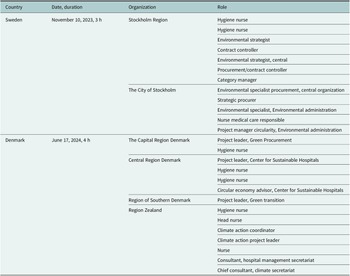
Both workshops had too many participants for a full-group discussion, and the groups were split into subgroups with 6–10 participants to facilitate the discussion, as recommended by Patton (Reference Patton2002). Each of the two groups was accompanied by a researcher, who ensured the workshop format was maintained and took notes. Respondents with similar competencies were represented in both groups to reap synergies based on the complementary expertise of the participants. However, every effort was made to avoid silencing minority perspectives or lacking confidentiality (see Patton Reference Patton2002). The participants covered various functions within the healthcare sector (see Table 1). The respondents were chosen to provide different perspectives on the glove usage in the public sector, both hospitals and elderly care homes. Only a few of them had sustainability as the main focus in their roles. The other representatives are hygiene nurses, controllers and so on, with different core focuses of their professions. This provides a nuanced picture of the topic, and different professional perspectives strengthen the study by providing a more comprehensive and practice-grounded understanding.
Healthcare systems and political objectives for healthcare services in Denmark and Sweden

Data analysis
The procurement documents were compiled and analyzed to provide an overview of the volume of gloves used over the past years (see Figure 1).
Volume of single-use examination gloves purchased by the Capital Region, Denmark, 2019–2023.

For the Swedish workshop material, the participating researchers compared notes and debriefed on critical elements of the discussions. The recordings were selectively transcribed (Flick, Reference Flick2009), and the compiled notes were structured using the workshop framework. The Danish workshop was not recorded, but extensive notes were taken by the participating researchers and the workshop participants (using Post-its). The data analysis was conducted in several steps. The identified challenges were matched to the most relevant life cycle phases for their occurrence and proposed solutions through pattern matching (see Yin Reference Yin2014). The data from the Swedish and Danish workshops are presented and categorized in Tables 2 and 3, respectively. An explanation and its consequences from an organizational perspective were stated for each challenge. The solutions proposed by the participants were linked to the respective 9R circular strategy with the best fit, which was ensured through clustering (Miles et al., Reference Miles, Huberman and Saldaña2013). Four categories of challenges emerged from this (see Tables 2 and 3): overuse, misuse, discarding and waste options. The data are discussed and compared between the two countries using these categories in relation to the R-strategies. Finally, the results are discussed within the broader context of single-use plastics to propose trajectories for reducing single-use plastics in healthcare.
Respondents participating in the workshops

Challenges identified for efficient and effective use of single-use gloves from a life cycle perspective, as well as proposed solutions in relation to circular strategies in the Swedish context

Results and analysis
Status quo in procurement and regulations
This section reports and analyzes the study’s results, starting with a cross-country analysis of the purchasing data for examination gloves. Second, challenges related to the use phase of gloves are presented and analyzed, and solutions are suggested.
Figure 1 shows the volumes of examination gloves purchased in the Danish Capital Region and used in hospitals. The data span from 2019 to 2023 and clearly shows an expected increase during the COVID-19 pandemic from already large volumes prior. From ca. 63 million gloves in 2019, a peak of 101 million was reached in 2021. Still, the purchasing levels in 2023 were 19% higher than pre-pandemic levels, at 75 million gloves. Data acquired from the Stockholm Region indicates a similar development, with pre-pandemic levels in 2019 reported to be ~100 million gloves.
Hygiene guidelines for glove use
In Sweden, the National Board for Health and Welfare outlines regulations on basic hygiene routines for all health and social care settings, specifying when and how to use personal protective equipment (The National Board for Health and Welfare, 2015a). In Denmark, glove use is guided by the National Infection Hygiene Guidelines (NIR), which require gloves in situations involving blood, body fluids or patient isolation and recommend hand hygiene before and after glove use (Statens Serum Institut, 2021). While Danish Regions implement NIR through tools like online learning, workshop participants questioned its effectiveness. The general nature of the guidelines enables local adaptation but also increases the risk of misinterpretation in practice. In Sweden, although similar online training exists, it is reportedly not in use in Region Stockholm. According to a hygiene nurse there, information and education about hygiene regulations are uncoordinated at both national and regional levels, limiting the effectiveness of these efforts.
Identified challenges and solutions for circular strategies of single-use gloves
In this section, the workshop data are presented and analyzed. Table 3 and 4 present the Swedish and Danish data results, providing insight into the similarities and differences between the two datasets. The results are analyzed based on the four categories in the analysis: overuse, misuse, discarding and waste options.
Challenges identified for efficient and effective use of single-use gloves from a life cycle perspective, as well as proposed solutions in relation to circular strategies in the Danish context

Overuse, misuse and the underlying reasons
Both workshops included discussions on overuse and improper use/misuse. Below, overuse is conceptualized as the extensive use of gloves when the purpose of using gloves, as defined by the guidelines (NIR in the Danish case), does not apply. Misuse is characterized as the incorrect use of gloves according to guidelines (NIR in the Danish case), for example, wearing a double set of gloves instead of a single pair or failing to use gloves when required. However, an important takeaway from the discussions in both workshops is that correct glove use depends on a professional interpretation of the guidelines in a specific situation.
Participants in both workshops identified widespread glove overuse, confirming trends seen in the quantitative data (Figure 1). Overuse was evident even before the COVID-19 pandemic, with usage increasing during the pandemic and not returning to pre-pandemic levels due to changed practices, shifting norms and a heightened focus on hygiene procedures. However, workshop participants indicated that practices surrounding glove use are associated with multiple trends in the healthcare system and society at large. For example, younger staff tend to use gloves more frequently than their older colleagues, and gloves are often seen as part of the uniform rather than solely for hygiene purposes. Usage also varies by context; staff are less likely to wear gloves when treating children than when caring for elderly patients.
Most nurses will receive the basic hygiene routines within their education, but most of the time, they learn when they start practicing and thus adopt the praxis for that department. The results show that departmental praxis in the everyday procedures overrules the regulations, and the praxis differs depending on the department’s culture. Culture, norms and routines shape glove use practices, and the relatively loose guidelines are interpreted to fit existing routines locally at department levels in the hospitals.
Discussions and reflections occur for departments requiring gloves, and plans are in place. However, respondents reported that no reflections are carried out for low-risk departments and that gloves are widely overused. In Denmark, guidelines for gloves are established at national, regional and local levels, leading to ambiguities and room for individual interpretation, which often results in overuse. However, according to the national guidelines, staff must carry out a risk assessment before using gloves, which can be challenging and lead to gloves being used just in case. Such practices can be further triggered by placing gloves in the rooms right by the doors and nudging staff toward excessive glove use. Local culture, practices and norms at the departments also influence glove usage, leading to overuse of gloves and use of gloves in situations that do not provide improved hygiene protection. The workshop data obtained from the participating hygiene nurses suggested that current practices might not result in high protection when correct hand sanitation is replaced with extensive glove usage. Similar insights have been found in Sweden, for example, gloves are used when there is a known infection, even though it is not transmitted through hand contact. This is among the many myths circulating about glove use in the healthcare sector. Group pressure is added to the list of reasons for overuse, as well as the taboo of correcting someone with more authority. A hygiene nurse explained that if the first person entering a room takes a pair of gloves, then the others will as well, and that the same is true for washing and sanitizing hands. Respondents suggested changing the location of the gloves to move further away from the door to encourage the washing and sanitizing of the hands instead. This should always be done before glove use, but this is not the case for all users in both countries investigated. Sanitizing hands is more crucial than using gloves because the traditional single-use examination gloves are unsterilized. Staff mistakenly believe gloves offer more protection than they do, leading to a false sense of security.
Discarding
Hand sanitation is required to avoid contamination when dispensing gloves from a box. Nevertheless, respondents reported that not everyone follows this practice, leading to frequent contamination of the glove container. A Swedish hygiene nurse describes that when a patient is discharged, the room is cleaned and the glove container is discarded. This is more common in single-patient rooms than in rooms with multiple occupancy. A nurse carries out a risk assessment, but most of the time, the just-in-case approach is used, resulting in large volumes of discarded unused gloves. In the Swedish workshop, the discussion centered on reducing glove contamination by using smaller packets, even if this would result in higher purchasing costs. However, the follow-up interview with the hygiene nurse stated that a smaller glove container costs the same as a large one. Hence, in this situation, there appears to be no economic incentive to buy a smaller box to reduce the number of discarded gloves. Again, proper washing and sanitation of hands before touching the glove container would facilitate a lower contamination risk and, thus, alter the outcome of the risk assessment.
Additionally, respondents mention the box design and a suboptimal manufacturing process as contributors to discarded gloves. Multiple gloves can fall out when personnel tries to remove one, a problem mentioned in Swedish and Danish contexts. This is further related to the incorrect or sloppy layering of the gloves in the container, which causes them to become tangled.
A further aspect is the volume of discarded gloves due to extensive stockpiling, resulting in gloves passing their expiration date before use and needing to be discarded. This results from the convenience of having products close to patients (unit stockpiling) and the increased uncertainty in supply, which skyrocketed during the COVID-19 pandemic.
Limited waste management options
Challenges in waste management persist for used gloves, as they are designed for single use. Currently, there is no technology available to decontaminate and recycle the material. Besides the recycling process, waste sorting and logistics would be a challenge. Internal waste logistics and a lack of space for disposal boxes were also pointed out as hindering factors, as the gloves would require a separate material flow. In recent years, Swedish and Danish healthcare underwent a substantial efficiency push, for example, to optimize the limited space available and shorten the time healthcare professionals spend performing their tasks. According to the respondents, this has created new path dependency, as the organization of, for example, patient rooms is designed for the products and technology available when the change is made. Furthermore, even the short time spent deciding which recycling bin to use adds up on the typically highly intensive workdays, with respondents assuming that glove users will likely place all gloves into incineration just in case, rather than checking for contamination and selecting the recycling option.
The Swedish workshop explored the option of sanitizing gloves with hydrogen peroxide as a potential future method for reusing gloves. However, this would require an appropriate space and quality check for contamination. In Denmark, a pilot project has been conducted for reusable gloves (Re:GLOVE, 2024), focusing on designing and testing reusable and washable nitrile gloves. However, a commercial reusable examination glove is still not available.
Use phase challenge mitigation through circular strategies
The key insights from the results are the extensive overuse and misuse of gloves in the healthcare sector and the multiple identified solutions for reducing this extensive usage. The analysis of the workshop data suggests that cultural norms in departments and behavior practices often override existing guidelines, leading to excessive glove consumption. Healthcare professionals often overuse gloves, for example, by wearing double gloves due to concerns about durability or by using gloves when they are not needed, despite evidence that such practices are unnecessary (Kristiansen et al., Reference Kristiansen, Bastien, Debesay and F2024). This reflects broader findings showing that perceived infection risks are often hypothetical and lack strong empirical support (Rizan et al., Reference Rizan, Mortimer, Stancliffe and Bhutta2020). Research also indicates that healthcare workers tend to prioritize personal safety over patient safety, reinforcing glove use at the expense of proper hand hygiene (Lindberg et al., Reference Lindberg, Skytt and Lindberg2020; Haenen et al., Reference Haenen, de Greeff, Voss, Liefers, Hulscher and Huis2022). Addressing overuse requires education, managerial commitment and practical measures, such as limiting glove availability for nonessential tasks. Glove use should be more clearly integrated into hygiene guidelines and training, and WHO recommendations on glove accessibility should be critically assessed to avoid encouraging unnecessary use (WHO, 2009; Loveday et al., Reference Loveday, Lynam, Singleton and Wilson2014). In the literature, the studies focusing on R1-Refuse (Kirchherr et al., Reference Kirchherr, Reike and Hekkert2017; Potting et al., Reference Potting, Hekkert, Worrell and Hanemaaijer2017) typically relate to the design and manufacturing of a product, where the center of attention is on increasing production efficiency and reducing dependency on critical resources (Garcia-Saravia Ortiz-de-Montellano and van der Meer, Reference Garcia-Saravia Ortiz-de-Montellano and van der Meer2022). In this study, however, the results suggest that the primary reduction potential lies in the product’s use phase, specifically when healthcare staff decides whether to use gloves, providing new insight to the literature in the field. Table 5 summarizes the derived applications of the R strategies to single-use gloves in healthcare. The analysis reveals R2 (Reduce) as the most promising strategy, achievable via behavioral change, revised hygiene routines and demand planning. Strategies R3 (Reuse), R4 (Repair) and R5 (Refurbish) are largely infeasible due to contamination risks and the disposable nature of gloves in clinical settings. Long-term strategies, such as R6–R7 (Recover), face systemic barriers. R8 (Recycling) is limited by material heterogeneity, a lack of standardization and infrastructure deficits (Kurilova-Palisaitiene et al., Reference Kurilova-Palisaitiene, Sundin and Poksinska2018; Ivanović et al., Reference Ivanović, Meisel, Som and Nowack2022). Current disposal practices are driven by perceived contamination risks, leading to the unnecessary discarding of entire glove containers. Just-in-case usage, spatial constraints and default incineration practices (R9) are driven by perceived risk and efficiency demands, which are combined by limited staff training in waste sorting (Singh et al., Reference Singh, Ogunseitan and Tang2022). Previous research on plastic waste in healthcare has largely focused on waste output rather than on opportunities for circularity within the supply chain (Ivanović et al., Reference Ivanović, Meisel, Som and Nowack2022). Overcoming the challenges requires engaging the entire supply chain (Alfina et al., Reference Alfina, Ratnayake, Wibisono, Basri and Mulyono2025), from manufacturers to end-users, through the redesign of products and packaging, investment in sorting systems and public procurement mechanisms that reward circular (Witjes and Lozano, Reference Witjes and Lozano2016; Alhola et al., Reference Alhola, Ryding, Salmenpera and Busch2019; Qazi and Appolloni, Reference Qazi and Appolloni2022). This aligns with calls for system-level change to enable sustainable healthcare practices.
Application of 9R circular strategies to single-use gloves in healthcare

Healthcare organizations that comprise highly skilled professionals at the front line are particularly complex when it comes to decision-making processes. Analyzing circular economy adoption in the public sector from the employees’ perspective is essential because of their expertise within their organizations (Klein et al., Reference Klein, Ramos and Deutz2022). While formal managers may be attributed with power, in practice, leadership is distributed, and informal leaders engage in leadership, making decisions that may counteract formal managers’ decisions (Svensson and von Knorring, Reference Svensson and von Knorring2025). This situation is confirmed by the cases analyzed, where the staff have no economic incentives to change. Still, the potential to reduce glove consumption and minimize environmental impact is substantial. This suggests that the organization’s environmental targets have minimal impact on operational decisions made in the healthcare sector. Previous research on circularity implementation suggests that an organization’s prerequisites play a crucial role in implementing circular solutions, and contextual solutions are necessary to overcome organizational challenges (Lingegård and von Oelreich, Reference Lingegård and von Oelreich2023; Santos et al., Reference Santos, Hilletofth and von Haartman2025). Shifting away from a linear consumption model necessitates systemic changes that integrate circular principles into routine practices (Hofmann and Jaeger-Erben, Reference Hofmann and Jaeger-Erben2020) and user behavior changes (de Sousa, Reference de Sousa2023; Bączyk et al., Reference Bączyk, Tunn, Worrell and Corona2024). This is especially important in the healthcare sector, where cultural norms often override guidelines, leading to excessive glove use (Rizan et al., Reference Rizan, Mortimer, Stancliffe and Bhutta2020; Kristiansen et al., Reference Kristiansen, Bastien, Debesay and F2024). The results show that the users, the healthcare professionals, must support circular strategies for single-use plastics in the healthcare sector.
Conclusions and implications for plastic consumption
This study focuses on the use phase, in contrast to the mainstream literature on circular strategies for rethinking and reducing, which primarily focuses on the production phase and end-of-life phase. It highlights the impact of processes and behaviors in public organizations that cause large purchasing volumes of gloves. This is due to three main aspects: the overuse of gloves, the misuse of gloves and the excessive discarding of gloves.
These aspects relate directly to circular strategies. The Reduce strategy offers the greatest potential, achievable through behavioral and routine changes and increased awareness. Recycling holds long-term promise if supported by technological advances, while Recover, here incineration by default, remains the current standard practice. This highlights the immense potential for reducing single-use plastics in healthcare by focusing on the use phase. Furthermore, applying circular strategies at the most effective life cycle stage is crucial, as it refines how circular economy principles are implemented in practice.
The same arguments would be valid for other single-use plastics in healthcare with low end-of-life value, where the staff makes the final decision on use, for example, aprons and incontinence products. Behavioral change among healthcare staff will likely have a more profound impact than procurement policies, usage guidelines or environmental targets alone. Substantial changes are unlikely to occur unless financial and procedural incentives are aligned with sustainability goals, since institutional practices and path dependency remain major barriers. Bridging the gap between environmental goals and daily practices is essential for fostering a culture of circularity in healthcare. This understanding may be critical to both policy (guidelines regarding procurement and design) and practice (behavioral, incentive-focused and organizational adjustments), and this gap needs to be further explored.
The results of this study are of broad relevance to the general trend of consumption patterns in public healthcare institutions. Furthermore, single-use gloves represent an illustrative trajectory for increased single-use of many other items in the healthcare sector and the challenges that arise in their wake. A key limitation of the study is its geographical focus. While the findings align with initial UK studies, further research is needed in other regions and healthcare systems. Constraints in efficiency-driven Nordic systems may not apply elsewhere, and higher population density could ease the scaling of recycling.
Open peer review
To view the open peer review materials for this article, please visit http://doi.org/10.1017/plc.2026.10047.
Supplementary material
The supplementary material for this article can be found at http://doi.org/10.1017/plc.2026.10047.
Data availability statement
The authors confirm that all data analyzed during this study are included in this published article. Summaries of the data collection are available upon request.
Acknowledgments
The authors would like to thank Region Stockholm, the City of Stockholm, the Capital Region Denmark, the Central Region Denmark, Region of Southern Denmark and Region Zealand for their support and interest in this project.
Author contribution
Conceptualization: S.L., J.M., T.B.C., N.G.O., and K.S.; Formal Analysis and Investigation: S.L., J.M., T.B.C., N.G.O., and K.S.; Funding Acquisition: S.L., and K.S.; Methodology: S.L., J.M., T.B.C., N.G.O., and K.S.; Writing – Original Draft Preparation: S.L., J.M., T.B.C.; Writing – Review and Editing: S.L., J.M., T.B.C., N.G.O., and K.S.
Financial support
This study was funded by Formas, the Swedish Research Council for Sustainable Development, through grant FORMAS 2022–01998, “Circular public procurement of plastic medical consumables - the missing steps for implementation.” For Roskilde University: CircleHealth, a part of TRACE, funded by the Innovation Fund Denmark.
Competing interests
The authors declare none.
AI declaration statement
The authors have used AI tools to improve spelling and grammar in the manuscript.





 Open access

