





Introduction
The recent rise of illiberalismFootnote 1 has disrupted the routine civil society dynamics that underpin the liberal international order. Since the turn of the millennium, states once aligned with liberal democratic norms have adopted a variety of tools—legalistic barriers, bureaucratic procedures, harassment, or outright repression—to constrain the opportunities of Western donors and domestic civic actors (Carothers & Brechenmacher, Reference Carothers and Brechenmacher2014; Wolff & Poppe, Reference Wolff and Poppe2015). This phenomenon has largely been analyzed through the liberal democratic framework, treating civil society as an autonomous sphere presumed to be respected by liberal democratic states but infringed upon by illiberal regimes (Toepler et al., Reference Toepler, Zimmer, Fröhlich and Obuch2020). While this normative autonomy/encroachment framework illuminates certain aspects of the illiberal shift—such as the neutralization or elimination of critical civic actors and the taming or co-optation of aligned ones—it overlooks the fact that illiberal civil society configurations are actively shaped by conflicts and structures carried over from liberal ones. Central and Eastern Europe offers a particularly illustrative case of this relationship, as the transition from state socialism to liberal democracy, intertwined with the pressures of neoliberal globalization, has produced enduring tensions that continue to shape how civic actors, including those aligned with the regime, navigate, or contest illiberal rule.
To capture the dynamics of civil society amid competing social visions, I draw on the Gramscian notion of civil society. Understood this way, civil society is not “an autonomous sphere of self-contained democratic activity” but “a chaotic sphere of competition” (Ehrenberg, Reference Ehrenberg2017, 7); “another term for the social power relations deriving from the economy” (Cox, Reference Cox1999, 10). In this framework, actors aligned with the illiberal regime are not merely facilitated, or misguided, but may possess a bargaining capacity, be capable of organizing popular consent, or have a historical role in consolidating the alliance that secured the regime’s power. However, while the Gramscian lens shifts the dispute from civil society’s presumed autonomy to the contest of alternative social visions within civil society, researchers using this approach have rarely compared liberal and illiberal dynamics (Gagyi et al., Reference Gagyi, Szarvas and Vígvári2020; Gagyi & Gerőcs, Reference Gagyi and Gerőcs2025; Nagy, Reference Nagy2024). Gramsci has predominantly been applied either to illuminate state–civil society dynamics in liberal hegemony (Fonseca, Reference Fonseca2018; Robinson, Reference Robinson1996), in related counter-hegemonic struggles (Dagnino, Reference Dagnino and Edwards2011; Greskovits, Reference Greskovits2017, Reference Greskovits2020; Jenkins & Brents, Reference Jenkins and Brents1989), or in the illiberal regime (Bohle et al., Reference Bohle, Greskovits and Naczyk2024; Landau, Reference Landau2008; Nagy, Reference Nagy2023; Ramasamy & Guan, Reference Ramasamy, Guan and Guan2004; Sivhouch, Reference Sivhuoch2013; Tugal, Reference Tuğal2024).
The current paper aims to fill this gap by focusing on what has so far remained a blind spot: the systematic comparison of state–civil society interactions through the agency of those aligned with illiberal regimes, from a longitudinal, historical perspective. Therefore, my question is the following: “How did organization–state relationships unfold for actors aligned with the illiberal state before and after the illiberal turn?” Moving beyond LGBTQ+, feminist, and human rights groups widely covered in the literature, I focus on “the other side of the coin” in Hungary—a polity that has become a key reference point for analysts of illiberal and authoritarian trends. I explore my research question through a case study of a Hungarian conservative organization, the National Association of Large Families (Nagycsaládosok Országos Egyesülete, NOE), by comparing its relationship with the liberal and illiberal states between 1990 and 2010 and between 2010 and 2024, respectively. (2024 is the last year of the examined period within the illiberal era.) To structure the empirical analysis, I develop a typology of patterns of organization–state interactions that helps answer the research question and serves as a tool with potential explanatory relevance for further research on liberal/illiberal state–civil society dynamics.
The paper begins by reviewing how the normative autonomy/encroachment framework and the Gramscian lens have been employed in the literature to interpret shifting dynamics within civil society. I accentuate the analytical advantage of the Gramscian understanding while highlighting my contribution, namely, the systematic comparison of state–civil society relationships across liberal and illiberal regimes. I then present my methodology for examining how these relationships differ before and after the illiberal turn for actors who align themselves with the illiberal regime. The next section introduces the case study, followed by an analysis combined with a typology of liberal/illiberal patterns of organization–state interactions in relation to the conflicts and structures inherited from liberal regimes. I conclude by highlighting the added value of the longitudinal comparative design to our understanding of illiberal dynamics and suggesting the relevance of my findings for civic organizations seeking to challenge illiberal regimes.
Civil society as a terrain of struggles
Since the turn of the millennium, the rise of illiberalism has disrupted the routine operation of civil society. The pushback on Western foreign aid, combined with changes in domestic legal and funding environments, had quickly become an authoritarian tool to neutralize, weaken, or eliminate critical domestic voices (Carothers & Brechenmacher, Reference Carothers and Brechenmacher2014; Mendelson, Reference Mendelson2015; Toepler et al., Reference Toepler, Zimmer, Fröhlich and Obuch2020; Wolff & Poppe, Reference Wolff and Poppe2015). These changing civil society dynamics, which threaten the liberal international order, have predominantly been analyzed within the liberal political-economic framework, where civil society is viewed as an autonomous democratic sphere presumed to be respected by liberal democratic states but infringed upon by illiberal regimes.
This widely discussed and influential normative autonomy/encroachment framework describes changing civil society conditions in illiberal regimes as either “shrinking” or “contested” spaces. In the first stream of the literature, the emphasis is on the closing of the space: the changing legal, funding, and media environments to harass, marginalize, or annul critical voices, the subduing of civic actors through co-optation, or the facilitation of government-established or government-sponsored organizations (gongo-ization) (Brechenmacher, Reference Brechenmacher2017; Gerő & Kerényi, Reference Gerő, Kerényi and Kovách2020; Hodenfield & Pegus, Reference Hodenfield and Pegus2013; Kuti & Marschall, Reference Kuti and Marschall2020; Nagy, Reference Nagy, Magyar and Vásárhelyi2017; Nagy et al., Reference Nagy, Béres-Áfra and Szalóki2025). The second stream of the literature acknowledges that it is a contested rather than a shrinking space for civil society. The space is expanding for “loyal” actors, can be beneficial for apolitical ones, and may continue to allow some pushback from claim makers (Gerő et al., Reference Gerő, Fejős, Kerényi and Szikra2023; Krizsán & Roggeband, Reference Krizsán, Roggeband, Krizsán and Roggeband2019; Mikecz, Reference Mikecz2023; Negri, Reference Negri2020; Toepler et al., Reference Toepler, Zimmer, Fröhlich and Obuch2020). Research using the closing or contested space frameworks assigns agency predominantly to critical actors while ignoring those aligned with illiberal regimes or depicting them as merely passive, facilitated, or misguided (see Fábián & Korolczuk, Reference Fábián, Korolczuk, Fábián and Korolczuk2017; Fejős & Neményi, Reference Fejős, Neményi, Fejős and Szikra2020; Szikra & Vajda, Reference Szikra, Vajda, Fejős and Szikra2020 as examples of exceptions).
While this normative autonomy/encroachment framework illuminates certain aspects of the illiberal shift—such as the neutralization or elimination of critical civic actors and the taming or co-optation of aligned ones—it overlooks the fact that illiberal civil society configurations are actively shaped by conflicts and structures carried over from liberal ones. In contrast to this framework, a stream of literature that revives a Gramscian perspective suggests that we view illiberal and liberal civil society dynamics as variations within the sphere of struggle for domination rather than as normatively opposed domains (Gagyi et al., Reference Gagyi, Szarvas and Vígvári2020, 161). Understood this way, civil society is not “an autonomous sphere of self-contained democratic activity” (Ehrenberg, Reference Ehrenberg2017, 7) but “simultaneously an object of conquest, a battlefield among different social and political groups, and the outcome of a given configuration of opposing forces” (Brighenti, Reference Brighenti, Moebius, Nungesser and Scherke2016, 4). In this terrain of struggles, the state promotes a particular way of life—through schools, churches, civic associations, newspapers, intellectual circles, etc.—in response to which new social and political alliances emerge and strive for dominance (Cox, Reference Cox1999, 16; Hoare & Smith, Reference Hoare and Smith1999, 495–503; Taylor, Reference Taylor2021). The turf war between liberal and illiberal values is one such clash.
In this Gramscian stream of the literature, the conditions for civil society promoted by liberal democracies—whether domestically or internationally—are viewed less as genuine expressions of pluralism and more as mechanisms for generating consent and securing the domination of the neoliberal political-economic order (Fonseca, Reference Fonseca2018; Robinson, Reference Robinson1996). Governments promoting global capitalism and governments integrating their countries into global markets need reliable local organizations that take responsibility for responding to the harms of the economic transition through service provision or focus their advocacy on civil and political, rather than economic and social, rights (Dagnino, Reference Dagnino and Edwards2011; Gagyi & Ivancheva, Reference Gagyi, Ivancheva, McCrea and Finnegan2019; Lomax, Reference Lomax1997). The reconfiguration of civil society through the “accelerated growth and expanded role of NGOs” and “the transfer of the state’s social responsibilities” to these actors is seen as an essential building block of the development of global capitalism (Dagnino, Reference Dagnino and Edwards2011, 128).
Researchers interpreting the illiberal dynamics apply the Gramscian lens in many distinct ways. One stream of this literature focuses on the changing modes of the economy. For example, Gagyi et al. (Reference Gagyi, Szarvas and Vígvári2020) and Gagyi and Gerőcs (Reference Gagyi and Gerőcs2025) derive the changing position of struggling constituencies in Hungary from neoliberal hegemony and the subsequent illiberal economic conditions. Another stream of the literature examines the state’s relational approach to civil society. Within this stream, Greskovits (Reference Greskovits2017, Reference Greskovits2020) explains the “Gramscian” political organizing strategy of the Viktor Orbán-led Hungarian Fidesz party before the illiberal turn. Similarly, Bohle et al. (Reference Bohle, Greskovits and Naczyk2024) analyze the “counter-hegemonic strategies” of the Fidesz-KDNP-led Hungarian governments and the Law and Justice-led Polish governments to advance a nationalist, right-wing Christian agenda both domestically and within the EU. In addition, Nagy (Reference Nagy2023) applies the conditions of the integral state to explain the remaking of the Hungarian art funding scene after the illiberal shift. However, none of this literature conducts a systematic comparison of state/civil society relationships across liberal and illiberal regimes.
My research aims to fill this gap by undertaking a longitudinal study of changing state–civil society relationships through the agency of those aligned with the illiberal regime. In contrast to the normative framework that explains these changing relationships—co-optation, gongo-ization, coercion, etc.—as the direct outcome of illiberal governance (Gerő et al., Reference Gerő, Fejős, Kerényi and Szikra2023; Nagy et al., Reference Nagy, Béres-Áfra and Szalóki2025; Toepler et al., Reference Toepler, Zimmer, Fröhlich and Obuch2020), I show how the contours of illiberal civil society are shaped by actors operating within conflicts and structures carried over from liberal regimes. Central and Eastern Europe serves as a key site for observing this relationship as the transition from state socialism to liberal democracy, intertwined with neoliberal globalization, has produced enduring tensions that continue to shape how civic actors, including those aligned with the regime, navigate, or contest illiberal rule.
In line with the Gramscian approach, I consider both liberal and illiberal civil societies to be integral parts of the hegemonic state (Fonseca, Reference Fonseca2018; Gagyi et al., Reference Gagyi, Szarvas and Vígvári2020); two terrains of struggles where social and political groups adjoin to reconfigure established power relations and advance their model of society. Therefore, I highlight the distinctions between the liberal and illiberal dynamics along the character of integration between civil society and the state. In both liberal and illiberal civil societies, civic organizations vis-à-vis the state and political parties engage in conflict over values and policies, cooperate through the intentional or incidental alignment of resources, or incorporate each other’s structures by sharing people or resources—albeit in different ways across regimes. I demonstrate how these conflictual, cooperative, and incorporative state–civil society relationships unfold before and after the illiberal turn. The story of actors aligned with the illiberal regime—their agency, and how their struggles predate the regime—also has important implications for the strategies civic organizations choose to confront and seek to replace illiberal rule.
Methods
The goal of the research is to identify how patterns of interactions between the state and actors who eventually align with the illiberal state evolve before and after the illiberal turn. The research is designed as a longitudinal case study across liberal and illiberal regimes. I examine a Hungarian conservative organization, the National Association of Large Families (Nagycsaládosok Országos Egyesülete, NOE), by comparing its relationship with the liberal and illiberal states between 1990 and 2010 and between 2010 and 2024, respectively. The specific geographic and temporal horizon (Hungary, 1990–2024) enables me to trace patterns of organization–state interactions across extended liberal and illiberal periods (noted as critical by Toepler et al., Reference Toepler, Zimmer, Fröhlich and Obuch2020, 659) and generate new insights into illiberal and authoritarian trends.
Given the character of organization–state relations and the longevity of the organization, NOE constitutes a crucial case (Eckstein, Reference Eckstein, Greenstein and Polsby1975; Gerring, Reference Gerring2007) for probing or refining the normative autonomy/encroachment claim about illiberal state–civil society dynamics. Before the illiberal turn of 2010, NOE advocated its conservative worldview by confronting and negotiating with governments across the political spectrum. After the illiberal turn, when it became one of the main beneficiaries of the new regime, its critical tone subsided. The normative autonomy/encroachment framework explains this shift in organizational behavior by co-optation (Nagy et al., Reference Nagy, Béres-Áfra and Szalóki2025, 16–17) or gongo-ization (Gerő et al., Reference Gerő, Fejős, Kerényi and Szikra2023, 22, 24). However, seen through the Gramscian lens, the case of NOE suggests a more complex phenomenon of underlying patterns of relationships between the organization and the state. To structure the empirical analysis, I develop a typology that distinguishes liberal/illiberal patterns of organization–state interactions in relation to the conflicts and structures inherited from liberal regimes. The typology also constitutes a tool with potential explanatory relevance for further research.
Table 1 shows that my primary data sources for observing relationship patterns between NOE and the state have been 719 media articles and 42 organizational documents. I have systematically organized content from these primary sources in a document, grouping data by how the organization related to parties and the state under subsequent governments around different policy issues. I have segmented my search for media data in the Arcanum Digitheca Database by governing cycles and used keywords such as the organization’s name or a combination of the organization’s name and other expressions (such as a party’s name or a policy issue). I have juxtaposed articles to lessen data validity issues. I have used newsreel footage (nava.hu), minutes of parliamentary meetings (parlament.k-monitor.hu), and the election database (valasztas.hu) to further triangulate data. After processing these written and visual sources, I have conducted two semi-structured interviews (one with two NOE leaders and one with a social policy expert) to verify preliminary conclusions and further triangulate data. By using media articles and organizational documents as primary sources rather than interviews, I have overcome the limits of memory and reduced distortion from retrospective reconstruction or reinterpretation of organizational motivations. The case study provides an original narrative of NOE’s story, and a selection of primary data sources is added as in-text citations.
Primary data sources

Case study: Large families in the terrain of struggles from 1990 to 2024
Background and summary of the argument
The National Association of Large Families (Nagycsaládosok Országos Egyesülete, NOE) is a Hungarian family organization advocating conservative family values (marital status, having three or more children, no abortion or divorce), universal benefits for all large families, and incentives for childbearing to support the demographic survival of the nation. Established in 1987 at the end of state socialism (1949–1989), NOE has operated for an extended period in two characteristically different, liberal (1990–2010) and illiberal (2010 to present), periods on behalf of a membership that never dropped below 10,000 families. During this time, NOE’s self-perception has been that the organization has consistently represented its principles to all governments and followed an escalatory strategy of negotiation and confrontation (Fejős & Neményi, Reference Fejős, Neményi, Fejős and Szikra2020, 86; Varga, Reference Varga2017, 5).
The fact is that after Fidesz, NOE’s conservative political ally, won a landslide victory in 2010, NOE’s critical tone gradually dissipated. This change correlated with lavish state funding (Kapitány, Reference Kapitány2019), influential roles in ministries (Inglot et al., Reference Inglot, Szikra and Rat2022, 277, 286), and a (renewed) strategic partnership between NOE and the Fidesz-KDNP government (Inglot et al., Reference Inglot, Szikra and Rat2022, 280). The normative autonomy/encroachment framework would interpret these dynamics as an example of co-optation or gongo-ization (Gerő et al., Reference Gerő, Fejős, Kerényi and Szikra2023, 22, 24; Nagy et al., Reference Nagy, Béres-Áfra and Szalóki2025, 16–17). On the contrary, I argue that the organization–state relationships have changed because the counter-hegemonic triumph over a liberal vision in 2010 was a shared outcome of NOE and Fidesz. The two organizations were the core social and political pillars of the struggle to advance conservative-nationalist family values in civil society and the state before 2010. After 2010, this vision was amplified by the centralized state to the point that both these values and NOE became tools for consolidating power. However, NOE did not legitimize Fidesz’s illiberal state-building because it was misguided, tamed, or facilitated; the illiberal model was collateral to the victory of a government that has delivered on several core items of the organization’s agenda.
The circumstances of NOE’s foundation at the end of state socialism (1987–1989)
In the late 1980s, reform communists and system-critical yet tolerated conservative intellectuals found common ground in supporting population policy and a robust social policy amid concerns over the nation’s demographic survival (Szécsi, Reference Szécsi2021, 76–77). NOE was brought to life in the summer of 1987 as the popular vehicle for these efforts (Kardosné Gyurkó, Reference Kardosné Gyurkó2017, 15–16). State supervision came with infrastructure and lobbying power, and the budding NOE was able to achieve that family tax credits for large families were incorporated into the new personal income tax legislation in 1988 (Inglot et al., Reference Inglot, Szikra and Rat2022). Like all organizations at that time, NOE was officially established under state supervision; members also included the emerging conservative and left-liberal political opposition (Kardosné Gyurkó, Reference Kardosné Gyurkó2017, 42–43). Soon, more than 100 members set out to recruit large families across Hungary and organize them into local chapters (G. Nagy, Reference Nagy1988, 5; Szécsi, Reference Szécsi2021, 78). Organizers drew on the infrastructure of the church (congregations, the Bokor base community), workplaces, and neighborhoods. Between 1987 and 1989, the membership grew from 500 to 5,000 families. As we can see, the dynamics between civil society and the emerging liberal state were already more convoluted than what the autonomy/encroachment framework suggests.
The relationship between NOE and the state in the liberal hegemonic period (1990–2010)
From the outset of the liberal period, NOE had a strong presence in both civil society and the state. In 1990, it had a mass base of 6,000 large families nationwide (approximately 3 percent of the constituency), and its vice-president and deputy president became ministers in the Christian conservative government (MDF-KDNP-FKgP). Additionally, 11 NOE members were elected across the political spectrum. In this political constellation, NOE anticipated the construction of a generous welfare state in which every large family would receive concessions regardless of their financial status. However, instead, the conservative government (1990–1994) executed the first phase of neoliberal restructuring, which the next left-liberal MSZP-SZDSZ government (1994–1998) completed. Between 1990 and 1998, NOE confronted both the conservative and left-liberal governments, albeit in different ways.
As the conservative government remained open to negotiations, kept the large family cause in its rhetoric, and did not touch core family benefits, NOE did not go beyond heavy criticism in the media. In contrast, the left-liberal government introduced a series of austerity measures in 1995, including the abolition of family tax credits, reductions in child care benefits, the means-testing of family allowances (without an increase in their value), and the elimination of free higher education, all without meaningful social consultation (Wells, Reference Wells2000). In response, on May 14, 1995, NOE organized a demonstration in front of the Parliament, submitted a petition signed by 43,000 people, and NOE’s president, Ágota Benkő, gave a speech criticizing the neoliberal elites: “Does the country have a Minister of Finance, or does the Minister of Finance have a country? Do not you read newspapers, Hungarian sociologists’ analyses? Have not you been to Káposztásmegyer or Ózd? Do you only watch the reports of the World Bank and the International Monetary Fund?” (élő, 1995, 5; translation mine).
This differentiated use of conflict traced the contours of the solidifying conservative and left-liberal blocs. However, the two conservative parties, MDF and KDNP, were losing influence due to internal disputes, and an ambitious political party, the Viktor Orbán-led Fidesz, was taking advantage of the vacuum. Fidesz shifted from the left to the right, aiming for a dominant position in the center right (Wéber, Reference Wéber2010). Between 1996 and 1998, Fidesz gradually gained trust among conservative political elites, intellectuals, and civic organizations, including NOE. Being the oldest player in the conservative movement (older than MDF, KDNP, or Fidesz), and backed by a membership of 22,000 families and 289 chapters in 1996, NOE became authoritative and essential for the party.
During this period, from 1990 to 2002, NOE ensured direct access to the state by running candidates in municipal elections nationwide. To indicate the scale: in 1994, out of the 305 people associated with NOE who ran for office, 92 became elected representatives, 6 became mayors, 8 became county delegates, and 176 became external committee members (Kardosné Gyurkó, Reference Kardosné Gyurkó2017, 24). Members typically ran on a single NOE ticket, while occasionally, they ran in alliance with conservative parties or explicitly on a conservative party ticket. This was a massive power demonstration comparable to a political party. NOE organized training for the candidates and supported the work of the elected members. Additionally, during the first parliamentary cycles, the organization monitored the work of elected representatives and evaluated party performance before the elections.
In 1998, NOE’s membership comprised 22,000 families, but it had achieved little during the conservative and left-liberal governments. Amid this disappointment of an important constituency, Fidesz won the national elections in 1998. The new Fidesz-FKgP-MDF government, led by Prime Minister Viktor Orbán, was eager to adopt a pro-family agenda and give voice to concerns about the nation’s demographic survival. Within 2 years of governing, it restored childcare benefits, universal family benefits, and family tax credits (which had been abolished or reduced by the previous administration). For the conservative movement, including NOE, Fidesz’s measures countered the former left-liberal government’s aggressive neoliberal restructuring and supposedly anti-family values. In return, NOE gave the Orbán government recognition many times publicly for being family-friendly and caring about demographic decline (Benkő, Reference Benkő1998, 10; Nagycsaládosoké a Ház, 1998, 2). While NOE demanded and gained concessions for lower-middle-class families during a government that otherwise predominantly targeted the middle class with subsidies, NOE’s equity claims were presented in a language that was fundamentally appreciative of the government’s achievements (Sebály, Reference Sebály2025, 91–92).
When Fidesz-KDNP lost the elections after a tight race in 2002, NOE’s membership base of 20,000 families constituted 9 percent of the large family constituency. Considering NOE’s readiness to bargain in favor of the middle class, Fidesz had proved to be a reliable political ally: it had embraced most of NOE’s values and policies in government (A nagycsaládosok egyesülete, 2000, 3). Nevertheless, NOE pursued a pragmatic approach toward the subsequent left-liberal governments: it maintained a seat at the negotiating table with the coming MSZP-SZDSZ administrations. At the same time, it remained aligned with Fidesz, which was engaging civil society with full steam and diligently organizing its conservative voter base after its 2002 electoral defeat (Greskovits, Reference Greskovits2017, Reference Greskovits2020).
When the left-liberal MSZP-SZDSZ government introduced a series of austerity measures in 2006, including hospital and tuition fees, and took steps toward integrating private insurance companies into the health care system, NOE became one of the catalysts of resistance. It organized two demonstrations in 2006 and 2007, criticizing the government for the devastating state of health care and education (the 2007 protest mobilized 10,000 people). The organization also complemented Fidesz’s mobilization (2007–2008) for a referendum. Spearheaded by the then NOE president, Endre Szabó, a doctor, the organization launched a petition against the privatization of health care in May 2007 and established a platform with two alter-globalist organizations. They later merged with a similar initiative of trade unions, farmers, health workers, and green organizations, which collected 500,000 signatures. NOE’s actions were part of a nationwide protest movement, contributing to the moral and political annihilation of the left-liberal MSZP-SZDSZ governments and the landslide victory of Orbán’s party in 2010.
All in all, out of the 20 years of the liberal democratic regime, there were only 4 years (2002–2005) when NOE built a trustworthy relationship with a left-liberal government. The organization organized demonstrations three times and endorsed about a dozen additional demonstrations by joining them. All these demonstrations, including the ones endorsed (1995–1996, 2006–2010), occurred under the left-liberal MSZP-SZDSZ governments. The other 16 years were spent collaborating with conservative parties, which, from NOE’s perspective, either delivered in government or fought alongside NOE to advance the organization’s values and policies. The return of Fidesz in 2010 with a two-thirds parliamentary majority held immense opportunities for the conservative bloc, including NOE.
The relationship between NOE and the state in the illiberal hegemonic period (2010–2024)
In 2010, Fidesz won the general elections with a landslide victory. From the outset, the Fidesz-KDNP government utilized its two-thirds majority to dismantle the liberal system by centralizing the state and media and recapitalizing the economy. Although the party stranded various constituencies from its former winning coalition, such as small farmers and workers (Scheiring, Reference Scheiring2020), large families have retained their central position in the new illiberal historical bloc. In 2010, NOE’s membership consisted of 15,000 families and managed an extensive network of ethnic Hungarian families—31 organizations in Vojvodina (Vajdaság) in Serbia, 3 in Upper Hungary (Felvidék) in Slovakia, 8 in Transylvania (Erdély) in Romania, and 1 in Subcarpathia (Kárpátalja) in Ukraine. Based on the performance of the first Orbán administration (1998–2002), NOE advanced the political credit to Fidesz-KDNP immediately after the 2010 elections and appeared on the same platform with the party on various issues, from confronting the International Monetary Fund to supporting Sunday store closures.
Soon, Fidesz-KDNP delivered on many fronts. Within less than 2 years of governing, the party restored (again) what the previous left-liberal governments had abolished or limited: family tax credits, social policy allowance, and gas price compensation. Moreover, it restructured debtor conditions in the aftermath of the global financial crisis and, as demanded by NOE, bailed out the worst-off families by purchasing their properties and granting them a tenant status at low rents (Tisztelt Miniszterelnök, 2011). Although most of these policy measures were not socially targeted (Czirfusz & Jelinek, Reference Czirfusz, Jelinek and Vankó2022; Inglot et al., Reference Inglot, Szikra and Rat2022), this did not contradict NOE’s core principles. NOE’s commitment to equity has always been agency-driven (contingent on the president, board members, and chapter leaders) and tended to compromise in favor of the middle class. By default, the organization has advocated universal subsidies for all large families (because they bear the brunt of social reproduction) (Benkő, Reference Benkő1996; Sebály, Reference Sebály2025).
The new regime also ensured access to the state: NOE received influential positions from the beginning of the illiberal period. Zsuzsa Kormosné Debreceni, NOE’s lead expert and board member from 1996 to 2000, became the head of the Unit for Women’s Policies (Nőpolitikai Osztály) within the Ministry of National Resources (later the Ministry of Human Resources) in 2011. In line with NOE’s longstanding advocacy for promoting the traditional large family structure at the European level, Kormosné became a fierce lobbyist for “family mainstreaming” under the 2011 Hungarian EU presidency (Inglot et al., Reference Inglot, Szikra and Rat2022, 286). Complementing these political efforts, a civic alliance of various pro-family and population policy experts and organizations, known as the Demographic Roundtable (Népesedési Kerekasztal), was founded in 2009. For a few years, coordinated by Ágota Benkő, former NOE president from 1992 to 2000, the Roundtable nurtured partnerships with high-level decision-makers (Inglot et al., Reference Inglot, Szikra and Rat2022, 279).
From its second term after returning to power (2014–2018), Fidesz-KDNP changed gears. In 2016, the government increased the social policy allowance—a longtime housing grant that incentivizes childbearing—by a factor of two for large families and introduced a variety of subsidized loans, also incentivizing childbearing. These policies, which addressed NOE’s concerns about the low level of the allowance (Vass-Gabay, Reference Vass-Gabay2013, 2), have been wrapped up in a government rhetoric advancing social reproduction at a previously unseen scale (Sebály, Reference Sebály2025). The subsidies had no income cap, and conditions often restricted eligibility to better-off households (Elek & Szikra, Reference Elek and Szikra2018; Pósfai & Sokol, Reference Pósfai and Sokol2024). The government also switched gears in funding civil society. Overall, state funding for organizations engaged in population policy increased with a giant leap between 2016 and 2017 (from 280 million to 738 million HUF), and NOE received 40 percent of the budget item in 2017, 300 million HUF (about 965,000 EUR) (Kapitány, Reference Kapitány2019, 67; Varga, Reference Varga2017, 5). Finally, since 2020, NOE has coordinated holiday charity programs with Lőrinc Mészáros, a businessman closely associated with Prime Minister Orbán (Egyszülős, 2020), and the then-resigned NOE president, Katalin Kardosné Gyurkó, ran for office in the 2024 municipal elections on a joint platform with Fidesz-KDNP.
Clearly, the illiberal regime worked closely with NOE, but it was a continuation of past relationships. In 2016, NOE became the government’s strategic partner, as it had been under the first Orbán administration (Fissza, Reference Fissza2000, 10; Varga, Reference Varga2017, 5), and it saw a responsive government. For instance, NOE was a key proponent of government policies such as generous family tax credits, lifelong tax exemption for mothers of four or more children, and women’s retirement after 40 years of employment (Inglot et al., Reference Inglot, Szikra and Rat2022, 280). Although overall, many of the family policies benefited predominantly middle- and upper-middle-class families, they were embedded in a vehemently family-friendly government rhetoric (Ámon, Reference Ámon2024) and delivered by an administration in which several women who are mothers of three or more children held key positions (Inglot et al., Reference Inglot, Szikra and Rat2022, 277). This all constituted an unprecedented symbolic recognition for large families.
At the same time, the government also abandoned policies important for NOE. For example, it doubled down on securing homeownership rather than resuscitating public housing provision and systematically deteriorated public education and health care. Although the protection of education and health care had previously motivated NOE to organize and endorse a series of protests under left-liberal governments, the organization avoided even the slightest sign of conflict in these areas during the illiberal period. Moreover, in the field of housing, NOE was a tough negotiator under the first Orbán administration (1998–2002) when a form of the social policy allowance (félszocpol), predominantly benefiting lower-middle-class and low-income families living in prefabricated housing blocks, was at stake (Sebály, Reference Sebály2025, 90–91).
Indeed, while the illiberal project has drawn considerable legitimacy from NOE’s moral and public support, the organization has refrained from using this leverage to press its demands more assertively or challenge the government over social inequality and the quality of public services. Instead, NOE has gradually shifted from public criticism through the media (Vass-Gabay, Reference Vass-Gabay2013, 2) to bargaining behind closed doors (Jobbágyi, 2016, 4; Varga, Reference Varga2017, 5), and after 2010, it has not escalated tensions into open confrontation. However, from NOE’s perspective, Fidesz has been a proven ally: it has been responsive to NOE’s demands and advanced the conservative family agenda both in opposition and in government (A nagycsaládosok egyesülete, 2000, 3; Fejős & Neményi, Reference Fejős, Neményi, Fejős and Szikra2020, 86; Hajnal, 1999, 5; Inglot et al., Reference Inglot, Szikra and Rat2022, 280; Varga, Reference Varga2017, 5). Consequently, in a political economy with no ideologically aligned alternative, NOE has implemented its program within the dominant bloc, which prioritizes at least part of its agenda.
Findings and discussion: A typology of state–civil society interactions in liberal and illiberal regimes
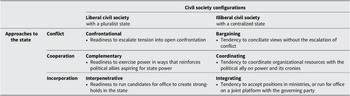
My longitudinal, historical perspective has illuminated patterns of illiberal state–civil society interactions in the context of long-term power struggles, rather than as instant outcomes of an illiberal political economy. The case study of NOE has shown that organizational behavior in the illiberal period is embedded in the consequences of the struggles in the liberal period. Using the Gramscian lens, I have considered both liberal and illiberal civil societies to be an integral part of the hegemonic state. They are two configurations of the terrain of struggles in which civic organizations engage with the state, albeit differently. Table 2 summarizes these distinctive patterns of state–civil society interactions along the dimensions of (1) approaches to the state and (2) civil society configurations. This multidimensional typology structures the empirics of the case study on NOE during the liberal and illiberal periods while also constituting a tool with potential explanatory relevance for further research. The typology refines the understanding of the alignment of “loyal” actors with the illiberal state, which the popular normative autonomy/encroachment framework often explains by co-optation or gongo-ization.
Patterns of interactions between the state and NOE before and after the illiberal turn

During the liberal period (1990–2010), the relationship between NOE and the state was characterized by a mix of confrontational, complementary, and interpenetrative dynamics, embedded in a hegemonic struggle within a capitalist system over a conservative and liberal vision for Hungary. In this context, NOE confronted governments across the political spectrum, but it employed a differentiated approach to conflict toward conservative and left-liberal parties. Moreover, although NOE remained engaged in dialogue with all governments, it consistently upheld its ideological alignment and readily exercised power in ways that complemented its political allies. In addition, to ensure direct access to the state, NOE ran candidates in municipal elections nationwide, and some of its members occupied important parliamentary positions. As a result of this approach to state power, combined with mass base building, NOE soon occupied an authoritative position in the emerging historical bloc, which eventually prevailed over liberal hegemony in 2010.
During the illiberal period (2010–2024), the relationship between NOE and the state has been characterized by a mix of bargaining, coordination, and integration, embedded in a new hegemony that emerged from a social and political struggle challenging the pillars of liberal hegemony. Both NOE and Fidesz, NOE’s longtime political ally, were an integral part of this struggle. In the new illiberal political economy, Fidesz, while dismantling the liberal system and recapitalizing the economy, occupied the entire conservative (and ultraconservative and far-right) political spectrum, making conservative family values and population policy its signature policy framework. (This changed in 2025 when a new political party, Tisza, reoccupied the liberal-conservative spectrum of politics.) In this context, NOE adapted its approach to state power to the new political circumstances. It ensured direct access to the state through a position in a ministry offered to one of its lead experts and a renewed strategic partnership with the government. In a political economy in which the governing party has ultimate power, NOE has taken advantage of the government’s willingness to work closely, enjoyed its readiness to deliver much of NOE’s core agenda, kept criticism behind closed doors, and coordinated organizational resources with the state and its cronies.
My longitudinal, historical perspective has demonstrated that illiberal civil society configurations are inherently shaped by the conflicts and structures inherited from liberal ones. The comparison of the liberal and illiberal periods suggests that “loyal” organizations may have a complex relationship with the illiberal state, one that is embedded in the consequences of hegemonic struggles during the liberal period. What seems to be misguided or co-opted in the first place may be a social and political alignment in which the civic actor has some bargaining capacity, a potential to demonstrate popular consent, and an authoritative position due to its historical role in consolidating the alliance that secured the regime’s power. In this power configuration, for NOE, the illiberal character of the regime has so far remained incidental to the advancement of population and family policies and has largely escaped the organization’s critique.
Conclusion
This paper has examined the underlying patterns of illiberal civil society through the case of a Hungarian conservative family organization, the National Association of Large Families. I have conducted a systematic comparison of the relationship between the state and the organization across liberal and illiberal regimes, a perspective that is largely absent from studies of illiberal dynamics. By adopting this longitudinal and historically informed approach, I can foreground the agency of actors aligned with the illiberal regime and highlight how their choices are shaped by conflicts and structures carried over from liberal regimes. The findings demonstrate how Central and Eastern Europe’s distinctive historical experience—marked by the transition from state socialism to liberal democracy, intertwined with the pressures of neoliberal globalization—continues to shape the strategies of civic actors under illiberal rule, offering insights of global relevance for civil society studies.
The systematic comparison of state–civil society dynamics across liberal and illiberal regimes opens up new avenues for identifying distinctions between liberal and illiberal civil society configurations. In my case study, the actor’s relationship with the liberal and illiberal states shifted from a readiness to escalate tension to a tendency to conciliate views (confrontational ⇒ bargaining); from a readiness to reinforce political allies aspiring for state power to a tendency to coordinate organizational resources with the political ally on power (complementary ⇒ coordinating); and from a readiness to create strongholds through elections to a tendency to accept positions in ministries or run for office primarily with the governing party (interpenetrative ⇒ integrating) (see Table 2). These are case-specific findings with potential generalizability that require further validation through research.
Finally, the research also offers lessons for confronting today’s illiberal turn. A longitudinal, comparative perspective enhances our understanding of the illiberal dynamics by demonstrating the agency of civic actors aligned with the illiberal regimes. In contrast, the dominant normative approach often reduces these illiberal dynamics to mere state interference, overlooking the broader struggles that shape them. By drawing on the Gramscian notion that considers civil society a terrain of struggles among actors advancing competing social and political visions, the struggles of Hungarian large families during the liberal period reinforce the idea that a meaningful counteraction to the illiberal challenge lies in building broad-based political and social alliances capable of advancing a renewed democratic imaginary.
Acknowledgments
I would like to thank the Special Issue guest editors for their valuable feedback, particularly Ágnes Gagyi for her profound comments on multiple drafts. The author also greatly benefitted from the three anonymous reviewers’ constructive guidance. Special thanks to Mary N. Taylor, Béla Greskovits, and Violetta Zentai for the insightful discussions that enriched this article.
Funding statement
This research draws in part on data collected within the author’s doctoral research project “Why Some Housing Struggles Succeed: A Comparative Case Study of Movement Strategies in Hungary between 1987 and 2024,” completed at the Central European University.
Competing interests
The author declares no competing interests.
Ethical standard
This research has been conducted in accordance with the Central European University’s Ethical Research Policy and Guidelines. Ethical oversight has been managed through institutional procedures.


 Open access

